Fred Van Senus--the former CEO and president of Vehicle Specialties, Inc. (VSI) and Van Sensus Auto Parts of Highland and Hammond, Indiana--has passed away. He was 79.
Van Senus Auto Parts was a family business until its sale to Auto-Wares in 2012. Van Senus and his brother, Fred, also founded, owned and operated the high-performance distribution company VSI for over 35 years before its sale to Meyer Distributing in 2014.
In 1998, SEMA recognized VSI as the Warehouse Distributor of the Year.
Donations can be made in Fred Van Senus' name to the Indianapolis Blue Hope Bash in support of the Colorectal Cancer Alliance.
With a vast product line, extensive in-house engineering, and a deep commitment to quality, BluePrint Engines enjoys strong present-day success and eyes an even more promising future.
It might not seem like racing engines and industrial engines have much in common, but BluePrint Engines has turned this combination into a recipe for success that has spanned more than 40 years. Founded in 1982 by second-generation racer Norris Marshall, this Kearney, Nebraska-based company has steadily grown into one of the world’s largest builders of performance crate engines.
BluePrint currently offers more than 300 different combinations of GM, Ford, and Chrysler crate engines, with carbureted, fuel-injected, and supercharged versions ranging from 300 to 1,015 horsepower. Alongside this wide assortment of automotive performance engines, the company’s Origin Engines division focuses on engines for generators, mobile equipment, agricultural implements, and other industrial applications.
Although both divisions have separate product lines, a recent cross-pollination between the two sides of the company has fired the imagination of racers and enthusiasts, creating a buzz of excitement at the 2022 PRI Show. The project began with Origin Engines’ proprietary 3.6-liter four-cylinder engine, which was originally designed for steady low-rpm use in industrial equipment. But then BluePrint refitted it with a single aluminum LS head, along with some other performance tweaks. The result is a tough, compact engine capable of 340 hp and 500 lb.-ft. of torque with a turbocharger.
It was all in a day’s work for BluePrint, which engineers and manufactures many of its crate-engine parts in-house, including a Chrysler Gen III Hemi block currently in development. This self-sufficient mindset contributes to the company’s ongoing efficiency, with 220 employees shipping approximately 50 crate engines and 30 industrial powerplants every day from BluePrint/Origin’s 230,000-square-foot plant.
In addition, the ability to engineer components within the company helps mitigate supply-chain challenges. Between the two divisions, there are approximately 1,500 key parts the company has engineered or re-engineered, largely freeing it from dependence on outside suppliers for many critical components.
Along the way, Marketing Manager John Chrise has seen BluePrint grow by leaps and bounds, while contributing significantly to the company’s good fortunes. Although he’s only been with BluePrint as an employee since September 2022, he’s been helping the company thrive and expand for decades. “I used to run a small marketing and advertising firm, and BluePrint was one of my clients,” recounted Chrise. “Eventually, I sold my partnership in the agency, but I made a stipulation that I took BluePrint with me. As an enthusiast myself, it was the only client that I was interested in servicing. Then, in the summer of 2022, the company asked me to come on inside. So I’ve been doing work for them for 20 years.”
John Chrise and his team at BluePrint Engines utilize a wide array of contemporary marketing methods, a campaign ultimately built on product quality and customer satisfaction. “One-hundred percent of our success comes from the reputation for dependability that we’ve achieved over the years,” he said.
To build the BluePrint brand and drive sales, Chrise and his team rely on a wide array of contemporary marketing methods. But he said it’s all ultimately built on the quality of the products themselves and the satisfaction they bring customers. “One-hundred percent of our success comes from the reputation for dependability that we’ve achieved over the years.”
Throughout Chrise’s involvement with the company, PRI has been a vital ingredient in reaching potential customers in motorsports and automotive-performance market segments. It has proven to be an indispensable tool for understanding where the company’s customer base is going and what resonates with them the most. “This whole community is so diverse,” observed Chrise. “PRI really helps us take the pulse of what’s going on in the professional race industry. It gives us a lot of insight, ideas, and strategies on which to enter into some of these fields.”
Given the many benefits the company gets from being involved with PRI, it was a natural step to join as a Founding Member. Further deepening the company’s commitment to the organization, CEO Norris Marshall also heads the SEMA Political Action Committee and serves as a member of the SEMA board of directors. “Norris is a true believer in the whole industry and loves it,” noted Chrise. “He gets really passionate about anything that he serves on. So he’s a great catalyst.”
With a relentless approach to quality, an innovative spirit, and the drive to continually excel, BluePrint engines is enjoying the kind of success that characterizes the best in PRI Members. As this is being written, the company is about to build its 400,000th engine and is considering doubling the size of its plant to allow continued expansion of the business.
“We’re always looking for ways to serve new markets, specifically in racing,” said Chrise. “And we have a lot of market segments we still really haven’t touched yet. It’s an industry constantly on the rise, and there really isn’t any end in sight.”
For a new vice president of direct sales, EV powertrain startup Hypercraft chose a veteran of the small-displacement turbo tuner market who later pivoted to EVs.
Kirk Miller’s long journey to recently joining Hypercraft began decades ago. His love of motorsports started on ice-racing tracks in New York state and at the drag strip and motocross track of Old Bridge Township Raceway Park. Miller opened his own race-prep and performance shop when he was just 22 years old.
After moving from New Jersey to California in 1993, Miller became the US director of GReddy Performance Products, just as the sport-compact scene was heating up. He later joined AEM Performance Electronics, where he capped a 24-year run as vice president of sales and marketing.
Miller explained that Hypercraft, which has operations in Utah and California, is designing and engineering complete EV drive solutions for vehicles at a fleet level, including powersports, industrial, military, and marine. Stealth EV, which Hypercraft purchased in 2022, is the aftermarket sales division for both consumers and builders.
He shared his outlook with PRI.
PRI: How did your role at AEM prepare you for this new role at Hypercraft?
Miller: At AEM, most of my focus was on the EV conversion and motorsports segments for roughly three years prior to our selling the company to Holley Performance Products in 2021. I am now reaching out to race, fabrication, and dyno shops that I’ve worked with over the years to show them what we have in the works. I’m also checking in with distributors that are very interested in this segment.
PRI: How does your deep background in the traditional hot rodding and performance market prepare you for the EV performance segment?
Miller: I’ve developed a great set of relationships over the past decades, which I think in some cases gives me a bit of an advantage, because there’s already credibility and trust in place. People in the performance aftermarket that are interested in this segment may look to their trusted suppliers.
PRI: Coming from AEM, which helped develop Ford’s 1,400-hp electric Cobra Jet Mustang, you’ve seen the potential for EV performance for the hot rodding world. How would you describe the level of enthusiasm for this market?
Miller: Enthusiasm and excitement are currently somewhat polarized. On the one hand, with EVs you lose the sound, that’s a big part of what makes racing and performance cars exciting. On the other, the performance levels using EV powertrains are amazing, and in many cases, superior to what an ICE-powered vehicle is capable of. Additionally, drag strips and other tracks are restricted by noise. So why not trial events with EV race or street cars, or a mix of those? There’s no noise coming out of the track, except maybe some tire noise, but not enough to disrupt local neighborhoods. If I were a track owner or promoter, I’d be excited about having this. We’ve had race tracks and manufacturers telling us they’d like to embrace this. It could help tracks that are having trouble.
PRI: You have said, “This is one of the most exciting times to be involved in the automotive aftermarket.” What excites you most about this new role?
Miller: What excites me most is that Hypercraft is a startup. For me, it’s like looking back at the early stages of my career in the mid-1980s in the import tuner market. We were getting small displacement turbocharged engines to work with devices from different manufacturers, making things that had no means of communicating with each other to work in sync.
We see a phenomenal opportunity for a programmable vehicle control unit, or other devices, to make various EV components communicate with each other. Hypercraft is completely focused on that right now. We can bring completely engineered packages to shops that can install them into vehicles. Our mission is to lower the technical and cost bars for making the jump to an EV drivetrain.
PRI: The performance aftermarket has been through some major transitions before. How does the EV phase compare?
Miller: I can’t think of a time in automobile history when the aftermarket didn’t eventually follow what the OEMs were doing regarding propulsion. My background was in the tuner segment with smaller-displacement imports. There was a lot of resistance to that segment from the traditional V8 hot rod and motorsport market people. OEMs are now hyper-focused on EVs, so that tells me that’s where the aftermarket focus is going to be as well.
The performance EV aftermarket is in its infancy. There are many young people—or not that young in years but young at heart—who embrace this technology for several reasons. Mainly, they like that it’s just great performance. Also, the cost of maintaining performance electric motors is almost non-existent.
PRI: Is Hypercraft using repurposed Tesla hardware or developing its own?
Miller: On the Stealth EV side, we are upcycling Tesla drive units and battery packs out of wrecked vehicles. We refurbish and bench-test these drive units, and then sell them with other devices in a fully engineered motor and battery package that the customer installs in a build. On the Hypercraft side, we’re sourcing brand-new motor cores for our own motor designs, as well as inverters, DC-to-DC converters, and onboard chargers. We manufacture our own battery packs, called HyperPacks. Our goal is to have robust inventories of products that we have vetted and make them available to ship within one to three days. We’re also doing development on expanding battery pack offerings and other products for those packages to cover a wider range of applications.
PRI: Are you involved with cooperation with OEMs or their suppliers?
Miller: OEMs are focused on volume in the tens or hundreds of thousands, or even millions. Their suppliers, though, have aftermarket-facing divisions that can handle smaller quantities, in the hundreds or thousands. BorgWarner, Cascadia, and Dana have been great to work with, and they’re as excited about the EV conversion market as we are. When I say conversion, I’m talking about two parts. Conversion for existing or new fleets, where there’s volume, and for the performance market, where people want to convert classic cars or build EV hot rods or even race cars.
PRI: With new EVs, buyers think about ‘range anxiety.’ Does that apply to the performance aftermarket as well?
Miller: I think range anxiety is something that we put on ourselves to some degree. A range of 80–100 miles, even on something as small as a 35-kilowatt-hour pack, is good range for a typical cruise. And nowadays, battery packs run as large as 100 kWh, so range can go up dramatically. I should also note, as with an ICE-powered vehicle, if you’re heavy on the accelerator, your EV range will fall.
PRI: Is there a critical mistake you’ve learned from in your professional career?
Miller: I started my first company when I was 22. I was building race cars and could work on European cars, which was lucrative. My biggest mistake was that I ran it almost like a hobby, rather than a business, and that cost me in profits and time.
PRI: Aside from your phone, tablet, or computer, what’s the one thing you can’t live without?
Miller: I would have a hard time living my life without motorcycles. I’ve got a bunch of bikes, and I absolutely love them.
FAST FACT: At 16, Kirk Miller had his own ice-racing car. “My dad was in the D-Stock class, and I had an A-Super-Modified. In my first year of racing, we were both New York state champs in our classes. I didn’t realize how well ice racing would play into my road racing career, being able to comfortably race in rain because I was so used to spending half my time going sideways on ice. It was just fun and normal to me.”
A look at some of the country’s in-demand motorsports products and services by region and racing segment.
Motorsports retailers and service providers are constantly tracking the latest parts and trends to give their customers a competitive edge. For the latest on which products and services are moving the retail needle, we present the following sales snapshots from shops across the US.
Boteler Racing Operations
Westminster, Maryland
Boteler Racing Operations is a dual-purpose company, selling a variety of racing parts while also manufacturing 1964 Ford Fairlane Thunderbolt fiberglass parts. This blended offering brings in a customer base that is roughly comprised of 85% racers.
Parts moving from the company’s shelves the fastest are Product Engineering PE 4400 fuel pumps, Remflex gaskets, Boteler’s own Thunderbolt fiberglass parts, and HJC helmets. Customers choose Product Engineering pumps because they come with a two-year warranty and are race proven. Remflex gaskets are preferred because they are designed to crush to fill gaps up to 1/16 inch. They won’t leak or burn out, and no re-torque is needed.
Boteler’s own fiberglass parts sell well because of their fit, quality, and price. Their reduced weight means improved ETs and mph on the track.
HJC Racing helmets provide a comfortable, fire-resistant, moisture-wicking, comfort-carbon interior and a large vision area, all while meeting/exceeding SNELL ratings. Additional popular products include Geddex Dial-in markers and Power Plus Lubricants fuel fragrances.
Boteler has a multi-faceted sales approach, selling parts through its website (botelerracing.com), social media, trackside, and at other motorsports events. While its customer base is widespread because of its Internet presence, most customers are regional and supported with a trackside presence at its home tracks, South Mountain Raceway in Pennsylvania, and Mason Dixon Dragway in Maryland.
Mar-Schan Motorsports
Douglassville, Pennsylvania
Mar-Schan Motorsports is primarily a retail safety gear business that also provides performance products from Holley, Jesel, Keizer Racing Wheels, Holeshot Wheels, and others. Owner Marc Schankweiler estimates 80% of his business comes from the drag racing market. A smaller percentage comes from dirt and asphalt racers, and he said he’s “trying to diversify into that market a little more.” Customers compete in NHRA, IHRA, NASCAR, USAC, and SCCA, and are primarily from the US, but include some international customers, too.
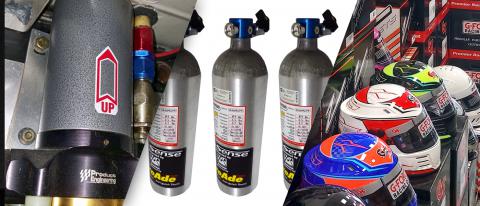
Fast movers over the last few years have been NecksGen head-and-neck restraints; SPA Technique fire system products, which include FireAde and FireSense+ by 4Fire; camlock harnesses and racing suits from Pro 1 Racing and Safety Products; plus helmets from Zamp Racing and Stilo. Schankweiler said, “Since the NHRA mandated head-and-neck restraints for Junior Dragsters, the NecksGen has been our bestseller. That’s what I put my son in two years before the mandate because I could see the sense it made to protect him with what I thought was the best.”
The SPA Technique brands are popular because of the company’s helpful tech support and SFI testing videos, reported Schankweiler. Users of the Pro 1 Safety harness rave about the webbing of the belts and the lightweight qualities of its racing suits. Zamp has numerous YouTube videos and attractive price points for its customers, he added.
A key component to Mar-Schan Motorsports’ repeat business is a simple principle. As Schankweiler proudly pointed out, “My phone is always on!”
RaceDay Safety
Dallas, Georgia
RaceDay Safety is a shop dealing in auto racing safety gear and equipment with a clientele that consists solely of racers. Its fastest moving items include Zamp helmets, G-Force Racing Gear helmets, and K1 RaceGear driver suits.
According to RaceDay owner Kevin Shaw, these items are popular because “both Zamp and G-Force have a good selection of nicely priced graphic helmets. The younger racers (from 5–40 years old) enjoy adding some style. K1 RaceGear has done a really nice job of becoming the preferred brand for dirt and asphalt oval racers.”
RaceDay Safety has been a Zamp and K1 RaceGear dealer for more than a decade and has just become a G-Force dealer this year, giving customers the benefit of products with a proven history behind them.
RaceDay Safety has customers throughout the US and Canada, with roughly 15% of the customer base from racers at tracks in its local area of north Georgia, east Alabama, and southeastern Tennessee. To capture new customers, its marketing involves traditional advertising in outlets including Speedway Illustrated magazine and RacingJunk.com. “We have scaled back our own social media,” explained Shaw, “letting our loyal customers spread the word through their own social media pages.”
“One of the first questions I always ask is what they’re planning to do with it,” said Ross Racing Engines’ Tony Lombardi when speaking with customers about their race engines. “That’s going to tell you a lot about what level of parts you’re going to be using. There’s no sense using a set of budget-focused connecting rods when you want to make 1,400 hp.”
While cost constraints might make budget-minded parts an attractive option when selecting components for an engine build, a solid foundation can save money down the road.
There are typically a few primary goals in terms of performance, response characteristics, and reliability when plotting out an engine build. Although these are logical targets to consider in the context of racing, there are other factors that also play important roles here, and they can have a profound impact not only on the immediate result, but also on the long-term viability of the build.
“Usually it comes down to money,” said John Schwarz of Aviaid, Chatsworth, California. “Because of that, people have to really understand the application they’re using it for. If you’re building a street engine—something you’re going to rev up a bit every now and then—it’s an entirely different context than a track car or purpose-built race engine. For example, there’s a perception out there that the crate engines you can buy from OEMs like Chevrolet, Ford, and Chrysler are racing engines, and they’re not. They’re using production parts, and sometimes they really make too much horsepower for their own good. The LS, simply by virtue of its popularity, is where we see the most of this.”
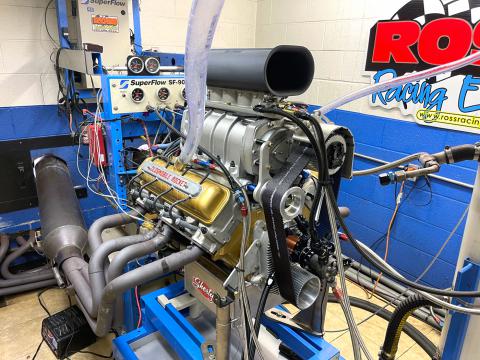
Tony Lombardi of Ross Racing Engines in Niles, Ohio, pointed out that in the context of motorsports, the use-case ultimately dictates the components that should be used. “One of the first questions I always ask is what they’re planning to do with it. That’s going to tell you a lot about what level of parts you’re going to be using. There’s no sense using a set of budget-focused connecting rods when you want to make 1,400 hp. Building an engine is just like building a house: You have to start with a good foundation. It doesn’t matter if you’ve got granite countertops and marble floors if it’s sitting on dirt.”
“External oiling systems are basically cheap insurance because they last forever, they’re transferrable, and they solve a lot of problems,” said Aviaid’s John Schwarz. An Aviaid pump is seen here on Schwarz’s Coyote engine.
Beyond any specific performance targets a racer might have in mind for an engine, planning for the future by building some additional headroom into the combination offers advantages that can benefit your pocketbook—and minimize potential headaches—down the road.
“There’s a balance between just building for today and getting too crazy and over-building for what you might do in the future,” Schwarz said. “But if you’re planning to use the engine for a long time, it makes sense to focus on using good quality parts simply because they’ll last longer, and that can save you a lot of money in the long run. When I was racing, we’d compete in 14 or 15 races a year, and we’d do a rebuild once a year. The quality of the parts allowed us to do that. I’ve spoken to plenty of guys today who’re running these crate motors, and they’re doing rebuilds every two or three races.”
While the strategic use of high-quality parts can improve durability and make it easier to add power later on, it’s important to note that how the additional power is going to be made will dictate whether or not some components will still be usable down the road.
“You want to make sure that the block is a good quality piece, and you’re going to use a good quality crankshaft, along with a good gear drive assembly,” Lombardi told us. “Those are things you want to invest in right out of the gate because they’ll last you the life of the motor no matter what you do with it. The valvetrain is important, too, but you have to consider whether or not you’re going to change cylinder heads later on because every cylinder head takes its own rocker setup. It’s not like the old days where you could take a set of stud-mount rockers and swap them over. If you’re planning to go from naturally aspirated to a boosted setup, nine times out of 10 you’re going to have to change pistons. If you’re running a compression ratio of 13:1 or 14:1 with a naturally aspirated setup, that compression ratio is not going to work if you bring in nitrous or forced induction.”
Schwarz pointed out that other supplementary components can help achieve these long-term goals as well. “External oiling systems are basically cheap insurance because they last forever, they’re transferrable, and they solve a lot of problems. A wet sump system will cost you $800 or $900, and a good dry sump system might cost $2,500, but what you saved with the wet sump is going to vanish with the first unforeseen engine rebuild that you have to do. And, perhaps more importantly, you could have been racing instead of rebuilding an engine. You’ve got to finish the race before you can win it.”
“The paper catalog, in my opinion, will last for quite a while,” said Aeromotive’s Jeff Stacy. “Sometimes as an industry we try to overcomplicate things. We have to look at what built this industry besides well-engineered, well-built parts, and it was the simple promotion of those parts.”
Catalogs have been a staple in the racing parts sector for decades. But, are they still valuable to buyers? The answer depends on who you’re asking and, to a degree, the age of their customers.
Given the steady decline of print media in the wake of digital media’s growth, it should come as no surprise that racing performance parts catalogs are being affected as well. Long a fixture at trade shows, manufacturers’ midways, and parts counters, these encyclopedias of parts numbers and fitment guides are in a period of transition.
My Generation
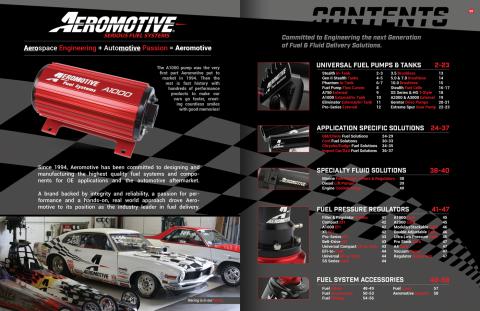
“Our catalog is an extension of our product,” said Jeff Stacy of Aeromotive, Lenexa, Kansas. “We try and build a catalog that is cosmetically appealing, easy to use, and has the information in it that our customers are looking for. We think that helps the perception of quality of Aeromotive.”
Stacy is a firm believer in the power of the print catalog. “For us, the catalog is something we can give away at trade shows, races, and events that stays with the consumer. You can get lost in what’s on the Internet. A paper catalog is something of a reference point.”
He also noted that “a lot of our business is done through distribution, so if you go to a Summit, Jegs, Motor State, or Turn 14, these guys still use paper catalogs along with digital assets.”
One reason Aeromotive is more “catalog-driven,” Stacy said, “is because our product is not year/make/model. The bulk of our business is universal. If a customer says, ‘I have a 1979 Camaro. What fuel pump does Aeromotive offer for it?’ Well, everything we make will fit on a 1979 Camaro.”
He acknowledged that demographics play a role in the decision to print catalogs. “The catalog is maybe not the best way to reach 18–30-year-olds, but most of the 18–30-year-olds don’t have the money that 31–60-year-olds do. So we’re going to continue to cater to my generation because we’re the guys spending a lot of money. There are younger kids that do spend a lot of money on cars, but it’s not as prevalent. When you go all digital, you alienate, at least in my opinion, 50% of your customer base.
“That’s going to change,” he added. “We’re the dying breed. In 30 years, everything will be digital. But for now, we will continue to invest a lot of money in our catalog.”
Always Actively Current
“With technology being our friend these days, there should be no reason why we couldn’t have the catalog online,” said Krista Baldwin of the Wharton Automotive Group, Anaheim, California. That’s why the company, which includes McLeod Racing, FTI Performance, and Silver Sport Transmissions, “is implementing new websites for each company, and on the website there’s an interactive catalog. You’ll be able to search year/make/model, specific products, or however you want to search on your phone.”
The McLeod website launched two years ago, “and we stopped making catalogs and threw it all online,” Baldwin said. After the change-over, “there was a huge influx of sales on the web side for us. Since the interface is very user friendly, our customers are able to navigate the website quickly and make the sale.” The Silver Sport Transmissions site is scheduled to go live this summer, and the FTI site will be up later this year. FTI will continue to offer a print catalog until its site is operational.
The ability to constantly update catalogs is among the advantages to having them online, said Krista Baldwin. “On the McLeod side, I’ve probably uploaded a new product every month or two, so it’s always actively current.”
McLeod does still print a mini-catalog, “a quick overview of the clutches and driveline components we offer,” Baldwin said. “We use this at all the events we attend as a tool to differentiate the discs that are available based on the horsepower rating and the use of the vehicle.”
The ability to constantly update the catalogs is among the advantages to having them online, Baldwin said. “On the McLeod side, I’ve probably uploaded a new product every month or two, so it’s always actively current. Whereas with a catalog, if you buy 5,000 of them, you can’t make a change until those 5,000 are gone.”
There’s also a cost benefit to not printing a catalog, Baldwin noted, as well as “the environmental benefit of not printing all those pages. And if you’re not throwing a catalog into every product box, it saves you on shipping costs. It’s just very economically friendly.”
Nothing but Good Exposure
Many companies are going through this transitional period by offering printed and digital catalogs. Supertech of Morgan Hill, California, prints a catalog that it takes to trade shows and sends to a mailing list of customers. That same catalog, in PDF form, is downloadable from Supertech’s website. “We also have a scannable business card with a QR code” for shows, explained Martin Tagliavini. “Our catalogs are getting a little bit large in size, and sometimes people don’t want to carry a full catalog at a show. With the business card they can download the print version of the catalog with the QR code.”
PROFORM Parts of Warren, Michigan, also takes the multimedia approach. “We have a printed catalog that we mail for free on request for anybody in the US and Canada,” said Ryan Salata. “We also have a PDF version of the catalog on our website and a digital flip book with a unique URL.” Like Supertech, PROFORM takes QR-coded business cards to trade shows for post-show catalog downloads.
Product education is a big reason why both of these companies continue to invest in catalogs. “I don’t think our catalog is used as an ordering tool,” said Tagliavini. “It’s used more for information: what the product is, how it’s made, the differences in products, why choose one versus the other.”
“A catalog allows the customer to be exposed to your entire product line, whether or not that’s what they’re looking for,” said Salata. “If they’re looking for rockers, but they happen to come across carbs just flipping through the pages, that’s nothing but good exposure.”
Both recognized that customer demographics play a role in continuing to produce the print catalogs.
From a marketing perspective, “if I didn’t hand out a single catalog, there’s still value doing it,” said PROFORM’s Ryan Salata. “It helps me learn about our new products and helps me write press releases for the rest of the year.”
“We want to extend [the catalog] to everybody because we know our demographic is changing, and we want to make sure that we cater to a broad demographic, not just to the generational demographic that’s going digital,” Tagliavini said. “We still want to cater to our core group of engine builders who were with us 20 years ago.” Those builders, he said, want the print catalog.
“Our customer base tends to skew a little bit older—over 40—and older people like the paper catalogs more than the younger crowd,” Salata said.
Both companies print fewer catalogs now than in the past, but neither is giving them up altogether.
“Have you noticed Amazon has started to print catalogs around Christmas time?” Salata pointed out. “If Amazon does it, it’s probably not a bad idea.”
“If the time comes when we take 1,000 catalogs to a trade show and come back with 900, then it is time to re-evaluate the catalog printing,” Tagliavini said. “But so far we’ve had success with our catalogs.”
PRI Catalog Poll
Wondering if catalogs are still a worthwhile investment, we spoke to manufacturers of race parts, but we also polled PRI readers and asked them, “In today’s digital age, should manufacturers still offer printed catalogs?” Of the almost 300 votes we received, an astounding 73% confirmed their desire for manufacturers to continue to offer catalogs made from paper.
Here are some of the comments we received from survey respondents:
• “Tangible is visible, and actionable.”
• “In my opinion, there’s a time and place where print comes into play. If you’re a manufacturer that’s working with multiple WDs and sales groups, handing out literature at trade shows, yes. If you’re only focused on your E-comm site, then no. It’s like investing—you have to diversify based on your wants/needs and most importantly on where your potential/current clients have weak spots in their marketing.”
• “I love flipping through a paper catalog…. However, I think it’s a waste of resources considering how many people are online. So, if you have a robust online catalog my answer is ‘no.’ If you do not have an online catalog my answer is ‘yes.’ We might need a ‘maybe’ option.”
• “As a retailer I’m more inclined to show a customer products digitally, but prefer to have printed application guides for part numbers and ease of writing an estimate.”
• “Catalogs may be out-dated but they last long after the power goes out. People have lost touch with print. I miss getting my Jegs and Summit catalogs. They are also a great reference for builders and an easy way to get a young gearhead involved.”
• “There are still people who prefer printed catalogs over digital ones. The age of the consumer really plays a role in this decision. Older consumers will generally prefer a printed catalog while digital natives will gravitate toward virtual versions.”
• “When you know what you want, digital is efficient. When exploring for new options/ideas print is best.”
• “Special or targeted materials only, not a full library. It’s 2023, not 1973.”
NASCAR will return to North Wilkesboro Speedway--the recently revived short oval track located in North Wilkesboro, North Carolina--on September 30 for Whelen Modified Tour Brushy Mountain Powersports 150, which will serve as the third race before the end of the season.
Daytona 500 winner Ryan Newman and NASCAR Hall of Famer Bobby Labonte are among the racing royalty expected to compete against Whelen Modified Tour title contenders Ron Silk, Justin Bonsignore, Doug Coby and Austin Beers in a 150-lap race for modified supremacy.
NASCAR has announced the 15 nominees for the NASCAR Hall of Fame's Class of 2024 and the five nominees for the Landmark Award for Outstanding Contributions to NASCAR.
The NASCAR Hall of Fame Voting Panel will meet in person to discuss and vote for the Class of 2023 and Landmark Award on Wednesday, August 2. The 62nd vote goes to winners of a NASCAR.com Fan Vote (nascar.com/halloffame). The Fan Vote is currently open and will close on July 30 at 12:00 a.m. ET.
Following are the NASCAR Hall of Fame Class of 2024 nominees and Landmark Award nominees:
Modern Era Ballot
Neil Bonnett, won 18 times in the NASCAR Cup Series, including consecutive Coca-Cola 600 victories
Tim Brewer, two-time NASCAR Cup Series champion crew chief
Jeff Burton, won 21 times in the NASCAR Cup Series, including the Southern 500 and two Coca-Cola 600s
Carl Edwards, winner of 28 NASCAR Cup Series races and 2007 Xfinity Series champion
Harry Gant, winner of 18 NASCAR Cup Series races, including two Southern 500 victories
Harry Hyde, 1970 NASCAR Cup Series championship crew chief
Jimmie Johnson, seven-time NASCAR Cup Series champion
Chad Knaus, seven-time NASCAR Cup Series champion crew chief
Larry Phillips, first five-time NASCAR weekly series national champion
Ricky Rudd, won 23 times in NASCAR Cup Series, including the 1997 Brickyard 400
Pioneer Ballot
Donnie Allison, ten-time NASCAR Cup Series winner, 1967 Cup Series ROY
Sam Ard, NASCAR Xfinity Series pioneer and two-time champion
AJ Foyt,won seven NASCAR Cup Series races, including the 1972 Daytona 500
Banjo Matthews, built cars that won more than 250 NASCAR Cup Series races and three championships
Ralph Moody, two-time NASCAR Cup Series owner champion as mechanical genius of Holman-Moody
Landmark Award
Janet Guthrie, the first female to compete in a NASCAR Cup Series superspeedway race
Alvin Hawkins, NASCAR's first flagman; established NASCAR racing at Bowman Gray Stadium with Bill France Sr.
Lesa France Kennedy, NASCAR Executive Vice Chair and one of the most influential women in sports
Dr. Joseph Mattioli, founder of Pocono Raceway
Les Richter, long-time NASCAR executive oversaw competition, helped grow the sport on the West Coast
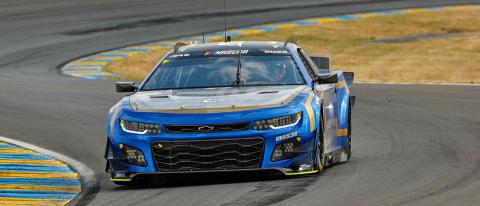
A month after NASCAR's Garage 56 car successfully completed the 24 Hours of Le Mans, the innovative program will return to participate in the Goodwood Festival of Speed Hillclimb in West Sussex, England.
Garage 56 drivers Mike Rockenfeller and Jenson Button will pilot the Garage 56 program backup car--identical to the No. 24 Chevrolet Camaro ZL1 that completed 285 laps on the 8.4-mile Circuit de la Sarthe in June--up the 1.16-mile hill seven times over four days. The entry will be part of a celebration of NASCAR's 75-year history, including several cars from throughout NASCAR history.
"Taking the Garage 56 car to the Goodwood Festival of Speed gives us another chance to bring the world of stock cars to fans of a wide variety of motorsports," said John Doonan, IMSA President and Garage 56 Program Manager.
The Garage 56 Hillclimb schedule is as follows:
Thursday, July 13, 2:30 p.m. BST/9:30 a.m. ET/Mike Rockenfeller
Friday, July 14, 9:10 a.m. BST/4:10 a.m. ET/Jensen Button
Friday, July 14, 3:10 p.m. BST/10:10 a.m. ET/Mike Rockenfeller
Saturday, July 15, 8:30 a.m. BST/3:30 a.m. ET/Mike Rockenfeller
Saturday, July 15, 2:55 p.m. BST/9:55 a.m. ET/Jensen Button
Sunday, July 16, 9:15 a.m. BST/4:15 a.m. ET/Mike Rockenfeller
Sunday, July 16, 3:50 p.m. BST/10:50 a.m. ET/Jensen Button
The Garage 56 project is a partnership between NASCAR, Hendrick Motorsports, Chevrolet and Goodyear.
Registration has opened for the Best in the Desert (BITD) "Casey Folks Vegas to Reno" race, August 16-20.
Some of the top names in desert off-road racing have already signed up, organizers said, including back-to-back overall champion Ryan Arciero, two-time Vegas to Reno champion and Red Bull athlete Bryce Menzies, and more.
This year marks the 28th anniversary of the legendary Vegas to Reno race, first held in 1996.
Racers can register here. For more information, visit bitd.com.
 MEMBERSHIP LOGIN