San Diego Automotive Museum Opens New Permanent Don Prudhomme Display

Submitted by laurap on Tue, 07/18/2023 - 17:35
San Diego Automotive Museum logo, facade


The San Diego Automotive Museum, the premier transportation museum in Balboa Park, California, has opened a new display that honors NHRA legend Don "The Snake" Prudhomme.

The exclusive display features more than 100 of the NHRA Wallys that Prudhomme has earned as a driver and team owner in NHRA Top Fuel and NHRA Funny Car competition. In addition, guests can also see gear like firesuits and helmets, as well as a video package showcasing some of Prudhomme's most memorable moments on the track.

For more information and to purchase tickets, visit sdautomuseum.org.

July 2023

Social Status

Submitted by johnc on Tue, 07/18/2023 - 16:19
image 1


A closer look at how racing and performance industry members are using social media to boost engagement, with a specific focus this month on BeReal.


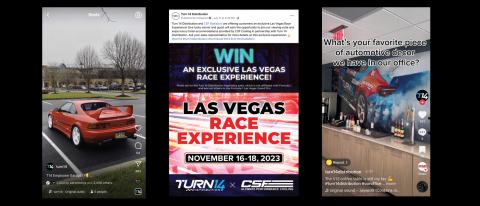
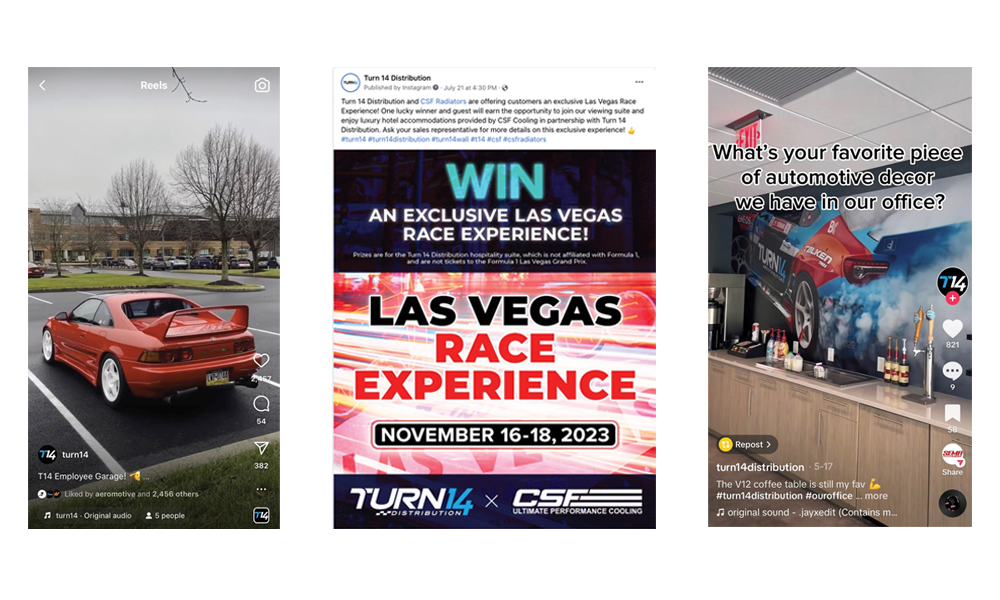
Turn 14 Distribution’s approach to social media is to “generate mutually beneficial content for T14 and its partners,” noted Kyle Crawford, digital media manager, of the Horsham, Pennsylvania, distribution powerhouse. This month, we’re going to take a deeper look at how the company implements its strategy.

The platforms utilized by T14 include Facebook, Instagram, YouTube, and TikTok. “Before we start a page for our brand, we analyze the potential benefit of having a presence on that social media platform. If there is a perceived or untapped benefit to us and our partners, we’ll shape how we generate material for said platform,” Crawford explained.

T14 has a team of industry insiders with varying segment focuses, backgrounds, and years of experience to help develop campaigns. “We each bring something unique to the table and follow two base objectives to shape each message we share,” he said.

image 2

When it comes to content, the company focuses on two main avenues of material. “Promoting employee life at Turn 14 Distribution: This content highlights T14 as an aspirational brand with specialized automotive knowledge while ensuring it’s still viewed as a regular business filled with real people and non-automotive-based career opportunities.

“Partner showcases: These posts include any news involving vendor brands or products we distribute, an activation that Turn 14 Distribution created or exhibited within, and notable general items from the automotive industry we all enjoy,” Crawford explained.

He pointed out that “while the first avenue targets talent acquisition and prospective applicants, the second is intended to be digested by our six market segments (Domestic Performance, European Performance, Truck Accessories, Modern Performance, Truck & Off-Road Performance, and Hybrid & EV Performance). With a vast product range and customer base, we prioritize consistent posts that appeal to as many segments as possible without lacking in others.”

One social media tip from the talented T14 team is to post with a purpose. Crawford noted, “Considering the influx of content at anyone’s fingertips, standing out is a challenge. Couple that with the notion that humans are inherently lazy, and conversion from social media to a website becomes much more difficult. To battle this, be direct, make your message as clear and concise as possible, and focus on why you’re posting in the first place.”

Additionally, details matter. “Whether that’s the media you choose for a particular post or carefully crafting the first line of your caption to attract a second glance, don’t overlook the importance of details,” he added.

Different brands have different social media objectives. Once you’ve established your goals, get creative, build a strategy, be consistent, and post with intention.

August 2023

From The Executive Editor

Submitted by jeffreyc on Tue, 07/18/2023 - 16:04


Our Changing World

What was effective just five years ago no longer works today in terms of race strategy, car setup, tuning, manufacturing, design—all across the motorsports spectrum. This August edition of PRI Magazine touches on the critical nature of not accepting the status quo and instead, making different choices that bring remarkable results.

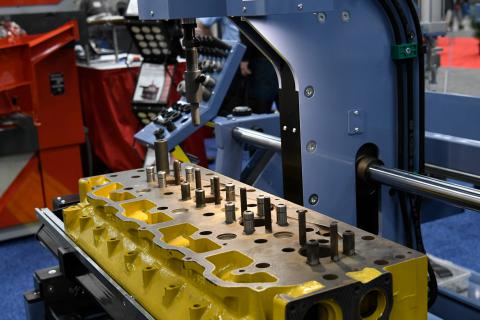
Leading the way in a hefty (both literally and figuratively) way is the shop machinery and tooling that will be on display at the PRI Show Machinery Row in December. Some perfect examples include the GH8 SMART from Robins on this edition’s cover, which allows a machine operator to learn to program the machine that can then run automatically. Plus, those who spend hours to hone valve guides manually with hand tools can use this machine to complete a set of V8 heads in as little as 10 to 20 minutes! Turn to the inside cover and you will see ultrasonic cleaning machines from Ultrasonic LLC, or turn to page 40 where our annual Machinery Row Preview coverage begins, with a sneak peek of equipment from a CNC machine to welding equipment to a seat-and-guide machine, and much more. If that hasn’t convinced you yet, turn to page 48 for a list of well over 100 machinery and equipment suppliers that have already signed up to exhibit on Machinery Row. If you are in the market for new equipment that can improve processes, save time, offer additional services or machining techniques, or fill a gap from the workforce shortage, then Machinery Row should be your first stop when you visit the Indiana Convention Center and Lucas Oil Stadium, December 7–9.

  • “It seems like we say this every year, but we’re still nowhere near the limit of diesel performance.” That’s the observation from diesel performance tuner extraordinaire Dan Scheid of Scheid Diesel Service Co. He, along with several other diesel performance experts, share their thoughts on the latest innovations that are leading to new records and advancing technology in the diesel race market, beginning on page 56. Our diesel coverage also includes products that promote “clean diesel,” beginning on page 62. No more billowing black smoke is necessary to be the fastest in these classes. In fact, the legendary Gale Banks of Banks Power told us, “That’s horsepower that you can see, but not feel or use. It’s wasted fuel.” So, waste no more. Calibrated Power’s Nick Priegnitz added, “In general, the attitude in the industry now is to use as little smoke as possible to make the power you need to make. It’s kind of the unspoken tuner’s rule now. It used to be a ‘more smoke is better’ mentality, but that has changed.” He added, “A sooty truck is just performing under its potential.”
  • While we can count on motorsports to evolve and deliver enhanced performance, we at PRI constantly strive to be better and deliver a product the industry expects and demands. We recently welcomed our new Editorial Director Jason Mulroney, who is embracing the digital possibilities of the PRI brand. And, this is my first column as the magazine’s Executive Editor. While I’m not new to our industry, having been a part of PRI for 27 years, I look forward to hearing from you about how we can work together to improve PRI along with our industry. Feel free to email me at meredithb@performanceracing.com and share any ideas you have about what we can do together to embrace change.


August 2023
By
Meredith Kaplan Burns

SEMA Hall of Famer Bob Airheart Passes Away

Submitted by laurap on Tue, 07/18/2023 - 15:38
Bob Airheart


Bob Airheart, a 1993 SEMA Hall of Fame inductee and industry innovator, has passed away.

Although Airheart operated his own rep agency, the Airheart name is also well known in the brake industry, notably for industrial and high-speed applications. Trains, buses and race cars have all been stopped by Airheart, a company owned and operated by Bob until it was sold.

"He taught me a lot and I am forever grateful. He was my staunchest supporter and generous friend, always there when I most needed him. I will miss him greatly, as will thousands of his friends. Gods Speed, Bob!" said Mike Zimmerman of Airheart Sales.

PWA (now the Custom Automotive Network) awarded Airheart its Person of the Year Award in 1980 for his outstanding contributions to the warehouse distributors and in appreciation of his conscientious dedication as an individual member of the specialty-equipment industry.

Airheart has also worked for Hurst as well as Cragar as a national sales manager.

July 2023

PRI Show: 2023: Machinery Row Exhibitors

Submitted by jeffreyc on Tue, 07/18/2023 - 15:05


Machinery Row is a top destination spot at the annual PRI Show in December for machinists, engine builders, fabricators, race team members, and anyone who wants to inspect the latest in machining and fabricating equipment. Live demonstrations await, along with helpful and knowledgeable representatives from more than 100 exhibiting companies. For booth details and a final list of suppliers exhibiting on Machinery Row, visit pri2023.com/floorplan.

ABRO Balancing Machines Inc.
abrobalancing.com
Balancing Machine, Laser Welding, Cleaning Machines

ABS Products
abs-products.com
Media Cabinet, Balancing Equipment & Tools

Accelerated Surface Finishing
asfmotorsport.com
Superfinishing Equipment & Components

ACU-RITE
heidenhain.com
ACU-RITE, DRO’s Controls

AERA Engine Builders Association
aera.org
Membership, Engine Specification Software

AVL
avl.com/avl-north-america
AVL Brake Torque Sensor & AVL IndiMicro

Axe Equipment
axeequipment.com
Wet Cleaning Systems

Bad Dog Tools
baddogtools.com
Tools

Bend-Tech
bend-tech.com
Dragon A250, Dragon A400 Machinery

Blackstone - NEY Ultrasonics
ctgclean.com
Ultrasonic Cleaning Systems

Blue Demon Welding Products
bluedemonwelding.com
Welding Machines and Welding Accessories

Boss Tables
bosstables.com
CNC Plasma Tables and Parts, Tumblers

Burr King Manufacturing Co. Inc.
burrking.com
Abrasive Belt Grinders, Polishing Equipment

Centroid Performance Racing
centroidperformanceracing.com
CNC Machining Centers

Clinton Aluminum
clintonaluminum.com
Engine Blocks, Cylinder Heads, Wheels

Cobra - Detroit Torch
detroittorch.com
Restoration and Service Welding Torch

Comec Inc.
comecus.com
Engine Rebuilding Machinery

Corghi
corghiusa.us
Tire Changers, Wheel Balancers

CWT Industries LLC
cwtindustries.com
Balancing Machines

Cylinder Head Abrasives
ruffstuff.com
Machine Shop Supplies

Dayton Rogers Mfg. Co.
daytonrogers.com
Short- to Medium-Run Stampings, Fabrications

Defiant Metal
defiantmetal.com
Premium Welding Gloves and Fab Accessories

Delta Custom Tools
deltacustomtools.com
Cap Grinder, Cylinder Head Pressure Tester

Dynabrade Inc.
dynabrade.com
Demonstrating American Made Power Tools

Dynocom Industries
dynocom.net
Hub, Chassis Dynos and Injector Test Benches

Dynojet Research
dynojet.com
Automotive Dynamometer, Potential UTV

FANUC America Corporation
fanucamerica.com
CNC Systems, Robotics and Factory Automation

Farris Equipment Sales
farrisequipment.com
Engine Rebuilding Equipment - New & Used

FIRMAN Power Equipment
firmanpowerequipment.com
Portable Generators

Fytron Software
fytronsoftware.com
Automotive Machine Shop Software - Fytron

Garage Guys
dalrada.com/ignite-industrial-technologies/
Bug/Tar/Floor Cleaner and Degreaser Parts Wash

Giant Finishing
giantfinishing.com
Vibratory Deburring and Finishing Equipment

Goodson Tools & Supplies
goodson.com
Tools and Supplies for Engine Builders

Graymills Corporation
graymills.com
Parts Washers: Manual, Spray, Sonic, Dip

Grex Airbrush
grexusa.com
Professional Airbrushes, Spray Guns and Accessories

Gusher Pumps - A Ruthman Company
gusher.com
Pumps and Valves-Dyno, Washer, Transfer/Fill

Haas Automation Inc.
hfochicago.com
CNC Machine Tools, Automation and Tooling

Hangsterfer’s Metalworking Lubricants
hangsterfers.com
Full Line of Metalworking Lubricants

HEM Inc. - HE&M SAW Inc.
hemsaw.com
FEMI Utility Bandsaws

Heritage-Crystal Clean
crystal-clean.com
Ultrasonic Parts & Aqueous Parts Washer

Hunter Engineering Company
hunter.com
Wheel Alignment, Balancing, Tire Changers

Huth Ben Pearson International
huthbenders.com
HB10 Bender, 1674 Expander Collectors

IPG Photonics
ipgphotonics.com
LightWELD Handheld Laser Welding & Cleaning

Irontite Products
irontite.com
Kwik-Way Valve Refacer, Irontite Diesel Tool

JD Squared Inc.
jd2.com
Benders, Notchers, and CNC Cutting Machines

JPW - Jobbers Warehouse Supply Inc.
enginepartspro.com
Private Label Engine Parts

KnKut Drill Bits & Cutting Tools
knkut.com
KnKut Drill Bits and Cutting Tools

Kyowa Eidemiller
kyowa-industrial.com
Precision Machining for Automotive Products

Laser Marking Technologies
lmtgrp.com
Laser Marking Machines

Lincoln Electric Company
lincolnelectric.com
Fabrication Equipment, Welding Equipment

Linde Gas & Equipment Inc.
linde.com
Welding and Automation Machines

LOCK-N-STITCH Inc.
locknstitch.com
Permanent Thread and Crack Repair Supplier

Longhorn Fab Shop
longhornfabshop.com
Engine Rotators, HD Rolling Carts

MAGIDO USA
magidousa.com
Automatic Parts Washing Equipment

Mainline Dyno
mainlinedyno.com.au
Hub Dyno

Mastercam
mastercam.com
Mastercam

Maxiforce Diesel Engine Parts
maxiforce.com
Diesel Engine Parts

Mazak Corp.
mazakusa.com
Machinery for the Automotive Industry

MB Metal Technologies
mbmetaltech.com
Part and Tag Marking Products

MEC CNC Machines
meccnc.com
Sales and Service of Engine Machines

Miller Electric Manufacturing LLC
millerwelds.com
Multimatic 220 AC/DC, Dynasty 300

Millner-Haufen Tool Co.
millnertools.com
Tools - Cutting, Grinding, Drilling and Fab

Mustang Dynamometer
mustangdyne.com
Chassis Dynamometers

Neway Manufacturing
newaymfg.com
Valve Seat Cutters and Valve Refacing Tools

NexGenSolutions
nexgensolutions.com
Autodesk CAD/CAM Software

Nitro Manufacturing Inc.
nitromfg.com
Pit Equip Templates Surface Plates Prototypes

Nu-Ice Dry Ice Blasting
nuiceblasting.com
Dry Ice Blasting Equipment

Ohio Brush Works
ohiobrushworks.com
Parts Washing and Flow-Through Brushes

Online Resources Inc.
onlineresourcesinc.com
3D Scanning, Inspection, Reverse Engineering

Palmgren
chhanson.com
Band Saws, Drill Presses, Finishing Machines

Performance CBN
performancecbn.com
Ultrahard Cutting Tools For Engine Machining

Performance Plus The Leading Edge
perfplustle.com
CBN PCD Inserts and Abrasives

Powerbuilt Tools
alltradetools.com
Hand and Specialty Tools, Garage Accessories

Pro Ultrasonics
proultrasonics.com
“PRO” Ultrasonic Cleaning Equipment

QMP Racing
qmpracing.com
MC-1 is Used for Measuring Engine Parts

QualCast LLC
qualcast.com
Engine Valves, Cylinder Heads, Components

Quantum Machinery Group
quantummachinery.com
Welding Tables, Cold Saws, Band Saws, Fab Equipment

QuickJack
bendpak.com
QuickJack All Models

Regis Manufacturing
regismanufacturing.com
Machine Shop Supplies, Abrasives, Lubricants

Reich Tool
reichtool.com
Manufacturing

Resolute Precision Manufacturing
resoluteprecision.com
Machined Shocks, Suspension Forgings, Swiss

RMC Engine Rebuilding Equipment Inc.
rmcengine.com
CNC Machine, ETS Machine, Belt Resurfacer

ROBINS Machines
robinsmachines.com
Seat Guides, Guide Honing, Surfacing

Rottler Manufacturing
rottlermfg.com
Engine Reconditioning Equipment

RT Sales
rtsalesinc.com
Engine Rebuilding Equipment & Supplies

Safety-Kleen
safety-kleen.com
Parts Washers, Oil & Lubricants, Absorbents

Sawblade.com
sawblade.com
Bandsaws, Blades, and Accessories

SBI Valvetrain Components
sbintl.com
Valvetrain Components

SERDI Corp.
serdi.com
Valve Seat Machines and Tooling

Service Precision Grinding Inc.
drill-grinder.com
Drill Sharpener/Grinder and Point Splitter

SHAVIV USA
shaviv.com
Hand Deburring Tools from SHAVIV by VARGUS

Shop Crane by Gorbel
shopcrane.com
Overhead Crane for Shops and Garages

ShopSabre - Langmuir Systems
shopsabre.com
CNC Plasma, CNC Mill, CNC Routers 

Silver Seal Products
silver-seal.com
Shop Tools, LS Engine Parts

SMW Autoblok Corp.
smwautoblok.com
Workholding Product for Metal Cutting

SSP Weld
ssp.com
Welding Supplies

Star CNC Machine Tool Corp.
starcnc.com
Star SR-20JIIB CNC Swiss Type Lathe

Stratus Auto Equipment
stratusautoequip.com
Scissor Lifts

Strong Hand Tools
stronghandtools.com
Welding Tables and Clamps, Work Holding Tools

Sunnen
sunnen.com
Honing Machines, Gauging Equipment

SuperFlow Dynamometers & Flowbenches
superflow.com
Dynamometers-Engine and Chassis Test Equipment

T&S Machines - PROBAL Dynamic Balancing
tnsmachines.com
CNC Boring Milling Machines and Balancers

Temco Parts Washer
washparts.com
Parts Washers and Related Chemicals

The ArmaKleen Company
armakleen.com
Aqueous Cleaning Products

THG Automation LLC
thgautomation.com
UR & Fronius Welding Solutions

Tierra Tech USA Inc.
tierratech.com
Ultrasonic Cleaning Systems

Trick-Tools
trick-tools.com
Metal Fabrication Equipment

TRUMPF
trumpf.com
TruArc Weld 1000

Tsugami America
tsugamiamerica.com
Tsugami America CNC Lathes

Tucker Valve Seat Company
tuckervalveseat.com
Auto & Industrial Engine Valve Seat Inserts

Ultrasonic LLC
ultrasonicllc.com
Ultrasonic Cleaning Machines and Detergents

Ultrasonic Power CorP.
upcorp.com
Ultrasonic Cleaning Equipment

Walter US
melintool.com
Milling, Drilling, Threading, and Turning

Whitney Tool Co. Inc.
whitneytool.com
Cutting Tools Used in the Machining Industry

Winona Van Norman
winonavannorman.com
Performance Racing Equipment

Woodward-Fab
woodwardfab.com
Fabricating Equipment for Sheet Metal

YourDyno.com
yourdyno.com
Dynamometer Instrumentation

Exhibitor List as of July 5, 2023

August 2023
By
PRI Staff

Special Report: Successful Sponsor Relationships

Submitted by johnc on Tue, 07/18/2023 - 15:02
image 1


Uncovering the secrets to prosperous partnerships between race teams and sponsors.


It’s no secret in the motorsports world that sponsorship money keeps race cars on the track and lights on at the shop, but it’s also no secret that cultivating successful sponsor relationships is often easier said than done. There are a lot of moving parts, and getting everyone rowing in the same direction takes considerable planning and effort.

After all, there’s a lot more to a sponsor partnership than simply a monetary transaction and decals on a race car. At least, there’s a lot more to a good sponsor partnership than those basics.

For this article we spoke with sources who have established enduring and mutually beneficial sponsor relationships. We wanted to hear from both sides of the partnership on what success looked like, and how teams and sponsors navigate their way to winning both on track and in the race for consumer attention. What we heard is that success is measured in different ways, but there are some fundamental benchmarks that any good partnership will meet.

Former IndyCar driver Bryan Herta fields Hyundai Elantra N TCRs in the IMSA Michelin Pilot Challenge series as part of his Bryan Herta Autosport racing stable, based in Speedway, Indiana. “I think good communication really has got to be at the top of the list,” Herta said. “With good communication you can really get aligned. Your partner is going to have goals and objectives, and obviously as a team you have goals and objectives, and trying to align those things through good communication is the basis for a good partnership so everybody is aware of what they’re hoping to achieve, and everybody is clear on what the goals are for the program.”

Other paths to good sponsor relations include finding natural alliances that match the right racer with the ideal brand. Three-time NHRA Top Fuel Champion Antron Brown has a long relationship with primary sponsor Matco Tools, starting with when the company was an associate sponsor during his Pro Stock motorcycle years earlier in his career.

“What makes for a successful partnership is when you’re representing a company that you’re passionate about, plain and simple,” said Brown, who owns AB Motorsports, Brownsburg, Indiana. “For me, I was a mechanic since I was a little kid, so by partnering with Matco Tools, that was like a match made in heaven because I use every single one of their tools. That’s what makes the partner relationship deep, is when you become a part of the brand, not just representing the brand. It makes everything easy. I could never represent a tobacco company because I never smoked a cigarette a day in my life. So the main thing is making sure both sides are a perfect fit, like a puzzle.”

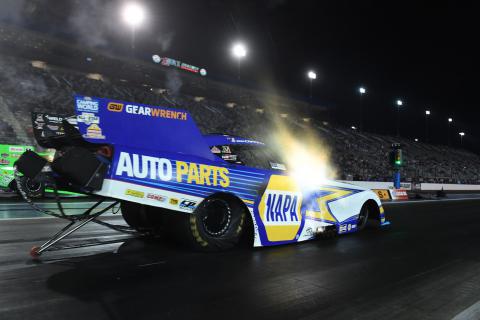
Three-time NHRA Funny Car champion and now team owner Ron Capps of Ron Capps Motorsports in Brownsburg, Indiana, was influenced by the legendary racers he drove for earlier in his career, such as Don “The Snake” Prudhomme and Don Schumacher. For Capps, one attribute that stood out from the best sponsor partnerships was attention to detail.

“Snake would talk about even small things, like our team scooters lined up in front of the pit area. He hated it if they weren’t lined up perfect,” Capps said. “I noticed when I went to my first IndyCar race and saw Mr. Penske’s pit area, that’s the way things were. It was attention to detail with everything. On my end, from representing the sponsors all these years waiting for a chance to be an owner, like with NAPA, who I’ve been with since 2008, I’ve always kind of gone to bed and woke up in the morning thinking about ‘How can I make them better?’”

image 2
“We’re always looking to listen to Hyundai and understand what their goals are,” said Bryan Herta, who fields Hyundai Elantra N TCRs in the IMSA Michelin Pilot Challenge series. “We try to basically be a one-stop solution for them in everything they need as it pertains to motorsports.”

Alex Striler is the former director of sales and marketing for Team Lucas Motorsports Program and is the author of the book Motorsports Marketing and Sponsorships: How to Raise Money to Race and Give Sponsors What They Really Want. He is currently hosting online summits educating racers and teams as to what sponsors want from representation.

“When a property, team, or an athlete can reach a market that the sponsor or brand or company does not already reach with their traditional marketing, then typically that could become a success,” Striler said. “The goal of sponsorship is to become a marketing extension of a brand, and to open up that market whether it’s relationships through sales, or branding through increasing equity like Red Bull does, into new markets where that company doesn’t yet already market. To market to the same old people in the same old series, the same old races, the same old demographic, that does nothing. A successful relationship opens new markets.”


Beyond the Track

Brightly colored race cars flashing by on the race track are the foundation of everything in motorsports, but race teams with solid partnerships spread the sponsor’s brand message far beyond the confines of the race track.

“We exist to go motor racing. We exist to go win races. That’s our end objective always,” Herta said. “But there’s a whole lot of other sub-objectives that have to happen along the way, and you need partners that are aligned, not just where you’re trying to get to, but the reasons for getting there. In Hyundai we’re just really fortunate that we found a brand that was relatively new to motorsports, certainly in the US, was relatively new to performance vehicles, and so we were able to grow this from what started seven years ago as two TCR cars to a program now where we are the sales, and parts, and service representative for all Hyundai vehicles throughout North and South America. That includes parts distribution, working with other customers’ teams within those markets. We build and sell TCR race cars completely in-house.

image 3
“We win on the race track, but we don’t like just winning on the race track, we like winning off the race track,” said Top Fuel champion Antron Brown. “That’s helping our partners be successful at their business.”

“We run a number of activations for Hyundai, including their at-track activations at the IMSA races,” Herta continued. “We run a fairly unique to North America Hyundai driver camp every year where we train all the Hyundai drivers from North and South America on physical training, data, social media, you name it. It’s a pretty intensive program. We capture, edit, and post, and provide Hyundai with a large amount of their social media content as it pertains to motorsports. With their support, we helped them launch a STEM engineering program for female engineering interns.

“We also run an at-track hospitality program, called the N Lounge, at all the IMSA races,” he added. “Basically, we invite anyone with a Hyundai. Anyone with the key to a Hyundai can come into our tent at the races and have a drink, experience some team hospitality, meet a driver. All these facets to our partnership really grew out of a conversation that started eight years ago: ‘Hey, if we got you guys a couple cars and a little bit of money, could you run in the TCR class for us?’ I think showing where it’s gone in that period of time really exemplifies why we embrace the term ‘partnership.’ We’re always looking to listen to Hyundai and understand what their goals are. We try to basically be a one-stop solution for them in everything they need as it pertains to motorsports.”

Good sponsor partnerships will also open up new opportunities and relationships for both sponsors and race teams. “The most successful sponsorships are those that really don’t focus on exposure, but focus on growth,” Striler said. “And growth not just with the brand and the team, but the growth of the entire sponsorship. That includes other sponsors as well. If there’s a tire company that sponsors a racer, that tire company also promotes the wheel company and the oil company and the filter company, and they all cross-promote and they all grow. Successful sponsorships package together the marketing of different companies to all grow to a common consumer.”

AB Motorsports has put that philosophy into action with its sponsors. “What we like to say is, we win on the race track, but we don’t like just winning on the race track, we like winning off the race track,” Brown said. “That’s helping our partners be successful at their business. And also, tying our other partners into B2B relationships and bringing them together.

“We have Lucas Oil, and then we have Hangsterfer’s, which is a metal cutting solutions company that does coolants and Way lubes for CNC machines and manual machines. Hangsterfer’s does a lot of private labeling for other companies,” Brown explained. “We’re able to put them on the car, but then we can tie them into our performance side of where we buy our race products—our pistons, our cranks, our valves. Well, they all use CNC machines, they’re all some kind of machining operation. We’re able to take Hangsterfer’s to all of our vendors where we buy parts and pieces and bring them a higher quality product. We don’t tell them it’s higher quality, we’ll give them some to try. Once they try, they tell us, ‘We love this stuff. We’ve got to have it.’ Then we slowly started converting all of our vendors over to Hangsterfer’s, and they got a better price on a better product, so that turned into more business for Hangsterfer’s, and at the same time, we get better pricing from our vendors from them getting better pricing with the products we sell to them from our sponsors. It’s all in relationships and true B2B business. It’s turned from not just being great on the race track, but you’ve got to be great in the office, too.”

Pleasing corporate executives is one thing, but large companies that sponsor race teams have many employees, franchisees, and vendors, and making connections with them can be as important as outreach to the general public. “The pitside hospitality is probably one of the biggest things that we have in our sport, compared to NASCAR and IndyCar,” Capps said. “Every fan, when they buy a ticket, they get a pit pass. So they go everywhere. Bigger than that is, when NAPA or any of our other sponsors wants to send customers or employees, our pit area is adjacent to our hospitality. Literally, we have a four-star meal served to our customers, and they’re 10 feet away from watching our guys tear the car apart, put it back together, and fire it up. That’s the access that I think really turns a lot of these sponsors on. I always say it’s like a backstage pass. That has been huge with our sponsors. We push really hard on making that the best experience possible.”

That outreach to employees and individual store owners is the kind of street-level marketing that pays big dividends for a company. “It’s critical to NAPA’s success that we be aligned with drivers and teams that act as positive brand ambassadors on behalf of NAPA and help us to celebrate the thousands of individual NAPA store owners and auto care center owners that make up the broader NAPA organization,” said Katherine Wooten, director of partnership strategy and activation for NAPA Auto Parts, Atlanta, Georgia. “So while we have national branding and national-level partnerships, the teams and races themselves are a way for us to show up locally and regionally for our organization. Racing is a great fit for us because teams visit every region that we operate in as a company, and we can engage with our customers and consumers across the country on a week-in, week-out basis. Whereas more traditional sports sponsorships might be tied to one geographic area or marketing territory, our motorsports partners give us connectivity across the organization, and can do it in an authentic way.

image 4
“We run a number of activations for Hyundai, including their at-track activations at the IMSA races,” said Bryan Herta. Among them is the N Lounge, a hospitality program where “anyone with the key to a Hyundai can come into our tent, have a drink, experience some team hospitality, meet a driver.”

“Success for us is knowing that a driver meet-and-greet at a store grand opening is boosting sales and visibility for that NAPA owner, or being able to reward NAPA customers with a VIP day at the track,” Wooten said. “At the end of the day, it’s all about the people and the relationships. Ron Capps, in particular, is one of the best in the business in that regard. He’s as much a part of the NAPA organization as anyone, and people see that in the way that he represents the NAPA brand. You can’t ask for more than that as a company in this business.”


Beyond the Money

Race teams can do plenty to raise the profile of sponsors, but sponsors also do much more than simply sign checks.

“Good sponsorships also are when teams can utilize a company’s marketing, when the company uses that team in the marketing it’s going to do anyway,” Striler said. “Companies are going to create product catalogs, marketing brochures, flyers, coupons, point-of-sale displays, all kinds of things. If a team is used in that media or in any type of marketing, then that team’s other sponsors benefit. There’s that compounding value.”

Striler recalled how when energy drink companies arrived in motorsports, they aided teams in improving the graphics on the cars, building a cooler image. “They really gave teams a new look. Sometimes the appearance that a sponsor can give, the image that a sponsor can give a driver, can enhance that driver’s value significantly.”

Herta has witnessed that image building capability that a sponsor can provide in his own racing program. “The Performance Blue has been a consistent feature in Hyundai’s motorsport programs,” he said. “It’s that light blue color that our race cars are generally seen in. They’ve done a really great job of keeping that look and graphics fresh, always tweaking and updating along the way. I think it gets better every year, and that is something that, as a large auto manufacturer, they have capabilities in those areas and others that we don’t. We’re able to lean on them and their expertise as much as the other way around.”

Sponsors that can provide technical assistance are invaluable to race teams. Ron Capps drives the NAPA Auto Parts Toyota GR Supra in Funny Car competition, and Toyota’s resources as a global automaker enhance the team’s capabilities significantly.

image 5
“To be successful at what you do, you always have to over-deliver,” said Antron Brown. “When you do that, the contracts keep getting re-signed. They want you to keep doing it because they see the value in what you do.” Brown’s relationship with Matco Tools goes back years, to his Pro Stock Motorcycle days.

“Toyota has been huge at the track behind the scenes,” Capps said. “They have people that pretty much show us every bump on every lane of every track. That kind of support has been huge with Toyota. I joke about it, but not really. To us, in drag racing, it’s been like F1 stuff. They have this full-on trailer that comes to every race, and they have these guys out on the track and they’re telling us for every part of the track exactly what the temperature is. The technical support is crazy good.”

Ideally, a sponsorship will help a team grow in every aspect of its operation. “They elevate our core capabilities,” Herta said of Hyundai. “As we’ve grown the team, there’s a large number of things besides running race cars that we can do. We’ve been able to grow in size and skill to a point where I’ve bragged on my guys and girls there at the shop before, and said, ‘Our team is structured as a top-line race team, and the fact that we’re running Elantra N TCR cars in the shop right now, I really believe we could roll any type of vehicle that races in North America into one of those work bays and, given a little bit of time and ability to get on top of it, could effectively run a car in any class of North American motorsports.’ That’s been as a result of the partnership that we’ve had with Hyundai. We’ve been able to expand our own capabilities in ways that we would never have been able to do on our own.”

“NAPA views our racing teams as true partnerships. We don’t ever want to be the company that just writes checks and walks away,” Wooten said. “We want to know what’s working, what isn’t, and how we can mutually benefit each other’s business at the end of the day. Some of that means knowing what’s going on in their worlds that we can maybe help with as an organization. During the pandemic, auto parts and supply chains were really constricted, so there were a couple of times that we needed to source hard-to-find auto parts.

“Other times it’s about providing resources to the teams and supporting them in a way that allows them to be successful in their current endeavors, but always with an eye toward what’s next,” she continued. “If our partners are engaged with charitable organizations or doing something off the race track that’s meaningful, we want to show up there and help out, too. Even something small like taking the team to lunch after a big win keeps us connected. We love to celebrate successes throughout the season, in addition to the championships. When teams are supported and working well behind-the-scenes, that translates to success on the track and in the results they put up. It’s a win-win for us.”


Meeting Expectations

Every sponsor partnership comes with expectations on both sides, but it pays to be realistic about expectations, and even more realistic about capabilities.

“What often happens is, a new racer seeking sponsorship will attempt to impress a new brand by overstating what they can do,” Striler said. “And then they actually underperform. When the brand comes in and looks at the expectations, they weren’t met, so those sponsorships are often not renewed. I see that a lot. It happens more than I’d like to see. I would prefer to see drivers and teams lower the expectations by starting out small and then over-delivering every year and exceeding those expectations.”

“Contracts never have goals, they have deliverables,” Brown said. “You always follow deliverables, but to be successful at what you do, you always have to come in and over-deliver what they expect you to deliver. When you do that, the contracts keep getting re-signed because you over-deliver on what you were supposed to, and they want you to keep doing it because they see the value in what you do.”

Expectations and goals between team and sponsor often evolve as the capabilities of each side expand. “I feel like we’re so lucky to have found each other. Because not only is the partnership, I think, successful, but the people involved we genuinely like and enjoy working with,” Herta said. “That’s an added bonus when you can find a company that shares common values. A lot of the things they do involve actively promoting young female interns and engineers through the program. They made additional investment for hand-control systems. We’ve had in Michael Johnson and Robert Wickens, two drivers in North America who’ve run at the very front of the field operating cars completely on hand controls. Those are the extra things that Hyundai does and the kind of things that they allow us to do that we’re really proud of.

“To my knowledge, we’ve had the only female back-to-back road course driving champion in North America in Taylor Hagler. Those are important milestones and things that I know Hyundai loves to celebrate. But we’re also equally proud to be a part of it with them. I think what’s amazing about our partnership with Hyundai is it’s a lot more than just going racing. We get to go racing in ways that are interesting and are difference makers in ways that we can be proud of what we’re achieving.”

Ultimately, successful sponsor relations can be defined as a partnership where both sides come out as winners. “We’ve mutually benefitted. That’s really important,” Herta said. “It won’t continue if only one side is getting what they want or need. Everybody has to benefit.”

SOURCES


AB Motorsports
antronbrown.com

Bryan Herta Autosport
bryanhertaautosport.com

NAPA Auto Parts
knowhow.napaonline.com

Ron Capps Motorsports
roncappsmotorsports.com

Alex Striler
alexstriler.com

August 2023
By
Steve Statham

PRI Show: 2023 Machinery Row Preview: Connect & Discover

Submitted by jeffreyc on Tue, 07/18/2023 - 14:15


Machinery Row at the PRI Show offers an invaluable opportunity to see ground-breaking innovations that help engine builders, racers, fabricators, and manufacturers complete their jobs faster and easier.

When Anthony Usher was selling valve-seat-and-guide machines more than 35 years ago, he literally put one in the back of his truck and drove around to different engine builders.

“I had trouble trying to explain these machines to people over the phone,” recalled Usher, who now runs MEC CNC—an American company that distributes Robins cylinder head machining equipment. “So I took this machine to their shops and told them to give me some heads to work on. Then they wouldn’t let me leave without selling them a machine.”

That kind of personal one-on-one connection helps draw hundreds of manufacturers and thousands of potential customers to Machinery Row at the PRI Show, which takes place this year December 7–9, at the Indiana Convention Center and Lucas Oil Stadium in Indianapolis, Indiana.

“I love the PRI Show,” added Usher, who will be showing off the new Robins GH8 SMART valve-guide honing machine that is featured on this month’s cover. “I wish we had one every month. People really get excited at these Shows. You can send them brochures, videos, emails, and it doesn’t mean much until they actually see the machines in action.”

Machinery Row typically corrals around 100 exhibitors at the PRI Show into one area of the Indiana Convention Center, making it easy for engine builders, fabricators, welders, race teams, and manufacturers to view the latest in equipment that serves their needs.

1

2

3

4

5

6

“When you go to PRI, it gives you the ability to look at tons of products at one time and really get a feel for the build quality and whether it’s going to work for your needs,” said Brian Springmeier of Mittler Bros. Machine & Tool, Wright City, Missouri. “The PRI Show is always really good for us because we can talk to people about the equipment and the individual pieces, whereas that’s difficult to do over the phone.”

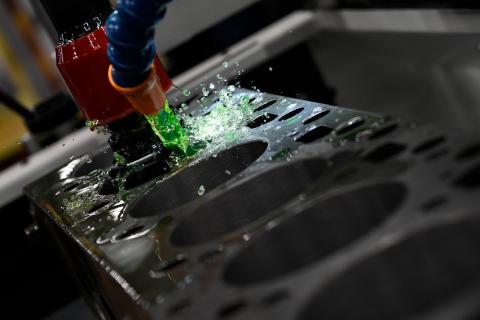
New CNC machines are often the big draw at Machinery Row because most are in action—showing off new tooling and software upgrades by cutting billet cylinder heads or other engine products. The benefits of CNC machines are well known, but it still takes a strong sales pitch to convince some Show goers.

“The machining center systems put the customer in control of their shop,” explained John Cowher of Centroid, Howard, Pennsylvania. “There’s no more outsourcing of work, saving valuable turnaround time for parts. It allows for in-house R&D with part prototyping. Additionally, since the machine is a CNC machine, it is like another employee. While it is making the parts, the shop guys can go onto doing other things.”

Automation versus manual is often a difficult choice for some customers who want personal control over the machine’s operation. So, many of today’s machines have computer controls as well as manual operation.

“A machine will perform a lot better if a computer helps it,” said Usher, adding that the GH8 honing machine will be offered in both manual and automated versions because “there’s still a demand for manual machines. Sometimes we call them manual, but inside they have electronics that help do a better job.”

View the list of 2023 Machinery Row exhibitors.

Sources

Centroid
centroidcnc.com

Fanuc America
fanucamerica.com

Magido USA
magidousa.com

Miller Electric
millerwelds.com

Mittler Bros. Machine & Tool
mittlerbros.com

Robins Machines (through MEC CNC)
meccnc.com

Safety-Kleen
safety-kleen.com

Serdi
serdimachines.com

Sunnen Products
sunnen.com

THG Automation
thgautomation.com

Trick Tools
trick-tools.com

UltraSonic LLC
ultrasonicllc.com

August 2023
By
Mike Magda

Featured Vehicles

Submitted by jeffreyc on Tue, 07/18/2023 - 14:07


21st century technology has boosted these 1990s models to new levels of power.

1997 Toyota Tacoma Single Cab

2

Duy Bui | Houston, Texas

Race Series/Class: ASAG (All Steel All Glass) and local truck events

Engine: 3.0 Bullet Billet 2JZ built by Scott Herzog at Arrow Machine, tuning by Chris Delgado

Car: Wiring by David Aiwase Products, intercooler and custom exhaust fabrication by Speedlab Creations, most fabrication by Teixeira Welding, additional help by Eric LaFerriere and Ulisses Garcia

Features: Precision Turbo & Engine turbocharger, Powerhouse Racing, Turbosmart
wastegate and blow-off valve

Facts: Bui is excited to see what his high-horsepower twin turbo compound setup will do on the track.


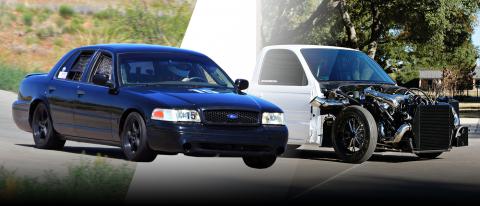
1999 Ford Crown Victoria

3

Mike Garman | Pahrump, Nevada

Race Series/Class: Pro Auto Sports ASA

Engine: 4.6L DOHC built by Ford/Roush with custom tune by Saleen

Car: Built by Roush

Features: Fuel Safe fuel cell, Falken Azenis RT660 tires, Cobra wheels, Borla exhaust

Facts: This car is number 15 of 18 built by Roush for the Bondurant School as an instructor car.

August 2023
By
PRI Staff

The Next Frontier

Submitted by johnc on Tue, 07/18/2023 - 13:43
image 1


Easily accessible horsepower has taken land speed racing to unprecedented levels of performance in recent years, but it takes more than brute force to break records.


Technological innovation has allowed racers across various motorsports disciplines to push the established boundaries to new heights in recent years, and land speed racing is no exception. These advances have not only created new targets for teams that are competing in the upper echelons of the sport, they’ve also raised the bar for those seeking to reach traditional milestones.

“For Bonneville, the ‘300 Club’ of today—that is, the group of racers who’ve broken the 300-mph barrier—is what the ‘200 Club’ used to be,” said Steve Strupp of ECTA Motorsports, Wadesville, Indiana. “Today you can buy a 200-mph car off of the showroom floor, so the new challenge is to get to 300 at Bonneville, or 250 mph on a mile-long pavement track. A lot of it has to do with the advancements in forced induction, both with blowers and turbos. It has allowed racers to get controllable, dependable increases in horsepower. But it’s not really about the amount of boost people are using, it’s more about having the ability to keep the engine alive for more than one pass. It’s much easier to manage now.”

This progress has made the sport more accessible to a greater number of would-be competitors, and it has also allowed teams that are on the hunt for a class record to devote more of their attention to design aspects outside of their engine program. Yet as we have so often seen when racers attempt to break into new territory, Mother Nature also plays a crucial role in determining what’s ultimately possible.


The Science Of Going Fast

“Electronics have become a big part of these cars,” said Steve Watt of Maxwell Industries, Ventura, California. Watt is also on the team that developed and races the Speed Demon, a streamliner-class land speed car, which currently holds the title of the fastest piston engine, wheel-driven vehicle in the world at 481.576 mph. “You’re basically trying to utilize 3,000 hp on 2 1/2 inches of tire tread in a five-mile drag race. In the past, a lot of the teams used weight to try and get some traction—the original Speed Demon, for instance, was more than 5,800 pounds. We designed a whole new car after an incident in 2014, and the new car is closer to 4,000 pounds. Our MoTeC electronics allow us to use a sophisticated traction control system. Once we’ve gotten a few runs in and we know the salt conditions, we can use that system to feed in the power at just the right rate for the available grip. That equates to faster acceleration without the need for additional weight to create the traction.”

Aaron Brown of The Garage Shop in Denver, North Carolina, told us that while the new tech has ushered in a new era of car development for land speed racing, some still prefer to do things the old-school way.

“Our team has two Roadster-class cars. One of them has MoTeC everything, and the other one—the one I drive—basically has a carburetor and a tachometer. What’s interesting is that the driver of the other car is only in his second season racing at El Mirage and events like that now, and his car is just as fast as mine. The data is really helping to level the playing field in terms of performance and repeatability.”

Dennis Sullivan of the Utah Salt Flats Racing Association said that this technology is also bolstering durability, which is a constant concern due to the format of land speed racing. “At Bonneville you’re running flat out for five miles. If you qualify, then you go to impound, and you’ve got to do it again the next day with the same motor. So you’re basically doing 10 miles at wide open throttle. The salt is a little bit like running on snow, and what kills motors is the loss of traction, because that causes the rpm’s to spike, and when it catches traction again, it puts a big shock load on the motor. Anything you can do to minimize that will help the engine live.”

As expected, aerodynamics play a crucial role in both speed and safety. “There’s a lot of wind tunnel testing involved at the upper end of the sport,” Sullivan added. “There are now companies that can simulate aerodynamic behavior at speed using computational fluid dynamics and using data from wind tunnel sessions to improve it further. Wind tunnels can be hard to find, and they can get pretty expensive, especially if you’re going to make changes while you’re there. But it’s generally more desirable than simulation because you can use smoke wands and things like that to see with your own eyes how changes are affecting the aerodynamics. Most of them have ‘tables’ that the car sits on, which allow you to adjust the angle of the car and so on. That can provide some insight into how altering the attitude of the vehicle not only affects the aerodynamics, but also its stability at speed.”


Run Whatcha Brung

A production-based chassis won’t put a team in the running for a new overall speed record, but these types of vehicles comprise the majority of the entries at events like Bonneville Speed Week. “They’ve got everything from antique-bodied cars to full sedans—you name it,” said Rick Vesco of Team Vesco Racing, Rockville, Utah. “There’s a class for everything. Typically, cars are classified by fuel, engine displacement, aspiration, and things like that. It’s broken down to the point where just about anybody can find a class to run in and be pretty competitive within that class.”

image 2
The Garage Shop fields two Roadster-class cars. Aaron Brown prefers the old-fashioned approach in this car—“it basically has a carburetor and a tachometer”—while the other one “has MoTeC everything. The driver of the other car, only in his second season racing, is just as fast as mine. The data is really helping level the playing field.”

Sullivan said that the rule sets vary from class to class, but there are some stipulations that tend to have an effect on vehicle designs. “Depending on which class you’re looking at, there can be quite a few rules that affect what you can and can’t do, especially as you move up the ranks. Beyond the safety requirements, there are limits on wings, air dams, and other aero elements. Even in the Roadster classes, which are the oldest classes, there have been some changes in recent years. In Modified Roadster, for instance, they’re now allowed to use wings on the back, which wasn’t always the case. And to revive some of the older cars that might’ve been parked in garages because they weren’t competitive anymore, a class called American Iron Roadsters was created to bring out the cars with old Dodge Hemis and old Pontiac motors, etc. Of course, due to the nature of competition, that has inspired some people to build ‘new’ old cars and build out those old motors with new hardware. Classes that used to run 140 or 150 mph are now starting to exceed 200.”

He also noted that, due to engine displacement being a key factor in car classification, some competitors have been taking big block motors that would normally be put in B-class racing and purposely reducing their displacement in order to make them eligible for C-class competition. That trend resulted in some racers petitioning for a new class for small block V8s in the 300 cubic-inch range, a displacement that’s harder to achieve when starting out with a big block, and the D-class was created as a result. But in other elements of the car, many classes offer teams quite a bit of freedom when it comes to innovation.

image 3
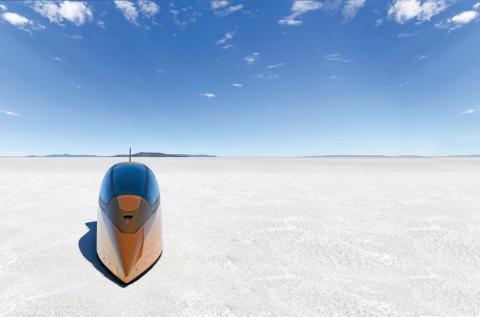
The Speed Demon currently holds the piston-engine, wheel-driven speed record at 481.576 mph. Power comes from a Ken Duttweiler-built, twin-turbocharged, big block Chevrolet-based V8. “It’s like a drag build in a lot of ways, but there’s more of a focus on longevity because you’re going wide-open for five miles,” said Steve Watt.

“Our Roadster cars actually use dirt late model rear suspensions, with a torque arm and a fifth coil,” Brown said. “When we built these cars last year, we really wanted to give a lot of consideration to the suspension stuff. Our first thought was, ‘OK, what type of race cars need the most traction and have the most power?’ So we got two right-side bird cages and designed all of our own brackets, and we looked to drag racing for a wishbone lower link. We chose that over a track bar and panhard bar because we wanted the rearend to be able to rotate freely. The data has helped us dial that setup in—we were pretty good right off of the trailer in testing last year—but having that data also allowed us to make some informed choices over the winter, so we were even better when we came back earlier this year.”


Going All Out

Even though the production-based classes are faster than ever, the streamliner class is the current top tier of land speed racing in the United States. Outside of safety requirements, basically anything goes in terms of body shape, chassis design, and wheel-driven propulsion. For Team Vesco Racing, whose Turbinator II car has been as fast as 503.3 mph during a qualifying run in 2018 (though they were unfortunately unable to certify the results the following day due to rain), it’s about achieving a balance between horsepower, reliability, and minimal wind resistance in a package that’s controllable at speeds where sonic pressure waves start to become a concern.

“When we built the original version back in 1981, we had two small block Chevrolet V8s in it, and we ran it with two-wheel drive,” Vesco recalled. “We got up to about 350 mph, and at that point we knew we needed some more horsepower, along with four-wheel drive, so we got ahold of two 159-cubic-inch Indy car motors. They put out 1,000 horsepower apiece because, despite the displacement, they would accept 50 to 60 pounds of blower pressure. That got us to 397 mph, and the record at the time was 409, so we thought we were on our way. But one of the motors dropped an exhaust valve, and the parts went through both engines. They were ruined, and we couldn’t find the parts to put them both back together. But my brother was invited to an unlimited hydroplane race, and those boats were running T-53 turbine engines. He called me from the race and said, ‘We’ve got to get one of these engines!’”

image 4
ECTA Motorsports is the first sanctioning body for paved land speed racing. Steve Strupp likened the powertrains used on ECTA’s paved mile as resembling slightly detuned versions of Top Fuel or Funny Car engines. “The combinations are a blend between drag racing technology and something like NASCAR in order to get that durability.”

After making a few calls, the team acquired a T-55 turbine engine from a Chinook helicopter, a powerplant that Vesco said is good for about 5,300 hp at sea level. While the unconventional mill required quite a bit of engineering to adapt it to the team’s streamliner (part of which included designing a custom-built transmission), the engine’s original use-case, which often sees it at wide-open throttle for extended periods of time, made it ideal for a land speed race car.

The body shape of the Turbinator II eschews the wings and splitters seen on the faster cars in the production-based classes as well. “The bigger the hole you punch, the more power it takes to get through the air,” Vesco said. “We’ve never done any of the simulation stuff; we’ve mainly focused on making the smallest and skinniest streamliner that we possibly could. The basic principles for aeronautics are pretty much the same for land speed cars, although we still have to get traction, and they don’t have to contend with ground effects like we do. A lot of teams build ground effects into their streamliners to get traction, but whenever you do something like that, it takes more horsepower to get you down the track.”

Watt and the Speed Demon team take a different tactic with their streamliner, which is motivated by a Ken Duttweiler-built twin-turbocharged, big block Chevrolet-based V8. “It’s like a drag build in a lot of ways, but there’s more of a focus on longevity because you’re going wide-open for five miles,” Watt explained. “You’ve got to use steel rods rather than aluminum ones, for example, and you can’t run as hard with as much boost as you would if it were in a drag car. With our car, the boost is fed in gradually—we don’t get to full power until we’re about three miles down the track because we don’t have enough traction. We need the aero to start really pushing down on the car.”

Strupp said the combinations at this level of land speed racing often resemble a slightly detuned version of an engine found in Top Fuel or Funny Car competition. “There are a lot of adjustments made in fuel mixture, timing, and the engine controls, but the fundamentals are the same. They’re turbocharged, blown, or they use some form of compound induction, and it’s typically V8-based billet stuff. Many of these engine builders come from the drag racing world, but the combinations end up being more of a blend between drag racing technology and something like NASCAR in order to get that durability.”

image 5
With passenger vehicles capable of more than 300 mph, and streamliners cresting 400 mph, land speed racing has some of the strictest safety rules of any form of racing. This includes complex roll cages, Lexan windows, fire suppression systems, and more.

Also in contrast to Team Vesco’s approach, the Speed Demon team isn’t shy about leveraging technology to develop their aerodynamic strategy. “We’re fortunate because we were able to run our old car through the Ferrari F1 team’s simulator, which is one of the most sophisticated in the world, thanks to a mutual friend,” Watt said. “That provided a whole list of things that we needed to do for our new car to improve downforce while also reducing drag, which in turn enabled us to go a lot faster.”


The Road Ahead

Although streamliners are the fastest land speed race cars currently competing, they aren’t the fastest land speed cars ever developed. That distinction goes to vehicles like the Aussie Invader and Bloodhound LSR, which use jet thrust to propel the car forward rather than wheel-driven torque. The Bloodhound has recorded speeds as fast 628 mph, but the runs were conducted on a dry lakebed in Hakskeen Pan, South Africa, rather than at Bonneville, due to an issue that has affected Speed Week racers at all levels of the sport.

image 6
“The bigger the hole you punch, the more power it takes to get through the air,” said Rick Vesco. For the Turbinator II, “we’ve mainly focused on making the smallest and skinniest streamliner that we possibly could.” That strategy resulted in a 503.3-mph qualifying run in 2018.

“Bonneville is getting smaller and smaller,” Brown pointed out, “and I think there needs to be a larger conservation effort because the problem has been getting worse over recent years. When we got flooded out last year, I wasn’t upset at all because the lakebed needed to sit like that for six or eight months in order to heal.”

Along with concerns about the consistency of the surface, the reduced amount of usable lakebed has made speed attempts with jet cars impossible due to the amount of space they need to build up speed and shut down. And, to a tangible degree, it also has put a cap on the performance potential of top-tier streamliners. “I think someone could go 550, 570 before they’d start to run into any trouble with sonic pressure waves, but it’s going to have to be at a longer race course,” Vesco said. “For us it’s not so much about horsepower or aero at this point as it is the track length. This thing is still accelerating like crazy at the end of that five-mile run, so if we had more room, I’m sure we could take it further.”

SOURCES

ECTA Motorsports
ectamile.com

The Garage Shop
thegarageshop200.com

Maxwell Industries
maxwellindustries.com

Team Vesco Racing
teamvesco.com

Utah Salt Flats Racing Association
saltflats.com

August 2023
By
Bradley Iger

Secret Weapon

Submitted by johnc on Tue, 07/18/2023 - 12:51
image 1


Increased durability, reduced friction, and enhanced thermal control are just some of the benefits that can be gained from coating engine and driveline parts. Other coating advantages, though, are a little more unexpected.


The coatings used on engine components and driveline parts have evolved to a point where they do very specific—and sometimes contrary—things. One type of coating attracts oil. Another coating sheds oil. There are coatings that act as a heat barrier. Others absorb and transfer heat. Some coatings have the hardness of a diamond. Others are soft enough to scratch with a fingernail. Some cure to a beautiful shine, while one company, Swain Tech Coatings of Scottsville, New York, warns that its White Lightning exhaust coating is downright ugly. “Which is not quite fair,” admitted Richard Tucker. The coating is an effective thermal barrier, but it can mar or scratch during shipping or installation, and it can change color when exposed to heat. Said Tucker, “We’d rather be very clear that customers should not consider our exhaust coating if the appearance is important to them.”

Parts coating has tangible benefits that can be felt as well as seen. “Roundy-round racers with a coated motor are going to blast off corners quicker and smoother,” said Carl Benton of Polymer Dynamics (PolyDyn), Houston, Texas. “And drag race motors accelerate faster.” The “heavy motors” used in drag racing and tractor pulling, “the blown alcohol and blown fuel motors, are using our coated rod and main bearings,” Benton said, “and they’re getting twice or three times the amount of runs because of the way the bearing can hold onto the oil.”

Line2Line Coatings of Clarkston, Michigan, is best known for its abradable powder coatings (APC) for piston skirts and other components. “That’s what sets us apart from everybody else,” explained Mark Gelstein. “We can put it on heavy, and it will adjust to fit under temperature and under load.”

That adjustment process, added Andy Suman, can actually be felt when racers are breaking in the pistons on track. “Sprint car guys will say, ‘Oh, you can feel it. At first the motor’s kind of tight, but as you do some laps, you can feel it find its fit,” he said. “It gets smooth and nice.’”

Sometimes, though, the benefits of a coating can surprise a racer.

image 2
The abrade-to-fit nature of Line2Line’s APC coating has improved the efficiency of “oil pumps, turbochargers, superchargers—they’re all pumps,” said Andy Suman. “If you can create the same amount of boost with a slower rotor speed, then you’re saving energy.”

“I was working with a friend of mine as he was putting together an off-road racing bike,” said Jason Arbogast of Tech Line Coatings, Rutledge, Tennessee. “He mentioned that they wanted to pull some heat out of the engine, because the race that was coming up was going to be a mud race, and that was known to cause havoc on bikes because of the airflow restrictions when the mud gets into the radiator guards.” The motorcycle was treated with Tech Line’s air-cure thermal dispersant coating “on the engine, radiator, and any other part that would or could see heat.”

After the coatings were applied, the rider went out for some test laps but came back quickly, certain that the bike was running hot. “When we asked why, he said because his feet were warmer than normal,” Arbogast said. It turned out the bike was not overheating—far from it. “We checked the engine temp, and it was 20-plus degrees cooler. The coating was pulling heat off the engine so well, it was warming up his boots more than he was used to.”

That kind of anecdote got us to thinking, were there other unexpected, surprising, or hidden benefits to coating parts?


Piston Coatings

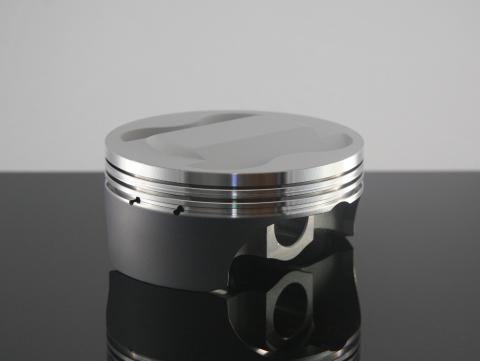
Piston coatings fall into two general types: coatings for the piston top and for the piston skirt. Each has a different role to play.

“Ceramic coatings on the top of the piston can greatly enhance flame propagation, so you’re burning fuel more effectively. The flame travel is more complete over the top of the piston,” explained Benton. “Because of that, some of our guys will, because the flame propagation has been enhanced, reduce the timing slightly, which makes more horsepower.”

Piston top coatings also act as a thermal barrier. PolyDyn’s ceramic piston top coating is a “synthetic polymer resin-based system that, as it cures, creates a ceramic matrix,” Benton said. “Then we add particles to it to reinforce its heat stability. The gold material in the coating is another pigment that adds resiliency.” The coating “reflects heat off the top of the piston, so piston temperatures during operation are much, much less than if it wasn’t on there. It’ll keep from reducing the Brinell hardness of the piston, which, if that occurs, can cause stress cracking afterwards. The coating enhances that stability and structural integrity.”

image 3
Tech Line Coatings’ Jason Arbogast applied thermal dispersant coatings to an off-road racing motorcycle to help cool the engine if it became covered in mud. After a brief test the rider came in worried that the engine was overheating. “The coating was pulling heat off the engine so well, it was warming up his boots more than he was used to,” Arbogast said.

Tucker said the primary purpose of putting a thermal barrier coating on the piston top “is to provide a margin of protection against a bad tune, lean condition, bad fuel, and so on, where an unusual amount of heat is generated. An uncoated piston top could be destroyed or badly damaged if the top was not coated.”

Yet not only will the coated piston run cooler and retain more strength in normal operating conditions, “less heat passes through the coating and into the piston, wrist pin, and bottom end,” Tucker added. “Rarely is this such a dramatic change that you would have to make a clearance adjustment, but it is often noticeable enough that the evidence of heat you see on the bottom of the piston is much less or completely eliminated when compared to a piston that does not have our thermal barrier on top of the piston.”

Piston skirt coatings, on the other hand, primarily serve to enhance the lubrication between the piston and the cylinder wall, while also providing some thermal protection.

“We primarily use our PC-9 skirt coating to provide a margin of protection against wear, scuffing, and damage that can occur at cold starts, oil starvation, when clearances are off due to a heat surge, or the integrity of the oil film being compromised,” said Tucker. “In these situations, our PC-9 skirt coating can help reduce or eliminate damage.”

PolyDyn describes its RP skirt coating as “a ceramic-reinforced dry film lubricant with a low affinity for oil.” In other words, said Benton, “oil won’t stick to the skirt of the piston, so the skirt will ride on the film of oil on the cylinders.”

Line2Line’s abradable piston skirt coatings add to those traits by their ability to find the proper fit in a cylinder bore. “You can open tolerances up a little bit,” said Gelstein. “You don’t need to be so precise because the coating will take up any of that extra space and will find the ideal fit and then lock it in.”

When a piston finds that “ideal fit,” it stabilizes in the bore, which has a number of benefits. “You get less oil coming up into the combustion,” Suman said. “Oil takes away from the octane rating, so you’re more likely to get pre-ignition if the rings are allowing oil to go by. By getting less oil in your combustion, you can advance the timing a little bit.”

image 4
How does a coating become a diagnostic tool? Tech Line Coatings offers a colored Ciloxide exhaust coating that darkens when warm and returns to its original color as it cools. Taking a quick glance at the headers will tell a racer if one cylinder isn’t firing properly.

Also, “stable pistons with uniform oil film thickness move less, rattle less, and do not pierce oil films with impact events as often as standard, uncoated, loose-fitting pistons,” Suman added. “Stable pistons also make the rings’ job of sealing and survival much easier because they are not getting pounded on and/or piercing oil films to cause wear, which also creates high friction events. Stable rings stay in better contact with the piston and the bore and therefore improve heat transfer to the bore for a cooler piston.”

Gelstein and Suman said they’ve seen high-powered race applications “get 1.5–3 times the life of uncoated pistons that have lots of secondary motions from poor fit. We also see circle track engines staying together much longer and running more reliably in intense race conditions. In all these cases, if a set of cylinder kits in a multi-cylinder engine stays together longer, the ability to tune the engine improves because the underlying components are not changing as much between passes or races or nights. This means the racer can refine his strategy around the weather and other conditions with better precision.”


Pump Coatings

The abrade-to-fit nature of Line2Line’s APC coating has improved the efficiency of “oil pumps, turbochargers, superchargers—they’re all pumps,” Suman explained. “If you can create the same amount of boost with a slower rotor speed, then you’re saving energy.”

The APC coating on gerotor oil pump gears, for example, helps tighten the clearances beyond what’s possible with standard manufacturing practices.

“When you design an oil pump, it has to pump enough oil at the lowest rpm so the engine won’t eat itself,” Suman pointed out. “But the efficiency of oil pumps is low at low rpm because the clearances have a greater effect when it’s spinning slower. There’s more time for the fluids to leak backwards.” Tightening the clearances “stops those leaks and maintains high pressure at low rpm. Then you can either spin the oil pump slower to save energy or use a smaller capacity pump.” Likewise, “if you want to run lightweight oil to save parasitic loss but can’t get enough pressure with the lightweight oil because your pump leaks, if you put our coating on that oil pump you can spin it slower with a bigger pulley on it, and you’ll still always have enough pressure.”

In regard to superchargers, “a lot of the blowers have Nylatron inserts at the tips,” Suman noted. “They’ll scrub against the factory anodized coatings on the insides of those cases and will wear out. If you put our coatings inside the blowers, the tips last longer, because our coating doesn’t eat the Nylatron. So you might get 20 passes instead of 10, and your blower is more consistent again.”


Exhaust Coatings

Tucker said the primary purpose of Swain Tech’s White Lightning exhaust coating is to “keep the heat in the exhaust to keep heat out of the areas that are next to the exhaust—generally the engine bay or near the driver’s feet.” Excess heat in those areas “can be detrimental to all kinds of parts in the engine bay.”

Beyond the protection factor, reducing heat in the engine bay “can reduce intake temperatures, which is one way you can gain power,” Tucker added. “Also, more heat kept in the exhaust moves the heat more efficiently through the pipe, so it breathes or scavenges more effectively.” It’s common for that increased efficiency to result in a power gain, but he pointed out that the increase may not be significant enough to be felt. “Few will have the time and energy to dyno before and after, so we primarily focus on the heat management aspect” of the coating.

As an additional benefit, “over the years, we’ve often heard many racers, especially drag racers, will have our coating on their exhaust because it is so effective at managing heat that they can work near the exhaust shortly after finishing a run. They would not think of doing that without our coating on their exhaust.”

Arbogast recalled a story about how one of Tech Line Coatings’ exhaust coatings became a diagnostic tool. The company sells a line of red, orange, purple, and blue Ciloxide exhaust coatings that “darken when they get warm and go back to their original color when they cool off,” he explained. A customer who didn’t fully understand how the coatings responded to heat called to say the coating wasn’t working right. “When he applied the Ciloxide Orange coating and installed the headers on the vehicle, he told us only one of the tubes was staying bright orange. The other tubes were darkening as the engine was idling. When we talked, he realized that the tube that was not darkening was not firing. This color change has helped some with being able to take a quick glance at the headers, and if they all look the same, the engine is firing on all cylinders.”


Drivetrain Coatings

“Once somebody starts to see what you can gain in performance and durability, it’s hard to get away from coatings,” Benton said. He recalled being contacted by Tim Cole, who worked for TCI. “I knew him from his drag racing days. We used to coat all his stuff.” Cole told Benton TCI was having warranty issues with its Powerglide transmissions and thought PolyDyn coatings might help, particularly on one part: the outer pump gear in the front pump. “After doing tons of tests, we reduced their warranty issues company-wide by 97%,” Benton said.

But it didn’t stop there. “I started getting 1,000–1,500 pump gears every three months from those guys,” Benton recalled. “I called TCI and said, ‘There ain’t no way you’re selling that many transmissions.’ They weren’t, but what they were doing was selling coated front pumps, and the rebuilders were saying, ‘These things are next to bullet-proof.’ They found a new avenue of business that they would never have explored if it wasn’t for the fact that the coating in the front pumps improves the durability so radically.”

A coating’s thermal-control properties can have benefits beyond the engine compartment. Arbogast said one of Tech Line Coatings’ applicators “was looking for ways to help a customer reduce heat on a side-by-side used for off-road racing. We recommended our Thermal Dispersant coating. It was applied to the drive clutch and secondary clutch, and the temps were reduced by about 100 degrees.” That made the customer happy, as did this unexpected benefit: “Not only did it remove the heat from the clutch system, cleaning it was easier as well. The coating has a hydrophobic property to it which, when it would get wet or muddy, would fling off the water and mud faster.”


The Secret Weapon

Beyond all these tangible benefits of performance parts coatings, Benton touched on an unexpected advantage he’s seen over the years.

“When you tell a racer he has a secret weapon that most likely nobody else at the track has, it makes a psychological difference that shows up at the track. When a racer knows he has a coated motor, he can push the car harder and do the whole event with more confidence than he’s ever had.” Benton cited drivers he’s worked with, including Rusty Wallace during his 1989 NASCAR Winston Cup Championship year and “something like 18 championships” won by Steve Kinser, all due, in part, to PolyDyn coatings. “Steve realized he could push his car harder than anything, and overheating the motor wasn’t an issue.

“Short-track guys, and stock and super stock racers, because they have to run steel rods, we put the oil-shedding polymer coating on the rods and cranks, and the rpm is so much smoother and quicker,” Benton said. “All of a sudden, you know you’ve got an edge.”

Even Benton’s son has benefited from the secret weapon. “My son had a NASCAR late model for about a year, and his first time out, here he is a rookie, and he said, ‘Dang, Dad, everybody out there is slow. I can jump on any of them.’

“They do feel it. And they didn’t know they could feel something like that.” 


Coating a Formula 1 Airplane Engine

When we spoke with Carl Benton of Polymer Dynamics in Houston, Texas, his technicians were coating engine components for a Cassutt Formula 1 airplane in preparation for the National Championship Air Races in Reno, Nevada. This is a relatively new race discipline for PolyDyn.

“We got involved a couple years ago, showing them how to pick up the speed of the plane,” Benton explained. “I’m a nobody with these racers, but all of a sudden everybody wanted my business card because we picked up the speed of this one particular airplane by almost 9 mph. Even with that itty-bitty motor these planes can go as fast as 250 mph.” The coatings used on the Cassutt’s engine are the same PolyDyn uses in “automotive applications every day.”

sidebar image
These engine parts from a Cassutt Formula 1 racing airplane demonstrate the variety of coatings from PolyDyn. “All of these are used in automotive applications as well, on a lot of diesels and everything under the sun,” said Carl Benton.

The bearings are coated with PolyDyn DL, “which stands for dry lubricant. It can work dry, but it’s unique in that it has a polymer that creates an affinity for oil. Oil wants to stick to the bearing like concrete.”

The crankshaft is coated with PD14 Silver, “which has PTFE in it, a material similar to what you’d find in a frying pan,” he continued. “It is a very resilient coating because it is a nylon composite resin-based system. When we compose this coating, we start off with the base system—the actual name is polyamide-imide—then we add nano-aluminum pigment particles for color and abrasion resistance. The PTFE gives it its slippery, non-stick surface. We use the same coating on connecting rods. Oil does not want to stick to that surface. It’s the opposite of what’s going on the bearings.”

The piston tops are coated with PolyDyn HS, a “synthetic polymetric ceramic” that makes the piston stronger by enhancing the dome’s structural integrity. It protects the piston from heat and also distributes the heat through the combustion chamber, allowing for more efficient flame travel.

Piston skirts receive PolyDyn RP, “two unique fluoropolymer coatings. The first one put on is a very tenacious coating, ingraining itself into the metal substrate. Then the bearing coating PolyDyn DL goes on top of it, wet-on-wet, so as it starts to cure, the coatings intermingle. The first coating acts as a primer, but it’s a dry film lubricant. The second coating has the ability to retain oil on the piston skirt,” Benton concluded. —Drew Hardin

SOURCES

Line2Line Coatings
line2linecoatings.com

Polymer Dynamics
polydyn.com

Swain Tech Coatings
swaintech.com

Tech Line Coatings
techlinecoatings.com

August 2023
By
Drew Hardin