This PRI Founding Member brings NASCAR’s brand of short-track Friday- and Saturday-night racing to local venues across the US and Canada, while working to preserve the health and future of all motorsports.
As one of the largest sanctions in worldwide racing, NASCAR has tremendous reach among racers, fans, and businesses that support the industry. The Daytona Beach, Florida-based sanction is celebrating its 75th anniversary this year and looks to draw on its rich tradition and history as it commemorates the milestone throughout the 2023 season.
Some of racing’s most famous names are part of this legacy. Given that fact, it’s impossible for NASCAR not to look to the past for inspiration. But at the same time, the sanction is looking to the future, adding technical innovations, new tracks, and even entirely different forms of racing from the classic paved-oval format.
Most of the public spotlight is on NASCAR’s marquee Cup, Xfinity, and Craftsman Truck Series. But the organization also hosts its Weekly Racing Series, which adds depth and dimension to the sanction’s roster, while providing a means for up-and-coming drivers to gain entry into NASCAR.
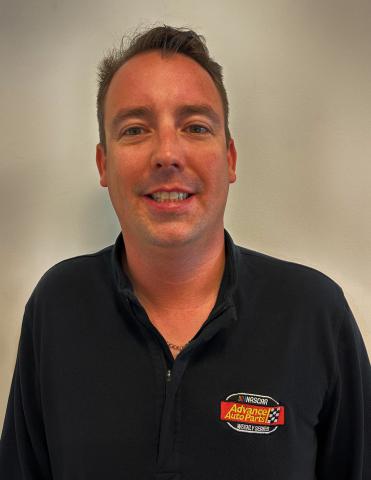
Bringing people together and fostering a connection is the value PRI brings to NASCAR and why the sanctioning organization joined as a PRI Founding Member, according to Brett Tisdale, senior manager, Weekly Racing Operations at NASCAR.
The NASCAR Advance Auto Parts Weekly Series races at more than 50 tracks throughout the US and Canada and boasts well over 10,000 members. Brett Tisdale helps manage weekly racing operations for this series, where he has worked for more than a decade. “We’re your short-track Saturday night racing,” he said. “We’re grassroots racing—at Saturday night shows from New Smyrna Speedway to Alaska Raceway Park—all across North America.”
Hosting a mix of long-term sportsman and career-oriented younger drivers, the NASCAR Advance Auto Parts Weekly Series operates as both a standalone series and as a feeder series for NASCAR’s upper ranks. “It’s definitely both,” said Tisdale. “Everyone has to start somewhere in racing, and that usually means local racing on Friday- or Saturday-night short tracks at one point or another. But on the other side of that, we have our diehard hobbyists. They don’t play golf. This is what they do for their hobby, and they enjoy the competition and camaraderie.”
According to Tisdale, the NASCAR Advance Auto Parts Weekly Series is running smoothly, having finally made it through the pandemic into some sense of normalcy now. But even “normal” can be a lot of work for a series of this scale.
“With COVID-19, there were some strange things with all the shutdowns, and it was a slow crawl back,” he explained. “But, to be 100% honest, this has been a great year, so far, going back to the end of last season. We’ve got a lot of momentum coming into this season, with 12 new race tracks coming on board, a great partner in Advance Auto Parts, and a great streaming platform with FloRacing. So I can’t say there’s been a lot of bumps in the road recently. NASCAR was first to lead the charge back to live sports, and that itself should speak for the organization as a whole.”
Hosting a mix of long-term sportsman and career-oriented younger drivers, the NASCAR Advance Auto Parts Weekly Series operates as both a standalone series and as a feeder series for NASCAR’s upper ranks. More than 50 member tracks participate, including Colorado National Speedway, seen here with its Late Model division.
Throughout his motorsports career, Tisdale has been an avid supporter of PRI, regularly attending the Trade Show and being involved in the organization whenever possible. He noted that PRI’s value to NASCAR has always been in bringing people together—fostering connection. This enables the sanction to better stay in touch with racers, suppliers, and tracks, which is invaluable as the organization navigates changing tastes and shifting attention in its core audience and the general public.
“PRI is great at bringing people together who all have the same goals,” said Tisdale. “That’s not just strictly NASCAR, but motorsports as a whole.” Through the Trade Show, professional “racers can come and see vendors, meet sponsors, and connect with sanctioning bodies like NASCAR.”
With the long history of PRI involvement for Tisdale and NASCAR as a whole, it made sense for NASCAR to join the organization when the chance to become a Founding Member was presented. Tisdale credits Tom Deery at PRI with reaching out to NASCAR and demonstrating the value of membership and what it could do for the organization. “We always looked at PRI from a vendor trade show standpoint,” recalled Tisdale. “I’ve known Tom my whole 12 years here at NASCAR, so it came about organically. It was a natural fit.”
The NASCAR Advance Auto Parts Weekly Series plays a key role in the development and overall health of racing throughout the US. But Tisdale emphasized that, despite the strength of the series, motorsports in America is under fire from forces that could significantly curtail the sport. To that end, he urges PRI Members to support legislation that protects motorsports, while getting out and seeing a local race whenever possible.
“I think everyone, especially us, wants to see weekly short-track racing grow. There’s nothing better than being live and local. So spend your Friday or Saturday night at a short track when you can.”
As the engine block industry recovers from the pandemic hangover, sales to racers are strong due to increasing performance options and robust construction.
One consistent takeaway can be drawn from talking with cylinder block manufacturers, engine builders, and race-industry observers this year: There is a significant demand for blocks. That statement can also be interpreted to mean there’s an undeniable shortage of cylinder blocks in the performance market. It just depends on who’s talking.
“There’s definitely a shortage of blocks,” said Carlos Inocencio of Concept Performance, Indianapolis, Indiana. “In fact, we just created new tooling for a big block Chevy because we have customers who cannot get BBC blocks. They’ve been hounding us to make a big block Chevy.”
“We’ve had some blocks on order for over a year,” added Ken McCaul of Borowski Racing Engines, Joliet, Illinois, adding that availability of many popular blocks is returning to near-normal status. “But the specialty blocks that used to be four or five weeks out, well, I’ve had one order in since May 2021. Thankfully, I have customers who are understanding.”
McCaul had the resources to plan ahead and make a six-figure purchase of blocks at one point. “We could see that the supply chain was becoming unpredictable,” he explained. “It got worse than we thought, but fortunately, we still have 50 or 60 blocks on the shelf. It was very fortunate that we were able to do that. Otherwise, I don’t know how you can make engines without engine blocks.”
Aftermarket manufacturers are rebounding from the industry turmoil created by the pandemic. First, many foundries were shut down due to COVID-19, and some didn’t go back online or they severely reduced certain services following supply chain and labor challenges. Even if another foundry could be sourced, all new tooling had to be developed to work with that foundry’s system.
At the same time that COVID-19 hit, thousands of racers and street enthusiasts were motivated to start new projects. Heavy demand was there, but product was hard to find. Many manufacturers had to put R&D projects on hold just to free up resources to fill orders.
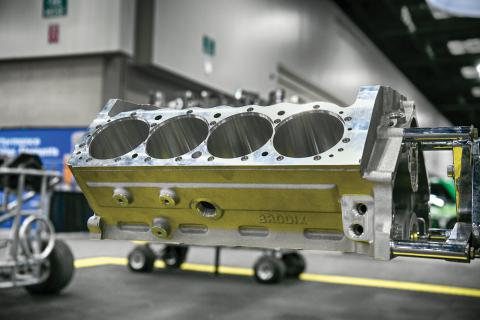
“We’re at about 110% capacity right now. We’ve had no time to develop new product because we’re making blocks as fast as we can,” said Mark Fretz of Brodix, Mena, Arkansas. Brodix has its own foundry for aluminum blocks and used to source a limited number of iron blocks from an outside supplier. “We suspended all sales of iron blocks until further notice. We’re working on a new deal, but it’s probably six months out.”
“We don’t have anything new right now. I wish we did,” confirmed Jack McInnis of World Products in Louisville, Kentucky, noting his company did experience problems sourcing a foundry during the pandemic. “We’ve remained committed to getting our castings US-made and doing all the machining and finishing work here. I don’t think we have every part number available right now, but that’s probably true at any given time for anyone.”
Over at Dart Machinery in Warren, Michigan, the recovery is also bullish. “Supply is back with an increase at a minimum of 10% across all fronts,” reported Steve Rhodey. “Probably more like 20% on the iron.”
Resourcefulness
The demand for new cylinder blocks comes after a long period when racers actually sought out used, or “seasoned,” production iron blocks. Conventional wisdom at the time was that a used block would reveal any problems with core shift or porosity from the casting process before it was put into racing.
There’s the folklore of BMW Formula 1 engineers in the 1980s selecting only blocks that had been driven 100,000 miles in a production vehicle. They were building the legendary 1.5-liter turbo four-cylinder M12/13 engines that reportedly hit 1,500 horsepower in qualifying trim with 80 pounds of boost. Once a suitable block was found, it was then left outside in the elements so that the hot-and-cold cycling would stress relieve the iron.
Energy Manufacturing offers solid billet-aluminum blocks for LS, big block Chevy, and small block Ford applications. Alcohol Hemi and Top Fuel blocks are in the works.
Mythbuster rationale aside, even the best of seasoned blocks will eventually fail, and then availability diminishes quickly. That scenario led BluePrint Engines of Kearney, Nebraska, to develop its own block-manufacturing program.
“When we started pursuing more horsepower, we needed blocks stronger than those made in the 1980s by GM, Ford, and others. That really led us down the path to do our own engine blocks,” said Johnny McDevitt, noting that the company either manufactures or tools many of the parts that go into its engines. “It just helps us control our own quality.”
The thought of not having blocks for his specialty engine business led Tim Banning to purchase Keith Black Racing Engines, which traces its history back to the legendary engine builder Keith Black—who also eventually had to manufacture his own blocks to keep up with increasing horsepower demands.
“Now we operate the business to produce blocks for a dealer network that assembles engines,” explained Banning, who runs the Hemis Only engine shop and the KB operation out of Clearwater, Florida. “We also sell to a lot of independent engine builders in addition to the dealer network. One of the reasons I purchased KB was to have a good supply of blocks.”
One-Off Blocks
Designing and producing a one-off cylinder block is hardly an uncommon practice. All you need is an inventive mind, CAD software, and a big CNC machine. New clean-sheet designs with wider bore centers, taller or shorter decks, massive camshaft diameters and relocated lifters are available from numerous sources. One such pioneer is David Visner, who has an engine development shop in Kentwood, Michigan, and purchased a CNC horizontal milling machine a few years ago.
“We had some ideas that we wanted to try and prove out,” recalled Visner. “We thought we could build a better block and thought it was an opportunity to fit into our program.”
Visner’s first project was a solid, 4.600-inch bore center small block Chevy. At the time, only one other company offered a similar block. Some drag racing rulebooks permit such a wide bore spacing but limit boosted engines to 500 cubic inches.
“So, we did a combination that had a 4.250-inch stroke. That put it just up right under 500 cubic inches. Then we did a taller deck deal for nitrous,” said Visner. “These were popular for grudge racers, no-prep, and so forth.”
Word of the block got out, and soon other customers with different needs approached Visner. “One of our first customers was Alan O’Brien with an AMC V8. People laugh when I tell them that we have an AMC billet combination. But it’s simply a customer who wanted that, and it was an opportunity,” said Visner. “With the late-model Hemi, they were having troubles. Tony Bischoff and Rob Goss were in X275, so we did those blocks. There again, it filled in the need, right?”
Visner used reverse engineering to develop the blocks, relying on measuring arms and laser scanners to gather the dimensions. “Then we modify it from that point to make it stronger, better,” he continued. “Most of the blocks are for power-adder applications. The goal is always to make the block better—designing the mains in a way where it has more positive registers to eliminate cap walk and give it a lot of strength in the crankcase. It’s all about reliability.”
“As a performance engine company,” BluePrint Engines “starts with a brand-new block. Everything is new,” said Johnny McDevitt. “There’s no reman content at all.”
Another manufacturer of solid billet-aluminum blocks is Energy Manufacturing in Fremont, Ohio. The company currently offers big block Chevy, small block Ford, and LS blocks, each with standard or raised-cam options and a choice of aluminum or steel main caps.
“Now we’re working on an alcohol Hemi block and a Top Fuel block,” said Heath Norton. “We had started the Top Fuel but put it on the shelf to collect more data. We’ll be relaunching it later this year with both 2.750- and 3.000-inch mains. A Hemi variant of that block will be for Top Alcohol/Pro Mods.”
Norton admitted the Top Fuel block was delayed due to increased demand for the existing lineup during the pandemic. The Pro Mod block will likely come out in Q3 this year followed by the Top Fuel in Q4.
“The Top Fuel block has been tested in the field with great results. COVID hit and the program stalled out because of other priorities,” said Norton, adding that there are new priorities in developing blocks. “We’re seeing a lot more horsepower across all platforms. This hockey-stick horsepower curve is changing how people look at engine builds and development. Everything we’re doing now regarding parts is, how do you make it last? If you look at it from the 1990s when everything was naturally aspirated for the most part or a blower, everything lasted. Now it’s less about weight reduction, more about stability.”
Complaints from racers dealing with block problems motivated Concept Performance to develop its own blocks, according to Inocencio. The company first produced the aluminum LSR with considerable reinforcements, upgraded A356 T6 aluminum alloy, and plenty of performance options. Concept is now releasing the LTR for the Gen V racers.
“A lot of basic dimensions are the same, but the accessory bolt holes are different,” explained Inocencio. “We’ve taken the same priority oiling system from the LSR and put that into the LTR. We see these blocks making 2,000 horsepower, and the LSRs up to 2,500 horsepower.”
The LTR blocks do not have active fuel management capability, so they are more suited to stand-alone race builds. They are poured in the company’s foundry, which also serves many race teams and other manufacturers needing castings. That experience is helping Concept design the new BBC block mentioned earlier.
“The good thing about us is, all we’ve really done throughout the years is high-performance racing,” said Inocencio. “I mean, we’ve made parts for tons of race teams, so we have the knowledge, and we have the foundry to do so. We’re only limited by the hours of the day that my guys are willing to work. And we’ve not seen a cap on that so far.”
The BBC project started in late October 2022 by researching the competition, asking racers what they liked and didn’t like about specific blocks on the market.
“We then came up with our own plan,” said Inocencio. “We started on the tooling around the PRI Show and had the first block at the end of April. The first blocks will go to selected builders. We have some very high-end builders who build large-horsepower engines, and that will be the testing phase.
“This block should be a beast,” added Inocencio. “We’re hoping to hit closer to 4,000 horsepower by the time we’re done. Eventually, we’ll have a tall deck and tall deck with a raised cam.”
New Life for a Brand
Reinvigorating the Keith Black brand started with all-new tooling that will be used at a foundry in Michigan. The goal is to eventually produce 300 blocks a year.
“We had to make new tooling,” said Banning. “The tooling and whole infrastructure hadn’t changed in 30 years. Everything was worn and outdated.”
KB offers the Street Hemi in 4.240- and 4.490-inch bores, and it can be ordered with either 7/16- or 1/2-inch head studs. There’s also a Race Hemi block in both bore sizes with 1/2-inch studs and a raised 60-mm cam tunnel. Finally, the company offers Street and Race versions of blocks for Mopar wedge-head designs.
“We’ll be reintroducing a solid blown-alcohol block soon,” added Banning. “Also, we have CAD work done for the KB600, which is popular with offshore racers and truck pullers. It’s basically a big block Chevy with Olds racing heads. We’re getting a lot of calls on that.”
Borowski Racing Engines recognized supply chain problems during the pandemic and responded by making a six-figure purchase of blocks, said Ken McCaul. “Otherwise, I don’t know how you can make engines without engine blocks.”
KB is also considering a Gen III Hemi block, but as with the KB600 block, the market has to be evaluated to see if the sales numbers will justify the new tooling costs.
“Right now, the biggest demand is the alcohol guys wanting a solid block,” noted Banning. “We’re doing that as a casting. The castings are super strong. We have guys making 4,000 horsepower with the water-jacketed blocks. I’m not too concerned about the strength of those blocks at all, but if the class rules don’t allow it, there’s obviously a limit of where you can race it.”
BluePrint Engines can produce 100 engines per day, and almost all of those engines will start with a BluePrint Engines’ designed engine block. However, such a volume could not be filled by US foundries alone, especially after the COVID-19 turmoil. So the company also works with a state-of-the-art foundry in Germany to meet demand.
“We found those facilities met our standards,” said McDevitt, noting that working with different foundries requires a strict quality control program when the blocks arrive at the plant for machining and assembly. “Everything that comes in the building goes into quarantine. They go through numerous inspections, both before we get them and after. Probably our smartest quality control movement is dyno testing every single engine. Even the long blocks get dyno tested.”
BluePrint’s block lineup covers all the popular platforms, including LS, and soon a Gen III Hemi will be added. Designing its own blocks allowed BluePrint to alter its business direction away from remanufacturing.
“We are a performance-based company—there’s no reman content at all. As a performance engine company, we start with a brand-new block. Everything is new,” said McDevitt, adding that all the engines currently sport an iron block but that an aluminum program may be explored in the future.
Delays are Ending
New block projects that were delayed by the pandemic are now close to release. For example, the Dart Iron Eagle Gen III Hemi block shown at the 2021 PRI Trade Show is a current priority.
“We are close. We’ve had to do some tooling, some engineering revamps a few times over from the original design, but we are on task to do sample trials by the end of May,” explained Rhodey. “When we get about a dozen samples in, we’ll get them machined, we’ll cut them up, and make sure everything lines up where we want, and the cross sections are correct. We are working with a couple of engine builders in the market to build them and test them for us. We should be filling orders by the fourth quarter this year.”
Tim Banning, who now operates Keith Black Racing Engines, is reinvigorating the brand with all-new tooling that will be used at a foundry in Michigan. “The tooling and whole infrastructure hadn’t changed in 30 years. Everything was worn and outdated,” he said.
Another new block already drawing heavy interest, especially in social media, is Dart’s version of the 2JZ. “We have a few different renditions of the block. We have the solid billet, we have a water billet, and we’re taking pre-orders on it right now,” said Rhodey. “Then we also have a cast-iron revised from the OE that we are actually in the final stages of getting the tooling operational now.”
A few years ago, Dart created a new approach to block design with the LS Next—a block that would support LS heads but use traditional SBC components. The concept has been expanded through a number of LS Next iterations that offer a wide range of options and features. One of the latest versions is the cast-iron LS Next SHP Pro. It’s constructed from 220 BHN iron and has many of the features favored by engine builders, such as priority main oiling, thick-wall siamesed cylinder bores, splayed outer bolts on the center mains, available 1/2-inch head holes, and it’s clearanced for up to a 4.100-inch-stroke center-counterweighted crankshaft with steel rods.
Also new is the LS Next2 in both iron and aluminum. “These blocks offer a few options like Cleveland mains (2.750-inch diameter) and come with blind 1/2-inch mains and head-bolt holes,” said Tony Hornak.
Other features of the LS Next2 block include extending the cylinder barrels .375-inch at the bottom, priority main oiling with two lifter crossovers, choice of 4.000- or 4.125-inch bore, and scalloped water jackets. The aluminum version will be offered in three deck heights: 9.240, 9.450, and 9.750, while the iron version comes in either 9.240 or 9.450.
Drag and Drive
Although the total number of participants is relatively low compared to most motorsports, the expanding drag-and-drive movement is generating new product technology and upgrades that allow high-powered engines to survive in a daily driving environment. Solid billet blocks are great for all-out drag racing but have limitations where engine cooling is required. There are a few water-jacketed billet blocks on the market, but they are expensive due to the extensive machining involved. That doesn’t mean a solid block can’t be used in drag and drive.
“With the block, most of the heat is trapped in the top end of the engine,” explained Hornak. “The bottom really only has the frictional heat that’s being created and which the oil typically removes. I know of a few street cars, true street cars that are driven hundreds of miles a day that use a dry block and water heads, and they get away with it. I’m not saying that’s for everyone. I’m just saying it’s feasible.
“Aluminum is a pretty good heat sink. If you put an oil cooler in and have water in the heads, you can probably cool the engine pretty well,” said Norton. “Drag and drive is fraught with peril because it’s usually a war of attrition, not necessarily a war of performance. It’s who can get to the end, not who is the best.
“Everything in this business is trial and error, and that’s one of the things we’re looking at,” Norton said. “With cast heads and a billet block, you get the stability on the bottom half and still maintain cooling around the plugs and the top of the cylinder. I’m not saying it’s bulletproof, but some people are trying it.”
Ready to Race?
Just how finished do engine builders want to see their cylinder blocks from the supplier?
Advancements in CNC machining allow manufacturers to offer more options in cam-bearing size, lifter-bore size, fastener sizes, and more. In theory, a customer could have a race-ready block except for finish honing and final cleaning. In practice, however, some engine builders want to have full control over block preparation work, including advanced machining procedures such as O-rings.
“There are too many variables,” said Brad Lagman of QMP Racing Engines, Chatsworth, California, one of the country’s leading block machinists. “As far as race-ready blocks, there is no such thing.”
“It’s all relative to the goal,” added Nicky Fowler of SDPC Raceshop, Lubbock, Texas. “Is it race ready for 1,000 horsepower or 2,500 horsepower? It’s not just little things like fasteners that have to be up to par. It’s the design of the block. Blocks, in general, by all manufacturers, have garnered the development over the years of what has made blocks better.”
In other words, the actual fastener may be robust enough, but if there isn’t enough metal in the block to support the threads, then a quality, high-priced fastener is no good with 30 pounds of boost.
Lagman agreed and pointed to the factory LS block as a perfect example. “The bulkhead underneath the deck is designed for a certain bore and 7/16-inch stud,” he said. “So these guys try to put a half-inch bolt in, and you’re really compromising that structure.”
“Then there’s the problem with turbochargers today,” Fowler added. “The customer said he’s only going to make 1,100 horsepower. But it’s like the dial on a speaker—it’s that easy to turn it up, and then they want to know why they lifted a head gasket. Well, there’s not enough clamping force.”
Many engine builders have reservations about running high power levels in a cast-aluminum block and may set an arbitrary limit of 1,500 horsepower.
“It’s tough to have that conversation because we’ve had customers making close to 3,000 horsepower and have no issues,” explained Steve Rhodey of Dart Machinery, Warren, Michigan. “Then again, we’ll have guys making 800 horsepower and they’ll shoot the crank clean out of the oil pan. So it’s hard to put a power number on a block because everyone is wanting max effort.”
“That’s a tough situation as a manufacturer, where the block failed because the tune-up was not correct, and it was pushing the envelope with the product in the first place,” added Dart’s Tony Hornak. “We continue to make upgrades where we see a failure and incorporate changes in either the way we machine an area or the way we cast it. We’ve made plenty of running changes throughout the history of all of these aluminum blocks.”
The majority of leading engine builders would prefer to see more options or features for a block, as opposed to more finish machine work.
“Most of our resellers are machine shops, so they’ll do all the final work,” said Jack McInnis of World Products, Louisville, Kentucky. “We will have some customers that don’t have that capability and ask about it, but at the moment we can’t offer it.”
“Most of our customers are high-end engine builders, and they want to do all the fitments themselves,” agreed Mark Fretz of Brodix, Mena, Arkansas, noting that all the blocks are custom ordered at Brodix. “We keep nothing on the shelf so that everything we build is specific to the customer’s needs.” —Mike Magda
Today’s safety-equipment manufacturers offer something for just about every budget, but should racers spend extra money on safety equipment if rules don’t require it?
How safe is safe enough? That’s the vital question all racers ask themselves at some point when making choices about safety equipment and how much money to spend on it. The question isn’t easy or simple. But it can have profound implications.
Vehicle safety equipment across the board has dramatically improved in recent years, with the lessons of real-world incidents continually applied to making even inexpensive safety gear considerably better than that of a decade ago. Nonetheless, most categories of safety equipment offer numerous price points, which can cloud what exactly racers can expect to get from the added cost.
There are almost always diminishing returns. Spending twice the money rarely, if ever, adds twice the safety.
And the idea of increased safety itself is a nebulous, undefined pursuit that can, at times, be difficult to justify. Many racers routinely struggle to find enough money to even get to the track. So it can be a tough sell to get them to invest in upgraded safety equipment.
These same racers figure that as long as they’re conforming with the bare minimum of the rulebook, they’re safe enough, bolstered by the all-too-common sentiment that “It’ll never happen to me.” For those racers who do have the extra money to spend, many would rather put it toward making their cars faster.
So is it worth spending more on better safety equipment? To answer that question, we talked to some of today’s leading experts on the subject. These sources have been in the business for decades. They’ve seen safety equipment evolve, improve, and grow vastly more sophisticated. Perhaps just as important, most of them have spent plenty of time behind the wheel, competing in motorsports ranging from drag racing to open wheel formula cars.
Along the way, some have felt firsthand the effects of serious crashes that would make even the most jaded spectators wince. These racers’ opinions on safety equipment have thus been forged in the ultimate crucible—the real world of hard hits and battered bodies.
What we learned from these sources was surprising at times. Contrary to what many racers think, spending extra money on better safety equipment isn’t necessarily a choice of safety over speed. In many cases, better safety equipment not only protects better, but it also allows drivers to go faster and race more competitively, resulting in better on-track performance.
Cash for Crashes
Despite all the advantages of better safety equipment, much of it is still purely optional. Sure, rulebooks specify a wide array of different safety equipment, and more are added continually as new situations warrant. But rules often lag behind catastrophes that happen on track.
“Going beyond the rules is never a bad thing,” said John Gentry of Stroud Safety, Oklahoma City, Oklahoma. “There are a ton of things that still generally aren’t required, but they make it safer for the racer. Take, for instance, wheelie bar nets. They aren’t mandatory by any sanctioning body, to my knowledge, but we sell a lot of them. And that makes sense. If a car with wheelie bars has a parachute fail, it goes straight down, the air catches it, and it goes under the wheelie bars, which can make for a really bad day.”
Vehicle safety equipment has improved dramatically over recent years and the best place to comparison shop is at the annual PRI Trade Show. Buyers can investigate materials and manufacturing quality, and then be able to explain those enhanced features to their racing customers.
When it comes to a fire suppression system, going beyond the rules is as simple as paying for greater capacity—money well-spent, said our sources. Again, most race rules specify just the bare minimum, but the dollars spent here could easily save the driver’s life in a fire.
“With fire suppression, a sportsman kit is going to have a 5-pound bottle,” explained Gentry. “A 10-pound kit can be more expensive, but it offers double the suppression and double the dispersion time. The quality is the same in both kits, but it’s just more capacity. Personally, I run 20 pounds in my car. Tommy [Cunningham], the owner of the company, runs 40 pounds in his car. We don’t want to catch on fire for any reason.”
Sometimes the cost difference in safety equipment is in the strength of the materials. With fuel cells, for example, bladders have greater strength at higher price points. This means more resistance to puncturing and rupturing in a crash. “FT3- and FT5-certified fuel cells have very different safety ratings and costs associated with each,” noted Ron Ross of Aero Tec Laboratories, Ramsey, New Jersey. “The difference is mostly based on what the bladder can tolerate as far as tear and puncture, being a single roto-molded bladder versus a reinforced ballistic nylon or a Kevlar-reinforced bladder.”
Along with these measures, additional fireproofing of equipment is a wise investment that can be a lifesaver in many situations. Sanction rules typically require only certain key components to be fire-resistant, but much equipment still isn’t generally required to be. Many of those items will burn readily, fueling fires, and possibly impeding drivers from making a rapid egress from a vehicle engulfed in flames. Our experts say that, wherever possible, it’s prudent to spend the extra money on fireproof versions of components, including safety belts, parachutes, and window nets.
Comfort = Safety + Speed
Our sources told us repeatedly that comfort is speed, and that additional money spent on it will yield heightened concentration, improved situational awareness, and faster lap times. The link between comfort and safety may not necessarily be obvious, but it’s a simple dynamic: If drivers are distracted by something, they’ll have a harder time concentrating on what their car is doing and what’s happening on the track, thereby reducing their ability to compete effectively.
“If you’re comfortable, your focus is going to be more on the task at hand, which is driving the vehicle,” said Ben O’Connor of Impact Racing, Indianapolis, Indiana, which manufactures race seats, parachutes, and restraints. “In the back of your mind, you’re fidgeting with whatever it is that’s bothering you. So we always tend to look at comfort as another aspect of safety protection.”
Sometimes the cost difference in safety equipment is in the strength of the materials. For ATL, its FT3- and FT5-certified fuel cells have very different safety ratings and costs associated with each, said a company source. “The difference is mostly based on what the bladder can tolerate as far as tear and puncture, being a single roto-molded bladder versus a reinforced ballistic nylon or a Kevlar-reinforced bladder.”
Since every racer’s body is unique, the adjustability of equipment is vital in making it as effective as possible. Higher-priced safety equipment often allows more parameters to be adjusted and with greater precision. On custom seats, for example, drivers can have builders add air pumps in them so they can be adjusted for unique driving styles or changing conditions of the driver.
“If you’re a left-foot braker, for instance, we can put something in the seat’s leg area so that you can pump it up and give your leg additional support there,” explained Gayle Gaborsky of Speed Seat Factory, Delafield, Wisconsin. “That gives you support to keep your left leg pushed over. Otherwise, you’re engaging a muscle for the whole race.”
In addition, more expensive safety equipment is typically built with greater precision, using better materials and more sophisticated designs that allow a finer degree of adjustment. This can be vital to both driver comfort and overall safety. For example, safety belts provide maximum protection when they’re as tight as possible. So if a safety belt can be tightened more precisely, with less effort, and it stays adjusted for the duration of the race, drivers are less likely to have loose, ill-fitting belts.
“There’s definitely a cost benefit in a more expensive restraint,” said O’Connor. “It can be difficult to understand that. The customer may just be looking at a picture on the website and asking, ‘Why is this restraint $200 and the other one is $120?’ A lot of it comes down to higher-quality webbing and better adjusters.
A 10-pound fire suppression kit is obviously more expensive than a sportsman kit with a 5-pound bottle, but it offers double the suppression and double the dispersion time, according to one industry source. In fact, for peace of mind, a racer can even consider 20 or even 40 pounds of suppression coverage.
“We’ve spent quite a bit of effort on restraints,” continued O’Connor. “Obviously, they need to work well in an event, but they should also be easy to adjust. Our adjusters are very smooth and easy to tighten. Entry-level restraints typically use basic, all-steel roller adjusters, and they can be a little difficult to get tight. They really take some effort, with weird angles and things like that.”
Safety equipment that comes into contact with a driver’s body can significantly influence his or her ability to sense what the car is doing and react appropriately. According to our sources, custom-made equipment that conforms to the driver’s exact physique can therefore offer a tremendous advantage. Besides increasing safety, this can result in reduced lap times and better performance.
“If you’re not supported, and you’re moving around, you don’t know what the car is doing because half of it isn’t the car, it’s just you moving in the seat,” said Gaborsky. “But when you’re one with the car, you know exactly what it’s doing. Our seats are a custom-molded product. We’re molding you in your car, so you feel everything you may not have been aware of before.
“We’re so confident in the way we position you and how you’re going to be able to drive better, that we say you’ll be one second faster no matter what,” continued Gaborsky. “Drivers will come back, and we will ask, ‘Well, how was the seat?’ And they will say things like, ‘On my home track, I was three seconds faster.’”
Buy it Once
Higher-priced safety equipment can prove to be an investment over the long haul. Cheaper equipment is generally built with lower-quality materials, which aren’t designed to have the same durability as premium materials. Of course, the upfront costs tend to be higher for better gear. But our sources agreed that, over the long term, it’s an investment that pays off because racers don’t have to keep re-buying these newer, yet low-cost items.
“There’s no real lifespan on our seats,” noted Gaborsky. “They’re made of multi-impact, self-extinguishing, nonflammable resilient foams, so they’ll move in an incident and go right back to the original shape. They’re fixable—repairable. I’ve got a seat here that’s nine years old. Yes, the cover looked quite worn after all that time. But we recovered it, fixed and repaired anything that needed to be done, and it’s fine.”
Plenty of safety equipment may not be “required” but should be considered for optimal protection. As an example, drag racers know to purchase and install parachutes, but may overlook the value of a wheelie bar net that can prevent the parachute from going under the wheelie bars in the event of a parachute fail.
At the same time, lower-cost safety equipment can demand unexpected hidden costs. For example, most off-the-shelf racing seats are built with a square profile. They require a seat insert to conform the seat to the curves of the driver’s body. In contrast, more expensive contoured seats and custom-made seats don’t need this added expense.
“When you have a square seat, you can’t do what I can with my seats by making the body fit,” explained Randy LaJoie of The Joie Of Seating, Concord, North Carolina. “With a cheaper seat, you have to buy an insert to make your body be in full contact with the seat. Everybody knows that if your body is in 95% contact with the seat, you can take the load better. You’re not going to have pressure points. Those inserts typically cost anywhere from $150 to $1,500.”
That said, the advantages of better safety equipment go unnoticed if drivers don’t know about them, or don’t know how to use these components effectively. For this reason, the expertise of pros in the industry can be vital when choosing safety gear. Custom-made equipment typically provides the highest degree of input from such experts.
Our sources emphasized that comfort leads to speed, and that additional money spent on it will yield heightened concentration, improved situational awareness, and faster lap times. Beyond the comfort level of using more expensive restraints, racers can also expect higher-quality webbing and better adjusters.
“We’re experts on driver seating position,” explained Gaborsky. “We’re not going to put you in a position you’re uncomfortable with, but we know where you have to be in the car. A lot of people really don’t know where they’re supposed to be, so we explain the entire process with drivers when we build seats for them.”
Ultimately, drivers need to find their own most effective balance between safety and cost. Like anything, a virtually unlimited amount of money can be spent on safety equipment, and that’s an extreme even the best teams avoid. But before choosing low-price safety equipment, racers need to pay close attention to what they’re giving up by economizing.
Good safety equipment can allow drivers to go faster, compete more effectively, and enjoy the sport more. But ultimately, it comes down to protecting the driver’s life. And that alone is worth the additional expense.
“After 32 years of racing, I had a drag car get away from me,” recounted O’Connor. “It managed to cross the track and knock the Jersey barrier backward. I hit it somewhere in the 160–165-mph range. And that knocked the car up on its roof, where it slid 300 feet to a halt. Everybody says, ‘It won’t happen to me.’ But it’s smart to just assume it will and get the best stuff you can.”
Truck and tractor pulling has always been about big engines and massive tires, but advanced technology is creeping into the sport with officials keeping a close eye on the developments.
Tractor pulling may be the only segment in motorsports where if a racer is having a tough time in one class, they can just bolt on another engine and step up to a different class.
That’s the option Bret Berg of Farmington, Minnesota, has when running his four-engine Renk Seed Money Maker tractor in the Modified class at events around the country. “In about 10 minutes in the pit, we can add a fifth engine for the Unlimited class,” said Berg, noting that each engine makes about 2,500 horsepower on methanol.
There might be some boat-racing classes where adding another outboard motor changes classes, but colorful multi-engine setups driving 30-inch-wide tires are the big crowd pleasers and clearly differentiate pulling from other motorsports. It’s also probably the only segment of motorsports where wind-tunnel testing is completely useless; however, that doesn’t imply that advanced technology isn’t trickling down to tractor pulling.
Despite its roots dating back a century or so to a few Midwest farmers putting their steel-wheeled tractors to the test by seeing who could pull the most weight, the sport has now grown to include sanctioning bodies with well-defined rules and classes.
The goal today isn’t challenging who can pull the most weight, but rather who can drag a sled over a dedicated course the furthest distance. The sled is designed to provide increased but controlled resistance as it is pulled down the track. The sled’s movable weight box is flexible to increase the weight and resistance depending on the class. Key to a successful pull is having enough horsepower to overcome this resistance and using special tires designed to grip the dirt track.
Pulling Developments
Tractor pulling suffered a horrendous 2020 season during the COVID-19 lockdowns since so many of its events were tied to fairs and other activities that were either canceled or were heavily restricted. But that break in the action actually led to a surge of horsepower.
“During the pandemic, so many competitors found more horsepower,” said Gregg Randall of the National Tractor Pullers Association (NTPA), Columbus, Ohio. “And now there are tires (see sidebar on page 66) that are getting a greater percentage of traction to the track.”
Pullers are leveraging advancements made in supercharger and turbocharger technologies to turn up the boost. Also, solid billet blocks and cylinder heads are giving racers more choices in engine configurations—and they’re not afraid to lean on those engines to the point they can’t come back for an encore pull-off.
“They’re running so hot now, you’re just not going to get them to come back. They’re producing more power and getting it to the track with the tire technology. That said, they’re running so much hotter that a second run is out of the question,” explained Randall, adding that officials have considered moving all pull-offs to the end of the session to give the teams more time to cool the engine and prepare for another pull. For teams with five engines and the need to change oil before another run, the time would definitely be welcomed.
David Visner of Visner Engine Development in Kentwood, Michigan, is one of those engineers pushing new engines in the sport. Currently, he is developing a hemi-head engine on a 5-inch bore-space block for which he is also producing a wedge-head option.
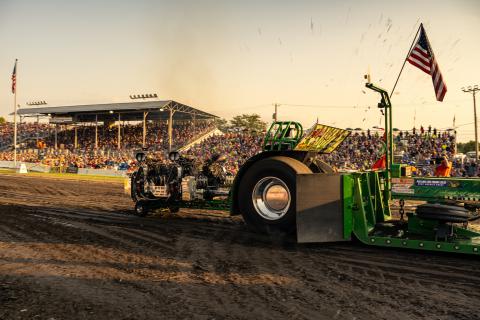
Multi-engine tractors are a fan favorite and are somewhat the signature image of the pulling sport. Here, Bret Berg has all four butterflies wide open on his Modified tractor. Photo courtesy of NTPA.
“The wedge has a valve orientation very similar to a GM DRCE3,” said Visner. “Now that we’re building our own blocks, we’re doing some things different and continuing to develop and compare the wedge and hemi. Valve geometry is the challenge because these engines have a 1.300-inch valve lift, which is very hard on the valvetrain. Pushrod angles are very important.”
The blocks will be machined from solid billet, starting with a 675-pound chunk of 6061 aluminum. Large displacement engines will use blocks with a 12-inch deck height, and smaller engines will use a 10.400-inch deck height.
“We have some unique cylinder sleeve designs, and we have some unique water jacket designs that we’re really excited about,” added Visner.
Constant Load
While pulling engines are influenced by drag racing technologies, the two sports have different needs.
“People don’t realize what a pulling motor has to do,” said Terry Hagedorn of Hagedorn Racing Engines, Thompson, Missouri. “Probably the only thing harder on a motor than truck or tractor pulling is offshore racing. You have constant load and running for an extended time. Our 800-inch motors have to run really good from 3,500 up to 8,500 plus. We get up to rpm in the first three seconds and may have to maintain that for 22 to 24 seconds. In drag racing, they’re pulling chutes after five seconds. We generally have more oil and heat issues when you’re loading the motor that severely.”
While the engines have seen huge strides in horsepower levels over the years, only incremental changes have been made in chassis design.
“Back in the 1980s, we went from mild steel to chromoly and did a lot of engineering on the design then,” said Tim Engler of Engler Machine & Tool, one of the leading chassis builders in the country, based in Princeton, Indiana. “But truthfully, the designs haven’t changed much.”
While most of the chassis have solid-mount axles, frames for some of the diesel classes are now being built with a front suspension. “It’s more for if you hit a bad spot on the track. A spring front end will cushion it and not unload the chassis near as fast,” added Engler.
Improved tires and greater horsepower have forced many competitors to adjust their gear ratios. “If the tires are better, we have to go to a little lower gear. And as they make more power you have to gear them back up,” said Engler.
Data Acquisition
Perhaps the most useful piece of technology that pullers have adapted is data acquisition. Sanctioning bodies heavily regulate electronics on pulling vehicles; however, data recorders are allowed.
“We really don’t have much new technology on the truck besides our Racepak,” said Carmen Foster, who races a 6,200-pound modified four-wheel-drive truck and was the 2021 national champion in her class. The truck runs a naturally aspirated 650-cubic-inch Sonny Leonard hemi that makes around 1,650 horsepower. “It tells us all the temperatures, throttle position, shock height, clutch slip, and more.”
Massive turbochargers, such as this diesel setup, are helping to push horsepower limits on today’s pulling tractors and trucks. Many of the classes are dictated by the sizes of both turbochargers and superchargers.
“For my own vehicle, I can download everything from the data acquisition,” said Kurt Afdahl, who runs a Light Pro Stock tractor and is president of the Wisconsin Tractor Pullers Association. “We can read cylinder temp, exhaust temp, speed, oil pressure—everything about the engine. We can fine-tune everything for our next run. It’s helped us make a lot more power, and also helps the longevity. If you’ve got a hot cylinder, you can do something before you melt that piston down. The technology has helped out in a big way.”
Keeping an eye on all the technological advances for the NTPA is tech director Marvin Epperson. He agreed with other observers in identifying tire advancements as the leading technology in the sport. But it’s also the category where some are trying to slip past the rules.
“Right off the bat some of them went over the specs and tires were too big,” recalled Epperson. “I had to shut them down, make them go back to the drawing board and narrow up the mold. Then they presented the tires to us again to be legal.”
Tires originally were molded with a tread in place, and there was no problem with illegal width. But the new tires were molded as a slick with extra rubber.
“They can cut whatever tread they want, but I don’t want to have to go measuring tires every day, so I wanted to catch them while they were brand new and then not have to worry about it,” explained Epperson.
Turbocharger design tricks are also drawing the officials’ attention. “The manufacturers are coming up with something new every day, and that’s one that may be hard to police,” admitted Epperson. “They’re doing things that are hard to find, both with the turbine wheel and the housings. The horsepower they’re gaining is just unreal.”
Since tire interaction with the track is so critical, sanctioning bodies have a strict policy against traction control devices. Ignition timing can be preset, but any adjustment based on real-time feedback from engine sensors is not allowed. Also not permitted is electronic fuel injection.
“I’m sure it’s coming someday, but as of now they’ve got too much horsepower. Once you go to EFI, it could be hard to police traction control,” said Epperson.
Engler, who is also one of the nation’s leading fuel-injection specialists, agreed. “I think [an EFI ban] honestly is a plus because I don’t think we need to get into electronics,” he said. “We build fuel injection for race car engines as well as tractors. Our mechanical fuel injection will still outperform EFI.”
Hot Topics
Perhaps the hottest trend for the pulling market is the mini tractors. There are classes for non-boosted small block engines, but the more popular vehicles sport blown big blocks. These racers stir up lots of dirt with all that power driving a smaller tire than the big tractors.
“A lot of people are switching from big tractors to the 2,050-pound mini rods with big V8s in them,” reported Epperson. “In some cases, high school and college kids are now driving them. Right now, we have an abundance of them.”
Benefits of the mini rod revolution include building and maintaining only one engine instead of three or more. The top class has a 565-cubic-inch limit with a 14-71 blower at 45% overdrive, or they can run 650 cubic inches naturally aspirated. “We also allow a single turbine with an 1,800-horsepower limit,” added Epperson.
They’re also easier to transport in smaller trailers, as the vehicle can’t be more than 76 inches wide, including tires and fenders. And, said Epperson, “the tires are cheaper.”
The number of pulling participants has increased appreciably since COVID-19 restrictions canceled so many shows three years ago. Sanctioning bodies are also considering new classes to help encourage racers to enter the sport.
One of the other hot topics for Epperson’s crew is testing diesel fuel. “You’ve got to watch these guys who will try and doctor the diesel fuel and make it a little hotter. We test the fuel with a dielectric meter. They’re allowed to mix biodiesel, but most of the time with our new numbers they can’t put very much in, or it goes over the limit,” said Epperson. “The other stuff is the water, which they spray into the turbo system. Of course, they try to add stuff that will burn, so we check the water with an alcohol refractometer.”
Finally, the latest technology to enter the world of tractor pulling doesn’t have anything to do with engines, tires, or chassis. “Now there’s Full Pull Bet, so you can bet on truck pulling,” said Foster. “There’s an app that came out, and it’s all fully legal.”
Randall cautioned that negotiations with the developers of Full Pull Bet were continuing at press time, and that officials still hadn’t seen the final version of the software. “It’s kind of like a parimutuel style of wagering, so there are no odds against the house,” said Randall. “Everyone’s hopeful that it’s going to be fruitful in getting more people to watch our sport and getting into NTPA TV.
“It’s hard to say what it will look like,” Randall continued. “But I know the people behind it certainly are trying to do things the right way.”
Family Focus
For the future, promoting the sport through social media and keeping the fans in the stands informed will be priorities.
“The last two years have been phenomenal,” said Afdahl. “Attendance is great, and we actually picked up several new pullers. I believe we’ve got 11 new vehicles coming into Wisconsin this year.”
The mini classes, including this mini modified, are very popular today due to the attractive weight-to-power configuration and much lower maintenance and transport costs than a typical modified tractor. And the crowds love them for all the action they stir up. Photo courtesy of WTPA.
The association recently purchased a large portable video board for replays and posting driver data. Afdahl said by offering commercials during down time, more sponsors have come aboard. The group has also expanded its personnel roster to assist with entries and other duties.
“For us, it’s a huge family. We’re working really hard to bring the family aspect back into pulling,” said Afdahl. “We’re encouraging families to come to the events as well as our competitors. We encourage them not to show up as a single individual but to bring the entire family. Even in the advertising, we’re incorporating families.”
Priorities for the NTPA include scheduling up to 10 multi-day Grand National-style events, similar to NHRA and NASCAR that hold multi-day national events.
“Everything is lined up the same way,” said Randall, noting that currently there are three events that are five-session, three-day events. “There are two or three more that could be in that mix easily. It’s going to take some time, money, and sponsorship, and we’re working behind the scenes. Got a lot of exciting things in the near future.”
Finally, much of the success in tractor pulling these days is due to the economy in the agriculture market.
“Probably 80% of our clientele are farmers,” said Chad Mayhill of CM Pulling Tires, Reynolds, Indiana. “When the farming commodity prices are good, the pulling side’s always good.”
“The sport is agricultural-driven,” confirmed Berg. “The ag population of the US is less than 2%, and I think that affects the number of people in the stands. As far as the sport itself, there’s a lot more money in the sport. I think the competitors have a lot more personal financial backing than 30 years ago when people were taking stuff off the farm and modifying it.
“It kind of went down the NASCAR road where all the vehicles are specifically engineered to go tractor pulling,” said Berg. “There may be fewer pullers than 20 years ago, but the guys who are left are really serious about the sport.”
POWER TO THE DIRT
Want to know what led to the sudden invasion of tire technology into the sport of tractor pulling? Sponsorship pride.
Around 2015, when Mitas was a privately owned tire company in Europe, it sponsored a popular tractor puller on the Eurocup circuit. When the owners attended an event and discovered Firestone tires on their Mitas-sponsored vehicle, they couldn’t let that conflict continue.
“So they decided to build a pulling tire,” recalled Jeff Miller of Mitas, which is now part of global giant Yokohama TWS. “From the very beginning, it was strictly designed for pulling. What’s unique about our pulling tires is that it’s an actual slick. The competitors then groove their own tread patterns.”
The tire is constructed with plenty of rubber depth to accommodate any design, and there are guide markings molded into the surface. These markings help the racer determine exactly how many treads or chevrons they want as well as the direction of each.
The first tires were given to three competitors with mixed results. Then a Modified racer tried one of those original sets of tires. “He immediately went from a mid-pack runner to competing for the win,” explained Miller. “That got everyone’s attention. Then others tried it and found a performance advantage.”
The tire is offered in two sizes, and the compound has been updated, but no specifics were released.
Offering an alternative to the traditional Firestone tire and also designing in specific elements to complement different classes is what drove Aaron Docter of Pro Puller Tires in Firth, Nebraska, to develop new product.
“Realistically, there had been only one tire offered until about six years ago,” said Docter. “A tractor with 700 horsepower and a tractor with 7,000 horsepower had to make the same tire work. Our philosophy was that we didn’t think that those two classes needed to use the same product. We saw the need for different products.”
Docter adjusted ply ratings for lower horsepower classes and added strength to tires in higher horsepower classes. “We try to make the heavier ply tires so that the tire doesn’t wrinkle too much and make the pan drop. Then you’re going to be dragging dirt, which is just dead weight,” explained Docter. “If you’re a lighter tractor, you don’t need as heavy of a ply of the tire because you’re not going to be wrinkling it down as hard. It’s just finding that balance of where it will hook and give you traction.”
The Mitas Power Pull tire gave racers a dedicated pulling tire that can be cut to their exact specifications. Note the guide markings molded into the tread surface. Photo courtesy of Dana Cerna/Mitas.
Pro Puller currently offers four sizes in different compounds for tractors. The tires are the company’s design but sourced from an outside manufacturer. As with the Mitas tire, tire cutters design and cut the tread pattern to each competitor’s specifications.
“The cutter can change the angle to either shallow or steep,” Docter said. “Also, they start with a .400-inch-tall bar, and we’re seeing some classes go down to .200-inch. Basically, we offer the closest starting point that you can get so that the cutters have an easier job.”
Driving even more tire development, outside of offering more choices, is horsepower. “It’s been a tremendous change in the last four or five years to where there are better designed tires,” said Chad Mayhill of CM Pulling Tires, Reynolds, Indiana. “They were maxed out on power. The tires couldn’t handle any more.”
Mayhill owns five molds and has the tires produced at Specialty Tires of America, a company the specializes in bias-ply tires for aircraft, mining, and industrial applications. Mayhill is also an expert tire cutter.
“The largest tire we have runs on a mini rod or two-wheel-drive class. Then we have tires for the core market down to the garden tractors,” said Mayhill. “We’ve also redone our four-wheel-drive tire to be more competitive.” —Mike Magda
When Troy Ermish faced a crossroads in his business, he followed the vintage racing path to become the “King of the 510s.”
The impact of the cars, products, and services provided by Troy Ermish Inc. can be summed up with these thoughts from satisfied customer Phil Hartstein: “There is just something so magical about walking up to a car and recognizing you are about to strap yourself into a purpose-built machine. There’s only so many people who are going to look you in the eye when you stare through your helmet, and you wonder if this thing’s going to work and perform as possible. When you see Troy on the other end of that, you certainly get that confidence that the car is built to do one thing: go around race tracks fast. That is truly a unique experience. I’ve never had a car built for me. I’ve never had my name painted on a car. This has been an absolutely over-the-top experience.”
To fully understand this experience, it’s helpful to have some background on the Datsun 510. When Nissan Motor Company set out to design the Datsun 510 in 1967, its aim was to produce an economical and reliable car. It was the influence of Nissan’s US president, Yutaka Katayama, a motorsports enthusiast, that added the element of making the car fun to drive a part of the project. The end result was a car not only well suited for economical daily transportation, but also as a driver’s car.
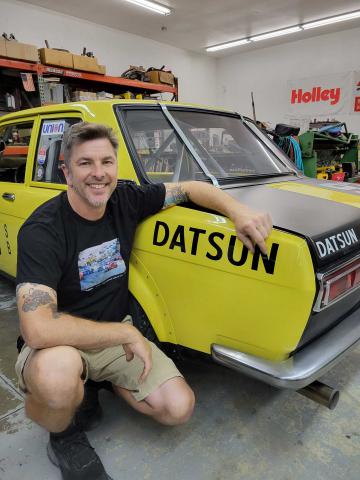
The driveability caught the attention of racers who soon learned the car was a perfect design for competition, specifically road rally style races. Luminaries such as Paul Newman and Pete Brock propelled the popularity of the car on the race track far above anything Datsun had ever envisioned, especially after Brock’s team won back-to-back Trans-Am championships with the car in 1971 and 1972. Fast forward a little more than 50 years and the unassuming little Datsun 510 is still wildly popular, now in the vintage racing circuit. A big part of the continued popularity can be traced to not only the timeless, reliable design, but also to a man referred to as “the King of 510s” by his customers, Troy Ermish of Troy Ermish Inc. in Tracy, California.
From Accidents to Opportunities
Ermish didn’t start life with the goal of becoming a 510 guru. It happened almost by accident. He had a deep appreciation for racing cars, as he was actively involved in both the NASCAR Southwest and ARCA series. One day he saw a bunch of Datsun 510s at WeatherTech Raceway Laguna Seca and knew right away he wanted to have one.
Some of the qualities of the little car that stood out to him were, in his words, “They were really well designed and really well engineered so that they really didn’t have any weak points. Seems like a 510 was ahead of its time. It was designed in 1967 and sold in 1968 in America with a five-year run ending in 1973. The only design changes made were super slight, mainly in the interior. Same engine, transmission, and differential, independent suspension with semi-trailing arm—it lent itself to be a great performance car.”
Troy Ermish Inc.’s 5,000-square-foot shop is within about 3 1/2 hours of four race tracks, which plays a key role in the success of the business.
Ermish had already been buying and selling cars, so it only seemed natural to add 510s into the mix. From there, he branched out into selling replacement parts to the people who were racing them. Quite unexpectedly, his 510 business started to grow.
“Sometimes funny things happen and accidents spill into opportunity,” Ermish explained. “For a good 10-plus years I was fixing cars for people, mainly street cars, and I continued to sell parts at swap meets to other race car guys or street car guys. That got me noticed and kind of on the map because people knew they could come to me when they needed to buy a transmission or a suspension piece or a body part.”
Ermish built his first 510 race cars for himself and one of his crew guys and began racing the 510 while also still active in the ARCA series. It was his NASCAR experience that provided an important component to the success of his business. The experience of racing his stock car gave him an in-depth understanding of chassis development, geometry, and how to make the cars work and handle better, which translated perfectly to his work on the 510s. And customers noticed.
Loyal customer Daniel Wu stated, “The fact that he races them only adds to that understanding because he’s doing R&D basically all the time. Every time he’s out on the track, if something fails, he thinks of a way that’s better. The suspension and brake packages sold through his shop are something he’s developed over time based on the fact he’s got a lot of hours and seat time in these cars and kind of knows what they need best.”
Fellow customer Hartstein agreed, adding, “I’ve really come to appreciate how much he understands these cars. I think he makes adjustments for specific drivers. He always seems to tailor his advice, guidance, and setup on the car based on what a specific driver needs.”
In the beginning, there was some overlap, with Ermish running both vintage race cars and stock cars, but that changed around 2013 when he decided to focus solely on the Datsun business. From then on, the business really took off.
“It just kind of went crazy after that,” he recalled. “It was odd because it was sort of like the buddy system. One guy would see a car, and I’d finish it, and then his friend would want one. These were guys who could certainly afford any kind of car they wanted. They had many other highly collectible, valuable cars, and they thought that 510s offered the best bang for the buck. The funnest car to drive, the most economical, entry-level, race-level race car they could own, and it required the least amount of maintenance—that’s what drove them to wanting Datsun 510s. A lot of my early customers would have two cars, a 510 they’d campaign at a vintage event and in conjunction, they’d have a historic stock car, a historic Trans-Am car, all these other high-dollar cars, and they’d always migrate back to the 510 because it was so fun to drive.”
The suspension and brake packages Troy Ermish sells “are something he’s developed over time based on the fact he’s got a lot of hours and seat time in these cars,” said customer Daniel Wu. “The fact that he races them only adds to that understanding because he’s doing R&D basically all the time.” Employee John Bionaz is seen here.
Not only does Troy Ermish Inc. build vintage road race cars, but the company also builds street cars, with a current split of about 50/50 race cars to street cars. Occasionally, the shop will also do a special SEMA build. One such build was done for actor and auto enthusiast Wu. Wu’s 510 was entered in the 2017 SEMA Battle of the Builders and placed in the top 10 of the Sport Compact division. Wu proudly stated, “The car is called the Tanto because it’s the little, tiny knife brother of the katana sword. Just because it’s small doesn’t mean it’s not deadly.”
Wu first met Ermish when the Tanto car was built. He had considered other builders, but after carefully weighing all options, it just made sense to go with Troy Ermish Inc. At the time, Ermish wasn’t known for building show cars, but together, Ermish and Wu worked on the project to create the ultimate 510 show car.
“With his expertise,” Wu explained, “I had the vision for it, all the bright-work bronzed, the Porsche interior, a mix and match of everything. I made the aesthetic decisions, and he helped with the motor and build. He is very meticulous and has worked exclusively on these cars for 25–30 years, so he knows them inside and out. It’s a custom car, so it will have issues. There really weren’t any, but he was there right away to take care of anything. He’s a great guy and stands behind his work. A real, true expert on the 510. What we were doing with Troy was trying to do the highest end and build the ultimate 510.”
In addition to building complete vintage and street cars, Troy Ermish Inc. can also take care of smaller jobs, too. “We fill in with guys who come in and just want a suspension package or an engine package,” Ermish said. “We don’t have to do a complete restoration. We’re capable of taking care of a guy’s small needs, someone who just wants a brake package, or suspension and brake package. Maybe it’s someone who just wants a daily driver, doesn’t want a race car and won’t do any track days, and just wants something that runs well and handles well. We’ll manufacture a lot of things to make those upgrades. We do our own sway bar packages, brake packages. We’ll buy calipers and rotors from Wilwood or StopTech, and we’ll make all of our own brackets, mounts, and those sorts of things.”
This touches on another key to the success of any of Troy Ermish Inc.’s builds: the strong, long-time relationship with Rebello Racing, a premier Datsun racing engine builder in Antioch, California, which is within 45 minutes of the Ermish shop. The two racing businesses work hand-in-hand, and Rebello builds all the engine packages for every single build Troy Ermish Inc. does.
“I’m not his only customer,” Ermish said. “He is super busy, but he and I struck up a great relationship. So for the last 15 or so years, he’s been an exclusive engine builder for me and is track proven.”
Loyal Customer Base
Troy Ermish Inc.’s shop is within about 3 1/2 hours of four race tracks, which plays a key role in the success of the business. The shop is designed to be efficient, just like the cars that come from it. It covers 5,000 square feet and includes four lifts. Besides Ermish, there is only one full-time employee in the shop, John Bionaz, and Ermish’s wife, Ashley, who handles all the shipping, receiving, bill paying, ordering of parts, inventory control, social media, transportation and towing of customers’ cars, paint, and most importantly, makes sure the lights stay on and the shop keeps generating positive cash flow. “She’s really involved,” Ermish emphasized.
A key to the success of any Troy Ermish Inc. 510 is Ermish’s relationship with Rebello Racing, a premier Datsun racing engine builder. “For the last 15 or so years he’s been an exclusive engine builder for me and is track proven,” Ermish said.
Ermish lets the quality of his work do the promotion. “I’m a believer in what I build. I don’t have to gimmick it; I don’t have to over-promote it. I let the finished product speak for itself and let the customer satisfaction promote it.”
One of the benefits of this approach comes when a high-profile customer is involved. “They’re treated no differently than the guy down the street who just wants a brake job,” Ermish said. “It’s no different with the exception that a high-profile customer has more social networks.”
Exposure from those social networks allows anyone to search the Internet and find videos of these customers showing and racing their cars, sharing their satisfaction with the Troy Ermish Inc. experience around the world, typically capturing a larger audience than any special promotion ever could. As an example, Ermish built a car for Greg Elliott, who was the prop master for “The Tonight Show with Jay Leno.” Leno included a segment in his recent show, “Jay Leno’s Garage,” about Elliott’s Datsun 510, which can be found with other videos on Ermish’s website, ermish-racing.com. As Leno was test driving the car, he enthusiastically said, “This car’s going to be the ’57 Chevy of the import world.” This sort of high-profile exposure is something that would be very hard for any ad campaign to match.
Every business faces its own challenges, and Troy Ermish Inc. is no different. In the early years things were simpler, as there was little overhead, and Ermish was governed by the amount of time and money he had available, being the company’s only employee. As the business grew, time management and meeting all the demands of the growing customer base became more important. For this, Ermish has a simple formula: “I don’t want to overextend myself buying more lifts, getting more property, and hiring more employees. I don’t want to be in a position where I have a chance for failure. I would rather take longer to do a job or miss out on one job to make sure I have three customers who are super happy and have the jobs get completed in a timely fashion.”
Ermish also faces a common post-COVID-19 challenge, which is “finding motivated individuals who are doing the same kind of thing I am to stay afloat. People don’t work as hard or as fast, and they’re not driven. If I could find one more full-time employee, I’d probably hire that person. That person is getting harder to find. The skills needed for this job today are diminishing.”
Customer support is always important for sustained longevity of a company, but what Ermish does for his customers could be redefining the term. For street car customers, he offers his three decades of experience and says he’s always there to take care of a customer who has a question or a problem.
On the road race side of the business, Ermish has customers who fly in from different states and countries to race. He houses the cars, maintains them, provides track support, transportation, and then does it all over again, race after race, for as many races as they want to do.
The cars are already shaken down for the race. “I take them to a track day,” Ermish said. “I’ll take them and dyno them so they’re 100% prepared for these guys to come to the race track. We have an extensive spares package, so if something goes sideways, we have engines, transmissions, differentials. We had one customer last year who made a mistake, ruining his engine. We did an engine removal and replacement in three hours, and he didn’t have to miss a track session. On average, we’d have three to four events with these guys, and we’d have to take four to six cars to the track. We’d have a couple of my crew guys from my stock car team come out and help because I can’t take care of six cars and my own car at the same time, provide a crew for them, and take care of all the little problems. All they’d have to worry about is putting a helmet on and having fun.”
Troy Ermish makes a shakedown run of customer Phil Hartstein’s 510. “To see my car perform before I ever actually got into it to drive it was really eye-opening to me. Really a fantastic experience,” said Hartstein.
Perhaps the depth of Troy Ermish Inc.’s commitment to customers and the sport can by typified in the experience of Hartstein. He got involved in racing as a hobby when he was about 40 years old. He started out in an Alfa GTV, spending about a year refurbishing it until it was safe to drive at speed. Upon getting it on the track, he soon discovered, while fun, the car was simply not competitive.
When looking for an alternative, Hartstein looked at all the cars in the B-Sedan class and settled on the Datsun 510. This was his introduction to the 510 world and to Troy Ermish.
Hartstein called Ermish and said, “I was about to buy a car. Would you mind taking receipt and delivery of this vehicle and just giving it a shakedown for me? Let me know if it’s safe.”
Indeed, Ermish brought the car up to racing standards, and Hartstein would go on to campaign that car for the next several years until the day came when Ermish told him the car had too many problems that couldn’t be fixed easily. Hartstein decided it was time to build a car.
“We started talking,” said Hartstein. “He explained to me what the process of developing a new car was. It took about a year [to build the car] while I drove my original car until we showed up at Thunder Hill for the first race this year. Troy arrived a day early. He wanted to make sure it was ready and safe, so he took it out for a cruise. To see my car perform before I ever actually got into it to drive it was really eye-opening to me. Really a fantastic experience. It was my first experience with true professionalism and performance dynamics of the mechanical limits of how these cars work.”
Troy Ermish Inc. is strictly a high-performance business, so there are no warranties involved in the products, but Ermish still backs what he builds. “I’ll be fair. We do our best to make the customer feel they didn’t just waste a big pile of money. We work in good faith and make concessions. I like to say I’m pretty thorough, and we don’t have mechanical issues. I like to think I’m a fair individual, and if we can make it right, we will.”
The success of Troy Ermish Inc. boils down to his commitment to the quality of his work, the Datsun 510, his customers, and to the sport. This commitment is captured in this observation by Hartstein: “One of the sweetest things is he married his wife Ashley on 5-10, at 5:10 pm. Their wedding colors were the colors of his race car. It gives you a sense of how dedicated and committed Troy is to the 510.”
A look at some of the country’s in-demand motorsports products and services by region and racing segment.
Motorsports retailers and service providers are tracking the latest parts and trends to give their customers a competitive edge. For the latest on which products and services are moving the retail needle, we present the following sales snapshots from shops across the US.
Bryant Racing Equipment Navarre, Florida
Thanks to high demand by owners of high-performance vehicles, fast-moving products for Bryant Racing Equipment, situated in the Florida panhandle, include Allstar Performance’s rivets and body bolt kits and AN fittings from brands like Brown & Miller Racing Solutions (BMRS) and XRP.
“Companies like Bassett Wheel, Bert Transmission, Wehrs Machine, and Schoenfeld Headers also offer excellent quality products that we can sell in a competitive market,” said owner Randy Bryant. The shop also carries DirtCarLift and VP Racing Fuels, and builds and crimps BMRS plumbing lines in-house.
In addition, Bryant Racing was busy supplying racers with safety items such as fire suits from RaceQuip and harnesses from Simpson Racing due to their price and quality, according to Bryant.
“We service pro and novice racers, from pavement and dirt Super Late Models to big block Mud Truck racers and everything in between,” Bryant said.
Dan’s Service Center Three Lakes, Wisconsin
Dan’s Service Center is a diesel repair/fabrication shop, primarily handling turbochargers, injectors, head gaskets, transmissions, and related components. The majority of the business is diesel and automotive repair; however, performance work is an area the business wants to grow and is passionate about. Its specialty is diesel performance, and owner Dan Zelten is particularly proud of a Duramax-powered race truck the company has built to showcase and advertise the business.
In addition to diesel repair, regular maintenance work, and transmission swaps, the shop also installs engines in custom hot rods. The company uses S&S Diesel Motorsports parts for fuel systems because, as Zelten stated, “they are some of the best fuel products out there.” Other fast movers include products from Stainless Diesel and Midwest Turbos.
The main driver behind the customer’s thirst for these parts and services is the business’s known reputation for being honest, open, and up-front with everyone, and its practice of treating customer vehicles as if they were its own. This is a formula that has proven to be successful, as Sarah Zelten said. “We do not advertise. All our business is by word of mouth, which is something we take pride in. Additionally, our race program helps promote what we can do.”
The race program includes a presence at No Prep and ODSS events at Rock Falls Raceway and Great Lakes Dragaway, which attracts both local customers and those from neighboring states as well.
Hathaway Performance Falcon, Colorado
Hathaway Performance is a brick-and-mortar performance parts store that does about $125,000 per year in sales. In addition to parts sales, it also does shock repair and service, and it is a full-service fabrication shop, building and repairing primarily oval track race cars and hot rods. The shop has a varied customer base, covering dirt and asphalt oval, drag race, and road race cars, with racers making up approximately 85% of its core business. Customers purchase products that provide better performance on-track, parts that produce more horsepower or better handling, parts required by new sanctioning rules, or as Mike Hathaway said, “they are copying what their buddies are winning with.”
For new car builds, off-season repairs, and improvements, Hathaway pointed to products from Allstar Performance, Fragola, Driven Racing Oil, Wix Filters, and Racing Optics as his fast movers. He said his customers like the “quality, price point, and availability” of these parts. Hathaway said he keeps a large selection of the products in stock and has carried these products for a long while with no issues keeping the shelves stocked.
Although Hathaway does some social media advertising, the parts “mostly sell themselves through word of mouth and the brands’ reputation.” Most of his customers are regional and compete on the area’s dirt oval tracks and Colorado National Speedway, participating in sanctioning bodies such as IMCA, NASCAR Weekly Series, NASA, and Colorado Hill Climb Association.
The Monterey County Board of Supervisors has approved a five-year extension for WeatherTech to continue as the naming rights partner of WeatherTech Raceway Laguna Seca, which is owned by the County of Monterey in California.
The new agreement--reported to be $1 million per year--will extend through June 30, 2028. WeatherTech became the title sponsor in July 2018 for its initial five-year involvement.
"The WeatherTech team's enthusiasm for motorsports and our community is unmatched," said John Narigi, president and general manager of WeatherTech Raceway Laguna Seca.
The announcement comes as WeatherTech Raceway nears completion on several projects, including the new Start/Finish bridge, site and drainage work, and the historical track's repaving. The grand reopening will be held Friday, July 7, during the MotoAmerica Superbike SpeedFest.
Rick W. Norton Jr., the founder of Callies Performance Products in Fostoria, Ohio, passed away in April. He was 76.
Norton began his career in the industry in 1969, working for his father, Richard Sr., at Norton Manufacturing Company, which was founded by his grandfather in Fostoria. Norton later expanded the family-owned tool-and-die business into performance automotive crankshafts under the Callies Performance Products name in 1989.
Norton later founded Energy Manufacturing, Aviation Manufacturing and Tecnoma Industries.
"He will be sorely missed by his families both at home and at work (Aviation Manufacturing, Callies Performance Products and Energy Manufacturing) and is a larger-than-life personality that asked for little and gave much to many," said Heath Norton in a social media post. "He has an absolute passion for manufacturing and taught all who worked with him, and he is rewarded with fierce loyalty and dedication by his work family. We will continue our march forward to provide our customers and friends with world-class products."
To honor Norton, Callies Performance Products has announced a Celebration of Life event set for Monday, June 26, from 12:00 p.m. - 5:00 p.m. EDT.
The event--held at Callies Performance Products, 901 S. Union St., Fostoria, Ohio--will benefit the Greater Fostoria Community Foundation for a scholarship fund in Norton's name. The scholarship will benefit local students pursuing a career in the manufacturing and metalworking industries.
Attendees will be able to take a tour of Callies Performance Products, get autographs and photos with three-time NHRA champion Ron Capps (12:00 p.m. - 1:00 p.m. EDT) and view NHRA cars on display, including the Funny Car driven by Ron Capps and the ProMod driven by J.R. Gray and tuned by 2018 NHRA Pro Mod Champion Mike Janis.
Those that cannot attend but want to donate can send checks to:
Greater Fostoria Community Foundation
PO Box 684
Fostoria, Ohio 44830 Note in check memo: Richard W. Norton, Jr. Scholarship Fund
T-shirts are also available for $20, and proceeds will benefit the scholarship fund. Shirts can be purchased at the event and online through the Callies website, callies.com.
The International Hot Rod Association (IHRA)--based in House Springs, Missouri--has announced the IHRA Hot Rod Classic is set to debut in 2024.
"Since we took over IHRA last year, we've heard from so many racers how they wish we would bring these classes back," IHRA Owner Larry Jeffers said.
Similar to the Pro-Am races from previous years, teams will compete in Quick Rod, Super Rod and Hot Rod classics to earn special black and chrome IHRA Ironman trophies.
In addition, there will be a heads-up Real Steel, No-Time class that requires OEM steel shell, steel doors and steel fenders (except those originally fiberglass, which must be factory-original parts). No Billet heads or engine blocks are allowed.
Top Sportsman and Top Dragster will also be contested at the majority of events, depending on location, as will bracket races for the Top (Box), Mod (No Box) and Junior Dragster classes. Each event will be tailored to the individual tracks and racers must be IHRA members to compete in these events.
For more information, visit the IHRA announcement here or visit ihra.com.
The staff, Board of Directors and volunteer leadership of the Specialty Equipment Market Association (SEMA) and Performance Racing Industry (PRI) would like to thank William "Bill" G. Miller for nearly 16 years of service.
Miller, who will move on from the association as of July 7, has served as senior vice president of operations since 2007 and will provide consulting services through December 2023.
Mike Spagnola, SEMA and PRI president and CEO, stated, "I was fortunate to introduce Bill to SEMA back in 1996 and work with him on a daily basis for the last decade. It is always bittersweet to have someone like Bill leave our team to pursue new opportunities, but we wish him and his family nothing but the best."
During Miller's tenure as senior vice president, the association evolved to meet the challenges and needs of its membership. Working with the SEMA staff and Board, he was integral in helping navigate the association through several challenges and opportunities.
 MEMBERSHIP LOGIN