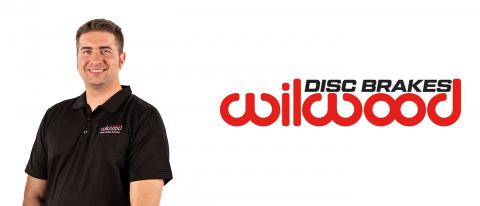
Wilwood Engineering--the Camarillo, California-based designer and manufacturer of high-performance disc brakes and components--has appointed Robert Hemingway as its new director of engineering.
Hemingway will join the research & development (R&D)/engineering team and focus on Wilwood's ability to design and produce premium-quality brake components and systems utilizing the latest manufacturing and new material technologies.
"I am excited to join the iconic Wilwood Engineering team and lead the already successful research and development group into the future. Let's grab another gear and push the pedal to the floor as we begin the next chapter of what the best brake systems in the world are and will always be."
With over 10 years as an engineering hardware development professional in the automotive, aerospace and defense industry, Hemingway most recently served as a senior development engineer at Garrett Motion in Torrance, California, where he helped launch new products.
Prior experience includes a position with Honda Performance Development as the top-end development lead for racing categories from motocross to IndyCar.
United Race Parts, the motorsports pit equipment and product provider based in Troutman, North Carolina, will expand into a larger facility in the South Fork Business Park in Mooresville, North Carolina, according to published reports.
The company was approved for town and county incentive grants to help it establish a new 20,000-square-foot facility, a project expected to cost $3.2 million and create up to 10 jobs.
Officials with the Off-Road Motorsports Hall of Fame (ORMHOF) have announced the honorees for the 2023 Hall of Fame Impact Awards presented by Yokohama Tire.
"We want to recognize the people in the sport of off-road who are making an impact in off-road. There are so many great people in our sport it gets harder every year to narrow down the list. The Impact Award honorees are on track to becoming inductees one day, and each year we will continue the recognize the up-and-coming generations as they continue to help grow our industry," said Bud Feldkamp, ORMHOF inductee and board member and chairman of Glen Helen Raceway.
This year there are three honorees in each of six categories: "Adventure," "Desert," "Industry," "Moto/ATV," "Rock Sports" and "Short Course." For 2023, "Media" and "Advocacy" were combined into "Industry," and UTV honorees are recognized in "Desert," "Rock Sports" or "Short Course" rather than in their own category.
The ORMHOF Board of Directors selected the honorees, and voting members will choose a Voters Choice in each category by email ballot. Voting takes place during August, with the results announced at the 2023 Induction & Awards Gala presented by 4 Wheel Parts on Saturday, September 9, at the South Point in Las Vegas.
(front row) Eric Bewersdorf, Reed Lubbers and Evan Belleville. (back row) Colin Belleville.
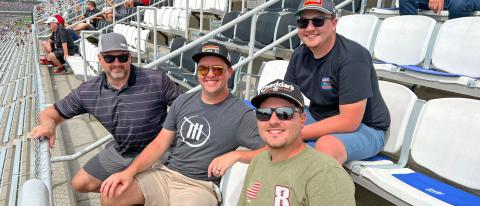
On Sunday, August 13, the automotive industry witnessed exhilarating on-track action alongside a successful collaboration between PRI and SEMA Political Action Committee (PACs). The highly anticipated fundraiser, held during the Verizon Brickyard 200 race, was a resounding success, bringing together industry leaders, local media and passionate race enthusiasts for an unforgettable event.
Deborah and Mansen Way.
Against the backdrop of the iconic Indianapolis Motor Speedway (IMS), nearly 50 PAC members, most of whom were first-time donors, raised more than $14,000 to support our shared mission to advocate for the interests of the automotive aftermarket sector and racing communities. This accomplishment is a testament to the dedication and enthusiasm of all those who participated and contributed to the event.
Attendees were treated to a day filled with excitement and camaraderie. The race track's atmosphere buzzed with the energy of industry professionals and enthusiasts coming together to celebrate their common passions. The synergy of networking, sharing insights and uniting for a meaningful cause added a unique layer of excitement to the event.
Karen Bailey-Chapman, Matthew Glasscock and Scott Davis.
The fundraiser's success was only possible with the dedication and support of each participant, donor and supporter. Together, we have reinforced the significance of advocating for our industry's growth, development and sustainability.
Reflecting on this remarkable event, we extend our heartfelt gratitude to everyone who contributed, attended and participated. Your involvement has propelled our mission forward and strengthened the bonds that make our industry a vibrant and resilient community.
Thank you for being a part of this incredible journey. Here's to many more successful collaborations and fundraisers that contribute to the prosperity of our industry.
National Auto Sport Association (NASA) has announced that NASA Southeast 944 Spec racer Michael Dearstyne has been named the new national director for the series. He replaces Dan Piña, who is leaving the role after eight years.
"Michael has upgraded, sold and built at least 20 cars for the class nationally. Mike has served as my stand-in at the previous nationals, and is already familiar with the procedures involved," Piña said. "Mike has even more technical knowledge of these cars than I do, and I've been keeping Mike in the loop of all the rule changes, vendor relationships, etc., over the past few years."
"Piña was instrumental in sourcing OEM-style replacement pistons from CP Carillo, which allowed competitors to overbore engines so they can continue racing in the series. Piña also paved the way for the use of steel LA Sleeves in the Alusil blocks used in the Porsche 944, another measure devised to preserve the viability of 944 Spec. He also worked with vendors to offer NASA competitors special discounts on short shifters, front valance panels and aftermarket fuel rails to prevent engine fires," said a NASA release.
Garrett Motion--the global differentiated technology provider--has announced an expanded distribution channel through a new agreement with Holley Performance. This strategic relationship will allow Garrett Motion to strengthen its presence to better serve the performance enthusiast's needs, the company stated.
"We are thrilled to welcome Holley Performance as an official performance distributor," said Kari Bye of Garrett Motion. "Their reputation for outstanding customer service, exceptional order fulfillment and extensive enthusiast network make them a perfect partner to boost our growth in automotive performance."
"We are excited to carry the Garrett Motion product line and to bring their turbochargers, intercoolers, and wastegates to our customers," said Mark Emerson of Holley Performance.
As part of the partnership, Holley will carry Garrett turbos, intercoolers and wastegates and also provide support to customers. For more information, visit holley.com/brands/garrett_turbochargers/.
Get ready for the PRI Show's highly anticipated Featured Products Showcase, returning for this year's event, December 7-9, in downtown Indianapolis. Once again, tens of thousands buyers, enthusiasts and media members seeking the latest cutting-edge performance products are expected to prioritize this exclusive Show feature.
And PRI Show organizers have exciting news for 2023: the Featured Products Showcase has found a new home at the Indiana Convention Center (ICC) Capitol Connector, strategically positioned near the Yellow Hall, Georgia Street entrance, Capitol Cube hanging car and the PRI Paddock. This fresh location promises amplified exposure and visibility for your products, encouraging increased foot traffic to your booth.
Participants of the Featured Products Showcase are automatically eligible for PRI's prestigious Featured Product Awards, recognizing top products across various categories. The winners will be selected by a panel of esteemed industry experts, including track operators, sanctioning bodies' representatives, social media influencers and media members. The Featured Product Awards is another excellent opportunity to showcase your products to the racing community and gain more publicity and recognition.
Don't miss this opportunity to be a part of the renowned Featured Products Showcase at the PRI Show. Register today and prepare to leave a lasting impression on the racing world with your exceptional products!
Key details:
Early Bird Pricing: First product submitted before 12/1/2023 is $50. Additional products (up to five total entries) are $75 each. After 12/1, exhibitors must register their products on-site in Indianapolis.
On-site Pricing: First product is $100. Additional products (up to five total entries) are $125 each.
All entries include free promotional exhibitor booth signage and an 8 ½" x 11" display sign provided by PRI.
Autocross and time trial competitions leverage many of the strengths of a burgeoning technology, but EVs also present organizers with a new set of challenges.
While the auto industry continues to ramp up development and production of battery-powered road cars, their embrace in the motorsports realm has been a significantly more gradual affair. Factors ranging from vehicle cost and aftermarket support to fast charger availability and the current limitations of the technology have all attributed to EVs’ measured adoption rate in the racing world, but there’s an increasing number of segments where they’re gaining ground.
Autocross and time trials, in particular, are two segments where EVs have shown significant promise thanks to the disciplines’ formats as well as potential performance advantages that the technology can provide. As more of these vehicles show up to events, sanctioning bodies and organizers are responding in turn to create a place for them within their class structures, establish a level playing field, and ensure the safety of everyone involved.
Sports Car Club of America
“At the national level, I think we’re still in an early adopter phase, but it’s not surprising to us that we’re seeing more people showing up with electric vehicles,” said Heyward Wagner of Sports Car Club of America (SCCA), Topeka, Kansas. “It’s the people who’re often the first to dive into new technologies and ideas. At the regional level, what we’re seeing is that a significant portion of the people who’re coming to us with EVs and electrified vehicles are different types of enthusiasts than we normally get. They’re more in tune with technology in general, and the car itself is the conduit into motorsports interest more so than we’ve traditionally seen.”
In 2021, the SCCA introduced Electric Vehicles Experimental (EVX), a provisional autocross class that, in terms of vehicle preparation, takes much of its inspiration from the Street and Street Touring classes. But the ruleset also takes EV-specific considerations into account.
Global Time Attack classes EV entries as it would any other car. “There are no horsepower limits in any of the classes,” said Jason Dienhart. “The way we classify cars is largely based on the stickiness and width of your tires, how much aero you’ve added to the car, and weight reduction efforts.”
“We have this emerging market of people who’re really into this stuff, and we want to give them a place where they can congregate and run,” Wagner explained. “EVX is a little more open from a rules standpoint so that people can play with the cars a bit, but it’s intended to be something that you can do with a car that you drive on the street every day. The idea is to bring in common aftermarket bolt-ons that are currently available for EVs, things like 200-treadwear tires, control-arm kits, camber kits, and so on. Part of the concept behind EVX was to create a space for these cars while this market matures.”
Wagner said that the SCCA’s long-term goal is to integrate EVs into larger, pre-existing classes where they can compete among other EVs as well as internal combustion-powered vehicles. At this stage in the market’s development, the challenge is less about making the technology competitive and more about developing best practices that satisfy the entire field.
“We’ve classified Tesla Model 3s in B Street and A Street in the past, right alongside internal combustion cars. We’ve done that because that’s a core value to us—we classify cars based on their performance potential, not based upon their drivetrain. The challenge is that these cars are programmable, so the performance might change between the time we classify it to the time it’s being used to compete. But it’s important to us to get this figured out because part of what makes SCCA interesting is having a diverse field of cars competing against one another. To us, that’s kind of the Holy Grail of motorsports.”
He noted that the SCCA’s current approach encourages EV racers to focus on modifications outside of the powertrain. “Because of the weight of the cars, they’re really alignment sensitive—they need a lot of camber to really work well. Suspension is probably the biggest space where we’re seeing aftermarket development right now.”
As NASA integrates EVs into its events, it is working on technical compliance procedures. “All of these EVs have their own proprietary software solutions, and it’s not easy to plug into those systems to make sure that a participant is operating the vehicle with a declared tune,” said Jeremy Croiset. NASA’s solution is to require EVs to “remain in stock configuration, aside from some allowed minor modifications.”
On the time trials side of the equation, the SCCA has been integrating EV entrants into existing classes from the outset, most of which land in the Sport and Tuner categories. “Because we’re still in the infancy of all this, nobody at the amateur level is really building a car to its ‘full potential,’ so most of them end up in those classes. We have seen a few that have gone to the Max category, which allows a broader range of modification, but that’s less common.”
In terms of safety, Wagner pointed out that although the National Highway Traffic Safety Administration data indicate that EVs pose less of a fire risk than internal combustion vehicles, the SCCA has faced some difficulties that originate from outside of the organization. “We’re working closely with the facilities to make sure that we’re in alignment with their expectations, but there are a lot of tracks that are shying away from electrified vehicles right now, so we’re trying to manage that. There’s a lot of concern that, if you have an electric vehicle fire, nothing will put it out. So some tracks are saying that they don’t want electrified vehicles at their track at all because of fire risk, while other tracks are saying that EV drivers need to sign a specific waiver that holds them accountable for any damage the vehicle does to that track. And there are other tracks that don’t have a concern about EVs at all. From my point of view, this is really the most interesting part of the conversation right now because we don’t know enough yet in order to make good policy. There’s a lot of ‘wait and see’ going on right now with the tracks. Nobody wants to be the guinea pig.”
Global Time Attack
The first EV entrants at events for Global Time Attack (GTA) in Torrance, California, began appearing roughly four years ago, and in the time since, the series has seen a steady uptick in these vehicles at events across the country. While most are street-driven examples, GTA series director Jason Dienhart said that they’ve also seen builds that are near the forefront of EV innovation.
“Evasive Motorsports, for instance, built a Tesla to compete at Pikes Peak, which Dai Yoshihara drives. They’ve taken that car to a couple of our Global Time Attack competitions, and they recently brought it out to our Super Late Battle at Circuit of The Americas as well. Since it’s a Pikes Peak build, it fits really well in our Unlimited class in GTA. There’s also Unplugged Performance, which specializes in EV tuning and building EV race cars. They’ve also done a couple of cars that have competed at Pikes Peak, and they brought a car out to the Global Time Attack finals at Buttonwillow Raceway last year. So we’re starting to see really dedicated hill climb builds that also effectively translate to what we do.”
He told us that Global Time Attack approaches classing EVs like it would with any other car. “They’re integrated into existing classes because we take a pretty traditional approach to time attack. The big thing with us is that there are no horsepower limits in any of the classes. To generalize things, the way that we classify cars is largely based on the stickiness and width of your tires, how much aero you’ve added to the car, and how much you’ve taken out of the car in terms of the interior and other weight reduction efforts.”
“A significant portion of the people who’re coming to us with EVs are different types of enthusiasts than we normally get,” said SCCA’s Heyward Wagner. “They’re more in tune with technology in general, and the car itself is the conduit into motorsports interest more so than we’ve traditionally seen.”
EVs are held to the same safety ruleset as other vehicles in the series, and Dienhart said that GTA organizers have been diligent about booking their events at tracks that maintain an EV-friendly policy. But when it comes to figuring out where and when to charge the cars, that responsibility ultimately falls on the drivers.
“At this point, some of the experienced racers have kind of integrated that into their strategy,” he said. “Like, ‘OK, if I’m running at such and such track, I know I need to drive down to Starbucks and charge up a couple of times throughout the day. With our series, there’s usually 45 minutes to an hour and 15 minutes between a group’s sessions, and each group normally gets four sessions a day. That means there’s a chance you’ll miss a session while you’re charging the car, and you just have to plan for that. So with tracks like Buttonwillow adding Tesla Superchargers, it adds an incentive for those guys to run at those particular facilities.”
National Auto Sport Association
Like the SCCA and Global Time Attack, National Auto Sport Association (NASA), based in Las Vegas, Nevada, has also seen a steady increase in EV entrants. Organizers noted that time trials were becoming a particular area of interest for these racers, but there wasn’t an effective way to integrate these cars into the organization’s existing class structure, so they created one to provide a space for those competitors.
“We started TTEV (Time Trial Electric Vehicle) because there just wasn’t a really good way to bring these cars into our other classes,” said NASA CEO Jeremy Croiset. “But we are working toward that goal. Right now, a big part of the focus is developing the capability and expertise to ensure that our technical compliance procedures can be done to the same level that we’re using with the ICE-powered vehicles. All of these EVs have their own proprietary software solutions, and it’s not easy to plug into those systems to make sure that a participant is operating the vehicle with a declared tune and things like that. So, in the TTEV category, we make it pretty clear that participants can run specific vehicles like the Porsche Taycan, Tesla Model 3, and Tesla Model Y in stock configuration, aside from some allowed minor modifications for things like cooling. Outside of that, it’s pretty much as the car is delivered from the factory.”
NASA created TTEV (Time Trial Electric Vehicle) “because there just wasn’t a really good way to bring these cars into our other classes,” said Jeremy Croiset. “But we are working toward that goal.”
NASA has also been working with EV manufacturer Scalar, which is currently developing a race car that can be entered in wheel-to-wheel competition. Rather than relegating it to a one-make series, the goal is to run the cars alongside the likes of modified Corvettes and Porsche 911s in the Super Touring 2 class sprint races.
“They’re taking brand new Toyota GR86s, taking out the ICE powertrain, and converting the cars to an EV powerplant,” Croiset explained. “They recently ran their first race under NASA sanctioning at our HyperFest event at Virginia International Raceway. From the standpoint of a sanctioning body, you’re looking to achieve this delicate balance because you don’t want to chase away your current competitors with a car that can overachieve in its class, but you also want to give the newcomer a shot, so they have the ability to grow.”
Importantly, Scalar appears to have taken some of track organizers’ primary concerns into account during the development of its EV powertrain. “They’re kind of leading the way in that regard,” Croiset said. “One thing that’s particularly interesting about the Scalar SCR1 is that it has an integrated fire suppression system that runs through the battery. So if there is a fire or a suspected fire and you activate the system, the agent itself can run into and through the battery. They’ve also developed additional safety elements into the battery design, like thermal barriers between the cells to help mitigate thermal runaway.”
Croiset added that the current challenges that EVs face in motorsports are largely temporary, and it’s simply a matter of time before those are resolved. “I think it is the way of the future, and right now we’re just dealing with a situation where innovation hasn’t kept up with the side of the market that’s driving consumers to buy street cars. As we see more and more EVs running at the race track, I think it will drive more innovation on the motorsports side to develop those solutions.”
50th Anniversary of the SCCA Solo Nationals
Back in the early 1970s, autocross competitors were faced with an array of different rulesets created by various independent entities across the United States. Organizers within the Sports Car Club of America (SCCA) and elsewhere were keen on establishing a unified standard, but the catalyst that gave birth to the SCCA Solo Nationals originated from a rather unlikely source.
“I think the idea to do a national event came from Schlitz Beer, actually,” Heyward Wagner said. “It was originally kind of a promotional thing, and the SCCA saw an opportunity to use that as a bit of a lever to start kind of unifying the sport and get to one ruleset.”
Over the past five decades, the Solo Nationals has been through several distinct eras that have helped to shape the event into what it is today. “I remember [SCCA historian and hall of famer] Rocky Entriken telling me that at the first Nationals, it was basically like a normal, regional SCCA autocross event,” he explained. “Nobody knew what to do yet, or how to build a car for it, so they basically just brought the car they had and just figured it out as they went along.”
After the event moved to Salina, Kansas, in 1983, the Solo Nationals entered a new, more competitive phase. “I think they had about 400 cars showing up at that point,” said Wagner. “That quickly grew to about 600 or 700 as interest increased, and that’s when we started to see the commercial impact on the sport.”
Suddenly tire manufacturers were directly involved, the OEs were taking notice, and support was coming in from suspension companies. “We think of that as kind of the ‘tire war’ era,” he said. “At that point there were several tire companies contracting drivers, trying to get class wins. There were a lot of bragging rights tied up in that.”
The Solo Nationals later moved to Topeka, Kansas, which paved the way for what Wagner considers to be the event’s modern era. “Now it’s more about the overall experience. It has kind of matured into this tailgate party, autocross family reunion kind of thing that’s fun and inclusive.”
More than 1,200 drivers are expected to compete at this year’s 50th anniversary event, which will take place September 4–8, at Lincoln Airpark in Lincoln, Nebraska, and the SCCA plans to celebrate the occasion in grand fashion. “There will be a welcome party on Monday night where we’ll honor our hall-of-fame members and other folks who have won major awards over the years. On Tuesday we’re going to have a gala that will include speakers from different eras of the event, and we’ll also be visiting the SCCA Solo Nationals installment at the Museum of American Speed there in Lincoln. It’s really the centerpiece of the event this year.” —Bradley Iger
A hot-rod rebel at heart, Michael Bream found engineering freedom on the wide new frontier of EV racing with EV West. Here, he offers us his unique perspective—and candid comments—on both the immediate limitations and long-term promise of electric auto racing.
Michael Bream believes that electric power will save auto racing.
He speaks his mind with infectious enthusiasm and vintage SoCal surfer-dude style, liberally dropping “way cool” and even “gnarly” into the rapid music of his words. He chose the name “EV West” to honor the West Coast hot-rod scene of his father’s youth. Dad is an engineer, too, who “always wanted to improve things, because that’s what you do on an amateur race team, which we had. And when we were doing that, I felt so restricted by the regulations. I wanted to do something more open.”
Bream understood that such rules were necessary to keep the sport competitive; still, he chafed against their restraint. “In 2009 we were running a BMW E30, and there was this new series called the EV Cup. So I thought I should build an electric E36.” EV Cup folded before its first race, but by 2012 Bream had turned his attention to the Pikes Peak International Hill Climb, where the promoters had “carved out a class” for EVs.
Friend-of-a-friend Boris Said was enlisted to pilot the electric BMW—before a forest fire in Colorado Springs delayed the historic hill climb until the same weekend as Watkins Glen. With Said unavailable, Bream decided to drive himself. He’d never even been to Pikes Peak, but he watched in-car videos until he’d “memorized the course like it was a video game. And then I went there and raced, and the car ran like a beast. We didn’t have to worry about oxygen anemia at the top. It was just insane.”
Bream’s 400-horsepower electro-Bimmer climbed the 5,000-foot grade in 11:58.929, a new record for a street-legal electric conversion. “The coolest thing is that I spent three hours at the top, hanging out with the racers from the vintage class—the Mustangs, Cobras, ’Cudas, 911s—and they’re like, ‘Hey rook, how’d you do?’” Bream re-checked the board to be sure of his time. “And then this guy goes, ‘You just beat our best time by 6 seconds.’
“And then people started reaching out, because in 2012, nobody was building performance EVs,” he added.
Breaking Stuff And Breaking Through
People were building EVs, and components were available—but information regarding performance, frustratingly, was not. “It was really weird from a racer’s standpoint,” Bream explained. “You could go to any knowledgeable speed shop and say, ‘I have a 1969 Camaro shell, and I’m thinking about an LS3 with a 10 psi turbo,’ and they could tell you what it would run in the quarter-mile. Now try that with an electric. I was calling people trying to get information on a motor: Could they tell me the peak torque? ‘No, but if you’ve got a minute, I can tell you how many CO2s you’re going to save’. And I was like, ‘Oh, man, electric-car people are not hot rodders like us.’
EV West got its start when Michael Bream made his first EV conversion using a BMW E30. He entered the car in the 2012 Pikes Peak Hill Climb and set a record for a street-legal electric conversion. The BMW has since been converted into an 800-horsepower electric drift car.
“I felt I had to relive my dad’s era, because back then all their stuff was still developing. They didn’t have fuel injection; they didn’t have a lot of things. Dynamometers were analog and not very accurate. So it was a lot of seat-of-the-pants experimentation. A lot of their theory came from somebody trying something, and maybe it made more power. I guess I got lucky because a lot of that ethic wore off on me.”
Bream firmly believes in what he calls FAFO: “Fool Around and Find Out,” in a more printable translation. While prepping his BMW for Pikes Peak, he probed the limits of available components. One motor got so hot at high rpm that the commutator came apart. Another melted the varnish on its field windings. One supplier complained that Bream would break his motor and make him look bad. “And I said, ‘No, I’m going to break your motor and be super quiet about it, but I’ll know where the limit is.’”
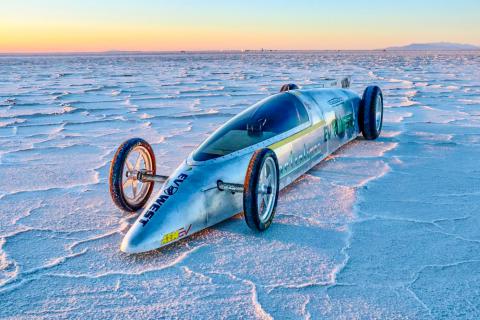
Bream continued to apply the FAFO philosophy when EV West built the Electraliner, a Tesla-powered, dry-lakes streamliner. “We tested six or seven battery packs until they caught fire. Then we knew we had a battery we could easily run for six minutes, when we only needed it to run for two. So we had a 3X factor of safety.
“That’s a way we offer value to our customers,” by being able to answer questions about components, when other suppliers “don’t even know what you’re talking about.”
At Bonneville in August 2020, land speed racing veteran Jim Hoogerhyde pressed the Electraliner to 238 mph, and with an official two-way average of 229.363 scored a new record for Class E2, electric vehicles weighing up to 2,200 pounds.
“A buddy of mine does portable power,” Bream added. “So we took this little trailer with a battery charger and solar panels on it, and oh, man, it was killer, because The Wall Street Journal and The New York Times came out and did articles on us. It was so cool to see this land speed car on the salt with solar panels charging it. It’s phenomenal to have that kind of horsepower come from something as benign as a little solar panel on your roof.”
Authorized installation centers handle conversions EV West has already engineered, leaving the company free to explore new applications. “We’re a parts supplier and integrator,” said Michael Bream. “We identify applications where there’s enough volume, where we understand the market and how many people are building on that platform.”
Bream returned to Bonneville in 2021 with the solar-power trailer and two electric lakesters. EV West technician Chris Spicer, recruited to drive the rebodied Electraliner, managed an impressive 196 mph in his rookie outing. Hoogerhyde saw 240 mph in Nebulous Theorem II, built in 1989 by multiple-record-holder Jack Costella and converted to electric power. Unfortunately, mechanical issues prevented a proper two-way run for an official time.
EV West has also rebuilt the Pikes Peak BMW as an 800-hp electric drift car; and supplied the 535-hp electric driveline for the 125-mph desert-racing buggy built by Strategic Racing Designs and the clean-energy non-profit Strategic Recovery Institute. “The next thing I’d like to do is the Volkswagen Mount Shasta event,” said Bream, citing the annual off-road winter slog from Clear Lake to Mount Shasta—exclusively for split-window (pre-1967) VW vans and pickups. “We have a 1963 single-cab in the shop, and I want to put in a system capable of really long distances. It’s 400 miles over some of the toughest terrain, where I think the torque and controllability of electric drive would excel.”
Components For Conversions
In the beginning, racing helped promote the company. “We were so early,” Bream recalled, “that we had to be every department. We had to be engineering, and marketing, and financing,” a burden Bream found uncomfortable. Now that the company is better established, promotion is chiefly by word-of-mouth. “We’re struggling to keep up with demand,” Bream added, leaving little time for marketing.
Social media also helped when performance EVs were a novelty, not so much now that they are “ubiquitous. Every really progressive car enthusiast has seen examples and read articles. So we don’t have to do promotion. The topic is so interesting that it feeds itself.” EV West does work with YouTubers, “who reach out to us all the time: ‘Hey, I’m building this, will you give me a discount on batteries?’ And we’re like, ‘Heck yeah, dude, you’re awesome.’”
Bream also teaches at the nearby Electric Vehicle Learning Center, a non-profit founded by three EV West customers. And he accepts interns, who have come from as far away as Poland and Chile to learn about performance EVs. With delight, Bream recalled an intern from Japan who returned home, “ripped apart a Prius, and turned it into a drift car. That’s how you convince people that this technology is super-cool!”
EV West now occupies a 15,000-square-foot facility in San Marcos, 35 miles north of San Diego. A dozen full-time employees are supplemented by “subs, part-timers,” and the previously mentioned interns. “We’re a parts supplier and integrator,” said Bream. The shop also performs a limited number of EV conversions, but as Bream explained, “We don’t do conversions to convert cars, we do conversions to engineer cars. We identify applications where there’s enough volume, where we understand the market and how many people are building on that platform.” Customer cars are laser-scanned, and conversion parts are computer modeled, so “while the chassis fitment is never going to change,” updates to accommodate ever-more-powerful electric motors are relatively easy.
Among the conversions EV West has done was to put Tesla power into this 1977 Porsche 911, which was on display at the 2019 SEMA Show in the SEMA Electrified display area.
“As we do more volume,” Bream added, “we can offer more things that are specific to the EV community, like flywheels for electric cars—balanced and lightweight, but with no starter ring.” To make a single, custom flywheel would be cost-prohibitive, but a run of 100 is commercially feasible.
Customers requesting a conversion that EV West has already engineered are referred to one of the company’s authorized installation centers: Action Vehicle Engineering in Chatsworth, California; Peace Vans in Seattle, Washington; or a third location “coming online very soon.”
While the majority of EV West’s business is now street performance, it continues to supply some racers, including Entropy Racing, which PRI Magazine profiled in October 2022. Able to swap batteries in under two minutes, Entropy electric endurance racers contested the 25 Hours of Thunderhill in 2021 and 2022, finishing 29th and 17th, respectively. “Because we were doing something that no one else had ever done,” recalled Entropy founder Charlie Greenhaus, “we needed a reliable supplier with experience, and Michael is exceedingly knowledgeable about his product. He was interested in our project, he followed our progress, and was attentive to what we needed. He was always there for us when we needed him, and always a great resource.”
Additionally, “Michael has done a bunch of good turns for us. We had a bumpy start, because of an assembly mistake by one of their suppliers, but they were very responsive and very helpful, and they took it on the chin because of that.” Finally, Greenhaus noted how EV West has “spearheaded the supply chain for used Tesla parts, and that’s been good for the entire industry.”
Electrifying The Future
While Bream firmly wishes that “politics and policy were out of the conversation,” he also believes that “the way we’ve been doing things is not sustainable.” And “because I’m an engineer, I’m in it for sustainability. I need to get this fuel out of the ground, and I need to refine it, and I need to transport it to my car. The job of an engineer is to make processes as efficient as possible—and to be open to the idea that maybe this type of fuel isn’t the most efficient. Maybe if we switched to another type of fuel, we could capture it easier. What if you could put a stick in the ground with a fan blade on it—oversimplifying—and make fuel? Or put fuel collectors on your roof and collect it?”
He readily admitted that electric power is not ready “to sustain everybody’s needs right now.” Battery technology is still a major barrier. Bream speaks of the “cruelest irony” of a “fuel so light you can’t even measure it,” that requires a “fuel cell” made with lead, “the heaviest thing you can think of. But if you’re an engineer, you look at theoreticals. We’ve already replaced lead with ‘lithium’ batteries made mostly from aluminum, nickel, and copper. And every year they are making improvements. Theoretically you could have a battery that runs the Indy 500 or Baja 1000 with a single charge.” The electric “fuel” required to go the distance still doesn’t weigh anything.
The Electraliner streamliner put EV West’s electric powertrains to the test at the Bonneville Salt Flats. In 2020 it set a record of 229.363 mph and hit a top speed of 238 mph. “It’s phenomenal to have that kind of horsepower come from something as benign as a little solar panel on your roof,” Michael Bream said.
“So right now, electric cars are really good at tough environments where there is less oxygen, and they’re really good if the race is 10 minutes or less.” On the other hand, “we’ve hit the theoretical max for gasoline. Combustion-car records are falling, for good.” EVs now own the record at Pikes Peak and the Nürburgring. And “they are flirting with 1.9- and 1.8-second 0–60s that would make your eyeballs hurt.
“So we’re in the early-adopter phase, where EVs are just a couple of percent” of the total performance market. “But they are the latest thing, so you’re probably going to see annual increases of 50% for the next decade.”
He continued, “And in the long run, nobody’s going to care about the type of fuel you use. You may think it’s a big deal, but it’s not. It’s like the transition from gas to diesel, or from carbs to fuel injection. And it will open new avenues for racing. You could have indoor racing, because emissions are no longer a big deal, or late-night racing because noise is no longer a big deal. And it’s going to save racing. I don’t think people fully understand this, but the corporate sponsors are pushing for carbon neutral.” They care about public perception, whether the racers do or not. “Once you realize where the push is coming from, then it’s like, ‘Oh, yeah, it’s inevitable,’ because they always get what they want.”
Of course, there will be doubters, whiners, complainers, and (if you can forgive the pun) resistors. But Bream has a message for them: “This is just the first inning. So cool your jets and hang out. Drop some popcorn, buckle up, and watch this, because this transition to sustainable energy—it’s going to be epic.
“Nobody has ever seen anything like it,” concluded Bream.
Social media has become a dominant form of communicating throughout many industries, and now it’s increasingly a means of handling customer service. But is that effective for motorsports businesses?
Business is a lot like racing—constantly evolving, relentlessly competitive, and always taking advantage of the latest technology to get an edge. It’s no surprise then that more companies in motorsports and the performance automotive aftermarket are tapping into social media as another method of addressing customer service.
While traditional avenues such as emails and phone calls are still used to address customer inquiries, the advent of social media has provided companies with a powerful tool for communication and customer service. It’s allowing motorsports companies to build better rapport with customers, strengthen brands, and trigger positive conversations among other potential customers who are witnessing the effective resolution of issues.
But on the flipside, there’s also the potential for negative effects. Customer expectations are rising higher than ever, which can prove challenging for companies that haven’t adequately prepared, or don’t have the necessary resources to accommodate customers through additional channels. And, at the same time, the multi-faceted nature of social media communication can strain centralized, chain-of-command driven teams that struggle to devote resources to other departments when necessary.
Given these opposing dynamics, the methods and the degree of commitment to social-media customer service varies widely in motorsports. Some companies have jumped in wholeheartedly, some are dipping a toe in it, and some are avoiding it altogether. And even for those that are embracing it, there’s a wide range of methods and expectations being applied to the task.
Nonetheless, social-media customer service experts are looking ahead to a bright future for these platforms in the industry, particularly with the advent of powerful new labor-saving social-media tools driven by AI technologies. These tools could lower the barriers that are keeping some companies from diving into social media as a means of improving customer service.
Customer Service Evolution
Social-media customer service has evolved considerably in its relatively brief history. Many of the first forays into using social media to communicate with companies came from angry customers taking a last-resort shot at unresponsive businesses in a public forum. But over time, social-media customer service has evolved into a nuanced give-and-take between customers and companies. The topics of these exchanges can be almost anything, including general questions about policies, deep details about products, or even gushing praise from loyal zealots.
Use of various social media platforms in these ways had been steadily growing for years as people in general were spending increasing amounts of time in front of phones and computers, while doing more and more of their business transactions online. Then the pandemic kicked that trend into high gear. With limited means for contacting companies and people spending more time in front of computers during the two-year-long international ordeal, customers began flocking to Twitter, Facebook, Instagram, and other platforms to voice their needs to companies with which they did business.
Handling customer interactions via social media is a lot like keeping up with a business’s inventory demands. “If you try to handle customer questions sporadically, you’ll get lost,” said Will Farkas of Design Engineering. “You’ve got to really dedicate time each day to making sure that you are able to cover it.”
Besides the undeniable global factors that have fueled customers’ expectations of social media as a medium for communicating with companies, there’s a more fundamental reason customers increasingly use social media in this way. Today’s social media platforms convey a greater sense of there being a real person behind the scenes, compared to the coldly anonymous feeling of a blank email contact form, or an impersonal-looking 800 number listed on a website. The basic sense of humanity on social media tends to encourage customers to use this channel instead of the more traditional email and phone methods.
“I think there’s an understanding that social media has to have a person behind it, unlike an email form, which you don’t really know if it’s actually going to a person,” said Andreanna Ditton of RacingJunk.com, El Segundo, California.
Handling customer service through social media allows companies to reach customers where they’re already at, in a means that they’re comfortable with. This fosters a greater sense of trust and openness among customers. This trust is further enhanced by the experience of seeing other customers successfully having their problems with a company resolved on the platform. This creates a powerful social proof that can foster positive feelings toward a brand and build enduring loyalty.
“There have been studies done that have showed that the overall feeling about that business goes up when people see a problem resolved for a customer,” explained Corey Perlman of Impact Social Media, Roswell, Georgia. “The reason for that is people don’t expect businesses not to make mistakes—they just want to see how the company is going to respond to those mistakes.”
Platforms for Work and Play
Although almost any social media platform is potentially suitable for customer-service interactions, in motorsports and the performance automotive aftermarket the dominant social platforms are Facebook and Instagram. These platforms have become the default standard for car culture, whether it be in the form of videos, cars for sale, or posts about automotive topics. This has fostered a vast audience of deeply enthusiastic users for these platforms, and so they’re naturally the place companies in this segment need to be when handling customer service through these channels. For automotive-related companies of all types, platforms other than these two stalwarts tend to be too much effort for too little return, according to our sources.
“For our audience, Twitter was a bigger job than we were able to maintain, and we didn’t gain much from it,” said Ditton. “We still have a Twitter account that people can connect with us or tag us on. We use it to promote our ads, press releases, and stuff like that, but we don’t do a lot of discussion on it. Same with Pinterest.”
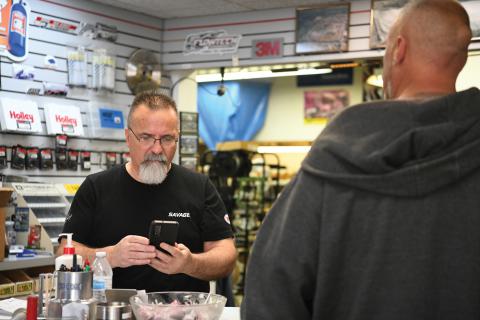
Scenes like this at speed shops and performance retailers across the country disappeared as a result of the pandemic. With limited means for contacting companies and people spending more time in front of computers during the two-year-long ordeal, customers began flocking to social media platforms to voice their needs.
Within the car-culture world, Facebook and Instagram users have somewhat different tones and attitudes between the two platforms, driven in large part by the nature of them and the slightly older demographics of Facebook users compared to those of Instagram. But for the most part, the companies we spoke to said the difference in tone and style between the two platforms has become negligible at this point.
“The Facebook and Instagram audiences are more similar than you’d think these days,” said Ditton. “We used to see a much different demographic on Instagram than on Facebook. I just don’t see that quite as much anymore.”
Reaching Out
Whichever platform is used, customers have three basic methods to communicate with companies: Direct messages (DMs), posts, and tagging. Direct messages are the most private of these methods, and that brings advantages and disadvantages. When messaging a company directly, there’s limited damage to a company’s brand if the interaction is negative in any way. But, on the other hand, DMs have limited potential for enhancing a brand and building general goodwill if the interaction goes particularly well.
Instead of messaging a company directly, customers may also choose to simply put their thoughts in a post, for potentially everyone to see. In the extremes, this can have a very damaging effect if the post is negative, but it can also be a very positive lift for a brand if it’s in the form of praise for the company or its products.
The sources we spoke to said that it can be effective and efficient to communicate with customers via posts, but they agreed that the interaction should be moved to private DMs if things get at all negative. Everything is fair game for public consumption and comment when it’s in a post. For that same reason, sometimes company representatives need to dial down any negative emotions that can cloud the interaction.
“When a negative response or interaction comes from a customer, the first thing you do is not respond right away, because you’re emotional about it,” said Perlman. “Take a breath. Give it a little time until you can let go of the emotions and can respond in a diplomatic way. Then respond and try to fix the problem. Oftentimes, if you do that, you can turn a critic into a champion. You can turn an unhappy customer into a very happy and loyal customer just by listening and being attentive to them—even if the problem doesn’t necessarily get fully solved—just by being empathetic to their situation.
“But if you can’t, and this person is just looking for a fight, then that’s the point where you take it offline,” continued Perlman. “It’s best to say something like, ‘I’d like to personally talk with you through this. Please provide me your email,’ or ‘I’m going to provide our business email here so we can get your phone number and I’ll get in contact with you right away.’”
Today’s social media platforms convey a greater sense of there being a real person behind the scenes, compared to an anonymous email contact form or 800 number listed on a website. The basic sense of humanity on social media encourages customers to use this channel instead of the more traditional email and phone methods.
Besides messaging or creating a post that mentions a company directly, customers can also tag a company in a post. Doing so consists of simply putting the company name somewhere in the post, preceded by a hashtag. This can be done on any post, even if it’s only tenuously related to a company or its products. Like other methods of contact, this can be a positive, uplifting moment for a brand, or it can be damaging and negative.
That’s why it’s crucial for companies to continuously monitor what’s being said about them online. This technique is called social monitoring, or social listening. Although this is a simple concept, it needs to be done on a consistent basis so that damaging statements don’t spiral out of control, fueled by a perceived lack of response from the company. Fortunately, it’s relatively simple to manage the process and stay on top of what people are saying.
“One easy thing that companies can do to monitor is to set up Google Alerts around their brand,” said Perlman. “That way, if something pops up on the Internet with their name attached to it, they’ll be alerted by Google via email. Or, if you go to Twitter, or Instagram, or Facebook, or even LinkedIn, you can simply type in your brand name in the search bar, and you very quickly can see if anything’s been mentioned about you.”
The companies that are the most effective at social-media customer service typically have a specific social monitoring methodology that ensures that job is handled thoroughly and consistently. Bringing greater efficiency and effectiveness to these methods are a number of digital tools that automate the work and provide greater control of the process. But businesses have to be careful to maintain the valuable human component that attracts customers to social media in the first place.
“It all comes down to being authentic,” said Perlman. “One of the big questions now is whether businesses should use automatic responses or artificial intelligence services. My thinking on that is yes, as long as you aren’t trying to pull the wool over the eyes of the customer—you’re not trying to make them think it’s a real person. Commonly asked questions, and requests that come in after hours, can be addressed by automated programs. But when you get to a point where it’s more specific, you need to get the customer over to a real person.”
These digital methods are typically just one component in a comprehensive suite of effective techniques organizations are using to handle customer service via social media. It’s essential to establish a solid, consistent process for handling social-media customer service. Without such systems, the chances of customer interactions turning negative greatly increase. But such a system doesn’t necessarily need to be complex or especially sophisticated. It can be as basic as having a set time of day to handle certain important tasks.
“If you try to handle customer questions sporadically, you’ll get lost,” said Will Farkas of Design Engineering Inc. (DEI), Avon Lake, Ohio. “You’ve got to really make sure to dedicate time each day to making sure that you are able to cover it. I check things once in the morning, once at lunch, and then once at the end of the day.”
Different Modes for Different Folks
For the most part, opening up social media channels for customer service questions is largely a matter of companies simply going where their customers are. But that varies considerably from one market segment to another. To some degree, it comes back to demographics. The enthusiast automotive market in general tends to skew somewhat older in comparison to certain other mainstream products, such as music or video games.
Although older users can certainly be technologically savvy and quite sophisticated in their use of digital devices, they nonetheless often prefer traditional means of communicating with companies. For this reason, the companies we spoke to all emphasized the need to offer multiple channels for communicating with customers. “In our posts and our direct messages, we always have a way to call us,” said Ditton. “So as soon as they message us, it gives them a phone number for customer service.”
Despite the challenges posed by handling customer service problems through social media, it shouldn’t be a cause for fear or hesitation. Instead, our sources say companies should jump in and embrace it as just another opportunity to connect with customers.
“One time a client said to me, ‘Why should I have social platforms just to give people another reason to talk about me or my business?’” said Perlman. “But that’s exactly the reason why you have this social platform—so that they’ll talk about you on your own turf. I would prefer a negative customer come to your social platforms for communicating with you than going elsewhere, like Yelp or Google.”
Counterpoint: Ignoring Social-Media Customer Service
Although motorsports and performance automotive aftermarket companies appear to be generally embracing the idea of handling customer-service inquiries through social media, some in the industry have intentionally turned their back on these methods. At first glance, such a move might appear to be unfashionably out of step. But, on closer examination, the argument can be made for such a policy in some businesses.
This is particularly true for companies with proprietary platforms that customers use to place orders, check status, and communicate problems. Such businesses may feel that monitoring and working customer service on channels outside the company’s existing platform is an unnecessary distraction.
Turn 14 Distribution in Horsham, Pennsylvania, is one such company. At one point, the company did allow the option of working with customers through social media, but ultimately decided that it wasn’t as effective as simply channeling those customers back to its own platform.
As a warehouse distributor, Turn 14 works only with established customers who have an account. This means that everyone it deals with is already registered and extensively documented in the company’s platform. When clients contact Turn 14, the customer support team can instantly access all of this information in one centralized location. This has proven to be more efficient than jumping back and forth between a social-media platform and the company’s own platform.
“We have a full-fledged team of 30 to 40 customer-support employees,” said Kyle Crawford. “And we have a whole portal and ticketing system that they use to deal with any kind of customer support requests. We learned pretty quickly that the time that it took us to figure out the order number, or where the part was going, or who it was going to, and then passing that information along to our support team, made it slower than what our support team would have done if they processed a ticket through our system.”
If Turn 14 customers do ask questions through social media, they’re steered back to the main company platform, where they interact directly with a member of the customer-support team. Because of the efficiency and thoroughness this method provides, customers are generally fine with being routed away from social media, according to Crawford.
“We started replying to social-media messages with a pretty generic response that says, ‘If you have a Turn 14 Distribution account, this should be handled through the support channel. If you don’t have a Turn 14 Distribution account, you should work through the retailer that you purchased the part from.’”
At the same time, Crawford said that staying exclusively on the company’s own platform provides greater security for the company and its customers. “One of the reasons we want people to work through our system is that we don’t want any of the information going into the wrong hands. By having access to the ship-to address and knowing what the part number is, sure, theoretically we could look that up in our system, but we don’t know who we’re actually giving that information to. So by it going through our main channel we keep things secure.”
Of course, ignoring social media as a customer service method may not be advisable for all companies. Many customers, particularly those of younger generations, see Facebook, Instagram, and other social platforms as an integral part of life online. But for companies like Turn 14, which has its own robust one-stop platform for serving customer needs, turning away from social media may indeed prove to be a viable option. —David Bellm
 MEMBERSHIP LOGIN