Engine: 427 LS3-based engine built by Texas Speed and Performance, runs on E85 or M1 methanol
Car: Built by Carl Balzer of Hidden Motorsports
Features: PRC heads, Holley Hi-Ram, twin Forced Performance 7875 turbos, XClutch triple disc clutch, Darton Sleeves, Grannas Racing billet T56 Magnum, GForce Engineering axles with billet stubs, Holley Terminator, many ancillary parts from Texas Speed and Performance, Holley, and Motion Raceworks
Facts: The car is capable of low 8s in the quarter-mile. It made 1,415 whp with a 6-liter motor, and Balzer is hoping for more than 1,600 whp with the new 7-liter. Balzer is also involved with a charity called Skids4Kids USA that helps raise money for children’s hospitals.
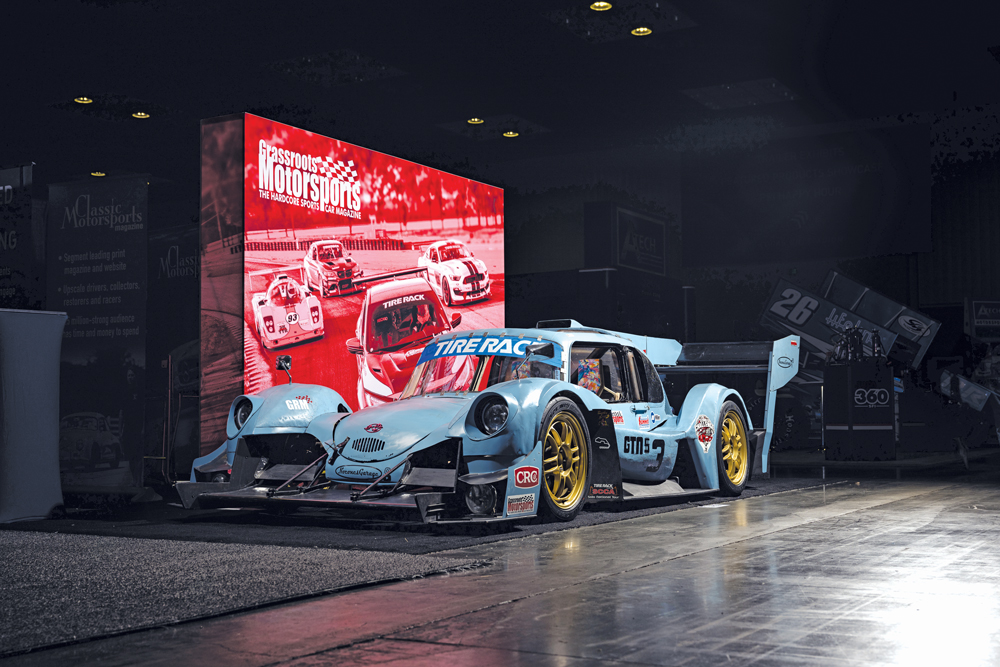
1968 Subaru 360 Sedan
Daniel Cummings | Mahomet, Illinois
Race Series/Class: GridLife Super Unlimited Time Attack
Engine: Subaru EJ251 NA, Flat-4 OEM build out of a 2002 Outback, utilizes Subaru ECU with stock tune and power levels
Car: Built by Daniel Cummings at home
Features: Full aero elements with dual element front and rear wing and underbody tunnels, uses a 4130 chromoly tube frame with custom F&R SLA suspension using pullrod-actuated bellcranks with motorcycle sourced coilovers, Wilwood brake pedal cluster with remote
reservoir master cylinders
Facts: This car was built for and won the Grassroots Motorsports $2,000 Challenge. Most of the basic running gear of the car is OEM Subaru but modified for use on this vehicle. The goal was to build a car that gave the driving and aesthetic impression of an LMP-style prototype on an affordable budget. Since the $2,000 Challenge, the car has been updated to run at GridLife.
Turn 14 Distribution, the performance parts distributor based in Horsham, has announced that it will acquire Tucker Powersports, a 56-year-old powersports company based in Fort Worth, Texas. Founded by Ed Tucker, Tucker Powersports also operates in Florida, Pennsylvania, Illinois and California.
Turn 14 Distribution will acquire its inventory, intellectual property and private label brands, which include marques like Kuryakyn, Answer Racing, Pro Taper and QuadBoss.
"The purchase of Tucker Powersports and our entry into the powersports market is an area of opportunity and growth. We look forward to applying many of the principles our company is founded on as we leverage our strengths in efficiency, focus, and excellence in the powersports category," said Jon Pulli, CEO of Turn 14 Distribution.
"The change in ownership is a huge injection of resources to better serve Tucker dealers around the country," said Marc McAllister, president and CEO of Tucker Powersports. "I am confident that Turn 14 Distribution will have a significant impact on the powersports industry with their approach to inventory and their high-quality customer service".
"As we form our powersports team, including sales, marketing and purchasing employees, Turn 14 Distribution will make every reasonable effort to retain and maintain the talent pool at Tucker Powersports," said Pulli.
Like it or not, EVs are here to stay. Before you turn the page, hear me out. Challenges are nothing new to the motorsports industry—new rules, the closure of a local track, and supply chain problems are just a few of the obstacles we face on a regular basis. We are an innovative bunch, and we do whatever it takes to make sure we keep racing. That same innovation applies to the EV segment. Consider some of the positives: Because EVs are so quiet, racers can still drive at tracks where neighborhoods continue to encroach and even race later in the evening since sound curfews won’t be relevant.
PRI contributor Drew Hardin interviewed three established performance conversion operations that took EV head-on and now embrace it. See Building Momentum on page 58. Of course, this doesn’t mean we at PRI are turning aside from traditional ICE-powered racing segments or overlooking other types of propulsion for racing. Instead, we are presenting new possibilities that continue to grow and strengthen motorsports as a whole.
Take Bisi Ezerioha of Bisimoto, as an example. He admitted his initial “discontent with the EV marketplace,” but when he saw the direction his partners were going, “If I wanted to remain relevant in the business, I needed to explore this technology.” Now, EVs account for 90% of his business.
Michael Bream of EV West specializes solely in EVs, but with the nostalgia of his father’s hot rod era. Bream’s cars have raced on Pikes Peak and the Bonneville Salt Flats, setting records at both. As a result, “We’re struggling to keep up with demand.”
For those who want to learn more about EVs and motorsports, visit the EV & Alternative Fuel section on the Lucas Oil Stadium floor at December’s PRI Show. Here, you can see how this technology is being used to advance motorsports, all with a more environmentally friendly focus.
Three PRI Show seminars have already been planned on this topic: Alternative Fuels: Maintaining the Internal Combustion Engine; EV Powertrains: Converted for Racing; and EV Racing: Aftermarket Performance Products. These will take place at the Lucas Oil Stadium seminar rooms, which are conveniently located near the EV & Alternative Fuel display.
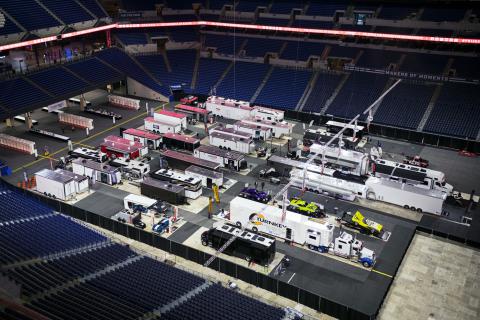
Also at Lucas Oil Stadium is the popular Trailers Exhibit. Turn to page 104 for a list of 23 suppliers who have already confirmed that they will bring some of the newest models of not only race trailers, but also new motorhomes and toterhomes, all designed to improve the at-track experience.
These suppliers will be ready to design the best-suited trailers for specific racing disciplines, including sprint cars, dragsters, dirt late models, road race vehicles, and so much more. Beginning on page 94, several of these suppliers share how they work directly with race teams to design trailers that organize race cars and parts. For example, winged sprint car racers can benefit from a trailer with a taller than normal interior height so the car can be loaded without removing the wing. Dirt late model racers will require a wider opening to allow the car to enter and exit the trailer easier. Front dragster wheels can be elevated to fit two cars into the trailer, allowing teams to bring more than one complete car to events.
If you haven’t already, sign up today to attend the PRI Show, December 7–9, at PRI2023.com.
Tracking legal, legislative, and regulatory developments impacting the racing and performance industry.
PRI’s Washington, DC-based legal and advocacy teams work continuously to protect and support motorsports venues, sanctioning bodies, and businesses around the nation. We are tracking several initiatives this month, including new movements in the fight to maintain a technology-neutral approach to motor-vehicle technology, and how PRI is spearheading a grassroots campaign for industry resources and support.
SEMA President and CEO Mike Spagnola Provides Comments to EPA Opposing Proposed Standards
SEMA President and CEO Mike Spagnola testified and provided written comments to the US Environmental Protection Agency (EPA) opposing the agency’s proposed new federal emissions standards for motor vehicles model years 2027 to 2032. The proposed rulemaking seeks to have battery electric vehicles make up 67% of all new vehicles sold in 2032 and ignores the many other technologies that can get us to lower emissions faster. PRI extends a huge thank you to the industry members and enthusiasts who sent more than 7,700 letters to the EPA.
“Thousands of small businesses and their employees will be adversely impacted by this proposal’s overly aggressive push to electrify America’s automotive sector,” said Spagnola. “There are many options on the road to zero emissions. American-grown biofuels, carbon capture, and innovations in engine production are all aimed at this shared goal. The specialty automotive aftermarket has also led the way in fuel innovations and conversions of old vehicles into new and cleaner technologies and is committed to playing a central role in the evolution of automotive technology, including the parts and products that power our vehicles. However, this proposal embraces electrification as the technology of choice to the detriment of many of our members and their innovations.”
PRI and SEMA have also coordinated a grassroots and media campaign, and highlights include:
Spagnola and Kim Pendergast, CEO of Magnuson Superchargers; Rob Simons, principal with Automotive Consulting Services; Billy Brooks, director of Engineering for Cobb Tuning; Dan Millen, owner of Livernois Motorsports; Mike Copeland, CEO of Arrington Performance; Laurel Moorhead, regulatory compliance engineer with Transfer Flow; and Keith Cavallini, owner of Green Diesel Engineering testified before the EPA in May about the proposed rule, speaking about how it would impact their businesses and the importance of the EPA maintaining a technology-neutral approach to motor-vehicle technology.
Ian Lehn, the founder and CEO of BOOSTane, spoke to ABC News 5 in Cleveland, Ohio, about how the EPA’s proposed rule could unfairly tilt the market toward electric vehicles (EVs) over the next decade. He also wrote an op-ed that was published on Cleveland.com.
West Virginia state lawmaker and SEMA member Gary Howell (R-WV) penned a powerful op-ed piece against the proposal for Maryland’s Cumberland Times-News.
Spagnola wrote an op-ed for the Washington Examiner and was interviewed on the Smoking Tire Podcast.
The Atlanta-Journal Constitution published an op-ed from Chelsea Allen, owner of Crush Customs, and Nick Caloroso, national sales manager for Driven Lighting Group.
The EPA is expected to issue its final rule later this year or early next. Through PRI and SEMA’s grassroots and education efforts, the work on this issue will continue over the coming months. While the EPA can issue its final rule, Congress still oversees the agency and its actions, so we expect this fight to make its way to Capitol Hill and continue well into 2024.
House Committee Passes PRI-Supported Bill Protecting ICE Technology
In a win for motorsports, the House Energy and Commerce Committee has passed H.R. 1435, the Preserving Choice in Vehicle Purchases Act, and H.R. 4468, the Choice in Automobile Retail Sales (CARS) Act. In addition, US Senator Markwayne Mullin (R-OK), the co-chair of the Congressional Automotive Performance and Motorsports Caucus, introduced S. 2090, a Senate companion bill to H.R. 1435.
These PRI- and SEMA-supported bills seek to preserve vehicle choice for consumers and prevent the federal government and the state of California from choosing only one form of technology (such as electric vehicles) over the many others to achieve their emission reduction goals.
PRI and SEMA have strongly supported the bills, which are designed to prohibit the US Environmental Protection Agency (EPA) from issuing regulations that would ban the sale or use of new motor vehicles with internal combustion engines (ICE) in California by 2035. As a reminder, this could lead to other states following suit, as 17 others have followed all or part of California’s previous clean-car rules.
“PRI believes that vehicle owners should not be directed toward a specific technology, but rather be allowed to choose the type of vehicle that best serves them,” said Eric Snyder, PRI Senior Director of Federal Government Affairs. “It’s important that members of Congress hear from you about how important it is that the American people, not the federal government and California, are able to choose the technology that powers their vehicles. We need to make sure that this issue is a top priority for the racing community and performance parts businesses.”
Ask your Congress members to support the Preserving Choice in Vehicle Purchases Act at https://p2a.co/qasAcva.
Ohio Introduces Bill Supporting Internal Combustion Engines
There’s a new opportunity for Ohio racers and enthusiasts! The state has introduced PRI-supported legislation (H.B. 201/S.R. 155/H.R. 198) which would prevent any state or local government unit from restricting the use or sale of motor vehicles based on the energy source used to power the motor vehicle, including ICE technology. H.B. 201 awaits consideration from the House Transportation Committee, and S.R. 155 was offered in the Senate. H.R. 198 awaits consideration from the House Transportation Committee.
“PRI and the racing community across Ohio have a vital stake in the outcome of these bills. If Ohio adopted California’s internal combustion ban, it would be costly and burdensome for motorsports teams and businesses, which are a major economic driver for the state,” said Christian Robinson, PRI Senior Director, State Government Affairs & Grassroots.
Industry members are encouraged to voice their support for the bills in a few clicks by visiting https://p2a.co/DMm4tNV.
PRI Track Ambassador Continues Grassroots Campaign for Industry Support
PRI track ambassador Tom Deery continues to visit industry events, including a winged sprint car race at Eldora Speedway, Street Car Takeover at Lucas Oil Indianapolis Raceway Park, and the 57th annual Redbud 400 pavement late model event at Anderson Speedway. Deery is bringing awareness to PRI’s advocacy efforts, with a focus on the Race Track Promoter Helpline available to track owners, operators, promoters, sanctioning body officials, and related motorsports professionals. Industry members can contact 202-847-6593 and PRILegalHotline@performanceracing.com for access to relevant legal resources, peer-to-peer discussions, grassroots campaigns, lawyer referrals, along with additional support.
PRI Track Ambassador Tom Deery is attending events around the nation to promote resources available to the industry.
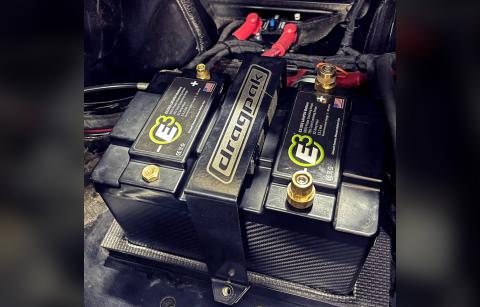
A major benefit of a lithium battery over traditional lead acid or absorbent glass mat (AGM) batteries is lighter weight. Lithium iron phosphate (LiFePO4) batteries are so light that, in many instances, two are still half the weight of one lead acid or AGM battery.
Is a lithium battery the right choice for your race car? What you need to know before making the switch.
A critical but often overlooked component in any race car is the battery. While racers have been using lead acid and absorbent glass mat (AGM) batteries for decades, with advancements in lithium technology, more lithium batteries are coming to market.
Traditional wet cell lead acid, AGM, and lithium all have their pros and cons, therefore choosing the right battery for your needs is critical to the performance and longevity of your battery. The key items to consider when shopping for a battery include:
Cranking power
Size and weight
Amp hour capacity
Battery Management System (BMS)
Types of lithium
Lithium is significantly more energy dense than lead acid, which means you can pack a lot more cranking power in a smaller and lighter package. Most customers are accustomed to using cold cranking amps (CCA) as the metric for how “strong” a battery is. CCA, however, is the measure of a battery’s ability to crank for 30 seconds at -17 degrees C. Unless you’re racing in below freezing temps like that, you’ll instead want to focus on pulse (or peak) cranking amps (PCA). This describes the max output of the battery at 25 degrees C (or 77 degrees F), which better represents most racers.
The typical 602 and 604 crate engine requires about 1,000 amps of cranking power. As you start moving up in displacement or compression ratio, you’ll need to move up in cranking power. For engines with compression ratios higher than 13:1, you’re going to need 1,200 or more cranking amps. Remember, more cranking amps are required to spin over a larger motor or push through the resistance of higher compression. Another benefit of lithium over lead acid is that it delivers that cranking power faster, meaning your engine will start easier and more consistently.
Amp Hour Capacity
Once you know how many cranking amps you need for your engine, you can start looking at size and amp hour (Ah) capacity. A huge benefit of lithium over lead acid is lighter weight. As an example, the E3.502 lithium battery weighs 80% less than the equivalent cranking amp AGM battery. From an Ah capacity standpoint, this is where it is important to size the system not only for your current setup but slightly over it, leaving room for future upgrades and modifications to the car.
A key difference between lead acid/AGM and lithium is the amount of usable Ah capacity due to voltage drop. Lead acid/AGM batteries have approximately 50% usable capacity at 12V, whereas lithium batteries have roughly 90–95% usable capacity.
Making the switch from lead acid/AGM to a lithium battery can be complicated. Lithium batteries require a lithium-specific charger as well as an appropriate battery management system. Battery manufacturers can offer information regarding specific applications.
A 50 Ah AGM battery only has 25 Ah at 12V. Once the battery drops below that, problems arise. Fuel injectors don’t spray consistently, cooling fans and fuel pumps begin running slower, all of which hurt performance. A lithium battery that’s rated at 32 Ah has around 30 Ah of usable capacity. When comparing specs, at first glance a 50 Ah AGM seems like it has more capacity than a 32 Ah lithium, but it’s actually the opposite.
For instance, on a dirt late model application that is carbureted with minimal electronics beyond a cooling fan and gauges, you don’t need a lot of Ah capacity. However, a fuel-injected drift car with multiple cooling fans, data acquisition, driver cooling suit, and so forth will need more capacity to keep up with the electrical loads.
This is even more important for those not running an alternator. A common mistake we see racers make is going for the lightest battery without considering the cranking and load requirements for their application. This not only creates the possibility of draining the battery dead or not starting the engine but overstressing the battery and reducing its useful life.
Deep cycle batteries offer a deeper draw than traditional lead acid/AGM however this deep draw still reduces number of life cycles. Lithium batteries can be drawn to near zero without impacting cycle life.
Safety and Longevity
This brings us to charging. Lithium batteries do require a lithium-specific charger for off-vehicle charging. Most standard automotive alternators will charge your lithium battery without issue, but you’ll want to consult each battery manufacturer’s recommendations before installing. For example, E3 Lithium starter batteries have a maximum alternator charging input of 160A. To get the longest life out of your battery, you’ll want to keep it on a maintainer when not in use. Never leave a battery deeply discharged, as this will damage the cells and reduce life.
There are many different types of lithium chemistry being used in batteries, including lithium ion (Li-Ion), lithium polymer (LiPo), and lithium iron phosphate (LiFePO4). LiFePO4 is significantly more stable than Li-Ion and LiPo, making it the safest option. It is also more energy dense, making it ideal for race battery applications.
This graph compares the typical voltage vs. depth of discharge curves between a lead acid/AGM battery and a LiFePO4 battery. Note the lithium-based battery not only has higher voltage but a flatter decline.
In addition to using a stable chemistry such as LiFePO4, you want to be sure the battery is equipped with a battery management system (BMS). The BMS is a circuit board that provides a wide variety of features such as short-circuit protection, over-charge/discharge protection, and overheating.
One of the most important features of a BMS is cell balancing. Lithium batteries are built using multiple cells, and these cells need to stay balanced. If there is a mismatch in cell charge, the entire battery will have lower usable capacity. Suppose that once the battery is charged, one cell is short by 5%. The entire battery will not be able to fully discharge that remaining 5%, so cell balancing is critical to the longevity of your lithium battery.
The complexity of the BMS varies by manufacturer, so be sure that the battery you’re considering has all the features you’re looking for.
While shopping for a battery can seem pretty straightforward, making the switch from lead acid/AGM to a lithium battery can get complicated. Don’t hesitate to reach out to the manufacturer directly to help answer all your questions and help size your setup appropriately. P
Chris LaCouture has been the Director of Engineering at E3 for 13 years, working in areas such as quality control, design, manufacturing, racing, and more. He graduated from the University of North Florida with a Bachelor of Science in Mechanical Engineering. LaCouture is the in-house technical expert at E3 and is currently helping design some of their batteries that will be on the market in the near future.
United Race Parts founder and CEO Thomas Decker, right, initiated the Golden Gun award at the 2022 Indianapolis 500 as part of the annual Pit Stop Competition.
With strong sales and a number of high-visibility international projects, United Race Parts has found success serving the behind-the-scenes needs of race teams big and small.
Success or failure of a race team is often decided in the pits. That’s the fundamental principle that paves the way for the success of United Race Parts. Partnered with Greaves 3D Engineering in England and Dino Paoli in Italy, this Troutman, North Carolina-based company specializes in equipment for pits, garages, and the general support of race cars.
Founded in 2015, United Race Parts has steadily grown to 10 employees, working out of an 8,000-square-foot building. The first big break for the company came in 2017 when it beat out dozens of rivals for the contract to provide wheel guns for NASCAR, when the sanction switched to a leasing arrangement aimed at blunting rapidly escalating costs among competing teams.
Although accomplishments like the NASCAR contract certainly boosted the fortunes of United Race Parts, it nonetheless has its share of challenges, like any company. The biggest hurdle being faced right now is the quest to complete its new building, which will be 7.5 miles down the road, in Mooresville, North Carolina. At 21,000 square feet, the new building will more than double the size of its current facility when completed. The additional space couldn’t come soon enough for the rapidly growing company.
Being a part of the NASCAR/Hendrick Motorsports Garage 56 team at Le Mans was “a huge privilege for us,” said Thomas Decker of United Race Parts. “What we provided really helped set the standard there.”
“It will give us some more room for growth because we’re basically bursting at the seams right now,” said company founder and CEO Thomas Decker. “Our current building is really good for us in the middle of the season, when things slow down a little bit. But in the really busy months of the offseason, it becomes inefficient just from the amount of stuff we have to have in the building.”
The new building was originally slated to be finished in late 2022, but a variety of local-government bureaucratic setbacks and other factors beyond the company’s control have pushed the project well into 2024. It’s been frustrating for Decker, but he describes it with a calm professionalism that belies the stakes of the effort.
Throughout this and other challenges along the way, he says PRI has proven to be a loyal partner and a highly effective tool for the company’s growth. From day one of United Race Parts’ history, Decker knew that having a booth at the PRI Show was an absolute must. “It was November 2015 when I started the company. We were at the Show a month later.”
He’s also quick to point out that benefits from exhibiting at the PRI Show can come in unexpected ways—brief interactions can plant seeds that bear fruit months or even years later. Such was the case with a short conversation at one Show, which proved to be a pivotal conversation that won him an excellent customer. “I’ll never forget, one year we had a particular piece of equipment from Greaves on display at the PRI Show. Six months later, in June, a customer called me from Le Mans and asked about it. We were able to get two of them to the track the next week for him. They ended up winning their class at Le Mans that year, and now they’ve become a showroom customer for us. They have almost every piece of equipment we make. And it all started from one 10-minute conversation we had with them at the PRI Show.”
PRI Founding Member United Race Parts bills itself as “Pit Equipment Headquarters,” supplying race teams—like Meyer Shank Racing, seen here—with tools and support for IndyCar, NASCAR, and IMSA events.
Having long been sold on the value of PRI and exhibiting at the PRI Show every year, he was eager to sign on as a PRI Founding Member when the program was introduced. “I liked the perks package that came with Membership—always being at the front of the line to make sure we have early access to certain ads or to certain bookings. It just felt like it was key to keep our company on top.”
Armed with the greater visibility that PRI membership gives his company along with the can-do spirit that’s made him successful already, Decker continues to make inroads deeper into the international racing market. Recent successful A-List projects are bringing increased visibility, powerful connections, and measurable business gains. Included among those efforts was providing all of the support equipment for the Garage 56 Le Mans team fielded by NASCAR, IMSA, and Hendrick Motorsports in 2023.
“The Garage 56 project was a once-in-a-lifetime opportunity for us,” Decker explained. “It was a huge privilege to be able to play a part in it. I think what we provided really helped set the standard there, when all the other teams turned up to the track and looked at how the team was operating. But it was a massive effort. At one point from all our partners, we had 22 people onsite working on it.”
Through it all, Decker handles the challenges of running and growing his business with both patience and passion. The road to where he’s at now had its ups and downs. But the courage and determination of Decker and his United Race Parts crew epitomizes the drive for success that runs throughout PRI.
“Don’t get me wrong. It’s not easy,” he said. “But you just need one moment of bravery to change your life.”
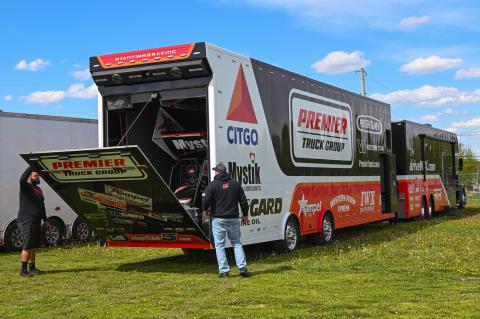
Running out of space in your hauler? Then visiting Lucas Oil Stadium during your trip to the PRI Show, December 7–9, should be at the top of your priority list. Inspect the latest race trailers, motorhomes, and toterhomes, and determine which models and features would best equip your race team when on the road during the 2024 race season. Visit https://bit.ly/3OnMNR3 for the most up-to-date list of exhibitors.
From the outside it’s a rolling box on wheels. Inside, a race trailer is purpose-built to suit the specific needs of a racing discipline. Here’s how it’s done.
“If you can dream it, we can build it.” —Chad Boespflug, Flying A Motorsports, Cuba, Missouri
“Building a race trailer is like building a custom house. What do you want? Do you want refrigerators? A microwave? Sleeping quarters? A couch or fold-down bench? How do you foresee yourself using the trailer?” —Wayne Quackenbush, Capitol Renegade, Beltsville, Maryland
These two trailer dealers summed up in a few words the level of personalization that’s available when ordering a race trailer these days. From spare-part-specific cabinetry to family-friendly amenities, trailer manufacturers have figured out ways to make just about anything fit around the race car.
That level of customization can be hugely important to racers. Beyond just the ability to hold the car, pit vehicles, and spares, trailer layouts can be fine-tuned to save a racer time, that most valued commodity at the track.
As we found out talking to these and other dealers and trailer manufacturers, how racers equip their trailers can vary quite a bit depending on the racing discipline. The inside of a sprint car trailer, for example, looks very different from one carrying a dragster or a Trans-Am car. That’s not just due to the size and shape of the car, but also the logistics of the various racing series.
Sprint Car
In sprint car racing, “things happen and happen fast,” said Quackenbush, “so when you get to the track you have to be prepared for quite a bit in a short period of time, from hot laps to time trials, heat races, features. Once things start, there’s not a lot of downtime, unlike other forms of racing. Your trailer layout is critical to being consistently competitive. It needs to be organized. Parts, equipment, tools, and spares all have to be quickly accessible.”
At the most basic level, a sprint car trailer is different from other trailers “because the sheer size of the car is different, especially when it has a wing on it,” Quackenbush said. “You need additional height in the trailer to roll the car inside, unlike a sports car or something like that where you don’t need a tall trailer unless you’re stacking them one on top of the other with a lift.”
“For a winged sprint car you want a minimum of 105.5 inches at the back door so you can load without taking the wing off,” said Josh Garner of inTech Trailers, Nappanee, Indiana. The trailer’s overall interior height will be taller as well—generally a minimum of 9.5 feet, Garner said—to accommodate the wing and to allow an additional chassis to be stored in the front bunk. “Sprint car teams find a way to use absolutely every inch of the trailer.”
A road race trailer “is not as specific as a sprint car trailer or a modified trailer,” said Mitch Bender of Bravo Trailers. “One trailer would work for almost all road racers—other than the choice in size and whether it’s a tag or a gooseneck.”
Some race cars, such as dirt late model cars, are also wider than the ramp door’s standard width, “so we can widen the opening by up to 5.5 inches to allow for a car to get in easier,” Garner said.
“Most sprint car racers will pit out the back of their trailer versus the side of the trailer like a drag car,” said Mike Nichols of Haulmark, Elkhart, Indiana. “We’ll outfit the back with two to three lights for that pitting situation, along with swing-out air hose reels and swing-out tool holders.”
A sprint car’s racing schedule also influences the trailer’s layout, said Boespflug. “Most dirt track sprint car guys are going to race four times as much as a drag racer. Some guys race 60–70 races a year. They may be on the road for three months at a time, racing four to seven nights in a row. To prepare for that, they have to have a lot of spare parts.”
“A lot of thought has to go into the layout of a sprint car trailer,” said Quackenbush, “and if you’re not familiar with sprint car racing, you can get it wrong quick. If it’s off an inch or two here or an inch or two there, it all won’t fit. It’s a game of inches squeezing it all in there.”
Even the trailer’s side door figures into the planning. “On the sprint car trailers we make it just big enough to walk through, because you need wall space inside the trailer for cabinets, tire racks,” Quackenbush said. “We’re maximizing every inch we can get. Most sprint car racers now carry enough parts in their trailer to build at least one spare car. The touring series guys and even some high-profile weekly racers that race two to three nights a weekend will even carry a spare car in the trailer. So we put trolley systems to load a spare car either up in the gooseneck of the trailer or build it with a loft for the spare chassis.”
“Every cabinet has a different depth for the parts that are secured to the wall inside—steering gears, radiators, torsion bars, shocks, gears—all those things have to be planned for,” Boespflug said. “Since the parts in those cabinets aren’t touched every day, they keep them from getting dirty and dusty from being at a dirt track. You can wipe the walls of the cabinet down and not have to wipe the nooks and crannies of spare parts that could collect a thick layer of dust over a weekend.”
This is the interior of a sprint car trailer from Flying A Motorsports. “The cabinet design is specifically laid out for spare parts to have a location to mount to the wall with hangers, and the cabinets are also meticulously thought out to make sure the sprint car, pit mule, and a small four wheeler will fit,” said Chad Boespflug. Also note the triplet overhead to load a spare car into the bunk and tire racks for extra tires and wheels.
Quackenbush also noted that “we all carry side-by-side utility vehicles with tool boxes that we roll out of the trailer, so we have to lay it out so a spare car, the mule, the complete car, and all your spares can fit in the trailer.”
The length of a typical sprint car trailer “really depends on how serious the end user is,” said Quackenbush. “Some sprint car guys will race 100 times a year, so bigger is better. For a local Saturday night racer who wants to be organized and competitive but is going home every night, we’ll build gooseneck trailers that are 36–40 foot, but traveling guys have trailers that are 42-, 44-, 46-foot in length. Tag trailer sprint car guys are 28–32 foot.”
“A lot of thought has to go into the layout of a sprint car trailer,” said Wayne Quackenbush, “and if you’re not familiar with sprint car racing, you can get it wrong quick.” This Capitol Renegade demonstrator illustrates how a winged sprint car—and all its related gear—loads into the trailer.
At Flying A, “we go from a 26-foot tag to a 48-foot gooseneck and anything in between,” said Boespflug. “It’s all about accommodating the customer’s needs. Budget comes into play, too. We can do a 48 loaded to the gills, but it’s going to be significantly more expensive than the 26-footer. It depends on what you’re trying to do.”
Pavement Late Model
Like sprint car racers, pavement late model racers pit from the back of their trailers, “so all your air outlets, electrical outlets, things like that have to be oriented to the back of the trailer,” said Quackenbush. “Those pavement late model guys have big pit carts, so you have to lay out the interior of the trailer so their big war wagon will fit up in there. They’ll want plenty of tire racks for spare tires and rims.”
For these racers he said Capitol Renegade builds “a lot of 42-foot gooseneck trailers, air conditioned, and insulated with double doors at the back so they can go in and cool off. Those guys are at the track all day, and it can get pretty brutal in the summertime.”
“With a lot of the ARCA, road course, asphalt, and even some dirt circuits, the racers want to go as short as they can” with their trailers, said Nichols. That’s because many of them “live out on the road, and they tow with a toter home or RV. They can only go up to 65 feet in length, so we accommodate that big RV with a short 20- or 24-foot stacker to keep them under that 65-foot DOT length.”
Drag Race
A drag race trailer is simpler than a sprint car trailer, Boespflug said, “because they’re carrying fewer parts and spares than the sprint car guy who needs to be able to race for 20 nights on the road straight through.”
“The first consideration for that market is the length of the trailer,” said Brad Bell of Formula Trailers, Bristol, Indiana. “It depends on the mod class they’re in, and the length of the wheelbase. For Top Fuelers, those are 32- to 34-foot-long trailers. Door cars will be in smaller, 24- to 28-foot trailers.”
“Most drag teams want the longest trailer they can get,” confirmed Nichols. “We build tag trailers out to 34 feet and goosenecks to 48 feet.”
One of Haulmark’s most popular options is its Dragster Lift, according to Nichols. He described it as a tube framework that goes in 6 to 8 feet before the end of the trailer. The dragster is then rolled in backwards and the front wheels are then placed in the lift while the back wheels remain on the floor near the cabinet. Then a second dragster can be moved into the trailer beneath the dragster with the nose lifted in the air.
Haulmark also accommodates drag racers in a less visible way. Beneath its rubber coin flooring is “felt backing saturated with adhesive,” Nichols said. “That’s specifically designed for door cars, bracket cars. When you pull the car out of the trailer, if you get wheel jerk because you can’t really feather the clutch, it causes ripples in a lot of floors.” The adhesive floor backing “helps to keep the floor perfect for the life of the trailer.”
Bell said each of Formula Trailers’ dealers sets up drag race trailers “a little bit different. They all have the same components—floor coverings, house electric, wall coverings, ceiling coverings—it’s just a matter of where they’ll put the cabinetry. Guys doing 32-footers use cabinets that are normally about 2-feet deep and put them on the driver side from the rear to the front wall. But another dealer buys a lot of 34-footers and puts the cabinets across the front. That trailer still has the same 32 feet of usable length from the rear of the trailer to the front cabinets.”
“Drag racers are always working on the curb side of the trailer, as are most other racers,” said Garner. To protect crews from the sun, inTech preps trailers for customer-installed awning kits, “and we do a lot of fully automatic awnings that allow the guys to work under there without having to worry about walking into an arm in the awning.”
Featherlite’s specialty trailers are custom built for professional, semi-pro, and serious amateur racers who require a big rig to travel from race to race. Layouts can include office space for those pro teams that travel with a cadre of engineers.
When inTech installs door caddies on the side doors, “the crew wants them easily accessible from outside the trailer,” Garner said. “If you look from the inside of the trailer, it looks like they’re mounted a little bit low, but when the door is propped open, they’re perfect for working outside the trailer.” inTech also offers fold-down shelves that are mounted in its custom wheel well cabinets and form an interior desk. “That way they can communicate back and forth with the car outside. They have monitors on the inside of the trailer and can have them hooked up outside.”
One amenity more popular with drag racers than other disciplines is a bathroom in the trailer, said Mitch Bender of Bravo Trailers, Bristol, Indiana. “As a general rule, drag racers like to stay at the track. We do a lot of drag racing trailers that will have a bathroom up in the front. And with a gooseneck they make the upper rise area into a sleeping area.”
“We are doing more and more bathroom applications, bathroom and shower combinations, mainly for drag racing customers,” said Bell. “They have the amenities of home. Everybody is more comfortable that way, especially if they’re bringing family with them.”
The gooseneck style of trailer in particular “allows them to turn the trailer into a multi-purpose vehicle,” Bell said, “with sleeping arrangements and a kitchenette. These types of trailers take the place of a motorhome, so they don’t have to have a large tow vehicle on the front, and these trailers are cheaper to purchase than motorhomes themselves. It just depends on their budget.”
As of July 1, Haulmark introduced a bathroom model “that makes it easy for the racer,” said Nichols. “We always had a bathroom package, but now it’s one model with a stand-up shower, porcelain toilet, and sink in the front of the trailer. It’s a point-and-click package that will be easy to add.”
Road Race
A road race trailer “is not as specific as a sprint car trailer or a modified trailer,” said Bender. In fact, he believes the “most general trailer” is one built for a road racer, as “one trailer would work for almost all road racers—other than the choice in size and whether it’s a tag or a gooseneck.” Bender is himself a road racer. “I owned Pace American before Bravo, so I’ve been doing this since 1986. Pace was started to help pay for my own personal racing.”
When Bender loads his road race trailer, he packs “a CTECH pit cart, golf cart, and then the race car will go into the trailer. We also carry a scooter and electric bikes. I have to load my golf cart first, and then the race car goes in behind it. What often happens is people like to pack up all their stuff and they go socialize and ride around in the golf cart, so some people try to load it last at the back of the trailer. I don’t have that ability because I have to center my car over the axles for weight distribution.”
“What it boils down to for us first of all is, can we build them a trailer that will work?” said Garner. “Sometimes just being able to load a road race car can be a challenge because they have pretty low clearances.” inTech asks prospective buyers to fill out a car clearance sheet. “It has 15 different measurements on it that we’ll load into a program, and we’ll determine whether or not we can load it, first of all, and if we can, what it’s going to take. It could take a 4-foot ramp, it could take up to a 10-foot ramp. The size of the rubber bumper that goes underneath the door could go from 1 inch up to 4.5 inches, so there’s quite a variance. Once we make sure all that’s going to work, we can start designing the trailer around the car.”
When inTech installs door caddies on the trailer’s side doors, “the crew wants them easily accessible from outside the trailer,” said Josh Garner. From the inside they look like they’re mounted a little low, “but when the door is propped open, they’re perfect for working outside the trailer.”
Victory Custom Trailers of Almont, Michigan, specializes “in many different levels of custom trailers and motorcoaches,” said Steve Chrisman. “We typically keep stackers, goosenecks, and tag trailers in stock for our customers, along with several custom builds we do during the year.” When we spoke to Chrisman, Victory had started building a custom trailer “for a top-tier Trans-Am team. This trailer will be built around the team’s needs, for such things as a spare car and several parts they will be carrying, including carbon-fiber body parts, bumpers, noses, hoods, and spare race engines.” The 48-foot gooseneck trailer will have an “8-foot interior height, 60-inch double doors, awnings, custom cabinets, a computer workstation for an engineer, and many other custom options the team is requesting. It’s crucial when running for a championship that you have the trailer equipped with everything you need to keep the race car on the track.”
Specialty Trailers
“A lot of similarities and a whole bunch of intricate differences” is how Mark Ackley of Featherlite Specialty Trailers in Cresco, Iowa, described trailer design for the top tier of hobby, semi-pro, and professional racers using tractor/trailer rigs to haul their cars.
At one end of this spectrum are, for example, vintage racers, “businessmen with lots of wealth and a huge interest in racing,” as Ackley described them. “Those folks are not engineer based. They want to go to the track, have a great trailer to put the car upstairs, and have a modestly equipped shop down below with limited parts. The lounge areas are more about creature comforts at the track during the day.”
On the other hand, “the professionals in IMSA, NASCAR, and IndyCar have an enormous number of engineers. Those professional folks have taken the kingpin area of the semi-tractor and made it into an office for six, eight, 10, 12 people.”
As with the other trailers we’ve discussed, car size affects the trailer layout, but in a different way. Because most cars are carried on the upper deck, and the bottom deck is dedicated shop and office space, “what we put upstairs we take away downstairs,” Ackley said. “IndyCar trailers have a lot shorter upper deck because their cars are so much smaller in height, while drag racers are much taller. If we want a trailer that can be used across multiple disciplines, it has to have at least a 55-inch upper deck, which is what NASCAR is, so it applies to the lower-level series as well.”
The sprint car trailer “is very unique from all of the other racers,” Ackley said. “They’re so tall with those wings that they cannot go on the upper deck. They go on the bottom deck, and they generally have ramps versus lift gates.” A sprint car “is so wide that we go to a single-tire, triple-axle configuration that allows just the front end of that car to drive between the fenderwells on the bottom floor.”
Pit configurations play a role in trailer design. “IMSA, Indy, and NHRA work out of the side of the trailer under an awning,” Ackley said. Electric outlets are added “at the awning rafter locations on the side of the trailer, and there’s additional lighting on the trailer’s exterior underneath the awning. Sprint car guys, who pull up and work at the back of the trailer right at the ramp, are lighted up very well at the rear of the trailer.”
To adapt to the unique demands of NHRA racing, “where they have limited time between runs and are in and out of the trailer between runs, we actually drop the floor in front of the axle 6 inches toward the ground. That creates an easier path for those folks to get from working on the car to the shop and back out to the car.”
Final Thoughts
“One thing I focused my efforts on, when I was racing 60–70 races a year, was paying attention to time management,” said Flying A’s Boespflug. “Time is money. If it takes you an hour to load at the shop, an hour to unload at the track, an hour to load after the race, and then an hour to unload at the car wash or at the shop, that’s four hours. If you can do that in an hour, you’ve saved yourself time for sleep, time to work sponsors, time to manage other things, or have a normal life when you get home. Loading your trailer so there’s a designated location for each spare part, where things have a rhythm and a flow, makes it easier to save that time.”
“I have been in the motorsports business, or some sort of racing activity, for the last 45 years of my life,” said Capitol Renegade’s Quackenbush. “I raced pavement late model cars and sprint cars. I know people who drag race and who road race. Having the experience of somebody who knows racing versus the guy selling cargo trailers to landscaping companies makes a big difference in the end result of what you’re going to get. Trust the people who’ve been there.”
“Racers buy from racers,” said Formula Trailers’ Bell. “That’s why the PRI Show is so important. When we go to the PRI Show, we have in our booth our dealer representatives, and they are actual racers. They speak the language. They know what these racers’ needs are. So we can gather a lot of knowledge on the front side, when a customer comes in and inquires about a race trailer. We ask, ‘What type of racing are you doing? What series is it?’ We have these types of trailers readily available on our lot, or we can custom build you one to meet your needs.”
PRI Show Trailer Exhibitors
View the list of trailer exhibitors set for the 2023 PRI Show, December 7-9 in downtown Indianapolis, here.
Intake manifold designers rely on a variety of tools when developing new products, whether using complex math formulas or simple gut instinct and experience.
Even with considerable technology and computing power available to the aftermarket, some companies still prefer to develop new intake manifolds or improve on existing manifolds by leveraging practical knowledge gained over the years.
“We’re actually old school,” said Mark Fretz of Brodix, Mena, Arkansas, explaining how the company is working on a new 18-degree cylinder head for the big block Chevy, with a dedicated intake manifold to soon follow.
“We still take each individual piece out of the core boxes in our foundry,” said Fretz. “We may take the center spider from one manifold, and we’ll build new core boxes for the inrails and the side rails. We can build a new valley, add material to the intake face, and then machine for that specific cylinder head.”
“It’s a lot of seat-by-pants work,” agreed Tony McAffee of Dart Machinery, Warren, Michigan. “There were some formulas we used in the past with carburetors—they came into play because of a gear change, and you don’t want to lose all your signal to the booster. So you kind of have to keep that plenum volume at a percentage of cubic inches.
“Now, with better carburetors with much improved venturis, that’s kind of going away,” continued McAffee. “Then, with fuel injection, there is no signal needed to the venturi. Some of the rules are tossed in the garbage.”
“We’re still using what we’ve proven in the past while verifying new ideas through testing,” said Corey Spainhoward of Holley, Bowling Green, Kentucky, which recently introduced two new intakes for the Ford Coyote platform.
With advancements in CAD software, CNC machining, and 3D printing, new and exciting designs are appearing in the racing market, but often for select customers or even the designer himself.
“The newest things I’m building are for my own cars,” reported Mike Weinle of Weinle Motorsports, Cleves, Ohio. “I’m building a billet Pro Stock manifold and I’m building a sheetmetal manifold for a late model dirt car engine with a 4.5-inch bore space. Both are something new that I’ve never built before.”
Optimizing Designs
Regardless of the methods or design theories, today’s intake manifold engineers have similar goals: improve runner and plenum design to optimize airflow to the cylinder heads. High-end race shops and the OEMs will utilize advanced computational fluid dynamics (CFD) computer simulation to test different designs. Often these programs validate the old-school approach that still leads to improved power numbers.
“It does seem like the higher horsepower and higher rpm range are where most of our customers are interested,” said Spainhoward.
The increased emphasis on boost has also shaken up the intake manifold industry, introducing new sets of challenges to distribute air effectively and equally to all the cylinders under high pressure. Conventional wisdom once boasted that a plenum under pressure shouldn’t have distribution problems; however, that thinking just hasn’t been proven completely true. Designers are still toying with throttle-body location and mounting angle in addition to experimenting with different plenum shapes to better control air distribution. Often the front cylinders miss out as the air rushes in on a manifold with a front-mounted throttle body.
1 Way Technologies developed a new four-barrel intake to support the cylinder head it developed for big block modifieds. “These cars have to accelerate off the corner and require a wide torque curve,” said Jeff Jones. “That means runner size, taper, and plenum volume all become big factors to develop an intake manifold for that environment.”
“The more you give the air a chance to actually make that turn and not starve the front two cylinders for air, the better the design,” said McAffee, who recalled a story about equal distribution to the runners when working for the late John Lingenfelter. He would switch between EconoDragster and A/Dragster classes by changing between single- and dual-carb tops on his tunnel-ram intake.
“With the single four-barrel we would have trouble with the outer four cylinders running lean, while it was perfect for the center four cylinders,” continued McAffee. “We had tried air dams in the roof and started playing with shear plates, and it wasn’t until we and other people started playing with the pent-roof design that we started making serious power.”
As noted earlier, cylinder head development is driving much of the intake these days, as are sanctioning body rules. 1 Way Technologies in Washington, Indiana, is developing a package to work with big block modifieds that run on Northeast dirt tracks.
“We have a cast four-barrel intake now in production that we developed for that tour,” said Jeff Jones. “We developed this intake around a SR-20 style cylinder head that fits their ruleset.”
Under the rules, the intake had to be cast and limited to a 4150-type carburetor. The heads were also limited on valve angle and other specifications.
“The port placement becomes critical, and then the intake becomes a big factor as far as getting runner shapes and sizes to fit,” explained Jones. “Manifold height wasn’t an issue, but plenum volume was a definite factor as these cars have to accelerate off the corner and require a wide torque curve. That means runner size, taper, and plenum volume all become big factors to develop an intake manifold for that environment.”
For the most part it was a clean-sheet design since there were no intakes available that fit that cylinder head. 1 Way cut up existing intakes, modified the sections, and welded them together to build early prototypes before transferring the dimensions into CAD to develop the tooling.
Holley 3D prints prototypes of new intake manifold designs for dyno testing and fitment validation.
“From concept to tooling probably took six or seven months,” said Jones, adding that the design was driven by a combination of math and experience. “It’s based on the portfolios that we have learned over the years. We have minimum cross sections that we feel like we need and where the runner takes off out of the plenum. We know that if you get outside of certain cross sections, you’re going to have to turn a lot of rpm that may make a lot of horsepower but not be very drivable on the race track.”
Blank Canvas
Much of the intake manifold industry is still recovering from the high product demand experienced during the pandemic, along with the supply chain and labor challenges that disrupted production. Many new product development projects were put on hold or delayed when engineering teams were spread thin.
“We’ve been so slammed just trying to keep up with orders that we really haven’t released any new product in two or three years. The Australian market is really big right now, and in the US market every aspect from street cars to offshore boats, sprint cars—it seems like every segment is staying busy,” said Fretz, noting that the Brodix philosophy tends to design heads and intake manifolds that can be easily modified by head porters and engine builders. “We provide a blank canvas for the guys to finish how they want. We’re not trying to compete with the end user. We provide a good platform that the porting shops can expand on.”
With that in mind, Brodix offers different plenum volumes for standard manifolds. “A couple years ago we did our new big-plenum manifold where we shortened it just slightly and made everything wider, bigger, with more of an open top,” Fretz continued. “That added volume for the large cubic-inch engines, and the new 18-degree conventional head will be on that platform. It will need the large-plenum manifold.”
Over at Bill Mitchell Products in Edgewater, Florida, the emphasis is also on keeping up with demand for shelf-stock items. “We upgrade and make revisions as we go along to make the intakes perform better,” said Bill Mitchell. “The Ford manifolds have gotten popular for us, and some of that is simply because more Ford guys have found out that we have that intake. And the marine guys love our brass water jacket piece. That’s something I don’t believe anyone else has.”
The marine intake is designed for big block Chevy and is available for both the 9.800- and 10.200-inch deck heights. The key feature is an integrated brass water jacket to prevent corrosion in saltwater environments.
This Bill Mitchell Products BBC marine intake features brass water jacket inserts to prevent corrosion in saltwater applications.
“The 9.800 guys all want a 4150 carb flange. Not very many wanted a Dominator, but they all did on the tall deck,” said Mitchell.
Recently, Mitchell brought the intake manifold machining in-house where the company’s cylinder blocks are finished. “We already had the machines to cover it. The manifolds are a much nicer piece now.”
Not all new intakes recently introduced are cast. Edelbrock in Olive Branch, Mississippi, just released a new XTS fabricated sheetmetal intake for the 7.3-liter Godzilla engine found in Ford heavy-duty pickups. In addition to improving power for racers and engine-swap projects, engineers wanted to ensure customers could fit the XTS under the hood of a stock pickup. Also, camshaft development for the Godzilla coincided with the intake manifold project.
“Because it’s a truck manifold, it was really hard to get torque out of an improved one,” said Jeff Krangnes, noting that the decision to construct it with sheetmetal was driven by time to market and no need for tooling development. “The stock throttle body is 85 mm, but we have the intake set up to run 102 mm.”
The camshaft engineers from COMP Cams were also involved in the project, so there was synergy in analyzing the flow characteristics of runner length and plenum volume.
“We ended up changing the runner lengths two times to get where we were happy, and we have a larger plenum than the stock manifold,” said Krangnes. “It’s definitely more of a race manifold. It’s meant for the guys who drop Godzillas into Fox bodies.”
As with other companies, Edelbrock is working on new cylinder head projects but not releasing details. Those heads will eventually spawn new intake manifolds as well as new carburetors. In addition, Edelbrock may trim some existing intake manifolds to simplify the lineup and avoid consumer confusion. “Plus, we’re trying to push our racing a little bit more,” added Krangnes.
Holley had a head start when developing the recently introduced Hi-Ram and Ultra-Lo Ram intakes for the Ford Coyote platform.
“We were able to get CAD data from Ford through our relationship with SEMA. By using their CAD models, we can optimize the ports,” explained Spainhoward. “We can ensure fitment with all the engine components.”
The modular intakes are designed to share the same base, then the front and tops can be designed to suit the different needs of the user.
“For the Ultra Lo-Ram, we wanted it to fit under a stock hood with stock engine mounts. The modular design also allows engine builders to easily access the runners for porting. A slightly different machining on the Hi-Ram allows people to use intercoolers for their boosted applications,” said Spainhoward, noting that Holley used 3D-printed protypes for dyno testing and fitment validation.
The new Ford Godzilla XTS intake manifold from Edelbrock is tuned for a higher rpm with shorter runners than stock. It’s constructed from lightweight sheetmetal with billet flanges and finished in black powdercoat.
As further testament to the popularity of carburetors, Holley released a low-rise, single-plane intake for the Gen III Hemi. It comes in black or natural cast finish and will support a 4150 carb or self-contained EFI throttle body such as the Holley Sniper system. There is also an EFI version that comes with fuel rails and multi-port injector provisions.
“The single-plane manifolds that we currently offer for LS1 and LS3 do really well. A lot of people like the retro look for swaps with a modern engine into an older chassis and not the plastic manifold,” said Spainhoward. “The runner length is optimized for mid-range, and even though it’s a low manifold, we still have a nice transition into the ports of the Chrysler head.”
Results Driven
While the bulk of intake manifold sales and development is driven by the needs and pocketbook of street enthusiasts and weekend warriors, they will benefit from lessons learned designing new race manifolds. Whether seat-of-the-pants creativity or formula-driven vision, the prime motivation is to try something different with the goal of making more power.
Weinle’s efforts to design a trick sheetmetal, single-four-barrel manifold for a Chevy ROX-style 460-cubic-inch late model engine with 4.500-inch bore spacing will focus on more size.
“I’ve got a billet manifold on there now. I figure my advantage is to build one with a little more plenum and a little bit longer runner,” said Weinle. “Also, I want to raise the manifold up a little higher—more of a drag-race style.”
Weinle is working with a Pro Stock engine builder who is a disciple of longer runner lengths, and that’s where much of the design theory is generated.
“You see more torque with a longer runner. I built a Super Stock intake for a guy in Sweden, and we were definitely able to go longer and bigger and make it work,” said Weinle, adding that equal distribution with the runners is the main challenge. “I’ll be honest, this manifold is not for a short track. You can’t lose three lengths on a restart. You can definitely get away with a bigger manifold on a big track.”
For his Pro Stock intake, Weinle has fabricated the runners and port plates so far. Next comes CNC machining elements of the plenum. “I’m actually building it for myself, and it’s going to cost every bit of five grand, but it’s going to be pretty sophisticated,” promised Weinle.
Bottom line, racers are eager to try new tricks in the area of intake manifolds.
“I’m working with a couple of race teams on Pro Mod and the Outlaw 632 projects,” said McAffee. “A lot of rules are myths. Sometimes you can change those rules, and sometimes you can do nothing more than confirm what they really were to begin with. You try to break the rules often, and most of the time you get spanked. But once in a while, you find that little something and you start picking at it.
“You still have to confirm the myth and the stories, and what you’ve always thought in the past wasn’t indeed the truth. It may have only been the truth up until then,” McAfee noted. “The cylinder head design and camshaft profiles are changing, and now you have to readdress all those myths and the rules. You have to at least test the waters.”
This trailblazer is turning NASCAR on its head with a successful, fresh approach to racing, sports, and entertainment.
Justin Marks and Trackhouse Racing are changing the way NASCAR works at a fundamental level. Not so much on track or in the tech shed, but certainly in the way that NASCAR functions as a channel for media and promotion. It’s right there in the company’s official name, “Trackhouse Entertainment Group.” The racing team is just one property of the company, and its mission is to “marry the cultures of music and motorsports.” The team’s tagline is, “Trackhouse is a sports and entertainment brand rooted in racing, bringing a fresh approach to NASCAR, sports, and entertainment.”
The organization is committed to its branding. The Trackhouse Racing team is partnered with “Pitbull,” AKA Armando Christian Pérez, a Grammy-winning international recording artist who has sold more than 25 million studio albums and 100 million singles. Instead of the usual sponsor liveries, Trackhouse cars have turned up at Cup races advertising Pitbull’s new album, also named Trackhouse. The team is also involved in a series of SLAM (sports leadership and management) charter schools that Pitbull founded to bring tuition-free academic excellence to underserved communities.
Another of the team’s efforts is called Project91. The project was designed to expand NASCAR’s international reach by putting world-class drivers from other racing series into Cup races. The team entered former F1 driver Kimi Räikkönen in two races, and in July, Shane van Gisbergen drove the entry to conquer the streets of Chicago in the inaugural NASCAR Cup event.
The man behind the concept and the team is Justin Marks. Marks is himself a NASCAR veteran with a 2016 Xfinity Series win to his name, as well as a successful two-decade career in sports car racing with Trans Am and IMSA. In addition to his role as a NASCAR team owner, Marks has continued to drive, most recently winning a Trans-Am race at Road America in July.
As an owner, his teams have won three championships and claimed more than 30 career wins in the World of Outlaws series. A recent addition to the racing business mix is Trackhouse Motorplex, the go-kart racing facility previously known as GoPro Motorplex, in Mooresville, North Carolina.
We caught up with Marks recently to ask him about his unconventional approach and what it means for the future of NASCAR and racing in general.
PRI: What makes Trackhouse Racing different from other teams?
Marks: Trackhouse is in the fortunate position of not having any legacy departments in the company or in anything we do. We were able to efficiently engineer this team from the ground up for the Next Gen era of the sport. That continued through the acquisition of Chip Ganassi Racing. We basically just took a real deep audit and said, “The world didn’t exist before the Next Gen car hit the race track.” We make sure that everybody in the company is contributing valuable work every single day that is trackable and accountable, and we know exactly how it makes the ship go forward, and this is where we ended up.
A big part of it is that we have a relationship with Chevrolet as one of their three key partner teams. Chevrolet invested a ton of money in their technology center. They’ve got huge engineering and data depth over there, and the results come to us through a communications pipeline, so we don’t have to procure that intellectual property in-house. There are other teams that also have that opportunity, but they do want to keep those programs in-house. We have to be as lean and as efficient as possible because we are wholly dependent on partnerships and sponsorships to make this go. It all creates a “one team” mentality where we’re just very efficient and good and effective at the work that we do. So just about every week we show up, we’ve just got very fast race cars.
Justin Marks and Trackhouse Racing are “bringing a fresh approach to NASCAR, sports, and entertainment,” as the team’s tagline states. Trackhouse Racing’s forward-facing members include (from left) Marks, driver Ross Chastain, recording artist Armando Christian Peréz (aka Pitbull), and driver Daniel Suarez.
PRI: Your team goes out of its way to promote community involvement among your team members. How do you think that benefits your organization?
Marks: Being stewards of the community and engaging ourselves as much as possible in “greater good” activities has always been very important. Internally to the company, it provides perspective. And we don’t get sucked into this bubble of NASCAR where you get so hyper-focused on your competition that you lose sight of the fact that what we’re doing is something that we’re very, very lucky to do. I think we should appreciate and see where the work that we do at NASCAR fits into the bigger picture of the American experience. So our crew is empowered to go out into the community.
They’ve got a lot of programs that they do that are really special and fun. We’ve done a lot of work with Pitbull’s SLAM schools in Florida. We’ve done speaker series, and our partner CommScope has done STEM events. We just go out and try to contribute to making the world around us a little bit better of a place. We’re not the only team doing that by any stretch of the imagination, but it’s an important thing to do psychologically for us as people. And it’s what every business in America needs to do. Whether you’re donating a hundred million dollars to some initiative or you’re giving away free sandwiches at the local shelter, it doesn’t matter. Everybody’s got to do something.
PRI: Your partner Pitbull is a celebrity in his own right, not related to racing, and you pulled him into the sport. Do you think other race teams can and should attract outside celebrities and VIPs into their teams?
Marks: I think that they should, but I also think that there’s a right way to do it and a wrong way. It was important for me when Trackhouse started that we had somebody amplifying who we were out to the world in a bigger way than we could, but that it was authentic. Some of the early conversations were very transactional, and it was brand ambassadorship, and I didn’t want that. I didn’t want to just have someone fake their interest in the team to get paid. I think that’s the wrong way to do it. It doesn’t stick with people.
Armando (Pitbull) was introduced to us through somebody that we both knew. We told him, “This is who we are, this is what we’re trying to do.” Then we flew down and sat with him in Florida, and we found that our values and our missions in life were so well aligned that we just wanted to go through this adventure together. He’s been very engaged and out in front of it promoting the brand. He’s been doing a lot for us and for our partners. So it works very authentically. That’s something that I hope will continue and will unlock some doors for other teams to start thinking about that. But it has to be authentic. It’s got to be somebody who understands the sport, who really actually understands the sport and sees the value in the partnership for both sides. It has to be someone who will get out in front of it and engage with the team in a very real way.
PRI: With your association with Pitbull and your drivers and everything else, you’re speaking to a younger demographic than traditional NASCAR and especially IMSA. What are you doing to bring in that younger and more diverse fan base?
Marks: Well, it certainly helps that we’ve got a guy like Pitbull who has a wide demographic of fans. He gets to take our message out to the world. Being focused on the youth is important because it helps build a strong future. I think it’s important for the sport, and I think it’s important for any consumer-facing business that wants to build longevity.
We are a young team, and we allow everybody to be young and enthusiastic and to learn and be authentic. I’m 42 years old, and I look at the sport and look at the world, and I want to challenge the way everything is done. Being able to do that in a sport that has traditionally had team owners who are much later in their life gives me an opportunity to attract younger fans.
We certainly don’t want to alienate anybody, but that attitude resonates with our partners. We have almost all of our race sponsorship inventory for the next two years already sold. A big part of that is because they want to be a part of the next new thing.
Justin Marks is a NASCAR veteran and has had a two-decade career in Trans-Am and IMSA racing, most recently winning a Trans-Am race at Road America in July. As an owner, his teams have won three championships and earned more than 30 wins in the World of Outlaws series.
PRI: Tell me about Project91. What is it and why people should care about it?
Marks: I have noticed over the years that there’s a lot of international interest in the NASCAR Cup series because it’s unique and high-quality racing. I think a lot of drivers from around the world view NASCAR as a bucket list item. But there’s been nothing set up in the sport to really welcome them in, or a framework of a program that’s catered specifically to drivers from different disciplines. It was typically just one-offs to roll an extra car out. Project91 is specifically geared to very high quality, talented race car drivers that come from very different disciplines.
We provide training programs, familiarization tests, time with Chevrolet and in the simulator, all baked into this one program. We can then build commercial viability around this for our partners. From a promotional and marketing standpoint, I wanted to brand it independently from Trackhouse. We plan to build some brand DNA to attract partners. I like that instead of just being a third car, it’s something completely independent that stands on its own.
PRI: What’s the source of the Project91 name?
Marks: 91 is the car number, and it encompasses our two other numbers. Calling it Project91 was inspired by some of the secret government projects of the 1960s and 1970s. We wanted a cool, experimental, groundbreaking, disruptive type of name. Like it’s a special experimental project about trying to attract the great drivers of the world and put them into NASCAR to see what happens.
PRI: It looks like you’re really trying to take NASCAR international. Is that something that’s important to you and to NASCAR?
Marks: Everything that we do at Trackhouse is to be good stewards of the sport and trying to help get the sport in front of new people. There’s certainly an element of altruism behind that. For us, it’s just seizing opportunity that nobody else is seizing. Ultimately, it has to work from a business standpoint, but we’re just doing something that needs to be done in the sport.
“We are a young team,” Trackhouse Racing team owner Justin Marks said, “and we allow everybody to be young and enthusiastic.” Marks (facing the camera) congratulates driver Daniel Suarez after winning the NASCAR Cup Series Toyota/Save Mart 350 at Sonoma Raceway in June driving the #99 Onx Homes/Renu Chevrolet Camaro.
PRI: Your driver Ross Chastain made that famous move in Martinsville, and it was attributed to video game practice. Do you think that more drivers are going to say they made a move because they practiced it on the simulator?
Marks: Everybody tried that move on a video game, but it takes a pretty rare personality profile to commit and do it in real life! I think that’s more Ross’s personality to commit that deeply to something. But the bigger answer around simulation is that it is absolutely going to play a bigger role in driver development because the physics engines [programs in the simulators] are getting so good that you can race and learn any time of any day at any age.
I think you’re also going to start seeing younger and younger Cup-ready stars. It’s truly amazing because when I was coming up at 17 or 18 years old, I felt very far away from the NASCAR Cup series level. But nowadays we have 16- and 17-year-olds who look like they’re on a path to be Cup-ready in two years. The tools that the young people have to develop their racecraft and be prepared are more effective and deeper than they’ve ever been.
PRI: Do you think there’s a happy medium between drivers being safe for corporate sponsorship while also allowing their individuality to be at the forefront?
Marks: That’s 100% where the balance needs to be found. The fact is, there’s just not very much money distributed to the teams in NASCAR, so we’re dependent on corporate sponsorships. I think it’s gotten to a point where people are afraid of being controversial. They’re afraid of saying the wrong thing. Drivers don’t want to put themselves out to the world as personalities because of that fear. But there’s a balance there because sponsors also love somebody who passionately talks about how hard they’re trying to win these races, because ultimately it reflects the stories that brands are trying to tell.
PRI: Do you think NASCAR is better now than it was 10 years ago?
Marks: I think that NASCAR is better in the sense that the level of competition has never been better than it is today. There are more teams that can win on any given Sunday today in NASCAR than at any time in the history of the sport. And that’s good.
PRI: If you could make one or more changes to improve NASCAR or IMSA, what would they be?
Marks: I would be making massive investments in the star power of the drivers. I think we’ve got the competition nailed. We’ve got the locations nailed. We’ve got great television partners. But you know, I grew up idolizing these larger-than-life personalities like Dale Earnhardt, Tony Stewart, Jeff Gordon, and so on. I just see a lot less promotion of our drivers by the league these days than when I was growing up. These guys need to be larger-than-life aspirational heroes. I think that’s where there’s a huge opportunity for the league to invest capital, for the television partners to invest capital, and frankly for a lot of the sponsors of these cars to do what they did for a long time. They would run national advertising campaigns around their driver. I think that’s the next big step for growth in NASCAR.
 MEMBERSHIP LOGIN