A closer look at social media tools that allow racing and performance industry members to boost engagement.
Numerous social media tools are available to help manage and schedule posts to multiple platforms, creating greater efficiency and organization for social media marketers. These tools can streamline the workflow, help save time, pull analytics reports, and more.
Many of these tools offer free plans with the option to upgrade to a paid plan for more features. Some of these programs include Sprout Social, Agorapulse, Brandwatch, Later, and many more. Deciding which tool is right for your company depends on your key needs. “Each experience I’ve had, from the native platforms to third party apps and what I use now, I’ve learned they each have unique strengths and can be equally beneficial depending on the goals of the individual or business utilizing them to manage their social presence across platforms,” noted Sal Nicosia, social media manager at Specialty Equipment Market Association (SEMA), Diamond Bar, California.
Let’s take a closer look at some of the options.
Edelbrock Group in Olive Branch, Mississippi, currently uses Agorapulse mainly for its user-friendly elements. “It feels a lot like what most people are used to when using direct social media apps,” explained Roddy Merritt. “While there are some limitations within the platform, the ability to schedule across multiple platforms, including TikTok and YouTube, are very helpful.”
Agorapulse has some unique features, like competitor analysis and social listening. Additionally, “Agorapulse has great chat and customer service features, and this would be one of the main reasons for choosing the platform,” Merritt said.
Nicosia at SEMA has used various third-party management tools including Sprout Social and currently Brandwatch. “Brandwatch is a more advanced tool that allows large businesses or organizations to manage social and utilize the standard features of a social management tool with the added layer of brand management,” he explained. “It allows users to create data dashboards that show social stats, top performing posts, sentiment of accounts based on keywords, and more. The tool is designed to allow for campaigns to be scheduled, and posts can be incorporated across the time span of the campaign.
“My favorite feature in Brandwatch is the ‘Iris Assistant,’” Nicosia continued. “This AI-powered, in-app feature helps improve captions by making text longer, shorter, suggesting synonyms and even emojis that can be used to help create more eye-catching social copy. Brandwatch also has integrations to other outside applications such as AirTable, where forms can be created for stakeholders to request social media posts and even provide assets and copy to the social media or marketing manager/team.”
Turn 14 Distribution in Horsham, Pennsylvania, utilizes Facebook/Instagram’s native tool, Meta Business Suite. It “has a robust offering that covers our Facebook and Instagram accounts semi-seamlessly and for free. It’s nice that it has the built-in functionality to repost, tag pages, and schedule while offering metrics across both platforms,” noted Kyle Crawford, digital media manager. “We also use Later for enhanced analytics, additional channel scheduling, and our trusty Linkin.bio referral.”
John Comeskey, digital marketing manager at Forgeline Motorsports in Dayton, Ohio, has developed his own social media scheduling system. He uses a cloud app called Evernote in combination with Google Drive cloud storage. “Within Evernote, I create a Note for each possible post. These posts are lumped together within Notebooks (aka folders) specific to working ideas versus actual scheduled posts. Once I decide to insert that post idea into the actual schedule plan, then I simply move it into the ‘Current Planned Posts’ Notebook and amend the title of the Note with the date. Then all of my scheduled posts become listed within the ‘Current Planned Posts’ Notebook in order by date,” Comeskey explained. “Each Note contains the post title with date, the full written post description, a link to the Google Drive folder that contains the images, and a checklist for each social channel to where it should be posted.”
These are just a few of the options that exist, but several others include Buffer, HubSpot, Reputation, Khoros, Zoho Social, SocialBee, Crowdfire, Social Pilot, MavSocial, Sendible, Tailwind, Sprinklr, and more.
Decide the key social media needs of your organization and which features would be most beneficial, as well as your budget. Then choose the most efficient social media scheduling and management tool for your team…or develop your own!
Gasket manufacturers are putting vast resources into developing products that seal better, last longer, and are easier to work with. A big part of that quest starts with the types of materials used.
It’s one of the most tortured components in a race engine. Many racers don’t give it much thought, but when a head gasket fails, it can wipe out an engine, take a team out of a race, and wreck an entire weekend in seconds. And there are dozens of other gaskets in a race car, any of which can wreak havoc in countless ways.
Although these modest-looking parts may seem simple at a glance, that’s deceiving. Sure, gaskets don’t have any moving parts, and they don’t gleam with the eye-candy, jewel-like sheen of a freshly minted set of cylinder heads. But gaskets are, in fact, extremely precise components. They’re the result of a vast army of engineers applying more than a century of collective experience, modern science, and the hard lessons of races gone wrong.
Central to the effectiveness of any gasket are the materials that go into it. On everything from oil pans to cylinder heads, gaskets are a meticulous blend of different substances, all carefully selected by engineers to deliver optimum performance. Although the basic functions of gaskets may not change much, development is never-ending nonetheless.
Gasket manufacturers are constantly developing new products and using new materials in the quest to deliver the most effective products possible.
Many of today’s racers are pushing the limits of power to sky-high levels, so gasket manufacturers see their products hammered to the limits day in and day out. As if the never-ending quest for more power isn’t enough, racers and ordinary drivers alike nowadays expect that everything on a vehicle will be a tightly sealed unit, free from leaks, drips, and fluid losses.
To cope with these demands, gasket manufacturers are in constant development mode, seeking new materials and new ways to use them, in the quest to deliver the most effective products possible. The results are new, innovative ways of using materials and steady, constant improvement in the science of sealing.
Head Games
In the world of gaskets, head gaskets generally get the most attention. When something goes wrong with a head gasket, it tends to cause big, dramatic failures, compared to something less demanding like a valve-cover gasket. Even more significant, head gaskets are the sole barrier separating combustion, coolant, and oil from each other, an extremely demanding role unlike that of any other gasket.
In general terms, the primary materials used for head gaskets aren’t anything new. The most popular head gaskets for most engines nowadays are multi-layer-steel (MLS) gaskets. These sophisticated components are designed largely around dealing with cylinder-head lift. In all engines, cylinder heads lift off the deck surface as much as several thousandths of an inch in every combustion cycle. This places obvious demands on the gasket, which must maintain a perfect seal every cycle, thousands of times per minute, despite the clearance that it sits in changing as much as .003-inch along the way.
Making this phenomenon even more challenging from a gasket-design standpoint, cylinder head lift doesn’t occur consistently across the head and deck surface during combustion. The amount of lift can vary considerably depending on proximity to head bolts, clearance between cylinders, and a wide range of other factors. Presented like that, it might seem almost impossible to seal such a thing effectively. But that’s one of the fundamental advantages of the MLS concept.
“Each and every combustion event is unloading the gasket,” said Aaron Hunter of SCE Gaskets, Mount Pleasant, Tennessee. “The beauty of MLS gaskets is that they act like a spring that tracks with that. But it varies. Take for example a Ford Coyote. They’ve got four bolts per cylinder, and the bolts are relatively close to the cylinders. The LS is a little bit further out from the cylinder, the Subaru is really far out from the cylinder. So you have to look at the right gasket materials for each application based on the position of the clamp load. And then also how much clamp was available, but we also try to make sure that we can get all the clamp load we need.”
Due to their unique combination of strength and malleability, copper head gaskets are ideally suited to the harsh engine environments in the most extreme forms of motorsports, such as fuel drag racing and tractor pulling.
As the name implies, the primary ingredient in a multi-layer-steel gasket is steel. Each of those steel layers is designed for a specific purpose. Some layers have embossing that allows the steel gasket to take on the spring action needed to compensate for the head lifting off the deck during combustion. Along with this, stainless steel is used for its ability to resist corrosion in the harsh environment head gaskets are subjected to. That isn’t just a matter of longevity. The ability to resist corrosion enables the head gasket to control coolant pressures effectively.
“The reason that stainless is typically chosen comes down to impingement,” said Tim Golema of MAHLE Aftermarket, Farmington Hills, Michigan. “In the olden days when they made metal gaskets, they had problems with the
tin-plated steel they used when you would run the coolant. Back then, in many cases, the coolant was just water. When you would run it through the gasket, that hole would corrode and get larger and larger. Eventually, you had a problem with coolant distribution. You’d overheat because you weren’t able to put the coolant where it actually needed to be. Now we use various grades of stainless steel to prevent that. While today we don’t use much water in production cars, a lot of guys in the race car world use water, and then they put the conditioner in there so they can get the temperature higher.”
Although the use of stainless steel in MLS head gaskets is a given nowadays, from there, the choices get rather complicated for engineers. To achieve the requisite amount of sealing, clearance, and compensation for head lift, engineers carefully choose the number of layers, the grades of stainless steel, the heat-treating of those layers, and whether or not those layers are folded over to double them. These measures are all chosen in an effort to control the load that cylinder-head bolts put on the gasket, so combustion, oil, and coolant are all sealed effectively.
“We’re trying to balance the load on the head gasket so we, for sure, have 50% of that load sealing combustion,” said Golema. “You don’t want to leak that—it’s exploding and it’s hot. That way you’ll also have load left to maintain the seal for the oil and the coolant. If you waste all your available bolt load at sealing combustion, you’ll end up leaking coolant or oil. So the various grades of the stainless steel are that way in an effort to distribute that load evenly across the cylinder at the given amount of bolt load.
“Different grades of stainless steel are typically used,” continued Golema. “Some of those layers are just a spacer layer. So it may be .006 or .007 thick. Now you may have another layer that has two mechanical beads on it, or maybe four mechanical beads on it. Those mechanical beads are what does the load distribution. In addition, there are some layers that are folded upon themselves, in an effort to create, we’ll call it a double stack. So if that layer was .006, it overlays upon itself again, and makes that .012.”
Of course, much of this exotic, complex engineering is completely hidden from view. That’s not only because the layers of an MLS gasket are thin, and they’re welded or riveted together, but because they’re also typically coated over their entire surface. Like the layers that lie beneath, this coating gets vast amounts of thought put into it, too.
“The coating on an MLS gasket can almost be in somewhat of a fluid state,” said Hunter. “You can see on the MLS gasket after they’ve been clamped down and used. In some spots, there’s no coating left—it’s been scrubbed off. On other spots the coating is there, but it’s actually been pushed away. So it’s interesting to play with different coatings, because you have different levels of hardness, different viscosities, and different resistance to chemicals. That can help to get the clamp load exactly where we need it in the right amount so we can seal the most power, while also maintaining a solid fluid seal.”
MLS gaskets have become the de facto standard for most performance applications, and our sources say there’s still a lot of room for continued development with this technology. But alongside MLS gaskets, there’s still demand for copper head gaskets in motorsports, particularly for extreme applications.
Gaskets are a meticulous blend of different substances, all carefully selected by engineers to deliver optimum performance. That’s more important than ever, as racers are pushing the limits of power to sky-high levels.
Copper head gaskets offer a unique combination of strength and malleability. This allows them to withstand brutal combustion-chamber pressures, while still being able to conform tightly to deck and cylinder head surfaces for good sealing. Copper head gaskets are also sold in a wide range of thicknesses, which allows racers to make relatively quick adjustments to the engine’s compression ratio simply by switching to a different gasket. In addition, copper head gaskets can also be reused, unlike other types of head gaskets, which are typically designed for one-time use.
Yet there are a number of disadvantages to copper head gaskets as well. One veteran supplier in the industry noted that he spends plenty of time talking potential customers out of using his copper head gaskets, simply because he doesn’t want the potential issues and backlash of dissatisfaction from customers who don’t know what they’re getting into with them. Foremost among copper gasket’s disadvantages is the additional machine work and prep required to run them; a groove must be machined into the deck around each cylinder bore to allow the use of an O-ring.
“Honestly, there are more disadvantages than advantages to copper head gaskets nowadays,” said Richard “JR” Clark of Clark Copper Head Gaskets, Blaine, Minnesota. “You wouldn’t really want to run copper on the street. Besides the fact that you have to have an O-ring and a receiver groove on the deck, copper is also very temperamental toward water. So you can’t run as much water pressure. The other thing with copper is it isn’t going to take up the little voids other kinds of gaskets will. So you’ve got to have a pretty flat surface to get it to seal properly.”
That’s not to say that copper head gaskets don’t have their place. Copper is ideally suited to the harsh environments such engines are routinely subjected to in the most extreme forms of motorsports. “There’s still a very large demand for copper head gaskets,” said Clark. “Mostly in tractor pullers, or in drag racing, for fuel cars.”
New Ideas for Old Challenges
Although head gaskets face the toughest demands of any gasket in a vehicle, engineers and manufacturers aren’t ignoring the rest of the engine. For instance, a failed oil-pan gasket probably won’t cause the immediate destruction of an engine like a head gasket can, but it can still sideline a car in certain situations.
One way manufacturers are preventing such problems is with one-piece gaskets. Many classic engine designs that are still being modified and raced extensively today were originally designed with multi-piece gaskets. These were difficult to seal completely even when the proper use of sealants and installation techniques were carefully heeded. Nowadays, racers generally prefer simpler, faster methods, so they’re increasingly receptive to single-piece gaskets designed to replace these trouble-prone legacy designs. “It’s just about using up-to-date technology to make these engines seal better. It makes a difference,” said Sergio Duarte of Flatout Gaskets, Mundelein, Illinois.
Although elastomeric materials made from silicone and other similar materials are becoming increasingly the norm, classic composite “paper” gaskets are still used in many applications, and the technology continues to be developed. “Composite gasket material is still a very relevant material,” said Hunter. “For lack of a better term, it’s called a ‘paper’ gasket material. But it’s not paper. It’s actually full of all sorts of really sophisticated technology. There’s a whole recipe for each and every material blend, and it all depends on what you’re trying to achieve.”
The right head gasket materials for each application are based on the position of the clamp load, said SCE Gaskets’ Aaron Hunter. It varies considerably, he explained, depending on the number of bolts per cylinder and how far away from the cylinder they are.
Many of the developments in all types of gasket materials come from OE manufacturers. With the billions of dollars they collectively spend on engineering and development, gasket technologies have improved considerably thanks to their work. The performance aftermarket often builds upon these designs, improving them or borrowing and reappropriating them to other applications. “The OEs are teaching us,” said Hunter. “And it’s not wrong, because they have R&D budgets that are way larger than the biggest gasket suppliers.”
Nonetheless, two aspects in particular of OE gasket designs are largely shunned by racers and the gasket manufacturers that supply them—built-in gaskets and factory engines that are ‘glued’ together with liquid sealers instead of gaskets. Although these make sense for bottom-line-obsessed automakers, they don’t work well for performance applications, in which users need to disassemble and reassemble engines with complete confidence that parts will stay sealed.
“Gaskets make the engine serviceable in a friendly manner,” said Hunter. “When stuff is glued on, you’re sitting there working with a razor blade, shaving stuff off. And you’re probably gouging the surface. At the same time, you’re so focused on what you’re trying to clean off the surface that you’re not paying attention to what you clean off. You can end up putting debris, including metal shavings, down into the crankcase or the timing area, which should be a cleanroom environment.”
At the same time, better components are increasingly being used by racers, according to our sources, which is greatly improving the sealing of engines in general. Although flimsy, thin stamped-metal components are still used by some racers, the poor sealing surface and inconsistent shapes are relegating them to stock restorations, for the most part.
“You see a lot of guys are going to a higher quality oil pan material now, whether it’s a cast aluminum pan or it’s got a nice, thick, welded flange,” said Hunter. “I’m a fan of that. It means my gaskets are going to seal, and people will quit blaming the gasket for leaking on an oil pan that’s been put on 30 or 40 times and over-torqued each time, to where the bolt hole is all stretched out and it doesn’t distribute clamp load properly.”
Keeping up with what’s happening in the field is said to be one of the vital keys to developing gasket materials and designs more effectively. Manufacturers continually work closely with engine builders and racers to get their input. Although this tends to be done with an eye on developing parts that have the potential for high production numbers, engines of all types are of interest to gasket manufacturers, as they seek to learn the nuances of different powerplants and the needs of the racers who field them.
One important aspect of these partnerships is the ability to examine used gaskets after engine builders or racers are done with them. This post-mortem investigation can yield vital information regarding the performance gasket materials and where they can be improved.
“We ask for gaskets back so we can take a look at them,” said Hunter. “Because a lot of these performance guys, especially street performance, burn up pistons all the time. Some of those used gaskets are in perfectly fine condition and they performed well. But it’s still very interesting to look at the gasket, study it, and ask, ‘What happened here? Can we improve on it? Is it doing everything we expected it to do? Are we satisfied with its performance?’”
Whether it’s a relatively simple valve-cover gasket or the endlessly complex head gasket that resides just inches away from it, gaskets are an unseen world that many racers take for granted. The fact that these unsung components work as well as they do is a testament to the vast amount of engineering, study, and thought that goes into their design. Much of that starts with the materials they’re made from.
As more electrified platforms find their way into motorsports, the demand for engineers and technicians with specialized expertise is poised to rise in turn. A growing number of certification and training programs are now available that are focused on EVs.
EVs still account for a small fraction of annual new car sales in the United States and throughout most of the world, but if manufacturers and governments maintain their projected roadmaps, we’re in for a significant shift over the coming decade. Considering that there are more than one billion internal combustion vehicles on the road today, according to a Bloomberg New Energy Finance report, it will still likely take some time for battery power to become the prevalent means of propulsion, but the implications for performance shops and top-tier racing teams may prove to be more immediate.
“Our mindset at the college is that we don’t expect this to entirely replace internal combustion engines,” said Taylor Brooks, Automotive Technology faculty member and department chair at Saddleback College, Mission Viejo, California. “What we’ll more than likely see is a mix of multiple types of technology that integrate the benefits of different types of systems into appropriate applications. I think that affects the focus for technicians. They might have a strong background in internal combustion, but we’re moving toward an environment where ICE and motor generators are working in the same space. We’re already seeing that in road-going supercars and at the upper levels of racing. So it would be wise for individuals who’re really interested in piston-driven engines to understand these emerging technologies.”
Given that need for training and foundational knowledge in the electrified realm, an increasing number of schools and automotive organizations are developing curriculums that reflect this evolution in the industry. These programs are designed to help new technicians establish those skill sets, and also provide seasoned professionals with the foundational knowledge required to safely and effectively develop, tune, and maintain high-performance vehicles that utilize these technologies.
Legacy EV
Established in Tempe, Arizona, in 2019, Legacy EV is a parts distributor and educator, said Tom Santilli. “We provide parts and kits for electric vehicle conversions, as well as the documentation and education needed to install those components safely.”
Legacy EV has partnered with more than 60 different manufacturers to create turnkey solutions for those looking to integrate this technology into vehicle platforms that weren’t originally designed for it. But to make it all work, the individuals who are turning the wrenches need proper familiarization as well.
The Auto 231 class at Saddleback College focuses specifically on hybrid and electrical vehicle technology. EVs at the college are used to demonstrate principles including the differences between an AC drive motor and a DC drive motor. Students “get experience rebuilding the lithium polymer batteries that are in our AC and DC Switch Lab vehicles, too,” said Taylor Brooks.
“The company’s president and co-founder, Mavrick Knoles, is also a Teach for America alumni,” said Santilli, who is a Legacy EV curriculum specialist. “So, like myself, he has a background in education, and he recognized the opportunity to upskill, and allow automotive technicians to grow into also servicing electric vehicles. A gas-to-electric conversion is a great way to leverage an automotive tech’s existing knowledge about ICE while expanding their understanding of high-voltage electrical systems.”
He said that technicians will need to be fluent in both ICE and EV technology in the coming years. In terms of the latter, the safety protocols are crucial to that fluency.
“High-voltage safety is a huge component to this learning,” Santilli explained. “It can be difficult to know when you’re in an electrically dangerous situation because often it is silent and not clearly noticeable. You need to have an understanding of things like how to use electrical measuring tools and an awareness of the consequences of resistance and insulation, and how to identify proper PPE and when to wear it. Creating electrically safe working conditions is something we really emphasize in our training.”
Legacy EV’s Certified Technician program consists of a five-module online course that covers topics ranging from an overview of EV components and safety best practices to wiring, mounting and fitment of parts, and tuning. “We cover the common parameters you’d set with this type of powertrain, data logging, and how to interpret that data in order to refine and tune the vehicle’s behavior,” said Santilli. “For example, when you’re setting parameters for your battery management system, you’re going to have to know what type of battery chemistry you’re using because that will have a certain low-voltage and high-voltage cutoff, and the battery is going to operate optimally within a certain set of conditions.”
In addition to these online courses, Legacy EV also provides a week of in-person training to give students hands-on experience that they can then apply to the EV conversion project they’re working on. Students are also provided with support as they work their way through the build.
Although Legacy EV developed its certified technician training program before industry standards had been established for the technology, Santilli told us that the company’s curriculum closely follows the EV testing and certification program that was announced by ASE earlier this year. “It was reaffirming to see that a lot of what we’re doing runs parallel with what they came up with,” he said.
Going forward, Legacy EV has plans to move further into the EV certification and education arena. “We found a 501(c)(3) called EVTEC—Electric Vehicle Technician Education Council—and we are gathering industry partners to review more than 140 standards that relate to building, servicing, and maintaining EVs,” Santilli said. “By getting industry input and accepting these education standards, our goal is to disseminate them to schools so they can teach about electric vehicles in a way that’s congruent with industry standards.”
Saddleback College
While many community colleges have well-established automotive departments, Brooks said that Saddleback College benefits from resources that can be tough to come by at other schools. “We pride ourselves on working with the best in the industry. We have a close working relationship with the University of California, Irvine, on their alternative fuel vehicle programs, for example. The goal is to provide the best training that we can.”
Legacy EV’s Certified Technician program is an online course that covers topics ranging from an overview of EV components and safety best practices to wiring, mounting and fitment of parts, and tuning. In addition, Legacy EV provides a week of in-person training to give students hands-on experience.
Saddleback offers automotive courses that cover topics ranging from engineering fundamentals to alternative propulsion systems, but the Auto 231 class focuses specifically on hybrid and electrical vehicle technology. These classes can be used for a certificate in a specified automotive field, or if a student chooses to also enroll in general education courses, the classes can be used as electives in the pursuit of an Associates of Science degree.
“231 is going to cover basic electrical theory, like understanding the differences between an AC drive motor and a DC drive motor, and we actually have two kit cars that demonstrate these two different configurations,” he said. “We also go over series hybrids, parallel hybrids, and series parallel, and the drivetrain architectures of each. Additionally, we have a small fleet of Toyota Priuses that the students tear down and rebuild, and we’ve started teaching them how to rebuild battery packs as well. We mostly do that with nickel metal hydride batteries only because they’re a little more stable and inexpensive, but they get experience rebuilding the lithium polymer batteries that are in our AC and DC Switch Lab vehicles, too.”
Students are also given a primer to EV and hybrid technology in Saddleback’s Auto 100 class, a prerequisite for every other automotive class that the school offers. A dedicated lecture and lab activities provide insight into EV and hybrid component design and purpose, and demonstrate how to safely perform a high-voltage disconnect. Brooks said that the goal is to give students a strong understanding of the technologies that are prevalent on today’s roads while also establishing a working knowledge of what’s around the corner.
“An older technician once gave me some really good advice,” he recalled. “He told me that if a shop or a dealership wants to send you to training, you should always say yes. So, back when I was working at a Hyundai dealership, I was sent to hybrid training after they introduced their first hybrid vehicle, and I was the only individual at the dealership who got the training. A few months later, a recall came out. One day I was in my dealer principal’s office to ask about a special tool that was mailed to the dealership to do these special recalls, and the fixed operations manager was in for a visit. The fixed operations manager asked why I needed the tool, and I explained that I was the only one who was hybrid certified at the shop. He looked over at the dealer principal and said, ‘Well, you heard him—give this guy a raise. He’s the only one who knows how to do it, so we’ve got to.’”
National Institute for Automotive Service Excellence (ASE)
For more than half a century, the National Institute for Automotive Service Excellence (ASE) in Leesburg, Virginia, has served as a certification group for automotive professionals. As Santilli previously noted, the non-profit organization announced two new certification standards specifically related to electric vehicles earlier this year, which now join a roster of more than 50 different tests offered by the organization.
“These standards specifically address safety in an automotive repair facility,” said ASE’s Trish Serratore. “We’re addressing those standards for someone who is working in the office, the lot boy, the service advisor, and all the way up to the technician who is handling battery diagnosis, replacement, and recycling. EV Electrical Safety Awareness Certification (Level One) is intended for anybody who is working in a shop that is servicing EVs. It covers general safety for everyone in a facility where there is an EV present. The EV Technician Electrical Safety Certification (Level Two) test is focused on the technician, and the safety of that individual around the high-voltage system of the vehicle in the shop. We’re also developing a third test that will deal specifically with those battery issues. We’re really trying to be proactive about making sure that the industry understands the precautions that they should take when working around those vehicles.”
Legacy EV’s training program curriculum closely follows the EV testing and certification program that was announced by ASE earlier this year. “It was reaffirming to see that a lot of what we’re doing runs parallel with what they came up with,” said Tom Santilli.
Serratore pointed out that, as a general rule, ASE doesn’t offer training programs in preparation for these exams; its role is to provide standards that help to design the key elements of that training. “A business can take a look at these standards and make sure that their employees are following those guidelines, and we have these certification tests that would support that,” she said. “Our standards are open source, so we hope that other organizations and educators out there will take advantage of them and start building those into the training that they offer to our industry.”
ASE also offers a Master designation, which signifies that an individual is certified in all of the organization’s automobile tests, or all seven of its medium-heavy truck tests, but the aforementioned EV certifications are offered outside of that framework.
“We additionally have the Light Duty Hybrid/Electric Vehicle Specialist Certification (L3) exam as well,” she said. “That is an advanced-level test for technicians who possess the skills required to diagnose hybrid-electric vehicles. With an L3 test like this, there’s an expectation that the individual has already acquired significant training and knowledge with these systems. There are several different ways that an individual might get that knowledge. They might work for a vehicle manufacturer and have gone through a specialized training program, or they might be working in the aftermarket and have attended a program offered by a number of different vendors out there.”
Notably, ASE provides background information on the standards and expectations involved with the two EV Electrical Safety Awareness Certification exams. “That will help you pass those particular tests,” Serratore added.
MiraCosta College
Paul Katson, the Automotive Technology department chair at MiraCosta College in Oceanside, California, told us that the aim of the school’s program is two-fold. “Part of it is to prepare students for entry-level work as an automotive technician. But our program is also utilized by people who’re already working in the automotive industry. We’re ASE accredited, and so our other goal is to help folks prepare and pass the ASE examinations.”
The school offers a course that focuses specifically on EV and hybrid vehicle technologies. The program covers a wide range of topics to lay a comprehensive groundwork for those who are new to the automotive realm, and it can also prove valuable for those with more experience who want to expand their skill sets.
Legacy EV has plans to move further into the EV certification and education arena. “By getting industry input and accepting these education standards, our goal is to disseminate them to schools so they can teach about electric vehicles in a way that’s congruent with industry standards,” Tom Santilli said.
“In our EV courses, we go over the fundamentals like EV safety, how to use a multimeter, Ohm’s law—which is basically mathematical formulations to determine voltage and resistance—AC/DC current principles, and electro-magnetism,” he explained. “We also discuss different vehicle platforms and the differences in their drive system configurations.”
The course also covers the differences in battery chemistries, the operating principles of motor generators and regenerative braking, and troubleshooting methods, among other topics. “We cover the rebuilding of battery packs as well, and they learn how to test for bad cells,” Katson noted. “Understanding how to read wiring diagrams is really important, too. Even if someone has a lot of knowledge and experience in the automotive field, this can potentially fill in some gaps.”
Credits earned from the course can be applied toward a certificate of achievement in automotive technology, which consists of six courses in total. “If they want to stop there, they can stop there,” he said. “Or, if they want to get an associate degree in automotive technology, they can use those classes and take some core academic classes to work toward that. Our curriculum is designed to help prepare students to take those ASE exams as well. There are a lot of different options available to them.”
Thinking of adding EV components to your performance racing business? Three real-world examples illustrate the benefits—and pitfalls—of expanding into the growing market segment.
Whether they’re perceived as the wave of the future or as soulless automatons, there’s no denying that electric vehicles are becoming a bigger part of the transportation segment in general as well as the racing community. Proponents point to the electric motor’s inherent ability to produce instantaneous and prodigious torque, while, especially at the high end of the market, EVs are setting new performance benchmarks that often eclipse their internal combustion-powered competitors. And that’s straight off the showroom floor. Aftermarket modifications will only make these EVs quicker, faster, and stickier, traits racers have been noticing for some time now.
This growth is causing some racing and performance businesses to consider a move into the EV space. In many ways, the EV modification industry is still in its infancy, which can be a good time to join the party, particularly for a company that relishes taking part in the creative thinking necessary to further expand the category. On the other hand, a lack of product—and experience—may deter some companies from participating at all, or at least cause them to postpone entry until the market is more mature.
To help any company weighing this decision, we spoke with three aftermarket businesses that have expanded into the EV marketplace, each to varying degrees. Their real-world experiences and insights should provide important guidelines for those considering EV expansion.
The Convert
“I had no interest in the EV market at all,” said Bisi Ezerioha of Bisimoto Engineering, Ontario, California. “We were quite happy with the petrol stuff.”
Now, performance EV conversions make up 90% of his business. “We have pivoted tremendously.”
The root of that pivot was a fundamental shift in Ezerioha’s business. For years, Bisimoto Engineering specialized in building exhibition vehicles for OEMs to display at trade and auto shows. “They would come to us if they had a new model that they wanted to appeal to the youth market and have us put our spin on it, make it exciting, hip, to appeal to a certain marketplace,” Ezerioha explained.
Yet over time, budgets for his OEM contracts were shrinking, and Ezerioha wasn’t sure why until Harmon Kardon approached him to build a Hyundai Tucson for the Consumer Electronics Show (CES). When he delivered the tricked-up CUV to the convention center, he saw that “the very same companies that were cutting my budgets were there in Vegas with splendor. The booths were out of control. The budgets for the cars being built for CES looked like they were multiple times what we were accustomed to. And guess what? All the cars were electric prototypes.”
While traditional ICE vehicles “still dominate” the parts sales and installation services at ModBargains, EV parts sales “are up to about 40% of our business,” said Ron Hay. “It’s climbed tremendously. It’s a major focus for us. Our customers were there, and we started getting pulled into it.”
Ezerioha realized that “even though I was very vocal with my discontent with the EV marketplace, I couldn’t help but notice what my partners were doing. They weren’t even considering me as a go-to for these projects. If I wanted to remain relevant in the business, I needed to explore this technology.”
After his CES epiphany, Ezerioha “reluctantly decided to build my own EV. Since I’m a performance guy, it was my goal to build a performance-based EV.” The result was an electric Porsche 935 tribute called the K3V. It’s powered by a 475 kW (636 hp) single-drive custom AC 3 phase induction motor fed by LG 60-volt lithium-ion batteries. Some of the car’s componentry is off-the-shelf, while others Ezerioha and his team designed for the car.
When the K3V was finished, “the first time I drove the car, I almost urinated on myself,” he recalled, laughing. “It was the most amazing experience. The torque, the acceleration, the sound. It had this supercharger-like whine to it. There was no lag. I’ve built high-horsepower naturally aspirated cars. I’ve built high-horsepower supercharged cars, and those were lousy compared to what I experienced in the K3V. As an enthusiast, it checked all my boxes. Overnight, I was a convert.”
That was in 2018. The media attention he received from the K3V resulted in prospective clients bringing cars for him to convert. The pandemic slowed his OEM business, and now he works solely on cars for private clients. Most of the EV conversions are being done on “cars of historical significance,” he said. The nine cars currently in his shop include several Porsches and a Caterham. They are “all classic vehicles that we’re upcycling with modern technology.”
The cars he’s building now “are quite different than what I built in 2018. They are more advanced with more safety features and more fail-safes. They’re faster, and they’re more exciting.” Conversion costs can range from $70,000–$100,000.
That’s pricey, but a far cry from the $240,000 Ezerioha spent converting the K3V. “Not because it cost that much at all, but because I made so many mistakes trying to figure things out,” he admitted. “Many times I’d go to some of the ‘gurus’ in the industry to learn from them, and many of them like to keep their cards close to the chest. My biggest education came from my OEM peers at Hyundai, Karma, Canoo. They ended up being the best educators for me. Not the other conversion shops. They were not very helpful.”
Learning from that experience, Ezerioha willingly shares what he knows. “I help anyone. I have this show every Tuesday on Instagram [“Bisimoto Tech2sdays,” 12 p.m. Pacific], where anyone can ask me questions about anything, and I feel free and share all my knowledge and insight. I have no objection to helping others because it makes the entire industry get better and stronger.”
Among his insights: “The chassis presents its own interesting set of problems as we build these cars. A standard 930, even the 911, tends to be quite tail-heavy. Many companies—KW, Eibach, Öhlins—designed suspension systems that can work very well with these rear-heavy chassis. Well, with our electric components and batteries, we tend to distribute weight more evenly instead of being tail heavy. When you use those suspension components in such cars, they don’t handle very well. They tend to oscillate. So we had to redesign the suspension to cope with our improved weight distribution. That sounds very elementary, but it was a problem we had to solve. We can’t send cars out into the field with factory style or factory upgraded suspensions that are rocking as they drive up and down the street.”
When asked about advice he’d have for companies looking to enter the EV space, Ezerioha said, “Do your due diligence. This is dangerous stuff. A lot of petrol heads may be used to throwing on carburetors, intake manifolds, fuel injectors, engine management solutions, but this is a whole different animal. Most of the conversions out there are recycling Tesla drive units, and they have 400-plus volts. The newer technologies are shooting toward 800, maybe 1,200 volts. This can kill you. Educate yourself. Seek the knowledge and experience, and partner with someone who’s done it successfully. Learn as much as you can and have an open mind. It can be quite an enjoyable experience. You can create amazing projects for your customer base.”
Need to Adapt
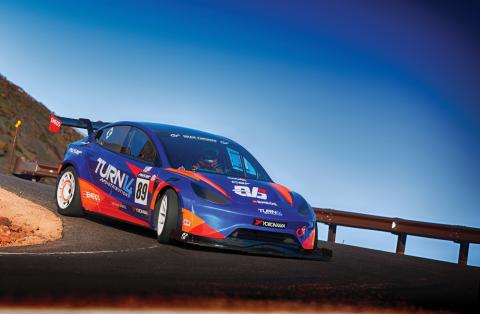
When it first started selling aftermarket parts in 2002, Evasive Motorsports of Cerritos, California, specialized in Japanese performance vehicles. It still does. “We are best known for Honda S2000 and Civic Type R; Toyota Supra, FR-S, and GR86; Subaru BRZ; Nissan GT-R; and Mitsubishi Evo,” said Tony Kwan. “We have competed in Time Attack since it started in the US, and this [2023] will be our ninth year at the Pikes Peak International Hill Climb.”
The company has also expanded into selling parts for some domestic and European brands, “and we recently added EVs to our specialty, specifically Tesla,” added Kwan.
“People keep saying EVs have no soul,” said Bisimoto Engineering’s Bisi Ezerioha, “but maybe that’s because they’ve just experienced a Nissan Leaf or base Tesla Model 3. The 930 tribute we just finished, Moby X [seen here under construction] has so much soul I should have called it James Brown.”
“We saw the popularity of the EV market increasing, especially with the introduction of the Tesla Model 3,” he explained. “Many customers were starting to modify this platform and even take it to the track. It’s safe to say that the EV market is only getting larger, so we decided we needed to adapt and see what we could provide for it. All car manufacturers are entering the EV market, and there are many electric racing series as well. EV may very well dominate the automotive industry within the next couple of decades.
“Most of our business is still ICE,” Kwan continued. “EV is only a small part of our business.”
Kwan acknowledged that, “for the most part, EVs such as the Model 3 aren’t easy to modify in terms of power. There’s no engine to modify, and you’re maxed out to what the electric motors that come with the car can produce.” The company did “learn a lot” from the Model 3 it raced at Pikes Peak in 2021 and 2022. “The modifications we focused on were to reduce weight, increase cooling, and on the aerodynamics, suspension, wheels, and tires. We have worked with a lot of the best companies in the industry to develop parts for our builds.”
To take weight off the Tesla, Evasive duplicated the factory doors, roof glass, rear trunk, and rear door windows in carbon fiber. “The carbon race splitter, diffuser, and wheel aero discs were custom designed by us under the EVS Tuning brand,” Kwan said. “The dry carbon GT Wing was provided by our good friends at Voltex, and we designed the wing mounts in-house.” Artisan Spirits made the widebody aero kit; and a set of TP-5 wheels, custom made by Titan 7 to fit within the kit’s wheel openings, mounted Yokohama racing slicks. KW Suspension provided custom motorsports coilovers, and Brembo custom made brakes for the car as well. “Sparco provided the steering wheel and racing seat to help our driver, Dai Yoshihara, navigate through the corners and withstand all the G forces.”
Cooling is essential on the Peak, and CSF provided additional coolers for the batteries and oil coolers for the front and rear powertrains, Kwan said. ENEOS provided specialized gear lubricants for the EV.
“Our major sponsor, Turn 14 Distribution, deserves praise as we’ve worked together throughout the years,” Kwan added. “With their help, we were able to establish the Model 3 race program for 2021 and 2022.” In 2022, Yoshihara finished with an 11:06 time, “taking second in the Exhibition Class, ninth overall, and was the fastest EV for the 2022 PPIHC. It was a great accomplishment for us.”
Beyond the successful Pikes Peak program, expanding into the EV market has enabled Evasive to “service new customers and continue servicing past customers who may have purchased an EV,” Kwan said. When asked if there had been any downsides, he was candid. “There’s some backlash in the automotive community. Many enthusiasts aren’t attracted to EVs and believe they’re boring or even soulless. We understand where the argument comes from, but it’s more of a different experience. Some people questioned why we were getting into the EV market, but we only want to learn as much as we can and continuously expand our knowledge of its application in a motorsports environment.
“Sometimes change is difficult but necessary in order to keep going,” he continued. “That’s the only way to continuously evolve your business model, no matter what industry you’re in.”
Cater to Customers
ModBargains, headquartered in La Habra, California, has been an online performance parts retailer “even before iPhones,” said Ron Hay. Initially the company specialized in BMW performance, “but as our customers gravitated to other vehicles—maybe they had an Audi or a Porsche—then we slowly fell into it because our customers were pulling us in that direction.”
That kind of evolution is how ModBargains began outfitting EVs as well. “We started seeing trends with consumers, especially here in Southern California,” Hay explained. “It really is kind of the hub of it. Our customers were there, and we started getting pulled into it, so we decided, okay, let’s cater to our customers.” Six years later, “we’re still growing, still learning from it. It’s another horizon for us.”
Tesla models are the “dominant platform” among ModBargains’ EV customers, Ron Hay said. The most popular components are aerodynamic pieces, wheels, and suspension components. “Track vehicles is a growing area,” he added, “as a lot more vehicles like Model 3s are going to the track. I know they have issues—how do we handle overheating?—but those are just new frontiers for us to explore.”
Plus, Hay pointed out, “regulations are changing. With the EPA and CARB doing their enforcement, doing high-performance type products is not going to happen. And a lot of new vehicles have a great amount of power anyway. So that was a dying area for us. We could see sales dropping.” Parts sales for traditional ICE vehicles “still dominate,” he said, but EV parts sales “are up to about 40% of our business. It’s climbed tremendously. It’s a major focus for us.”
Parts for Tesla models make up the biggest share of his EV business, “but you’re going to specialize in what’s available to you. In the shop we have a Model S and a Model 3, so we have the experience of working on those.” Other EVs are “coming on,” he added. “I’ve been doing a lot of Mustang Mach-Es. They’re coming on to the scene and they’re doing really well.”
Hay said that the most popular parts ModBargains sells for EVs are aerodynamic pieces, suspension components, and wheels. One of the biggest benefits of expanding into the EV market has been “discovering and working with new companies and discovering new products. It took us out of our comfort zone, working with new companies that are willing to go with cutting-edge stuff.”
But that can be a downside, too, he acknowledged. “Because there’s all that opportunity for new products, there are a lot of companies out there that are making products that, in my opinion, are not the best. That hurts consumers, and that can hurt consumer confidence.
“I want this industry to grow,” Hay continued. “I want our customers to modify their cars a lot longer into the future, to make it a positive experience. So when products come out that are not as good, not of the quality that is needed, that leaves a sour taste in the consumer’s mouth. It hurts us as a retailer, hurts the manufacturer of that product, and it hurts the long-term effect for this industry because those people will not recommend it.”
One way Hay is trying to keep the experience positive is through a vigorous education program. “I want to educate people, to make them confident in this industry,” he explained. To that end, he posts numerous technically oriented blogs on the company’s website and also created a YouTube channel, Talking Mods, “to help this industry out with all the different issues that come up.”
The majority of Bisimoto Engineering’s business used to be building gas-powered show vehicles for display at trade and auto shows. “Now we are 90% EV conversions and that may grow by the next quarter,” said Bisi Ezerioha. “Demand is just amazing, and as the components get more ubiquitous, I’m sure the prices will go down and even more people will be open to it.”
He also encourages other performance aftermarket companies to “reach out to companies like ours, companies already working with these products, to get the right products that you want to have. The parts can be hit-and-miss, and trials and tribulations can happen.”
The EV market in general, and EV mods in particular, are new, Hay pointed out. “You have to be patient with it, spend time with it, learn it.” Ultimately, though, Hay feels “it’s nothing too far off from what we’ve done. It’s still a vehicle. It’s just a little different to diagnose. There are opportunities for us all in this industry to work together. Our doors are always open for people who want help with anything that they’re working on. If we can help each other, it only makes it that much easier for all of us to get into that marketplace and have an easier time with that marketplace.”
Hay did make a point to say that, when a traditional performance parts company moves into the EV space, “you may have people who don’t want to be part of that. It may not be the image you want. That’s going to be a problem that a lot of people will face. It has to be a collective thought process to move toward the EV market.”
But, he added, “you can always do it the way we did it. You don’t have to be 100% EV. You can still cater to both. In my opinion, it hasn’t hurt us in any way. It has allowed us to cater to people across various markets. A lot of our customers who had BMWs or a Porsche, they own EVs now, and we moved along with them.”
Electric vehicles are poised to change the automotive landscape in the coming years, but there’s still much work to be done to properly integrate them into motorsports.
While we’re still in the early days of the automotive industry’s collective shift toward electrification, there’s no question that EV technology is becoming a regular topic of conversation in the motorsports realm. It may still be a while before we see cars lining up at the 24 Hours of Le Mans that are motivated solely by electricity, but to be ready for that day, the pieces need to be in place to make it work.
As it stands now, much of the discussion is focused on the unique safety challenges that these types of vehicles bring to the table. At the moment, there’s a sense that many organizations are taking an ad hoc approach to those concerns, likely due in part to the fact that EVs currently represent a small fraction of the car count at most events. But mounting evidence indicates that this tech will become a common sight in various racing disciplines sooner rather than later.
“We’re already starting to see a lot of it in the NHRA,” said Danny White of White Services Group, Indianapolis Indiana. Formerly the director of motorsports at Purdue University, White also oversaw the evGrand Prix racing program, which brings together college teams from across the country to compete in student-built, lithium-ion battery pack-powered karts. “I also think IMSA will embrace it more and more as we go forward, and I know that USAC has reached out to us about electrifying a midget for demonstration. Who knows where they might go with that, but it’s clear that EV technology is taking on greater importance in motorsports.”
As this interest builds, many sanctioning bodies and tracks are finding themselves at an early crossroads where they must choose between supporting this emerging technology or shying away from it, and some are choosing the latter. Although the rationale behind some of that trepidation isn’t without merit, some of the biggest challenges may be easier to address than they appear at first glance.
Extinguishing Concerns
While shock risk and vehicle weight—which, in some disciplines, could potentially be nearly double that of a typical ICE-powered entry—are significant aspects of the EV motorsports safety discussion, vehicle fire response continues to be the largest challenge facing organizers today. The focus isn’t necessarily on the driver, though. Rather than quickly igniting and rapidly engulfing an area, as gasoline fires often do, the threat of injury from a battery fire is fairly low because it typically takes much longer for the flames to spread.
Entropy Racing opted to power its EV race cars with lithium ferro-phosphate batteries, which are less volatile than lithium ion. “We took about a 15% weight hit because of that,” said Charlie Greenhaus, “but we felt that this chemistry would be more readily accepted by organizations because of the safety benefits.”
While statistics have proven that EVs are much less likely to catch fire after an incident than their ICE counterparts, the concern is that once a battery fire starts, it can be incredibly difficult to put out. Along with the unique chemistry involved in these types of fires (which necessitates the use of specific fire retardants in order to efficiently respond), the battery packs used in production vehicles are usually designed as enclosed, reinforced units to protect them from damage by outside elements, and that can make it very difficult to get the fire retardant where it needs to be to put the fire out. As a result, the risk of property damage by an EV fire—be it to the road surface below it or structures around it—is a serious concern for some track owners.
“Right now, there’s really no definitive procedure for fighting these types of fires,” said John Metric of the National Electric Drag Racing Association (NEDRA), Lake Jackson, Texas. “The perpetuating story is that you have to douse it with many thousands of gallons of water, and then that water becomes a hazardous liquid pollutant on the track afterward. And if you don’t have the right equipment to respond to it, you may end up having to shut down the event.”
Metric added that one response method that’s gained traction in recent years is simply to pick up a burning EV with a front loader or crane and move it to a designated location in order to fight the fire while mitigating potential damage to the track. But other solutions are also beginning to emerge. The Scalar SCR1, for example, is a purpose-built EV road race car that has a fire suppression system that runs through the battery itself, allowing the agent to get directly to the source of the fire. There’s speculation that OEMs may begin to incorporate special ports into their battery pack designs to make it easier for first responders to get that agent where it needs to be in production vehicles, too.
In the meantime, companies like Rosenbauer International are also developing firefighting equipment that’s meant to deal with EVs specifically. Its Battery Extinguishing System Technology (BEST) uses a low-profile design that makes it easier for firefighters to access the undercarriage of the vehicle, where most battery packs are mounted in road-going EVs. The system uses a high-pressure nozzle that can pierce through the casing. According to details from Rosenbauer, about 260–1,000 gallons of water are typically needed to bring an engulfed battery pack down to a safe temperature, a fraction of what’s often required when responding to an EV battery pack fire with conventional equipment.
The SCR1 race car from Scalar Performance has a fire suppression system that runs through the battery, allowing the agent to get directly to the source of the fire. Photo courtesy of NASA.
Fire suppression additives like the F-500 Encapsulator Agent—which is readily available on the market now—are also said to provide more effective EV fire response with traditional gear, but others cite the use of different battery chemistries as a better way to address the problem.
“The chemistry in most road-going cars is lithium-ion,” noted Charlie Greenhaus of Entropy Racing, Sacramento, Pennsylvania. “That’s one of the most volatile battery chemistries out there. For our EV race car, we chose a lithium ferro-phosphate chemistry because we felt it would be safer in that regard. We took about a 15% weight hit because of that, but we felt that this chemistry would be more readily accepted by organizations because of the safety benefits.”
Modernizing The Curriculum
Heyward Wagner of the Sports Car Club of America in Topeka, Kansas, told us that one of the larger obstacles facing sanctioning bodies with EV integration into their programs is simply a lack of foundational knowledge. While internal combustion cars have been commonplace for more than a century, EV platforms and technology have not, and this disparity has implications on several levels.
“I think the biggest challenge for a sanctioning body in 2023 is that a Mazda Miata can’t really get into a situation that we don’t already know how to get it out of. We know how to pick one up off of a tire wall, we know how to turn one over after it’s flipped, and we know how to quickly put it out if it catches fire. It really doesn’t matter what a Miata does at a race track because we already know how to solve for that. Right now, as far as institutional knowledge within the organization goes, we can’t say the same for a Tesla Model 3.”
The evGrand Prix race program brought together college teams from across the country to compete in student-built, lithium-ion battery pack-powered karts. The photo was submitted by Danny White, who was the director of motorsports at Purdue University and oversaw the evGrand Prix program.
That knowledge base will inevitably grow as time goes on, but in the here and now, White said that specialized training for first responders is vital. “It’s definitely a situation where you don’t know what you don’t know. You’ve got folks all around the country who work races, and they’re first- or second-class firefighters. The problem is that this situation not only takes a firefighter, it also takes a HAZMAT technician. So, in order to effectively work an EV race, they need to be trained for that as well. There are a lot of factors involved that they may never have had to consider before, and that changes a lot of things.”
Greenhaus also explained that more comprehensive EV-specific knowledge is going to become increasingly crucial for proper tech inspection as well. “Another very real problem right now is that, while we don’t lie to sanctioning bodies about what’s in our car or how it’s designed, they wouldn’t know if we did,” he said. “They’re either going to believe you, or they’re going to spend a bunch of time and energy for a very small portion of their participants. Most of these organizations just don’t have the internal capacity to verify some of these things. It’s not like an engineer looking at a roll cage. It’s much more complex than that.”
Wagner agreed. “When you start talking about the more home-built stuff—whether that’s an EV swap into a platform that was formerly ICE-powered, or some sort of custom EV Formula car, or something like that—probably our biggest challenge is finding another person, aside from the person who built that car, who can look at it with an educated eye and do a technical inspection on it,” he explained.
Updating Best Practices
Even though we’re still in the early adopter phase of EVs in motorsports, sanctioning bodies are beginning to establish comprehensive rules packages that should help keep the playing field level and minimize confusion for would-be EV racers.
Entropy Racing conducts EV safety seminars with track workers. Charlie Greenhaus believes more comprehensive EV-specific knowledge is going to become increasingly crucial for proper tech inspection.
“The NHRA recently did their first major rework of their EV rules in more than 15 years,” said Metric. “This is the first version that wasn’t just basically a straight copy of the NEDRA rules. We worked together with the NHRA to put together a package that makes sense for them, and they’ll be using them for this year’s Summit Super Series. We had around 10 EV entries in the series last year. They were still dwarfed by the number of internal combustion cars there, but it’s growing. You add a few cars each year, and pretty soon, you have a significant impact on it. The performance of these cars is very repeatable, and that’s what wins drag races.”
He added that the ruleset’s battery design mandates should address concerns about how to properly respond to EV fires. “As far as custom drag cars go, this NHRA ruleset revision has a pretty good take on how to get water into each battery case, and the requirement of a vent on the bottom so it’s venting downward. It covers the construction materials and firewall design as well. It took us months of deliberation to establish something that everyone was satisfied with, and it seems to be a good approach.”
From Wagner’s perspective, at this stage it ultimately comes down to proper preparation. “Autocross, for example, has existed for a very long time with the idea that if you have a fire, you’re going to use a fire bottle. And you’re going to call local emergency services to bring a fire truck if needed—it wouldn’t be onsite. So, for an autocross event with electrified vehicles, it means things like having a specialized fire bottle onsite, along with high-voltage gloves and things like that. It’s about figuring out how to get to a level of equivalency with our ICE response.”
That same perspective should be shared by EV racers, he said. “I think you have to understand that, when you show up at an event with an EV right now, it’s not likely that there’s going to be a lot of organic knowledge already there for you. So it’s going to be important for these early adopter drivers to educate themselves, so they understand things like how to jack the car up, what to do if the vehicle needs to be towed, what warning lights mean, and what needs to be done in order to make sure the car is fully off.”
But as Metric pointed out, the larger integration of EVs into motorsports is likely to be a gradual process rather than the flip of a switch. “The bigger shift will happen when these cars are out of warranty, the dad is handing the car down to the kid, and the kid wants to hot rod it. At that point you’re talking about hacking the computer, figuring out what can be removed from the car to lighten it, and that kind of thing. I think that when that cycle starts, things will ramp up. But when a car starts at $100,000, that doesn’t happen very quickly.”
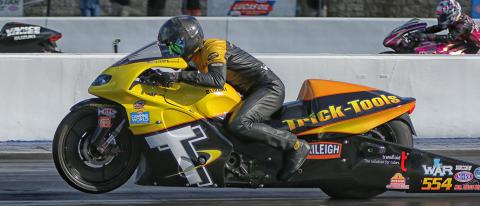
Trick-Tools, the manufacturer of high-performance metal fabrication equipment and metal working tools, has partnered with NHRA Pro Stock Motorcycle team White Alligator Racing (W.A.R.) and Transfluid, the global manufacturer of tube processing and tube bending machines. The partnership will support W.A.R. in the NHRA Pro Stock Motorcycle Series in 2023.
"Our long-lasting relationship with Trick-Tools made it easy to take advantage of the sponsorship opportunity. As a technically enthusiastic company with a major involvement in the racing and automotive industries, we have a natural affinity for motorsports. It's an outstanding field that requires technical excellence and teamwork--values that are also the foundation of our company. We are honored to be part of this racing family and look forward to an incredibly exciting season," said Yannick Bludau, CEO of Transfluid Tube Machinery.
PRI Membership allows the racing community to showcase their passion and pride for the industry. By uniting the industry, PRI is actively addressing challenges and needs, such as providing support for race tracks to prevent them from closing, advocacy for the racing community against current legal threats and educational programs that help businesses and racers succeed.
View the long list of top companies committed to boosting the performance and motorsports industry with special deals and discounts--only available to PRI Members through the PRI Member portal.
An active PRI Membership is required to attend the PRI Show, Dec 7-9, in downtown Indianapolis. For more information, visit performanceracing.com/membership.
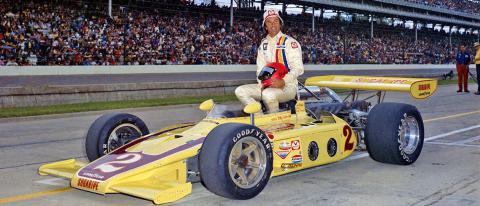
Bill Vukovich II, the 1968 Indianapolis 500 Rookie of the Year and a member of one of the race's most prominent families, has passed away. He was 79.
Vukovich was the son of two-time Indianapolis 500 winner Bill Vukovich and the father of fellow Indianapolis 500 Rookie of the Year Billy Vukovich III, as the Vukovichs were one of only five families to have three generations of drivers compete in "The Greatest Spectacle in Racing," joining the Unsers, Andrettis, Foyts and Brabhams.
California native Vukovich made 12 starts in the "500" between 1968-80 with six top-10 finishes. His best result was second in the rain-shortened race in 1973, driving the No. 2 Sugaripe Prune Eagle/Offy fielded by Jerry O'Connell.
In 1968, Vukovich qualified 23rd and steadily climbed to finish seventh as a rookie driving the No. 98 Wagner-Lockheed Shrike/Offy fielded by fellow Californian J.C. Agajanian. That performance earned Vukovich the Rookie of the Year award.
Vukovich also was a star on short tracks across America. He earned 23 USAC National Midget victories racing for such premier team owners as J.C. Agajanian.
In 1998, Vukovich was enshrined in the National Midget Auto Racing Hall of Fame, joining his father. All three Vukovichs are also enshrined in their hometown in the Fresno Athletic Hall of Fame.
For more information, visit the Indianapolis Motor Speedway announcement.
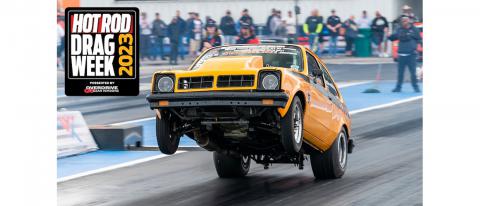
The race to determine the title of "Fastest Street Car in America" is back as HOT ROD Drag Week 2023 presented by Gear Vendors Overdrive returns to premier tracks in four Southeast cities Sunday, September 17 through Friday, September 22.
HOT ROD Drag Week puts competitors through a grueling test over five days of action-packed drag racing, requiring racers to drive their vehicles on a specified route from city to city, upward of 1,000 miles, while securing the quickest possible elapsed time across the five days.
Spectator tickets will be available at each track for $20. Children 12 and under are free with a paid adult.
HOT ROD DRAG WEEK 2023 PRESENTED BY GEAR VENDORS OVERDRIVE™ SCHEDULE
(Daily end times as stated or until complete)
Tech Inspection, Registration, Test 'N' Tune – Sunday, Sept. 17
Darlington Dragway (Hartsville, S.C.) - 8 a.m. to 9 p.m. local time for registration, tech inspection, and test' n' tune (tech open from 8 a.m. to 6 p.m., test 'n' tune begins at 2 p.m.)
Day 1 Racing – Monday, Sept. 18
Darlington Dragway (Hartsville, S.C.) - Gates open 7:30 a.m. local time, racing hours 8 a.m. to 2 p.m. local time.
Day 2 Racing – Tuesday, Sept. 19
Rockingham Dragway (Rockingham, N.C.) - Gates open 7:30 a.m. local time, racing hours 8 a.m. to 2 p.m. local time.
Day 3 Racing – Wednesday, Sept. 20
Bristol Dragway (Bristol, Tenn.) - Gates open 7:30 a.m. local time, racing hours 8 a.m. to 2 p.m. local time.
Day 4 Racing – Thursday, Sept. 21
Carolina Dragway (Aiken, S.C.) - Gates open 7:30 a.m. local time, racing hours 8 a.m. to 2 p.m. local time.
Day 5 Racing (Finals) – Friday, Sept. 22
Darlington Dragway (Hartsville, S.C.) - Gates open 7:30 a.m. local time, racing hours from 10 a.m. to 6 p.m. local time, followed by awards.
NASCAR has introduced a new way for fans to explore its rich racing history with "NASCAR Classics." Now available at nascar.com/classics, NASCAR Classics offers free, ad-free viewing of more than 1,000 full race replays, condensed broadcasts and recap packages spanning eight decades of the NASCAR Cup Series.
Anchoring the extensive archive is a new anniversary capsule: NASCAR's Top 75 Greatest Races. The unranked collection, selected by the sanctioning body, showcases some of the most exciting on-track action, important milestones and enduring memories throughout NASCAR's first 75 years, bookended by 1951's Motor City 250 in Michigan and Ross Chastain's "Hail Melon" move at Martinsville in October of 2022.
NASCAR also launched dedicated NASCAR Classics accounts on Facebook, Instagram, X (formerly Twitter) and YouTube, to engage fans with a variety of throwback content on an ongoing basis.
"NASCAR Classicsis a significant addition to our digital content offerings that, for the first time gives fans around the world free, uninterrupted access to enjoy decades of past NASCAR Cup Series action whenever and wherever they'd like," said Tim Clark, senior vice president and chief digital officer at NASCAR.
 MEMBERSHIP LOGIN