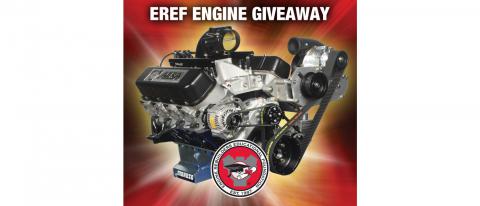
Officials with the AERA Engine Builders Association have announced an engine giveaway benefitting the Engine Rebuilders Education Foundation (EREF). The engine is built by renowned builder Jeff Baldwin, owner of Baldwin Racing Engines of Friedheim, Missouri. The punched-out big block Chevy features a whopping 565 cu. in.
The winner of the engine will also receive free shipping (within the continental United States) for transport from the PRI Show in the Indianapolis Convention Center.
The winning ticket will be drawn on the final day of the PRI Show, Saturday, December 9. The winner does not need to be present to win.
The EREF Engine Giveaway is a direct fundraiser to benefit EREF. All proceeds from the engine raffle will go directly to the scholarship and grant program, AERA officials stated.
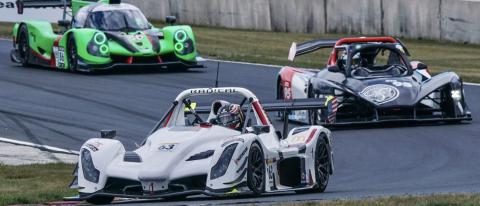
Prototype Sprint Series Association presented by Hankook (PSSA) has announced its 2024 schedule. Marking its sophomore season, the series features prototype race cars competing in a sprint race format across the country. Increasing from eight to 12 events, the 2024 season will mark the debut of the PSSA East and PSSA West championship titles and will crown a national champion.
“We’re excited to announce the 2024 schedule for the Prototype Sprint Series Association presented by Hankook,” said Rob Elson, Technical Director of PSSA. “We’ve had a successful inaugural season, and with continued support from great partners like Hankook, Radical, Revolution and Ligier, we expect to see even more growth in 2024. We continue to add eligible chassis, opening up the series to even more potential, and now we’re adding five new venues, with Thunderhill, Eagles Canyon, Lime Rock, Portland and Watkins Glen all included on next year’s schedule. We’re just getting started with PSSA, and we can’t wait to see how its potential unfolds.”
With events planned coast to coast, racers will be able to contend for the PSSA East or PSSA West championship or take on everyone to compete for the national title. Nearly 20 chassis will be eligible for competition, and drivers must hold either a SVRA Competition License or SVRA Super License (or equivalent), depending on which class they compete in. Weekends feature five on-track sessions, including two feature races. Hankook racing tires are required for all on-track activity.
At the conclusion of the season, both the PSSA East and PSSA West Champions will be awarded a $10,000 prize in addition to several product awards. Meanwhile, the overall national champion will be awarded a limited-edition Bell Racing gold helmet. PSSA will also add a constructor’s championship in 2024 to recognize the manufacturer that accumulates the most points throughout the season.
For more information about the 2024 PSSA schedule, see the full announcement here.
2024 PSSA East Championship Schedule: March 7-10, 2024: Eagles Canyon Raceway (Decatur, Texas)
March 21-24, 2024: Road Atlanta (Braselton, Ga.)
June 28-30, 2024: Road America (Plymouth, Wis.)
July 19-20, 2024: Lime Rock Park (Lakeville, Conn.)
Aug. 21-25, 2024: Watkins Glen International (Watkins Glen, N.Y.)
Oct. 3-6, 2024: Virginia International Raceway (Alton, Va.)
Oct. 31-Nov. 3, 2024: Circuit of The Americas (Austin, Texas)
2024 PSSA West Championship Schedule: March 1-3, 2024: Thunderhill Raceway Park (Willows, Calif.)
April 18-21, 2024: Sonoma Raceway (Sonoma, Calif.)
May 2-5, 2024: WeatherTech Raceway Laguna Seca (Salinas, Calif.)
June 28-30, 2024: Road America (Plymouth, Wis.)
July 26-28, 2024: Portland International Raceway (Portland, Ore.)
Oct. 18-20, 2024: Spring Mountain Motorsports Ranch (Pahrump, Nev.)
Oct. 31-Nov. 3, 2024: Circuit of The Americas (Austin, Texas)
For more than four decades, Wally Stroupe has been building championship drag race cars deep in the heart of NASCAR country.
It’s not bragging if it’s true.
“We’re fixing to top 500 cars that we’ve built,” said Wally Stroupe in early September. “We’re really close. And I’ve got 21 world championships in our cars. We’ve got them from Pro Mod down to Quick Rod. We’ve got, I think, six or seven championships in Top Sportsman.”
Longevity has something to do with that. Stroupe, now 60, has been building drag race cars since he was a teenager. But just being around a long time is no guarantee of success. That takes dedication, innovation, and a commitment to quality.
“The biggest thing I hear from customers is not only do our cars work well, but our fit-and-finish work outdoes everybody,” Stroupe said. “I’d say we’ve got probably 200 Best Engineered and Best Appearing awards with our cars.
“I’m a stickler,” he added. “I’m very picky about looks and detail stuff. I guess it shows when the customers say that.”
Top Sportsman drag racer Jackie Darter feels much the same way. “I’m really particular about my stuff. I know what I’m looking for.” Stroupe has built five cars for Darter over the past 25 years, and he “takes a lot of pride in what he does,” Darter said. “I’ve seen a lot of cars in my time, and there’s nothing better out there.
“And you can talk to him,” Darter added. “If you want to do something, that’s what he’ll do.”
“He’s very easy to work with,” agreed Pro Mod racer Mike Janis, who has had two cars built by SRC Motorsports. “When we want a car done, like every racer, we want it the way we want it. A lot of guys would fight you all the way, but Wally just said, ‘Whatever you guys want.’ And there were no surprises. Usually when someone tells you it’s going to be three, four months to build a car, it’s going to be a year. He was within a week of what he said, and he stuck to his price.”
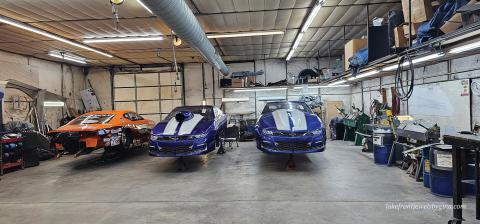
SRC Motorsports is housed in a 7,000-square-foot shop in the Charlotte suburb of Kings Mountain, North Carolina. Stroupe, his son Luke, fabricator Cody Williams, assembler Lamar Woods, and machinist Melvin Price keep the customer cars moving from frame jig to final assembly. Stroupe’s wife, Gina, and their daughter, Sarah Gann, run the office.
SRC Motorsports’ founder Wally Stroupe isn’t just a race car builder, he’s an innovator. During four decades in business, he has developed a number of unique chassis components and suspension designs. He recently applied for a patent for an adjustable four-link that would work in both a Pro Stock and Top Sportsman car.
When we spoke, Stroupe had finished and delivered “seven cars in the last two, three months. Up until then we had 20 cars in here.” His three jigs are currently full of cars in process, two for no-prep racing and one Top Sportsman truck. A Pro Mod car waits its turn to get on a jig, “and I’ve got two Top Sportsman cars sitting here ready for paint.”
These cars are not only going all over the country, they’re going all over the world. “I’ve got Pro Mod world champions in Sweden and Norway. I’ve got three- or four-time world champions in Pro Stock in Australia. I’ve got Pro Mod world champions in Australia. I have a lot of customers in Australia now,” Stroupe explained.
The Look
There’s no mistaking a Stroupe race car. In a world where ride height and rake mean so much to the success of a drag racer, Stroupe’s cars are that much lower, that much sleeker.
“They do have a look, don’t they?” we asked.
“Yes, they do,” he agreed. “When all the new cars went to the carbon fiber bodies in 2001, we built a new Grand Am for me to run Mountain Motor Pro Stock. We showed up at the race track, and ours was sitting like a Pro Stock car does now. It was only like 2 1/2 inches off the ground. Everybody else couldn’t get the tires under, and they were sitting like 4 or 5 inches off the ground in the rear. It blew everybody’s mind.”
\Wally Stroupe finished and delivered seven cars during the summer months, and the shop remains full of cars in process. Parts shortages continue to be a problem. “I’ve got two brand new cars sitting here that I’m waiting on all the suspension for.”
Stroupe’s chassis innovations include adjustable motor plates for Pro Stock cars with “a jack system on the motor plates and transmission to raise the engine up and down when everybody else was putting shims under everything,” he explained. The adjustable strut mounts he developed utilize threads, “like the shocks in the rear,” that enable ride height change without affecting shock travel. Currently he’s applied for a patent on a new four-link that allows for adjustability “every 5/8 inch forward and back, and you can raise it every 1/8 inch up and down. You can actually go above the motor with the intersect point if you wanted to.
“We have found in the last few years the more horsepower you make, and the higher we keep going with the intersect, the quicker the cars keep going.” Dealing with increasing power levels is a continuing challenge. “I’ve seen some dyno sheets from customers of ours that have been like 4,400 horsepower. It takes a toll on them.”
Diesel Certified
For all his success building drag cars, Stroupe’s formative years were spent in a whole different direction. “My dad had a trucking company, and I went to Caterpillar and Cummins school before I graduated high school. I’m certified Caterpillar and Cummins, and I did that for years.” When Stroupe was 15, his father bought him a 1968 Camaro “to fix up,” and it wasn’t long before he was racing it.
“Then we wanted to go a little quicker in it,” Stroupe recalled. “I think I was 17. We kept trying to get another chassis builder to build us a car, and he kept putting us off. So I just built it myself. Next thing I know, we’re winning races like crazy. We won 11 straight weekends in a row and won three races in one weekend—twice. That’s when people started wanting me to build cars.” For a while he continued working on diesels while building race cars on the side, “but then I had more cars to do than I had time to do diesel work.” In 1981, at age 19, he opened Stroupe Race Cars in a shop adjacent to his father’s business, “and it kind of progressed from there.”
Helping to cement his reputation as a builder was his success at the track. After running a Top Sportsman Camaro Z28 and winning at the 1986 IHRA Pro Am Nationals in Rockingham, North Carolina, Stroupe built a Beretta in 1990 for the then-new Pro Modified class. He set a world record ET of 6.81 seconds in 1991, and “after we set the world record, we got really covered up [in work],” he said. “We did that up until 2008.” In all, Stroupe has won 61 races so far, “from Pro Stock down to Quick Rod and bracket racing.” He’d still be racing—“I got a brand-new car; it’s got 15 runs on it, and we’ve already been to the semifinals in it”—if he had the time.
With a Vengeance
In the early 2000s, Stroupe Race Cars was building “30 cars a year, and I had 14 people working,” Stroupe said. “But toward the end of 2008, when we had the election, it’s like you took a switch and just cut it off. I think the whole industry was affected. We went from 30 cars a year down to four. That’s a big swipe, and we had to downsize. But when it came back, it came back with a vengeance, and we’ve been doing it ever since.”
Wally Stroupe’s 25-year-old son, Luke, has been working in the shop for some four years. “He welds all the cars up, and he’s excellent,” Stroupe said. SRC Motorsports is a family affair; Stroupe’s wife, Gina, and his daughter, Sarah Gann, work in the office.
Stroupe changed the business’s name to SRC Motorsports in 2010, “which stands for the same thing,” he pointed out. “Insurance people, they don’t ask any questions about ‘Motorsports.’ When you say ‘Race Cars,’ they drop you like a hot potato. So we had a name change and went from an LLC to a corporation.”
With the amount of work coming in the door, Stroupe would like to expand, ideally growing both staff and square footage. “But right now, you can’t find anybody to work. We’ve been struggling in that case.” He admitted that “being right in the middle of all the NASCAR teams” doesn’t help. “They suck up all the people.”
In another echo of pandemic times, he’s suddenly finding it hard to get parts and materials. “It seems to be happening in the last few weeks. I don’t know why. We’ve had five billet rearend housings ordered for four months from a manufacturer, and we’ve got two so far. And then I’ve got two brand new cars sitting here, one for Pro Mod and one for Pro Stock, that I’m waiting on all the suspension for. Everything else is done.”
Expanding his shop space has been on Stroupe’s mind since before the recession. In fact, blueprints were done for a 40,000-square-foot space on the same property. “Right before I pulled the trigger is when the economy went down, so I kind of shelved it for a while. But if I could get the help right now, I would build it now. That’s the only thing I’m waiting on, and just trying to see what this economy is going to do.”
Biggest Changes
When asked what changes he’s seen in race car construction over the years, Stroupe first pointed to safety.
“The whole car is different now. Some of the things we used to do in the 1980s, you sit back and wonder, ‘What were we thinking?’” he said, laughing. “When SFI started, that changed everything. Now we’re all on kind of a standard deal as far as the safety aspect of it. We still have free reign on what we can do with the front and back of the car. Four-link designs have changed. Struts have changed. Our shock packages are major different. Back then, it didn’t really matter what you had on the car. Now it’s gotten to the point where, on a Pro Stock car, the rear shocks are $21,000. Front struts are $10,000. It’s ridiculous. On a Pro Stock deal, if you don’t run the inerter shocks, you’re gonna be about two-hundredths behind. And now the Pro Mods have got into that. It just drives the cost of racing up. I remember we used to build cars for $20,000 to $30,000 back in the 1980s. And that was a nice car back then. Now, the costs are upwards of $125,000 to $200,000.”
Melvin Price, seen here, who is also Gina Stroupe’s brother-in-law, is a machinist at SRC Motorsports. The tight-knit crew also includes fabricator Cody Williams and assembler Lamar Woods. Finding good help has been a challenge for Wally Stroupe, and being located in NASCAR country doesn’t help. “They suck up all the people,” he said.
Speaking of costs, Stroupe learned an unexpected lesson when he increased his prices two years ago. “It was getting to the point where we couldn’t make a living,” he admitted. “So we went up on our prices, and the business doubled.”
How did that happen? “I’ve been told before, ‘You’re so cheap, the customer thinks they’re not getting something,’ even though we’re building a product that’s as good or better.” So, he figures, his increased prices aligned with the perceived quality of his cars.
Then again, “other than in the pro categories, this is everybody’s play money, right? This is what they work all week for, to play on the weekends. So a lot of people only have a certain amount of budget. That’s what blew my mind when we went up on prices and doubled the business. I wouldn’t have thought it would do that.
“You know,” he added, “this is a weird business. Business models for a normal business don’t seem to work in this business. I can’t explain it. It don’t make no sense to me. But that’s what I found.”
Influencers are an increasingly important component in a performance business’s marketing strategy. Here are some tips to get the most out of that relationship.
When Marla Moore was the marketing director for Coker Tire in Chattanooga, Tennessee, she developed a close working relationship with the writers and editors of automotive magazines. They were for years the chief means of distributing information about Coker’s various tire lines to an enthusiast readership that represented a large segment of Coker’s market. Those magazine staffers “were the content creators; they were the influencers,” she said, even though at the time no one used those terms.
“Now all of that has changed and evolved,” Moore continued. “There’s just not as many magazines or as many outlets in that area for manufacturers to work with. We still need the magazines that are still out there, and I want to support them, but our industry should seriously be looking at putting more of their money into the influencer side of the digital marketplace. Today, something like a third of the marketing directors out there are spending 40% of their budget on content creators. It’s definitely a shift in what’s happening.”
Moore herself is riding that wave. After leaving Coker last December, she is the co-founder of a new company, Autofluencer, that will help aftermarket companies connect with influencers and manage their relationships (see sidebar on page 254).
Moore was one of a half-dozen performance industry members we spoke with about the nature of influencer marketing: how to choose an influencer to best represent a company, setting expectations (for both parties), and measuring the success of an influencer’s efforts.
Choosing an Influencer
For those new to this kind of digital marketing, it’s important to understand that there is no one-size-fits-all type of influencer.
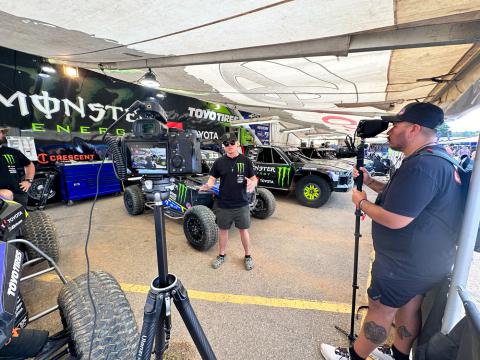
“Every influencer has a niche. They really can’t be viewed the same,” said Bob Galuska of STA-BIL, Chicago, Illinois. “For example, some of our influencers have a strong social media presence, which allows us to get a bunch of eyeballs on our brands through digital channels like TikTok, Instagram, YouTube, and so on. Others may not have a huge social media following or don’t do a ton of content online, but they have a really awesome, one-of-a-kind car that gets them featured on huge media outlets like Hoonigan or MotorTrend, which gives our logos on the car a ton of exposure. It takes all types of them to fill out the portfolio of whatever you’re trying to accomplish. Are you looking for an influencer just from a digital perspective to help increase sales for a promotion? Are you looking for a personality in your booth at events? Is your brand into racing circuits? These are the kinds of questions that we ask ourselves when creating our marketing plan. What influencers do we need to fit in each bucket?”
Working with influencers can be a “two-way street,” said Bob Galuska of STA-BIL. For example, the company’s in-house content team produced a documentary about Time Attack racer Feras Qartoumy’s attempt to break the lap record at COTA a few years ago. “If you have a good relationship with them, and you’re helping them build their business or their ambitions, they should also want to support you more,” added Galuska.
“When I was looking for an influencer, I had some very specific boxes that I was looking to check off,” said Nolan Jamora of Isky Racing Cams, Gardena, California. “A must was someone who was not just an influencer but also a racer and builder. We wanted someone who already had a presence but who also could grow with us as the collaboration progressed. It’s important for us that an influencer has credentials and a body of work that gives their recommendation weight. They must attend events, race, and have a reputation of strong character, skill, and hard work. For us as a family company, that was a really important aspect to consider. Another important consideration was that the influencer doesn’t have a ton of companies they post for, and they have not oversaturated their social media. I like an influencer who has a very select group of sponsors that we would consider leaders in the industry.”
Kevin Parlett of VP Racing Fuels, headquartered in San Antonio, Texas, had a similar wish list for his company’s influencers. “We want guys who are winning and influencing. If you’re not doing both, are you really a voice in the industry that is meaningful to a consumer? We sponsor what I consider the best of the best of each of the motorsports we touch. To do that they’ve got to win on Sunday and be posting on Monday. We don’t just want somebody who’s popular. We want somebody who’s meaningful.”
When Isky Racing Cams was looking for an influencer, it was “a must” that the person “be a racer and a builder,” said Nolan Jamora, “someone who already had a presence but who also could grow with us as the collaboration progressed. We could not have found a better fit than Alex Taylor,” seen here.
“Once you identify a couple of influencers, then you can start digging into, is the audience they have relevant?” said Galuska. “Are they actually engaged with the content that influencer is putting out? What did the comments look like in the posts? Are they truly engaged, asking questions? Are they commenting about experiences they’ve had with similar products or with this product?” An audience that isn’t engaged will “probably have little or no impact for your brand.”
By the Numbers
To Galuska’s point, what might seem to be the most obvious metric of a content creator’s influence—audience size—may not always tell the whole story.
“If you’re looking for exposure for a new product, and you’re really trying to expose that to a large audience, the larger influencers are definitely worth it,” he explained. “If it’s the kind of product you’re trying to maintain, or has been on the market for a while, the smaller influencers are great at penetrating their audiences, because usually with the smaller influencers, they have a more niche and engaged audience. If it’s something that really catches their audience’s eyes, we can really benefit from them.”
“The biggest influencer isn’t always the best influencer,” said Emily McConkey of lighting company Project X, Costa Mesa, California. “It’s not just the number of followers or their engagement, it’s what you see them doing within the community. When it comes to affiliate links, we’ve seen the highest number of sales from micro influencers rather than those big mega influencers. It really has to do with credibility. Those are the people you see out on the trails every single weekend conquering those obstacles. So whatever this person does use, you trust. They’re not just posting a really cool photo or a super cool Reel. They interact with their followers, significantly more than one with a million followers would.”
“Big numbers is a scam,” said Casey Currie of Currie Enterprises, Corona, California. “Anyone can go out there and buy 100,000, 200,000, 500,000 followers instantly, and it doesn’t create sales.” Plus, Currie noted, “it doesn’t take hundreds of thousands of followers to make a lot of money. At Currie Enterprises, one rearend is $7,000, and a Jeep takes two rearends. I don’t need somebody with a million followers and maybe only six of those followers are Jeep enthusiasts to the point where they can afford the axles. But if I have a guy who has 25,000 followers, and he creates great content, and that guy is selling 50 rearends a year, you’re talking hundreds of thousands of dollars a year in sales.”
Related to the subject of numbers is influencer compensation. For the most part, the days of retaining an influencer by providing them only with free parts are over (though depending on the cost of the part, and who the influencer is, that does still happen).
“You should be prepared to pay influencers because they can do so many things,” Moore pointed out. “Even a micro influencer can install a product, they can do an unboxing, they can do a video, they can do a social media post, they can do an appearance, they can be at a show for you. There’s a number of things you can do when you work with these content creators as actual partners.”
An influencer can also be more cost-effective than doing some marketing tasks yourself, she added. “Let’s say you produce a video in-house, and it costs you $5,000–$10,000. You put it on your website, or your YouTube channel, and maybe you get 150 views. But if you go with an influencer with 50,000 followers on YouTube, that same video might cost them no more than $5,000, and they’ll put it out to their subscriber list of people who will watch it, and you can put it on your channel, too. It’s a good deal.”
“Whenever you’re establishing a creator program, you really have to understand that the ROI will not be 100%,” McConkey said. “I have had people who have just taken products and posted twice, don’t really care, and have done nothing for us. That’s just a risk that you have to take when putting your product in someone else’s hands.”
That outcome has been rare for her. “We’ve had, pretty honestly, an amazing ROI when it comes to creators.” One reason is that “for every single creator that I sign on, I make them sign a creator agreement, which has deliverables outlined in it. That’s one of the most important parts about giving away free stuff to an influencer that you don’t really know. Because then they’re contractually obligated.” Those contracts are in effect for a year, she said, “and if they don’t meet the terms within that time, I won’t re-sign them.”
Kevin Parlett of VP Racing Fuels works with influencers who are hands-on and understand “why they need the product. You’re not looking for just a pretty face. You’re looking for someone who can win at the track, wrench in the garage, and talk about all of those moments in a meaningful way,” he said.
It’s important, too, to have realistic expectations of the influencer relationship, Parlett said. “VP is a decent size business, but we don’t have the same marketing budgets as energy drinks or some of these other non-endemic brands. We sponsor a lot of guys who are also sponsored by Monster Energy, and I don’t expect to get the same value out of them that Monster Energy gets out of them, because they are spending a lot more money. I can spend $50,000 with a team that has a big sponsor like that, and it only gets me a couple of inches of movement. But I can spend $50,000 with a middle-level athlete and get a ton back from it. So it’s a balance of, who are their sponsors? What am I going to mean to them? And what is a reasonable expectation back from them in that process? That’s why you need to have a healthy balance of top-tier athletes, middle-tier athletes, and even grassroots athletes. You need to have a wide portfolio that touches all of those different audience points.”
The Authenticity Factor
When McConkey mentioned credibility, she touched on another factor important to an influencer’s effectiveness: authenticity.
“We want to make sure that the influencer who will be representing our brands is someone who’s natural,” Galuska said. “They aren’t forcing people every five seconds to ‘Look at this! Buy this!’ They’re educational, they’re authentic, they’re not someone who’s totally different in person versus who they are online. If you ever see any of our influencers online, someone like Feras Qartoumy or Kelsey Rowlings, I guarantee they’re the same person in person as they are online. If you go up to them, they’re going to take the time out of their day, no matter what they’re doing, and talk to you, share stories. They’re just genuinely nice, everyday people, and that’s really what I love about the influencers we work with day to day.”
As part of her work with Isky Racing Cams, Alex Taylor, on right with Lizzy Musi, interviews racers from other disciplines who are also sponsored by the company. “That crossover and activation has led to a whole new group of followers for each,” Isky’s Nolan Jamora said.
Jamora said Isky Racing Cams “could not have found a better fit than Alex Taylor. At her suggestion we crossed over her followers with those of others we sponsor such as our Street Outlaw guys like Ryan Martin and our IndyCar driver Conor Daly by having her attend events and interview them. That crossover and activation has led to a whole new group of followers for each. Alex has become a very important part of the company and has become a brand strategist for us. We also have the added benefit of working with her family. Alex’s sister, Megan Taylor, has become our social media and marketing manager; her dad, Dennis Taylor, is building a Tribute T Roadster project car for our SEMA and PRI booths; while her mom, Debbie Taylor, books our travel plans and reservations. The Taylor and Isky families enjoy a very successful working relationship.”
“I don’t want to sponsor a person who has a cool car and just puts pictures of them standing in front of their cool car,” Parlett said. “I need them to be a hands-on person who understands why they need the product that they’re being sponsored for. You’re not looking for just a pretty face. You’re looking for someone who can win at the track, wrench in the garage, and talk about all of those moments in a meaningful way.”
As an example, he cited Street Outlaws driver Justin Swanstrom. “He takes you along for the ride, you know? If they’re tearing down an engine, he’s talking about what’s happening with the engine and why they are doing it. That type of content is so much more meaningful, not just for us as a company, but also for me as an enthusiast. The more opportunities you have to talk about the products in their natural setting, the more effective it is for us. And the more valuable that sponsorship is.
“There’s a big difference between meaningful content and just simply brand recognition,” Parlett added. “A logo doesn’t do anything unless you have the influencer athlete talking about the product in a way that will help you sell that product.”
Need Help in the Influencer Space?
Marla Moore’s new company, Autofluencer, built in partnership with co-founder Erica Sietsma, will offer the automotive aftermarket a “one-stop shop” that handles it all: “matches their marketing campaign with the correct influencer, creates the contracts, does the billing, handles the tracking and results measurement, everything that they need to create that relationship, document it, and show ROI,” she said. “We even have a content library for each brand so they can upload assets for creators or store creator assets to which they’ve been granted rights.
“There are a lot of influencer platforms out there,” she continued. “The problem is, they’re more focused on beauty and travel and things like that. It’s extremely time consuming for an automotive aftermarket company to go through their millions of influencers to figure out who to get. It’s also extremely expensive. We hope that this is going to be a tool that’s going to make it much easier.”
To track the value of its influencers’ social media posts, VP Racing Fuels in San Antonio, Texas, uses an online tool called Hookit, Kevin Parlett said. “It’s software that we plug our athletes into. It scans their social media and does a report on when VP Racing or any of the keywords we tell them are mentioned. It also has an AI scanning tool that reads when logos are in the photos.”
Hookit uses “a couple different algorithms” to set up a points system and adjust for added value, Parlett said. “It will look at things like, what was the context of the posts? Was there a VP logo visible, and how long was it in the post? Are the hashtags you want them using in it? Then it will give the post a quality rating.”
—Drew Hardin
This island jewel in the Caribbean is more than just a sunny vacation getaway—it’s also a hotbed of motorsports competition, where passionate competitors chase glory by shattering records at home and abroad.
Maybe it’s the hundreds of glistening white-sand beaches. Or the powerful mountains that rise majestically from lush tropical rainforests. Or the temperatures that stay permanently pegged between 70 and 90 degrees day-in and day-out. Whatever the specific attractions are, they’re enough to draw approximately five million visitors a year to the island paradise of Puerto Rico.
But paradise means different things to different people. While those picture-perfect attributes of the island may be ideal for restless sunseekers craving relief from the drab routine of Main Street USA, “paradise” tends to be quite a different concept for racers. Those who get their kicks from hauling booty more than tanning it typically measure the quality of a locale by things of the high-octane persuasion.
Simply put, any paradise without auto racing is just a temporary diversion.
If you listen closely, somewhere between Puerto Rico’s bouncing lope of Reggaetón beats and shrill swooping chirp of Bananaquit birds, you’ll hear a familiar siren song play. It’s the glorious ring of internal combustion engines being pushed to their limits in competition. Although Puerto Rico spans only about 35 by 100 miles—roughly the size of Connecticut—it has a rich, vibrant motorsports culture that runs deep in the heart and soul of native Puertorriqueños.
Popular Rides
The most popular form of motorsports in Puerto Rico is drag racing, which has long had a passionate following among fans and racers on the island. “At one event, you can have over 200 cars,” said Junot Medina of Jimmy Bou Distributors, San Juan, Puerto Rico. “The biggest event of the year is Festival Import de las Americas every year in March. And the second biggest one is Vispera Thanksgiving Miercoles, in November—the Wednesday night before Thanksgiving.”
Almost all the drag racing in Puerto Rico centers around Salinas Speedway, a quarter-mile, NHRA-sanctioned track on the south side of the island. Because of Puerto Rico’s persistent pleasant climate, racing takes place there year-round, save for a break over the Christmas holiday.
The types of cars that race in Puerto Rico for the most part mirror those found on the US mainland, but the relative popularity of those types can be considerably different in Puerto Rico. Sometimes those preferences defy expectations. For instance, the handful of American-style Pro Mod cars that race in Puerto Rico are fan favorites on the island. But the progenitors of those extreme machines, the typical steel-bodied V8 muscle cars that pour into mainland US drag strips, are generally a footnote in Puerto Rican drag racing competition.
Instead, the bulk of the action in Puerto Rico is in sport compacts, which fill staging lanes on the island and attract widespread attention from fans. Some sources even claim it’s the island’s racers that first discovered the performance potential of these affordable small cars, thereby forming the earliest roots of the entire sport-compact movement.
“From my point of view, Puerto Rico is where the sport compact thing began,” said Erik Maldonado of PMS Race Cars, San Lorenzo, Puerto Rico. “We’ve been racing sport compacts forever. And the cars from here are always the faster ones. I’d guess that maybe 40% or even 80% of the people in the US who run sport compacts are Puerto Ricans,” he added, laughing. “I go to an event over there and I know everybody.”
Included among the sport compacts that compete in Puerto Rico are the usual array of Hondas, Toyotas, and Nissans. But there’s also a strong following for rotary-powered cars, which appear in their native Mazda platforms or quite often swapped into an almost unlimited array of other makes and models. “Rotaries are a big focus in Puerto Rican drag racing,” said Medina. “We have the world records in two and three rotors—all-motor, turbo, whatever.”
Despite the popularity of drag racing in Puerto Rico, almost all of the action centers around just one track: Salinas Speedway, a quarter-mile drag strip just outside Salinas, a town of approximately 5,700 residents on the south side of the island. The track is NHRA sanctioned, with facilities comparable to a typical small local track in the mainland US.
Because of the island’s pleasant, consistent climate, racing in Puerto Rico is interrupted only by a holiday break in December. “We go all year round,” said Damaris Lopez of Salinas Speedway. “We do close for about a month around Christmas because it gets slow. Everybody is spending time with their family. Then we open again after we celebrate Three Kings Day, which is on January 6.”
While Salinas is adequate enough to satisfy the basic needs of many Puerto Rican racers, there is a significant number of competitors on the island who crave a more major-league racing experience. These ambitious racers regularly migrate to the States, typically competing at large events in Florida and Maryland.
According to our sources, Orlando Speed World Dragway in Orlando, Florida, has become somewhat of a satellite track for Puerto Rican drag racers, with many of them routinely making pilgrimages to the States several times a year. Some have even gone so far as to have flipped that equation around, spending most of their time racing in Florida and then occasionally returning to their native island home.
“People in Puerto Rico love to send cars to the United States,” said Medina. “The top engine builder for rotary cars, Jonathan Ortiz of Moncho Performance, is from Puerto Rico. Five years ago, he was going to the US every two or three months. Now he stays there and every few months he goes back to Puerto Rico.”
Logistics are key for racers making the journey from Puerto Rico to the States. For this, they rely on a proven roster of experienced service providers who take care of all the details, leaving racers with little to attend to other than getting themselves and crew members to the event.
Jimmy Bou Distributors in San Juan is one of Puerto Rico’s more prominent sources of aftermarket equipment. The company has a second facility in Orlando, Florida, to serve the many Puerto Rican racers competing in the States.
“Racers in Puerto Rico ship their cars through a number of American freight companies,” said Medina. “They use 53-foot ship containers with three cars inside. These companies do all the paperwork, provide the container, and handle everything else. The car owner just brings the car to a specific place and puts it inside the container. Then they just fly over and pick their car up at the event—the companies bring the container right to the track.”
Although Puerto Rican drag racers are frequent visitors to mainland US events, some in the Puerto Rican drag-racing scene would like to see more of that migration go the other way—US racers coming to the island to compete on Puerto Ricans’ home turf.
“I think it would be interesting to bring more sport compacts from the US and have them spend a couple months here racing with us,” said Maldonado. “That would make it more interesting and it would also bring more fans. They already do that at Festival Import de las Americas, with about 12 cars from the States. And it’s a big deal.”
Setting Records
Road racing has something of a following on the island, too. Although not as large as the crowd at the drag strip on any given week, there’s enough interest in it to hold regular road-racing events throughout the year.
As with drag racing, Puerto Rico’s road-racing scene also revolves around Salinas Speedway. The facility has a road course that can be configured in 1.3- or 1.8-mile lengths and hosts five practice sessions and five main events a year. In terms of dimensions and degree of challenge, the Salinas road course appears to be similar to a typical club track in the mainland US, which is more than ample for the Miatas, Minis, and Hondas that typically compete on it.
Yet the Salinas road course is also becoming the domain of well-to-do competitors on the island, who field more exotic machinery, Medina said. “Road racing is starting to bring people to the track with Porsches, Ferraris, and other fancy cars.”
While Salinas Speedway satisfies the basic needs of many Puerto Rican racers, numerous competitors on the island crave a more major-league racing experience. These ambitious racers regularly migrate to the States, typically competing at large events in Florida and Maryland. Photo courtesy of PMS Race Cars.
Much like competitors in the States, racers in Puerto Rico often pursue their sport with a passion that goes beyond rational thinking. “Puerto Rican racers will spend 90% of their money on their car and live in an apartment that they can barely sleep in,” said Medina. While the intensity of these racers certainly compares with that of competitors in the States, our sources noted a key difference that sets them apart.
“Puerto Ricans only want to break world records,” said Medina. “They sometimes don’t even seem to care about winning. They want to have the bragging rights—‘I’m the world’s fastest.’ This is the difference between them and Americans.”
As a result, racers on the island hold records in numerous sport-compact classes, and they’re consistently ranked among the quickest and fastest. Typifying this spirit is Jorge “Oso” Juarbe of San Juan, Puerto Rico. He’s one of the most accomplished drivers on the island, with decades of drag-racing experience that runs the gamut of classes and cars. Throughout the season, Juarbe divides his time among at least a half-dozen cars for various owners.
“We’ve been racing for almost 30 years,” said Juarbe. “As of today, we have the record for the quickest six-cylinder import, with a 5.55 quarter-mile. We’ve had some other records, too, and we’ve got the three-rotor rotary record right now, with a 6.0 E.T. Until recently, we also had the rotary record for two rotor, with a 6.16. We had that record for about six years.”
This emphasis on record setting is, perhaps, due in part to what our sources said is a very limited attention span among race fans on the island. Besides pushing drivers to achieve ultimate levels of performance in their respective classes, the need to keep people excited has largely dictated the types of cars that are fielded.
“People in Puerto Rico just get bored of everything,” said Medina. “A long time ago, back in the 1990s, the main focus was domestic cars—V8s. But over the years, import stuff started to catch people’s eyes in Puerto Rico, because those were the cars that were always trying to break records. For example, a 9.90 Super Gas car runs 9.90 all the time. People here got bored with that. They saw that with imports, this guy will go 10.2 today, and then next weekend he’ll run 10.10. And then in three months, he’ll put in a new transmission and go 9.5—faster and faster and faster.”
Expect to see some serious horsepower at Salinas Speedway in Puerto Rico. La Plomera, owned by Eliezer Roman, tuned by Chupa Tech, and running an engine built by Mitchell Munoz of MAR Performance, boasts 8.06 seconds at 178 mph in the quarter mile, and 5.36 seconds at 147 mph in the eighth mile.
To build cars that can charge after records week after week, racers in Puerto Rico depend on many of the same parts sources mainland racers rely on: large catalog suppliers based in the US. At the same time, many Puerto Rican racers frequent one of the island’s more prominent local sources of equipment, Jimmy Bou Distributors. The company also has a second facility in Orlando, Florida, to satisfy the many Puerto Rican racers competing in the Sunshine State.
Jimmy Bou Distributors is actively engaged in the Puerto Rican racing scene as the title sponsor of the Jimmy Bou Challenge road racing event at Salinas Speedway. Along with this, the company is also responsible for the Puerto Rico Racing Expo, hosted every two years at the Puerto Rico Convention Center, in San Juan, Puerto Rico. “It’s like a small version of the PRI Show, for the island people,” said Medina.
Come To The Island
Although the Puerto Rico racing scene has much to offer, it’s largely unknown to most Americans, despite the strong presence island natives now frequently have at major events in the States. Through pride, pluck, and determination, Puerto Ricans have proven time and time again they can hold their own with the best racers anywhere. “We’re proud that we built the fastest import in the world, which went 5.55,” said Maldonado. “And then, last year, we went to Bradenton for the Snowbird Outlaw Nationals, and we got a runner-up with a Pro Mod.”
What about his wish for US racers to compete in Puerto Rico? It’s an idea well worth considering. The island’s competition is intense, the scenery is stunning, and the people are friendly, warm, and welcoming. Further sweetening the idea is the relative convenience of such a journey. Puerto Rico is a territory of the United States, so citizens from the US don’t need a passport to travel there. In addition, the national currency on the island is the US dollar, phones work just like they do on the mainland, and English is widely understood.
Hello paradise—you could be just what we need right now.
Thanks in part to a rapidly developing aftermarket, these purported show cars are bringing some serious
hustle to the drag strip.
Initially dismissed by some as a drag racing anomaly, the Big Wheel scene has picked up significant momentum over the past few years. The level of performance that some of these cars are capable of today is truly jaw-dropping.
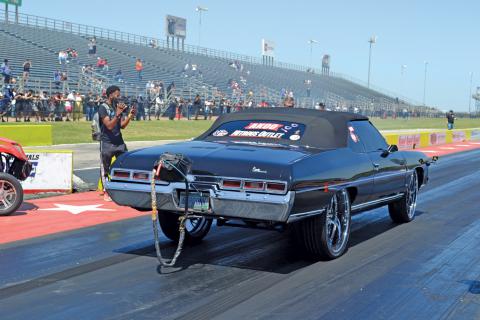
Before we dig into the factors that have helped this segment mature into what it is today, we should probably have a look at the terminology involved and address some common misconceptions. Perhaps most importantly, “Donk” denotes 1971–1976 Chevrolet Caprices and Impalas with wheel diameters of 22 inches or larger (though many in the scene still use the term “donk” to refer to all of the cars that make up the phenomenon). Meanwhile, a “Box Chevy” represents the third-generation Caprices and Impalas that were produced from 1977–1990 on similarly sized wheels, and the fourth-generation car—produced from 1991–1996—is called a “Bubble.”
Although these General Motors platforms represent the vast majority of the cars in this segment, GM G-bodies as well as a few Fords and Mopars have found their way into Big Wheel racing as well. It’s a scene that has matured in a familiar hot rodding tradition: After a distinct style was established, builders soon focused their efforts on performance. And as competition started heating up on the street, the folks with the fastest machines began looking at ways to bring their cars into formalized racing venues.
“The Big Wheel thing has been around since the late 1990s,” said Sage “Donkmaster” Thomas of the National Donk Racing Association (NDRA). “A few years later, social media platforms, YouTube, and publications like Rides magazine started to bring a lot more awareness to it.” As interest ramped up, Thomas and others saw an opportunity to bring Big Wheel racing to a larger audience in a more organized setting, resulting in the first annual Fast and Flashy car show and race event at South Carolina’s Darlington Dragway in 2015.
“The idea was to move the racing from the street to the race track,” Thomas said. “At that point, the cars were probably running in the low 11s, high 10-second range. These were street cars with full interior, sound systems, air conditioning—all of it. Guys were running combinations like turbocharged LS engines and big blocks with multiple stages of nitrous, but the cars weighed about 5,500 pounds, and they were running tires that weren’t made for the drag strip.”
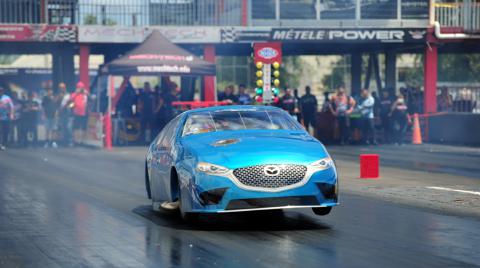
The fastest racers in the Big Wheel scene tend to use every advantage they can get. “At this point, some of these are basically purpose-built drag cars with big wheels. People are doing full fiberglass bodies now,” said Garvey Yeldell of GDawg803 Automotive Media, who also supplied this photo.
Those circumstances are actually part of the appeal of Big Wheel racing, said Glen Nichols of G Kustoms in Fort Worth, Texas. “When you don’t have readily available resources, it makes things a little more interesting. Initially it was about making a big body car as fast as something like a Camaro ZL1 or a Hellcat. Once everyone was able to do that, they moved on to the next challenge—proper race cars. At those first events, a lot of guys were running big wheels on the front and traditional slick setups on the rear, and Donkmaster is the only one that I can recall that was racing on rims. That forced everyone to adapt to that. He proved that you could make a car fast that way. So if you weren’t doing that, you were basically taking the easy route.”
Fast forward to 2023, and Big Wheel cars are now delivering performance that’s raising some eyebrows. Although grudge racers aren’t keen on offering specifics when it comes to ETs, many estimate that today’s quickest machines are capable of knocking out consistent sub-9-second quarter-mile times. This considerable improvement comes not only from the refinement of combinations and swelling horsepower levels, but also increasing aftermarket support and a greater understanding of how to effectively integrate advanced drag racing technology into these cars.
Motorsports Meets DIY
Tom Vigue of 3V Performance in Denver, North Carolina, said that although Big Wheels might appear to have wild suspension setups in order to accommodate these large-diameter rollers, that’s not really the case. “The guys that are running factory chassis will remove the inner fenders, the wheel tubs, and things like that, and then they restructure the body around the wheel. The cars aren’t lifted—if anything we like to drop the cars. They just look like they’re lifted because the diameter of the wheel moves everything up.”
Many of the engines in Big Wheel machines produce 1,500–2,000 hp or more. Data acquisition and the traction control features in ECUs like the Holley Dominator system have become prevalent in the upper tiers of the sport
That keeps things fairly conventional underneath the car, which allows those racers to bring in some familiar drag racing hardware. “They’re using things like ladder bars, four-links, and bolt-on front suspensions to get more travel at the nose of the cars,” Vigue continued. “One of the bigger challenges we face, particularly with the donks, is that they carry a lot of nose weight because they’re so long. Getting that weight to transfer to the back on a tire that’s got a limited contact patch is difficult. It’s very hard to get the car to work correctly, but it can be done.”
Nichols told us that one of the early breakthroughs in the Big Wheel scene was QA1’s introduction of a purpose-built suspension kit for 1977–1990 GM B-Bodies. “In 2015, nobody had any kind of kits for big body cars. When this came out, I decided to just try something. I’m always interested in seeing what’s possible, and what needs to change in order to make something work somewhere else. I discovered that the kit would work on a donk, and it also pulled the wheel in an inch, which was a bonus because it provided more clearance for the bodywork.” Although that older platform wasn’t officially supported at the time, QA1 soon expanded the kit lineup to include support for both older and newer generation GM B-bodies. Suddenly Big Wheel racers had a proven, readily available suspension setup that would make it much easier to put the power to the ground.
He also noted that companies like Roadster Shop and Speedtech Performance have developed purpose-built chassis for these cars, but many Big Wheel racers are hesitant to use solutions that fundamentally change the vehicle. “It’s a huge advantage, but it kind of goes against the spirit of this type of racing. You have a body that looks like that car, but everything underneath it is something totally different. Nobody wants to race against a car like that,” added Nichols.
Today’s quickest Big Wheel racers are capable of consistent sub-9-second quarter-mile times. This level of improvement comes not only from the refinement of combinations and growing horsepower levels, but also increasing aftermarket support. Photo courtesy of GDawg803 Automotive Media.
But as Garvey Yeldell of GDawg803 Automotive Media pointed out, like most motorsports disciplines, the fastest racers in the Big Wheel scene tend to use every advantage they can get. “At this point, some of these are basically purpose-built drag cars with big wheels. People are doing full fiberglass bodies now. There weren’t a lot of parts available for this when we first started, but that’s changing.”
Much of that development can be attributed to Thomas’ efforts to connect with manufacturers. “In the beginning we had to make a lot of parts, so I sat down with a number of big companies with the help of SEMA and PRI,” he explained. “Going to these events provided an opportunity for these companies to see what we were doing and how much excitement there was behind it. We were making extended trailing arms and cutting up control arms to make it work. Now you can just go on the Internet and order what you need. QA1 helped a lot with that, along with FTI Performance, which developed torque converters and transmission gear sets that are dialed in for this kind of car. Moser also developed a stronger Positraction unit and beefier gears. When you’re trying to launch a 5,500-pound car with over 1,000 hp, you need all the strength that you can get.”
A thousand horsepower is becoming increasingly pedestrian by today’s Big Wheel racing standards. “We just set the record with one of the engines that we did for Boost Doctor,” said Vigue. “At 2,350 hp, it’s the most power produced at the tire with a hydraulic roller cam. The problem is, most of these cars can’t access all of that power on these tires at the track.”
He said that many racers dial things back to between 1,500 and 2,000 rear-wheel horsepower. That’s still a whole lot of grunt to put down with this type of tire, though, which is why data acquisition and the traction control features in ECUs like the Holley Dominator system have become prevalent in the upper tiers of the sport. “It’s actually pretty similar to the strategies you’d find in no prep setups,” Vigue continued. “You do everything you can to get the weight on the rear tire and hold it there and apply the power as smoothly as you can. It’s a lot of the same stuff; it just needs to be massaged for this type of application.”
Today there are numerous Big Wheel racing events held in various regions of the country, and the National Donk Racing Association has played an important organizational role in these events, both in terms of setting up classes and instilling the importance of proper safety equipment. Photo courtesy of GDawg803 Automotive Media.
Tires are one aspect of Big Wheel racing where purpose-built options remain essentially nonexistent. Yet as they have in the past, racers are creating their own solutions. “There’s a gentleman who goes by the name Black Flag who has developed a 24-inch slick,” said Yeldell. “At first there were just a handful of people that had those tires, but now there’s so many out there that they’ve created a class just for the cars that are running them.”
Going Legit
Today there are numerous annual Big Wheel racing events held in various regions of the nation throughout the year, and the NDRA has played an important organizational role not only in defining car classes within Big Wheel racing, but also instilling the importance of proper safety equipment.
“These started out as show cars with big motors in them,” Thomas said. “But when you go from 11-second quarter-miles to sub-9 seconds, safety has to become a big part of it, especially when you’ve got cars running that fast on big wheels. So we had to add things like roll cages, driveshaft loops, engine diapers, along with simple things like kill switches, up-to-date racing harnesses, and fire-suppression systems.”
Vigue said that safety has come a long way in Big Wheel racing in recent years, and that change has helped to bring the competition to a wider group of enthusiasts. “Even just a couple of years ago, a lot of these cars didn’t have much more than a basic roll bar in them, but we’re beginning to see full cages becoming the norm. Now the NHRA is starting to put on some exhibition races with these types of cars, and that’s bringing this style of racing to a whole new fan base.”
Today the NDRA has three core classes—Lightweight, Middleweight, and Heavyweight—for donks and G-body vehicles. Cars are largely classed by the power adders used and level of race prep. Donks must run a 26-inch wheel diameter at minimum, while G-bodies can run 24-inch wheels. Cars that don’t fit into these categories also have a place to compete in the Open Class. “That could be a Bubble Chevy, a truck, a Dodge Charger on 24s, or a new Camaro on 24s. It could be a Tesla,” said Thomas. “Anything that isn’t a donk or a G-body can run in that class. It just has to have 22-inch wheels on it.”
Looking ahead, Thomas expects to see Big Wheel racing proliferate outside of the US in the coming years. “These cars are already popping up in Canada and Mexico, and we’re starting to see a lot of interest in countries like Japan and Dubai. People are building cars out there, and they want to get into Big Wheel racing. I think this is going worldwide.” He also envisions a class dedicated to 25.5-certified tube chassis cars in the not-too-distant future.
Vigue said that the Big Wheel segment’s expansion into faster and faster racing seems inevitable. “I see Big Wheel racing becoming more of an amateur, semi-pro, and pro division type of thing. And I think there needs to be a full-blown, Pro Stock car-style class. But what’s happening right now is already pretty incredible. These cars are extremely fast. If they showed the times on the boards, people would definitely be surprised.”
The off-season doesn’t have to be met with dread as these three track promoters make these precious few months work to their advantage.
Drag racing is one of the most exciting forms of motorsports on the planet. From wheel-standing launches to the sweet smell of race fuel propelling cars with thousands of horsepower screaming down the track, the thrill of the drag strip is a sight to see. Unfortunately, virtually any weather event can turn a fun day at the track into a car and driver waiting in the trailer.
We’ve seen races postponed or canceled because of fog, wind, rain, and even snow. This might be fine for a weekend or two, but what happens when the weather doesn’t cooperate for weeks on end, or even months? Bad weather can be tough on racers, but it can be even tougher on track owners and their employees. Fortunately, many race track promoters at both large and small facilities have come up with interesting ways to improve cashflow in the off-season to make up for that lost revenue.
When Wagler Motorsports Park isn’t hosting races, the facility stays open as Wagler Education and Training Center, which offers a number of hands-on classes on subjects ranging from CNC machining to EMT certification. The drag strip is used by prospective truck drivers practicing for their Class A license.
One of the leaders in wintertime track activity is Jeremy Wagler, who owns Wagler Motorsports Park in Lyons, Indiana. When the drag strip isn’t hosting races, the facility stays open as Wagler Education and Training Center, a place where truck drivers can acquire their Class A license, EMTs can get certified, and much more. There’s welding and CNC classes, and even a school where students can earn their GED. Motorsports aren’t left out either, as the facility has a UTV course and a burnout pad where drivers can let off some steam (and tire smoke).
“To say we’re busy all year round is an understatement,” said Wagler. “A lot of the equipment does double-duty. Our truck driving school is on the drag strip, and the ambulance is used for EMT training. We have both volunteers and staff, and we keep growing. Establishing a solid bond with the community around us has been one of the most important aspects of success.”
After a short but busy racing schedule, Alaska Raceway Park extends its season with car and truck shows, “but we’re down most of the winter,” said Michelle Lackey Maynor. The area’s harsh weather necessitates maintenance and improvements during the off season.
Wagler added that the Education Center has some specialized staff, along with partnerships with local hospitals, and a dedicated social media page.
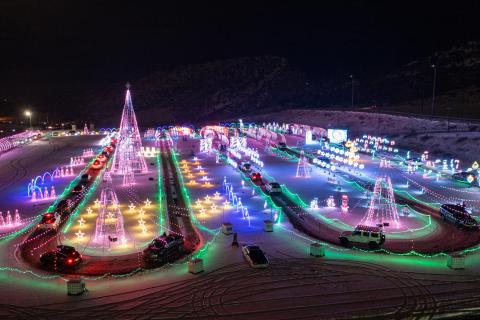
Bandimere Speedway, currently in Morrison, Colorado, but with plans to soon relocate to a new home in the metropolitan Denver area, has a different approach to winter income: one giant event. Every year the facility uses its extensive pit area to present Christmas in Color, which is a parade of lights where patrons can drive through in the comfort of their cars and enjoy some very bright Christmas cheer.
“We’ve been doing this for long enough that it has become a Christmas tradition for many families,” said organizer Larry Crispe. “We get tens of thousands of cars a year, and the kids just love it. We’re also able to keep much of our drag strip staff busy during this time.”
Crispe also noted that the track keeps income flowing through seasonal RV or trailer storage and builds equipment, such as its proprietary tire rotator tractor, which is also used by NHRA.
Moving north from the lower 48 states found us talking to Michelle Lackey Maynor, from Alaska Raceway Park in Palmer, Alaska. Situated in one of the most scenic backdrops in the world, the facility has a very short but busy summer racing season.
“We try to extend it a little bit with car and truck shows and other fun activities, but we’re down most of the winter,” said Maynor. “The weather is harsh on equipment, so we spend a lot of time on maintenance and improvements, but we’re definitely looking to expand our winter activities—probably something involving snow,” she added, laughing.
Maynor said any time not spent working on the raceway is taken up by going to trade shows—including the PRI Show in Indianapolis—and promoting next year’s racing season.
In the past, many facilities have considered the off-season just that—a time to suspend operations. In reality, it pays to diversify a facility to be productive in the winter, as the drag strip itself, side buildings, grounds, and pits are all useful space. The same can be said for road courses or ovals. In fact, road courses can even host no-prep drag races when it’s too cold for road racing. So don’t be afraid of the wind, rain, and snow. It might stop the racing, but that doesn’t mean the facility has to shut down. In fact, it might just end up being more profitable than ever.
Technology never sleeps in the motorsports industry, and a timely investment in new machinery can pay big dividends. Walk down the aisles of Machinery Row at next month’s PRI Show to investigate whICH machine could add to your bottom line.
Investing in new machinery is not a step taken lightly in the motorsports industry. Quality machinery is a necessity when it comes to manufacturing components, but factoring in costs, lead times, installation details, and employee training requires serious homework ahead of time. Those considerations make Machinery Row at the PRI Show one of the most popular destinations, as attendees can get a hands-on introduction to the latest technology as well as talk to the manufacturers themselves (more on Machinery Row later).
We spoke with a number of sources that had made recent machinery purchases to delve into their thinking on what they purchased, why they selected particular machines, and what advice they could offer to other businesses that are about to take the plunge and commit major funding to machinery purchases.
For QA1, a manufacturer of high-performance suspension and driveline parts in Lakeville, Minnesota, machinery purchases are based on a number of factors. “It’s all based on an expected ROI, but some typical considerations include age and repair frequency of existing equipment, efficiency improvement of new equipment versus old methods, technology advancements with new equipment, capabilities we need to advance our design sophistication, and need for increased capacity,” said Mark Sullivan. “There’s no set schedule, and we purchase as we see justified opportunities. However, we probably average at least one new significant purchase a year.”
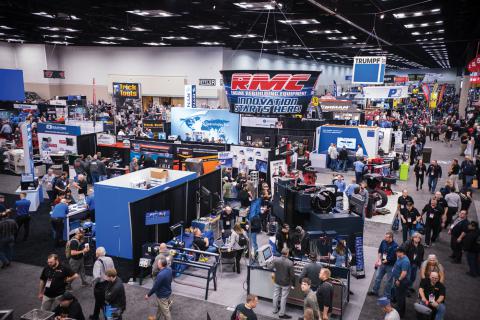
Machinery Row at the PRI Show is one of the event’s most popular destinations, as attendees can get a hands-on introduction to the latest machinery as well as one-on-one time with reps.
Advancing technology is going to put even more capabilities into the hands of independent businesses in the near future, as well as raise expectations. “If you bring in the right manufacturing capabilities, you can successfully invest in your staff and machinery to increase productivity and create a superior product at the same time,” said Ken Wible, owner of S&W Performance Group, a manufacturer of racing chassis and components in Spring City, Pennsylvania. “A lot of the technology that’s out there today, in my opinion, used for higher-end fabrication, really hasn’t trickled down to the smaller businesses yet. It’s still expensive, but now that it’s available, I think that what we’re going to see over the next five years is a lot of these companies are going to have to do that because that’s what the consumer is expecting.”
New Buys
Our sources reported that their recent machinery purchases resulted in some very specific and measurable benefits to productivity and the bottom line. “One of our newer purchases was a Mill/Turn CNC with 12-foot bar feed capability,” QA1’s Sullivan said. “We selected this system for its ability to run our shock bodies 24/7 with very little operator intervention and minimal time wasted for bar changes. We’re maximizing material and chip-to-chip time. This equipment allows our machinists to focus on setups and more complex projects while shock bodies run unattended for hours. We’re minimizing labor content and have dramatically increased throughput.”
For Isky Racing Cams in Gardena, California, working directly with the manufacturer paid solid dividends. “Our latest purchases have been Landis LT1 cam grinders. Landis cam grinders are by far the most advanced and accurate grinders made,” said Isky’s Nolan Jamora. “We chose the Hydrostatic options for them because of the speed and accuracy, which is unparalleled in the industry. We visited the factory in Maryland several times, and they were very collaborative in giving us what we asked for on the build specs as well as the custom software we requested. They also have a great training team they send out to train the employees, which is a huge benefit. The first machine alone allowed us to double production numbers. We are now not only able to grind double the cams but have much greater accuracy.”
Point One LLC, a precision parts manufacturer in Rogersville, Missouri, is a relatively young and rapidly expanding company and is currently purchasing new machinery almost every month, said Shannon Strother. “Almost all our machines are brand new in the last few years, but among our newest arrivals is a batch of five additional fully automated lathes from Takamaz,” he said. “We use these CNC lathes in all kinds of secondary operations for fasteners after forging. We’ve owned several of these machines for a couple of years, and when combined with bowl feeding equipment, we have found them to be a good value for us. They are not ultra-fast but are predictable in setup and throughput. It is rare for us not to have two or three of these machines running all the time.
“In this case, I think the largest benefit to the organization is both the quality of the output and the ability for one operator to run multiple machines at one time,” Strother said. “Due to the automation and the skillful setup process our team employs, one person can be setting up one cell while two or three other cells are in constant operation. This even includes frequent part inspections coming out of each cell.”
Planning Ahead
For companies on the brink of a machinery investment, it pays to look beyond the current year and keep an eye on the horizon, our sources advised.
“Focus on ROI and make sure to think of the parts the machine could be running in the future. Be careful not to purchase a machine that isn’t suited to the parts you will be running five years from now,” Sullivan said.
“Always go for the best quality machine the first time,” Jamora said. “Do your homework, decide on the complete build specs, and don’t be shy about asking for exactly what you need. Don’t be in a position where you feel forced to make a selection because of a timetable, and be sure to communicate fully with your build team.”
When planning for a machinery purchase, “always go for the best quality machine the first time,” said Isky Racing Cams’ Nolan Jamora. “Do your homework, decide on the complete build specs, and don’t be shy about asking for exactly what you need.”
A machinery purchase often requires a 360-degree view of what is required before the equipment is even turned on for the first time. “Plan early,” Strother advised. “Be aware of all your options. Consider the whole package required to make your new investment ‘active.’ Be prepared for the risk of late delivery or having your needs change before the equipment arrives. Additionally, be sure to plan for your mechanical infrastructure like compressed air, electricity, cooling, etc. Make a plan for the rigger if needed, the accessories, fluids, and tooling needs well in advance, as those items can keep you from getting a return on your investment. Plan for the total cost and manhours it takes to get the machine from the truck into production. Sometimes writing the check might be the easy part. Someone on your team needs to own the project.”
That level of planning is crucial, as there are any number of things that can go wrong before a machine is fully functional and adding to profits. “There’s the downside of new machinery. You have to know what you’re getting into,” Wible said. “A lot of people are not aware of the weight, the complexity, of these machines. In my scenario, I’ll give you a perfect example. We hired a contractor to pour a machine bed. We had to have a 50x30-foot cement floor cut out of our existing shop. We had to pour it so it could keep the machine independent and keep it level, because if they move more than ten one-hundredths of an inch, it goes out of calibration, and now your machine’s down.
“We ordered a machine, it took 18 months to get it,” Wible continued. “We get it delivered, we start installing it, and sure enough, our contractor made the mistake of not prepping the bed properly and allowed the machine to get out of whack. Now I have a machine that we have a couple million dollars invested into that sat idle for four-and-a-half months as I’m waiting for a new pad to be rebuilt and cure.”
“We use CNC lathes in all kinds of secondary operations for fasteners after forging,” said Shannon Strother of Point One Manufacturing. “We’ve owned several of these machines for a couple of years, and when combined with bowl feeding equipment, we have found them to be a good value for us.”
The issue of lead times in ordering should play a front-and-center role in the planning process, even in this post-pandemic market. “I’m guessing lots of manufacturers are seeing similar issues compared to our experience these past couple of years,” Strother said. “Our vendors know we are growing quickly and have generally kept in touch with us, but lead times have generally continued to go out, even recently. Everyone reports good demand but also the remaining persistence of supply chain and labor constraints. In our experience, many vendors are not delivering on time. Most of the quotes for new projects we are looking at right now are stating eight months to 14 months for delivery times.”
Machinery Row
Even for experienced hands at established shops, it can be difficult to envision all the capabilities and nuances of leading-edge machinery when viewed from afar. That has made Machinery Row one of the must-see exhibits at the PRI Show. Machinery Row features aisles and aisles of exhibitors displaying hundreds of different pieces of manufacturing equipment.
The PRI Show’s Machinery Row, located in the Indiana Convention Center’s Yellow Hall, features more than 100 exhibitors displaying hundreds of different pieces of manufacturing equipment.
“We attend a variety of shows yearly to explore new technologies, but the convenience of walking out of our booth at PRI and within 15 seconds standing in the middle of a strong line-up of high-quality equipment makes it a unique experience,” Sullivan said. “Our engineers look forward to exploring Machinery Row every year.”
“We are usually so busy we are not able to get out and see machines in person,” Jamora recalled. “At last year’s PRI Show we were walking around and looking at the new machines on display, and I said to one of my guys, ‘I didn’t even know we needed that machine until I just looked at it!’ As with the rest of our racing industry, machining technology advances so fast that it’s hard to keep up with. What may have seemed like tip-of-the-spear technology only a few years ago has now been replaced with something that is faster, more accurate, and more economical in many cases. This can only help the bottom line.”
It’s hard to overstate the impact that well-chosen, up-to-date machinery can have for a company. One factor not always considered is that using the latest machinery can be attractive to prospective employees, not to mention customers.
“In the past, if someone wanted a roll cage for, say, a 1968 Nova, we had a roll cage that would fit their car,” Wible said. “But now, someone can come in and in a matter of 15 minutes I can have their car scanned, we can create a 3D model, we can draw to the 3D model, convert that mesh file into a CAD drawing, have the customer sign off on it, then import it into our machinery. An hour later, I have a custom-cut roll cage down to four one-thousandths of an inch. Before, that would have taken me two months to complete. I have it in an hour today. I would never have been able to do that before if I didn’t go down this path.”
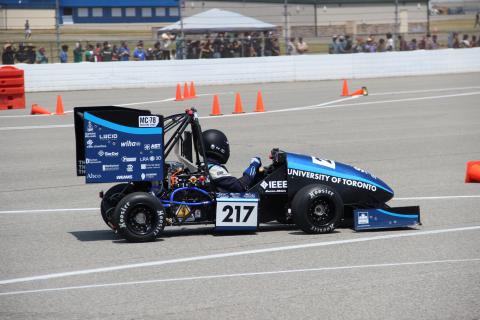
Once primarily focused on creating industry standards, the Society of Automotive Engineers has become a driving force in the effort to provide university students with hands-on vehicle development experience.
When the Society of Automotive Engineers (SAE) was originally founded in 1905, the main intent of the organization was to help the fledging auto industry address shared design problems and develop engineering standards that would support both automakers and their suppliers. While technical innovation and creativity helped to define the brands of the day, much like they do now, there was an emerging need to establish agreed-upon values for various components that were quickly becoming ubiquitous.
“Motor oil is a great example,” noted Dean Case of the SAE Southern California Section. “On the side of a quart you’ll see something like SAE 20W-50. We don’t make the oil; we determine how viscosity is measured. That way it doesn’t matter whether you buy Mobil or Pennzoil—if it said 20W-50, you know it’s going to be the right oil from a viscosity standpoint. The same goes for things like nuts and bolts. They didn’t want to get into a situation where a bolt that General Motors used wouldn’t be compatible with a Ford or a Dodge. The mindset was that the design of the cars should be unique, but a lot of the ‘boring bits’ that underpinned them needed to be commonized.” Notably, the SAE is also responsible for creating both the gross and net horsepower rating standards, the latter of which has been used by the auto industry for more than half a century.
As SAE grew and evolved over the years, it also became a knowledge base that industry professionals could leverage to help them resolve specific problems. “Local sections were established, and that expanded its reach significantly,” Case explained. “So, if someone had a technical problem, they might go to their local SAE meeting and say, ‘Hey, I need someone that’s an expert in kinematics or NVH,’ and within that SAE group they could find someone who would have specialized knowledge on that subject. It became kind of a professional networking tool as well.”
Educational institution involvement with the SAE dates all the way back to 1915, when a team at Cornell University established the first student chapter, but the relationship between the association and colleges evolved substantially in the mid-1970s. This close connection between SAE and schools continues today, and those efforts have created a direct pipeline between students and the automakers and motorsports companies that are on the hunt for the next generation of engineering talent.
Collegiate Competitions
In the early 1970s, SAE realized that the student membership would benefit from a formalized program that provided hands-on, real-world experience. “The Collegiate Design Series is really focused on providing engineering students with a platform to develop, build, and compete in the motorsports and aerospace realms,” said Allison Hostetler, director of community programs for SAE International in Warrendale, Pennsylvania. “Since student membership is a little too young to be on standards or technical committees, it gives those members an opportunity to utilize their talents and expand their skillsets through organized competition.”
Baja SAE, which started in 1976, was the first program in the SAE’s Collegiate Design Series. It provides student members “an opportunity to utilize their talents and expand their skillsets through organized competition,” said Allison Hostetler.
Baja SAE was the first program born out of this effort. Developed in collaboration with Briggs and Stratton, the competition got its start in 1976 and brought with it a strong emphasis on collaboration and pragmatism. “At the time, an engineering education was rooted in a lot of theory. You’d build something in the lab, but there weren’t big, team-based projects that focused on a real-world application,” said Case. “One student would be over here working on something, and another one would be over there working on his or her own thing. That was kind of a problem because that’s not how industry operates. No one designs and builds a car by themselves.”
The competition tasked teams with designing, building, and eventually competing using a single-seat dune buggy, designed around an 8-horsepower Briggs and Stratton engine, which was developed over the course of a school year. Importantly, the teams were also required to create a cost analysis and present a business proposal that outlined the feasibility of putting their design into limited production. Once completed, the prototypes were put into action in acceleration and maneuverability tests, hill climbs, and a four-hour, wheel-to-wheel endurance race.
Baja SAE quickly grew in popularity, and by the early 1980s, a push to bring a similar type of competitive program to pavement-based vehicles resulted in the creation of Formula SAE. It followed a similar format, but as the name implies, the teams’ goal was to create a formula-style open wheel race car using a four-stroke engine with displacement no greater than 710cc.
“Originally, we had a consortium model of American auto companies that came together and said, ‘We want to build a workforce development competition,’” said Hostetler. “So Formula SAE was developed with the assistance of a professor from the University of Texas to give undergrad and graduate student teams the opportunity to conceive, design, fabricate, develop, and eventually compete with these cars against other college teams.”
The program has generated a massive following in the years since, eventually leading organizers to cap annual Formula SAE participation to 120 teams from around the world. The cars developed for the competition are judged for the best overall package of design, construction, performance, and cost.
“The students get educated in the classroom, but they learn by doing the Formula SAE program,” said Don White, who serves as a mentor for the University of North Florida’s Osprey Racing team. “I think of it as almost like a ‘Shark Tank’ of formula race car design, if you will. You have dynamic events that are on track, but you also have these static events that are off track, like the business case and the cost report, that really encourage these teams to think about production feasibility when they’re designing these cars.”
The competition helps to chart a clear path for these students not only into potential jobs developing road-going passenger cars, but also important roles within motorsports. “In the 1980s and early 1990s, there wasn’t a lot of material to read about race car engineering,” said Case. “At that point in time, Carroll Smith’s books like ‘Engineer to Win’ were the bible for students who wanted to understand race car engineering. Smith eventually became one of the judges in the Formula SAE competition, and he started bringing in race engineers as design judges. That brought a lot of credibility to the competition within the motorsport realm. If you walk through any IndyCar, NASCAR, or IMSA paddock today, most of the race engineers under the age of 45 have Formula SAE or Baja SAE on their résumé.”
The SAE’s second Collegiate Design Series program, Formula SAE, has grown so popular since its founding in the 1980s that participation has to be limited to 120 teams from around the world. Here students are giving their presentation to an SAE judge.
Case also pointed out that the competition makes it easier for students to move straight into a career after graduation. “If you don’t have this experience, it makes it much harder to get hired by a race team once you’re out of school. From the perspective of a race team, the people who’ve been through the Formula SAE or Baja SAE competitions have experience that puts them years ahead of other potential candidates.”
While mechanical engineering is the primary focus of most students who’re involved in SAE International’s University Programs, there’s a demand for other skillsets in this realm as well, and the need is growing. Teams utilize design and computational modeling software packages like SolidWorks, Simulink, MATLAB, and Ansys while developing their prototypes, and Hostetler said that the teams are given primers on the software and other technologies involved via industry workshops.
“That includes things like training videos and product demonstrations that are provided by the sponsors. It gives these students an opportunity to get familiarized with these software packages early on so that when they get out into the industry, they already have a working knowledge of the software standards that are being used.”
White pointed out that the program fosters other aspects of professional development as well. “Although Formula SAE is centered on building a race car, the series encompasses all aspects of engineering and business. Research, design, development, and testing are major components of it, but so are manufacturing, marketing, management, and finance.”
Perhaps most importantly, the program illustrates how lab research and development translates to a real-world, team-based project. “One of the big things is that they learn how one system can impact another,” said Case. “You can’t develop an element of the car to only work within its own little bubble. It has to work in concert with the rest of the components in the car to make it perform the way you want it to.”
Staying Current
In 2013, SAE introduced Formula EV as a class within the Formula SAE program with development assistance from volunteers in the industry. The new class followed a format similar to the standard Formula SAE competition but swapped the four-stroke ICE powertrain for a fully electric one.
Baja SAE tasks teams with designing, building, and competing in a single-seat dune buggy designed around a Briggs and Stratton engine. Teams are also required to create a cost analysis and present a business proposal that outlines the feasibility of putting their design into limited production.
As the automotive industry continues its electrification expansion, and the use of these technologies continues to grow within motorsports, interest in the Formula EV class has grown in turn. Accordingly, in an effort to bring more visibility to the program and make it easier for teams to seek funding for the effort, SAE has reconfigured things to provide the electric competition with a larger forum.
“This past year we made some changes—we now have one internal combustion competition with Formula ICE, and another competition that is solely based around electric with Formula Electric,” said Hostetler. “There’s a growing demand for that electric powertrain knowledge, so we’re expanding this to better represent that aspect of automotive engineering. Along with mechanical tech inspection, these cars are also being tech’d for the electrical powertrain itself. And there are other aspects of functionality, like endurance and efficiency, that come into play as well.”
In order to help teams prepare for Formula Electric competition, SAE has also developed a specialized fall EV workshop that focuses on safety and the fundamentals of electric powertrains, vehicle development, and the ruleset related to the competition. “Putting an electric powertrain into a motorsport arena is very much a new ballgame,” she said. “So we want to make sure that we’re preparing students for success.” Teams participating in the Formula Electric competition are also required to go through an electrical safety review to have their system designs approved.
As the electric program has expanded, it has also attracted a new crop of prospective competitors. “Because of the electric class, Caltech is building a Formula SAE car for the first time ever,” Case told us. “And MIT is involved as well. Some of the most famous engineering schools in the world that have never been involved in the competition previously are now doing it because there’s an electric class.”
“If you walk through any IndyCar, NASCAR, or IMSA paddock today, most of the race engineers under the age of 45 have Formula SAE or Baja SAE on their résumé,” noted Dean Case, of the SAE Southern California Section.
That’s also attracting students from other engineering focuses as well. “There’s a great demand for students with electrical engineering backgrounds,” he said. “If you’re building an ICE car, you can buy a MoTeC unit and do fuel injection relatively easily with off-the-shelf parts. But that kind of off-the-shelf hardware isn’t readily available for EVs, so there’s a greater need to build things from scratch. Battery packs are a huge element of this, too, not just from a capacity standpoint, but in terms of thermal management. The batteries perform their best in a specific temperature range, and keeping them in that range is a big challenge.”
Moving forward, Hostetler said that SAE International has every intention of keeping its engineering focus aligned with the contemporary demands of the industry. “Each year we go through a rules development cycle where we look at what the current industry needs are and what trends are developing, and that helps direct how the programs evolve over time. With development programs like these, we want to make sure we’re building a workforce that is capable of hitting the ground running. Catching up is not the goal. The goal is to build the future.”
The Formula 1 safety car has proven not only an indispensable tool for race officials but also a popular icon among racing fans. September 23, 2023, marked 50 years since Eppie Wietzes’ Porsche led a 12-lap caution at the 1973 Canadian Grand Prix—recognized as the first official appearance of a safety car in Formula 1 racing. More than two decades would pass, however, before the safety car became a permanent F1 fixture, while its older ancestor, the Indianapolis pace car, evolved into a similar role.
After a fog-shrouded morning practice, and an hour-long delay due to pummeling rain, the 1973 Canadian Grand Prix was green-flagged on the rain-drenched pavement of Mosport Park. A blinding wall of spray limited on-track visibility and obscured a rapid shuffle in the running order, which continued as the surface dried and one car after another pitted to exchange rain tires for slicks.
Thirty-two laps in, François Cevert’s Tyrrell tangled with Jody Scheckter’s McLaren, flinging both cars into the Armco. Neither driver was seriously hurt, and the race continued under caution as emergency crews were dispatched to clear the wreckage.
It would be a caution like F1 fans had never seen before.
During practice at the Österreichring in August, F1 officials had tested a “pace car control system,” using a conspicuously striped and lettered Opel Commodore fitted with police-style lights and siren. A marshal waved a signal flag from the right-front window. In contrast, the yellow Porsche 914/6 deployed at Mosport on that late September Sunday appeared somewhat hastily cobbled: no lights, no graphics, just credentials taped to both doors and twin yellow flags flying from brackets on the rear bumper. But as the race cars lined up behind the Porsche, a Formula 1 tradition was born.
“The safety car is such a successful measure, and now so ingrained in motorsport culture, that I think we sometimes take for granted the enormous positive effect it has had,” F1 Race Director Niels Wittich wrote for F1 Insights. “It is one of the key tools at our disposal for dealing with hazards…related to incidents, weather, or people or vehicles on the track. The ability to quickly neutralize a race and ensure the security of…anyone who might be on the track…cannot be overestimated.”
“Its primary role is to ensure the safety of the track marshals and safety crews during an accident or other hazardous conditions,” confirmed Mark Webb, writing for Motor1.com.
At the same time, the safety car allows the race to continue, for drivers to keep up their rhythm, for tires and fluids to maintain their operating temperature—instantly ready for all-out speed once the green flag falls again.
“People tend to forget what it was like before,” added FIA Permanent Advisor Herbie Blash, also in F1 Insights. “What did we do when the rain was so heavy that it was difficult to continue? Nothing.”
The Grand Prix of Confusion
Also forgotten, however, seems to be the controversy that clouded the safety car’s debut. Accounts vary somewhat, but it appears that driver Egbert “Eppie” Wietzes pulled out in front of Howden Ganley’s Iso-Marlboro, mistakenly believing Ganley to be the race leader. This allowed several cars ahead of Ganley to complete an extra lap under yellow, while confused scorekeepers assumed Ganley was leading and adjusted their paperwork accordingly. When the checkered flag fell, Peter Revson (McLaren), Emerson Fittipaldi (Lotus), and Jackie Oliver (Shadow) were each quite certain they had won. Race officials reviewed lap charts—some water-damaged from the race’s soggy start—and debated for four hours before declaring Revson the winner, Fittipaldi second, and Oliver third. Jackie Stewart, who had already clinched the championship at Monza two weeks earlier, was scored fifth.
A pace car procedure was rehearsed during practice at the 1973 Austrian Grand Prix. It was the first time that a safety car was seen at an F1 event. Photo courtesy of Motorsport Images.
The 1973 Canadian GP has since been derided as “The Grand Prix of Confusion.” So it’s hardly surprising that for the following two decades safety cars appeared only sporadically at Formula 1 races. The Monaco Grand Prix was an early adopter, fielding a Porsche 911 in 1976, then upgrading to a Lamborghini Countach in 1981–1983. Then, after a nine-year hiatus, the safety car was revived when Ford offered an Escort RS Cosworth for trial runs at the 1992 British and French Grands Prix. These tests went well enough for FIA to approve safety cars for all race weekends in 1993.
Responsibility for the safety car was left to local race organizers, however, who complied only occasionally, and with an uneven assortment of vehicles. Patriotic pride seems to have influenced some of their choices: a Brazilian-built Fiat Tempra at Interlagos in 1993, followed by another Cosworth Escort at Silverstone; a Honda Prelude at Suzuka in 1994; an Argentine Renault Clio at Buenos Aires in 1996. No one could question the Lamborghini Diablo unleashed in Montreal in 1995; but far less fathomable was the Opel Vectra dispatched at Imola in 1994, which, after the Pedro Lamy-JJ Lehto shunt, navigated the circuit so slowly that Ayrton Senna pulled alongside several times and urged driver Max Angelelli to increase speed. (According to at least one source, Angelelli was trying not to overtax the Opel’s already fading brakes.) Senna suffered a fatal crash later in that same race.
Blash recalled how his “first encounter with the Safety Car in Race Control wasn’t without its difficulties.” It was the Renault Clio in Argentina. “It wasn’t ideal.”
Shortly after that, FIA took control of the situation, named Mercedes-Benz its official Safety Car Supplier, and saw that an adequately fast safety car was actually supplied for every race. Oliver Gavin, who had competed in Formulas 3 and 3000, was chosen as the permanent driver of a potent AMG C 36. F1 Race Director Charlie Whiting assumed responsibility for the safety car program in 1997, and “every year after that improvements were made,” said Blash, “to the car, to the technology inside it, and to the procedures.”
By that time, however, the Indy 500 pace car had been leading caution periods—essentially functioning as a safety car—for almost 20 years.
Origins In Indianapolis
As fans of the sport well know, F1 races are green-flagged from a standstill; normally the safety car has no role in the start of the race. “Standing starts are the default in Formula 1,” said Tom Wood, FIA Formula 1 World Championship media delegate, “and are used unless the race director decides there are specific circumstances, such as weather or track conditions, that necessitate a rolling start on safety or fairness grounds. Standing starts and restarts are also considered by the Commercial Rights Holder to be a more exciting spectacle for the fans, and a key moment of the race.”
Whereas what in the US is called a “pace car” was used originally, and exclusively, to enforce an orderly rolling start. According to Donald Davidson, recently retired as historian for the Indianapolis Motor Speedway, a pace car may have been used for this purpose as early as 1896, at a Narragansett Park, Rhode Island, competition for electric vehicles. That early experiment appears to have led nowhere, and maybe Carl G. Fisher, the visionary creator of the Indianapolis Motor Speedway, knew about it and maybe he didn’t. Fisher was certainly familiar with rolling starts from his bicycle-racing youth. And when 40 cars qualified for the first 500 in 1911, he foresaw the potential chaos of a multi-row standing start and turned to his bicycle racing experience for a solution.
Since 2002, every Indy 500 pace car has been a Chevrolet Corvette or Camaro, but a Honda Civic Type R is used at other IndyCar events. “That’s based on our relationship with Chevrolet and Honda,” said IndyCar’s Dave Furst.
Fisher pitched his idea to the racers: Eight rows of five race cars would cruise behind a passenger car for one unscored lap; then the passenger car would pull over and release the rolling field to the flagman. The racers generally like the idea but nominated fellow racer Ralph DePalma to lead the field for one lap and then fall back into position. But Fisher insisted on starting the race himself, in a stock Stoddard-Dayton (for which Fisher was the Indianapolis dealer, and distributor for the state of Indiana). On the day before the race, Fisher practiced the rolling start, leading just 12 cars at first, gradually increasing speed and the number of cars while consulting with the racers between runs. On May 30, 1911, Fisher led his orderly start (albeit to a less-than-orderly race) and birthed a US tradition that has endured to this day.
Decades later, the pace car began returning to the track for re-starts—first in 1967, then in 1970, and again in 1973. And for the 1979 500, USAC decided to use the pace car to guide the racers through caution periods. So when Cliff Hucul stalled on lap 28, the remaining cars lined up behind a 5.0-liter Mustang driven by Jackie Stewart.
Already, however, it was becoming increasingly difficult to find catalogued production cars producing the minimum 200 horsepower required to safely lead championship-level race cars at speed. Stewart’s 5.0 had been rebuilt by Jack Roush to develop about 280 hp, exactly double its stock rating. With a few notable exceptions, Indy pace cars from the early 1970s into the early 1990s hid extensive modifications under their stock-appearing bodywork.
By the late 1990s—around the same time the FIA reached the same conclusion—the fledgling Indy Racing League was looking for an exclusive supplier that could guarantee an adequate level of performance. Series engine supplier Oldsmobile was a logical choice, transitioning to Chevrolet as GM allowed its oldest nameplate to fade into oblivion. From 2002, every Indy 500 pace car has been a Chevrolet Camaro or Corvette, although a Honda Civic Type R may pace other IndyCar-series races. “That’s based on our relationship with Chevrolet and Honda,” said Dave Furst, IndyCar’s vice president, Communications. Chevrolet also supplies Silverado pickups “used mostly for firefighting,” Furst added, although they may also assist the medical crew, whose primary vehicle is a Honda Pilot. (Furst called the Pilot the “safety car;” it would be the “medical car” in F1.)
Slicker Cars, Higher Tech
Meanwhile, the F1 safety car was upgraded to an even higher-performing CLK 55 for 1998–1999. When Gavin returned to Formula 3000 in 1999, Blash and Whiting recruited Bernd Mayländer, a former F1 driver who was then competing in the Porsche Carrera Cup and Supercup series.
Mayländer’s first safety car was the CL 55 that he drove at San Marino in 1999. F1 then deployed an SL 55 in 2001–2002, returned to a CLK 55 for 2003, and then chose a SLK 55 for 2004–2005, a CLK 63 for 2006–2007, and an SL 63 for 2008–2009. Succeeding the SL 63 for 2010 was the exotically gull-winged SLS; after SLS production ceased in 2014, F1 adopted its successor, the Mercedes-AMG GT, running the S variant in 2015–2017, and an R model in 2018–2021.
The BTCC introduced safety cars in the mid-1990s. Today Porsche is the official safety car supplier for the BTCC, which ties in with the series’ Carrera Cup support races.
Through 2020, all of these cars were painted traditional Mercedes-Benz Grand Prix silver, but for its final season, the GT R was sensibly finished in a high-visibility red. Today Mayländer pilots either a Mercedes-AMG GT Black Series (still painted red), or since 2021, an Aston Martin Vantage (British Racing Green, of course).
On-board technology has evolved along with the cars. The CL 55 that Mayländer drove in 1999 had a built-in radio and a handheld backup unit. “And we were happy if the radio covered the full circuit,” said Mayländer, as quoted in FIA Insights. There was no GPS; Whiting pinpointed the car’s position using binoculars. Little changed until the late 2000s, and then a rapidly rising wave of advancing technology carried the safety car to where it is today.
Now, “GPS positioning helps us monitor everything,” Blash told FIA Insights. External cameras watch the action on the track, while telemetry allows engineers to monitor the health of the safety car itself. No fewer than four video screens display information inside the cockpit. The stock 10 1/2-inch infotainment screen, located above the center air vents, can be programmed to display virtual gauges, allowing Mayländer to monitor vehicle data such as transmission temperature. What looks like a second, larger inside mirror is in fact a screen connected to a video camera, expanding Mayländer’s view to the rear. Two additional screens, each at least as large as the factory screen, and mounted below and right of the air vents, respectively, provide a live feed of the race and pertinent information regarding any incidents on the track. Generally, co-driver Richard Darker watches those, allowing Mayländer to focus on driving. A medical warning light flashes if an on-track incident exceeds 20 G.
The safety car’s roof-top light bar flashes orange at each end to command attention, while its center section can light up the same red, yellow, or green as the safety marshal’s flags. This is controlled from an overhead console, while matching indicators light up at the center of the dash. A bright yellow knob, nestled among the center air vents, provides quick and convenient adjustment of the electronic traction control. The hardware that supports all this electronic wizardry occupies most of the AMG GT’s modest trunk.
Yet underneath all of this add-on equipment, the Mercedes-AMG remains absolutely showroom-stock, with all of its luxury features intact, or, as Mayländer puts it, it has “all of the regular buttons, and the function of all of the buttons is completely regular.”
A pace car has been a fixture at the start of the Indy 500 since the first race in 1911. Using the pace car for restarts and caution periods came later.
In addition to the safety car, F1 now employs a medical car, a Mercedes-AMG C 63S wagon, which is “tuned up” and equipped with a marshaling system and multiple interior screens, much like Mayländer’s safety car. It, too, has a regular crew, although driver Bruno Correia and Dr. Ian Roberts are usually accompanied by a local physician. Their duties include training local medical personnel on FIA rescue and extraction procedures. Additionally, Correia is Mayländer’s understudy, ready to take the wheel of the safety car in case of illness or injury.
Roads Parallel and Divergent
Today, safety cars are used in most of the world’s premier race series. Just one example is the British Touring Car Championship (BTCC), which “introduced a safety car in the mid 1990’s,” said Anna Cowie, of the BTCC Media Team in Weybridge, Surrey, United Kingdom, “to neutralize the race while an incident is taken care of, rather than stopping the race. This has a few advantages, including the ability to clear any obstructions under safer conditions for all involved.”
Porsche is BTCC’s official safety car supplier, which ties in nicely with having the Carrera Cup as a support race. Although Porsche has provided Cayenne SUVs in the past, the current safety car is a stock Panamera GTS—more appropriate, perhaps, as a “saloon car” (in Britspeak) marshaling a saloon-car series. Cowie said the Panamera was chosen “for marketing and performance reasons” and because “it gives the Panamera a sporting presence.” Additionally, since 2018, BTCC has employed a Ford F-250 pickup—“carrying the very latest and best in cutting equipment”—as a rescue vehicle.
Like F1, BTCC favors standing starts wherever feasible, with rolling starts reserved, said Cowie, for when “weather conditions dictate it would be safer.”
That distinction aside, a case can be made that the Indy 500 pace car inspired the “pace car control system” tested in Austria 1973, and six years later assumed the caution-leading function of an F1 safety car, while FIA was still sorting out the details. Since the late 1990s, however, pace cars and safety cars have traveled parallel roads—with safety benefits for racers and race workers worldwide.
Thanks to primary sources Tom Wood of FIA, Anna Cowie of BTCC, and Dave Furst of IndyCar. Other sources include “TIMELINE: The 50-year history of the Safety Car’s Evolution in Formula 1,” by Nadim Bart-Williams, Formula 1.com, June 17, 2023; “Indy 500 Traditions: Pace Car Usage Originated in Indy,” by Donald Davidson, IndianapolisMotorSpeedway.com, May 17, 2020; “1973 Canadian Grand Prix—A race of confusion,” by René Fagnan, Motorsport.com, April 25, 2017; Forty Years of Stock Car Racing, revised edition (1990) by Gregory Lawrence Fielden; “My job in F1: The Safety Car driver,” by Erwin Jaeggi, Motorsport.com, May 6, 2022; Indy 500 Pace Cars, Publications International, 1996; “First-ever appearance of the Safety Car in F1,” Salracing.com, June 7, 2023; “1973 Canadian Grand Prix—Race Profile,” by Al Wolford, SportsCarDigest.com, February 5, 2015; “F1 Looks Back On 50 Years Of Safety Cars, Starting With The Porsche 914,” by Mark Webb, Motor1.com, June 22, 2023; and “FIA Insights: Celebrating 50 Years of the FIA Safety Car In Formula 1,” June 15, 2023.
 MEMBERSHIP LOGIN