From The Executive Editor

Submitted by johnc on Mon, 06/24/2024 - 11:00
image 1


In any business, a barometer is a critical tool that analyzes industry trends and provides a forecast to predict what is on the horizon. We are pleased to announce PRI’s own barometer with the first official “2024 State of the Racing Market Report,” which provides industry-specific data to guide PRI Members to stay competitive and grow their businesses.
Veteran PRI Magazine readers will recall the annual Motorsports Retail Business Survey that was produced by the PRI Editorial team and appeared annually in our pages. However, that was just a smaller snapshot of the industry compared to this new market report produced by the PRI Market Research team, led by Gavin Knapp, with help from Matt Byun, who used their tremendous resources and expansive database to reach out to thousands of PRI Members to get their take on what is going well in the industry, and what areas may need some work.
Some highlights:
• Track-use motorsports parts accounted for more than $8 billion in US sales in 2023.
• 76% of racing businesses view the racing market as either stable or on the rise.
• 47% of racing parts resellers experienced sales growth, and 51% anticipate their sales will grow over the next year.
Next month’s issue of PRI Magazine will offer additional coverage of the Report. In the meantime, PRI Business and Individual Members can download the full report by using their individual login to access their member portal at performanceracing.com. Once logged in, the report can be found by clicking “My Benefits.”

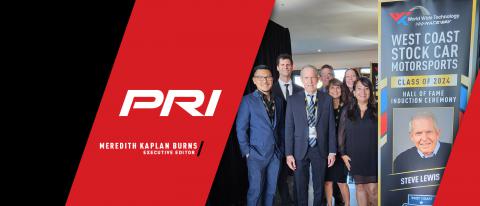
Out & About: As I write this column, I just returned from the West Coast Stock Car Motorsports Hall of Fame Induction Ceremony as it honored its Class of 2024. Ken Clapp and his team produced a memorable and well-done presentation that honored Dick Cobb, Eric Holmes, Jimmie Johnson, Jimmy Vasser, Cal Wells, Joe Huffaker, Emmett Malloy, Tom Malloy, Paula Murphy, Bob Swanson, Ernie Triplett, Frank Lockhart, Fred Frame, Jack Dill, Jimmy Murphy, Johnny Boyd, Louis Vermeil, Rex Mays, Ted Horn, Ralph Sheheen, and PRI Founder Steve Lewis. What a wonderful celebration of these motorsports innovators.
While in Sonoma, the PRI Team attended the ARCA and NASCAR events at Sonoma Raceway. We had the pleasure to interact with numerous industry members, which only confirmed, “A bad day at the track is better than a good day in the office.” How truly blessed we are to be in an industry for which we all exude such passion and commitment with the goal of bettering our sport.

July 2024
By
Meredith Kaplan Burns

Race Shop

Submitted by johnc on Mon, 06/24/2024 - 10:28
image 1


Be the go-to source for all the latest parts and services to enhance your customers’ motorsports programs.

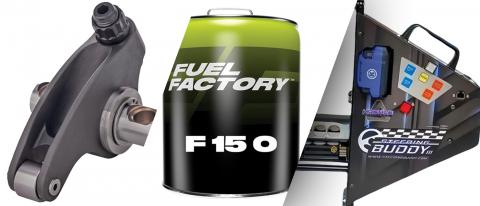
PRO-STOCK Hydraulic Roller Lifter/Guide Assemblies for Chrysler Hemi Engines

Elgin Industries
elginind.com

image 2

New hydraulic roller lifter/guide assemblies are now available from Elgin Industries in Elgin, Illinois. These assemblies are compatible with the 2004 and above 5.7L, 6.1L, and 6.4L Hemi engines without Multiple Displacement System (MDS) cylinder deactivation. Every PRO-STOCK lifter/guide assembly is pre-assembled for quick, accurate installation. Three assembly sets are available: HLG-7013A includes four lifters assembled in one guide, HLG-7013FRA includes four assemblies for one engine, and HLG-7013A-12 has 12 assemblies for three engines.
Rick Simko of Elgin Industries stated, “We have fielded countless calls from engine builders and performance enthusiasts who are looking for an expanded range of true OE-quality parts for Hemi engines. These new performance lifter/guide assemblies join a growing range of PRO-STOCK parts—including pushrods, valve springs, timing sets, and head bolt kits—available for the most popular Hemi applications.”

F 15 O Leaded Oxygenated Fuel

Fuel Factory
fuelfactoryusa.com

image 3

Fuel Factory, a provider of high-performance racing fuels, based in Murrysville, Pennsylvania, introduces its new leaded oxygenated fuel, F 15 O. This new fuel was developed with engine builders Philip and Jay Oakley of Oakley Motorsports in Owensboro, Kentucky.
F 15 O is an oxygenated version of Fuel Factory’s F15 fuel that was specifically designed for use in large cubic-inch, naturally aspirated drag racing and truck pulling applications. The fuel has been rigorously tested on-track and has shown a larger tuning window and increased resistance to weather changes. In fact, F 15 O has already earned victories in several NHRA Super Gas and Super Comp events this year, along with high-dollar bracket races.
“As both a builder and user of Fuel Factory products, I can confidently say they’re integral to our success,” said Jay Oakley. “Their flexibility and commitment to listening to racers’ needs ensure we get the best performance on the track.”

STEERING BUDDY

Hostile Industries
steeringbuddy.com

image 4

Racers looking for a convenient way to steer their vehicle remotely when it’s powered off can do so with ease thanks to the Steering Buddy from Hostile Industries in Anniston, Alabama.
Made out of 6061 aluminum and weighing less than 17 pounds, the Steering Buddy is a self-contained device that attaches directly to the steering shaft or column of almost any dirt, asphalt, or drag car. It’s designed to eliminate the need for another crew member by allowing racers to easily maneuver their vehicles around the garage or race shop, on and off the trailer, and through tech inspection with the touch of a button.
“This one simple device completely changes the way racers and teams transport their cars,” said Mike Pearl. “It puts out enough torque to steer your car—in all conditions—when it’s not running. Jobs that were previously impossible with just one person are now totally manageable.”
The Steering Buddy installs in seconds, and each unit comes with its own male coupler or clamp that affixes it to the steering column. In fact, every device consists of over 100 individual parts assembled in-house, and all laser-cutting and powder coating is done locally.
Once in place, the Steering Buddy can be controlled multiple ways: manually, through a dedicated iPhone or Android app, or via a new wireless hand controller. And, it runs off your tool battery, which means it doesn’t draw power away from the vehicle.
“Years of R&D work went into the Steering Buddy to make sure it would perform flawlessly, in all applications and environments,” Pearl added.
In addition to making transport of the race car easier, the Steering Buddy can be used to check caster and camber, set up Ackerman, and handle countless other tasks that would otherwise require another set of hands.

8.6 mm Direct Fit Ignition Wires

BluePrint Engines
blueprintengines.com

image 5

BluePrint Engines in Kearney, Nebraska, which is known for its crate engines, has announced a new line of 8.6-mm Direct Fit Ignition Wires. Designed to enhance performance and simplify installation, these ignition wires are compatible with GM LS, small and big block Chevy, small block Ford, and small block Chrysler engines.
The BluePrint Engines performance spark plug wire kits come fully assembled with both the spark plug end and distributor (or coil pack on LS applications) ends pre-terminated and ready for installation. This provides a solution for those who are seeking a reliable, ready-to-use and easy-to-install set of ignition wires in equal lengths.
Several features of ignition wires include an optimized design with a large 8.6-mm size that ensures ultimate spark delivery and strength, professionally crimped spark plug and distributor boot ends that provide a hassle-free installation and maximum performance, double silicone jackets for extreme durability providing long-lasting use, maximum spark delivery with only 40 ohms resistance, and they are made in the USA.

The Trouble with Howard

Ground Effects Marketing
thetroublewithhoward.com

image 6

What could possibly go wrong if a skunk was in the pits at an auto race?
“The Trouble with Howard” is a new children’s book based on a real-life story about two auto racers and their pet skunk, available from Ground Effects Marketing in Auburn, Alabama.
The 48-page hardcover book is a collaboration between author and motorsports veteran Lee Anne Patterson and acclaimed racing illustrator Roger Warrick.
The story is based on the experiences of driver and mechanic Howard Millican and his wife, Anita. The latter became the first woman licensed IndyCar mechanic in 1980. She was also the first woman to go over the pit wall during pit stops at IndyCar races as a pit crew member. She was the jack “man.”
The book promotes gender equality and encourages girls to tackle STEM careers. It also suggests how to handle bullies and ways to display good sportsmanship.
In addition, it inspires compassion toward animals. A portion of the proceeds will go to animal rescue operations.
Patterson wrote the book for children who are 5 to 8 years old. Each page carries Warrick’s colorful illustrations like a picture book.
The book chronicles the story of an injured wild skunk who was treated and adopted by Howard and Anita Millican before they were married. They named him “Trouble,” and he travels with the couple from race to race.

Sportsman Steel Shaft Rockers

Jesel
jesel.com

image 7

Lakewood, New Jersey-based Jesel engineers have combined the innovative features of the company’s Pro Aluminum Rockers with the durability of its Pro Steel Rockers. Jesel Sportsman Steel Shaft Rockers offer engine builders a solution in high strength steel rockers at an affordable price. These rockers can be seamlessly integrated as an upgrade to existing Pro Aluminum shaft rocker systems or ordered as standalone components.
Every Sportsman Steel shaft rocker is built with the same high- quality components as Jesel’s Pro Aluminum series, but enhanced for superior durability. These rockers feature a .625-inch wide body with an ultralight slot to reduce both weight and moment of inertia, making them perfect replacements for Pro Aluminum bodies.
Jesel Sportsman Steel Rockers are equipped with a .360-inch wide non-needle valve tip roller and a cup-style tool steel adjuster, designed to endure high lift and high spring pressure applications. Optional upgrades include needle bearing nose rollers and ball-style lash adjuster. The precise rocker geometry minimizes roller movement on the valve tip, while the premium alloy steel construction and thorough hardening heat-treatment, topped with a black oxide coating, ensure years of dependable service and corrosion resistance.
These rockers are specifically designed to excel in extreme conditions, making them ideal for turbocharged, supercharged, nitrous, endurance, and marine engines.

Super Damper with HTD Drive for Chevy LS3 Camaro

ATI Performance
atiracing.com

image 8

ATI Performance Products in Baltimore, Maryland, has released its Super Damper for Chevy V8 LS-based engine applications for Z-Body Camaro and Gen 3 and 4 Vortec Trucks. Part #918657 is an OEM-sized, 7.48-inch aluminum shell damper for high-performance and Non-A/C applications. The main accessory drive is a six-groove serpentine on the outer shell, in the OEM location, and also features a bolt-on, 8-mm pitch HTD, 31-tooth drive on the hub in the OEM A/C location. This can be used for any aftermarket accessory of the customer’s choice.
The damper comes with laser-etched timing marks, a single 3/16 keyway, 4140 heat-treated hub, and exceeds SFI 18.1 Certification. This damper will fit in the OEM location on LS3 2010–2015 Camaro; Gen 3 and 4 Vortec Truck 4.8L, 5.3L, 6.0L; LS1, LS2 2003–2006 SSR; and LS2 2006–2009 Trailblazer 5.3L, 6.0L.
This damper replaces the OEM GM balancer #12675620 and #19300488 in applications with the OEM main accessory locations where the use of a rear HTD drive is needed.

July 2024

Social Status

Submitted by johnc on Mon, 06/24/2024 - 10:10
image 1


New services make creating and posting testimonial videos a snap for customers.

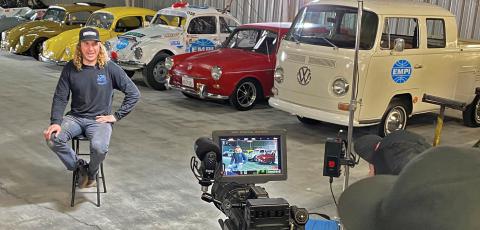
Business leaders who are convinced that there are few things more powerful than a customer testimonial on video are in luck.
Scores of service providers have cropped up that virtually automate the entire process of creating a video testimonial library—including invitation, collection, editing, hosting, and posting to all the social media networks that matter to your business.
Those testimonials also feed into the overall hunger for endorsement video on the web—a genre of promotion known as “social proof,” according to Isaiah Shelton, senior content strategist at Lemonlight, a video marketing services provider.
And the promotional genre is also yet another indicator of the wild popularity of video in the digital world right now.
The report, “The State of Video Marketing 2023” from Wizowl, for example, found that 91% of video marketers used video as a marketing tool in 2023. Moreover, 46% of marketers used testimonial videos as part of that mix. And 96% said video has helped customers and potential customers get a better idea of what the company was selling.
Fortunately, when it comes to video testimonial services, generally all that’s required from your customer is a smartphone and a story to tell. From there, most of these services walk your customer through the video testimonial creation process, including suggestions on what they might want to post on your behalf. Plus, the services also streamline the process for getting the video testimonial filed, approved by your company, and then published across the web in all the places your business does its digital promotion.
As most businesses realize, potential customers assign great value to testimonial videos from real shoppers that pull no punches when it comes to sharing actual experience with a product or service. Those potential customers would much rather see a testimonial from a satisfied customer—production warts and all—than a slickly produced, professional production that in the end, is little more than clever huckstering. And those potential customers are much more likely to buy from your business once they’ve been reassured—by real customers—that your brand is one that can be trusted.
Nikola Bojkov, CEO of EmbedSocial, a social media marketing services provider, said, “Nothing is more powerful than a real customer testimonial video recorded with their own words without any pressure.
“Video testimonials provide visual proof of customer satisfaction, where prospective customers can see and hear the satisfaction and happiness in the existing customers’ expressions and tones,” added Bojkov.
Lisa Harroy, creator partnerships lead at Riverside, a customer video testimonials service provider, agreed, adding, “Video testimonials are an authentic, engaging way to show prospective customers how your satisfied customers feel about your brand.”
Moreover, given that there’s intense competition among video testimonial service providers right now, you’ll find most of these services have tried—in every conceivable way—to make the video testimonial creation and submission process for your customers as effortless as possible.
Many of the services, for example, can be integrated into your e-commerce software or platform, so that securing new testimonial videos is as easy as posting an invitation to submit on your website, sending an after-purchase email asking for a video testimonial, or providing a link for your customer to click on after check-out.
Indeed, some services even enable you to offer a QR code that your customer can scan with a smartphone, which automatically triggers activation of the video testimonial creation-and-filing service.
Most solutions also provide a release form your customers can sign, which gives your company the freedom to use their video testimonial anywhere—including on your website, social media properties, or advertising—in perpetuity. And most services offer prompts to your customers that provide ideas on what they can talk about in their video—including a list of questions they can answer as they make their testimonial.
The good news here is if you’re stuck on how to put together suggestions for your customers for the testimonial videos you’d like, some services offer Q&A templates you can customize for your own purposes. In addition, many services are designed to auto-interface with the social media networks you promote on, including TikTok, Instagram, Facebook, and LinkedIn. That makes it a snap to publish a customer endorsement video you receive to all your social media properties in a matter of seconds.
Bottom line: It’s never been easier to get serious about soliciting—and leveraging—a library of testimonial videos for your business. And if you’re already involved in testimonial video promotion, it’s never been easier to automate much of the process that you may be engaging in manually.

Where To Begin

Here’s a representative sampling of existing solutions:
Widewail Invite Video: Widewail is definitely from the ‘less-is-more’ camp of customer testimonial videos. Your customers need only a smartphone to record videos endorsing your company, service, or product.
Once successfully invited, the Widewail service is designed to take these influencers every step of the way. And once your customers are satisfied with their testimonial, they simply submit their video via Widewail’s app—which auto-notifies your company that you have a new video endorsement waiting.
Widewail also secures a signed release from your customer as part of the video submission processing, guaranteeing that your company will be able to use the video anywhere for free—and in perpetuity.

image 2


Vocal Video: Testimonials handled by Vocal Video also require nothing more than a smartphone to submit a customer endorsement. It’s a full-featured service that includes consumer testimonial collecting, editing, publishing, and hosting. And it also offers auto-polishing of videos customers want to submit by combining raw footage into multi-scene productions including motion graphics, soundtracks, subtitles, and branding.
You’ll also have the option to feature your library on customer video endorsements via embeddable galleries that you can feature on your website and other digital properties.
Like many service providers, Vocal Video encourages you to offer questions to answer to your satisfied customers or you can customize one of Vocal Video’s 46 question templates for your own needs.
VideoPeel: Besides offering basic collecting, editing, and publishing services for your testimonial videos, Video Peel also enables you to do some extra editing once customers submit their videos. For example, VideoPeel enables you to add your own video to what customers submit. Plus, you will also be able to embed your company logo, some writing—and some calls-to-action to potential customers who are viewing the endorsement.
Vidmonials: Offering a video testimonial service similar to Widewail, Vocal Video, and Video Peel, Vidmonials takes things a step further by a text-to-video option. Essentially, if your customer prefers to file a testimonial via text, Vidmonials takes things from there by auto-converting that text review into a video slideshow that features background music. Either way, the resulting video testimonials can be posted to your website or other digital properties by using a Vidmonials “embeddable widget.” With these widgets, you have the option of showcasing an especially outstanding customer endorsement. Or you can use the “Playlist Widget” that plays all the testimonial videos you’d like to be displayed.
Testimonial Hero:  Business leaders looking for a more professional product-focused feel to their testimonial videos may want to opt for this service, which works with a company one-on-one to edit a customer-provided testimonial.
Testimonial Hero’s initial process is similar to more basic services: Customers are invited to submit a video, follow prompts offered by Testimonial Hero about what they may want to say, and then invite them to submit their footage to the service. But once the raw footage is in hand, Testimonial Hero works with you over the next 10 business days to create a 90-second edit of the customer video that will have more of a professional production quality feel.

Joe Dysart is an internet speaker and business consultant based in Manhattan. Voice: (631) 233-9770.
Email: joe@breakingintech.com.
Web: www.dysartnewsfeatures.com


July 2024
By
Joe Dysart

Advocacy Corner

Submitted by johnc on Mon, 06/24/2024 - 10:03
image 1


Tracking legal, legislative, and regulatory developments impacting the racing and performance industry.

PRI’s Washington, DC-based legal and advocacy teams work continuously to protect and support motorsports venues, sanctioning bodies, and businesses around the nation. We are tracking several initiatives this month, including PRI’s inaugural State of the Racing Market Report, a successful Washington, DC Rally to advocate for our industry, and victories to protect vehicle choice in Louisiana and Virginia.

Inaugural State of the Racing Market Report is Published

PRI released its first-ever market research report, showing that track-use motorsports parts accounted for more than $8 billion in sales in the United States in 2023, among many other racing market data points. Produced by PRI Market Research, the 2024 State of the Racing Market Report includes key industry trends and sales metrics and is available to PRI Business and Individual Members for free as a membership benefit.
“As the industry continues to evolve, businesses need to rely on facts to understand where the market currently stands and where it’s headed,” said PRI President Michael Good. “This study takes the guesswork out for our members, helping them to identify new opportunities in an easy-to-read and comprehensive download.”
The report finds that “businesses across the racing ecosystem are seeing positive signs that motorsports is getting back to its usual rhythm.” According to the report, 76% of racing businesses view the racing market as either stable or on the rise. While companies saw strong sales growth following the reopening of tracks and resumption of races post-pandemic due to pent-up demand, the growth slowed slightly in 2023 amidst recession and inflation concerns. Still, overall sales were largely positive or remained stable for those selling racing parts.
“The racing segment continues to be a strong piece of the specialty-equipment market and a revenue opportunity for many businesses,” added Good. “Whether you are a CEO, salesperson, or race service provider, this report can help you stay ahead of the curve and navigate the dynamic motorsports landscape.”
PRI Business and Individual Members can access and download the full report by using their individual login to access their member portal at: performanceracing.com. Once logged in, the report can be found by clicking “My Benefits.”

PRI Members Rally on Capitol Hill, Host ‘Cars at the Capitol’ Event

PRI members recently traveled to Washington, DC, to advocate for the interests of the motorsports parts industries as part of the 2024 SEMA & PRI Washington, DC Rally. Members and industry leaders held nearly 150 meetings with elected officials and congressional staff, advocating for their lawmakers to support legislation to protect the future of the industry. “Thanks to all of the PRI and SEMA members who participated in the 2024 Washington Rally and made sure the motorsports parts industry’s voice was heard on Capitol Hill,” said Eric Snyder, PRI’s senior director of federal government affairs. “The relationships that were developed and reinforced during our meetings and interactions with lawmakers and their staff are critical to ensuring Congress understands and addresses our industry’s policy needs.”

image 2
BOOSTane’s Ian Lehn brought his 1969 Mustang to the 2024 SEMA & PRI Washington Rally. The car recently competed in the Big Bend Open Road Race in Texas. It has a stroker motor from BluePrint Engines, plus products from BOOSTane, SilverSport Transmissions, Moser Engineering, Bearded Stitch, Simpson Race Products, and Graphics Guys Motorsports.


Congressional meetings provided PRI members with an opportunity to advocate for protecting the right to repair and modify vehicles with advanced technology, stopping vehicle technology mandates that limit consumer choice, protecting motorized access to federal government lands, making permanent business tax incentives for race tracks, and extending business tax incentives that will be expiring or be reduced in 2025.

image 3
SEMA and PRI encourage those who weren’t able to attend the 2024 SEMA & PRI Washington Rally—which included the “Cars at the Capitol” event seen here—to get involved by writing their members of Congress on issues of key importance to their business and the industry.


The Rally kicked off with a congressional dinner and engaging panel discussion hosted by TV presenter and car builder Ant Anstead. The discussion featured industry champions from the U.S. Representatives, including Reps. Marie Glusenkamp Perez (D-WA), Tim Walberg (R-MI) and Mark Amodei (R-NV). Industry members also participated in a lunch at the exclusive Capitol Hill Club with U.S. Senator Markwayne Mullin (R-OK), co-chair of the Congressional Automotive Performance and Motorsports Caucus. The Rally also featured “Cars at the Capitol”—a curated showcase of customized vehicles ranging from classic cars to late model vehicles—putting our industry on display just beyond the steps of the Capitol.

image 4
From left to right: Auto industry personality Ant Anstead and U.S. Representatives Marie Gluesenkamp Perez (D-WA), Tim Walberg (R-MI) and Mark Amodei (R-NV).


PRI members who were unable to attend this year’s Rally can still get involved by writing their members of Congress on issues of key importance to their business and the industry. We also encourage you to host your members of Congress at your business. Our government affairs team makes this easy by coordinating the logistics and participating in lawmaker visits to member companies.

Virginia Becomes First State to Disassociate Itself from California’s Emissions Standards and ICE Ban

Virginia Governor Glenn Youngkin announced that the Commonwealth would not adopt California’s 2035 ban on selling new gas- and diesel-powered motor vehicles.
“Seventeen states have attached themselves to California’s emissions standards over the past 20-plus years. Nine states have passed laws and/or resolutions rejecting government deciding what technology American consumers must purchase and buy,” said SEMA President and CEO Mike Spagnola. “Virginia is now the first state in the nation to untangle itself from California’s emissions standards and EV mandates. We applaud Governor Youngkin for this bold action that rejects the notion that California should determine policies for nearly half of American consumers. We urge other states to follow Virginia’s lead.”
SEMA and PRI have led the charge to pass laws and/or resolutions in nine states that would outlaw states and local governments from mandating a singular vehicle technology over others and protect the American consumer’s right to choose the vehicle technology that best suits them and their families. SEMA and PRI’s efforts also led to the successful delay in the adoption of California’s ICE ban in Connecticut and Maine earlier this year.

Louisiana Governor Signs Bill to Protect Vehicle Choice into Law

Louisiana Governor Jeff Landry signed House Bill (H.B.) 515 into law, which ensures consumers’ choice of vehicle power plants and fuel technologies. This action will go into effect on August 1, 2024.
The PRI-supported law officially prohibits a state agency from restricting the sale or use of motor vehicles based on their energy source. H.B. 515 passed both chambers of the legislature with overwhelming support. The new law makes Louisiana the latest state to embrace vehicle choice.
“PRI and SEMA appreciate Governor Landry and Louisiana’s lawmakers for approving H.B. 515,” said Colby Martin, PRI’s director of state government affairs. “As with any automotive advancements, PRI and SEMA have continued to support an ‘all of the above’ approach to vehicle technology policy, advocating for technology-neutral policy that allows the free market to continue to innovate all technology that significantly reduces vehicle emissions.”
Louisiana is among several states seeking similar proposals. PRI believes that Louisianans, not the government, should decide what vehicles are best for them and their families. This effort promotes consumer choice, fosters innovation, and protects jobs.


July 2024
By
Jack Haworth

PRI Tech: How to Choose a Racing Harness

Submitted by johnc on Mon, 06/24/2024 - 09:57
image 1


Belt width, length, latch type, and mounting location are just some of the variables to consider when adding a safety harness to a race car.

Seat belts and racing harnesses are among the top-five most important safety items you can buy for your race car. With all the options that exist between size, length, closure type, and adjustability, it can be hard to decide on a specific set. This guide will give you helpful tips on what to look for in each belt and help to narrow down your choices for an informed decision.

Do I need a 3-inch or 2-inch belt?
First, let’s look at size. The majority of belts come in a 3-inch width. They are common in bigger classes of cars such as sport compacts, hobby stocks, modifieds, and sprint cars. There are also a few belts that are 2 inches wide. These are common for smaller cars such as cage karts, quarter midgets, and junior sprints. Verify with local tracks or series if they require a specific size.
From there, it comes down to what you race. The only exception to this is that some 3-inch harnesses have an option for 2-inch upper shoulder belts (above right). These are referred to as “HANS” type belts. When wearing a HANS device, these narrower belts fit the HANS shoulders better. With some belts you can upgrade the shoulder belt portions for HANS use versus buying all new belts.

What belt length is right for me?
Next, let’s discuss belt length and why you might need a longer belt. Some belts are made longer to facilitate attachment points that are not directly behind the seat. In some race cars, such as quarter midgets, the belts need to be longer to reach the bars where they attach. Harnesses can be bolt-in, wrap-around, or both.
Bolt-in harnesses have a triangular bracket at the end of the belt that bolts through a spud or tab welded onto the frame. Usually, these brackets are sewn in place and are not removable. Wrap-around harnesses are just that: The belt wraps around a frame gusset and passes through a buckle multiple times to hold itself in place. A good option for this type of harness is Speedway Motors’ Racing Harness/Shoulder Pad/Sternum Protector Kit. Some belts offer a combination, which has a wrap-around end but include a bolt-in triangular bracket that the belt can be threaded through and secured into the harness using the wrap-around buckle. With the bracket, you basically turn the wrap-around belt into a bolt-in. See “How do I mount my safety harness?” section below for more details on proper mounting configurations and belt angles.

image 2
These 2-inch upper shoulder belts fit better with a head-and-neck restraint.
image 3
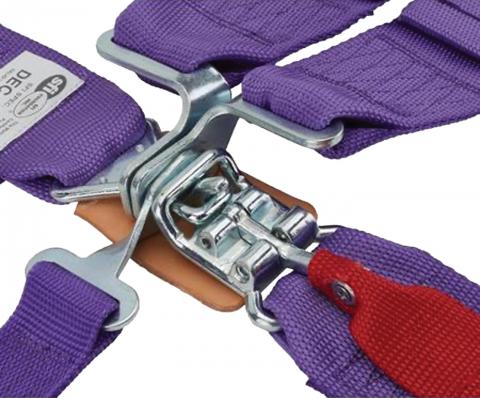
Speedway Motors’ five-point harness latch collects all five belt segments.
image 4
Speedway Motors’ Elite 5-point Seat Belt Harness.

Four-point vs. Five-point Harness
A four-point harness consists of two shoulder belts and two lap belts connecting at the center of the lap belts. It is commonly used in recreational off-roading, track days with street vehicles, and non-extreme racing events, offering better restraint than the traditional three-point harness (seat belts) used in passenger vehicles. The SFI five-point harness consists of two shoulder belts, two lap belts, and an anti-sub (AKA anti-submarine or sub-strap) belt that goes between the legs to a mounting point under the seat line. The anti-sub strap on a five-point harness prevents the driver from sliding forward in a crash. Each belt in a five-point harness assembly is a distinct belt, and all the belts are connected together at a common point via a latch or cam lock, which is covered in the next section. Nearly all competitive racing bodies (IMCA, NASCAR, NHRA, World of Outlaws, USAC, F1, IndyCar, etc.) require at least five-point harness seat belts, and it’s the minimum recommendation for high-speed environments.

What is the difference between latch-and-link and cam lock belts?
The next option on harnesses is the latch type, such as the 5-point racing harness cam lock (bottom left photo). There are basically two different kinds of latches: latch-and-link and cam lock. The latch-and-link belts are the most popular and most common. They basically operate as a hook and loop. The shoulder belts and sub belt slide onto the loop, and the hook latches onto the loop, holding it all together. The cam lock latch operates as a hub. The shoulder belts, sub belt, and other lap belt push into the cam latch, clicking into place like a street car
seat belt.
To release, you simply pull or rotate a lever or knob, which activates a cam-release inside the latch, releasing all the belts simultaneously. Generally, the cam lock belts are easy to operate, allowing the belts to be locked in/secured one at a time, but are more expensive. Whereas, the latch-and-link belts are nearly infallible, but take a little effort to get used to and don’t release quite as easily.
The latch-and-link style belt latch (photo on middle left) helps provide some clarity to the design. The right lap belt has the link loop end sewn into it and the sub strap end buckle, along with both shoulder strap end buckles, slip over the link loop portion. Finally, the left lap belt’s end buckle is slipped over the end of the link loop and the left belt’s latch lever is pushed toward the belt webbing to engage the latch into the right lap belt’s link loop, retaining all five belt segments.
Similar to the latch-and-link, the cam-lock style belt starts with the main latch assembly as part of the right lap belt. However, that is pretty much where any similarity ends. The remaining belts, which include left and right shoulder, sub strap, and left lap belt, all have a latch “tongue” like a production car seatbelt that can be inserted into the cam lock latch individually. This makes belting in yourself a little easier. Then, instead of lifting the latch-and-link lever, you either twist or pull the cam lock lever to release all the belts at once.
To see the difference between latch-and-link and cam locking systems in action, we have a helpful short video at youtube.com/shorts/YKRbfvh2Q-M.

What type of belt adjustment is best?
The type of adjustability each belt has is another consideration. The basic types are pull-up, pull-down, and ratcheting. When a belt is a pull-up design, it means that the lap belts tighten by pulling the belt’s “tail” upward toward the latch. These belts are easier for the driver to tighten. In comparison, a pull-down design means the belt tightens by pulling the belt’s “tail” downward away from the latch. These are easier to have someone outside the vehicle tighten for the driver. Lastly, ratcheting seat belts have a mechanism on the left side lap belt that, once latched together, the ratchet can be tightened a lot tighter than simply pulling on the “tail.”
They use a standard 1/4-inch ratchet and still utilize the standard latch-and-link style latch. Ratcheting belts, such as a 2-inch racing harness, are most common in sprint cars and other race cars with enough clearance around the left side of the seat to mount and access the ratcheting mechanism. These require a bolt-in spud or extra frame bracket.

What is the benefit of a six-point restraint?
The one last thing to consider in your safety belt plans is whether you want to use a more traditional five-point belt or the newer six-point belt. Initially, the thought goes to driver comfort, as the six-point’s additional sub strap means the two sub straps are positioned against the inner thighs versus the single sub strap of the five-point harness, which is routed straight down the middle of the groin area. However, consider the racing seat and belt mounting locations before you decide. An improperly installed six-point belt is not better than a properly installed five-point belt. Furthermore, check with your sanctioning body and/or track rules, as some mandate the six-point belt setup. Whichever system you choose, ensure it is properly installed for it to be the most effective.

How do I mount my safety harness?
The proper way to mount a harness depends on the cage design, racing seat, and harness. Generally, avoid mounting to any area not specifically designed to hold the end of the harness (be it a bolt-in or wrap-around). It is preferred to mount the belts in double shear with a bolt-in tab on the end of the belt. This allows the belt/harness to pivot and align with the force applied in a crash. Avoid mounting a bolt-in tab where any load applied to it would bend the tab or bolt. The shoulder belts should attach to a cage crossbar roughly 10 degrees below the horizontal plane of the driver’s shoulder, while the lap belts should sit across the pelvis (the strongest bone in your body!) with the buckle about 2 inches below the driver’s navel. Lastly, the sub strap should be anchored just behind your chest plane. The belts should not rub against the seat openings or any sharp interior panels, and the belts should be configured in the shortest length possible.

What is an SFI Rating?
SFI is a non-profit certification and testing organization for the motorsports industry. The certification shows a product has been tested to meet or exceed a set of data points to ensure the user’s safety. Items like racing suits, helmets, and safety belts come in various SFI ratings (particularly racing suits). For safety belts the SFI rating is 16.1, and they are certified for two years. Why only two years? Many variables, such as sun fade that deteriorates the webbing material, dirt and water, etc., all contribute to loss of belt strength. Harnesses can lose between 50% and 75% of their strength over this two-year period, thus the replacement mandate. Furthermore, if the belts have been through an accident, they should be replaced immediately due to the stretching forces exerted on them in the crash.
There exists a multitude of options for harnesses. Check your rulebook, look at the racing you will be doing, and consider what neck restraint you will be using. Measure for belt length, if they don’t attach right behind the seat, and think about your needs when it comes to the latch and adjustability. Remember, safety components are the most important thing in your race car, besides you. Check out the racing harnesses from Speedway Motors. Your safety comes first!

Mark Houlahan joined Speedway Motors in 2020. Houlahan has always enjoyed telling a story with words on paper (and now a screen) through numerous automotive magazines and a book on Fox body Mustangs. In 2023, Houlahan was inducted into the Mustang Owner’s Hall of Fame. Column courtesy of Speedway Motors; SpeedwayMotors.com/The-Toolbox.

July 2024
By
Mark Houlahan

Hold Fast

Submitted by johnc on Mon, 06/24/2024 - 09:40
image 1

Photo courtesy of ARP


How fastener technology translates from the highest tiers of motorsports to amateur and grassroots racers.

Chris Brown of ARP in Ventura, California, recalled what the fastener business was like “in the glory days of Formula 1, in the early 1990s, when we got into that space. It was crazy. The budgets were about the size of a small country’s GDP. It was a free-for-all. You’d have a room of 30–40 designers just drawing whatever they needed. They would come up with some great designs, but often they were expensive to produce.
“We’re not in that world anymore,” Brown said. “It’s cost-capped, in an attempt to try to keep the cost of racing under control.”
Yet at the same time, the demands put on fasteners, particularly those that are engine-related, have exploded, pun intended.
“There’s probably nothing on earth that’s harder to seal than a Top Fuel motor,” noted Mark Campbell of P1 Manufacturing, Rogersville, Missouri. “Especially when things go wrong.”
Fastener manufacturers are challenged to find sealing and connecting solutions that strike a balance between cost and strength, while also factoring in weight and durability, always seeking less of the former and more of the latter.

Design Principles

At ARP, fastener development is based on a set of design principles, Brown said, which “really haven’t changed over the years. When it comes to fasteners, there are certain do’s and don’ts that you incorporate into design. Many of the same ideas and principles that are used in the top levels of motorsport have also been used in the grassroots, in parts in our catalog, for many, many years.”
As an example, Brown pointed out that “when an engine designer is designing a joint, they want to use the lightest, highest strength thing that they can so they can keep the weight down. That is when those principles kick in as far as, for example, where you can neck the stud down in diameter to keep the weight down, but also maintain the joint integrity with the clamp load.”
Or in another example, a connecting rod bolt, the ideal basic design principle would be a bolt “that would be like a piece of steel rope—something very strong in tensile strength, but also something flexible, that will allow the bolt to bend slightly without cracking,” Brown said. The material used to execute that design principle would vary from application to application depending on the “duty cycle, the load that the fastener is going to see in service. We know there’s going to be a force generated on the cap when the rod and piston get to top dead center. We can calculate what that force is with that rod, piston, stroke, and rpm combination, and then we select a material from our palette of materials that will exceed those requirements with a very healthy
safety factor.”

image 2
According to one of our sources, some engine builders, even after years of experience in the field, can still learn new tricks about properly torquing fasteners and the correct lube to use to get, for example, a positive and equal clamp load across a cylinder head to make sure it stays sealed.


When developing a new fastener for a customer in motorsports’ top ranks, ARP collaborates with the team to develop fasteners for each specific use case. Teams will provide basic parameters, ARP will get back to them with recommendations, and once they agree, ARP executes the fasteners to spec. “Or, customers will send us a drawing, knowing exactly what they want,” Brown explained. Either way, the fastener design is proprietary.
“We are involved with lots of NDAs,” Brown noted, adding that ARP is “in an unusual position of making parts for several engine manufacturers that compete head-to-head, and yet we make their parts here. It’s a position of great trust that we take very seriously.” As one would imagine, those proprietary parts don’t trickle down or wind up in the catalog.
Interestingly, Brown has noticed something of a trickle-up situation happening “with the push to reduce the cost of racing. A lot of the top-tier racing engines now are somewhat cost capped. What a lot of designers who have worked with us over the years have recognized is that the quality that we offer with an off-the-shelf catalog part is much higher than it would be for, say, a commercial grade socket head cap screw that they might have been using previously. So a lot of our off-the-shelf designs and part numbers are being incorporated into the design of some very cutting-edge modern power units.”

A Different Approach

P1 Manufacturing entered into the fastener business much differently than most would expect, Campbell said, “because one of the first products we made was a billet Top Fuel block and then the fasteners for it. We learned a lot about fasteners doing that, and we have taken a lot of that knowledge and technology and applied it to our regular, everyday stuff.”
As an example, Campbell said P1’s heat-treating process “is quite different than any other fastener manufacturer out there. We do vacuum heat-treating, which eliminates any of the particulates in the air that could contaminate that part while we’re heat-treating it.” The process and its related equipment are “very expensive,” he said, “but we started doing that when we were making these extreme high-end fasteners, and we’ve had very good luck with it. So today, literally every single fastener that we make, whether it’s an 8740 or a 625 Plus or anything in between, is vacuum heat-treated to increase their reliability.”

image 3
Choosing the right fastener is “all about the application,” said one source. The ultimate, highest-strength material may be ideal for one part of a vehicle but not another. “Pick which material is right for the application.”


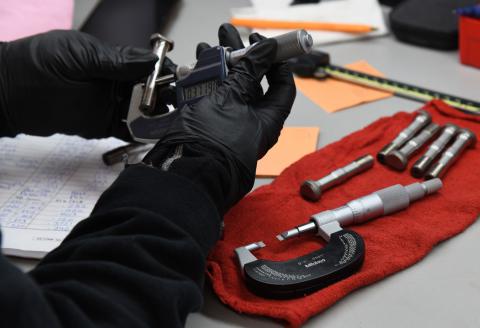
The 8740 material Campbell referred to is a chromoly used for fasteners that is often treated with black oxide to improve its durability. He described 625 Plus as “a very unique material, some of the best material you can use” with properties similar to tool steel and tensile strength in the “270,000–300,000-psi range.” It’s used in P1’s highest-end fasteners—including those for Top Fuel engines—because “it’s about the only thing that will live in an application like that.”
Developing a fastener using a material rated for 270,000-plus-psi tensile strength is “really a matter of coming up with a fastener that obviously has a lot of strength, but also does have some pliability or is a little bit ductile,” Campbell said. “Because no matter what, the stud does have to stretch to create the load you want, but it has to come back as well. Otherwise, you’re getting into a torque-to-yield type fastener, a one-time use. These guys don’t want to just use this once and throw it away.”
Some of the fastener knowledge P1 shares across motorsports disciplines is about how to properly torque fasteners, “and the lube that they use on the fasteners, all those things to get a very positive clamp load and an equal clamp load across the entire cylinder head to make sure that they stay sealed up,” Campbell said. Many in the racing industry have been torquing fasteners for a long time and are a bit set in their ways, he acknowledged, “but we’re trying to show them different ways, better ways. We have a metrology lab here, which is the science dedicated to measuring stuff, and we’re trying to help them understand the properties of the materials and how they react to loads.”

Panel Fastener Evolution

To diversify our fastener discussion a bit, we spoke with two companies that manufacture and/or distribute panel fasteners. Clarendon Specialty Fasteners of Long Beach, California, distributes fasteners of all kinds “to just about every sanctioning body in motorsports, whether it’s Formula 1, IndyCar, NASCAR, Top Fuel, even endurance racing and drifting,” explained Caulin Anderson. One of the company’s most popular panel fastener lines, Live Locks, “started in Formula 1, but now they’ve moved over to endurance racing, and you’re starting to see them more, not just on DTM or GT3 cars but also filtering into GT4s.” That includes the GT3 and GT4 Mustangs Ford released earlier this year.
Several factors set Live Locks apart from other quarter-turn fasteners, Anderson said. “They’re a little bit smaller and more aesthetically pleasing. And unlike the quarter-turn fasteners that give you one click, these can be ratcheted down for the perfect fit. They’re also offered with different styles of heads, including one that’s countersunk, one that’s protruding, and the one used on the Mustang GT3 cars, which has like a mushroom-shaped head for a little more clamping area around the body panel.”
Because Live Locks are “at a higher price point,” it may be a while before they reach the street car market, Anderson believes. “It’s really going to come down to how much the OEMs are using it. The more they use, the more stock we’re going to buy, which means a lower sales price we can give the average motorsports guy.” Right now there’s “something of a disconnect” between the price of the studs and the receptacles, he said, “because a lot of people need the receptacles, but they’re not using the same size stud. All the studs go in the same receptacle. It’s kind of like nuts and bolts. Everyone can use the same nut, but not everyone can use the same size bolt.”
Behrent’s Performance Warehouse in Florida, New York, has specialized in quarter-turn fasteners “for the dirt market for the last 20 years,” said Jon Lynch. “Our Panelfast fasteners, which now have more than 200 variations and sizes, started with the Northeast modified market and now have pushed into national tours such as Late Models, sprint cars, IMCA, and UTV/off-road applications. We see new growth every year with different purposes. The expansion trickles down to karting, mini-sprints, Legends, quarter midgets, and other beginner racing classes. Most recently we have seen an influx from the drag and street market as well as niche markets like rock climbing and monster trucks.”

image 4
The fasteners P1 Manufacturing developed for its billet Top Fuel blocks are made from 625 Plus, a unique material with tensile strength topping 270,000 psi. “It’s about the only thing that will live in an application like that,” said Mark Campbell.


Lynch said that newer design machinery, “such as 3D printing and scanning, has made making new items and prototypes easier and more efficient in the design stage, which enables us to make products more accessible to the end user quicker.”
He noted that the fastener industry has “recently seen a bigger push toward aluminum fasteners compared to steel. Between strength of material and weight savings, it provides racers with an advantage without sacrificing durability.”

image 5
A fastener undergoes hardness testing at ARP. “The space where ARP lives is in much higher grade materials and much tighter controls and specs than a commercial fastener, and in some cases much tighter controls and specs than an aerospace fastener,” said Chris Brown.


What drives the decision to choose one material over another? “It really depends on the customer,” Lynch said. “In crate engine classes for example, where every car has the same motor and parts, they tend to try and find the lightest option. Whereas short track racers still tend to use steel buttons, as they are more cost efficient when the possibility of damage is higher.
“Changes in head styles, color, and material options have given racers and manufacturers the ability to offer more options and tailor-make what fits each customer’s needs,” Lynch concluded.

THE RIGHT STUFF?

Should racers use aerospace-quality fasteners? The term would seem to indicate a fastener of the utmost quality and strength, one good enough to keep airplanes or spacecraft in one piece in the harsh environment of extra-terrestrial travel.
“Generally speaking, people hear about a part made to aerospace or aircraft or military specification, and they automatically assume that it’s better,” noted Mark Campbell of P1 Manufacturing, Rogersville, Missouri. “But really, it’s similar to making something to an ISO standard. Aerospace has certain standards that they want you to abide by when you’re building a product. Typically, it means that it’s a better product, but it doesn’t necessarily mean that it’s right for what we’re doing in motorsports. What we do for a Top Fuel engine can be crazy compared to the fasteners we create for the aerospace industry. ‘Aerospace’ definitely doesn’t mean that it’s better.”
Just because an aerospace fastener is designed to meet a particular specification “doesn’t mean it’s the strongest fastener,” added Chris Raschke of ARP, Ventura, California. “It was designed for a certain area of the aircraft. They’re all designed around a spec, and every one of them went out to meet the minimum bid at the minimum standards. In our world, we make fasteners to the highest standards at a good quality price for good value.”
“In aerospace there is quite often a degree of redundancy,” said ARP’s Chris Brown. “If it takes 10 bolts to hold a joint together, aerospace might use 15 or 20 to have an extra level of safety. We don’t have that luxury in motorsport. The joints are really critical and a lot closer to the edge. So the materials, design, and quality of that part have to be that much higher.
“We don’t want to demean the term ‘aerospace quality,’” Brown continued, noting that ARP has held an AS 9100 aerospace quality credential since 2009, “and we were compliant before we became accredited. It’s a very, very stringent set of rules. By the nature of what it is, aerospace has to be very tightly controlled because of safety. So it gives you a high degree of confidence as far as consistency from one part or one batch to another. Whereas in the commercial world, that can vary quite a bit because the rules are much looser.”
With an aerospace fastener “you are certainly getting more strength than your run-of-the-mill product,” said Caulin Anderson of Clarendon Specialty Fasteners, Long Beach, California. “But with the way cars are developing, you may need something more. Previously, automobiles didn’t see the same kind of stresses as a plane. But nowadays, you’re seeing more stresses on certain components.” —Drew Hardin

SOURCES

ARP
arp-bolts.com
Behrent’s Performance Warehouse
behrents.com
Clarendon Specialty Fasteners
clarendonsf.com
P1 Manufacturing
p1mfg.com


July 2024
By
Drew Hardin

Power Punch

Submitted by johnc on Mon, 06/24/2024 - 09:19
image 1


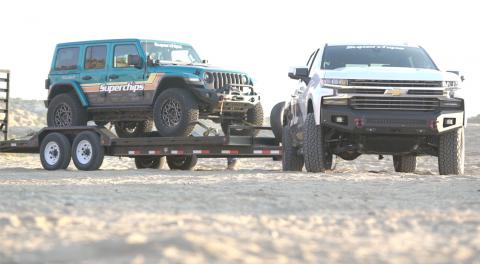
Getting to the track is almost as fun as being at the track with these tow vehicle performance enhancements that boost truck performance, fuel economy, and drivability.

Racers—all of them—are obsessed with power. Most will dig deep into their finances, and their personal efforts, to add a few horsepower to a race car in a competitive class. Yet another investment in power—in their tow vehicles—will pay big dividends as well. The performance aftermarket offers a host of electronic and mechanical aids that can markedly improve a tow vehicle’s power, driver-friendliness, and fuel economy, which may just be the most important improvement of all given the persistent increases in fuel prices.

Tuning Tools

Some of the equipment available allows teams to do a quick tune-up of their hauler, using proprietary technology, often in handheld packages that can be plugged into a hauler’s data ports. At COBB Tuning in Austin, Texas, customers can find a way to better the behavior of Ford trucks equipped with the automaker’s 10-speed automatic transmission. As COBB Tuning’s Kirstin Backes explained, “One of the most common complaints in the Ford trucks in the last few years has been the 10-speed’s shift characteristics. From the factory, they’re always hunting for a gear. All the up-and-down shifting is annoying as a driver, and it only gets exacerbated when you’ve got a load behind your truck. We can fix that with the COBB Accessport and a few minutes of your time.”
The Accessport module is advertised as an easy-to-use ECU upgrade solution for a variety of performance vehicles and trucks. It essentially replaces the factory’s more conservative engine-management settings with either off-the-shelf or enhanced custom powertrain mapping for any level of customer modification. The Accessport rides in a holster and is plugged into the vehicle’s OBD II port to input pre-loaded mapping, with driver-selectable tuning settings that are fine-tuned to any power modifications already on the truck by following directions on the unit’s screen.

image 2
Edge Products’ Insight CTS3 on-dash monitor provides drivers with real-time data that includes transmission fluid and coolant temperatures, engine oil and exhaust gas temperatures, boost pressures, and more.


“It will help you make more power, and many drivers see improvements in their fuel economy after a good tune is loaded,” Backes said. “You can’t beat that combo when you’re pulling another vehicle to the track. Freed-up airflow, combined with a good ECU tune, will add substantial power, and you don’t even have to leave your garage to make it all happen.”
Holley in Bowling Green, Kentucky, offers a variety of towing-related horsepower products through several brands under its wide corporate umbrella. Several recent product releases are aimed directly at tow-vehicle performance. Under its DiabloSport brand of tuners and programmers, Holley produces a variety of plug-in tuning devices, most of which can be hand-carried, that are aimed at providing flash tuning upgrades to gasoline-fueled trucks. The DiabloSport loaded-in tuning maps can boost power for trucks using 87-octane fuel, with greater gains realized when the fuel is 93 octane. The DiabloSport tuners offer variable valve timing and torque management calibrations.
One such offering, which Holley sources said offers maximum control for Stellantis, Ford, or GM vehicles, is its Trinity 2 programmer. This is built around a haptic 5-inch touchscreen with multiple menus and monitoring functions and is updatable via Wi-Fi using either Windows or Mac-based computer operating systems. With 10 analog and digital function readouts, the Trinity 2 is expandable via licensing agreement to cover multiple vehicles in a customer’s fleet.
In some newer trucks, especially recent General Motors trucks with 5.3-, 6.2-, and 6.6-liter engines, owners can find that the factory ECM and TCU settings may be locked. DiabloSport offers exclusive in-field tuning kits that will unlock the modules and allow uploading of a performance tune. Added horsepower, optimized transmission calibration, and improved throttle response are the advertised benefits. DiabloSport also promises better 0–60 times, improved passing power, and more consistent transmission operation.
Superchips, another Holley holding, offers a variety of handheld flash tuners and inline tuning products for gasoline- and diesel-fueled trucks produced by a variety of automakers. Owners of Ford F-150 trucks from 2021 and up are directed to Superchips’ new Pulsar XT module. This unit allows trucks that tow with the 3.5-liter or 2.7-liter EcoBoost engines to reprogram the tune without first unlocking the truck’s ECM. Superchips forecasts power gains of 65% with the Pulsar XT, along with up to 90 additional pounds-feet of torque. If the truck has been re-geared or fitted with taller tires, the Pulsar XT allows the user to properly calibrate the speedometer, adjust the Tire Pressure Management System (TPMS) engagement threshold, or bypass the TPMS entirely. The system also allows users to dial up the available power as needed—when climbing a hill, for example. The component is legal under the federal EPA’s anti-tampering rules.
Another Pulsar XT is aimed at owners of Ram pickups with the 3.6-liter V6 or 5.7-liter Hemi V8. While not specifically a power-adding device, this Pulsar XT allows owners to disable the Ram Multi-Displacement System, which drops cylinders under moderate loading for fuel-saving purposes. There are seven preset throttle-booster settings. The Pulsar XT also disables the truck’s engine auto start and stop, can be specifically calibrated for tires of 28 to 40 inches in diameter, and can compensate for gear ratios from 2.73 to 5.38. The unit can also adjust the TPMS warning threshold and can recall previous tow and haul settings on startup. It’s all controlled through an Android or iOS smartphone app.
Under its Edge Products brand, which dates to 1999, Holley offers tuning and monitoring equipment aimed at the light-diesel truck owner. To make sure everything’s operating properly, Edge Products recommends its Insight CTS3 on-dash monitor, which provides drivers with real-time data that includes transmission fluid and coolant temperatures, engine oil and exhaust gas temperatures, boost pressures, diesel particulate filter (DPF) regeneration frequency, and DPF soot load. The Insight CTS3 has hundreds of configurable displays for keeping track of a broad range of powertrain functions. External temperature probes and temperature and pressure sensors can be added to reveal data not disclosed by normal OBD-II functions. The unit has self-diagnostic programming that will allow it to report functional problems on the fly.
The Insight CTS3 can be used for full tuner applications across nearly all Ford, GM, and Ram diesels produced from 1996–2024. Edge Products’ Evolution CTS3 and Juice with Attitude CTS3 platforms offer added power and torque, modified transmission shift strategies, and calibrations specifically developed to improve overall drivability and towing performance.

image 3
Superchips’ hand-held tuners enable the driver to perform multiple functions, not all of them related to engine performance. Some models enable the driver to adjust the Tire Pressure Management System engagement threshold or bypass it entirely.


These tuning tools from Edge Products offer improved drivability and towing performance by increasing mid-range torque and adding up to 180 horsepower over stock ratings, according to company sources, who added that most users report an improvement in mileage, throttle response, and passing power on the highway.
Among its newest offerings, Edge has released its Evolution CTS3 with Locksmith for owners of trucks equipped with the GM LP5 Duramax diesel engine. The system allows ECM and TCM unlocking and tuning, directly from the cab, using an industry-leading touchscreen with multiple digital monitors. Covering 2020–2023 models, the Evolution CTS3 is said to deliver “massive power gains” with improved throttle response. A PC and downloaded Update Agent software is required to complete the tuning process. Edge Products’ sources said the system will add up to 125 horsepower at the tires, for which the speedometer can be calibrated to match tire sizes. Four calibration maps are offered for tuning the GM 10-speed automatic transmission. Monitored functions include soot and regeneration frequency, with adjustable speed and rev limiters, among other functions. The component is legal in all 50 states.
Another of Edge’s newest products for diesel applications is the EZX, which is an inline programming module controlled through an intuitive smartphone app along with the truck’s factory steering-wheel controls. According to Edge Products, the EZX is applicable to 2013–2024 Ram Cummins, 2017–2022 Ford Power Stroke, and 2020–2022 GM 3.0L Duramax diesel engines. It adds emissions-friendly power (up to 65 horsepower) that is adjustable on the fly with the app monitoring variables such as tire size, pedal sensitivity, the truck’s speed limiter, turbo timing, and engine brake setting recall, among other variables. The system is completely plug-and-play and leaves no trace of ECM tampering, the producer reported.
The recent merger under Derive Systems in Sanford, Florida, has brought the tuning products of Bully Dog and SCT under the same corporate umbrella. Jay Payson said the firms’ products are intended to boost horsepower, improve fuel economy, and enhance the overall experience of driving a tow vehicle with added performance.
The SCT BDX Performance Programmer and X4 tuning accessories are known in the marketplace for delivering street-tested and dyno-proven tuning files developed by expert, in-house calibrators. Both are described as adding horsepower, torque, and a more responsive towing experience. Some of the calibrations are also aimed at improving fuel efficiency. The systems have the capability to monitor variables such as coolant temperature, battery voltage, and spark timing, which helps ensure the vehicle is running optimally. As Payson explained, “This not only enhances the driving experience but can also prevent potential issues before they become serious problems.”

image 4
PPE’s new bar-and-plate transmission fluid cooler has a larger effective cooling area and bigger core than the OE cooler, but it still utilizes the factory mounting hardware for ease of installation.


For diesel-powered towing vehicles, Bully Dog offers the compact GT Diesel Performance Monitor & Tuner. The unit can be mounted by suction cup and bracket inside the cab and is updatable via PC interface. The multi-function tuner is capable of performing both monitoring and diagnostic functions with a variety of pre-loaded tuning maps. Performance is relayed to the driver through a series of virtual gauges that project rpm, boost level, road speed, and operating temperatures.
Both the SCT BDX and X4 offer user-friendly data interfaces, with the BDX featuring a full-color display along with Wi-Fi-enabled software updates and tuning downloads. This allows access to up-to-the-minute tuning data without requiring access to a personal computer, enabling custom performance tailoring. The devices can also serve as diagnostic tools, capable of reading and clearing diagnostic trouble codes. This feature can save a trip to the mechanic by allowing drivers to address some problems themselves, according to company sources.

Engine to Drivetrain

Pacific Performance Engineering (PPE) in North Las Vegas, Nevada, has a full catalog of horsepower-improving accessories for trucks, including newly upgraded cast-iron cylinder heads for the General Motors Duramax diesel V8. Another such improvement can be realized from PPE’s air-to-water intercooler kit for 2011–2023 Ford trucks equipped with the 6.7-liter Power Stroke. The unit advertises increased cooling efficiency and improved density of the incoming fuel charge, both of which enhance performance under heavy loads, such as towing. A simple, drop-in installation is also cited, along with a 50% larger core and reduced inlet backpressure when compared to a stock intercooler. The flow-optimized, cast-aluminum end tanks of the PPE intercooler are reported to improve airflow, while also reducing frictional pressure drop by a calculated 63%. Sources at PPE said this ensures a constant and smooth airflow with minimized flow restrictions and maximum performance, along with significant fuel-economy benefits.
For those who tow with GM trucks, PPE also now offers its bar-and-plate transmission fluid cooler for trucks equipped with the 6.6-liter Duramax. The unit is a direct replacement for the OEM fluid cooler and uses OEM mounting hardware for speed and simplicity. The PPE unit has a larger effective cooling area and bigger core, which, according to PPE sources, allows the unit to draw 200% more thermal heat from the transmission fluid than the factory cooler can manage. That can result in a 40% drop in fluid temperature, improving transmission operation under all load conditions. The cooler is crafted from high-quality aluminum for better temperature dissipation than stock and comes with a limited lifetime warranty.

image 5
Components from Wehrli Custom Fabrication not only improve a truck’s performance, but the company also offers custom powder coating that can match a tow vehicle’s or race car’s color scheme.


Wehrli Custom Fabrication of DeKalb, Illinois, is a one-stop source of equipment for the mechanical and cosmetic upgrading of light- to medium-duty trucks, especially diesels. Established in 2010, Wehrli produces specialized components for Duramax-powered GM pickups, Fords with the Power Stroke diesel V8, and Cummins-motivated Ram trucks. Among its offerings are drop-in enlarged turbochargers for a variety of models, dual-turbo conversions for the Cummins six-cylinder diesel, and intake kits for the three major diesel providers.
Wehrli sources explain that their selection of intakes, intake horns, intercooler pipes, and down pipes increase both air and exhaust flow for the turbocharger, resulting in improved efficiency, better throttle response, and turbo spool-up. According to the manufacturer, Wehrli turbo components eliminate weak points in the factory design that can contribute to lost power, boost leaks, and complete failures during hard-working and high-performance applications. One of them is a custom 67-mm drop-in turbocharger intended for use with the Ford 6.7-liter Power Stroke diesel from 2017–2019.
Wehrli also offers upgraded silicone boots to withstand higher boost pressures than the factory components, with an eye on increasing reliability and eliminating both blown factory boots and horsepower-robbing boost leaks. The various intake kits that Wehrli designs and produces are also advertised as improving intake air velocity and volume, while providing a more aggressive engine and turbo exhaust note during acceleration. Cosmetically, Wehrli also offers custom powder coating that can match a tow vehicle’s or race car’s color scheme.
In addition to offering supercharger kits for both hot street and race applications, Vortech Superchargers in Oxnard, California, also produces its Charge Cooler upgrade package for Ford F-series trucks equipped with the 3.5-liter EcoBoost engine package. The system, which reduces the temperature of the incoming air charge, can be upgraded to a complete system that incorporates the DiabloSport hand-held tuner and Vortech tuner file, plus all necessary hoses and related equipment. Andrew Schwartz said that Vortech superchargers increase power and torque, making for easier hill climbing with improved fuel economy, depending on the driver.
“If the customer is looking for a product with race-winning performance that
delivers quality and durability, there’s no better product on the market,” Schwartz said.

SOURCES

COBB Tuning
cobbtuning.com
Derive Systems
derivesystems.com
Holley
holley.com
Pacific Performance Engineering
ppepower.com
Vortech Engineering
vortechsuperchargers.com
Wehrli Custom Fabrication
wcfab.com


July 2024
By
Jim Donnelly

Silent Titans

Submitted by johnc on Mon, 06/24/2024 - 09:02
image 1

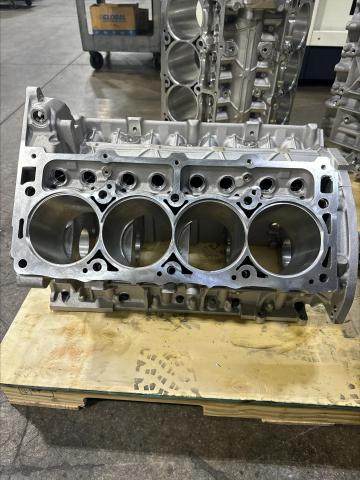
The Gen III Hemi block developed jointly by Bill Mitchell Products and Gen3 Performance Products is constructed with 356 aluminum alloy and is also available in a solid casting.


Cylinder blocks are at the core of race-engine performance, and the newest products are expected to make a significant impactin motorsports.

If recent cylinder-block development is any indication, then expect popularity of the Gen III Hemi engine family to continue growing in the performance aftermarket. Two new aluminum blocks and one iron configuration will be available this year for Mopar enthusiasts who have high-horsepower ambitions.
“In the past 10–15 years, the horsepower levels just got out of control so quickly,” said Bill Mitchell of Bill Mitchell Products, Edgewater, Florida, which partnered with Gen3 Performance Products in Smyrna, Delaware, to develop new cast aluminum blocks (both solid and water-jacketed versions) for the Hemi platform. Mitchell has also been busy making sure the rest of his block lineup will stand up to racing demands. “That’s what I’ve spent the last few years doing to all blocks, just upgrading and making them stronger where they needed to be stronger. Not that I had any issues, but why wait?”
Other new Gen III Hemi blocks will be available from Energy Manufacturing and from Dart Machinery. The racing community will also benefit from other notable cylinder block products, including upgrades to a venerable SBC iron block from World Products, a new Brodix sprint car block, a new 2JZ iron block from Dart, and a new short-deck SBC iron block for small-displacement racing applications from 1SPEC, which is a subsidiary of M&M Competition Engines. The market will also see more of the Honda K24 and Lamborghini billet blocks recently developed by Noonan Race Engineering.
The surge in new cylinder block products is a result of a shortage created by the pandemic. First, there was significant demand when racers and hot rodders revived projects after being sent home from work and a couple trillion dollars in stimulus money was injected into the national economy. But at the same time there were serious foundry issues for the block manufacturers due to rampant labor and raw materials shortages along with some casting operations being shut down completely.
“Racers are mainly asking for availability these days,” said Heath Norton of Energy Manufacturing, Fremont, Ohio. “They just want to be able to get blocks at a good price. It’s more about consistency of product and consistency of supply.”
“The whole COVID-19/supply chain issue has now pretty well sorted itself out,” added Jack McInnis of World Products, Louisville, Kentucky. “We continue to have our products cast and machined in the US. They were never done offshore.”

Focusing On Established Customer Base

One company that didn’t have to worry about securing a foundry is Brodix, as it owns its own casting and machining facility in Mena, Arkansas. The company’s newest block is designed for 410 sprint car engines and has additional features that are beneficial to engine builders in that highly competitive segment.
“The entire block scavenges the dry-sump system internally and doesn’t require any additional internal plumbing,” said Mark Fretz. “It has in and out ports on the front of the block and requires no other external tubes to scavenge the valley.”

image 2
The new Brodix aluminum sprint car engine block features a dedicated sprint car-style bellhousing pattern, improved dry-sump scavenging, and weight-reduction machining.


The block is available with either 400 or 350 mains and comes in a 4.125 bore diameter. The first time the block was raced in a World of Outlaws event, it won.
“We also lightened the block more, so the overall appearance of the block is different,” added Fretz. “We’ve removed some of the unnecessary casting parts off of the block that didn’t need to be there for sprint cars. We just tried to lighten the block up as much as possible, and then we do the ultra-light machine work to the outside of the block to make it look really nice.”
The block will accept 55-mm roller bearings and either 0.904 or 0.937 lifters. There’s also a valley-pressurized oil-supply hole for spring oilers, sprint-car-style bellhousing pattern, and 0.391-inch raised camshaft tunnel.
Overall, Brodix continues to focus on a core customer base that builds traditional small and big block Chevy engines, including spread-bore versions and solid castings for select classes.

image 3
The Dart Toyota 2JZ iron block is designed with enhanced strength and rigidity for racing but can be used as a direct replacement.


“Our engine builders aren’t looking to reinvent the wheel,” said Fretz. “They’re building bracket-race motors and they’re building for heads-up drag racing. We do a ton with the radial racing, Top Sportsman, Top Dragster. They all want a block that will hold 3,000 horsepower and make 100 runs without hurting it.”

Hemi Blocks And More

The Dart Gen III Hemi Iron Eagle block arrives a little later than expected due to foundry issues, but it went through a full development action plan that included testing and validation. The main engineering challenge was unwanted porosity in the upper sections of the block. Numerous blocks were sectioned or machined as different tooling solutions were tested. The problem was solved with a unique venting design that allowed the unwanted gasses to escape.
Some of the standard features include conventional-style main caps to help control windage, priority-main oiling, increased rigidity in critical areas, Siamese cylinder bores with extra-thick walls, available 0.500-inch head bolt upgrade, and enough clearance for a 4.050-inch stroke with steel rods. The four-bolt-main block is available with or without VVT. Among the most notable design elements are the scalloped water jackets.
“We really focused on the flow of where the water goes,” explained Jon Kempf of Dart, Warren, Michigan. “Everything is smooth. Every internal radius has a smooth edge. We may have solidified an area that was not otherwise solidified to eliminate stagnation points in the water flow, and so you don’t get any hot pockets.”
In contrast to the Mopar block, the Toyota 2JZ block development was one of the smoothest executions by the Dart team. Since the engine is an overhead-cam design, there was no cam tunnel to worry about, and there were other components typical for a V8 that didn’t need attention when working on a straight-six. Still, the goal was to produce a very strong block for high-horsepower demands.

image 4
Energy Manufacturing developed two styles of the Gen III Hemi iron block for sale through Callies. Both are officially licensed through Mopar. One was designed for the Hellephant engine and is VCT capable. The other is for the Dragpak package and features a large cam tunnel and larger lifter bores.


“Through a few different manufacturing techniques, we were able to thicken the bore walls without compromising anything else. The water jackets are in their factory placement, and we’ve managed to put in well over 0.003-inch of cylinder bore wall thickness,” said Kempf. “That, plus 0.750-inch decks. We also added more material in the skirting. We also opened up the oil drain-backs, anticipating more oil is needed at 8,000-plus rpm.”
The block will also work as a replacement for the factory block, but it does boast a performance attitude. Extra attention was paid to the deck area to help reduce head gasket failures that are becoming notorious with the factory block, and the main caps are designed with four bolts, like other Dart blocks.

image 5
Here’s the new Chevy Small Block Motown III block from World Products going through validation testing. It features increased deck thickness for those racers installing power adders or cutting the decks down to reduce weight.


“You have seven mains lining up with a long crankshaft,” explained Kempf. “We needed to make this block as rigid as possible to eliminate the jump-rope effect. So far through testing, it’s been phenomenal. We’ve used the largest turbocharger and the largest wastegate that the company we’re working with has in stock for these types of applications. They said the block acts as if they’re not even leaning on it.”
Dart, as part of Race Winning Brands, will be working with sister companies to develop a crankshaft, rods, pistons, and valvetrain gear.

Filling A Void

Like many of the other block projects, the Bill Mitchell/Gen3 Performance Products collaboration was launched to fill a void in the market. Bruce Maichle of Gen3 Performance Products and High Horse Performance in Smyrna, Delaware, had been working with Rob Goss and his X275 Dodge Challenger.
“We had broken a few old factory blocks, and someone asked me if I’d seen the Mitchell block,” recalled Maichle. “I had never heard of it, so I called him and bought three that had been sitting around for some time. They weren’t making the blocks at that time, and I asked him if he’d be interested in making more.”
“We actually had the block on the back burner at that time,” said Mitchell. “Castings, tooling—all that was done. But I had my hands full when Gen3 called.”
Maichle put the block project under the Gen3 Performance Products banner and made some improvements in select areas. He also developed a solid casting for high-horsepower applications. “I know the power level we were going to go to. When you get much above 2,000 horsepower, it is really hard to keep a water-jacket block from not cracking due to the amount of stress that the head bolts put on it.”
Finding the right foundry to work with was also a challenge. The original tooling was developed in Europe. When Maichle brought the work back to the US, the pours were different with the first foundry. Now he has found a much better working partner, and both solid and water-jacket blocks are in production.
The blocks are cast using 356 aluminum alloy with the standard deck height. Billet main caps are included with the six-bolt style in the center three locations and four-bolt in the front and rear.

image 6
The short/mid deck iron block from 1SPEC, which is a subsidiary of M&M Competition Engines, can be cut down to a deck height of 8.000 inches for use in small-displacement applications like Comp Eliminator or Bonneville. It also accepts Jesel cartridge lifters.


“By the time we hit the PRI Show this year, we’ll have plenty of blocks out there running,” promised Maichle.
The third Gen III Hemi block hitting the market was developed by Energy Manufacturing with factory Mopar engineers for the Hellephant and Drag Pak applications. The former features accommodations for the VCT solenoid and can work with the 6.2- and 6.4-liter timing set. It also has standard lifter bores and standard cam bores. The latter is not VCT capable and works only with the 6.1-liter timing set. It also upgrades to 0.937 keyway lifter bushings and 60-mm cam bore.
“Right now they’re in durability testing,” said Norton, noting that the blocks are officially licensed by Mopar and also available through Callies. “Mopar is running dyno cycles to validate the design. We’ve done some initial engine builds and dyno sessions. Now we’re doing the full durability tests.”
Energy Manufacturing also has a Gen II Hemi block with 4.800-inch bore spacing that is designed for Pro Mod and tractor pulling. It’s been under development for about 18 months and was expected to hit the market at the end of Q2.
“It’s a solid block, but we are exploring the option of a water billet block. We have enough work right now with the solid billet,” said Norton, noting that the Gen II Hemi may see a unique option in the future. “We may be exploring clamshell camshafts for that platform. Part of it is, there is not a lot of support for it in other aspects of the industry. It will probably grow, but I don’t see it happening too frequently yet.”
Norton said other cast-aluminum and billet blocks are in development but wouldn’t divulge the applications. He added that the company’s small block Ford billet block remains one of the most popular products in the current lineup.
“It definitely stands out,” said Norton. “What’s unique, it’s a small block that looks like a big block. It has a big block-style raised cam (1.237-inch), wide oil-pan rails, and Chevy bellhousing. It fights well above its weight class and does a really good job. It is a very good foundation for a pretty sweet power plant.”
One of the most sought-after blocks for sportsman racers and high-performance street applications is the Motown SBC block from World Products. Now this well-respected hardware is getting a significant upgrade. Called the Motown III, the block features a 0.700-inch-thick deck to better support the head bolts and to add rigidity to the entire structure.
“We’ve seen a demand in the circle track world. Engine builders can cut the deck down to 8.900 or 8.800 inch,” said McInnis. “Also, the front will be machined so that it can use either a standard small block camshaft or the later model step-nose type.”
Other features include standard or 0.134-inch raised-cam location, cast-in hone reliefs, nodular-iron main caps (billet-steel caps are optional), and 7/16-inch main studs. Maximum cylinder bore is 4.185 inches, and the block can support a 4.000-inch crankshaft. Finally, the Motown III offers priority-main oiling with cross-feed lines between the right and left oil galleries, and it can be set up for either wet- or dry-sump operation.

Changes On A Whim

While the Motown III targets a wide range of users, another iron block is designed for a select group of racers. The 1SPEC Evolution short/mid-deck block is for
small-displacement applications such as Comp Eliminator and land-speed attempts. Right now the company is evaluating the market before ordering the tooling and casting the first run.
“It’s taken off. We’ve gotten a lot of deposits, a lot of interest in it,” said Scott Patton of M&M Competition Engines, Franklin, Indiana, the parent company of 1SPEC, noting this new block is modeled off what was known as the GM Aurora block that is hard to find in race-worthy condition these days. “We’ve got the block 100% designed and engineered. We’re just waiting for the order numbers to get it off the ground and running.”
The shortest deck that can be machined on a standard SBC block is around 8.800-inch. The short version of the new 1SPEC block can be machined between 8.000 and 8.500 inches, while the mid-deck version works from 8.500 to 9.000 inches. Both have the cam raised 1.0535 inch and will allow up to a 70-mm roller cam bearing.
“The old Aurora block had a different bellhousing on it. If we can’t drastically improve a product, we don’t venture out into it,” said Patton. “Ours has a standard bellhousing. Our block also accepts Jesel cartridge lifters in all 16 positions. That’s a huge improvement for guys running extremely high rpm. We can also put up to nine cam bearings in this block.”

image 7
Noonan has sold out of every production run of its billet Lamborghini blocks. The engineering team took on the project because it was a complex design and posed a challenge the Noonan team wanted to tackle.


Other features include standard 4.400-inch bore spacing, a wide pan rail, two-piece rear main seal, and a choice of 283, 350, or 400 main journal sizes. Maximum cylinder bore is 4.200 inch, and engine builders can go as low as 250 cubic inches with this block.
“The primary use for the block is probably going to be Comp-style drag racing. But the Australian Pro Stock guys like to run that shorter deck as well. I also see this block being pretty heavy in some of the Bonneville classes,” said Patton.
With the likelihood of short production runs, innovations like 3D printing the cores is a possibility. “That is an option. In a lot of our projects, we do kind of a hybrid as far as our tooling and cores are concerned, depending on how complex the core is,” said Patton. “For some cores, that’s the only way you can produce them. Also, we make our own core boxes. We can make changes quickly and on a whim.”

Looks As Well As Performance

As far as cylinder-block aesthetics goes, Noonan is the likely winner of the under-hood bling award. Its Honda K24 and Lamborghini billet-aluminum blocks are polished gems in the aftermarket jewelry store. While conventional wisdom dictates that the Honda block has generous market potential, the Lambo V10 block place appears quite esoteric.
“We kind of thought the same thing initially. But in reality, we’ve actually sold out of every production run that we’ve made of them so far,” said Barry Pettit. “It was a good product for us to sink our teeth into as a challenge for the team because it is the most complex part that we make. So it really wasn’t the quantity of customer requests. It was the quality of customer requests.”
The Honda block can be ordered solid or with water jackets and allows a max bore of 88 mm. Maximum stroke is 106 mm with steel rods. Other features include 0.500-inch head studs, four-bolt mains in the center three locations, and compatibility with all factory engine and accessory mounts. The 5.2-liter Lamborghini block offers improved oiling and cooling systems, increased deck thickness, and a more rigid main-cap girdle.
Noonan’s most popular application remains the 4.9-inch bore-space Hemi. “It’s engineered exclusively for the drag racing world. You’ll see it in at least 50% of the cars at big outlaw Pro Mod type races,” said Pettit.
The traditional 4.800-inch bore-center Gen II Hemi platform had numerous limitations with cylinder-head sealing, valvetrain angles, and other issues. Also, boost levels were increasing, and rpm levels were climbing fast.
“It was a perfect opportunity to re-engineer that platform and make it a more durable piece for customers at the race track. It’s also more serviceable, as well,” said Pettit. “We were very fortunate that once we had our prototype complete and ran our checks and balances, we got it in a customer’s car and set a record with it the first weekend. From there, it was pretty much on its way.”


Customer Feedback

As cylinder block manufacturers continue to improve products, it’s important to note that they still need honest and positive feedback from the customers.
“When we make an engine block, we don’t always know the exact combination that everybody’s going to run, right? It’s very easy to think that every combination out there is a common combination,” warned Pettit. “But we are seeing a lot of customers who want a block to arrive and be pre-rod notched and everything ready to go. From a manufacturer’s standpoint, that’s almost an impossible thing to chase, although we do try.
“At the end of the day, we are all in the motorsports industry, which evolves at a rapid pace,” continued Pettit. “So my advice to engine builders is to not be complacent. Whether it is Noonan or any other manufacturer, inspect every part and how it fits within the engine. And always ask yourself if the combination is correct for your application.”

SOURCES

1SPEC
1spec.net
Bill Mitchell Products
billmitchellproducts.com
Brodix
brodix.com
Dart Machinery
dartheads.com
Energy Manufacturing
energymanufacturing.com
Gen3 Performance Products
facebook.com/Gen3PerformanceProducts
M&M Competition Engines
mmcompetitionengines.com
Noonan Race Engineering
noonanrace.com
World Products
pbm-erson.com

July 2024
By
Mike Magda

Tuning Teachers

Submitted by johnc on Mon, 06/24/2024 - 08:52
image 1


How quality tuning education is opening doors for motorsports hopefuls.

As today’s race cars continue to push the boundaries of horsepower and performance, EFI tuning has taken on increasing importance in the world of motorsports.
Great tuners bring home trophies, bad tuners detonate motors. For prospective tuners, these real-world consequences underscore the importance of getting a high-quality tuning education from a credible program.
Fortunately, there’s no shortage of programs offering EFI tuning education. Online and in-person programs cover a range of budgets, teaching styles, and time commitments. But after speaking with top tuning teachers from around the country, one thing is clear: There are no shortcuts to becoming a successful tuner.

Wild West

It wasn’t so long ago that EFI tuning was stuck in the dark ages.
“We started in the mid-1990s, and there were no good ways to learn how to tune a car,” said Bob Morreale of The Tuning School, Brooksville, Florida. “Literally nobody would give us any knowledge, and the only thing you could do was buy chips through mail order. Typically, what you got was a roll of the dice. Sometimes it was better, most of the time it was worse.”
Since those early days, EFI tuning has always been an awkward fit in the motorsports ecosystem. Morreale views his school as the connection between two vastly different specialties. “We like to refer to ourselves as the bridge between people who understand engines and people who understand programming.”
The proliferation of information via the internet and advancements in EFI tuning software helped tuners emerge from the dark ages. However, this EFI enlightenment has given rise to a new problem.
“We call it YouTube learning,” said Morreale. “There’s so much bad information out there about tuning. We always say you’re just one key stroke away from disaster. Though more likely you’ll spend a year trying to tune a car but without understanding the tuning process.”
Bad decisions lead to unintended consequences. But even if a motor isn’t damaged, opting for patchwork tuning education on YouTube is more likely to result in wasted time rather than a properly tuned race car.
“People usually poke around on YouTube for a year or two, and they get fed up with it,” observed Morreale. “There are sufficient places to learn. However, most people just take a slow track and then eventually realize their YouTube education wasn’t really the right option.”

Growing Demand

Skirting by on a few tutorials isn’t realistic. For those who are serious about learning to tune, there are many excellent programs that cater to a range of budgets, skill levels, and locations. For those who put in the work, the upside is significant.
“If you’re an engine builder, mechanic, or technician, and you want to expand your income potential or expand the service you offer in your shop, then tuning is a great thing that people are picking up,” explained Morreale.
Jeff Evans of Evans Performance Tuning, an online tuning education program based in Mt. Bethel, Pennsylvania, noticed sustained growth in the sector beginning with the COVID-19 pandemic, as people found time and opportunity to expand or start a business.
“I think there’s been a bigger demand in the last five or six years in general, but since COVID I have definitely seen a huge explosion,” said Evans. “People are starting businesses and realizing there’s decent money to make in calibrating and tuning, and that’s where I think the need for education comes into play. Anybody can punch numbers into a keyboard, but to understand what’s going on is key to calibrating and tuning.”
However, new tuners should keep in mind that turning desire and potential into competence and success takes time and hard work. While many EFI tuning software programs have streamlined their interfaces to be more user-friendly, jumping into tuning on a certain platform without understanding EFI tuning fundamentals could result in a short-term gain and a long-term loss.
“A guy might choose a particular brand of software, but that’s just the tool that you decided to use,” said Ben Strader of EFI University, Lake Havasu City, Arizona. “You still need to know how to make the engine physically run well before you can do it with any particular brand of software. If you know what buttons to press to make the car run, but not why it worked, then you get boxed into, ‘I can tune your engine if you’re using brand X software.’ That shouldn’t matter if you really understood the whole package.”
Greg Banish of Calibrated Success in Bloomfield Hills, Michigan, and author of “Engine Management: Advanced Tuning,” joined Strader in stressing the importance of EFI tuning fundamentals.
“Taking the time to understand how the system works is the real key,” said Banish. “I’ve worked with dozens of different control systems over the years. Some guys say they are Ford specialists, GM specialists, import specialists, or whatever. But by sweating the fundamentals, that’s how we get it to work right. Even if we go to European or Japanese ECUs, they’re still finding a way to figure out how much stuff is in the cylinder, how much fuel goes with that, and how much spark goes with that.”
A good tune enables an engine to run properly and reach its full potential. Get that wrong and nothing else matters.
“The number of vehicles out there being modified is what drives the need for tuning work,” said Banish. “We used to do it with a screwdriver and a timing light. Now we do it with a laptop. But it’s always going to be a necessary part of the process. Every new engine that we build, every new camshaft we install, every supercharger is going to require some ECU change to make it run as good as it should. It’s always that last but critical step to getting the car to run right.”

Tuning for the Track

Tuners aren’t exactly celebrities at the track. Nevertheless, they’re one of the most important members of successful race teams. Just look at what’s happening in drag racing, where tuners are enabling cars making eye-popping horsepower to actually hook up to the track.
“Twenty years ago, if somebody had an engine that made 1,000 horsepower, everybody’s eyes got really big,” said Strader. “Now street cars make that much power, and Pro Modifieds make 3,000 to 4,000 horsepower and nobody even bats an eye. I really think part of that is because EFI brought us finer control. The ability to manage the amount of power you’re making has really made it a tuner’s game.”
With tuners driving more performance in the drag racing sector, race teams are directing more attention and resources to tuning.
“People who drag race know everything comes down to the tune that’s in the car,” said Evans. “They also realize they need to look at data. That’s the one large thing that’s really changed in the last 10 years. People went from sending the car down the track and just trying to figure it out, to now people are heavily focused on what the data shows. The amount of data that you can process and what you can do with it is huge, which is why the cars are getting faster and faster.”
Despite improving engine performance, Evans finds many racers still aren’t up to speed with tuning. However, this creates opportunities for younger tuners looking to break into the motorsports industry.
“If you’re a young guy trying to get into the industry, you probably don’t own your own race team,” said Evans. “If you look at the demographic of guys who typically do have their own race programs, they’re generally older guys and maybe aren’t quite as savvy on the computer side, so they’re depending on someone else to do that for them. So if you show up at a race team looking for a job and you have this higher level [tuning] skill, I think it opens doors and opportunities that you otherwise wouldn’t have.”

No Substitute for Hands-On Experience

Whether you are a racer, a shop owner, or a young gearhead looking for a path into motorsports, becoming an EFI tuner is a wise decision. However, the first hurdle is simply figuring out which path will get you there.
The piecemeal YouTube approach isn’t advisable, but a range of reputable tuning education programs is available to fit anyone’s budget, knowledge base, time, and ability to travel. The most common distinction among tuning schools comes down to in-person versus online tuning education.
Hennessey Performance’s Tuner School in Sealy, Texas, offers comprehensive in-person education for those hoping to make a career in the high-performance vehicle and motorsports industry. Approved and regulated by the Texas Workforce Commission, the Tuner School offers two 14-week programs—100 Automotive Technology: Intro to High Performance, and 200 Automotive Technology: Advanced Tuning.
Jason Haynes is the director of research and development for Hennessey Performance, but also oversees the Tuner School, including writing much of the program’s curriculum.
“We tell students to show up and treat it as a job,” said Haynes. “This is basically you interviewing to be part of the performance racing industry.”
In addition to tuning, the 100 program provides students the opportunity to cover a range of subjects ranging from fabrication to alignment.
“The expectation of that class is for you to come in, maybe not knowing anything but loving cars, and then once you graduate, you have a foundational education,” said Haynes. “We try to make the class as all-encompassing as possible, so that the students really get a feel for every facet of the performance and racing industry.”
Each subject is introduced in the classroom, followed by a hands-on lab component where students get an opportunity to put their newly acquired knowledge to the test on a trio of high-performance cars—a supercharged Hellcat, Mustang GT, and a Camaro SS.
“They actually get to go into the lab and perform those hands-on modifications under the safe supervision of our staff,” said Haynes.
Haynes noted their 100-level graduates typically go into one of four different sectors: high-performance technicians, fabrication, engineering, or EFI tuning. For those students pursuing the latter category, the 200 class provides a comprehensive tuning education that includes running the dyno, practicing advanced traction control strategies on a test track, and getting experience on various advanced aftermarket EFI standalone systems.
“We really try to get them as much hands-on experience with all things EFI. The basic principle of the program is to graduate as a well-rounded EFI tuner.”
Though just like in real life, there are no shortcuts in this program. Tuner School students must complete the 100 class to build a foundational understanding of high-performance vehicles before moving onto advanced tuning.
“To do this the right way, you need to have a very firm understanding of engine dynamics—the physics, the math of everything that goes into it,” said Haynes. “It’s no longer just fuel and timing. There are so many more things that go into these modern systems, and that’s why education is so important.”
The program isn’t for everyone, and space is limited, with classes sold out for the rest of 2024. However, the success rate of its graduates is high. According to Haynes, students who complete both programs have 95% job placement, with several alumni going on to work for professional race teams in NASCAR and NHRA.
For those who already operate a shop or possess a solid understanding of high-performance engines, several programs provide a quality education without requiring a significant investment of time and money. EFI University offers a popular five-day program dedicated to motorsports tuning education. Strader believes the key to his program is the in-person experience.
“I’m a true believer in you’ll remember what you do, not what I say,” said Strader. “We present a concept, explain it until you understand it, and then go out into the dyno shop and actually experience it. Because without the experience, it’s just a rule. If we make engine tuning a bunch of rules that somebody has to memorize, they’re not only going to be uninterested, but they’re not going to remember a lot of it.”
Beyond the experience of tuning a car on the dyno, Strader believes there’s another intangible that can’t be taught in a virtual environment—pressure.
“With today’s culture, everybody wants the easy button, and it sounds good to download a video, watch it, and know how to tune,” explained Strader. “But I’m telling you, it’s not the same as when all that pressure is there, and you’re worried about blowing up some engine or crashing some race car. It changes the experience, not so much the information.”

Convenience and Accessibility of Online Schools

For all the positives of learning in-person, it’s not possible for everyone. Fortunately, there are several online tuning schools that provide a thorough education and extended support. The support for students is key, as it helps inexperienced tuners get up to speed once they start tuning on their own.
Evans Performance Academy started out offering in-person instruction before eventually switching gears to online only. Evans found too many students “didn’t know the basics and fundamentals,” which led to them not understanding the information taught in class. “It’s like starting off trying to teach somebody algebra when they don’t know addition or subtraction.”
Evans’ online-only program includes more than 2,000 hours of video content, including more than 1,700 tutorials.
“It’s more like a streaming service, where you elect what you want to learn, how you want to learn, and your learning pace,” said Evans. “You can watch tutorial videos over and over again.”
Evans acknowledged much of tuning comes down to troubleshooting and diagnostics, which is where he saw students struggle once they left the classroom setting. For this reason, he offers email support and a private support forum for students to submit calibration files, which he then coaches them through or helps identify problems.
“You can learn the basics and the fundamentals, but as a long-term approach to tuning, you need someone to almost coach you and guide you along the way. That long-term support I think is really key to having success with tuning.”
For all the benefits of the in-person experience, the online advantage is found in the ability to review past lessons for a refresher, whenever you need them most.
“Even professional calibrators and tuners can only remember so much, so they’ll pop in and go through the tutorials,” said Evans. “I think that’s the one nice advantage of online compared to in-person, is that you have the ability to go back to the material and cycle through it. You’re not going to remember something two to three years from now unless you’re doing it every day.”
Morreale’s The Tuning School takes yet another approach, offering both in-person and online education. Prospective students can choose between live classes on the dyno, virtual classes via the Master Tuning Experience, and budget-friendly learn-at-home courses. Additionally, each option includes a year of support from The Tuning School instructors. The extended support is something Morreale also touted as being a critical component of learning to tune.
“We want to make sure that if people learn from us, when they go to do their job, they aren’t hung out to dry,” he said. “They have a support system, and when they’re struggling on the dyno and don’t understand something, we’re not going to tune it for them, but we’re going to teach them why it’s not working so they can fix it. We’re educators. That’s our goal.”

Certificate Optional; Experience Required

EFI tuning education requires forging one’s own path. There is no official third-party certification or test to prove someone is a qualified tuner. While several tuning schools mentioned in this article—Hennessey’s Tuner School, EFI University, and The Tuning School—have instituted their own certification test, the lack of an independent third-party certification comes down to a confluence of factors.
“I’ve had this conversation 50 times over the last 15 or 20 years, and I would wholeheartedly support an industry-led group,” said Strader. “But it’s one of those things that we all wish would happen, but somebody’s got to pick up the reins and do the work. I’ve never really seen that part because to be honest, everyone’s busy running their business. And then who runs it? Who finances it? How do you get compliance and enforcement? There are a lot of tentacles to it that make it more difficult.”
An additional wrinkle to forming a third-party certification comes from the very nature of tuning: It requires creativity and ingenuity to be successful. Getting all relevant stakeholders to agree on the “right way” to tune would be challenging, if not impossible.
After all, the true measure of success in tuning is determined on the track, not in the classroom or on a certificate.
“[Tuning] is a form of creativity,” said Haynes. “It’s a form of thinking outside of the box. The results may be the same, but how you arrive at those results may be different. That doesn’t necessarily make it right or wrong, but getting a body to agree on that, it’s just never going to happen.”

Choose Your Path

“The big thing is, there’s something out there for everyone,” said Banish. “That may be a book, it may be a video, it may be a class, it may be a one-on-one. There are different levels of engagement, but there’s something for everybody.”
Tuning education is essential for understanding the concepts and basics of tuning. Without that foundation, failure could be inevitable. But once that solid foundation has been obtained, real-world experience is the next step in putting that tuning knowledge to the test.
“The big thing for someone starting out would be trying to get experience,” explained Evans. “Maybe doing an apprenticeship at a tuner shop or volunteering time for a race team and being exposed to it. You can learn a lot at tuning schools, but you need to take what you’ve learned and practice. If someone’s persistent and willing to learn, they can definitely pick it up and get into EFI tuning.”
To be a successful tuner, our sources agreed the biggest investment is in time and dedication. “Just like being a race car driver, seat time is number one,” said Haynes. “You can never replace seat time. You have to be on the dyno, you have to be at the track, you have to be married to the cause because that’s what’s going to gain you the most experience and knowledge—seat time.”

SOURCES

Calibrated Success
calibratedsuccess.com
EFI University
efi101.com
Evans Tuning
evanstuning.com
Hennessey Performance’s Tuner School
tunerschool.com
The Tuning School
thetuningschool.com

 

July 2024
By
Jack Haworth

AAAA Announces 2024 Hall of Fame Inductees

Submitted by laurap on Fri, 06/21/2024 - 16:43
Bessie Stringfield, Crystal Windham, KJ Jones, Richard Petty, and Larry Nance Sr., AAAA 2024 Hall of Fame Inductees
Bessie Stringfield, Crystal Windham, KJ Jones, Richard Petty, and Larry Nance Sr.


The African American Automotive Association (AAAA) announced on Juneteenth its 2024 Hall of Fame class. Joining the roster of those who have made significant contributions for African Americans in the automotive and motorsports industries are Bessie Stringfield, Crystal Windham, KJ Jones, Richard Petty, and Larry Nance Sr. 

"Our Hall of Fame is a celebration of excellence, resilience, and groundbreaking achievements in the automotive industry," said AAAA Founder Chris Harris. "Each inductee's story is a testament to the power of perseverance and the impact of trailblazing individuals who have paved the way for future generations." 

Harris specifically chose Juneteenth to announce the 2024 honorees, which is the beginning of an annual tradition to celebrate this significant occasion. "Juneteenth commemorates the emancipation of enslaved African Americans and celebrates our perseverance and contributions to the nation," he explained. "The increased visibility and media coverage around Juneteenth helps us raise awareness about the AAAA Hall of Fame, its inductees, and align with broader celebrations of African American excellence. Too often, African American contributions to American history are omitted, and many organizations, especially in motorsports, fail to acknowledge their past transgressions against African Americans. I see Juneteenth as a chance to educate the public about the incredible individuals in the AAAA Hall of Fame and their significant roles, connecting past struggles with present accomplishments." 

Harris was motivated to create the AAAA Hall of Fame after noticing a glaring omission in other automotive halls of fame. "I wasn't happy with the lack of recognition for African Americans in other automotive halls of fame," he stated. "So, I decided to create one that celebrates and honors their significant contributions. Representation is important, and I have to make sure future generations can easily learn about African Americans' positive contributions to the automotive industry, and that includes transportation and motorsports. This year, we inducted the legendary Richard Petty into our Hall of Fame. While he isn't African American, his words and actions over the past 50 years have helped African Americans enter motorsports on the biggest stage and highlight their skills to the world. Allies like him are well deserving of being in the AAAA Hall of Fame." 

Following are the 2024 Hall of Fame inductees and details about their contributions. 

Bessie Stringfield, "Motorcycle Queen of Miami" 

Bessie Stringfield, known as the "Motorcycle Queen of Miami," is celebrated for breaking barriers for both women and African-American motorcyclists. Starting her journey at 16, she rode her motorcycle across the United States and beyond, facing and overcoming discrimination with unmatched courage and resilience. Her legacy is a testament to the power of perseverance. 

Crystal Windham, Automotive Design 

Crystal Windham, the executive director of design at General Motors, is recognized for her innovative vision and leadership in the automotive industry. As the first black woman to serve as a design director at General Motors, Windham's story is a powerful reminder of the impact of mentorship, perseverance, and the pursuit of excellence. 

KJ Jones, Media 

KJ Jones is celebrated for his extensive contributions to automotive media. He is currently the senior editor of HOT ROD. He was the first, and for almost 20 years, only African American person on MotorTrend's editorial staff (a company with a 75-year history). In 2014, he became the first African American to hold the editor-in-chief title for any publication in the aftermarket-performance space (Diesel Power). His journey, marked by a deep love for high-performance cars and dedication to sharing his knowledge, has earned him a place in the AAAA Hall of Fame. His passion and perseverance have made a significant impact in the automotive and media industries. 

"Being inducted into the African American Automotive Association Hall of Fame is the most humbling honor I have ever received. It's still incredibly surreal, as I had no idea that I was being considered for something like this," said Jones. 

He believes his "grind and resilience" are two qualities that led to this honor. "Being a black man in an industry that for all intents and purposes is predominately caucasian, I had to immediately prove that I belonged here (on the merits of my knowledge and ability), and then I felt that I needed to accel in order to stay here," he explained. "To do that, I've been dedicated to outworking competitors, waking up at 3:00 a.m. every day to get emails with project pitches sent, parts requested, other business-related matters handled, and stories written, while everyone else--on both coasts--is still in REM sleep. I've been traveling throughout the United States since I started, getting stories because you can't wait for them to come to you. 

"To be included in the Hall of Fame, the African American Automotive Association's shrine for celebrating excellence and outstanding people who have contributed so much to one of the biggest industries in the world, is a privilege that I will cherish forever," concluded Jones. 

Richard Petty, Motorsports 

Richard Petty, "The King," is a legendary NASCAR figure with a record 200 NASCAR Cup Series wins. Beyond his racing achievements, Petty has been a vocal supporter of minorities in motorsports, providing opportunities for minorities in racing and businesses. His decades of public support and action for drivers like Wendell Scott and Bubba Wallace exemplify what diversity looks like in this industry, earning him a place in the AAAA Hall of Fame. 

Larry Nance Sr., Motorsports 

Larry Nance Sr., a three-time NBA All-Star, seamlessly transitioned into professional drag racing after his basketball career. As the first African-American NBA player to participate as both a car owner and driver in professional drag racing, Nance's achievements highlight his exceptional talent and determination, earning him a place in the AAAA Hall of Fame. 

The AAAA Hall of Fame Class of 2024 showcases the incredible achievements and enduring legacies of these trailblazing individuals. Their stories inspire future generations and emphasize the importance of diversity and inclusion in the automotive world. Learn more about these individuals by visiting the AAAA Hall of Fame at aaaassoc.com/hall-of-fame.  

June 2024
By
PRI Editors