Nationwide, digital advertising has grown to nearly $130 billion, outpacing traditional advertising for the first time. This growing industry is also evolving at a rapid clip, which can make it increasingly confusing and hard to manage.
As a result, many small businesses may spend thousands of dollars—or more—on digital advertising with little or nothing to show for it.
To help you get a handle on where and where not to spend your digital ad dollars, here is a basic overview of the different types of digital advertising.
THE BIG SIX OUTLETS
As a small business person, you have several different ways to push your message through digital media. The main ones include:
Search engine optimization (SEO)
Search engine marketing (SEM)
Social media marketing (SMM)
Email marketing
Content marketing
Affiliate marketing
To add a bit of context, following are brief definitions of each.
Search engine optimization (SEO): SEO is “the process of optimizing your website to ‘rank’ higher in search engine results pages, therefore increasing the amount of organic (or free) traffic that your website receives,” as defined by HubSpot. The primary goal of SEO marketing is to drive potential customers to your website. When I do a Google search for “speed shop in Kansas City,” the first three names that appear are: VCR Speedshop, Speed Auto Body Shop, and Fast Lane Speed & Rod Shop. When it comes to an online search, if your shop is not listed on the first screen (page), and preferably in the top three, you are nonexistent. The content and format of your website determines how the search engine ranks you. When I narrow my search to “speed shop in Overland Park” (a suburb of Kansas City) I see Fast Lane Speed & Rod Shop listed first, followed by Star Performance, and then KC Maxx Performance. So, the narrower you structure your keyword phrases toward your business, the more you’re likely to rank higher.
Search engine marketing (SEM): Since Google and Bing don’t make any money off of you with an organic search, they would much prefer that you buy a higher placement. That’s called search engine marketing (SEM), and it works like this: You take your keyword or phrase and bid on how much you’re willing to pay every time someone clicks your listing. This is referred to as ‘pay per click’ or PPC. The good news is that you pay nothing unless someone clicks. The bad news is finding the best key phrases is a challenge.
For example, consider a speed shop located in Gahanna, Ohio, a suburb of Columbus. Some of the search terms for you to consider bidding on might include: Speed Shop Gahanna Ohio; Performance Automotive Gahanna Ohio; Speed Shop Columbus Ohio; Performance Automotive Columbus Ohio; Speed Shops near me; Turbocharger Installation near me; Supercharger Aftermarket; Auto Racing Parts; Race Car Engine Rebuilds.
There are many more. And it could end up costing you a small fortune before you start seeing real, measurable results. Think of the keywords/phrases that seem to make sense. Then test them to see which ones show better results.
To help you choose the right keywords, check out “Keywords Everywhere” (keywordseverywhere.com). Keywords Everywhere pulls the “people also search for” and “related” keywords from Google and shows them to you, with the volume metrics right inside Google’s search page. Another resource is Yoast SEO (yoast.com). They offer a free version you can experiment with.
Social media marketing (SMM): Social media marketing (SMM) involves both organic (free) and paid marketing. SMM utilizes social networking websites as a marketing tool. The goal of SMM is to produce content that users will share with their social network to help a company increase brand exposure and broaden customer reach.
Margaret Rouse of whatis.com explained, “One of the key components of SMM is social media optimization (SMO). [Like] search engine optimization, SMO is developing a strategy for drawing new and unique visitors to a website. SMO can be done two ways: adding social media links to content, such as RSS feeds and sharing buttons; or promoting activity through social media by updating statuses, tweets, or blog posts.”
Email marketing: Using an email management service like Constant Contact or Mail Chimp, you can send email messages to your customers from your email list. Since you own your list, you control what segment of your list receives which message and how often. You can also hire email services that use rented lists (like using a direct-mail service), but in my experience the results seldom justify the expense.
Content marketing: This is when you create content (articles) that you submit to other sources for posting. The content must be something of value to the reader or it won’t get posted. When posted, there’s an opportunity to direct the reader back to your website, but it’s not an overt or obvious advertisement. This can be very effective as long as you have the journalistic skills and time to devote to the project.
Affiliate marketing: Pat Flynn of Smart Passive Income describes affiliate marketing as “the process of earning a commission by promoting other people’s (or company’s) products.” There are thousands of companies and individuals who have created a platform (blog, website, Twitter feed, etc.) with thousands or even millions of followers. These independent contractors are paid to direct those loyal followers to a company’s website. They are paid by the number of “click thrus” they generate for that company. The cost per click (CPC) is negotiated. It’s probably not a good way to go for most smaller businesses, unless you find a small affiliate with just the right following at a reasonable price.
ACTION PLAN
Check out the rankings of your shop’s website for a variety of keywords and key phrases. Combine what you do: “race car fabrication” or “race car parts” with your geography: “city” or “community.” Include some special services: “turbochargers,” “cylinder head work,” “crank grinding,” etc. Run these through Keywords Everywhere or Yoast to see how viable they are for your operation.
Now, review your website to improve your potential ranking during a search. You can probably find a local techie or student that can help you with this without spending a ton of money.
Test several paid searches. Start with Google Ads (formerly Google Adwords). Take no more than three key phrases. See what the current bids are (per click) and place some bids. Set a small budget—no more than a few hundred dollars or less. Review the results of your effort via Google’s Analytics, which is provided. Google provides you with a report that shows the number of impressions (people who were exposed to your ad). These are free. How may clicks you got (and paid for) and when you got them.
When creating your ad, include a call to action. Provide a special offer or more info. The click takes them to a “landing page” within your website. By having them go to a specific sub-page for that special offer, you’ll know that you got that lead or sale from your Google test. It can be measured and tracked to discover your “return on marketing investment” (ROMI).
Review your email list. If you don’t have one, start one. Begin keeping your list clean and current. Categorize your list so you can identify the special interest of the customer. This way you won’t blast the entire list for an idea or announcement. Rather, you customize the outbound email to the specific needs and interests of the group of customers.
Ease into it. Digital marketing is relatively new, growing, and constantly changing. Don’t stop your existing marketing efforts that provide proven results. Digital shouldn’t replace the traditional; instead, it should enhance your existing efforts.
Jeff Slutsky is the president of Street Fighter Marketing in Kansas City. He specializes in teaching businesses how to market, promote, advertise and increase sales on a shoestring budget. He is a keynote speaker and the author of numerous books including Street Fighter Marketing Solutions (Free Press). Visit the company’s website at StreetFighterMarketing.com.
For racing and performance WDs, relationship building is just as important as carrying the proper inventory in today’s ultra-competitive marketplace.
Being a WD isn’t easy.
Many of today’s top-tier distributors offer a number of the same products as one another, with the Internet allowing transparent pricing that can be compared instantly between competitors. The result is that customers often shop prices aggressively, jumping from one WD to another to chase the latest specials or deals.
At the same time, WDs also battle indirectly with some of the toughest competitors in the industry—large, online equipment retailers. With a limited number of customers for WDs to serve, online retailers create additional pressure on the independent-dealer business model. Ultimately, intense competition between WDs has driven many rounds of consolidation over the years, the most obvious being Turn 14 Distribution’s recent acquisition of Motovicity.
So how do WDs survive in this cutthroat environment? The smart ones do it by building relationships with their customers, focusing the bulk of their company’s resources on becoming an ally for the jobbers that order from them. If done right, this fosters strong repeat business and referrals, while at the same time allowing for a smaller marketing budget without the need to endlessly chase potential new customers.
MASTERING THE FUNDAMENTALS
Regardless of how sophisticated a particular WD is about relationship building, all of the ones we spoke with for this report agree that fostering customer loyalty has to start with the fundamentals—having the right products, keeping them in stock, providing fast shipment, and offering competitive prices. Along with this is the need for prompt, knowledgeable customer service.
“Probably the biggest deal is just establishing the trust and having a fair price,” said Greg Nicol of Speedway Motors, Lincoln, Nebraska. “There’s always someone out there that’s going to sell it cheaper. But if you can establish that you’ve already got what they need, and you’ve got the knowledgeable people to sell it to the customer, and that you can help them when they want to talk about what they need, that goes a long way.”
These essential elements are the first battleground for building strong customer relationships, and they’re the foundation that everything else in the loyalty game is built on. Without these pieces in place, all additional attempts at fostering relationships are almost certainly doomed.
With so much competition among WDs, there’s pressure to get every aspect of sales and fulfillment mechanisms right. It doesn’t take much in this business to break the customer’s trust. And because there are many alternatives generally available, the damage can be expensive and long lasting. Therefore, strong WDs tackle these fundamentals with a holistic approach, in which every aspect of customer interaction is polished, refined, and tuned.
“Relationship building is an integral part of what we do,” said Daryl Sampson of Turn 14 Distribution, Horsham, Pennsylvania. “We do so daily with our sales staff, our customer support team, and our accounts receiving team who work with customers on their billing and credit needs.”
Some WDs aim to further sharpen these aspects of the business by focusing on a particular range of products, and then shaping that into a competitive advantage built around specialist salespeople. “Our business has really morphed over the years,” said Tom Ressler of Nickels Performance, Piney Flats, Tennessee. “If you look at our business today versus even, say, a decade ago, because of online retailers, now our biggest segment of customers is engine builders. So all our phone salespeople are also tech people—engine builders or racers at some point back. That’s how we’re able to win out over warehouses that are all larger than us. They lack our technical capabilities.”
WORKING THE WEB
Beyond the essential foundation elements, strong customer relationships demand good communication. By getting in touch with customers frequently, efficiently, and in a compelling manner, companies can establish a running dialogue on everything from prices and specials to tips and guidance, thereby enhancing the relationship and what customers can gain from it.
Naturally, the tool that’s first enlisted for these conversations is the Internet. With frequent social media posts and email blasts, WDs can avoid the “out-of-sight-out-of-mind” effect that can weaken ongoing relationships in all businesses.
“Through our Facebook, Instagram, and Twitter feeds, and our free email blast, we keep our customers up to date on the newest events, sales, and product releases,” said Jon Lynch of Behrent’s Performance Warehouse, Florida, New York. “Providing our customers with a 24/7 website also helps them keep in touch and look for what they need, even after business hours.”
Many WDs take a somewhat informal approach to social media, posting videos, announcements, and product promotions as they come along. Some, however, pursue a more comprehensive strategy. “Most people who work in shops don’t necessarily have that as a badge written on all of their social media profiles saying that’s what they do for a living,” said Patrick Wagenbrenner of Keystone Automotive Operations, Eastvale, California. “So, we’re casting a wide net and engaging with the audience. Our Instagram focus is automotive performance. We’re building community around that and driving traffic to their local shop whoever that may be. Then that’s creating awareness for the shop and supporting the automotive community.
“We also like to think of ourselves as providing a lot of the same tools as a marketing agency would for our jobbers,” he continued. “Having an online, digital, and email presence is becoming increasingly important. But shops are busy. We provide the tools for our jobbers and act as their marketing agency. For instance, we have a broad selection of what we call Social Share. Our marketing team builds post-ready content—image, copy, everything—for jobbers, based on products. All the jobber has to do is one-click download, one-click post, and they have content that they’re able to use for their social platforms.”
Fostering customer loyalty for WDs starts with carrying the right products, keeping them in stock, providing fast shipment, and offering competitive prices. “Probably the biggest deal is just establishing the trust and having a fair price,” said our source from Speedway Motors in Lincoln, Nebraska.
TAKING IT LIVE
Despite the proliferation of sophisticated digital tools, most WDs still put a great deal of value on traditional face-to-face interaction. Most are consistent exhibitors at PRI, SEMA, and other trade shows throughout the year, seeing this as a crucial means of meeting customers in person and reinforcing the relationship. Keystone has taken this a step further, holding its own annual trade show exclusively tailored for its customers—with a new twist in 2020 due to the coronavirus pandemic. “The Keystone BIG Show is styled after other industry trade shows, but built to serve its unique audience well,” said Wagenbrenner. “Think of SEMA, but scaled to where it’s 100% focused on our customers, the jobbers.
“This year, because of COVID-19, we shifted the show to where it was an online event,” he continued. “Keep in mind, we’ve never done an online event before. And we felt it was extremely successful, extremely well received. We conducted live webinars with suppliers. We had online area destinations featuring new products, new suppliers, training, and education. We provided more than 100 training and new-product videos.”
Turn 14 has taken the notion of loyalty events and added a vacation element, with its annual Industry Leaders Summit. This program aims to reward the company’s best customers with an all-expense-paid trip to an exotic resort. The event is said to mix exciting activities, gifts, and other perks, along with the promise of private interactions and networking with key people in the aftermarket industry. Turn 14 customers can earn points for the trip by purchasing products through the distributor during a set period of the year. From those eligible points earners, 65 customers are picked to attend the event.
Most WDs place a high value on face-to-face customer interaction. For example, Motor State Distributing regularly hosts technical seminars, including last year’s AERA Tech & Skills Conference that showcased almost three-dozen manufacturers, as well as some of the latest engine building techniques and components.
Motor State Distributing in Watervliet, Michigan, also invests heavily in events as a means of developing and strengthening customer relationships. The company has recently begun sponsoring Race & Performance Expo, an annual performance-parts trade show in the Chicago metro area. And in the summer, Motor State conducts the annual Motor State Challenge, a three-day driving event tailored for pro-touring cars. The event includes scenic drives, track time on GingerMan Raceway, and an awards ceremony. In addition, the company also hosts a number of technical seminars, such as the AERA Tech & Skills Conference. Last year, the event showcased 34 manufacturers presenting the latest engine building techniques and components, with industry experts discussing popular technical topics.
However much each individual WD participates in or conducts events, it’s clear that building relationships is largely a matter of going where your customers are. And in the performance aftermarket, that means racing. So, not surprisingly, motorsports activations are a big part of the relationship-building toolbox for some WDs. For instance, Turn 14 is the title sponsor for John Urist’s drag race Mustang, Dai Yoshihara’s Formula Drift Subaru BRZ, and Evasive Motorsports in its Pikes Peak and time attack efforts.
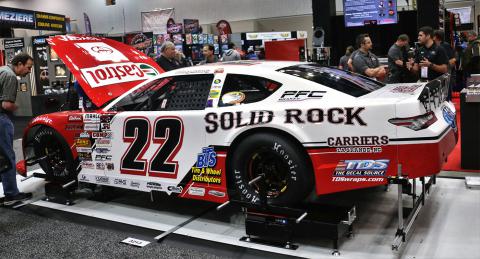
Motorsports, of course, represents a classic branding opportunity, with the company’s name emblazoned on sponsored machines in billboard-size lettering, on display for the rapt attention of the company’s audience. However, some WDs aren’t so enthusiastic about motorsports as a means of relationship building. Like many aspects of personal interaction, choosing which racers to support can get messy.
“We tend to back away from sponsorships,” said Ressler, “simply because the majority of our customers race in some way or another. And if you sponsor one, you have to sponsor them all. We found that out the hard way one time about 25 years ago. We sponsored a driver on the national level, and our largest customer competed regionally. He was so upset, because he had been a loyal customer for years and spent hundreds of thousands of dollars every year, but we didn’t sponsor him. He left us 100%. So we decided that if we can’t sponsor everyone, we won’t sponsor anyone.”
Keystone Automotive Operations’ annual trade event—the Keystone BIG Show—is tailored specifically for its customers. Typically featuring new products, new suppliers, training, and education (as pictured), this year’s show instead shifted online due to COVID-19. “We felt it was extremely successful, extremely well received,” a company source said.
THE ELEPHANT IN THE MAILBOX
At the same time WDs are working to build relationships with their customers, those independent shops and jobbers are locked in the throes of an ongoing war of their own with a formidable, well-entrenched opponent—online parts retailers. With WDs being a key component in independent shops’ supply chain, that means WDs are ultimately in competition with those online mega retailers, too.
This has prompted Keystone to launch Parts Via, a unique online sales platform that blends online ordering with fulfillment and installation at local shops.
Intense competition among WDs in the motorsports space has resulted in some consolidation over the years, including Turn 14 Distribution’s recent acquisition of Motovicity, which was finalized in mid-May. Photo courtesy of Turn 14 Distribution.
Parts Via customers can order parts and then have them shipped either to their home or to a nearby shop for installation or pickup. And regardless of who ends up installing the parts, ordering through Parts Via offers a big incentive for customers to have their items delivered to a nearby shop—free shipping, which is a significant savings on large items like wheels, tires, and body parts. Additionally, Keystone shares profits from each sale with the nearest Parts Via partner shop, thereby supplementing shops’ revenue.
From these examples it’s clear that today’s WDs are using every advantage they can to win in an industry that’s more competitive than ever. Whether it’s by launching bold new innovations or just simply being the easiest, most reliable source to work with, building and maintaining relationships in this business all comes down to being a valuable ally for customers.
“Ultimately our message really is, ‘Support your local shop,’” said Wagenbrenner. “And we’re your local shop’s shop.”
Building relationships is a proven strategy that works in many different industries, and it’s particularly well suited to performance aftermarket warehouse distributors. WDs, like most business-to-business (B2B) companies, work with a smaller pool of customers than retailers and other business-to-consumer (B2C) brands. Further intensifying competition, B2B companies like WDs typically operate in relatively narrow customer segments, which the performance-aftermarket wholesale certainly is.
And then there’s the sticky problem of differentiation. A study conducted by Google and business-research firm CEB determined that 86% of B2B customers see competing companies’ products as being equal, with no difference between them. This lack of differentiation pushes many B2B companies to use price wars as a means of gaining market share—the dreaded “race to the bottom.”
However, focusing on customer loyalty can help mitigate that struggle. “Customers that are loyal to you don’t beat you up for every last penny,” noted Tom Ressler of Nickels Performance, Piney Flats, Tennessee. “Once customers have a comfort level that you have good inventory and good customer service, it takes price for the most part out of the equation.”
Another key consideration in customer loyalty is the fact that transaction values are typically higher for B2B companies, particularly over the lifetime of the relationship. Put simply, customers of WDs tend to buy more and will potentially keep ordering on a regular basis, unlike the sporadic and somewhat random purchasing habits of retail customers.
Therefore, it’s vitally important for any B2B company to retain customers and keep them satisfied. Doing so pays measurable benefits to a company’s bottom line. According to marketing-research firm Forrester Research, increasing customer retention by 2% has the same effect on profits as a 10% cost cut. And most marketing experts agree that it costs at least five times more for businesses to acquire a new customer than it does to keep an existing one.
Successful WDs embrace these facts—if perhaps only intuitively—and they make them an integral part of day-to-day operations. “The cost to acquire and grow new business is substantially higher in most cases than it is to maintain an existing relationship with a loyal customer,” observed Daryl Sampson of Turn 14 Distribution, Horsham, Pennsylvania. “We value both types of customers but understand that retention can be a fixed cost versus marketing to new customers. The latter casts a broad net in hopes of catching a few new customers, and the yield from that expense takes time to develop.
“Loyalty equals consistency, which is essential for any business and its growth,” Sampson added. “Loyal customers help us understand forecasting for purchasing, sales growth, and planning in all aspects of the company.”
But despite the clear benefits of retaining loyal customers, the process can be complicated. Customer retention and loyalty is an emerging field, with new methods, tools, and techniques being introduced rapidly. In general, B2B companies like WDs still lag behind B2C companies in the sophistication and application of specialized loyalty-building tactics.
Nonetheless, some WDs are taking a page from the B2C playbook and are developing extensive programs aimed at fostering valuable long-term relationships with their customers. Among WDs, Keystone Automotive Operations is a good example. In much the same way as leading consumer-goods marketers, the company has adopted a comprehensive loyalty philosophy in which every customer contact point is seen as a potential for enhancing the relationship. “It’s a lot of work,” said Patrick Wagenbrenner of Eastvale, California-based Keystone. “It’s a big team and there’s a lot of people involved in it. There’s a lot of moving parts.”
Despite the potential demand on companies’ resources, this type of approach to customer loyalty could become increasingly important for surviving the intensely competitive market that WDs operate in. —David Bellm
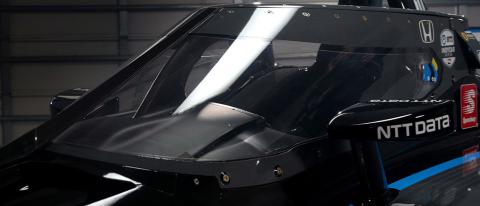
The 54th annual Louis Schwitzer Award was presented to eight engineers for their engineering excellence in developing the innovative Aeroscreen for INDYCAR, which protects the driver from airborne debris.
Implemented by INDYCAR for the 2020 season, the Aeroscreen is designed to withstand up to 28,100 lbs of vertical and lateral static loads and survive the impact of a 2.2 lb projectile fired at 220 mph.
The awardees included Ed Collings, Red Bull Advanced Technologies; Antonio Montanari, Dallara; Stefan Seidel, Pankl Racing Systems; Craig McCarthy, Aerodine Composites; Brent Wright, PPG; Marco Bertolini, Isoclima; and Bill Pappas and Tino Belli from INDYCAR.
BorgWarner and the Indiana Section of the Society of Automotive Engineers (SAE) International gave the award, along with a $10,000 prize, to the engineers. The award recipients have decided to donate the prize money to SeriousFun Children’s Network.
The Louis Schwitzer Award honors engineers who innovate new concepts to improve competitive potential, with a focus on new technology with applications in the engine, powertrain, profile, chassis or safety, and that adhere to the NTT INDYCAR SERIES specifications. Judges aim to recognize advancements that increase performance, safety or efficiency.
Proper training and an understanding of the data are essential to maximizing the benefits of these precision tools.
Even within the racing world, chassis setup is a bit of a dark art. While gear ratios, boost levels, and horsepower are easily contextualized, metrics like cornering loads and camber angles can be a bit more nebulous. But make no mistake—when it comes to road racing, circle track, and even drag racing, proper chassis setup is a crucial element of a competitive program.
“Chassis setup tends to be more experience-based rather than data-based,” said Lynnie Doughton of DRP Performance, Rocky Mount, Virginia. “So for most tuners, the settings that they input are largely based on what they’ve done in the past, not necessarily what is considered ‘optimum’ for the vehicle.”
While the sweet spot tends to be harder to pinpoint, there is a science to it. “You’re going off of what’s essentially an emotional reaction—driver feel,” he explained. “But with the right equipment used properly, you can actually put numbers to all of that, and make logic-based decisions based on the data you have, just like you would when tuning an engine.”
Part of what makes chassis setup such an arcane enterprise is the specialized equipment required to do procedures like corner balancing, damper valve adjustments, and motorsports-spec alignment tweaks, along with the fact that changes made to one element of the setup have the potential to affect other aspects of chassis behavior. Together, it’s a situation that can create a steep learning curve for both the uninitiated and seasoned veterans alike.
“None of it is particularly complicated,” Doughton emphasized. “But it’s a challenge we run into a lot—folks get a new piece of equipment and they don’t know exactly how to use it, and they’re not really sure how to analyze the data they’re getting. That complicates things for them tremendously versus just doing it the old-fashioned way. The key is really just proper training.”
With that in mind, let’s explore some of the challenges most often faced by teams and shops related to their chassis setup equipment, and how best to address those matters.
Because “enthusiasts do love to tinker with things,” according to our contact from PROFORM, a scale’s accuracy may indeed fall out of whack. In that case, racers are advised to send the system back to the manufacturer for recalibration. Or, if time is limited, most systems can be recalibrated by the user, provided they’re walked through the process.
How often should I recalibrate my vehicle weighing system? Corner balancing a car is a fool’s errand if the equipment you’re using to measure the weight carried by each wheel isn’t yielding reliable data. With road racing cars, the typical goal here is to distribute the weight of the car as evenly as possible among all four corners to provide predictable and balanced handling when turning in either direction. Adjusting that balance can also be a useful tool for drag racers who are looking to fine-tune their setups for optimal weight transfer at launch. And as such, the accuracy of these systems can be a concern for some racers.
“There are folks who have owned our scales 10 or 20 years and have never had to recalibrate them once,” said Chris Berg of Intercomp, Medina, Minnesota. “Then there are other folks that like to have their scales calibrated every year, or more, for their own peace of mind.”
Berg noted Intercomp recommends to have race scales professionally calibrated yearly if used frequently.
Ryan Salata of PROFORM Parts in Warren, Michigan, added, “Generally speaking, you’re not going to fall out of calibration—you’re not in danger of being out of calibration at any given time. That being said, things happen, and enthusiasts do love to tinker with things.”
If a scale’s calibration is in question, both Berg and Salata suggest that the best way to get things back in order is to send the system back to the manufacturer to ensure it’s recalibrated to the highest accuracy level possible. However, if a racer is pressed for time or simply trusts their own work, most systems can be recalibrated by the user if they’re walked through the process—provided they have what’s needed to create an accurate baseline measurement.
“With our equipment, calibration can be done over the phone or online with the calibration guide on our website,” Salata explained. “But it’s important to note that the calibration will be to the weight you use, so you have to ensure that you have an accurate calibration weight, and you’ll need to place a minimum of 200 pounds on the pad. So if you have scrap metal or old parts lying around, put 200 pounds or more of it into a container, get it weighed at a junkyard or recycling center, and use that number as your calibration number.”
When tuning suspension, it helps to know whether the initial settings are within similar numbers of what most racers in a particular class are using. “If you can get a general idea of what the top teams are running, that’s a good place to start,” said our source from Maxwell Industries.
What should I use as a baseline for my suspension adjustments? Suspension tuning is a delicate process largely due to the fact that small changes tend to have a significant effect on the vehicle’s overall dynamic behavior, and that means that too many tweaks in short succession can easily lead to a situation where you’re struggling just to get back to where you started from.
“Most of the top teams in World of Outlaws and other circle track series are all in the same realm when it comes to shocks and torsion bars—there’s only so many manufacturers, so most of the teams have already been through the gamut of what’s available,” said Steve Watt of Maxwell Industries, Ventura, California. “So the general mindset is to find a combination that works and stick with it, because the more you switch, the greater the chance you have of losing that baseline.”
For that reason, it’s important to know if your initial settings are within similar numbers of what most racers in a particular series or class are using before you start making more adjustments, and that kind of data is usually acquired the old-fashioned way.
“If you can get a general idea of what the top teams are running, that’s a good place to start,” Watt said. “First, folks usually ask about torsion bars—what rate they should be using on all four corners. That’s pretty straightforward stuff. Shock valving is a little more complicated because you have to consider compression and rebound at each corner—they’re looking for the numbers. Once we know what they’re currently running, and we have some data that’s already been proven by other teams, we can tell them whether they’re close to where other competitive cars are, or if they’re way off.”
All scale systems are basically the same, right? While the primary job of a scaling system is to determine specific pieces of data—how much weight is resting on each wheel of the car—these days racers have some options when it comes to the additional data a system can provide, which can have a significant effect on a team’s overall approach to tuning.
“Any worthwhile system is going to give you information like the weight distribution between the left side and right side, the front and rear percentages, the cross, the wedge numbers—all those different scenarios,” said Ben Baker of Longacre Racing Products, Boonville, Indiana. “But there are different levels of complexity in terms of what you can do with that data. For instance, with our basic scale system you can save one data point, whereas with our tablet systems you can save up to 50 data points. With the tablet system that allows you to, for instance, keep a record of the data from a specific day, a specific location, and a specific setup so you can reference that later when making adjustments or compare the changes when testing. It adds a lot of flexibility.”
Baker also noted that racers have some considerations to make with regard to the technology involved. “We have both wired and wireless scaling systems,” he said. “With any wireless system, one thing you need to keep in mind is that most of these systems use a Bluetooth signal to communicate. Because of that, it’s important for each scale pad to have a clear line of sight to the tablet—they shouldn’t set down into pull down rigs or some kind of concrete opening where the signal can get trapped. So with a wireless system you need to be mindful of how the pads are placed under the car, or it may have trouble getting data from the scales.”
While a scaling system’s primary job is to measure how much weight is resting on each wheel, racers do have additional options. “Any worthwhile system [will] give you information like the weight distribution between the left and right side, the front and rear percentages, the cross, the wedge numbers,” said our source from Longacre Racing Products. Pictured here is the Longacre Computerscales AccuSet II.
Beyond the obvious benefits of cabled scales versus wireless scales, what other benefits are there? “Other than the convenience of not having to run cables to each scale pad, Intercomp RFX Wireless Scales provide the most options to view and analyze your scale data,” said Berg. “Display options include a traditional wireless handheld indicator, RaceWeigh PC software, and Bluetooth communication to a mobile device. An added benefit of the PC software option is the ability to plug into a flat screen TV for easier viewing. Bluetooth communication from a handheld RFX indicator to any mobile device with the iRaceWeigh app is a standard feature beginning in 2020.”
What is the difference between spring load and wheel load, and why should I care? “A lot of teams will get data from spring and shock load machines, and they’ll assume that’s all that they need,” said Doughton. “But the wheel load is important data, too—that’s what the tires are actually feeling on the track.”
He noted that there’s a significant difference between the two, and the buck ultimately stops where the tread meets the surface. “As the car is traveling down the track, it’s going through pitch and roll motions that will change the needed spring load. It’s something we see a lot—people think that because they have their spring loads correct that the car should be sorted out, and they don’t understand why the suspension is over-traveling once they get it out on the track.”
That extra layer of wheel load data is provided by a pull-down fixture. “It’s a piece of equipment that measures how much force is on each wheel while it’s in a corner, and the confusion tends to come from not understanding how it works independently of a spring load machine,” he continued. “A spring load machine is a great tool—that’s what we’d use to make spring changes at the track, but it’s not really a ‘setup’ machine. It’s only looking at one individual element among myriad different things that are happening. A piece of equipment like a pull-down fixture is going to give you more of the total picture of the entire setup.”
So, why wouldn’t a tuner just use a pull-down fixture from the get-go, then? Doughton said it often comes down to sheer simplicity. “A lot of people are looking for the easiest way to get from Point A to Point B,” he explained, “and there’s this hope that they will get where they want to be just using spring and shock load data. That stuff is going to get you to a certain level. But for those who want to get their setup to the next level, you need to take a more advanced approach, and that’s where things like pull-down fixtures come in.”
Products like Intercomp’s RFX Wireless Precision Hub Plate Scale System, pictured here, allow racers to corner balance their car without having to account for variables like tire air pressure and tire wear, and eliminating the need to bring another set of tires to ensure scale data is consistent.
Is there a reason to upgrade from an analog caster-camber gauge to a digital one? Caster-camber gauges are one of the primary tools used when adjusting a car’s alignment, and “bubble vial” analog designs have been the industry standard for decades. However, digital gauges have become more affordable in recent years, and there are clear benefits for those who decide to make the switch.
“The thing with an analog gauge is that you’re really only as accurate as your eyesight is,” said Berg. “If you go the digital route, it gets you down to tenths of a degree, so you’re able to get that much more exact, and know exactly where you’re at.”
Baker shared a similar perspective. “As people have started running more and more camber and caster in cars, the analog-style caster-camber gauges are becoming obsolete,” he explained. “A digital gauge has essentially infinite range, while an analog one might cap out at 15 or 20 degrees, so the flexibility is limited. And digital is basically foolproof—whatever the number is on the gauge, that’s where you’re at. Analog is more the user’s interpretation of the readout—two people can read the same gauge and one might see 13.2 while the other sees 13.0.”
And while a tenth or two of a degree might not seem like much, Doughton reminded us that it can mean a lot on race day. “Minutiae is the difference between finishing third or first, or tenth and fifth. Modern chassis tools allow you to get close to perfect right off the bat, and that means you can focus more time on the small stuff to get the car to run just a little bit better, rather than spending it just getting the car initially dialed in.”
The critical need for speed and precision on the track is reflected in the shops who make the parts powering those runs. And like on the track, it’s important to know how to squeeze every bit of performance out of your machining.
You can you get more productivity with the equipment and tooling you already use, as well your future machining centers by updating your machining strategies. It starts with the cutting tool. The key to more productive machining is using tools the way they were intended at optimum feeds and speeds and, most important, chip load.
Dynamic motion has a long pedigree, dating back to early machining theory.
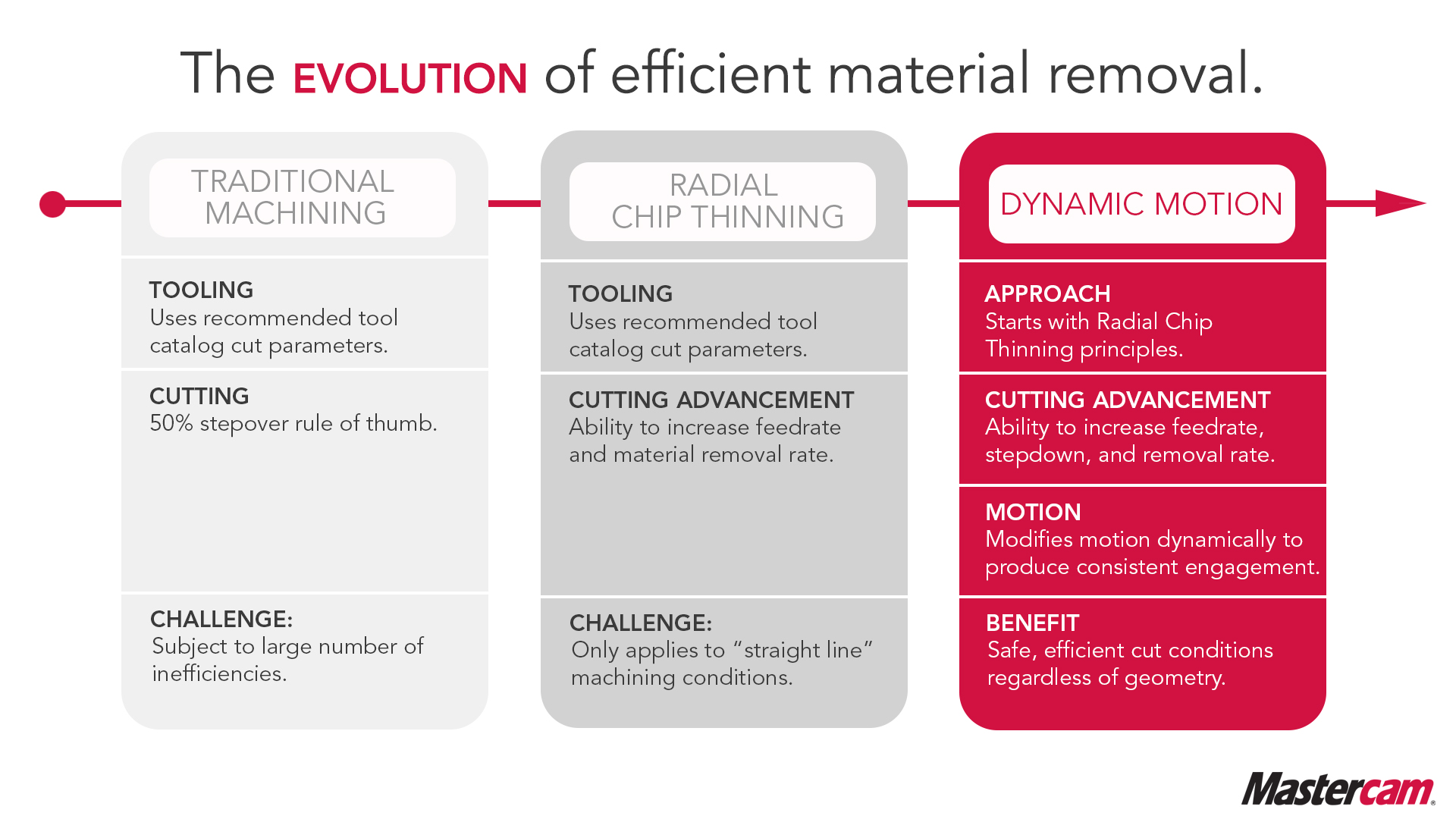
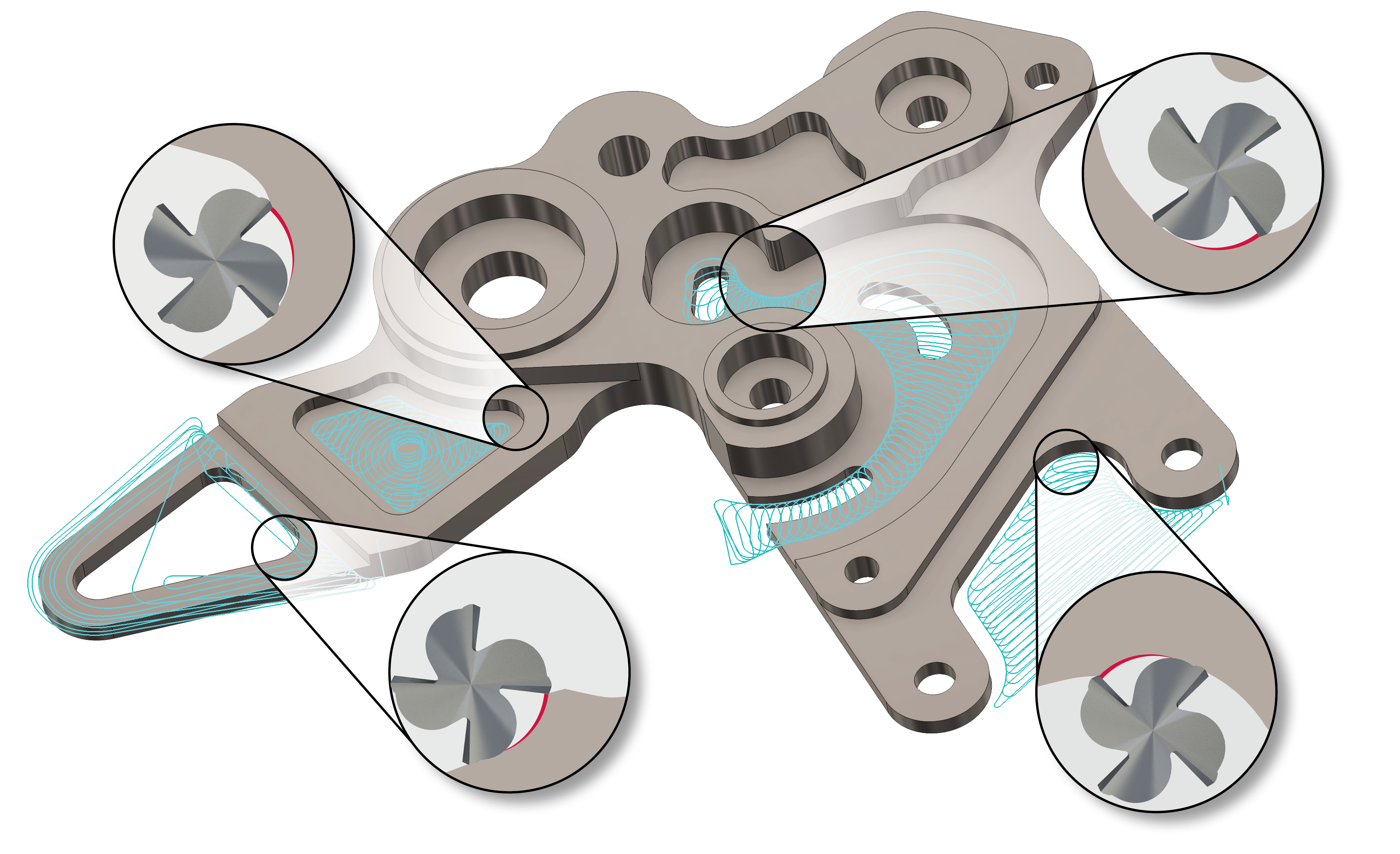
For most shops the barrier to achieving these gains is not their equipment, but their ability to generate part programs that consistently keep tools in the cut under optimal conditions. Well known CAM developer, Mastercam, has an answer for that with its Dynamic Motion toolpath engine. This CNC programming technology dynamically generates the most efficient toolpaths that maintain a constant chip load in the sweet spot of any cutting tool’s true cutting capabilities. Much more efficient machining is the result with metal removal rates as much as 70% higher than conventional machining.
Letting Tools do their Job
Tools are designed to cut the material with a target chip load, which sends as much of the generated heat as possible into the chip, and evacuates that chip away from the workpiece. How well the combination of spindle speed, feed rate, and toolpath motion is able to maintain the tool’s target chip load determines how well that tool will perform and what type of tool life you will achieve.
Dynamic motion is designed to keep a consistent chip size in changing conditions.
The problem with traditional part programing is that it is driven, first, by the geometry of the part. A common result is that tools get over engaged particularly in tight corners or during sharp directional changes. To compensate, the programmer typically adjusts feed and speeds for the worse-case scenario, usually a corner where the tool is buried into material and applies those parameters for the entire cut. That results in the tool operating outside the optimal chip load for most of the cut. Either the tool gets over-engaged in corners or gets substantially underutilized for the rest of the path, and sometimes both. Cycle times grow unnecessarily long, and tool life gets shorter.
Consistency is the Key
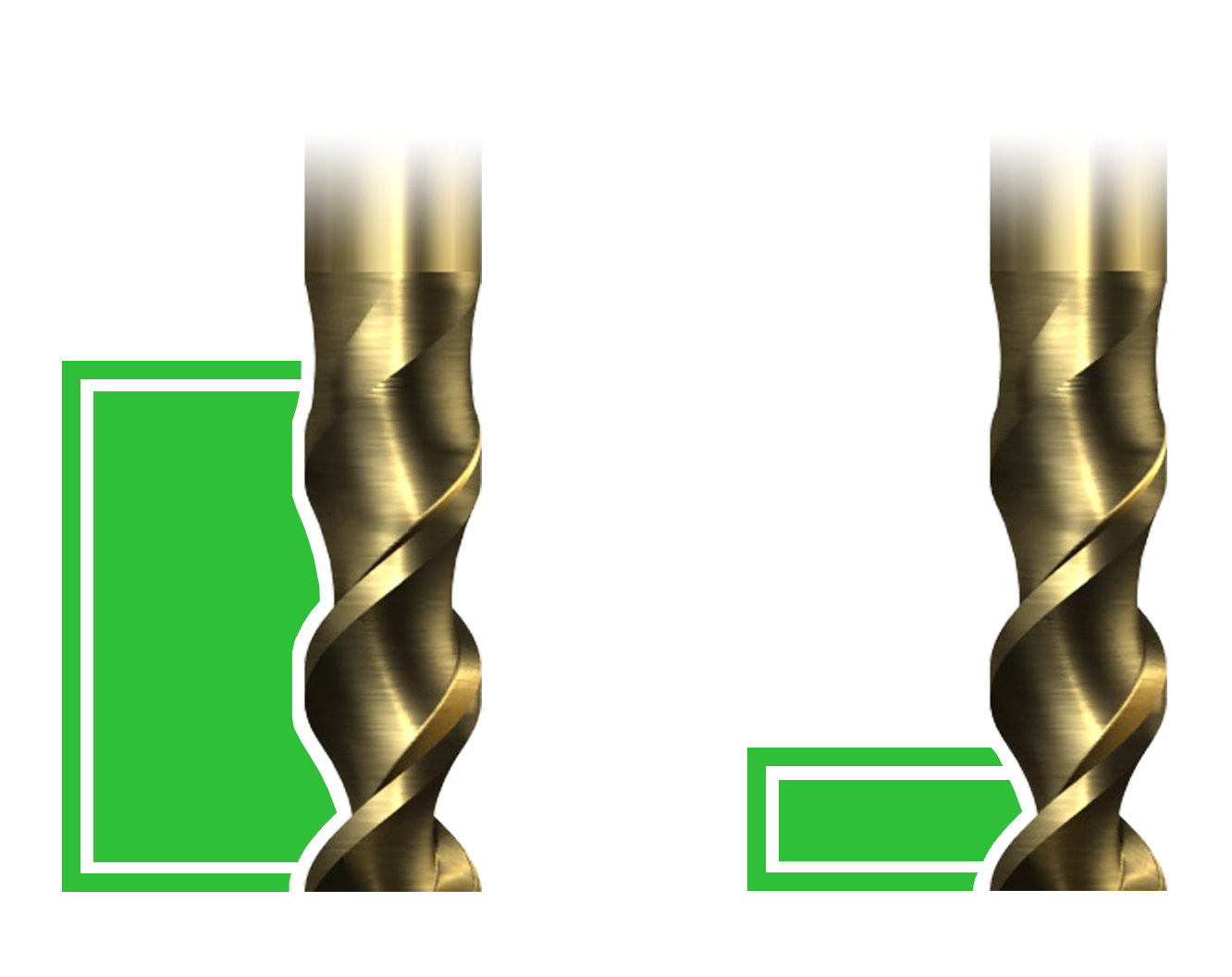
An alternative cutting strategy is based on radial chip thinning (RCT), known more broadly as constant chip load machining, which improves machining efficiency and tool life. For conventional machining tool manufacturers typically recommend cutting parameters assuming a stepover of 50% of the tool diameter Feeds and speeds adjusted accordingly to deliver an ideal chip load. With radial chip thinning the stepover is reduced, which of course would also reduce the thickness of the chip under the same feed rate. To compensate, the feed rate must be increased accordingly to yield the desired chip thickness.
Using deep cuts and shallow, variable stepovers, material is removed faster and heat is transferred away in the chips.
The other big difference with this cutting strategy is in the depth of cut. A traditional strategy is to step down 25% of tool diameter. With RCT the depth of cut can be as much as two to three times tool diameter, depending on the tool. With the deeper depth of cut, you get much better utilization of the entire tool’s cutting edge, rather than just always cutting with the end of the tool. And since the side load on the tool is greatly reduced (from 50% step-over to maybe 15% or less) there is also less load on the spindle. With less load on the spindle, you can expect less wear and tear on your machines, and may be able to cut some jobs on lighter duty equipment.
Best of all, this combination of faster feeds, speeds and deeper cuts can typically improve metal removal rates by 60 to 70 percent or more compared to conventional machining practice.
Faster Motion in the Straightaways AND the Corners
But there’s a catch. The benefits RCT described so far can only easily be achieved with straight-line cuts. What do you with pockets and other forms of profile geometry?
This is where Dynamic Motion comes into play. It dynamically adjusts the motion or trajectory of the toolpath such that the tool remains safe and the chip load is consistent even during directional changes. Unlike traditional a toolpath that is primarily generated by offsetting the geometry it was based on, Dynamic Motion maintains the same chip thickness regardless of where the tool is or the material it is cutting.
Dynamic motion uses as much of the cutting area of the tool as possible with motion designed to adhere to the tool’s optimal chip load.
Dynamic Motion takes the optimum “straight-line” feed rate improvement of radial chip thinning and enables you to apply it to any pocket or contour whether it an open pocket, closed pocket, loose or tight geometric condition. The advantage is that once you are satisfied with your feed rate parameters for a given material, tool and tool diameter, you can feel confident that the toolpath generator always keeps your tool in a safe, optimum cutting condition regardless of part geometry.
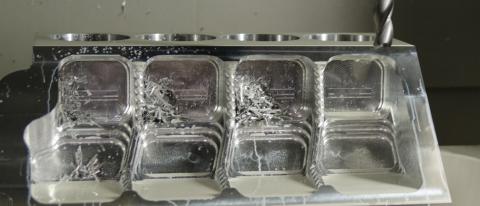
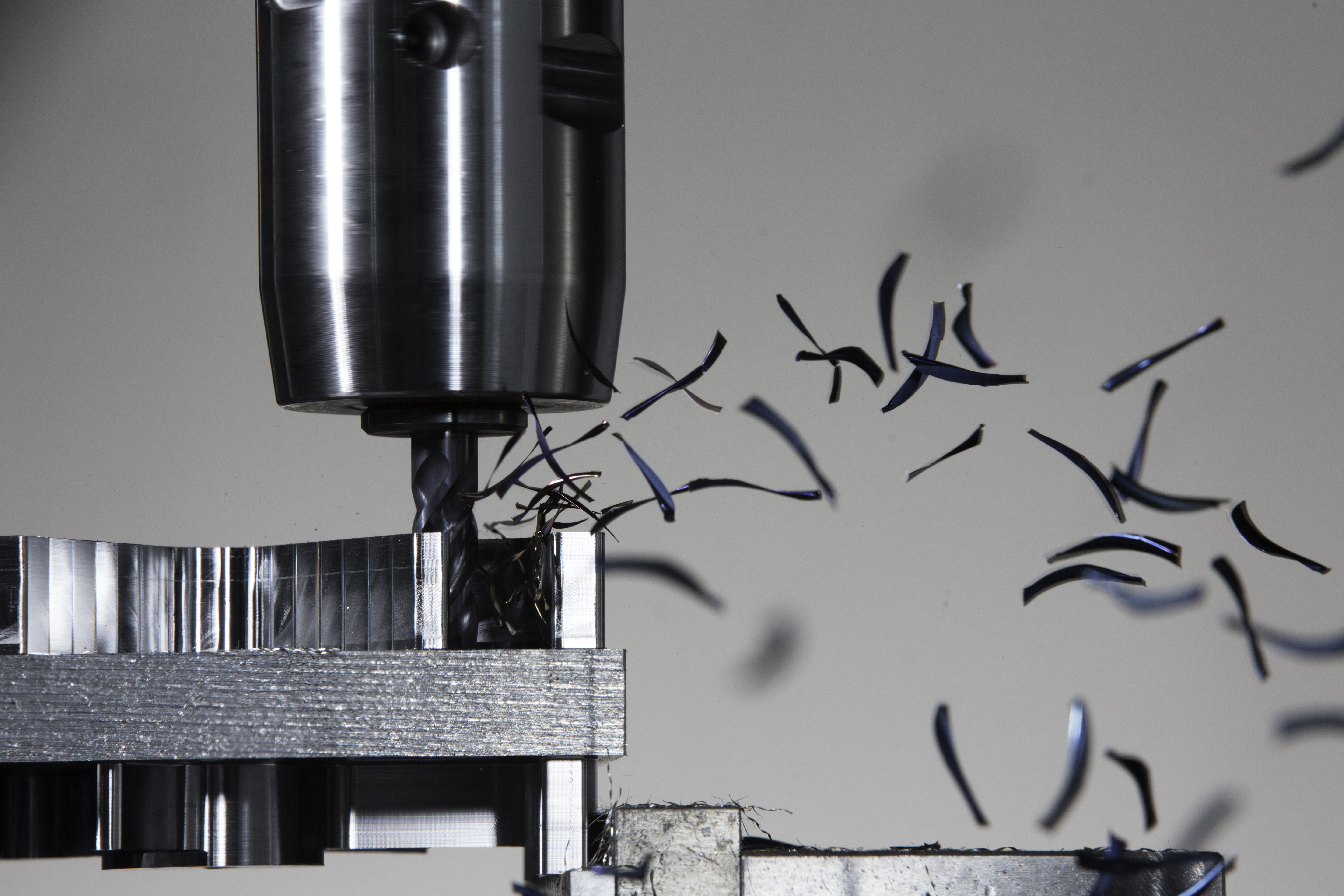
While Dynamic Motion can’t change the cutting capabilities of your machine tools, it will enable you to get much more out of that equipment. For example, look at the cuts taken on this Okuma machining center, and see what an RCT cutting strategy looks like in action.
Constant chip load cutting can produce substantial gains in machining productivity. In removes more material and increases tool life. It’s easier on your machine tools, and lets you cut more aggressively with lighter machines. And perhaps best of all, it works on any machine.
National Auto Parts Warehouse (NPW), a family-owned automotive aftermarket parts distributor with a nationwide presence, has completed the acquisition of substantially all Auto Plus assets in Washington and Oregon.
Auto Plus is owned and operated by the Ichan Automotive Group, which also owns Pep Boys retail and service locations. The recent NPW transaction includes two Pep Boys Parts retail store locations in Seattle, Washington, but excludes Pep Boys automotive service centers.
NPW will convert and rebrand the acquired Auto Plus and Pep Boys Parts retail locations as Auto Value parts stores.
“This is a great opportunity to grow our parts business and increase our overall service levels in the Pacific Northwest. We have plenty of capacity in our Hillsboro, Oregon, Distribution Center, and we are ready to extend our customer-first approach to these new locations and their customers,” NPW President and CEO Larry Pacey said. “We welcome the new employees and customers to the NPW family.”
Performance Racing Industry (PRI) has deployed a host of new tools and resources in recent months—a relaunched website, an ambassador program, and a webinar series—and plans to further boost its advocacy efforts in order to help race tracks and racing businesses work through the COVID-19 pandemic and beyond.
Among the resources now available at performanceracing.com are legislative advocacy and representation information, updated information on guidelines and federal aid, a running list of tracks that have so far reopened, and more. Users can also reach out via the PRI Track Promoter Helpline for assistance in safely hosting race events while adhering to local and state guidelines.
The ambassador program leverages industry veterans Gene Bergstrom, Tom Deery, and Frank Hawley, as well as PRI staff, to assist track operators across the country in reopening and event operation. It was launched under the leadership of PRI President Dr. Jamie Meyer in conjunction with a new webinar series geared toward track operators, sanctioning bodies, racers, and car and engine builders who can benefit from PRI’s efforts and resources.
Meyer, speaking with host Rob Kibbe on a recent episode of the “MuscleCar Place” podcast, noted: “You know, these [tracks] are not big organizations—they are usually a family-owned affair with some loyal employees. Some of them have kept going through creative work with their local government entities, but a lot of them need help and a little bit of guidance, and that’s where PRI comes in, from an advocacy standpoint.”
Building on opportunities to extend PRI’s expertise and assistance, Meyer touched on down-the-road plans for a PRI membership program: “We’ll start on the businesses, but at some point in the next couple of years we’ll have an individual membership for PRI,” he said. “[T]he focus will be on protecting and growing the industry. We’re going to help all corners of the racing industry.”
Among other topics, Meyer also shared with Kibbe’s audience his thoughts on industry growth areas, in particular the vast potential in electric vehicle racing.
“Without exaggeration, billions and billions of dollars are being spent on EVs in the city of Detroit alone right now,” Meyer said. “We are going to be racing EVs; we already are to a point. Will they be full-blown, international series? It depends on the racers. I’m a firm believer in the intelligence and creativity of the grassroots racer. If it’s fun and they want to do it, PRI will be happy to work with them and get the right sanctioning bodies together.”
For the full "MuscleCar Place" podcast episode featuring PRI President Dr. Jamie Meyer, click here.
Although some race tracks have axed their 2020 plans due to coronavirus—noting that events without fans are not financially feasible—several facilities report healthy car counts and scores of spectators, thanks in part to state guidelines that support socially distanced activities.
One of those is Oklahoma, which fully reopened race tracks, alongside movie theaters, bowling alleys, outdoor concerts, sporting events, and rodeos, as part of its latest mandates issued on May 30. Social distance guidelines are at the discretion of the business owner or local officials, along with sanitation and disinfection, although considerations are mentioned. No fan capacity limits are enforced.
Of nearly 20 currently active Oklahoma-based facilities, all but one are hosting events in August, with most websites mentioning social distancing, face coverings, and handwashing precautions.
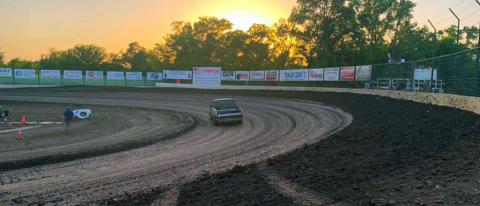
One of those tracks is Port City Raceway in Tulsa, which hosted its “Quarantine Make Up” points race on Saturday, August 15, a replacement for one of six events lost when gates were shuttered mid-March through mid-May. The remainder of its calendar includes six events, highlighted by the 21st Annual Pete Frazier Memorial on September 4-5, and the RUJO Rumble on October 2-3.
“Our local authorities asked us to remind everybody to keep six feet apart and practice cleanliness. Our very first event back [in mid-May], we offered limited seating, but the very next weekend, we were fully reopened,” Port City Raceway President Mike Eubanks told us. “We are averaging about 350-400 fans [per weekend now], and our facility can seat over 1,000, so we can accommodate the spacing. Everyone spreads out.
“We also have extra handwashing stations, signage before and after you enter, around concessions and restrooms,” he added. “Basically, any place where people would normally be congregating—all the precautions are there.”
Oklahoma’s guidelines are similar to three other states’ in that they do not cap spectator attendance, according to language from the latest executive orders that affect racing found on PRI’s state-by-state race track reopening directory.Georgia, North Dakota, and South Dakota also allow motorsports facilities to operate at 100% capacity.
Such mandates also allow for fewer legal hurdles to hosting race events.
“If you look at the states that have larger or no capacity limits, they have all put out clear and concise guidance that allows businesses to operate unimpeded,” said Christian Robinson of PRI’s Government Affairs team. “This is important because the safe resumption of racing provides desperately needed economic stimulus to communities all around the country. Race tracks are job creators. More importantly, they also provide a morale boost to residents.
“There’s a saying in politics that if you aren’t at the table, you’re on the menu,” Robinson added. “PRI’s Government Affairs team is working tirelessly to ensure that track operators and promoters have a seat at the table as states reopen their economies.”
For more information, or for assistance in safely hosting race events that adhere to state and local guidelines, visit PRI’s Track Promoter Information webpage here.
“Have people get out and support their local race track [where they can],” Eubanks concluded. Be as safe as possible. It’s like anything. You come to something because you want to; nobody is made to come.”
Due to the COVID-19 pandemic, NHRA and Maple Grove Raceway have canceled the 2020 Mopar Express Lane NHRA Nationals presented by Pennzoil, originally scheduled for September 11-13.
“We are extremely disappointed to announce the cancellation of the September national event, which has been a staple event for the past 35 years. Due to the pandemic, Pennsylvania governor Tom Wolf has severely limited attendance at events for the 2020 season,” said Maple Grove Raceway President Kent Lewis.
NHRA's next event is the Denso Spark Plugs NHRA U.S. Nationals set for September 3-6, at the historic Lucas Oil Raceway near Indianapolis, Indiana.
“We are grateful to the loyal NHRA fans who have stuck with us during these trying times,” said NHRA President Glen Cromwell. “NHRA expects to move forward with the remainder of the 2020 schedule. Thank you to our fans, racers, and partners for your continued support and cooperation.”
Ticket holders for the 2020 Mopar Express Lane NHRA Nationals should contact bwitmer@maplegroveraceway.com or 610-856-9200.
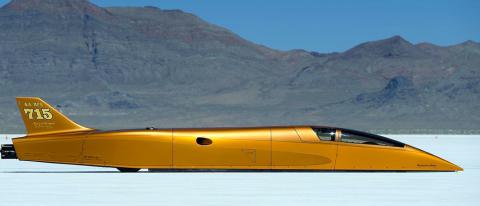
The Speed Demon 715, the piston-powered land speed streamliner, has made history by clocking 470.016 mph at Bonneville Salt Flats. The effort marks a record as the top piston-powered land speed run to date.
The streamliner, powered by a twin-turbocharged 555-cubic-inch Chevy, was piloted by George Poteet. The recent effort surpassed the previous record of 448.75 mph, secured in 2018 by Danny Thompson, the son of off-road racing and land speed racing legend Mickey Thompson.
Poteet and his crew previously clocked a five-mile speed of 469.298 mph on Wednesday of last week, setting the stage for the record run the following morning. Figures are taken from two-run averages.
 MEMBERSHIP LOGIN