Vehicle Safety Products: Safer All Around
Submitted by johnc on Tue, 03/22/2022 - 15:31


Just count the numerous ways that vehicle safety product development is protecting today’s race car drivers.

In today’s motorsports arena, there are few components on a race vehicle that haven’t undergone a critical safety review. Comprehensive rulebooks are a testament to this reality. A generation ago, there were suggestions for safety equipment. Now there are detailed mandates that are strictly enforced.

Serious accidents used to be shrouded in secret internal investigations. Now motorsports safety research facilities have access to ‘black box’ data recorders that are installed in many types of race cars. Constructive safety conferences are held around the world to share innovative ideas and evaluate test results on new equipment.

Accidents, however, still happen, and a death on the track is a tragic reminder of the dangerous speeds modern horsepower and chassis designs can deliver. So there’s an eye constantly focused on building even safer vehicles.

“I think we’re always looking for ways to improve product,” said Fred Bickford of ButlerBuilt, a manufacturer of racing seats and other safety equipment based in Concord, North Carolina.

Seat and roll-cage design is one example where components have worked hand-in-hand to drastically improve driver safety in the past two decades. Researchers learned that confining the driver greatly increases survival upon impact.

“We really want to cocoon the driver into the seat,” added Bickford. “The less movement there is, the better off they’ll be in an accident.”

Driver Comfort and Safety

Full containment around the ribs and head is crucial, and so are the seat dimensions. A large seat might seem more comfortable than a smaller, tight-fitting version. Some drivers think the safety harness will hold them in place. Belts, however, are for impact. The seat should hold drivers tight enough so they can direct all their energy into driving.

“If you’re coming to the kink or going through the carousel and you’re loose in the seat, you put your elbow up so that you are centered and you put your left leg out to hold your position,” explained Gayle Gaborsky of Speed Seat Factory, Delafield, Wisconsin. “All of that is mental and physical fatigue.”

Racing seats are generally manufactured from either steel, aluminum, fiberglass, carbon fiber or other composite material. There are numerous configurations to fit modified street cars all the way up to scratch-built race cars. Some sim racers even get high-dollar racing seats to enhance the experience.

“Recently, we found a composite matrix fiber-reinforced polymer that allows us to build very strong, yet lightweight and affordable seats. This discovery led to us to launching five new seats within the last year,” explained Patrick Utt of RaceQuip, Riverview, Florida.

image 2
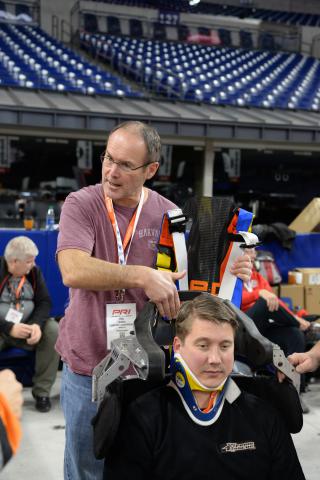
Full-containment seats enhance safety by keeping drivers in the optimum position at all times. “The less movement there is, the better off they’ll be in an accident,” explained our source at ButlerBuilt.

Rules may mandate a specific material and construction design, such as implementing side head restraints, which are often called ‘halos.’ Rules can also apply to the halos, such as making sure the driver has a proper sightline. Once the rules are understood, the important decision factor is the fit. Seat manufacturers have detailed instructions on measuring the driver’s body and applying those numbers to the seat order.

“When racers follow the measurement guide, then everything on the seat is made to fit their body,” said Bickford, noting some minor supports like lumbar can be added later to improve the fit.

Image 4
Two-inch seat belts have replaced three-inch in most series. “With modern textiles…we can meet the absolute, most stringent standards with two-inch restraints,” said our source at Impact Racing.

But many of the top drivers get a fully customized seat with a pour kit; that is, a bag of liquid molding material is placed into the existing seat or compartment area, and the driver sits on the bag until the solution solidifies and reveals a perfect mold of the driver’s physique.

“You can pour a kit to fill voids,” said Bickford. “Some people have different arches in their back and things of that nature.”

image 3
Improper installation remains a significant problem with belts, noted our source from RaceQuip. The rollbar attachment on the left is correct, the other one isn’t.

Most drivers in top-tier racing circles have custom seats molded for them.

“Everything is specific to car and driver,” said Gaborsky. “That’s the beauty of this safety feature because we position you. The pedals have to be in the correct position because everything is part of the equation.”

For endurance racing, special inserts are made for each driver in that seat. That’s the type of class racing where the fatigue factor becomes a serious safety issue. The materials that Speed Seat uses meet all sanctioning body requirements. For drivers with multiple cars, Speed Seat can scan the first seat and make identical reproductions as needed. Most like the same seat position, but others like to have a choice.

“If we poured him three times, he can sit different each time. He could be a little more upright or a little more laid back,” she continued. “You get a seat that you absolutely love, and if you have multiple cars, then you just get a replica of that seat and it’s identical.”

Buckle Up

Advancements in materials have led to significant changes in the safety harness market.

“Most of the changes come from advances in materials or manufacturing techniques,” said Utt. “One example is that a number of years ago we transitioned away from nylon webbing for seatbelts and window nets and started using a softer, more durable polyester webbing.”

“Of all the things that we’ve dealt with in the last 10 years, restraints have probably changed more than any of them,” said Ben O’Connor Jr. of Impact Racing, Indianapolis, Indiana. “Which is pretty wild, when you consider just how simple the restraint concept is, yet, how complex it can be in terms of all the little details.”

One of the more significant trends is the move to two-inch-wide belts. The industry standard had long been three-inch, which is basically a carryover from what the military was using in the 1950s. The materials available then required a three-inch-wide belt to withstand the loads of an impact.

“With modern textiles, it’s just not necessary. We can meet the absolute, most stringent standards with two-inch restraints,” explained O’Connor. “As a matter of fact, typically the hardware will fail before the webbing does.”

“The big change in the industry has been from three-inch to two-inch,” agreed Danilo Oliveira of G-FORCE Racing Gear, Acworth, Georgia. “The perception that three-inch is stronger doesn’t exist today, because now we have stronger materials. European racers took to it earlier than the US. You probably see it more often in Formula 1, sports cars, road racing, and Indy cars. The three-inch is probably more popular with dirt tracks and drag racers.”

The move to two-inch belts was somewhat encouraged by drivers who find that width works better with their HANS devices. At one time, drivers were tucking their three-inch belts under to achieve a better fit. Then the FIA conducted tests with the two-inch belts and found some safety advantages.

“From a biomechanical viewpoint in terms of safety, it is generally accepted and understood that a two-inch restraint is safer than a three-inch—especially in the area of the hips,” said O’Connor. “The hips are the largest load-carrying capacity for the body, and with two-inch belts you can get really tight without bunching up.”

image 5
Most sanctioning bodies now require fire-suppression systems. However, for those that do not there is still a push to require installed systems, such as this one from Lifeline USA, instead of less-effective handheld extinguishers.

Adjusters have also changed in recent years. They’ve been easier to tighten and loosen in addition to losing weight. “Most of the weight of a harness comes from the buckle and adjusters,” noted Oliveira. “There’s a trend toward aluminum.”

Enhanced seat-belt materials have improved window nets, as well. “With window nets, there really isn’t much else you do,” said Oliveira. “We have better fabrics than five years ago at the same cost.”

The biggest mistake racers make with regards to the safety harness is the installation. “Every time we walk through a pit area, we see seat belts improperly installed,” said Utt. “A standard SFI instruction sheet is provided with each belt set sold by every manufacturer, yet many racers do not look at their installation angles and belt threading through attachment hardware.”

Slowing Down

Advanced materials have also improved parachutes for drag racers. Nylon continues to be a popular choice for many classes. However, faster and heavier cars have prompted chute suppliers to explore other options.

“Nylon chutes have a limitation. They can literally burst apart,” said O’Connor. “Our latest chute for the fuel and alcohol ranks is a Vectran fabric that we found a few years ago that gives a longer lifespan. Fuel teams could get several passes out of nylon before they need a patch or replacement. Now they’re getting almost a season out of the new ones. It’s a bit more expensive on the front end, but long term it saves them money.”

As mentioned earlier, every component of a race car has undergone some type of safety scrutiny. Rear-view mirror design and location can be controlled by sanctioning bodies. Minimum tubing standards for rollcage construction can also mandate that the padding be certified by FIA or SFI.

Steering wheels are even factoring into the safety equation. “We were the first to revolutionize NASCAR with a new steering wheel that absorbs load under impact,” explained Max Papis of Max Papis Inc., Mooresville, North Carolina. “We did a study of impact testing to understand the deformation factor of the steering wheel itself, and we created structures that under the heavy impact will protect the driver. The technology that we learned from the stock-car steering wheel has been implemented in all products that we make. We’re slowly educating the masses that the steering wheel is a safety item.”

The new safety features, such as seats and harnesses, can be applied universally throughout motorsports. Many racing classes have specific requirements for other equipment. One safety item catching on with road racers is the rain light for the rear of the vehicle. They’re required to emit a certain brightness to help drivers see vehicles that are obscured by water spray from the tires. Speaking of tires, many open wheel classes require tethers to keep the wheel-tire combo from detaching and rolling into the grandstands or pit areas.

Parts containment is another safety area for some cars. Drag racers have steel or titanium bellhousings to keep clutch and flywheel pieces inside in the event of an explosion. Supercharged cars have restraints to keep the blowers tied to the engine if there’s a backfire or explosion.

Stay Cool

Perhaps the single most terrifying scenario for any race car driver is fire. Many will say that vehicle construction and the latest seat and safety harness technology will protect them from trauma to the body in most collisions and rollovers, even if the accident

is so severe that they have to be extracted from the vehicle by track safety crews.

The frontline defense for fire is a fire-suppression system that uses chemicals or foam to extinguish the flames. Pro Mod racer Craig Sullivan had a spark-plug failure on a new car that was making its first test pass last spring. That failure led to methanol being forced out of the cylinder at high pressure, resulting in an under-hood fire.

“I smelled carbon fiber burning and shut the car down 200 feet into the run,” he recalled. “Then I saw smoke coming out of the hood by the blower and realized it’s on fire.”

Sullivan pulled the pin on the Stroud Safety fire-suppression system that Larry Jeffers installed when he built car. While coasting at the top of the track, the flames continued, and he pulled the pin on the second system.

“I immediately stopped the car, and the flames were out, so I got out of the car,” explained Sullivan. “The flames erupted again, but the safety crew got there and put them out right away.”

The Stroud system on Sullivan’s wildly colorful 1949 Mercury included two 10-pound bottles of suppressant, which were required by the rules. Front-end repairs and a new windshield were all that was required to get the car back on the track.

Besides meeting FIA and SFI requirements for a fire-suppression system, manufacturers also have to follow EPA regulations. Early systems used Halon until it was banned in the 1990s after scientists discovered that it contributed to the depletion of the ozone layer.

image6
Nylon chutes are prone to bursting, noted our source at Impact Racing. The company’s new Vectran fabric chute is said to last nearly a season, instead of the usual few passes of nylon chutes.

“Right now we’re coming out with a new system. We’re just waiting on approval,” said John Gentry of the Oklahoma City, Oklahoma-based Stroud Safety. “We used to use a suppressant called FE36. Now the EPA is banning that, and we’re forced to find another solution.”

SFI tests on the new system were being conducted. The new suppressant, Novec 1230 from 3M, itself isn’t being tested, but rather the new chemical has to work with Stroud’s engineering design that includes the nozzles and other equipment on the system.

“Our kits come with three nozzles: a 60-degree, a 120 and a 360,” explained Gentry. “Usually, two go in the engine bay and one in the driver’s compartment.”

The systems come with either a five- or 10-pound bottle. Some sanctioning bodies require two systems, and some racers look to save weight with the smallest system.

Another popular suppressant is AFFF, which stands for aqueous film forming foam. Whereas Novec is a gas that absorbs the heat of combustion to stop a fire, AFFF is discharged as a foam that covers the area of the spray patterns to snuff out the flames. AFFF is non-corrosive and environmentally friendly.

“The foam is water-based,” explained Brandon Marshall of Lifeline USA, Dublin, Virginia, a company that offers both types of suppressants depending on racer needs and budget. “We want to know what they’re doing with the vehicle and what their sanctioning body said. We typically give options, like a good, better, best.”

An entry-level system might be a $400 foam system followed by a $700 Novec system. More expensive systems might require electronic or thermal automatic deployment. And some sanctioning bodies require 20-pound systems, which would be two 10-pound bottles.

“For our Novec systems, typically those will run five nozzles, and on our foam systems we’ll run eight nozzles,” said Marshall.

More sanctioning bodies are expected to require fire suppression systems. The World of Outlaws NOS Energy Drink Sprint Cars will have them in place in 2023, and the off-road market is moving in that direction as well.

“That’s a big market. We have an off-the-shelf system, but typically those cars need something specific,” said Marshall, noting that many teams currently just bolt fire extinguishers to their rig’s rollbar. “But it’s usually a handheld, powder-based type of extinguisher that you’d have in your kitchen or pit box. The problem is all those vibrations are channeled through the chassis, and it’s packing the powder into a rock in the bottom of the extinguisher. That’s what will happen to these guys racing out in the desert for 200 miles.” 

World Of Outlaws Sprint Car Series Mandates Fire Suppression Systems

The World of Outlaws NOS Energy Drink Sprint Car Series will require competitors to use on-board fire suppression systems in 2023 and beyond in an initiative that Series Technical Director Tom Devitt called a few years in the making.

“We’ve been talking about this idea for a few years and figured it was time to do it. We are one of the only major racing organizations in the country that doesn’t mandate [fire suppression systems], and we felt we had to make it right because the sprint car is like no other animal on the planet,” Devitt said. “I presented this during an owners’ meeting at the 2021 Knoxville Nationals with all our platinum [full-time touring] teams. Everybody was very much in favor of it.

image sb1
The World of Outlaws NOS Energy Drink Sprint Car Series is one of the last major racing series to not require fire suppression systems. They’ll be mandatory for 2023 and beyond.

“We also talked to our other drivers and chassis builders, and got input from fire suppression manufacturers,” he continued. “We like to start early with changes like this because it affects sprint car racing across the country, not just World of Outlaws.”

Series officials are working with the SFI Foundation to develop new fire suppression specifications for sprint cars. Currently, the two standards (17.1 and 17.2) do not cover vehicles that use methanol as fuel, so officials are in the final stages of developing a brand-new 17.3 standard. Called the “Single Seat Open Wheel Front Engine On-Board Fire Suppression System,” the specification has already been drafted by SFI, which expects to finalize the process following research and development. The official rules and approved systems are expected to be released in May.

“We’re looking at the size of the bottle, where it will be placed, how many nozzles will be needed, what type of suppression material will be used to put the fire out,” Devitt said. “All of this is going through the SFI, which is doing all the testing with input from manufacturers.” —Laura Pitts

Advancements In Fuel-cell Technology

Fuel-cell development is one dimension of race car safety where new materials are being introduced to improve the product.

“The new ATL bladder is constructed of an all new, very pliable, low mass, yet extremely strong Kevlar reinforced elastomer,” said Dave Dack of Aero Tec Laboratories (ATL), Ramsey, New Jersey. “It has been thoroughly tested and has qualified to SFI’s stringent 32.1 standard.”

“We have developed a new fuel bladder material that holds up better to the methanol-laced fuels that are more commonly being used today,” added Steve Russell of Pyrotect Racing Cells, Redmond, Oregon. “We haven’t released it officially. We’ve been developing with teams running the new coatings. But that’s the wave of the future with more methanol fuels being used in more types of racing.”

image 9
Fuel cells for UTVs often have unusual shapes to take advantage of limited space. “It’s difficult to put larger volumes of fuel in these vehicles. So, you do have to get creative,” explained our source at Pyrotect.

The new ATL bladder and fuel cell will be used in all NASCAR Next Gen cars that were introduced in the 2022 season. CAD-designed robotic cutting patterns were developed to achieve precise tolerances required for consistent manufacturing.

“This was especially important to satisfy NASCAR’s vision for an even playing field with no teams having an unfair advantage,” explained Dack. “Bladder capacities, weights, etc. remain extremely consistent from bladder to bladder.”

The Next Gen bladders also feature removable internal collector compartments that have secure attachments, explosive-resisting safety foam baffling, and a lightweight inner billet nut ring to accommodate team-supplied fill plates.

Stock cars run on gasoline, but there has been increased participation in classes that allow methanol, especially sprint cars, tractor pulling, and drag racing.

“Gasoline and methanol have completely different chemical backgrounds,” Russell explained. “They tend to react differently, and we have to use different materials to withstand them. Take an IndyCar fuel cell: Gasoline of any kind will ruin the bladder. And alcohol in a gasoline bladder will ruin the bladder. To have one that will withstand both, to some levels, is really difficult. We’ve been working on coating formulations to enhance the alcohol resistance, since we’re finding more fuels being laced with methanol at higher concentrates.”

The market for fuel cells continues to expand, especially in off-road and powersports. UTVs can present a unique packaging challenge for racers trying to increase fuel capacity.

“It’s a growing market with very tight quarters, and it’s difficult to put larger volumes of fuel in these vehicles. So, you do have to get creative,” explained Russell, noting that driveshafts and wiring harnesses often want to share the same space as a fuel cell. “We put a tube through the fuel cell for these items. Then there are the filler tubes, vents, sending units, pickups. Usually it’s very tight, so we have to get very creative on how to handle that.”

The future for even more improvement in fuel cell development is quite optimistic. These suppliers are often involved in other markets, including military operations, where fuel containment is critical.

“ATL is extremely active in defense and aerospace markets,” Dack told us. “Much of this specialized technology and unique materials developed for unmanned aircraft and military vehicles and vessels have been adapted to racing markets.” —Mike Magda

Carbon Safety Technologies
Purpose-built Sprint Car/Midget Fire Suppression System

product 1

• 5 lbs. of 4Fire Universal.

• DOT3AL cylinder/bottle.

• One AM Block, has both automatic thermal
  bulb activation at 175 degrees F and manual
  activation with a pull lanyard, and push-lock
  fittings for easy tubing connection.

• Three nozzles with push-lock fitting.

• One T push-lock fitting.

• 10 feet of aluminum.

For more info: carbonsafetytechnologies.com


Design Engineering, Inc.
Sensor and Connector Covers

product 2

• Protect sensors plugs and wire connectors
  from heat, moisture, and dirt.

• Aluminized insulation that reflects heat and
  acts as a thermal barrier for sensitive wire
  connections and sensors.

• Simple to install with a split top.

• Can be nested to fully cover connectors
  near engine manifolds, turbos, and their
  heat sources.

For more info: designengineering.com


Pyrotect Racing Cells
Polaris RZR RS1 UTV Fuel Cell

product 3

• Capacity: 12 gallons.

• Designed to fit stock location.

• Fully TIG welded aluminum container .080 standard.

• Durable ballistic nylon/urethane bladder.

• Utilizes stock fuel pump sending unit module.

• FIA FT3 homologation.

• Includes 1-inch vent check valve.

• 2 1/4 remote fill with roll-over check valve.

For more info: pyrotect.com


RaceQuip
6-Point All 2-inch FIA-Rated Harness Set

product 4

• Two-inch lap belt with pull-up adjusters.

• Two-inch shoulder belt accommodates HANS/FHR device.

• Shoulders and crotch can be changed to wrap or bolt in.

• Certified to FIA 8853-2016 specifications.

• Mono filament woven for increased strength and smoother edges.

• Dual direction magnesium alloy cam buckle.

• Six snap ends and six #700050 eyebolts included.

For more info: racequip.com


Safecraft
LT Model

product 5

• Uses 3M Novec 1230 Fire Protection Fluid.

• Manual pull-cable activation.

• Available with aluminum or stainless steel tubing.

• The “gold standard” of the industry.

• With its wide variety of activation and mounting options,
  it can be easily integrated in all vehicle designs.

• The 10-pound system comes with all fittings, tubing, and
  nozzles needed for installation along with mounts
  and brackets.

For more info: safecraft.com


Thermo Tec
Aluminized Heat Barrier

product 6

• Woven silica with flexible aluminized finish.

• Capable of withstanding radiant temperatures up to 2,000 degrees F.

• Fabric side can handle temperatures up to 1,000 degrees F.

• Can be installed using standard rivets with a backup washer or weather strip adhesive.

• The use of clamps or straps such as Thermo Tec’s Snap Strap can be used to hold the blanket in place for manifolds or exhaust systems.

• This product can be cut to fit.

For more info: thermotec.com


SOURCES

ATL
atlinc.com

ButlerBuilt
butlerbuilt.net

Carbon Safety Technologies
carbonsafetytechnologies.com

Design Engineering, Inc.
designengineering.com

G-FORCE Racing Gear
gforce.com

Impact Racing
ximpactusa.com

Lifeline USA
lifeline-fire.com

Max Papis Inc.
maxpapisinc.com

Pyrotect Racing Cells
pyrotect.com

RaceQuip
racequip.com

Safecraft
safecraft.com

Speed Seat Factory
speedseatfactory.com

Stroud Safety
stroudsafety.com

Thermo Tec
thermotec.com

World of Outlaws
worldofoutlaws.com
April 2022
By
Mike Magda

Edelbrock Group, Musi Racing Engines Continue Partnership In 2022 

Submitted by laurap on Tue, 03/22/2022 - 13:46
Edelbrock Group, Musi Racing Engines Continue Partnership In 2022 


The Edelbrock Group has announced a continued partnership with Musi Racing Engines. 

“We are thrilled to continue this long-time partnership,” said Edelbrock Group Chief Commercial Officer Chris Douglas. “Pat Musi has a reputation in the industry for winning and excellence, as do we. It makes us perfect partners. Our Edelbrock Race Center, located within Pat’s engine shop [in Mooresville, North Carolina] continues to support key elements of our growth strategy. We are excited to see what develops over the year.”

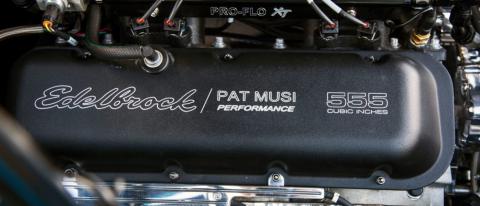
The Musi/Edelbrock partnership began over 20 years ago when industry pioneers, Vic Edelbrock and Pat Musi, teamed up to develop the first 555 prototype. Currently, Edelbrock offers three configurations of the Edelbrock-Musi 555 Crate Engine: AVS2 Carbureted, Pro-Flo 4 EFI, and Pro-Flo 4 XT EFI. 

For more information, visit edelbrock.com or musiracing.com. 

March 2022

PRI To Sponsor Three-Day Race Track Safety Program By ICMS

Submitted by laurap on Tue, 03/22/2022 - 13:40
International Council of Motorsport Sciences (ICMS) logo


The International Council of Motorsport Sciences (ICMS), which hosts its Annual Congress at the PRI Trade Show in Indianapolis each December, will host its Race Track Safety Program (RTSP) at Lucas Oil Indianapolis Raceway Park in Brownsburg, Indiana, from March 31–April 2.  

Sessions for the event, which is supported by PRI, include certified medical and fire rescue, drag racing track prep, and EV emergencies, plus an online didactic session and test. 

In addition to PRI, the event is also supported by AMR, ESI Equipment, and Hazard Control Technologies.   

“Due to their incredible support and wanting to make medical and safety training affordable for everyone, we are able to lower the cost to attend the RTSP to just $175,” ICMS Executive Director Tom Weisenbach said.   

To purchase tickets, visit the event page, here. For more information, visit icmsmotorsportsafety.org.     

March 2022

RPM Act Adds Key Supporters In Congress

Submitted by laurap on Tue, 03/22/2022 - 12:34
RPM Act Adds Key Supporters In Congress
(From left to right): Rep. Garret Graves (R-LA), Rep. Sean Patrick Maloney (D-NY), Sen. Marco Rubio (R-FL), and Sen. Catherine Cortez Masto (D-NV). 


Support for the bipartisan Recognizing the Protection of Motorsports Act (RPM Act) continues to expand as members of Congress receive an outpouring of support for the bill from racers and the motorsports’ parts industry. Over the past few weeks, several members of Congress have agreed to co-sponsor the RPM Act, H.R. 3281 and S. 2736, including Sen. Catherine Cortez Masto (D-NV), Sen. Marco Rubio (R-FL), Rep. Sean Patrick Maloney (D-NY), and Rep. Garret Graves (R-LA). 

PRI government affairs staff had a chance to catch up with Rep. Maloney about the RPM Act. Congressman Maloney represents New York’s 18th district in the U.S. House of Representatives. His Hudson River Valley district is home to Orange County Fair Speedway in Middletown, NY, and a passionate racing community.

“Car racing is a treasured American pastime that extends from Daytona Beach down to the hundreds of local tracks where hobbyists and professionals alike work on their cars and prepare for race day,” said Rep. Maloney. “I am proud to support the RPM Act, a critical bill that will ensure well-intentioned policies to protect the planet don’t inadvertently undermine a sport beloved by so many folks here in the Hudson Valley and all across the country.” 

The RPM Act must be enacted into law to guarantee your right to modify street cars, trucks, and motorcycles into dedicated race vehicles and ensure that the industry can offer parts that enable racers to compete. Lawmakers must continue to be reminded of the importance of passing the RPM Act, as we need your help now more than ever.

Below is a list of things you can do right now to help to pass the RPM Act:

  • Call or send a letter to your lawmakers at: saveourracecars.com. A letter has already been drafted. It takes less than a minute.
  • Sign a letter to your lawmakers on company letterhead—email erics@sema.org for a template and more information.
  • Post about the RPM Act on your company’s social media accounts using the toolkit of digital assets or pass out a flyer at your business of events. 
  • Learn more about PRI’s Political Action Committee (Performance Racing PAC) at performanceracing.com/pac. Performance Racing PAC allows PRI members to support the lawmakers that stand up for racing in Washington.


For details, contact Eric Snyder at erics@sema.org.

March 2022

Driver Safety Products: Safety Engineers

Submitted by johnc on Tue, 03/22/2022 - 12:19
Image 1


Constant innovation in designs, materials, and manufacturing are pushing the development of driver protection gear beyond the minimums required by tracks and sanctioning bodies. Here’s how these advances are improving racers’ performance.

Stereotyping is never a good thing, but racers have a reputation for being willing to spend nearly anything to make a car go faster, while being much more frugal when it comes to investing in their personal safety gear.

“Racers won’t bat an eye at putting a $50,000 engine in their sprint car or Late Model, but they will balk at spending $1,500 on a custom suit to keep them safe,” said Jacob Brown of K1 Race Gear, Carlsbad, California. “You can always buy more race cars, but you can’t buy another you. You get one life, one body. You can’t just buy another.”

But, a racer may be thinking, safety standards change every few years anyway. Why can’t I just upgrade then?

“Those changes to homologation standards do drive requirements,” said Kyle Kietzmann of Bell Racing, Miami, Florida. “There are new standards put in place every five to 10 years that help make the safety equipment better. But outside of those standards, we’re constantly looking at new materials and manufacturing techniques to make our products perform better, not just according to the standard but also to offer attributes that the customer wants, like fire suits that are lighter and more breathable, and helmets using more advanced carbon materials to make a lighter shell. We’re adapting and taking advantage of new technologies so we can build a better, lighter, stronger product for customers.”

Let’s look at some of those new technologies to explore why safety equipment should be upgraded on a regular basis.

image 2
Many safety gear changes are subtle, evolutionary improvements, such as G-FORCE’s modularized liner padding that allows racers to add or remove padding to achieve the ideal fit.

Helmets

“Helmets do change,” said Ben O’Connor Jr. of Impact Racing, Indianapolis, Indiana. “The Snell Foundation and the FIA change requirements for standards every five years. The thinking is that each iteration is conceivably better than the prior specification. The helmet a racer could buy today is in theory safer or better performing than a helmet from five years ago under the last standard. I say ‘in theory’ because in some cases, if a company is already ahead of the curve, it doesn’t need to make any changes to meet the new standard. Ideally, we want to build the safest product that we can, so sometimes when they change standards, we’re already there.”

While Snell and the FIA set the standards, “they don’t dictate how to get there,” O’Connor continued. “That’s up to the manufacturers. We have virtually free rein in terms of how we develop the textiles, the fabrics that are used, the layup of the shell, the inner liner of the helmet, the densities and materials that are used. That’s where the changes and advancements are being made.”

“There are a lot of changes in materials,” said Danilo Oliveira of G-FORCE Racing Gear, Acworth, Georgia. “Specifically, we developed a completely new set of modularized liner padding for almost all our helmets in 2021. Not only did it offer the best user customization, but it provided a much more comfortable experience in a better-quality material. Racers can choose to add or remove padding to perfect the fit. Customers who are between the standard sizes—a racer who’s between medium and large, for example—can get a large helmet and put in more padding to get a perfect fit,”

Oliveira said G-FORCE made “a lot of significant upgrades in the shell composite of the Snell 2020 helmets as well, as seen on our Flash, Fusion, and Graphic models. Some of these upgrades were pioneered by the G-FORCE R&D team and are being used for the first time ever in the car racing industry. That’s technology we didn’t have two years ago.”

As Kietzmann indicated, the upgrades Bell Racing makes to its helmets are not just to adhere to changing standards but also to “purpose-build different models for different applications.”

image 3
Racing suits need proper care to stay effective. “Many of today’s cars have such small window openings,” said our source at RaceQuip. “It’s easy to catch a rivet or cut the suit on a piece of sheetmetal.”

For example, Bell’s new BR8 helmet for off-road racing was designed with a liner system “that evenly distributes airflow around the crown” and allows a choice of air inlet locations. “The way the liner is constructed internally allows airflow to circulate throughout the entire helmet, so whether it’s top air, side, or 3/4-side, there’s even airflow all the way around the crown, not just air ported into one area of the helmet.”

Air has to come in, but dust needs to stay out. “We’ve added a double screen insert for the visor so it completely seals and added a kit system that can seal off the helmet except for the forced-air nozzle,” Kietzmann said.

For sprint car racing, Bell’s GTX3 helmet manages airflow differently. “It has a rear-facing venting system so air is not directly vented into the helmet. It’s designed to create low-pressure areas in specific parts of the helmet, so as air flows over the helmet, there’s a natural draw or air exchange through the helmet from low-pressure points from the rear-facing vents.”

Bell’s new 6-series helmets for sports car racing “address the need for more visibility with a larger eye opening, integrated ear cups for more noise attenuation protection, versatility in the radio systems we can install, and the helmet is adaptable for hydration,” Kietzmann said.

image 4
Pyrotect’s new helmets feature channels in the liner for improved cooling, along with a new latch and quick-release system designed for easier opening.

“Models from five or 10 years ago don’t have many of those features, or the helmets were more generic and less specific,” he continued. “As we advance, we look at the application, look at the different features that need to be incorporated into the helmet, and make adjustments to meet customer demands.”

Airflow was a key driver in the redesign of the SA2020 off-road racing helmets from Pyrotect of Redmond, Oregon, said Steve Russell. “The internal air channeling in our helmets has changed, with more positive channeling of airflow through the helmet. Before, if a manufacturer had a pumper helmet, that air would come out wherever it wound up coming out. With our new air channeling system, air flows through the helmet in a much more direct way.”

Pyrotect has also improved its helmet liners, Russell added. “Instead of a solid liner—which is like having a heavy sock wrapped around the top of your head—our liners now have corrugated channels all around the headliner to allow for more air movement and more cooling on top and around the head. That’s a huge improvement in fogging and keeping cool.”

Even the face shield has been improved, with a new front latch and a quick-release system “that allows the shield to be closed or opened much easier than in the past, when the driver was trying to find that little lip on the shield over by their ear,” Russell said. “Now, all it takes is a little hand swipe up the front to open the latch. The upgraded ratchet system allows the shield to open about a quarter of an inch with one click, then there are three more clicks to allow the shield to open at different increments without it flopping around.”

Fire Suits

Other than the SFI regulation that requires suits rated 10 or higher to be inspected and recertified every five years, “there really isn’t a timeframe for replacing suits,” Russell noted. “It’s more of a wear-and-tear issue. I’ve seen racers wear suits that are 20 years old or older.”

That said, racers “should keep a close eye on their suit to be sure it’s not torn and there are no open seams,” added Roger Mealey of RaceQuip, Riverview, Florida. “Many of today’s cars have such small window openings that when a driver is trying to slide past the head restraints, it’s easy to catch a rivet or cut the suit on a piece of sheetmetal.”

Mealey also noted that “one of the most common problems we see is drivers wearing their suits to work on the car and getting oil and dirt ground into them. This will shorten the effective life of the suit dramatically and makes it more likely to burn.”

Beyond those reasons, “technology always marches forward, and the safety gear made today is much better than what was offered just 10 years ago,” Mealey said. “There are always improvements being made, so updating safety equipment can provide better protection and added features.”

“Technology changes every two to three years, so it’s always a good thing to be looking for updated product,” said G-FORCE’s Oliveira. “The suit you bought five years ago has completely changed in technology. It could offer increased protection, and in many cases it’s more comfortable.”

“We have a new suit in production that we’ve been working on for about a year, and it’s now in final testing with the FIA,” said K1’s Brown. Yet he is “already working with our textile supplier on the next new thing. Suits continue to evolve. Materials are constantly getting better and lighter.”

As recently as 10 years ago, “the suit that everybody needed was a three-layer suit,” Brown said. “Then, within the last five to six years we went to a two-layer SFI 5 suit, because the new materials in the two-layer suit were actually better than the three-layer mockup.” More recently, though, “a lot of the new suits are going back to three-layer. Because of the way the layers work, the three-layer suit is actually lighter and better than the two-layer suit that we have.”

“Safety goes up as textiles get better, which is certainly a strong argument for upgrading,” said Impact Racing’s O’Connor. “The biggest changes that we see are on the milling side of things—how the textile manufacturers weave the thread to form different air pockets. That’s the goal: create insulation by creating these air pockets and trapping them in certain places. After thousands of years of milling fabric, it’s hard to believe there’s anything still to be found, but the makers are always figuring out better ways to create fabrics that are safer by milling them a different way.”

As the textiles get better, “we can produce a suit or gloves or even shoes that are lighter than previous models and maintain and even exceed what the prior performance was,” O’Connor added. “That’s important in terms of safety as it relates to being comfortable in the vehicle. The more comfortable a racer is in the vehicle, the more they’ll be able to concentrate on the task at hand, which is driving, right? They’re not thinking about an uncomfortable suit, shoes, or gloves.”

How a suit is put together is also evolving. “In the last three years or so we’ve gone to a diagonal stitch,” Brown said. “It has the same fire retardancy, but it’s stronger and holds the layers better. The suit has more longevity and is more flexible that way.”

image 5
According to our source at Stroud Safety, new developments are often born out of necessity. “We live and learn a little bit,” he said, pointing to padding on the knees and how epaulets are attached to the suit as two recent modifications.

“Sleeves that are independent of the jacket’s torso is something new for us this year,” said Tommy Cunningham of Stroud Safety, Oklahoma City, Oklahoma. “It’s a fit and feel thing for me. When I’m strapped in the car and I go to move my arms, the whole front of the suit tries to move or bunch up. If the sleeves can move independently, the whole front of the suit isn’t moving when I move my arms.”

As a racer, “I run our product, and some of our fire suit changes are little things that I wanted, like a pocket or something,” Cunningham said. “Then there are bigger things, like how our epaulets are attached. A lot of racers think those are just an aesthetic thing to make a suit look a little better, but they have a purpose. They’re designed to be a handle. When a first responder gets to the car, they can get a hold of the driver and pull him out of the car by the epaulets.”

Another change Stroud is making is the addition of pads on the inside of the suit’s knees. “When Jon Stouffer had his wreck in Great Bend, Kansas, last year, he told me a couple months later that he broke five ribs and didn’t have much pain from that, but he said he couldn’t hardly walk because his knees slapped together,” Cunningham explained. “That’s an easy upgrade for us. We can put some foam on the inside of the knees. I hope I never need it, but at least it’ll be there if I do.

image 6
Bell Racing offers a range of different helmets purpose-built for specific applications. For example, the GTX3 model for sprint car racing has a rear-facing venting system so air is not directly vented into the helmet.

“A lot of safety developments are through necessity,” Cunningham added. “We live and learn a little bit.”

Accessories

If a fire suit upgrade can be a tough sell, it’s even harder to convince racers to upgrade to new accessories, such as underwear, gloves, and shoes. But these products, too, are changing.

At the 2021 PRI Trade Show, Stroud Safety introduced a new SFI 20 boot that was designed with an eye to “the EV market and where it’s going,” Cunningham said. In addition to heat and chemical resistance, the sole has “an electrical charge resistance that will be standard in the boot. Racers won’t have to order anything special for that.”

“We’re seeing a lot of advancement in technology in the base layers and underwear,” O’Connor said. “As motorsport has progressed to being recognized for its athleticism, and as drivers—particularly on the professional side—train more, they gravitate toward replicating what is being done in other sports. One of those things was compressive base layers. Originally, a lot of drivers were using traditional athletic-type base layers for their performance aspect, but they’re very dangerous to use in motorsports because they contain fabrics and materials that could actually melt in fire.”

To offer a safer alternative, “manufacturers have looked at producing fire-related base layers that still have that compression technology,” O’Connor added. “Traditional Nomex type fabrics don’t have a lot of memory to them. They stretch and stretch out, so they can’t be used in a compressive sense.” The new compressive fabrics still have fire-retardant elements, “but the fabric is inherently different from what would be used in a suit or traditional undergarments.” Impact Racing’s new Ion line of underwear “is a version of that. It has the fire rating of a protective undergarment but has compressive capability as well. That would have been unheard of 10 years ago.”

Impact Racing also recently introduced the Transition balaclava, with a bottom portion that can be pulled down. “This was the result of a request from the AMR folks [the safety team] in IndyCar,” O’Connor explained. “They wanted it so they could pull it down when they’re waiting for hours on end, but could pull it up in an instant to go into action. This also made it COVID-compliant for a lot of places.”

image 7
Impact Racing’s Transition balaclava features a bottom panel that can be pulled down while waiting to race or using a drink system, and then quickly pulled back up.

There are benefits from the driver’s perspective, too. “It’s very common, particularly in off-road and endurance racing, to have drink systems in the helmets,” O’Connor said. “With a regular balaclava, drivers would have to either pull the balaclava all the way up to use the drink system or pull the eye port down below the mouth. Neither scenario is ideal, and [both] could be dangerous. The Transitional balaclava allows the driver to pull down the panel without disrupting the eye port area.”

To give racers more options with their accessory choices, K1 Race Gear has instituted a tiered system, “a good/better/best model,” said Brown. When choosing shoes, Challenger model shoes are good, GTX shoes are better, and Flight shoes are the best. With gloves, the ranking goes from Track 1 to Flex to Flight. “All three will keep you safe and meet the same specifications, but there are varying levels of comfort and maneuverability. It’s like a Honda Civic versus a Cadillac. Both will get you from A to B, both pass crash tests. The choice comes down to a matter of what features the driver wants.”

‘Injuries Don’t Take Vacations’

“You can never be too safe,” Brown said. “Injuries don’t take vacations. We can’t do everything to protect the drivers, because in racing there are so many uncontrolled variables. But we’re doing our best to control the ones we can. We have to make sure we’re doing our part to make drivers safe, but drivers have to do their part to remain safe as well.”

To O’Connor, that is happening. “In the 11 years I’ve been in this side of the industry, the attitude about safety has changed dramatically. It’s gone from being a disgruntled purchase—‘I have to have this stuff or they won’t let me race’—to being almost a fashion statement. That’s where, as manufacturers, we’ve had a great opportunity to increase sales when we develop better-looking product people want to wear. We don’t think of style as a safety aspect, but it kind of is. If they want to wear it, they’re more apt to use it.”

“The best part,” said Mealey, “is that all these advances in safety equipment have not come at much expense. Today’s safety gear prices are on par with the past, if adjusted for inflation.”

Bell Racing
BR8 Carbon

product 1

• Double Screen Anti-Fog (DSAF) insert to create a positive visor seal and prevent shield fogging.

• Rear-facing Venturi airflow vents that prevent dust from entering the helmet while still allowing forced air to be introduced into the helmet.

• Unique air chamber system that evenly distributes airflow around the head regardless of the top air configuration used.

• The helmet can be used with or without ear cups (included with the BR8 Carbon and sold separately for BR8 Matte Black and BR8 White versions).

• Innovative kit system featuring a low-profile forced air insert (included). The forced air kit can be installed on the left or right front, left or right 3/4 side, or top position for the ultimate flexibility in forced air placement and management.

For more info: bellracing.com
 

Pyrotect Safety Gear
ProSport SA2020 Helmets

product 2

• Designed with a Carbon Composite Weave Vacuum bagged and autoclave cured lightweight shell for maximum durability.

• Stainless steel hardware and a Kevlar chinstrap.

• Center latch .125-inch Polycarbonate shield with tear-off post.

• Rubber eye port seal.

• Large eye port offers greater visibility.

• M6 inserted for head-and-neck-restraint devices.

• Fire-retardant Nomex interior.

• New head liner air channel design for better adjustability, added comfort, and improved airflow.

• Removable six-pad headliner and cheek pad system for cleaning and easy resizing for a perfect fit.

For more info:  pyrotect.com
 

Racechick
FIERCE Women’s Auto Racing Suits

product 3

• Designed and developed specifically for the female form combining movement and performance into a great value suit built to the highest quality standards.

• FIERCE collection featuring one-piece suits, two-piece suits, and fire jackets in off-the-rack or custom sizing, and available in many color options.

• Available in SFI 3.2a/5 safety specifications featuring FR Cotton and  Nomex materials.

• Suits are made to coordinate with Racechick’s women’s race shoes and gloves.

• Built for women racers by women racers.

For more info: racechick.com
 

RaceQuip
356 Series SFI-5 Outseam Gloves

product 4

• Double layer Nomex knit construction.

• SFI 3.3/5 rated (tags affixed).

• Soft, supple, and comfortable.

• High grip suede leather reinforced palm.

• Reverse seam for superior comfort and feel.

• Extra-long cuffed gauntlet.

• Mitered fingers for precise fit.

For more info: racequip.com
 

Sampson Racing Communications
Digital Communications Systems

product 5

• Digital offers 100% communication coverage on any track in the US.

• Motorola systems.

• 29 years of quality service and support.

• Same-day shipping.

For more info: sampsonracing.com


Stroud Safety
Drag Boots

image 6

• Integrated soles.

• Fire-/electric-shock resistant soles.

• Optional adjustable strap.

• SFI 20 rated.

• Made in the USA.

For more info: stroudsafety.com


Turn 2 Racing Communications
CP510 2 Man System

image 7

• The company’s most versatile system.

• Uses the Turn 2 RC 4-watt 200 Channel Pro Radio.

• This system is ideal for quarter-mile drag racing, oval track racing, off-road racing, and much more.

• Has a built-in FM radio.

• Comes complete with everything needed for the car, driver, and one crew member.

• FCC licensing is the responsibility of the customer.

For more info: turn2rc.com
 

SOURCES

Bell Racing
bellracing.com

G-FORCE Racing Gear
gforce.com

Impact Racing
ximpactusa.com

K1 Race Gear
k1racegear.com

Pyrotect Safety Gear
pyrotect.com

Racechick
racechick.com

RaceQuip
racequip.com

Sampson Racing Communications
sampsonracing.com

Stroud Safety
stroudsafety.com

Turn 2 Racing Communications
turn2rc.com

April 2022
By
Drew Hardin

Special Report: Follow the Science

Submitted by johnc on Tue, 03/22/2022 - 11:01
image 1


Outside of the limelight typically reserved for high-profile teams and drivers, medical professionals are quietly using breakthrough discoveries in human biology to help facilitate sharper—and safer—performance behind the wheel.

Scientific and medical advances that relate to motorsports can sometimes break through with revolutionary suddenness, but usually the process moves forward at a steady, evolutionary pace. Undertaking research to find new ways to keep drivers and crew safer, and improving driver performance, is a marathon, not a sprint, as the saying goes.

Rest assured, behind-the-scenes research is ongoing, the equipment is improving, and the knowledge base is deepening. Much of that progress comes from the manufacturers of safety equipment themselves. “They don’t rest on their laurels. They’re always saying, ‘How can we make our products better?’” said Tom Weisenbach of the International Council of Motorsport Sciences (ICMS), Indianapolis, Indiana.

“I think we have definitely improved the PPE [personal protective equipment] the motorcycle riders and drivers are utilizing to protect them, whether it’s fire, whether it’s impact collision, what have you, we’ve seen improvements,” he said. “I give credit for that to the PPE manufacturers, to SFI, Snell, and the FIA. Those organizations are setting the standards that are now required and the specs on safety products.”

Beyond the established brand names and organizations most racers would recognize, there is a substantial amount of work quietly being done by medical professionals that is leading to better outcomes for racers. Many of the high-profile medical studies in racing have traditionally revolved around patching drivers back together after crashes, but in speaking with sources for this story, we found a number of talented professionals diving deep into the basics of nutrition, sleep, and bio-mechanics, and how they relate to motorsports participants.

“Nutrition is a big thing now,” Weisenbach said. “I don’t care what type of racing you’re in, you’re seeing more and more of an emphasis put on the racer for nutrition and making sure they’re eating properly. And then also getting enough sleep. That’s something that I don’t know people years ago even thought about. I still don’t know how some of our sanctioning bodies, which run 100-plus races a year, how their crew members and racers get enough sleep. But I know if you look at Formula 1 teams, the majority of them have their own team nutritionist who works with not just the drivers but the crew members as well to make sure they’re eating properly.”

image 2
Research in the field is ongoing, and a number of the latest advances in safety equipment come from the manufacturers themselves. “They don’t rest on their laurels,” said one of our sources. “They’re always saying, ‘How can we make our products better?’”

Talk to the Doc

The casual observer might be surprised to learn how much of motorsports-related medical research is focused on fundamental aspects of human biology. At a superficial glance, some of these studies seem to concern themselves with what many would consider common-sense knowledge. Most people are at least vaguely aware of the importance of hydration, nutrition, and sleep. But the question becomes, how much sleep? What’s the proper level of hydration for a driver or crew? How can proper nutrition improve driver performance? As it turns out, specific answers to these questions and how they affect racers haven’t really been studied much until recently.

Now that they are being studied, some amazing data is coming out. David P. Ferguson is an assistant professor of kinesiology at Michigan State University in East Lansing, Michigan, where one area of his studies examines physiological stresses placed on race car drivers and pit crews. “I’m an exercise physiologist. Think of me as a mechanical engineer for the human body,” he said. “I spend my time looking at stressors that fatigue drivers. That could be something like heat, dehydration, G-forces, vibration, anything like that. And then I use physical training, nutrition, and then even a little bit of engineering to make them fatigue less in the car. Which, of course, improves safety because they don’t have as many crashes. And on the flip side, it makes them faster, which they like.”

Ferguson has witnessed a major shift in attitudes since he began his studies. “When I started this, race car drivers were not even considered athletes. They just thought they sat there and drove their car around the race track and nothing much happened,” he said. “In fact, when I first started doing these studies and publishing some of the initial results, manuscripts would be rejected at sports journals because they would say, ‘Race car drivers are not athletes, so we can’t accept your paper.’

“We now know that they are considered athletes,” he continued. “Their cardio-respiratory fitness is pretty much equal to an elite triathlete. They’re quite fit. When they compete, they will drive the race car for two to four hours at a heart rate of 160 to 180 beats per minute. They’re going to burn 2,000 calories in the race. They’re going to lose about 7 pounds of sweat, due to the fact they’re in the hot cockpit and sweating quite a lot. The G-forces they’re going to experience are quite massive—actually, every race car driver would qualify for the Apollo space program for the amount of G-forces they can handle. They’re quite exceptional athletes.”

A big part of being able to maintain that level of performance is tied to getting enough quality sleep, and the sleep habits of athletes is another area that is receiving fresh scrutiny. Dr. Meeta Singh specializes in sleep science and has given talks at the ICMS Congress on the effects of sleep on mental health.

Racers are increasingly turning to medical experts such as Dr. David Ferguson, pictured at right with IndyCar driver James Hinchcliffe, for insight into the physiological aspects of racing, which can be applied to improve performance, safety, and endurance.

“I’m a sleep doctor and a psychiatrist. My expertise and experience is working with professional athletes. And I firmly think that drivers, they’re athletes,” she said. “When it comes to athletes of any kind, whether they’re motorsports drivers or playing football, in any of the major leagues, the lifestyle of a motorsports driver, as well as the pit crew, is tough. Their schedule, their practice times, the way that they’re together with their travel, the week leading up to the actual weekend of races, all of those factors make it difficult to fit sleep into their lives.”

Constantly crossing time zones while living out of a suitcase can result in problems with sleep and problems with circadian rhythm disorder, she said. “The problem is that number one, being in this sport is problematic for sleep, but then it’s the vice-versa that also holds true. Having impaired sleep, having irregular sleep or chronically being deprived of sleep itself can result in impaired reaction times. It can make you less accurate. Your judgment is impaired, so you are likely to put yourself in risk-taking situations. That may be okay for you and me, but imagine if you’re in a car that’s going 150 mph. Then those small, split-second decisions can mean the difference between winning or crashing.”

Anyone who has pulled a race car onto a track knows that the track condition, vehicle setup, and constant G-forces from acceleration and negotiating turns result in constant head motion. But exactly how much head motion does the typical driver endure? That too is being studied. Dr. Joel Stitzel Jr. is a professor and chair of biomedical engineering at Wake Forest University in Winston-Salem, North Carolina. “My training started in vehicle safety, understanding how passenger vehicles are regulated and the bio-mechanics of crash-test dummies,” he said. Stitzel is a past president of the Association for the Advancement of Automotive Medicine (AAAM).

“We’ve started to study more and more the environment of the vehicle as it relates to what we call environmental loads or accelerations or motions of the head. And also crash-related biomechanics of the head,” he said. “We developed instrumentation to study head motions in sports. With NASCAR’s support, we started looking at deploying this sensor system, instrumentation system, out in some NASCAR vehicles and different testing environments.

“Toyota took an interest in what we were doing, and then Toyota Racing Development has supported us to help understand the grassroots dirt track environment with this instrumentation system.

“In a nutshell, what we’re learning about is what the head is experiencing when you’re driving around the track on pavement or on dirt, and we’re starting to look into characterizing that environment and then what sort of things you might think about down the road to improve the situation for the drivers,” added Stitzel.

Gathering Data

The key to turning research into products and policies that benefit the driver is being able to gather data, and in that field, technology has made significant advances. “Sports analytics, data analytics are becoming a big thing in all other sports,” Ferguson said. “Special sensors can be put on a bat, a football, or on a player and watch them do all sorts of stuff. But, for the first time, racing is actually leading the field. These cars collect so much data and there are so many sensors, that they’re already set up to collect data on various drivers. You go to an engineer and say, ‘I want to measure this,’ and they’ve probably got a sensor for it. We have ear accelerometers in the earpieces now. In my work, for the longest time we had a bio-harness that the drivers wore. It was like a chest-piece that could measure their heartrate with an EKG, and from that we could get skin temperature and breathing rate. We would have them swallow a little pill, like a multi-vitamin, and it transmitted their core body temperatures. We could see how hot they’re getting. We did that for a long time. We are actually moving away from that and going to an ear temperature sensor to measure core body temperature, just like when you go to the doctor and they take your temperature with your ear, it’s the same thing.

image 4
With its mission of studying the scientific and medical factors of motorsports, the ICMS is a leading source of information on how physiological effects relate to on-track performance.

“A lot of drivers complain about how hot it is in the new NASCAR car and the new IndyCar with the windscreen,” Ferguson continued. “So we’re really trying to push getting a temperature sensor in the earpiece. You take all that data and feed it into the car’s data system and then you have everything. You’ve got car and driver as one. You have heart rate and oil temperature. It’s pretty cool to look at.

“From where I started to where I am now, it’s pretty wild. I still remember lugging a big box of batteries and wires and all this stuff, and now we’re on the micro-level. It’s come a long way in 15 or 20 years,” Ferguson concluded.

One of the data recording devices Stitzel has been utilizing in his studies is a mouthpiece that incorporates sensors. “It goes into the roof of the mouth and it’s not visible. It’s not a mouth guard, so no one can see it. It’s one of the systems that drivers are generally comfortable to wear,” he said. “We’re learning what those environments are like at a really detailed level for the head, in a way that we could use that information to design seating, design maybe a head-and-neck restraint, maybe a helmet, to improve the situation.

“Think of this like an instrumented data recorder for the head,” Stitzel continued. “The instrumentation system fits within acrylic. It’s almost like a retainer, a similar design that goes behind the teeth. On that system is a linear accelerometer, angular rate sensor, the stuff needed to store, the stuff needed to power, and later on we connect this to Bluetooth and download the information.”

Modern race cars are loaded with sensors, making them well-suited for sports analytics. “For the first time, racing is actually leading the field,” observed Dr. David Ferguson, who is shown here collecting physiology data in a Gradient Racing Acura NSX.

Commercially available health tracking systems have also opened doors in ways that can help motorsports participants. “Typically, I focus on screening the athletes for any sleep disorders and then helping them with their sleep issues throughout the season,” said Singh. “There is lots of new technology that can help. Now we have these handheld wearables, devices that can be worn on the wrist or on a ring that can help measure sleep. Just wearing these will not make sleep better, but now we can collect data about people’s sleep without them having to do something. Once we get that data, we can have actionable items from that data we can do.”

Track Results

How is all that research and data gathering improving driver performance and safety? Concrete examples of how a better understanding of human biology can affect driver performance are making their way to the track.

“What’s really kind of cool is what we’re learning now, about how important hydration is in race car driver physiology,” Ferguson said. “We just completed a study that showed if a driver becomes dehydrated, they lose the ability to modulate, and the car kind of goes into a point of understeer. They’re kind of sliding a little bit over the corner, which makes it slower, tears the tires up. They could drop a wheel and possibly spin off the track. But if they stay hydrated, and drink throughout the race session, that doesn’t happen so they can optimize their performance. Our data suggest that will save a driver basically one second a lap on a road course, which is pretty exciting.”

Applying those findings in an across-the-board way has always been a challenge, but there is progress on that front. “We’re starting to see a lot of the manufacturers homologate drink systems in cars,” Ferguson said. “We actually dictated how much fluid you should drink in the car. A lot of teams are going to say, ‘We’re not going to put a drink system in the car, that’s added weight.’ So what manufacturers are doing now is homologating it. ‘You buy this car, it’s got this drink system in it. Every car has this drink system in it. You don’t have to worry about the weight now.’ So now teams are saying, ‘Okay, the driver can drink now.’”

Staying hydrated during a race yields results, but eating well is just as important. “The biggest thing that was illuminating to us was how many calories these drivers actually burn,” Ferguson said. “In a two-hour race they’re going to burn 2,000 calories. That’s what most Americans burn in a 24-hour period. Then you have to figure out how to refuel that. What’s interesting, we have the equipment to not only measure the calories someone is burning, but also if they’re burning carbohydrates, fats, or proteins. When a driver is in a high-G corner or really battling it out to push the car, they’re going to burn more carbohydrates because carbohydrates are more easily broken down and used by your body. But if they’re on a fuel-save lap or running a triple stint in the middle of the night at Le Mans or something like that, they’re going to burn a lot of fat.

“With that information you can make meals for drivers—a pre-race meal, a post-race meal, you can tell them how many calories they need to include, what it should be made of, how much carb, fat, protein,” Ferguson continued. “Let’s take the endurance races like Daytona, Le Mans. You can actually have in-between-stint meals. ‘Okay, during this stint we know what you’re going to burn, so eat this, that’ll get you ready to go back in the car four hours from now.’”

image 6
Manufacturers continually use the insights of scientists and medical professionals to develop equipment that’s safer and more effective for drivers, according to our source at RaceQuip.

The extreme calorie burning that racers routinely undergo produces some unexpected side effects that need to be understood. “Talk about nutrition also addresses percent body fat,” Ferguson said. “Take any Olympic athlete, run their metrics, and they’re around 3% body fat. Race car drivers seem to be in the 12–16% body fat range. These are people who have won multiple championships, legends of the sport. They always say to me, ‘Shouldn’t this be lower? I train really hard. Shouldn’t my percent body fat be lower?’ What we’re finding out is that due to the high caloric expenditure in the car, and the big travel days that they do, these athletes actually need to store that fat to have the fuel to do what they do. It’s kind of a unique thing in terms of nutrition in sport, of knowing how much fuel someone needs. They also need a certain level of body fat just to sustain performance. When we see drivers with less than that they get sick quite a lot, they fatigue a lot, and they really don’t advance in the sport. It’s kind of a unique thing in terms of sports nutrition.”

Walking hand-in-hand with nutrition is the importance of sleep, and here small changes can provide big performance dividends. “When it comes to what sort of advice one should give, I think that even looking at really simple things can get a big bang for the buck,” Singh said. “One of them is caffeine, being aware of how much caffeine you’re drinking.

“Number two is being aware of how much alcohol you’re drinking. Number three is this thing about light exposure. Many times, drivers go into a new hotel room and feel they have to unwind. They may be on their laptop, they may be playing video games, they may be on the Internet scrolling social media. That will all impair their sleep. You want to keep the room cold, it should be dark, it should be comfortable. Those are some common, simple things you can tell athletes. But athletes are individuals, so some people just have difficulty sleeping when they’re in strange environments. If you’re one of those people, then any time you travel and stay in a hotel room you’re going to have difficulty falling asleep. That may take more intensive one-on-one work, taking their history and finding out how we can help them,” she said.

“The reason we talk about light exposure at night and how it impairs sleep is because our brains actually need darkness to get the signal that we’re ready to sleep,” Singh added. “Light is like an alertness signal at the wrong time if you get exposed to bright light at night. When it comes to light, we talk about lux. So the higher the lux, the brighter the light, the worse it is. The blue-green wavelength is worse as compared to red light. The longer you expose yourself to bright light at night, the worse your sleep is going to be. Because of that, there are some studies that show if you wear blue light blocking glasses, that might actually help you fall asleep because you’re preventing your exposure to blue light, which makes it difficult to sleep.”

Stitzel’s research into driver head motion could very well lead to new equipment and practices on the track. “It’s not hard to make the leap that it has implications maybe for fatigue of neck muscles,” he said. “How do you feel after driving for an hour or two? That has an effect. We really don’t know the amount of vibration that you can handle. When you’re driving a NASCAR Cup series vehicle, or a grassroots dirt midget car, there’s a lot of vibration in that environment. You’re shaking a ton. And we’re starting to measure all that. Depending on what threshold you use, you’re talking like two to three, to eight to 10 times per second that your head is moving back and forth. We’re starting to look at that at a really detailed level. We don’t know what the threshold is. We don’t know how much is too much, how many times is too many times, so we operate under this principle of public health science. It’s called ‘Precautionary Principle.’ Even though you don’t know what the threshold is, and what you would call ‘okay’ versus ‘not okay,’ it’s still a good idea to reduce it when you sense it’s going on.

“You’d think it would be really easy to go out and get all this data, but it’s a challenge,” Stitzel added. “We’re at the stage now where we’ve done a lot of characterization, and we’ve done a little bit of looking at what is possible with the Cup series cars. But we’re actually just starting to think about that with the grassroots dirt vehicles.”

Gear Up

The racing equipment manufacturers are likewise examining the latest science to make their own inroads into safer gear for the track. “There is evolution taking place on the manufacturers’ side,” said Mike Hurst with the SFI Foundation, an organization that issues and administers quality standards for racing equipment, based in Poway, California. “They are always coming up with new weaves and blends. The biggest changes compared to years ago is how light and comfortable a good driver’s suit can be today. Which then reduces the heat stress—the non-fire heat stress on the driver, which is healthy for the driver. There are hundreds of different models of drivers’ suits that basically meet the same standards, and the difference between a very expensive one, a very nice one, and say an economy suit, is that comfort level and breathability of the fabric. It’s light weight and it’s comfortable to wear. It’s a big difference.”

RaceQuip in Riverview, Florida, manufactures driving suits, gloves, footwear, and other racing safety gear, and it has been able to translate the latest scientific research into readily available products.

“The study of human biomechanics coupled with auto racing crash analysis has led to many advances in everyday safety gear,” said Roger Mealey of RaceQuip. “Understanding what forces your body is subjected to during an impact has caused us to re-think how we build many of our products. Some advances are revolutionary, like a Forward Head Restraint, but most are evolutionary, like adding a containment halo around the top of a seat to limit side movement of the head. Another evolution has been the emergence of 2-inch-wide lap belts instead of traditional 3-inch wide. Testing has taught us that a 2-inch belt will tuck under your hip bone rather than riding on top of it, allowing them to be cinched tighter and load more quickly in the event of an impact.

“Our FIA-rated full containment seats, Snell SA2020 Carbon helmets, and SFI-15 and SFI-20 suits are all examples of new products that were developed using the latest technology in materials and manufacturing techniques,” he said. “The seats and helmets are both lighter and stronger due to advanced composite materials. The seats feature an FRP infused matrix composite covered by an energy absorbing memory foam. The helmets utilize a pre-preg carbon fiber composite material that is then placed into tool steel molds using pressure and heat to cure. Our new SFI-15 and SFI-20 suits use advanced aramid fabrics to provide a very soft and supple multi-layer suit.”

There are plenty of future scientific advances on the horizon for motorsports, but right now, a new emphasis on biomedical fundamentals is yielding fruitful results.

So get a good night’s sleep!

Sources

David P. Ferguson PhD FACSM CEP
Michigan State University
rdsp.canr.msu.edu/faculty/35-ferguson-david

International Council of Motorsport Sciences
icmsmotorsportsafety.org

RaceQuip
racequip.com

SFI Foundation
sfifoundation.com

Meeta Singh MD
meetasinghmd.com

Joel Stitzel PhD
Wake Forest University School of Medicine
school.wakehealth.edu/faculty/s/joel-douglas-stitzel


April 2022
By
Steve Statham

Industry Insights: Dave Argabright

Submitted by johnc on Tue, 03/22/2022 - 10:39
image 1


A fixture on pit road at countless televised race events, along with contributions in myriad racing publications—including this one—the Indiana native reflects on a Hall of Fame career in motorsports journalism, and hints at future opportunities to continue telling stories.


For the past 42 years, Dave Argabright has been among the country’s most influential and celebrated motorsports journalists. As a writer, his work has appeared in National Speed Sport News, SprintCar and Midget Magazine, Road & Track, Car and Driver, and right here in PRI Magazine. He’s also been seen and heard on Speed Channel, MAVTV, CBS Sports, ESPN, TNN, Versus, Must See Racing, and the Indianapolis 500 Radio Network. In addition, he’s the author of more than a dozen books on motor racing. His list of professional awards and honors is lengthy, and he’s earned every one of them.

Recently, Argabright made the decision to step back from day-to-day coverage of motor racing and spend more time writing books and tackling new projects. Given his decades of experience and always-insightful thoughts on the industry, we jumped at the chance for a sit-down to discuss, among other topics, how motorsports journalism has changed over the last half-century and where it stands today.


PRI: Motorsports journalist is not a career that they tell you about in high school. How did you get into this line of work?

Argabright: It was just a fortunate accident. I’d been out of high school for a few years, and I happened to meet the sports editor of our local newspaper. I mentioned that I wrote a little bit for my high school newspaper, and he said they needed someone to cover high school football and basketball. I thought I couldn’t write for a real newspaper; there’s no way. But then he said, “Well, we pay 15 bucks a story.” At that time, 15 bucks was a tank of gas, so away we went.

I covered stick-and-ball sports the first couple of years, but my passion was already auto racing. So I started lobbying to cover some races and some racing personalities. The newspaper was in Anderson, Indiana, and they have Anderson Speedway, which is a legendary short track. I kept selling them on the idea that we needed to cover the local track better. Through the newspaper, I was exposed to National Speed Sport News and began writing for them, and that’s where it all took off.

PRI: What was it about motorsports that attracted you?

Argabright: I’m not sure I really know other than the atmosphere of a great short track race, where it’s loud and exciting and people are shouting. That attracted me from the get-go. Then once I got a chance to get to know some of the people behind the scenes and some of the competitors, that captivated me from day one. I never had any interest in driving a race car or trying to work on a race car for a living. That didn’t appeal to me, but the idea of being able to tell some of the stories really drew me in. That was compelling to me.

PRI: If you had to go back through all the races you’ve ever been to, is there one that really stands out?

Argabright: I think it would have to be when I was 10 or 12 years old, and I went to the Little 500 sprint car race in my hometown of Anderson, Indiana, for the very first time. Because I was an impressionable young kid, that really was the moment that just truly set the hook for me for the rest of my life to love motorsports. As I said earlier, it was loud and colorful, and I had just never seen anything even remotely like all that. From that moment forward, the gears in my brain were turning and I was just fascinated.

PRI: What do you know now, as you are mature in your career, that you wish you knew when you started?

Argabright: I wish I could have been a little more patient and tried a little harder to see things from various points of view. I had a tendency, like everybody else, particularly when I was younger, to want to see things in a black-and-white way. I’ve learned as I go along to see less and less black and white and a whole lot more gray. Things are seldom as simple as we want them to be.

image 2
Dave Argabright is an icon in his own right, bringing the perspective of motorsports legends like AJ Foyt, at left, and Richard Petty, at right, to fans around the world for more than four decades.

PRI: The follow-up is, what’s the best piece of advice, personal or professional, that you’ve ever received?

Argabright: I was blessed with a series of mentors, in and out of motorsports. They really had a profound impact on me and the person I grew to be. One of the things that stuck with me was about 30-some years ago, Richard Petty said, “The easiest thing in the world is being nice to people.” I never forgot that. That’s as good a piece of advice as I’ve ever heard because it’s true. It doesn’t cost extra. Just be nice. It doesn’t hurt. Then the second thing was from Chris Economaki, who drilled into me: Ask a question. Whether it’s television, print, or whatever, just ask a question. Ask a question that you think the reader would ask, or the viewer would ask if they had the opportunity. That was good advice.

image 3
Dave Argabright, pictured at center, has always seen himself primarily as a storyteller. “I never had any interest in driving a race car or trying to work on a race car for a living,” he said.

PRI: How has motorsports journalism evolved over the years you’ve been involved?

Argabright: For me, the biggest change has been the timeframe in which we have to collect our thoughts, get them organized, and get the information presented to the reader. In the magazine world, we had several weeks to gather information, contemplate a story, and get it out to different sources. We could build our story, but also our views, and we could get various points of view. We had time to do that. I think the contemplative writing and reading experience was very, very different because things were in much greater detail, and the analysis was much more thorough.

But today, everything is compressed into such a tight timeframe. I think we’re missing that deep analysis and that deep view of a complex issue. We try to distill it down into something that can be read and fully understood in three minutes. Some topics, some elements, you can’t understand in three minutes.

PRI: Along those lines, do you think social media is a good or bad thing for the motorsports industry?

Argabright: It’s a little bit of both. Obviously, social media can help, whether you’re a track or a driver. If it can help you get information out to fans quickly and efficiently, then it’s great. But if it’s also a vehicle where people use your social media account to say nasty, mean, negative things about you or your track or your series or your family, then it’s not a good thing. But I don’t know how you have one without the other, because that’s sort of human nature.

I believe social media is going to be around for many years to come, but I do think we forget sometimes that it’s a relatively recent social experiment. When I read about an NFL player who has been dogged with controversy because of his political or social views, and he deletes his Twitter account and then says, “You know what? It’s the happiest I’ve been in five years. I feel like a giant weight has lifted off of my shoulders.” That’s pretty telling, and it may tell us a little bit about where everything’s going.

PRI: What is it that makes good news?

Argabright: I think that news—like everything else in media—has to be somewhat entertaining at its core. It has to be something the reader feels is important enough to invest their one minute, three minutes, 10 minutes in reading or watching that story.

PRI: As someone who’s made his living interviewing people, what do you think makes for a good interviewer?

Argabright: Obviously, a person needs to do their homework. They need to study the subject beforehand. They need to understand where they want the interview to go. But you also learn pretty quickly that you can’t get in somebody’s face and ask the difficult questions, nose-to-nose, because you learn pretty quickly that you lose people. So you learn how to be diplomatic and use a lot of tact. You build their trust to where they can understand that you’re not there with a hatchet, you’re not there to try to put them in a bad light. You’re just there to try to get their answers. It takes a lot of experience, I think, before somebody is really good at that.

image 4
Today’s fast-paced media environment presents significant challenges for journalists, said Dave Argabright, at left with Keith Kunz during the 2000 Lucas Oil Chili Bowl Nationals. “I think we’re missing that deep analysis and that deep view of a complex issue,” he told us.

PRI: Do you always have a specific goal in mind for an interview, or is it better to let it roll on and see where it goes?

Argabright: It’s pretty rare that there was something really specific that I wanted. Most of the time, my goal is to help the readers know and understand the person and the subject better. I think it’s better to let an interview roll on. I say that a person needs to be prepared, but I also think that it’s really important to listen to what somebody is telling you, because a lot of times they’ll bring up something that opens the door to go in a whole different direction. That might be the most fascinating part of the interview; something that you hadn’t even thought about beforehand. You have to organically see where it’s going to lead.

PRI: What do you think we can do to recruit and train the next generation of motorsports journalists?

Argabright: Bringing kids to the race track and introducing them to people and exposing them to the sport is the number-one thing we could do. But as far as attracting young journalists, that’s a tough one because the state of journalism across the board, not just in racing, is very, very challenging right now. The legendary people, back in the day, such as Jim Murray and Jimmy Breslin and people like that, were great print journalists, but it was never a lucrative endeavor for them. Print journalism is very, very challenged right now because the consumers have shifted to electronic news media, and nobody wants to pay for content. If no one is paying for content, you don’t have a lot to offer that young person who’s trying to get into journalism in terms of being able to make a decent living.

It’s great to be passionate. It’s great to dedicate yourself to a venture, but at the end of the day you’ve got to be able to put beans on the table. That’s really the bottom line. Unless the model changes where consumers become comfortable paying for content, whether that’s print, electronic, audio, video, whatever, it’s going to be challenging. I’m not going to lie. I’m deeply concerned about where we’re headed.

PRI: Are there any racing promoters who have really impressed you, and what did they do that really made an impact on you?

Argabright: Earl Baltes who built Eldora Speedway. I was privileged to write his autobiography with him. Earl was great because he was such a flamboyant, charismatic person. He epitomized what old school promoting could be, getting attention, creating a lot of buzz and excitement. Nobody could do that quite like he did in his day.

Then Ralph Capitani. He was the race director at Knoxville Raceway. He really helped propel the Knoxville Nationals into the modern era and make it the dynamo that it is now. I always admired how he was this great, wise, astute, patient person. In the midst of one of the biggest events and one of the most important tracks in the world, he had a knack for making people happy. He knew how to get a lot accomplished without putting people off, without making people mad at him.

Both those guys were just terrific in their own way.

image 5
Although he’s scaling back his workload, Dave Argabright’s passion for motorsports is as strong as ever. “I definitely want to stay engaged in the sport, and I still want to tell some stories,” he said. Argabright is pictured here, at right, with Mike Marlar, winner of the 2021 Lucas Oil Late Model Knoxville Nationals.

PRI: What do you wish more racers understood about promoters and the challenges they face and what they do?

Argabright: I’ve said for a long time that every racer should have a few weeks in the promoter’s chair on Saturday night to really understand how a race track works and how hard it is. And every promoter needs to spend a few weeks with a race team all week long, and then on the weekends, and truly understand how their world works. Because I think way too much of the time, promoters and racers forget that they’re really on the same team, and they really need each other to thrive in order for it to be successful.

PRI: What legacy do you want to leave in motorsports journalism for those who follow?

Argabright: I would hope that we preserved the history and the stories of racing the best way we knew how. I think over the long haul, I’m glad we were able to produce the books that we did because, despite the shift away from print and different things that are happening, books are still pretty permanent. And the books that we produced are going to be on shelves for a really, really long time to come, and that’s a good thing.

PRI: Is there anything that I have not asked you that you want to talk about?

Argabright: I want to make it clear to people that even though I’m dialing back quite a bit, and even though I’ve ended some of my longtime monthly obligations, I’m not retiring. I’ve had a pretty ambitious workload for a lot of years. I don’t want to work quite that hard anymore, but I definitely want to stay engaged in the sport, and I still want to tell some stories. I’m excited to explore telling the stories in a different way, through video or podcasts or some of the newer technologies. It would be both interesting and challenging to see if I could continue to tell stories in a totally different way. 

April 2022
By
Jeff Zurschmeide

Mountain Creek Speedway (NC) To Livestream All Races In 2022

Submitted by laurap on Mon, 03/21/2022 - 18:20
Mountain Creek Speedway (NC) logo

Mountain Creek Speedway, the dirt oval kart track in Catawba, North Carolina, has announced that all races in 2022 will be live streamed via mountaincreekspeedway.tv as part of the speedsport.tv platform. 

“People have been asking about going live streaming for a while now and we’re proud and honored to bring it to them,” said track co-owner Adam Stewart to SPEEDSPORT.

The live streaming schedule begins on the first race of the weekend with flat kart racing on Saturday, March 26 and outlaw kart racing on Sunday, March 27. 

For more information, visit mountaincreekspeedway.tv or mountaincreekspeedway.com.

March 2022

Three Inducted Into Little 500 Hall Of Fame

Submitted by laurap on Mon, 03/21/2022 - 17:53
Little 500 HoF logo

One former Little 500 car owner, a current Little 500 car owner, and a former Little 500 mechanic are slated for induction into the Little 500 Hall of Fame on Saturday, May 28, as part of the 74th Annual Lucas Oil Little 500 presented by UAW Week at Anderson Speedway in Anderson, Indiana. 

The Class of 2022—Harry Campbell, Dick Fieler, and Charles Ledford—will be formally inducted at a luncheon at Anderson Speedway. 

To purchase tickets to the event, visit the track box office or call (765) 642-0206 or (765) 278-8231.

For more information, visit andersonspeedway.com.

March 2022

Newly Appointed: Romain Thievin

Submitted by johnc on Mon, 03/21/2022 - 14:12
image 1


The former racer brings his Las Vegas-based Exotics Racing and dedication to safety to SPEEDVEGAS, taking on the role of CEO
of the recently combined venture.

Not everything that happens in Vegas stays in Vegas. Romain Thievin, a former racer and stunt driver, wants enthusiasts who visit SPEEDVEGAS to leave this motorsports experience with memories they’ll long treasure. Thievin joined SPEEDVEGAS as CEO in December 2021, combining his own Exotics Racing business with SPEEDVEGAS Motorsports Park, which had recently been revived out of bankruptcy under new ownership. The new enterprise is touted as the largest “arrive-and-drive” motorsports destination in the US, with a fleet of the latest supercars, plus off-roaders and go-karts.

Born in France in 1979, Thievin became a racer and won championships in Peugeot Cup and French Super Production series. He also became a stunt driver, racing instructor, and host/driver of a French racing TV show. He has also raced in numerous segments in Europe and the US.

Thievin’s initial projects at SPEEDVEGAS included major renovations and safety upgrades, improving the Vegas Off-Road Experience dirt track, and launching the Vegas Superkarts go-kart track. He discussed his plans and goals with PRI.

PRI: What was the purpose behind combining Exotics Racing with SPEEDVEGAS?

Thievin: The goal was to create a unique motorsports park open seven days a week. Visitors can drive supercars, off-road vehicles, and go-karts, each providing a different type of adrenalin rush. Exotics Racing had the best operations, and SPEEDVEGAS had the best location, so it made sense to combine both companies to build a strong leader in this market.

PRI: You once spoke out about safety concerns at SPEEDVEGAS. Describe the safety improvements you and your team are making.

Thievin: Safety is our number-one priority. To make sure everything was up to our standards, we changed a large portion of the supercar and off-road tracks. We shortened the straight and added new asphalt run-off areas, gravel traps, and F1 Tecpro safety barriers. We also reviewed and improved safety processes and training.

PRI: What are you most looking forward to in your role as SPEEDVEGAS CEO?

Thievin: To continue to share my passion with as many people as possible. We will invest $10 million in the facility by adding new buildings, race tracks, and vehicles. We always want to make our driving experiences better.

PRI: Why the addition of the Vegas Off-Road Experience and Vegas Superkarts?

Thievin: When a group of friends comes to SPEEDVEGAS, some just want to race one another for an affordable price, and the kart track is perfect for that. We are unique in offering all those activities at the same location.

PRI: How can SPEEDVEGAS Motorsports Park attract new racers and ultimately better serve the motorsports market?

Thievin: We offer affordable arrive-and-drive experiences, from $35 for the go-karts, $199 for the supercars and $299 for the off-road. It’s a perfect first step for beginners.

When a driver wants to learn more techniques, we offer the High-Performance Driving Experience that includes skid pad exercises, multiple driving sessions, and private coaching with video analysis and a ride-along.

Our EXR Time Trial World Challenge is the world’s largest motorsports competition, with more than 72,000 drivers ranked. Drivers shoot for the fastest lap times against friends, colleagues, and other racers, and our live rankings allow them to compare their times against other drivers.

PRI: Safety is obviously of utmost importance in motorsports. What caused you to become such an advocate?

Thievin: I am a former race car driver, but also a stunt driver. I know that when a vehicle is moving, there is a danger, but it doesn’t mean that you cannot have fun, drive fast, and drift a vehicle on a race track safely.

PRI: What’s your most gratifying professional accomplishment?

Thievin: I think my most gratifying professional accomplishment is to be able to live from my passion and to share it with my amazing team of more than 100 employees, and our customers, too.

PRI: Who has been the biggest influence in either your professional or personal life, and why?

Thievin: Ayrton Senna and my dad. I became a race car driver because of them. Senna was a pure racer, same as Max Verstappen now. They always drive to the limit. My dad was an amateur race car driver in France in the 1990s. I learned how to race by watching his races.

PRI: What is one trait that you admire in others, and why?

Thievin: Patience, because I don’t have any!

PRI: What is a recent mistake you’ve learned from?

Thievin: A few years ago, we created the EXR Racing Series. The goal was to create an affordable arrive-and-drive racing series in the US. It was a very good experience for the drivers, but not as a business owner. We lost over $1.5 million in three years and had to end it.

PRI: Excluding your cellphone/tablet/computer, what’s one thing you can’t live without?

Thievin: My family, of course. But I cannot stay away from SPEEDVEGAS for more than a few days. I love to work there and drive the cars, go-karts, and trucks regularly. It’s also awesome to see the smiles on our customers’ faces every day. 

Romain Thievin

Title:
Chief Executive Officer

Organization:
SPEEDVEGAS

Hometown:
Henderson, Nevada

Fast Fact:​​​​​​​
Romain Thievin won a Taurus World Stunt Award for his driving work in “The Bourne Identity” starring Matt Damon.

April 2022
By
Jim Koscs