Hot Shot’s Secret, manufactured by Lubrication Specialties Inc. (LSI), has announced a year of fundraising to support Battle Scarred Motorsports (BSM). BSM, formerly USMC Racing, assists disabled service members and first responders by providing “adrenaline therapy” through racing opportunities on the track and in the pits.
Money raised through 2022 will help convert vehicles into hand-controlled race cars, provide scholarships for racers to participate, and ensure their vehicles are operating at optimum performance.
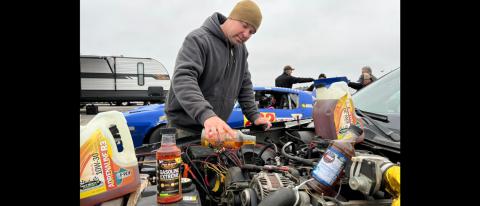
Additionally, Hot Shot’s Secret will provide teams with fluids, including racing engine oil, transmission fluid, gear oil, plus oil and fuel additives for the race team and their diesel haulers used to tow the race cars.
The fundraising activity is structured to provide opportunities for matching donations throughout the year.
The West Coast Stock Car/Motorsports Hall of Fame has announced its selection of six Heritage members, whose careers primarily took place or began before 1972. Their selection brings the 2022 honorees enshrined during this year’s induction ceremonies to a total of 12. The event, presented by World Wide Technology Raceway, will take place on Thursday, June 9, at Sonoma Raceway’s VIP/Hospitality Complex in Sonoma, California.
The 2022 Heritage inductees are Art Atkinson, Phil Casey, Ron Esau, Phil Hill, Ken Sapper, and Jim Walker.
“We at the Hall are thrilled with this year’s Heritage inductees,” said Ken Clapp, the chairman and CEO of the West Coast Stock Car/Motorsports Hall of Fame.
Previously announced members of the Class of 2022 are Greg Biffle, NASCAR Xfinity and Campion World Truck Series champion; Garrett Evans, multiple NASCAR Northwest Series champion and track operator; Brendan Gaughan, two-time ARCA Menards Series West champion; David Gilliland, two-time ARCA Menards Series West championship crew chief and Daytona 500 pole winner; John Moore, driver and owner champion and Placer County (Calif.) Fair Board president; and Jimmy Sills, three-time U.S. Auto Club Silver Crown Series champion.
Tracking legal, legislative, and regulatory developments impacting the racing and performance industry.
PRI’s Washington, DC-based advocacy team works continuously to protect race tracks, sanctioning bodies, and motorsports businesses around the nation. This month, we are tracking several initiatives, including ways you can support the federal RPM Act, as well as a California short track, plus an update on Japanese tariffs, lawmakers combating counterfeit goods, and a bill to support manufacturers in the Golden State.
Six (Easy) Ways You Can Support The RPM Act
PRI continues to work closely with key lawmakers in Congress, PRI Members, and the racing community at large to enact the Recognizing the Protection of Motorsports Act (RPM Act), H.R. 3281 and S. 2736. The RPM Act clarifies that it is legal to make emissions-related changes to convert a street vehicle into a dedicated race car under the Clean Air Act (CAA). The bill would also confirm that producing, marketing, and installing racing equipment on track vehicles does not violate the CAA.
The RPM Act enjoys strong bipartisan support in the 2021–2022 session of Congress, thanks to unprecedented grassroots advocacy by the motorsports parts industry and targeted outreach to lawmakers through Congressional site visits and meetings. However, it is imperative that we continue to keep pressure on lawmakers to pass the bill before the Congressional session ends on January 3, 2023.
“Congress is responsive when there is a sustained drumbeat of support for an issue. In order to pass the RPM Act into law, it is important that PRI Members and the racing community overwhelm lawmakers with calls and letters that reinforce that they must pass the RPM Act,” said Eric Snyder, PRI’s Director of Congressional Affairs.
Here are the ways you can support the RPM Act:
1) Call or send a letter to your lawmakers at: saveourracecars.com. A letter has already been drafted. It takes less than a minute to send it to all three of your federal lawmakers.
2) Sign a letter to your lawmakers on company letterhead. Email Snyder at erics@sema.org for a template and more information.
3) Post about the RPM Act on your company’s social media accounts or pass out a flyer at your business events using the toolkit of digital assets at sites.sema.org/rpmtools.
4) Learn more about PRI’s Political Action Committee (Performance Racing PAC) at performanceracing.com/pac. Performance Racing PAC allows PRI Members to support the lawmakers that stand up for racing in Washington.
5) Share a video (youtu.be/-V5tqQrWvL4) with your friends to educate them about how a bill, like the RPM Act, actually becomes law.
6) If you have a connection to a member of Congress or their staff, contact erics@sema.org to see how we can leverage this relationship to benefit the industry.
U.S., Japan Announce Update On Steel And Aluminum Tariffs
As an update to January’s Advocacy Corner column, U.S. and Japanese officials have agreed to a tariff-rate quota deal to end the 25% tariff on steel imports from Japan. These tariffs have been imposed since 2018 under Section 232 of the Trade Expansion Act of 1962 on national security grounds.
Beginning April 1, the 25% tariffs will be suspended on up to 1.25 million metric tons per year of steel imports from Japan.
In 2019, the U.S. had imported 1.1 million metric tons of steel from Japan. This was significantly less than the 1.7 million tons imported in 2017 before the tariffs were imposed.
“This is likely to make it more attractive to import steel from Japan. But it’s important to note the tariffs are only suspended on up to 1.25 million metric tons per year of imported steel,” Snyder said.
In addition, the new agreement does not cover aluminum imports, which are still subject to 10% tariffs.
Separately, the U.S. and the European Union have agreed to a quota system for ending the steel and aluminum tariffs in 2022. As of early March, negotiations were underway to end the metal tariff disputes between the U.S. and the United Kingdom.
House Passes Act Designed To Combat Counterfeiting
The PRI and SEMA-supported “INFORM Consumers Act,” H.R. 5502, has passed the U.S. House of Representatives as part of the “America Creating Opportunities for Manufacturing, Pre-Eminence in Technology, and Economic Strength Act of 2022” (America COMPETES Act), H.R. 4521. The INFORM Consumers Act is designed to protect Americans from criminals who sell counterfeit and stolen goods through online marketplaces and would require high-volume third-party sellers to disclose the full name of the seller or company, its business address and its contact information, among other requirements.
The U.S. Senate did not include the INFORM Consumers language in its version of the COMPETES Act. As the House and Senate seek to reconcile the differences in the two bills, PRI and SEMA are advocating for passage of the INFORM Consumers Act. These efforts are in coordination with the Buy Safe America Coalition, a group of retailers, consumer groups, manufacturers, intellectual property advocates, and law enforcement officials who support efforts at all levels of government to protect consumers and communities from the sale of counterfeit and stolen goods.
“We are alarmed by the danger posed to unsuspecting consumers when they purchase what they believe to be legitimate auto parts and equipment,” said Daniel Ingber, SEMA’s Vice President of Government & Legal Affairs. “The reality is that major sources of counterfeit products are Internet consumer purchases that arrive in the United States via postal and overnight carriers. We are confident that, by passing commonsense legislation like the INFORM Consumers Act, we can stop these bad actors from selling dangerous counterfeit automotive parts and equipment to unsuspecting consumers.”
In recent years there’s been a rise in the sale of counterfeit automotive parts on online marketplaces, posing a threat to the safety of U.S. consumers. The coronavirus pandemic has exacerbated the issue, as traffic toward e-commerce has grown and current regulatory standards fail to hold third-party marketplaces accountable.
A recent study published by the Buy Safe America Coalition found that illegitimate imports entering the U.S. cost domestic retailers nearly $54.1 billion in sales annually. Additionally, over 39,000 jobs in wholesaling and 280,000 retail jobs—paying over $13.6 billion in wages and benefits to workers—were found to be lost due to counterfeit production.
The U.S. House-passed America COMPETES Act is the counterpart to the U.S. Senate-passed “United States Innovation and Competition Act of 2021” (USICA), S. 1260, which did not include the INFORM Consumers Act. The House and Senate are expected to conference the two bills and reconcile their differences. PRI will advocate for inclusion of the INFORM Consumers Act in the final consensus bill produced by the two houses.
For additional information, contact Eric Snyder at erics@sema.org.
CA Bill Erases Sales Tax On Most Equipment Purchases
California Assembly Member Tim Grayson (D-Concord) has introduced PRI- and SEMA-supported legislation (AB 1951), which would create the California Manufacturing Attraction and Development Exemption (CA MADE). The CA MADE exemption would eliminate the sales tax on most manufacturing equipment purchases.
If it’s enacted, California would join 38 other states with full exemptions on manufacturing equipment from sales and use tax. The CA MADE exemption would change the current, narrowly applied exemption, and focus on improving cost competitiveness to spur investment in California. Accounting for both local and state taxes, California’s ranks among the highest tax rates in the country.
“AB 1951 will allow businesses to invest in the latest manufacturing technology, innovate faster, and expand their market share,” said Christian Robinson, Director, State Government Affairs & SEMA PAC.
PRI Members and the racing industry are encouraged to register their support for the bill by visiting https://p2a.co/Cgf1U1H. For more information, contact Robinson at christianr@sema.org.
Your Support Can Help Save Calistoga (CA) Speedway
Officials have announced the City of Calistoga is preparing to purchase the Napa County Fairgrounds in Napa County, California, a move that would re-open the famed half-mile dirt oval Calistoga Speedway, best known for the annual “Louie Vermeil Classic.”
The City Council has unanimously agreed to develop a proposal to purchase the entire fairground property, including the dirt race track plus a golf course, RV lot, and several buildings.
Calistoga Speedway, operated by the Hunt Family and HMC Promotions, first opened in 1938. Its “Louie Vermeil Classic” honors Calistoga resident and longtime racing enthusiast Louie Vermeil. The track has not hosted the event since 2018.
“Calistoga Speedway is one of the only half-mile dirt tracks in California, and it’s been silent for years. Instead of competing at their local track, racers are often forced to visit other cities and states, and that has a negative impact on the local economy,” Robinson said.
For more information about how you can support this initiative, contact Robinson at christianr@sema.org.
AZ Introduces Proposal Urging Congress To Pass RPM Act
Arizona’s legislature has introduced a PRI- and SEMA-supported memorial (H.C.M. 2001) urging the U.S. Congress to pass the Recognizing the Protection of Motorsports (RPM) Act (H.R. 3281 and S. 2736). A memorial is a document presented to a legislative body and contains a petition or a representation of facts.
In short, Arizona lawmakers are urging Congress to pass the RPM Act, which guarantees the right to modify street cars, trucks, and motorcycles into dedicated race vehicles and safeguards the industry’s right to offer parts that enable racers to compete.
Arizona race enthusiasts are encouraged to voice their support for the memorial by contacting lawmakers at https://p2a.co/hc8EZhP.
When building a proper E85 fuel system, it’s important to select an injector size that meets the flow requirements while maintaining a 90% or lower duty cycle.
Consider these important factors before moving to E85, including how to care for your fuel system after the fact.
There are many options to choose from beyond standard pump gas when fueling a high-performance engine, including 93-octane pump gas, ethanol blends, methanol, and myriad race gas options. Like every other decision made when building a race car, each option has advantages and disadvantages, and the build team decides what will work best given the project budget and objectives. One option that has skyrocketed in popularity over the last decade is E85, a blend of 15% gasoline and 85% ethanol. This article will give a basic overview of the advantages and disadvantages of E85, guidelines for components and tuning, and some best practice suggestions for E85 fuel system maintenance.
Why Choose E85?
The performance advantage of E85 versus pump gas lies in its octane rating and its cooling effect on the intake charge. True E85 has an octane rating of 105. The RON component of the R+M/2 octane rating is particularly high, meaning E85 is resistant to knock, which allows increased timing advance and boost pressure. In addition, the ethanol component of E85 extracts heat from the intake charge as it transitions from a liquid to a vapor phase. This cooling effect creates a dense, oxygen-rich intake charge that increases combustion energy. There are also two significant practical advantages with E85 from the pump: affordability and convenience. Pump E85 is easy to find at many retail filling stations throughout the Midwest, and with a bit of searching can be found throughout most of the US. If there is a need for a search, it is worth the effort because pump E85 is a performance bargain. At a current national average of $3.09 per gallon at the pump, E85 costs less than even the cheapest low octane gasoline.
Does E85 Have Any Disadvantages?
One of the most significant issues when using pump E85 is that the concentration of ethanol can vary significantly. The term “E85” can be a misnomer because the standards organization ASTM International allows fuels with ethanol concentrations as low as 51% to carry the E85 label. Inconsistent fuel properties can have catastrophic effects on a tuned performance engine. Another point to consider is the hygroscopic nature of ethanol. Ethanol readily pulls moisture from the air, so E85 may be “watered down” if not transported and stored correctly by the fuel retailer. Water can also accumulate in a vehicle’s fuel tank if left at a low fuel level for an extended period, especially in a humid environment. It’s also important to remember that ethanol has high corrosivity and low lubricity, which together can lead to premature wear of fuel system and engine components. Lastly, the energy density of E85 is significantly less than standard gasoline. This means fuel economy will be reduced, and injectors and the fuel pump might need an upgrade (more on this below).
While most OE and aftermarket pressure regulators are compatible with E85, beware of those with brass sealing valves that can be susceptible to corrosion. The optimal choice is a regulator with stainless internals and a fiber-reinforced Viton diaphragm.
Pump E85 vs. E85 Race Fuel
The rise in popularity of E85 has taken place at the pump and through traditional race fuel manufacturers like VP Racing, Sunoco, Ignite, and others. As mentioned, two disadvantages of pump E85 are the inconsistency in ethanol concentration and the risk of water in the fuel. However, both are essentially non-issues for racers going the E85 race fuel route. E85 race fuels have an 85% ethanol concentration every time. However, this quality and consistency come at a high price. E85 race fuels typically cost $8–$12 per gallon and can be challenging to find, transport, and store. This makes the allure of easily accessible pump E85 at the cost of $3 per gallon hard to pass up.
Building An E85 Compatible Fuel System
Building a proper E85 fuel system will take advantage of all the performance benefits of pump E85 while mitigating the risks. Flow capacity, material compatibility, tuning, and maintenance are the biggest considerations.
Fuel System Capacity
The lower energy density of E85 requires 30–40% increased flow from the fuel system to maintain proper lambda. Usually, fuel injectors and fuel pumps—and occasionally fuel lines—need to be upgraded to increase flow. Selecting an injector size that meets the flow requirements while maintaining a 90% or lower duty cycle is recommended. It is also recommended to have 10–20% headroom on the fuel pump. Technical support from a quality fuel systems manufacturer or retailer, or a consult with an engine tuner, should help in choosing the right components.
General Material Compatibility
The high corrosivity, low lubricity, and hygroscopic nature of E85 can wreak havoc on an ill-equipped fuel system since what works for gasoline does not necessarily work for E85. Materials to avoid are PVC, nitrile, natural rubber, urethane, non-anodized aluminum, zinc, brass, and any untreated ferrous metals. In general, OE fuel systems in vehicles manufactured before 2001 were not engineered for compatibility with any concentration of ethanol in the fuel. Therefore, the entire fuel system should be evaluated and upgraded.
Fuel Injectors
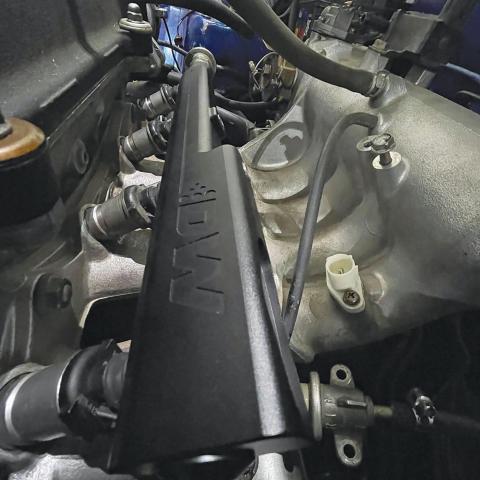
Most modern fuel injectors, such as the Bosch EV14, have stainless steel internals and withstand harsh corrosive environments. When it comes to O-rings, Viton O-rings are the best choice for use with E85 since the compatibility of nitrile is debatable. Lastly, the addition of a serviceable inlet filter is recommended for all injectors in a fuel system using E85. This filter will serve as the last line of defense against clogging with fuel system residue.
Fuel Pumps
Brushless fuel pumps are the most durable choice for E85 use, but note that quality brushed pumps with carbon commutators can be very durable. It is essential to avoid pumps with copper commutators. For in-tank pumps, composite turbine impellers are much more durable than positive displacement gerotors such as those found in Walbro 255-style pumps.
Fuel Filters
Most OE fuel filters are paper or cellulose and are acceptable for use with low ethanol concentrations. However, as the ethanol concentration increases, these filter materials become susceptible to breaking down. In E85, the breaking down of paper and cellulose filters can cause flow restrictions, starving an engine of the fuel it needs. Stainless steel mesh filters are the tried-and-true safe bet. No variation in filter pore size is required to accommodate E85. There is a common misconception that a 40-micron filter should be used instead of a 10-micron. This idea is to prevent filter clogging because E85 can dissolve solids that gasoline cannot. However, this is a bad idea. All port fuel injectors require 10-micron filtration for proper protection. If concerned with clogging filters, the correct course of action is to increase the filter size (capacity), not filter pore size.
Pressure Regulators
Most OE and aftermarket pressure regulators are compatible with E85. However, some aftermarket regulators have brass sealing valves that are susceptible to corrosion. This corrosion can result in poor sealing and loss of pressure at key-off. The best option is a regulator with stainless internals and a fiber-reinforced Viton diaphragm.
Fuel Lines
OE fuel lines are often left intact when upgrading fuel systems for increased flow of gasoline. However, special consideration should be taken when converting to E85. The rule of thumb is to replace all OE rubber and leave OE hard lines intact. This is primarily a safe bet on vehicles manufactured after 2001. It is recommended to use CPE synthetic rubber line for concentrations up to 85% and a PTFE (Teflon) line for concentrations above 85%. Some customers prefer PTFE regardless of the ethanol concentration. There is no harm in that, but PTFE is more expensive and challenging to assemble.
Tuning For E85
After building an E85 fuel system, it’s time for tuning. With E85, a tuner will be able to add timing advance and increase boost pressure, which will significantly increase an engine’s power. The tuner will also need to adjust for the 30–40% increase in fuel volume needed by E85. This is where the bigger injectors and pump suggested earlier will pay off. There is nothing more frustrating than running out of fuel on the dyno, falling short of the anticipated power level. Cold starts on E85, especially in the winter months, can be problematic, so be sure the tuner adjusts cold start tables.
While it is recommended to use CPE synthetic rubber line for ethanol concentrations up to 85% and a PTFE (Teflon) line for concentrations above 85%, some customers prefer PTFE regardless of the ethanol concentration.
Developing a flex-fuel tune makes life with ethanol much easier. A flex-fuel tune is only possible if an ethanol content sensor is incorporated into the fuel system to communicate with the ECU. Once set up and tuned, the engine will be able to adjust to varying concentrations of ethanol in the fuel, just like an OE flex-fuel vehicle. Without flex fuel, a tuner can only calibrate for a specific concentration of ethanol, requiring the racer to be very particular about the fuel used. This can be critical when using pump E85, as the exact ethanol concentration can vary significantly according to brand, class, season, and region. A flex-fuel tune will also allow the use of regular unleaded pump gasoline when an E85 pump cannot be found, or if the vehicle is going to be stored for an extended period. Also, when putting the car into storage in the offseason, it isn’t necessary to flush or pickle the fuel system; just run a tank of regular gasoline before storage.
Maintaining E85 Fuel Systems
Success with E85 fuel systems lies with the proper component choices and following established best practices for storage and maintenance. Vehicles stored with E85 in the fuel system can develop corroded pump commutators, stuck injectors, and clogged fuel filters. Best practices are to flush the fuel system with gasoline and fuel stabilizer before storage. This will help ensure the fuel system will perform adequately before the next race. If the vehicle has been stored for more than a year with E85 in the fuel system, it is suggested to inspect the fuel tank, change the fuel filter, service the injectors, and test the fuel pump. Although time-consuming and somewhat costly, performing these checks are better than risking fuel starvation and damaging a high-dollar performance engine.
It is also best practice to increase the frequency of routine fuel system maintenance when using E85. Ethanol will lift contaminants from fuel system components that gasoline would have left untouched. This “cleaning” of the fuel system by E85 can load up fuel filters quickly, especially upon initial conversion from gasoline to E85. Check the filter frequently to avoid restricting flow and possibly contaminating the fuel injectors. Lastly, many E85 users will pull their injectors and send them out for flow testing during the offseason. This may be overkill for a regularly driven vehicle, but for a race car or occasional driver, which is stored with E85, it can be cheap insurance given the engine damage that could occur if injectors are clogged.
David Deatsch is the founder and president of DeatschWerks, a manufacturer of high-performance injectors, pumps, and other fuel systems components based in Oklahoma City, Oklahoma. Deatsch has maintained the company’s technical lead since its inception in 2004 and has vast experience in E85-specific product development, component durability testing, and fuel system conversions. Current project vehicles for DW include a flex-fuel 750whp CTS-V, an E85 450whp Subaru 2.5RS, and an E85 drift project SR20 s13.
Hoosier Racing Tire President and CEO Joerg Burfien
This iconic brand that dates back to the 1950s plans to expand its footprint in motorsports, both domestically and abroad.
The official company logo is still the immortal stylized “H,” printed in purple, the color borrowed from founder Bob Newton’s race car when he established Hoosier Racing Tire in 1957. While the neo-gothic purple H remains intact, Hoosier has otherwise retooled its corporate branding for easier recognition and has recently rejoined PRI as a Founding Member.
The Hoosier brand is one of the most iconic in North American motorsports. For countless race fans, it evokes an image of a non-wing sprint car firing a barrage of clods at the wall of some loose-dirt Indiana bullring. Even though German tire giant Continental AG took ownership of Hoosier Racing Tire in 2016, much of the Hoosier production takes place at an expanded manufacturing facility in Plymouth, Indiana, where tires for oval competition, both on dirt and asphalt, are the firm’s enduring core products.
But that base is steadily broadening. With global reach in the tire market amassed during its 150-year history, Continental’s overarching endeavor is presenting Hoosier purple to the wider world, both for competition and street applications, and not always originating from the tire’s namesake home. Issue one, however, remains stabilizing tire supplies, as tracks, teams, and organizers continue dealing with pandemic-related shortages.
“The supply chain, at least to our knowledge, is pretty drained on every level,” Hoosier Racing Tire President and CEO Joerg Burfien explained to PRI in January 2022. “It’s at our warehouse, at the distributor level, the dealer level, and even the race teams themselves have been hoarding tires. This fact will force us to produce at a higher level just to fill back what was consumed last year.
Hoosier Racing Tire’s iconic purple “H” is based on the shade of purple on company founder Bob Newton’s race car in 1957. Hoosier Racing Tire has since been purchased by Continental (in 2016), which provided additional resources and a global reach to the motorsports tire manufacturer.
“On top of that, we’re still seeing a very high demand,” Burfien said. “Compared to 2019, which was the last normal year for us, we’re still experiencing shortages. Everybody believes it will blow over and we will manage—and here, we have managed—but we’ve also told people to change tire rules, run tires longer. By the time summer is here, we should be able to make all these tires, even though we’re seeing demand way above our manufacturing capacity. We will have to cut some series short, and we’re actively communicating that.”
The first remedy Hoosier Racing Tire has pursued is simply keeping its customers apprised about the state of the competition tire market and how it’s likely to evolve. Part of the solution has involved streamlining Hoosier production in Plymouth to concentrate on core, demand-driven tire sizes and compounds. “We changed some tire specifications and eliminated some others to extend tire life,” Burfien said. “We’ve taken out some complexity through fewer tire choices, which should make the supply situation a little more relaxed, but I’m not sure how much further we can take it. Everybody thinks that on February 1, the situation will be back to normal, but it can’t be, because all the warehouses are still basically empty. We are shipping, though, and we’ve introduced a weekend shift now at Plymouth, and we expect we will have a record year of production in 2022, but we fear that it may not be enough.”
Burfien stressed that even before the pandemic, demand for Hoosier tires was on an upswing, a reality that exacerbated the shortages further. “Demand wasn’t as far down as we anticipated, about 10–15% below 2019 levels, and we were expecting to be down much more than that. People still have time and money. They build cars, and they want to race. That’s a good problem to have from a business standpoint, but not so good from the standpoint of customer satisfaction.”
Addressing the tire shortage in motorsports, Hoosier Racing Tire President Joerg Burfien reported streamlined tire production in the company’s Plymouth, Indiana, manufacturing facility to concentrate on core, demand-driven tire sizes and compounds. He noted that even before the pandemic, demand for Hoosier tires was already on the rise.
Hoosier was steadily expanding its presence across a growing range of racing disciplines when Continental acquired the firm. Drag race, road course, pro street, and karting rubber occupy Hoosier’s product portfolio. In coming months, the breadth of Continental’s marketing and technological reach will open new markets for Hoosier that don’t necessarily wind their way through Indiana, Burfien predicted.
“We will never forget our heritage and core market; it’s by far our biggest segment, and we will continue to maintain and develop that,” he said. “We are looking closely at the ATV and UTV market, and with the help of our mother company, we are also looking seriously into the semi-street or dual-purpose tires, UTG 200 or even UTG 80 or 100 tires,” referring to the US-mandated Uniform Tire Quality Grade that measures tread wear. “We have just a joint product with Conti, the ExtremeContact Force, a UTG 200 racing tire, that was introduced last summer. It was developed by Hoosier, it’s sold by Hoosier, but it’s built by Conti in Germany.
“We’re looking to make the Hoosier brand available outside the US, because we were pretty much a nobody in Europe,” Burfien said. “We have a Hoosier sales team in Europe now. If we want to expand Hoosier into China, Conti already has thousands of people in Beijing and Shanghai. Our tractor pulling tires will be coming out of Malaysia now—they’re too big for us to make in Plymouth, so that’s something that we could have never looked at without the Conti footprint. We’re also looking at recreational vehicle and endurance tires, from Thailand or APAC, although Hoosier-branded race products will be out of Plymouth for the next couple of years, for sure.”
Electronic fuel injection is more popular than ever, and manufacturers are pouring valuable resources into developing new products with more versatility, greater power potential, and added convenience.
It was once thought of as the enemy—the end of racing, hot rodding, and the freedom to modify cars at will. Now, a few decades later, electronic fuel injection (EFI) is seen as one of the great liberators of the performance world, a technology that allows unprecedented reliability, precision, and consistency.
And from what we can tell, it’s really just getting started. The far-reaching products that EFI manufacturers are developing continue to push this technology to levels few racers could even imagine not that long ago.
To get a handle on these developments, we reached out to some of the leading suppliers in the EFI market. They gave us the lowdown on the trends, products, and expectations that will affect motorsports in the months and years to come.
The Push for Power
One of the biggest factors driving the EFI market is the proliferation of very high horsepower engines. As power output climbs, EFI manufacturers are forced to keep pace. The resulting EFI systems facilitate even greater power, resulting in a self-perpetuating cycle of escalating output.
“We’ve been seeing insane growth in horsepower numbers,” said Mike Wahl of FiTech Fuel Injection, Riverside, California. “Four-hundred horsepower isn’t a lot anymore, when cars are putting down 800 or 1,000 horsepower to the rear tires now. So we’re having to make our fuel injection systems grow to accommodate people—bigger injectors, more robust computers, and just more technology.”
Although big horsepower numbers are still very much within reach of carbureted engines, there are many things that can go wrong when an engine is boosted, tuned, and tweaked to its absolute limits. Many racers find that a traditional carb setup isn’t up to the demands of this unyielding environment.
“Horsepower numbers are getting so high that the precision that comes with fuel injection is becoming almost a necessity,” said Evan Perkins of Holley Performance Products, Bowling Green, Kentucky. “In the realm of 3,000-plus horsepower, running lean, even for a split second, or having any point in the powerband that’s not controlled is a major problem.”
But with outrageous power levels becoming the norm these days, injector manufacturers are encountering unique challenges that must be taken into consideration throughout the design process. Among these new challenges is the proliferation of specialized fuels.
“Normal race gas has definitely declined in popularity,” observed Tim Jilg of Fuel Injector Clinic, Hobe Sound, Florida. “Right now, it seems like E85 is king, as far as all-around race fuel. When people move past that it’s typically to methanol. So we look to materials that are compatible with harsher fuels like M5 or Q16. Anything with nitromethane or an oxygenation chemical in it can be a little rough on some of the current larger fuel injectors.”
Making the choice of materials for injectors even more difficult is the fact that materials with the best chemical resistance sometimes can impede essential functions of the injector. “The injector coil is basically an electromagnet,” explained Jilg. “It has to grab the valve and pull it up. But a lot of the materials that are resistant to chemicals in certain racing fuels don’t respond to magnetism as well as something that would have some more iron in it. To make the valves operate the way they do, they have a little bit more iron in their material, and because of that, they are susceptible to corrosion.”
According to Jilg, most EFI injectors are manufactured by Bosch regardless of who builds the rest of the system. But some EFI manufacturers are now starting to build their own injectors, as the demand for ever-higher flow rates dictates more specialized designs and materials.
Supporting today’s ultra-high-horsepower engines requires a sometimes-tricky balance of flow rate, fuel compatibility, and drivability in EFI systems, noted our source at Fuel Injector Clinic.
Along with the EFI system itself, the quest for greater power is pushing the limits of the rest of the fuel system. Adding to the challenge of moving more fuel on high-horsepower EFI applications, fuel system manufacturers often have less space to use within the tight confines of late-model cars.
“New engine technology has pushed fuel demands ever higher with increased power,” said Rob Scharfenberg of Fuelab, Collinsville, Illinois. “This has placed greater demand on finding higher flow rates and improved performance with smaller and smaller package sizes. We’ve responded by expanding our line for higher-flow-rate fuel pumps, and we are offering new configurations that allow higher-performing systems in tight spaces, like fuel modules in modern vehicles.”
Driving It Home
Now that the ability to coax thousands of horsepower from a relatively small displacement V8 is pretty routine, racers are looking to have that kind of power in cars that can readily be driven on the street. “People can make so much power so easily and reliably that everybody’s goals have gone up tremendously,” observed Jilg. “Nowadays it’s not uncommon for us to talk to customers who want to put a ProCharger on their car, make 1,000 horsepower, drive it every day, and then go to the track on the weekend and beat on it.”
For extreme dual-purpose cars, EFI systems are increasingly designed to support high-horsepower race applications while maintaining acceptable low-speed drivability for street use. “What we see a lot of these days is staged injection,” explained Jilg. “There will be two or three sets of injectors—smaller primaries for street manners, and then after a certain indicator, the ECU will activate the secondary set of injectors for wide-open throttle.”
Along with that, the increasing popularity of high-horsepower dual-purpose cars is also driving injector development, too. According to our sources, giant injectors that can flow massive amounts of fuel and still remain streetable are somewhat of a holy grail for EFI manufacturers.
“That big, 3,000cc injector that will idle nicely, that’s kind of like the golden egg right now,” noted Jilg. “We do not have anything to confirm 100% yet, but we are working on an injector like that. We have been developing it for well over a year now, and we have made a lot of progress. We are hoping to have an announcement about it maybe later this year.”
While high-horsepower drag cars make up a large portion of the dual-purpose cars being built, pro-touring-style builds continue to gain popularity. Essentially vintage cars with advanced, modern drivetrains and suspensions, these machines are being put into competition more often these days. Naturally, EFI manufacturers are responding with appropriate products.
“I’m really seeing an increase in autocross,” observed Wahl. “For those applications, we’re seeing more port injection versus throttle-body injection, and guys who are using power adders because they want a snappier response. We’re developing systems that can support that.”
New Users, Challenges
As EFI is increasingly seen as a mainstream, necessary product by many racers, our sources said that what constitutes the “typical” EFI user is gradually shifting. “We’re seeing a lot more people moving to EFI who were traditionally hardcore carburetor guys before,” noted Perkins. “I think that’s a little bit of a monkey-see-monkey-do phenomenon: This guy set a record, and he’s running fuel injection.”
To further entice the traditional carburetor crowd, FiTech will soon introduce its new Nemesis system. Built on a 4500-flange Dominator-style throttle body, the new system runs 12 injectors and can support up to 1,600 horsepower. “The guys with the high horsepower, they’re often on a very well-built carburetor that they’re constantly having to work on,” said Wahl. “Our 4500 system will be able to learn, pick up, and go. Our goal is to try to get rid of carburetors, period.”
EFI users increasingly expect systems to be easy to install and set up. Holley’s Terminator X line is designed to fit specific make and model cars, with plug-and-play simplicity.
And as more racers migrate to EFI systems, the knowledge level of users has shifted somewhat too, according to our sources. While EFI on race cars was once largely the domain of specialized tuners and engine builders, it’s now being adopted by less technically inclined users. This continues to put demands on manufacturers who have to support these products.
“When you get fuel injection right, it’s awesome,” said Wahl. “But it exposes every problem on the motor that a carburetor would cover up. When we first developed our systems, one of our co-founders said, ‘Now we’re going to have to teach the whole world EFI.’ We constantly face that challenge.”
This shift in expertise level is also creating greater demand for systems that are easier to install and set up, so users can consistently get good results with minimum fuss. “Convenience has gotten more important,” noted Perkins of Holley. “Professional race car builders are not going to have a problem building custom wiring harnesses—that’s their bread and butter. But the average guy isn’t going to invest the time to become an automotive electrician and computer tuner to be able to build these sorts of things.”
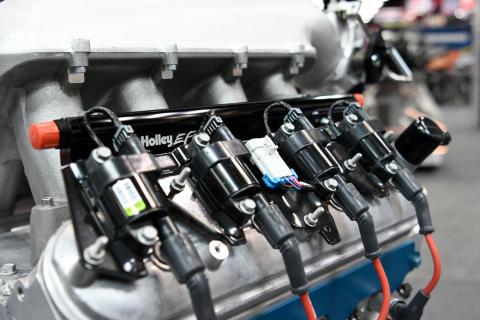
For that reason, “our Terminator X systems for LS, LT, Coyote, and Gen III Hemi have been huge,” continued Perkins. “They’re plug-and-play solutions. Racers just order the Terminator X that matches the year, make, and model engine they have. So the idea of having to buy a universal computer, or build a wiring harness, or order a complex series of sensors and pigtails and plugs and then put it all together is out the window.”
Manufacturers are also taking note of other aspects that often prove difficult or time-consuming when converting a car to EFI, such as setting up the requisite dual-line return-style fuel system. “We’ve worked really hard to do year-make-model-specific fuel modules,” explained Perkins. “If somebody is doing an EFI swap, all they have to do is drop their tank, knock the sender out of it, and drop our unit in. It has a combo fuel pump and sender. Their stock tank goes back up into the car, and all of a sudden it’s an EFI-capable fuel system.”
A number of manufacturers also offer kits that speed the installation of more efficient brushless fuel pumps. “Our latest offering is the 496xx Series in-tank brushless fuel pumps,” said Scharfenberg of Fuelab. “Like other standard in-tank pumps, these new fuel pumps fit into modern fuel tank modules. We have kits that include everything needed to install the system, including the controller, sealed bulkhead for passing wiring into the fuel tank, and supplied terminal sets.”
New Engines, Old Engines
Ultimately, the market for EFI systems is largely driven by engine platforms. The 460-pound gorilla of the V8 racing world is still the LS motor, which can be found in everything from Camaros to Caterhams.
That said, some EFI manufacturers we spoke to are starting to notice a shift away from the LS to the newer LT design, due largely to increasing prices being charged for the steadily dwindling supply of used LS engines. To facilitate moving to the LT, FiTech is introducing new EFI systems to make it a more viable engine platform for racers.
“The LT motor is going to be the next booming motor as far as a Chevy platform for our systems,” said Wahl. “The LT motors are designed to be direct injection, but we’ve developed a kit to convert them to a port-injection system. It’s going to be out in 2022, by mid-year.”
Fuelab’s 496xx-series in-tank brushless fuel pumps fit into modern fuel tank modules, and are offered as a complete kit to speed installation.
Regardless of which engine platform is being used, late-model engines are a huge portion of the EFI market. Accordingly, Kinsler Fuel Injection in Troy, Michigan, has developed its own drive-by-wire throttle actuator for use on a wide range of the company’s throttle bodies, including units designed for Honda, Toyota, Porsche, and the gamut of American V8s.
When used with a compatible ECU, Kinsler’s actuator can facilitate such features as traction control, launch control, shift rev-matching, rev limiter, and pit-lane speed limit. Somewhat recently, Kinsler also introduced billet 4150- and 4500-flange throttle bodies with available drive-by-wire, which is a purpose-built unit for the racing industry.
But while much of the EFI market has always been rooted in late-model performance cars, our sources also report rising interest in certain classic V8s. “There definitely is a little bit of a resurgence of big block Chevy stuff,” said Perkins. “I see why it’s more popular than it was maybe five or six years ago. The LS architecture is somewhat limited in how big you can build it. Even with modern machining and manufacturing, you’re never going to build a 700-cubic-inch LS engine.”
“I see guys wanting big block Chevys back again,” added Wahl. “So we developed a big block Ultra Ram system, and we give them a sheetmetal intake for a big block Chevy. That gives them that LS throttle body, so big block Chevy guys can get some of the luxuries of an LS motor.”
Wahl also noted that FiTech is looking to expand beyond its largely GM-focused product line to offer EFI products for Ford Coyote and Gen III Hemi. Although no specific products or plans were mentioned for these engine platforms, the company appears ready to begin developing systems for them.
Good Times, Bad Times
The EFI manufacturers we spoke to all reported that demand is extremely strong right now. Several companies stated that they set all-time sales records in 2021. And the current level of development underscores the strength of the EFI market overall. Further evidence of the segment’s health is the influx of companies looking to get into the market.
The Chevrolet LT engine is steadily gaining popularity. To help facilitate its use in racing, FiTech is introducing a kit that converts the LT to a port-injection system.
“More and more people are starting to come to us to build EFI throttle bodies for them,” said Joe Hilerio of BLP Racing Products, Orlando, Florida. “At the same time, we’re working on a retail version of our own throttle body. It will probably be out by summer this year. What I’d like to do is to team up with someone on the electronics side and make a kit for it.”
But while the EFI market thrives, many manufacturers are struggling with the same supply-chain bottlenecks that plague the rest of the performance aftermarket as this is being written. These issues, however, aren’t affecting all EFI component manufacturers equally. “We’ve been very fortunate that the raw materials for fuel injectors weren’t hit hard,” explained Jilg. “We’ve been able to weather this fine.”
Other EFI suppliers haven’t been so fortunate. “I’ve had to really load up on raw materials,” said Hilerio. “We have to tie up a lot of cash flow just to have enough material in here. I just received some quotes, and they’re 25–26 weeks for delivery. And they may call on the 26th week and say it’s going to be another six to eight weeks.”
Along with issues sourcing materials, many companies throughout the performance aftermarket have been struggling to hire enough employees to keep up with increased product demand. Nonetheless, the EFI manufacturers we spoke to for the most part have been able to continue developing and improving their existing products, even while introducing new ones.
Kinsler Fuel Injection has developed a purpose-built drive-by-wire throttle actuator that works with many of the company’s throttle bodies, including its 4150- and 4500-flange units.
“We just revamped our whole product line,” observed Wahl of FiTech. “We introduced a new ECU design last year for our throttle bodies. We took the relays off the throttle body itself and made them into a fuse box. It makes our product more robust so it will last longer. That’s carrying into our new line of products.”
“We’re always developing new firmware,” said Perkins of Holley. “We’re on version six for the Dominator. Last year we added some advanced traction control; we added torque converter lockup control, as well as a whole bunch of other stuff for dedicated racers.
“So even though we’ve already sold customers their computers,” Perkins continued, “we’re still working on the back end, talking to our motorsports team, redeveloping the software, trying to make it better and more expansive. And we will never stop doing that.”
Faced with the loss of its largest industrial customer, this engine building and machine shop in South Central Pennsylvania restructured and re-invented itself as a multi-faceted operation that now serves up race-winning powerplants for competitors throughout the region and beyond.
For those who have never passed through Breezewood, Pennsylvania, it’s a small town that can best be described as a strip of businesses designed to cater to travelers who stumble upon this strange convergence of Interstate 70, US Highway 30, and the Pennsylvania Turnpike. Once a sparkling little city of lights dubbed the “City of Hotels,” the town is now more known for its decaying remnants of that former glory than anything, as more and more travelers these days are inclined to just pass through without stopping.
Tucked into this once bustling little town is LaSalle Engine & Chassis, home to one of the premier dirt track engine builders in the area. The building itself is humble, a former bank building Chuck LaSalle has transformed into an engine building operation. The resourcefulness of this group comes through when shop manager Luke Nesbitt points out with pride how the bulletproof glass from the bank drive-through has been repurposed for the engine dyno room window.
LaSalle did not start out with the goal of becoming an engine builder. Instead, the inspiration that became LaSalle Engine & Chassis came about in 1987. LaSalle, a dirt track racer at the time, was competing in a big race and lost oil pressure in his engine. This experience motivated him to build his own engines and try to make a go of machining and building engines for others.
The success of LaSalle Engine & Chassis stems largely from its staff, which has 165 years of combined experience. “They have a good crew,“ said racer Drake Troutman. “They’ve proven themselves every weekend.” Seen here, from left to right, are Luke Nesbitt, Andrew McGinnes, Paul Shandor, Chuck LaSalle, Eugene Kaminsky, Richard LaSalle, and Doug McGinnes.
The business started as a two-man shop next to his home and steadily grew until it moved into the 7,800-square-foot former bank building. By then, the company was using top-notch equipment to do all block prep and head reconditioning. In 2014, LaSalle added balancing and crank grinding services, with engine dyno service coming onboard in 2016. In 2021, LaSalle upgraded equipment with a new CWT crankshaft balancing machine and a reconditioned Berco crankshaft grinding machine.
By 2016, the business had reached its peak of 20 employees, and its primary focus had settled on industrial engines, with only a handful of racing engines being built in the shop. It was at that peak of success that a major challenge to the company’s existence occurred. It lost its largest industrial customer, causing it to restructure and redefine the business in order to survive. The loss of business did result in reductions in staffing, but numerous strategies were employed to remain afloat and establish new customers. LaSalle invested in more advertising to spread word of his services, purchased new equipment, upgraded existing equipment, and retrained the remaining workforce to focus on the needs of his customers. To strengthen the business, it evolved from the original mix of 98% industrial engine product sales in 2015, to a more balanced 30% heavy- and mid-truck engines; 25% industrial and farm engines; 25% passenger, classic, and muscle car engines; and 20% racing engines.
Experience Matters
The LaSalle team currently consists of eight employees who possess more than 165 years of combined overall machine shop and engine rebuilding experience, with 115 of those years happening right in the LaSalle shop. LaSalle cited the commitment of these employees to producing quality engines, and as a result, a lack of turnover. Leading the team are Nesbitt, the shop manager who has a degree in machine tool technology, and head machinist Paul Shandor, a journeyman machinist.
All employees are trained on the job for the specific machines used in the shop. During LaSalle’s industrial-focused days, it achieved ISO-certified status. Even though there’s no longer a need for the certification, it still utilizes the ISO-documented processes to ensure its customers receive the highest quality products and services possible.
LaSalle’s customer base is mostly within a 200-mile radius, but some of its racing engines have shipped as far away as Tennessee, Minnesota, and Indiana, with its industrial engines shipping all over the United States and also to other countries.
In addition to engine-building services, LaSalle also sells methanol; is an East Coast warehouse distributor for Champion Oils; and is a dealer for VP Racing Fuels, Outerwears Performance Products, Randy’s Racing Filters, and Klotz Synthetic Lubricants.
All of this is a source of pride for LaSalle, who explained, “I’m very proud of my shop and my guys. We are not engine assemblers; we are engine builders. We can make stuff; we can make valve seats. We can make stuff fit. An engine assembler is someone who buys stuff from the suppliers and puts it together in their garage. We can actually grind cranks; we can do our stuff here. We take engines from scratch and build them up.”
That ability to “make stuff” comes in handy considering the diversity of engines the shop builds. The oldest engine that went through the shop was a single-cylinder, 9-horsepower 1903 Waukesha. Other recent unique builds include engines for a 1931 Studebaker and 1928 Cadillac, along with two 1947 flatheads that were in the shop when this interview occurred.
As LaSalle noted, he and his team will work on a variety of engines, including those for golf carts, jet skis, and boats. This characteristic is something that makes LaSalle Engine & Chassis a bit different as far as most engine builders go. It allows customers to bring in their engines and parts to see if those parts can be used to build a quality engine. The answer is not always yes, but the team will look at what the customer has and give honest advice.
That honest approach is what brought Larry “Pork” Sell to LaSalle as an early customer. According to Sell, “I’ve known Chuck for years, and when he went into business, I thought I’d try him because I knew him. I’ve had no complaints since I started getting him to do my engines. We won three championships in the first four years that we had his engines. We’ve had very little trouble with anything, and if we did [have trouble] he took care of it immediately without any added charges. I started racing in 1982 at Jennerstown and raced against him and his brother. I’ve known him ever since. He’s been nothing but honest with me. My sponsor told Chuck he wanted the best he could build, but it had to be legal.”
LaSalle Engine & Chassis has built a reputation for quality work, honest dealings, and close personal attention. The shop routinely tackles anything from 100-year-old antiques to modern racing V8s. Here, shop foreman Luke Nesbitt and Doug McGinnes check engine specs.
Sell’s sponsor is one LaSalle recalled well. He explained, “Larry’s car is sponsored by a business owned by a pastor who stressed, ‘I want a good engine, but it has to be legal.’ He didn’t want to be embarrassed as a pastor and a businessman by being disqualified for an illegal engine. Even more so, it would be embarrassing to me as an engine builder if the only way I could win was by cheating.”
Dirt Track Domination
LaSalle’s passion for the world of dirt track racing is obvious after stepping through the doors of the LaSalle shop, with all the pictures on the walls of his winning customers. But he quickly added, “I like anything that goes fast or makes a lot of noise.”
To explain the logistics of this customer base, the old real estate adage of “location, location, location” applies to LaSalle’s dirt track customers. He explained that a large part of the passion and emphasis on dirt track racing is due to about a dozen dirt racing tracks within a two-hour tow of the shop and a number of others not too much further. Due to this proximity to local tracks, LaSalle builds engines for hobby cruisers, street stocks, semi-lates, limited lates, super lates, and modifieds.
The LaSalle crew prides itself on being able to handle all aspects of engine building, including grinding cranks and making valve seats. Here, Chuck LaSalle sets up a crank balancing machine.
On top of that, South Central Pennsylvania is also a hot spot for sprint car racing. For that style of car, LaSalle builds a “house engine” for the 305 sprints, an engine program Austin Reed runs. Since 305 sprints are popular throughout the country, LaSalle has customers as far away as Oklahoma, Minnesota, Indiana, and New York. One of its more recognizable customers, Jones Performance, whose parts are featured on the “Trick My Truck” TV show, uses a LaSalle engine in its sprint car, driven by Roman and Vivian Jones. With LaSalle power, Vivian was able to win in her fourth time out in the car.
Success is not unusual for cars using LaSalle engines. He reported that in 2021, “our engines won 63 races and five track championships.” Even with the reduced racing schedules in 2020 due to COVID-19, LaSalle engines still earned more than 50 wins. “We have a lot of good customers, a lot of good guys.”
Even though LaSalle has a well-balanced customer base, he quickly clarified that the business doesn’t just build dirt track engines, as it also has customers who participate in drag racing and tractor pulling, along with customers who focus on restorations. LaSalle also proudly noted that his team built five engines for vehicles that crossed the auction block at the famed Barrett-Jackson car auctions.
Helping Others
Outstanding service after the sale for each and every customer is a hallmark of LaSalle’s success, which is evident in the dirt racing program. During the racing season, Doug McGinnes, who assembles most of the racing engines, will attend events at the local dirt track for quick repairs.
To stay informed, LaSalle and his team keep up with the latest technology through magazines, webinars, and related events, including attending the annual PRI Trade Show. LaSalle reported that the team constantly talks with their customers and their parts and equipment suppliers, and, of course, listens to what is going on at the track. Once they have received input from those sources, they incorporate the best ideas into the engine building process and then move on to testing in the dyno room. Finally, drivers running their house engines provide feedback, which is then used to enhance the performance of all of the builds.
Although some businesses may seem detached and lack personal attention, LaSalle has found the opposite to be true for his company’s success. “We are not competitors with other engine builders,” he said. “We want to be friends and work together. That’s how you become successful. Everybody is surprised to find we’re friends with other engine builders. Yeah, we help each other. It’s not about me against you, we’re friends. We call back and forth and help each other when we can; not working against each other. That’s how I was raised and that’s how I do business.
“When you make true friends, that’s priceless,” he continued. “Money can’t buy friendships. I cherish my friends and the people I work with more than anything. Our shop manager, Luke Nesbitt, is an example of that. He’s an amazing person. Always thinking, not about one thing in particular, but he thinks about all kinds of engines; how to get more horsepower, how to get that old tractor engine fixed when we cannot find the parts we need. That’s what made this business. It’s not me. It’s my guys. It’s everybody here. Every one of my employees has a special talent, and it’s a combination of all of them. It’s not one person. Everybody here has something to contribute. My guys are all open-minded and smart. I wouldn’t know what to do without them. I love them.”
The feeling of friendship and family that is felt within LaSalle’s staff and is spread through its suppliers and customer base is reflected in one of its newer customers, Drake Troutman. It’s hard to imagine Drake as a veteran racer, as he is only 16 years old and just got his driver’s permit.
“They don’t cut any corners,” Troutman said. “They’re the type that only puts out the best. Chuck won’t do a motor unless it’s going to be 100%. If someone doesn’t want to go to 100%, then he won’t do that motor for them. That’s the kind of people they are.
“They hopped onboard with me not long after I started racing, which was when I was 11 years old back in 2016. I haven’t switched since. Their engines are the only thing I run. They’re like another set of grandparents to me, great people, church-going people. They won’t cheat you out of anything. I feel like they’re really out for what’s best for the customers.”
As a result of running LaSalle engines, Troutman won 55 races in the past five years and multiple championships, including three track titles and the 2021 Renegades of Dirt Modified Tour championship. “I’m trying to step up to the late model series right now,” he added.
LaSalle’s engines are proven winners, which attracts a loyal clientele of racers who compete at the many dirt tracks within a few hours’ drive of the shop.
Troutman credits LaSalle, Nesbitt, and the entire team for their engine building expertise. “They have a good crew up there,” he said. “They’re small and local, but they’ve proven themselves every weekend. They have a lot of 305 engines out there. As an engine builder, Chuck’s as good as anyone out there. Chuck’s the type who wants the best. If someone comes in and wants to cut corners, he won’t do it [the job] because he doesn’t want it out there with his name on it. He doesn’t need a ton of people, but the people he does have, he wants good people who will go all out with their motors and with their program. They’re a class act. Chuck cares about everyone who works for them. It’s awesome to see how much their business has grown in just the last four or five years since I’ve been with them. One of them is always out there at the track to help.”
All of these factors—the skill to build its own parts, its high level of service, doing what it takes to keep the business up to date and viable, a commitment to excellence and honesty, and treating everyone like family—adds up to the successful business that is LaSalle Engine & Chassis.
Modifieds remain one of the most popular and competitive segments in motorsports. With teams constantly looking for an edge on the track, sanctioning bodies and tech officials have been tasked with keeping costs in check and maintaining safety standards and performance parity while also staying vigilant over those seeking to exploit any gray areas of the rulebook.
The spirit of competition has always fostered innovative thinking, and that’s led to countless advancements in performance, durability, and safety over the years. But as a racing format becomes more refined (and often more complex) as the associated technologies mature, other factors often start to take on greater importance as a result. Ignoring them can put the health of the discipline in jeopardy.
Modified racing serves as an excellent example. The cars are seemingly simple and rule sets are similarly straightforward, factors that have played a significant role in its ongoing success. But with such close competition, racers are always on the lookout for anything that might shave a tenth or two off of a lap time, and that’s turned rule set design and technical inspections into a sport of its own.
“The modifieds have been relatively basic race cars for a long time now, but as things evolve with suspension combinations and platform setups, the modified has kind of become a beast of its own,” said Greg Felton, the director of technical inspection for the Tri-Track Open Modified Series, Seekonk, Massachusetts. “We’ve tried to create some simple rules to make some of the high-dollar things that you might want to do less attractive from a competitive standpoint.”
Maintaining performance parity and a high level of safety will always be top priorities in modified racing, but in recent years, another component has led to increasing importance. “We’ve always been pretty strict on safety,” said Darlo Mulder, tech director for the United States Modified Touring Series, Webster City, Iowa. “When you’re teching a premier class, most of the drivers have been around the sport long enough that they understand the dangers and they take safety seriously. We see more concerns in that area in the lower divisions. The bigger issue is with everyone looking for the performance edge. We often have to decide whether this is an area we’re going to let them go into, or are we going to stop this before it gets out of hand. It’s an ongoing battle, and it really comes down to containing costs so that one team doesn’t have an inherent advantage over another because they can outspend them.”
Seeking The Next Big Thing
Bill Doucette of the Modified Racing Series in Canaan, New Hampshire, said that more often than not, setup trends in modified racing come down to “monkey see, monkey do” behavior within the field. It’s rare that unconventional tactics result in a clear competitive advantage.
As technology evolves, officials often must decide when and how to discourage modified competitors from spending their way to the winner’s circle. “It’s an ongoing battle,” noted one sanctioning body source, “and it really comes down to containing costs so that one team doesn’t have an inherent advantage over another because they can outspend them.”
“An issue came to light a couple of years ago with coil binding,” Doucette explained. “Basically, that’s increasing the wheel loads by limiting suspension travel, so the car becomes very rigid—almost like a go-kart. All of the wheel load is going into the tire and theoretically increasing grip. Racers were spending a lot of money chasing that, but that kind of setup can actually reduce grip in some situations because of the lack of compliance. We watched how other competitive series were handling it, and we saw how they were basically chasing their tails trying to get these guys to stop coil binding. Sometimes trying to chase something and make rules around it ends up costing people money, so after a conversation with one of our chassis guys we decided to see if it would just play itself out. And it did.”
With horsepower levels already exceeding the amount of available grip in most series, competitors have shifted more of their focus toward chassis tuning to find additional performance potential. “We have specs on where all of the mounting points are supposed to be, but every year we seem to find people who are fudging on that,” said Bill Engelstad, tech director for the WISSOTA series, Saint Cloud, Minnesota. “There were some instances where the companies that were re-popping the front stubs were moving things around from the stock locations. On these modifieds they’re trying to get the front crossmember and everything else as close to the ground as they can without digging in, so they’ll try to fudge on some of these measurements to change geometry and lower the center of gravity. We cracked down on that, and guys had to send cars back to have them fixed. Our approach is that if something isn’t legal, we’re not going to make it legal because someone got caught with it. If you don’t do that, it’s just going to get out of hand sooner rather than later.”
Mulder cited weight placement as another area of increasing scrutiny. “They’re trying to put weight in different areas, and it can be a huge advantage, so we have a lot of rules on that. But it’s also a safety issue. Since there are minimum weights that these cars need to adhere to, the teams often need to add weight, but it has to be added to the frame or the chassis—they can’t put it anywhere else. We had racers putting lead weights on suspension parts and rotating parts, and that’s a problem. A lot of folks like to put it inside the left rear to help plant that left rear tire and give the car more bite off of the corners. But this is an area that’s constantly being inspected because we once had an issue where a racer put wheel weights inside his left rear wheel, and during the race the left rear tire blew. When that happened, it shot these lead pellets all over the place, hitting people in the grandstands. It was a bad deal. So there’s a safety element of it that we have to regulate, and we have to be particularly vigilant because of the potential performance advantage it offers.”
Keeping Pace
With such a wide array of different tactics at play, organizers have devised strategies of their own to detect problems without making tech inspections a lengthier process than they already are. “I’ve put together a pretty vast selection of tools to test all of this different stuff that we need to check at the race track,” Mulder explained. “I travel from race track to race track with a full-sized GMC pickup that’s just packed full of tools. It takes a lot of equipment to be able to tech all of it.”
But Felton noted that some inspection methods are more straightforward than others. “I have a very simple system to check for coil bind,” he said. “We roll the two front tires onto two 3/4-inch pieces of plastic. Two guys who weigh 185 pounds each then get on the front bumper, and they have to be able to make the chassis touch the ground. That pretty much eliminates the issue. With no ride height rule, the lowest the guys can run the left front corner of the car is about an inch and a quarter to an inch and a half. The money in coil binding is in the shocks, and the goal here is to implement some simple strategies that make those expensive things go away.”
Engelstad said that as more technology infiltrates into modified racing, it’s no longer the realm of the backyard builder, and with that comes greater challenges for tech officials. “Who would have thought that we would have modifieds in wind tunnels and on pull-down rigs to figure out what’s going on with them? Aerodynamics have turned out to be much more important to these dirt cars than we previously thought, so we’re looking for bodies that have been mounted on the car crooked and things like that. A lot of little things can turn out to be a big thing.”
Leveling The Playing Field
Felton emphasized that the most effective way to keep the racing fair is to be consistent. But he also likes to throw a few surprises in here and there to keep folks honest and streamline the inspection process. “It wouldn’t really be feasible to do every single check on every car at every race because of the sheer amount of time it would take to do that. So there are a few checks that are routine, but I always try to add two or three things in at every race that I won’t do for the rest of the year. That way the racers never really know what I’m going to do and when I’m going to do it. It keeps them on their toes. I was a racer too, so they know what I know.”
The relative simplicity of modifieds is a big part of their popularity. But it also makes for tight competition and plenty of rule-bending, which is challenging for officials to monitor and enforce.
In other situations, new rules must be implemented in order to prevent a situation where the entire field needs to upgrade their cars in order to stay competitive. “Teams are allowed to run either a pull bar or a lift arm—it’s the traction device for the rearend,” said Mulder. “Modifieds don’t have much of a tire, but they’ve got a lot of horsepower, so traction is always a huge concern for these teams. A few years ago, a racer took his pull bar and made it into a two-piece system, essentially a cantilever. The way the rule was written it didn’t outright say that he couldn’t do that, but it wasn’t what we wanted to see, either. It proved to be a huge advantage, and he went on a winning spree. We had to change the rules to be more specific about what we want for this traction device. The gray areas can shift directions for a series, and we didn’t want to force everyone else to have to adopt that system.”
Setup trends in modified racing are often a result of racers mimicking each other in an effort to find what works best. With power output far exceeding grip, much of the focus is now on chassis tuning.
Sometimes the changes are less dramatic, though, and rules need to be updated in order to prevent an incremental trend from getting out of hand. “We were finding that cars were 10 to 12 inches wider at the bottom than they were at the top,” said Engelstad. “About five years ago we implemented a maximum car width rule, and we’ve had to add to it over the past couple of seasons because we weren’t specific enough. People were taking the bottom of the left-hand quarter panel and pushing it underneath the car so they could push the bottom of the right-hand quarter panel out further to create more downforce.”
Looking down the road, the prospect of additional technology making its way into modified racing may pose an even greater challenge for tech officials. “I would say in the next five to 10 years we’re going to start seeing some engine combinations moving over to fuel injection,” said Doucette. “That’s something we’re starting to look at more closely and get prepared for, but it’s going to be tough. Suddenly you’re into engines that have computer control, and that means your tech officials need to understand how to work with ECUs and devise a way to monitor them.”
Effective rules enforcement is largely a matter of discouraging rule-bending by varying what’s checked. As such, tech inspectors often switch up what they look at from race to race to keep competitors on their toes.
Communication is key regardless of where things are headed, said Mulder. “It’s crucial that the tracks, promoters, and tech officials are all on the same page, so we have a private Facebook group that all of our series’ tech officials are members of. That allows us to get something out to everybody fairly quickly and share pictures to help illustrate any concerns.”
Felton told us that it’s important not to conflate consistency with complacency. “Do the right thing and do things consistently, but don’t just do the same things in tech all of the time because teams will quickly get used to that. If they know what to expect, they can just focus somewhere else to look for an advantage. A lot of it has to do with each specific event because there are a lot of outside factors that go into the strategy. The important thing is to keep them guessing.”
Specialized tools, data analysis, and continual education have changed the way on-track incidents are handled in top-tier series in recent years. That approach is starting to make its way into grassroots racing.
From the combustible fluids involved to the sheer physics at play, there’s no question that racing is an inherently dangerous endeavor. It’s an element of motorsports that we tend to romanticize in certain contexts and compartmentalize in others, but at the end of the day, on-track safety will always be crucial to the sport’s well-being.
Although real-world experience has often been the impetus (and cost) for these improvements, racing is now far safer than it was even a decade or two ago, and it only takes a moment of brief reflection to realize just how far we’ve come from “the old days.”
“Back in the early 1980s, first responders like me were often wearing shorts and t-shirts at local tracks,” recalled Jay Masur of Med-Star Dirt Track Rescue, Brandon, South Dakota. “At that time nobody knew any better. I remember that at one of the races at Huset’s Speedway there was an incident that caused a bad fire and some serious burn injuries. The very next week I was in my first fire suit. Most of the improvements we’ve seen in track safety have come as a result of evolving the equipment and procedures in response to incidents that have occurred.”
Safety teams in racing not only benefit from the knowledge and experience of those who came before them, but also contemporary technologies that have allowed them to create procedures and equipment that are purpose-built for the unique requirements of auto racing. And as is often the case with motorsports’ trickle-down effect, elements of strategies that originated in the upper tiers are now beginning to find their way into grassroots racing.
A Targeted Approach
“These first responders often come from paramedic backgrounds, but they also need to be mechanically inclined,” said Jeff Horton of WH Engineering, Zionsville, Indiana. Formerly the director of engineering for IndyCar, Horton said that on-track incidents often come with challenges that are unique to racing.
“When you get to a scene, it’s not always straightforward—there may be debris in the way or broken parts of the car that need to be cut off. But ultimately you are treating a driver who’s potentially injured, so the biggest thing that comes with assembling a safety team is establishing a coordinated response. Each member of the team has a specific job that they’re tasked with. When a team of first responders arrives at a scene in a series like IndyCar and NASCAR, one may go to the driver while another handles flammable fluids leaks, and the others address any potential obstacles they’re facing for driver extraction. It’s become much more scientific,” he explained.
Track safety procedures are more effective now than ever, largely because of lessons learned from real-world incidents. Improvements tend to trickle down from the top tier to grassroots series, officials noted.
Jason Smith of USAC in Speedway, Indiana, said that the approach is often not only motorsports-specific, but also potentially class-specific. “It’s not like we just go to the local fire department and say, ‘Hey, we need six guys to come help out at this event.’ When there are different types of car designs with different types of fuel involved running on different types of tracks, you need people who are trained in how to approach those different scenarios. The way we do safety with side-by-side races might be different than how we’d approach a similar situation with sprint cars.”
He added that ensuring that rescue teams are familiar with the configuration of a given race car can have a big impact on response efforts. “A race car has different characteristics and concerns than a street car, so they need to know things like where the fuel shut-off is and what they have to look out for, so they don’t accidentally grab a hot component or something like that.”
Track first responders ideally have a mechanical background and paramedic experience. In addition, proper training is essential for understanding how to handle specific types of race cars. Photo courtesy of World of Outlaws.
As such, the training programs for track first responders tend to be tailored toward the particular circumstances of a given racing discipline. “Every single official that we have on track at an event has been through the Short Track Incident Response Program,” said Tyler Backman of World of Outlaws, Concord, North Carolina.
“It’s an SFI-certified course, and they’re required to run through it every two years,” he continued. “One of the big elements that is covered is how to properly extricate a driver from a car. The containment seats are much safer than what we used to use, but they’re also more difficult to get people out of, so the program shows these trainees the correct technique to get someone out of a car while minimizing the risk of further injury. Another big component is fire rescue and how to address different types of fires. We’re dealing not only with gasoline, but also alcohol and other types of flammable liquids. How to properly flip a car over is another significant aspect of the program as well. There are a lot of variables involved in on-track incidents, and we want to make sure our first responders are ready for them.”
The eight-hour first responder training program put on by Med-Star Dirt Track Rescue involves race-day strategies that are put into action long before the green flag drops. “Pre-race training is an important element,” Masur said. “For instance, the proper placement of equipment and vehicles, and the verification that the vehicles are stocked and in proper working order.” Along with fire training and extrication methods, Med-Star also looks at how to neutralize potential hazards that can further encumber rescue efforts.
“Working with race cars comes with some additional considerations,” he added. “But there are some pretty simple things that can be done to improve safety, like using dish soap on tubing where you’re cutting to prevent spark hazards and save the blade. When cutting the car apart, there needs to be another person with a dry chemical by the motor during that process. The last thing we want is for a spark to ignite some fuel on the ground and create a bigger mess than we already have.”
The Right Tools For the Job
Horton said that upper-level series tend to have not only in-house training, but also equipment that’s been built specifically for the materials involved in a given racing series. “They’re using trucks that are designed for their race series, and specific tools that are matched to the car designs and the materials used in those cars. Those folks are trained to use those tools. They can’t be fumbling around when they get to the car in a scenario where seconds matter. The situation might be a bit different at the lower levels because of the funding involved, but the fundamental concepts are the same.”
A detailed emergency plan is vital for handling on-track situations efficiently. These plans specify ambulance services, helicopter landing zones, and other essential elements.
The need for specialized tools used in those series often relates to the materials used in those race cars as well, materials that may become more common in grassroots series in the future. “There was an IndyCar incident where a piece of suspension punched through the carbon tub and subsequently pierced the driver’s left leg, but first responders weren’t able to see what was actually pinning the driver in the car, so they initially struggled with the problem,” Horton recalled. “After that we had a desperate need to prevent that situation from happening ever again, so we worked with Holmatro to develop a new tool that would allow us to sheer the side of the cockpit off to get access to the underside of the tub. It was ultimately just a matter of getting a tool with the proper saw blade to cut through carbon fiber, and now all of the trucks in the series carry that tool.”
Meanwhile, Smith noted that it’s important for first responders to be prepared for any contingency that might occur during the process of extracting a driver from a vehicle after an incident. “All of our safety directors have cutter tools like the Jaws of Life or spreaders, or both. Cutters are useful to cut a door or a frame, and spreaders come in handy if something is preventing access to the driver and it needs to be moved out of the way to get them extracted. They typically go through two days of training, if not more, to learn how to properly use those tools.”
Improvements in containment seats and other safety gear have made race cars more secure, but they also create difficulties getting drivers out of cars. Focused training and practice are required to offset this obstacle.
But Masur said that while first responders at the grassroots level need to be familiar with certain extraction tools, the equipment doesn’t necessarily have to be exotic. “We’re not talking about $20,000 or $30,000 tools here. A track can put together a system that will allow it to address virtually everything that can happen for less than $1,000. That can be equipment as common as Sawzalls and impact wrenches, things typically used to take apart a car under normal circumstances. Once the body is off of a car, you’re basically just dealing with tubing.”
Evolving Strategies
Decades of racing has provided organizers and first responders with a wealth of information and experience to draw upon in order to improve their safety programs, but even today, incident response continues to evolve based on what’s being learned on the race track.
“These days when we get to an accident, we know how to properly approach it,” said Backman. “Part of that simply comes down to preparedness. For instance, we have emergency plans for all of the different race tracks we go to. Going into it, we know who the ambulance service is, who the fire service is, we’ve got an established helicopter landing zone, etc. All of that is figured out prior to us getting there. The emergency plan for our bigger events is nine pages long, and I think that level of organization makes a difference. You hope you never have to activate a plan like that, but you also don’t want to be left scrambling in case you do.”
With continual improvements in safety being the core goal, the ability to share that experience and knowledge with not only first responder staff but also the racing community at large is an invaluable resource. “Ideally the training is continuous,” said Horton.
“And by an odd twist of fate, COVID-19 has actually helped folks share the latest information on the subject,” he continued. “The International Council of Motorsport Sciences is an organization with the primary goal of spreading safety knowledge. In the past I’ve done talks on my safety research from IndyCar’s point of view, while officials from NASCAR would come and present their findings as well. Traditionally, that’s been something we’ve done live at PRI shows, but over the past two years we’ve been doing these seminars virtually, and it has really opened up our audience. ICMS is a worldwide organization, and now instead of just a handful of people coming from Europe and Australia to attend in person, we have all sorts of folks from many different countries who can now get access to these talks online and apply that knowledge to their own racing series. The information is getting out to a much broader audience now, which is really cool.”
ICMS seminars coincide with the PRI Trade Show schedule with one day dedicated specifically to on-track safety. The organization provides other seminars throughout the rest of the year as well.
“Anybody can provide proper race rescue if they put the time into it to learn the skills,” said Masur. “There are a few places where we’ve done training with them and then come back later only to discover that they were doing the same old thing, but what we’ve seen with the vast majority of the people that we’ve trained is that they’re picking up their game year by year. Track safety is one of those things where you don’t know what you don’t know, and these improvements aren’t necessarily expensive to implement. But the eight hours that we put into training people is just the beginning. You’ve got to do your own training on a regular basis to keep those skills sharp. Like anything else, if you don’t practice this stuff, you’ll lose it.”
HOW AND WHERE THESE SAFETY Products DID THEIR JOBS
When Austin Hill’s No. 16 NASCAR truck was hit from behind on October 2, 2021, at Talladega Speedway, the vehicle turned into Zane Smith’s truck, pushing both into the outside wall of Turn 3 on lap 58. This sparked a multi-car wreck appropriately known as “The Big One,” which ultimately involved 21 racers and eliminated eight from competition. Just 20 laps later, Grant Enfinger would be bumped by Sheldon Creed and hit Stewart Griesen, taking out an additional six drivers from the race, which Tate Fogleman would win.
Fluid spills are one of the most common on-track safety hazards. Safety-Kleen’s Oil Absorbent product plays a key role in removing these dangers and allowing races to continue with minimal delay.
For both wrecks, the Alabama track deployed its safety team to check for injury and hazards, then tackle surface cleanup, where Safety-Kleen’s Oil Absorbent product was instrumental.
“As we know at big superspeedways, ‘The Big One’ is almost always a factor and can affect upwards of as many as 20 cars, as it did in the 2021 crash at Talladega. The Safety-Kleen Oil Absorbent was used to clean the track that day so that the 80,000 fans could enjoy the balance of the race,” said Drew Patey of Safety-Kleen, Port Orange, Florida. “Oval tracks require slick tires. Any liquid on the track can cause spin-outs or skids and damage the race car. Our oil absorbent spreaders are sprayed on the water and oil on a surface, then vacuumed up and properly disposed.”
Similarly, a strategically placed track barrier system by Scribner Plastics prevented injury at All American Speedway, the 1/3-mile paved oval in Roseville, California.
Effective track surface prep enhances safety by making tires bond to the track more effectively. “I’m the last line of defense before a driver makes a run,” explained our source at Mass Traction.
“During a NASCAR weekly race in 2019, a racer got a throttle stuck, and the car hit the on-off wall at full speed. Fortunately, we had a Scribner Plastics barrier installed, and the driver was unhurt,” said Bill McAnally, the promoter of the track. “The car was totaled. We had to cut off the roof to get the driver out to be safe. But the plastic barrier definitely saved them from serious health concerns. It truly got us to trust and believe in the barriers.”
“The reality is, many tracks were made 40, 50, even 60 years ago, and we’re carrying much higher speeds today,” said Chris Scribner of Scribner Plastics, Rancho Cordova, California. “Many tracks use tractor tires to cover exposed concrete, but the problem is they roll if not fastened. Or, in the case of a multi-car pile-up, the first car might move the barrier, leaving the wall exposed. Our Link Barrier system links together with a nut and a bolt, and in this particular application, there were pins we ran through to hook them together. Then a ratchet strap goes through the pin, and it straps to the actual wall itself, so it doesn’t move. That barrier takes the blunt impact from a vehicle and absorbs it.”
Even a simple on-off wall can be a serious danger in the right circumstances. Scribner Plastics’ barrier system proved instrumental in preventing serious injury at California’s All American Speedway.
As opposed to manufactured products, Mass Traction in Wellington, Florida, provides track safety with a host of preparation services.
“I’m a one-person operation that serves many of the drag strips on the East Coast, from West Palm Beach, Florida, all the way to the upper peninsula of Michigan,” said Brandon Mass. “I’ll re-do a track surface, lay down fresh rubber, then will choose track glue depending on factors like dust, cloud cover, and temperature. We’re essentially painting a rubber surface to make the tires bond to the track, which is huge for safety. I’m the last line of defense before a driver makes a run.
“Outside of prep, I try to point my clients in the right direction for track safety since, unfortunately, it often takes an accident to open eyes up,” Mass continued. “I show them where they might improve. For example, I still see guardrails—which have caused damage and even death. That’s troubling.”
Mass Traction will travel to 48 events this year. “I supply every facility with an overview of what they can do to be safer and run better events. The more information you give, the better, in my experience,” Mass said. —Laura Pitts
SCRIBNER PLASTICS
BLUNT IMPACT ABSORPTION SYSTEM
• Hollow molded modules from specialized proprietary polymer.
• Multiple modules anchored and tethered in place.
• Modules will temporarily deform and partially collapse to absorb impact.
• Can be configured either 36- or 54-inch heights.
Jeff Lutz brought the remnants of his prized yellow 1957 Chevy, which sustained point-of-no-return damage during a “Street Outlaws” race in Okemah, Oklahoma, in May, to the PRI Trade Show to illustrate the importance of proper safety equipment in motorsports.
Drag racer Jeff Lutz brought two 1957 Chevys to last year’s PRI Trade Show—a roller that would become his next race car, and the crumpled remains of his famous yellow car. He brought the wreck as a stark example of how proper safety construction and equipment can save a driver’s life—in this case, his own.
In early February, viewers of “Street Outlaws” on Discovery Channel finally saw the footage of the horrendous crash that sent Jeff Lutz to the hospital in May 2021, fortunately with just bumps and bruises. The crumpled and torn yellow 1957 Chevy, which Lutz had built with his son, Jeffrey Jr., looked like it had been used for target practice on a mortar range; the crash that sent the car tumbling at a race in Okemah, Oklahoma, seemed nearly as destructive.
Lutz, who spoke with PRI shortly after the “Street Outlaws” episode aired, said that it was the worst smashup he’d ever been involved in. He is well known in the street-car drag racing world for his “Mad Max” 1969 Camaro that a few years ago won Hot Rod magazine’s Drag Week. The competition requires racers to drive their race cars from track to track, going 1,000 miles over five days. Lutz set a record for a street-legal car with a 5.852-second quarter-mile run at 250.27 mph.
At the 2021 PRI Trade Show, the wrecked ’57 Chevy was displayed in the Stainless Works booth alongside the new ’57 roller Lutz had built by DMC Racing in Halifax, Massachusetts. He and his son completed the car in their Lutz Race Cars shop in Callery, Pennsylvania.
Recalling the crash, Lutz explained that the Chevy had hit a bump at about 160 mph and gone instantly out of control, flipping and rolling to a stop seconds later. He said he had released the chute but acknowledged that even then he knew it was for naught.
“There was nothing I could do at that point,” he explained. “The car went end-over-end and side-over-side. I was just along for the ride.”
Lutz was life-flighted to a hospital. “I didn’t know what was going on for a couple of days,” he said. “I was bruised up around the neck pretty badly. I had neck trauma from the HANS device, but I might have broken my neck without it.”
PRI Trade Show attendees got to see up-close the 1957 Chevy that “went end-over-end and side-over-side” after hitting a bump at about 160 mph during a race last year. But the car also likely saved driver Jeff Lutz’s life, he explained, as its roof sustained minimal crush, and the cabin remained virtually intact.
Before long, Lutz was racing again, driving a 2004 Pontiac GTO built by DMC Racing while the new ’57 Chevy was under construction.
At the PRI Show, the wrecked ’57 stood as an example of the safety he said Lutz Race Cars builds into all its cars. He also wanted it to be a stark reminder that racers need to take safety seriously.
Photographic Proof
The photos of Lutz’s wrecked Chevy tell the story: Safety saves drivers. Note the minimal crush of the roof, and that the cabin remained intact. Lutz’s car retained only its quarter panels and roof skin from an original ’57 Chevy. It was the car’s by-the-book race car construction, and, most critically, its SFI-certified chassis and cage, that protected him.
“The cage saved my life,” he said. “I mirror all my safety on NHRA rules. Our chassis certifications and all of our stuff is up to date. That’s what we do. We built it well, and it saved my life. It was crazy to see the carnage it went through, and all I had were bumps and bruises.”
‘Safety is No Joke’
Lutz pointed out his other safety equipment, including a carbon fiber seat, the harness and helmet from RaceQuip, and a Simpson fire suit. Having spent much of January racing and filming for “Street Outlaws” in South Texas, he saw firsthand the consequences of a crash for an ill-prepared driver.
Fabricator and racer Jeff Lutz told us his vehicle’s by-the-book race car construction, and, most critically, its SFI-certified chassis and cage, protected him from more serious injury. “It was crazy to see the carnage it went through,” he said of the ’57 Chevy, “and all I had were bumps and bruises.”
“There was a guy there who never wore all his safety equipment,” he recalled. “He wasn’t wearing gloves or even a face shield. He crashed, caught fire and got burned on his hands and eyes. His wife was in the next lane. She hit the parked cars and was still in the hospital.”
Lutz’s message to other racers: “Do it by the book. Safety is no joke.”
 MEMBERSHIP LOGIN