Power Automedia—the media and automotive digital publishing company based in Temecula, California—has hired Andy Bolig as the new editor of Chevy Hardcore, the magazine for educational and entertaining content for fans of classic Chevy performance as well as modern classics from the 1980s and 1990s.
Bolig began his career as tech editor for Corvette Fever magazine, later becoming the editor for Corvette Enthusiast magazine. He has also written for numerous other publications and websites throughout his career. Most recently, Bolig was senior editor for Power Automedia’s LSX Magazine.
Andy’s brother, Randy Bolig, has previously managed the Chevy Hardcore title for seven years. He has now been promoted to run the company’s Diesel-centric magazine, Diesel Army.
How some of today’s leading manufacturers are helping customers fine-tune their setups to put power squarely where it belongs.
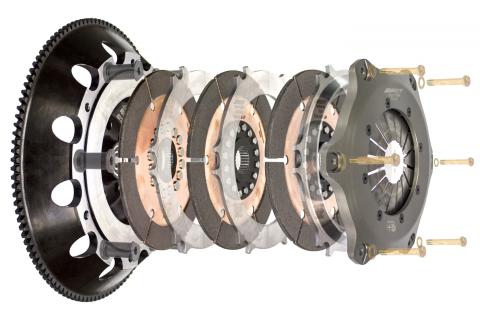
Regardless of the type of car, amount of horsepower, track surface, ambient conditions, or driver habits, the fundamental physics equation for any race car involves getting its engine’s power securely to the track. Given the reality that a race car’s driveline consists of major components, attempting to fine-tune the driveline in the work area at a speedway can involve swapping out those major mechanical systems. But procedures do exist that are less dramatic and more easily accomplished in the limited time available between racing events.
Among the performance racing companies that specialize in providing this sort of driveline solution is McLeod Racing in Anaheim, California, best known for its lines of specialty performance and racing clutches and flywheels. Will Baty observed, “It’s not an easy change, and depending on whether it’s a long track or a short track, that in turn determines what changes they might want to make to the vehicle so it’s performing at its top level, and making sure the engine’s in its torque band at all times.”
It’s important to draw the distinction here between horsepower and torque because while horsepower is the better-known measure of output, torque is what actually moves the car. Baty explained that in addition to clutch selection, picking the proper flywheel weight is crucial. “The same thing happens on an autocross, or a road course, as in drag racing,” he said. “We sometimes want to kill that initial shock, so the guy isn’t putting so much power to the ground. You can put in an ultra-lightweight clutch and flywheel so that when you’re coming into the turn, it’s great once it’s moving and it also gives you optimum compression braking once you let off the throttle, so you’re not using the brakes as much.
“You can make the change at the race track, but you’re talking about pulling the transmission down and such,” Baty continued. “Some vehicles are equipped to do that. Some guys can do it in a few hours, but in between runs, that’s going to be hard to do. Same thing with the converter, it’s not an easy task. There are great things to do, depending on the event, but you prep prior. The most important thing is knowing how the car is going to react, knowing the weight and suspension. If you are going to be running at the top of the rpm spectrum on a road course, the tuning is going to be different.”
Advanced Clutch Technology in Lancaster, California, offers a wide range of clutches, clutch components, and flywheels that can be selected to address particular launch or traction issues. Christopher Bernal noted, “A lot of the design and development work that goes into ACT products really tries to minimize the amount of changing configurations that one would have to do once you have it configured correctly for the type of racing, the type of vehicle, the torque of the engine, and that sort of thing. One of our goals is to reduce the competitor’s cost and confusion, or the number of configurations they have to build.”
When racers have questions about their driveline components, it’s best to call the parts manufacturers, said Will Baty of McLeod Racing. “We’re going to recommend our best product and dial you in once we know everything about that vehicle and how it behaves.”
In drag racing, ACT works with customers to develop adjustments or different versions of the traditional diaphragm clutch, where rules permit, depending on the amount of rubber laid down on the drag strip and the amount of prep the track operator does. “It can really change for small-displacement guys who risk bogging at the line if there’s too much clutch grab. There are some things we can do to allow for some trackside adjustment because you really have to get that launch nailed.”
Some drag racing teams, for example, will use clutch delay valves where it’s legal, or vary the size and capacity of the clutch master cylinder, Bernal said. “It’s really particularly difficult to get a small-displacement, high-rpm engine to launch consistently. We can tune some things or allow for a setup that can be tuned after working closely with the team.”
Bernal said the “magic” found from this clutch manufacturer comes from building its own diaphragm springs in-house. “It’s like building and tuning engines and using somebody else’s camshaft,” he explained. “If you’re using your own camshaft grind, you can really get into the nitty gritty and make changes that work. That’s pretty much what the diaphragm spring is to us. We do approach flywheel weight with a little bit of variability. For our high-performance street guys, we have what we call our Streetlite flywheel, which is lighter than stock but not ridiculously light, very drivable. And then when we get to the track, we direct people to our Prolite flywheels, which are much lighter, one-piece forgings that are very safe and certified. We’ll tune the flywheel for the engine and the use as well. Inertia is something that we’ll work with to make sure the vehicle’s working properly.”
Here, Formula Drift competitor Matt Field installs an Advanced Clutch Technology clutch. “A lot of the design and development work that goes into our products tries to minimize the amount of changing configurations one would have to do once you have it configured correctly for the type of racing, the type of vehicle, and that sort of thing,” said ACT’s Christopher Bernal.
Total Transmissions Chicago of Bellwood, Illinois, produces and sells remanufactured torque converters for both street and strip applications. Justin Carlisle said the short turnaround between rounds in drag racing means that swapping out a converter at the track is impractical. “Most racers don’t do that at the track because you’ve got to put the car in the air, take the transmission out, and most of them don’t keep a spare torque converter in the trailer,” he explained. “We’re primarily street-strip cars and daily drivers. The torque converter determines when the vehicle is going to start moving. I had a guy who was working on an SRT-8 Jeep. We went into his converter I think four times, because each time he took it to the track, he wanted a little bit better response out of it, so it’s playing with the stall speed of the converter as to where it’s actually going to launch the vehicle. That’s about the most that we can help him with, like a case where it’s stalling at 3,000 rpm and I’d like to get it a little closer to 3,200. We can take it out, tighten the stall up a little bit, do a little machine work on the converter, to see if it helps them.”
Easy Swap-outs
Cars with more basic drivelines can present more simplified tuning solutions. Winged sprint cars on dirt don’t use a conventional powertrain since their engines are linked directly to the rearend via an in-and-out coupling. Dave Ely of Diversified Machine, which manufactures Bulldog Quick Change Rears in Lancaster, Pennsylvania, is a winning sprint car driver himself, and he said the simplest tuning at an oval track involves switching out the gears in one of his company’s rears.
Dynamic Drivelines manufactures carbon fiber driveshafts with varying levels of twist rigidity that can be swapped to compensate for changing track conditions. “We have four different winds to them, so if the track is really slick, you can put the softer-twist one in, and that will help the car’s traction,” said Mike Bennett.
“Your track conditions, along with the size of the race track, are what determine the final drive ratio that’s required,” Ely explained. “A wetter, heavier race track that would have more grip to it is going to require more gear because otherwise, the car’s going to get bogged down. A dry, slick race track is going to require less gear in most cases, because you don’t want to spin the tires. There are some cases of guys on a dry, slick track who will actually plug more gear into it, and actually use the extra gear as a Jake Brake, which helps slow them down when they enter the corner.”
Once a racer chooses a driving style, adjustment is a matter of following changing track conditions and adjusting accordingly, Ely added. “You simply lie down under the car, take the six rearend cover bolts off, take off the cover, slide the rearend gears out, install the new set of gears, put the cover back on, tighten the nuts, top off with fluid, and go back on the race track,” he explained. “It’s not uncommon where the series officials use an eight-minute horn, or a four-minute horn. The gear ratio is one of those things that let you wait till the last possible moment to make that decision. You can change gears in a minute and a half to two minutes.”
Driveline tuning can involve internal components such as these, but other solutions can involve feasible swap-outs, especially a comparatively straightforward single component such as the driveshaft. That’s where Dynamic Drivelines of Des Moines, Iowa, comes in. The firm specializes in shafts for racing, off-roading, and even commercial vehicles. Mike Bennett explained that Dynamic Drivelines manufactures driveshafts with varying levels of twist rigidity that can be swapped to compensate for changing track conditions.
The simplest tuning at an oval track involves switching the gears in a quick-change rearend, said Dave Ely of Diversified Machine. As track conditions change, the gears in a DMI Bulldog rearend can be swapped in as little as a minute-and-a-half to two minutes, he said.
“The biggest thing to do is with our carbon fiber shafts. We have four different winds to them so there’s a swift one all the way down to a soft one that twists, so if the track is really slick, you can put the softer-twist one in, and that will help the car’s traction,” Bennett described. “You can adjust on them for different track conditions. A lot of the guys down South will run the twist shaft more than up here in the Midwest, because just as the track gets slicker, you can put the twist shaft in to help absorb some of it. They use different steps when they wind the shafts so the shaft will actually twist, up to 45 degrees. You can actually see the shaft twist in the tester. Our stiff ones, they don’t move at all. We do a lot of it with our drag race stuff. At the drag strip, you can do the twist shaft if the track is not treated, and then where there’s a lot of traction in the track, you don’t need the driveshaft to help absorb the shock. If it’s real sticky or heavy, you don’t need it, but as it goes slicker, you can put twist into the shaft to compensate.”
Test and Tune
Not every solution will be operative during a race meet because of the quick turnaround time between events. In such cases, Baty from McLeod recommends turning the event from a race into a test session and to get disciplined about collecting data. “It’s just like our leader, Paul Lee, who was a Funny Car drag racer, said: You’ve got to take notes. You’ve got to take track temperature and everything else so you know that you can get the power to the ground,” Baty stressed. “Whether it be on the dirt, the street, asphalt, however you want to do it, you really need to know that vehicle and its power curve. More than anything else, you need to know the torque curve, how it produces that power. The feeling of getting shoved into the seat isn’t horsepower, it’s torque. So when you’re changing gear ratios at the rearend, or in the transmission, you’re changing the mechanical advantage of that vehicle over the weight and the horsepower that it develops.
“In a driveline sense, it’s a test session to see how the car reacts,” continued Baty, urging racers to start testing at the track if they can’t swap components. “When we’re talking about overall performance, you’re trying to get as much power to the ground as possible without breaking traction. There are things you can learn from other racers that have a similar vehicle. That’s where you get that knowledge, something that they’ve actually already experienced. The most important thing we tell people is when you don’t know, call the manufacturer. We like to know the overall intended use for this vehicle, and we’re going to recommend our best product and dial you in once we know everything about that vehicle and how it behaves.”
Consistency and dependability are driving today’s valvetrain development as elevated boost levels continue testing the limits of these hard-working components.
Turbos, superchargers, and copious amounts of nitrous have been creating chaos within the pushrod engine’s valvetrain for a couple of decades now—especially at the drag strip, where outlaw and small-tire classes have mushroomed in popularity under promoters who have written generous engine rules with few limits on boost.
Manufacturers of valvetrain components are rapidly diagnosing those problems with a great deal of success and responding with improved parts that not only survive in these high-stress environments but support engine builders who promote these high-boost strategies.
For example, the custom shop at Jesel in Lakewood, New Jersey, had a drag racing customer running a spread-port-style cylinder head on a big block Chevrolet with a pair of turbochargers.
“He wanted to improve the valvetrain stability. He was running a typical spread-port rocker system that consists of individual intake stands with aluminum rockers and individual exhaust stands with steel rockers,” explained Rob Remesi.
Jesel engineers determined that the top of the heads could be milled flat, then they designed a new one-piece rocker stand with additional mounting points that increased the overall clamping force on the stand.
“Along with the new stand, we re-engineered and optimized the valvetrain geometry by rotating the rockers slightly to take out some of the offset typically needed with the spread-port intakes,” added Remesi. “We anticipate this new setup will greatly enhance high-rpm valvetrain performance.”
This manner of problem solving and performance upgrades for boosted engines has been in play for some time.
“Many years ago, NHRA Top Fuel and Funny Car ran 11/32-inch exhaust valves for years until they simply couldn’t any longer under the demands of these nitromethane beasts,” recalled Trip Manley of Manley Performance, Lakewood, New Jersey. “Then we came out with a purpose-built, 3/8-inch stem Inconel exhaust valve that has since set the gold standard for years.”
Finding new materials, especially from within the aerospace industry, has benefited racers and manufacturers.
“Everything we’re doing right now is to get a material that can not only take the heat that these engines are putting out, especially turbo motors,” explained Ed Doyle of CHE Precision in Newbury Park, California, a manufacturer of valve seats, guides, retainers, and more. “But also making them not so much hard as tough. There’s a big difference. Everybody gets toughness and hardness misconstrued.”
Exhaust Side
In sampling a wide range of valvetrain manufacturers about developing parts for high-powered engines, the exhaust side seemed to draw the most attention. With high boost, cylinder pressures are enormous, and opening the exhaust valve can be a tense operation—and it starts with the camshaft.
Because of the high cylinder pressures in boosted engines, many engine builders are switching from aluminum to steel rockers, as they “contribute to the biggest gains in valvetrain stiffness,” said a source.
“With heavy boost or heavy nitrous, you can’t just smack that exhaust valve open,” said Lance Stillwell of Erson Cams, Louisville, Kentucky. “Really, you need less acceleration on the cam lobe. You want to creep it open to start letting the pressure out. That relieves the pressure on the rocker arm and the rest of the valvetrain.”
“The real valve event we are concerned about, the one that is impacted the most, is exhaust valve open (EVO),” concurred Chris Potter of Edelbrock, Olive Branch, Mississippi. “The worst offenders are nitrous and rev limiters. For the nitrous cars, especially closer to peak torque, they will run very little timing, which means max burn occurs that much further ATDC (after top dead center). They are usually softening the timing to keep that cylinder pressure from lifting head gaskets and/or trying to keep the rotating assembly alive. Softening the timing around peak torque is a way of reducing cylinder pressure to keep these parts alive.
“It’s extreme applications like this where we can see the need for a 9/16-inch pushrod,” continued Potter. “It doesn’t necessarily have to do with spring pressure but trying to keep system stiffness at peak lifter acceleration as the camshaft opens the valve and begins to normalize the pressure in the chamber.”
In the early days of hot rodding, engine builders assumed that reducing the weight of all valvetrain components would benefit the engine and increase rpm. However, as valve lifts and spring pressures increased, the pushrods were flexing enough to dramatically disrupt valve events and introduce unwanted harmonics. In fact, when some engine builders installed larger and stronger pushrods, they had to completely rethink their camshaft strategy because so much flex was taken out, and the reality of the cam design was exposed.
“We continue to see larger cubic-inch engines move to bigger diameter and heavier wall pushrods to help reduce deflection in the system,” said Mike Panetta of Race Winning Brands, which is the parent company for pushrod manufacturer Trend Performance in Warren, Michigan.
When some engine builders installed larger and stronger pushrods to compensate for flex under higher spring pressure and taller valve lift, they found they had to completely rethink their camshaft strategy because so much flex was taken out, said a source.
“Flex will always equate to a change in duration and overall lift. Flex is inevitable, therefore measuring it can be very important in a combination where you’re trying to get every ounce of power you can,” added Luke Brandt of Howards Cams, Oshkosh, Wisconsin. “You might find that the cam may need to be slightly bigger just to compensate for the flex. In a nutshell, flex is generally unwanted, but it’s more important to control it over trying to irradicate it completely.”
There are also schools of thought that not only accept a little pushrod flex in the valvetrain but use it to an advantage.
“Unknowing flex is different than unwanted flex,” said Derek Dahl of Victory 1 Performance, Mooresville, North Carolina. “Sometimes, for longevity, a small amount of bend is needed. Beefed-up one-piece rocker stands, improved materials for stiffness in the entire valvetrain all add up hopefully to a recipe of success.”
Under the pushrod, the lifter has also gained weight and increased in size over the years to provide extra strength to the bottom side of the valvetrain.
“We advise the customer to go to the larger lifter-bore diameter. When you go from an .842-inch diameter lifter to a .937 in the same engine, you go from a .750 wheel to an .850 wheel,” said Guy Aguayo of Crower, San Diego, California. “We have a very strong American-made lifter to begin with, but going to the bigger lifter bore makes the body larger and gives you a larger pin and wheel for added strength.”
In the lifter market, bushings on the wheel axle are replacing needle bearings in many high-stress applications that use solid lifters.
“At any one time in the needle version, you’re running on three of the needles, at most,” explained Nolan Jamora of Isky Racing Cams, Gardena, California. “If you’re running a bushing lifter, you are running on the oil band, which you get about 300–400% more pressure load-bearing capability and it’s spread over a wider area.”
Jamora said many needle failures start with a crack in the outer race. “That’s because going up the ramp the race is vibrating up and down or going in and out and getting oval-shaped. The main pin will slide between the needles’ contact with the outer race and crack it.” He noted that Isky has offered a bushing style lifter for 15 years and is now on its seventh generation.
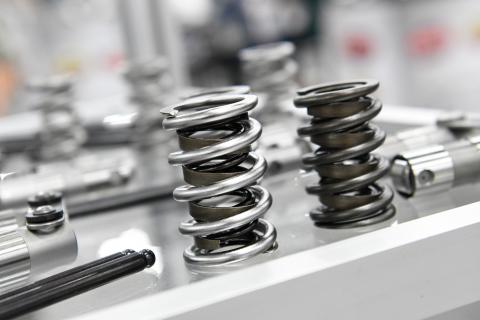
Perhaps no component in the valvetrain has received more improvements and design changes over the past couple decades than the valve spring. New materials and manufacturing tricks—along with new designs like beehive and conical—have given engine builders more options in helping stabilize the valvetrain by reducing valve float and other unwanted valve action.
Valve springs have also become much heavier in terms of load on the seat and “on the nose,” or at maximum lift. Springs can be rated at 400–500 pounds on the seat and well over 1,000 pounds at open load. They’ve also grown in size as total valve lifts are more than 1.2-inch in Pro Stock and other similar classes.
The formulas for selecting valve springs are different for boosted and nitrous engines compared to naturally aspirated. “It depends on the installed heights because we want to be in the coil-bind range,” said Jamora. “The sweet spot is .070-inch for most, or .060 to .070. Of course, we have racers that will be within .020 or .030 but, I mean, everything is going to go to coil bind. I was explaining to an engine builder, the spring just doesn’t stop at that line. It goes way past so that every spring is coil binding. What you’re setting at the coil bind is just basically the limit of where it’ll bounce off each other and not crack.”
Intake Side
The amount of boost an engine builder is planning also plays a key role in determining the valve spring package, especially on the intake side.
“With real high-boost pressures, the backside of the intake valve is really important because that’s under a constant static pressure, no matter what. So it diminishes with the seat pressure but not a lot,” said Jamora. “What we’re trying to decide is, how much does it drop or diminish under that pressure? A typical valve diameter is around two inches. That’s about three square inches of area on the back side of the valve. If you have a spring that’s 300-pound seat pressure, a good rule of thumb is to deduct 10 pounds per square inch, which will be 30 pounds at maximum load. So that means that even though you put the spring in at 300 pounds seat pressure, it’s really only 270 because of that back pressure on the inlet valve.”
“Boosted engine combos don’t need large valve lift,” said Luke Brandt of Howards Cams. “This has made it easier to get combinations to live, and in some situations, requires far less spring pressure.”
Not only can boost slightly unseat the intake valve, it makes it more difficult to close the intake valve. “A lot of guys with diesel engines, they may not have a lot of spring on the seat but they’re running these huge turbos and 90 pounds of boost,” warned Stillwell. “So it’s hard to get the valves shut. When you’re bouncing valves, you’re bending valves.”
“Added boost can also absolutely require more spring seat pressure on the intake side in order to keep the valve controlled and closed,” added Manley. ”To that end, we built some better springs for the domestic late-model markets knowing these customers would be adding turbos and superchargers.”
The formulas for selecting valve springs are different for boosted and nitrous engines compared to those that are naturally aspirated. “It depends on the installed heights because we want to be in the coil-bind range,” said Isky Racing Cams’ Nolan Jamora.
Package Deal
Still, much of the concern when designing a valvetrain package is focused on the exhaust side, again because of the increased cylinder pressure. An unlikely culprit could be traction control. One method of reducing wheel spin is pulling timing to reduce cylinder pressure, as opposed to closing the throttle.
“Late timing is like creating work or power and not taking advantage of it,” explained Potter. “Obviously, we can’t take advantage of that power, otherwise we wouldn’t need the traction control. Either way, the delayed timing creates a later burn that EVO must fight. In these cases, not only is EVO fighting opening, but in some cases, it also must fight a significant buildup of pressure in the exhaust, such as a backfire when unburnt fuel ignites. This is where a two-step rev limiter will make many valvetrain designers cringe. That explosion outside of the combustion chamber can force the exhaust valve open, creating separation between the valve, rocker, pushrod, lifter, and cam lobe. The crash when these come back together can be incredibly detrimental. We’ve definitely had to step up and design components that can handle this abuse.”
Because of the high cylinder pressures in boosted engines, many builders have already switched from aluminum to steel rockers on the exhaust side—and some use steel across the board. Again, valve size is critical to overcoming those pressures.
Turbocharged engines making large amounts of boost generate so much cylinder pressure that it could take thousands of pounds of force to open the exhaust valve. “That is why steel rockers are so important on the exhaust side of turbo/nitrous builds,” said Jesel’s Rob Remesi.
“Steel rocker arms obviously contribute to the biggest gains in valvetrain stiffness,” observed Remesi. “If you have a turbo engine that develops 1,500 psi of cylinder pressure and you are using a 1.800-inch diameter exhaust valve with a surface area of 2.54 sq./in., it would take about 3,800 pounds of force to start to open the exhaust valve. That is why steel rockers are so important on the exhaust side of turbo/nitrous builds. Our Pro Steel BBC 1.650-inch pivot rocker is approximately 20% stiffer than its Pro Aluminum solid-body equivalent.”
Increased spring pressures compel other equipment manufacturers to respond by improving their products, such as spring retainers and rocker-arm trunnions.
“We’ve made everything a little bit beefier, still trying to keep the weight the same, which is next to impossible. With minimal weight change, we’ve tried to make everything stronger. Our trunnions are proprietary material specifically for the LS,” said Doyle, adding that little race tricks like 55-degree valve-seat angles can wreak havoc on valve seats. “We’ve especially worked on materials. When you start increasing valve angles, the unit pressure goes through the moon. Take your 1,000-pound over-the-nose spring and bounce on a 55-degree angle, and the unit pressure is astronomical. So, we worked on materials that could handle that kind of abuse.”
Looking Ahead
Looking to the future, valvetrain manufacturers will be watching for problems and reassessing component strategy for the different racing disciplines.
“Honestly, it depends on the market. There really isn’t a one-shoe-fits-all answer for this question,” said Manley. “For instance, I would say that the domestic late-model market has seen high demand for twin turbos as a way to achieve big power. On the other hand, there are plenty of classes, from Pro Stock to dirt late model, that do not allow power adders. Engine builders putting together naturally aspirated motors must figure out creative ways to eke out more power without the benefits of a turbo, blower, or nitrous kit.”
“To state it plainly, turn up the boost,” said Brandt. “Combinations these days are going ridiculously faster with half of the cam. Rpm always makes power, but when you’re confined to a budget, like most guys are, making power to the point that rpm falls just above peak torque on the shift is really all you need. Boosted combos don’t need large valve lift. It’s not uncommon to see very fast, boosted combinations running low .600 or less lift, and durations in the high 220s to low 240s at .050-inch lift. This has made it easier to get combinations to live, and in some situations, requires far less spring pressure.”
One trend that is welcomed in the boost industry is that engines are being purpose-built from the ground up with turbos, nitrous, or superchargers in mind.
“Recently the term ‘power adder’ is used less and less as people are realizing it’s difficult to add power to a combination and get the performance they need with the parts they have,” said Dahl. “What most builders have now is a stable base that is consistent and trackable. If they start from the same point every time, it’s easier to pinpoint the problems and find solutions. Every part has its frequency, and the difference between motor carnage and winning is how far you’re allowing the part to move versus how far it needs to move.”
“We want horsepower,” concluded Potter. “The easiest way to get us there will win.”
As engine technology changes, oil and lubrication technology must change with it to keep up with increased protection demands, higher temperatures, closer tolerances, and a growing call for renewable resources.
“We keep pushing the limits every year.”
That’s how Josh Steinmetz of Lubrication Specialties, maker of Hot Shot’s Secret in Mt. Gilead, Ohio, describes in a nutshell the current state of race engine technology, and the concurrent need to develop new lubricants for that technology.
“We keep finding more horsepower that wasn’t there five years ago, in the same race class that had very similar rules,” he pointed out. Those engines are often “doubling horsepower, or at least adding 25%.” That’s why “more and more people are going to synthetics and renewables as a steppingstone away from conventional oil, especially when it comes to the high-performance market. Conventional oil just won’t take the abuse that these high-demand applications dish out.”
The shift from conventional, petroleum-based oil to synthetic has been going on for a while. But Steinmetz and other experts in the oil and lubrication industry noted some additional trends that point to a rapid evolution of the whole field.
Gas Engine Lubrication Trends
“Gasoline engine oils are evolving to accommodate the increasingly severe operating conditions of new engine designs,” said Chris Mileti of Klotz Synthetic Lubricants, Ft. Wayne, Indiana. “These designs frequently include direct injection, turbocharging, high compression ratios, and elevated combustion temperatures. Modern oil formulations must continue to offer traditional performance features such as wear protection and deposit mitigation, but these formulations must do so while also offering new features such as preventing low-speed pre-ignition, resisting oil thickening from high-temperature oxidation, protecting timing chains from elongation, and providing measurable fuel economy benefits.”
Engine oils for racing applications have traditionally been “boosted versions of top-tier passenger car oils,” Mileti added, but that, too, is changing. “Most premium motorsports engine oils are bespoke formulations designed for a specific type of racing. They use additive packages and boosters that would damage passenger car emission systems. In general, motorsports engine oils are trending toward lower viscosity grades, especially in drag racing. They are also migrating away from mineral base stocks and toward higher performing synthetic base stocks.”
Klotz Synthetic Lubricants not only has a number of gas and diesel engine oils, it also has “a full line of hypoid gear oils with a formulation designed to be very shear stable and with robust corrosion inhibitors, all designed to protect the gearsets,” said Chris Mileti.
“The viscosity of oils is getting lower all the time,” Steinmetz agreed. “It used to be you never heard of a 0W-20, but now it’s common, and now there are 10- and 8-weights out there as well.” With viscosity that low, the oil has “less cushion to work, so we have to find unique ways to mitigate the wear and the degradation of the oil itself.” Hot Shot’s Secret’s nanocarbon technology “has done a great job of that. We add it to any oil and see improvements in wear reduction.” The nanocarbon technology “also reduces temperature, so the oil is less likely to shear and break down from heat.”
Ultra-low viscosity oils aren’t recommended for every drag race application. Danny Vaca of LAT Racing Oils in Orange, California, said he gets calls from customers “who say, ‘I have a turbo, with 50 pounds of boost, and I’m using a 20W-50.’ A 20W-50 can’t handle 50 pounds of boost. There’s too much pressure on the bearings and journals. In that case, they need a straight weight, like a straight 50. Sometimes people are misled on the difference between a straight 50 versus a 20W-50. A multigrade oil has a viscosity modifier in order for it to go from thinner to thicker, while a straight 50 has no viscosity modifier. It’s that thick because of the base oil.”
Diesel Oil Trends
“Diesel engine technology is changing just as quickly as gasoline engine technology,” Mileti said. “Traditional lubrication problems such as bearing wear, excessive soot, and poor low temperature operability are no longer significant issues with modern diesel engines. But these legacy problems have been replaced with new challenges such as high-temperature oil oxidation and more stringent efficiency expectations. As a result, new diesel engine oils are slowly migrating to lower viscosity grades to improve fuel economy. They are also being fortified with more effective antioxidants and detergents to mitigate both oxidation and deposits over increasingly long oil drain intervals.”
Hot Shot’s Secret makes use of proprietary nanocarbon technology in many of its lubrication products, including its Adrenaline Racing Gear Oil. The technology improves wear reduction and also reduces temperature, “so the oil is less likely to shear and break down from heat,” said Josh Steinmetz.
Low viscosity oils may work in production-based diesels—“I believe the small Duramax runs a 0W-20,” Steinmetz said—but he sees some racers “going heavier. Not across the board, but we’re seeing people looking at a 60-weight compared to a 50, looking for more protection, more cushion in the oil.” The reason, he believes, “comes down to parts availability. The thinking is, ‘How can I make this thing last longer?’ They’d rather give up a couple horsepower to make sure it’s going to stay together.” Plus, he said, in the diesel drag racing and truck and tractor pulling worlds, “these guys are making a huge amount of horsepower that they weren’t making a couple years ago. They don’t have to find every single ounce of horsepower. So now they’re trying to make longevity part of their equation.”
At Hot Shot’s Secret, “we’re seeing some demand for even higher viscosity oils,” Steinmetz said. “Our 60-weight is already on the high end of a 60-weight, and I have people wondering about a 70.” There’s no such thing as a 70-weight oil, he said, since the viscosity designations developed by the SAE stop at 60. Should his company develop a heavier weight oil, “we’d probably call it a 60-plus, to try to stay as close to the science as we can.”
Renewable Resources
According to Mileti, “The next 10 years will bring unprecedented change to the lubricant industry. Environmental regulations will encourage oil marketers to formulate engine oils with environmentally friendly or recycled (re-refined) base stocks. This will eventually lead to the formulation of engine oils using renewable, bio-derived base stocks.”
Evolve Lubricants of Reno, Nevada, is there already. It has developed “a special process of creating pure high-performance hydrocarbon molecules from plants,” according to a company representative, and it offers several different oils and lubricants using that non-petroleum technology.
“We have the answer today to get companies and people off of petroleum,” added Rick Lee. Motorsports is an important part of Evolve’s portfolio, but it’s just one component of a multi-faceted product lineup. Evolve has formulated diesel engine oils for over-the-road trucks that have shown a 4% mileage improvement, Lee said. “That’s a huge number to a company like Walmart or Penske that has hundreds of thousands of trucks and spends a billion dollars on fuel.” It also developed a small-engine oil, used by Home Depot, that in testing lengthened drain intervals four times more than normal. Evolve is now moving into a new category with a high-performance shock absorber oil that’s being tested by “some of the largest high-performance aftermarket and OEM shock manufacturers,” Lee said. “We are under an NDA so I can’t say who just yet.”
Hot Shot’s Secret is also doing some R&D with renewable formulations, Steinmetz reported, “in what we call the fleet line of diesel oils, the diesel oil most people use in their truck or hauler. We want to see if the renewable part can work in tandem with the synthetic base oil we already use to get longer drain intervals, and still maintain the wear resistance we like to see, and also if the detergency package will stay in solution with it.”
Mark Wheatley at TriboDyn Lubricants in Mooresville, North Carolina, has a different way of thinking about renewable resources and oil, “if you’re talking about reducing the carbon footprint. Using our oil can improve fuel economy by as much as 5–10%. An average car that goes 12,000 miles a year puts quite a bit of carbon in the atmosphere, but if you can improve its fuel economy by 5–10%, you’re saving that much in carbon footprint per vehicle. We’ve always been doing that, but with today’s new focus on green, we’re changing the way we promote our product.”
Can Oil Make Power?
In 2021, Evolve took part in an engine oil test put on by Porsche AG in which its EvoSyn 0W-40 European Car Formula non-petroleum oil was run in a Porsche 3.0-liter MA203 turbocharged engine to examine engine wear.
“They ran over several hundred hours in all different conditions, including stop-and-go and full throttle at the Nürburgring race track,” Lee said. “They said our oil maintained its viscosity under this test better than any other oil they had tested.” Additionally, dyno testing of the engine “gained a positive variance of 12 metric horsepower,” he added.
“If I can deliver 12 metric horsepower in a factory test, which is about 8 US horsepower, from a drop-in replacement oil change, that has to be the cheapest high-performance bolt-on in history. If I gave you a tenth of a second in every corner, would you take it?
“I can’t promise everybody is going to have the Porsche result,” he pointed out. “But everybody who’s using my oil is reordering,” including Bruce Canepa, “who’s running the most expensive Porsche 917s in the world.”
Wheatley could also cite tests that showed the use of TriboDyn oil increased engine power. “MAG Motorsports had the NASCAR Institute do a dyno test with our TriboDyn oil, and they picked up 4–5 horsepower on two different engines just by putting in the TriboDyn oil.”
In addition to the MAG Motorsports test, Wheatley recounted several anecdotes about racers and other users of TriboDyn oil who accidentally holed their oil pans or differential cases and went on to turn laps or drive miles after losing oil, with no damage to components. “When the oil or parts get hotter, the TriboDyn oil’s patented coating technology actually forms a dry lubricant film on the substrates to stop any micro welding or galling. It’s almost like powder coating the inside of the engine.”
The Unavoidable Trend: Cost
The high-quality base stocks and complex additive packages that go into racing lubricants come with a literal cost to the end user. That brings with it the inevitable questions, said Vaca. “They ask me, ‘Why is your stuff so expensive?’ They look at the cost, but they also have to look at the performance of the fluid. Once they’ve used it, they get it.”
LAT Racing Oils formulated its new High Performance Supercharger Oil for customers who use ProChargers, said Danny Vaca. “It still follows our same focus on using higher end base oils with higher film strength, which provide better lubricity to keep the parts alive.”
For those who haven’t tried the LAT Racing lubricants, Vaca tries to “educate them on why its cost is so high, explain to them about all the components in the oil.” Not everyone is receptive, “and I get it. They’re probably thinking I’m a salesman trying to sell them something they’ve been sold before and it’s failed in the past, so it’s kind of hard for us to get our message across and really prove it. I work with them, be truthful with them, and sometimes I’ll give them a little discount for them to try it once. That’s the only opportunity I need is for them to try it once.”
Wheatley also sees the need to educate his customers about the benefits of TriboDyn’s oils, particularly racers who have been taught “by their family members, dads or grandpas that you need to change your oil after every race or every second race. The problem with that is, it’s expensive. If you feel you should change your oil 11 to 22 times because you race 22 times in a season, you’re spending $8–$16 a quart and you’re changing eight quarts before a race. That adds up to $704–$2,800 on oil per season. But by using our TriboDyn products, you don’t have to change TriboDyn oil before every race or every other race. You can extend it, so TriboDyn can save people money and still protect their engine.”
Wheatley did a test with a team on the Carolina Sprint Tour last year where they put eight quarts of TriboDyn oil in the car and “every third race, because they raced on dirt, they changed the filter. Never changed the oil, but we topped off. At the end of the year, they only used 12 total quarts of TriboDyn oil, which only cost them $144 for the whole year. When they took the engine apart, because of our film strength and because of the protection, the engine looked brand new.”
Wheatley regularly offers discounts of 20–40% to racers, and at the recent PRI Trade Show he handed out 40% discounts to “anyone at the Show. If they bought it one time, they got that discount all year.”
Beyond Engine Oil
Many of these companies have or are about to release lubrication products that go beyond engine oil. LAT Racing Oils recently developed a new drag racing automatic transmission fluid, Pro X, that’s a “much thicker ATF for heavier cars with lots of horsepower,” Vaca said. “It seems like there’s always a new class coming up, and we don’t hear about it until a failure occurs. So we worked with M&M Transmissions to develop an ATF with a lot higher viscosity for the heavier cars with a lot of power.”
The components in the Pro X ATF “are still like all of our other formulas,” Vaca explained. “Once we have a formula that works, all we do is raise the viscosity. We don’t change anything else. It’s still running the same high-end base oils” as LAT’s other transmission fluids.
LAT has also developed a new High Performance Supercharger Oil “for our customers who run ProCharger units,” Vaca continued. “They have needed something more robust, and we developed an oil that still follows our same focus on using higher-end base oils with higher film strength, which provide better lubricity to keep the parts alive.”
Hot Shot’s Secret has been prototyping new transmission fluids, “doing testing with racers with different viscosities to meet some of their different needs, especially in drag racing,” Steinmetz said. “Some of these guys are doing some really unique stuff with their transmission setup, and we’re working to provide fluids that meet their needs—whether that’s a little thicker fluid or a little thinner fluid—so they don’t have to make so many mechanical changes. By changing the viscosity of the fluid, they can make the torque converter lock up sooner or let it release at a different time.”
This purpose-built gearbox came out of a buggy that College of Engineering students at Utah State University built for the Baja SAE competition. They used TriboDyn oil in the box—note the distinctive blue color—and were very happy with the box’s performance and lack of wear, said Mark Wheatley.
Klotz has “a full line of hypoid gear oils,” Mileti said, “with a formulation designed to be very shear stable and with robust corrosion inhibitors, all designed to protect the gearsets.” As an addition to that segment, Klotz developed a Limited Slip Axle Booster that is “an extremely advanced high-end friction modifier, which reduces friction for better power transfer, and it will lower operating temperatures.” The booster, Mileti added, “doesn’t have to be used with Klotz gear oil. It can be used with any incumbent oil to provide an extremely advanced friction modifier.”
TriboDyn has formulated a new break-in oil that Wheatley was handing out at the PRI Show. “You don’t want to use our TriboDyn Tri-Ex or Tri-Ex2 as a break-in oil,” he advised. “They have chemistry that won’t break in the engine. It’s too slippery.” Instead, the new TriboDyn break-in oil is an exclusive formulation with 2,200 ppm of zinc, plus high-sulfated ash, phosphorous, and sulfur to provide critical protection to high-performance engines during the engine’s break-in period.
TriboDyn has also taken its grease blending in-house, and new product labels will mark the change-over. The company will offer four different grease products: a base grease with 5% moly, called TriboDyn Moly 5% Multi-Purpose Grease; and TriboDyn’s patented greases, a good-better-best offering of Tri-All multi-purpose grease, Tri-Max high-temp extreme grease, and Tri-Ex2 extreme pressure high-temp grease. The latter three represent “three different levels of extreme pressure, high-temperature patented technology, with the same coating technology in the grease as our oil product,” said TriboDyn’s Rick Pelfrey.
“We went with three levels of grease because it’s expensive to put the additives in there, and some of our customers may not need to go all the way to Tri-Ex2, which has a four-ball test over 1,000-plus kilograms. We have customers trying all three right now and finding they may be okay with the middle grade, the Tri-Max, and will go with that for their applications.”
What the Future Holds
The use of lubrication products with renewable components is only going to grow, according to Evolve’s Lee, due to what he sees as “a convergence of public policy, public opinion, and consumer demand, interest in, and acceptance of renewable products. We have the talent to do just about anything, and we’re small enough to do that. We are already making renewable gear oil and renewable transmission fluids. They’re not available to the general public, but we are testing with the US military in non-tactical vehicles.”
Lee’s plans aren’t limited to lubrication products. “We have the technology to make renewable fuel, jet fuel, and gasoline as well. It’s already part of our IP. We can take our feed stock and split it in two directions to make finished lubricants or fuel with our technology,” he added.
At Hot Shot’s Secret, Steinmetz foresees the company doing even more with its nanocarbon technology. “We’re looking at other sources of them, how they interact with newer oils, and how we can use them more efficiently.” By efficient, he means “better reductions in friction and wear, and also the treatment of the oil. Can we put lower amounts of additive in the oil and still get the same results? As base oils improve, we may not need as much additive. That’s something that’s continuously changing.”
Evolve Lubricants has formulated pure high-performance hydrocarbon molecules from plants and is using the non-petroleum technology to make engine oils and other lubricants. In testing with Porsche AG, the use of Evolve oil in a 3.0-liter turbocharged engine saw a net gain of about 8 horsepower, which “has to be the cheapest high-performance bolt-on in history,” said Rick Lee.
Tolerances are “getting smaller in every engine,” Steinmetz added, “and as they do, there are opportunities for lubricants to step up to the plate and meet those challenges, whether that’s a better base oil, a better additive pack, or things we can add for wear resistance.”
Looking at the lubrication industry in general, Klotz’s Mileti said the next five years “will bring both logistical and technological changes to the engine oil market.” The logistical changes have already started, as “oil manufacturers are quickly restructuring their supply chains to deal with inflation, component shortages, shipping challenges, and rising geopolitical tensions.”
The technical changes, he said, “may be even more dramatic. Engine oil is increasingly being used as a hydraulic fluid, as in hydraulically actuated camshaft phasers, for example. Hydraulic fluids must be incompressible to function properly, so oil formulations will become optimized to prevent aeration.”
Other technical challenges will present themselves with “the increasing market share of electric passenger vehicles, along with a growing number of electric racing series,” Mileti said. “That will force oil marketers to redirect their formulating expertise to other lubricants in the vehicle, which could lead to drastic improvements in the performance of driveline lubricants, wheel bearing greases, and shock fluids.”
Mileti also said the trend to longer drain intervals will likely lead to “the adoption of oil condition monitoring technology in the transportation sector.” Already in use in industrial applications, these monitors “can measure basic oil parameters such as temperature, pressure, acidity, viscosity increase, wear metal content, and water dilution. In theory, oil condition monitoring will eliminate the need for scheduled oil drain intervals. The oil will only need to be changed when the sensor identifies a significant degradation in performance.”
Currently, these monitors are very expensive, but prices are dropping, Mileti said. “These lower costs, combined with the growing data transmission capabilities of cellular networks, have made the technology more feasible for transportation markets. In my opinion, it’s just a matter of time before it finds its way into professional motorsports—if it has not already done so. This technology would be another tool that crew chiefs and race engineers can use to monitor the health and performance of engines and driveline components during testing or competition.”
While the similarities between these powerplants competing on the water and combinations found in the automotive drag racing world might surprise you, some fundamental differences still distinguish them from their land-based counterparts.
Competing in the upper echelons of drag racing is an already incredibly sophisticated and demanding business, but it gets even more challenging when you swap out prepped pavement for H2O. Although drag boat engine combinations share plenty with their land-based counterparts, there are also many elements that are uniquely tailored to the demands of the discipline. Those deviations provide some insight into what it takes to perform at the top of the class.
Kjell Adams
NJBA Pro Gas Jet
In April 2022, Kjell Adams set a new NJBA Pro Gas Jet class record of 7.248 in the quarter-mile at Lake Ming in Bakersfield, California, in Fluid Motion, a 19-foot tunnel boat that weighs about 1,400 pounds. The jet boat gets its motivation from a 513-cubic-inch V8 with an architecture that’s loosely based on a Chevy big block. Running on Q16 race fuel, the mill makes 1,380 horsepower and 850 pound-feet of torque without the aid of power adders, as the Pro Gas Jet class requires competitors to use naturally aspirated engine combinations.
“The incorporation of technologies like data loggers has been huge for the jet boats and the top-end stuff like Top Alcohol Hydro,” Adams said. “It has allowed teams to make significant strides in this type of racing—we now have all of the information. I think we have 26 channels of data on this boat. It really allows you to pinpoint things and figure out how to make it perform even better. Things like individual cylinder timing have really changed the game in terms of consistency, and the longevity of parts.”
Adams told us that Pro Gas Jet shares many common traits with the technology found in NHRA Pro Stock. Along with the mandate for naturally aspirated engines, the class also limits displacement to 515 cubes, so toppling a record that had been in place since 2016 required some potent, high-winding hardware.
The Pro Gas Jet class shares many common traits with the technology found in NHRA Pro Stock, Kjell Adams said, with displacement limited to 515 cubic inches and a mandate for naturally aspirated engines.
The DRCE (drag racing competition engine) billet engine block from GM, symmetrical billet heads, and intake came as a package from CFE Racing. The combination is outfitted with a gun-drilled and polished Bryant Racing billet crankshaft, CP-Carrillo rods and pistons, and a 70-mm custom tool steel camshaft with more than an inch of lift. A Jesel valvetrain keeps things under control at 9,200 rpm and beyond, while a dry sump system from Dailey Engineering ensures that everything stays well lubricated. A pair of 1,425-cfm carburetors from Holley Performance Products rounds out the combination.
“The boat uses a gear reduction transmission—it allows the motor to spin up at 9,200 rpm while the jet drive is spinning at around 7,500,” Adams explained. “That gets the motor where it wants to be to make peak power, and we can use a larger impeller on the jet drive to make it more efficient. When you start cutting down impellers to get the motor up, it makes the impeller more inefficient because you’re creating more cavitation.”
As with automotive drag racing, getting a good launch is crucial in drag boat competition. “I bring the rpm up to about 4,400, and the jet drive enables the boat to send the water through the pump,” he said. “But instead of going out the back, it goes out the sides with a special bucket, which allows the boat to sit still but keep the rpm high enough to prevent it from bogging when you take off. It’s kind of like a trans brake. We can flip a switch, and the data logging starts, the ignition system releases the rev limiter, and that bucket on the back of the boat opens up.”
Joey Grose
NJBA Pro Gas Flat
“This class is based off of NHRA Pro Stock,” said Joey Grose, who currently holds the NJBA Pro Gas Flat class record ET of 6.85 seconds at 155 mph. “Because we also currently run a Pro Stock car, it allows us to keep up on the technology and apply that to the boat program.”
Like Pro Gas Jet, Pro Gas Flat is a carbureted and naturally aspirated class that limits displacement to 515 cubic inches, but the boats themselves differ significantly, so the combinations necessitate their own specialized approach. “There’s no weight limitation in this class, but lighter isn’t always better,” he said. “There’s a lot of different styles of flat-bottom boats for this type of racing. We use our own custom mold for the boats that we run, and we’ve made a lot of changes to the bottom of it over the years. Motor placement and V-drive placement play a big role in this particular class.”
“The incorporation of technologies like data loggers has been huge for the jet boats,” Kjell Adams said. “It really allows you to pinpoint things and figure out how to make it perform even better.”
Grose’s C25-fed, big block Chevy-based DRCE V8 is equipped with a Winberg crankshaft, MGP connecting rods, CP-Carrillo pistons, a Bullet camshaft, Jesel lifters, and Manton pushrods, among other go-fast hardware. “The cylinder heads are a GM casting that we created our own CNC program for,” he said. “And we build parts like the manifolds and rocker arms in-house as well.”
The engine is topped with a pair of 1,250-cfm carburetors that have also seen significant tweaking by his Lodi, California-based shop, Grose Racing Engines. “The carburetors are a big factor in getting these boats to run at this level, so we’ve spent a lot of time fine-tuning those,” said Grose. “They’re based on a Holley design, but it’s all our own work as far as the internals go.”
Grose said teams that use automotive engine combinations in drag boat racing will quickly discover the importance of fine-tuning the powerplant to the application. “In a car, you either have a converter or a clutch that allows you to bring the rpm up for the launch, but in this type of boat you’re leaving from a dead idle. So to get the boat moving initially—and keep it pulling all the way down—requires a very different approach. You have a propeller that’s not always hooked up all of the time like a tire would be on a car, so that kind of changes the rpm ranges and the curves that you’re working with. Most of these races are won in the first half of the track, so you need to have that setup dialed in.”
CarrolL-HAAS Racing
SDBA Top Fuel Hydro
As the name implies, the Southern Drag Boat Association’s Top Fuel Hydro class mirrors NHRA Top Fuel in a number of ways, and that means stunning horsepower paired with truly incredible speed. Team owner and crew chief Todd Haas tells us that the team’s 272.95-mph trap speed from a 3.41-second, 1,000-foot run during the 2022 Drag Boat Nationals in Phoenix, Arizona, makes their 21-foot outrigger the second-fastest drag boat in history. And they’re not done yet.
“I think it could potentially run in the 280s,” Haas explained. “It was running on seven cylinders for the last second of that pass.”
Fine-tuning the engine to the application is critical to success in NJBA Pro Gas Flat racing, said Joey Grose. “To get the boat moving initially—and keep it pulling all the way down—requires a very different approach” than tuning a drag car.
Powering the 2,700-pound boat is a 10,000-hp, 500-cubic-inch, Hemi-based V8 that’s similar to what you’d find underneath the bodywork of an NHRA Funny Car or Top Fuel dragster. The powerplant runs a compression ratio of 6.5:1 and consists of an Alan Johnson billet block with a Bryant Racing crankshaft, CP-Carrillo rods and pistons, forged Jesel rocker arms, and Alan Johnson billet aluminum cylinder heads. Additional grunt is provided by a DMPE 14-71 Roots-type supercharger that delivers 60 pounds of boost, and the combination is fed a mixture of nitromethane and methanol by a mechanical fuel injection system with a pump that’s capable of delivering more than 100 gallons of fuel per minute.
“The fuel pump is a crucial part of keeping these engines happy,” Haas emphasized. “It blows the minds of NHRA crew chiefs when I show them a run on this boat, and how hard it tugs down when it leaves the starting line. If a car tugs down to 7,800 rpm or so, that’s a pretty decent run. Sometimes this boat will tug down as low as 5,800 rpm, and that puts a serious load on it. If you don’t have enough fuel in it when it drops that low because the fuel pump isn’t big enough, it’s on fire.”
The delivery of that fuel—which is 88.5% nitromethane and 11.5% methanol—is managed by an Electrimotion Command Module. “The percentage of nitro that you use has a big impact on the tune,” he said. “The higher the percentage, the more compression it makes.” While the engine is very similar to what you’d find in NHRA Top Fuel, Haas said that there are some important distinctions when it comes to tuning. “In an NHRA car you’d use a rev limiter to regulate engine speed, but we don’t have that—we can turn this thing to whatever speed we think it’ll turn.”
Joey Grose’s C25-fed, big block Chevy-based DRCE V8 is topped with “cylinder heads that are a GM casting that we created our own CNC program for,” he said. “And we build parts like the manifolds and rocker arms in-house as well.”
Team driver Kebin Kinsley, who also competes in NHRA Top Fuel, said that the drag boat engine will likely feel familiar to anyone who’s worked on Top Fuel cars. “It’s almost exactly the same—the motor’s just in backwards. And we pull a lot of the technology that we’re using from the drag car side—the Racepak computer and the Electrimotion system are the same. When they make more power with the cars, we make more power with the boats.”
CNC technology has also helped to elevate the game in top-tier drag boat racing, Kinsley said. “Machining propellers has been kind of a dark art for a long time. These were hand-made, and it was almost impossible to get two of them that were exactly the same. A 200-thousandths discrepancy can change the whole attitude of the boat, especially when you’re working with this much power. So being able to get that consistency has been really important.”
He said that the team has already identified what hurt the engine during their run at last year’s Nationals, and they have some other upgrades in store for the coming season. “It’s all about loading the motor when you’re working with nitro, and it just went rich on the big end—we just weren’t loading it hard enough,” Kinsley explained. “There are different ways we can address that, like a big propeller or a larger gear ratio in the W-drives. We’re also working with Revchem to develop a new carbon fiber Kevlar capsule for the boat. The goal is to make it both stronger and lighter than what we’re using now.”
Both Haas and Kinsley say that 280 mph is an achievable goal that they may reach this season, but right now the team is primarily focused on making the boat as consistent as possible.
Carroll-Haas Racing’s Top Fuel Hydro outrigger made a 3.41-second, 1,000-foot run with a 272.95-mph trap speed during the 2022 Drag Boat Nationals, making it the second-fastest drag boat in history. “And we’re not done yet,” said Todd Haas.
The sentiment that there’s still a lot left on the table is shared by Grose and Adams as well, not just within their own racing programs, but across the sport. “I think there’s still a lot of performance to be found in boat setup and V-drive stuff, and there’s a lot of engine technology that can benefit these boats, especially when it comes to power adders,” said Grose. “I don’t think that will ever stop. They’re always finding new ways to make more boost.”
While Adams has his sights set on another record-setting run in the 7.0 range in 2023 thanks to some changes made over the winter that have bumped up the horsepower in his naturally aspirated combination, he said that the biggest gains to be had in drag boat racing might be found in the power adder classes.
Powering the Carroll-Haas Racing boat is a 10,000-hp, 500-cubic-inch, Hemi-based V8 that’s similar to engines found in NHRA Funny Car or Top Fuel dragster. “The percentage of nitro that you use has a big impact on the tune,” Todd Haas said. “The higher the percentage, the more compression it makes.”
“I think nitrous stuff is really going to come into play for the heavy hitters,” Adams observed. “When I held the record in the Unblown Fuel Jet class, we were closing in on 2,000 hp with a conventional 572-cubic-inch Chevy big block. Now that we’re seeing teams getting into 700- to 800-cubic-inch stuff, it’s just going to raise the bar because they’re not limited by displacement anymore. And as we see more and more teams consistently making 2,500 to 3,000 hp on nitrous, we’re going to see more and more of the existing records get blown away.”
Universal Technical Institute (UTI)—the US-based workforce solutions provider of transportation, skilled trades, and more education programs—has announced Michael A. Slubowski has joined its Board as an independent director.
Slubowski will offer his 45 years of healthcare experience to help guide UTI’s growing healthcare education following its acquisition of Concorde Career Colleges late last year.
UTI operates 16 campuses across nine states and offers a wide range of transportation and skilled trades technical training programs under brands such as UTI, MIAT College of Technology, Motorcycle Mechanics Institute, Marine Mechanics Institute, and NASCAR Technical Institute. The recent acquisition of Concorde added 17 additional campuses across eight different states.
Formula 1 officials have announced a new four-year agreement to race in Austria until 2027.
The Austrian Grand Prix returned to the FIA Formula 1 World Championship in 2014, and since then, the Red Bull Ring has welcomed millions of fans, with 303,000 supporters in attendance at last year’s sold-out event.
The last race under the current agreement, set to take place June 30–July 2, will celebrate the 10th anniversary of the Austrian Grand Prix’s return to the Formula 1 calendar and feature an F1 Sprint for the second consecutive year.
“We are proud of the special partnership we have with Formula 1, and we are absolutely delighted to be welcoming the top class of motorsport to the Red Bull Ring for a further four years. In signing this contract extension, Formula 1 has made a strong commitment to Austria, Styria, and the Murtal region,” said Erich Wolf, the general manager of race promoter Projekt Spielberg GmbH & Co KG.
Photo courtesy of Turn 14 Distribution, Pit+Paddock
Turn 14 Distribution-sponsored Daijiro “Dai” Yoshihara has entered the TC America competition with the Florida-based Victor Gonzalez Racing Team (VGRT).
The TC America powered by Skip Barber championship comprises three competition classes—TCX, TC, and TCA. All categories utilize factory-built or supported turnkey race cars, with TCX supporting the BMW M2 CS Racing platform and other full-fledged, homologated race cars.
Yoshihara, who will field a Honda FK8 Civic Type R TCR race car built by JAS Motorsport in the TXC category, is among two other drivers in the VGRT TC America entry list: Ruben Iglesias Jr. in TCA and Michael Hurczyn in TC.
Turn 14’s automotive media brand Pit+Paddock signed Yoshihara to its athlete management portfolio last May. Since, he has built three cars for SEMA (including a pre-runner-style Nissan Frontier, an R33 GT-R, and a 2023 Acura Integra), secured the title of fastest EV at the 100th Running of Pikes Peak International Hill Climb, and launched the nationwide Ride with Dai Experience to give fans a ride in his Formula DRIFT Pro class BRZ. He is also an official ambassador for Turn 14 Distribution, ENEOS, and Yokohama Tire.
“As part of our ongoing relationship with Dai, we are pleased to enter the TC America racing series with VGRT. The team at Victor Gonzalez Racing has a proven track record of performance. Dai’s addition to their established roster adds a proven winner and a new challenge in professional road racing in the series,” said Daryl Sampson, publisher of Pit+Paddock.
After assuming operational oversight of Engine Pro, The AAM Group—the automotive aftermarket program distribution group and specialty marketing firm based in Piney Flats, Tennessee—has announced Jeff Kesar will help lead marketing and strategic planning for Engine Pro.
In his role as AAM Group Marketing Specialist, Kesar will work to bring Engine Pro into the existing portfolio of AAM Group marketing programs, integrating tools and services “that make sense for resellers in the engine performance industry as well as devising new solutions that address the particular concerns of those business owners,” a company official stated. Kesar will also oversee an ongoing strategy to generate exposure and influence for supplier partners.
Kesar most recently served as the creative director for Phoenix-based Western Window Systems, and before that, was at Shelby American to help establish its chassis line. Kesar, who started his career at Las Vegas-based Hayes Engineering, notably produced the Motorsports Mania television show on Fox Sports Network Arizona.
The Indianapolis Motor Speedway (IMS) Museum has announced the IMS Hall of Fame Class of 2023 Inductees Tim Cindric and Tony George. The inductees will be formally celebrated at a ceremony and dinner on Friday, May 26, at the Indiana Roof Ballroom.
Cindric currently serves as the president of Team Penske. He has overall management responsibility for Team Penske’s racing operations, including teams competing in the NTT IndyCar Series, the NASCAR Cup Series, the IMSA WeatherTech SportsCar Championship, and the World Endurance Championship.
George began his tenure as president and CEO of the IMS Corporation in 1989, continuing the work his grandfather, Anton “Tony” Hulman, Jr, started when he purchased the Speedway at the end of World War II. He served in this role until 2009. George joins his grandfather, grandmother, Mary Fendrich Hulman, and his mother, Mari Hulman George, in the Hall of Fame.
A national panel of more than 150 journalists, participants, and historians voted for the two from a ballot of 14 total nominees.
Tickets for the Hall of Fame Induction Ceremony and Dinner presented by Shell and supported by the National Bank of Indianapolis are available here.
 MEMBERSHIP LOGIN