The African American Automotive Association (AAAA) has established the Reyana Lobban Memorial Scholarship Fund, an initiative designed to propel high school seniors toward success in the automotive industry.
The scholarship is dedicated to students interested in automotive-related fields, encompassing a wide array of disciplines, such as marketing, design, journalism and photography, within the realms of trade schools, colleges and universities.
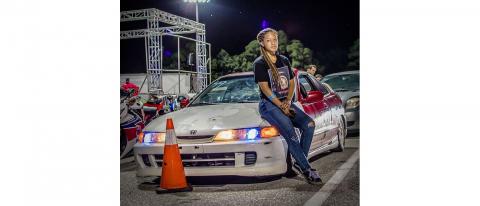
The fund was established in memory of Reyana Lobban, a high school student who was deeply rooted in the automotive world through her work at her family's Acura Parts Depot in Miramar, Florida. Lobban actively participated in local car meets and races, including events at the nearby drag strip. She passed away in 2019 at the age of 19.
Eligible candidates can submit an essay that reflects on their automotive-related experiences and achievements, substantiated with evidence of their engagement in the automotive community. Furthermore, applicants must articulate their vision for the future of the automotive industry, highlighting the roles they wish to play and the contributions they intend to make.
Two high school seniors will be selected based on their passion for automotive culture, the clarity and feasibility of their future contributions to the industry, and the overall strength of their applications. More information will be released at a later date.
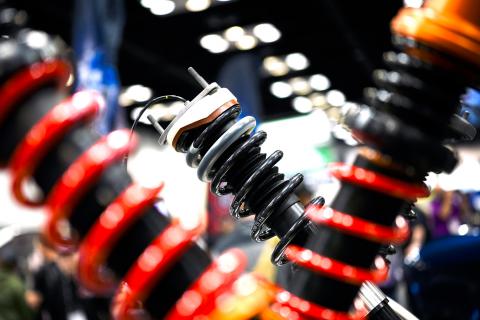
Suspension manufacturers discuss new products, trends, and how shock and spring development are already moving into the future.
Racing drives innovation, the old saying goes. Except when it doesn’t. In the interrelated interests of parity and cost control, some sanctioning bodies impose limits on the components allowed on a race car, despite existing technology that could make the cars faster or more reliable. Probably the most famous example of this was NASCAR’s insistence on using carburetors long after the OEs phased them out in favor of fuel injection.
A similar situation is happening today with suspension systems. Electronically controlled active suspensions are becoming increasingly available in the transportation sector—and not just in the highest-end supercars—but a few sanctioning bodies allow them. “I think it was in the mid- to late-1990s when that was banned in Formula 1, and it’s carried over,” said Aaron Lambert of Penske Racing Shocks, Reading, Pennsylvania. “All the endurance-type sports car racing we’re dealing with has banned any type of active suspension whatsoever.”
“That’s all illegal in the circle track world,” added Ben Baker of AFCO Racing Products, Boonville, Indiana. There are other suspension limitations in dirt track racing, he added, pointing at the fallout from the rear suspension device engineered by Kevin Rumley and used by Jonathan Davenport on his dirt late model in 2015. “That basically allowed them to have a lot of extra droop in the car without a lot of steer,” Baker explained. “They won a lot of races with it, but rules came out later on and outlawed the part. It narrowed the box to play in, which I’m not a huge fan of. The late model world was supposed to help innovate.”
Yet despite sanctioning body rules—or more likely because of them—suspension manufacturers remain innovative, searching for the setup that will increase speed and shorten lap times. They’re using the advantage of electronics where allowed, and thinking out of the box when it comes to conventional spring and shock systems.
“Any time we try to develop shocks, you always have to look at the sanctioning bodies, what they do or don’t allow,” Lambert said. “Some series are sort of status quo, so the rules kind of stay where they’re at. There’s only so much development you can do inside that box. But then there are other series that are a little bit looser with the rules and allow you to develop. Those trends typically carry over to other similar series.”
Dirt Track Development
Attendees at the 2023 PRI Show saw a number of new products introduced by Bilstein Motorsport, whose American headquarters is in Poway, California. “Bilstein Motorsport displayed at the PRI Show with a singular objective: differentiation from competitors,” said Lexie Mead. “Our commitment to product development is centered upon dominance within our target market.”
To draw attention to the new gear, Bilstein hoisted a dirt late model car high over its booth. The car was fitted with Bilstein’s new AS2-R shocks, several versions of which were on display below. They included the AS2-R ESCV, built with an aluminum cannister and three-way adjustability, with high- and low-speed compression, and shaft-based rebound adjustments. “Notably setting this build apart, this shock incorporates an internal hydraulic bump stop,” said Mead. A Big Canister version of the AS2-R has, as its name suggests, a larger, 12-inch nitrogen canister, which allows lower nitrogen pressure with the increased nitrogen volume. There’s a new AS2 FSR that’s “uniquely designed to address the Northeast dirt modified market.” The AS3, a successor to the AS2, was designed for applications “catering to a twin-tube feel” and offering “zero rod pressure,” she said.
Among the latest products from QA1 are caster/camber plates for 1979–2014 Mustangs with the adjustment knob on the top of the plate. “You don’t need to reach under or behind the wheel to make any adjustments,” said Steve Smith.
Not all the new Bilstein products were shocks; the company introduced a spring specific to the dirt late model market that’s “crafted for corner-specific applications” and is tailored to be used with Bilstein’s shocks.
Penske, too, has new shocks for this market, specifically designed for dirt modifieds. “Those cars used to have a steel shock rule, but now they’re opening up a little bit, and we have shocks for them with aluminum Heim ends,” Lambert said. That “doesn’t sound like a big thing,” he admitted, “but from a machining standpoint it makes it more cost effective for us to allow an aluminum body cap and aluminum eyelet.” Some modified series are also accepting single-adjustable shocks, Lambert said, “so that customer base, which was always locked into a non-adjustable shock and had to have multiple shocks to do one little change, now can have an adjustable shaft that gives them the freedom to do a little bit more fine tuning.” Penske is also adapting its NASCAR-style base valve into a steel shock, “which is going to work more efficiently and should feel better for the drivers and also should be better for tire wear.”
Lambert believes the modified classes “are allowing a little bit of freedom where they used to be really clamped down.” That may require “an uptick in spending” by the racers, “but the series are more competitive than they ever have been with car counts, the level of competition, and the payoffs. These races are paying out quite a bit more. So they’re allowing the racers to get a little bit—I don’t want to say free—but definitely allowing them to figure out some setups to be more competitive.”
Rising costs are on Penske’s radar. “We’re always conscious of what the racer is willing to spend,” Lambert added. “In the end, it has to make sense for the racers. I don’t like spending anybody’s money, so I want to make sure it’s worth it in value.” That’s why when it can, Penske will “take parts already available on the shelf and adapt them to what a current customer might already have.” The new adapter for the NASCAR base valve, for example, allows racers “to take their existing shocks and bolt those pieces right on. They don’t have to buy a whole new set of shocks.”
Bilstein introduced a number of new products for dirt track racers at the 2023 PRI Show, including three-way adjustable and Big Cannister versions of the AS2-R shocks and dirt late model-specific springs. To draw attention to the new offerings, the company suspended this dirt late model car over its booth.
“The whole thing is a challenge,” acknowledged Steve Smith of QA1 Motorsports, Lakeville, Minnesota, “but we have to give the customer as much as we can, and still keep it within a price range that gives the part value.” Value, and performance tailored to local track conditions, were behind QA1’s introduction of the Dry Shock Six Pack last year.
“It’s very hard for us to have somebody call and ask about valving they should run at a certain track that we’ve never been to,” Smith explained. Plus, “racers will use different valvings on all four corners of a circle track car, and then it might sprinkle a little bit, and they want a whole different set of valvings.” The Dry Shock Six Pack is just as it sounds: a box with six dry shocks and all the components needed to set up track- or condition-specific valving. QA1 initially offered the Dry Shock Six Packs for front shock applications only, but it now offers the shocks in different lengths for both front and rear shock setups. Because they come six to a box, “a dealer can order a Six Pack and outfit a car and then have two differently valved backup shocks,” Smith said.
For AFCO, which also introduced new shocks at the PRI Show, the ideas for new products “come from the man in the field,” Baker said. “I do a lot of hand-to-hand testing with teams, who will say, ‘Hey, we need to be able to do this better.’ Maybe it’s a small modification to an existing part, or a whole new part altogether.”
One trend that Baker is wary of is the increasing number of teams “getting involved with pulldown rigs. I’ve seen some interesting innovations there, but I’ve also seen over-engineering there. You move things and you find different loads and think, ‘Oh, I’ve just got all kinds of traction.’ Then you go to the race track, and it’s totally the opposite. I do think pulldown rigs are a good thing to get the car through travel, check for bind, check for different things like that. But you’re not necessarily going to move a bar here and there and find tons of traction just because you found load on a scale.”
Drag Race Development
Baker said drag racing has recently become “a huge growing portion” of AFCO’s business. “Last year it may have even surpassed the circle track side as far as shocks were concerned.” AFCO has developed four-way adjustable shocks for drag cars, “and we’ve been working on different types of air shifters and controllers for them where you can change the valving in the shocks as you go down the track.” Most of the technical innovation, he feels, is originating in the Pro Stock and Pro Mod classes, “because that’s where most of the money’s at, and then it trickles down all the way back into the bracket racing classes.”
“The Pro Stock market is becoming heathier,” Lambert agreed, “so we’re constantly doing things there. Just small changes, as the engines become more efficient. The majority of those cars run some type of pneumatic adjustments that are all automatic based off the timers. So we are continuing to refine just how quickly the shocks can react to the track changes and to what the crew chiefs are looking at. Obviously, if you can get a little bit more mechanical grip to the rear tires, it makes a big difference.”
Penske Racing Shocks is collaborating with Claytex USA to build a dirt late model simulation package to help “develop new pieces and see what they do before you cut metal or bolt it on somebody’s car,” said Aaron Lambert. “In the end, it’s more cost effective to do it that way.”
The no prep side of drag racing “is becoming more and more interesting,” he added, “and the shocks are becoming much more important. They have way more horsepower than they need, so whoever can figure out how to put more power to the ground usually does pretty well. We’ve been lucky to work with a few of those really good cars.”
“Drag racing has not been big for us before, but it’s becoming bigger now,” noted Erik Ras of JRZ Suspension Engineering, which is based in the Netherlands but has two service centers in Illinois. “A customer like Underground Racing, which builds those drag race Lamborghini Huracáns with 2,000 horsepower, they order suspensions from us which they can fine-tune to the extreme to control the squat of the car.” JRZ’s 50-DA system allows adjustment of the compression and rebound “directly on the piston, and that makes it a very sensitive system for drag racing.”
Road Racing & Autocross Development
Drag racing is just a part of the “very broad market” to where JRZ supplies suspension components, Ras said. Many of its customers are road racers, running their cars on courses as diverse as the Nürburgring and Pikes Peak. For them, JRZ offers products from two different lines, the RS line and the Motorsport line.
“All the shocks we manufacture are from the Motorsport production line,” Ras explained, “so in reality, those choosing the RS line are getting a motorsport shock they can use for racing as well.” The biggest difference between the two is their adjustability. Shocks in the Motorsport line offer “a slightly bigger adjustment range, and the steps in between are slightly smaller.” Also, “all the compression and rebound adjustments in the Motorsport shocks are 100% independent from each other, while with the RS line, the compression adjustment is also independent, but when you adjust the rebound, there’s a slight difference in compression damping as well.”
At the 2023 PRI Show, QA1 debuted new struts for Mustangs and third-generation Camaros. “We had struts previously, and they worked fine,” Smith said, “but there were some design changes we wanted to make.” Now part of the Proma Star line, the bodies are made from aluminum, “so there’s lots of weight savings.” Also, the new struts mount inverted, “so the majority of the weight of the strut is hanging on the upper mount, which allows 4 or 5 pounds of sprung weight to be saved, which is going to lead to faster suspension reaction times,” Smith said.
Aldan American’s drag racing coilover systems are commonly used in index classes for their consistency and ability to be adjusted for track conditions to run specified ETs. Aldan has also released products for cruise-night cars that occasionally autocross.
Along with the new struts, QA1 introduced new caster/camber plates for 1979–2014 Mustangs. “These are available in the single- and double-adjustable versions like we’ve always had,” Smith said. “But the adjustment knob for the compression and rebound is on top of the caster/camber plate. You don’t need to reach under or behind the wheel to make any adjustments.”
There are also new Mustang control arms from QA1 in both race and street versions. They have forged ball-joint housings integrated into the weldment, “so now the ball-joint housing is part of the arm,” Smith said. “You save weight without sacrificing any strength.” Both street and race versions have low-friction ball joints. “The big difference between the two is that in the race arms we have a cam eccentric in the mount with a hex on it, so you can get additional caster and camber adjustments out of that.”
Smith sees these new products as part of the evolution of race car parts. “Even if we have a product that does really well, we’re always looking for ways to manufacture it in a different way or add more benefits for the customers.” The inspiration for these changes comes from QA1 customers, he said. “We get weekly updates from our phone calls, and we get a lot of feedback from our customers. We take what we’re hearing and turn it into the product development side, and then we make decisions from there.”
Aldan American of Signal Hill, California, has “predominantly a hot rod and cruise night kind of customer base,” said Gary Nelson, but it does offer coilover systems for “the lower end drag race classes, the guys working on their cars in their garage. Our clientele is running the index classes, and they want something that’s consistent, that they can adjust for track conditions in order to run their ET.”
To serve those and its other customers, Aldan has expanded its offering of double-adjustable shocks. “And we’ve been doing a lot more direct-fit applications for a cruise-night car that goes autocrossing occasionally,” Nelson added. “With a set of double-adjustable coilovers you can have something pleasant to go to a cruise night, and with some twists of a couple knobs you can have a lot of fun on the autocross.” The direct-fit applications, which drop into the stock suspension locations, started with Vipers and C5/C6 Corvettes and have expanded into Mustangs, Camaros, Chevelles, and other American muscle and performance cars.
The Active Suspension Question
For those classes that allow it, JRZ has developed an active suspension system valve that is “extremely fast and extremely accurate,” Ras said. “There’s no hysteresis, which means when you take current away from the valve, there’s no remnant magnetism left in the coil. So the valve always goes to exactly the position you want the valve to go.”
Ras has racing customers using the active system on Pikes Peak to help mitigate the changing road conditions on the mountain. “The road surface can be completely different from the lower section to the upper section, so you want to have more control. With the active system, you can control it on the fly, and it will adjust to what it needs to do.”
Ras believes some time in the future, perhaps “five years from now, active suspension will be allowed because by then it will be commonly used in all the cars.” Resistance to it from the racing community isn’t a matter of cost, he believes, but because “it’s mostly unknown.”
Lambert sees two reasons to keep active suspension systems out of racing. “Being able to police that and enforce that gets a lot more difficult when you’re dealing with electronics.” He also sees cost as a barrier. “When it comes to racing, the low dollar [active suspension systems] never work as well as they need to. You can really spend a lot of money on very expensive valves and things like that to make an active suspension react the way you want it to.”
Mining Data
At the top tiers of racing, gathering suspension data through race simulation has become a necessity, Lambert said, “because they typically limit the amount of testing you can do.” He sees the practice trickling down into other race disciplines, and Penske is moving that way when it comes to its dirt late model racing customers. He acknowledged that testing for a dirt late model team isn’t as limited as in other series, “but the testing side has become so costly when you’re putting laps on your motors and on your tires and burning fuel.”
Penske is working with Claytex USA of Cornelius, North Carolina, in building a dirt late model simulation package. “We purchased our own dirt late model house car that we have on a pulldown rig in our shop in North Carolina. We’ve had that entire car scanned and put into our sim package.
“It’s quite an undertaking,” he added. “You have to have your chassis scanned and put in there, you have all your moving pieces put in there, we have the shocks themselves modeled, the spring curves modeled, you have to do the tires. But once you have it and you start correlating it to the real world, and you can start making your simulation match what you see on the race track, it really starts to streamline the process of developing new pieces and seeing what they do before you cut metal or bolt it on somebody’s car or ask a team to waste laps on tires and engines to see what it feels like.”
This would be a good time to clarify an important point. Nate Horn of Claytex said, “In the vehicle simulation world, a simulator is considered something that has a steering wheel and pedals. A desktop simulation, what we are doing here, is something that is run by the click of a mouse on a computer. The math model that is run in the desktop simulation (when properly implemented) is what runs in ‘real time’ on a powerful computer that is hooked up to a driving simulator.”
“You’ll be seeing a lot more about this in the next two to three years in these lower forms of racing,” Lambert predicted, “because in the end, it’s more cost effective to do it that way.” While Penske’s customers are going to benefit from what’s learned by the company’s simulations, “ultimately if you really want to refine it and make it your own, you have to scan your own chassis, because everything’s a little bit different. But right now, just in terms of general tuning and trends, we’re going to learn more because now we can run a simulated lap in a matter of seconds compared to waiting to go to the race track and trying different things.”
Additive manufacturing is presenting fresh, cost-efficient ways to develop and manufacture racing components.
The mid-July summer heat of 2020 was unbearable for IndyCar drivers at the Road America double-header. The new Aeroscreen protection reduced cockpit air circulation, so teams, race officials, and engineers from vehicle designer Dallara collaborated on ways to introduce a fresh-air cooling duct. Time certainly wasn’t a luxury as a pair of 250-mile races was scheduled for the following weekend in the sweltering Midwest.
“I knew several lead people at Dallara, and they reached out to us while I was at the Elkhart Lake race on Sunday,” recalled Allen Kreemer of Stratasys, a manufacturer of polymer 3D printers based in Eden Prairie, Minnesota. “They said a driver cooling duct was needed. We were able to produce 24 of them in 48 hours and distribute them to all of the teams for the next race.”
Dallara had a slight head start by working on the cooling duct with a couple of teams to develop the initial CAD files, including running computer simulation tests. Initial concerns included disturbance at the top of the screen and possible buffeting that might affect a driver’s helmet. Teams were able to mount the ducts on top of the Aeroscreen using existing fastener locations.
A section of exhaust for a Porsche GT2 RS car is 3D printed at Pankl. Here, the employee is vacuuming up leftover metal powder that can then be recycled.
“It actually gave the teams space for a logo or advertising for the in-car camera,” noted Kreemer, who as a former IndyCar mechanic was helpful in finalizing the design in addition to managing the product’s manufacturing.
IndyCar then made additional modifications to the Aeroscreen to manage cockpit temperature before the Indy 500 that August, eliminating the need for the temporary overhead scoop. However, the quick response facilitated by 3D printing demonstrated that additive manufacturing (AM) is arguably the most important disruptive manufacturing technology in motorsports since CNC machines.
3D Printing in Action
Every major race team and aftermarket parts manufacturer relies on 3D printing in some manner for different facets of their operation. It may be used only for rapid prototyping, or with the use of advanced materials—including metals—end-use parts can be printed. Some teams even take 3D printers to the track. However, it’s not just big-budget operations that take advantage of 3D printing.
“I’m a small shop in terms of engine volume, but in terms of performance level we try to aim high,” said Ben Strader of EFI University, Lake Havasu, Arizona, which has a dyno and Spintron for unique engine-development projects. “Even at our level, we are using 3D printing for many things.”
Strader will request custom piston and rocker arm designs in plastic for mockup purposes before ordering the actual part. “We aren’t big enough to justify the expense of owning the machines, but there are plenty of companies like Jesel, MAHLE, and others who offer these services to us,” said Strader, who is working with BES Racing Engines on a 360ci LS engine with a goal of 1,100 horsepower naturally aspirated at well over 11,000 rpm. With an expected valve lift of 1.085-inch, valvetrain geometry is critical.
“We worked with Jesel on multiple iterations of rocker arm design by installing and mocking up the rockers on the actual engine and measuring the pushrod and rocker geometry. This led to several small modifications to the rocker arm adjuster angle to get the sweeps correct near the bottom and top of the lift curve,” explained Strader.
Over at Elite Motorsports in Wynnewood, Oklahoma, 3D printing is also used for mockups. “3D printing allows us to achieve lighter weights, faster manufacturing, and cost saving for mock-up components that simply aren’t possible with standard fabricating and machining practices,” said Scott Woodruff.
“We use 3D printers to make parts for prototypes, test fitting, fixturing components, trim guides, and production retaining parts,” concurred Jason Harding of Performance Design, Auburn Hills, Michigan. “We also outsource 3D printing for things outside of our build window or different types of 3D printing, which are used in development and dyno testing.”
Race shops with 3D printers are producing a wide variety of parts that speed up operations, such as wiring or plumbing brackets, gauge housings, hood vents, brake ducts, switch panels, steering-wheel grips, and much more. In some situations, the design work is already available. The Internet offers generous sources of free standard triangle language (STL) files for brackets, spacers, tool holders, and other helpful products.
Ben Strader of EFI University uses 3D-printed parts for mock-up purposes to check clearances and fitment before ordering the actual components. “We aren’t big enough to justify the expense of owning the machines,” he explained, but there are plenty of parts manufacturers that offer this service to his shop.
For more intense development work, there are numerous companies that will flesh out customer ideas, draw up the CAD files, and either print out prototypes in-house or source them out. HV3DWorks in Sewickley, Pennsylvania, was formed by Paul Vorbach to support a concours-level automotive restoration shop that often experienced difficulty locating rare or out-of-production parts. 3D scanning, CAD tools, and additive manufacturing allow Vorbach to reproduce many of these scarce components. Sometimes he also helps racers.
“I did some injector stacks for a BMW engine,” he said. “We took the owner’s stock one, modified the design to make them longer, and then printed them. In that case, they were printed out of a nylon plastic.”
Vorbach doesn’t own the printers used to produce the parts he designs “because of all the different disciplines, and the machines are so darn expensive to do one-off parts,” he explained. “But if you work with somebody who knows the various different disciplines, metals, and materials, you can do the design work and then print the parts. The advantage is you can print one, 10, or 20 parts and not lose your shirt.”
Vorbach has seen the cost of metal printing come down in recent years, and there are more opportunities with metal printing—including titanium, stainless steel, and other alloys.
“I would say the metal AM is where we’re seeing the biggest increases in technology. There’s a lot in composites, too, of course,” said Vorbach. “The real opportunity is in making parts lighter and cheaper. You can design to take advantage of honeycomb structures and things like that. Think of holes. In a CNC machine, putting in holes costs money. Once you design something with holes, in additive manufacturing you’re not putting in any material, and it costs you less.”
There are dramatic examples of high-end race teams and automotive companies that are 3D printing end-use metal parts. The $2 million Czinger 21C hypercar is mostly built with parts that were designed with AI software and produced at Divergent Technologies on huge 3D printers.
Critical engine parts such as pistons are also 3D printed. As long ago as 2017, Ferrari publicly discussed printing steel pistons for its F1 team. The alloy may be heavier than aluminum, but design changes can reduce the amount of metal needed. Porsche recently disclosed it was 3D printing pistons for a 911 GT2 RS engine. Not only did the company reduce the weight 10%, but it added cooling ducts that allows oil squirted from below to draw heat away from the crown. Such a feature would have been impossible with traditional forging and machining.
About 10 years ago, Pankl Racing Systems in Austria recognized the potential of AM and invested heavily in 3D metal printing. “We have 10 machines in different sizes, and we try to keep the machines printing the same metals,” explained Christoph Wachmann. “When switching from titanium to steel or aluminum, you have to clean the machine thoroughly to avoid contamination. It’s better to have more machines with separate materials. We have our own HIP [hot isostatic pressing] chamber to reduce porosity. And we have four or five choices of heat-treatment options.”
On a recent project, Pankl helped a race team reduce engine weight by 3D printing a thin-wall aluminum oil tank that is attached directly to the cylinder block, a set of titanium fuel rails, and coolant fixtures. Pankl also 3D printed Inconel header flanges and exit tips for the exhaust system.
“We can do crankcases, it just depends on how big the engine is,” said Wachmann. “We are also doing turbocharger housings that could be titanium, aluminum, or Inconel.”
And remember those Aeroscreens for Indy cars mentioned in the beginning? Pankl 3D printed those from a titanium alloy. Five separate pieces are printed, then welded together.
Technology Advancements
The potential to expand metal 3D printing involves a number of technology advancements, including the metals themselves. New alloys are being tested, and the feedstock powder itself is being produced with more consistency to improve the resolution of the finished product. The machines will get bigger with more lasers used to speed up the process, and the software will continue to improve. Finally, testing will validate material properties to satisfy structural demands.
“[Printed materials] are consistent and can be used in FEA,” said Wachmann, noting that early iterations of the previously mentioned lightweight oil tank developed a crack from vibration. “This crack happened three or four times in exactly the same spot. The root cause was stress from vibrations that we didn’t know about up front in the design stage. But the crack was always in the same spot, which for me is an example that the metal is consistent. Then we made a design iteration, and it stopped cracking.”
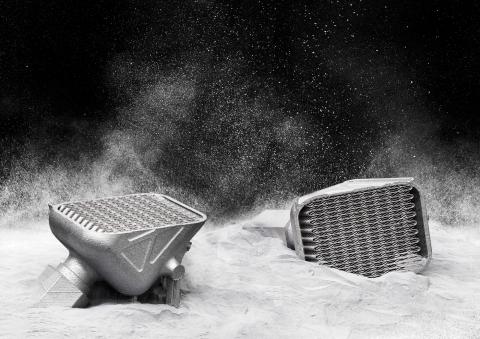
Another motorsports supplier moving forward with 3D metal printing is PWR, which is based in Australia and has a plant in Indianapolis, Indiana. The company designed a heat exchanger concept and tried it on 20 different printers before choosing one from Velo3D.
Trick Flow will 3D print sand cores to make aluminum prototypes during the design phase. Once the design is approved, then a traditional casting pattern can be machined for the foundry. Eventually, Trick Flow may use 3D-printed cores in production when print cycle times and costs are reduced.
“For us, machine capability with additive wasn’t about just producing the fastest nor the cheapest part,” explained Matthew Bryson. “Obviously, you’ve got to be cost-competitive with everything you do. But for us, it was about exploring the maximum potential of the technology to try to produce components that others couldn’t.”
One of the current strategies at PWR is to integrate 3D-printed pieces with existing conventionally manufactured components. “If you want to propose additive as a solution, it’s not good enough to be, in and of itself, interesting or look cool. It genuinely needs to compete with traditional technologies,” added Toby Maconachie. “While additive has advantages for thermal applications and the capability for internal complex geometries, it’s also limited, such as the minimum feature size.”
Key performance factors possessed by traditional thermal products include fine features, such as very thin tubes and tight tolerances. While current 3D printers can achieve mathematically complex surfaces, the resolution doesn’t always meet the engineers’ requirements.
“We can take both the high-performing cores that are traditionally manufactured and combine with fluid distribution systems that take advantage of complex geometries achieved through additive manufacturing,” said Maconachie.
That means that complex housings can be designed to fit the lines of bodywork or wrap around a rollbar, then the different heat-exchanger cores can be integrated with welding or brazing.
“Heat exchangers are being redefined at the moment with hybrid and EV technology,” added Bryson. “The increased power density of electronics and batteries now mean more power in smaller spaces. More complex cooling solutions are required to deal with those thermal challenges, and additive manufacturing gives us the ability to produce some quite intricate and freeform geometries to be able to solve some of those challenges.”
On the other side of the industry, Stratasys focuses on polymer printing to meet the needs of racers. Often the printed part is used as a sacrificial core to manufacture the end-use piece.
“We can 3D print the inside shape of a brake duct out of a high-temperature soluble material, then wrap it with carbon fiber,” said Kreemer. “You cure it in an autoclave, trim the ends, and finish as needed. Then you toss it in a support removal tank that comes with every FDM [fused deposition modeling] printer. That washes away the printed material in a matter of a few hours. That leaves a seamless, very durable, very complex shaped carbon-fiber duct.”
More permanent carbon-fiber molds can be printed and used to lay up the composite materials many times. “You can literally bake and cure the carbon fiber in an oven, and the plastic tool does not deform whatsoever,” said Kreemer, noting that Stratasys offers five different printer technologies using both thermoset and thermoplastic materials to serve a wide variety of customer needs. “The reason we have a diverse product line is there are some applications, some users that need a very high detail, smooth finish part for a concept model. Those same materials would not work as parts on race cars.”
Race Winning Brands in Mentor, Ohio, the parent company of such race suppliers as JE Pistons, Dart Machinery, and Manley Performance, uses 3D plastic printing during the R&D phase of product development, including test-fitting applications.
“It is part of our day-to-day business with almost every brand in our portfolio,” said Nick DiBlasi. “It saves us time, money, and allows us to visualize parts at our facilities that do not have manufacturing cells onsite. The best-use case is when making custom pistons or rods, and we need to get the largest skirt or beam width. It’s very important to 3D print and test fit them in the engine and cycle them for clearance. That solves issues where a customer can’t 3D model their block that has been modified, yet they need a part to fit perfectly. We also send them parts where they can grind and fit the part, then send it back and we model the clearance built in. This happens a lot with big beams on rods needed to clear blocks, or pistons with oil squirters.”
Modeling With Sand
While 3D-printed prototype parts are useful in most mock-ups, some parts can’t be tested in plastic, or a race shop wants to see how a cast-metal part will fit and perform. Hoosier Pattern in Decatur, Indiana, can 3D print sand cores for a foundry to cast the part. If changes are needed, an updated sand core is printed, and another test casting is made.
“We had a customer testing exhaust manifolds, so we printed up a couple of molds,” recalled Todd Yoder. “They ran their samples and found out that the external geometry was what they wanted but wanted to tweak the internal geometry. We printed a couple more molds, and then they had their final parts for the race day. That was pretty easy to do with 3D-printed sand because there were no major changes to a core box. All we had to do is print the model based on what they needed.”
Instead of making traditional hard tooling for casting, Hoosier can print molds in sand directly from a 3D CAD file. The process is quicker and less expensive while retaining the freedom to make changes.
Here is the Velo3D Sapphire printer used by PWR. This laser powder bed fusion printer works by selectively welding 50-micron layers of metal powder to produce a final part that is then heat-treated and machined.
“We can combine cores. So, if you have a complex internal assembly, many times we can print all the cores as one piece,” added Yoder. “You’re going to have higher accuracy. You don’t have to worry about making all the individual pieces, filing them, and then assembling and gluing them together, then risking stacking up the tolerances.”
Trick Flow Specialties in Tallmadge, Ohio, utilizes 3D-printed sand cores to produce prototype cylinder heads and intake manifolds for testing. “When designing a cylinder head or an intake manifold from scratch, the CAD modeling and flow simulation only gets you so far,” said Josh Cook. “At some point early on, you need work with real metal parts.”
Once testing and validation are complete, Trick Flow will use conventional tooling for production. Even though 3D printing the sand cores offers additional flexibility in the design, Trick Flow hasn’t had a problem translating any printed designs into standard tooling.
“Our products are designed to be moldable or castable from the beginning of the design process. Our design engineers work with our pattern makers to think about draft angles, and can we make a tool effectively where our parting lines are going to be clean,” continued Cook. “They’re going to be in a location on that part that is either aesthetically pleasing or isn’t going to affect the performance.”
With regards to 3D metal printing, the team at Trick Flow is looking forward to having that option. “I see great potential in that technology. There are still question marks that I have about the strength of 3D-printed materials. Strength is extremely critical in our application. So, the cost-effectiveness of that manufacturing process and the material properties are something that we would really need to dig into and understand,” said Cook. “We haven’t been convinced that the technology is ready for scale volume production—at least to be cost competitive with more traditional methods.
“The exciting thing is pushing those boundaries, and over time that technology becomes cost effective, and it can trickle down,” Cook explained. “I believe that it will reach a point where it becomes more cost effective in mass production applications, and more consumers are going to be running 3D-printed product on their grassroots race cars.”
Giovanni Sgro manages the historic Maserati Corse racing brand while preparing for an all-electric future.
Among racing automakers, few have more historic significance than Maserati. The family-named company was established by six brothers in the northern Italian city of Bologna in 1914. Like most Italian brands, Maserati was involved in racing from the first car they made. A Maserati car driven by Alfieri Maserati won the noted Targa Florio race around Sicily in 1926, and the company’s cars won the Indianapolis 500 in 1939 and 1940, making Maserati the only Italian automaker ever to win that historic race.
Last year, Maserati CEO Davide Grasso announced that the brand would go electric and phase out gasoline-fueled engines by 2030. After an accomplished history spanning 110 years of gasoline-fueled performance cars, that’s a tall order. Maserati is leaning into that transition both in street cars and on track. All electrified Maseratis use the name Folgore (FOLE-Gore-Ay), which means “lightning” in Italian.
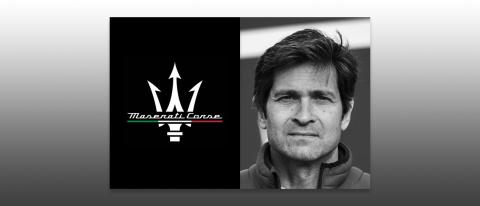
The man chosen to head up the racing program in this transitional period is Giovanni Sgro, an Italian-American who was born in Rome, Italy. Before coming to Maserati, Sgro earned a degree in communication sciences from the University of Rhode Island, with additional studies in Spanish and business administration. He put his talents to use first in the alcoholic beverage industry, working at Diageo, the corporation behind brands like Johnnie Walker, Crown Royal, Smirnoff, Captain Morgan, and more. At Diageo, Sgro served as group brand director with responsibilities for brand relationships in motorsports. In that role, Sgro managed sponsorships in NASCAR, Grand Am, and IMSA.
Coming to Maserati, Sgro is responsible not only for the transition to electric power in motorsports, but also to maintain the Maserati-branded presence in GT racing. Sgro led Maserati to become the first Italian automaker to compete in the electrified FIA Formula E series. We caught up with Sgro just before the 2024 Formula E season kicked off in Mexico and IMSA’s Rolex 24 Hours of Daytona signaled the start of traditional GT sports car racing for the year.
Racing in Formula E is “a natural choice” for Maserati, said Giovanni Sgro, based on the company’s objective to be fully electric by 2030. “I think that Formula E has really been one of the greatest opportunities to build awareness of our past but also to look toward the future,” he said. “Our future is electric, and that’s why Formula E has been a great platform, a learning platform, and it’s exciting to be a part of it.”
PRI: Tell us about yourself. How did you get to the top of Maserati’s racing program?
Sgro: I have a diverse background. I think that I’ve always been a strategy and brand marketing person through my entire career. I started at CNN and ended up also working for a company called Diageo, which is a large alcohol beverage company. That was my first step into motorsports because with that business I was involved in NASCAR, Grand Am, and the Rolex 24 Hour race, as well as Formula 1.
I’m half American, half Italian, so I lived in the US and worked in the US. With NASCAR I sponsored Roush Racing with Crown Royal whisky. Then with Formula 1, we had Johnnie Walker. I’ve always been involved in sports, but I always loved motorsports. Maserati has been at the forefront of motorsports, not just automotive in general. It’s a luxury automobile brand that was born on track. So when this opportunity came about, obviously being half Italian, I had to go back into my roots, and certainly there’s a high level of pride when you work for a brand like Maserati.
PRI: Formula E represents a shift to electric power at the highest levels of FIA racing. What made Maserati look at Formula E and decide that this is a place where the company wants to be?
Sgro: I think it’s a natural choice for us based on the strategic business objective that we declared, which is to be fully electric by 2030. If you look at our background, which is racing, that’s one check. Then you look at authenticity and credibility, that’s another check. We’ve been in lots of different racing programs from Formula 1 to IndyCar to GT racing in our history, and now we’re the first Italian luxury automobile brand to be in Formula E. It’s just another milestone for us.
The fact is our business objectives tied in very well with the Formula E program. It’s the highest performing electric racing car in the world. Formula E also has a very diverse audience. It’s not just motorsports fans, it’s also individuals who are really interested in technology innovation. Formula E fans want to understand what they’re going to be driving in the future. Really, those two things interest us very much. Another reason is that our racing programs also allow us to showcase the full range of our automobiles, specifically the GT cars, as we’ve done this past year. That’s an immediate connection.
The technology transfer from Formula E isn’t immediate or 100% obviously, but it does give us a lot of insight in what we can do with our street cars. It’s about developing software technology and the electric powertrain. I think one thing that is also very important in Formula E is that we can tap into our existing group of race car drivers. It’s an additional edge that we have.
Also, in Formula E the technological aspect is immediate. You can auto-correct immediately because it’s software, not hardware. That means you can imagine and understand how you can better use the consumption of energy from the battery. Then the drivers give us insight into how the car is performing and what things we can do. It’s interesting to get them into our simulators and into our street cars and get their input on those as well. All in all, the first year in Formula E was extremely exciting, and we’re very proud to be part of it, and we’re looking forward to our second season kicking off in Mexico.
Giovanni Sgro (center) with Maserati’s Formula E drivers Max Günther (left) and Jehan Daruvala. “I’m very happy that the two drivers are wearing Maserati on their chest,” said Sgro, who predicted that in 2024 “we will fight until the last race and hope to bring home more points than we did last year.”
PRI: Electric racing can be hard to sell in America. Do you see plenty of internal combustion motorsports going on in the future, or is 2030 a hard cutoff date?
Sgro: I think our focus is set. We made that commitment and we’re sticking to that 2030 objective. We sell Italian luxury, and that is independent of the motor that is driving your Maserati. It is Italian craftsmanship, audacity, and luxury that is in that Maserati, and that’s consistent across any kind of motor that you have. I think that the objectives that we have from a business standpoint are firm, and I think any product that Maserati produces becomes a global icon, in our opinion. I think consumers will be happy with us, whether it’s a combustion engine car until 2030, or an electric car after that.
PRI: With the Formula E series, you mentioned that the technology transfer isn’t immediate, but it is happening, and as you mentioned, you can get the input from your drivers on the Folgore line of Maserati electric street vehicles as well. Is there any other major benefit that you’re seeing from your participation in electric racing?
Sgro: I go back to this: Technology transfer isn’t immediate, but there’s an analysis, an evaluation that happens. It’s not like everything that we’re doing in the race car is applied to the street car, but it is immediate in the sense that we have immediate data. When you finish a race, you go from one race to the other, you have immediate data after the race when you’re sitting with the engineers and the drivers. You have an immediate output of what happened, what we could improve, how could we really capture some of this data and apply it. It’s whether we use it immediately. It’s more of analyzing how we really decipher what we’re pulling out of the car.
One of the benefits is the overall awareness of Maserati that we are gaining. It’s not only about new consumers or potential customers, but also the existing customers who have known Maserati in the past. They have a chance to see what our future is all about. Then [there are] the new consumers, the ones who are perhaps the younger generation who probably know what Maserati is, but some probably didn’t know that we’re celebrating 110 years of history this year, or that we were born on track, and we won so many championships.
We’ve had ups and downs, but I think that’s what really builds a strong foundation. It’s about really understanding where your strengths are and really building on those. And it’s about the challenges that we’ve faced and overcome. I think that Formula E has really been one of the greatest opportunities to build awareness of our past but also to look toward the future. Our future is electric, and that’s why Formula E has been a great platform, a learning platform, and it’s exciting to be a part of it.
PRI: Let’s talk about that electric future. Formula E is a spec series where you’re all on the same chassis. You have a little bit of latitude to develop your own driveline and certainly your own setup and energy management system. Are we going to see Maserati electric GT cars competing in new electric series in the future? Is there anything you are working on that you could tell us about?
Sgro: For electric racing, I’m focused on Formula E right now. In GT racing we started off when we announced the MC20 a few years back, and Davide Grasso, who’s my CEO, he made the commitment to go back to racing as a company. That commitment had three aspects to it: One was Formula E because obviously that’s the natural choice for electric. Then going back to GT racing with the MC20 GT2 race car in the FIA GT2 class. The MC12 has been an iconic racing machine in FIA GT1 with Andrea Bertolini at the helm. And then the MCXtrema, this limited edition 62-unit beast of a car that we unveiled, or really unleashed, at Pebble Beach in California this past August. Those are the three focused platforms that are helping us reset ourselves into racing, but they also highlight the equity of the brand because what we do on track is what inspires us to do things off track.
To answer your question the long way, is there a future for GT on track? I think there is, absolutely. I think it’s about making sure that we make the right decisions, that we don’t dilute the opportunities that we have, but really focus on what those potential other racing platforms that are all-electric could offer us. We look at everything just because we want to be aware of what our competition is doing, and we want to be aware of what our future offers. So yeah, the long answer is I think we look at everything.
In 2023, Maserati returned to GT racing with an MC20-based car in FIA’s GT2 class, where it claimed pole position and a second-place finish in its first outing. Giovanni Sgro noted, though, that Maserati’s commitment to full electrification by 2030 could mean the end of the company’s internal combustion race cars.
PRI: Are the benefits from Formula E quantifiable in terms of sales or followers for Maserati?
Sgro: Absolutely. We’ve had our social media channel at a tremendous growth rate since we launched our Formula E team, and that’s one indication that what we’re doing is working. We’re communicating to an audience that is interested in what we’re doing in racing, which is very positive. It’s quantifiable in many different ways. I’ll give you an example: In Rome we had the electric Maserati Gran Turismo Folgore on track doing hot laps, and you should see the images of the potential customers. We had stakeholders as well as journalists who were inside the car, and the acceleration when they took off, both their hands were one way and the other! You couldn’t see all their faces because they have the helmet on, but their eyes were all the same—they were popping out of their heads!
The acceleration and the performance of that car is incredible. To answer your question this way, when you sit in that car, you create an immediate connection to what Folgore means, and a great opportunity for conversion that is quantifiable. There’s also a return on investment in terms of media awareness, TV broadcasting, and the fact that Maserati is in single-seater racing. We were the only Italian luxury brand to do that, and it gave us some great visibility as well as several different narratives: Maserati back to racing, Maserati full electric, Maserati’s outlook for the future. We had narratives about Fangio, about Maria Teresa de Filippis as the first woman in Formula 1 back in 1958, and Andrea Bertolini in GT racing, so it gave us a great opportunity to really tell different stories. We set the foundation in 2023 and really look forward to 2024 to do the same. So overall, we’re pleased with the outcome of our first year back to racing.
Maserati’s participation in Formula E and GT racing, and the introduction of the limited-edition MCXtrema hypercar, “underline the commitment of the brand and the sense of responsibility that we have,” Giovanni Sgro said. “It’s a real honor for all of us to be part of this brand.”
PRI: Looking to the future, what have you got in store?
Sgro: I am hoping to build on our momentum in Formula E. If you like any kind of sports, you love a comeback story. We had a little bit of that in 2023. We had a challenging first half of the season with a new car, new tires, new drivers. There’s a lot of things that you have to digest and learn. From January to April was challenging, and then Berlin came along, and we got to the podium with Max Günther. It was an amazing experience. I never thought I could be so emotional about getting to the podium. Then we had the third-place podium at home in Rome with Max, and he had third place and two pole positions in Jakarta.
I’m hoping to build on that momentum. We have a young new driver, Jehan Daruvala. He’s talented, he’s motivated, he’s committed to the team and the objectives. So I’m very excited. I think Max will be a great role model even though they’re both extremely young, all in their 20s. I could be their grandfather in terms of age, but I’m looking forward to Max being a great role model to Jehan. They can work off each other really well. I never want to make a prediction of victories, but I’m very confident that we have a great structure, and I’m very happy that the two drivers are wearing Maserati on their chest. So our prediction is, we will fight until the last race and hope to bring home more points than we did last year.
PRI: Is there anything we haven’t talked about that you would like to put on the record?
Sgro: I think we covered this, but this is one of those points that’s really close to me. We kicked off in 2023, and it’s nice to see the richness of what Maserati Corse meant in this last year. We were in Formula E with some successes and some learnings. I’m very proud of the team and the drivers who got us to that point. In GT2, we made a commitment to go back to GT racing, and we made the commitment to Paul Ricard at the last race of the season. We committed to the engineering team, and to Andrea Bertolini as our chief race car driver and tester who did the shakedowns getting that car to perform really well. Then at the first race in GT2 with Paul Ricard, we earned pole position, and we finished second.
I don’t want to sound like we are showing off, but it’s nice to recognize team effort and Maserati’s resilience in making sure that we always push the boundaries and race beyond. That is our positioning with Maserati Corse. And I think with Formula E, and with GT2 getting on track, and the MCXtrema, it all really underlines the commitment of the brand and the sense of responsibility that we have. So any time a journalist asks me what I hold dear, it is the fact that we came out, we made promises, and we maintained them as best as we could. It’s a real honor for all of us to be part of this brand.
The Southeast Gassers Association champion who bought this fun, throwback drag racing series plans for growth that preserves its old-school appeal.
The news this past December that Leslie Horne purchased the Southeast Gassers Association (SEGA) racing series from its founder, Quain Stott, would likely not have come as a major surprise to anyone who knows Horne and his background. He had already built successful businesses before becoming a tough competitor on the SEGA circuit in 2018.
That Horne would end up behind the wheel of a race car might have been pre-destined from childhood. At just nine years old in rural Green Creek, North Carolina, he learned to drive in a 1963 Falcon convertible with a “three on the tree” column-shift manual transmission. From working in a cotton mill after high school, Horne went to school for auto body and then worked in a body shop for a couple of years. He also opened a detailing business and had a buy-here/pay-here used car lot.
In the 1990s, Horne road-raced motorcycles and opened a motorcycle service shop that he sold in 2007. After he began buying houses to fix up and sell, Horne earned his real estate license in 2008 and built up Leslie Horne and Associates Realty agency in Boiling Springs, South Carolina. It currently employs 13 agents.
Horne had known Stott from growing up in the same part of North Carolina. “He and my father were buddies,” Horne told PRI in a recent interview. “He’s 11 years older than I am. I always looked up to him.” Watching Stott race in 2017 inspired Horne to enter SEGA competition. He started with a 1962 Chevy II wagon called “Stud Muffin,” winning the C/Gas championship in 2019. After selling that car, he built his 1955 Chevy, “Chick Magnet,” and won the 2022 A/Gas championship.
SEGA’s 13th season started on March 23 at Brainerd Motorsports Park in Ringgold, Georgia, with nine races to follow that.
PRI: Was buying SEGA a huge leap for you, or did it just seem like a natural progression from what you had already been doing in racing and business?
Horne: It did seem natural. Quain had been talking to me about it on and off for a couple of years. I made an offer, and here we are today. It felt like the right time. In 2022, I was invited to the PRI Show, and that helped get me on fire about doing this. Then in 2023, [SEGA Race Director] Randy Edmonds was with me for the Show. The people that I met there were so positive about me purchasing SEGA.
PRI: Should SEGA racers expect to see any significant changes for 2024?
Horne: I don’t expect significant changes. I’m keeping all the employees. Quain already had Randy and Operations Director Rocky Platt running the show, and that will continue. My goal is to make things run more smoothly. I’m going to stay as true to the roots as we can. I want to carry on Quain’s legacy. But you don’t want things to always be the same, because then you don’t evolve.
PRI: Where do you see room for growth in the series?
Horne: We’ve got a good following, but I think there’s room for it to go to another level.
I think that we have about outgrown some of the smaller tracks. People want to go somewhere for a really good experience. They don’t want to stand in long lines to get a sandwich or use the restroom. We’ve got to be looking at these things.
PRI: People are attracted to SEGA racing for its “old school” racing experience and atmosphere. How do you preserve that while growing?
Horne: With the buzz and excitement around the new ownership, I just feel like it is going to go to another level. Things will evolve, and I’ve got some different ideas, but I also do not want to take away from the “old school” factor. I want it to be a good, fun experience for the whole family, from little kids to grandparents. Also, we’re working on some TV coverage, possibly streaming or something else.
PRI: How do you balance your work at SEGA with your real estate business?
Horne: I have good people in place at my office. That’s enabled me to do the racing full time for the past five years. When you run a gasser for the championship, it’s pretty much a full-time job.
PRI: Is there any advice you received personally or professionally that you feel guides you?
Horne: Nine times out of 10, people just want others to listen to them.
PRI: Except for your cell phone or other technology, is there anything you would say you can’t live without?
Horne: My wife, Donna, and two kids, son Logan and daughter Lexi. That’s what makes me get up in the morning and do what I do. My wife is always there and supportive of me, no matter how wild or crazy it is.
Leslie Horne
TITLE:
Owner
ORGANIZATION:
Southeast Gassers Association (SEGA)
HOMETOWN:
Chesnee, South Carolina
FAST FACT:
“I mess around with a lot of old cars—Chevelles, Novas, Camaros, Corvettes, 1955 Chevys, and 1950s trucks. I’ve had 32 cars at one time. When I started SEGA racing in 2018, a lot of those went to the side. I’m down to 20-something. The 1967 Camaro is my favorite, because that was the first car my dad bought for me when I was 14. I’ve probably had more than 150 of them over the years.”
Extreme E has announced Symbio as its official hydrogen fuel cell provider ahead of the championship's transition to Extreme H in 2025. Symbio is co-owned by Forvia, Michelin and Stellantis.
Symbio will supply the series with a 75kW hydrogen fuel cell, replacing the battery as the principal energy source. Green hydrogen sources will be used to power the Extreme H fuel cells, created using a combination of solar and water.
Garrett Motion has appointed Paul A. Camuti, the executive vice president and chief technology and sustainability officer of Trane Technologies, to its board of directors.
Camuti replaces John Petry, founder and managing principal of Sessa Capital, on the board.
The NHRA Youth and Education Services (YES) Program will host 15 live events and six virtual programs during the 2024 NHRA Mission Foods Drag Racing Series season.
The NHRA YES Program will also hold two "Pilot Program" events during the 2024 season at a pair of NHRA Member Tracks: April 15 at Kansas International Dragway in Wichita, Kansas, and May 17 at Toronto Motorsports Park, in Cayuga, Ontario, Canada. The pilot program events will allow the two NHRA Member Tracks to host YES Programs for local schools in the community.
The YES Program invites students to NHRA national events to observe career chances within the motorsports field, while the pilot programs offer those same opportunities at tracks without a national event.
In 2023, the YES Program hosted more than 31,000 students at tracks across the country.
Expanding beyond cooling products, Flex-A-Lite in Burlington, Washington, now offers performance ignition wire sets and an HEI distributor under the SQR Performance brand.
“SQR Performance is a new line of high-performance ignition products designed with the sportsman racer in mind,” explained Cole Quinnell. He added that SQR Performance ignition wires have 150 degrees F better heat resistance on both the boots and the wire than some competing products, while delivering at least 50% less resistance for better performance.
The wire sets are offered in 8 mm and 8.5 mm in both universal and direct-fit for select applications. They come in a black-and-gray color combination and feature a suppression core with black silicone sleeves. The 8.5-mm wires feature a spiral-wound core and extra-thick molded boots. The kits are available with either straight or 90-degree boots.
The HEI distributor is a direct replacement for small and big block Chevy engines with the standard deck height. An all-new design, it features a CNC-machined cast-aluminum body, brass terminals in the cap, and an SQR Performance HEI ignition module. It also comes with a mild performance mechanical advance timing curve, and the vacuum advance is easily adjusted. The four-pin module provides high coil output and is constructed from solid state electronics.
Developed for Trophy Trucks and other off-road applications, the Baja Eliminator racing muffler from motorcycle specialist Vance & Hines in Santa Fe Springs, California, features stainless-steel construction and a rebuildable baffle core assembly.
“Our extensive research and experience in exhaust development was instrumental in finding the right combination of materials to address heat dissipation while maintaining weight savings, all without sacrificing power delivery,” said Raphael Paula.
Baldi Racing first approached Vance & Hines with the need to reduce cabin noise in the truck without sacrificing power. The mufflers are made from 304 stainless steel, and the proprietary baffle core can withstand temperatures up to 1,800 degrees F.
“Our commitment to noise mitigation guarantees an optimal in-cabin experience, striking the perfect balance between power and comfort,” said Paula.
The mufflers weigh 14 pounds each and feature ceramic-coated billet aluminum end caps. Inlet sizes range from 3.5 to 4.0 inch, and the mufflers are sold as a left and right pair.
“The inlet adaptor introduces a new level of versatility, allowing for a customized experience based on the header OD, and tailoring the system precisely to specific racing needs,” added Paula. “Finally, the removable baffle core assembly ensures easy maintenance.”
Designed to reduce the severity of wrist injuries to drivers following a head-on impact, the Steering Coupling Device (SCD) from LaPlante Racing Products in North Scituate, Rhode Island, is welded to the steering shaft and can be adjusted for adult or youth drivers.
“The SCD is designed to always provide the driver with control of the race car,” explained Paul LaPlante. “The device reduces the wrap effect of front-wheel impacts, without yielding control of the vehicle. Impacts aside, drivers experience no change in the drivability after the SCD is installed.”
A common practice among drivers is to withdraw their hands from the steering wheel and hold them to their chest before an impact. With the SCD, drivers can maintain their grip on the steering wheel.
“I have witnessed and experienced wrist injuries attributed to open wheel and full-fendered racing,” added LaPlante. “I became frustrated that this injury seemed to have no opportunity for remediation and impacted so many drivers for months after a race. So, I set out to conquer it.”
The SCD is available in two versions: 6.0-inch long that weighs 2.4 pounds and has a 2.5-inch OD, and another that’s 4.5-inches long, weighs .74 pounds and has a 1.5-inch OD. LaPlante advised that racers send the units back every five years to service the spring pack.
A big hammer is no longer necessary to install camshaft bearings. Bonefied Customs in Lowell, Michigan, has developed an installation tool that uses an integrated hand-operated hydraulic pump that gently inserts the bearing into its respective bore in the cam tunnel.
“It’s very gentle on the bearings,” said Jamie Hamm. “It maintains the bearing integrity. You almost never have to scrape the bearings.”
The tool is designed with centering cones and a steel shaft to support the bearing mandrel. Spacers get the bearing in position one at a time for installation in the cam bore. With just a few pumps on the hand lever, the bearing is slowly moved into place. The tool is then quickly disassembled, and the spacers can be set up to install the next bearing.
“There are no distorted bearings, and they’re all installed with the correct orientation to the oil holes,” added Hamm.
Much of the tool is CNC machined from 6061 T6 aluminum and finished with a Type III hard-coat anodizing. The steel pieces are CNC machined and treated to a black-oxide finish. The tool can also be used to remove bearings. Currently, the kit comes with mandrels to support bearings for LS, big block Chevy, and small block Chevy engines. More mandrel sizes will be available soon.
The Pro level oil pump from Schumann’s Sales and Service in Blue Grass, Iowa, is available for popular racing applications, and engine builders can customize their pumps with up to 14 patented options.
“Many racers attest our wet-sump-performance oil pumps have a dry-sump attitude,” said Verne Schumann.
Perhaps the most popular option is the paddle-wheel design that improves the exit flow speed of the oil to the engine in gear-to-gear pumps.
“It makes a conventional gear pump behave like a rotary pump,” added Schumann.
Another popular option is the 140 ball valve that is a significant improvement over the factory cup-valve system by reducing oil foaming and yielding a lower oil temperature. If the factory cup valve system is retained, adjustable quick-change color-coded springs are available to control oil volume and pressure.
Additional modifications like oil-slot lubrication for the idler shaft and the driven shaft are also available.
Finally, all pumps are supplied with a copper mount gasket to prevent oil leakage and aeration foaming of oil supply to the engine. The gasket seals up scratches in the machined surfaces or corrects misalignment during mounting.
A new downdraft eight-stack EFI intake manifold for big block Chevys is now available from Speedmaster in Rialto, California.
“Thanks to the individual throttle body EFI system, racers can experience crisp throttle response and stable idle, essential for both street and track performance,” said Erickson Pereira. “While specific dyno figures can vary based on the overall setup and tuning, users have reported significant improvements in engine responsiveness and efficiency. The system is designed to work optimally within a basic operating range from idle to 7,000 rpm.”
The system comes with an innovative linkage set that includes integrated throttle stops, idle controls, lever arms, and joiner/balancer. There’s just a single-screw adjustment for calibration between the front and rear throttle shafts. The throttle bodies are CNC machined from 601 cast aluminum and support precision-machined butterflies.
“The system supports high horsepower, making it ideal for racers looking to maximize engine output,” added Pereira. “It’s compatible with 50 lb/hr injectors for 700–750 horsepower and 80 lb/hr for over 1,100 horsepower naturally aspirated, and it caters to a wide range of racing needs.”
In addition to its performance qualities, the system is also visually appealing with a classic design that bridges contemporary engineering and traditional car culture.
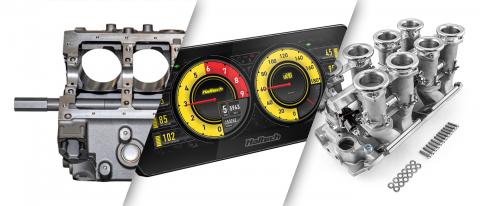
Following the success of its first color dash display, the 7-inch iC-7 model, Haltech in Wetherill Park, New South Wales, Australia, has released a 10-inch version named the uC-10. It’s designed to work alone or with the vehicle’s ECU, and it can be tied in with a tablet or laptop for data or tuning purposes.
“Both the 7- and 10-inch displays can be used standalone, and you can actually utilize many of our other CAN devices, so you’ll be able to data log things like your wide-bands utilizing just our dash,” explained Andrew DiMartino. “If you want to pair with the ECU, it just opens everything up a little bit further.”
The 10-inch display offers plenty of viewing area to monitor critical data in real time. The full-color TFT screen is optically bonded to ensure clear visibility, even in bright sunlight. The sleek aluminum enclosure is designed to enhance the appearance of any interior.
The uC-10 is compatible with Haltech CAN, OBD2, and select aftermarket ECU brands. It offers plenty of scope for sensors and other inputs in standalone or for use as an I/O expander in a Haltech environment. The uC-10 has the same mounting points as the iC-7, so an upgrade is quite easy, and it fits a variety of dash profiles.
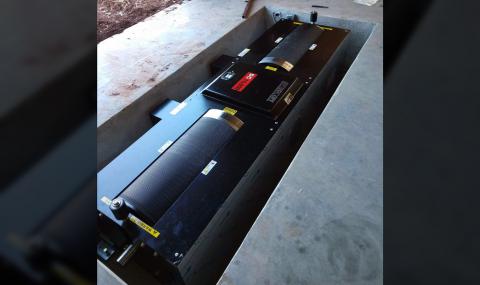
With a pit installation, it’s important to pull the plates off and clean down in the pit to get rid of paper or other debris. Dynocom’s Allison Blackstein had a customer who found rats in the pit chewed through the wires. “Rats love the insulation,” she said, “so you really have to stay on top of that.”
These tips can help prevent downtime as well as the potential need for costly repairs down the road.
Like any sophisticated mechanical device, chassis dynos require routine care to ensure consistent and accurate performance. But while some of this maintenance should be performed in scheduled intervals, Michael Caldwell of Mustang Dynamometers in Twinsburg, Ohio, said that maintaining some good habits on a day-to-day basis can help address some common problems before they develop.
“It’s important to have a very organized dyno room. You want to know where everything is because things can get into the dyno and cause problems, and if the room is disorganized, that might go unnoticed,” he explained. “If it’s in a pit, you want to make sure you pull the plates off and use a shop vac to get pieces of paper, tools, and other debris out of there. It’s really just a good idea to clean your dynamometer and dynamometer area on a regular basis.”
Allison Blackstein of Dynocom Industries in Fort Worth, Texas, also noted that cleaning the dynamometer and surrounding area on a regular basis is important for another reason that should definitely be on the radar of dyno operators with pit installations.
Load cells should be inspected and calibrated on a routine basis, said Michael Caldwell of Mustang Dynamometers. He recommends replacing the load cells every eight to 10 years.
“We visited a customer of ours in Oklahoma recently who was having some unusual problems with his system,” she said. “We took the car off, took the pit cover off, and got down in the pit, and we discovered that rats had chewed through a bunch of the wires. Rats love the insulation on the wiring, so you really have to stay on top of that.”
Regular cleaning also provides opportunities to lubricate the bearings and eddy current brakes. “Make sure to use the lubricant that’s recommended by the dyno manufacturer and follow the recommended lubrication schedule,” Caldwell said. Owners should keep in mind that those schedules can vary widely depending on a dynamometer’s design.
“Our dynos, for example, use Dodge bearings, and these bearings aren’t really meant to be greased. They’re designed to essentially run 24 hours a day, seven days a week for 20 years in industrial applications,” said Blackstein. “They have Zerk fittings because people tend to get a bit anxious about not being able to grease the bearings if you sell them without those fittings. But there’s not necessarily a need for it with this type of bearing, and you can definitely over-fill a bearing. Over-filling can cause grease to come out of the seals, which can create issues rather than resolving them.”
Caldwell said that the electrical system that the chassis dyno is connected to can affect component longevity as well. “You should definitely be using a dedicated circuit. Most eddy current dynamometers have a separate circuit for the eddy current brake that runs off of a 240V single-phase circuit. You should have your electrician run a dedicated circuit for that, and you should switch that off at the breaker when you’re not using it. That’s going to minimize the chance for some kind of electrical damage from storms, which is the most common issue that we see.” He also recommends using surge protection for all of the dyno’s associated electronics, much like you would with sensitive electrical equipment at home.
Beyond the Dyno
Consistent performance also requires proper leveling, Blackstein said. “A lot of people say, ‘My concrete is perfectly flat,’ but there’s no such thing as perfectly flat concrete. You have to make sure that it’s not deflecting, so we provide shims with every chassis dyno, and they should be used wherever you can tap them in with a mallet.”
S-beam load cell calibration should also be done on a routine basis, Caldwell told us. Operators should also be aware that, due to the forces that they’re subjected to when used, these load cells typically need to be replaced every eight to 10 years in often-used dynamometers so that the dyno can continue to provide accurate results.
Shown here is a Mustang Dynamometer speed sensor and toothed gear. Michael Caldwell said the gear should be “clean and free of any dust or tire debris.” Also visible in the photo are pillow block bearings, which should be greased per the instructions that came with the dynamometer.
“There are folks out there who have been using the same load cell for decades,” he said. “Bad idea. It may still seem to work, but the chances of it operating to as-new specifications are zero. You’re putting tons of force on it over and over again, and that means it’s not going to stay linear because the shape of it actually gets warped over time. It may seem to be working because it calibrates, but it’s not linear anymore.”
Blackstein recommends having a spare speed sensor on hand at all times. “Even a little flake of dirt on the reluctor wheel will cause issues.”
Newer versions of these sensors are typically sealed, but dirt can find a way in anyway—especially on mobile chassis dynamometers. “This is the most important sensor on virtually any dyno,” she added. “If you don’t have the speed sensor, you don’t have anything. So it’s good to always have a backup available, just in case.”
 MEMBERSHIP LOGIN