Adaptive Race Cars

Submitted by johnc on Wed, 02/21/2024 - 12:15
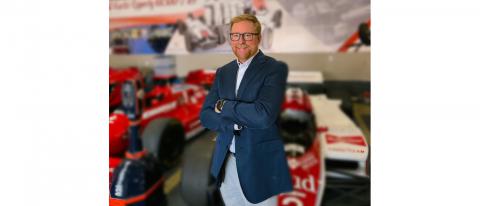
image 2


Adaptive race car equipment allows drivers with disabilities to overcome challenges and compete on track while winning championships and setting records in the process.


When human spirit and willpower are able to harness technology and industry, amazing things can happen. This has been illustrated in motorsports since the beginning, but there are some corners of the racing universe where that marriage of determination and tech is even more pronounced, if less visible. The niche of adaptive race car technology has increasingly allowed individuals with physical handicaps to compete on track. It is one area where victories don’t always come with a checkered flag, but the wins feel just as big.

Adaptive race cars have opened the doors for paraplegic and quadriplegic drivers, those born without limbs, amputees, and others to pilot cars in competition. Even blindness isn’t necessarily a barrier in select racing venues. Disabilities don’t extinguish the competitive spirit in drivers, nor the competitive spirit in the motorsports aftermarket, where finding solutions to difficult problems is just another day at the office.

Adaptive race car technology is a subject that has been in the headlines recently, most notably with Bryan Herta Autosport (BHA) drivers Robert Wickens and Harry Gottsacker winning the 2023 IMSA Michelin Pilot Challenge TCR division championship. Wickens is a veteran driver who has reached the top levels of the sport, including being named the 2018 Indianapolis 500 Rookie of the Year and the IndyCar Series Rookie of the Year. A terrible crash later that season at Pocono left him with paraplegia and other injuries.

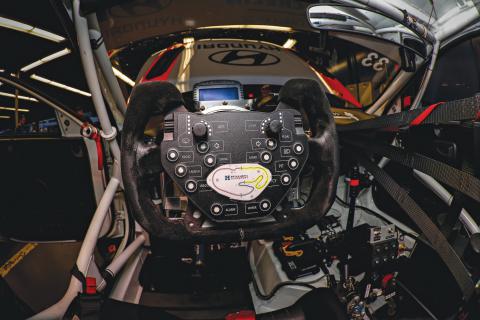
But his determination to race again was undimmed, and his IMSA championship was earned in his second season in the series piloting the BHA Hyundai Elantra N TCR with hand controls. We asked Wickens how much testing he had to do before he achieved proficiency with the hand controls, and his answer, surprisingly, was not much.

“During my years of recovery, I always envisioned months of testing so I could hit the ground running when I returned to racing,” he said. “However, that just wasn’t reality. I got my first taste back into the car in May of 2021 at Mid-Ohio at a BHA track day. After that, my next time in the car was the Daytona Roar in 2022 just one week ahead of my first race back in Daytona, where we finished third.”

image 1
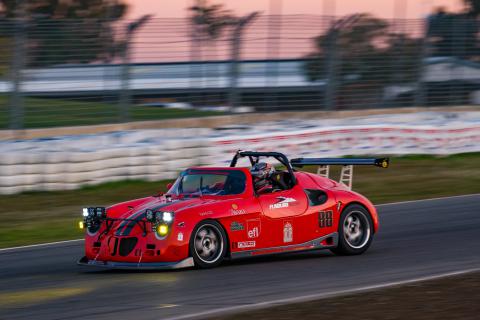
Adaptive race cars have provided opportunities for disabled people to either enter or continue their careers in motorsports. In fact, 2005 ADRL Pro Nitrous champion Dan Parker, who became blind after a 2012 testing crash, now competes behind the wheel of a 2008 Corvette using a guidance system. In 2022 he set the Guinness World Record for fastest blind driver, at the Spaceport America runway in Truth or Consequences, New Mexico, averaging 211.043 mph.

Far away from cheering IMSA grandstands, other drivers are overcoming different challenges thanks to adaptive race car technologies. Dan Parker is an accomplished drag racer, with the 2005 ADRL Pro Nitrous world championship on his resume. A horrific crash during testing in 2012 left him blind. It was not easy for Parker to regroup, but inspiration struck in the form of a dream to race at the Bonneville Salt Flats.

“I reached out to my good friend Patrick Johnson at Boeing and asked him about a guidance system,” Parker recalled. “He said, ‘That’s easy. If that’s all you’re worried about, start building your bike.’”

Other land speed racers with vision loss had used a follow car or motorcycle with two-way communications to navigate. The guidance system Johnson created allowed Parker to ride unassisted. He took his three-wheeled bike to Bonneville in 2013 and became the first blind man to race at the historic land-speed lakebed. “I returned in 2014 and set my FIM class record with no exemptions for blindness because I don’t need any human assistance,” Parker said. “Once they tell me the course is clear, nobody helps me do anything until I bring the motorcycle to a stop.”

He has since stepped up to even more ambitious land speed racing goals, behind the wheel of a 2008 Corvette. In 2022 he set the Guinness World Record for fastest blind driver, at the Spaceport America runway in Truth or Consequences, New Mexico, averaging 211.043 mph. (Officially, “Fastest Speed for a Car Driven Blindfolded,” as Guinness did not have a blind driving category.)

When not stretching performance boundaries for the blind, Parker is a machinist. He runs his mill machine and lathe every day making custom hand-machined writing pens that he sells online as part of his The Blind Machinist business. But even here, the racing technology he employs plays a role. Patrick Johnson, the same engineer who made his racing guidance system, created a digital readout so that his mill machine could talk to him.


High Tech and Low Tech

Parker’s record-setting Corvette illustrates how far technology has empowered racers with disabilities, with potential applications that extend far beyond the race track.

“In 2017 I started building a Corvette. The system in the Corvette is way more sophisticated,” Parker said. “The guidance system box is mounted between the two rear wheels inside the car. We plot the centerline of the track at both ends, as far as we can go. That creates a theoretical centerline. If I go one foot right or left off that center, I get a tone in that ear. The farther off-center I go, the tone increases. If the tone is steady, I know I’m going straight and parallel, I just might be a little right or left and I’ll ease in. Then, 400 feet before the finish line, it tells me ‘parachute,’ and I deploy my parachute. Then, ‘stop,’ which tells me I crossed the finish line. Then I bring the car to a stop.

image 3
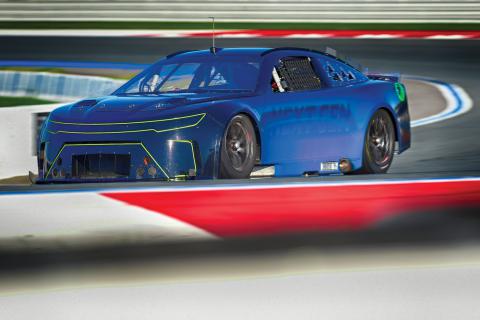
Adaptive Driving Experience uses a NASCAR Toyota Camry to give disabled people a real-life experience of driving a race car. To make sure the guest driver doesn’t have any problems, there’s a second set of controls on the right side of the car and a veteran driver in the passenger’s seat.

“It’s using GPS signals that, once I start, the main thing that does most of the calculations is a gyro that can detect one-tenth of one degree of yaw, and it is updating over 100 times a second. Patrick wrote all the software, 100% volunteer.”

The guidance system is the centerpiece of Parker’s land-speed efforts, but his own racing experiences colored every aspect of the car build. “I was a chassis builder before I went blind, and I designed the car myself. Obviously, I had help building it,” he said, “but I designed pretty much every aspect of the car myself. So we went way above the minimums. I try to stress to people, ‘The rules are just a minimum. You can do more.’ My car has a lot more cage in it than is required. I have containment seats on both sides, window nets on both sides. Ten pounds minimum fire suppression is what the rule is; I have 20 pounds. We’ve just gone way above and beyond to make sure that me and my co-pilot are safe if anything turns to crap.”

Robert Wickens’ racing controls combine established technology with custom engineering. “The foundation of the system is produced by Guido Simplex and is available to anyone for purchase,” Wickens said. “However, Bryan Herta Autosport has made many alterations to give me as much feeling and sensation as possible. The system includes a pneumatic actuator to help generate brake pressure. The actuator pushes the able-bodied brake pedal that my teammate uses. The majority of the work has been trying to create a linear brake feeling from the actuator, because that is the feedback I get from my brake ring when I apply the brakes.

“The only other part of the car that was changed was relocating the clutch to a hand-controlled lever, which is used as a hand brake for the abled-bodied drivers. So Harry and I have to use a hand-controlled clutch to get the car moving and stopping.”

The Adaptive Driving Experience (ADE) in Fairfield, New Jersey, is getting ready to relaunch its program with a series of driving events in 2024. Its target market is largely disabled veterans’ groups and other organizations that represent the handicapped looking for the experience of driving a race car. The organization’s car was on display at the 2023 PRI Show and reflects a combination of custom design and proven parts technology.

“The car itself is a NASCAR Gen 6 Toyota Camry Cup car, so it has some history already, with NASCAR and drivers like Elliott Sadler and Brian Keselowski. We got the car from Brian,” said Danny Chrissanthis, director of ADE. “The body that is on there is a show car body, it’s not actually a racing body. We put a door in it, so it’s a removable door section. And it has a swivel seat base made by a company called Drive-Master. They’re on our Board. They build vehicles for people with disabilities, so this is their specialty. They put the swivel seat base in there and then the hand controls, and they also put in another steering wheel and gas and brake on the right side of the car. It has two full sets of controls. The goal is a race car driver sits on the right side of the car. He’s maintaining control of the vehicle at all times, so the guest driver, who has likely never driven a race car before, doesn’t have a problem.”

The ADE car is proof that it doesn’t require cutting-edge technology for physically challenged people to experience the thrill of driving a race car. “The push-pull gas/brake that we use is off-the-shelf. That was actually invented and developed decades ago by Drive-Master out of New Jersey. It’s a very basic setup,” Chrissanthis said. “We went with it because it’s inexpensive and also because it’s kind of popular because it is inexpensive, and there would probably be more people who are familiar with it.”

image 4
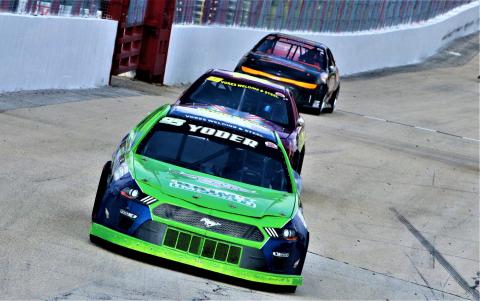
As a teenager, Eric Saunders was a successful motocross racer until a crash left him paralyzed from the chest down. Undaunted, he turned to four-wheel racing and now competes in winged sprint cars with his brother Garrett.

Another racer who has taken the low-tech road to success is Eric Saunders, from Lakeville, Indiana. A successful motocross racer as a teenager, Saunders crashed at a test track in 2010 and was paralyzed from his chest down the day before his 18th birthday. But an unquenchable racing spirit and help from family, friends, and sponsors put him back on track, initially in mini sprints. He currently competes in winged sprint cars with his brother Garrett as part of Saunders Racing.

Eric’s father Irish Saunders said he’s a big believer in the KISS principle—keep it simple, stupid. The hand controls on Eric’s race car bear that out. Plus, cost is always a factor for race teams. “It’s pretty simple. The throttle is cable-driven to the injection. The brake is hooked right into the regular brake with a Brembo hand master cylinder, is all it is,” he said. “We’ve been talking about the fly-by-wire deal, electronics for the throttle. But good God, it’s $7,000 for one of those things.”

Other more subtle modifications help Eric maximize his talents behind the wheel. “Randy Sweet made a steering rack that was super fast, so that if you had your hands at 10 and 2 and you went to 12 and 4, you’d have full lock on the wheel,” Irish said.

If his own race car relies on less-than-exotic technology, Eric is looking forward to the day when four-wheeled racing stretches the boundaries more. “There’s so much technology out there, but they’re only using a portion of it. They’ve not even touched the surface of where the technology actually is,” he said.


Rising Above

For racers struggling to overcome the devastating reality of crippling injuries, being able to compete in a race car again means almost more than they can express. “It’s huge. When I went blind, and coming home and facing reality, I never imagined I would be behind the wheel of a race car again,” Parker said. “I was on the verge of suicide, and one night it just came to me in a dream, at 2 o’clock in the morning, the most vivid dream that I would build a motorcycle and race at Bonneville. I never went back to sleep that night. When my fiancée woke up, I told her, ‘I know what I want to do.’ And I told her about my dream. She said, ‘Okay,’ and that dream saved my life.”

Robert Wickens’ IMSA championship has lit a renewed fire inside him, and he’s already planning his next moves. “Winning the championship was an incredible feeling. It only further vindicated that I belong in motorsports even as a paraplegic. The faith that BHA, Hyundai, and my teammates put in me only proves that my hard work in recovery and setting my goals high were worth it.

image 5
Dan Parker, who is blind, has set speed records in his Corvette using a guidance system developed by a friend of his who works at Boeing. The system uses GPS signals and a gyroscope that “can detect one-tenth of one degree of yaw, and it is updating over 100 times a second,” Parker said.

“I am hoping this is only the beginning in my new journey in motorsport,” Wickens added. “We are working on a new state-of-the-art hand-control system that will provide me a much higher ceiling and can take the next steps in motorsport. The goal is to race in the IMSA WeatherTech series, and with the technology we are working with, it should give me an equal chance to any other driver out there.”

For Eric Saunders, the switch to sprint cars from motocross turned into a case of one door closing and another opening. “The reason why I liked this was because I never did this before,” he said. “I didn’t have any expectations. I knew where I was at when I was racing motocross, and I would never be at that level ever again.

“There’s a thing that [sprint car driver] Randy Hannagan told me, because his brother was paralyzed, too. He said, ‘Eric, you have to think about this. Out of everybody out there, you have more of an advantage than you think you do. You can pick a needle up with your fingers, but you can’t pick a needle up with your feet. So think of having all the throttle control right through your hands.’”

Watching a handicapped individual return to racing means almost as much to family members and friends as it does to the racer. Eric’s circumstances rallied supporters from the motorsports industry to his side, including Tracy Trotter, Ed Kennedy, Mike Fedorcak, Randy Sweet, Tony Stewart, and many others. That sense of philanthropy is embedded in Saunders Racing. “Tony Stewart’s foundation was a huge, huge help with redoing our house and getting it handicap accessible,” Irish said. “Tony’s foundation is for animals, children, and injured racers. Those foundations are huge. That’s what we promote our whole deal through.” Saunders Racing recently announced partnerships for 2024 with the Dale Jr. Foundation, Ryan Preece, the Kevin Harvick Foundation, and the Tony Stewart Foundation.

image 6
“The rules are just a minimum. You can do more,” Dan Parker said about the safety systems in his Corvette. To keep him and his co-pilot safe, there’s “a lot more cage” in the car, plus containment seats and window nets on both sides and a fire suppression system with double the required capacity.

For Irish, watching his son win his first race in four-wheel competition was overwhelming. “I was bawling in victory lane with him,” he said. “Eric won a lot of motocross races, and I thought I’d never see my son win again. And he started winning.”


Your Turn

For racers confronting similar challenges, our sources offered advice both practical and spiritual.

Although Adaptive Driving Experience is not a driving school, would-be drivers occasionally approach them for advice. “I do get, occasionally, somebody who reaches out and says, ‘I want to race, what do you suggest I do?’” Chrissanthis said. “My answer always is, ‘I can’t answer that question. You’re the one going into the corner at 90 mph or 120 mph or whatever kind of racing you’re doing. You’re the one who has to be in control of that car. Only you can say what it’s going to take for you to be comfortable doing that.’”

Once the decision to race is made, there’s more involved than simply outfitting the car with adaptive parts. “I would strongly recommend that any track they go to, that the safety crew knows that that person is paralyzed and show them how to get him or her in and out of the race car. Very important,” Irish Saunders said. “Get there early and make a point to go to the promoter or tech guy, or whoever it is, and say, ‘Hey, I want you to come over here, and I want to show you how to get him in and out of the race car.’”

Practical aspects aside, for many former or aspiring racers dealing with physical challenges, the mental and spiritual side of the equation is the taller mountain to climb.

“Surround yourself with supporters, and distance yourself from doubters,” Parker advised. “When you’re trying to accomplish something like I’ve accomplished, everybody’s going to tell you, ‘It can’t be done, you’re crazy, that’s impossible.’ But you have to believe in yourself, and you’ve got to have blind faith.”

SOURCES

Adaptive Driving Experience
adaptivedrivingexperience.org

The Blind Machinist
theblindmachinist.com

Bryan Herta Autosport
bryanhertaautosport.com

Saunders Racing
facebook.com/SaundersRacing/
March 2024
By
Steve Statham

Social Status

Submitted by johnc on Wed, 02/21/2024 - 12:07
image 1


Put AI to work for you by incorporating ChatGPT in your social media strategy.


Artificial Intelligence (AI) is continuing to advance at a rapid pace, and many industries and departments are utilizing its capabilities. Marketing, and more specifically social media, is one of those areas that can benefit from AI tools. Although there are various AI tools, including Flick, Dall-E, Heyday, and many more, we will discuss ChatGPT and how it can be used to help enhance social media. However, we want to preface this article by saying that although AI can be a valuable tool, human oversight is still essential.

After typing www.chatgpt.com into your web browser or downloading the app on your mobile device and setting up a free account, you can start benefitting. To use this tool, simply input prompts into the message box. (Side note: ChatGPT also offers upgraded plans with access to more in-depth features.)

Various ways ChatGPT can be used for social media include content generation, keyword research, content planning and scheduling, copywriting, trend monitoring, content optimization, and much more.

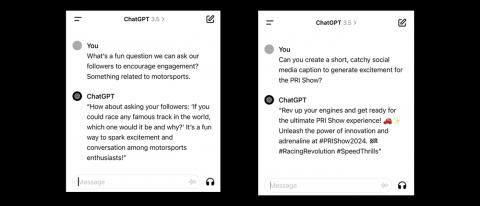
For assistance in generating content, be detailed with your prompts. Ask direct questions and be specific with which social media platforms you’re referring to. For example, ask ChatGPT, “Can you give me content ideas to encourage more engagement on Facebook and Instagram?” If you’re not satisfied with the list of ideas ChatGPT comes up with initially, just follow up with, “Provide more ideas,” and more options will be produced. You can also be more specific with a prompt, with something like, “What’s a fun question we can ask our followers to encourage engagement? Something related to motorsports.” ChatGPT can also provide inspiration for a mix of topics related to your industry or niche.

For keyword research, ask ChatGPT to identify relevant keywords or hashtags to optimize your social media content for searchability and discoverability. This can help with social media captions and SEO.

image 1

When building a social media calendar, ChatGPT can help determine the best days and times to post as well as ensure that you’re using a variety of content. It can also assist with organizing your content calendar and scheduling posts.

Need help writing creative and engaging captions for social media? ChatGPT can facilitate that as well. It can assist with crafting messages to enhance the effectiveness of your campaign. Here’s one example prompt PRI might ask ChatGPT: “Can you create a short, catchy social media caption to generate excitement for the PRI Show?” It’s not imperative to use the exact caption that ChatGPT generates, but you can use it as a starting point and modify it to fit your brand.

Stay informed of the latest industry trends by asking ChatGPT about any new developments or updates. This can help you create relevant content for your audience and encourage you to try new features and content ideas, utilizing the most current trends.

Want to reach a larger audience or resonate with the audience you currently have? Request suggestions from ChatGPT on how to optimize your social media content for engagement and reach. This can provide insight into what type of content you should be creating more of or offer new content ideas to try.

Whatever you might need help with regarding social media, when using ChatGPT, experiment with different types of questions and prompts. The more information you provide, the better.

ChatGPT, and AI in general, can be a helpful tool to enhance your social media efforts, but all generated content should still be reviewed and modified by a human to align with brand and messaging strategies. Regularly monitor your social media performance, and then utilize ChatGPT to make adjustments when necessary. Get started now and use ChatGPT wisely!

March 2024

Appealing to the Masses

Submitted by johnc on Wed, 02/21/2024 - 11:07
image 1


Long popular at the local level, sport compact andfront-wheel-drive oval track classes have been elevated to new heights in recent years by sanctioning bodies and touring series.


Sport compact oval track racing has come a long way in a relatively short amount of time. As Kelley Carlton of the Sport Compact Dirt Racing Association (SCDRA) in Woodruff, South Carolina, explained, early iterations of this type of competition began to crop up in the mid-2000s, and the division wasn’t considered much more than sideshow entertainment at the time.

“They had a division up at Lavonia Speedway in Georgia, and I just remember it being incredibly basic. To be honest, it kind of scared me. The cars didn’t have any cages or harnesses, no containment seats. It was just basically front-wheel-drive cars that had the glass knocked out and some numbers put on the doors.”

While problematic from a safety standpoint, there is an undeniable allure to a racing division that’s truly grassroots and more or less untethered from regulations. Much like the Crown Victoria oval track racing that’s becoming increasingly popular at tracks across the country, the fledgling division’s back-to-basics approach attracted a younger pool of drivers who tended to be focused on having fun rather than using the division as a steppingstone into a professional racing career.

“Today it’s the youngest demographic of any of our divisions,” explained Brett Root of International Motor Contest Association (IMCA), based in Vinton, Iowa. Root noted that the average age of sport compact competitors running with the sanctioning body is in the low 20s, whereas ages in divisions such as Late Models and sprint cars are typically in the high 30s and low 40s. “At our national banquet late last year, we had more sport compact competitors there than any other division—and it’s not our largest division. These folks are, in my estimation, racing for all the right reasons. This is about having fun competing more than anything else.”

But while some series have focused on keeping their sport compact divisions close to original concept—albeit with more comprehensive safety mandates—others have taken a different route that includes a more open ruleset and larger purses. This, in turn, has effectively created two distinct schools of thought when it comes to sport compact and front-wheel-drive oval track racing. But one commonality remains intact: Interest is strong across the board.

Divergent Paths

Over the years, IMCA has largely stuck to its original concept for the division: naturally aspirated four-cylinder, front-wheel-drive cars that are very close to factory stock (aside from safety requirements like fuel cells and cages). That keeps expenses low, not only from the standpoint of the cost of the cars—which are often sourced locally by racers from salvage yards or online ads as street cars and maintained using consumables from local auto parts stores—but also in terms of what it takes to be competitive, as the restricted ruleset discourages racers from focusing on creating sophisticated setups to find competitive advantages. That tactic appears to be working.

image 2
Sport compact racers represent the youngest demographic of any of IMCA’s divisions, said Brett Root. The average age is in the low 20s, while drivers in other divisions, like Late Models and sprint cars, are in their high 30s to low 40s.

“In terms of what it takes to get the car on track and be competitive, I don’t think it gets any cheaper than this,” said Root. “The idea is to keep it basic and minimize the barrier to entry. That’s a priority for us. That gets these folks racing. Our vision has always been, ‘Okay, if you want racing wheels and tires, purpose-built engines, and things like that, there are other divisions in our organization that have that.’ We see a lot of our compact racers migrate into other divisions over time, but the compact division itself has a strong following. We have almost a thousand racers in the division, and this past season we were at roughly 50 race tracks across the country. It’s truly a national division.”

Other sanctioning organizations have followed a different ethos, offering a less restricted ruleset when it comes to performance modifications in their front-wheel-drive classes. While it has resulted in more costly builds—and an older racer demographic as a result—it has also translated to events at bigger tracks, often with significantly larger payouts.

“We wanted to get these racers to some of the greatest short tracks in the country,” said Dan Redmond of Vores Compact Touring Series (VCTS), Farmland, Indiana. “But you can’t go to fast, high-banked tracks like Winchester Speedway and Salem Speedway with stock compacts—it’s just not safe. So the goal was to put together cars that would keep the expense relatively low but would be safe to run at those types of facilities.”

As a result, VCTS created what it refers to as Pro Compacts, which have more open engine rules than stock-style sport compact divisions and allow for significant suspension and chassis upgrades, with weight minimums tied to engine displacement.

“Some term these as Outlaw Compacts,” explained Redmond. “With stock compacts, you’re still limited to things like steel wheels, stock suspensions, no camber, and things of that nature, whereas we allow all of that. But to level the playing field in Pro Compacts to maintain good competition and strong car counts at all our events, we require that everyone runs a one-inch air intake restrictor at all of our tracks, which we provide. That way, even if someone has a $10,000 engine in their car, they can only get so much power out of it with that much air going in. That helps the teams on smaller budgets stay competitive.”

The use of a restrictor also allows competitors to build their cars around the rulesets of sport compact divisions that offer even more leeway in terms of modifications without having to make significant changes to be eligible to compete in both series.

image 3
VCTS has a division with more open engine rules than stock-style sport compact divisions and also allows significant chassis and suspension upgrades. “Some term these ‘Outlaw Compacts,’” said Dan Redmond.

“We’ve never been a ‘knock the windows out and go racing’ type of series,” said Drew Jach of Midwest Dirt Compact Touring Series (MDCTS), Battle Creek, Michigan. “That’s allowed for the series to evolve from a performance standpoint. We give our drivers the freedom to build up their motors. While they have to be from the manufacturer of the car—a Honda in a Honda, if you will—they can build and tune them the way they want to within reason. While it’s not the Wild West when it comes to chassis and suspension stuff, they are allowed some freedom there as well.”

MDCTS requires the cars to run either a Hoosier 790 or a DOT-legal tire with a minimum treadwear rating of 200. Breaking with tradition, the series also allows four-cylinder-powered rear-wheel drive vehicles to compete in the same division, but Jach said that the front-wheel-drive vehicles are often the quicker machines.

“Our ruleset is more open because we have strong relationships with other compact series throughout the country,” he told us. “At some of our races, we bring the East Coast, Midwest, and the Southern series together for these events. But we try to keep our ruleset to where a driver can go between different series with minimal hassle. It’s not perfect—there’s a lot of give and take that needs to happen in order to make it work.”

Although this less-restricted ruleset has made racing in these divisions more costly, Carlton said that it hasn’t really had a negative impact on interest, and the events themselves have taken on a more professional look and feel as a result.

“Initially, one of the things that I felt was problematic was that sport compact just wasn’t getting the same level of respect as other divisions,” Carlton explained. “So we really encouraged the drivers to take some time to make their cars presentable and keep them maintained, and that really made a difference in the perception of the division. At this point, we could book 50 of these events a year if we wanted to. There’s actually a waiting list of race tracks that want to get involved.”

image 4
“Our ruleset is more open because we have strong relationships with other compact series throughout the country,” said Drew Jach of MDCTS. “We try to keep our ruleset to where a driver can go between different series with minimal hassle.”

SCDRA tends to attract a different type of racer as compared to IMCA’s sport compact division due not only to the costs required to build a competitive car, but also because of the prize money involved. “These cars can still be built for $10,000 or $12,000, and drivers can race for $5,000 at least once a month,” Carlton noted. “Some events pay $12,000 to win, while the Winter Freeze race at Screven Motor Speedway pays $20,000 to win.”


Keeping Pace

Root said that while the IMCA’s sport compact division is in a good place, some changes are inevitable in the years ahead.

“It’s something we talk about regularly,” Root explained. “Eventually we’ll likely need to allow more makes and models into the division, which may usher in some six-cylinder cars as well. But it’s hard to do something to these things without ruining what you’ve got, and without making everything that the racers currently own uncompetitive. We’re always asking ourselves when the right time is for some of these changes, and that can be hard to pin down. But we have to stay aware of the fact that some of these vehicles and engines are getting scarcer simply by virtue of the fact that manufacturers’ designs changed over the years. We currently don’t allow engines with variable valve timing, for example, but non-VVT engines are getting harder to come by, so that could change down the line. If we allowed VVT, we’d probably implement some kind of restrictor rule rather than creating a separate division for those cars.”

Redmond said that while VCTS generally prefers to keep a consistent ruleset, its advisory board meets annually to take stock of the issues that need attention. “Something we often hear from drivers is that they love racing with some series, but they’re changing the rules constantly, and that’s costing them time and money. So it’s important for us to get drivers’ input before the rules come down; and once they do, we try extremely hard not to change anything during the season.” One of the few changes that VCTS has implemented for the 2024 season is the use of aftermarket body panels on the cars rather than mandating OE components throughout.

image 6
A benefit to MDCTS competitors, according to Drew Jach, is drivers have the freedom to build up their motors. “While they have to be from the manufacturer of the car—a Honda in a Honda, if you will—they can build and tune them the way they want to within reason,” he said.

“Originally, the rules stated that a car had to look more or less stock—a Honda Prelude had to look like a Honda Prelude from front to back,” Redmond said. “But it was just getting incredibly difficult to find front bumpers that matched certain cars, and it had gotten to the point where racers were spending several hundred dollars just to get the right bumper from a junkyard. So we opened that up so they could go to Five Star or other suppliers and use a Camaro nose, or a Ford nose, if they wanted to. Now we’re extending that rule change to front fenders, rear fenders, and things like that, which helps from a cost standpoint. As availability of parts evolves over time, we want to do what’s right to keep the racing affordable while also making sure that this is still something that the fans want to come and see.”

SCDRA recently implemented a similar rule in its series as well. “We allow aftermarket nose pieces now, and we actually had some discussions with the folks at Five Star at the PRI Show about them potentially adding a product line specifically for these cars,” said Carlton. “As of right now, most of the racers in our series are already using the MD3 stuff that they produce for Late Models, and they’re just cutting it down to fit.”

image 5
“One of the things I felt was problematic was that sport compact just wasn’t getting the same level of respect as other divisions,” said SCDRA’s Kelley Carlton. “So we encouraged the drivers to make their cars presentable and keep them maintained, and that really made a difference in the perception of the division.”

Jach pointed out that keeping costs in check helps these series maintain their lasting appeal. “Without some restraints, you run the risk of pricing the division out of affordability, which is part of what made it attractive to begin with,” he said. “Some of the motor builds and chassis modifications are already pushing that concept. Suddenly what was a $20,000 car build is now $30,000 or $40,000.”

MDCTS’s current ruleset requires stock A and C pillars, along with a stock-appearing floor pan, but racers can use an aftermarket roof. Jach doubts it will go much further than that. “We’re starting to see some tracks allowing tubular four-cylinder chassis, but I don’t foresee us ever going that route. At a certain point, if it gets too expensive, the racers are just going to start looking at other divisions,” he explained.

SOURCES

International Motor Contest Association
imca.com

Midwest Dirt Compact Touring Series
midwestdirtracing.com

Sport Compact Dirt Racing Association
scdra.net

Vores Compact Touring Series
voresracing.com

March 2024
By
Bradley Iger

Business Profile: Funduro Racing

Submitted by johnc on Wed, 02/21/2024 - 10:33
image 1


With its mid-engine, tube-frame chassis and two-seat cockpit, Funduro Racing’s Roadster Cup car offers an authentic race car experience, with the bonus of in-car coaching, at a price point that’s surprisingly competitive in the HPDE market.


Nicolas De Keijser is on a mission to bring the motorsports experience to the masses. “How can I democratize access to race cars?” is the question that drives him. “Making the fun of racing accessible to all—that’s what I’m looking for.”

Nestled in the paddock at Thunderhill Raceway in Willows, California, De Keijser’s Funduro Racing seems like a good start toward his stated goal. Keeping the business model simple, Funduro rents seat time in the company’s own Roadster Cup race cars for high-performance driving events (HPDE), private track days, and, for qualified drivers, real competitive racing in a range of West Coast enduros, including the 25 Hours of Thunderhill, where in 2021 the Funduro team finished first in Class E1. “It’s all 100% arrive and drive,” De Keijser added. “I own the cars, and I rent the seats. I make it simple, so everyone has a good time.”


REAL RACE CARS

What makes Funduro “fairly unique,” De Keijser insisted, is “the cost of what I offer for a real race car experience.”  He brings his own impressive background to the table: More than 20 years of endurance racing, including 10 years in various European Touring Car series, as well the VW Fun Cup, a spec series which his father, Benoit De Keijser, co-founded in 1996. But Nicolas would prefer to talk about Funduro’s Roadster Cup cars, which he and his father helped develop in 2004 as “a natural progression” of the VW Fun Cup. Like the Beetle-bodied Fun Cup, the Porsche-esque Roadster Cup is powered by a relatively economical 1.8- or 2.0-liter VW-Audi engine mounted just ahead of the rear axle in a purpose-built, tubular space frame. Roadster Cup cars raced in the Belgian Touring Car Series (BTCS) and enjoyed their own spec series in 2005–2010. And because they are engineered purely as race cars, said De Keijser, Roadster Cup cars deliver a more visceral driving experience than any street car that’s been modified for racing.

“The car is very analog,” De Keijser explained. “It has no driver aids. It has a manual gearbox, no power steering, no power brakes, so you get a lot of feedback. You are driving everything. It’s high-performance, but it’s approachable.” And because the mechanically simple Roadster can be maintained for literally a fraction of the cost of a newer, high-performance road car, Funduro can offer HPDE at prices “comparable to a Miata rental. Miatas are great, but we give you a race car feel you can’t get in a Miata.”

image 2
Headquartered at Thunderhill Raceway in California, Funduro Racing rents purpose-built, tube-frame Roadster Cup race cars for HPDE and other events. Funduro’s rental prices are aimed at “democratizing access to race cars,” said company founder Nicolas De Keijser.

“It might even be a bit more affordable than renting a Miata,” commented Jo Voordeckers, who drove track days in Belgium, France, and Germany—on the Nürburgring, in fact—before emigrating to the United States, where he met De Keijser through mutual friends. “I’ve driven a spec Miata, and there is a night-and-day difference. A fully prepped, fully built race car is so different from a production vehicle that has been beefed up so you can drive it on a track. From the first time I got in a Roadster Cup I knew exactly what I wanted from that point on. My thoughts of buying my own car for track days or racing were over.”

“The chassis is incredible, the brakes are incredible,” explained Alex Garden, who campaigns an ex-Bill Brock Formula Atlantic race car when he’s not driving with the Funduro race team. “It drives a bit like a slightly heavier shifter kart, and it can run with cars that, on paper, should be much faster.” With just 160–180 hp, “it is a momentum car; you have to carry a lot of speed through the course, because it doesn’t have a lot of juice to get going. But, man, it has crazy-good handling.”

Garden found the Roadster Cup “unbelievably predictable” and “very forgiving. You can push it way past the envelope, and it will let you know, ‘Hey, you’re here, and this is how much I have left.’ Which is kind of fun because you can really hammer it.”

Another important feature of the Roadster Cup is its two-seat bodywork, which allows De Keijser to accompany his customers on the track—“and in a race car,” he noted, “that’s hard to come by. It’s something that we offer that is extremely valuable.”

Voordeckers agreed that he “absolutely” gained confidence from De Keijser “sitting next to me and giving me pointers. He eased me into driving an actual race car—going from a production vehicle with ESP and ABS and road tires, to slicks and no assists. He’ll say, ‘It’s okay, you can go faster. You can brake later. Listen, you can trust me.’ These are things that someone has to tell you, or you would stay far, far away from the limits.”

“The part I enjoyed most was riding with Nick,” added Tim Hurlbut, a 40-year veteran of time trials and track days, whose most recent ride was a fully race-built BMW E36. “When you watch someone who is truly talented, you clearly know what the car can do—and it gives you something to shoot for.” When Hurlbut took the wheel, De Keijser “helped me drive the line and use the car’s full capabilities. I really appreciated having the guy who owns the car sitting next to me saying, ‘This is what will happen if you do this, and this is what will happen if you do that.’”


DOWN TO BUSINESS

That said, competitive endurance racing is as important to De Keijser as his HPDE business, and he divides his time about equally between them. “In terms of revenue, there is a bit more in racing, but track days are really stable,” he explained. “They are a good business for keeping fixed costs under control, because with track days you can better predict how you are going to cover your costs. I have fixed costs such as shop rent, but [with HPDE] even the variable costs are easy to predict.” Whereas with racing—an ironic laugh here—“things can go off in many directions.”

Funduro’s corporate (and other group) track days at Thunderhill Raceway can accommodate between 10 and 30 people, who bring widely varying levels of skill and familiarity with high-performance driving. “Often they are novices,” De Keijser noted, “so they require a bit of coaching. Sometimes they have to learn how to drive a manual shift—and that’s an interesting experience. But we bring them through the whole idea of what it’s like to drive a race car, and I think the uniqueness of that experience versus the cost is pretty amazing.

image 3
Nicolas De Keijser (right) brings years of his own racing experience to Funduro and enjoys coaching his customers. “We bring them through the whole idea of what it’s like to drive a race car, and I think the uniqueness of that experience versus the cost is pretty amazing.”

“But for the ultimate experience, we offer true private events, limited to one to four customers, and where we have exclusive use of the track. This provides the opportunity for enhanced one-on-one mentoring while also making the business more viable.”

Always, De Keijser strives for “a pleasant, family-style atmosphere. My wife Ann, my children Matthew and Mika, and sometimes even my parents help with logistics, making sure that everyone is taken care of with food, accommodations, information, a place to change and relax, etc. Even our dog (and team mascot) Maui helps keep our guests entertained,” he added.

Again, De Keijser emphasized how his HPDE and racing activities complement each other. “Could I make a living out of track days? No,” he answered, “and I don’t think anyone would ever tell you that they could. Even if you had good margins, you would need enormous volume. As I said earlier, it’s a way to keep the cost of your race team under control—and if you have a good season in racing, you can grow your business that way.”


FROM TRACK DAY TO TRACK CHAMPION?

It would be a mistake, also, to count on HPDE customers becoming racers. “I’ve seen a little bit of everything,” said De Keijser. “I’ve seen people just stick to track days with us. I’ve seen people start with us, and they move on to a different platform, and that’s fine. We also have customers who were already racing, and they rent our car because they want to try something new. And they become good customers.

“I think at the end of the day, someone who wants to race has a commitment to racing—you need a certain level of commitment if you are going to race—and they will find a path that allows them to do that. It’s not because they rented a car from me. They had it already in their mind.”

image 4
Competitive endurance racing is as important to Nicolas De Keijser as his HPDE business, and he divides his time about equally between them. In 2021, the Funduro team finished first in Class E1 at the 25 Hours of Thunderhill.

Remember Voordeckers, who had considered “buying my own car for track days or racing” before his experience with Funduro? Early last year he drove in his first race, completing 90 minutes of a seven-hour event with the Funduro team at Sonoma.

“We have a number of racing customers that we have been working with for several years now,” De Keijser added, “and new customers are coming in. Of course, there is some cycling, but ideally you can keep the customers for a longer time and do entire seasons with them. I enjoy developing a team and sharing my long experience with endurance racing in Europe.

“We run in NASA WERC”—the Western Endurance Racing Championship—“and in Lucky Dog,” including events at Fontana, Willow Springs, Laguna Seca, and Sonoma. “We’ve done the 25 Hours of Thunderhill three years in a row.”

Some of Funduro’s more seasoned racing customers attested to De Keijser’s organizational skills. Geir Ramleth, who runs a 1963 Lotus 23B in the Classic Sports Racing Group and competes in Formula Atlantic with a 1982 Ralt RT4, shared Funduro’s class win at Thunderhill in 2021 and raced with the team again in 2022. He remarked on how De Keijser enlisted his family in the effort, “and they really knew how to run an endurance race. They planned the whole thing from beginning to end. It’s not only getting the car ready. It’s organizing work in shifts, cycling the drivers, assuring that people are getting fed and getting rest. And they knew exactly what to do.”

“Nick is extremely well organized,” agreed Oleg Gorshkov, who has competed in the 25 Hours of Thunderhill since 2016—with Funduro since 2018—and more recently joined a Porsche Cayman team in WRL GT1. With Funduro, “the car is extremely well prepared. I’ve been on teams where the car was not prepped at all, or it was prepped on practice day. With Nick, you show up and the car is ready. And the crew is very professional. He has seven or eight technicians for one car—which is a lot.”

“The cars are prepped correctly,” Garden confirmed. “Everything runs on-schedule.”

For Ramleth, just as impressive as Funduro’s 2021 win was how well the organization held together when the mechanical parts didn’t in 2022. “We had a couple of engines and a transmission go bad,” Ramleth recalled. But in addition to his crew in California, “Nicolas had brought over a team of mechanics that he had worked with in Europe, and they did not know how to spell DNF. They just kept us going.”


OBSTACLES AND ENDURANCE

Satisfied customers like these, De Keijser contends, are the best possible promotion. “I’m getting to be known, and when people talk about you, that’s usually where new customers come from.”

Of course, De Keijser is not the first to tell us that, nor is he the first to note the challenges of promoting a business through social media. “I have a Facebook page, I have Instagram, and I have my website, which is where I get the most Internet traffic. My social media presence is marginal, but that’s self-inflicted. Social media has to be cultivated. You have to stay active on it or it’s hard to stay relevant. For a website, the most valuable thing is to be prioritized by the search engine—and I am not, because that costs money.”

image 5
Funduro Racing customers appreciate how thoroughly the Roadster Cup cars are prepared for each event. “The crew is very professional,” said one racer. “He has seven or eight technicians for one car—which is a lot.”

One very simple, no-cost promotion that De Keijser does recommend is a marker showing his location on Google Maps. “My son Mika, who just started competitive karting, helped me with that. Now when people look up Thunderhill, they see the name of my company, too.”

De Keijser expressed some frustration, also, with racing sanctions that “have no obvious class for my car,” and so tend to default to classing it where it’s less competitive. NASA, with its “more open rules,” offers a better fit than some others, but still penalizes “non-production” (e.g., tube) chassis—which De Keijser finds ironic, arguing that “tube-chassis cars bring a more real race-car feel at a lower cost, for similar performance, than a stock-based car.” Fortunately, in endurance racing, “even if you are not ideally classed, you can bring forward other attributes to be competitive. We’ve proven it. But it’s a lot harder to do that in a 20-minute race.”

When we asked De Keijser if he would consider prepping and maintaining customer-owned cars, he said that was “definitely a path forward,” albeit one he has not yet taken. Growth could also come from “sponsorship or, alternatively, customers who are wealthier, but then you are working in a different tranche of the business. And it would be against the concept of racing for the masses.”

De Keijser plans to import more Roadster Cup cars. With his father he owns an even dozen, but only three are presently garaged in California. The rest are in Belgium but bringing them over is “in the cards.”

What De Keijser would “love to see” is “something similar to the VW Fun Cup in the United States—a single-make endurance series. You would need to have an association with the manufacturer, and I don’t have that recognition,” nor, he allowed, the necessary capital “to get something like that started. But I believe in the concept. If you look at the World Racing League, or Lucky Dog Racing, they are bringing endurance racing to the masses, but with all sorts of cars. The same concept with VW Fun Cup or Roadster Cup cars would be fantastic.”

March 2024
By
John F. Katz

Open Entry

Submitted by johnc on Wed, 02/21/2024 - 10:16
image 1


How NASCAR’s Next Gen car platform became an international launching pad.


It’s often a little moment when the reality of a massive accomplishment sets in.

NASCAR’s Garage 56 entry had just completed the 24 Hours of Le Mans, a historic achievement in which a modified NASCAR Cup Series car competed on the same track as Hypercars, LMP2 cars, and GT cars in the legendary endurance race. It was the culmination of a collaborative effort led by IMSA President John Doonan.

Amid the post-race hype and congratulations, Doonan visited a local cathedral the following day for a moment of solitude. However, it wasn’t long before a man and his son noticed Doonan’s Garage 56 jacket and came up to him with an unusual request. They wanted Doonan to take a video of them.

“In the video, they’re wearing 24 Hours of Le Mans hats, and the guy says, ‘I never watched NASCAR before and I live in Miami, but I can assure you after what I saw with the Garage 56 project, when I go home, I’m going to go to the Homestead race and try to tune in and learn more because they opened my eyes,’” Doonan recalled. “For me, that was a big milestone.”

How did NASCAR reach a point where new fans were so fascinated by the sport that they were making testimonial videos at a French cathedral? That story begins in 2018, when development began on the NASCAR Cup Series Next Gen car.


Genesis of Next Gen

“The platform we had, while it had served us well, it was getting old and wasn’t as relevant to our existing OEMs anymore,” said John Probst, NASCAR senior vice president, chief racing development officer. “The suspensions on them got pretty antiquated, so we had the opportunity to start with a clean slate.”

Probst and his development team went to work on the Next Gen car. They modernized the car with significant upgrades including an independent rear suspension, rack-and-pinion steering, transaxle, larger brakes, 18-inch forged aluminum wheels with a single lug-nut design, and wider tires. They also made significant aerodynamic adjustments, sealing the bottom of the car with an underwing and rear diffuser, while adding hood louvers to maximize engine performance independent of aero.

image 2
NASCAR’s Garage 56 entry beat the fastest GT car in the field by nearly four seconds a lap during qualifying for the 2023 24 Hours of Le Mans. More importantly, the car finished the legendary endurance race and “fans absolutely loved it,” said IMSA President John Doonan.

“As we were designing the new car, we were keeping an eye out for not just the powertrains, but how relevant our car topology is to the rest of the world,” said Probst. “The idea was not only to attract new [team] owners, but how can we try and attract drivers from all over the world.”

Significant changes to the car’s anatomy made it more akin to traditional GT cars, while the sanctioning body also mandated the use of single source supplied parts. The latter was done to reduce development costs for teams and achieve more parity in the Cup Series. In 2022, the Next Gen car’s first year on track, the Cup Series saw a record-tying 19 different winners and success from newer teams including Trackhouse Racing (co-owned by Pitbull and Justin Marks) and 23XI (co-owned by Michael Jordan and Denny Hamlin).

The on-track success of the Next Gen car in 2022 was a positive step, but NASCAR Chairman and CEO Jim France saw the car as an opportunity to do something historic on the world stage—at Le Mans.


Taking on Le Mans

In 1976, France’s father, NASCAR founder Bill France Sr., had the vision to take two Cup Series cars to Le Mans, France, and compete in the 24 Hours of Le Mans. Unfortunately, both the Ford Torino and Dodge Charger failed to reach the halfway point of the race before retiring. Fast forward nearly 50 years, and the Next Gen car provided a platform to not only complete the race, but to be competitive. NASCAR was ready for another shot at Le Mans.

Of course, a good platform is not the same as a race-ready car on the starting line of a 24-hour race. The Next Gen car would require significant modifications that would take a collaborative approach from NASCAR and various partners.

That is where Doonan and the International Motor Sports Association (IMSA) team came into play. While NASCAR and IMSA are both owned by the France family, the two organizations had historically operated separately. The Garage 56 program marked a turning point in that relationship.

“The whole Next Gen project and how that morphed into the Garage 56 effort has pretty much blurred the lines between NASCAR and IMSA,” explained Probst. “I would say now in retrospect, this has been a project that we’ve all kind of unified around even beyond the car, with our relationships across the company.”

In addition to NASCAR and IMSA, the Garage 56 collaboration recruited Chevrolet, Hendrick Motorsports (HMS) and Goodyear. The IMSA component was crucial, as its expertise in endurance racing and international relationships with the Automobile Club de I’Ouest (ACO) and the Federation Internationale de I’Automobile (FIA) helped pave the way and inform NASCAR and HMS engineers how to best develop an endurance car for Le Mans.

Starting with a 5.8-liter V8-powered Chevrolet engine from HMS, the Garage 56 team made various adjustments to the car. Changes included adding real headlights and taillights, a larger fuel cell, eliminating nearly 500 pounds of weight (compared to a current Cup car), and making various aerodynamic modifications to increase downforce, including dive planes and underbody adjustments to the front splitter and rear diffuser. “From an aero perspective, we actually doubled the downforce on the Garage 56 car,” said Probst. “The majority of that was underneath the car.”

image 4
From the independent rear suspension to the rear diffuser and single lug-nut design, NASCAR’s Next Gen Cup car was designed “with an eye for how relevant the car topology is to the rest of the world,” said NASCAR Chief Racing Development Officer John Probst. More akin to traditional GT cars, “the idea was not only to attract new [team] owners,” but also “to attract drivers from all over the world.”

While Garage 56—a single entry “innovative car” category—does not have any in-class competition, the ACO provided NASCAR with a target lap time to be midfield of the GT cars. When it came time to qualify, Mike Rockenfeller pushed the car to a lap time of 3:47.976, nearly four seconds faster than the quickest GT car in the field, a Ferrari 488 GTE.

“I don’t think any of us could be more proud of how we performed over there,” said Doonan. “We certainly hit expectations on Day One, in terms of lap time performance the ACO was hoping for. Then they asked us to go quicker, and fortunately, thanks to John Probst and his team, we had the capability to do that.”

Fans quickly took notice.

“You just had this constant buzz about the American car that was there,” said Chad Seigler, NASCAR chief international officer. “Whether that was the difference in the look of the car, the sound of the car, there was a buzz around the venue that week.”

During the race itself, an all-star driver roster consisting of seven-time NASCAR Cup Series champion Jimmie Johnson, 2009 Formula 1 world champion Jenson Button, and two-time 24 Hours of Le Mans winner Mike Rockenfeller shared responsibilities for piloting the car around the 8.4-mile Circuit de la Sarthe. The Garage 56 entry showed strong pace in the race, completing 285 laps (2,413.1 miles) and finishing 39th place in the 62-car field. Fittingly, it was Johnson who brought the car to the checkered flag in the race’s final stint.

“I thought the fans would like it when we got over there, but they absolutely loved it,” said Doonan. “I think we made a huge impression on what NASCAR is as an overall brand. And I think it’s a compliment to John [Probst] and his team on what the Next Gen car is all about because it’s very akin to the GT cars that we run. I think it had everybody starting to think more about what NASCAR is about and the capabilities of the new car.”

Capitalizing on Momentum

The “capabilities of the new car” is an important consideration. For the first time, a NASCAR Cup Series car shares design characteristics with GT cars that have long dominated the international racing scene. That pivot to a more modern car design is creating opportunities for the sport that didn’t exist a few years ago.

“Two or three years ago, I would not have guessed we’d had this car at Le Mans running, and then running as well as it did,” said Probst. “I’m just really excited for the future of not just this car and where it’s going, but our relationship with the IMSA side and growing that.”

The on-track performance grabbed attention, but NASCAR capitalized on their Garage 56 success with a carefully planned outreach strategy.

“I think it’s probably easy for a lot of people to look at what happened during that 24-hour run there, but the build-up and those several months after [the race] were key for us,” said Seigler.

After leaving Le Mans, Seigler and the NASCAR team visited London to hold a partner summit with 70 decision makers, including track promoters, broadcast partners, potential team owners, investors, and others. Seigler’s team also restructured the NASCAR Whelen Euro Series calendar to move their race at Brands Hatch in West Kingsdown, England, to the weekend immediately following the 24 Hours of Le Mans. The race attracted 41,000 people, setting an attendance record for the Euro series.

“There are places we go in the US where 40,000–50,000 is a big number,” said Seigler. “Not just for motorsports, but all sports. So that was a positive.”

To cap off their summer, they brought the Garage 56 backup car to the Goodwood Festival of Speed Hillclimb in West Sussex, England. The final European stop resulted in further exposure to the European market, as Rockenfeller and Button revved up the crowd with burnouts and thunderous runs up the 1.16-mile hill climb.

New Drivers, New Countries, New Fans

Back in the States, a flurry of circumstances converged to deliver one of the most unlikely Cup Series victories in recent years and pique the attention of international drivers around the world. Shane van Gisbergen, a three-time Australian V8 Supercars champion, became the first driver in 60 years to win in his first NASCAR Cup Series start, pulling off the upset during a soggy race on the streets of Chicago. The New Zealand-born driver was hooked immediately, eventually signing a multi-year deal with Trackhouse Racing to come to America for a crack at NASCAR.

image 3
Shane van Gisbergen, a three-time Australian V8 Supercars champion, became the first driver in 60 years to win in his first NASCAR Cup Series start. Since his 2023 win in Chicago, the New Zealand-born racing star signed a multiyear deal with Trackhouse Racing for a full-time opportunity in NASCAR.

Van Gisbergen’s victory not only displayed the Kiwi’s raw driving talent, but also the Next Gen car’s potential to attract other international drivers. In fact, the 2023 Australian V8 Supercars champion, Brodie Kostecki, signed a deal with Richard Childress Racing to run a limited number of Cup races in 2024. Unconfirmed rumors suggest they aren’t the only V8 Supercar drivers with an eye on competing in NASCAR.

“I think that in a lot of ways, our car is not all that different than an Australian V8 Supercar,” said Probst. “Certainly, in the way they handle.”

Beyond Australian drivers, other international drivers including former F1 drivers Jenson Button and Kimi Raikkonen also competed in Cup races during the 2023 season. As Seigler explained, international drivers coming to NASCAR doesn’t just diversify the starting grid, it also opens the gateway to an entire country. “Traditionally what we see when a [driver] from a foreign country comes in, you pull in that country’s motorsport fans with them because there’s a rooting interest. It’s that patriotic moment.”


The Next Era

The Garage 56 effort and van Gisbergen’s win were both major international victories for NASCAR. Those two events happening within a month of each other only amplified the attention and helped to grow the sport’s international footprint. “Those all coming together was kind of a perfect storm,” said Seigler. “There’s a lot more wind at our back right now.”

It’s a new era for NASCAR, and the sport’s leaders seem to have calculated that growth requires shaking up the status quo. On the digital front, it just launched a new Netflix documentary series, NASCAR: Full Speed, while its new seven-year media rights deal that begins in 2025—worth an annual value of $1.1 billion—includes five races each season that will be streamed exclusively on Amazon Prime. Of course, the on-track product is most important, and the Next Gen car represents a major departure from its previous-generation stock cars. After two years on track, the results are exceedingly positive.

image 5
After 24 hours and 2,413.1 miles, NASCAR’s Garage 56 entry completed the 2023 edition of the 24 Hours of Le Mans following a historic collaboration between NASCAR, IMSA, Hendrick Motorsports, Chevrolet, and Goodyear. IMSA’s John Doonan believed the effort “made a huge impression on what NASCAR is as an overall brand,” while NASCAR’s John Probst championed future collaboration, “the Garage 56 effort has pretty much blurred the lines between NASCAR and IMSA.”

Nevertheless, Probst and his team continue to tweak on the car. In fact, data from their Garage 56 effort in Le Mans contributed to aero changes NASCAR applied for the 2024 season.

“As we go through and try to improve the packages that we run in the Cup Series, we’re able to start with some of the concepts that we actually raced at Le Mans, even for some of the short-track-package updates that we made for this year,” said Probst. “So any time we’re able to put a race car on track and try something different, even if it’s for a road race effort at Le Mans, our engineers back here at the R&D center are paying particular attention because these are lessons learned that we can apply in other forms of our race product.”

As NASCAR enters its 76th year, the sport isn’t shying away from change, and the Next Gen car is leading the charge into the future. The sanction debuted an all-electric race car at February’s pre-season Clash at the Coliseum in Los Angeles, though there are no current plans for an electric series at this time. From a powertrain perspective, Probst and his team are exploring everything from hybrid to hydrogen. “One of the tenets of the whole Next Gen project was to have a platform that would enable us to react to a lot of the trends we see coming from a powertrain perspective.”

Undoubtedly, some detractors will decry these significant changes, clinging to nostalgic visions of the past. But change is an unstoppable and constant force, one that NASCAR has chosen to embrace rather than fight.

With the success of Garage 56, a closer collaboration with IMSA, an embrace of new vehicle technologies, and an influx of talented international drivers and their fans, the sport known for left turns may have made the right turn, at the right time.

SOURCES

IMSA
imsa.com

NASCAR
nascar.com

March 2024
By
Jack Haworth

Advocacy Corner

Submitted by jeffreyc on Tue, 02/20/2024 - 15:37


Tracking legal, legislative, and regulatory developments impacting the racing and performance industry.

PRI’s Washington, DC-based legal and advocacy teams work continuously to protect and support motorsports venues, sanctioning bodies, and businesses around the nation. We are tracking several initiatives this month, including a pro-business tax bill in the US Congress and multiple state legislatures introducing bills aimed at fighting ZEV (zero-emission vehicle) mandates and supporting consumer freedom.

Attend the SEMA & PRI Washington Rally

Don’t miss out on the opportunity to attend the SEMA & PRI Washington Rally, taking place in Washington, DC, on May 8–9, 2024. The Washington Rally provides an opportunity for SEMA and PRI member companies to come together and advocate on behalf of the specialty automotive aftermarket and motorsports parts industries with members of Congress.

By attending the Washington Rally, you will have the opportunity to meet with your members of Congress and their staff, discuss critical issues, and advocate for policies that will benefit our industry. Your participation will help ensure that our industry’s concerns are heard and that we can continue to innovate and grow.

Whether it’s protecting the right to repair and modify vehicles with advanced technology, combating vehicle technology mandates that limit consumer choice, or protecting motorized access to federal government lands, there are many issues facing SEMA and PRI members in the nation’s capital. With the 2024 presidential election heating up and the balance of power in both the House and Senate up for grabs, it’s more important than ever for SEMA and PRI members to come to Washington, DC, to advocate for the industry!

To register for the Washington Rally or for more information, please visit sema.org/washington-rally or contact Kayla Mitchell at kaylam@sema.org.

SEMA and PRI have a limited number of rooms available at the Royal Sonesta Washington, DC Capitol Hill for $409 per night plus tax. A link to book a room will be provided upon completing the registration form. Please encourage SEMA and PRI members to RSVP for the Rally and book their rooms ASAP!

2024 Washington Rally events:

Wednesday, May 8, 2024 

5:30 pm–7:00 pm: SEMA-PRI PAC Reception, Royal Sonesta Capitol Hill, Sapphire Room & Terrace – Penthouse level

*A PAC contribution is required to attend in the suggested amount of $250 per individual. If you have already contributed to the SEMA and PRI PAC in 2024, this event may be complimentary as a part of your PAC Membership Benefits. Please contact PAC Manager Alicia Steger at alicias@sema.org if you have any questions.

7:00 pm–9:00 pm: Washington Rally Congressional Dinner, Royal Sonesta Capitol Hill, Crown Ballroom – Penthouse level

Thursday, May 9, 2024

7:00 am–8:30 am: Breakfast and Welcome Briefing, Royal Sonesta Capitol Hill, Crown Ballroom – Penthouse level

9:00 am–12:00 pm: Meetings with Congressional Representatives, House and Senate Office Buildings

9:00 am–3:00 pm: Cars at the Capitol Event, Southwest side of the US Capitol on Maryland Avenue (across from the Botanical Garden)

12:00 pm–1:30 pm: Congressional Luncheon, Capitol Hill Club, Eisenhower Room

2:00 pm–5:00 pm: Meetings with Congressional Representatives, House and Senate Office Buildings

California Introduces Bill to Mandate Speed Limiters

California has introduced SEMA- and PRI-opposed legislation to require new vehicles to be equipped with speed governors starting in model year 2027. Speed governors, also known as intelligent speed limiters, use GPS technology to limit vehicle speed. If enacted into law, new vehicles would not be able to travel more than 10 mph above the speed limit.

“SEMA and PRI stand firm against the proposed California legislation mandating speed limiters on new vehicles,” said Christian Robinson, SEMA and PRI’s senior director of state government affairs and grassroots. “This one-dimensional approach fails to acknowledge the nuanced nature of driving and the diverse needs of motorists. Imposing rigid restrictions undermines the essence of individual responsibility embraced by automotive enthusiasts, and we advocate for solutions that balance safety with the enjoyment of driving experiences.”

Currently, devices that prevent vehicles from exceeding a certain speed are not required. Among other issues, this proposal makes broad assumptions about real-world circumstances. This one-size-fits-all approach fails to recognize the diversity of driving experiences and the individual responsibility that automotive enthusiasts take seriously.

Pro-Business Tax Bill Passes House Committee

The US House of Representatives passed H.R. 7024, the Tax Relief for American Families and Workers Act of 2024. The PRI- and SEMA-supported bill gathered strong bipartisan support, passing by a margin of 357-70. 

Sponsored by Rep. Jason Smith (MO-08), this bipartisan legislation allows for immediate expensing of research and development (R&D) and investments in equipment, reduces reporting for small businesses using subcontractors, increases the small business expensing cap by nearly 30%, and expands the Child Tax Credit. The legislation now awaits consideration in the US Senate’s Finance Committee. 

“PRI is proud to support the ‘Tax Relief for American Families and Workers Act of 2024,’” said Eric Snyder, PRI’s senior director of federal government affairs. “The tax incentives in the bill will provide a shot in the arm for small businesses, including motorsports parts manufacturers, retailers, and race tracks.” 

PRI members and manufacturing businesses can benefit from the following parts of this legislation: 

R&D expensing: Businesses of all sizes can immediately deduct the cost of their US-based R&D investments instead of over five years, encouraging American innovation and improving our competitive position versus China and the rest of the world. 

Interest deductibility: Continued flexibility for businesses forced to borrow at higher interest rates to meet their payroll obligations and expand their operations. 

One-hundred percent expensing: Restore full and immediate expensing for investments in machines, equipment, and vehicles. 

Expand small business expensing cap: Increase the amount of investment that a small business can immediately write off to $1.29 million, an increase above the $1 million cap enacted in 2017. 

Cut red tape for small businesses: Adjust the reporting threshold for businesses that use subcontract labor from $600 to $1,000 and index for inflation, the first update to the threshold since the 1950s. 

SEMA and PRI, together with more than 260 organizations, signed the National Association of Manufacturers’ letter to US House and Senate leadership in support of the Tax Relief for American Families and Workers Act of 2024. 

PRI will provide updates on the progress of this important legislation. For more information, contact Tiffany Cipoletti at tiffanyc@sema.org.

West Virginia, South Dakota Introduce Bills Supporting Internal Combustion Engines

West Virginia Delegate Gary Howell, chairman emeritus of SEMA’s State Automotive Enthusiast Leadership Caucus, introduced SEMA- and PRI-supported legislation that would prevent any state or local government unit from restricting the use or sale of motor vehicles based on the energy source used to power them, including internal combustion engines (ICE). 

In addition, South Dakota has introduced SEMA- and PRI-supported legislation that would prevent any county or city in the state from limiting access to ICE and related technology. The bill awaits consideration by the House Local Government Committee.

“As advocates for the motorsports industry and individual freedom, we applaud West Virginia and South Dakota for taking a stand in favor of consumer choice,” said Christian Robinson, PRI’s senior director of state government affairs and grassroots. “The legislation introduced reflects our commitment to preserving the rights of residents to choose the vehicle technology that aligns with their needs and preferences. This move sets a positive precedent, and we hope other states will follow suit in championing individual liberty and the diverse automotive landscape.”

West Virginia and South Dakota are the first states to introduce this legislation in the 2024 state legislative sessions but follow seven other states (Texas, Oklahoma, Kansas, Wisconsin, Michigan, Ohio, and North Carolina) that have previously passed similar legislation and resolutions. 

PRI believes West Virginia and South Dakota residents, not the government, should be allowed to choose the type of vehicle technology that best serves them and their families. 

For details, contact SAN@sema.org. 

Virginia Lawmakers Introduce Bill to Repeal Virginia’s ZEV Mandate

In Virginia, lawmakers introduced PRI-supported legislation to repeal the law tying the state to California’s motor-vehicle emissions standards. Under current law, new gas- and diesel-powered vehicle sales will be banned starting in 2035. The multiple bills now await consideration in the Virginia General Assembly. 

PRI does not believe that the government—Virginia’s or California’s—should be choosing winners and losers in the automotive market. Virginians should decide what vehicles are best for them and their families. 

“In the spirit of individual choice and free-market principles, PRI stands firmly against government interference in the automotive market,” said Christian Robinson, PRI’s senior director of state government affairs and grassroots. “Virginians deserve the autonomy to decide their preferred vehicles without the imposition of mandates. We believe in empowering consumers, not dictating winners and losers.”

PRI will provide updates on the progress of this important legislation. For more, contact Kiley Chapley at kileyc@sema.org.

March 2024
By
Jack Haworth

PRI Tech: Alternative Fuels in Motorsports

Submitted by jeffreyc on Tue, 02/20/2024 - 15:27

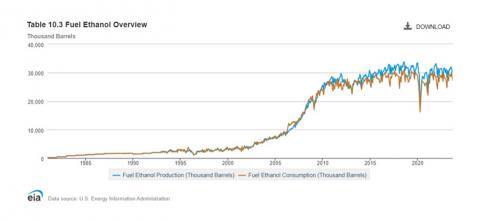
Timeline of ethanol introduction to US gasoline market.

The term “alternative fuels” has been used in headlines for the past few decades as the world searches for a new method of producing fuels to power our lives. Crude oil provides an economical solution for transportation, but it brings carbon molecules from underground and releases them into the environment. Many fuel providers and race series, as well as government agencies, are focusing on the challenge of developing a technology that powers our vehicles without altering the composition of our planet’s atmosphere. This is why almost every recent headline regarding racing fuel has been focused on communicating a sustainable message.

The fact that the racing industry is included in the search for sustainable energy is a compliment to the unrivaled creativity inherent to the sport. This creativity spawns from intense competition and the everlasting spirit of racers who push boundaries and drive technology forward. This article will cover the history of alternative fuels used in the US as well as define the next generation of diesel and ethanol products becoming more available for racing and transportation vehicles.

Alternatives to Tradition

The history of alternative chemicals that have been tested in internal combustion engines focuses on racing fuels and the wide adoption of ethanol in gasoline and biodiesel in diesel. Alcohols, ethers, esters (biodiesel), and nitromethane could all be considered alternative fuels compared to traditional gasoline and diesel. These alternative products have been around for decades in racing and are even favored by many different categories. While these alternative fuels meet the demands of racing, they do not address the challenges of the US transportation sector or allow for a sustainable environment. 

The addition of ethanol and biodiesel have helped shift the fuel source away from solely relying on subsurface carbon. Additionally, these biofuels recycle some of the carbon that is currently in the atmosphere. As seen in the graph at top left, from 2000 to 2010, ethanol production ramped up and became widely utilized at up to 10% in gasoline.

Both the top and bottom graphs show how ethanol and biodiesel production have plateaued, indicating stalled progress in reducing carbon emissions from fuels. Conversely, renewable diesel production has doubled year over year for three years running. When deciding which direction the industry will shift, the key is not only the chemical compounds themselves, but how they are produced.

Renewable Diesel

How is renewable diesel different from biodiesel? Renewable diesel is made from vegetable or animal fats that are heavily refined and purified into a very narrow cut of synthetic diesel that can be a drop-in replacement at 99% usage in fuels. Many refiners have fully switched from crude oil processing to animal/vegetable fat processing so they can support markets where low carbon emissions are valued. 

2
Timeline of biodiesel (shaded) and renewable diesel introduction to the US market.

Renewable diesel is being favored over biodiesel because it can be used as a drop-in replacement for diesel without the gelling troubles that plague biodiesel. Renewable diesel also has a high “cetane rating,” which gives the fuel a shorter ignition delay from when the fuel is injected to when it combusts and offers better tuning for performance applications. The cetane rating of renewable diesel is in the 70–75 range, much higher than the EPA minimum of 40 for crude diesel. This alternative fuel is attractive because heavy industries (aviation, trucking, shipping) are less likely to be electrified in the near future.

Low Carbon Intensity Ethanol

Low carbon intensity ethanol is an example of how changing the production method of a particular chemical can also reduce the impact on the environment. Also known as “second generation” or “cellulosic ethanol,” low carbon intensity ethanol has the same fuel specification as traditional ethanol; therefore no changes are needed for current vehicles. Low carbon intensity ethanol is made from breaking down cellulose from corn stalks and leaves into sugars that can be fermented into ethanol. Using the parts of the corn that would otherwise be burned or sent to a landfill helps reduce the carbon intensity of this ethanol. It will deliver the same performance benefits as typical corn starch ethanol when used in fuels like E85. Starting in 2024, Sunoco has adopted low carbon intensity ethanol in the manufacturing of its race fuels such as E85-R.

3
Sunoco E85-R is always 85% volume ethanol and is blended from low carbon intensity ethanol.

The next generation of fuel is upon us with low carbon intensity versions of ethanol and renewable diesel becoming available in certain markets. When combusted, they still have similar emissions to their first-generation counterparts; however, the way they are produced has a lower impact on the environment. Each pathway to produce the fuels is different due to variables in gathering feedstocks, processing methods, and transportation of finished fuels. These products can reach up to 65% reduction in life-cycle carbon emissions when compared to gasoline or diesel. While these fuels are not perfect, they are available currently, and many companies and municipalities are selecting them. This has led to a demand for low carbon fuels that outpaces the production capacity in the US and signals a growing alternative to electric vehicles.

Racing continues to offer a canvas for testing new ideas that reward performance, power, and reliability. New fuels are always welcome to be tested, as the next generation of low carbon fuels promises a more sustainable product alongside performance readiness. 

Zachary Santner is the Manager of Product Engineering for Sunoco Performance Products, providing high octane specialty fuels to the largest racing series as well as the enthusiast market. Mr. Santner is a resource to the automotive aftermarket and holds a degree in chemical engineering and a master’s degree in business administration.

Sources

Alternative Fuels Data Center
afdc.energy.gov/fuels/renewable_diesel.html

U.S. Energy Information Administration
eia.gov/totalenergy/data/browser/index.php?tbl=T10.04B#/?f=M

March 2024
By
Zachary Santner

Michael Good Appointed President of Performance Racing Industry

Submitted by ajh on Tue, 02/20/2024 - 13:48
Michael Good, president of Performance Racing Industry PRI


Michael Good will join Performance Racing Industry (PRI) as president, effective February 26, 2024. Good will be based at PRI's headquarters in Indianapolis, Indiana, reporting to SEMA President and CEO Mike Spagnola. 

Good is a strategic and high-achieving executive with over 25 years of experience leading teams and organizations, as well as growing top and bottom-line revenues across a variety of industries both domestically and internationally. He has also served in a variety of executive leadership roles, including president, CEO, vice president of Sales and Marketing and chairman. 

"Michael has both the passion for racing combined with business acumen that makes him perfectly suited to lead PRI," said SEMA President and CEO Mike Spagnola. "Under Michael's leadership, PRI is well-positioned for future success both nationally and internationally and to expand on its position as a market leader in the motorsports industry."  

The motorsports industry has experienced steady growth in recent years, fueling increased sponsorship and investment as new technologies and formats, including e-racing, bring new fans into the sport. As President, Good will oversee all areas of PRI's operations, including the annual PRI trade show in Indianapolis, with support from various shared services at SEMA.  

Good joins PRI from Dynamat, Inc. where he served as the president and CEO. Dynamat is an industry leader in producing and delivering high-quality acoustic solutions to the world with speed, quality and accuracy, for better sound everywhere. Under Good's leadership, Dynamat refocused its culture, reinvented its brand and launched into multiple new channels, while expanding its global footprint. 

"The motorsports industry is poised for tremendous growth," said Good. "I'm looking forward to working with the PRI team to build on our foundational pillars, leverage our tremendous brand equity and aggressively advocate for our members while attracting the next generation of enthusiasts into the world of motorsports that we all love." 

Good is a graduate of the University of Southern Indiana and Anderson University. A self-described "car nut," he spends his free time at racing events and car shows and serves on the boards of Indianapolis Cars & Coffee and Carmel Artomobilia. He also works with other nonprofits focused on at-risk youth and currently serves on the Purdue Global Advisory Board. Good and his wife of 24 years, Heather, have three children.  

February 2024

Vic Edelbrock Sr. and Jr. Among Automotive Hall of Fame Class of 2024 Inductees

Submitted by laurap on Tue, 02/20/2024 - 13:14
Automotive Hall of Fame logo Class of 2024 Inductees


Officials have announced the Automotive Hall of Fame Class of 2024 inductees, who will be honored during the induction and awards ceremony on Thursday, September 19, in Detroit, Michigan. Induction into the Automotive Hall of Fame is reserved for noteworthy individuals whose efforts helped shape the automotive and mobility marketplace. 

The Automotive Hall of Fame Class of 2024 inductees are Bill Ford, Dr. Betsy Ancker-Johnson, John James Sr., Wendell Scott, Vivek Sehgal and Vic Edelbrock Sr. and Vic Edelbrock Jr. of Edelbrock Performance.

"Once again, this year's class of inductees highlights the breadth of contributions individuals have had on this industry and all that it influences," said Sarah Cook, president of the Automotive Hall of Fame. "This diverse group of trailblazing innovators and leaders have played a critical role in shaping our industry, and we couldn't be more pleased to recognize their achievements and welcome them into the Hall of Fame."

For inductee biographies, visit the Automotive Hall of Fame webpage here.

For event sponsorship information, contact Morgan Pigott at mpigott@thedrivingspirit.com or 313-240-4000, ext. 103. For more information, visit automotivehalloffame.org.

February 2024

Game Changer

Submitted by jeffreyc on Tue, 02/20/2024 - 12:31


Having the right parts cleaning equipment and using it correctly “will change your life,” said an expert in the industry. He and others share tips for getting the best results.

To Perry Crabb, who has worked at AXE Equipment of Council Grove, Kansas, since 1985, the importance of clean parts is obvious. “Everything starts with the cleaning department.” No shop is going to “put a filthy block in their honing cabinets, or on their boring table, either. You don’t start anywhere until you get it clean.”

Mark Haworth of Temco Parts Washers in Edmond, Oklahoma, agreed. “Everybody in the automotive world deals with cleaning parts. I don’t care if it’s a race car or an everyday driver, if you take something off, you’re going to clean it before you put it back on or rebuild it.”

That being the case, these sources and others we spoke to in the parts cleaning industry remain surprised at how many automotive-related businesses don’t have the proper parts cleaning equipment. Or, if they have it, don’t use it for maximum effectiveness.

Before he worked at UltraSonic LLC in Amelia, Ohio, Jason Shaw used to “spend hours busting my knuckles in a mineral spirits parts tank scrubbing nuts, bolts, parts, valvetrain, all that stuff,” he said. “When I got here and saw what these machines can do, I was kicking myself wondering, ‘Why have I not seen this before?’ Once you see how much time and effort it will save you, it can be an absolute game changer.”

But, Shaw added, “it’s not magic. It’s science.” To get the most out of a parts cleaner, whether it’s an ultrasonic machine, a blast cabinet, a water-based parts washer, or other piece of equipment, there are processes and formulas to be followed. 

Multiple Steps

Depending on the parts being cleaned, the job may require several steps using multiple types of equipment. 

Mark Oryszczak of Giant Finishing in Addison, Illinois, pointed out that a shop doing remanufacturing will have parts “with heavy greases and oils on them, so they may have to go into a parts washer first, and then they’ll need to scrub the parts afterward. Then there are times, like to get into little nooks and crannies, they’ll want to do that in a dry blast cabinet. But you can’t put wet, greasy, oily parts in a dry blast cabinet, so that’s when you have to use something like a slurry cabinet.” 

“A good cleaning system combines different kinds of equipment working together, which can dramatically reduce the amount of time needed for cleaning,” Shaw said. “For example, instead of putting something in a jet wash or spray cabinet for a half hour or an hour, put it in there for five or 10 minutes just to knock off the heavy, thick stuff. Then put that part into an ultrasonic cleaner for precision cleaning. It will get down into the angles, the blind holes, the places you can’t see or touch. If at that point you’re going to machining, you may need a little media blasting, but the ultrasonic machine may have eliminated the need for that, or at least reduced the media blasting time.” 

Time, Temperature, Detergent

While different kinds of water-based cleaning equipment may not function the same way, they all have one thing in common: To get the best results, “it’s all about time, temperature, and concentration, and the concentration is the detergent,” Haworth said. 

Temco’s parts washers don’t use spray nozzles, “so for us it’s about gallons per minute and pressure. We want to flood the part with as much hot, concentrated detergent as we can to get it as clean as we can.” The ideal water temperature is “around 180 degrees or hotter,” Haworth said.

2
When using parts cleaning equipment with nozzles, like this Safety-Kleen cabinet, it’s important to have a good filtration system, one of our sources said. That will prevent debris clogging the nozzles, which will keep the equipment running efficiently. 

“You’ve got to have hot water,” Crabb agreed. “We set parameters where you can’t get any colder than 140 degrees, because with anything under 140 you’re just wasting your time.” However, “you can’t go over 200, because above 200 water starts to boil, and the pumps don’t want to pick up the water.” Cast iron parts, he said, “respond well at a higher temperature, like 180 or 190.”

Because AXE cleaning equipment does use nozzles, Crabb added a good pipe system and filtration to his list of must-haves. “Without the filtration you risk plugging your nozzles,” he said. “If you’re running this big, 10-horsepower pump with 20 nozzles, and 11 of them are plugged, you’re running all that energy and not getting anywhere.” 

One more ingredient Crabb included was a good drive system for the parts turntable. “Our turntables are very slow, like two-and-a-half times per minute, because we have to have contact time coming out of those nozzles.”

Time is a critical factor when using an ultrasonic machine, Shaw said. “Start with short cycle times, especially if you’re dealing with aluminum. If you leave it in there too long, it can etch or discolor the part. You will want to do some testing, as there’s a bit of a learning curve with this equipment. All too often people put parts in the tank and crank on the time for, say, 15 minutes, when the part was actually done in 3 to 5 minutes.” 

The “science” aspect of parts cleaning figures most prominently when it comes to detergents. 

“Monitoring the pH of your water is important to every parts washer,” Haworth said. “It’s all about monitoring the pH of the detergent and mixing it correctly.” Most detergents come with a Safety Data Sheet (SDS) that indicates what the pH of that detergent is when properly mixed. Ideally, “you want a high pH, but not above 12,” he said. “You’re getting more alkaline as you go higher on the pH scale, and if you go above 12, you can damage the cabinet if it’s a steel cabinet. We’ve seen people who have had a machine for a few years, and they complain about it rusting out and things falling apart. It’s mostly because they’re using a chemical in their machine that has a high pH. It may clean the part better, but it’s also damaging the cabinet.”

Rust, though, can form for another reason. 

“A lot of people who buy these spray washers think, ‘All I’m doing is final wash. I’m washing completely clean blocks. So I’m just going to put some Simple Green in my spray washer. It smells good,’” Crabb said. “But that machine will rust up within a week. If you don’t run a detergent with a built-in rust inhibitor, you’re going to have problems.” 

The hardness of the water used in the machine—the water’s calcium content—can also affect the detergent, Haworth said. “You can’t achieve the pH you want if the water is really hard. If you can’t get your pH up above 11 with a detergent that says its pH is above 11, then you probably have very hard water.” There are ways to treat hard water, he said, “and none of them is extremely expensive. You don’t have to buy some elaborate water softening system. There are chemicals you can add to your tank to reduce the hard water and its impact on the detergent. The detergent will last longer, the pH will stay higher, and the parts will get cleaner.” To determine the pH in their washers, “people can go to Amazon and get a digital pH tester for about $12.”

Cast Iron vs. Aluminum

Another factor in choosing a detergent is the makeup of the parts to be washed. 

“What are they going to be cleaning, cast iron or aluminum?” asked Crabb. “If they tell me strictly cast iron, they should ask for a chemical with a high concentrate of sodium hydroxide, meaning it’s caustic. That will eat at that paint and that baked-on sludge on those blocks. But then they can’t put aluminum in it.”

“There are products on the market that do very well with steel, but most of those products can discolor aluminum,” Haworth said. “They will turn an aluminum part dark gray. There are specific chemicals that you want to use for aluminum. Those have a different chemistry. They can create the same pH, but they don’t have such a harsh effect on aluminum.”

He acknowledged that, for shops that do both cast iron and aluminum in a single parts washer, “it doesn’t make sense to drain out and waste all that detergent. You can get by with running shorter cycles using an all-purpose detergent with aluminum. It can minimize the impact of the discoloration. But if you run it for a long wash cycle, you’re going to get discoloration. It’s a challenge when you’re trying to use two different base materials in a parts washer.” 

3
A good drive system is necessary for the parts turntable, according to a source from AXE Equipment. Not only does it need to be capable of handling the jobs coming into the shop—like this Caterpillar diesel block—but it also has to turn slowly enough so the part has maximum contact with the cleaning solution. 

In an ideal world, Crabb said, a busy shop would have two machines, one dedicated to cast iron, the other to aluminum. For those shops that can’t afford that, he recommended using aluminum cleaner for both cast and aluminum parts. “That aluminum cleaner with high heat and good pressure will clean probably 70%, but it’s not going to cut any carbon, not going to take off any paint, not going to really cut that heavy sludge.” In those instances, “they should do a little bit of hand massaging before they put the part in there, scraping off some of that big stuff.”

To help in these situations, AXE manufactures washers “with a built-in hot tank in the front,” Crabb said. “You can soak a block or a pair of heads in our hot tank while you’re spray washing up in the top.”

These same kinds of detergent choices apply to ultrasonic washers as well, Shaw said. “We offer several different detergents depending on the kinds of parts they’re cleaning. Anybody who’s dealing with billet and racing parts exclusively should use our Ultra 3. It’s definitely the safest for that kind of thing. If you’re cleaning diesel reman and dealing with cast iron, ferrous metals, and old school parts coming out of a junkyard, Ultra 1 is the most aggressive. Ultra 2 is our mid-grade, for people cleaning a variety of parts.”

“There’s always new chemistry and new media coming out,” Oryszczak said. “It uses our same style of equipment, but there are options that make using that equipment more user-friendly.” One example he cited was a chemical mixing system “that automatically siphons the correct mix of chemistry and water. The best analogy I can think of is this: Do you want to be the fifth person in line for a bath with the same water after me and four other guys? Just recirculating the water? Or would you rather take a shower where you’re not recirculating the water? Where are you going feel clean? Same with your parts.”

4
“There’s a bit of a learning curve with this equipment,” reported a source from  UltraSonic LLC. Users can often shorten their cycle times to a fraction of what they’ve been accustomed to with other cleaning equipment. Product walk-arounds at the PRI Show help introduce new customers to how an ultrasonic machine works. 

On the subject of recirculating cleaning water, depending on how busy the shop is, cleaning solutions should be changed about four times a year, Crabb said. “But I’ll bet many rebuilders only do it twice a year. Nobody wants to clean these things. They’re filthy.” What happens more often is the water that naturally evaporates due to the high temperatures is replenished. “When they lose 10 gallons, they’ll add 10 gallons and more chemical.

“But there’s risk to that,” he continued. “When they go home on the weekend, and that water gets cold, all that stuff gels together, and it falls on the bottom. It’s not coming back up until you take it out. If they’re not mindful, they’ll get a big sludge buildup down there, which is going to insulate the heater. Now it’s not going to heat up right.” Fortunately, there are service agencies, including Safety-Kleen, which will “come in and suck that sludge and the water out of there and take it away for you.” 

Environmental Impact

Mentioning washer water removal brings up another aspect of parts washer ownership that shops need to consider: the environmental impact of the machine. 

“When you buy these water-based cleaning products like ours, there’s some responsibility that comes with it,” Crabb said. “What are you going to do with all the mud that’s collected down in the bottom? There’s lead content in all the stuff we’ve washed out of the engine block. If you’ve stored it out in the backyard, it’s all going to leach down into the ground, and the EPA doesn’t like that. It’s something to be mindful of when you’re buying these things, even ultrasonics.” 

Having an agency like Safety-Kleen remove the wastewater and sludge is a good first step, Crabb said. AXE also manufactures a Rinse Booth that retains and recycles the rinse water inside the booth’s reservoir. “It’s a closed-loop system. We call it ‘No drain, no EPA pain.’ We take them to the PRI Show every year, and we sell them all the time.” 

Crabb also suggested that shops add a line for waste disposal fees in their invoices, much like tire stores and oil-change stations do, to offset the costs involved with properly disposing of the water. “Otherwise, they’re cheating themselves. And I wouldn’t bury it in the price of the product. I’d put it on a separate line just like they do with tires.” 

Return on Investment

“You don’t make money cleaning parts,” Haworth admitted. “It’s a process, but it’s not a profitable part of the process. It’s something you have to do. But I’ve done so many ROIs, and there has never been a case where a parts washer didn’t pay for itself in less than a year. Do the math: You pay a kid minimum wage to stand out there with a pressure washer. Or you waste the time of a technician who’s bent over a wash tank trying to clean a part. Within a year, a $10,000 parts washer pays for itself. You can’t hire a person and pay an annual wage of $10,000. Well, not in this country. It just pays for itself. You put a part in it, you turn it on, you walk away, you come back, and your part’s clean.”

5
Mark Haworth of Temco Parts Washers said in most cases a parts washer will pay for itself within a year. “You put a part in it, you turn it on, you walk away, you come back, and your part’s clean.”

“An UltraSonic machine never takes a break. It doesn’t take a vacation. You get the same precision cleaning job every single time,” Shaw said. “Even a tabletop cleaner has merit and value. Then, depending on what you’re doing, you can move up to a larger unit. Now, instead of spending half your day cleaning heads, it’s doing that for you, and you’re on to assembly or machining. You’re increasing your volume, and it will increase your profit. It will change your life.”

Haworth called a parts washer purchase a “100% get what you pay for” situation. “When you’re making an investment in a parts washer, a few thousand dollars can make a difference between a two-year machine or a 20-year machine. I have machines still running, that run every day, which were built in the 1990s. You want to make a solid purchase, a one-time purchase if possible, and have a machine that will be around a long time. 

“I rarely replace the machine,” he added. “If I sell a repeat to a customer, it’s because they’ve added on, and they need more machines. It’s not because their machine wore out or fell apart. They’ve grown, and they need another machine.”

Final Thoughts

“How can someone get the best results from their parts washer? Pick up the phone and call a metals finishing expert,” said Oryszczak. “There’s a lot to be gained by talking to an expert. There are minor details that you may divulge in just general conversation that could be key to helping figure out what you’re doing. We can help figure out if they need equipment. Do they just need to tweak their process? Are they using actual chemistry, or are they using Dawn dish soap? Seriously, you can’t make some of this stuff up. Do they need heat? Are they doing this in a parts washer? Are they doing this in a vibratory, a tumble cleaner? Are they doing this in a blast cabinet, a slurry blast cabinet, centrifugal barrel, ultrasonic cleaner? There are so many methods to do this.” 

Giant Finishing will even accept sample parts, “and we’ll process them free of charge” to help solve a cleaning problem, Oryszczak said. 

“These machines are a lot like air compressors, in that people put them up, and when they stop working, that’s when they take care of them,” Crabb said. “Nobody cares about them until they’re broken. The performance people are better than most, but the engine rebuilding businesses in general don’t take care of them very well. But this is our 40th year. We rolled out the first machine in July of 1984. And we still have machines out there. If you take care of them, these things will last you 25 to 30 years. No problem at all.”

Sources

AXE Equipment
axeequipment.com

Giant Finishing
giantfinishing.com

Safety-Kleen
safety-kleen.com

Temco Parts Washers
washparts.com

UltraSonic LLC
ultrasonicllc.com

March 2024
By
Drew Hardin