PRI EDUCATION: NON-VERBAL COMMUNICATION: TIPS FROM AN INTERROGATOR

Submitted by ashtonr on Wed, 10/28/2020 - 17:04


Feet firmly planted on the floor, arms resting on the table, he looks straight ahead at you, oozing confidence. Across the table, the subject moves in his seat, eyes darting side to side with an occasional, hopeful glance toward the door.

Interrogation? Or business meeting?

The tactics for success are similar for both, and in the lines that follow we’ll touch on some of the secrets that professional interrogators use to accurately identify and decode non-verbal behavior, and how motorsports professionals can be more effective and tactful in their own communications.

FIRST IMPRESSIONS

Imagine having the ability to read another person so well that you can predict their thoughts and next moves. Reading and interpreting “tells” that give you clues as to how to approach different individuals can help to ensure you have a successful end to your interaction with that person. Whether you are building your business, making a sale, or negotiating a deal, the ability to accurately read and decode body language may very well separate you and your sales efforts from the competition’s.

But make no mistake, it starts with you. By now you’ve heard about the importance of first impressions. And, as you approach a person or group of people with whom you are looking to do business, they in turn are judging you and seeking to determine two things: trust and credibility.

How are you non-verbally communicating to others that you are trustworthy and credible, that you are someone they should be doing business with? Stand tall, avoid the slump, and project confidence with your posture. Confidence comes from within and portrays on the outside. In your head, picture yourself being successful in your goal. Say something strong and positive to yourself before you walk in the room (“I’ve got this”). Make and maintain good eye contact with interested parties. Smile (even when you’re nervous).

Using a person’s first name will also build trust and confidence in you. When they trust you, they are more likely to trust your product/service/deal. Consider this introduction upon first meeting: “Hi, I’m Matt. What do your friends call you?” When you offer your name first, you are building reciprocity. Many people will feel compelled to “return the gesture” and give you their name. By asking “What do your friends call you?” you are subliminally planting a clue that you are “friends.” Be sure to use the variation of their names that they respond with. For example, if Charles responds, “Hi Matt, my friends call me Chuck,” then be sure to call him Chuck.

BUILDING RAPPORT

Treat every potential customer like you are building a business relationship for life. Even if it is not clear how you’d ever encounter that person again, things have a way of coming back around. So build rapport frequently throughout your interaction.

One way to build rapport is by asking an open-ended question to find something the customer is interested in. For example, “If you had no obligations today, and could do anything you want, what would you do?” Now here’s the key: Listen. Encourage that person to speak without interruptions. Refrain from “one-upping” their story. If you have common ground, converse back and forth, like a verbal game of catch where you toss the role of speaking to one another.

If you are unfamiliar with the customer’s interest(s), admit that and ask questions to learn more. Use active listening to ensure the person speaking knows you are paying attention. Making a person feel listened to is one of the most powerful tactics in human communication.

Now, you are off to a good start—your meeting is going well, you made a good impression, and you have built rapport. How do you know when to make your “ask?” To determine when the time is right, you must read what their body is telling you. For example, feet point where the interest lies. If their feet are facing you, they are interested. Make sure your feet point at the customer to subconsciously show that you are interested. If their feet are facing the door, they are looking to leave for some reason (do not make assumptions as to why). Foot position will give you a clue if you are doing well during rapport-building just as well as if you are speaking to their interests with your business information.

A key, and often misinterpreted body language occurrence, is when a person has folded arms. First, determine if that is a normal stance the person is comfortable in. You’ll know this if they commonly relax in that position. Second, make sure the customer is not cold. Finally, never make your “ask” when the subject’s arms are folded. An interrogation fact that holds true for business is that a person will never say “yes” when their arms are folded. If it’s nearing time to make your move, attempt to unfold their arms by handing them a bottle of water, for example. It’s a thoughtful gesture, and that person will unfold their arms to accept the water. Be sure, too, to have your own bottle of water, so that you are in similar positions. This is the principle of “mirroring” that says people like people that are like themselves. (Read that again.)

Anyone in almost any kind of business relies on communication on a number of levels. Mastering non-verbal communication helps you understand the customer’s need. It helps the customer understand what you can provide. And it provides the framework, the foundation, and the “goods” to make the sale.

Most importantly, good communication is crucial to having happy, loyal customers and a lucrative, successful business.

A Medal of Honor recipient with more than two decades in law enforcement, Matt Episcopo has helped companies around the world—from start-ups to Fortune 500’s—improve their leadership, customer retention, and employee engagement. He is also the author of “How To Gain The Upper Hand, P.O.W.E.R. Tactics That Get Leaders Results.” Additional information can be found at his website, mattepiscopo.com.

November 2020
By
MATT EPISCOPO

SCCA Opens Registration For US RoadRally Challenge

Submitted by laurap on Wed, 10/28/2020 - 13:13
Sports Car Club of America (SCCA) logo


The Detroit Region of SCCA has announced that registration for the United States RoadRally Challenge (USRRC) is now open. The three-day event begins Friday, November 13 through Sunday, November 15, at the SRRC headquarters in Whitmore Lake. 

The RoadRally Challenge is an annual celebration of road rallying, offering three days of rallying for novices and experts alike. The USRRC intends to encourage rallyists to come out and enjoy a set of rallies that are engaging and fun. Rallyists from across the nation are expected to participate in each year’s USRRC. 

The USRRC is hosted in turn by the various SCCA regions with active RoadRally programs. This year the Detroit Region will again host the Challenge, as it did back in 2012.

Rallyists can compete in one, two, or all three of the rallies comprising the USRRC–one rally for each of the three days. Friday’s rally is called “Hell and Back” and was organized by rallymaster Scott Harvey Jr. The Friday event will count towards the SCCA National Tour Rally Championship and the Great Lakes Division and Detroit Region Championships.

Saturday, meanwhile, will feature the “Pavement Ends” tour organized by John Kytasty. Like Hell and Back, Pavement Ends will traverse some of south-central Michigan’s back roads while giving participants a scenic yet challenging run. Pavement Ends will also count towards the SCCA National Tour Rally Championship and the Great Lakes Division and Detroit Region Championships.

The “Are Your Territorial?” tour, organized by Bruce Fisher, is set for Sunday. Are You Territorial? is a trap rally, wherein the rallymaster will test your ability to follow the course using a set of the main road following rules while still staying on time.

Registration is online at msreg.com/USRRC-2020. For more information, visit scca.com.

October 2020

Hendrick Motorsports Signs Kyle Larson For 2021

Submitted by laurap on Wed, 10/28/2020 - 12:44
Kyle Larson


Hendrick Motorsports has signed driver Kyle Larson to a multi-year contract that will see him join the 12-time NASCAR Cup Series champions beginning with the 2021 racing season. Larson was recently reinstated into NASCAR competition in late October, more than six months after his suspension for the use of a racial slur during an iRacing event.

Larson will pilot the No. 5 Chevrolet Camaro ZL1 1LE, which the organization will field for the first time since 2017.

Larson has won more than 250 events across a variety of sanctioning bodies and vehicle styles. The Elk Grove, California, native began driving at age seven and has raced stock cars, winged and non-winged sprint cars, karts, trucks, and sports cars. 

In 2021, he will be paired with crew chief Cliff Daniels, who currently leads the No. 48 Hendrick Motorsports team with seven-time NASCAR Cup Series champion Jimmie Johnson.

“Kyle is unquestionably one of the most talented race car drivers in the world,” said Rick Hendrick, owner of Hendrick Motorsports. “He has championship-level ability and will be a significant addition to our on-track program. More importantly, I have full confidence that he understands our expectations and will be a tremendous ambassador for our team, our partners, and NASCAR. Kyle and I have had many, many conversations leading up to today’s announcement. I’m confident about what’s in his heart and his desire to be a champion in all aspects of his life and career. Kyle has done important work over the past six months, and Hendrick Motorsports is going to support those continued efforts.”

Larson, 28, is half Japanese and the only Asian-American to regularly compete in NASCAR. He is the first NASCAR Drive for Diversity graduate to race full-time at the Cup level and now serves as a mentor for the program. Since 2018, he has been a volunteer with the Urban Youth Racing School in Philadelphia, which helps expose students of color to motorsports. In May, Larson also began working with the Minneapolis-based Sanneh Foundation to advance diversity, equity, and community well-being. He and wife Katelyn live in North Carolina with their son Owen and daughter Audrey.

For more information, visit the official announcement here, or visit hendrickmotorsports.com.

October 2020

IMS Museum Appoints Joe Hale As President

Submitted by laurap on Tue, 10/27/2020 - 18:06
Indianapolis Motor Speedway Museum logo


The Indianapolis Motor Speedway Foundation Board of Directors has announced that Joe Hale has been named president of the Indianapolis Motor Speedway Museum.

Upon joining the IMS Museum on January 5, Hale will be responsible for every aspect of the Museum’s operations, curatorial duties and endeavors, programming, communications and advertising, corporate partnerships, philanthropic initiatives, and membership growth.

His larger goal is to reimagine the Museum in a wholesale fashion and guide the Museum staff and supporters toward a future state-of-the-art Museum, community asset, and world-class destination.

A native Hoosier and Hanover College graduate, Hale returns to central Indiana after a five-year stint as executive director of The Dreamland, a year-round non-profit film and cultural center on Nantucket Island, Massachusetts.

“I look forward to joining the iconic Indianapolis Motor Speedway Museum as President,” said Hale. “The board’s commitment to transform the Museum into the world’s premier automobile racing museum is exhilarating. Plans to build upon the Museum’s 64-year history of telling the stories of automobile racing around the world and to make the Museum even more interactive, experiential, immersive and educational, are exciting. I look forward to working with the board and staff to make their vision a reality, and Linda and I can't wait to be back home again in Indiana.”

For more information, visit indyracingmuseum.org.

October 2020

PRI EDUCATION: THE SECRETS YOUR WEB VISITORS ARE KEEPING FROM YOU

Submitted by ashtonr on Tue, 10/27/2020 - 17:05


Is your business missing out on this epic trend? According to the US Department of Commerce, eCommerce sales increased 14.9% in 2019. And, with the notable behavioral changes in how we shop in 2020, the projections for growth are even higher at 18%, according to a study by eMarketer.

The opportunities for online businesses certainly look bright. But prosperity is not automatically shared by all. In fact, on average over 60% of web visitors leave a website without visiting a second page. Upwards of 98% choose not to purchase on any given visit.

Do you know why your web visitors don’t become your customers? Wouldn’t it be great if they told you? Well, don’t count on it—they won’t. But the good news is that there are ways you can outperform those averages, delight your visitors, and increase your online sales.

There are six main principles that will determine how well a site engages and converts visitors to leads or customers. We call those the “Six Pillars of Conversion.” Let’s take a closer look at those six pillars and see just how they can be utilized to increase the marketing performance of your site.

RELEVANCY

The first and arguably most important pillar, relevancy, requires you to look at your website from a completely different perspective. When most businesses are redesigning their sites, they tend to adopt a seemingly logical approach that, ironically, often dooms their site to failure.

Let’s see if you’re guilty of this scenario. You call a meeting with the key people in your organization and ask for opinions on what should be on the new site. You may have heard the following answers: “I want to showcase our new products.” “I want visitors to sign up for our newsletter.” “I’d like to see some cool graphic effects.”

Now, even though this may have seemed like a productive meeting, it wasn’t. The problem is you all failed to address the most important reason why your website exists—it’s a resource or tool for your prospects and customers, not for you. The truth is, your visitors do not see your site the same way you do.

So, to ensure the highest levels of relevancy for your visitors, start by identifying the key characteristics of your visitors. What are their goals, pain points, level of knowledge of your products/services and that of competitive alternatives? How do they typically research and make decisions, and what is their emotional makeup during the process? Answers to these questions should be your guide into how to structure your site, the type and prioritization of content, and your messaging.

How do you go about getting these answers? Through a combination of qualitative and quantitative research. First, talk to the folks who have front-line communications with your prospects and customers—your sales, customer service, technical support, and marketing staff. Additionally, review your CRM system, chat logs, and any other resources that will uncover important characteristics of your prospects. If you can, interview current customers. Also, review your analytics and look for important visitor behavior and trends. If you don’t feel comfortable digging deep into the numbers and making sense of the results, there are many qualified digital marketing agencies that can assist.

AESTHETICS

The next pillar, aesthetics, is likely more obvious. Although evaluating the aesthetics of a site—the overall look and feel—can be quite subjective, visitors, collectively, can almost instantly determine the level of professionalism of a design. And that initial impression is a lasting one that can have a distinctly positive or negative impact on engagement and conversion. Visitors will tend to have lower levels of trust in sites that look dated, have poor quality images, and lack a clear sense of visual organization.

Aesthetics also play a role in establishing a proper emotional connection, another important element leading to engagement and conversion.

It’s important to understand that designs, by nature, require a certain level of visual effort for visitors to organize what they see, discover what’s available on the site, and find the information they’re seeking. Your goal should be to minimize this visual effort by favoring simplicity over a “design-for-decoration” approach. Bright colors, strong contrast, images, and especially motion on a page draw visual attention. Be sure you’re using these to help visitors achieve their objectives while also staying in alignment with your brand, instead of just to be different or cool.

Finally, remember that negative space—the blank space between elements—helps create a sense of organization and assists your visitors in identifying and scanning your page contents.

USABILITY

Do you remember the last time you were on a site that was so easy to use, it just felt natural? Probably not. And that’s not because there aren’t a lot of highly usable sites—there are. When something feels so natural and easy to use, we’re not even aware of the notion of usability. On the other hand, difficult sites in terms of illogical navigation, too many font treatments, lack of consistent visual treatment of page elements (buttons for example), and the absence of a logical information hierarchy will immediately broadcast a frustrating user experience that visitors will remember and want to avoid.

Look at the usability from your visitor’s perspective. Is it easy to find what they’re likely most interested in? Is it easy for them to discover what’s on your site? And don’t forget about the usability of your mobile site. Many organizations are now experiencing more than half of their traffic coming from a mobile device. And even though your mobile visitors may choose to wait to place their order until they’re in front of a desktop computer, the mobile site can still be an important touchpoint in their multi-device visit experience. Besides the smaller visual screen size on mobile, other important considerations to be aware of include the smaller keyboard size, the use of imprecise thumbs versus a precise mouse, unpredictable lighting, and higher likelihood of user interruption.

Also note that many visitors may need help narrowing their selection of your products or services to meet their needs. You can help them by utilizing product configurators, filters, or online wizards (a series of questions to ask your visitors) to help them narrow down their choices.

MESSAGING

For your content to be effective, it first must be easily readable. Although most visitors will likely not read all your copy, they will, via scanning, key in on sections that are relevant to their needs. Making your content easily scannable helps visitors find what they’re looking for and increases the chances they will become your customer. Tips to creating easily scannable content are:

  • Be succinct; use short sentences and short paragraphs.
  • Use descriptive panel and section headings to alert visitors about the nature of the content. Those headings should be a larger font size, and you should maintain that font consistency throughout the site.
  • Refrain from using full screen-width text, as eye tracking studies show that it’s taxing to scan and scan rates fall off very quickly after just a couple of lines.
  • Use a font treatment (font face [open sans, e.g.], style [italics, e.g.], weight [bold, e.g.] color, case [upper, lower, sentence], and size) that is easy on the eyes.
  • Limit the number of font treatments, as excessive types of different fonts can be fatiguing on the human eye and increase visual clutter.
  • Pay attention to leading (the distance between two lines of text) and kerning (the spacing between letters). You can leverage these attributes to improve readability.
  • In many cases, your visitors will not be as knowledgeable as you. Your content should be written to match your audience’s typical level of knowledge. You may want to refrain from acronyms and technical terms unless you’re comfortable that many of your visitors will understand.

Finally, remember that your visitors will be in a “what’s in it for me” mode. You can really keep visitors engaged and moving through the flow by ensuring your content focuses on benefits for them. It’s easy to fall into the “we-we syndrome” trap where your copy is all about you. Here’s an easy test to see if you’re guilty of the we-we syndrome: Count how many times “we” or a variant of that word is in your copy versus “you” or its variants. A lopsided ratio of “we’s” to “you’s” in your copy is a recipe for losing your visitors.

PERSUASION

Have you ever been on a web page where you felt like you’re being forced to complete an action that you’re just not quite ready to start? Many landing pages are guilty of this. They strip out the navigation, present you with only a form or a big call-to-action button, and believe that by giving you no other choice you’ll complete the action. Occasionally these tactics work, but most times, unless the visitor is in the very final stages of their research, they will simply just hit the back button and visit a competitor’s site. There’s a more effective way to guide your visitors to become your customers, and it’s by using persuasion instead of forcefulness.

By now you’ve probably heard that we make our decisions based on emotion and then justify that decision with logic. The irrational biases in our brains have primary control over most decision-making. When appropriate, take advantage of those irrational biases to motivate your visitor to move to the next level by using one or more of numerous persuasion tactics, such as:

1. Employing FOMO (fear of missing out)

2. Creating a sense of urgency—limited-time offers, low-stock warnings

3. Sunk cost fallacy—once we start a process, we usually want to complete that process to prove to ourselves we didn’t initially make a mistake. Therefore, make it easy for your visitors to start the process and ask them easy questions up front.

CREDIBILITY

Unless you have the brand equity of a well-known and trusted brand, your visitors will arrive at your site with a healthy dose of skepticism and anxiety. You can reduce these negative emotions and increase your organization’s perceived level of trust and credibility by utilizing these five forms of trust:

Visual trust—based on a professional look and feel and speed of your site

Industry trust—based on displaying your industry affiliations, awards and accomplishments, and logos of brands carried if applicable

Social trust—based on showing reviews and testimonials, “as seen in” or other thought-leadership insignias/logos, BBB

Transactional trust—based on the presence of transactional trust symbols (Norton, McAfee TRUSTe, for example) privacy policy, guarantees, and use of a secure site (https)

Longevity trust—displaying how many happy customers served, products shipped, years in business, etc.

ONLINE OPPORTUNITIES

The days of thinking of your website as just a cool, cutting-edge-design destination to showcase your organization are long past. Web visitors have become much more savvy and demanding. They have limited time, limited patience, and close to unlimited choices. Top-notch aesthetics are a critical component of a successful site and may initially engage your visitors, but really motivating them to become your customers also requires attention to the other Pillars of Conversion: relevance, usability, messaging, persuasion, and trust. P

As CEO of Wolfhound Interactive (wolfhoundinteractive.com), Brian Lewis has over 20 years of strategic digital marketing experience. An accomplished speaker, Lewis has led panels around the world on trending digital marketing topics. And, his work has been referenced in The New York Times, The Wall Street Journal, and various marketing industry publications.

November 2020
By
BRIAN LEWIS

TMI Automotive Products Adds Ross Berlanga As Marketing Director

Submitted by laurap on Tue, 10/27/2020 - 16:59
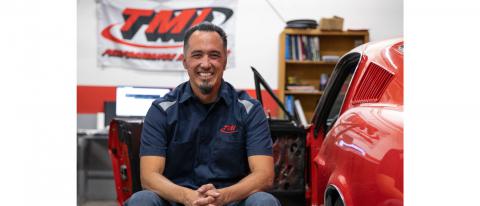
Ross Berlanga


Longtime automotive interior manufacturer TMI Automotive Products. Inc., based in Corona, California, has recently announced Ross Berlanga as its new marketing director.

Berlanga, a Southern California native, brings over two decades of automotive experience from various positions. Having held roles in marketing, advertising, and graphic design, Berlanga will be responsible for TMI’s overall marketing effort, including product marketing and marketing communications, in his new position.

Beginning his automotive career in publishing, Berlanga has worked on well-known publications, including Hot Bike, Sport Compact Car, and Custom Rodder. He later contributed to the growth of Edelbrock, MagnaFlow, JE Pistons, KTC Media Group, K&N, and AEM Intake. Most recently, he served as the director of advertising at Race Winning Brands, where he was pivotal in the creation of the Masters of Motors contest held at the SEMA and PRI Shows.

“Ross brings exciting ideas, a wealth of industry experience, and the marketing savvy to add to the already successful brand. We are excited to have him join the Tuccinardi & Company family, and we are eager to see the fruits of new products and applications,” said Malek Tawil, president of Tuccinardi & Company.

TMI Automotive Products. Inc. offers high-volume automotive components like seating, interior panels, floor coverings, convertible assemblies, headliners, and integrated electronic systems for both new and restored vehicles. For more information, visit tmiproducts.com.

October 2020

Three States Celebrate 50th Anniversary Of Bonneville Salt Flats Speed Record

Submitted by laurap on Tue, 10/27/2020 - 13:56


The states of Utah, Wisconsin, and Illinois celebrated “Blue Flame Day” last week to celebrate the 50th anniversary of a Bonneville Salt Flats speed record.

On October 23, 1970, the Blue Flame rocket car became the world’s fastest vehicle when driver Gary Gabelich recorded the FIA-certified world land speed records of 622.407 mph for the flying mile and 630.388 mph for the flying kilometer. 

The Blue Flame was designed in part by several professors and students at the Illinois Institute of Technology in Chicago. It was fabricated by Reaction Dynamics in Milwaukee, Wisconsin, and raced by the Blue Flame team at the Bonneville Salt Flats in Utah.

The Blue Flame was 37-feet long and nearly 8-feet high and wide, had an aluminum body, and weighed over 6,500 pounds.  The rocket engine produced 58,000 horsepower and 22,000 pounds of thrust, burning a combination of hydrogen peroxide and liquefied natural gas pressurized by helium gas. To this day, the vehicle remains the fastest American hot rod and the fastest vehicle ever driven at Bonneville.

Photo courtesy of Troxx

October 2020

Tifft, McLeod To Operate Charter In Cup Series In 2021

Submitted by laurap on Mon, 10/26/2020 - 17:31
NASCAR logo


Matt Tifft and B.J. McLeod have acquired Archie St. Hilaire's ownership interest of Circle Sport Racing's charter, as announced in a joint statement. 

McLeod and Tifft will operate the charter alongside Joe Falk, the Virginia businessman and former NASCAR Cup Series team owner, beginning in the 2021 season.

"NASCAR's new business model that will come to fruition in 2022 with the NextGen car makes our vision possible. We are committed to being a staple in the sport for many years to come," a statement said.

"There are more details to release and we'll announce all aspects of them in the near future. Thanks for your support and looking forward to starting the new venture in 2021."

For more information, visit matttifftracing.com or bjmcleodmotorsports.com.

October 2020

PRI EDUCATION: HOW TO HIRE ROCK STAR EMPLOYEES

Submitted by ashtonr on Mon, 10/26/2020 - 17:07


Have you ever hired someone who had a great resume but turned out not to be worth their salt? Did you hire that person based on a “gut feeling” you had during the interview?

Or, have you ever hired someone with a great skill set…but then, after training them, they left to go to a competitor down the street for a few pennies more an hour?

A bad hire can cost anywhere from $8,000 to over $200,000 per employee; but there is more when you factor in missed opportunities, lost time spent training, and a potentially damaged brand. While many business owners and leaders in the specialty parts and accessories industry have processes in place for nearly every facet of their operation, they often rely on intuition when it comes to hiring staff.

Many race professionals’ love of the sport led them into the role of business owner, and while they excelled on and around the track, most were never trained on an effective method for hiring and retaining employees. Many often make the mistake of trying to sell a candidate on the job during the interview rather than the other way around. Without having a clear process to identify character traits, personality fit within the culture, and a system to validate that they will perform well and fit in as a long-term staff member, these business owners find themselves frustrated when it comes to building their team.

Considering that 80% of all employee turnover is a result of poor hiring decisions, and that companies with low turnover have higher profits on average, it becomes even more urgent and important to have a solid hiring process in place.

There are three key elements to consider when hiring rock stars.

1. Who: Who are you looking for? So often those in motorsports naturally gravitate to a skills-based job description while forgetting that there are other key components to attracting the right talent. One of the most important steps is putting time into creating an exceptional job description. Often, people list the minimum skills needed for the job that focus on daily tasks of the role. Instead, imagine your ideal employee for this particular role and build the job description around that. To help you get started, describe that perfect candidate from head to toe.

What kind of smarts do they need? Do they need to have critical-thinking skills, or will the role be repetition-based? Will they be customer-facing? What communication skills are needed? Is having a heart for the business and motorsports an absolute necessity, or just a plus? Do they need high compassion for people, or can they be comfortable with their head under the hood with minimal contact with others? These are just a few examples of how you can take a “head to toe” approach when creating your job description. By setting the bar high and describing exactly who your ideal candidate is, you will attract those types of people to apply for the job.

One caution with this process: You don’t get nearly as many responses from online services and other job boards that offer a broad approach to recruiting. But don’t worry—that’s a good thing! It means those who don’t meet the requirements have already weeded themselves out. Why would you want to waste time poring through resumes of people who are not qualified for the role or a good fit for the organization anyway? Consider it a blessing.

2. Where: Where do we find these amazing rock stars, you ask? Many motorsports business owners look within the industry when they need to hire someone. I challenge you to think differently and connect with people outside that world, such as fellow church or temple members, the Chamber of Commerce, Rotary or other civic clubs, trade schools, and others. There are likely 30 or more resources right under your nose that you may have never considered. For a resource list, visit janspence.com/hiring-resources.

Statistics show that the best hires come from referrals from people in our network. (In fact, one report by SurePayroll found that 30% of all hires and 45% of internal hires came from referrals.) Once you’ve nailed down your job description, you can share it with people you know, and they can scan their hypothetical or literal Rolodex (a contact list, for you younger folks) for any potential matches. By having a clear process and not making this an emotional hire, you are in a position to keep good relationships with anyone who refers a candidate to you; if the referral didn’t work out, it’s because that person did not successfully proceed through the process, not because of a personal decision you made.

It’s important to consider that a good referral candidate may have the exact skill set you need, but they may not have experience in the industry. These can often be the most trainable and best long-term employees, however. Because of the time and energy you’ll spend training them, it’s critical to make sure they have the right culture fit, desire to succeed with the company, and excel in their role before hiring them.

3. How: How do you actually hire the best candidate? As a reminder, this process takes the emotion out of hiring and bases it on facts, scores, and ratings as a candidate moves through or eliminates themselves from the running. According to Steve Suggs, creator of the “Recruit the Best” system, the steps are:

* screen by resume review/application

* short phone interview

* email response for a work sample

* online personality profile

* initial interview using structured questions

* reference checks

* final interviews

Taking this step-by-step approach during the hiring process will ensure you’ve properly vetted applicants to find the best fit for the role.

Following a defined, specific process for recruiting, screening, and interviewing will take the guesswork out of finding and retaining rock star talent, which will help propel your organization forward.

Jan Spence, CEO of Jan Spence & Associates, is a Certified Advisor of the “Recruit the Best” system and an international speaker, author, and business-growth trainer. To learn more about increasing employee engagement, check out her book Cheer On Your Team! 52 Tips to Increase Employee Retention, Engagement, and Loyalty at janspence.com/shop-2.

November 2020
By
JAN SPENCE

2021 Holley NMRA Ford Nationals Schedule Released

Submitted by laurap on Mon, 10/26/2020 - 16:56
Holley NMRA Ford Nationals logo


The Holley NMRA Ford Nationals returns in 2021 with six all-Ford national events through diverse markets. 

“We closed out the 22nd season with an incredible NMRA World Finals + Holley Intergalactic Ford Festival, despite the challenges presented by the global pandemic. It’s nice to have that momentum heading into 2021 for our racers, fans, and sponsors as next year’s schedule is our best yet,” Holley NMRA Ford Nationals General Manager and National Event Director Rollie Miller said. 

The national series hosts thousands of participants each year with championship drag racing, QA1 True Street challenges, specialty shootouts, UPR Products car shows, and more.

The season kicks off March 4-7 at Bradenton Motorsports Park in Bradenton, Florida, for the 27th annual NMRA Spring Break Shootout, followed by a visit to Atlanta Dragway in Commerce, Georgia, on April 8-11 for the 13th annual NMRA/NMCA All-Star Nationals. 

The prestigious 16th annual NMRA/NMCA Super Bowl of Street-Legal Drag Racing is set for May 13-16 at its new home just at the World Wide Technology Raceway in Gateway, Madison, Illinois.

The inaugural NMRA Ford Performance Nationals is set for June 10-13, at Summit Motorsports Park in Norwalk, Ohio, followed by the inaugural NMRA/NMCA Power Festival at US131 Motorsports Park in Martin, Michigan, on July 22-25.

Closing the season is the 23rd annual NMRA World Finals and the Holley Intergalactic Ford Festival at Beech Bend Raceway Park in Bowling Green, Kentucky, on September 30-October 3. 

For more information, visit nmradigital.com.

October 2020