Grind Game

Submitted by johnc on Mon, 03/18/2024 - 11:05
image 1


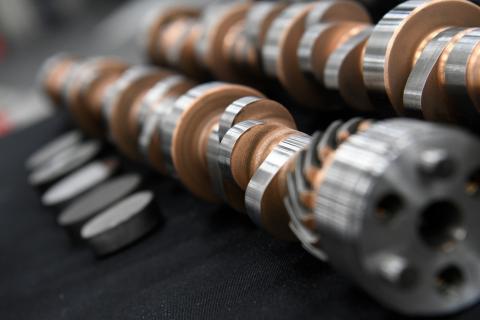
Custom camshafts are gaining popularity as racing needs become more specific and engine builders feel more confident that they can find a winning edge with their combinations.


There was a 24-hour endurance team that told its camshaft supplier the engine needed more low-end performance because of changing driver dynamics at night.

“Drivers would be less apt to grab a lower gear out of the corner late at night, so torque production was key,” explained Chris Potter of COMP Cams, Olive Branch, Mississippi. “However, the engine needed to run at race pace for more than 24 hours. A custom grind and new lobe series were the answers this team needed to meet their goals.”

Years later, that lobe-design family became one of the most popular choices for non-race applications at COMP Cams. “That shows that race technology trickles to the street, even in the world of camshaft lobe design,” added Potter.

In other examples that tout custom cam rewards, COMP Cams’ engineers helped a bracket racer with a 582-cubic-inch big block Chevy project and a circle track team with a GM Ecotec I4 engine.

“We worked through the BBC system, which was limited by the cylinder head, and moved to a newer lobe series matched with good springs. It picked up peak power by 10%,” recalled Potter. “Another example is the Ecotec owner who had maxed out our catalog cams while running circle track races. Last year, we helped with a custom grind and picked up the performance significantly. Since then, he’s been able to refine his package even further while working on a new cylinder head package. This year we’re doing another set of custom grinds to further his platform.”

Depending on the application, custom camshafts can make up 70% or more of a cam company’s sales, easily outperforming off-the-shelf cams for select categories. Some companies don’t even have cams with designated grinds and part numbers in their immediate inventory.

“We’ve found that making cams and putting them on the shelf doesn’t really fill the need that customers have,” said John Partridge of Bullet Racing Cams, Olive Branch, Mississippi. “Sure, there’s a standard combination out there for a 350 or a 383, but I try to look at everything that customers are doing to be sure that I give them the best I can the first time.”

Over at Crower Cams in San Diego, California, most of the simple stock-engine-type applications with hydraulic or solid flat-tappet lifters are generally purchased from the catalog.

“That would be about 70% catalog or standard off-the-shelf grinds,” observed Guy Aguayo. “We’ve had some grinds that work well across the board. The majority of the roller cams are custom ground because of power adders, nitrous, big compression, and big cubic inch. The size of cams keeps getting bigger because of better flowing heads.”

Nolan Jamora at Isky Racing Cams in Gardena, California, said the split between custom and off-the-shelf at Isky depends on the race venue. “If it’s drag racing, it’s about 20% off-the-shelf and 80% custom,” he said. “It’s a big difference because of the Outlaws, drag-and-drive, and small-tire racing. We’re customizing all that because everything is power adder. There are just so many combos out there, and product right off the shelf is not going to work anymore.”

There are engine combinations that remain quite popular, such as a 632-cubic-inch tunnel ram with a pair of Dominator carbs, for which a shelf cam will be appropriate. However, a basic boost-prepped engine can have different-sized turbos, an intercooler or not, etc. Even street engines, added Jamora, that step up to turbos should be evaluated for a custom cam.

“Boost applications have enough variables—such as displacement, static compression, amount of boost at different loads, etc.—that custom cams are the norm rather than the exception,” added Eric Bolander of Howards Cams, based in Oshkosh, Wisconsin.


Playing Within the Rules

In oval and dirt track racing, sanctioning bodies have introduced numerous rules to regulate camshaft design, and companies have to engineer the best possible profile to stay within the guidelines.

“In oval track, the split between custom and off-the-shelf is about 50/50,” said Jamora. “We have vacuum-rule cams or compression-rule cams, those are pretty much all set depending on the cubic inch. Racers can get those right off the shelf since that’s pretty cut and dry.”

Isky also offers lift-rule cams that in the early days were designed to “lob” the lifter off the cam lobe nose to gain a little extra lift. That strategy is no longer favored.

“Yeah, we do lift-rule cams, where 0.400-, 0.420-, 0.450-, 0.480- or 0.500-inch lift rule,” said Jamora, explaining the lobe design favors more contact with the lifter. “You don’t lob the lifter anymore. You want the lifter on the lobe at all times. With the new modern design, and how you can grind it, you can get very aggressive, so you don’t have to design loft into them, which is just unstable for the valvetrain.”

image 2
Depending on the application, custom camshafts can make up nearly three-quarters—or more—of a cam company’s sales, easily outperforming off-the-shelf cams for select engines and racing disciplines. Photo courtesy Erson Cams.

Crower keeps the lifter close to the lobe when designing a lift-rule camshaft. Engineers also manipulate the lobe-separation angles when working with vacuum-rule camshafts.

“We’ll open up the lobe-separation,” said Aguayo. “Because you’re not making a lot of power, the weight of the car comes into play. Then, if it’s two- or four-barrel, another little curve comes into play. The two-barrels tend to work a little bit different torque-band than a four-barrel. The race track makes a big difference, too. I need to know their max rpm and their slow rpm off the corner, so they don’t come off the corner under a bad load. The driver makes a big difference.”


Feeding Information

As previously mentioned, camshaft tech reps are requesting more information about the drivers’ racing style and preferences.

“I’ll ask what’s the track like? Do they run the cushion? Does the driver like to dive into the corners or get on the brakes early? Is he young and aggressive? So we’ll actually do the cam for that,” said Jamora.

The difference in driving style—that is, one who likes to brake early or one who carries speed into the corner—may mean a difference of three or four degrees duration in the lobe design.

“You’re really talking about keeping them in the power band,” added Jamora. “If they’re basically a stop-and-stab style, we’ll need to have more torque built into the grind. If it’s somebody who rides a cushion and is very smooth, he’s not dropping a lot of rpm, you could keep more mid-range power and torque because he’ll keep the rpm up.”

Besides drivers, engine builders are becoming more appreciative of custom camshafts. There’s a greater sense of confidence when selecting a cam grind that is designed around their specific setup and racing needs.

image 3
Callies Performance Products was early to market with cams for the Ford 7.3 Godzilla. When Jesel came out with a belt drive, it used a bushing to reduce the OEM cam thread from 21 mm to 7/16-inch. “After some back and forth with Tim Fodor at Jesel, we came up with a solid roller tool steel core that utilized a 7/16-inch thread, and dual dowels as found on most other Ford race cams,” said Callies’ Nick Norris.

“That is why it’s an advantage to build a relationship with a cam company—more specifically a ‘cam guy.’ He won’t point you at a part number or plug everything into a computer and let a program spew out a part number,” said Bolander. “You want someone who knows why they’re recommending a grind and what it’s going to do for you.”

Working with knowledgeable tech reps at a cam company takes time. There are forms to fill out that help them get started, but the real information comes from their questions and feedback. Key to a productive discussion is honesty.

“That is one of the things we tell our customers up front: Be honest with me. Don’t tell me something you’re going to do. You tell me exactly what you are doing now because it’s going to be really imperative that I have the right information,” explained Partridge. “Don’t give me the pie-in-the-sky deal. I don’t want to recommend something that won’t work for you if you’re not doing what you’re telling me.”

“The basics we need are still the same, things like intended use, displacement, expected rpm, tappet choice, head flow, induction choices, bore/stroke, valve selection, transmission…the more information you provide, the better our team can quickly zone in on a recommendation on the lobe series and valve timing,” explained Potter. “As we approach from a system perspective, more questions are needed. Rocker style, pushrod types, valve spring installed height, spring loads, lifter diameter, journal size, lifter spacing, and more.”

Other information, like cylinder-head flow rates, is also crucial so the tech reps can build a model for a specific combination of parts as well as the intended use of the engine.

“We’ll get everything on the combination, such as cylinder heads, what they flow at certain lifts, the compression ratio, iron or aluminum cylinder block, carbs or fuel injected, header size, gearing, type of fuel, tire…I mean, we get down to everything,” said Jamora.

All this information flow to the cam company’s hotline can beg the question: What if I talk to different tech reps on the same day? Will they recommend the same camshaft?

“Yes, you’re going to get the same information,” said Partridge. “Now, it may vary by a degree or so, but yeah, you’re going to get the same recommendation from anybody here.”

The need for camshafts in airplane engines motivated Callies Performance Products in Fostoria, Ohio, to get into the cam business. Lycoming Aircraft had relied on another cam manufacturer for product that went out of business and approached Callies, which purchased equipment from the liquidation sale.

“Within a matter of months, we were in the camshaft business,” said Nick Norris.

Callies specializes in manufacturing the billet-steel cores used by many aftermarket suppliers that finish-grind custom racing camshafts. Many of these cores are 8620 carburized steel, and there are some induction-hardened cores. The cores are ground with oversized but unfinished lobes in position for the desired firing order. The bearings are ground to the finished size, as is the distributor gear, if needed. Then the cores are heat-treated before shipment to the cam grinders for finishing.

“The firing order, lift, duration, and lobe separation all have to be within a certain envelope in order not to grind through the heat-treat,” added Norris.

Callies will finish-grind the cores for select customers but not on a single custom cam order. Builders with high-volume crate-engine or private-label programs will be considered, or race teams that need a large order of camshafts with similar grinds, like Top Fuel or Funny Car.

image 4
A camshaft profile custom ground by COMP Cams for an endurance race team eventually became a popular non-race cam choice. “That shows that race technology trickles to the street, even in the world of camshaft lobe design,” said Chris Potter.

Even though nitro cars have the most powerful engines in motorsports, crew chiefs are burdened by strict rules that have changed very little in the past two or three decades. Therefore, cam specs haven’t changed that much. However, cam grinders are starting to work with fresh ideas to manipulate valve events in fuel engines.

“When we first got into Top Fuel, everybody gathered up and measured cam samples. I was amazed at how close they were to each other. They were nearly identical,” said Norris. “The biggest problem with the fuel cars is the opening side of the exhaust lobe because you have so much cylinder pressure. It has a lot to do with the lash ramp at the beginning of the opening side of the profile. It took four or five tries, but one turned into magic.”

“We have updated some [Top Fuel lobes] in the last year or two,” added Partridge. “We have gotten a little more aggressive than we used to be and found some places that we could push it. And we found some places that we shouldn’t have. The exhaust side really seemed to be the area where I work on the most. The intake doesn’t seem to respond a whole lot, but the exhaust side has.”

Even in the diesel market, especially with the tractor pullers, the exhaust lobe is drawing more scrutiny.

“Depending on the class, they’re running more boost than any drag car thought of. Seriously, diesel tractors run anywhere from 130 to 150 pounds, and in the Outlaw classes as much as 250 pounds,” said Russ Yoder of Erson Cams, Louisville, Kentucky. “This is where a lot of Erson’s Top Fuel experience comes in. We had to calm down the aggressiveness on the exhaust because those engines make so much cylinder pressure. You have to run a fairly mild exhaust profile in order to not blow the lifters apart.”

Yoder said that Erson doesn’t change lobe profiles often, preferring to expand the lobe catalog only when a custom cam grind has proven extremely beneficial to a customer. Erson was also cautious when it was trendy in the industry to make the popular lobe profiles more aggressive without addressing other issues, such as valve springs.

“So many people got on the bandwagon of more aggressive, make more power. When you do that, if you don’t really stay on top of valve springs, inevitably that profile doesn’t work and you end up tearing up parts,” said Yoder. “We can go with something that’s tried and true and not destroying the valvetrain. And honestly, it still gets as much horsepower.”


Supporting Cast

All variants of engines seem to be reaping the benefits of custom cams, and cam designers have been taking advantage of continuing advancements in supporting valvetrain components around the camshaft.

“The evolution in valve springs has really been the key,” said Partridge. “Don’t get me wrong, there are other things, such as better pushrods and rocker arms. But valve springs are what really changed everything. We’re able to run smaller, lighter springs and nowhere near the kind of spring pressure we used to run.”

image 5
Off-the-shelf cams are still in demand due to proven performance and quick delivery, according to race cam suppliers. Photo courtesy Erson Cams.

“We’re really paying attention to valve springs,” agreed Norris. “For a long time, people have over-sprung. They put too much valve spring in the system. When they have a valvetrain that gets out of control, the first thing they do is put more spring on it, when in all actuality, they should probably take spring out of it.”

“Getting the lightest valvetrain makes a big difference because the valves will rev more rpm safely,” advised Aguayo. “The bottom line is, if you can check a camshaft on a Spintron and figure out exactly where that valvetrain keeps from entering into harmonics, that’s the cam you want to run because it will live for the long run, like lots of 40-lap mains.”

Even the rest of the drivetrain behind the engine will benefit from the right custom camshaft if all the components are optimized to work together.

“This is even more true on the race side where big power can be put to the ground more efficiently,” said Potter. “Now we’ve moved further into the realm of systems engineering, beyond just the valvetrain system or the engine system, and now into the entire vehicle system. As we have the ability to put more and more power to the ground, the more important a good, engineered custom cam grind will become. As the entire vehicle and engine system becomes more and more refined, the more important a well sorted custom grind will be to match with the other components.”

SOURCES

Bullet Racing Cams
bulletcams.com

Callies Performance Products
callies.com

Cam Motion
cammotion.com

COMP Cams
compcams.com

Crower
crower.com

Erson Cams
pbm-erson.com

Howards Cams
howardscams.com

Isky Racing Cams
iskycams.com
April 2024
By
Mike Magda

Fluid Solutions

Submitted by johnc on Mon, 03/18/2024 - 10:07
image 1


Racers want more power and better protection from their lubricants. Here’s how the racing oil companies are responding.


How often should oil be changed? Should it be mineral-based oil, full synthetic, or a blend? How thin or thick should that oil be? These questions sound like they come from the FAQ section of your local quick-oil-change station’s website, but racers share many of these same concerns when seeking the best lubrication for their engines. Granted, the worlds they occupy are very different: Racers may be looking for protection from the pressure generated by forced induction, or to squeeze a few more horsepower from an otherwise sealed powerplant, while fuel economy is the name of the game in the transportation sector. But the constant evolution of engine technology, whether that’s for the drag strip or the interstate, is forcing race oil formulators as well as commodity oil manufacturers to re-examine oil’s basic building blocks to find new lubrication solutions.


Latest Lubricants

The French oil company ELF traces its motorsports involvement back to the late 1960s. Now a brand under the TotalEnergies umbrella, it has re-entered the US market and is offering racing fuels and two lines of lubricants, HTX and HTX Classic. These oils “cover the gamut,” said Michael Beam from ELF’s US headquarters in Linden, New Jersey. “Circle track, dirt track, IMSA, endurance racing, drifting, pretty much everything except for drag racing.” The HTX Classic oils contain higher levels of zinc for classic road cars and vintage race cars.

ELF’s HTX oils are formulated with an ester base and a mix of polyalphaolefin (PAO) oils, Beam said, “which allows us to handle higher temperatures, higher shear, and help reduce friction.” HTX oils “really exceed on the turbocharge side of things, where the high exhaust temperatures can cause coking on those small bearings inside the turbocharger.” To explain the difference between HTX’s base oils and more conventional synthetic base oils, Beam pulled out a cooking analogy, likening ester/PAO oil to olive oil, “while synthetics are more like butter. When you cook both of those, olive oil can handle the temperature a lot longer before it starts smoking, and when it does burn off, it doesn’t leave any deposits. But if you cook butter, it burns pretty quickly in a frying pan.”

Ester technology isn’t new, Beam acknowledged, “but it’s really coming around. It definitely costs more—esters would be cost-prohibitive in your daily driver—but it’s great to use if you want the best protection.”

image 2
During its development, Klotz tested its new KE-916 0W-16 Pure Estorlin racing oil with several Stock Eliminator and Super Stock teams, including Russell Ghent, who is seen here. The oil was formulated specifically for teams that run their engines as cold as possible to produce more power.

Klotz Synthetic Lubricants of Fort Wayne, Indiana, has recently introduced two new products, a drag race oil and a motorcycle oil with applications in the circle track world.

Klotz’s new KE-916 Pure Estorlin Racing oil “is one of our first drag-racing-specific oils,” said Chris Mileti. With a multigrade viscosity of 0W-16, it is “the lowest viscosity grade racing oil that Klotz has introduced in recent years.” It was formulated in response to a trend Klotz recognized in Stock and Super Stock drag racing classes. Two trends, actually.

These racers are “going to lower viscosity grades in an effort to reduce frictional losses in the engine and generate more horsepower,” Mileti said. “They’re also going to extraordinary lengths to keep their engines cold, during warm up, during the burnout, and during the race, because cold engines produce more power. We had to change the formulation for that, because most racing oils are designed to protect the engine from high temperatures.”

Mileti called it a “balancing act, because you want to reduce the frictional losses, but you still have to protect the engine. Even though it’s running for only a few seconds, it’s under a tremendous amount of stress.” The new oil was formulated “so that its friction-modifying and anti-wear chemistry activate at low temperatures.” Just how low? “These drag racers see maximum oil temperatures around 145 degrees Fahrenheit,” Mileti said. “To put that into perspective, Klotz participates in other forms of racing where oil temperatures can approach 330 degrees F.”

Klotz tested the new oil with select customer race teams last year, from dyno sessions to racing at the NHRA US Nationals. “When we reviewed all the data and looked at some of the teardown engines, we were really happy with the performance,” Mileti said. As an added benefit, “in dyno testing, we were able to improve horsepower. Across the entire rpm range over our benchmark oils, we were getting about 4 hp. That’s a pretty big deal for a Super Stock team.”

Klotz’s other new oil, KL-840R Motorcycle Techniplate, is a 10W-40 variant of a 15W-60 racing oil designed for motorcycles with wet clutches, “where the engine oil touches both the engine and the clutch,” Mileti said. “It’s very hard to find performance gains in those types of engines because you have to watch what type of chemistry you put in there. It can negatively impact clutch performance.” KL-840R is formulated to “handle extremely high temperatures, and it’s optimized for clutch feel and performance.” Klotz developed the oil with feedback from flat-track motorcycle racers.

During the oil’s development, Klotz discovered that it “excels” in motorcycle-engine-powered Legend cars, Mileti added. “The issue with those Legend cars, especially the air-cooled ones, is as the oil heats up, they lose some ring sealing, which causes a loss of power. But with the KL-840R, you get very good lap-to-lap consistency. In fact, in some of the testing we did down in Georgia late last summer, one of the fastest laps we had was the last lap of the race.”

Schaeffer’s Specialized Lubricants of St. Louis, Missouri, introduced two racing oils at the 2023 PRI Show. Its Micron Moly SAE 70 and Micron Moly 10W-30 were specifically formulated for drag race engines using alcohol- and methanol-based fuels.

“We’ve always had success on dirt and asphalt tracks, and some of those racers would also participate in drag racing, so interest started to grow,” explained Larry Ludwig. “Normally, our semi-synthetics would work with the alcohol in circle track racing because the temperatures got up to the point where it boiled off the alcohol. But in drag racing, you have more of a tendency for that alcohol to get into the oil and to not be burnt or vaporized off. With a synthetic or partial synthetic oil, that alcohol will basically separate. When it goes to the next race, you may get a slug of alcohol instead of the oil getting into the engine and trying to lubricate it, which can cause a catastrophic failure.” However, these new oils, which are petroleum based, “will mix with the alcohol and keep it suspended.”

The 70-weight Micron Moly was formulated “for extremely high-horsepower drag race and tractor pulling engines, where traditionally a 70-weight is used mainly because of the amount of fuel dilution that happens in those particular applications,” Ludwig noted.

The 10W-30 is intended for aluminum-block engines with tighter tolerances. “At one time, we only had a 20W-50 viscosity grade, but we were getting feedback that 20W-50 was, in some engines, a little bit too heavy of a viscosity,” Ludwig continued. “Engine builders still wanted the protection of a little bit heavier viscosity oil, but not a 20W-50. We came up with the 15W-40 Supreme racing oil, and that worked excellently, but we kept getting feedback about how the tolerances were becoming so much tighter in the crate engines being used. So we developed that 10W-30.”

TriboDyn Lubricants of Mooresville, North Carolina, has made a couple of improvements to its formulations in recent years. “Our goal was to improve two things,” explained Mark Wheatley. “One was to bring our coefficient of friction 30% lower than anybody else. The other was to improve our film strength so overall it would be the best product out there with the highest film strength.”

image 3
“I like to use our synthetics in the drifting world,” said Bill Alexander of Driven Racing Oil, “as it’s a more sustained high-rpm environment with more temperature.” At higher oil temperatures, “a synthetic will hold up better than a mineral oil.”

TriboDyn’s film strength technology is formulated into its TRI-EX oil, “while our TRI-EX2 has our highest film strength, our ceramic lubrication, and a coefficient of friction technology that is second to none on the market.”

Not long after the formulations were complete and on the market as a running change, two of TriboDyn’s oils were bought on the Internet along with 38 other oils to be used in a test of “the tribological characteristics of next-generation lubricants” by the Metropolia University of Applied Sciences in Helsinki, Finland. None of the companies whose oils were used in the study were told that their oils were being evaluated, Wheatley said, and only found out after the results were released and posted. The test results showed that TriboDyn Lubricants’ oils were number-one in every category, including film strength, and they achieved the highest horsepower numbers in dyno testing because of their reduced coefficient of friction. “That test proved we were on the right track with the goals we set,” Wheatley said.

TriboDyn has also reduced its retail prices on all TriboDyn Lubricants products by 15%.

Not all the latest product releases are engine oils. Lubrication Specialties of Mt. Gilead, Ohio, parent company of Hot Shot’s Secret, has introduced Adrenaline Assembly Lubricant. “It has a lot of tackiness, so it clings on the parts,” explained Josh Steinmetz. “It also has a lot of rust and corrosion inhibitors in it, and a whole lot of zinc”—more than 2,000 ppm—“to help with that initial startup until we get oil flowing to the rest of the components.

“We wanted to offer something better than other assembly lubricants on the market and also offer a complete solution, from assembly all the way through our racing oils,” Steinmetz added. “Next on our radar is a break-in oil.”

Driven Racing Oil of Memphis, Tennessee, is also working on a new type of break-in oil, said Bill Alexander. We spoke with him while he was on the road, having just completed some dyno testing at a race engine shop. “I’m maybe 50% of where I’m going on those,” he said, “but I know what we found this week is going to lead to a new and enhanced break-in oil.”


One Oil for Both Drag and Drive?

Driven has entered into a partnership with Sick the Magazine, the publication that supports Sick Week and other drag-and-drive events. “We’re seeing a big boost in popularity in these events,” Alexander said, “and we’re trying to figure out what works for drag-and-drive, because in our mind, drag racing and street driving are two different applications. But in these events, you’re doing both. So we may be adjusting a formulation, or recommending they use what we already have but in a different way.”

Alexander believes these racers “may need to run higher viscosity oils than they would typically run because of the heat in the drive.” For the same reason, synthetic oil may be a better choice for these racers, even though “in our opinion, synthetic wouldn’t be the best choice for the drag racer. We typically don’t recommend it because, for one thing, they don’t run the oil long enough to really get the benefits of a synthetic, especially the higher oxidation stability. You never get the oil hot enough to take advantage of it. And mineral oils, like our GP-1, which is Pennsylvania-grade crude, give a better ring seal, which can result in better compression and more power.” But Alexander has already been testing synthetic oil with drag-and-drive competitors, believing it will stand up better to the heat generated by hundreds of miles of street driving between drag strips.

image 4
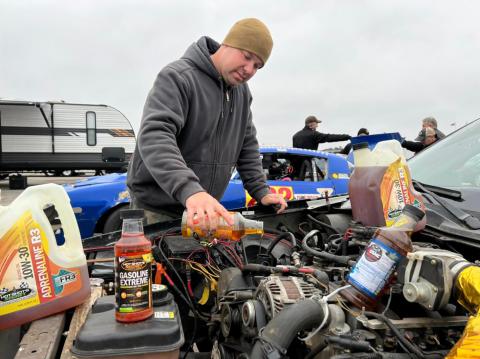
Hot Shot’s Secret’s new Adrenaline assembly lubricant “has a lot of tackiness, so it clings on the parts,” said Josh Steinmetz. “It also has a lot of rust and corrosion inhibitors in it, and a whole lot of zinc to help with that initial startup until we get oil flowing to the rest of the components.”

What about the possibility of using synthetic oil for the drive portion of the event and then replacing it with mineral-based oil for racing? “What I’ve found is that a lot of them will only do one oil change through the week,” Alexander said. The Driven van that goes to these events carries 50 cases of oil for the racers, but it wasn’t selling much “until about day four, which was right in the middle of the event. They do not want to change the oil every day, so we’re looking to get optimal performance out of one product for both applications.”


Viscosity Trends

Tighter production tolerances and the drive to improve fuel economy have created a need in the general transportation sector for thinner and thinner oils, some down to single digits. However, does that trend hold true in racing?

“A lot of times to get more horsepower you want to go to a thinner viscosity,” Beam acknowledged. “But the problem with, for example, a forced-induction engine is you tend to get a little blow-by, so fuel dilution becomes a problem. Managing the right viscosity to handle fuel dilution, and maintain protection, is very important. To me, it’s important to match your oil weight to what you’re doing and what you need.”

“I would say there’s a trend to go to lower viscosity grades because you’re reducing frictional losses in the engine,” Mileti said. “These teams are going to want to use the lowest viscosity grade that they can that still provides adequate protection for the engine. In some circle track racing we’re seeing viscosities as low as 0W-30.”

Mileti went on to say that in some applications, NHRA Top Fuel, for example, “those engines produce so much horsepower, they’re not going to gain any appreciable performance improvement by lowering the viscosity. They’re more concerned with just keeping the engines together. The diesel tractor pullers might be in the same camp. They wouldn’t benefit from a couple fractions of a percent horsepower improvement. But the Stock and Super Stock guys would.”

Steinmetz noted that in the diesel racing segment, “tolerances are getting a little tighter in some of the engines, so we’re making weight adjustments on their oil viscosity based on what they’re setting up. We’re working with them to find out what new issues they’re having. We’re still primarily 50- and 60-weight oils, but we do have some guys going down to 40-weights with increased tolerances.”

image 5
Many of our sources recognized a trend toward lower viscosity grades, especially for those racing engines built with tighter tolerances. But there still has to be enough film strength to protect the engine, they reported, especially in forced-induction engines that are prone to fuel dilution.

“There’s a lot of old-school thinking about viscosity,” Alexander said. “Guys will say, ‘I’m gonna run the thickest oil I can because that gives me the most protection.’ What we find is, viscosity is really dependent on engine oil bearing clearance and other things. An oil that’s too heavy may be hotter than a thinner oil, because if the engine’s not set up for it, there’s more resistance in the fluid, which creates heat. And maybe that oil’s not getting to your lifters, so the hydraulic lifters aren’t working as efficiently as they should.”

“If you lower the viscosity, you do get rid of drag,” Wheatley said. “But you may be creating wear issues, because the thinner the oil, the worse the film strength is.” TriboDyn’s film strength improvements were made to address just these kinds of circumstances, he said, with the added benefit of gaining horsepower due to the lower coefficient of friction. He cited tests done with TriboDyn oil in a 602 crate motor where “all they did was drain their 20W-50 oil and add our TriboDyn 20W-50 oil. On the dyno they picked up 4 hp, and they also reduced their operating temperature 20 degrees. If I ask engine builders, ‘How much would you pay for 1 or 2 hp?’ I get answers from $1,000 to $2,000 or even $5,000. When I tell them they can do it just by changing their oil to TriboDyn oil, they look at me like I have five heads.”


Renewable Future?

We received very mixed responses when we asked if these companies were planning to incorporate renewable oil ingredients into their racing oils. Ludwig said there’s been “no demand whatsoever” for a product like that at Schaeffer’s. “You’ll see it more in commercial use and by companies that have government contracts because the federal government and some state governments mandate the use of a renewable type of base oil.”

Likewise Beam said that while ELF did formulate renewable race fuel, there were no plans for renewables on the lubricant side. “Renewable oils, which are re-refined base oils, are fine for a daily driver. But they aren’t really capable of giving you the protection of an ester or a PAO that you would want in a race engine.”

Mileti said that the use of renewable lubricants in motorsports “is a ways away from large-scale adoption.” Klotz does have two products in that space, though they don’t use re-refined base oils. “We’re one of the last companies to use castor-based lubricants,” he explained, referring to oil derived from the castor bean. Both products, BeNOL Racing Oil (100% castor oil) and Super Techniplate Synthetic Lubricant (a castor/synthetic blend) are for two-stroke motorcycle engines, “and they work pretty well if you have a two-stroke racing engine that runs very hot and at high rpm.” Some automotive race teams, he added, will put a small amount of BeNOL into alcohol, methanol, and even nitromethane “to add a little lubricity to the fuel.”

Steinmetz said Lubrication Specialties is “continuing to experiment” with renewable lubricants. “We continue to look at that as an opportunity to see what’s happening there and make sure that we’re ahead of the curve if anything changes in that market.”

Driven has a “100% renewable motor oil,” Alexander said. “It’s called an estolide, and it’s a true synthetic. I’ve been working on it for a couple of years, and I’m seeing pretty good results out of it. It works as well as a lot of mainstream synthetic motor oils, but the cost is much higher, so the market doesn’t seem to be there. But we’re going to keep working on it, and staying on top of it, kind of jogging alongside the market with it.”

SOURCES

Driven Racing Oil
drivenracingoil.com

ELF
elf.com

Klotz Synthetic Lubricants
klotzlube.com

Lubrication Specialties/Hot Shot’s Secret
hotshotsecret.com

Schaeffer’s Specialized Lubricants
schaefferoil.com

TotalEnergies
totalenergies.com

TriboDyn Lubricants
tribodyn.com

April 2024
By
Drew Hardin

Holding A Grudge

Submitted by johnc on Mon, 03/18/2024 - 09:31
image 1


Grudge racing and its related “no time” events offer an outlaw spirit as well as a sense of community that can get lost in the pomp and circumstance of organized drag racing.


A vast array of subgenres has cropped up since the advent of drag racing, but it could be argued that the original concept continues in its purest form as grudge racing. Recent years have seen grudge racing itself splinter into niches like ‘no time’ and ‘no prep’ racing, but the core concept remains consistent: a straight-line competition between two vehicles with minimal preamble.

While larger, better-publicized drag racing events and series put on by sanctioning bodies like the NHRA kept the segment on the periphery for a time, recent years have seen a resurgence of interest in grudge racing. As Josh Robinson of Ohio Grudge Racing in Columbus, Ohio, explained, it’s not hard to understand why.

“It’s born out of what always made street racing appealing, but it’s the more legitimized events that started to crop up about seven or eight years ago that really gave it a push, especially the ‘no time’ stuff,” Robinson said. “Big egos, big money, lots of flash, and lots of heated negotiations and arguments between two camps. It eventually resulted in two racers lining up for a large sum of money. I’ve seen grudge races where there’s been as much as 60 or 70 thousand dollars on the line. That tends to create an exciting atmosphere.”

image 2
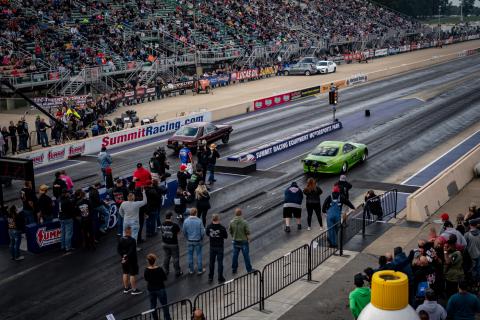
While purpose-built drag cars do turn out for grudge races at Motorsport Park Hastings, many of the participants are “people in street cars who’re looking to put them through their paces,” said Jeff Lacina. “People are looking for ways to exploit [their car’s] performance in a safe environment.”

For decades, grudge racing’s inherently clandestine nature relegated this type of competition to word-of-mouth events held on backroads and side streets. But thanks to concerted efforts by promoters, organizers, and the racers themselves, these types of events have become a consistent draw at drag strips across the country.

Taking It To The Track

“There’s always been a niche for this type of racing, but for a long time it was pretty underground,” said small-tire drag racer Cory Clemens. “I think it really started to find a place in the racing world when Duck of Duck X Productions started including these types of races in his events in the early 2010s. Duck’s races were originally kind of a grudge type of vibe. That’s why those events were so big back in the day. There’d be 500 people at the starting line, betting and going nuts. He had all of that no-time stuff, and then he slowly started adding Radial vs. The World and Pro 275 stuff, going into a more polished kind of format.”

Clemens said that, as with many things in life, drag racing trends tend to be cyclical. “Like everything else, it starts on the street.
And when you really boil it all down, the money is a big factor. It’s all about how you can make the most profit out of what you’ve got. That’s part of the appeal of street racing. Eventually that scene is going to get out of hand, though, and folks are going to say, ‘OK, let’s take it to the track.’ But the traditional formats at the drag strip aren’t going to allow you to play your game if they’re showing your times. So those folks are going to organize events where the times aren’t being shown because there’s a demand for it. Suddenly you’ve now got no-time events at the track. But when the money starts shifting to other types of events, it takes a lot of those racers with it. Eventually it all kind of resets again.”

As Jimmy Owen of Carolina Dragway in Aiken, South Carolina, explained, the ‘outlaw’ mentality of grudge racing only adds to the allure. “It’s the same thing that drove us to do it back when we were teenagers. And you get these rivalries: Aiken versus Augusta, or North versus South, etc. They’re communities that kind of keep to themselves, but they’ll call out one another to pair up and settle things.”

image 3
Gambling is a huge part of the culture of no-time and grudge racing, which increases the intensity for racers and spectators alike, according to one source.

Perhaps the biggest factor that contributes a sense of excitement to grudge racing is the fact that the performance capability of the racers and cars involved can’t be easily quantified. “You can’t really tabulate what one racer can do against another if you don’t have times, and removing the ability to apply statistics really plays into it,” said Robinson. “Gambling is a huge part of the culture of no-time and grudge racing, and that just ratchets up the intensity both for the racers and the spectators.”

The simplicity of this type of drag racing also inherently sets a low barrier of entry for grassroots competitors. While racers in the upper echelons of grudge racing might be competing for tens of thousands of dollars in what are effectively purpose-built drag cars, the format also attracts those with mildly modified street machines who might be racing for a few hundred bucks—or just for the fun of it—at more exhibition-minded events.

“People are always looking for something to do with their car hobby, and grudge racing can provide an option that doesn’t require a big investment or a lot of hoops to jump through in order to get involved,” said Jeff Lacina of Motorsport Park Hastings in Hastings, Nebraska. “While we do see some folks bringing more purpose-built vehicles to some of our grudge racing events for shakedown and testing runs, but a vast majority of our grudge racers are people in street cars who’re looking to put them through their paces. Today’s cars are so good compared to what was available just 10 or so years ago, and many of our racers are looking for ways to enjoy all that performance in a safe environment. It’s very affordable and there’s no complex tech inspection. People will often come just to spectate and hang out, and then later decide to make some passes when their buddies show up.”

The recent rise of reality-style television shows like “Street Outlaws” has also elevated grudge racing’s visibility significantly. But when it comes to big money, one-off events like those organized by Big Jake Promotions in Carrollton, Texas, Clemens said that Facebook and other social media platforms tend to be the most effective way to get the word out. And the numbers involved tend to get the racers talking.

“Right now, Big Jake’s stuff is really getting a lot of attention because of the size of the pots that they’re putting on,” Clemens said. “No-time racing is still pretty underground—I didn’t even know about one of their events until someone sent me a flyer for it and asked if I was going. I think it’s like $30,000 for the Friday night race and $50,000 for the Saturday night race. So you could go home with 70 or 80 grand just from a couple of passes over a weekend.”


Fast and Faster

Weekly events like the grudge night races that are held at Motorsport Park Hastings and Carolina Dragway tend to attract the usual suspects—late model Ford Mustangs, Chevrolet Camaros, Dodge Challengers, and the like, many of which are outfitted with power adders like turbos and superchargers as well as DOT-legal drag radials. While these street machines are tamer than the tube-chassis cars that are typically seen at big-money events, it doesn’t necessarily mean that they’re slow.

“A lot of the younger generation that’s coming in now aren’t really focused on building something that’s basically a Pro Mod on steroids for grudge racing,” said Owen. “A lot of these late model muscle cars are getting to be 10 or 12 years old now, so they’re getting cheap enough to modify, and some of them are extremely fast. These kids don’t shy away from big stakes, either. There was a race not long ago between two Challenger Hellcats where they were holding $60,000 on the starting line for one run.”

image 4
According to racer Cory Clemens, most of the cars that show up for grudge and no-time racing are steel body tube chassis cars. He sees a trend toward classic muscle cars and third-gen Camaros. “I notice that because that’s what I run. They’re still relatively inexpensive.”

But there are also those who’re interested in taking their builds to more purpose-built levels. “We have guys who’re turning the latest Camaros into tube chassis cars with solid rear axles, but for the most part, the Fox-body Mustang platform is still really popular for competitors who’re racing at that level,” Owen continued. “Small blocks are common, and some of the more serious guys are using aftermarket blocks and heads, or having engines built professionally by shops like TRE Racing Engines. We see turbo setups and some ProChargers, but nitrous-fed combinations tend to be really popular around here. Nitrous is cheap, and perhaps more importantly, it’s much easier to hide than a turbo or supercharger setup. A lot of folks are more comfortable tuning those types of combinations.”

Clemens said that, although they may be underpinned by a tube chassis, all-steel, all-glass cars have always been popular in no-time racing. “Ten years ago, a big no-time combination might’ve been a Fox-body Mustang with spray on it and radials, but like everything else, the wildfire gets to it, and it just climbs and climbs. Next thing you know you’ve got full-blown, carbon fiber-bodied Pro Mods racing in no-time events. We’re seeing more of that now, but it’s definitely not every car that shows up. Most of what’s showing up is still steel-body tube chassis cars, and they’re staying competitive. We still see a lot of Fox bodies, and we’re actually seeing a trend of 1969 Camaros and other vintage muscle cars like that. I’m also seeing a lot more third-gen Camaros pop up, and I notice that because that’s what I run. They’re still relatively inexpensive, so that’s kind of a fad right now.”

He noted that while pretty much anything goes in terms of vehicle dimensions for many top-tier, no-time events—which lend themselves to those Pro Mod-style carbon bodies—the all-steel, all-glass classes tend to require stock vehicle dimensions even if there’s a tube chassis underpinning the factory-style bodywork. “I think that’s another reason this type of racing resonates with fans. These cars still look like the cars that you see driving down the road. I think that makes it more relatable,” Clemens added.

image 5
Grudge racing was “born out of what always made street racing appealing, but it’s the more legitimized events that started to crop up about seven or eight years ago that really gave it a push, especially the ‘no time’ stuff,” said Josh Robinson of Ohio Grudge Racing.

Much like the platforms, the engine combinations used at the top tier of no-time grudge racing have evolved significantly as well. “A few years ago it was about turbo LS combinations and small blocks with nitrous making about 1,500 hp,” Clemens said. “And there was a phase where everyone was running those twin-turbo 481X engines. But now, if you’re not bringing a twin-turbocharged, Alan Johnson-style Hemi, or some other kind of setup that can make 5,000 hp, you’re kind of behind the ball. While track conditions play into how much you can actually put down, it’s good to have the power for the back half.”

Outside of exhibition and test-and-tune events, the consensus is that the ongoing health of the grudge racing segment is largely tied to the purses that are up for grabs at these events. If that money shifts to no prep and other drag racing niches, top talent may also gravitate in that direction as they seek payouts that are in line with the level of investment involved, whether that’s at the track or somewhere else. The key, Owen said, is always being aware of the current temperature in the scene and taking a proactive role when needed.

“With true, ‘I’m calling out’ grudge racing, I think it’s really about knowing your customers—the guys who are coming to the track,” Owen explained. “We pay a lot of attention to social media so we can stay on top of what’s going on in that world. There are certain times of the year when it starts to get a little quiet, and when that happens, we get on the phone. We’ll call a couple of people and say, ‘Hey, let’s try to put something together—we’ll throw some money on top of whatever y’all come up with.’ You get that rolling, then you start marketing it, and it always generates more interest. You end up with four or five locked-in races for the night, and that’s what you sell your tickets on.”

SOURCES

Carolina Dragway
carolinadragway.com

Clemens Motorsports
clemensmotorsports.com

Motorsport Park Hastings
racemph.com

Ohio Grudge Racing
facebook.com/OhioGrudgeRacing/

April 2024
By
Bradley Iger

Featured Vehicles

Submitted by jeffreyc on Fri, 03/15/2024 - 13:36


One car in this month’s profile of popular race vehicles is street legal, while the other was driven on the street while not street legal, which landed the driver in the local jail.

2

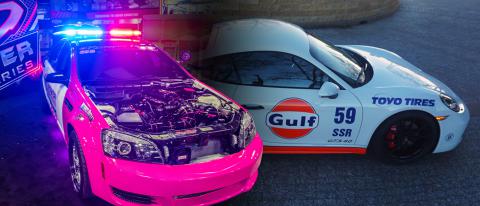
2012 Chevrolet Caprice

Breonna West  |  Clarksville, Tennessee

Race Series/Class: Women & Wheels

Engine: 408 LS built by Texas Speed & Performance

Car: Built by Renegade Racing in Clarksville, Tennessee

Features: ProCharger F1A, 2-Stage Nitrous Outlet kit, XS Power battery, Tick Performance camshaft, wrapped by CWraps, Battle Born powder-coated TBM Brakes

Facts: Breonna’s husband, Thomas West, went to jail for driving the car on the street. It makes 1,750 whp.


3

2021 Porsche Cayman GTS 4.0L

KJ Crumb  |  Minneapolis, Minnesota

Race Series/Class: SCCA Class Super Street R (SSR)

Engine: Mid-engine, 4-liter flat-six, naturally aspirated 

Car: Work by RENNtech and Further Performance 

Features: Toyo R888R DOT Competition tires, Porsche dual-clutch transaxle

Facts: In 2023, Crumb won a regional series championship and a national
championship with this car, and it’s street legal.

March 2024

MidAmerica Outdoors Announces Heartland Racing Association as New Short Course Promoter

Submitted by ajh on Fri, 03/15/2024 - 10:10
MAO HRA Logos


MidAmerica Outdoors, an off-road racing venue in Oklahoma, has announced Heartland Racing Association (HRA) as the new promoter of its short course races.

MidAmerica Outdoors will no longer operate its racing series, MAO Racing SXS Championship Series, but will host short course races and other off-road racing series as a part of their previously announced event schedule.

HRA will sanction each of the five previously announced short course rounds and utilize the existing rulebook and class list previously run by MAO Racing.

For more information, visit midamericaoutdoors.com.

March 2024

NTT INDYCAR SERIES Releases New Details for Thermal Club Exhibition Race

Submitted by ajh on Fri, 03/15/2024 - 09:22
NTT INDYCAR SERIES Logo


The NTT INDYCAR SERIES, the Indianapolis-based open-wheel series, has released new details regarding the upcoming The Thermal Club $1 Million Challenge event at the Thermal Club near Palm Springs, California.

The non-points event will include a two-day open test, group qualifying sessions, two heat races and a 12-car "all-star" race with $1.756 million at stake--the largest purse for an INDYCAR SERIES race outside of the Indianapolis 500.

Additionally, the event will pair Thermal Club members with INDYCAR SERIES drivers. Members will be embedded with their respective teams during team meetings and have access to driver question-and-answer sessions, racecraft instruction and tips and use of authentic race team gear.

Qualifying for the event will divide the field into two groups, with each receiving a 12-minute session. The results of the qualifying sessions will set the field for two 20-minute heat races. The top six advancing cars from each heat race will make up the 12-car field for The Thermal Club $1 Million Challenge. The final will consist of 20 laps divided into two 10-lap sprint segments with a 10-minute "halftime" break following the completion of Lap 10.

For more information on the event format, visit indycar.com.

March 2024

Special Report: Autonomous Racing

Submitted by johnc on Thu, 03/14/2024 - 15:36
image 1


The drivers are written in code, but the racing competition is no less fierce.


Auto racing has long been a proving ground for technologies that expand the boundaries of the world around us. At the heart of the sport, however, has always been the competitive clash of driver against driver fueled by the desire to win, to vanquish opponents, to be the best no matter what the danger, and hoist the trophy.

So what is racing if the driver is not a human being, but rather software and sensors processing terabytes of data?

We’re about to find out, because autonomous racing is here and is making rapid advances around the globe. In the US, the Indy Autonomous Challenge (IAC), Indianapolis, Indiana, has been holding increasingly advanced autonomous races since 2021. The teams writing the code that pilot the cars come from top universities around the world, with backing by industry and governments.

“This is an applied research initiative that connects 18 of the top engineering universities around the world with top industry suppliers into the automotive sector. And that’s not just traditional automotive companies. Cisco is a partner,” explained Paul Mitchell, president of Indy Autonomous Challenge.

Governments have also taken an interest in the development of high-speed autonomy. The IAC receives backing from the state of Indiana and is on the federal government’s radar screen. “We had a lot of representation from the DoD [Department of Defense] and DARPA [Defense Advanced Research Projects Agency] at our event in Las Vegas. We have partnerships with some European countries—Italy, Germany—all working to use motorsport as a platform to accelerate the development of AI driver software and components that can handle high-speed ground-based autonomy,” Mitchell said.

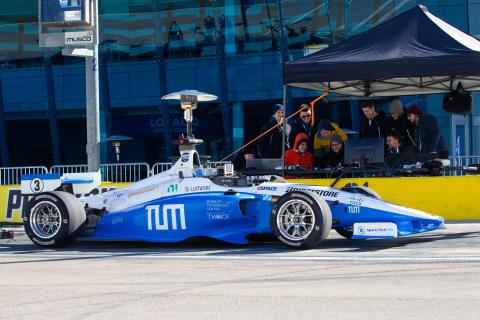
Autonomous racing is far enough along that the IAC can brag of some impressive results. The cars are modified Indy Lights chassis built in collaboration with Dallara, although at the moment, the racing is not like an IndyCar event, where two-dozen cars compete on track at the same time. Nonetheless, the IAC achieved several milestones at the most recent event in January in Las Vegas as part of the Consumer Electronics Show (CES). At Las Vegas Motor Speedway, the IAC debuted its new AV-24 chassis, while its legacy AV-21 chassis achieved firsts in autonomous vehicles passing each other at speed.

“The race itself was the same format as the previous years: two cars at a time racing in these passing competitions on an oval. There was some really compelling action that took place, particularly in the semifinal round between Technical University of Munich, which went on to win the competition, and Korea Advanced Institute of Science and Technology,” Mitchell said. “It was really the first time we’ve seen in one of these races what you and I would describe as wheel-to-wheel racing through corners. Typically, our AI drivers, when they make a pass, they make a pass pretty directly—they accelerate, they go around the car, they move back into a race line once they’ve cleared it by a safe margin. If, for whatever reason, they aren’t able to make that pass, they usually back off.

“What happened was, the German team started a pass heading into Turn 1, and rather than completing the pass it ran wheel-to-wheel with the car from the Korean team through Turn 1, into Turn 2, and then made the pass. You and I would say, ‘Well, that’s racing.’ But we’d not seen that before with these fully autonomous AI drivers, which tells us that they’re getting better. We’re seeing an increase in the quality of the racing that appears more in line with top human race car drivers for IndyCar or for other series. That was, for me, the highlight of the race that took place at Las Vegas Motor Speedway on January 11.”

image 2
At the debut of the Indy Autonomous Challenge’s new AV-24 chassis at Las Vegas Motor Speedway, racing was run in the dark. The cars were lit up with LED lights but had no headlights, and the lights at the track were turned off.

If the AV-21’s wheel-to-wheel passing seems unremarkable, the AV-24 car flexed abilities that humans would struggle to match. “The rollout of this new AV-24 vehicle was exciting because we put three cars on the track at the same time for the first time,” Mitchell explained. “We’ve never had three cars running together. And we had them running in the dark. The cars were lit up with LED lights but no headlights. The lights were turned off at the track. As the light came down to total darkness, the cars kept running. Then once it was completely dark, one of the cars passed another car.”

This type of research is part of a global competition to master autonomous technology. On the other side of the world, another series is set to hold its inaugural race on April 28, 2024, at the Yas Marina Circuit in Abu Dhabi, United Arab Emirates. The Abu Dhabi Autonomous Racing League (A2RL) uses customized Dallara Super Formula cars as the base competition vehicle.

For A2RL, the teams competing also represent an international collection of universities and institutions from the UAE, China, Germany, Italy, Singapore, Hungary, and the US.

“A2RL was conceived by ASPIRE, the technology transition pillar of Abu Dhabi’s Advanced Technology and Research Council,” said Stephane Timpano, CEO of ASPIRE. “A central motivation in establishing A2RL was to create an extreme testing ground to stress test and optimize the performance of autonomous vehicle software, enhancing safety and reliability. With its sophisticated infrastructure and technology focus, Abu Dhabi has become a hub for innovation. We are augmenting our knowledge economy through R&D, and A2RL just shows the scale of our ambitions for the future.

“Held once a year, the event will see competing teams partake in a series of races and challenges for a stake in the US $2.25-million prize purse, with engineers, scientists, programmers, and technicians becoming the ‘heroes’ of the sport.”


The Long View

Although racing is a high-profile testbed for autonomous technology, the ultimate goals reach far beyond the race track. “A2RL is certainly not intended to replace conventional motorsport or to develop systems that replace drivers in the future—absolutely not,” Timpano said. “It is an exciting proving ground for the world’s most advanced autonomous driving systems. We want to help accelerate the development and effectiveness of safe autonomous systems for road cars. At the same time, we hope that showing AI perform in such an extreme situation will build consumer confidence in everyday Advanced Driver Assistance Systems (ADAS) like Lane Assist or Automatic Emergency Braking, which some find disconcerting. We are doing science in public.”

A world dominated by autonomous technology will surely have drawbacks, but our autonomous racing sources reported plenty of upside. “The focus is, how do we get to a world where we have high-speed autonomy, cars and trucks that can move on highways at speeds greater than 100 mph, speeds that humans are not really well suited to pilot a vehicle,” Mitchell explained. “If we can get to that point, our economies will speed up from a supply chain standpoint, human mobility will speed up between destinations, and if it’s done in a way that’s safer, then even for humans driving at lower speeds on highways, think of how valuable that would be to society. That’s the long-term objective, that’s the North Star that everyone is working toward.

“Along the way we certainly hope to develop a way to transition some of these technologies and learnings into human-driven race cars to make them faster, safer, more effective,” Mitchell continued. “I often liken that to the modern US Air Force fighter jets. Think about the mechanical planes that were being flown in WWI and WWII, and how much the human had to do on their own, versus the F-35 today that at times can fly itself, but still very much relies on the capabilities of this extremely well-trained, almost superhuman, fighter pilot. I think that’s increasingly what our race car drivers are, and as we add more technology to the cars, adding technologies that can allow them to see 360 degrees, adding technologies that may give them separating front and rear braking, and other things, is all part of perhaps leading to higher performance, higher speed, and most importantly, safer motorsports.”


Team Sport

A conventional racing team will have a driver, crew chief, and pit crew, maybe a spotter or two, along with engine builders and engineers. Autonomous racing likewise requires a team, although the duties are divided in ways that reflect the technology involved.

CK Wolfe is the program manager for Research Operations and Technical Projects at the University of California, Berkeley. AI Racing Tech is the name of the Berkeley autonomous racing team, a collaboration between UC Berkeley, University of Hawai’i (UH), University of California, San Diego (UCSD), and Carnegie Mellon University. AI Racing Tech was one of the three teams testing the AV-24 at Las Vegas, with Wolfe as the simulation team lead.

image 3
The Abu Dhabi Autonomous Racing League (A2RL) was established “to create an extreme testing ground to stress test and optimize the performance of autonomous vehicle software, enhancing safety and reliability,” said Stephane Timpano. The A2RL will hold its inaugural event in April at the Yas Marina circuit.

“The sub-teams that we have are perception, planning, localization, controls, vehicle dynamics, simulation, and trackside logistics,” Wolfe said. “The trackside logistics is like our pit crew that a normal racing team would have. On the autonomy side, because we write software to make all of the same decisions in real-time that a real race car driver would have to do, you have to respond to the track conditions. The top 1% of drivers in the world are the ones who actually end up in the racing field, and we’re trying to mimic what they do.

“So you need your race car to be able to respond to the changes on the track, to be able to sense those things, and make decisions in real-time the same way that an actual race car driver would. There are a lot of components of that,” she continued. “Perception is how you see the world. High-level planning is, based on what you see in the world, how you’re making those decisions. Controls would be how you’re executing those decisions, like how you’re actuating the low-level steering, throttle, brake commands, which can be a very complicated way to apply things. Vehicle dynamics is how you’re modeling the car. Simulation, which is the team I lead, brings all of those things together, and you’re driving the car in simulation the same way you would in the real world, to try to validate all of that software and all of that AI for the real car before we even get to the track.”

High-speed autonomy requires the race car to be equipped with a suite of leading-edge processors and sensors, and the IAC’s new AV-24 chassis employs the best of the best.

“For perception we added more capabilities by putting some rear-facing sensors. There’s a lidar that’s facing backward and a radar that’s facing backward,” the IAC’s Mitchell said. “In the AV-21 there’s nothing facing backward. So we created 360-degree uninterrupted lidar perception by having four lidars instead of three on the car.

“Additionally, we’ve upgraded the quality of the sensors. We went from a first-generation lidar from our sponsor Luminar to its newest one called the Luminar Iris, which is longer range, more accurate, and more powerful. Similarly, for radar we changed from a legacy radar technology to a brand-new Continental 4D radar, a more advanced radar technology. And then we’ve increased the 360-degree perception of our cameras.

“For localization, we added more GPS, GNSS [global navigation satellite system] capabilities—stronger, better, more accurate GPS. We also increased the wireless communication pathways because another way you do localization is not just by GPS, but communicating with race control so we understand where the cars are. For that we added this Marelli telemetry device that is used in F1.

“In vehicle dynamics, we made some really big changes by putting in a completely new drive-by-wire system, steering and braking,” Mitchell continued. “We actually did it as an internal engineering project within IAC, sourcing rotary actuators and linear actuators that are very robust, accurate and fast, and could handle the harsh operating conditions of a race car. So we dramatically improved the steering strength and accuracy. For braking, with two linear actuators, we separated the braking of the front master cylinder and the rear master cylinder, so the AI driver can send different brake pressures to the front and rear of the car.”

image 4
Top engineering universities from around the world are competing in autonomous racing events, working with industry suppliers both within and outside the automotive sector. “Cisco is a partner,” said Paul Mitchell of the Indy Autonomous Challenge.

This hardware and software magic can take a race car quite far, but it still helps to have the perspective of a racing veteran to speed things along. One such veteran is Gary Passon, who currently runs the AVT program at the University of Hawai’i and is the AI motorsports team principal. As a driver, he progressed through the amateur and semi-professional ranks, rising as high as the USAC Mini-Indy series (today’s Indy NXT) before leaving racing behind to focus on a career in the computer industry. “I retired after 30 years of industry work and moved to Maui, and got involved again in technology, but this time blending my computer background with my racing background by involving the University of Hawai’i in autonomous vehicle technologies,” Passon said.

“In the beginning it was all about just getting the car to move and getting it to go around the track without hitting something. And then pretty soon you want to do that a little faster, and a little faster, and that’s kind of what a new driver coming up in racing goes through,” Passon said. “They have to earn their way into the program by learning the nuances of operating at the extreme of the tires and the vehicles themselves. What I hopefully have helped bring to the table is the perspective and experience from having done that as a human, and trying to highlight for the team the areas where we need to put our focus so that we can teach our autonomous driver the way of the world and the limits in which it has to operate and go there in a safe and fast manner. Crashing cars is not good whether it’s a human or an AI driver.”


Real Deal

Autonomous racing is so new on the scene that misconceptions still pop up. These are not race cars being guided remotely or piloted using a racing simulator. “We’re talking about full level 5 autonomy, meaning that the moment that the competition starts, other than turning the car on, the team does nothing,” Mitchell said. “They’re sitting there and they’re watching. The only thing they can do is they have essentially the ability to abort if they see something on their telemetry data or their vehicle’s behavior that they don’t like.”

image 5
Like conventional racing, autonomous racing is a team sport, though the teams and their duties reflect the high levels of technology involved in full level 5 autonomous driving. Once the competition starts, though, the human members of the team do nothing to control the car.

“I feel like there’s a lot of confusion for people, where they seem to think that autonomy means something like a giant RC car, and they don’t see the point,” Wolfe said. “Which I think is a little unfortunate. If I were to try to communicate one thing, it’s that the level of complexity that goes into engineering an autonomous system, essentially something that responds in real-time and can react and mimic the behavior and precision of the top 1% drivers in the world, is not a trivial task.

“Autonomy is still a huge research area in industry and in academia, and in many ways, it is still an unsolved problem. What we’re doing when we engineer these systems is, we’re writing code that can make decisions in real time and execute those decisions and compete in an adversarial head-to-head competition while we do nothing. So we have to write software that is intelligent enough to mimic all of those human behaviors in real time and make those decisions and optimize and try to race to win,” she said.

image 6
Among the enhancements made to the Indy Autonomous Challenge’s AV-24 chassis is the addition of rear-facing lidar and radar to give the vehicle 360-degree perception. The quality of the lidar sensors and the radar has also been improved.

Autonomous vehicle technology will advance, but racers shouldn’t worry about losing their seats to some future hard-driving Terminator, according to our sources.

“A lot of people think what we’re doing is creating some kind of future motorsports thing that replaces human drivers and the kind of motorsports that most people are used to. I think that’s probably a misperception,” Passon said. “Yes, I think autonomous racing is here to stay. I don’t think that’s going to go away. It’s going to get more and more competitive, and it’s going to get more and more visibility. But I don’t think it’s a replacement for traditional human-driven motorsport. I think it’s a complement to that.” 


Autonomous Racing Calendar

Abu Dhabi Autonomous Racing League 2024

• Yas Marina Circuit in Abu Dhabi April 28

Indy Autonomous Challenge 2024

• Milan Monza Motor Show, Autodromo Nazionale Monza June 28–30

• Goodwood Festival of Speed July 11–14

• Indianapolis Motor Speedway September 6


SOURCES

Abu Dhabi Autonomous Racing League (A2RL)
a2rl.io

AI Racing Tech
airacingtech.com

Indy Autonomous Challenge
indyautonomouschallenge.com

April 2024
By
Steve Statham

ASCS Names Series, Competition Directors

Submitted by ajh on Thu, 03/14/2024 - 15:05
American Sprint Car Series


The American Sprint Car Series (ASCS), the Concord, North Carolina-based series, has hired Lonnie Wheatley as its new series director and Cody Cordell as competition director and leader of the ASCS Sooner region.

Wheatley has been involved in the Tulsa Shootout and Chili Bowl Nationals for more than 20 years, assisting with media needs, developing the formats, covering the passing points, and managing the efficiency of the shows.

Cordell spent the last four years as crew chief and team leader for sprint car driver Noah Gass and previously served as race director for POWRi.

For more information, visit ascsracing.com.

March 2024

MBE Group Promotes Gretchen Bennett to Account Manager

Submitted by ajh on Thu, 03/14/2024 - 11:45
MBE Group Gretchen Bennett


Marx Buscemi Eisbrenner Group (MBE Group), a Troy, Michigan-based marketing communications agency, has promoted Gretchen Bennett to account manager.

Bennett joined MBE Group in 2022 as an intern and previously held the position of account coordinator. She has provided support to clients through various marketing programs, social media management, content creation and event planning, along with website and press-release copywriting, according to the company.

In this new role, Bennett will support wider strategic initiatives for business-to-business and direct-to-consumer clients, including media relations, event management, social media marketing and content development. 

For more information, visit mbe.group.

March 2024

Toyota Gazoo Racing North America Launches GR Cup eSports League

Submitted by ajh on Wed, 03/13/2024 - 13:57
Toyota Gazoo Racing GR Cup eSports League


Toyota Gazoo Racing North America (TGRNA) is partnering with SRO Motorsports Group America and iRacing to launch the Toyota Gazoo Racing GR Cup eSports League.

Managed and operated by the SRO Motorsports Group America, the GR Cup eSports League will be the official sim racing league of TGRNA. Forty sim racers will have the opportunity to compete virtually at the same race tracks the GR Cup will visit this season to win a share of more than $10,000 in purse and prizes by qualifying for and competing in the league.

Each race will be 60 minutes and broadcast live on the GT World YouTube channel and SRO Motorsports Twitch.

For more information, visit grcupseries.com/esports.

March 2024