Jaguar Commits to Formula E GEN4 Era

Submitted by ajh on Mon, 04/29/2024 - 13:16


Jaguar, the England-based vehicle manufacturer, has committed to the FIA's Formula E World Championship forthcoming GEN4 platform, solidifying its role in the series until 2030.

The new GEN4 platform will offer improvements to energy efficiency, race performance, and safety standards, according to Formula E, and will introduce new features such as regeneration capacity up to 700kW and a power output surge up to 600kW.

For more information, see the full announcement on fiaformulae.com.

April 2024

Formula 1 Mulls Change to Championship Points, Launches U.S. Streaming Channel

Submitted by ajh on Mon, 04/29/2024 - 13:12
Formula 1 Logo


The Formula 1 Commission has discussed changes to its championship points allocation system during its second 2024 meeting, according to the series, with a proposal for changes slated to be presented to the Commission later this year.

The group, led by FIA Single-Seater Director Nikolas Tombazis and Formula 1 President and CEO Stefano Domenicali, also discussed 2025 preseason testing dates and venues, as well as the introduction of rear-facing cameras. 

For the full wrap-up, click here.

Additionally, Formula 1 is launching a new, subscription-free streaming channel in the United States ahead of next month's Miami Grand Prix. 

Available on services including Samsung TV Plus, Amazon Freevee, and Pluto TV, Formula 1 Channel will show F1, F2, F3 and F1 Academy race replays and highlights along with full reruns of classic Grands Prix and racing documentaries. 

For more information, see the full announcement on formula1.com.

April 2024

Zachary Tinkle Receives ARCA 2023 General Tire Spirit Award

Submitted by ajh on Fri, 04/26/2024 - 15:31
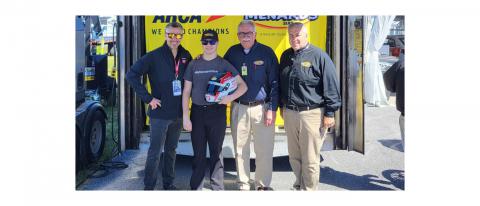
Zachary Tinkle ARCA General Tire Spirit Award


The ARCA Menards Series presents its 2023 General Tire Spirit Award to ARCA Menards Series East driver, Zachary Tinkle.

The Speedway, Indiana, native received the award during the ARCA Menards Series/ARCA Menards Series East combination race at Dover Motor Speedway on April 26.

The General Tire Spirit Award is presented annually to a recipient who displays dedication to and support of ARCA, is uplifting by example, and by such actions earns the respect of the community, displays perseverance in the face of adversity and maintains a supportive, helpful and positive attitude even under duress, the series said.

Tinkle received a commemorative General Tire helmet and a check for $2,500. A second check, also for $2,500, will be presented to a charity of Zachary's choosing.

For more information, visit arcaracing.com.

April 2024

NHRA Names New South Central Division Director

Submitted by ajh on Fri, 04/26/2024 - 15:18
Jonathan Johnson NHRA


The National Hot Rod Association (NHRA), based in San Dimas, California, has named Jonathan Johnson as the division director for the South Central Division (Division 4).

Johnson will oversee NHRA member tracks in Texas, Oklahoma, New Mexico, Louisiana, Arkansas and Mississippi.

Prior to being named NHRA Division Director, Johnson was the president at JKJ Auto Parts and was most recently the south region parts and service manager with National Trailer Source, the NHRA said.

The South Central Division oversees several NHRA Lucas Oil Drag Racing Series events in addition to the upcoming Cajun NHRA SPORTSnationals at No Problem Raceway in Belle Rose, Louisiana, and the Texas NHRA FallNationals at Texas Motorplex in Dallas as part of the NHRA Mission Foods Drag Racing Series.

For more information, visit nhra.com. 

April 2024

Dragzine Names Brian Wagner Lead Content Creator

Submitted by ajh on Thu, 04/25/2024 - 10:29
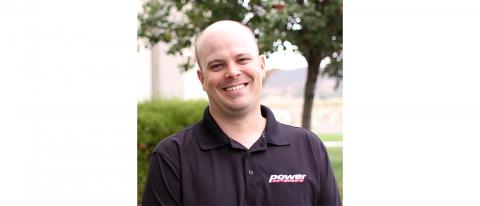
Brian Wagner Dragzine


Power Automedia, the Temecula, California, media company, has named Brian Wagner as Dragzine's new lead content creator.

Wagner has more than seven years of experience on the Dragzine and Street Muscle staff, with an additional four years as a freelance writer and photographer.

Wagner has also hosted the "Dragzine Podcast," SpeedVideo's "Tech Inspection," online videos, and provided on-air talent for FLO Racing's drag racing live streams.

For more information, visit powerautomedia.com.

April 2024

Wilwood Extends Speed Ventures Corvette Challenge Partnership for 2024

Submitted by ajh on Thu, 04/25/2024 - 10:22
Wilwood Corvette Challenge Speed Ventures


Wilwood Disc Brakes, based in Camarillo, California, is extending its sponsorship of the Speed Ventures Wilwood Corvette Challenge for the ninth year.

Speed Ventures, a West Coast-based organizer of time trial competitions, hosts a variety of events allowing sports-car owners to race at road courses in a Corvette, Nissan, BMW, Honda, Mustang or other spec race cars.

For more information, visit wilwood.com or speedventures.com.

April 2024

NASCAR Hall of Fame Announces Class of 2025 Nominees

Submitted by ajh on Wed, 04/24/2024 - 13:46
NASCAR Hall of Fame logo


NASCAR has announced the 15 nominees for the NASCAR Hall of Fame’s Class of 2025 and the five nominees for the Landmark Award for Outstanding Contributions to NASCAR.

Two Modern Era candidates and one Pioneer candidate will be elected as the Class of 2025. The Pioneer ballot honors those whose careers began more than 60 years ago. The Landmark Award honors those who made significant contributions to the growth and esteem of NASCAR.

The NASCAR Hall of Fame Voting Panel will meet in person to discuss and vote for the Class of 2025 and Landmark Award on Tuesday, May 21. The winners of a fan vote will comprise the final ballot tallied. The Fan Vote is currently open and will close on May 19 at 12 p.m. ET.

The Modern Era Ballot and Landmark Award nominees were selected by the Nomination Committee, which consists of representatives from NASCAR and the NASCAR Hall of Fame, track owners from major facilities and historic short tracks. The Honors Committee, largely comprised of all living Hall of Famers, Landmark Award winners and Squier-Hall Award winners, selected the Pioneer Ballot.

Following are the NASCAR Hall of Fame Class of 2025 nominees and Landmark Award nominees:

Modern Era Ballot

  • Greg Biffle, 2000 NASCAR CRAFTSMAN Truck Series champion and 2002 Xfinity Series champion.
  • Neil Bonnett, won 18 times in the NASCAR Cup Series including consecutive Coca-Cola 600 victories.
  • Tim Brewer, two-time NASCAR Cup Series champion crew chief.
  • Jeff Burton, won 21 times in the NASCAR Cup Series including the Southern 500 and two Coca-Cola 600s.
  • Randy Dorton, built engines that won nine championships across NASCAR’s national series.
  • Carl Edwards, winner of 28 NASCAR Cup Series races and 2007 Xfinity Series champion.
  • Harry Gant, winner of 18 NASCAR Cup Series races, including two Southern 500 victories.
  • Harry Hyde, 1970 NASCAR Cup Series championship crew chief.  
  • Ricky Rudd, won 23 times in NASCAR Cup Series, including the 1997 Brickyard 400.
  • Jack Sprague, three-time NASCAR CRAFTSMAN Truck Series champion.


Pioneer Ballot

  • Ray Hendrick, won over 700 times in NASCAR Modified and Late Model Sportsman.
  • Banjo Matthews, built cars that won more than 250 NASCAR Cup Series races and three championships.
  • Ralph Moody, two-time NASCAR Cup Series owner champion as the mechanical genius of Holman-Moody.
  • Larry Phillips, first five-time NASCAR weekly series national champion.
  • Bob Welborn, three-time Convertible Division champion.


Landmark Award

  • Alvin Hawkins, NASCAR’s first flagman; established NASCAR racing at Bowman Gray Stadium with Bill France Sr.
  • Lesa France Kennedy, NASCAR executive vice chair and one of the most influential women in sports.
  • Dr. Joseph Mattioli, founder of Pocono Raceway.
  • Dr. Dean Sicking, inventor of the SAFER (Steel and Foam Energy Reduction) barrier.
  • Les Richter, long-time NASCAR executive who oversaw competition, helped grow the sport on the West Coast.


For more information, visit nascar.com/halloffame.

April 2024

Advocacy Corner

Submitted by johnc on Tue, 04/23/2024 - 15:37
image 1


Tracking legal, legislative, and regulatory developments impacting the racing and performance industry.

PRI’s Washington, DC-based legal and advocacy teams work continuously to protect and support motorsports venues, sanctioning bodies, and businesses around the nation. We are tracking several initiatives this month, including a new EPA ruling regarding emission benchmarks, Californians’ strong opposition to proposed legislation mandating speed-limiting devices, and multiple states rejecting legislation to adopt California’s clean-car rules.

SEMA, PRI Continue Fight Against ICE Bans as Feds Announce New Emission Laws

The US Environmental Protection Agency (EPA) is delaying its most aggressive tailpipe emissions-reduction requirements from model-year 2027 to model-year 2030. The move comes after advocacy from small businesses across the country that represent the specialty automotive aftermarket and other key stakeholders.  
The EPA’s final rule also slightly increased the average tailpipe emissions for light-duty vehicles, increasing the standard to 85 grams/mile from 82 grams/mile for model-year 2032. The agency’s final rulemaking provides automakers with additional time to ramp up production of zero-emissions vehicles (ZEVs). Currently, only electric vehicles (EVs) and five plug-in hybrid electric vehicles (PHEV) meet the easier 85 grams/mile standard. It is estimated that 67% of new vehicles sold would have to be EVs by 2032 to meet this standard. Automakers could also comply with the final rule if EVs account for 56% of new vehicle sales and PHEVs comprise 13% of model-year 2032 sales.
While this final rulemaking establishes more incremental emissions reductions, it still requires automakers to increase ZEV sales rapidly. PRI opposes the EPA’s final standards for the model-year 2027 to 2032 light- and medium-duty vehicles, which force automakers to sell EVs and PHEVs to comply with this rulemaking and further limits internal combustion engine (ICE) technology options.
“SEMA and PRI rallied our members and car enthusiasts across the country whose advocacy played a critical role in pushing back against the EPA’s proposed tailpipe emissions standards rule,” said Eric Snyder, SEMA and PRI’s senior director of federal government affairs. “Over 7,500 of our member companies and automotive enthusiasts wrote to the EPA to oppose the agency’s efforts to mandate the sale of EVs and eliminate the sale of ICE vehicles. Their efforts made a difference in softening the EPA’s rulemaking, but it’s clear there is more work to do.”

Survey Finds California Voters Would Reject Proposed Speed-Limiting Devices Legislation

A recent SEMA-commissioned survey of likely California voters found they would overwhelmingly reject SB 961—the proposed legislation which would require new cars and trucks to be equipped with speed-limiting devices beginning in 2027.
The survey, conducted by Rodriguez Gudelunas Strategies in mid-February, found 69% of respondents in opposition, with over half (51%) of likely voters strongly opposed to the legislation, while only 12% strongly support it.
“It is clear that Californians want to control their cars, not vice versa,” said SEMA President and CEO Mike Spagnola. “That’s why we urge California legislators to listen to the voters they represent and shelve this unpopular bill.”
Additionally, the proposal fared poorly across age groups and party lines, failing to reach majority support among all significant voting blocs.

Industry Members Oppose California’s Mandate to Ban ICE Vehicle Sales

PRI- and SEMA-member companies and automotive enthusiasts have come out in strong opposition to the California Air Resources Board’s (CARB) “Advanced Clean Cars II” (ACC II) regulation that would ban the sale of new internal-combustion-engine (ICE) motor vehicles by 2035.
Specialty-equipment businesses and industry supporters sent more than 5,000 letters to the US Environmental Protection Agency (EPA) expressing opposition to the agency providing California a Clean Air Act waiver, which is required in order for ACC II to take effect. Industry members and enthusiasts alike have united in opposition to California’s Zero Emissions Vehicle (ZEV) mandate that would adversely impact automotive businesses, their employees, and millions of automotive enthusiasts.
ACC II requires that 35% of new cars, SUVs, and small trucks sold in California must be zero-emissions vehicles (ZEV) starting in 2026. The regulation increases ZEV sales requirements by 6% to 8% annually through 2035, when 100% of new vehicles sold in California must be ZEV—eliminating the sale of any new gas-powered vehicles.
Before ACC II can be implemented, CARB must receive a waiver from the EPA for the regulations to take effect. If the regulation is finalized, it will effectively block out non-electric vehicle technologies and innovations already underway in the industry to help achieve lower automotive emissions goals.
“Thank you to all of the SEMA and PRI members for writing letters opposing the EPA granting a waiver to allow California to dictate the kinds of vehicles over 40% of Americans can purchase,” said Eric Snyder, SEMA and PRI’s senior director of federal government affairs. “Requiring all new vehicles sold in California and other states that follow their vehicle emissions policies to be 100% ZEV is inconsistent with marketplace realities and hurts consumers by driving up costs and reducing vehicle options. Simply put ACC II is bad for American consumers and, if implemented, would hurt thousands of small businesses that are not being propped up by government subsidies.”

Maine Rejects ICE Vehicle Ban Amid Industry Opposition

After a several-month delay, Maine’s Board of Environmental Protection (BEP) voted against adopting a PRI-opposed proposal requiring that 82% of new vehicles sold in the state be zero-emissions vehicles (ZEV) by 2032.
Drafted in response to a citizen petition from an environmental group, the rule aimed to tighten emissions standards for new passenger cars, light-duty trucks, and medium-duty vehicles sold in Maine, aligning the state with California’s latest clean-car rules, which the state has historically followed.
While the BEP debated adopting California’s clean-car rules, lawmakers concurrently held a hearing on a bill (L.D. 2261) that would reclassify the proposal as a “major” regulation, providing the legislature with final approval before it could become law.
PRI believes that Mainers, not the government, should decide what vehicles are best for them and their families. And, in the case of Maine, it rebukes the push by 150 citizens who attempted to determine policy for the rest of the state.
“SEMA and PRI applaud the Maine Board of Environmental Protection’s decision to reject this overly burdensome ZEV mandate. This proposal would have severely limited consumer choice and driven up costs for Mainers,” said Christian Robinson, SEMA and PRI’s senior director of state government affairs and grassroots. “We believe in offering a variety of vehicle options to meet the diverse needs of American consumers, and this regulation would have unfairly restricted that choice.”

Connecticut Legislature Shelves Gas-Powered Vehicle Ban

In a win for the automotive specialty-equipment industry, the Connecticut legislature has shelved plans to adopt California’s ban on the sale of new gasoline-powered vehicles by 2035. This decision comes amid concerns about the feasibility of such a drastic transition, particularly regarding the readiness of the state’s electric grid and charging infrastructure.
In late 2023, Connecticut Governor Ned Lamont withdrew a PRI-opposed regulation requiring the state to adopt California’s strict motor-vehicle emissions laws and outlaw the sale of new gas- and diesel-powered cars beginning in 2035. The move to withdraw the regulation came after bipartisan opposition from state lawmakers, with the governor acknowledging that the proposal lacked sufficient support to pass the legislature’s Regulation Review Committee.
A recent poll commissioned by SEMA revealed that 59% of registered voters in Connecticut oppose a ban on the sale of new gas-and diesel-powered vehicles. Rising living costs and the potential financial burden on low-income families were cited as major concerns. Additionally, the poll found that 67% of voters believe electric vehicles pose environmental concerns related to battery production.
“The decision by the Connecticut legislature to shelve the California-style gas vehicle ban is a victory for common sense and Connecticut consumers,” said Christian Robinson, SEMA and PRI’s senior director of state government affairs and grassroots. “This proposal raised serious concerns about affordability, grid capacity, and even the environmental impact of electric vehicles. We’re encouraged by the legislature’s recognition of these issues and their commitment to finding practical solutions that prioritize consumer choice.”
For more information, contact SAN@sema.org.


May 2024
By
Jack Haworth

Editors' Choice

Submitted by johnc on Tue, 04/23/2024 - 15:19
image 1


Hundreds of new product announcements cross the desks of PRI editors each month. Following are our top picks for May.

Billet Aluminum Pedal Boxes

PE Racing

peracing.com.au

image 2

Constructed from aircraft-quality billet aluminum, these pedal boxes from PE Racing in Sydney, Australia, are available in either two- or three-pedal configurations. One of the key selling points is a patented design that allows for an easy installation.
“The floor often needs no additional supporting structures. This results in a lighter and stiffer install,” said Daryl Perusic. “Pedal stiffness is what the driver actually feels, providing the much needed and direct feedback.”
The assembly can be mounted to a variety of bulkhead floor shapes and angles, and pedal adjustments can be made without removing mounting bolts or modifying the floor shape.
“The pedal assemblies can also be fitted up to our slider and sim kits. Sliders are ideal in endurance for driver changes, while the sim is ideal for training,” added Perusic.
The height, depth, and pitch angles of the pedals are all adjustable, along with the pedal ratios. The throttle can be activated with a cable or tied to a throttle-by-wire system. There’s also an adjustable brake bias.
“Adjustments are easy and do not affect critical mechanical alignments,” said Perusic. “The brake and clutch alignment of pushrods to master cylinders cannot deviate when pedal positions are adjusted.”

225 Mod-Twin Clutch for Subaru WRX

Advanced Clutch Technology (ACT)

advancedclutch.com

image 3

Subaru WRX drivers taking their factory clutch to the limit now have an option of upgrading to the 225 Mod-Twin clutch kit (push type) from Advanced Clutch Technology (ACT), Lancaster, California.
“The Subaru turbo four-cylinder engines make big power and have a lot of torsional vibration. They are notorious for being hard on clutches, specifically stripping out the splines in the hubs,” explained Rich Barsamian. “The problem? It was too difficult to get two spring-centered hubs in such a small space to adequately reduce torsional vibrations. We created a clutch that is completely modular, and both friction plates mount to one Mono Drive hub. The springs dampen the torsional vibration from the input shaft and extend life to the splines in the clutch hub.”
Features of the system include the Mono Drive modular hub and forged aluminum cover with Streetlite flywheel. The T1 version has a light pedal, while the T2 is slightly firmer. The clutch is designed to handle power levels beyond the capacity of the OEM transmission.
“This clutch will hold 625 to 910 lb.-ft. of torque at the crank,” added Barsamian. “It features increased spline life of the sprung hub, and the pedal feel is incredible.”

Special Chaser Taps

ARP

arp-bolts.com

image 4

Proper preparation of a cylinder block before assembly includes thoroughly cleaning all threaded apertures. ARP in Ventura, California, has expanded its specially designed chaser taps to include 22 different sizes in SAE and metric.
“Blocks may have sealant or other material caked up inside the threads,” explained Chris Raschke. “I’ve seen guys who have twisted the bolt off before it even touched the head, so it’s critical that you make sure the holes are clean.”
Iron blocks can have rust buildup on the threads that a wire brush or other cleaning tool can’t remove. Also, it’s not a good idea to use a conventional tap on the threads.
“You don’t want to take out any more material than you need, especially on older blocks, because you may be on the edge of losing the thread,” Raschke explained. “Taps range in size because of the classification of the thread, and one may remove more material than another. These chasers are classed to work alongside our fasteners.”
Engine builders can also take advantage of ARP’s Ultra-Torque fastener lubricant to obtain accurate fastener preloading. Lab tests show this lubricant to be superior to oil, moly, and other substances in delivering 95–100% of the desired preload in the first pull of the torque wrench.

Conical Valve Springs

PAC Racing

racingsprings.com

image 5

PAC Racing in Southfield, Michigan, has released three new conical valve springs to service various applications from hydraulic flat tappet to roller lifter.
“There are several advantages to conical springs: First, and most obvious, is the moving end of the spring is smaller and lighter. This allows for a smaller and lighter retainer,” explained Chris Osborn. “Any time you can reduce the mass of the moving side of the spring, you get more control over the valve and can rev the engine higher.”
Conical springs also will have a more variable rate. And third, the spring coils will get additional damping due to the fact that coils will tend to nest inside themselves—especially as they get closer to coil bind.
“This is due to the continually variable diameter of the conical shape. You don’t get that with a traditional beehive spring,” added Osborn.
The three springs are PAC-1421 with an open load of 425 pounds, PAC-1422 with an open load of 505 pounds, and PAC-1423 with an open load of 395 pounds.
“We have one Stock Eliminator racer who put a set on to start this year. He reported a gain of a few more horsepower and additional rpm out of the engine,” said Osborn. “He is excited, thinking this will allow gear changes that will allow him to set a new national record.”

Electric Water Pumps

Aeromotive

aeromotiveinc.com

image 6

With three fitment variations—including five engine-specific, a radiator mount, and a universal mount—Aeromotive in Lenexa, Kansas, offers a wide-ranging lineup of billet aluminum, brushless electric water pumps for performance vehicle applications.
According to Shawn Wessol, the team at Aeromotive is excited about this new line due to the water pumps’ light weight and higher flowing results shown in testing. “It also gave our Aeromotive engineers a new platform to showcase their skills. Of course, like our fuel system product line, these water pumps have been heavily tested and manufactured to the highest standards.”
The engine-specific pumps apply to the Chevy small block, Chevy big block, GM LS, Ford Coyote, and Mopar Gen III Hemi platforms. Weights range from 6.6 to 8.04 pounds, and the free-flow rates are from 35 to 50 GPM at 13.5 volts.
The radiator-mount pump weighs 6.1 pounds and has a 60-GPM rate, while the universal mount weighs 4.3 pounds with a 27-GPM rate.
The pumps are optimized for motorsports classes like Top Sportsman, drag-and-drive, Formula Drift, Baja prerunners, Ultra 4, and more.

Universal Kill Switch

Wehrli Custom Fabrication

wcfab.com

image 7

Designed for competition truck and tractor pulling, this billet kill switch from Wehrli Custom Fabrication in DeKalb, Illinois, interrupts the ground circuit of the ignition, fuel pump, ECM, or other required electronic device when triggered by the sled operator.
“We’ve been heavily involved as truck-pull competitors and specifically with the Illini State Pullers sanctioning. In that time, we’ve seen a real need for a high-quality electrical kill switch to specifically address the needs of truck and tractor pulling organizations,” said Jason Wehrli. “Too many of the options out there for conventional race vehicles just don’t work because of the unique requirements that the sled poses when connected to the vehicle.”
The switch housing is constructed from billet aluminum and features tapped mounting holes. There’s also a zip-tie mount point to act as a safety check and secondary method to retain the 2.5-inch pull ring, which meets sanctioning body rules for connecting to the sled hook.
For diesel-specific applications, the switch runs together with a mechanical turbo air knife/guillotine/shutter switch which is activated by the same winch on the sled. When needed, this activation will close airflow to the compressor inlet to help prevent a runaway. The switch is compatible with 6-/12-/16-/24-volt systems.

75/76 Series Pro Filter II

Russell

russellperformance.com

image 8

Designed for optimum fuel filtration without the pressure loss often seen in other designs, the new 75 and 76 Series of Pro Filter II filters are available from Russell, Olive Branch, Mississippi. These filters have been tested on both carbureted and EFI applications, and they’re compatible with ethanol-added fuels.
The 76 Series “Big Russ” Pro Filters are targeted at high-horsepower street and race vehicles with engines rated at 2,000-plus horsepower. They measure 6.5 inches long and are available with -10, -12 or -16 AN hose ends.
The 75 Series filters are 4.0 inches long and are designed for street vehicles with less than 750 horsepower. They’re available with -06, -08 and -10 AN hose ends.
Filter replacement is easy with the aluminum cases that feature threaded ends and O-ring seals. Filter elements are available in 10-, 40-, and 100-microns for both series.

May 2024
By
Mike Magda

PRI Tech

Submitted by johnc on Tue, 04/23/2024 - 15:07
image 1


Proper placement of an engine-driven cooling fan on a race car is crucial for maximum cooling efficiency and avoiding cooling problems.

You can have the best belt-driven radiator fan in the world that moves a high volume of air, but if it’s not properly positioned inside the fan shroud, you’re not getting the best engine cooling. It’s like running with only seven out of eight spark plugs installed in an engine. And if you’re running a belt-driven fan without any shroud, that’s like only installing half the spark plugs in your engine.
A fan shroud is actually the other half of the fan system for those who rely on a belt-driven fan for engine cooling. The shroud forces the air to be pulled through the radiator instead of around it. And correct placement of the fan blades in the shroud is important for proper airflow.

image 2
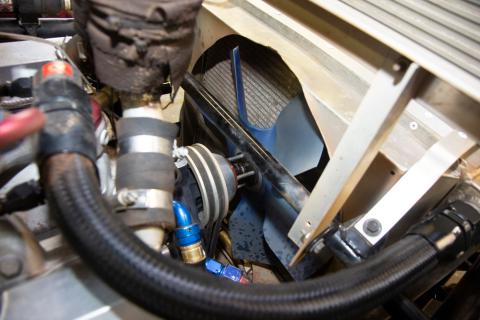
Optimal placement for an engine-driven radiator fan is with the blades half in the shroud and half out, looking from the side. Other critical measurements are to ensure there is approximately 1 inch of clearance around the circumference of the fan blades, and at least 1 inch between the fan and the radiator. If the engine, chassis, core support flex quite a bit during racing, more clearance is recommended to avoid physical contact.


When looking at the fan from the side of the race car, if the fan blades are completely inside or outside of the shroud, then the fan will simply move air around, not effectively pull it through the radiator. If the fan is too far inside the shroud, it creates turbulence inside the shroud that causes air to start spinning around in the shroud instead of moving through it. This condition will persist until vehicle speed increases enough that the ram air overcomes the turbulence, but the race car will still not get the maximum airflow and engine cooling that it could.
For circle track racers, during parade/caution laps there is still some vehicle movement to help with airflow across the radiator, but the reduction in fan efficiency can cause the motor to start building heat. If full speed racing doesn’t resume fast enough, the build-up of heat increases the risk of engine detonation, which could lead to engine failure, and/or it increases the risk of vapor locking with the fuel system and carburetor. It can also cause issues with any fluid coolers mounted in front of the radiator that are also dependent on the radiator fan for air movement to dissipate heat. From engine-oil cooling to transmission-fluid cooling, lack of proper fluid cooling can lead to failure of components.
For drag racers, the only time there is any ram air effect to assist with cooling is during an actual pass and during the shutdown run after the lights. When driving back to the pits, a car isn’t moving fast enough for any ram air benefits. In turn, this means more time is necessary in the pits for cooldown, even when using auxiliary fans to assist with cooldown. This becomes critical if the time between rounds is reduced for whatever reason. If the engine is building too much heat before the next run, conditions exist for issues similar to circle track cars with increased risk of engine-harming detonation or vapor lock that will reduce performance.
Regardless of the type of racing you do, if an overheating situation happens, you can end up with a failed head gasket, damage to engine components, or a blown engine.

Correct Placement

What’s the correct basic positioning of an engine-driven radiator fan inside a fan shroud? The optimal location is to have the fan halfway inside the shroud. Besides the lateral positioning of the fan, pay attention to the longitudinal positioning. If the fan isn’t centered properly inside the shroud, it causes dissimilar resistance along the length of the fan blades. This means that air will be moving at different velocities across the span of the blade, creating stress that leads to failure of the fan blade(s).

image 3
Another aspect of fan placement inside a fan shroud is making sure the area around the outside diameter of the fan has enough clearance from the inner diameter of the shroud opening to avoid contact with the shroud and potentially damaging the fan blades. But if there is too much space, the fan will start pulling air from outside the shroud, which means less air being drawn through the radiator for heat exchange and cooling.


Another factor relating to the shroud is the spacing between the outer diameter of the fan and the inner diameter of the fan shroud. If there is too much space between the fan outer diameter and the shroud inner diameter, efficiency will be reduced because the fan will be pulling some air from outside the shroud instead of through the shroud. Second, there must be enough clearance to account for engine and chassis movement during hard acceleration and cornering. If the fan blades make contact with the shroud, damage can occur.
If you’ve looked at your radiator fan position in relation to how far it goes into the shroud and noticed it’s wrong, what do you do? If the fan is too far inside the shroud without any spacers installed, you’ll need a different shroud that isn’t as deep, or trim the existing shroud if possible. If you’re using a fan spacer, then use a shorter one (more on that later).
If the fan is too far back from the shroud, which is the most common problem, it’s time to install a spacer to position the fan correctly. Fan spacers are available in a variety of lengths, generally from a half-inch thick up to 3 inches. Some companies, such as Flex-A-Lite, say that up to three spacers can be stacked together if needed. If you stack spacers, make sure that all of them are the same brand and that they fit together perfectly. Any discrepancy can cause the fan to not be parallel to the water pump flange or have a wobble that can loosen the fan bolts as the engine runs.

image 4
To achieve the proper placement of the engine-driven radiator fan inside the shroud, spacers often have to be used. Spacers are made in a variety of lengths, but not all spacers are the same. Flex-A-Lite chamfers the sharp edges off the outside circumference of the spacers (as seen in this photo) of its fan spacers. This prevents the spacer from work-hardening the center star of a fan and causing damage to the fan or even failure.


One important thing to know is not all fan spacers are created equal. A lower-cost fan spacer might look like a bargain, but it can cost you way more later on. Sharp edges on budget spacers can work-harden the center star of a belt-driven fan, damaging the fan where it won’t center properly and possibly fail prematurely and catastrophically. To prevent this, companies like Flex-A-Lite chamfer the edges of its fan spacers so they won’t cause this wear problem. In fact, Flex-A-Lite will void the warranty on its engine-driven fans if they’ve been used with a spacer from another brand.
Proper placement of a belt-driven fan in a fan shroud is relatively simple to achieve, and it’s critical to proper cooling for racers.

Patrick Hill grew up in the performance industry and has decades of experience working on street vehicles and race cars. As a former editor of Super Chevy Magazine, Hill now writes for several publications and manages Flex-A-Lite’s social media accounts and various marketing projects. For more than 60 years, Flex-A-Lite has specialized in performance cooling products designed to increase vehicle performance including electric fans, fully shrouded primary fans, belt-driven fans, and the original Flex Fan.

May 2024
By
Patrick Hill