IROC Holdings, the rights holder to the International Race of Champions (IROC) brand, will hold the first IROC event in nearly 20 years as part of the SpeedTour All-Star Race weekend at Lime Rock Park on July 19-20.
IROC (International Race of Champions) is a series that held races from 1973 to 2006, which brought together drivers from all forms of motorsport to race identical cars on historic tracks. NASCAR Hall-of-Famer Ray Evernham and former NASCAR Cup Series team owner and venture capitalist Rob Kauffman founded IROC Holdings and acquired the rights to the IROC brand earlier this year.
The IROC event at Lime Rock Park will feature original IROC racecars on track and on display throughout the weekend, including nearly every generation of IROC race cars, with many being driven by former IROC drivers. The IROC paddock will feature appearances by some of the original IROC racers, Q&A sessions, and IROC-branded merchandise.
IROC has also opened entry applications for anyone who owns IROC racecars and would like to display or drive in the event.
The National Hot Rod Association (NHRA) has named Tim Erdmann as its new vice president of finance.
Erdmann is based out of NHRA's San Dimas, California, office and has been the NHRA senior director of finance since 2020. He was hired by NHRA in 2019, first serving as an NHRA business manager.
As NHRA’s vice president of finance, Erdmann will oversee the organization's payroll, accounting, and finance departments.
For some trackside vendors, the race track is an oasis in a treacherous retail market.
Trackside vendors have a special and very important role in the motorsports ecosystem. After all, the show must go on. For racers involved in an on-track collision, or dealing with tire failure, or being forced to limp back to the pits due to broken parts, having access to a reliable mobile parts store at the track can mean the difference between continuing to race or packing up and heading home.
“Our main goal is to keep all the racers on the track for the heat races and the main event,” said Jack Parker with High Tech Performance, Van Nuys, California. “It makes the promoter happy; it makes the fans happy. Nobody wants to go from a 15- or 20-car field down to a 10-car field, or a 10-car field down to a three- or four-car field if they crash and we don’t have any parts.” Parker, along with Vic Parker and Debbie Fairchild, operate trackside sales at Ventura Raceway in Ventura, California, and other area tracks. They support sprint cars, midgets, dwarf cars, mod lights, pony stocks, and stock cars out of a 32-foot Freightliner, along with a second truck to house bulky items like tires, nerf bars, fuel, and lubricants.
“We have a pretty good size truck, and we carry a lot of parts. Our racers who come to weekly shows rely on us for that to keep them going,” Parker said.
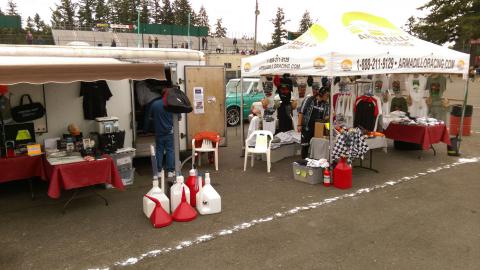
Even setting aside the regular weekend racers, trackside vendors play a key role in encouraging new racers and would-be racers to stick with it. Andy Collins of Armadillo Racing in Bremerton, Washington, is in his 37th year in the trackside sales business in the Pacific Northwest. The bulk of his business serves the sports car market at Pacific Raceways in Kent, Washington, as well as Ridge Motorsports Park in Shelton, Washington, and Portland International Raceway in Portland, Oregon. Over the course of his career, he has serviced the Canadian American Late Model Series, as well as the drag racing market.
Don Dawson II said trackside sales make up about 40% of Jocko’s Sprint Parts’ business. “Once they close that gate, I’m the only one there, so trackside sales have stayed consistent.” A bigger challenge is maintaining sales during the week and in the off-season.
“We do run a store at Pacific Raceways for the track. They call it the Drag Pro Shop, and we’re only open on drag racing days, test and tunes, and the like. There’s a little building right near the burnout area and the grandstands near the starter stand,” Collins said.
“I used to go to the promoters meeting. They usually had it up here in the Northwest for all the stock car promoters. They gave me five minutes at their meeting, and I stood up and told them why letting us come to their tracks benefitted them. The best way to say this is to use an example of us running the drag store at Pacific Raceways. People come in all the time with a new car and say, ‘I just want to see what it’ll do!’ The guy’s got a new Tesla or a Corvette or Camaro or Hellcat. And he just wants to go out and have fun that day. Well, Pacific Raceways is an NHRA track, they run NHRA rules, and the rules say if you’re going 13.99 or faster you have to have a helmet.”
Being on hand to sell such customers a helmet has allowed Armadillo Racing to let these rookie racers have their day of fun, and hopefully return for more. “The track benefits because he doesn’t go home. If he goes home, he gets his money back and goes out the door.”
Business Model
The business model for a successful “track truck” has always been an inventory balancing act. Carry too few parts and racers won’t get the help they need. Carry too much and the dead inventory gobbles up cash and drags down the business.
The wild card in recent years has been competition from large online retailers offering overnight (or even same-day) shipping. Ordering online, rather than visiting the local race shop, has become the norm for a great many racers.
However, for our sources, the trackside vending model hasn’t changed all that much. “Trackside sales is the most consistent piece of our business,” said Don Dawson II of Jocko’s Sprint Parts, Carlisle, Iowa. Jocko’s has a regular presence at Knoxville Raceway in Knoxville, Iowa, to service the sprint car market. He estimates track sales to be roughly 40% of his business. “Once they close that gate, I’m the only one there. It doesn’t matter if they can get it next day or two days down the road, once that pit gate closes, I’m all they’ve got. So the trackside sales have stayed consistent.”
The bigger challenge to the business model is maintaining sales during the week and in the off-season. “The online vendors and the big companies are slowly choking out all of us in the small mom-and-pop retail shops,” Dawson said. “We’re struggling more and more every year to try and maintain business from the retail part, more so than the trackside sales.
The constantly evolving demands of safety equipment make those items—helmets, suits, gloves—bestsellers for some trackside vendors. That and the fact that racers generally don’t want to buy this equipment without trying it on.
“It’s a funny era,” he continued. “I personally work a full-time job on top of owning my business, just because the retail piece of it has disappeared so much that you can’t afford to work there full time anymore and have any standard of living.”
In California, Parker has also noticed little change in the trackside business model. “We carry so much stuff to keep the racer on the track, I don’t know if it’s changed a lot,” he said.
What has changed, noted Parker, is the technology that goes into the parts. “Back in the 1990s, it was not the same car that’s racing now in the 2020s. Everything has changed, every car has changed. A sprint car has looked like the same car for the last 30 or 40 years, but there are light technology changes that go into that—the material the cars are built with, some of the technology of the front axle in the sprint cars.
“We try to look at new products all the time to keep up on technology for each one of the classes,” Parker continued. “We try to get involved in the technology end of it and try to pass that on for people who want to move up.”
For Armadillo Racing, if the business model hasn’t changed much, the inventory mix has. “We have more inventory than we’ve ever had, ever. We’re taking about 40 helmets to the race track,” Collins said. The constantly evolving demands of safety equipment has made those items his bestsellers. “Suits, helmets, gloves, balaclavas, socks, underwear—basically every piece of safety equipment. We’re one of the very first HANS dealers in America. We’re also a HANS re-certifier, one of only a handful in the country.”
Helping Hands
To keep their businesses at the forefront of racers’ minds, our trackside vendor sources offer hands-on services not available from distant online retailers.
“Trust me, there’s a lot of guys who come to the track and work on their car,” Parker said. “That’s the only time they have to work on their car. And then they come over and get products from us. There are other guys who have sufficient help and sufficient resources to work on it through the week and get it all prepared. But there are other guys who haven’t got those resources or people to help them, so they can’t work on the car until they get to the track. That’s probably not the right thing to do, but these race cars take a lot of time and effort.
“We try to look at new stuff all the time to keep up on technology for each one of the classes,” said Jack Parker of High Tech Performance. “We try to get involved in the technology end of it and try to pass that on for people who want to move up.”
“We provide a tire service; we change tires at the track. We have an air compressor that anybody can use anytime they want,” Parker continued. “We have a welder on board the truck so if you break a frame part, or you break a bumper or a nerf bar, you can come over and borrow the welder and use it, or we can weld it up for you. We have testing equipment. We’ve probably kind of gone overboard with some of this stuff. But we’re racers, too.”
For Dawson at Jocko’s, the 3,600 parts he routinely carries keep the cars racing, but the extra services are the difference makers. “In my case, I offer a lot of services. I rebuild rearends, I fix cars,” he said. “Those are some of the advantages. You help them with setups. That’s what you’re not going to get when you shop with one of the bigger companies, because they don’t have a presence there. Your local guy there, he’ll support you every way he can. I fix cars during the night at the race track for guys who have got in crashes, go help them put their cars back together. That’s the one piece with the local guy that you’re not going to get when you deal with the big box stores in this industry is the actual presence there and the help at the race track.”
The hands-on aspect is a big driver for Armadillo Racing’s sales. “Because we’ve been in business a long time, because we go to the race track a lot, people buy from us because, one, our pricing is pretty much MAP [minimum advertised price] pricing, so there’s no reason for them to go online,” Collins said. “I contend that people do not want to buy a helmet or gloves or shoes or a suit without trying them on. And we’ve got them to try on. So I’ve never seen the Internet as a threat to me at all in the safety equipment world because people want to try on these products. Yes, the big retailers out there have a great return policy, but do you really want to send a pair of gloves back and forth three times until you get a pair that fits right? And I’ll guarantee you this: A pair of Alpinestars gloves does not fit the same as a pair of OMP gloves. You need to try them on.”
Having a robust supply of tires is important for trackside vendors, racers, and the promoters, as no one wants a racer to go home early due to tire failure. Some vendors augment their tire supply with tire-changing services and handy air compressors.
For those businesses considering a shift into trackside sales, taking the time to recognize the optimum parts mix will be the biggest part of the learning curve. “The Catch-22 is always inventory is the biggest thing you have to watch. You’ve got to be able to maintain your inventory, but you also can’t have it eat all your profits,” Dawson said. “That’s the hardest cycle of this thing. So the biggest killer is maintaining a steady inventory. You’ve really got to be on top of what’s moving, and when stuff quits moving, you’ve got to get it going.
“In motorsports, function ain’t always what leads to what’s being bought, as much as being the ‘flavor of the month.’ Sometimes the new, hot item comes out, you order 20 of them, you sell 14 in a hurry, and then you can see it’s already going to die, so you clearance the other six. You definitely have to stay on top of what’s moving and what the trends are. A lot of times, something will come out that’s no more functional than the item before it, but it’s the hot, new, pretty item, so it moves fast, and then all of a sudden it doesn’t move,” Dawson explained.
Despite the online era we live in, there’s still much to be said for personal service. Being able to look a customer in the eye and shake his or her hand still carries weight in the racing world, especially for trackside vendors.
“Philosophically, if I save your butt by having a gauge or the fittings for something, then I believe you’re going to remember that,” Collins concluded. “And when it’s time for a new helmet, you’re going to come buy it from me.”
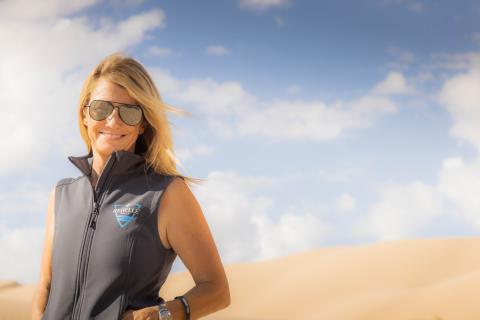
This “rebelle” with a cause is the visionary and motivating force behind the Rebelle Rally, a weeklong off-road navigation rally in the United States strictly for women.
One of the challenges in bringing women into motorsports is finding women who believe they can succeed in what remains an overwhelmingly male-dominated field. In the past, attempts to create all-female motorsports competitions could be perceived as condescending—a “Powder Puff” race is a novelty, not the main event. It has taken a new generation of racing women to create venues where women can develop their skills and discover that they do have what it takes to excel.
Among that generation of women working in motorsports today is Emily Miller. She is a longtime off-road racer and motorsports marketer, and a graduate of Western Colorado University. After spending years racing for Rod Hall Racing and producing events with the team, Miller formed her marketing company, Soulside Network, Inc. Through Soulside, she has worked with many major brands producing and marketing motorsports events. Her credits include 13 years working with King of the Hammers as media director and working on the Red Bull Supermoto Championship.
Since 2015, Miller has been the visionary and motivating force behind the Rebelle Rally. This weeklong event is the first women’s off-road navigation rally in the United States. Blending challenging off-road driving with ultra-precise navigation, the Rebelle tests a variety of skills over eight days of competition. There’s no GPS allowed. The rally is navigated for time, speed, distance (TSD), headings, and hidden checkpoints using only maps, compass, and a route book. It is not a race for speed, but rather a unique and demanding event that builds skills not only in finding one’s way but getting over tough terrain and maintaining one’s vehicle to the end.
Over the past nine years, the Rebelle Rally has attracted the attention and respect of automakers looking to prove and refine their off-road chops as well as substantial media presence. We caught up with Miller for a brief chat to talk about how she created and developed this landmark event.
PRI: What led you to organize the Rebelle Rally? Miller: It was a culmination of things. For one thing, when I was racing there were almost no other women racing. I’ve been in races where I was the only woman driving. I’ve been in big races like the Baja 1000 with over 500 teams, and only two women were drivers. We ran training programs, and it was open to women. They’d be invited, but women just wouldn’t come even though it was open to them.
Then a key thing was when I went to Africa and competed in an all-women’s event called the Gazelle Rally (formally known as the Rallye Aïcha des Gazelles du Maroc), and it was great. It was really different. There were no Americans doing it, and I was racing for Rod Hall at the time. Rod always told me that the best way to see the world is from behind the windshield doing cool things. So I went over, and I did that, and I thought, this is a great rally for women who probably don’t have experience in racing.
I love Morocco and I love the culture, but I think we have the best and most diverse off-road driving terrain of anywhere I’ve been to in the world right here in the United States. I mean, where else can you go from the highest peak in the lower 48 at Mount Whitney, and within a hundred miles as the crow flies, you’re at the lowest point and you go from high alpine to the most insane desert.
What I loved about the Gazelle Rally was that it was really a great opportunity where women weren’t afraid to step in. There are more women than ever racing now, but that’s still 2% of the field or less. That’s not a lot of women racing. Women are great drivers, they’re great navigators, and they’re great tenacious competitors, but why aren’t there more women in the field of racing?
With the Rebelle Rally, Emily Miller created a Dakar-style rally for women competitors that covers a variety of terrain, from 10,000 feet in elevation to below sea level, over eight days. “You use a lot of brain and a lot of spirit and a lot of grit, and it’s hard to win.”
PRI: That’s a great question. Why is it so difficult to attract women as competitors? Miller: This will be controversial when I say it, but 60% of our audience for Rebelle, whether it’s on our website, social media, etc., are men. We are very intentional about how we do our marketing so that it’s gender nonspecific. We just show women being badass! What I have seen is men get really excited about the rally and encourage women to do it. But a lot of times women will be really uncomfortable and decline. They have other places to spend their money, or they don’t have time, or they’re just not comfortable with the idea.
Then I see women saying to other women, ‘Do you think that’s a responsible thing to do? Do you think you should do that?’ And the men are saying, ‘Go DO this!’ Women need to be better about supporting each other on achieving their dreams. Then there are the ones who may talk about it or kind of dabble in it, but they’re afraid to say yes. When you have people around you who aren’t encouraging you to say yes, that’s challenging. I have almost never seen a man discourage a woman from doing the Rebelle, but I have watched women discourage other women from doing it.
I am not saying that’s the total issue because I’ve also been subject to conscious and unconscious bias against women in this space from both men and women. But I also believe that there are a lot of really great men out there giving women opportunities and just giving people opportunities to be involved. We always say, start somewhere. If you want to get into this, just start somewhere. I also say, if you want to be the best, learn from the best. I believe that a lot of times the best are going to be the ones who are very encouraging of women in the space.
I asked one journalist who competed in the Rebelle Rally several times, and she said she normally doesn’t do women’s events. So I asked if she would have signed up for the Rebelle Rally if it was an open event instead of a women’s event? She said no, she probably wouldn’t have, but she couldn’t explain why. What I’ve found is that women really want to learn the skills, but they want to learn it in an environment where they feel comfortable stepping in and not feeling under the microscope. I think the industry is doing a much better job of welcoming women into the space, but I still want to see more until women are closing in on 30% to 50% of the competition field. We still have a lot of work to do. PRI: How does the Rebelle prepare women to participate in other events? Miller: I think that there need to be opportunities where women feel comfortable to come in and start somewhere, because I think it is about that first opportunity. People need to work proactively to create those opportunities. What the Rebelle does, which I think is great, is that you use a lot of brain and a lot of spirit and a lot of grit, and it’s hard to win. You need to be really good to win, but you can learn those skills. This rally gives you seat time. When people leave the Rebelle, they’ve had eight start lines, eight finish lines, and about a hundred hours of competition time under the pressure cooker of the clock. While it’s not a race for speed, you still have to get it done. Further, they’ve been able to reinforce good driving skills, good navigation skills, and make good decisions. PRI: How did you develop the Rebelle’s orienteering format? Miller: I wanted to make something we don’t have here in America. I wanted multiple days because I believe that anyone can do anything for three days, because there’s a light at the end of the tunnel. But when you get into eight days, you’re talking about something that takes more determination, and it shows you how good you are when everybody’s exhausted.
I just wanted basically a Dakar-style rally, but for stock manufacturer vehicles. I wanted it to be about driver skill and good durable vehicles because there are not many credible competitions that allow stock manufacturer vehicles. Then I wanted it to be remote. I wanted it to be about navigation, and I wanted people to not be able to use their phones or GPS. I believe it’s important for people to have the fundamentals of time, speed, distance, and bearing, and not worry about how they look on social media.
I wanted a triathlon of rally, so we made map and compass challenges, which really nail down people’s ability to understand navigation and be great at navigation. Those challenges are green, blue, and black diamond checkpoints. The green checkpoints are mandatory, the blue and black diamond checkpoints are not mandatory. With the black diamonds, it’s kind of like a dartboard, you get your points based on how close you are to the target and how close to your TSD. I would call it a quick moving chess game, and it’s very strategic.
Rebelle Rally participants forego GPS or cell phones for navigation and use maps, a compass, and a route book instead. The Rally’s map and compass challenges “really nail down people’s ability to understand navigation and be great at navigation,” Emily Miller said.
Then there are what we call Enduro challenges, which are basically TSD or staying on route challenges. Our course director is Jimmy Lewis, who’s a famous moto racer, and he was the first American to podium the Dakar Rally. Jimmy is an incredible coach, especially with navigation rally.
So you have these different challenges within a day, and you also have to plot your latitudes and longitudes on a map or heading in distance. Our competitors know how to take a physical Lat/Lon in degrees, minutes and seconds, and plot it on a map. They have to do more than 25 of them in a day, and they have about an hour in the morning to do that as well as doing their TSD math before they’ve ever gone out on course.
The last thing that was very important to me is that you had to be in every type of terrain. We have double track, we have fast rally roads, we have washes, rocky technical terrain, and sand dunes. Our altitudes will range from below sea level to 10,000 feet. PRI: Were there any particular challenges that you had to overcome in order to make this rally happen? Miller: One challenge was educating land management that we were not a speed race to get the permits. We are the longest competitive off-road rally in the United States, so we go through many districts and different types of jurisdictions. Many people with experience said that there would be no way we could get the permits to pull this off. But I knew it wasn’t illegal, and I knew it wasn’t a race for speed, and I knew that we could spend the time educating people on what it was. It took a lot of time to do that, a lot of meetings, a lot of education, and trying to find the right people and then coordinating them. For example, the Bureau of Land Management said that they don’t really do multi-state permits. So there was a lot of learning and work on their end to make this happen for us because they had to coordinate through all these offices, but also between states and then national parks, national preserves, and so on.
“There need to be opportunities where women feel comfortable to come in and start somewhere, because I think it is about that first opportunity,” Rebelle Rally’s Emily Miller said. “People need to work proactively to create those opportunities.”
PRI: Now that the Rebelle is established, are there challenges still ahead? Miller: Here’s what is challenging, and we’re working on some of these things right now: For safety and permit reasons, Rebelle remains a confidential course with no spectators. But we work hard to be digitally focused. We have a great live webcast. It’s on YouTube under the Rebelle Rally channel (youtube.com/RebelleRally), and it’s on our website (rebellerally.com). We have a lot of people watch it, and we have a lot of people who follow our tracking and our scoring. Those numbers have gone way up, which is great.
Right now, we are sold out at 65 teams. We tend to sell out at least 10 months in advance, and we don’t want to take it above 65 teams because it starts to impact the environmental footprint, which puts us into a different permitting situation. I would say that the important thing for us is how we continue to expand the brand and the opportunities for people to be involved who don’t have one of those 65 team spots. That’s why we have great training programs. We’ve launched what’s called Rebelle Trials where you can do a training program and then do one full stage of the rally using our format. We tested that last year, and we were sold out and had a waiting list. So we are doing two this year. We’ll do one in California, and we’ll do one in British Columbia, which is really great.
“Women need to be better about supporting each other on achieving their dreams,” declared Rebelle Rally founder Emily Miller. To encourage and show appreciation for the event’s participants, she shakes hands with the competitors at the start and finish line of the first and the final stages of the rally. She is seen here with a team from the Pacific Northwest.
PRI: Are there any moments when you were particularly proud? Miller: Gosh, there are so many, and if there weren’t, I’d probably quit because it’s really hard to produce this rally here in the US. It’s when women come back and say, “I went back to the office and I got a huge promotion and my boss said, ‘I didn’t know you were such a badass.’” Other times have been when people have been in really tough challenges out on the rally, and they’ve come through and they had that ‘a-ha’ moment about themselves. PRI: What have you learned along the way that you can offer as advice to others? Miller: Sometimes when you want to make something easy, that usually doesn’t work. It’s never easy. There were a couple of times when I wanted to make something easy by hiring an outside group to do something. Then I realized that group didn’t care about our mission nearly as much as we did, and I already knew all the right people. Don’t think you’re going to cut a corner and make something easy.
Also, a lot of people think they want to be event promoters. I would really take a look and figure out if that’s what you want to do, because it’s a really hard and thankless job. We’re fortunate in the Rebelle because it’s very rewarding, but it is very hard to be an event promoter. So first think about that; it will not be easy. Make sure you have good insurance, and make sure your permits are in good shape, and don’t burn bridges. But I would say that what’s critical is to have realistic expectations, stretch goals, and a killer team.
PRI’s new president shares his vision for the brand, where he sees the industry headed, how we can unite to address current and impending challenges, and his focus on continuous improvement not only for him but guiding his team members as well.
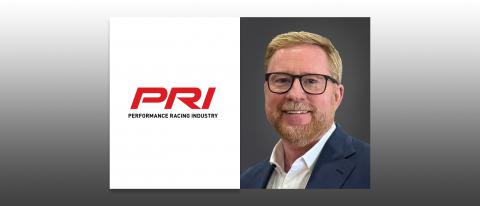
With more than 25 years of experience guiding teams and organizations, and a self-professed “adrenaline junkie who loves speed,” Michael Good was named PRI president on February 26, 2024.
Good’s extensive resume ranges from entrepreneurship to leading and growing global brands in the automotive space in the roles of president, CEO, chairman, and vice president of sales and marketing. He joined PRI from Dynamat, Inc., an industry leader in producing and delivering high-quality acoustic solutions, where he served as the president and CEO.
Good is a graduate of the University of Southern Indiana and Anderson University. He spends his free time at racing events and car shows and serves on the boards of Indianapolis Cars & Coffee and Carmel Artomobilia. He also works with other nonprofits focused on at-risk youth, and currently serves on the Purdue Global Advisory Board.
Good and his wife of 24 years, Heather, have three children. He will be based at the PRI headquarters in Indianapolis, Indiana. PRI: How has your experience prepared you for this role to lead PRI? Good: It is truly a humbling privilege to step into this role, into a team that exudes passion to connect, protect, and advocate for an industry that brings out the best in people. Each of us is a culmination of our prior experiences. It’s through those experiences that we continuously learn, shape, and mature in our approaches to simple tasks, and how we overcome and solve complex problems in changing times.
I am confident that my prior experiences, which include starting a company from just an idea to leading and growing global brands in the automotive space, have collectively given me the diverse background needed to embrace our changing world. Together we will bring new and innovative methods to the industry that further strengthen our position to attract future generations while embracing those that have been engaged with PRI from the beginning. PRI: You mention future generations, so how can we as an industry attract the next generation of enthusiasts? More specifically, how can PRI be integral to that? Good: Engagement—at all levels. Engaging with our future: motorsports engineering students, trade schools, and enthusiasts. Getting involved in racing organizations at the local level, as well as at the enterprise or national level. Content is consumed so vastly different from just a few years ago. PRI needs to continue to innovate and bring new ideas to the marketplace, leading from the front. Creating not only “one-way” consumable content but creating “two-way” conversational engagement through education and partnerships. PRI: Can you elaborate? Good: Sure. One-way consumable content is digital, such as social media where you’re seeking a “like” or a comment. It’s putting something visually in front of the consumer as they’re scrolling through their phone, and it’s not necessarily prompting us to have a conversation, even though that can happen on social media platforms. A two-way conversation prompts people to join and engage. This could be done in a variety of ways: through a virtual educational workshop, a meet the expert and/or an industry spotlight webcast with an industry influencer. It could be with somebody at the grassroots level or at the highest levels of open wheel racing.
At the opposite end of the spectrum, it’s really important to show manufacturers that PRI is willing to make investments and have conversations with sanctioning bodies, race team owners, race track owners, and unite the whole industry. I believe a much larger audience exists than what we have today.
From entrepreneur to leading and growing global brands in the automotive sector, Michael Good brings his sales and marketing expertise and extensive leadership skills to PRI as the recently named president.
PRI: Why is this position a good fit for you? And why are you a great fit for PRI? Good: I don’t take for granted that I’ve been able to align my passions and my career. I believe that you are either running from something or running to something throughout your life. I was fortunate to have a great career prior to joining PRI. I saw this opportunity as definitely running to something. When I look at the foundation of PRI—a strong connection to our members, constantly advocating for our members, and always looking for new, innovative ways to connect our industry peers to one another, and then combine that with the brand equity of a 36-year-old organization, I see tremendous upside potential. My ability to help shape the culture and strategic vision, understanding how to bring the voice of the customer into our decision-making process, to do all of that at a best-in-class level, is what excites me the most. I can clearly see the path ahead and understand what it will take for PRI to become an even more integral partner to the industry. PRI: Advocating for the motorsports industry has been a core value of PRI in recent years. What can be done by PRI to protect our industry from damaging legislation? Good: Motorsports has driven innovation that all of us feel every day in our consumer cars: disc brakes, ABS, the rearview mirror, dual-overhead camshafts, paddle shifters, are just a few of the innovations that have improved the consumer car experience that were born out of the racing industry. With that being said, our industry continues to be at the forefront of many regulatory discussions. Three main directions are clear: electrification is here and expanding, the potential for hydrogen is promising, and ICE will be around for the foreseeable future, coupled with either sustainable fuels or hydrogen.
PRI will continue to advocate for our industry, being a voice to protect the rights of the racing industry. PRI: Can you cite some examples as to why you are bullish on the racing market? Why are you optimistic about racing’s future? Good: The racing industry is not only founded on innovation, but it also embraces the technologies that exist outside of the racing industry—autonomous driving and AI, for example—and finds ways to incorporate them. In many ways, innovation and technology have lowered the barriers to entry for enthusiasts to get involved in racing. The expansion of the SIM racing world is bringing a younger generation into the industry and giving them an introduction into the sport, in a virtual manner. Technology and innovation can drive future growth, and I believe we’re seeing that in the growth of grassroots racing in local markets across the United States.
I’m optimistic that racing will continue to evolve and take on new and exciting ways to pursue speed. PRI: What are you most looking forward to in your new role here at PRI? Good: Engaging with the manufacturers to learn more about how best to help them grow their businesses! Driving change where it is needed and making sure not to try and fix what is not broken. PRI: What has been your most gratifying professional accomplishment so far? Good: For me there have been several, but probably giving the commencement address to the graduating class of the University of Southern Indiana, where I obtained my undergrad degree. That was something that I would never have expected to occur and was a truly memorable experience.
From the perspective of what really matters, hearing from former team members who have gone on to accomplish their career goals and sharing that I played a small role in them accomplishing those goals. PRI: What is something that people don’t know about you that helps define who you are as an individual? Good: I definitely have a soft spot for underprivileged youth; those who are victims of their circumstances. I was fortunate to have a wonderful childhood, and as I’ve gotten older, I’ve realized that is something that should never be taken for granted. If I can help in that area, then I will do my best to do so.
Michael Good is passionate about expanding motorsports’ reach, particularly with the younger generation by engaging motorsports engineering students, trade school students, as well as enthusiasts.
PRI: Past or present, who inspires you and why? Good: I’ve met several inspiring business leaders, men and women who have been mentors to me throughout my career, and I’m so very grateful for them modeling how to make a difference in people’s lives, looking for nothing in return, other than to help someone else succeed. As I’ve gotten older, I would put my parents at the top of that list. My father, who passed away just over two years ago, was 100% self-made and modeled living a life of grace. I never once heard him speak negatively of anyone, and it was a great lesson learned. My mother, who is one of 11 children who came from very little, has modeled the life of a servant’s heart, finding her truest joy in helping others. She still does this today and does so with what I call a “quiet strength.” Living a life with grace with a servant’s heart, while having a quiet strength behind it all, seems to be a good approach. PRI: Is there a valuable piece of advice, or a lesson you picked up along the way that has served you well through the years? Good: Three things come to mind. I’m a firm believer that you get back what you put into the world, so lead with grace. Invest in your EQ (emotional intelligence) as much or more than you invest in your IQ. Never let your current circumstances drive you to make an impractical decision that could have long-term negative implications.
And BTBVOY: Work a little bit each day to ‘Become The Best Version Of Yourself.’ PRI: Professionally or personally, are there any areas you think you could improve on, or that you want to continue developing? Good: I get up every day with the hope to improve 1% each day. With a focus on mind, body, and spirit, that is a continuously evolving area where I’m always trying to improve. Continuous learning and development—it never stops. And yes, this fixation on continuous improvement drives my family crazy. PRI: Describe a time when you were challenged with what appeared to be an insurmountable obstacle, and how you overcame that. Good: When I became the CEO at my last company, there was a desire by the owners for it to evolve from a 30-year-old value-added reseller to a full-on manufacturer, and to do so quickly. With a solid plan of attack in place and amazing individuals on the team, we accomplished that task and began producing high-quality, error-free products within six months. At the beginning of the process, there was a tremendous amount of skepticism as to whether we were going to be successful. It was a great lesson in perseverance and working as a team to accomplish a common goal. PRI: Describe your leadership style. Good: Leaders create leaders. People don’t care what you know until they know you care. I once heard that the greatest talent of a leader is helping someone else realize their strengths. I would say that is the foundation of my leadership style: to inspire others to go places they didn’t realize they could go. Be clear and communicate often and communicate with transparency.
My guiding principles are as follows: 1) Take out the trash. Do the things that others don’t want to do. 2) Don’t get complacent. Always push to the next level. Always seek improvement. 3) Live with purpose. 4) Serve others. Put others first. 5) Work hard. Stay uncomfortable. 6) Push past perceived limits. Go one more. 7) Create certainty. Make decisions. PRI: Besides a smartphone/laptop/smart device, what is one thing you can’t live without? Good: You can usually find an energy drink nearby. I’m not a coffee drinker, and that is my one vice.
Michael Good
TITLE: President ORGANIZATION: Performance Racing Industry HOMETOWN: Indianapolis, Indiana FAST FACT: “I love going to concerts with my wife, family, and friends! Outdoor amphitheater preferably!”
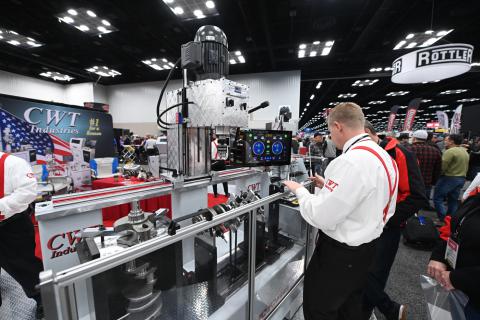
Procedure is key to proper crankshaft balancing, said CWT Industries’ Randy Neal. Here, CWT demonstrates a crankshaft balancing machine at the PRI Show.
Balancing engine components is an exact science, and small mistakes can have a big impact on accuracy.
Maximizing the efficiency of an engine is the key to unlocking all of its performance potential, and crankshaft balancing has played an important role in that effort for some time now. But while balancing tools have become more sophisticated over the years, they’ve also introduced opportunities for more mistakes that can negatively affect the end result.
“Everything is procedure,” said Randy Neal of CWT Industries, Norcross, Georgia. “If you can’t properly measure, you can’t properly determine value. Balancing is really a matter of getting everything established in a proper process.”
Akhil Nath of ABRO Balancing in Murfreesboro, Tennessee, noted that part of that procedure involves adhering to ISO balancing standards in much the same way that OEMs do. “The best way to balance is to use a low-speed machine that spins the crankshaft at about 200 to 300 rpm,” Nath explained. “If you spin a long shaft—especially those diesel ones—at a higher speed of, say, 1,000 or 1,500 rpm, it won’t be properly supported on the balancer, and that will change the readings. Inside the engine the crankshaft is supported on various bearings. But on the balancer, you’re using only two end supports, and if you run it at a higher speed, it can cause the shaft to bend and deform because it lacks support in the center. If that happens, it’s going to give you inaccurate readings. Unbalance shouldn’t change with speed because the crankshaft isn’t supposed to deform. There’s really no benefit to running it at higher speeds.”
ABRO Balancing’s Akhil Nath cited no benefits to running a crankshaft balancer at high speeds. “The best way to balance is to use a low-speed machine that spins the crankshaft at about 200 to 300 rpm,” he said.
Neal also pointed to the process of correcting the crank as another area where mistakes are commonly made. “We’re at a stage where we’re making so much power now that the counterweights are distorting and becoming ‘hostile.’ The counterweight is meant to develop a mass of weight that offsets the piston rod assembly mass, but it has to be stable when it’s running. If you are going to drill, we tell people it should be no more than two holes that are a half-inch deep. Any time you go past that, you run the risk of making the counterweight go out of control. If you have to take out more than, say, 50 grams, you’re probably going to get out of the scope of normal drill depth. We have software on our machines that will show you how you can put the crank in a lathe and cut down the counterweight—in other words, reduce the radius of it—instead. That way the counterweight maintains its structure, and it lowers the polar moment of energy as well as the moment of inertia.”
Nath said that another frequent mistake can create inaccurate measurements right out of the gate as well. “You’re using a belt drive to drive the crankshaft—great,” he said. “But on one side of the belt drive people have a habit of sticking on some kind of magnet that is running the encoder to get the angle on their software. When you do that, you’re actually adding an error on one side of the crank because you’re not compensating for that weight. That magnet isn’t going to be there when the crankshaft is running in the engine, so if you do this, you’re never going to properly balance the crankshaft for the environment that it’s going to be used in.”
To address this, Nath suggested either compensating for that additional weight or using an encoder inside the driving motor of the balancing machine instead. “The most accurate way to compensate is within the software, but using an encoder inside the driving motor is really the best option because then there’s no attachment involved.”
He also said that people often inadvertently cause damage to either the balancing machine rollers or the crankshaft’s rod journals when drilling counterweights due to the pressure of the drill.
Seen here is finite element analysis of crank deflection from MAHLE. The scale on the right identifies the units of magnitude of stress, with red representing the higher stressed areas.
“Over time you’re either going to damage the machine, or you’re going to consistently damage the journals of the crankshaft,” Nath explained. “You need to have anti-thrust compensation—essentially a mechanism that lifts the crankshaft so it isn’t resting on the rollers. Once you lift it, you can’t damage the journals or the rollers of the machine.”
Neal added that many of these issues have been allowed to perpetuate because racers and engine builders have a tendency to falsely associate the results with on-track competitiveness.
“For example, I tell people to be careful about getting away from 50% unbalance on the bob weight formula. Some people want to go over, some people want to go under—I’ve been listening to this for years and years. There are plenty of good engine builders who have their beliefs, but I’m coming at it from the engineering side of this. Give me the data, and I’ll support you. That’s where folks tend to get lost. They might say, ‘Well, I’m winning races, that’s how we figured this out.’ That doesn’t count. Everything is math; there’s no getting around it.”
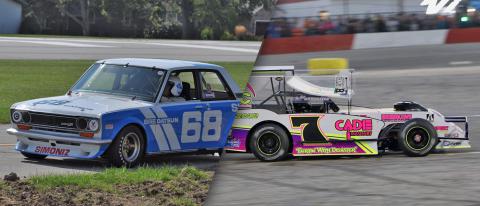
Families are often the driving force in motorsports and are exemplified in this month’s Featured Vehicles. One World Figure 8 Championship car earned its titles with two different drivers—brothers, no less. Plus, a vintage Datsun 510 was refurbished by a father-and-son duo who proved their craftsmanship by driving the car two hours to its first event, raced two full days, and then drove home.
2014 NASA Racecars Outlaw Figure 8
Sam & Kim Breedlove | Indianapolis, Indiana Drivers: Jesse and Austin Tunny Race Series/Class: Outlaw Figure 8 Engine: 368-cubic-inch Chevrolet small block built by Spec Racing Engines Car: Built by Audie Moose Features: Advanced Racing Suspensions, Bert Transmission, Winters Performance quick-change rearend Facts: This car has won two World Figure 8 Championships with two different
drivers. Jesse Tunny won in 2020, and his brother, Austin Tunny, won in 2023. Austin also won the 2022 West Coast Figure 8 Championship at Orange Show Speedway and 2023 Colorado National Speedway Figure 8 Championship in this car.
1972 Datsun 510
Larry Ritz | Wadsworth, Ohio Race Series/Class: Used in a variety of events including autocross, track days, vintage races, car shows, etc. Engine: 2.2-liter Datsun L-Series engine Car: Built by Larry and Eric Ritz (father and son) Features: The vehicle was a 100% rotisserie build in the Ritz’s pole-barn backyard garage. All
fabrication, paint and finishing were done in the Ritz’s shop with the exception of the roll cage, which was done by longtime friend Mark McMahon of McMahon Autosport in New Franklin, Ohio. Sponsors include Design Engineering, Inc., Painless Wiring, Hawk Performance, Centerforce Clutch, Braille Battery, Steel-It Paint, and KrydeRacing. Facts: The car’s first event was the 2023 Put-In-Bay Vintage Sports Car Race, an event on an island airport in the middle of Lake Erie. “With a support vehicle (another 510 wagon), we drove the car two hours to the ferry and over to the island, swapped out the street tires for race tires, ran two full days of racing events in the exhibition class, and then drove back home. No trailer required! It was the only car competing in the racing portion of the event that wasn’t trailered to the event,” said Eric Ritz.
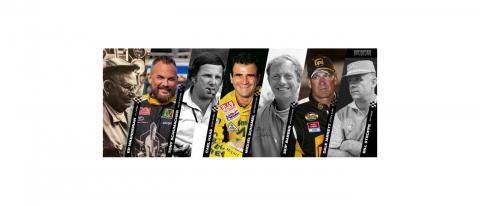
The Motorsports Hall of Fame of America (MSHFA), located in Daytona Beach, Florida, has revealed its 2025 Induction Class.
Revealed at the Acura Grand Prix of Long Beach, the Class of 2025 includes Skip Barber, Miguel Duhamel, Carl Haas, Ed Iskenderian, Dale Jarrett, Tony Schumacher, and Bill Stroppe. The Induction Celebration will be held at the MSHFA in Daytona Beach, on March 10 -11, 2025.
Through the Class of 2024 induction, 297 individuals are currently in the MSHFA, a number that will grow to 306 with the Class of 2025.
NASCAR has announced the launch of the "NASCAR Alumni Network," a program that will help the sport--and its fans--stay connected with former competitors.
The program is open to past NASCAR competitors with a focus on those who competed in more than 100 races in their careers. Members of the "NASCAR Alumni Network" will have the chance to engage with current and past industry members through exclusive networking opportunities, including an annual at-track reunion.
Amber Wells, a 25-year veteran of NASCAR who manages the NASCAR Hall of Fame for the company, has been named executive director of the NASCAR Alumni Network.
"The relationships built in NASCAR are very special," Wells said. "We've seen tremendous fellowship in the connections rekindled through the NASCAR Hall of Fame, and we want to extend that to all past competitors. Our hope is that this program will not just connect members with us, but also with former teammates and competitors."
The inaugural NASCAR Alumni Network reunion will be held at Darlington Raceway during the Goodyear 400 on Sunday, May 12.
Former drivers, crew chiefs, team owners, team members and other industry competitors are invited to apply to join the NASCAR Alumni Network at nascar.com/alumninetwork.
The program launch coincides with "NASCAR Legends Presented by Geico," a four-week campaign that centers on telling stories of notable traditions and prominent pieces of NASCAR history. The campaign begins this weekend at Talladega Superspeedway and continues for four weeks, culminating at the NASCAR throwback race weekend at Darlington Raceway, May 10-12. Fans can visit nascar.com/legends for more information.
The American Sprint Car Series National Tour (ASCS) is updating its nightly race format for the 2024 season.
Now under the sanction of World Racing Group, located in Concord, North Carolina, the ASCS will utilize a format based on that used by the former All Star Circuit of Champions, according to the organization.
For all the details on the new nightly format, read the full announcement here.
 MEMBERSHIP LOGIN