Spotlighting how one industry manufacturer has strategically used its social media platform, which has resulted in hundreds of thousands of followers.
This month, we’re shining the spotlight on Vibrant Performance, based in Mississauga, Ontario, Canada. This designer and manufacturer of automotive exhaust and vibration-control components has utilized its social media platforms to creatively showcase its products, spark conversations, amplify its message, and provide value to customers.
Vibrant Performance has a strong presence on social media, boasting 223,000 followers on Instagram, 60,000 followers on Facebook, nearly 40,000 subscribers on YouTube, and more than 23,000 followers on TikTok. “We have found the most engagement on our Instagram page; however we are investing a lot into our YouTube channel since we use that channel to educate our audience on how our products work and the benefits,” noted Vibrant Performance’s Marketing Manager Arthur Malczewski.
Why is it important for a business to have a social media presence? Malczewski noted four main reasons: “1. Tell the story of who you are, what you are about, and what you do. This can be personal; it will help build credibility and the customer can relate to the business. 2. How to buy your service/product (website, distributors, directly through eCommerce). 3. Discuss results, case studies, and testimonials. This will help build trust in the brand and show the effectiveness of the company with real-world examples. 4. Tips, tricks, how-to’s, and product usage. Always try and give your audience something back by teaching them to build credibility. You need to be the master in your field (or specific product line) within the industry.”
With its business-to-business structure, Vibrant Performance can’t really measure social media success based on sales or return on investment. However, the company has gathered many new leads from shops and fabricators who have learned about its products through social media marketing. Vibrant Performance currently measures the success of its social media posts based on views and engagement, both of which can increase brand awareness, improve customer relations, drive traffic to the company website, boost SEO, create new leads (as mentioned above), and much more.
Vibrant Performance strategically uses its sponsored partners as influencers “to tell their success stories with our products, whether that’s setting records, building endurance cars that made it to the end of the race, or unique fabrication setups that helped complete intake/exhaust tubing in a very tight package,” Malczewski explained. “We have created a content schedule that prioritizes a different product every month. We send this schedule out to all our sponsored partners and let them choose the category of product they would like to promote on their channels and do collaborative posts to tell stories.”
AI (artificial intelligence) is on the rise, and Vibrant Performance has been experimenting with it but hasn’t implemented it into its social media content just yet. However, the company sees potential for AI “as a great tool to use to build ideas when you are stuck and are looking for new ways to make content for your channels,” Malczewski said. AI can assist in generating content for social media platforms, which includes creating captions, writing posts, and generating visual content like images and video. Additionally, some AI-powered tools can curate relevant content from various sources based on user preferences, interests, and behaviors.
The team at Vibrant Performance has also found success in posts that prioritize engagement and authenticity. “In order to achieve this, the content has to be high quality and relevant to your audience,” explained Malczewski. “We find that product videos themselves will do poorly; products do not belong on social media. However, since our products are solutions-based universal items, we tell the story of how they are used and add unique effects to bring them to light.”
He added, “I see a lot of accounts sharing every single bit of content they are tagged in. You should never do this as a manufacturer. Instead, share high-quality content that provides value to your audience. The audience already knows people use your products, so leverage your social accounts to teach something about how the product will help them with their vehicle.”
In a nutshell, it’s becoming increasingly evident that the quality of posts and the value they bring to your followers is more important than ever. In a world that’s flooded with content, material that resonates with, educates, inspires, and/or entertains your audience will stand out. It’s not just about being seen, but also about being valued as a business.
Looking for the right tool to complete the job? These latest solutions can ease the rigors of engine building, engine swaps, and more.
By their nature, racers are pretty organized people. They pull away from their shops en route to the track aboard stacker rigs that have components compartmentalized for every conceivable purpose—almost. Whether it’s at the workbench or in the pits, people in motorsports invariably experience moments while struggling with a task when they wish that a tool existed that gave them added leverage, accessibility, or solved an unforeseen problem.
It’s a commonly shared dilemma and, thanks to research and development efforts in the hardcore components industry, solutions to pit-side and preparation crises exist in significant numbers today. Whether a racer is building an engine or even contemplating an unorthodox engine swap, there’s a range of equipment available, much of it newly developed, that can considerably ease prep work and eliminate guesswork. The tool and equipment element of the racing industry has been working overtime on solutions.
FOR THE ENGINE
Engine builders have a welcome resource in Bonefied Tools in Lowell, Michigan, which is an operating unit of engine shop Bonefied Customs. Jamie Hamm pointed to Bonefied’s hydraulic cam bearing installer as its most popular recent offering, one that eliminates the old caveman-like methods of forcing a bearing into place.
“The cam bearing tool is becoming wildly popular; a new spin on an old craft,” Hamm said. “Everyone has the cam bearing tool where you would pound it in with a hammer; that’s the old standard. Everybody’s been doing that since the beginning of time. Mine does it by holding the cam bearing in place hydraulically, and almost effortlessly, without damage to the bearing. Hydraulic function is part of the tool, and it’s hand operated, so there’s no air and no electricity. It’s just a little hand pump that the drawbar connects to that goes through the block. Depending on the operator, you can do it as quickly as the old hammer smash method, but the advantage is that there’s no shock force or damage as when you bludgeon them in with a mallet.”
Pounding the bearing in with the old-fashioned brute-force method can force engine builders to use a bearing scraper to smooth out the surface so the camshaft will fit properly. “The tool’s only been out a few months,” Hamm added. “I just happened to be in a social media platform, and one person saw it, then another saw it, then it got into the hands of a lot of social media people who have followers, and that’s when it really took off. We estimate there are close to 100 units in the field, targeted at the professional engine builder. This is not a tool that your shade-tree mechanic would have, it’s a professional tool. Some people say they’ve been using hammers for 60 years. That’s dinosaurs using dinosaur tools.”
Bonefied Tools’ cam bearing installer puts the cam bearings in place hydraulically, without damage to the bearings or the block.
At Total Seal in Phoenix, Arizona, Lake Speed Jr. is employed as a tribologist, an expert in friction and lubrication. One tool Total Seal offers, which some engine people tend to miss, is a leakdown tester, which he said used to be commonplace but has become more unusual, or atypical, due to engine material advances in recent decades. “The old-school guys do it because they’ve always done it, but the new school hasn’t, so they don’t. That’s the dichotomy we’re seeing.”
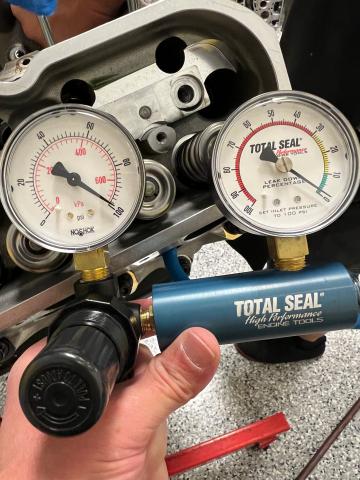
The leakdown tester operates on compressed air, which most teams have by the tank in their haulers. The test hose screws into a spark plug hole, and the cylinder is rotated to top dead center. Speed said the next step is to pump 100 psi of air into the cylinder and see how much it holds. “The differential pressure is the amount of the leak,” he said. The number should be less than 10% with conventional gapped piston rings, or possibly 5% with gapless rings like Total Seal produces. “If everything’s less than 10, we know it’s good. But if you get one cylinder that’s 20% or 25%, whoa, something’s going on with that cylinder. It can’t tell you what’s wrong, but it alerts you. If you catch a problem first, it saves you money.”
This magnetic deck bridge from CCA Racing can be used when degreeing a cam or checking deck clearance.
More assistance for engine builders comes from CCA Racing Products, located just outside Milwaukee, Wisconsin. Mike Gallo described one such tool as a magnetic deck bridge, which is basically an indicator stand that stretches across a cylinder bore. “A lot of guys will use it to determine top dead center when degreeing a cam, and for checking deck clearance because you can easily slide it across the deck to check depth versus piston heights. You can also check piston rocking to see how much the pistons are moving in the bores. Those are the main things that the deck bridge does. It’s going to be on the engine building side of things unless you decide to pull the heads at the track. This is something that’s going to be used more in the engine shop.”
Having a connecting rod bolt fail can be an immediate death sentence for any high-dollar racing engine, which is why CCA Racing Products also offers a critical gauge that precisely measures rod-bolt length to determine if the component is being stretched by kinetic forces. “The rod bolt gauge is used for the final tightening of the connecting rod bolt,” Gallo said. “It measures the actual stretch of the fastener as it’s being put under load. All of the rod bolt manufacturers will have a specification for that. Torque angles are commonly used now, but stretch is kind of the final arbiter of things, because it’s a real physical measurement of what’s happening with the fastener. From that, you can tell the exact clamp load. You can use it if you’re doing teardowns at the track, but mostly it’s when you’re putting your engine together. It measures the actual stretch of the fastener as it’s being put under load.”
CCA’s bolt tester is available without a dial indicator, or with indicators purpose-built in the United States by Chicago Dial Indicator. “It’s small enough that it allows you to get inside a girdled main area like the import guys have,” Gallo said. The tester also offers a digital readout for situations where a larger gauge doesn’t fit or is otherwise inapplicable.
Goodson’s main cap puller for Ford Coyote engines will soon be joined by similar tools for LS and Hemi engines.
The world of aftermarket performance has seen the Coyote engine produced by Ford emerge as a favorite among engine builders for both street and track purposes. Richard Orlikowski of Goodson Tools and Supplies in Winona, Minnesota, said the Goodson team was hearing growing complaints from engine builders who were struggling to remove Coyote main bearing caps. The solution turned out to be elegant.
“We came up with a main cap puller for the Coyote engines after engine builders approached us with the idea of doing it,” he said. “I think it’s an underrated tool that people don’t think they need to invest in. If you’ve tried pulling a main cap off without digging up the bore or any other part, you really can’t do it easily without a good pulling tool.”
Goodson is a warehouse distributor that buys the puller from its producer and resells to both racers and shops. The company plans to introduce cap pullers for the Big Three of American performance V8s, adding units for the GM LS and the Mopar Hemi to the Coyote tool.
PROFORM Parts in Warren, Michigan, offers a host of tools aimed at both engine preparation and chassis tuning. Ryan Salata cited the company’s piston ring filer, which Salata said is “mostly used as an engine shop aid because you wouldn’t be checking your rings at the track. The filer has a dial indicator, because you want to get the same resistance number on each of the rings. If you’re seeing 0.01 inch across all eight rings, you can know exactly how much pressure you need to put on it for repeatability.”
The dial indicator on PROFORM’s piston ring filer provides repeatable resistance numbers for each of the rings.
Summit Racing Equipment in Tallmadge, Ohio, has several recent advances. One of them is a flywheel turning tool aimed at engine builders, which allows the flywheel to be turned, rotating the internal assembly, especially when the engine and transmission are still in the car. Alan Rebescher explained, “It has a long handle that allows you to have an easier way of torquing the flywheel or harmonic balancer. Because of the handle, you don’t have to deal with breaker bars or getting your hand caught way down there with a torque wrench or impact wrench. It’s for checking timing when you’re trying to turn things. You can use it on flexplates and torque converters, so it’s really a very handy tool.”
Other goodies in Summit’s kit include a spark-plug gapping tool that holds the plug in place using a fixture with a handle, and combines feeler gauges for setting the gap. “That’s something that will be very useful at the track because you can use both hands to gap the plug, and it’s a lot more accurate than a feeler gauge alone,” Rebescher said.
Still another Summit work-saver is its timing cover alignment tool, intended for General Motors LS engines. This device helps locate the sensors and seals on both the front and rear covers when they’re being installed. The tool properly aligns the seals to prevent leaks.
BEYOND THE ENGINE
Some tools aimed at simpler tasks can yield big benefits. KNIPEX North America of Buffalo Grove, Illinois, specializes in marketing precision, German-made hand tools for a host of specified uses. One of the newest is its Spring Hose Clamp pliers, which come in lengths of 7 1/4 inches, 10 inches, and a 10-inch locking version. The pliers use a proprietary jaw design, with replaceable gripping edges, that takes the drudgery and aggravation out of removing hose clamps.
“You show these tools off, and it’s almost like, ‘Where has this tool been all my life?’” Peter Grable said. “What makes this tool great is that you can take a piece of radiator hose and the hose clamp, try to get the clamp off, and nothing seems to work. Once you line up the jaws on the clamp, you use the handle, and you can rotate it loose.”
KNIPEX also offers a related line of Click Clamp pliers, which are aimed at the sort of clamps that most users simply cut away instead of trying to reuse them. This tool will remove the clamp but will still allow you to reuse it. As Grable explained, “To put the clamp back on, you use the handle, and it will lock into place.”
The fixture in Summit Racing’s spark plug gapping tool holds the plug, freeing both hands to gap the plug.
Speedway Motors of Lincoln, Nebraska, offers lines of tools that are useful in setting up a car and doing engine transplants. First, Speedway produces its WheelWise tire-measuring tool in several models for drag racing, street, and autocross applications. Greg Nicol explained that WheelWise is a measuring tool that helps the user with proper tire selection and wheel-offset calculations, with the goal of maintaining proper wheel clearance. The tool consists of a bolt-on hub mounting and a gauge to determine tire width. The tool is made from laser-cut and press-bent 12-gauge steel.
“You bolt the tool onto the hub, take the tire you want to run, adjust your width to match the rim width, turn the wheel once the tool’s mounted, and you can check all clearances for the wheel and tire,” Nicol said. “You can move the suspension through its travel to see what combination of tire and rim is going to be the perfect combination.” The WheelWise system comes in a variety of wheel diameters and with bolt patterns including four-lug, six-lug metric, and eight-lug for trucks. As Nicol explained, “If you work with 15-, 16- or 18-inch diameter, you set the tool to that rim width. The tool clamps around the bead of the tire, so you can check to see what will clear. This tool is aimed at the guy who’s in the building stages of his car.”
KNIPEX’s Spring Hose Clamp Pliers take the drudgery and aggravation out of removing hose clamps.
Speedway has another useful creation for the car-building process. Its SoloSwap system is a selection of mocked-up steel engines and transmissions that resemble popular engines including the LS. “It allows you to mock up your engine, valve covers, exhaust, drives, and pan,” Nicol said. “If you’re trying to put an LS into a Mustang, instead of wrestling with a 600-pound engine, you can use the 40-pound, laser-cut SoloSwap piece.” The system is available in LS, Ford Coyote, and Mopar Hemi applications, plus transmissions such as the GM 4L80-E.
Rebescher at Summit acknowledged that builders may have to repair a brake line that’s on the vehicle, not on a workbench. To that end, Summit offers its On-Car Flaring Tool, which allows the user to create 45-degree SAE double flares in 1/4-inch and 3/16-inch steel, copper, or nickel tubing, even in confined spaces. With the handle removed, the tool can also be locked in a bench vise for making flares. It’s sold with 1/4-inch and 3/16-inch punches, plus positioning bolts and lubricant.
Goodson is actively marketing its line of abrasive tools, which include proprietary-design polishing and surfacing belts. “Customers may have old tools that they can’t find belts for, but we make them custom and ship them out in two or three days,” Orlikowski said. “They’re for belt grinders, cylinder head resurfacers, and crankshaft polishers. People can save themselves some time and money if they have the right tool in the box to clean up, rather than sending the part out to a specialty shop.”
Speedway Motors’ WheelWise tire measuring tool helps with proper tire selection and wheel offset calculations.
It’s a service, not a product, but Total Seal offers teams used-oil analysis, using a prepaid mailer to send in oil samples for examination with about a one-week turnaround period. A three-day option is available for those who need the news even faster. “The reality is that with analysis, you’re able to know the health of the engine as a whole,” Speed explained. “The test looks at all wear metals in the oil. If one cylinder is off 25%, and there is a ton of aluminum and iron, you know you scuffed the piston. If the iron is elevated, and there’s a ton of dilution in the fuel, you have fuel leaking down into the sump. Maybe there’s a leak in the injectors, which caused that cylinder to wash down. You can begin to understand what part of the engine is wearing. I perform the oil analysis based on oil diagnostics.”
Finally, PROFORM’s oil filter cutter is a good way to get at the oil that programs like Total Seal’s oil testing can evaluate. “The tool is essentially like a giant can opener that cuts open the filter and allows you to test the oil. It’s like doing blood work,” Salata concluded.
The journey of cylinder head development starts with a need, then an idea, followed by a combination of computers and experience.
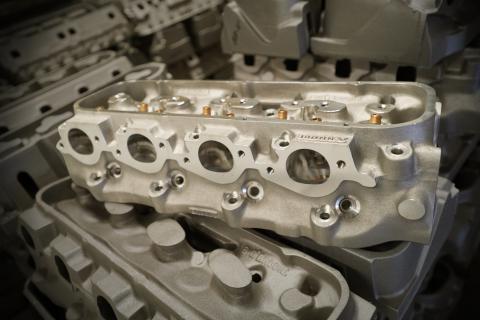
Performance cylinder-head development can be triggered by any number of factors. A fresh engine platform from the automakers is perhaps the leading reason the aftermarket launches new product development in this category. Rule changes from the sanctioning bodies will also perk up the engineering department. Maybe a single racer has an idea that excites a cylinder-head manufacturer.
Jon Bitler of IRD Racing Carburetors in Brooksville, Florida, was assembling a 557-cubic-inch big block Chevrolet for his all-steel, all-glass 1969 Nova drag car when he had to choose a cylinder head.
“It’s our R&D car,” noted Bitler, who said he had considered an exotic 9-degree BBC head. “But I wanted to build a combination that the average Joe can look at and say it’s not out of his league. I wanted to go fast with a set of conventional 24-degree heads.”
Bitler called on Brodix in Mena, Arkansas, which offers a wide variety of racing cylinder heads for numerous applications. “I’m running a ProCharger with a single blow-through four-barrel carb on alcohol,” explained Bitler. “It’s crucial how air moves on the exhaust side.”
Bitler had a number of conversations with Mark Fretz at Brodix, who proposed a hybrid design. “We took our best 24-degree cylinder head, which was our Head Hunter 395cc head,” recalled Fretz. “We then took the exhaust port and the combustion chamber out of an X275 prototype head that we had and placed those in the Head Hunter 395. So we used the intake port of one head and the exhaust port and the chamber of another head.”
Fretz adjusted the intake-port design slightly on this new combination to complement the power adder. The heads were sent off to Bitler for installation. The car was then sent to the hub dyno at Ball Ground, Georgia-based FuelTech, where it pulled more than 3,100 horsepower at 38 pounds of boost. On the track, Bitler’s car has recorded a 3.97 at 186 mph in the eighth-mile on 275 tires.
Some of the conversations between Bitler and Fretz remain confidential, but Brodix has plans to leverage this concept for a new cylinder head. Development costs were actually minimal because Brodix had the CNC programs for the elements, and the foundry had the appropriate cores.
Another interesting BBC head recently released is a billet model from Dart Machinery in Warren, Michigan. So far only a few pairs have been shipped to racers, but the feedback has been positive.
Here’s a view of the machine work on a wide-bore, 10-degree cylinder head performed by 1 Way Technologies.
“The initial demand was the Outlaw 632 nitrous racer,” explained Tony McAfee. “They were using the Big Chief 2, which worked well, but we couldn’t do any more with it because of the water-jacket limitations in the casting. And even with it being A357 alloy casting, it could lose the heat-treat after so many heat cycles.”
When the decision was made to use 6061-T6 billet aluminum and design a fully water-jacketed head, engineers made significant changes to the overall design. The guides were moved, and bigger valves (2.550 intake, 1.875 exhaust) were positioned.
“The valvetrain is completely different. We thought, if we are going to redo this thing, let’s straighten out the rocker arms, move the valves so we can safely put bigger valves in it,” continued McAfee, adding that the cylinder head tentatively will be called the Big Chief 3. “There are more iterations on the table right now.”
Following current trends, extensive work was performed on the exhaust side. “The port shape, the throat diameters, the exit size—it’s all stuff we’ve been playing with on the power-adder cars to take everything to the next level on this cylinder head,” added McAfee. “We can only go so big with a valve because of physical limitations. But once we exit the valve, it’s what we do with the throat area, the short turn area, and how fast the port increases cross-sectional area past that point.”
The heads are produced ready to bolt on. There’s an eight-angle valve job with an aggressive valve-seat angle that’s suited for coated titanium valves. The combustion chambers are softened.
“You could play with them, but I would highly advise not to touch them,” said McAfee, noting that development took about one year with testing mostly on the flow bench as opposed to computer modeling.
Rule changes are another motivator for cylinder head development. Recent engines built by Toyota and Ford for the World of Outlaws featured symmetrical intake-port designs. Brodix had proposed a symmetrical-port head for the small block Chevy nearly 25 years ago, but it was deemed illegal for competition. The cylinder head was picked up by some drag racers, but there had been little development work until it was approved in 2023 for World of Outlaws use.
“It’s still an inline valve, 13-degree head. We made some changes to basically bring 20 years of technology back into the casting,” explained Fretz. “We changed the rocker gear and added material where some of the head porters wanted. Now that is being developed through four different head porters. By midseason this year, hopefully, we should have some of those ready for competition.”
Engineers at Frankenstein Engine Dynamics use SolidWorks to develop cylinder head designs on the computer. They can also run simulation programs to test airflow and material strength.
One of those head porters is 1 Way Technologies in Washington, Indiana. “We asked Brodix to change some things on the casting so that we could put current technology in as far as porting and spark-plug locations,” said Jeff Jones, noting that the symmetrical ports are a welcome feature. “The big thing with the conventional small block Chevy head has been having the two exhaust ports in the middle and a lot more heat in the center of the cylinder head. Just being able to separate that helps cooling across the head and combustion chambers.”
The other benefit of the symmetrical port design is getting a full bell on the top of the ram tubes on a sprint car individual-runner fuel injection setup. Previous designs were limited to siamesed D-shaped bells.
“We’ve done a lot of testing with what goes on in that void where it’s notched for those two tubes to go together,” continued Jones. “There’s a little horsepower there. Not major, but it’s enough that you want to think about it.”
The head currently sports a 13-degree valve angle, but that could change with further development. “We’ll probably look at some different valve angles on the wet flow bench as we develop this head,” added Jones, “but we wanted to start out with something that we know is a proven piece, as far as the ports go. Those can be optimized with some fine tuning and move forward from there.”
As mentioned, the new Ford and Toyota sprint car heads prompted the Chevy symmetrical port revival. One of those who helped develop the Toyota head was Bob Williams of All Pro Cylinder Heads in Johnstown, Ohio. He worked with engineers from Toyota Racing Development (TRD) and two leading sprint car engine builders.
“Toyota provided the CAD drawings with what they liked, and we made some changes,” recalled Williams. “The ports and chambers were our design.”
Williams’ experience came sharply into play in designing the topside to support the rocker arms and the critical decisions for locating the injector nozzles. “We tailored that to some of our existing ports, so that was basically a no-brainer. Everything works exceptionally well, as far as the motor tune,” he said, noting there have been changes since the first cylinder heads were raced. “There have been some changes in the exhaust. There’s been changes in the water jacket and deck thickness. We fixed any weak point.”
While most performance cylinder heads are made from aluminum, World Products keeps its cast-iron heads up-to-date for those customers racing in classes that mandate iron heads.
Sprint car officials have also loosened up the rules to allow LS-style cylinder heads, but so far, there doesn’t seem to be much interest. “We developed a head several years ago, but it’s not been a popular combination for sprint cars,” admitted Williams. “The LS platform is a little heavier and harder to work on. I drag race an LS. It’s a great platform but not easy to work on.”
Paused Development
Not all projects follow an uninterrupted timeline. About 10 years ago, Frankenstein Engine Dynamics in Weatherford, Texas, designed a canted-valve LS head for a third party. The development got as far as a 3D-printed half head before the outside party cancelled the project. The idea was reviewed a few years ago but sidelined.
“Fast forward to late fall of last year and we decided it was time to see it through,” recalled Jesse Meagher. “We revisited that proof of concept and quickly realized it was a little too extreme to be truly viable within the confines of our existing castings. So back to the drawing board we went.”
After defining the objectives and settling on valve sizes and a rough goal of the valve angles, a new head was modeled. A full engine assembly was also modeled to analyze valvetrain components.
“The idea was to create a canted-valve F-Series head in LS7 and LS3 versions that would use off-the-shelf components and be compatible with our intake manifolds,” added Meagher.
Meagher worked with Chris Frank on dozens of digital iterations to narrow down the details before setting up the CNC machine. “Due to the nature of the canted valve, cubing these castings required operations that can only be done on a five-axis CNC, so new fixturing and tooling had to also be developed,” said Meagher. “At this point, the project was handed over to Chris and Brad Hall for port and combustion chamber development. We digitally create most of our products here, but when it comes to port design, those two have more than 70 years of combined experience.”
Work continues on the project today. When the port designs are finalized, Meagher will wrap up the CNC programming to optimize surface finishes before prototype sets are machined.
“That set of cylinder heads is then valve jobbed, assembled, and ready for real-world testing. We will initially run the heads on our in-house engine dyno. Assuming all goes well on the dyno, the prototype heads are packed up and sent out for testing at the track,” said Meagher.
The majority of performance cylinder heads come from aluminum castings; however, there is still interest in cast iron. World Products in Louisville, Kentucky, offers iron castings for big and small block Chevys and small block Fords.
Mike Weinle has been developing port designs and a sheetmetal intake for the 4.5-inch-bore-center R0X Chevy cylinder head to be used in dirt late model cars.
“A lot of what is driving our catalog is circle track where they mandate iron heads,” said Jack McInnis. “Also, a few classes in NHRA Stock and Super Stock and the truck-pulling competition. Right now, we’re looking at re-engineering some of our heads. We want to update them and get them to flow a little better.”
The pandemic hampered manufacturing of World Products cylinder heads and blocks as foundries were shut down or forced to limit production. “We’re just getting the word out because for a year or so we hardly had any cylinder heads available. Now we have pretty much everything in stock,” explained McInnis, adding that World continues to offer CNC porting for select applications.
One of the more interesting trends in dirt track racing is the growing use of small block engines with 4.500-inch bore spacing compared to the conventional 4.400-inch blocks. The wider bore spacing is now mandated on NASCAR engines, so that has opened up some trickle-down opportunities. Mike Weinle of Weinle Motorsports in Cleves, Ohio, found three sets of Chevy R0X heads, which are basically SB2.2 heads with a 4.5 bore space.
“I did a bunch of port work on them and then built six different intake manifolds. The problem with the head was that it didn’t make enough torque, and nobody had a manifold that would help the torque,” said Weinle. “I’m also building a carbon fiber manifold because the dirt-track manifold gets so hot. I figure we’re going to gain some power there with a cooler charge.”
OE Influence
Detroit’s latest engine platforms will generate aftermarket projects, and GM’s LT architecture is one that poses a couple of unique challenges with its direct injection (DI).
“We often try to push the rpm limit of the ports and valvetrain, but different applications desire different features. Let’s take the LT platform as an example,” explained Matt Hollywood of Mast Motorsports, Nacogdoches, Texas. “Some people want to run port fuel injection and a GM LS ECM to retrofit to another vehicle. Some people want to bolt the LT4 supercharger on and run direct injection with a larger combustion chamber for the lower compression ratio that forced induction requires. Or we could look at our Mozez race head line up. Some want to run naturally aspirated on race fuel with high compression and push past 10,000 rpm, still others want to run alcohol and require 16 injectors. We try to add versatility for all, and it’s a continuous improvement process that doesn’t end.”
Once Mast sets a project goal, engineers use 3D modeling to create a concept and ensure compatibility with related components. The team will create prototypes using 3D printing for the sand cores. “That’s expensive, but we could find errors or make improvements before investing in the tooling to mass produce the part,” added Hollywood.
Fixturing for the CNC machines will also be developed, then quality controls are set as production ramps up. “While all of this is going on, the team is working on valve-spring testing on our in-house Spintron,” he continued. “Also, working with suppliers to source valves, locks, retainers, seats, and guides. All this takes eight months to a year and could take longer depending on the complexity of the project.”
The Gen III Hemi is also receiving plenty of attention from cylinder head manufacturers. Air Flow Research in Valencia, California, has developed a new head, starting with extensive computer time.
“This was really the first time the majority of it was designed on the computer in CAD,” said Steve Arent. “The old-school guys used to draw everything out on a napkin, make a sample, make some tweaks and changes along the way. With this head, we had FEA and CFD analysis. We left the stock valve angles but opened up the intake and exhaust to a certain point.”
Edelbrock’s new Victor CNC cylinder head for the Gen III Hemi engine has fully machined ports and combustion chambers and comes with copper valve seats installed.
Nicknamed the Black Hawk, the cylinder head comes fully CNC machined with either a 212cc or a 224cc intake runner. “They can be ordered with either a 69 or 73cc combustion chamber,” explained Arent. “We also have an as-cast version with a 185cc intake runner.”
Based in Olive Branch, Mississippi, Edelbrock has the Performer RPM and Victor CNC versions of its Gen III Hemi head tentatively set for a Q3 release this year. Edelbrock raised the intake-port roof to increase flow, which required raising the spring seat. To maintain target valve lift, adjustments were made to the rocker support bar. “We also did a lot of work to add rigidity to the rocker shaft mount,” said Jeff Krangnes. “That’s one thing we can do with 3D printing the cores.”
The base envelope for the Hemi didn’t allow changes to valve angles or other significant dimensions. Stock valvetrain components and the factory valve covers will fit on the cylinder heads. Valve sizes will be 2.250 inch on the intake and 1.650 inch on the exhaust.
The Performer RPM is an as-cast model, while the Victor CNC is fully machined. Both are produced with the company’s new Clean Cast Technology, which helps eliminate casting flaws and promotes a smoother internal surface finish that was designed to improve air and coolant flow. The Victor CNC heads offer fully machined ports and combustion chambers and come with copper valve seats installed.
“The Performer RPM has an intake flow of 387 cfm at .700-inch lift, and the Victor CNC flows 431 cfm,” said Krangnes, adding the intake port volume will be 225cc and the combustion chamber will be 72cc.
As technology improves, cylinder head designers will be relying on many different tools to finalize design.
“Back in the early days, people lived and died by the flow benches. I think we have learned that the flow bench is definitely a tool that we use to compare designs,” said Jones of 1 Way Technologies. “What we see now has more to do with atomizing the air-fuel mixture, looking at wet-flow characteristics and looking at cross-sectional areas and port velocities that we need to have for certain applications. That goes hand-in-hand with observed flow numbers. We look at a lot of other things today to get to the end result.”
Engine management systems in development today will deliver more features and simpler operating parameters to make vehicle control even easier for racers and tuners.
Product development in our digital/electronic age happens at a rapid rate. The automobile was around for between 80–90 years before the first electronic engine control modules appeared in the 1970s. Now it’s common for even a low-priced, transportation-oriented car to have multiples of them, and their functions go far beyond the engine compartment. Thankfully for the performance market, aftermarket tuning companies have kept pace, devising ways to manipulate the OE systems or, for the ultimate in performance gains, replace them entirely.
We spoke with several of these companies to see what was on their drawing boards for future engine management system development. Some common themes emerged, many having to do with making these systems not only more capable but also easier to use.
A Lot in Six Months
DIYAutoTune of Gainesville, Georgia, was purchased by EFI Innovations Inc. in October 2023, and in the six months since it has “picked up the reins and continued the existing product line while putting a bunch of new stuff in development,” said Steve VanOrder. As the company name implies, many of its legacy products were aimed at the do-it-yourself racer, “those who have to get in there with a soldering iron before they even start their car.” Those kit products are still available, “but our focus recently has been on a more modern-style ECU, because not everyone wants a DIY-type kit. That’s where our Pro products slot in,” he added, referring to the line of AMP EFI MS3Pro systems. “These can be wired into pretty much anything” and are used across a wide spectrum of racing disciplines, “but I’d say about 70% of our MS3Pro EVO and MS3Pro Ultimate, our higher-end products, go into drag cars.” The plug-and-play versions, MSPNP and MS3Pro PNP, “are used in road racing and drifting.”
(AMP EFI is one of the product brands sold by DIYAutoTune, VanOrder explained. “And AMP stands for American Made Performance. Everything is still made here in the US. All our assembly happens right here in-house in Gainesville, Georgia.”)
He said the plug-and-play systems are also popular in low-cost endurance racing series because they’re budget friendly. “The easiest way to do it is to remove the factory computer and just put in a new computer, so you don’t have to completely rewire the car. You can easily spend a quarter-million dollars on a race car, right? But if you and three friends each put in $5,000, you can go Champ Car racing and be competitive. We really want to make it easy for people to get into racing.”
The AMP EFI MS3Pro Mini from DIYAutoTune is a compact, entry-level version of the company’s MS3Pro. In the works is another Mini ECU “with a higher IO count,” said Steve VanOrder. “We’re going to call that the Mini 8, and it will be focused on the V8 community.”
The company has long offered products for LS engines and will soon branch out to support “some of the other modern engines,” including the Coyote, Hellcat, and Godzilla, added Kurtis Warne. “We have a whole new ECU style coming out to handle just those particular engines. It will all be internal within the actual ECU versus a lot of external boxes. We’re trying to make it easier for the end user.”
DIYAutoTune offers a compact, entry-level version of the MS3Pro called the MS3Pro Mini, according to VanOrder. “We’re also working on another Mini ECU with a higher IO count. We’re going to call that the Mini 8, and it will be focused on the V8 community. It’ll be a low-cost entry into our higher tier product line.”
Branching out beyond engine management systems, DIYAutoTune recently released the DD-EFI, a digital dashboard “that communicates with the AMP EFI and MegaSquirt product lines,” Warne said. Available in 10.3- or 12.3-inch versions, the DD-EFI features a high-resolution screen “with a modern-type feel that has the splash-screen boot-ups they can customize. They can change the dashboards, and it will do all the on-board data logging for them. It gives a lot of the tuning sets that they’re used to having but is directly on their dash.”
In development from DIYAutoTune is a drive-by-wire controller, VanOrder explained, “something people have been asking about for years. Ours functions a little differently than the competition. I can’t really go into the details, but our primary concern is safety, safety, safety. I cannot stress that enough. We don’t want just a simple pedal follower system; we want something with checks and balances. We don’t want guys out on the race track having an issue and the system not go into limp mode appropriately. I have seen some scary things happen on the race track when drive-by-wire controllers malfunction. We are taking our time to make sure we get it right.”
New Construction Phase
When we asked him about new products in development, Mark Honsowetz of the Edelbrock Group in Olive Branch, Mississippi, said the Edelbrock Electronics Category “is currently in a new construction phase. We are reviewing the capabilities and features of all our existing EFI products and how we could fill voids and demands in the current motorsports industry so we may develop new products that offer our consumers an advantage on the race track. The wheels are in motion, and we are excited to announce a completely new product line in the very new future.”
One challenge the company is facing is “supply chain constraints on the semiconductors and components used in our ECUs, which has made it difficult to continue developing many of these ECUs,” he added. While the company finds the “best channels” to “fill the void left by many of our sunsetted EFI products,” Edelbrock still offers its Pro Flo 4 and Pro Flo 4 Plus EFI systems, “which are capable of 800-plus horsepower and are popular for sportsman drag racing classes.”
Honsowetz said the Flo 4 Plus EFI product line “provides the traditional Pro Flo EFI simplicity with additional VCT, ETC, alternator charging control, knock control, and many other advanced features for more modern engine platforms like the Chevrolet LS, Gen III Hemi, and Ford Coyote. CAN communication has opened a whole new window for expanding a more basic EFI system into a powerful network of ancillaries like dash displays, transmission controllers, power distribution modules, and data analysis tools.”
Technology is changing so fast, Honsowetz said, that “especially with EFI systems, it has become more difficult to provide advanced products that provide an IO platform for most any application or class of racing and are supported with a simple and intuitive supporting software.” Yet “simple” is just what Edelbrock customers are asking for, he noted. “Edelbrock puts a lot of emphasis on simplicity. We want to provide EFI systems that make the conversion from carbureted applications or for new builds an easy, enjoyable experience. The accompanying E Tuner tuning app is compatible with most Android and Apple personal devices, and it provides simple setup and tuning and eliminates the necessity for expensive additional calibrating and dyno sessions.”
While steering clear of speaking specifically about new Edelbrock product, Honsowetz said in general “racers can expect ECUs with improved ignition and fuel control, programable IO features, and simple, programable PID and algorithm control for additional power adders. More control over engine power adders and accessories is all part of the power management game. Reasonable cost, reduced product footprint, and simple expansion are also all in the near future.”
Easier to Use
The goal of making its engine management systems easier to use came up several times when we spoke with Richard Shumack of Haltech, which is headquartered in Wetherill Park, New South Wales, Australia.
“You’ll see that with our new Nexus Rebel LS for example,” he explained. “It’s very easy for someone to set up and get running, whereas previous Haltech products needed a fair bit of configuration, even with base maps available.”
Designed specifically to support Gen III and IV LS engines, the Nexus Rebel LS features eight pre-configured ignition and injector outputs, two user-definable analog voltage inputs, engine position inputs dedicated to the crank and camshaft, a dedicated Haltech CAN Bus network, and Wi-Fi and data logging onboard. The ECU is sold with an engine harness kit, and it can be set up either using the Setup Wizard in the software or through Haltech’s new Haltech Connect app.
“We have a ton of experience and a solid baseline from the years of on track experience we have obtained from a great product like the FAST XFI,” said Mark Honsowetz of the Edelbrock Group. “The wheels are in motion, and we are excited to announce a completely new product line in the very near future.”
That app was the result of another of Haltech’s goals, Shumack said: “Expanding what we do. Our customers love our engine management systems and are quite vocal in their desire for us to expand our range. In the past, Haltech only made EFI controllers. Now we also sell dashes and PDMs (power distribution modules), and the list of things our customers want to do with dashes and PDMs is always expanding. Previously people just wanted to drive fans and pumps, but now that we have a light sensor in the dash and a PDM that controls headlights, we want to be able to make the headlight function automatic based on ambient light.
“People are always adding more sensors and want better ways to check the health of their investments,” he noted, so Haltech is developing “more data logging and viewing options. And there are always requests for more complex functionality or higher levels of system integration.”
Shumack said racers can expect future Haltech products “to get easier to use. We understand that our customers enjoy all aspects of their vehicles, not just driving but also building, upgrading, and maintaining them. We want to be right there with them for the entire journey, so our aim is to make the Haltech process of install, setup, and running the best user experience we possibly can.”
Instant Live Tuning
Located in Torrance, California, near Honda’s US headquarters, Hondata got its start some 25 years ago in New Zealand when Doug Macmillan and Derek Stevens “wanted to do things to our own Hondas,” Macmillan explained. The depth of its experience with Honda products has enabled Hondata “to do things that no one else is doing” in the realm of engine controls, he said, including the ability to tune the Civic Type R (both the FK8 and FL5 as well as the Integra-S DE5 platform) literally on the fly. Instant Live Tuning, a software update the company released in February 2024, gives tuners “the ability to adjust fuel, ignition, cam angle, and things like that” while the Civic is on the track, “because there are some things you cannot do by re-flashing the computer. Some of these things have to be done while the car is running.”
Haltech’s new Nexus Rebel LS was designed to support Gen III and IV LS engines. “It’s very easy for someone to set up and get running, whereas previous Haltech products needed a fair bit of configuration,” said Richard Shumack.
The first use of Instant Live Tuning that was brought to Macmillan’s attention took place in March at the Global Time Attack Super Lap Battle at Circuit of The Americas in Austin, Texas. Matthew Rushton of REDRAGN Racing said his tuner, John Pierro of FK8 Tuning & Development, Murrells Inlet, South Carolina, had tuned Rushton’s Civic to “a healthy 547 whp on the dyno,” but he planned to be trackside in Austin and use Hondata’s new software to “maximize the car’s tuning in a real-world competition environment.”
“A dyno is a necessary part of the tuning and racing procedure,” Macmillan pointed out, “but validation on track is absolutely essential, because there are conditions on the track that you will not get on the dyno.”
“John brought two laptops and utilized the cell phone hot spot, Hondata Bluetooth, and Wi-Fi service at the track to access live data during my on-track sessions,” Rushton explained. “As my entire build was fresh and had never seen the track, we needed data! Through the use of Hondata’s Live Tuning feature, John was able to make real-time changes to the tune as he monitored everything from temperatures, pressures, and even wheelspin. Having access to live data allowed the tune to be tailored to local altitude, temperatures, fuel, and hundreds of other variables in order to safely maximize performance. Adjustments were literally being done during actual laps to help improve lap times and make traction control seamless and invisible to the driver’s senses.”
Rushton’s lap times improved by seven seconds during the event, and he finished second in the Enthusiast class. Macmillan acknowledged that tuning likely wasn’t solely responsible for the quicker laps, because Rushton and Pierro “were shaking the car down in a bunch of different areas.” Rushton himself gave credit to Pierro’s “extensive knowledge of the FK8 and FL5 platforms” as well as the “amazing features of the Hondata tuning platform” for his results.
“This highlights the deep control we have over the Civic Type R computer,” Macmillan said. “We are recoding the computer to do all sorts of useful things.” Right now, Macmillan is in the midst of adapting some of Honda’s newer ECUs to run flex fuels. “We’re recoding the computer to understand when we put a sensor in the fuel line, and it reads flex fuel content and feeds it to the ECU, it will on-the-fly adjust the performance, altering ignition and injection duration based on the ethanol content.”
Using an alcohol-based fuel like E85 “is like having an in-cylinder intercooler,” he pointed out. “You spray the flex fuel through your DI injector, and as the flex fuel evaporates in the cylinder, it pulls the temperature of your charge down.” The lower efficiency of E85 versus gasoline limits its viability in endurance racing, “but in shorter races, if the sanction bodies allowed it, flex fuel is a good option because your engine runs cooler with higher octane.”
The day we spoke to Macmillan, the new flex-fuel system was undergoing testing in the SEMA emissions lab. “Our goal is to get 49-state approval for our flex-fuel system for Hondas. We focus a lot on 49-state and CARB-approved products, as it gives our customers and our dealers a choice,” he continued. “By doing that, we can help keep the EPA off our dealers’ backs. We tell our dealers to make sure they have our CARB-approved and 49-state approved products on their website, so if the EPA happened to look, they can see they offer emissions-legal stuff as well as race-only stuff. We’re providing options so that our racing products aren’t seen as the devil incarnate. You can have clean, green, and fast.”
Tuning Reliably and Consistently
When asked about new products in the pipeline, Derek Morley of HP Tuners in Buffalo Grove, Illinois, played it close to the vest. “We are constantly developing new products to excite our customers. We are continuously exploring and developing systems to control varying powertrain systems. Watch this space.”
HP Tuners recently went through a major introduction with the launch of its CORE ECU and VCM Live software at the 2023 SEMA Show. CORE is HP Tuners’ “debut stand-alone engine management solution,” a company source said, in support of GM LS applications. Among its key features are fueling control for up to 16 injectors (enabling flex fuel control) and sequential injection, support for up to eight coil packs, dual throttle body support, two built-in lambda controllers, internal data logging, three CAN Bus networks and ethernet connectivity, nitrous control, traction control, and turbo boost control.
Hondata’s new Instant Live Tuning was put to the test at Global Time Attack Super Lap Battle at Circuit of The Americas in March. John Pierro was able to tune Matthew Rushton’s Civic Type R in real time—when the car was in the garage and even on track—to help Rushton earn second in his class.
VCM Live is the latest version of the company’s VCM software that’s designed specifically for the CORE stand-alone ECU. It “combines diagnostics and calibration elements into a single, user-friendly interface,” the source shared. That interface is entirely new when compared with HP Tuners’ existing VCM Suite and enables live tuning and data logging in real time, among many other features.
“The customer is asking for ease of use with their new systems,” Morley said. “We are concentrating on specific engine releases, which includes defining templates and calibrations, making it easy for users to start their journey and expand their tuning capabilities.” The new CORE system “has the functionality to allow an enthusiast to extract greater performance reliably and consistently.” CORE is LS-only for now, but more applications will be coming soon.
Morley also said HP Tuners is “closely monitoring the latest trends toward EV and hybridization, and this is in alignment with our strategies over the next few years.”
What can racers expect from future engine management systems? “Machine learning is becoming more prevalent,” Morley said. “Expectations from the consumer are that these systems should have a degree of plug-and-play and the ability to self-calibrate to a base setting.” The fine tuning, he added, would be done “by an experienced calibrator thereafter.”
How motorcycle engine builders find big power in small packages, keeping pace with some of their larger race vehicle counterparts.
Successful engine builders have always been the ones who are able to adapt and evolve. Whether it’s reacting to new rules, new technologies, or an entirely new discipline, change is the name of the game.
Arguably, nowhere is this evolution more pronounced than with motorcycle engine builders. For many of them, what started as a career in the two-wheel world was upended by the confluence of two opposing trends: the decline of American motorcycle road racing and concurrent rise of motorcycle engine classes invading the circle track scene.
“We started out as a motorcycle shop and worked on a lot of road race motorcycle engines up in the Northeast,” said Will O’Connor at NPS Racing, Ransomville, New York. But, due to changing rules and the American Motorcyclist Association’s (AMA) decreasing involvement in sanctioning road racing, his business “kind of fell off. So we were lucky when the small car market took off.”
Micro Mania
While motorcycle engines appear in various four-wheel applications, micro sprints have become a popular discipline for motorcycle engines. For example, this year’s Tulsa Shootout drew more than 1,600 entries across six different classes of micro sprints.
As for O’Connor, micro sprints weren’t his original destination. He learned his craft at the American Motorcycle Institute (AMI) in Daytona Beach, Florida, before moving back to New York, where he worked on and raced road bikes. Following the AMA’s lessening race involvement in the mid- to late 2000s, micro sprint engines became O’Connor’s main source of work. He estimates it’s now roughly 75% of his business.
“I always tell my wife, ‘I’d have been out of business a long time ago if micros hadn’t come along,’” said O’Connor. “My heart still lies in the road racing stuff because that’s what I wanted to do and road raced myself for a while, but the micros pay the bills. They keep the doors open.”
The micro sprint discipline has wide-ranging appeal, featuring smaller versions of full-size sprint cars powered by side-mounted 600cc motorcycle engines that run on methanol. It is a popular entry-level class for aspiring young racers, but experienced racers also enjoy running micros for the affordable, high-adrenaline action they provide.
Though he started NPS Racing building engines for road race motorcycles, Will O’Connor reported that engines for micro sprints now make up 75% of his business. “The micros pay the bills. They keep the doors open.”
“We have guys who stay in the micros for quite a while,” said O’Connor, “just because the performance versus cost is pretty good. It’s hard to beat.”
Affordability and performance can vary widely depending on the class and the region. Midwest-based micros run in the A-Class or in Outlaw class. While the A-Class is popular among the cost-conscious racers due to its stock engine requirement, the Outlaw class allows any engine modifications up to a maximum 636cc displacement motor. This can significantly increase both cost and performance.
However, most East Coast tracks play by a different set of rules, governed by the Universal 600cc Sprint Association (U6SA) Rules Committee. Engines are limited to 600cc, and builders aren’t allowed to do any porting or crank lightening.
“Most of the mods we’re doing are increasing compression, changing cams, cam timing, and building the bottom end of the engine so that it’s capable of handling the increased loads and extended high rpm from the cars,” O’Connor said. “There’s also a lot of power to be gained in the cylinder head by doing a good concentric multi-angle valve job that provides better valve sealing and better flow over the valve seat.”
Like most engine builders, O’Connor said he prefers to “build engines with the Outlaw rules. I can replace the OEM components with my own custom designed engine parts, resulting in a stronger platform that is unique to my shop and produce something not everyone else has the knowledge or capability to duplicate.”
Regardless of the rules, a winning race car still requires a solid powerplant. The debate about which reigns supreme in micros is constantly changing.
The Kawasaki 636 used to be the dominant engine in the class, but the manufacturer stopped making that engine in 2006. While it remained popular for some time, these engines began to wear down, and demand shifted to the Yamaha YZF-R6. O’Connor noted that the Suzuki GSX-R600 is now gaining popularity, as it has proven to be a more reliable powerplant.
“With the Suzuki, the components they use from the factory are pretty good,” he explained, though the engine may seem “a bit overbuilt versus the Yamahas,” which use “borderline the lightest components they can get away with to make the same power, but they don’t seem to hold up as well.”
Jon Fitzpatrick of FTZ Racing in Cape Girardeau, Missouri, focuses mostly on the Yamaha YZF-R6 and Suzuki GSX-R600 platforms, while also doing a few Kawasaki ZX-6 engines as a “budget option.” He explained that the Yamaha’s popularity stems from its rpm capabilities.
“With the introduction of the Yamaha R6, the rpm capabilities went from under 14,000 rpm to over 16,000 rpm,” explained Fitzpatrick. “With this came new challenges to keep them reliable, such as changes in the oiling systems and bearing clearances, and we introduced products like our FTZ oil cooler package.”
In addition to the oil cooler package, FTZ Racing made significant investments in its shop to develop and produce new products for the micro sprint market, especially in the Outlaw class.
“We have some advantages over many ‘engine only’ shops because we have a full machine and fab shop, along with our own in-house CNC equipment,” said Fitzpatrick. “If we want to change something up, like the dome shape of some pistons, then we just take them downstairs and do it. Plus, we make our own EFI systems and many billet engine accessories, as well as our FTZ exhausts in-house. It gives us full control of the entire horsepower package.”
It may sound like an operation for a dedicated full-fledged sprint car team, but FTZ Racing focuses exclusively on micro sprints. Just like all forms of racing, advanced technology is beginning to work its way into the micro sprint classes.
“The latest game changer is the electronic fuel injection,” continued Fitzpatrick. “The ECU we use for our EFI has totally accessible tuning of all aspects and is complete with integral data acquisition. This takes out much of the guesswork about tuning like we all had to do back in the day. It is a real advantage for those teams that are willing to embrace the technology.”
Despite the new tech, there are still some core foundational principles to follow. Builders we spoke with had sage advice for racers looking for a motor: Don’t risk a salvage one.
“I tell my customers that you have to start with a strong foundation,” said O’Connor. “I always like to see guys purchase a completely built engine from us. Otherwise, the majority of these engines come from crashed sport bikes, and if they were laying on their side running without oil pressure for even a few seconds, they could have oil-starved a bearing. It can go right away, or it can go a couple races and then spit a rod out, but it’s pretty catastrophic at that point.”
Also considering that these engines are being used in cars instead of motorcycles, one of the most important modifications is the oil pan and pickup.
“I have seen a lot of pans designed that had good intentions but failed because either the pickup wasn’t designed correctly or the pan angle and oil sump volume weren’t correct,” said O’Connor. “The cars tend to push the oil to one side or a certain spot in the oil pan, and if the pickup isn’t in the correct location, it will starve for oil at some point during the race.”
Additionally, he noted that due to the extreme stress these engines experience during the race, “Keeping oil pressure and temperature in check is crucial to minimizing engine failures.”
Prototype Powerhouse
On the other side of the country, a fellow AMI alum charted a similar path from the world of two wheels to four.
George Dean of George Dean Racing in Mountlake Terrace, Washington, worked exclusively on bikes during the 1980s, until a customer asked him to build a motorcycle engine—a Kawasaki GPz550—for his daughter’s dirt car in 1989.
Powered by side-mounted 600cc motorcycle engines, micro sprints provide an affordable entry point for aspiring racers while also appealing to more experienced competitors. This year’s Tulsa Shootout drew more than 1,600 entries across six different classes of micro sprints.
“I thought I had a fish on the line there,” recalled Dean. “Whoever heard of putting a bike engine in a car?”
Luckily for Dean, he followed through with the customer’s request and helped them test the car at Deming Speedway in Everson, Washington. During her first race with Dean’s new engine, 15-year-old Shawna Wilskey drove from last to first and won the race.
“That’s when this lightbulb went on inside my head,” said Dean. “I thought to myself, ‘I’ve got something here.’”
Local dirt racers started bringing him engines, but eventually word of Dean’s success trickled into the local road racing club. In 1990, Dean built a 1,000cc Kawasaki ZX-10 for a road racing car and success followed. He continued working on both cars and bikes throughout the ’90s, and then in 2004 shifted to exclusively working on race engines—primarily in the road race scene—where competitors spare no expense building prototype cars.
“The road racing thing is so much different than the dirt track thing,” said Dean. “With dirt track, you can go racing for a fairly reasonable amount of money. The road race cars I play with, the Prototype 1 (P1) and Prototype 2 (P2) class in SCCA, it’s very common for a guy to invest $150,000 to $200,000 in their race car. And this is for a hobby, guys going out and racing for a wood plaque and a flag.”
Dean has made a name for himself in the Sports Car Club of America (SCCA). By his count, cars with his engines have tallied up 15 SCCA National Championships, including a recent major achievement for Dean. “When we were in Indianapolis (for the SCCA National Championship) a couple of years ago, we were the fastest car in the whole event, and there’s 700 competitors out there, throughout all these classes of cars. We beat up on all those automotive-based cars. That was probably one of my crown jewels.”
According to Dean, his success starts with understanding and protecting against the extra stress these engines experience in a car versus a motorcycle.
“When we’re putting these motorcycle engines into these race cars, we’re making those engines do things that they were never designed to do,” said Dean. “G-forces are fighting the internal parts of these engines, and the main thing is keeping the oil where it belongs. At 2G, that’s like taking the engine and laying it on its side while it’s running at 12,000 rpm. You start sucking air into where the oil is supposed to be going, and at that speed, it doesn’t take hardly any time at all to damage the bearings and for the engine to fail.”
George Dean has found success building motorcycle engines for dirt track racers as well as road race customers. His approach to engine building is focused on longevity. “I decided I was going to emphasize making the engine as strong as I possibly could to keep the reliability there.”
With that in mind, Dean leans into the “to finish first, first you must finish” approach that prioritizes engine longevity. “I decided I was going to emphasize making the engine as strong as I possibly could to keep the reliability there. We kept refining the oil systems to make them better, and the engines became more reliable.”
Right now, the Kawasaki ZX-10R is Dean’s “weapon of choice,” producing 210 horsepower straight out of the box. In the SCCA Prototype 1 class, where the only limitation is a naturally aspirated engine capped at 1005cc, he’s been able to increase those numbers to “225 to 228 hp fairly easily.”
He said it’s “all basic stuff—add compression, cylinder head porting, camshafts, and for strength I put Carrillo connecting rods inside the engine, and that’s about it. There’s not a lot of super black magic science that goes on here.”
Pushing 230 hp in a 1,000-pound car, Prototype 1 vehicles are fast and on edge. However, Dean has seen the rise of automotive-based engines in this class, which feature more power but also more weight.
“Unless something drastic happens, I have a feeling we’re in the twilight of the motorcycle engine classes in the road race cars,” said Dean. “The automotive cars are definitely taking over; I think the cars are more comfortable to drive, and the popularity is there.”
Dean has adapted to this latest shift by going back to his dirt roots, which now make up about 50% of his business.
“A few years ago, a guy called me and said, ‘I want you to build an engine. We’re going to go win Clay Cup [at Deming Speedway],” said Dean. “I just had this feeling that I had unfinished business up at that track. I hadn’t been there [in 15 years], but we had a good driver, a good car, and we won that first year. As a matter of fact, we won three in a row.”
The disciplines may change, but Dean’s dedication to extracting reliability and performance from motorcycle engines has always kept him at the front of the pack. “There’s been a lot of (engine builders) that have come and gone, but I’ve hung in there and just continued doing it, day-in and day-out.”
A Legion of Legends
It’s been more than 30 years since US Legend Cars International (USLCI) in Harrisburg, North Carolina, first hit the racing scene. These spec cars have become hugely popular among developing young drivers and hobbyists alike. However, a new sealed powerplant has reduced opportunities for engine builders.
These 5/8-scale fiberglass silhouettes of classic modified American race cars were traditionally powered by Yamaha FJ1200/XJ1250 engines. But once Yamaha took that engine out of production after 2014, USLCI introduced the 125-hp Yamaha FZ-09 sealed engine in 2018, while the MT-09 is the new generation of this motor.
“The reason US Legend Cars International went with the Yamaha FZ/MT-09 is because it was an excellent platform for the Legend Car, and Yamaha was discontinuing their XJ1250 air-cooled carbureted engine that we had run for 25 years,” said Graham Smith at USLCI. “With the change, we were able to source an ECU that only USLCI can control. We couldn’t ask for a better platform to use on our cars, and the results show on the track with increased longevity, ease of use, and overall customer satisfaction.”
The 847cc liquid-cooled inline-three motor has helped level the playing field from a powerplant standpoint, but not everyone is happy about the new sealed motor.
“They’ve 100% sealed those engines, so nobody can work on them at all,” said Randy Raduechel of Raduechel Performance Motorsports, Oakdale, California. “We’re on the West Coast, and we can’t even adjust the valves on those things. That engine has cost us a lot of business because at the height of it, I was building 50 engines a year with the FJ1200. I haven’t built a FJ1200 for a Legend Car in three years. I build them more for street bike guys now.”
The sealed engine is reliable, but if it needs any work, it needs to be sent to USLCI headquarters in North Carolina for a tune-up or repair.
“It’s a water-cooled engine that just runs forever,” said Raduechel. “Guys are getting a season out of them, and then they send it back for a freshen up. (USLCI) takes it apart, grinds the valves, puts a set of rings in it, and then they run it for another year.”
In 2018, US Legend Cars International started using Yamaha FZ-09 engines, and recently debuted the upgraded MT-09 platform. “With the change, we were able to source an ECU that only USLCI can control” said Graham Smith.
In California, Raduechel has seen car counts fall, which he believes is due to the new sealed engine. “If you force me to send my (engine) across the country to have the valves adjusted, people aren’t going to invest in that. They’re seeing a heyday back East, but it’s killed the series out here.”
On the East Coast, renowned engine builder Hank Scott of Real Race Cars Performance Engines in Concord, North Carolina, has been building Legend Car engines for 25 years. While the new sealed motor is off-limits, Scott is now the “sole sealed engine builder for the XJR1250 for the past two years.”
The XJR1250 has no shortage of power, with Scott able to see horsepower numbers in the “upper 150s” to go along with “above 106-foot pounds of torque.” Strip away the rules and he’s been able to push this engine to ridiculous numbers.
“We have built this same engine for other applications making 133-foot pounds of torque and over 230 hp,” said Scott. “We concentrate on our valve work and bore finish, to make sure the engine is sealed up—in that area gains are noticeable. Of course, we know what valve lash, cam timing, and ignition timing the engine likes, all of that is a total combination to arrive at those numbers.”
Unfortunately, too much power can be troublesome in the Legend Car class. With many struggling to transfer all that power to the ground, they often opt for the three-cylinder FZ/MT-09.
“The FZ/MT-09 is much easier to drive,” said Scott. “They have 18- to 20-foot pounds less torque, so they don’t blow the tires off like the 1250 does.”
With the right driver and setup, Scott believes the XJR1250 still has the advantage on ovals “due to its enormous torque over the three cylinder.” As for how things look going forward, he believes the “1250 is still popular,” and expects racers to continue using both powerplants. It simply “depends on the driver and what they like.”
The new sealed motor hasn’t worked out for everyone, but as both builders noted, Yamaha’s discontinuation of the XJR1250 forced USLCI’s hand into making the switch. It’s part of an ongoing trend that has added yet another challenge for these builders.
“A difficult part is the motorcycle industry itself is changing,” said Raduechel. “They’re not producing (engines) in such long cycles of life.”
New series, new rules, new engines, new disciplines. In the motorcycle engine classes, it may seem like the only constant is the need for constant adaptation. Nevertheless, builders continue to meet the challenges of these mighty but micro powerplants.
Being a small chassis builder has its advantages, and Stuckey Enterprises has made the most of its niche position, emphasizing personalized customer service while pinning plans for growth on an all-new Black Diamond chassis for the 2024 season.
Ronnie Stuckey is hoping for—no, Ronnie Stuckey is working for—a comeback.
An all-new Black Diamond chassis is already on the track. “We took three of them out to Vado, with Kyle Beard, my manager BJ Robinson, and my son Clay, and we got six nights of racing,” Stuckey related when we spoke in mid-February. He planned to start campaigning the new cars in the COMP Cams Super Dirt Series in March. “We’re close to having 10 of them built, when our customers start racing in March or April.”
Stuckey’s long career in racing has included stints as crew chief for Scott Bloomquist and for the late Freddy Smith. “Smith was a perfectionist in the department of the front end: camber, caster, and bump steer,” Stuckey recalled. “I learned a lot from him, which enabled me to get a job with Billy Moyer [Sr.], where I worked for three seasons with good success.”
In 2002, Ronnie and his wife Terri returned to their hometown of Shreveport, Louisiana, and launched Stuckey Enterprises, where they assembled, sold, and repaired chassis from various manufacturers. They built the first Black Diamond chassis in 2013, and updates to the design have kept the brand competitive. Last May, at Batesville Motor Speedway in Locust Grove, Arkansas, Robinson won the 30-lap feature; and the following night Beard aced the Bad Boy Mowers 98, collecting a career-high $12,000 for his effort. Then in October, Beard nearly cinched the COMP Cams Super Dirt Series, finishing the season just two heartbreaking points behind series champ Billy Moyer Jr.
Still, Stuckey remembers 2018—not so long ago—when Earl Pearson finished first in the Dirt Million finale at Mansfield, and Jimmy Owens topped the Knoxville Nationals. “Those wins stand out more than what we did last year.”
Ronnie Stuckey has engineered an all-new Black Diamond chassis, and he planned to have close to 10 of them built before race season started this spring.
ROUND AND ROUND
Stuckey’s tone is not wistful or nostalgic; he has seen this cycle before. One brand starts winning on the national level, “and the teams all jump on that bandwagon. They almost have to, and after a few years it all breaks up and goes another way.” Perhaps the leader “starts getting a bit stale, while their competitors are working harder than ever, developing new cars, new frames, new suspensions. Rocket built the XR1 for almost 10 years, and all the while Longhorn kept pecking away at it.” Now Longhorn is the top-seller, “and Rocket and Barry Wright and us, we’re hoping not to just catch up but to pass them up. We’ve looked at their chassis, which is built quite a bit differently from the way we’ve built chassis in the past. The halo and the hoop attach differently. They’ve strengthened the center of the car and given the front and back a little more flex. That fits the new tire rules and gives the shocks a break.”
Stuckey understands how the leading chassis works because he invested in equipment to examine it. “Our business purchased a laser cutter in 2023, and that allowed us to re-work our jig fixture so we could look at multiple frames—really get down to the nitty-gritty and see how they had been improved, rather than just looking at them with a tape measure.” Stuckey used the laser to “cut a piece of half-inch plate, and cut half-inch holes on 4-inch centers, and build a jig fixture where all the jig fixtures unbolt. That allowed us to set anyone’s frame down in there, including our own. So now we can compare frames and get a better understanding of what our competitors are doing to bring their cars to the front.”
More than mechanical issues, teams will ask Ronnie Stuckey about setup for a particular track surface. “It’s taking your experience, traveling around the country for 30 years, and projecting what that track is going to do during the next event,” he said. “You use your experience, what you’ve seen at other tracks, and bring it to that night.”
Stuckey is naturally reluctant to reveal details of his latest chassis, but he did share some of the theory behind it. “The way that they are driving them today, they fuel them up before the apex of a corner, but you don’t want to let the motor lift the left front off the ground. If you look at the cars that have a wheelie effect, they get beat by the ones that don’t. So we had to change the way the chassis was structured to deal with that.” Suspension pickup points have also been changed, and Stuckey offers some of these new upgrades for older Black Diamond chassis.
DIRT TECH
Stuckey’s arsenal of test equipment includes an Accu-Force spring smasher (“We feel we have a really good brand there.”), an RE suspension dynamometer, and a DRP pull-down rig—although “we don’t get on the pull-down rig as much as we used to. It doesn’t take into consideration aerodynamic side loading, or the side loads from G-force, or tire squish, and if you don’t have those key elements, you’re not getting the whole picture.”
Stuckey prefers “all-out data testing,” running laps with an AiM data logger, “bringing that test data back up on your computer and comparing lap times to the changes you made. Then you can use your spring smasher to find the sweet spots, the numbers your car needs to be competitive for different track conditions.” Two “key areas” are suspension travel at the right front, and the action of the left rear chain limiter. “The gains are always there. You want to make sure your right front is traveling enough, and that your left rear is not traveling too far.”
Ronnie Stuckey “thinks things through, and he pays attention to detail,” said Hunter Rasdon, a customer since 2015. “Everybody in the pits, no matter what brand of car they have, wants to talk to him.”
For some data, Stuckey depends on his suppliers, who can afford even more sophisticated equipment. “We stay on top of shocks through Integra and Bilstein. The shock manufacturers are such a huge part of what we do today, you have to get their help to develop a package that complements your chassis.” Similarly, “we stay on top of springs through Swift and Eibach. We lean a lot on Keith Berner at Accu-Force. He’s made some huge advances both in collecting data and understanding various brands of cars—how the data relates to each car, and what you can take from one brand to another. So we use Keith’s data on the car, and then go to the track and do, say, 15 sessions of hot laps, then go back to Keith and dissect the new data with him.”
Aerodynamics are “very important” at half-mile tracks such as Volusia or Eldora, where a dirt late model can “get up closer to 100 mph. We usually see that the cars with the most scoot are very competitive, and cars with older-style bodies are really off the pace. But at a small track where you’re going left at 60 or 70 mph, aero is not making much of a difference.”
Clearly, the development process is data-driven, but Stuckey doesn’t characterize anything he does as simulation. “They’re doing that in NASCAR, but in the dirt world it’s still a lot of hardcore trial and error.” Experience is as important as technology. “You have to test with a driver who knows the basics. If your driver is looking for traction, is the steer-in good? If it is, then you have to find some traction. If it isn’t, then you have to fix the steer-in first.”
WINNING SALES
Stuckey understands that while race wins drive new sales, service can keep customers coming back. “Chassis sales are directly related to speed. When you’re not building cars that win on the national level, it’s a lot tougher to sell them on a regional level.” Tough, but not impossible, because “you have so much loyalty from the teams you’ve spent time with on the telephone, helping them through their problems. We have some good dealers, too, who help us sell cars, such as Jason Fitzgerald, who handles about 10 customers himself. You have to have good dealers out there to push your products, and go to the race track, and make sure your teams are competitive all night.”
Fitzgerald described his Fitz Factory Inc. in Middleburg, Florida (about 30 minutes south of Jacksonville) as “a training facility, because that’s the future of the sport.” His drivers include Trey Mills, who at 15 finished fifth in last year’s Hunt for the Front Super Dirt Series, earning rookie of the year honors. Mills and fellow Fitzgerald protege Jackson Hise are competing this year in the Lucas Oil Late Model Dirt Series, where in early March they ranked 50th and 47th in points, respectively—solidly mid-pack in a field of more than 100 drivers.
“When racers see a car running better, and it’s a car they used to out-run, they are going to ask who built the chassis, and someone’s phone is going to ring,” Ronnie Stuckey said. “That’s why we spent the second half of 2023 rebuilding our car, so we cannot just catch the cars that are in front of us but pass them.”
“I met Ronnie when he was consulting for Earl [Pearson], and we just hit it off,” Fitzgerald recalled, adding that Stuckey had become a friend and mentor long before any business association. Fitzgerald was driving a Longhorn for James Simons, when Simons, impressed by Pearson’s racing success, suggested a switch to Black Diamond. “And I said, ‘I know those guys, they are friends of mine, so let’s try one.’”
Fitzgerald’s continuing loyalty derives not only from his friendship, but also his respect for Stuckey’s knowledge and work ethic. “Every chassis builder out there is really, really good, but no matter what you buy, you still have to work to make it go fast. It’s not like you can buy something magical. I’m with Ronnie because he works as hard as I do. He’s worked for the best of the best, and he’s just a book of knowledge. And if I call at 4 o’clock in the morning, he might not answer on the first ring, but he will answer on the second ring.”
Interestingly, “book of knowledge” is also how Hunter Rasdon described Stuckey. “He’s been around dirt late model racing going back to the Scott Bloomquist days. He thinks things through, and he pays attention to detail. Everybody in the pits, no matter what brand of car they have, wants to talk to him. I’ve seen multiple situations where people with different cars get into a wreck, and he opens his shop and helps them any way he can.”
Rasdon met Stuckey in 2015, when he and then-sponsor Brown Bros. Farms decided to move from modifieds to dirt late models. “I talked to Ronnie and other people I knew in the industry, and they all said how good a guy he was. So we got one of his cars, and he really helped me out. He taught me the ropes of late models, and he helped get my name out there. In 2016 we nearly won the COMP Cams championship, but we got beat on the last night by three points.”
Now operating as Five Star Motorsports in Little Rock, Arkansas, Rasdon “tries to help out pretty much anybody in the area who runs a Black Diamond. We’re about 5 1/2 hours from Shreveport, and Ronnie’s always been real good about sending customers in my direction. It helps Ronnie, it helps me, and it helps the racers in this area.”
Rasdon himself still relies on Stuckey for advice. “He and I are just real good together, bouncing ideas off each other and being open with each other. And it’s not just Ronnie, either. Terri has been real good to me. BJ and I work really well together. It’s everybody who works in the shop. It helps when you have multiple people who can talk and share notes. You get a better game plan. When I show up there, I feel welcomed.”
Stuckey emphasized that any customer, anywhere, “can still ring in here and talk to BJ or myself—and every night you are at the track, you are going to help the teams that buy your cars.” More often than mechanical problems, teams will ask Stuckey about setup for a particular track surface. “It’s taking your experience, traveling around the country for 30 years, and projecting what that track is going to do during the next event. Is it going to get slicker, or rubber up? Will the moisture strip stay in, or will the crew come out and re-work it? You use your experience, what you’ve seen at other tracks, and bring it to that night. More people will come over and ask you, ‘What do you think is going to happen?’ than ‘What spring do you think I should put on?’ You have to know what the track is doing first.”
In fact, one advantage that a smaller manufacturer enjoys is ”a little more one-on-one with the owner, or with the tech lead at the shop, so when you are at the track you are trying to help five teams instead of 25. There are advantages to keeping your quantities down, but in all honesty any chassis builder wants more quantity—because it’s a lot easier to beat ’em with numbers,” he added.
THE NEXT CORNER
In addition to building Black Diamond Chassis, Stuckey Enterprises offers repairs, suspension updates, shock dyno services, body fabrication, and wrap installation. Ronnie and Terri also own Advanced Powder Coating and FiberTec laser cutting, bringing both of these functions in-house, while providing additional income from racing and non-racing customers.
Asked about long-range goals, Ronnie cited the racing careers of sons Jarret and Clayton. At 25, Jarret “has already won a couple of races, and in 2023 we let him run the COMP Cam series, and he put together some good weekends. We’re building him a new car now.” Clay, 20, “took a different approach,” traveling last year through “Louisiana, Arkansas, Missouri, Iowa, Illinois, Indiana, and down through Tennessee and Mississippi, running about 80 races” and “learning a ton,” before turning west to Vado Speedway Park in New Mexico and Casa Grande in Arizona. “He’s already run 13 features in 2024. It will take money to move them both to the next level, but as long as they are running competitive races, they will continue to learn.”
A more immediate goal, of course, is the successful launch of the new chassis. “If your cars are running up front,” said Stuckey, “or even running better—when racers see a car running better, and it’s a car they used to out-run, they are going to ask who built the chassis, and someone’s phone is going to ring. That’s why we spent the second half of 2023 rebuilding our car, so we cannot just catch the cars that are in front of us but pass them.
“Because if you do that, your phone will ring, I promise you!”
Big names, large purses, and tight competition have elevated the dirt late model segment to new heights in recent years, but smaller teams are paying the price.
No one has ever argued that racing is an inexpensive endeavor, but some forms of motorsports are more costly than others. Over the past decade or so, the dirt late model segment has seen an influx of talent from other disciplines, which has ushered in more sophisticated engineering and better racing in turn. That’s certainly a positive trend for the sport, but it has also come with some undesirable consequences.
“To run 70 or so races in 2020, my operational costs were in the $245,000 to $260,000 range,” said Shawn Martin, team owner of Viper Motorsports in Benton, Illinois, who oversees a racing effort that spans over the Lucas Oil Late Model Dirt Series, World of Outlaws CASE Construction Equipment Late Models, and Hunt The Front Super Dirt Series, among others. “Today that number is over 450.”
Although this rise in costs is certainly not exclusive to dirt late model racing, it is becoming a major concern for a growing number of teams, and it comes at a time when a competitive race program essentially requires a host of advanced technologies to stay in the game. While some top-tier teams’ balance sheets can bear these increases, there are others that are being left behind.
“It’s definitely hitting the weekly racers the hardest,” Martin said. “It’s just killing them.”
The Balancing Act
Ben Shelton, general manager for the FloRacing Night in America series, pointed out that these frustrations extend far beyond the world of motorsports.
“There is no question that costs have gone up, but so has the cost of everything in the world,” Shelton observed. “The technology has definitely increased, particularly with the engines and the shocks, but so have raw materials that the chassis companies use, and that means it costs a lot more to simply build these race cars. It is a challenge for everyone.”
He also said that although these increases have created difficulties, they have yielded tangible results on the track. “If you talk to the teams, they all say the same thing: The cars are glued better than ever before, as far as downforce goes. If you’ve got more downforce, you can handle a bigger motor. Before the aerodynamics of these cars got sorted out, smaller motors were beneficial in some conditions because they just couldn’t utilize the power. Once the aero got figured out, attention turned to the suspension. Now they’re so pinned down, they can take just about as much power as you want. But all of that development costs money.”
Shawn Martin has seen operating costs for his Viper Motorsports team rise dramatically over the past four years. But he pointed out that while all teams are affected, “it’s definitely hitting the weekly racers the hardest.”
Travis Gorsuch of Gorsuch Performance Solutions in Chanhassen, Minnesota, also said that it’s not simply a case of unchecked spending by the teams. “A lot of it comes back to the fact that dirt late model racing has become very popular, and a lot of companies have realized the value in this particular market. Companies that used to invest in product development for NASCAR or the upper levels of road racing are now shifting their focus here. The notoriety of some of the drivers and events, and the overall rise in popularity of this type of racing, have gained the attention of manufacturers that are willing to focus their premium product lines on this market.”
While innovation has always played an important role in motorsports, Shelton said limits are necessary in order to keep the sport viable. “We’re paying attention to the technology entering the segment, and we’re stopping some of it. If we just let it happen, it would increase costs substantially—different suspension components and things like that. The folks from Lucas Oil and World of Outlaws have done a lot of research in this area, and we follow their guidance on a lot of what we do and do not allow. It’s tricky, though. Sometimes you make a change because you think it’s going to save racers money, but it ends up costing them more.”
He cited a tire rule that was enacted during the pandemic-related supply chain problems a few years ago. “We thought that marking tires, and limiting the number of tires teams could use in a night, was the way to go, especially during the shortages. While some people continue to mark tires, we stopped last year. I talked to a lot of teams, and they told me they were ultimately using more tires as a result of that rule. Last year, Kyle Larson won a race that I helped put on, and three of the tires on the car had been used for two nights several months prior. He told me, ‘I was able to pull those tires off of the car throughout the night, rotate them, and use them again.’ We thought we were helping by limiting tires, but the reality was that teams were just burning tires to the ground over the course of a night.”
Gorsuch Performance Solutions has developed brake systems with “better materials and tighter tolerances” to “provide the driver with the performance while also significantly improving the longevity of the parts,” said Travis Gorsuch. “It’s one less thing they have to worry about.”
Martin also said that other changes implemented by series organizers to curb tire expenses in dirt late model racing have had the opposite effect. “They told us that going to a few Hoosier compounds was going to make it cheaper and better for the car owners, but my tire bill in 2023 was over a hundred grand, and it’s never been that high before.”
He said that it ultimately comes down to the cost per tire. “They raised the cost of each tire, and when you don’t have a limit in place as far as the number of tires you can use per night, somebody is going to bolt on new rubber each time they go on the track. That makes a difference when it comes to the competitiveness of the car.”
While the technology commonly used in dirt late model racing has advanced in recent years, Mike Nuchols of Warrior Race Cars in Seymour, Tennessee, said consumables are still the main culprit when it comes to rising costs. “The technology does play a role. The shock packages, for example, have gone from about $2,500 to a minimum of $5,000 in recent years. But data acquisition, wind tunnel testing, and things like that? That tech isn’t substantially moving the needle when it comes to costs. It’s really just, ‘the world.’ Labor costs are up, material costs are up. And tire costs are probably the biggest increase.”
Plan Of Attack
These concerns aren’t falling on deaf ears, and series organizers like Shelton are exploring different options to stem the tide. The trick, he said, is finding a solution that benefits all parties involved.
“The blue-collar racers are being hit the hardest, but it’s an issue for everybody,” he explained. “Talking with some of these top-tier team owners, they’re telling us it’s now starting to cost them enough money that they’re starting to consider what does and does not make sense. The national-level teams may have a bigger budget, but they’re also racing more, so they’re spending more. Nobody is saying, ‘I don’t have any issues with what I’m paying right now.’”
Some rules changes intended to save money actually wind up costing racers more. The pandemic-era practice of marking tires and limiting how many tires a team could use in a night was supposed to cut down on costs, but Ben Shelton reported teams told him “they were ultimately using more tires as a result of that rule.”
Martin told us that one of the primary problems facing teams is that while marquee events incentivize participation with large purses for the winners, it’s often a losing proposition for the rest of the field.
“For example, it pays $3,500 for third in a national touring event. If I ran a hundred races this year with $10,000 to win and $3,500 for third, and I came in third at every one of those races, that’s $350,000,” Martin explained. “It would be the feat of the decade. But if our operating costs are $450,000, we’re still a hundred grand in the hole. It doesn’t matter if you pay $10,000 to win—the series need to find a way to pay $2,500 to start.”
But Shelton noted that there’s a tightrope that must be walked when it comes to the optics involved. “There’s only so much you can do to make an impact on the cost of this equipment, so I’ve been paying more attention to moving purses around,” he explained. “For example, last year our races were $23,000 to win, and we started 22 cars with a thousand dollars to start. This year, I’ve made all my races (aside from the finale) $20,000 to win, I expanded the starting grid to 24 cars, and I took the balance of the money and spread it from 7th to 12th on our payouts. Last year it was $1,500 to run 10th. This year it’s $2,000. That can make a difference for the regional guy. For the past few years, our finale has paid about $50,000 to win and a thousand to start. This year I’ve restructured that, so it’s $30,000 to win and $3,000 to start. If we can’t get ahead of costs, we can make sure that more racers leave with more money. The challenge is convincing the fans that this is as big of an event as it was in previous years.”
Meanwhile, manufacturers like Gorsuch are focusing on finding ways to save racers money by developing products that address challenges that are particularly prevalent in dirt late model racing.
Manufacturers are focusing on finding ways to save racers money by developing products that address challenges that are particularly prevalent in dirt late model racing. Gorsuch Performance Solutions has designed a thinner, more efficient fan blade with a material that prevents it from breaking off at the base of the fan.
“If you get a DNF, it can be incredibly damaging to a race program, and that can be caused by things that racers might not necessarily expect,” he explained. “For example, if you’re running a steel fan blade, there’s a high probability that if that fan takes a rock or it scoops up a bunch of mud, it’s going to destroy things as it breaks apart, and it’s going to prevent you from finishing the race. So we designed a thinner, more efficient fan blade with a material that prevents it from breaking off at the base of the fan. If it does take a shot, it typically just chips at the outer edge of the blade. We’ve had people run them with that kind of damage for months without issue. It’s not ideal, and I wouldn’t race at a crown jewel event like that, but they didn’t hurt their engine, and they finished the race that the damage occurred in. That might not have been the case otherwise.”
He also told us that with some consumables, a larger up-front expense can actually lower long-term costs. “I guess I’m coming at it from a crew’s perspective as much as the racer’s,” Gorsuch said. “Like, how can we save the teams some work and get products to last longer? For example, I have a customer who was running someone else’s brake pads, and he was putting a new set of pads and rotors in the car every three weeks. It blew my mind that this is what was required to get it to work. I look at the brakes as an entire system, and I think the solution has to be holistic. By using better materials and tighter tolerances than our competitors, we came up with a system that would provide the driver with the performance while also significantly improving the longevity of the parts. Our pads will last for many races, and the rotors should last roughly a season. It’s sort of a ‘buy once, cry once,’ proposition. But it’s one less thing they have to worry about.”
Contributing to rising costs is the fact that “dirt late model racing has become very popular, and a lot of companies have realized the value in this market,” Travis Gorsuch said. “The notoriety of some of the drivers and events has gained the attention of manufacturers that are willing to focus their premium product lines on this market.” Seen here is Kyle Larson, who runs some of Gorsuch’s manufactured products on his dirt late model.
Every bit of cost savings is certainly welcome, but Martin was adamant that the future of the sport will largely be determined by how promoters and series organizers respond to calls for purse restructuring.
“If you structure it like $30,000 to win, $25,000 for second, $20,000 for third, $17,500 for fourth, $15,000 for fifth, $7,000 for 10th, and $3,000 to take the green, you have something that’s a lot more appealing to a wider scope of the sport,” Martin said. “But folks have said that when they advertise a $30,000-to-win race, it doesn’t get the same kind of attention as $100,000 to win because it doesn’t seem as special. So maybe it’s a perception problem. I mean, how many people watch the Daytona 500 despite the fact that no one knows what it pays to win?”
The International Hot Rod Association (IHRA) has named Staci Kettles as its new director of racer relations.
With experience as a driver, track announcer, track manager, and more, Kettles will visit different race tracks to help racers with membership needs and recently visited Newport Raceway in Arkansas with IHRA Membership Coordinator Heather Roth.
The world's first supercharged C8 Corvette E-Ray was tested in SEMA Garage Detroit.
Lingenfelter Performance Engineering, in partnership with Paragon Performance, has successfully supercharged and fully integrated the C8 Corvette's supercharged LT2 with the E-Ray Corvette's electric drive system.
The project came together when Paragon Performance, an authorized Lingenfelter installer, called the company about supercharging an E-Ray.
Lingenfelter started the process of upgrading the E-Ray by installing a set of forged Lingenfelter by MAHLE C8 Corvette High Performance Drop-in Pistons, and a Lingenfelter C8 Valve Spring and Pushrod Upgrade. The engine returned to the car where it received the Lingenfelter MAGNUSON TVS2650 Stage 1 C8 Supercharger Package.
Additional modifications were made to the heat exchanger system, according to Lingenfelter. Normally the center tunnel area houses the reservoir tank for the system, however, in the E-Ray the battery for the EV system takes up the entire tunnel area, so a custom tank was fabricated.
For more background on the E-Ray, check out a recap video from Lingenfelter here.
On-track validation is still an important aspect of race car development in dirt late model racing, but data acquisition, wind tunnel testing, and simulation have also taken on increasingly pivotal roles.
While the overall design of the cars has largely remained constant, over the past decade or so, the setup of dirt late models has taken on an increasingly sophisticated approach. Rather than focusing on extracting every last ounce of power from the engine, these days most teams are more concerned with grip, and how suspension, aero, and other tuning strategies can affect it.
“I think that if you look at a 10-year-old car compared to today’s car, the chassis are very similar,” explained Aaron Lambert of Penske Racing Shocks, Reading, Pennsylvania. “The bigger changes are happening in the technologies that are being used—how data is collected, and how we do testing. As more folks come in with experience from NASCAR, and other forms of racing where aerodynamics plays a big role, it has definitely affected where dirt late model teams are focusing their efforts. If you can find an aerodynamic advantage over your competitors, it can be a game changer. Mechanically, everyone is running very similar equipment. So if you can gain a 10% or 15% improvement in aerodynamic efficiency, it’s nearly impossible for your competitors to overcome.”
Finding these aerodynamic advantages—and replicating them in a predictable, repeatable manner—is easier said than done, though. Whereas the surfaces in pavement-based disciplines tend to stay fairly consistent throughout a race weekend, in the dirt world surfaces not only vary widely from venue to venue, they also often change considerably throughout the course of a race.
These changes affect the car’s mechanical grip levels as well as its posture at speed, which in turn affects how the car’s aerodynamics function. Suspension setup, chassis flex, and even the proximity of other cars can also significantly impact the effectiveness of the aero, making it difficult to pin down strategies that will yield repeatable improvements. As a result, many manufacturers and teams are leaning more heavily on technologies that will allow them to account for these variables. While these solutions often require significant up-front investment, they can actually end up keeping costs down in the long run.
Getting Scientific
“We used to scale the car on the ground, and kind of guess to where it was going,” said Mike Nuchols of Warrior Race Cars, Seymour, Tennessee. “If it hit the ground during the suspension’s travel, we would just add spring rate to the corners to make changes. These days we know exactly where it goes to, and we’re really not changing spring rates much—we’re manipulating cars with 1/16 of an inch packers. The window of adjustment is much smaller now, and there’s not a lot of guessing anymore.”
The use of data acquisition systems over the past few years has provided teams with a wealth of proven information to pull from, which has in turn reduced the amount of time and effort required to establish a solid baseline setup for these cars. These systems can also provide the insight needed to further refine the setup with smaller changes, Nuchols explained. But that is only part of the process.
Wind tunnel testing can result in “huge” aerodynamic changes, said Mike Nuchols of Warrior Race Cars, but it has its limitations. “We could yaw [the car] out about three to five degrees at the wind tunnel, but our cars run at about 15 to 20 degrees of yaw on corner entry, so we’re not getting a full picture of side force and air blowing across the car.”
“We’re still in the early stages of figuring out what body manipulations we can do to the car to make them better,” he said. “The first time we went to the wind tunnel, we tried a lot of old school tricks that were suggested to us, and we didn’t see changes with a lot of it. There were some other things that we initially didn’t think about doing that ended up making huge changes, like air cleaner deflectors. If you have an air cleaner that’s 90 degrees to the hood, it immediately shoots the air over the deck, and over the car. Just changing the way the air rolls over the top of the air cleaner can keep the air stuck to the car for longer across the deck and get it to the spoiler. A minor change like that can make a big difference.”
But he’s quick to note that wind tunnel testing has its own limitations. “We can put the car in attitude as far as rake front-to-rear, and we could yaw it out about three to five degrees at the wind tunnel we went to. The problem is that our cars run at about 15 to 20 degrees of yaw on corner entry, so we’re still not getting a full picture of what’s going on in terms of side force and air blowing across the car.”
While there are wind tunnel facilities that can replicate those on-track yaw angles, Nuchols said they can cost up to $2,000 an hour, making them prohibitively expensive for routine testing for most teams.
“That’s where CFD [computational fluid dynamics] testing comes in. It requires a big investment up front—probably $20,000 to do initial scanning and things like that. But in the long run, simulation is probably going to be a lot cheaper,” Nuchols noted.
As Steve Arpin of Longhorn Chassis in China Grove, North Carolina, pointed out, leveraging simulation technology can also potentially speed up development. “For example, let’s say you have a new left rear suspension configuration that you want to test. If there are 10 steps involved in vetting whether or not it’s going to be beneficial, simulation can fast-track the process because you don’t have to go through each one of those steps manually. You might already be at step five before you have even hit the race track. That has really revolutionized the development process. The math doesn’t lie. If you can work through the numbers ahead of time, it takes a lot of the guesswork out.”
Computational fluid dynamics simulations helped Penske develop position-sensitive shocks that encourage a car to stay in its ideal aerodynamic posture. The shocks provide more compliance through the middle of their travel, taking some of the burden off the tires to absorb the energy from cornering loads and track surface inconsistencies.
Simulation’s usefulness extends to many other aspects of dirt late model car design as well. “Teams are starting to realize that the brake packages have evolved, too. It’s not just the same old technology,” explained Travis Gorsuch of Gorsuch Performance Solutions, Chanhassen, Minnesota. “Today we have a lot more tools to work with to help these racers fine-tune the car, and brake system adjustments can affect the whole setup.”
The company has used finite element analysis (FEA) simulations to help guide the design of the vanes in its brake rotors, which Gorsuch reported yielded improvements in airflow through the disc as well as more consistent heat absorption throughout the rotor, the latter of which reduces the occurrence of hot and cold spots that can cause cracking.
“A lot of our calipers have gone through FEA simulations for strength,” Gorsuch continued. “If a caliper flexes when you step on the brake pedal, it’s going to feel spongy. At the same time, we want to keep the weight down as much as possible. So this allows us to optimize the design by determining where we need material in the caliper and where we don’t. If we can design something that allows the driver to modulate the brake pedal with more precision, it’s going to give them better feedback about the car’s setup on the whole.”
Purpose-Built Solutions
Lambert noted that computational fluid dynamics simulations that also helped Penske develop position-sensitive shocks encourage the car to stay in its ideal aerodynamic posture. While many position-sensitive shocks are designed to stiffen as the shock compresses, these are designed to provide more compliance through the middle of their travel, which takes some of the burden off the tires to absorb the energy from cornering loads and inconsistencies in the race track surface. Lambert admitted, though, that there are still limitations to this type of technology.
“You really need a race atmosphere to see where you’re at. Once you get 10 or 15 other cars on a track you get dirty air, you get cars running different lines, and the conditions really change,” he said.
Simulation technology “has really revolutionized the development process,” said Steve Arpin of Longhorn Chassis. “The math doesn’t lie. If you can work through the numbers ahead of time, it takes a lot of the guesswork out.”
Penske is working on an answer to that as well. “We’re developing a simulation program that will allow us to import parts of the race car—the chassis, all of the suspension pieces, and so on—and apply inputs to them,” said Lambert. “That will allow us to run virtual laps around a track, make changes, and get immediate feedback about how that alters the performance of the car. So if we change the load by X amount on the left front, it also shows us how that affects everything else and gives us a theoretical lap time. It’s similar to what we’re seeing in NASCAR, IndyCar, and Formula 1. Simulation is the world they live in. It’s expensive initially, but when you look at it from a dollar-per-lap perspective, it’s much cheaper.”
The many variables in dirt late model racing—track surface, suspension setup, chassis flex, proximity to other cars—can impact the effectiveness of aerodynamics, making it difficult to arrive at aero strategies that will yield repeatable improvements.
He added that while the software currently looks at the radiuses of the corners and angles of the banking on a given track, future versions are expected to include track surface condition data as well. “Characterizing the condition of the dirt is probably the hardest part. What is a heavy track with a lot of grip, and how is that different from a slow track that’s really slick? Fortunately, we have a lot of feedback and data to work with from teams and drivers. Once we have a really good race track in simulation that correlates to the real-world data, we should be able to say, ‘OK, let’s degrade the track condition 15% and see how that affects the car.’”
Meanwhile, Arpin told us that achieving repeatable results is one of Longhorn’s primary objectives with its chassis. Since the chassis’ flex is effectively a part of the suspension system, he said it’s crucial that the design yields a consistent spring rate.
“As you go into the corner, your right front tire is the first thing that gets there, and the load comes into the chassis from there,” he explained. “As you leave the corner, the load is being transferred back to the race track through the left rear tire. So it is about figuring out what is happening in that chassis during that time. That is all spring rate, and we want to make sure that is consistent on every car we build. That way when we make an adjustment on one car, that same adjustment is going to create the same effect on another one.”
In order to ensure that the adjustments they make will yield beneficial results, Longhorn Chassis has partnered with two different companies to develop two simulation models, one focused on the mechanical elements of their cars, the other on the aerodynamics.
Penske has invested in a computer simulation program that enables the company to “import parts of the race car—the chassis, all of the suspension pieces, and so on—and apply inputs to them,” said Aaron Lambert. “That allows us to run virtual laps around a track, make changes, and get immediate feedback about how that alters the car’s performance.”
“The models are independent of each other, but the information does transfer back and forth between the two camps,” Arpin said. “For example, if we find that we can make more mechanical grip in a certain posture, we’ll then go to the aero side, put the car in that posture, and measure how it affects the aero. That can go a couple of different ways. We might gain 8% mechanical grip with this change, but the posture reduces the aerodynamic grip by 10%. Assuming that in this scenario the mechanical grip and aero grip are equal to each other, we actually have a net loss. So you have to work them back and forth with each other to find a good balance.”
Like Penske, Longhorn Chassis is also working to bring greater accuracy to the simulations it’s using in order to develop and test its products more precisely.
“When you go to a wind tunnel, you can only measure one race car. The problem is that you’re basically just simulating being on the track by yourself for qualifying, and we don’t win trophies for qualifying,” stressed Arpin. “So we’ve chosen to invest in CFD technology that allows us to digitally place five or six cars in the wind tunnel together, and we can measure how that turbulent air is affecting the cars.”
Although dirt late model chassis haven’t seen dramatic changes in recent years, Nuchols said that as these development methods continue to mature, that may be poised to change in the future.
“Over the past few years, the rule makers have started to clamp down on some of the shock technologies, so the focus may shift down the road. If we want to go faster, it may require a whole different type of frame. The chassis rules are pretty vague right now—they are mainly focused on safety. So it seems like there is still a lot of room to innovate there.”
 MEMBERSHIP LOGIN