PRI manufacturers are invited to meet with media members who can promote their brand to mass audiences during the SEMA Motorsports Parts Manufacturers Council (MPMC) Media Trade Conference--taking place January 21-23, 2025, in Orlando, Florida. Registration opens June 3 at www.sema.org/mtc.
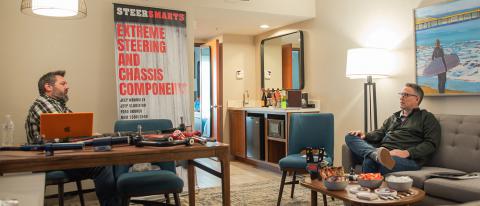
The MPMC Media Trade Conference enables motorsports parts manufacturers to take part in more than 40 private, 30-minute meetings with media over three days and offers a unique opportunity to build valuable connections with media in a targeted environment. The meetings are held in private suites and focus on manufacturers sharing detailed information about their products and developments in their company. Attending media represent a range of outlets, including print, digital, radio, podcast, and social media content creators, who use the information collected to publish in their channels year-round.
"It's always a value to connect with media," said Trent McGee of Centerforce Clutches. "We're lucky if we see even well-established members of the media more than once a year, but we can count on seeing them at the Media Trade Conference. Also, having the opportunity to discover up-and-coming media formats and meet with the people driving them makes being a part of the MPMC conference a no-brainer."
Relocating from Los Angeles, California, to Orlando for the first time since the program's inception in 1997, the 2025 conference is anticipated to attract new manufacturers and media participants from the East Coast. Networking breaks and a reception scheduled throughout the week will give participants multiple opportunities to further their connections.
The MPMC Media Trade Conference is open to PRI, MPMC and SEMA Truck & Off-Road Alliance (TORA) manufacturing companies whose membership is active at the time of the conference. Manufacturer registration opens June 3 and runs through September 9, with early-bird pricing closingAugust 4. Media registration will open in September Learn more at sema.org/mtc.
PRI and SEMA members recently traveled to Washington, D.C., to advocate for the interests of the specialty automotive aftermarket and motorsports parts industries as part of the 2024 SEMA & PRI Washington, DC Rally. Members and industry leaders held nearly 150 meetings with their elected officials and congressional staff, advocating for their lawmakers to support legislation to protect the future of the industry. The Washington Rally kicked off with a congressional dinner where TV presenter and car builder Ant Anstead hosted an engaging panel discussion with industry champions from the U.S. Representatives, including Reps. Marie Glusenkamp Perez (D-WA), Tim Walberg (R-MI) and Mark Amodei (R-NV), and included a lunch at the exclusive Capitol Hill Club with U.S. Senator Markwayne Mullin (R-OK), co-chair of the Congressional Automotive Performance and Motorsports Caucus.
The event also featured the "Cars at the Capitol" event, which showcased a curated offering of customized cars, trucks and SUVs that exemplify the spirit of innovation and craftsmanship that drives the specialty automotive aftermarket and motorsports industry. The car show put our industries on display just beyond the steps of the Capitol with a vehicle lineup that included everything from classic cars, including a '67 Chevrolet Chevelle and a '69 Ford Mustang Mach 1, to late-model vehicles such as a '15 Nissan GT-R, a '22 Gladiator 4xe and a Toyota Tundra.
Boostane's Ian Lehn brought his '69 Mustang to the 2024 PRI and SEMA Washington Rally. The vehicle recently competed in the Big Bend Open Road Race in Texas and features a stroker motor from BluePrint Engines plus components from Boostane, SilverSport Transmissions, Moser Engineering, Bearded Stitch, Simpson Race Products and Graphics Guys Motorsports.
Congressional meetings provided PRI and SEMA members with an opportunity to advocate for protecting the right to repair and modify vehicles with advanced technology, stopping vehicle technology mandates that limit consumer choice, protecting motorized access to federal government lands, making permanent business tax incentives for race tracks and extending business tax incentives that will be expiring or be reduced in 2025. This year's Washington Rally marked the 17th time that SEMA and industry members have traveled to our nation's capital to advocate for the industry. The event plays a pivotal role in SEMA and PRI's advocacy efforts at the federal level, providing our members with an opportunity to develop and strengthen relationships with key members of Congress.
From left to right: Auto industry personality Ant Anstead and U.S. Representatives Marie Gluesenkamp Perez (D-WA), Tim Walberg (R-MI) and Mark Amodei (R-NV).
SEMA and PRI welcome our members who weren't able to attend the Rally to get involved by writing their members of Congress on issues of key importance to their business and the industry. We also encourage you to host your members of Congress at your business. Our government affairs team makes this easy by coordinating the logistics and participating in lawmaker visits to member companies. Click here to sign up to host your members of Congress.
The new series director for the USAC Western States Midget Series comes from a family of racers and brings years of experience in series development and promotion.
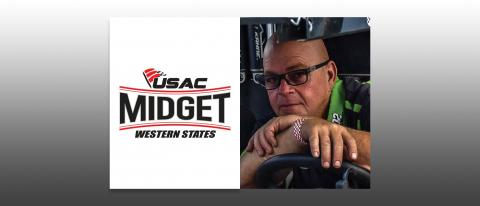
A familiar face on the West Coast open wheel dirt track racing scene, Scott Hall took on a new role in late 2023 as series director of the USAC Western States Midget series. A 16-race schedule is currently underway. He is aiming to expand the sport’s family appeal and attract more youngsters to the exciting world of midget racing.
A roofing and solar installation contractor, Hall also has plenty of his own experience as a racer, promoter, and series organizer. Many know he comes from a major California racing family. Hall’s grandfather, Jimmy Sills Sr., was a winner on the Bay Cities Racing Association (BCRA) midget circuit in the early to mid-1950s. As a boy in the 1990s, Hall watched his uncle, Jimmy Sills Jr., become a household name as a three-time USAC Silver Crown champion. He later pursued his own racing career and entered the racing business.
“I’ve done a lot of promoting in the past with the Sprint Car Challenge Tour, and I’ve helped develop the Hunt Magneto Wingless Sprint Car Series out here, and I’m still on the board for both of those series,” Hall told PRI when discussing his plans for this midget series.
“There’s a lot of passion out here on the West Coast for midget racing,” he said. “It’s an amazing development series for the upper ranks in racing.”
Hall also has a strong personal connection to midget racing, as his daughter, Taylor, recently moved to midgets after two seasons in outlaw karts and one in micro sprints.
PRI: What was your first experience behind the wheel of a race car? Hall: My Uncle Jimmy had the racing school at Marysville Speedway in California. After the school one night, he said, “You want to jump in that thing and make some laps?” I was in my mid 30s when I started racing and did it for about 12–15 years. I won a fair share of races here in Northern California running non-wing stuff. PRI: What in your racing background has prepared you for this role as director of a midget series? Hall: I’ve done this before and understand the role. With the Sprint Car Challenge Tour, I was in the trenches at the beginning stages of building that thing out and learning what I’m about to do here with the USAC midgets on the West Coast. PRI: Is that related to needing to attract more young people to the sport? Hall: Yes, it kind of goes hand-in-hand with a couple of things. Development is huge.
At 14 years old, you used to have to go to the Midwest to be able to race. We just got the minimum age down to 14 on the West Coast, which I think will be crucial for us in developing younger drivers coming out of go-karts and micros. Mixing some micro races with some midget races is something I want to do to develop these kids coming up. PRI: What needs to be done to preserve the future of midget racing? How do you plan to implement that in this series? Hall: Racing has gotten expensive over the years. While there are families that can afford this industry, we want to bring on the resources that can help the kids that might not have the money. Part of developing this younger generation is going to be helping them market themselves. I’m going to use my experience with marketing and sponsorship. PRI: Because so many young people are involved in social media, is that an avenue that you are pursuing? Hall: Yes. It’s where everybody goes these days. Using social media when we launched the Sprint Car Challenge Tour gave it a lot of traction. It’s a great way for fans, racers, sponsors, and car owners to all engage. PRI: How else can you help boost exposure for the series? Hall: Streaming is crucial. With the Sprint Car Challenge Tour streaming, it allowed us to utilize some marketing tools that used to be used on television to help bring money into tracks and traveling series. That’s a great way to open eyes for sponsorship. PRI: You are still working full time as a construction business owner. Does this benefit you in terms of marketing and strategic development for the USAC Western States Midget Series? Hall: Yes, I’ve been doing that in Sacramento Valley for quite a few years, so we have marketing partners and connections to utilize to grow this series. PRI: What is one mistake that you feel you’ve learned from in your professional career? Hall: A lesson I learned in business is to try not to talk too much about what you’re doing until you’re done. It’s hard when you are working on your purpose, as I feel I am now, because you get excited. PRI: Aside from your phone, tablet, or computer for business, what’s one thing you can’t live without. Hall: I’ll give you three: God, my daughter, and the gym—in that order. I wouldn’t have anything or be in the position I am right now without any of those.
Scott Hall
TITLE: Series Director ORGANIZATION: USAC Western States Midget Series HOMETOWN: Roseville, California FAST FACT: Hall recently signed a lease on his own micro track in Dixon, California, that he will use for driver development. “It is going to help me with some dreams and goals that I’ve been trying to work on for a long time. I’m blessed to be working with my purpose, and my purpose aligns with my daughter’s dreams. I don’t think I could be in a better place in life.”
The considerations extend well beyond cost and power output in motorsports applications.
While it is effectively a consumable, a clutch that’s properly matched to a given platform and use-case is crucial to both the durability and drivability of a race car. Yet as noted by KC Polk of Prescott, Arizona-based Centerforce, it’s far from a “one size fits all” proposition.
“Flywheel weight, friction materials, clamping force, and a number of other factors come into play with a racing application,” Polk said. “In much the same way that camshafts, cylinder heads, and other components need to be matched to the engine combination, so do the clutch and flywheel.”
With the number of variables involved in clutch selection, it can be difficult to zero in on which option makes the most sense for a particular vehicle and racing discipline. This often leads to racers over-buying or under-buying, and either can result in frustration.
Deciding Factors
“Clutches tend to be very application-specific, so it’s easy to make mistakes,” said Christopher Bernal of Advanced Clutch Technology (ACT), Lancaster, California. “If someone is coming from a different form of racing, or even moving from one class to another, sometimes carrying the same equipment with you isn’t the best option, and you need to make a change. But it can be easy to over-spend here: If you’re going up in power, you might think that you need to upgrade to a triple-disc clutch, when in reality you might only need a single-disc. On the other end of the spectrum, under-spending and getting less than you need could end up costing you more because you’ll have to replace the clutch more often.”
Bernal also noted that although there are some good rules of thumb for clutch selection, there’s one variable that really has to be evaluated on a case-by-case basis. “Driving style plays a big role in this,” he said. “In fact, in some forms of racing it might be the most important variable to consider.” Still, there are some other considerations that ultimately take precedence over technique and driving habits.
Choosing a racing clutch is far from a one-size-fits-all situation, said Centerforce’s KC Polk. “Flywheel weight, friction materials, clamping force, and a number of other factors come into play with a racing application.”
“First, it has to fit,” he pointed out. “That can be a limiting factor in some series. We’ve seen well-known racers go from one form of racing to another and call us for the same clutch they’ve been using, but we discover along the way that they’re using a different gearbox setup, and the clutch they’re used to just won’t fit. You have to look at diameter, along with total stack height. You also have to consider where the splines are on the input shaft, and whether or not it has a spacer in between the engine and the transmission. There’s a lot to take into account. Just because it will bolt up to the crankshaft doesn’t mean a particular clutch is going to work in that application.”
The next factor to consider is the engine’s output. “We are specifically interested in torque output at the crank here,” explained Polk. “When we are talking about clutches, we are not really concerned with the horsepower number. The twisting that is happening is what makes the clutch slip, and slippage creates heat.”
How the clutch is going to be used is also a hugely important consideration.
“Just because a clutch is rated to handle a certain amount of torque doesn’t mean it’s designed to put up with a type of use,” Bernal told us. “A drag racer is looking for consistent launching, and that consistency has a lot to do with clutch material selection. But in a road race car, you’re not worried about launch consistency, it’s more about quick shifting. Meanwhile, a drifter is going to be more concerned with thermal capacity because of how the clutch is being used in that discipline. Even if you’re using similar engines in all of those cars, you’d want different types of clutches in each.”
Bernal explained that thermal capacity is dictated in part by the mass of the clutch. Much like a brake disc, the clutch also serves as a heat sink, so the more mass it has, the more capacity it has to absorb thermal energy.
“If you’re going to have a lot of slipping going on, like you often see in drifting, you can’t have a lightweight clutch because it’s going to overheat very quickly,” Bernal said.
Among the factors to consider in clutch selection, the most important one is “it has to fit,” said ACT’s Christopher Bernal. “That can be a limiting factor in some series.”
“You also have to consider the type of materials used in the clutch. Some friction materials will handle heat and slippage without seeing degradation as quickly as others. A sintered iron material, for example, is going to handle thermal energy better than a stock-style clutch that uses organic fibers. But it’s also going to be heavier.” He cited cerametallic material as landing somewhere in between those two, while carbon materials like siliconized carbon and carbon ceramic materials are both light and capable of handling high levels of heat, but their high cost currently relegates their use mainly to top-tier disciplines like Formula 1.
Polk also noted that material choice can affect drivability. “Organic materials tend to be more streetable. The downside with organics is that they start to lose frictional stability around 500 degrees Fahrenheit, at which point your torque capacity starts to diminish. That’s where rapid wear starts.”
He pointed out that in some situations, a multi-disc design can offer a solution with minimal compromise in both regards. “With a twin-disc you now have four friction surfaces to work with rather than the two you’d have with a single-disc clutch.” This additional surface area inherently creates greater thermal energy capacity, which can in turn allow for a less aggressive clutch material in some use-cases. But as is typically the case, minimizing compromise doesn’t come cheap.
“Cost is usually the main reason why folks don’t use a multi-disc clutch in applications where they have the option of using a single-disc or multi-disc clutch,” said Bernal. “But if a driver isn’t hard on the equipment, using twin-disc instead of a single-disc might end up saving them money in the long run because they might be able to make it last several seasons. There are a lot of variables involved, and the driver is a big one.”
Versatility is the theme with these drag race vehicles as one car can run the same time regardless of elevation while the other is a real-life transformer.
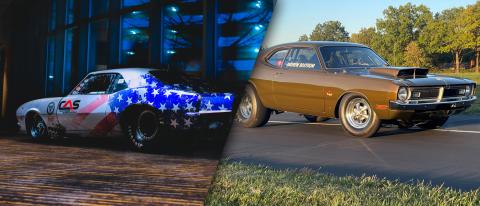
1968 Chevrolet Camaro Mark Griffin | Marble Falls, Texas
Race Series/Class: Midwest Drag Racing Series and National Hot Rod Association (NHRA) Top Sportsman class Engine: 540-cubic-inch big block Chevy built by Hill Country Performance & Machine in Spring Branch, Texas Car: Built by Mark Griffin Features: CAS (Compressed Air Supercharging), Stroud Safety, Wilson Manifolds Facts: The car uses its own atmosphere, so whether it’s in Houston or Denver, it will run the same number: 6.82 @ 208 mph.
1971 Dodge Demon Andrew Bostrom | Colorado Springs, Colorado
Race Series/Class: National Hot Rod Association (NHRA) Div 5, Nostalgia Modified Eliminator, Nostalgia Pro Stock Engine: Engine 1: 398-cubic-inch small block Mopar built by Mason’s Automotive & Machine in North Scituate, Rhode Island; Engine 2: 430-cubic-inch Gen 2, 16-plug Hemi built by Bostrom Racing Enterprise in West Wareham, Massachusetts Car: Built by Bostrom Racing Enterprise Features: JEGS, C&S Specialties, Liberty’s Gears, Schneider Racing Cams, Moroso, CP-Carrillo, Arias Pistons, Callies Performance, Molnar Technologies, Tubular Automotive, Ray Barton Racing Engines, Helger Bros. Speed Shop Facts: This was Andrew Bostrom’s first car with the following build progression: street car to street/strip car to super stocker to modified eliminator (currently) to nostalgia pro stock (building).
Officials with Champion Racing Association (CRA) and Owosso Speedway have released the digital entry form for the upcoming Big O Classic 100 on Saturday, May 25, at Owosso Speedway in Shiawassee County, Michigan.
The third points-paying race of the 2024 season features a $10,000 payday to the winner, $1,000 to start, the only official tune-up event for the $15,000 to win Masters of the Pros 185, and a potential for other cash bonuses. The first of three trips to Owosso Speedway this season for the JEGS Tour totes plenty of anticipation for the unofficial kickoff to summer.
For more information and the entry form, visit the CRA website here.
Speedway Motorsports announced that the NASCAR All-Star Race will return to North Wilkesboro Speedway in 2025. It will mark the third consecutive year the marquee exhibition event will run on the hallowed grounds in the North Carolina foothills.
The 2025 event--scheduled for May 18, 2025--will mark the 41st All-Star Race in NASCAR history with prior hosts being Charlotte Motor Speedway, Atlanta Motor Speedway, Bristol Motor Speedway and Texas Motor Speedway.
The NASCAR Craftsman Truck Series will also return to North Wilkesboro in 2025 for a Saturday night race prior to Sunday's main event.
Cummins and Valvoline have presented Andrew McDougall with the 2024 Louis Schwitzer Award for his Xtrac Electric Servo Actuator, which is used in the NTT INDYCAR SERIES.
In addition to the award, Cummins, Valvoline Global and the Indiana Section of the Society of Automotive Engineers (SAE) International presented McDougall with a $10,000 prize.
The award is presented annually to individuals and teams behind innovative concepts introduced to the motorsport industry.
McDougall was recognized for the Electric Servo Actuator, a new gear change system for sequential shift transmissions. The benefits of the system, according to Xtrac, include faster shifts, reduced weight, fewer components, and increased efficiency.
Former Promoter and Texas Motor Speedway President Eddie Gossage has passed away. He was 65.
Gossage was named the first general manager of Texas Motor Speedway when it was built in 1996, leading the Fort Worth facility for 25 years until his retirement in 2021. He spent 32 years promoting events for Speedway Motorsports, both at Charlotte Motor Speedway and Texas Motor Speedway.
Bridgestone Americas, based in Nashville, Tennessee, has introduced new Firestone race tires for the 2024 Indianapolis 500 that incorporate sustainably sourced raw materials.
The Firestone Firehawk tires use two monomers sourced from the waste residue of palm oil processing, according to the manufacturer. The bio-styrene and butadiene monomers used in this year's race tires are certified by the International Sustainability and Carbon Certification (ISCC) for the transparency and traceability of sustainable raw materials throughout the supply chain.
"Our racing heritage with Firestone dates back more than 100 years to the very first Indy 500 in 1911, and we remain focused on helping sustain the sport we love for future generations," said Cara Krstolic, executive director of race tire engineering and production, Bridgestone Americas. "The demands of racing also offer the ultimate challenge for our innovation. In proving the same premium performance can be delivered at this level through more sustainable materials and technologies, we can work to extend these efforts beyond motorsports into solutions being designed for the future of mobility."
 MEMBERSHIP LOGIN