Porsche has committed to the Formula E Championship until at least 2030 as a GEN4 manufacturer, the series announced.
The GEN4 will be introduced in time for the 2026-27 season and will have a regeneration capacity of up to 700kW and a power output surge of up to 600kW.
The announcement also follows commitments from both Nissan and Jaguar as manufacturers in the GEN4 era.
Lubrication Specialties (LSI), manufacturer of Hot Shot's Secret performance lubrication products, has expanded the company's marketing staff with the recent addition of Justin Brown as marketing project coordinator and Mike Meyer as the company's new bypass filtration product specialist for Frantz Filter.
Brown, a graduate of Ohio Northern University (ONU), has experience in digital marketing, graphic design, video, research and budgeting, and previously served as the social media manager for the ONU esports program.
As marketing project coordinator, Brown will coordinate all marketing and media initiatives and will assist in creating branded advertising campaigns, evaluating current trends, managing promotional campaigns and presentations, and ensuring all projects proceed timely and on budget. Brown will report to Hot Shot's Secret Brand Manager, Josh Steinmetz.
Meyer will fill the newly created bypass filtration product specialist position. Formerly a technical sales representative with Race Winning Brands, Meyer's primary role is to provide tech support to dealers and end customers as they incorporate a sustainable by-pass filter designed for light- and medium-class trucks to reduce oil maintenance costs and extend the life of engine oil.
Meyer will work with the marketing and research and development departments to develop a vehicle application database and develop support materials including video installation instructions to integrate the company's Frantz filtration systems with the Hot Shot's Secret brand. Meyer is reporting to LSI's Director of Marketing, Bud Prenatt.
Hundreds of new product announcements cross the desks of PRI editors each month. Following are our top picks for June.
High Energy DLC Flat-tappet Lifters
COMP Cams
compcams.com
Conventional iron flat-tappet hydraulic lifters are hard to find these days, especially for those engine builders on a budget. The new High Energy lifters from COMP Cams in Olive Branch, Mississippi, feature a DLC (diamond-like carbon) coating that is compatible with all steel and cast-iron camshafts.
“We wanted to offer a high-quality lifter with a DLC-coated face, very similar to our higher end tool steel lifters but at a price point that all racers and engine builders would benefit,” said Chris Mays.
These lifters are available for Chevy small and big block engines along with the W-series platform. They are designed to leverage the performance that the High Energy line has provided for years yet are now available with the friction-reducing DLC surface treatment. This coating extends the life of the lifters and camshaft and reduces the likelihood of a flattened cam lobe.
“After the extensive Spintron testing we performed before the release of these lifters, we knew we had a winner,” added Mays. “The number of wiped lobes from a faulty lifter is all in the rear-view mirror now. Our promise is to bring DLC-coated lifters to all of the engine families in hydraulic and solid lifters.”
Since the DLC coating offers high lubricity and wear resistance, there’s no need for the traditional break-in procedure that’s usually performed on cast-iron cams with flat-tappet lifters.
BBC to LS Water Pump Adapter
PROFORM Parts
proformparts.com
This easy-to-use kit allows racers on a budget to adapt a big block Chevy electric water pump to an LS engine. “We saw a need for an inexpensive water pump option,” said Ryan Salata of PROFORM Parts, Warren, Michigan. “We already made the big block pump, and it seemed like a good idea to offer a way to mount it to the LS engine.”
The adapters are constructed from black anodized billet aluminum. They come with gaskets and mounting hardware. Each adapter features 1/8-inch NPT female steam-tube ports, and there are -12 AN O-ring female ports for the radiator return flow.
“For the racer, there’s increased horsepower because you’re not using a belt-driven system,” added Salata. “Depending on the application, it could be 5-10 horsepower. Basically, you get the functionality of an LS water pump at the price of a big block pump.”
The adapters are first installed to the LS block, then the BBC pump is attached to the adapters.
Elite Pro Wireless Racing Scales
Longacre Racing Products
longacreracing.com
The Elite Pro wireless scales from Longacre Racing Products in Boonville, Indiana, have been completely redesigned for 2024 with the latest Bluetooth 5.0 technology.
“There’s also improved quality and fit and finish,” said Gary Lewis. “This upgrade has been in the works for a year or so. The connectivity, range, and ease of use is so much nicer.”
The scales can be easily connected to any Android or iOS device with a simple but secured pairing process. Users can view weight and saved data simultaneously on a user-configurable screen, including corner weights and partial percentages. Additional pages in the software include note taking, organization, ride height, and alignment.
When the need to analyze data or share it with others arises, the simplified data export procedure transfers all selected data seamlessly to a computer. Plus, users can monitor the pad battery status directly from the Longacre Connect app’s home screen.
The 15- x 15-inch low-profile pads feature a powder-coated finish, and every kit comes with a case for easy storage and transport. The internal-bridged pad design is the secret behind the precision. It eliminates pad flex, guaranteeing accurate measurements even when dealing with off-centered loads.
Greaves TS-03 Tire Scraper
United Race Parts
unitedraceparts.com
Recently redesigned to incorporate feedback from racers and tire technicians, the Greaves TS-03 tire scraper features an adjustable and molded handle for user comfort. This helps reduce the time needed to remove irregularities and debris from tires without damaging the compound.
“The biggest selling point is improved track times,” said Thomas Decker of United Race Parts, which is the Troutman, North Carolina-based North American distributor for the product. “When they go back out on the track, the tires are completely clean.”
The adjustable blade and roller angles along with revised weight distribution ensure ease of use. Other key features include 2,000W power in the heat gun, adjustable temperature of 200–1,000 degrees F, and a variable fan speed.
“Another big benefit is the accuracy of reading for tire wear, because it’s a consistent method to clean the tires,” added Decker.
The tire scraper is applicable in all forms of motorsports, including karting, road racing, and oval track.
1979–1993 Fox-body Mustang Suspension Kit
QA1
qa1.net
The Fox-body Mustang has always been popular for drag racing with its lightweight construction. Now many owners are seeking to improve the handling for a different type of racing. QA1 in Lakeville, Minnesota, now offers three levels of handling kits to meet any budget.
“They’re designed for road course and autocross racing,” said Kasey Saltness, “and we also make the drag-specific kit.”
The first level offers sway bars and upgraded shocks. The second level gets serious with double-adjustable coilovers, tubular K-member, tubular control arms, boxed trailing arms, and sway bars. The K-member helps save weight and allows for different engine mounts. The front struts feature an inverted cartridge design, large-diameter shaft, and lightweight aluminum body. Aluminum caster/camber plates also allow for more tuning adjustments. The third level provides more adjustability and race-ready control arms.
“This kit offers a level of response and control that sets the standard for Mustang suspension,” said Saltness. “It’s also an easy way to swap in a Coyote engine because it frees up space in the engine bay.”
The QA1 kits are made in the USA, come complete with hardware, and are designed for easy bolt-in installation.
Fronius AccuPocket 150 Battery-powered Welder
Pit Weld U
visitpit.com
Weighing just 24 pounds, the battery-powered Fronius AccuPocket 150 welder is available from Pit Weld U, which is part of Pit Instruction & Training, Mooresville, North Carolina.
“It is a popular unit with grassroots racers, and racers in general,” explained Trent Schanen. “It allows you to make quick repairs without a generator. It is a good fit for the racing audience.”
This portable TIG and stick welder can be used in three different modes. In battery mode it will weld 124 inches TIG or 18 electrodes on a single charge. It can also be used in a hybrid mode with simultaneous charging and welding, and there’s generator-powered operation.
The welder features voltage monitoring for all the lithium-ion battery cells, and there is protection from overcharging, deep discharge, and overheating. Rapid charging in 30 minutes will provide about 80% performance.
The AccuPocket welder can be used in off-road racing as part of a chase crew or in a pit situation where a quick repair is needed and there’s no access to an electrical outlet.
Vulcan Cut-Ring CR58 Head Gasket for Gen III Hemi
SCE Gaskets
scegaskets.com
The clever hybrid-style Vulcan Cut-Ring head gasket from SCE Gaskets in Mount Pleasant, Tennessee, is now available for the Gen III Hemi platform.
“It was developed to fill the need for a gasket that can hold much higher power levels than MLS head gaskets are capable of, while being very friendly to liquid-cooled engines that may be dual-purpose street/strip cars,” explained Aaron Hunter.
The gaskets feature a pliable, perforated metal-core composite body that is coated with a polymer. A silicone bead seal is applied to critical areas. The key feature is a solid stainless-steel cut ring that “bites” into the cylinder head to form a positive barrier against combustion pressure leaks.
“In the past, racers and enthusiasts would have machined the block and/or heads for stainless steel O-rings or fuel hoops to work with our Pro Copper head gaskets,” said Hunter. “Pro Copper head gaskets seal up the highest of horsepower engines, from Pro Mod to Top Fuel. However, they aren’t very friendly for street cars with heat cycling and liquid cooling.”
The Vulcan Cut-Ring has sealed as much as 2,300 horsepower. The gaskets require normal engine and block machining prep, including the smooth, flat surfaces needed with an MLS head gasket. These gaskets are also serviceable. Upon engine tear down, the Cut-Rings, if still in great condition, can be re-used with the purchase of a new composite gasket body.
How a marketing agency can boost your social media engagement.
This month we’re taking a look at social media from an agency’s perspective to provide an idea of why it could be a valuable source in assisting with social media for your company. Drive Marketing Group, based in Vancouver, British Columbia, Canada, is an automotive marketing agency that represents several automotive and aftermarket brands including Formula DRIFT; various auto shows; OEMs like Toyota, Lexus, Porsche, Kia, Nissan, Aston Martin, McLaren, Audi, and many more; plus manufacturers like Continental and General Tire.
“One of our favorite success stories would be Formula DRIFT,” noted Josh Chow, president and founder of Drive Marketing Group. “We took their social media, amongst many other marketing services, in which they boasted 500,000 Instagram followers, and over the course of four years, we more than tripled their account. Now at year seven, they sit at over 1.8 million followers.
“With a combination of our love for motorsports from every staff member and being Meta’s automotive Partner, we were able to use our passion, understanding of motorsports, combined with our social media knowledge to create a ‘storytelling’ social media to generate so much engagement that everything grew organically,” Chow explained.
Drive Marketing Group is a full-service marketing agency, but with its social media suite, clients can choose the level of involvement they need. The options include social media consulting, full management, content creation, specialized advertising, media creation (photography and videography), influencer management, and much more.
To stay up to date with the latest trends and algorithm changes, as a Meta Partner, the Drive team is continuously in training modules within the platform. “In addition, our team looks to other industries as well to research what has been working for major brands,” Chow said. “Our team uses a platform that compilates best practices from competitors of our clients as well as aligned brands to see what everyone is doing from a 10,000-foot view.”
To become a Meta Partner, an agency must have enough clients in a specific category (i.e., automotive), spend enough ad dollars to qualify, complete required training modules to qualify, and be an industry leader and innovator. Once the agency becomes a Meta Partner, “we consult for Meta in the automotive sphere, we have access to the latest Meta technology, usually in beta stages so we can let our clients access these technologies not publicly available, we have access to training modules for our staff, and we participate in all Meta learning programs,” Chow explained.
When asked about what strategies Drive utilizes to boost engagement, Chow responded, “Using tactics that foster engagement such as questions, education, comments, emotions, and actionable items is always our first point of attack in any social media. We want to make everything noteworthy to share and engage with others.
“We also recommend a social media engagement advertising budget where we can help push impressions, but very tactically using our proprietary advertising system that pinpoints people most likely to engage with your brand,” he added.
One of the basic tips the team at Drive recommends is to understand your audience and the content they would like to see. Furthermore, educating the audience is often met with much success. “We want educational videos on social platforms to be quick, bite-size (15–30 seconds) videos with captions or ‘supers’ (stylistic captions) since most people are now viewing things on their phones,” Chow explained. “Also, remember to edit your videos for vertical formats to optimize for mobile as it creates a better user experience, and Meta favors this.”
Using a marketing agency can be beneficial for social media, but do your research and choose the right fit for your business. Many agencies offer expertise in this realm, and they have the proper tools and resources while bringing creativity and innovation to the table as well.
Tracking legal, legislative, and regulatory developments impacting the racing and performance industry.
PRI’s Washington, DC-based legal and advocacy teams work continuously to protect and support motorsports venues, sanctioning bodies, and businesses around the nation. We are tracking several initiatives this month, including legislation to secure consumer freedom and protect vehicle choice in Maine, Kansas, Kentucky, and Alaska.
Maine Governor Signs Bill Requiring Legislative Approval for Clean Car Laws
Maine Governor Janet Mills signed PRI-supported legislation (L.D. 2261) that would reclassify the state’s adoption of California’s clean-car rules as a “major substantive rule,” requiring the legislature to provide final approval of the regulation, not the Board of Environmental Protection (BEP).
Under current law, citizens—including environmental groups—can initiate the regulatory process for minor updates upon submission of a petition with 150 voters’ signatures.
In March, Maine’s BEP voted against adopting a PRI-opposed proposal requiring that 82% of new vehicles sold in the state be zero-emissions vehicles (ZEV) by 2032. Drafted in response to a citizen petition from an environmental group, the rule aimed to tighten emissions standards for new passenger cars, light-duty trucks, and medium-duty vehicles sold in Maine, aligning the state with California’s latest clean-car rules, which the state has historically followed.
“This legislation ensures Mainers have the final say on what cars they drive, not a small group pushing an agenda that doesn’t reflect the needs of the entire state,” said Christian Robinson, SEMA & PRI’s senior director of state government affairs and grassroots.
PRI believes that Mainers, not the government, should decide what vehicles are best for them and their families. In the case of Maine, it rebukes the push of 150 citizens who attempted to determine policy for the rest of the state.
Kansas Governor Signs Bill Protecting Vehicle Choice into Law
Kansas Governor Laura Kelly signed the legislature’s House Bill (H.B. 2783) into law, which ensures consumers’ choice of vehicle power plants and fuel technologies.
The PRI-supported law officially prohibits a state agency, city, or county from restricting the sale or use of motor vehicles based on the energy source. Kansas lawmakers passed a similar, non-binding resolution during last year’s legislative session, but this year’s bill now makes it a law in the state.
“PRI thanks Kansas’ lawmakers and Governor Kelly for the enactment of H.B. 2783,” said Robinson. “History has shown that consumer choice and innovation are the cornerstones of a thriving automotive industry, and this bill aligns perfectly with these principles. In fact, seven states have now passed these PRI-led ‘ban the ban’ laws over the past two years.”
PRI supports an “all of the above” approach to vehicle technology policy, advocating that the innovators, consumers, and the marketplace should decide the direction of vehicle propulsion technology and that the government should remain technology neutral. With this new law, Kansas residents will continue to decide what vehicles are best for them and their families.
Kentucky Governor Allows Bill Blocking California Emissions Standards to Become Law
The Kentucky legislature’s Senate Bill (S.B. 215), which restricts the state from adopting California’s stricter emissions standards for new vehicles, has become law without Governor Andy Beshear’s signature.
The PRI-supported law prohibits the state from setting or enforcing regulations on emissions that align with California’s plan to phase out the sale of new gasoline- and diesel-powered vehicles by 2035. While not signing the bill, Governor Beshear allowed it to pass into law without his veto.
“PRI applauds Governor Beshear’s decision to allow S.B. 215 to become law,” said Robinson. “This legislation empowers Kentuckians to make informed choices about the vehicles they use for work, transportation, and recreation. Kentuckians know their needs best, and this law ensures they have the freedom to select vehicles that fit their budget and lifestyle.”
Alaska Advances Bill to Protect Vehicle Choice
Alaska lawmakers have advanced PRI-supported legislation (H.B. 375) to ensure consumers’ choice of vehicle power plants and fuel technology by preventing a state agency, county, or city from limiting access to internal combustion engines (ICE).
PRI was invited to testify in support of H.B. 375 before the Alaska House Committee on Labor and Commerce. Following the testimony, the bill successfully passed the committee and is now awaiting consideration by the full House.
“H.B. 375 is a pro-consumer, pro-innovation, and pro-business piece of legislation,” said Colby Martin, PRI’s director of state government affairs, during the hearing. “PRI urges the committee to support this bill and allow the automotive industry to continue delivering the freedom and choice that Alaskans deserve.”
When should coatings be used and on which parts? This guide from Calico Coatings explains why coatings are considered “the hidden heroes of racing” and how they can enhance your racing program.
In an industry where performance is everything, coatings have stepped in to provide a performance advantage. Professionals in the racing industry use coatings on their engine components to provide various benefits, such as friction reduction, corrosion prevention, enhanced material compatibility, and improved overall engine performance. Coatings are used extensively for their ability to provide higher engine efficiency, durability, and reliability, making them the hidden heroes of the racing industry.
A wide range of components can benefit from performance coatings, everything from bearings to wrist pins. These powerful coatings are designed to modify the behavior of the substrate material, preventing various types of wear, including abrasive, adhesive, fretting, and surface fatigue. By mitigating these wear properties, the coatings improve the lifespan of engine components.
DLC, PVD, dry-film lubricant, CrN, and TiN are some of the top performance coatings used in automotive racing to reduce heat, increase wear resistance, protect against corrosion, and improve overall performance on the track.
In addition to their performance benefits, coatings are also used in the racing industry to address environmental concerns. While the racing industry focuses on enhanced performance through lower friction, a secondary benefit is lower fuel consumption and reduced emissions due to increased lubricity provided by coatings—another valuable unseen benefit.
Following are the top-five reasons the racing industry chooses performance coatings: 1. Reduced friction. Coatings can be applied to various engine components to reduce friction and increase efficiency, improving engine performance and longevity. 2. Heat resistance. High-performance coatings help dissipate heat more effectively, keeping critical engine components from overheating during intense racing conditions. 3. Corrosion protection. In the demanding automotive racing environment, vehicles are often exposed to harsh elements such as moisture, salt, and chemicals. Coatings act as a tough protective barrier, shielding components from corrosion and significantly extending their lifespan. 4. Wear resistance. High speeds and intense forces make components prone to wear. Coatings with high wear-resistance properties can help prolong the life of these components, reducing the frequency of replacements and maintenance downtime. 5. Customization. From adjusting friction coefficients to modifying thermal conductivity, coatings can be tailored to specific racing applications, allowing teams to fine-tune their vehicles’ performance characteristics.
CrN (chromium nitride) is an excellent coating for applications such as automotive parts, molds and dies, pump parts, shafts, and dry deep drawing. CrN performs well under conditions of high load and has excellent chemical resistance.
Which Coatings and Why?
While there is an arsenal of performance coatings from which to choose, Diamond-like carbon (DLC) and Physical Vapor Deposition (PVD) are top contenders for providing race teams with a performance advantage. Various factors, such as the application methods, substrate material, surface preparation, and performance properties, determine the effectiveness of DLC and PVD coatings.
Diamond-like carbon is a family of carbon-based coatings that have extreme hardness due to the diamond crystal (tetragonal) structure and is soft and lubricious due to the graphite crystal (hexagonal) structure. A technological advancement, DLC is a combination of PVD and Plasma Enhanced Chemical Vapor Deposition (PECVD) coatings. Combining these two structures reduces the coefficient of friction by 200%–500% compared to traditional tribological PVD coatings, making them an excellent choice for components that operate at high pressures.
Physical Vapor Deposition coatings offer several benefits across various applications due to their unique properties and characteristics, including hardness and wear resistance, low coefficient of friction, and temperature resistance. They also have a positive presence in a wide range of industrial, non-industrial, and cosmetic applications due to their increased hardness, low coefficient of friction, extreme temperature resistance, and a multitude of color ranges.
Depending on the specific issue the engine builder is trying to solve, there are various other coating solutions to choose from.
Dry-film lubricant coatings help reduce friction and abrasive wear. They provide intermittent dry lubrication, are not affected by dust or dirt, and are specifically engineered to withstand the extreme conditions of today’s high-performance engines. With increased embeddability, strength, and durability, dry-film lubricant coatings give professional engine builders a higher confidence level.
Titanium Nitride (TiN), the staple of thin film coatings, solves tribological problems with machine components that can be coated at temperatures of 425° C–450° C. TiN is normally applied to steels, hardened steels, and stainless steel materials where high wear resistance and lubricity are needed.
Chromium Nitride (CrN) provides lubricity, superior wear, and corrosion resistance, and a very low residual stress, which provides for the best adhesion and ductility of any PVD coating. High hardness, low coefficient of friction, and the low residual stress of CrN combine to resist abrasive, metal-on-metal wear, and galling.
Super Finishing is a precision surface prep process commonly applied to critical engine and drivetrain components to reduce friction, increase durability, improve fatigue resistance, and enhance overall performance. Super Finishing removes microscopic peaks, component stresses, and stress risers, leaving an isotropic or uniform surface finish of less than 2–3 micro-inch. Super Finishing prior to coatings can lead to improved power transfer, reduced energy consumption, and increased reliability, all of which are crucial in high-performance racing applications.
Coatings are the hidden heroes of the automotive racing industry, playing a vital role in enhancing performance, durability, and efficiency, making them indispensable for competitive teams seeking an edge on the track.
Calico Coatings has been a premier coatings provider to the automotive racing industry for more than 25 years. It has developed some of the industry’s most technologically advanced coatings—with the ability to withstand the extreme conditions of high speed and engine wear. Find out more at calicocoatings.com.
The tools oil system manufacturers use to produce performance lubrication systems are necessarily high-tech—except when they aren’t.
How high are the stakes when it comes to lubrication systems in race engines?
“You can break a lot of things in an engine, and it can survive, but you can’t break your oil pump. That would mean almost instantaneous self-destruction,” said John Schwarz of Aviaid, Chatsworth, California. Building a reliable oiling system is a “heavy burden of responsibility,” he said, particularly in extreme motorsports like tractor pulling. “We have a little oil pump that’s 12 inches long, 3.25 inches in diameter, and it’s basically keeping a 600 cubic inch, 6,000 horsepower, 6,500 lb.-ft. of torque diesel engine spinning a 300-pound crank at 6,500 rpm in one piece for 300 feet.”
It’s no wonder, then, that oil system manufacturers are taking advantage of the latest, state-of-the-art technology when it comes to designing and manufacturing their components. Even someone as self-described “old-school” as Verne Schumann of Schumann’s Sales and Service in Blue Grass, Iowa, admitted (with tongue in cheek) that he “survived for 40 years in machining with my fingernail test for roughness, but that doesn’t make it anymore. Now we use Mitutoyo RA technology to decipher what looks to be identical to the naked eye.”
What follows is a look at several companies making high-performance oil system components to see what kinds of cutting-edge tools they’re using, and how those tools benefit racers.
A Big Leap
“The buzzwords 10 or 15 years ago would have been finite element analysis and computational fluid dynamics, and that’s still the case. Those are still top-line tools in developing the core parts of a lubrication system,” noted Travis Rosenbarger of Boundary Racing Pumps, Royse City, Texas. Yet when designing oiling systems for racing, “there’s a lot of wear and a lot of stresses that the OEM guys don’t have to deal with. So we have to go back through and look at how the components are actually designed, and how they’re interacting, to get a component that’s going to work in the more extreme environment.”
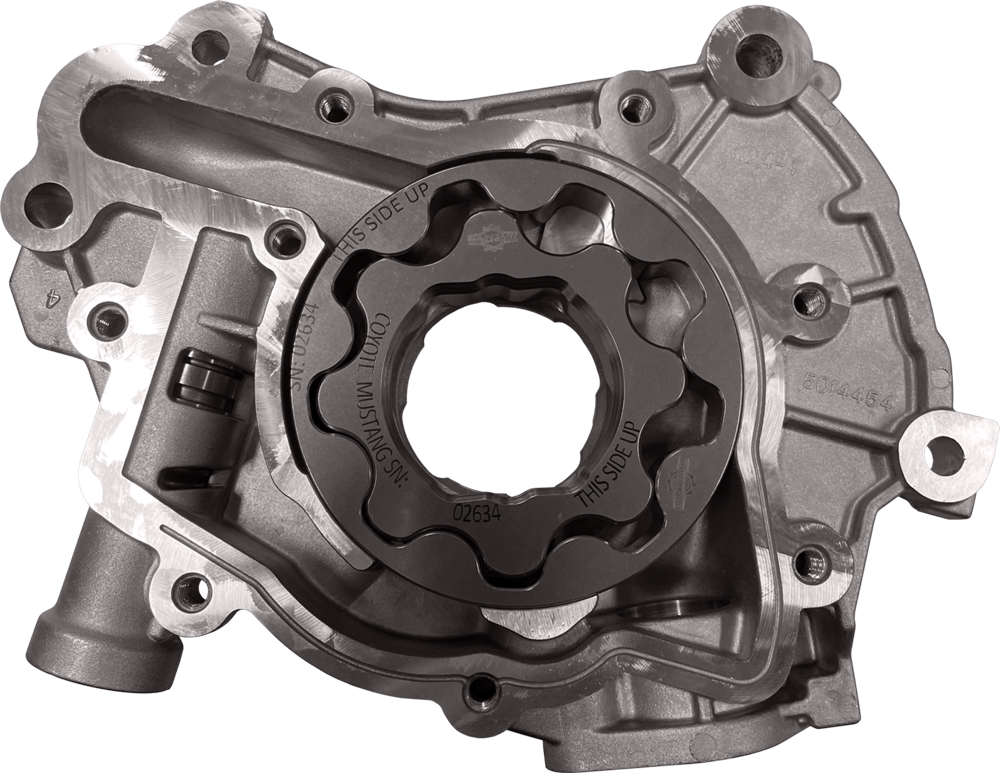
At Boundary Racing Pumps, “every single gear now gets a CMM scan,” said Travis Rosenbarger. “That would not have been possible 10 or 15 years ago, not on any kind of budget the automotive industry would recognize.”
To that end, Rosenbarger has coded some proprietary programs “that look at stress in these components and adaptively adjust the parameters that control that geometry to minimize the stress in the design.” With this kind of analysis, “you can do what a standard engineer 10 or 15 years ago would have done in a week in maybe five minutes or so and come up with a design that’s pretty well minimized in stress.” This isn’t AI at work, he explained. “It’s parameterization of these components so that, given a certain geometry, we know what stresses they’re going to incur. By putting in the specifics for whatever pump you’re doing, and then telling it to minimize the stress, it’s going to move those parameters around until it finds a minimum for that particular gear that you’re trying to design. That is a big leap. Where it used to take me about a week to make a design for a new gear set, I can now competently create a gear in maybe an hour, hour and
a half.”
Rosenbarger has also tied this design step into the manufacturing process. “I parameterize the model to minimize the stress, which gives me the geometry. Then the geometry itself is linked to CNC programming machining templates that I can copy on top of, so in that hour and a half or two hour window, I can come out with G code that’s ready to go to the machines to actually produce the first prototype part and see how it’s done.”
Technological advances are also helping on the quality control side of the business, he said. “There’s a wide variety of equipment from different manufacturers where you can give the machine the critical inspection components, slide that gear in front of it, hit go, and it’ll do visual recognition of the component. Then it knows how to go in and probe the exact points that you want it to, to tell you if the part is in compliance.”
At Boundary, “every single gear now gets a CMM scan,” Rosenbarger added. “Every inner and outer rotor that goes on a set gets a CMM scan, along with some other hand inspection techniques. That also would not have been possible 10 or 15 years ago, not on any kind of budget the automotive industry would recognize.”
That’s largely because the tools have become “very cost effective,” Rosenbarger said. “In the old days, you had software that you would have to program, and a lot of times, the programmer for that software would carry a six-figure salary. Then the software itself was $40,000. And then you have the hardware that would be $400,000 or $500,000. Today, all of that has culminated into more compact systems that cost well south of $100,000 that ordinary users can interact with. That’s been really impactful to our quality.”
More Accurate Design Environment
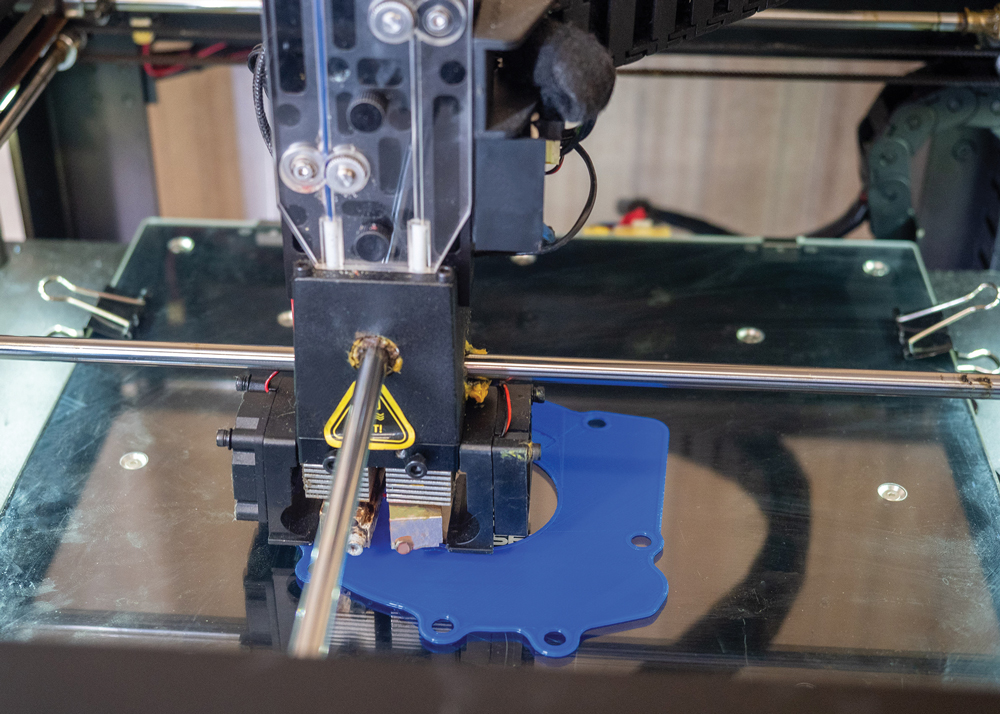
In 2018, Melling Tool Company of Jackson, Michigan, began using fused deposition modeling 3D printing “to allow our engineering department to 3D print products and components for development and static prototype evaluation on engines and vehicles to ensure proper design fit-up, envelope clearances, and overall feasibility before permanent tooling is produced,” said Travis Stevens.
Prior to having 3D printing capabilities, Melling would order stereolithography or selective laser sintering parts from outside service providers, “resulting in multiple weeks for delivery timing and costs of hundreds to thousands of dollars,” Stevens explained. “Now we can make a 3D-printed component within hours, review the components on the engine, make any needed changes, and re-print the component for further evaluation.”
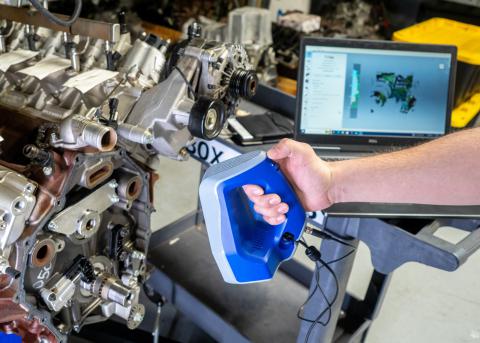
Also in 2018, Melling started using 3D portable scanning equipment “for reverse engineering and 3D CAD model to physical product overlay validation,” Stevens continued. “3D scanning of engine components and vehicle physical attributes has allowed for a more accurate 3D design environment for our engineers to understand existing components on the engine and design in the proper packaging clearances prior to making any physical components. Melling engineers can make sure the designed oil system components do not have any spatial interference with other nearby components and assemblies on the engine or vehicle. 3D scanning has also allowed for casting validation between the physical castings and the intended 3D product design. Castings are scanned and compared against the 3D CAD casting models to make sure that the castings being supplied to Melling are being manufactured within the needed design requirements.”
An added benefit of Melling’s 3D printing is convenience, according to Stevens. “3D printing of various oil system components has allowed us to make multiple prototype copies of the same component that could be used in different manufacturing disciplines at the same time,” he said. “A 3D printed oil pump housing, for example, could be printed multiple times and used for product design validation, tooling and fixture development, a visual aid for various meetings, and manufacturing processes development. Prior to 3D printing capabilities, only one prototype would have been ordered due to timing and cost constraints, and this one prototype would then have to be shared amongst all departments.”
Extremely Fast and Accurate
At Moroso Performance Products of Guilford, Connecticut, Engineering and R&D Manager Frank Kokai and Operations Manager Gary Burkle walked us through some of the equipment Moroso uses on the R&D and manufacturing sides of the house.
When R&D gets a request to build a new oil pan, for example, “we’ve invested in a Hexagon portable CMM, which allows us to verify dimensions on blocks for pan rail locations, bolt hole locations, main caps, and other features, before we even get to the design stage,” said Kokai. “Then we can take that information and import it directly into our Creo CAD design software.”
Melling uses 3D printing to make prototype components for several reasons, not the least of which is convenience, said Travis Stevens. “It has allowed us to make multiple prototype copies of the same component that could be used in different manufacturing disciplines at the same time.”
Moroso used the Hexagon CMM in the creation of a series of V-Band drive pumps for ProCharger applications, Kokai said. “We worked with the manufacturers and used the Hexagon arm to gather the data we needed to design the pumps to bolt directly to the ProCharger system. Then we worked with chassis and engine builders to gather data and import that into our software to make the system work seamlessly together.”
When looking at manufacturing, “the CNC machines haven’t changed much, but the software has,” Kokai said. “It is constantly evolving. The software we use to program, Mastercam, has advanced tool paths that allow us to machine materials quicker, more efficiently, and more accurately.”
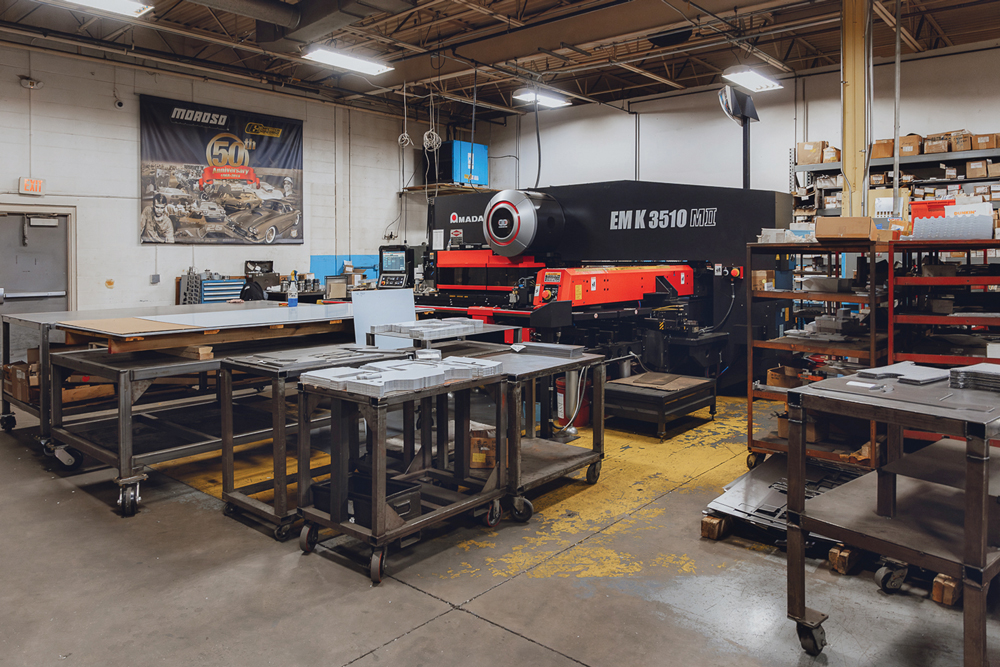
“On the sheetmetal side, over the last five years we have updated all of our turret equipment,” Burkle said. “We have invested in two Amada EMK servo-driven turret punches that allow us not only to punch and profile a part, but we can also form features in the machine.”
“There are 58 stations with live, indexable heads,” Kokai added, “with tooling that allows us to punch and form features into the sheet metal in the turret without having to take it to a secondary operation. That’s something you couldn’t always do with the older hydraulic driven machines. These are also extremely energy efficient compared to the old hydraulic machines. Plus, they’re extremely fast and accurate.”
Advanced technology, combined with the investment in new machines, has allowed Moroso to take a concept from the design stage through prototype and bring it to market faster than ever before.
“The communication that happens from engineering to manufacturing is almost seamless in today’s world,” Burkle said. “That’s a big change. We can update the design in Creo, and within a day, the floor is updated completely with new prints and machine files. You can revise a singular product, stop its production for the day, and have the revised product in production within the same day.”
The Benefit is Speed
ARE Dry Sump Systems of Loomis, California, has been “designing and manufacturing dry sump components for racing engines since 1978,” said Gary Armstrong. “We start with a ‘blank sheet of paper’ design and make all our casting tooling, patterns, fixtures, etc. in-house.” Prior to the widespread adaptation of CNC machining, “precision surfacing and drilling fixtures were used on the castings. For many of the older, lower volume dry sumps they still are.” But the company also has several Haas three- and four-axis CNC machines to manufacture its newer designs, as well as Autodesk Fusion 360 or Solidworks computer software. “We also make use of modern time benefits such as CFD, CAD/CAM, as well as input from the factories, pro racing teams, and engine builders.”
When we asked Armstrong for an example of a dry sump system he was able to create or improve by using these high-tech tools, he said, “the only real benefit is in speed of production. Modern manufacturing does not make anyone any smarter.”
Necessary Precision
When Aviad started building oil pumps in 1968, “it was all done on tracer equipment—tracer mills, tracer lathes,” Schwarz explained. By the time he joined the company in 1998, manufacturing had been converted to CNC machines, though initially the company used an earlier generation, numerical control (NC) machine that was fed cutting instructions via tape.
The precision that current CNC machining technology brings to oil pump manufacturing has been a benefit as preferences are switching from petroleum-based to synthetic oils, and those oils have gotten lighter, Schwarz said. “When you’re looking at thinner and thinner oils, oils with smaller and smaller molecules, you’re talking about pumping water, not oil, anymore. So you have to be able to grab hold of that oil and move it to where it has to get to. That’s where the technology has helped, because with the CNC manufacturing processes that we have now, it’s much easier to maintain the gear-to-housing clearance numbers.”
Over the last five years, Moroso has updated all its turret equipment, including an investment in two Amada EMK servo-driven turret punches. They are more versatile and more energy efficient than previous-generation machines, “plus they’re extremely fast and accurate,” said Frank Kokai.
Aviaid contracts most of its CNC machining to companies with five-axis machines “so that we can get a single setup. That’s the whole key to multi-axis machining,” Schwarz said. “When you’re machining a housing, you’re doing it on so many planes, if you were doing it on a regular CNC mill, you’d be doing three or four setups with every part. That gets a little tedious. So the five axis-stuff really helps that part of the business.”
Credit, too, goes to the expertise of the machine’s operator, Schwarz added. “The trick is not only designing and programming the part, but then there’s building the fixturing, and the tooling, and getting it all set up and running properly so you get the desired results.”
Yet the five-axis machines—and their operators—can have weaknesses. Schwarz cited one experience he had where a night-shift operator failed to take into account the thermal dynamics of ambient temperature change compared to the daytime, and part-to-part tolerances slipped to unacceptable levels.
These technologies can “really sound good until you do the deep dive, and then you have to understand the strengths and weaknesses of each process,” Schwarz said. “The trick in making the same part today that we made 50 years ago is really understanding how the manufacturing process has evolved. Each new step engenders different issues.”
Self-Taught
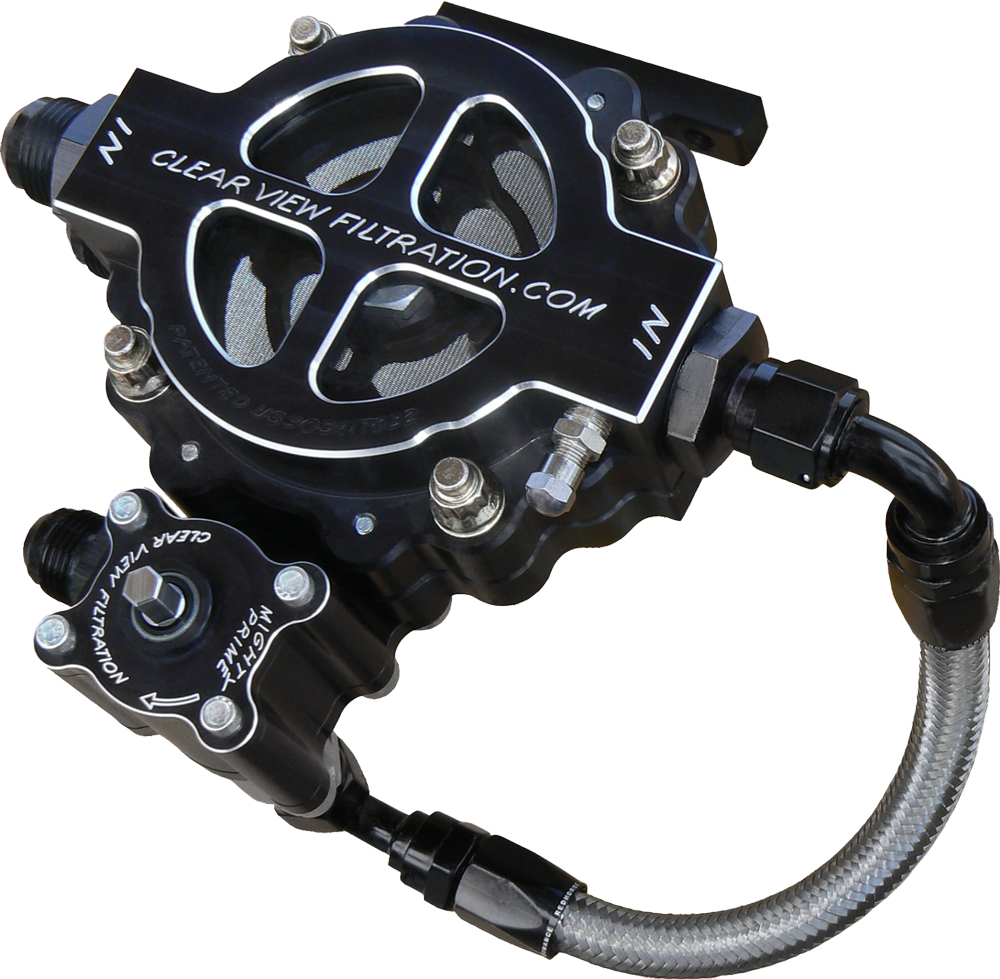
To manufacture his see-through oil filters and other components, Mike Cofini of Clear View Filtration in Spokane, Washington, utilizes six Haas CNC machines. Somewhat surprisingly, he said he’s “never been trained in CNC machining,” even though he and his partner, Jessie Juel, have written “every single program ourselves. We’ve never had anybody come in and teach us anything. For an old-school guy like me [Cofini spent 30 years building race engines before starting his filter company], it’s been about the Internet and how we can research things.
“Technology is moving forward at the same speed our cars are,” he said. “The information is out there. People just need to research it.”
Internet research and the design programs he’s found there were key in the development of Cofini’s latest product, a priming system that incorporates a small oil pump in a stand-alone unit that can be easily mounted to a Clear View filter. The priming unit will be incorporated in the base of the filter and can “make 70 pounds of pressure on a big block Chevy with just a 12-volt cordless drill.” Cofini said he expected to spend a month developing the pump, “and we actually spent a week and a half. Honestly, without the technology of that newest program [which he sourced from an engineer in the UK who was familiar with his filters], we probably could not have accomplished that on our own.”
Mike Cofini of Clear View Filtration expected to spend at least a month developing his new priming system, which incorporates a small oil pump into the base of a Clear View filter. But Internet research and production programs available online cut that development time down to a week and a half.
Cofini recently had his Haas machines tested to make sure they were still within factory spec for accuracy, and he has also upgraded the cutters. “There are some better cutters that have just come out, and we’re getting better tolerances because of the upgrade in cutter technology.”
Build it Ourselves
Innovation has marked Verne Schumann’s long career in performance lubrication systems, from his “paddle wheel” oil pumps and oil pressure warning lights to his latest new product, a 120% external bypass system, for street, strip, and race applications, that re-engineers the factory cup valve in small block Chevrolet engines. Schumann has applied that same level of innovation to the machinery he uses in producing and quality-checking his oil system products.
“The trouble with oil pump manufacturing is you can’t just pick up the phone, order 10 machines, and be in business next week,” he said. “All the equipment that we use in-house to check flow, pressure, volumetric, feet per second, we have to build ourselves.”
Schumann contracts out what he called the “heavy manufacturing that we have done to our specification, such as foundry and three- and five-axis machining. When those parts come in to us, we do the final machining.”
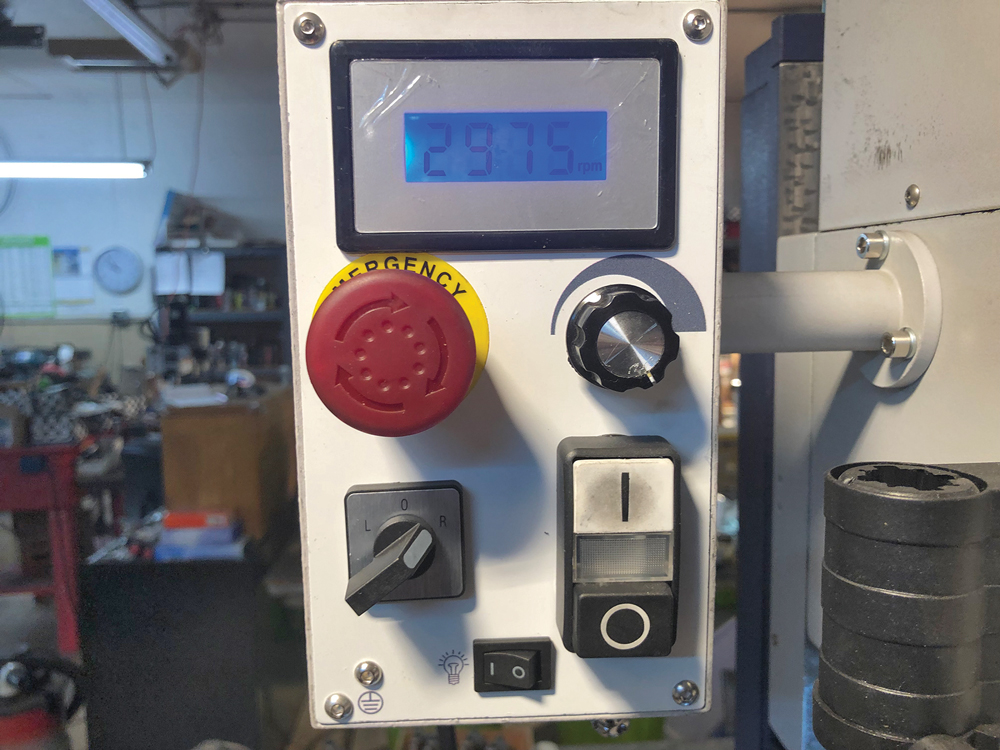
One of the newest additions to his shop is a milling machine “that we had built especially for our use,” he said. “It took a year to get it the way I want it.” The machine has electronic rpm control “because in some cases, when you’re doing a precision bore, the same speed from top to bottom through the bore is not the answer. You want to vary it as you go deeper and increase the rpm to get the chips to come out. Once a chip doesn’t come out, it grinds itself up and ruins the surface finish.”
This machine also had an electronic readout that “shows the vertical feet of the milling,” Schumann said. With most milling machines, “the depth of the plunge is controlled by go and no-go gauges or a mechanical micrometer you have to check and recheck. With this machine, I can see on a digital readout how much material we’re removing in real time.”
Verne Schumann spent a year working with a milling machine manufacturer to develop a one-of-a-kind mill with electronic rpm control (the display in this photo shows the spindle rpm) and a readout that indicates in real time the vertical feet of the milling.
Schumann’s inquisitive mind is open to the benefits of the latest technology unless that latest tech doesn’t serve his purpose. His custom milling machine, along with a Fowler TH550 electronic hardness tester, SP profilometer, and Mitutoyo surface roughness tester, share space with the diamond paper used to hand-lap valve or surface plates. “Hand lapping is still the most accurate way to get the proper surface finish on a flat part,” he said, and his preferred procedure is accomplished by triangulation lapping. “You do three strokes, rotate the part a third, do three strokes, rotate the part a third, and so on. We have four different levels of lapping depending upon the racer’s oil usage: aggressive lapping for 70 weight, very fine structured lapping for 0 weight, and points in between.”
There are lapping machines, and he has owned them, but they lap in only one direction. “Then the oil follows the direction of the lapping grid and doesn’t stay in place long enough to separate parts.” It is possible to rotate the part in a lapping machine, Schumann explained, but it is far more time consuming than in the hand-lapping process.
“We try to go more and more to the newest technology if we can, but still, in some cases, the old stuff is still the only answer.”
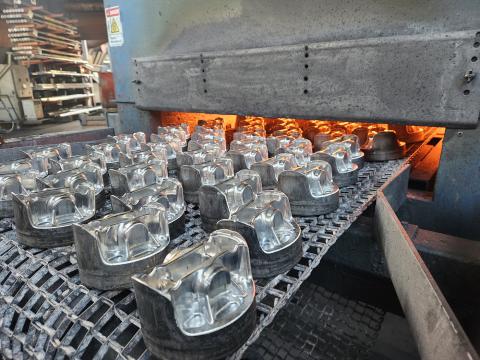
Forgings with intricate tooling requirements may have to be struck twice. Here the initial forging is being preheated to 800 degrees F at Performance Forge before going back to the press to be hit with a finish die. Tooling will last longer when using this process, and the forging is more refined before going to the customer.
It’s not always the piston’s fault. Analyzing piston failure can expose other problems in a race engine.
In a presentation at an AERA conference one year, Eric Grilliot of MAHLE Motorsport, based in Fletcher, North Carolina, led with a slide that simply stated: Rule No. 1: It’s never the piston’s fault!
“Then I had to convince a room full of engine builders to agree,” he quipped. “A lot of times the piston takes the brunt of what’s happening, whether it’s faulty fueling or detonation. The piston is literally right there in the line of fire.”
Analyzing piston failure has become more of a priority for manufacturers that supply product to the racing community. As boost levels and compression ratios increase for many race engines, failures also escalate. While the piston may not be the initial source of the failure, it bears the scars that can be examined and evaluated to uncover the root cause of the breakdown.
Race piston design, materials, and manufacturing haven’t really changed much in the past decade or so. Several new and promising alloys have been tested, but the negligible performance or durability gains are heavily outweighed by the increased costs. Only a few well-funded independent teams are trying these exotic materials. There’s the promise of 3D-printed pistons and those forged from composite materials, but those pistons are very rare in the aftermarket. Forged aluminum—mostly 2618 alloy—is still the preferred recipe in most motorsports segments, with some teams machining pistons from billet aluminum to address complex objectives.
Engineers are constantly making small design adjustments to meet the needs of racers, including working with thinner ring packages, modifying the skirt design, and playing with the barrel shape. However, there has been no significant design breakthrough that has disrupted the piston industry. On the manufacturing side, CNC machines are more precise, so more delicate designs can be attempted.
As for piston rings, they are getting thinner, and there is more attention to coatings. However, the biggest emphasis is on how the rings interact with the cylinder wall to maintain cylinder pressures. (See sidebar below.)
“There are numerous factors that can cause piston damage,” noted Jack McInnis of PBM Performance Products, Louisville, Kentucky. “Detonation puts tremendous mechanical stress on the engine and transfers a lot of heat into the piston. This can cause pistons to deteriorate, fracture, or even melt in extreme cases.
“For drag racing engines using power adders, we frequently upgrade to stronger heavy-duty wrist pins,” he continued. “Pistons for power adder applications are designed with the top ring groove set lower to prevent the ring land from fracturing. This often means the pin must also be located lower to keep it out of the ring grooves.”
“Bad tune-ups are the single biggest reason that leads to piston failures,” added Kirk Peters of Howards Cams, Oshkosh, Wisconsin. “If the engine has a detonation problem, no matter what the reason, it will lead to piston failure.”
“Tuning errors and/or chance circumstances leading to uncontrolled combustion [detonation] are the leading causes of piston failure,” said Trey McFarland of RaceTec Pistons, Huntington Beach, California. “Improper pin selection is also a common issue. We’ve seen failures due to both overly stiff, heavy-wall pins and too light, thin-wall pins.”
RaceTec tells the story of a customer supplying his own DLC-coated wrist pins. “The pistons were sent in for analysis due to an unrelated concern, and the evaluation showed the pins were distorting heavily,” recalled McFarland. “Due to the DLC coating, they had not yet pushed the pistons to failure. The customer was using the same pin his competitors were because the class was under the impression this was the cure for a galling issue that all were experiencing. We suggested a slightly longer pin to increase bearing area that would also not require DLC coating. This reduced costs as well as increased build intervals.”
Analysis Beyond the Piston
When a failed piston is returned to the manufacturer, each company has a procedure in place to inspect the product and find the cause of the problem. Sometimes that means analyzing more than just the piston.
“The biggest thing about analyzing is experience,” observed Chris Madsen of Ross Pistons, based in El Segundo, California, noting that in some failures the biggest piece of aluminum to examine is no bigger than a nickel. “Typically, if there is a failure, we like to see all the pistons. Sometimes you can find ones that are on the verge of failing and get an idea of what is really happening in the engine.”
MAHLE Motorsports provided this example of damage to the crown and pin bore of a diesel piston. “A lot of times the piston takes the brunt of what’s happening, whether it’s faulty fueling or detonation,” said Eric Grilliot. “The piston is literally right there in the line of fire.”
In one example, a customer had a new set of pistons for a rebuild and lost the engine on the first burnout. “Again, we need to look at everything. He had less than 20 seconds on the motor,” said Madsen, adding that the customer claimed the valve reliefs were not in the same location as the previous set of pistons. He sent only two pistons back, and both measured fine. Madsen then asked for the connecting rod from the failed piston. “We found two spots where it was cracked.
It was an NA motor, and they were going
too light.”
The rod hadn’t come apart but allowed enough flex that the piston rotated slightly and lost all radial clearance around the valve. Most likely it hit the back of the valve first, and the forces kept compounding with every rev until the piston was destroyed.
“Yeah, we like to see all the related parts, too,” agreed Bryan Moreland of CP-Carrillo, Irvine, California. “Wrist pins, locks, connecting rods, bearings, and parts from cylinders that didn’t fail. Sometimes you really can’t tell from the piston itself because it’s in such bad shape that it won’t give you a good read.”
CP-Carrillo has a rigorous action plan when analyzing a piston failure that starts with establishing a folder for data and detailed photos. The piston is inspected under a stereo microscope and sent to an in-house laboratory for even more intense evaluation.
“We have the ability to check hardness on all the parts that need to be evaluated. We also have cold saws so that we can section parts without changing the material properties,” said Moreland, who noted that the company’s OEM projects have led to a massive database that can be leveraged in piston failure analysis.
CP-Carrillo recently worked with a Top Fuel team that was suffering scuffing on the pistons. Engineers looked at changes in the oil selection, oil dilution, and differences between the cylinder blocks used by the team. They also checked a number of pistons for machining accuracy.
“Once we verify that the dimensions of the parts are all accurate, then we can start talking about what steps we can take to make the part different or better for that particular customer,” explained Moreland. “In this particular situation, we had a variety of concepts for pin-bore machining, skirt design, the areas around the oil ring, and
so forth.”
CP-Carrillo worked with the team to adjust clearances on the skirts. Attention was also focused on the ring-land diameters, piston taper, piston crown, and even the diameter of the holes in the oil-ring groove. Since there is limited Top Fuel testing, the team may try different piston designs in the same engine.
“That is the benefit of a Fuel car. They are pulling the pistons out every round anyway,” explained Moreland. “We have the ability to put one piston with one change in one cylinder, and one piston in with a change in another cylinder and try multiple changes at one time. It costs a lot of money to run those cars, so you have to test multiple things at once.”
Over at Mentor, Ohio-based Race Winning Brands (RWB)—which is the parent company for JE Pistons, Wiseco pistons, and Diamond Pistons—the customer bases and marketing efforts are separate for each brand. For example, JE continues to promote the Ultra Series with its unique Aligned Grain Flow forging technology, and Wiseco is putting the spotlight on its new Red series with some 150 new applications coming to market. Diamond is working on its 2K line with new offerings for the LS engine family and the 2.0-liter TDI architecture.
These damaged pistons were examined by CP-Carrillo engineers. The company’s OEM projects have led to a massive database that can be leveraged in piston failure analysis.
The company, however, will share engineering expertise for improving manufacturing as well as analyzing piston failures. As with other companies, it collects as much information as possible about the application and inspects the parts.
“Things like the color of the dome will tell us the heat range running in the motor. The color of the undercrown tells us how much heat saturated through,” said David Back. “Also, scuffing on the ring lands or the skirt, or signs of detonation. Those are all signs that jump out to you in the beginning and give you an indication of how the engine was running and what the tune-up was like.”
Engineers will then check material hardness against a large database on file at the companies to help determine running temperatures. Sometimes this step requires sectioning the piston to obtain multiple check points.
“That’ll basically tell us how heat was coming into it, how it was exiting, and whether heat was transferred appropriately,” said Back, adding that additional tests include examination with a Zyglo dye under a black light to check for hairline cracks. “And we usually will back that up with FEA simulation to see where those hot spots are on the piston and make sure that lines up with where we see cracks. That tells us that maybe we can improve those areas where those cracks are starting.”
RWB sees oil contamination from dirty environments and butting of the ring end gaps as two of the leading causes of failure. “Contamination is probably 50% of the failures. It seems when people send in the pistons, they don’t do a good job of trying to hide it. It’s pretty clear you have dirt or metal going through the oil,” said Back. “A lot of times they might have had the right intention when setting the end gap. But because of the tune-up, they had excessive heat and butted the rings. Through our internal testing, we always tell people to lean on the side of too much gap rather than too little gap.”
Coatings are also being emphasized at RWB, especially with the increased popularity of boost and with ring packages getting thinner, which affects the heat transfer.
“The vast majority of heat going into the piston has to come out of that top and second ring,” explained Back. “As the rings get smaller, that heat has to go somewhere else, so you definitely have to design accordingly. We’ve evolved a lot of different coating options to help combat that. Specifically, our thermal crown coatings help reflect heat away from the dome of the piston. We have anodizing, electrolysis, and nickel plating that also help that piston live a little bit longer in heavy-boost environments.”
Robotics’ Increasing Role
On the manufacturing side, there haven’t been too many changes of note. Wayne Ramay of Performance Forge in Montebello, California, a leading supplier of raw forgings to piston manufacturers, said robotics is playing an increasing role because of struggles in the labor market, and piston weight is always a concern with customers.
“Robotics help us in a number of ways—consistency of product, and consistency of labor,” said Ramay. “With regards to tooling, customers keep designing weight-reduction pockets to be deeper. Unfortunately, I can’t always do that. My tooling won’t last. A long, deep weight-reduction pocket takes a little finger on the forging die. When it hits the metal, it just puts so much side force on those little fingers that it can break them off.”
New materials are also being tested. “We’ve played with a couple of them, but they’re so expensive,” added Ramay. “We’ve been trying some with additional nickel, and they hold up really good. But with the cost, we can’t justify the benefit.”
UEM-Icon/KB Pistons in Carson City, Nevada, however, expects to introduce an exotic new composite forging for the wrist pin. “We’re working as a distributor with AWA Composites for a lightweight wrist pin,” said Christopher Sulprizio. “The wrist pin itself is about 40% lighter than a standard wrist pin. You’re looking at reducing upwards of 4 pounds from the rotating assembly.”
UEM’s strategy in analyzing piston failure is similar to other companies. Its team requests as much data from the customer as possible and also seeks to inspect the parts.
“Sometimes we ask for the rod and bearing, so we can see what kind of load that bearing was also seeing,” said Trevor Cleveland. “If it was a detonation condition, you start seeing that wear on that bearing, not just the piston. There are a lot of good resources in terms of identifying certain failures just by the damage on the piston.”
One such reference source is the “Failure Analysis Manual” from AERA. “It’s an encyclopedia of piston failures,” noted Cleveland. “You take your part, look in there, and can almost always figure out what your problem is. MAHLE also has piston failure books, and Kolbenschmidt, too.”
Among the numerous factors that can cause piston damage, “detonation puts tremendous mechanical stress on the engine and transfers a lot of heat into the piston,” said Jack McInnis of PBM Performance Products. “This can cause pistons to deteriorate, fracture, or even melt in extreme cases.”
A little more than a year ago, UEM licensed Speed of Air (SoA) technology to offer pistons with dimples on the crown. While dimpled pistons have been around for some time and often tried by race teams, SoA has patented the technology based on specific dimple diameter and depth, along with location on the piston crown. So far, it is showing promising results in the diesel market.
“We continue to partner with them, pushing new applications,” said Sulprizio. “We’re starting to find that Speed of Air has nothing less than spectacular results, especially on turbo applications, and some of our diesel applications are where this product shines. We’re working with SEMA for certification, and then we’ll have our first SEMA-certified diesel motors for the GM Duramax and potentially some others.”
Still a Place for Castings
The discussion so far has focused on forged pistons, but cast pistons still have a place in the market. MAHLE recently upgraded its castings for the LP5 Duramax.
“We make it a more robust part, and because we’re building for the performance versus all the restrictions that the OEM manufacturers have,” explained Grilliot. “We try to build reliability into the part for the guys pushing it into performance applications, like tractor pulling. Where they see weak points, we tweak and redesign the casting to accommodate them. These tweaks include modified bowl geometries, compression ratios, using our skirt coatings, and just trying to offer an overall more robust part, but still in a cast piston. That’s important for diesels because you can keep the steel insert for the ring groove, and they have the cast-in cooling channel on the inside of them—things you can’t do with a forging.”
Here is an example of a piston inspection at Race Winning Brands using Zyglo treatment, which is an extremely sensitive fluorescent process to detect cracks and surface irregularities.
MAHLE’s failure analysis practices are among the more robust in the industry, often leveraging lessons learned developing and testing pistons for OEM customers.
“If I made up a statistic, I might say that half the time we can’t ultimately tell you why something failed, but maybe we can tell you how it failed,” explained Grilliot. “We can see whether it overheated and melted and how that failure came about. But we couldn’t say it was because the spark advance was wrong, or because it went lean. There was something in that combustion event that led to the consequences that we saw on the piston.
“If there was one sentiment that I could share, it’s that being able to look at the entire picture is extremely important. All too often somebody will get a failure, and the knee-jerk reaction is to send in this one broken or failed part and have someone tell me what went wrong,” continued Grilliot, adding that inspecting as many parts of the engine as possible is key to identifying the root cause of the failure. “The reality is you may have one bad piston and seven good pistons, but seven good pistons to you isn’t necessarily seven good pistons to us. Those other seven usually tell the story or provide insight.”
In summation, a piston rarely fails on its own. More often than not the expectations of the piston are far too bullish. Said McFarland, “On custom pistons—not that the piston manufacturers cannot make a mistake when designing a piston—but in most cases, pistons are designed with a level of additional strength for the intended application. It is not uncommon that, despite recommendations, we are pressured to design to unrealistic goals with an improbable outcome.”
The Great Divide: Check Those Ring Gaps to Avoid Failure
Performance engine builders are moving away from iron and trending toward PVD-coated steel piston rings these days. For many applications, especially naturally aspirated, thinner is better. NASCAR and Pro Stock engines are reportedly in the 0.5- to 0.6-mm range for the top ring. High-boosted engines are known to be safe with 1.0-mm or a more traditional 0.043-inch top ring.
“With steel, you’re getting a better-quality material. It’s stronger and more malleable. It can be thinner and not break,” said Lake Speed Jr. of Total Seal, Phoenix, Arizona. “It can conform to the movement of the pistons.”
Speed said there’s often a misconception that the piston ring is comparable to a structural component within the piston. “The wrist pin is 100% a structural component. A piston ring is not a structural component. It’s a seal, and it needs to be able to conform to the movement of the piston. The thinner the ring is, the more it can conform.”
Which begs the question: If rings keep getting thinner, aren’t they more vulnerable to failure? “Not necessarily,” said Speed, noting that ring failure is often traced to the wrong end gap. “People are obsessed with trying to run too little end gap. There’s an idea that if I’m a couple thousandths too wide, I’m going to have a blow-by problem and my engine won’t run. That is absolutely wrong.”
Setting the proper end gap is crucial to ensuring piston and ring performance. Total Seal representatives said some racers may set the gap too close to avoid blowby, but heat expansion could butt the ends together and cause damage.
Speed said that while running a smaller end gap “makes sense on paper,” the reality is that on a 4.00-inch bore engine, a 0.012-inch gap won’t run any better than a 0.024-inch gap.
“In fact, I’ll say this: I can make that 24-thou gap probably run better than your 12-thou gap because I can use that little bit of blow-by to push oil out of my oil ring,” added Speed.
Of course, every engine is different, and dry-sump, boosted engines have different ring packages and clearance suggestions than wet-sump, NA engines. Thinner rings will expand more because they will get hotter, so stepping up from a stainless-steel ring to a tool-steel material may be necessary if the engine builder wants to run a very thin ring and maintain durability. Either way, end gap is the first defense against failure.
“What will normally happen when you have a problem is you’ll see some witness marks where there is butting of the ring ends. It might just be tiny, but whenever that ring butts, nothing good happens. Only bad things happen if the rings touch,” warned Speed. —Mike Magda
Better breathing and lighter weight enhance thermal protection in the latest selection of drivers’ suits.
Some 60 years ago, when most race cars were still powered by gasoline, fire protection for race drivers consisted largely of dipping cotton coveralls into a drum of supposedly fire-retardant chemicals. The resulting concoction was often proven to be inadequate. The resulting push to protect competitors from fire has exponentially boosted the sport’s safety as fire-resistant fabrics, led by DuPont’s Nomex brand, became standard-issue equipment for drivers.
The carnage from fire in racing has been unquestionably diminished. Over the decades, fire suits, as the racers call them, have evolved in terms of fire protection to include multiple layers of protective fabric. In the case of drag racing, where engine explosions are more commonplace, those layers have resulted in bulky, thick suits. The desired outcome of driver suit development has been a gradual arc toward making the suits easier to wear. It can be tough, and dangerous, for a driver to exit a burning race car if the suit binds up his or her movement like a straitjacket.
During our interviews with several prominent US manufacturers of drivers’ suits, the providers agreed that compliance with SFI Foundation guidelines for driver protection from fire, which in themselves have become more stringent and comprehensive with the passage of decades, is nearly universal. They are also
in agreement that because of SFI and constant testing, most suit manufacturers have arrived at a plateau where excellent fire protection is the norm across the board, given constants such as the number of layers of a given suit. They agree that any additional protection against thermal injury is likely to come incrementally as fabrics undergo continued development.
What is more realistic is that drivers’ suits of tomorrow will become increasingly user-friendly to their wearers. Product manufacturers are continually engaged in testing and research to find new materials that will allow the suits to breathe better, enhance the wicking of driver perspiration to minimize the threat of steam burns in a fire, and improve their suits with panels that are both fire-resistant and flexible enough to afford racers more freedom of physical movement, especially when they’re trying to escape from a flaming race car.
K1 RaceGear has created a new process of Nomex digital printing that offers a lighter suit that meets the demands of today’s sponsors for logo presentation.
Cooperative Effort
“The first thing to clarify is that all the manufacturers today have a cooperative effort between the manufacturers and the suppliers,” said Ben O’Connor of Impact Racing, Indianapolis, Indiana. “You have suppliers that are trying to sell us goods and services, and then they work toward trying to develop better products, such as fabrics. They’re the ones who are really doing the technical development work. We may use an outer layer with a combination of a different layer that may come from a different supplier, to come up with the best protection and thermal properties.”
O’Connor noted that SFI standards for burn protection “haven’t really changed in decades.” Most suit manufacturers today have no difficulty when it comes to meeting the SFI requirements. “The real key, and where the magic is, is better fabrics and better breathability. If you look at what was being produced 10 years ago, and what’s being produced today, it’s profound in terms of how light the fabrics are and their breathability. And there are secondary considerations, like stretch panels for comfort, the design and patterning of the suit, where you put the belt, and even closure types. Whether the suit is two layer for SFI 5, or multiple layers for SFI 15 or 20, we’re creating it while also making it lighter and breathable.”
Fire-resistant drivers’ suits today largely employ two different fabrics. One is Proban, the name given to cotton-based threading used in some SFI-approved fabrics. The other major group is Aramid, a nylon-related polymer that is more rigid and can also be milled into fabrics, with Nomex arguably the best-known brand. As O’Connor explained, the milling process involves variables such as the distance between individual threads, how large the threads are, and how much the patterning affects the weight of the suit. This process is one reason drag racers, who once wore bulky, astronaut-style aluminized fire suits, now enjoy the added mobility and protection of multi-layer fabrics.
Impact Racing offers custom-designed drivers’ suits for top professionals such as NASCAR racers, and the technologies of those suits have trickled down into more widely marketed suits. “Going forward, we’re still looking for better breathability and light weight,” O’Connor said. “Today’s changes could be very small and incremental, a lot smaller compared to what we’ve done over the past 10 years.”
Digital Influence
Carlsbad, California-based K1 RaceGear offers a line of protective gear including its Challenger, Precision, and Aero SFI lines of racing suits, and is doing its modern adaptations in view of today’s importance of motorsports as a marketing tool. In the past, heat-transfer suit graphics and dye-based materials began to pose challenges such as reduced airflow inside the suit and added weight. That led K1 RaceGear to create a new process of Nomex digital printing, which offers a lighter suit that meets the demands of today’s sponsors for logo presentation.
Continual testing and research with materials have resulted in suits that breathe better, enhance wicking, and improve freedom of physical movement.
K1 RaceGear has shifted from traditional hand-patterning to Optitex digital patterning. This technology, tailored for apparel design and akin to SolidWorks, allows for precise customization based on individual body measurements, according to a company source. Digital patterning ensures a consistent fit for drivers across various suits. Once an optimal fit is achieved, the pattern can be easily replicated on future suits, providing drivers with a dependable and standardized fit. The Optitex software also facilitates the overlay of artwork onto the pattern, ensuring accurate positioning and sizing of logos and designs.
All of this allows for the suit to provide adequate thermal protection while also meeting rigid standards on the sizing and positioning of sponsor logos as required by groups including NASCAR and IndyCar. These advantages also translate to sportsman-type suit buyers looking for better sponsorship exposure. NASCAR has also added tests for the flame resistance of embroidery and other suit add-ons. Aesthetics will be a big component of future suit development, sources at K1 RaceGear believe, along with addressing safety concerns such as heat exhaustion, which better fabric breathing will address.
Personal Experience
Fabric evaluation and selection is also a key element of suit creation from Redtide Race Gear in Salt Lake City, Utah, as identified by Josh Minson. “The biggest thing at Redtide is that we want a lightweight Nomex suit that won’t weigh them down, and we’re working to get them as light as physically possible within the SFI guidelines,” he said. “I wear one myself, so if I don’t like it, I’m not going to sell it to a customer. We try to build a brand so everything’s custom. Everyone has a different body shape.”
Minson noted that a current Redtide SFI 20 two-piece suit weighs 13 pounds, meaning additional lightness is a goal. The overall weight of the suit can be exacerbated by the weight of logos stitched to it. As Minson explained, “Nobody wants to sit in a 30-pound suit. That’s where we’ve excelled in terms of our racers giving feedback, including our NHRA racers, and we start adapting some of that. This year, we’ve added extra gusseting.”
As to the future, Minson expects more effort to lighten the fabric and patterning. “All the manufacturers are doing the same thing. Nomex is Nomex, and they can try to work with things like thread counts, so we’re trying to learn what fabrics are going to be better. Most of our customer base is in the drag racing market. We do have some circle track racers that we work with. Some of them prefer a two piece as well. Obviously, there are some people who require a single piece, like the ARCA racers we’ve done some work for. I’d say it’s pretty much 50/50 on preference. Weight is pretty much the same. Another thing we’ve done on two-piece suits is started offering belt loops, so if you wear suspenders, and if your pants keep falling off, you can wear a belt.”
Drag racers, who once wore bulky, aluminized fire suits, now enjoy the added mobility and protection of multi-layer fabrics.
As an example of fire-safety evolution, Minson pointed to the heavy bunker gear worn by firefighters, noting that those materials were eventually modified into lighter suits favored by volcano explorers. “In the next 10 years, you’ll see Nomex products and futuristic styles that are going to be coming out, lighter than the typical Nomex,” he said.
Meeting Expectations
Some suit makers have a different measure of practical product-planning experience. Cheyenne Reed of Accelo Racewear in Punxsutawney, Pennsylvania, is a longtime local racer who now campaigns a dirt late model. He started his driving suit experience by trying to fabricate a custom suit to fit his father. “I had a really hard time ordering from different companies, with poor customer service, and the whole process was cumbersome and difficult,” Reed said. “The fit wasn’t very good, not what we were expecting from a custom suit. I finally hit the ground with Accelo in 2019 and had a lot of success. As a racer myself, I know what people expect.”
Reed makes the obvious point that anyone who straps into a competitive vehicle of any kind needs a protective suit, such as Accelo’s Champion line of SFI-approved racewear. Accelo Racewear is currently working to develop drivers’ suits that will meet the SFI 3.4A5 standard, which is now a NASCAR requirement. “The logos for SFI 3.2A5 don’t have to go through testing, but for 3.4A5, they do,” Reed said. “They have to exceed SFI’s benchmark to pass. We send in samples to SFI that are the same way we construct the suit for thermal protection. They do flame burn [the fabric samples], shrink them, and do other tests. A lot of the parts are the same, but with 4A5, you have to send in samples of the logos for testing as well.”
Impact Racing offers custom-designed drivers’ suits for top professionals such as NASCAR racers, and the technologies of those suits have trickled down into more widely marketed suits.
Accelo, like other providers, is working to find and develop alternative fabrics to make the suit more driver-friendly while still delivering superior protection. “We definitely have some things in the works,” Reed explained. “We’re working with suppliers to develop lining materials, usually a soft-knit Nomex. They might be able to produce seamless liners for us, depending on how we can construct the suit, which would be more comfortable for drivers, and we might be able to produce more breathable material to keep the driver cooler. One of the issues with a fire is that a lot of the time, injury comes from a steam burn because they’re wet with sweat, not just the flame burn. It depends how much moisture is in the suit that hasn’t evaporated. The farther we can get the moisture away from the driver’s skin, the better off we are.”
Budget-Conscious
G-FORCE Racing Gear of Acworth, Georgia, is another provider that offers a comprehensive line of equipment for all aspects of driver protection. Danilo Oliveira estimates that suits make up about 5% of overall business, which also encompasses tools such as driver restraints and helmets. G-FORCE aims most of its products at budget-conscious racers, who don’t require the sort of advanced fire protection that the FIA mandates for Formula 1, for instance. As an example, Oliveira points to enhanced glove and shoe protection mandated by the FIA after Romain Grosjean suffered burns to his hands and feet when he was trapped in his burning F1 car for close to 30 seconds following a horrific 2020 crash during the Bahrain Grand Prix. “Personally, I think the suits we offer provide excellent protection,” Oliveira said. “If the SFI standard stays as it is, we will be working with better materials increasing how long the suits can handle the fire, but not necessarily to increase driver protection. There hasn’t been anything major [in terms of fire-protection advances] in the last nine, 10, 11 years.”
One driver mistake he has repeatedly spotted is amateur competitors relying on less-expensive karting suits while driving race cars. Karting suits are designed to protect their wearers from abrasions when they become separated from a kart, not against injuries from fire. “If you look at how suits have gone in the past five to 10 years, that is the best protection you can have,” Oliveira explained. “No one gets heat-injured anymore if they are wearing the proper material. We are working on lighter material that is still going to give the same amount of protection.”
“We want a lightweight Nomex suit that won’t weigh them down, and we’re working to get them as light as physically possible within the SFI guidelines,” said RedTide’s Josh Minson. Seen here is drag racer Camrie Caruso wearing a RedTide suit.
Doing that at G-FORCE, Oliveira said, involves blending better comfort and flexibility into a suit that racers on a budget can reasonably afford. “As a company, we don’t work with high-end customers,” he explained. “We look at a suit that costs $2,000 and ask, how do we get the latest technology in a suit that’s going to cost one third of that price? My customer base is entry level to midrange. If the suit is $1,000, my customers aren’t going to buy it.”
G-FORCE has worked over the past few years on making suits at an affordable price point “while offering it with ‘X’ weight,” Oliveira said. “If you look at our entry-level competitors, their suits haven’t changed in the past 20 years. We are making the entry-level products better, so we can offer the best suit at a $500 price point.”
Ford’s 7.3-liter “Godzilla” V8 is breaking out into the wild and coming soon to a track near you.
At a time when practically every new production engine sports double overhead camshafts, turbochargers, hybrid technology, and aluminum everything, Ford Motor Company zigged when everyone else zagged.
In 2020, Ford released its new 7.3-liter “Godzilla” V8 for its Super Duty line of trucks. The engine was designed as a replacement for the SOHC 6.8-liter Triton V10 that had been available in large Ford vehicles since 1997. For those who didn’t want or need a diesel powerplant, the 7.3L (445 cubic inches) was the new, large-displacement, gasoline-powered V8 alternative.
But rather than follow the pattern of increasing complexity and fashionable technology that has dictated engine design in recent years, the Godzilla V8 arrived like some throwback from an earlier time. Besides plentiful cubic inches, the 7.3 features overhead valves, pushrods, a camshaft located in its traditional spot in a cast iron block, and a forged steel crankshaft.
Even more important for the motorsports and hot rodding audience, Ford Performance almost immediately made the engine available as a crate engine. In crate form, the Godzilla V8 is factory rated at 430 horsepower and 475 lb.-ft. of torque. “The Ford crowd finally has a modern pushrod engine at their disposal,” said Cale Risinger of Melling, Jackson, Michigan.
Making Fans
Whether from a slow rollout due to pandemic supply chain challenges, or just the newness of the engine, the Godzilla 7.3 hasn’t made serious inroads in professional racing classes. That’s steadily changing, but in the meantime, the street/strip market and engine swap crowd have embraced the engine with both arms, according to our sources.
“The racing guys aren’t totally sold on it from the performance aspect, just due to the lack of experience with them. They have no history with the 7.3 yet,” said Todd Warren of Apocalypse Performance, Mason, Ohio. “Some people are scared to get into them because the weak points are unknown at this time. But the engine swap community is big on them—people getting rid of the old 460s, some of them even getting rid of diesels in some of the older trucks.”
Apocalypse Performance has a Facebook group dedicated to the 7.3, and enthusiasm for the engine is reflected by the 12,000 members. “Most of them, I would say, are just going into older trucks,” Warren explained. “We have a Facebook group that caters to the 7.3 and swaps, and the vast majority are going into older F-150s, F-250s, stuff like that.
Packaging the Godzilla for engine swaps has been a priority for Holley. In the past year, the company has released a high-mount accessory drive, an oiling system positioned to gain crossmember and ground clearance, a low-profile intake manifold, and this Terminator X ECU.
“As far as what we sell, most of it’s the swap parts, the stuff to delete the oil coolers, cooling passage block-off parts, and some other stuff that the guys doing swaps aren’t using. The majority of people here are just doing crate engine swaps into older stuff, like Fox body [1979–1993] Mustangs. A couple of guys have put them in Fairmonts, which is pretty cool,” Warren added.
At Holley in Bowling Green, Kentucky, the appeal of the Godzilla to owners of older Mustangs has also been apparent. “You see a lot of use in Fox-body Mustangs,” said Dave Bellm. “That’s kind of the bread-and-butter Godzilla swap application, a Fox Mustang or maybe an SN-95 Mustang. That said, if it will fit in there, it will fit in just about anything that could reasonably accommodate a V8.”
One factor in the Godzilla’s popularity is its size. It offers big block displacement, but in a configuration that’s not much larger than a small block Ford 351 Windsor V8 and is quite a bit smaller than Ford’s big block FE-series and 429/460 engines. Ford’s current mainstream performance engine, the “Coyote” 5.0-liter V8 found in the Mustang GT and F-150s, is a respected engine in the performance world. But its wide double-overhead-cam dimensions make it a tough swap for many applications.
“The Godzilla is smaller than a Coyote from the width standpoint,” Warren said. “It’s taller, but from the width standpoint, for guys putting them into cars, there’s a huge benefit. You can actually work on the engine when it’s installed. For the average hot rodder, the guy who’s going to work on his own car, that’s a huge benefit. It fits into the older cars, the older Mustangs, a lot better than a Coyote. You don’t have to pull out your shock towers to put a Godzilla in.”
Indy Power Products of Indianapolis, Indiana, currently specializes in 7.3 Godzilla engine components. Jim Ryder sees the engine being widely swapped into older cars, with many destined for both street action and track days. “We’re seeing a lot of engine swaps being done with it,” Ryder observed. “You’ll see the aftermarket Cobra guys doing the replicas, they use it quite a bit. They’re now looking at putting it in the GT-40 replicas as well as the Shelby Daytona Coupes. Lincolns, Mustangs, early Broncos, late Broncos, it’s just a nice engine swap package.”
Yet the 7.3 Godzilla V8 is not tiny. From the factory, the crate engine is tall enough that much of the aftermarket’s initial focus has been on parts that trim dimensions to maximize the number of vehicles that can accept it. The primary issues are a deep oil pan and associated oiling system, tall intake manifold with an upturned throttle body, and a wide accessory drive.
Melling has introduced three new camshafts for the Godzilla engine, with power gains of 50–100 hp. While the factory cam “is an assembled cam, the Melling cams are all machined from one-piece billet cores,” said Cale Risinger.
Packaging the Godzilla for engine swaps has been a priority for Holley. In the past year, Holley has released a high mount accessory drive that allows for flexible configurations, and an oiling system that uses a high-capacity gerotor pump positioned behind the timing cover to gain crossmember and ground clearance, along with an external access port for easier switching of the pressure spring. Holley’s aluminum Godzilla intake manifold offers a lower profile and downturned throttle body angle for additional clearance, plus support for cable-driven or drive-by-wire throttle bodies. Holley’s combination of parts can even allow the use of the factory hood in applications such as the Fox Mustang.
“Once you can get the oil pan shortened up on it, get the accessories pulled in, and then get a manifold low enough, then this thing can go into all kinds of stuff without too much trouble,” Bellm said.
Apocalypse Performance developed billet main caps for the Godzilla block because the OEM caps “were seen as a potential weak point,” said Todd Warren. “We haven’t seen anybody break a main cap, but the stock main cap just isn’t up to par with those in the higher horsepower engines.”
One of the main aspects of the 7.3 Godzilla engine that has attracted aftermarket attention is the oiling system, for both ease of engine swapping and performance reasons. “We had an engine just about as the pandemic hit. We tore it apart and said, ‘What are we going to do here?’” Ryder recalled. “I wanted to jump right on cams and performance, but then I looked at the oiling system and realized it was going to be a packaging issue for a lot of the applications.
“It’s really neat how Ford did the stock oiling system with the oil pump located in the sump of the pan and the shaft going back to drive the oil pump, and variable displacement,” Ryder added. “It’s really a nice package for the F-250s and F-350s and trucks, but it just won’t package in a lot of applications. So that’s where we jumped in. We said, ‘Well, there’s going to be the first opportunity, let’s replace that oiling system with something we can package.’ That’s where you see one of our two oiling system solutions, a front-mounted gerotor pump that we came up with. That allows you to put a front sump or rear sump pan on there. We’ve got a special pan for the Cobra kit cars, and you can do custom pans as well with our system.
“Our newest system uses the stock, production oil pump and relocates the pick-up to some parts that we make for the back of the stock oil pump,” Ryder continued. “We can take 2 inches out of that rear sump pan. Our newer system uses the stock oil pump, rear sump only, and it has a built-in pressure relief valve into the pump. It actually then brings the oil inlet and outlet to the same side of the engine.”
Deep Breathing
A crate engine is often seen by enthusiasts as a starting point, and so the performance aftermarket has wasted little time in discovering what the Godzilla engine responds to, and what it needs to support higher outputs.
“The biggest, the first thing, is the camshaft,” Ryder said. “You can keep the production valve springs and do a camshaft change and pick up over 100 hp. If you pull it out of the crate and put it on a dyno, it’s going to read 500 hp. Advertised in the truck, with the exhaust and air cleaner in place and everything, the SAE spec is lower. But if you go to any engine shop and put the crate engine on a dyno, it’s going to read right around 500. You do that cam change with a stock intake and everything and you’re over 600 hp.”
The forged pistons MAHLE developed for its Godzilla PowerPak piston set are “ideal for added durability and reliability for any vehicle equipped with a boosted or turbocharged Godzilla engine,” said a company source.
Melling announced in January three new camshafts for the 7.3, with power gains of 50–100 hp depending on the cam. “The Godzilla has fairly good cylinder heads from the factory, which makes a cam swap one of the easiest ways to add power,” said Risinger. “The three cams that Melling is offering are aimed at the street rod, street/strip, and drag race only crowd. The factory cam is an assembled cam; the Melling cams are all machined from one-piece billet cores.”
Recently introduced forced induction options for the 7.3, such as ProCharger’s centrifugal supercharger and Whipple’s twin screw supercharger, have also allowed racers to reach next-level horsepower. “The drag race guys have really taken to it, especially with the readily available superchargers now, and turbochargers,” Ryder explained. “The drag racers just love it. You take one of these engines and put a turbo or throw a supercharger on it, and you’re over 1,000 hp. We’re seeing a lot of drag race applications.”
As the aftermarket, racers, and hot rodders continue to find ways to build power with the Godzilla, strengthening the engine for endurance has taken on added importance. “We developed some billet main caps. That was seen as a potential weak point,” observed Apocalypse Performance’s Warren. “We haven’t seen anybody break a main cap, but the stock main cap just isn’t up to par with those in the higher horsepower engines.”
Warren said he has seen failures with the stock timing set in high-rpm, high-horsepower applications. “A good double roller timing set would go a long way with this engine,” he noted.
Ford Performance has also raised the bar with its own “Megazilla” crate engine. Megazilla comes factory rated at 612 hp and 670 lb.-ft. of torque thanks to a Ford Performance intake manifold, 92-mm throttle body, CNC-ported cylinder heads, high-performance camshaft, MAHLE forged pistons, Callies H-beam forged connecting rods, and other tweaks. According to our sources, Megazilla sightings have been scarce on the ground. Whether that’s from the newness of the package or the Megazilla’s nearly $23,000 price tag is hard to pinpoint. For now, racers have discovered that they can vault their Godzilla engines to Megazilla levels of power using the latest batch of aftermarket parts.
ATI Performance Products has released its SFI flexplate and SuperCase bellhousing kit for the Ford 7.3L Godzilla engine. This kit even allows racers to run a GM transmission and torque converter behind the Ford engine.
“The longer the engine is around, the more people are coming out with stuff,” Warren said. “Getting better intake manifolds, getting better cam profiles, valvetrains, everything. We worked with Jesel when they produced their adjustable rocker arms for it. It’s all coming around.”
Looking ahead, the racing community should expect many more Godzilla sightings. “I think the market is still so young for that engine that I think we’re going to see it going a lot of different directions now that there’s stuff out there to make it more of a viable swap,” Bellm said. “Before, it was something you really had to want to do pretty badly. You had to be that pioneering type who is willing to sort out problems and figure things out. There’s a big thread of that that runs through hot rodding and racing, of course. But if they can just bolt stuff in and make it easy, that’s even better.”
 MEMBERSHIP LOGIN