USF Pro Championships Announces 2026 Schedules

Submitted by ajh on Mon, 10/27/2025 - 14:08
USF Pro Championships


Andersen Promotions, parent company of the USF Pro Championships, has confirmed the 2026 calendar of events for the three series that comprise the driver development ladder.

Highlights of the 2026 schedule include:

  • A total of 32 races in support of INDYCAR
  • An expansion to two oval events for USF Pro 2000 with the addition of The Milwaukee Mile
  • A debut on the Streets of Markham for USF Pro 2000 and USF2000
  • Inclusion on the Streets of Arlington inaugural event for USF Pro 2000
  • Three new circuits for USF Juniors, including Lime Rock Park alongside the NASCAR CRAFTSMAN Truck Series
  • An extended schedule ending in late September at Road America for all three rungs of the ladder
  • The continuation of both INDYCAR and AMR Safety Team services


Once again, more than $1.48 million in prize money and awards will be distributed in 2026 including champion's scholarships valued at $594,500 for the USF Pro 2000 champion to graduate to INDY NXT, $405,050 for the USF2000 champion to advance to USF Pro 2000 and $249,675 for the USF Juniors champion to move to USF2000.

Continental Tire will continue to provide $53,000 in pole position awards over the course of the season.

For more information, visit usfprochampionships.info.

See the full 2026 schedule below:

USF Pro Championships


October 2025

NASCAR Unveils 2026 Whelen Modified Tour Schedule

Submitted by ajh on Mon, 10/27/2025 - 13:55
Whelen Modified Tour


NASCAR has revealed the 16-race slate for the 2026 NASCAR Whelen Modified Tour schedule.

The new season marks the highly anticipated return of Stafford Speedway (CT) and Oxford Plains Speedway (ME), while the championship finale moves back to Thompson Speedway Motorsports Park (CT).

The Tour will once again kick off at New Smyrna Speedway (FL) on February 7, marking the fifth straight year the high-powered Modifieds will open their season at the 0.48-mile Florida oval near NASCAR headquarters.

From there, the series will appear on some of NASCAR's biggest weekends. On Friday, March 27, the Tour will set the stage at Martinsville Speedway (VA), opening a weekend that includes the NASCAR Xfinity Series and NASCAR Cup Series. Later in the season, on Saturday, August 22, the Modifieds will headline the NASCAR weekend at New Hampshire Motor Speedway.

Two beloved tracks make their long-awaited returns in 2026. Oxford Plains Speedway rejoins the Tour for the first time since 1991 with a race on May 2, while Stafford Speedway returns on August 28 with the Riverhead Building Supply 150 for the first time since 2021.

The 2026 calendar also features the return of White Mountain Motorsports Park (NH), Monadnock Speedway (NH), and Oswego Speedway (NY). Claremont Motorsports Park (NH) is also back on the schedule for the first time since 2022.

For more information, visit nascar.com/whelen-modified-tour. See the full 2026 schedule below:

26 Whelen Modified Tour


October 2025

WoO Late Models Set for Hendry County Motorsports Park in '26

Submitted by laurap on Mon, 10/27/2025 - 13:42
World of Outlaws Real American Beer Late Models presented by DIRTVision logo


After years of planning, the dirt road has opened for the World of Outlaws Real American Beer Late Model Series presented by DIRTVision to invade Hendry County Motorsports Park during the Swamp Cabbage weekend in 2026, the series stated.

The World of Outlaws will make its debut at the 1/4-mile dirt track in Clewiston, Florida--about an hour away from Fort Myers, 90 minutes from West Palm Beach, and a short drive from Lake Okeechobee--on February 20-21, for the Swamp Cabbage 100.

"I've wanted to do this deal forever," said track promoter Ken Kinney. "The ultimate goal is to get the World of Outlaws. As a kid, you've always heard of the Sprint Cars or the Late Models, so that was the ultimate goal to get the Super Late Models in Southwest Florida, because it has never happened.

"It's just something people have always had a vision down here to do, but it had never been possible. With East Bay being gone, we fill a perfect void."

There's already a plethora of local support behind the event from the likes of the Hendry County Tourism board, Clyde Johnson Contracting & Roofing, of Clewiston, FL, Central Mobile Homes Inc., of LaBelle, FL, Seminole Brighton Bay Casino & Hotel in Okeechobee, FL (30 minutes from the track), and the Seminole Casino Hotel in Immokalee, FL (50 minutes from the track), according to the series.

The event will present another healthy purse for teams following Federated Auto Parts DIRTcar Nationals, with Friday's 40-lap race at Hendry County paying $12,000 to win, and Saturday's 60-lap finale paying $20,000 to win.

Drivers will also get to participate in a bass fishing tournament during the week.

"We've been working with Ken for the past few years to create this event, searching for a time that worked best for both parties and allowed us to build it into a new vacation destination for race fans," said World of Outlaws Late Model Series Director Steve Francis. "We're excited to bring the World of Outlaws to Hendry County for the first time and expand the reach of Super Late Model racing in Florida."

To further enhance the fan experience for both nights, every ticket will be all-inclusive, providing access to the grandstands and pit area. Every fan will get to see the cars and stars up close before watching them battle around the Florida bullring. Fans can get a jump on securing their tickets when they go on sale on Wednesday, Oct. 29, by calling 863-675-8888.

If you can't make it to the event, you'll be able to watch every lap live on DIRTVision.

October 2025

WoO Sprints Set for Canada Return in 2026

Submitted by laurap on Mon, 10/27/2025 - 13:32
World of Outlaws NOS Energy Drink Sprint Cars logo


A trip across the northern border is on tap for the World of Outlaws NOS Energy Drink Sprint Car Series again in 2026, with a doubleheader event at Ohsweken Speedway in July.

A few days after crowning a new Kings Royal champion, "The Greatest Show on Dirt" will make the trek north to Ontario, Canada, for the Federated Auto Parts Six Nations Showdown, featuring a $15,000-to-win night on Tuesday, July 21, and a $20,000-to-win night on Wednesday, July 22.

This year, the World of Outlaws returned to Ohsweken for the first time since 2017 and held a two-day event there for the first time since 2010.

Tickets go on sale on Saturday, November 1, at 12:00 p.m. ET. Visit ohswekenspeedway.ca for tickets and event details. If you can't make it to the track, you can watch every lap live on DIRTVision.

For more information, visit worldofoutlaws.com/sprintcars.

October 2025

Bernal Appointed Elgin Industries Director of Global Aftermarket Sales

Submitted by ajh on Mon, 10/27/2025 - 13:24
Elgin Industries Juan Bernal


Juan Bernal has been appointed director of global aftermarket sales for Illinois-based Elgin Industries, a supplier of engine and chassis parts for original equipment, aftermarket replacement and high-performance vehicles and equipment.

Bernal will oversee all sales and customer development activities for Elgin's aftermarket business, which serves distributors, engine builders and other customers throughout the United States and Canada as well as Latin America, the Middle East and other regions.

Bernal previously was director of business development, Mexico and Central America for Old World Industries, Northbrook, Illinois. He joined that company in 2019 as Latin America sales manager after having held a similar position with Ecco Safety Group, Boise, Idaho. Earlier he was export sales director for ATP Automotive, Elk Grove Village, Illinois, and held international customer service and sales responsibilities for Old World Industries.

For more information, visit elginind.com.

October 2025

Illinois Stock Car Hall of Fame Inducts Class of 2025

Submitted by laurap on Mon, 10/27/2025 - 13:23
Illinois Stock Car Hall of Fame logo


The Illinois Stock Car Hall of Fame, based in Roscoe, has officially inducted its Class of 2025 following a ceremony and festival at the Historic Auto Attractions Museum near Rockford.

The 12th annual celebration honored four new inductees and stock car visionaries, including Larry Schuler, Bob Pierce, Bill Venturini, and the late Elmer Musgrave.

Schuler, still an active pavement racer at 72, scored his first late model feature win in 1973 at the former Illiana Motor Speedway, a now-closed race track located in Schererville, Indiana. More recently, he scored his 79th career win at Grundy County Speedway during a 40-lap NASCAR Advance Auto Parts Weekly Series main event this summer.

Pierce is a dirt late-model champion throughout the nation, especially in the Midwest. His career began in the early 1970s, frequenting tracks like Fairbury, Farmer City, Macon and Danville. In 1983, Pierce reportedly secured 38 feature race wins, plus two UMP Summer Nationals titles in 1992 and 1995, for a total of 14 career Summer Nationals victories. In 1990, Pierce was the UMP national champion. Following his racing career, he founded Bob Pierce Race Cars, a dirt-track modified and late-model chassis builder and parts supplier in Oakwood, Illinois.

Following in his father Tony's racing footsteps, Venturini started his racing career in the 1970s, winning his first late model feature in the Roadrunner division at Rockford Speedway in 1976. Bill began competing in the United States Auto Club (USAC) stock cars in 1978, in addition to the American Speed Association, ARTGO late models, and the International Racing Association. For a time, Venturini became known for his all-female pit crews, led by his wife, Cathy. With starts in the NASCAR Cup, Busch, and Craftsman Truck Series, he later rounded out his driving career with his first ARCA stock car championship in 1987, repeating the effort in 1991. He began fielding cars for his son, Billy, to race in ARCA competition before establishing roots in Concord, North Carolina, for Venturini Motorsports. The team, known as one of the winningest car owners in ARCA history, was officially sold to Nitro Motorsports earlier this year.

The late Musgrave began his racing career just before 1950, before rising to be known as a formidable force on short tracks throughout Chicago and the Midwest region. For years, Musgrave was a staple late-model competitor at O'Hare Stadium in Schiller Park, Illinois, in the modified class, and also competed in national races with USAC and the Midwest Association for Race Cars, now known as ARCA. He secured two wins with USAC, one in 1959 and another in 1963, plus five MARC/ARCA races. As is typical in the industry, Musgrave passed the racing gene to his sons. Tom Musgrave is a two-time late model champion at Grundy County Speedway, while the younger Ted Musgrave was competing at Waukegan in 1974. Ted even made starts in the NASCAR Cup Series and Craftsman Truck Series, winning the truck championship in 2005. Elmer Musgrave passed away in 2000 at the age of 72. His son Ted accepted the recent induction award.

October 2025

Watch What Happens When PRI Starts a Movement

Submitted by ajh on Mon, 10/27/2025 - 10:59
SEMA PRI PAC


In Washington, D.C., and in statehouses across the nation, PRI and SEMA's Government Affairs team is delivering on behalf of the motorsports and automotive aftermarket industries. From defeating electric vehicle (EV) mandates to protecting access to racing and motorized outdoor recreation, we're ensuring our industry's voice is heard loud and clear in policy debates.

Every win generates highlights--and ours are no different. Click here or below to see how SEMA & PRI PAC started a movement on behalf of the aftermarket.

PRI SEMA Watch What Happens When PRI Starts a Movement Advocacy Washington DC


Join Us on the Road to Victory at the 2025 PRI Show

If you want to join a winning team, your first move should be to join us at the SEMA & PRI PAC Reception at the PRI Show on Thursday, December 11, at The Westin Indianapolis Capitol Overlook in Indianapolis. Your $200 personal contribution (a donation is required to attend) puts you in the room with our industry's movers and shakers and helps fuel the SEMA & PRI PAC to bolster the efforts of our industry's champions. 

Together, through SEMA & PRI PAC and Driving Force Action SuperPAC, we're building the political horsepower to elect allies, stop harmful policies before they gain traction and keep the aftermarket thriving.

Learn more about the SEMA & PRI PAC and the Driving Force Action SuperPAC during your visit to the 2025 PRI Show, December 11-13, Indianapolis.

2025 SEMA & PRI PAC Reception
Thursday, December 11
The Westin Indianapolis - Capitol Overlook
241 W. Washington St, Indianapolis, IN 46204

A PAC contribution is required to attend. The suggested contribution is $200 per person.

For more information or to RSVP for the event, contact PAC Development Director Eleanor Rollings at eleanorr@sema.org.

October 2025

Big Exposure at the PRI Show, Starting at $75

Submitted by ajh on Mon, 10/27/2025 - 10:15
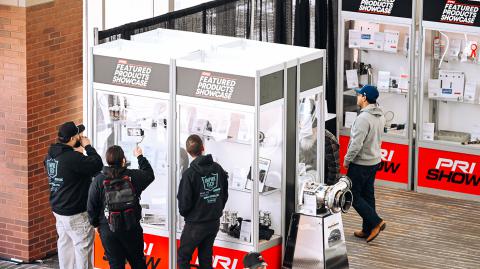
Featured Products Showcase


If your goal at the 2025 PRI Show—December 11-13, Indianapolis—is to attract more buyers, generate qualified leads and boost brand recognition, this is your chance (and for only $75!). 

The Featured Products Showcase is the top destination for attendees looking to source the newest technology and performance innovations. Exhibitors who participate see increased booth traffic, stronger buyer engagement and more post-show inquiries. 

ENTER HERE button for PRI News Featured Products Showcase 2025 PRI Show


Here's what you'll gain by entering your hottest products in the Featured Products Showcase: 

  • Premium exposure to thousands of qualified racing professionals. 
  • Online promotion before and after the Show through PRI's digital channels. 
  • Media coverage opportunities that put your product in front of the industry's top outlets. 

Don't let your latest innovation go unnoticed! Submit your product now and turn attention into action at the 2025 PRI Show, December 11-13 in Indianapolis. 

Affordable entry fees starting at $75 ($100 per entry after December 5).

Click here for more information or to submit an entry.

October 2025

Engineer's Dream: Super Mod Tractor Class

Submitted by ajh on Mon, 10/27/2025 - 09:26


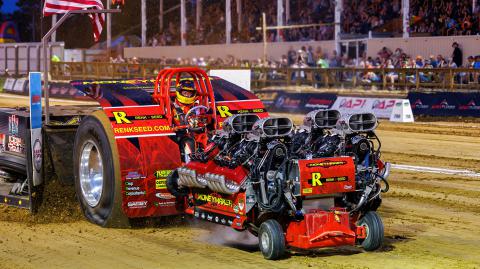
The Pro Pulling League (PPL), headquartered in Charlestown, Indiana, calls its Super Modified Tractor class "an engineer's dream." The goal is the same as other pulling classes: Drag the sled down the 300-plus-foot track as quickly as possible while a weight on the sled moves forward, making progress increasingly difficult.

But the variables in this class are unique. Pullers can choose engine types, from automotive-style internal combustion to aircraft engines, turbine engines, even industrial engines. They can also choose how many of those engines to use on the tractor.

The biggest limiting factor in the class is weight. "They're all limited to a 7,700-pound maximum weight, full of fuel, driver on the seat, ready to go," said Larry Richwine of PPL.

"There's no real set chassis design or engine location," Richwine continued. "It's pretty much whatever you can think up, get it on there, get it within weight, and get it to where you can control and balance it. Years ago, it used to be a combination of two, three, or four [engines], and they got as high as six. Now the average in the Super Modified class is four or three."

Innovation in the class is "a matter of, 'what can we think of? What did somebody else already try that didn't work? What can we do better?'" Richwine said.

It's a popular class among other organizations as well. The National Tractor Pullers Association (NTPA), based in Marion, Ohio, calls them Modified Tractors. Its rules are similar to the PPL, though the NTPA limits weight to 7,500 pounds.

Full Pull Productions of Scottdale, Pennsylvania, added the class, using PPL rules, to four of its events this year. "We had a need for it. We had promoters who were interested in it. A lot of people expressed interest in running for my company," said Richard Love.

Pulling in the Super Modified Tractor class "is more of a drag race anymore," Love said. "We have a sled in that class that weighs about 60,000 pounds. We go from 0 to 30 or 35 miles per hour and come to a stop within about 350 feet. Everything happens in basically less than 10 seconds. That's a lot to happen in that period of time."

10,000 Horsepower

While the class is open to many engine choices, the most popular are methanol-burning supercharged V8s, based on either Hemi or Chevrolet big block configurations. One of the few restrictions in the class concerns supercharger size. To maintain parity, four-engine tractors are limited to 8-71 superchargers, while three-engine tractors use 14-71 superchargers. Additionally, the three-engine tractors "can have unlimited overdrive on their superchargers, while the 8-71s must run at 45% overdrive," said Adam Koester of JAK Racing Engines, Wadesville, Indiana.

Koester builds engines developed by Bob Miner of Miner Brothers Racing Engines, which Miner adapted from a design Nick Arias created years ago. They are built using a solid billet block with "big block Chevy bore spacing, cam height, crankshaft dimensions, and stuff like that. There's a Ford head-bolt pattern on it, and it uses hemispherical heads like a Hemi. They basically took the best ideas from different engines and put them all together," Koester explained.

The two most popular engines Koester builds for pulling displace either 526 or 557 cubic inches. Their output varies depending on blower size. "A 14-71 engine, for a three-engine vehicle, makes roughly 3,000 horsepower. So if you're running good, you're around 9,000 hp for the three engines. The engines in a four-engine tractor make about 2,500 hp apiece, so they're around 10,000 hp for the entire vehicle."

Koester likened the engines to what you'd find in a Pro Mod drag racing car, though "drag racers tend to have shorter stroke engines, where the pulling engines have bigger stroke, higher torque engines. You need torque for pulling." Fuel is another differentiator. "In Pro Mod they run an 18-gallon-per-minute pump. We run a 20-gpm pump with 8-71 engines and a 23-gpm pump with 14-71 engines. We have more fuel going to the engine because it runs for a longer period of time." And while pulling a 60,000-pound sled puts demands on a tractor not seen in drag racing, "our objective when we build the engine for the customer is to see them run the entire year without rebuilding the engine. I try to go an entire year without changing rods. A Top Alcohol Funny Car could be changing rods every 16 runs. We're changing rods every 30 to 35 runs."

That rebuild schedule has a lot to do with driving style. "What drag racers don't understand about tractor pullers is, we don't swap feet at the starting line. We don't have that instant-load type scenario," said Craig Sage of SCS Gearbox, Bellevue, Ohio. "When you leave the starting line in tractor pulling, the sled is next to zero load on the tractor, except for a little bit you have from the draw bar, so you use your hand to actually drive, hook the tractor into the track, and drive out."

When talking to tractor pullers about their lubrication needs, "they really want something that's reliable," said Josh Steinmetz of Hot Shot's Secret, Mt. Gilead, Ohio. The company is PPL's title sponsor and NTPA sponsor, "and we sponsor a few drivers," Steinmetz said. "They'd like to get about 35–40 passes out of an engine without having to tear it down and get through their season without doing any major rebuilds--minus catastrophic failure."

Hot Shot's Secret isn't formulating pulling-specific lubrication--yet, said Steinmetz. "The fluids we make work really well in anything we've ever thrown at them, and tractor pulling has been no different. We do see pulling using some heavier weight oils and lubricants sometimes, so we have some things in development to help meet those needs. Sometimes there's a need for a thicker lubricant to help with these extreme stresses."

Steinmetz said when Hot Shot's Secret is providing oil to a puller, "we tell them we can get you a couple of extra horsepower. But horsepower isn't everything in this world. You do need horsepower to be competitive, but you need to be able to put it to the ground efficiently and be able to do it repetitively and do it without a whole lot of issues that are going to keep you on the sidelines."

In the Harness

The job of sending the engines' power to the tall rear tires falls to two key components: the gearbox and rearend.

"Everybody goes, 'They've got four or five engines. How do you make them run together?'" said Richwine. "Hooking the engines together is really not that big a deal. They're not running together because they've all got their own clutch. They're independently putting power into that gearbox with a clutch between them and the gearbox."

When it comes to designing the gearbox for a tractor, "they first have to start with what kind of engine setup they want to do--whether they want to put the motors side-by-side or inline," said Sage.

The inline "crank-to-crank setup ties the engines together with a flange on the rear of the crankshaft and a driveshaft hub on the front of the back engine," Koester said. "The engines run together, and there's only one clutch at the back of two engines." That makes it a lighter setup than having a clutch for each engine, "but it's harder on the crankshaft of the front engines."

Gearbox ratios are another important consideration, Sage said, which has more to do with the rearend than the gearbox itself. "The ring-and-pinions that these tractors run were designed for use in a semi-truck. The ring gears in these things are, like, 16 inches. They're made for big torque applications. But if you try and take four motors and put them right to the pinion, typically the pinion bearings or the pinion itself is just going to get very argumentative with you."

The solution for a four-engine tractor "is to design the gearbox with overdrive," Sage continued. "We'll put somewhere in the neighborhood of 40–50% overdrive in there, and that cancels the torque of the drive of the four motors. The driveline only thinks it's hanging on to the two motors. So we accelerate the driveline up, and then we reduce it back down with the ring-and-pinion and the wheel planetaries."

"The ring-and-pinion is called a 21-145 Rockwell," Koester said. "It still fits in the factory Rockwell housing, but the ring-and-pinion is a little bit bigger. Then they utilize either Caterpillar or Franklin planetaries. Franklin planetaries are lighter, where the Caterpillar planetaries are heavier and stronger." By using planetaries, "gear reduction is done in the wheels," he added. "It takes stress off the ring-and-pinion and the axles."

Custom Carved

"Tire technology has come a long way in the last 10 years," said Love. "Many years ago, they started out with ag tires and just cut the tread down. Now there are companies specific to the pulling industry that have developed their own tires and molds." Love said the tires preferred among Modified tractors are from the overseas company Mitas. "They are molded basically as a racing slick, so you can do anything with them in terms of lug angle, lug count, and lug depth. Back in the day, when tires where being used from the ag industry, they would come in with set lug count and angles. Now you see tractors with various lug counts, angles, and depth."

While the technology in those tires has been "tremendous," Love said, "that has actually started to hurt the rearend situation. Without this new tire technology, the tractors weren't able to get as much power to the ground, therefore not creating as much load and force on the drivetrain. Now, with the tires being able to grip the track so much better, it's put a lot more strain on the driveline components."

"There are three or four manufacturers who make custom tires out of a mold," Richwine said. "The pullers still modify them--sharpen them and grind them to get their own personal designer cut on the tire. But they're all chevron-type ag tires. The newest ones have lugs that aren't any taller than a half inch. And most of the guys that run Super Modified are running a quarter-of-an-inch-tall lug. They would probably run slicks if we would let them."

Slicks on dirt? "It's the friction on the ground that they're going for," he explained. "The shorter the lug, the less dirt they're throwing in front of the sled and the skid pan that's directly behind them. If a guy has an older school design on his tires with maybe a half-inch lug, which sounds very little, but he'll put a lot more dirt between him and the thing he's pulling and drag it down the track with him."

Balance

Tying it all together is the tractor's chassis. "The chassis is limited in overall length to a maximum of 15 feet forward from the center of the rear axle," Richwine said. Engler Machine and Tool of Princeton, Indiana, and Modern Machine and Tool of Van Buren, Indiana, are builders of "the chassis at the top level of both the Pro Pulling League and the NTPA," Richwine said. "They figured out ways to have a strong and durable chassis that's lightweight and adaptable to multiple engine configurations," added Koester.

Koester, who used to work for Tim Engler, said chassis tend to fall into one of two types. There's the wedge, "which is like sheet metal bent into a C channel, tapered from the rearend where it's wider, to the front end where it's narrower. It's a little bit heavier than a tube chassis, a little bit more flexible, and they hook a little bit better. But a lot of people are starting to utilize the chromoly tube frame, which is a little bit more rigid and a little bit lighter, so it allows for that extra movable weight."

Koester was referring to what Richwine described as "100-pound, suitcase-looking weights that they can hang on the front or the back" of the tractor to optimize its balance.

"They also utilize roll cage position," Koester added. "On some of the tractors they try to push the roll cage as far forward as they can, to try to keep as much weight off the rear of the tractor as possible. The further you move it forward, the more rigid it makes the chassis, and it kind of loosens up the rearend. So chassis designers have made ways to stiffen the rearend up while they're moving the roll cage forward. The weight seems to be more beneficial than the rigidity of the chassis."

"Weight" and "balance" came up a lot in our conversations, especially with Richwine, who started pulling competitively in 1974 and spent 29 years as the NTPA's head tech director before moving to the PPL.

"The challenge is the balance," he said, "to get that 7,700-pound total weight to the ground. You could have all the tire speed and power in the world, but if you can't get it to hook to the ground and go on down the track, it doesn't matter. That's why they went away from the six-engine and five-engine combinations so much, because they had too much power-to-weight ratio, and they couldn't get it hooked up."

Richwine described his idea of a perfect, balanced run: "You pick that front axle up maybe 6, 8 inches, a foot max, and you'll get the maximum weight transfer to the back of the tractor. [Steering is done via rear-wheel brakes.] If your front end's too light, it's going to go in the air higher. The guy who does the looks-amazing wheelie isn't going to go as far, because the draw bar on the other end of the tractor is going to go down. And that's going to reduce the draft, and it won't be as efficient to the ground."

There are a lot of variables to get the balance right, from power-to-weight ratios to tire air pressure, Richwine said. "It's just an engineering nightmare. And a dream," he added, recalling the company's website verbiage.


Sources

Full Pull Productions

fullpullproductions.com

Hot Shot's Secret

hotshotsecret.com

JAK Racing Engines

National Tractor Pullers Association

ntpapull.com

Pro Pulling League

propulling.com

SCS Gearbox

scsgearbox.com

Walsh Bros. Motorsports

facebook.com/WalshBrosPullingTeam/


To read hundreds more articles like this one, for free, sign up for a digital subscription to PRI Magazine on Zinio here.    

Once you download the Zinio mobile app or are logged into Zinio on a desktop browser, you will gain immediate access to more than a year's worth of content, including "Engineer's Dream: Super Mod Tractor Class" here and additional coverage in the October 2025 issue here. 

October 2025
By
Drew Hardin

Printing Performance: 3D Printing

Submitted by ajh on Mon, 10/27/2025 - 09:07
3D Printing


Traditionally, budget disparities in motorsports create performance gaps that keep better-funded teams at the front of the pack, while the rest of the field fights to keep pace. However, that status quo may be on the verge of a shakeup.

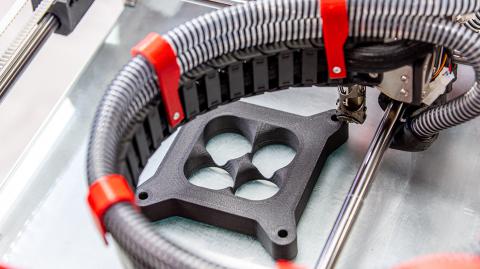
The growth of 3D printing in motorsports is unleashing new development opportunities that would've been unthinkable a decade ago—at a fraction of the cost. While this will benefit the entire industry, including well-funded teams, it also presents small teams and businesses with a better opportunity to design innovative new parts without being restrained by cost.

"One of our biggest successes in motorsports has been with our customer McGunegill Engine Performance [MEP]," said Michael Parks of GZERO Additive, Cincinnati, Ohio. "MEP is an established engine shop in the asphalt short track world, and they recognized 3D printing as a very cost-effective way to decrease development time and increase performance for their customers."

Less design time and more performance may sound like a far-fetched dream to some, but for those ready to embrace the possibilities of 3D printing, the opportunity is there for the taking.

New Approach to Engineering

3D printing is a common form of additive manufacturing in which an object or part is created or "printed" layer by layer, based on a digital CAD software file. This layered build allows engineers to create geometrically complex shapes and use less material than traditional manufacturing methods—a great combination for motorsports parts development.

"In the year after taking delivery of their first GZERO Additive 3D Printer, MEP engines won 30-plus Pro Late Model races, the World Crown 300, and an ASA STARS National Tour race using intake technology that included functional prints developed and produced on their GZERO machine," said Parks.

The advantages of incorporating 3D printing are not limited to a single factor. It's their versatility that can have the greatest impact.

"The ability to go from one-off prototypes to production batches of thousands of units using the same process on the same machine is massive," said Parks. "McGunegill Engine Performance is a perfect example. They use their 3D printer to make one-off prototypes for dyno testing during the day, when they're there to test and iterate, and then run production parts for customers overnight."

The ability to switch from mass production to experimental design prototyping with a single machine is a key benefit of 3D printing. This could be especially advantageous in today's labor landscape, as many companies struggle to find skilled and reliable workers.

When discussing how fabricators can benefit from large-format 3D printing—more on that later—Steven Nelson of Nelson Racing Design in Denver, Colorado, highlighted one of the major benefits of 3D printing.

"It's a full-time employee that can focus on a singular task without fail or supervision," said Nelson. "You can print jigs for welding, tools for assisting, joggles for placement, or anything that fits. The limiting factor is only your design capability."

In an industry where money is typically the main limiting factor, the emergence of a technology that empowers designers, fabricators, builders, and engineers to reach their potential is something to celebrate.

"3D printing technology has changed how engineering and prototyping are approached," said Omar Vinces, an engineer at Speed Concepts, a race team based in Sarasota, Florida. "Now engineers can see their designs come to life without even leaving their desk. They're able to print out designs or even mock-up parts before purchasing them."

Testing design concepts via 3D printing also significantly reduces the required investment of time and money, said Parks. "This includes making fixtures and tools for processes such as welding or machining, making low-cost prototypes to validate fitment, and in some cases, 3D printing components that were previously made from other manufacturing methods."

Increased Performance at Reduced Cost

Gaining an advantage in motorsports is a battle of tight margins. A single well-designed component can provide the difference between a winning race car and the rest of the field.

One of the primary factors that makes 3D printing such a good fit for motorsports applications is the ability to create specialty, low-volume components at a reasonable cost.

"The cost to make just one part with many traditional manufacturing methods can be quite high," said Parks. "Setup time, programming, fixturing, and tooling costs that normally would be spread out over hundreds or thousands of units are concentrated into just one. With 3D printing, the programming and setup are done in a couple of minutes. There are no fixturing or tooling costs. This makes it very cost-effective to run a one-off prototype or limited batch of parts, production volumes that are common in the motorsport world."

The other advantage of 3D printing for motorsport is the ability to "create geometries that would be incredibly expensive or impossible to make using traditional manufacturing methods," said Parks. "Obstructed overhangs, hollow cavities, and custom surface textures can all be leveraged to improve performance for functional parts."

Better yet, 3D printing prototypes allows builders and engineers to experiment with innovative design ideas without the high material costs.

To read the rest of this article, and hundreds more like it, for free, sign up for a digital subscription to PRI Magazine on Zinio here.    

Once you download the Zinio mobile app or are logged into Zinio on a desktop browser, you will gain immediate access to more than a year's worth of content, including "Printing Performance: 3D Printing" here and additional coverage in the October 2025 issue here. 

October 2025
By
Jack Haworth