Ultimate Street Car Association (USCA) Announces New Segment Manager

Submitted by Anonymous (not verified) on Mon, 06/22/2020 - 11:50
The Ultimate Street Car Association (USCA) and FM3 Performance Marketing have appointed Eric Heller as the new segment manager for the autocross and Speed-Stop competitions.  

In his new position, Heller will be responsible for all aspects of competition elements for the two segments including course design and set-up, timing and scoring, staffing, and more.

In addition to USCA events, including OPTIMA'S Search for the Ultimate Street Car presented by Advance Auto Parts, Heller will also assist FM3 at events including LSFest, Roadkill Nights, HOT ROD Power Tour, FM3 Cars & Cones, and more.

Heller has an extensive background in the automotive events industry and also has experience in event management and course design.

For more information, visit DriveUSCA.com.


June 2020

Industry Insights: Doug Herbert

Submitted by danielk on Mon, 06/22/2020 - 11:47

With deep roots in motorsports and performance, the championship drag racer and founder of teen driving program BRAKES reflects on a changing marketplace, lessons from his trailblazing father, and how the industry can capitalize on racing’s eventual return to normalcy.

Few contemporary racers have the lineage of Doug Herbert, who can trace his roots in the performance industry to his birth. A championship drag racer for more than 25 years, Herbert boasts several historic connections. His father Chet Herbert was a pioneering cam builder during the industry’s infancy, and his aunt Doris Herbert brought to prominence one of the first successful publications focusing on drag racing, Drag News.


Doug Herbert’s racing career was pioneering in its own right, as he was the first to reach 300 mph during NHRA eliminations in 1993, and was recently inducted into the NHRA Southeast Division Hall of Fame. After winding down his on-track efforts in recent years, Herbert continues to lead Herbert Cams, the firm founded by his father in 1949. 

In 2008, Herbert’s life was rocked when his two sons, Jon (17) and James (12) were killed in an automobile accident. The tragedy led Herbert to launch the BRAKES (Be Responsible And Keep Everyone Safe) program, a non-profit that teaches defensive driving techniques to teens.


PRI recently caught up with Herbert for a conversation about his career and his thoughts on the current state of the industry. Of note: At the time of this interview the COVID-19 crisis was just beginning, and the conversation naturally referenced the growing crisis and its potential impact on the industry.

PRI: Obviously, at this moment the world—including all of racing—is sharply focused on the COVID-19 pandemic. Clearly, we are looking at a very significant impact on our sport in the near term. What element of the current situation concerns you the most?


Herbert: I’m just worried about live sports in general. Racing is one thing, but they are canceling all sorts of live events. Concerts, ball games, everything. It seems that many of those types of events have declined over the years, so that really worries me. Because the virus certainly exacerbates that problem. I don’t know the fix, but I believe that live sporting events are definitely going to be hit pretty hard in the short term for sure.


PRI: It’s impossible to know at this moment how long motorsports will be on hold. Any advice on how suppliers and tracks and sanctioning bodies can weather the storm?


Herbert: People have to pull their horns in. Looking back over the past 30 years I’ve been in business, we’ve faced various challenges. The Gulf War came along, September 11 came along, the UPS strike of a few years ago came along, the 2008 economic crash, all of those things affected our business. What I’ve learned over the years is that you’ve got to react pretty fast. When you see something, you have to start thinking about what direction you need to go. If you don’t do it quickly you might not be around for long.


PRI: Racing is filled with problem-solvers who always seem to figure out the solution to any challenge. But this is unique because it’s a very different kind of challenge. Does that make it more difficult to overcome?


Herbert: Sure it does. I was listening to the President today, and he was saying this is an invisible enemy. That’s true. In other situations, we’ve had an idea of who the enemy is, and how to deal with them. This is different. It obviously can affect people’s health, but it also impacts the economy. This can seriously affect racing suppliers, teams, sponsors, everybody. I don’t know that anybody has a full grasp on how big this is going to be or how long it will take us to recover. We won’t know that until we’re further along, I think.


PRI: On an optimistic note, it’s a safe assumption that when we return to a sense of normalcy there very well could be a strong, pent-up appetite for all things racing. What do we need to do to capitalize on that?


Herbert: Man, I hope we can capitalize. The sport is much more focused on putting on a show today than we were some years ago. We are thinking of the entertainment aspect, and that’s a good thing. That will help us, I think. The attention span of people is a lot shorter today and we have to take that into account. We’re better at this, but we have to make sure we realize we’re in the entertainment business. As long as we think about it like that, it’s probably going to be okay.


PRI: Let’s shift directions. On a day-to-day basis, you’re involved in the operation of Herbert Cams and Doug Herbert Performance Parts. You reside in North Carolina, while the business operation is in Anaheim, California. What’s the key to making that work?
Herbert: It’s just a matter of having the right people there. The guy who runs the cam shop there began working for my dad, probably 40 years ago. He taught me how to run a cam grinder. His son is working with him, and they’ve done a great job.


PRI: Your father, Chet Herbert, was a pioneer in our sport, grinding the first Herbert cam in 1949. So you literally grew up in the industry. How much does that background influence you in your day-to-day business?


Herbert: Not much, to be honest. There’s a lot of history in the cam business, with people like my dad, Ed Iskenderian, Harvey Crane, all those legendary guys who were involved in the 1950s and 1960s when they had what they called “cam wars” with the Top Fuel guys. That’s pretty interesting to me and I’m proud to be involved in that, and I am very proud of my dad. When I was growing up, my dad wasn’t involved with going to the races that much. I went to the races more with my aunt Doris, who owned Drag News.


But I’m not sure how much all that history influences me. I don’t look back at that a lot, because times are different now.

insights 1
Doug Herbert’s father, Chet Herbert, at left, founded Herbert Cams over 70 years ago, and was part of the “cam wars” of the 1950s and ’60s. “I’m proud to be involved in that, and I am very proud of my dad,” Doug said.


PRI: You make a great point. As much as we love history, the fact is that in the business world everything has changed today. The key, I’m guessing, is to appreciate our history but also stay focused on the relevant issues of the day.


Herbert: That’s right. For example, I got my first job at a hot rod shop in Southern California in 1984, I think it was. Larry Dixon worked there, too, and we were just kids. At that time when a guy pulled up in a 1970s Camaro you might as well just run to the back and grab a set of headers, an intake manifold, a carburetor, and an air cleaner, because those were the hot goodies everybody wanted for their car. That’s what was selling. But obviously things have changed through the years. Things are much more specialized. The guys who are really doing well in the performance business are the guys who specialize. Experts in one sector. In the earlier days you had to be able to offer parts and pieces for almost everything.


PRI: More than a few days have come and gone since you made your first pass down the track. You’ve seen a lot in that timeframe. What’s the biggest change in drag racing over that span of time?


Herbert: I made my first pass in an outlaw dragster that I raced back in 1985 or 1986. Today I look at that car and think, “Man…that thing was dangerous!” And before that, the guys who ran the front-engine cars in the 1960s and ran 220 mph, that was really dangerous. I’ve been at many races where bad things happened, and danger was a common thing. So the biggest change is probably safety; it has increased tremendously since I started. NHRA has done a good job, SFI has done a good job, NASCAR…the world changed, and safety was much more on our mind. We can thank guys like Bill Simpson and Fred Crow and Jim Deist, all those guys who made such a difference in the sport.


It’s sad that big changes came only after bad things happened. But the focus on safety is the biggest change and the absolute best thing that’s happened for all of racing.


PRI: You had a successful and productive career as a racer. In those years when you were actively racing, did you envision eventually taking on the leadership role with Herbert Cams?


Herbert: When I was racing, I would come home Sunday night from the track and be (at our business) working the next day. My dad, the one thing he really taught me was working hard. My dad got polio when he was 20 years old and was in a wheelchair the rest of his life. All that did was fire him up; being in that wheelchair didn’t slow him down one bit. It just didn’t. Whatever he had to do to continue to work and build racing stuff, he did it. 

insights 2
Doug Herbert, pictured at left with crew chief Larry Frazier after their Top Fuel victory at the 1999 AutoZone Nationals, has more than 25 years of championship drag racing experience. When asked what has changed most in the sport, Herbert said safety “has increased tremendously.”


I remember one time when I was maybe 10 years old, and my dad sent me out with a small hatchet to cut down a little tree in our backyard. I chopped for a while and came back in the house and told him there was no way I could cut the tree down with that little hatchet. I need a chain saw! He looked at me and said, “You’ve got to be kidding me.” He wheeled out to the backyard in his wheelchair and leaned down and went to work, and with just a few whacks was at it. He looked like a buzz saw! The tree fell over and he handed me the hatchet and said, “Don’t ever tell me you can’t do something, unless you really can’t.” I never forgot that. That was an important point in my life.


PRI: I’m guessing that’s the kind of lesson that never leaves you.


Herbert: Absolutely. My dad, he was a very motivated guy who loved to do things. Growing up around that gave me a good sense of making sure I took something from the start to the finish. If it gets hard, you just work harder. Make sure you make it happen. That was instilled into me, to work hard and do a good job.


PRI: When the time came to step away from driving, was it tough? How did you know that the time was right?


Herbert: Back in 2008, Snap-On Tools had been my sponsor for 17 years. They were a great partner. But when (the economy) turned south in 2008 they wanted to cut back on what they were spending. Everybody’s business was hurting at that point. So it wasn’t hard to step back, because I had to step back. The costs of running a Top Fuel team, it wasn’t feasible without a partner like Snap-On. So I just realized that, even though I still loved racing, I had to step away from running my team. Although I stayed involved and ended up racing for a few more years off and on, the days of running my own team had ended.


If I had a chance to race again, I’d be glad to get back into it, but only if I had an opportunity to win. I was able to accomplish what I wanted, and I don’t feel like I have a lot of unfinished business. I’m satisfied with my career, and it doesn’t bother me that I’m not driving every weekend. Trust me, there is nothing more fun in the world than firing up a Top Fuel car and hitting the gas and leaving the starting line, pulling the parachute at the other end. That’s a really exciting thing. But I’m also smart enough to realize that this is a young man’s game.


PRI: One of the pressing issues facing every form of motorsports today is attracting young fans and participants. Kids don’t necessarily grow up with the same infatuation you and I had for cars when we were kids. What can we do to attract younger people to motorsports?


Herbert: You know, that’s a really good question. I’ve been asking myself that question a lot. I had my 16th birthday at the DMV, because I needed my driver’s license to be able to go see all my friends! Now, the communication modes (for kids) have changed. Getting together with your friends used to mean driving over to their house. Now it can mean Facetime, Snapchat, whatever. It’s just different. When we were kids the car was part of our personality; you’d go out and shine your car as a point of pride. It was our deal. But kids now look at cars simply as a mode of transportation. Point A to point B. And the love for driving has gone away, which is kind of sad.

insights 3
Doug Herbert founded BRAKES to teach defensive driving to teenagers, helping over 45,000 families to date. “I’ve had parents tell me that the class changed their child’s life and the way they look at things,” Herbert said.


One of the elements of the charitable program we created, BRAKES, is teaching defensive driving to teenagers. We’ve taught over 45,000 families at this point. One of the things I see when teenagers come to the class is that, when they get there, they often aren’t all that excited about being there. They look at driving kind of as a drag, something you have to do. So one of the things we teach the kids is how much fun driving can be. To be independent, to be in control of that machine, it’s something they discover. That’s an important thing we want to teach kids.


PRI: You led right to our next topic, your BRAKES program. The program was born from tragedy, and the loss of your two sons. Talk about the inspiration for such a powerful and helpful program.


Herbert: I was in Phoenix racing, and their mom called me and said Jon and James have been in an accident. It was early in the morning and I was packing up to go to the race track. Then I got another call that yes, both had been killed in the crash. Wow. So I packed up all my stuff and traveled home, and started doing some research. At that moment, I felt like the most unlucky guy in the world, losing two sons in a highway crash. But then I discovered that automobile crashes are the number one cause of death for teenagers. At that time—2008—more teenagers were killed in car crashes than the next four causes put together. That was shocking to me. It made me so sad…the thing I love so much—cars—are causing deaths and terrible injuries to these teenagers. I felt like I needed to teach my kids’ friends how to be a better driver to try and keep them safe. That was where it all started. I knew I had to do something.


The kids who were friends of Jon and James came up with the name, BRAKES. That first year we trained 50 of their friends, and from there it grew. I did a little bit of research to find out the main cause of crashes. In the rural areas, it’s dropping a wheel off the side of the road and over-recovering. In different areas it’s different things. Tailgating, distractions, that’s huge. 


Our program is about a half-day, and we teach kids about all the different causes of crashes. After we taught those first 50 teenagers, I had parents approaching me, asking about us doing another class. We did another, then another, and it started to snowball into something. 


I’ve had parents tell me that the class changed their child’s life and changed the way they look at things. I didn’t plan on all that, but learning safe driving puts a real value on the relationship between a parent and a teenager, and it helps kids see how fragile life can be. So many good things happened from that first class, it’s been incredible. 


PRI: Obviously BRAKES is a labor of love, but I’m sure it still requires a lot of effort to keep it going. Do you still find inspiration in the kids who come to the classes?


Herbert: Absolutely. I try to come to every class. When teenagers and parents come in, it’s early in the morning, and a lot of the teenagers are irritated that they are there. But when the class is finished, and seeing those kids smiling, totally engaged in the process, and leaving the class with their arm around their parent, saying, “Hey, thanks for bringing me to this! That was fun!” That’s a great thing to see. It’s really rewarding, and I think I’m making my boys proud. Hopefully we’re preventing some other parent from getting that phone call.


PRI: You’ve made a successful transition to working in various media assignments over the last few years. What’s the key to becoming comfortable on the other side of the microphone?


Herbert: When I started doing the radio show with Motor Racing Network (MRN), it came down to something Steve Evans told me many years ago. Steve was a great mentor and a neat guy. He told me at the very beginning when I started racing, “Doug, here’s the deal. I’m going to ask you a question and you just answer the question like it’s just you and me standing here talking. If you do that, you’ll do fine.” So that’s what I always tried to do.

insights 4
BRAKES founder Doug Herbert, at left, and General Motors Vice President Steve Kiefer are pictured here at Oakland Hills Country Club in Bloomfield Hills, Michigan, during last year’s Swing For Safe Teen Driving charity golf tournament, whose proceeds go to help build the BRAKES program and its presence statewide.


At the end of the day, (media work) is not that hard. We’re in the entertainment business, so you’ve got to ask questions that would be entertaining to viewers and listeners. You just hope you’ll get good answers and keep things interesting.


PRI: We’ll finish with this. How can our readers learn more about the BRAKES program? And how can they attract a class to their area?


Herbert: We run classes all around the country, and this year we’re probably going to run close to 200 classes. The best thing to do is go to our website: putonthebrakes.org. We have videos there, safe-driving tips, and lots of resources for teenagers and parents. The website is the best tool to reach us and learn about the program.


The number one thing you can do for your kid is to bring them to one of our classes. It’s just a great experience. It’s just half-a-day, and it’s free. Through the work we’ve done with the University of North Carolina we’ve found that teenagers who attend our program are 64 percent less likely to be involved in a car crash. That’s a really good thing. 


PRI: Doug, thank you for sharing some time with us during this difficult episode for our sport. We wish you the best in the coming months.


Herbert: Thank you, Dave. It was good to talk with you.

July 2020
By
Dave Argabright

MotorsportReg Launches SpeedWaiver Platform

Submitted by Anonymous (not verified) on Mon, 06/22/2020 - 11:38
MotorsportReg, the motorsports membership, licensing and online event management system, has announced the launch of SpeedWaiver.com. The new platform will allow racing event organizers and participants to digitally sign liability waivers.

"SpeedWaiver eliminates one of the biggest hassles for event organizers and participants – standing in line at the liability waiver table," said Brian Ghidinelli, managing director of motorsports for Hagerty, parent company to MotorsportReg. "It's fast and simple, but best of all, in this age of social distancing, it's much, much safer."

SpeedWaiver is free for event participants, including drivers, crew members, guests, walk-ups, VIPs, and more. No sign-in or pre-registration is required. For event organizers, there is a monthly fee based on the number of waivers signed.

"At Hagerty, our mission as a company is to grow and enable the international tribe of car enthusiasts, including those who enjoy motorsports," Hagerty Motorsports Vice President Derek Prechtl said. "Helping people get more out of their car experience is what it's all about."

For more information, visit Hagerty.com or SpeedWaiver.com.
June 2020

Illinois To Allow Fans At Motorsports Events This Week

Submitted by Anonymous (not verified) on Mon, 06/22/2020 - 11:28
Illinois Governor J.B. Pritzker has announced that the state will advance to phase four of his Restore Illinois plan on June 26. During this new phase, spectator sports facilities, including race tracks, may reopen at 20% capacity. Previously, motorsports venues were restricted to testing and tuning events and were off-limits to fans.

The PRI-supported Illinois Motorsports Coalition (IMC), a group comprised of racing facilities across the state, previously submitted an eight-step plan to Governor Pritzker to allow motorsports to safely resume statewide.

PRI has also compiled an up-to-date listing of motorsports’ status in each state. Click here to discover whether racing venues in your area are ready to drop the green flag.

For details, contact Christian Robinson at stateleg@sema.org.
June 2020

SBA Reopens Website To Allow Businesses To Apply For COVID-19 Disaster Loan

Submitted by Anonymous (not verified) on Fri, 06/19/2020 - 12:31
The US Small Business Administration (SBA) is once again accepting applications for Economic Injury Disaster Loans (EIDL). The program had closed temporarily due to an overwhelming demand for assistance.

Businesses impacted by COVID-19 may seek a disaster loan of up to $150,000 at a 3.75% interest rate, which may be used to pay fixed debts, payroll, accounts payable and other bills that cannot be paid because of the disaster’s impact. As part of the 30-year loan application, companies may request an EIDL advance of up to $10,000 that does not have to be repaid. The forgivable grants have been capped at $1,000 per worker due to demand.

The EIDL program is separate from the forgivable Paycheck Protection Program, which is currently accepting applications until June 30. Applicants may apply to both programs. Grants given through the EIDL program will be included in the PPP loan.

For more information or to apply for an EIDL loan, visit sba.gov/funding-programs/disaster-assistance/coronavirus-covid-19.


June 2020

GearFX Driveline Announces New Location

Submitted by Anonymous (not verified) on Fri, 06/19/2020 - 11:53
GearFX Driveline, the provider of driveline products and services, has announced the company will relocate to a new facility in Mooresville, North Carolina. The new location is down the street from its current post.

The company's new 18,000 square-foot facility increases the company’s footprint by more than 5,000 square feet. The new location will feature a larger dyno area and increased warehouse capacity. The machine shop, build shop, and fabrication shop will also each be housed in individual, climate-controlled spaces to better control dust mitigation.

“I am proud of how the GearFX brand has grown since its inception two years ago,” GearFX Driveline Owner Kyle Tucker said. “A larger footprint allows us to keep up with demand from our customers while providing the level of quality and service they’ve come to expect.”

Effective June 22, 2020, the new physical and mailing address will be 114 Infield Court, Mooresville, NC 28117.

For more information, visit GearFXDriveline.com.
June 2020

Motorsports Companies Adjust Operations In Response To COVID-19

Submitted by Anonymous (not verified) on Fri, 06/19/2020 - 11:46
Racing businesses have provided updates on their operations in response to the novel coronavirus (COVID-19) outbreak.

$2.95 Guys
Face masks and essential company t-shirts are now available through $2.95 Guys. Its "shirt face masks" are available custom printed with a logo or message. A minimum order of one case (120 masks) is required. Each custom mask is $4.95.

Additionally, its custom-printed essential company shirts are also available. For more information, contact 858-513-7000 or visit 295guys.com.

3-Dimensional Services Group
Located near Detroit in Rochester Hills, Michigan, Urgent Plastic Services, a branch of 3-Dimensional Services Group, has halted regular production to manufacture protective respirator housings for mobile respirator machines.

The components will be sent to another company to be assembled and issued to urgent care and hospitals around the world. The effort is led by Trans-Am driver and team principal Doug Peterson, the owner of 3-Dimensional Services.

For more information, visit 3dimensional.com.

Advanced Clutch Technology
Advanced Clutch Technology is open for business, but there may be delays in shipping due to reduced staff. For more information, visit advancedclutch.com.

AEM Performance Electronics
AEM is still manufacturing, assembling, and shipping products, with non-essential workers operating remotely. There may be a slight delay in technical support and customer service, which can be reached at emstech@aemelectronics.com (for engine management support) and gentech@aemelectronics.com (for all other products).

Air Flow Research
Air Flow Research (AFR) is fulfilling orders. All staff members are following guidelines to protect themselves and the community. For more information, visit airflowresearch.com.

Billet Specialties
Billet Specialties is fulfilling orders. For more information, visit billetspecialties.com.

BorgWarner
BorgWarner is fulfilling orders, and reported that some key employees have volunteered their time to make personal protection equipment (PPE) for frontline health workers. For more information, visit borgwarner.com.

Bridgestone Americas
Bridgestone Americas is fulfilling orders. For more information, visit bridgestoneamericas.com.

Buffalo Turbine
Buffalo Turbine has announced the District Disinfector Series, its latest line of sprayers designed to aid municipalities and commercial operations in the fight against COVID-19. The easy-to-deploy, self-contained sprayer, which is designed for use with any truck or utility vehicle, is capable of disinfecting large areas. Applications may include but are not limited to crosswalks, benches, lamp posts, mailboxes, bus stops, streets, sidewalks, building facades, park equipment, and stadiums. The sprayer is compatible with EPA, NYS DEC, CDC, and WHO registered and approved disinfectants. For more information, visit buffaloturbine.com.

Bully Dog Performance
Bully Dog Performance, as well as its parent company, Derive Systems, is implementing remote work and virtual collaboration. The company has canceled all large gatherings and non-essential business travel. The company is also limiting visitors to all office locations, as advance approval is needed for any office visits. Sales and customer service are available and the company is shipping orders as usual. For more information, visit bullydog.com.

Centerforce Clutches
Centerforce Clutches is currently fully operational and still manufacturing products and shipping orders. According to the company, it is monitoring the situation around the virus closely and adhering to local, state, and federal guidelines, and extra precautions have been taken to ensure customer and employee safety. Centerforce has been determined as an essential business and will continue to meet demand. There may be some delays due to the safety precautions currently in place. For more information, visit centerforce.com.

Champion Brands, LLC
Champion Brands is fulfilling orders, and also manufactured alcohol hand sanitizer and isopropyl alcohol disinfectant for local senior homes, hospitals, medical-related businesses, food shelves, and local government agencies. Champion's hand sanitizer is 75% alcohol, while its isopropyl alcohol disinfectant is 99% alcohol.

Additionally, Champion will continue to accept and ship orders as normal. The company has adjusted internally, including social distancing, frequent sanitizing of facilities, transitioning some employees to work from home. On-site visits from non-employees have also been suspended. For more information, call 660-890-6231 or visit championbrands.com.

Classic Industries
Classic Industries is fulfilling orders. Customer service personnel are working remotely during regular business hours, and longer wait lines may be expected. For more information, contact info-desk@classicindustries.com and visit classicindustries.com.

Crower Cams & Equipment Co.
Crower continues to ship products and manufacture with a reduced staff. The company has implemented remote work where possible, temporarily suspended visitors to the facility, established social distancing, and have taken additional sanitizing measures. The company continues to manufacture products and is taking new orders, although some materials and products may have increased lead times. Visit crower.com for more information. 

CRP Technology
CRP Technology is fulfilling orders, and manufacturing several functional prototypes of emergency valves for reanimation devices and link-components for emergency respiratory masks for assisted ventilation. The CRP Technology’s Rapid Prototyping Department has used 3D printing technology called HSS (High Speed Sintering) and the Windform P1 isotropic material to make both types of components. For more information, visit crptechnology.com.

Cummins
Cummins has reached an agreement with 3M to manufacture high-efficiency particulate filters for use in 3M’s Powered Air Purifying Respirators (PAPRs). PAPRs use a battery-powered blower that sends filtered air into a hood or head top that covers the wearer’s head or face and can provide increased levels of respiratory protection. PAPRs may also be more comfortable to wear for those who need respiratory protection for long periods of time. The partnership has the potential to more than double the current production of filters for 3M’s PAPRs. For the latest information, visit cummins.com.

Custom Automotive Network (CAN)
Custom Automotive Network (CAN) President Tracie Nunez sent out a letter regarding its CAN Connect conference, set to be held in September, which the organization continues to prepare for as scheduled. CAN offices are fully operational from multiple remote locations and during normal business hours. For more information, visit customautomotivenetwork.com.

CTech Manufacturing
The company has been deemed essential and continues to operate as normal. CTech's targeted 10-day lead time for tool drawer manufacturing remains uninterrupted. The company also continues to follow CDC guidelines, has implemented remote work where possible, and has suspended all work-related travel. Visits to company facilities have been limited to business-critical only. For more information, visit ctechmanufacturing.com.

Dart Machinery
Dart Machinery is fulfilling orders and has lowered its pre-paid freight policy to help its customers. The new pre-paid freight will be set at $8,000 on any order of Dart products. For more information, reach out to contact@dartheads.com or 248-362-1188.

Dayco
Dayco has applied its manufacturing resources to help produce a vital component in the conversion of a readily available snorkeling mask into a ventilator. The mask is already being used in hospitals in northern Italy and by the Italian Red Cross. Dayco has begun production on a key component, the Charlotte Valve, which allows the mask to be converted to a medical respiratory device. The company is utilizing its 3D printers at its San Bernardo d'Ivrea facility in northern Italy. For more information, visit dayco.com.

Daystar
While the company is still distributing products, it has shifted to a three-day-per-week, 12-hour workday production schedule and is encouraging remote work when possible. It has also provided employees with sanitizer and is following CDC guidelines. The company currently expects no disruption of production or distribution. For more information, visit daystar.com.

Don Schumacher Racing
Don Schumacher Motorsports converted two Stratasys 3D printers to manufacture headband components for medical face shields. For more information, visit shoeracing.com.

Engine and Performance Warehouse
Engine and Performance Warehouse sent a letter to customers stating that all EPWI facilities are currently open and the company continues to accept and ship orders as normal. The company has experienced some minimal delays and supply chain disruptions. EPWI also asks that all orders be called in or ordered through epwi.net. The company will not currently be accepting orders at the will-call counter.

Engine Pro
Engine Pro distribution centers stay open as essential businesses. According to the company website, there may be some shortages and slowdowns from suppliers but Engine Pro is working to boost inventories to meet current and future demand. Ordering online or by phone is preferred. Customers are advised to call their distribution center to determine if any special procedures are in place for in-person sales. For more information, visit enginepro.com.

EXEDY
EXEDY is in full operation and following Michigan guidelines. The company is still processing and fulfilling daily shipments. Orders can be placed during normal daily hours of 8:30 a.m.–5:00 p.m. (EDT). For more information, contact AMSales@exedyusa.com or 800-346-6091.

Factory Five Racing
Company President Dave Smith provided an update via email, which read: We have been able to continue working as an automotive parts manufacturer, but I've dialed back operations to a minimum to support mostly the parts side of the business (and keep our work going on our massive solar array and new facility construction). The small team here is working under extreme contact precautions, social distancing, and each functional team of ten people or less work in separate spaces or in large areas of 6,000 sq. ft. The team is supporting our customers in creative ways with more emails and messaging, daily live broadcasts (on YouTube and Facebook Live), and work from home where possible. Our production schedule has been modified and delays are being addressed, but I'm super proud of the team.

For more information, visit factoryfive.com.

Fiat Chrysler Automobiles (FCA)
FCA is producing face masks for donation to first responders and healthcare workers. The first machinery has been delivered and installed with supply and donation coming on stream in the coming weeks. In addition, FCA has announced the expansion of its charitable programs. For more information, visit fcagroup.com.

Fleece Performance
Fleece Performance has redeployed its engineers and a portion of its flexible manufacturing space to develop, test, document, and begin producing a disposable full face shield for medical professionals nationwide. Officials report the ability to produce 500 shields per single shift, with up to 100,000 units made each day. For more information, visit fleeceperformance.com.

Fluidampr
Fluidampr continues to operate and ship products, according to the company. Fluidampr has canceled all travel, implemented remote work where possible, temporarily suspended any visitors to its facility, and instituted social distancing and additional sanitizing measures. The company continues to manufacture products and is taking and fulfilling orders. For more information, visit fluidampr.com.

G-FORCE Race Gear
G-FORCE Race Gear remains open with all teams currently working remotely and adhering to local, state, and federal shelter-in-place guidelines. The company's new warehouse and office facilities are on schedule to open. Contact info@gforce.com or visit gforce.com for more information.

Grand Prix Auto Sports Center
Grand Prix Auto Sports Center remains fully staffed and open for business but has mandated all government guidelines to keep employees and customers safe. For more information, visit grandprixauto.com.

Hooker Harness
Hooker Harness has begun manufacturing fabric masks for the Stephenson County Health Department for use by local Emergency Management Services. The Freeport, Illinois-based custom seatbelt and shoulder harness manufacturer has already completed several hundred masks, which are cleaned and sanitizes at a second location, then packaged and shipped to EMS departments.

"We'd rather be at the track but we're happy to be able to do this," Hooker Harness Company Owner Scott McPhillips said. For more information, visit hookerharness.com.

HRX Bespoke Motorsport
HRX, known for its production of FIA- and SFI-approved fireproof clothing, has begun production of civilian face masks. Company officials also announced plans to produce fully compliant surgical grade lab coats and face masks for healthcare workers. Production will take place in its headquarters in Turin, Italy. Officials estimate the company will produce around 50,000 units per month. In addition, HRX will donate 10% of its turnover of the new production line to "Protezione Civile," an Italian organization that aims to protect the community. For more information, contact info@hrxtech.eu or visit hrxtech.com.

Ignite Racing Fuel
Ignite Racing Fuel is manufacturing hand sanitizer through its High Performance Lubricants brand. For more information, view a video overview here, or call 815-932-3288.

Impact Racing Inc.
Impact Racing Inc., which includes the MasterCraft Safety and MasterCraft Defense brands, is open and fulfilling orders. As a defense sector manufacturer and now medical PPE manufacturer, Impact Racing Inc. is considered an essential business and will remain open for business. The company is producing face masks for the general population, which are available for purchase. The company’s manufacturing facility in Indianapolis is accepting deliveries and manufacturing as normal. The Impact showroom is closed, but curbside pickup is available. The sales staff is available from 8:00 a.m.–4:30 p.m. to take calls and answer emails. The company is following CDC-recommended guidelines for social distancing, cleaning the environment, work from home options, and restricted travel. For more information, visit impactraceproducts.com.

Indy Performance Composites (IPC)
IPC is manufacturing face masks with 3D printing in partnership with Stratasys to assist with PPE shortage for medical staff.

Keystone Automotive Operations
Keystone Automotive Operations employees are currently following CDC guidelines and instituting more frequent disinfecting of delivery vehicles and facilities. Employees are working from home where possible, but the company continues to process and fulfill orders. For more information, visit keystoneautomotive.com.

Legendary Companies
Legendary Companies and its subsidiary Coker Tire is fully staffed, but no longer accepting walk-in customers. Will-call pickup is available. For more information, visit legendarycompanies.com.

LIQUI MOLY
LIQUI MOLY is fulfilling orders, and also announced a bonus for each employee in response to the pandemic. The company also has a majority of its administration working from home. For more information, visit liqui-moly.com.

Livernois Motorsports and Engineering
Livernois Motorsports and Engineering has been deemed essential and will continue to fulfill orders, but will operate on a limited schedule with limited staff. Staff will also not give walk-throughs to new or existing customers unless it is a pre-approved appointment. For more information, visit livernoismotorsports.com.

Lubrication Specialties Inc. (LSI)/ Hot Shot's Secret
Lubrication Specialties Inc., the manufacturer of Hot Shot’s Secret fuel and oil additives and specialty oils, has announced two production lines have been redeployed to produce hand sanitizer in multiple sizes, including bulk, with special pricing for race tracks and SEMA member companies. For more information, email Kyle@lubricationspecialties.com. Production, distribution, and sales of the company’s 35 products for the automotive aftermarket are still ongoing, and there are no reported supply chain issues.

For more information, visit hotshotsecret.com or lubricationspecialties.com, or call 800-341-6516.

Lucas Oil
Lucas Oil Products, the California-based manufacturer and distributor of automotive oils and additives, is fulfilling orders. Lucas Oil is also offering hand sanitizer refill bottles for purchase through distributor networks nationwide. Lucas' new Hand Sanitizer is made with 80 percent ethyl alcohol.

Lucas' liquid formula is fast-acting and has a milder odor than isopropyl-based hand sanitizers. Lucas Hand Sanitizer is also made using glycerin additives that help keep your hands from feeling dry and cracked, according to a press release. The sanitizer is available in a 64-fluid ounce (two-quart) refill bottle.

In addition, a portion of the proceeds from every bottle of Lucas Oil Hand Sanitizer sold will be donated to high-risk facilities and organizations including local and regional senior centers, homeless shelters, and more. For more information, visit lucasoil.com.

MAHLE Motorsport North America
MAHLE Motorsport, the manufacturer of performance and race piston assemblies and custom pistons located in Fletcher, North Carolina, reports that for the past two months part of their staff has been working from home and they are in the process of transitioning back to the office. The company’s supply chain has remained intact. Moving forward, MAHLE Motorsport has returned to full strength in regards to manufacturing and throughout the pandemic has not had a problem with meeting the demand for pistons and rings to vendors. For more information, visit us.mahle.com/en/motorsports.

McLeod Racing
McLeod Racing remains fully operational and continues to build and ship products while practicing safe protocols to protect employees. Tech and sales lines continue to operate normally while the staff works remotely. For more information, visit mcleodracing.com.

Melling Engine Parts
Melling Engine Parts is fulfilling orders, and announced it will minimize operations but will remain open and shipping products with a reduced staff. Customers may experience a delay in shipments. For more information, visit melling.com.

Meyer Distributing
The company has added additional stock and broadened its shop supply category with products like toilet paper, disinfectants, cleaners, sanitizers, soap, and more. For more information, visit meyerdistributing.com.

Mittler Bros. Machine & Tool
Mittler Bros. Machine & Tool continues to operate, according to a letter from Paul Mittler, although upcoming metal-shaping and metal-working classes, hosted by the company have been postponed. For more information, visit mittlerbros.com.

Molecule
Molecule has begun production of hand sanitizer in accordance with the FDA request for the topical product. The company, who specializes in cleaning performance apparel and equipment of all types, will be repurposing raw materials and packaging to meet the need. Molecule Hand Sanitizer is available in four-ounce and one-gallon sizes. For more information, visit moleculesports.com.

ProCharger
ProCharger, along with its parent company Accessible Technologies, has been deemed an essential business and is fully operational at all its facilities. Sales and tech support are also still available and most supercharger orders are currently ready to ship within two business days. For more information, visit procharger.com.

ProMedia Events & Publishing
ProMedia Events & Publishing, the parent company of the Holley NMRA Ford Nationals and NMCA Muscle Car Nationals, has closed its office but remains operational as staff members work remotely. Personnel will be available via email only. Longer processing times are expected for merchandise orders, memberships, rule requests, and other inquiries. For more information, visit promediapub.com.

Racecar Engineering
Racecar Engineering, based in Lakeland, Florida, is 100% operational, fully staffed, receiving and shipping parts and operating under all current city, county, state, and federally mandated guidelines and best practices (self-distancing, cleaning, etc.). The company’s satellite Midwest fulfillment center is also still operating and shipping parts to customers daily. Operations are subject to change at any time. For more information, visit racecareng.com.

Racequip
Racequip has activated a plan that adheres to government guidelines while remaining open and in full operation. Most employees are working from home, and the warehouse continues to ship products with safety precautions in place. For more information, visit racequip.com.

Racing Optics
Racing Optics is fulfilling orders, and also announced a multi-layer optically removal film for face shields and medical hoods. For more information, visit racingoptics.com.

Racing Power Co.
Racing Power Co. is fulfilling orders. Subject to a shelter-in-place order in California, the company will continue to operate with minimum warehouse staff on site. Online retail orders are available through USRPC.com. Fulfillment may take up to 24 hours.

Rocket Chassis
Rocket Chassis is fulfilling orders. For more information, contact steve@rocketchassis.com, or visit rocketchassis.com.

Rod End Supply
The company is shipping products daily but no longer accepting walk-in customers. The company is accepting phone, email, fax, and text orders, with provisions in place for pickup. For more information, visit rodendsupply.com.

Roush Yates
Roush Yates Manufacturing Solutions, a division of Roush Yates Engines, is working in collaboration with BioMedInnovations LLC and their partners Equilibar on the development and production of specialized ventilators to help address the mounting need for life-saving health care equipment.

“In these last few weeks, we have looked for various ways to support our health care systems and country during the COVID-19 outbreak,” Roush Yates Engines President and CEO Doug Yates said. “Our talented employees are looking forward to working with BioMedInnovations and Equilibar to produce precision components and aid in the assembly of these high-tech SuppleVent ventilators.”

For more information, visit roushyatesmfg.com, or contact 704-662-7164 or RYMSales@roushyates.com.


S&W Performance Group
S&W's Spring City, Pennsylvania manufacturing facility has officially reopened. Staff members are on-site and all departments are appropriately manned. Its production team is working to produce orders that were received during the coronavirus state-mandated shutdown. Orders will be produced and shipped in the order in which they were received.

Employees and customers are required to follow state and CDC safety guidelines. The customer lobby, which has a limited social distancing capacity, will be open from 8:00 a.m. until 5:00 p.m. M-F (EST). Car and parts order pick-up are by appointment only. For more information, visit swracecars.com.

Sabelt
Sabelt is using its 3D printer to produce fittings for the Decathlon diving masks used for COVID-19 patients in need of ventilators. In addition, the company is also supplying fittings for masks used by medical workers. The special component connects the masks to purifiers to prevent the spread of the virus. For more information, visit sabelt.com.

Safety-Kleen
Clean Harbors and Safety-Kleen have announced decontamination and disposal services for businesses. The companies can help with preparedness, business continuity, and response. For more information, contact a Safety-Kleen motorsports representative, including Drew Patey at 386-547-7091 and Buddy Judy at 336-451-4250; or visit safety-kleen.com.

Simpson Racing Products
Simpson Racing Products is shipping safety gear. For more information, visit simpsonraceproducts.com.

SPAL USA
SPAL USA remains open and continues shipping products. The company's Italian facility remains open and fully operational with reduced staff. For more information, visit spalusa.com.

Sparta Evolution
Mark Joseph, COO of Sparta Evolution, has confirmed that the company is repurposing several CNC machines to manufacture components for various medical equipment such as life support ventilators, respirators, and other medical instruments. Along with CNC machines, Sparta Evolution maintains commercial equipment such as 3D printers and laser etchers. Staff members have reached out to several medical suppliers offering the services of its manufacturing facility. Those that want to inquire about its new manufacturing assistance, contact info@spartaevo.com or 425-298-0617 (ex. 101). For more information, visit spartaevo.com.
 
SpeedDirect
SpeedDirect remains open for business with no changes in levels of service or supply. All necessary precautions have been implemented, including remote work, sanitation, and social distancing. All business will be conducted by phone, email, or via the company’s website. For more information, visit speeddirect.com.

Stewart-Haas Racing
Stewart-Haas Racing has announced several initiatives in response to the pandemic, including using its transporters to deliver two million face masks to Novant Health's frontline healthcare workers, and manufacturing webcam carts for patients. The championship-winning NASCAR team began building a prototype cart at the start of the pandemic for use in hospitals’ intensive care units. SHR announced plans to build 110 units for use across Novant Health’s integrated system of physician practices, hospitals, and outpatient centers. For more information, visit stewarthaasracing.com.

Summit Racing Equipment
As an essential business, Summit Racing Equipment is open and providing its customers with parts, tools, and accessories for their project vehicles and daily drivers. The company is taking measures to keep its employees, customers, and community safe; the majority of its employees are working from home or with flexible schedules. Anyone who enters its facility is also screened for health and must wear a mask at all times. Work stations are appropriately distanced, with cleaning and sanitizing efforts appropriately increased. For more information, visit summitracing.com.

SuperPro
SuperPro is still operating but has taken precautionary measures to facilitate remote work where possible and social distancing for staff still operating at its California, Australia, and New Zealand facilities. For more information, visit superpro.com.au.

SuperSprings
SuperSprings remains operational and open for orders. The company has implemented remote working for sales, customer service, and order fulfillment departments, potentially impacting timeliness of order fulfillment. For more information, visit supersprings.com.

Team Penske
Team Penske, along with Stratasys, produced over 500 3D printed face shields in its race shop.

Tenneco
Many of Tenneco’s facilities on the motor-parts side of the business remain open. Transportation-related businesses, including auto-manufacturing and assembly, auto-supply, auto-repair, and other related facilities, have been classified as essential businesses in many states, and they continue to operate and support customers that remain operational. Staff members are following proper guidelines, and global team members are working from home. For more information, visit tenneco.com.

Turn 14 Distribution
According to Turn 14 Distribution, its distribution centers in Pennsylvania, Nevada, and Texas remain fully operational, while sales, accounting, and support staff work remotely. Employees on the job at the distribution centers are now working on separated shifts, the company said, and professional cleaners have been hired to clean high-traffic and high-contact areas of its facilities between shifts. Will Call service at all three distribution centers has been suspended until further notice. For more information, visit turn14.com.

UMI Performance
UMI Performance, Inc. has reopened with its sales and technical staff at full strength. Stock checks and sales questions are available via phone or email. Due to high demand and limited production over the past few months, UMI reports very limited items in stock. Customers are advised to call or check the stock online. For sales, contact sales@umiperformance.com. For technical support and installation help, contact support@umiperformance.com. For more information, visit umiperformance.com or call 814-343-6315.

VP Racing Fuels
VP Racing Fuels, Inc., the provider of performance fuels, lubricants, and additives, announced the launch of VP Hand Sanitizer to support the needs of commercial businesses, retailers, and race tracks. VP Hand Sanitizer is available in a variety of container sizes, including 32-ounce, one-gallon, and five-gallon packaging, as well as 54-gallon drums and 325-gallon totes.

VP Racing Fuels Inc. also continues to supply race fuels, coolants, and lubricants to race series and teams. For more information in North America, contact VP at 844-331-6478 or cpinfo@vpracingfuels.com. For International inquiries, contact +210-635-8774 or international@vpracingfuels.com. For more information, visit vpracingfuels.com.

Photo courtesy of Racing Optics

June 2020

Slide By Design

Submitted by danielk on Thu, 06/18/2020 - 17:25


Specialists reveal inside strategies to building and maintaining a race-ready drift car.

While the origin story of drifting is one of impromptu touge street races along the winding mountain roads of Japan in the 1970s, the latest chapter of the saga is now largely being told on race tracks across the United States. As one of the fastest growing motorsports disciplines worldwide, drifting has attracted a younger set of enthusiasts and competitors due in part to its appeal at the grassroots level as well as the diligent work of series like Formula Drift, the premier sanctioning body for drifting competition in America.

As the sport continues to mature and the rule sets are further refined, the sophistication of the builds involved at all levels of the sport have improved in turn. That’s not only raising the bar for racers, it’s also giving fans and aspiring competitors plenty of creative fuel for their own projects.

“Before it started to take off a couple years ago, drifting was really just something for a select few,” said Nolving Melara of Apocalypse Racing, Temecula, California. “It was kind of like a niche genre of music that really only appealed to certain people, but now it has become mainstream. It’s not just stuff from Japan anymore—American muscle is getting into it, and the Europeans as well. Back in the day when we used to go to drift shows, it was mainly Nissans and Mazda Miatas. Now it’s not uncommon to see a Corvette and BMW 3 Series going head to head.”

drift1
Just a few years ago, drifting “was something for a select few. It was kind of like a niche genre of music that really only appealed to certain people,” one of our sources noted, adding that “now it has become mainstream.”

Daniel Mendoza of SSWORXS in Modesto, California, noted that the American drifting market has eclipsed all other regions worldwide. “It’s bigger than the Japanese side by a significant margin—the attendance is huge. If you go to a Formula Drift event, you’ll notice that the drivers are coming from all over the world to compete in the US, and foreign companies are now looking at the American market as the nerve center.”

With strong support from both aftermarket suppliers and sponsors, the evolution of the discipline continues at a brisk pace as programs and class structures are developed to provide a clear path up the ladder for grassroots racers while still allowing teams to be creative in the garage. And more and more often, that creativity involves a lot of horsepower.

“Power levels are up across the board, along with performance overall,” observed Aaron Kahn of Driftmotion, Montclair, California. “It used to be that you could pick up a fairly stock vehicle, put some basic mods on it, and be competitive. Now they’re back-halfing the cars, and the power levels have gotten to the point where if you’re making 900 horsepower, it’s like, ‘Oh—that’s it?’”

The grunt isn’t just for bragging rights, though. “The judges want to see you carrying speed through the whole course, lots of smoke, and the power allows you to keep close proximity with the car in front of you,” he added. “It’s basically a drag race to the first turn, so if you can gap the guy behind you as you head for that corner, you stand a better chance of keeping that distance through the whole course (which reflects negatively on the trailing car) and winning.”

But with engines on boil throughout most of a given run, horsepower levels venturing well into four-digit territory, and even the smallest of mistakes often resulting in unscheduled meetings with retaining walls, drift cars certainly see no shortage of abuse. And that means keeping them alive and well throughout the course of a season—or even the course of an event—can be a formidable challenge in and of itself.

Prepped For Primetime

Even at the ground level, the old adage that “there’s no replacement for displacement” has begun to resonate with drift competitors in recent years. “These guys are starting to really get into Fox-body and SN95-generation Mustangs, along with C5 and C6 Corvettes,” Mendoza said. “And that’s if they’re not running an American power plant in their BMW or Japanese chassis of choice. The trend started about 10 years ago, and at this point it’s becoming the go-to option. You’ll still see the famous Toyota 2JZ here and there, but the American power plants are superior for this kind of competition. The torque availability for a driver is just insane, and that kind of response is generally harder to get with the Japanese engines. The V8s also tend to last longer, and there’s less complexity, which means there’s less to go wrong.”

While Ford’s modular V8s have a substantial presence, and even the Gen III Hemi pops up on occasion, it likely comes as little surprise that the LS platform is by far the most popular means of motivation for the V8 faithful in the drift scene. “For the average competitor that’s looking to climb the ladder, they’re going to start with some kind of LS combination,” Mendoza added.

Melara said that starting with an LS is often the most cost-effective way to develop a competitive car, even at the grassroots level, whether the platform is LS-native or not. “If you build the 3.5-liter V6 in a 350Z with a turbo kit, you’ll probably end up pushing 500 horsepower to the wheels, maybe a bit more. But with these LS swaps, you can get to that power level with a naturally aspirated engine by just throwing a few bolt-ons at it. And with the way those engines develop torque, you can just drop the hammer and instantly light up the tires—there’s no real need to launch the car.”

drift3
With strong support from aftermarket suppliers and sponsors, drift class structures provide a clear path up the ladder for grassroots racers while allowing teams to be creative in the garage and under the hood. Photo courtesy of Drift HQ. 

Joel Garcia of Drift HQ in Fort Meyers, Florida, explained that while naturally aspirated LS builds are still common, forced induction combinations are quickly taking over. But without the burden of engine restrictions in most classes, the method of delivering that boost often comes down to personal preference. “Blowers provide more linear power delivery than most turbo setups, but they also generate a lot of heat, and you have to contend with belts ripping,” he said. “Cog belts have a reputation for holding up to high loads, but some of the drivers complain that it affects the smoothness of the power delivery. Whipple-style superchargers are popular, but ProCharger also just sponsored their first drift car in Formula Drift Pro 2, so we expect to see more of them in the drift scene going forward.”

With high lateral loads a near-constant occurrence in drifting competition, oil starvation is a big concern for competitors using LS power, in particular. “You’re violently sloshing the oil from one side of the engine to the other,” Mendoza said. “That’s why you see a lot of guys running Accusump systems, or at least some sort of dry sump setup.”

drift4
Heat management and cooling are vital in drifting since the cars run sideways, and “you’re not really getting much airflow through the front of the car,” one source said.

Although V8s have become more prominent in drifting, Kahn said that a significant contingent still see the virtue in the classic combinations. “The JZ has proven itself to be one of the best platforms out there. You can make a lot of horsepower with a 2JZ, it’s fairly easy to work on and maintain, and they’re reliable. Some of the folks that moved to V8s have come back to this platform because they want something that can withstand this kind of abuse at really high rpm. We can build 800-wheel horsepower on fairly mild combinations with no problem. We’re talking about a stock block and crank with just cams, rods, pistons, and boost.”

Regardless of the powertrain combination, one concern for virtually all competition-level drift cars is cooling. “Cooling systems are super important because you’re using tons of throttle, but the cars are moving at a relatively low rate of speed,” Kahn said. “And because you’re sideways, you’re really not getting much airflow through the front of the car.”

And that means that electric engine fans are a popular upgrade, as are the systems that support them. “Charging systems are overlooked on a lot of cars—guys get out there, run a few laps, and suddenly the alternator is burned out and they’re dead in the water after the battery is drained,” he said. “We noticed that guys were bringing two or three alternators to a race, so we got with DC Power to develop a bolt-on high output 2JZ alternator as well as heavy-duty battery cables. A lot of these guys don’t even know that they need this stuff until they’ve seen it done right.”

drift5
Drift teams often research where they’re going to compete to better understand the tire compounds and suspension tunings they will need. “What works great at one track might not work well at another,” one source said. Photo courtesy of Drift HQ.

The cooling requirements don’t stop at the engine bay, though. “A lot of these transmissions and rear differentials die a slow, painful death as a result of excessive heat,” said Melara. “A good crew will go through these after every competition, replacing the fluid and checking for metal shavings or anything like that—that’s just good practice. Transmission and differential coolers can definitely make a difference in the longevity of those systems.”

And, of course, the suspension system is another key area of focus both when preparing for a race or doing work between runs. “At higher levels of competition, most of the suspension joints are going to be spherical,” said Garcia. “They’re lubed externally and don’t have a boot to protect them, which means that a lot of grime gets into them, so they need to be serviced regularly. Components like heim joint ends wear out quickly as metal rubs against metal. Grassroots guys might be able to get through a light season with a set, but in a professional setting you’re changing these every other round.”

Part of the reason these components are designed this way has to do with the format and overall nature of drifting competition, he explained. “If you’re in the middle of competition and you have five minutes to change something out, you’re going to want to be able to easily see if the part is worn and replace that part quickly. Some of these parts are also designed to collapse on themselves if you crash—that way you’re not destroying the rest of the suspension components or the frame of the car itself. So instead of sacrificing the knuckle, which is basically the core suspension component, you could just be changing lower control arms or the tie rods.”

drift6
Upgrades on drift cars range from new cage structures to engine combinations, body kits, and even car aesthetics. “A lot of the guys running in higher level competition are revamping the whole car,” one source said. Photo courtesy of Driftmotion.

The time between events during the race season gives teams the opportunity to go over their setups more extensively to make any necessary changes in preparation for the next race. “That gives you time to do all the fluids, the spark plugs, the tires, change out fuel, and take a look at the shocks,” Mendoza said. “Guys are constantly going back and re-valving to get more grip out of whatever suspension setup they have.”

Wrenching In the Offseason

The stretches of downtime during the winter months give teams a chance to establish a larger game plan for the upcoming year. “They’re often researching where they’re going to be competing at to get a better understanding of what compound and suspension tunings will work the best at those venues,” said Melara. “What works great at one track might not work well at another, so tires and suspension are a big focus.”

For others, it offers the opportunity to make substantial changes to their setup, or just completely rework their approach. “A lot of the guys running in higher level competition are revamping the whole car,” said Garcia. “That’s everything from the aesthetics and body kit to the cage structure and engine combination. Full teardowns are typical, so they’re either re-doing everything, or just building a whole new chassis.”

And some of that comes out of necessity rather than just preference, Mendoza said. “You’re at least doing a full teardown of the motor, transmission and rearend. That gives you a chance to really inspect everything and look for any potential issues before they become big problems down the road. That time also allows teams to modify their programs to accommodate any new sponsorship agreements they may have. Sponsorship proposals generally get moving two rounds before the end of the season, as that gives potential sponsors a good idea of where you are as a contender and what your marketing campaign looks like. It plays a big role, but it’s also an aspect of competitive drifting that’s still very much in its infancy.” 


SOURCES

–

Apocalypse Racing

apocalypseracing.net

Driftmotion

driftmotion.com

Drift HQ

drifthq.com

SSWORXS

ssworxs.com

July 2020
By
BRADLEY IGOR

SPECIAL REPORT: CRISIS MANAGEMENT

Submitted by danielk on Thu, 06/18/2020 - 17:13


How motorsports shops and suppliers are responding to a novel coronavirus that is rewriting many businesses’ rulebooks.

We were all ready to race. Schedules for the 2020 season were set. Cars were prepped. Trailers were stocked and loaded. America had entered a long period of sustained economic growth, and times were good.

Then came the coronavirus.

By the middle of March, most businesses had shut their doors, entire racing series were halted, and millions of people throughout the nation were locked out of their offices and relegated to working in bedrooms, studies, and kitchens amid the din of children, spouses, and fast-food deliveries.

Our whole world had been flipped and spun into the wall.

But we had to continue. That’s what racers do.

The emotions, attitudes, and needs of people swept up in this crisis are as varied as the people themselves. Some have cautiously inched along as best they can, using recommended means of protection to limit their risk and give them at least slight peace of mind. Others have largely disregarded the crisis and pushed ahead unfazed, with little concern for mitigating measures.

To get a handle on these widely varied responses and how they’re reshaping the racing and performance industry, we recently reached out to a number of shops and suppliers. Their thoughts on the crisis and how they’re dealing with it offer illuminating insight on how varied our industry really is.

And how resilient, too.

Open For Business?

With states left to decide for themselves how best to respond to the pandemic, the resulting regulations have been inconsistent and patchy. Some states were completely locked down except for “essential services.” Other states operated with relatively few official edicts. Given those two extremes, there has been a great deal of latitude and variation within what’s actually permissible for business owners.

And even for companies that were restricted by a state-mandated shutdown, the decision on whether or not to stay open included gray areas. Although auto racing may be considered “non-essential,” at least in the spirit of most regulations, it nonetheless falls under the general umbrella of automotive parts and services. Therefore, most companies in our industry technically have been allowed to operate even in states with total shutdowns.

covid 2
Some companies, especially those that also make products for non-racing clients, have reported little to no change in production during the pandemic. “[We have] been running at full employment and full capacity,” said our source from Champion Brands.

At the same time, for the most part there appears to have been very little actual enforcement of shutdown regulations. And so, ultimately, the extent to which businesses have remained operational during the shutdown has basically come down to what their owners felt was prudent in their unique, individual situations.

“I never closed,” said Bernie Stuebgen of Indy Race Parts, Indianapolis, Indiana. “We weren’t necessarily allowed. We just didn’t turn the ‘Open’ signs on. I don’t really believe in a whole lot of this, honestly.”

For some businesses we contacted, shutdowns simply didn’t apply to them. “We produce essential goods, not just for racing, but for other industries as well,” said William Smith of Smith Systems, Brevard, North Carolina. “So we have to keep on producing during this time because our equipment goes into heavy machinery that moves goods and distributes things in mines, railroads, etc.”

The Waiting Game

Aside from the question of whether businesses could actually open, there was a more pressing concern—was there even any business to conduct? Soon after the crisis struck, most public gatherings were canceled. Racing ceased for the time being. And in one quick stroke, the lifeblood was sucked out of some businesses.

“When this all hit, it was just full steam ahead, normal springtime racing,” said Pancho Lawler of Pancho’s Racing Products, Hanover, Pennsylvania, when we spoke in May. “And then ‘boom,’ it stopped. So we got caught up on projects, redoing the showroom, stuff like that. But a month into it, it’s really tough to see people gone because there isn’t any racing.”

covid 3
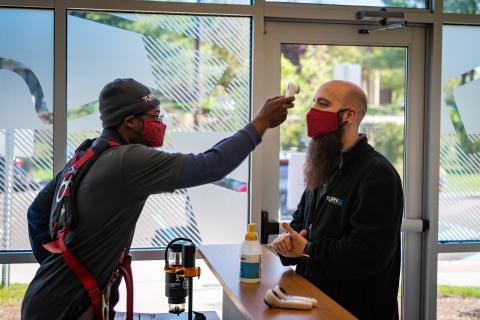
One of the most important considerations in maintaining a safe workplace is assessing the health of employees. Some businesses have instituted mandatory temperature checks, while others are asking workers to self-monitor their health. Photo courtesy of Callies Performance Products.

Curiously, while retail stores like Pancho’s have seen business drop off sharply, other retailers such as Indy Race Parts haven’t experienced the same harsh effects. “In mid-April or so, we actually started getting a little bit busy,” said Stuebgen. “As time went by, and people started to feel like they’re going to go racing at some point, we actually have become busier and busier. This week has been crazy busy.”

And, for at least one race-car fabrication shop, the effect of the shutdown ended up representing more of a shift in demand than a halt or even a slowdown. Instead of customers buying consumables, Knoxville, Tennessee-based Warrior Race Cars has been selling more project-based parts, as racers hunkered down in their garages and prepared for racing’s eventual return.

“I’ve sold more stuff in the past six weeks than I normally do this time of year,” explained Mike Nuchols. “But it’s front suspension kits, new shock packages. Random stuff for this time of year.”

Meantime, companies that also make products for non-automotive businesses seemed to accept that the motorsports side of production was temporarily on hold. For them, staying open is the order of the day, as they continue to serve their non-racing clientele. “Our production has been running at full employment and full capacity,” said Karl Dedolph of Champion Brands, Clinton, Missouri. “It isn’t just racing products we’re running. Work we do for other industries is the biggest part of our business. They continue to order.”

Playing Keep Away

For businesses that have stayed open—or plan to resume operations in the near future—the question then becomes how to navigate the myriad challenges presented by the coronavirus. One of the most important considerations in maintaining a safe workplace is assessing the health of employees. Most companies have adopted official policies to keep those who are sick with COVID-19 from entering the workplace.

But within that general necessity, the range of measures varies widely. Some companies have instituted mandatory temperature checks for all employees entering their facilities. Others have taken a less formal approach, instead asking employees to simply monitor their overall health and act responsibly.

“We aren’t taking temperatures before people come into the facility,” said Smith. “Primarily because so many people are asymptomatic, it doesn’t make much of a difference. They can still spread it. But we’ve made it a requirement that if people don’t feel good, they can’t come to work. They don’t have to worry about if they have sick time or not. We’ll figure it out as far as paid time off.”

In addition to monitoring employees’ general health, businesses are wrestling with the need to maintain the recommended six-foot “social distance” between workers. The mixed shop and office environment of many facilities has posed different challenges for each. “The offices are a bigger problem than the manufacturing area,” said Heath Norton of Energy Manufacturing and Callies Performance Products, Fremont, Ohio. “Some of the people who are indirect, like engineers and admin, are staggering what times they’re coming in, so the offices aren’t so crowded.”

Most of the sources we spoke with said their companies have set up some form of work-from-home policy for office workers. For many, it’s been mandated companywide. But a number of other businesses have kept this aspect of operations informal, allowing office personnel to work from home if they choose. Salespeople and product reps in particular have adjusted their activities.

covid 4
Most of our sources told us employee morale and motivation during the coronavirus crisis remains positive, and throughout the industry people are staying strong, showing up, and getting on with the task at hand. Photo courtesy of Turn 14 Distribution.

Prior to the coronavirus crisis, extensive nationwide travel had been the norm for employees in these roles. But many companies have generally eliminated such travel for the time being. “We’re no longer using outside road sales,” said Dedolph. “They’re doing everything by phone. And anyone who traveled was home quarantined for two weeks after they arrived via an airplane or visited a customer.”

Although no one really knows what the near future holds for that aspect of their business, the travel situation is something companies are monitoring closely. “Right now, we’re not sending our salespeople on any travel,” said Smith. “Maybe later this year we would be comfortable with doing that. I don’t know. We’re scheduled to exhibit at PRI in December. At this point we intend on going, especially because we can drive. But if I had to put my guys on a plane right now, I wouldn’t do it.”

In contrast, shop workers in the companies we spoke with don’t seem to face as big of an adjustment with regards to social distancing. For the most part, the sheer scale of machinery and car projects has always incorporated a certain degree of distancing. Therefore, most of the changes needed to ensure six-foot buffers have proven to be minor in many shops. “This ‘social distancing’ stuff is already a way of life for us,” said Nuchols. “There are only two of us in the shop. We’re usually more than six feet apart anyway.”

Some companies have taken the additional step of dividing the workday into separate shifts in order to reduce the overall number of employees in the building at any given time. “By splitting into two shifts, we’re completely able to keep everyone apart from one another,” said Smith. “But we also did it to mitigate risk—in the event that one shift is exposed in some way, then the other can keep producing goods and shipping them.”

Along with these measures, most of our sources have tried to minimize the number of non-employees coming into the building. This, of course, is more difficult for retail stores. Other types of businesses have effectively ceased all non-essential activities and contact with outsiders.

“We’re no longer allowing outside sales companies to come and see us,” said Dedolph. “Everything has to be done via Zoom or Skype or Google Meetings or Facetime. And when trucks come in, the drivers don’t come into the factory.”

Not surprisingly, smaller businesses have tended to adopt a less formal approach to this aspect of the crisis, too. “I’ve been trying to just urge people to let me know when they’re coming instead of just dropping in,” said Nuchols. “And if they do, I just try to schedule throughout the day when they’re coming in—certain times, instead of everyone piling in all at once.”

Of course, short of locking folks up 24/7, it’s tough to regulate people coming and going. This has made for somewhat challenging situations in some businesses. “We had an outside person come by mistake to the shipping dock,” said Dedolph. “That person had recently just arrived on a plane from out of state and didn’t self-quarantine. So, as a precaution we sent three people on the dock home for two weeks, because they were in close proximity to this person.”

Behind the Mask

Along with the need to maintain distance, health experts have said face masks covering the mouth and nose can be an effective method of preventing virus transmission. Many employees choose to wear them, but few of the companies we contacted for this piece have an official policy requiring them. Other companies view them largely as a branding opportunity. “We don’t require anyone to wear masks coming into the store,” said Stuebgen. “But I do have Indy Racing Parts masks on the counter that people can buy. As a matter of fact, I’ve sold eight of them today.”

At the same time, most of our sources told us that employee morale and motivation during the coronavirus crisis have remained good so far. Throughout the industry, people are staying strong, showing up, and getting on with the task at hand, they said.

“Most everybody’s been pretty great and positive,” Smith noted. “I would say we’ve had less absences than usual due to everything since the start of this. We thought that maybe more people would be scared to come into work. But I think that splitting into two shifts kind of made people feel more comfortable and more separated from one another.”

Many workers are simply happy to still have a job, a routine, and a paycheck. Others are glad to be able to continue doing activities they love—not surprising among motorsports businesses. Still others see the coronavirus crisis as a mere hiccup in the larger scheme of things.

“I think everybody is really excited to get back to work,” said Norton. “Most of the people that work with us are race fans. They’re into us. It’s a lot of fun for us. Maybe they liked a week or two at home, but now they’re pretty much ready to come back. We had people texting every other day, ‘Can we come back?’”

covid 5
Some companies view protective face masks as a branding opportunity. Among them is Indy Race Parts in Indianapolis, Indiana, which offers masks for sale directly on its checkout counter. “I’ve sold eight of them today,” a company source told us in May.  

Nonetheless, it’s hard to say if this fighting spirit can be counted on indefinitely. Some managers are monitoring employee attitudes and morale very carefully, fully understanding that if worker acceptance and motivation wanes, safety might be compromised.

“We need all their buy-in,” said Smith. “We send out a letter just about every week to our employees, just letting them know our thoughts on everything, trying to help them understand why we’re making the decisions we’re making. That’s important. And at the same time, we encourage them to make really intelligent decisions outside of work. Because, if one of them decides to go to a party and potentially contracts this thing and brings it into work, it affects all of us. It affects their job, their colleague’s job, and even whether or not the company can continue to operate.”

Fortunately, none of the companies we spoke with reported any actual cases of COVID-19, at least as of mid-May. Perhaps it’s due to the preventive measures they’ve taken. Or maybe it’s because their region of the country was low risk to begin with. Or it could be just the random hand of fate dealing good cards. But that uncertainty is perhaps the most vexing thing about this situation. How much caution is enough? What’s the most responsible way to handle it?

Frustratingly, there are few, if any, exact answers. It’s a crisis that so far has been shrouded in unknowns, with more misinformation and guesses than definite facts.

And so, companies’ responses to it have ranged from fairly elaborate to relatively non-existent, underscoring the reality that there aren’t any absolutes to this crisis. It’s very personal, especially for smaller businesses. “I don’t run a kindergarten school here. I feel as though I shouldn’t have to govern anybody,” added Stuebgen. “You’ve got to do whatever’s right for you.”


SOURCES

–

Callies Performance Products

callies.com

Champion Brands

championbrands.com

Energy Manufacturing

energymanufacturing.com

Indy Race Parts

indyraceparts.com

Pancho’s Racing Products

panchosracingproducts.com

Smith Systems

smith-systems-inc.com

Warrior Race Cars

goddardwarrior.net

July 2020
By
DAVID BELLM

THE NEW VINTAGE

Submitted by danielk on Thu, 06/18/2020 - 16:45


Historic racing may celebrate the past, but that doesn’t mean it never changes. Quite the contrary, in fact, as our inside sources cite innovative solutions and approaches designed to stand the test of time.

Vintage racing is one of those sports that, whether wandering the pits or watching the action on track, can make fans feel like they’re frozen in time. Being surrounded by cars once piloted by the giants of racing, cars that mesmerized so many future fans during their formative years, has the effect of catapulting people back to earlier days where they’re happy to hang around awhile.

But time is definitely not frozen in the real world.

Time can’t, and doesn’t, stand still even for racing that celebrates the past. And vintage racing today is undergoing changes from several directions, some expected, some arriving out of left field. There’s the inevitable reevaluation of what counts as “vintage” as the calendar marches on. There’s the introduction of new technologies and new business models. And there are the short-term and long-term changes brought about by this year’s COVID-19 outbreak that will have an impact on all forms of racing.

TIME MARCHES ON

The perception of what qualifies as vintage, of course, is highly subjective. A car that appears “vintage” to a 30-year-old may remind a 60-year-old of a car he was driving seemingly only yesterday. Periodic updates are inevitable as one generation supplants another. Usually those changes begin very slowly, then accelerate quickly.

“We see it across the board. Whether it’s a street car or whether it’s a race car, we’re seeing it across the board,” said Bruce Canepa of Canepa Motorsport, Scotts Valley, California. Canepa Motorsport sells, services, and restores vintage racing machines. “In the last five years—it was in that small a window—people’s ideas of what an old car was went from a Pre-War car to the 1970s. Literally, it jumped 30 or 40 years, and it happened quickly. Part of it is, if you just look at the demographic of people that own the cars, race the cars, people that drive them on the road, if you look back, you say, ‘A 1970s car is an old car. I mean, it’s 50 years old.’”

vintage 2
What qualifies as vintage, our sources noted, is highly subjective. After all, a car that appears “vintage” to a 30-year-old may remind a 60-year-old of a vehicle he was driving seemingly only yesterday. Photo courtesy of Canepa Motorsport.

Vintage racing organizations have their fingers on the pulse of the market and have seen the evolution firsthand. The Vintage Racer Group is one such. “When VRG started, the cutoff date for production cars was 1972. So about 10 years ago we said, ‘You know what? We need to start getting some younger people involved, because we don’t want this to become just a ‘silver only’ club,” said Jim Karamanis. “When you do that, you age out and you’ve got no one to drive the cars. As much as I love cars from the early 1970s, someone that graduated from high school 20 years after me—I graduated in 1990, so 2010—they don’t know what a 1972 B-Sedan Pinto is; to them, that is just something that they heard explodes.”

The Sportscar Vintage Racing Association (SVRA) in Southlake, Texas, has been particularly aggressive about expanding eligibility for vintage motorsports. “We constantly change every year. Our rule of thumb is five years or older,” said Tony Parella. “Theoretically, 2015 cars can run with us in different classes. The older classes have stayed still, but we’ve added and expanded the newer classes. We added Miatas in a separate class, a race group, a few years ago with the Heritage Cup program to bring in younger kids and remove some of the high-cost barriers to go racing.

“We’ve evolved since I’ve owned SVRA in 2012,” Parella said. “We instilled a rule, five years or older, that we would create a class for your car, a race group for your car. That served us well. A lot of the groups were anything newer than 1972 [and] they wouldn’t do it. Well, that’s not what we are. We’re a national racing organization and we feel that’s too wide a gap to run at the places we run.”

Besides just the natural changing of the generational guard, there are solid practical reasons to expand eligibility for newer cars. “Over the last five years we’ve done a couple more updates,” said the VRG’s Karamanis. “Two or three years ago we moved the production date from 1979 to 1989. And this past year, we changed the rules to also allow IT (Improved Touring) cars from 1979 to 1993. What that does is it lets you allow cars that might not necessarily require a fuel cell, because once you start getting into more modern technology of the 1980s, cars are designed to crunch—they’re not the rigid things that the cars of the 1950s, 1960s and 1970s were.” Being able to run a stock fuel system is one less obstacle to clear for drivers to get a car on track.

“We had racers coming to us and saying, ‘I don’t want to put a fuel cell in this car,” Karamanis said. “My car’s designed to crumble. I’d have to build a cage there. Is that safer than my car crumbling and absorbing the impact?’”

Car count is another practical necessity that favors adding newer-generation vehicles. “It’s not cheap to rent a race track, I don’t care if you do it on a Wednesday or Thursday through Sunday,” said Don Hoevel from Don Hoevel Racing, Fox Lake, Illinois. “Car count still pays the bills, for one. And that makes perfect sense. And the demographics—I’m 60, and none of us are getting any younger. And most of my customers are 60 and older. I’ve got a couple of guys that are 45 to 55. Myself, I grew up in the 1960s, and Boss 302 Mustangs, Z28s, that was the king of the hill. The people that are 10, 15, 20 years younger than me, they didn’t live through that.”

vintage 3
A few years ago, the Sportscar Vintage Racing Association (SVRA) introduced a separate class for Miatas “to bring in the younger kids and remove some of the high-cost barriers,” a source told us.

Hoevel reported steady business at his shop, everything from 1960s Can Am racers to a 2009 Porsche Cup car. “I don’t see historic racing going away, it’s just changing,” he said. “You look at all the LMP cars, and all that stuff coming in, it makes perfect sense. I mean, you’ve got that stuff laying around. They’re obsolete cars in the current classes, so why leave them laying around? Car count is paying the bills.”

Expanding eligibility has helped expand the field at the Monterey Motorsports Reunion. Bruce Canepa serves on the selection committee, and he said that he has long pushed for inclusion of an IMSA 1973–1981 group, which eventually came to pass. “Today, that class is oversubscribed by 50-plus percent. We’ll get, for a 40-car field, 65 or 70 cars easily. We have to pare that back to a manageable amount for on-track. And that really affords you the opportunity to pick the most important, famous, recognizable cars that ever raced in the event, whether it’s an Interscope 935 or a Momo car, or this Corvette or that Ferrari.

“We’ve also added a newer class, which is the IMSA GTO, and Trans-Am tube-frame cars, and GTP Group C cars,” he continued. “Those cars in different parts of the world ran together. They were different classes, but they ran together. So we have a class, it’s prototypes, starting in 1982, like the first March, up through 1990–1991, which includes all the GTP cars up through the Toyota GTP cars, Nissans and Jaguars, of course 962s in between. In that class there’ll be 20 of those cars, and there’ll be another 20 IMSA GTO kind of cars like Roush ran with Tommy Kendall, and like Scott Pruett drove, because those are now old cars to people. They look at them and remember seeing those cars race.”

vintage 4
Tony Parella of Parella Motorsports Holdings, which took over the SVRA in 2012, attributes the organization’s growth to its event format, which often combines both vintage and modern segments in the same weekend. Pictured here are International GT sports cars at an SVRA event.

Another practical advantage of including tube-frame Trans-Am and IMSA cars is that they are sturdy machines, to say the least. Most were engineered to withstand the rigors of endurance racing. “What we see there, the old Group 6 was the Camaros and the Corvettes, and the Mustangs, the 1960s and 1970s,” Hoevel said. “A lot of those guys had those cars. Those cars are huge maintenance. To drive them well and drive them fast, those cars are a lot of maintenance. Then all of a sudden you get one or two guys getting into these tube frame cars, and it’s a whole lot easier to drive one of those cars. You’re six or eight or 10 seconds faster than what you’re driving your 1965 Corvette. There’s a big transition from the Group 6 guys into the Group 9 class with all the tube-frame cars, and all the semi-modern Trans-Am and GTO sports cars. Group 6 has dwindled, and Group 9 has gotten big.”

Individual race shops are also seeing the shift in vintage racing interest. “It’s hard to get people into some of the older vintage stuff,” said Ryan Hayes of RaceKraft & Design, Englewood, Colorado. “That’s why Miatas are so popular. Shoot, all you have to do is add gas and check tire pressure all weekend, and it’s a bulletproof car. I consider the Miata the bugeye Sprite of the day.”

At Michael’s Vintage Racing in Hopewell Junction, New York, they’ve also witnessed interest in newer vintage cars. “I’d say the cars we’re starting to see that are a little bit newer, some of the weird and cool stuff, kind of some 1970s-era Celicas, pseudo-sedan type stuff like that, which is cool,” said Mike Clifford Jr. “We’re seeing E30 BMWs, first- and second-generation RX-7s. There are a couple guys running early Golf GTIs, which is kind of fun.”

Clifford also appreciates that the newer cars are sometimes easier to find parts for than the much older vintage models he usually deals with. “We have a 510 and a 260Z here, and it’s nice to be able to just order stuff sometimes,” he said, laughing. “Most of our stuff is a process.”

Of course, newer vintage race cars aren’t always easier to put together. One stumbling block to widespread acceptance is the difficulty in finding obsolete electronics packages. “What people don’t realize is the availability of the electronics,” said Hoevel. “As the cars started going to electronics, it’s getting more and more difficult to get functional black boxes, ECUs and things like that. It’s not impossible, and there are ways to outfit the car with different systems, but everybody doesn’t quite understand that when they go to buy this stuff straightaway.”

The Business Plan

Besides the newer cars on track, vintage racing is also evolving thanks to new business models and new opportunities.

Parella Motorsports Holdings, owner of SVRA, is also majority owner of the Trans Am presented by Pirelli Series, and has been aggressive in pairing the two together for common events.

“When we bought SVRA it was only running at three race tracks. We run at 14 now. We’re national in scope,” said Parella. “We invested in the Trans Am race series, a professional series, so that enabled us to put on a show that we could market to race fans to sell tickets. We could attract sponsors, but we also could leverage the vintage side of things for luxury brands and race-related brands, and now the collection of both we’re starting to market to consumer brands,” he said.

“Our strategy, it’s not just vintage, it’s not just Trans Am—the two together really give us a unique show. I’m marching us toward mainstream motorsports in this country.”

vintage 5
One of our sources reported rising interest in open wheel cars from the 1980s and 1990s. “There’s a pretty good demand for that right now,” he said, “because [the events] have started to get more organized.”

The combination of vintage and current racing in the same race weekend is paying off in ways that benefit vintage racers. “The proof in the business strategy is simple,” Parella said. “If you look at SVRA in 2012, 100 cents on the dollar came on the backs of the racer in two forms, either a license revenue or entry revenue. There were no spectators and there were no sponsors.”

According to Parella, as of 2019, SVRA is 30 times bigger than it was in 2012. “But more important than that, over 50 percent of our revenue comes from sponsorship and gate,” he stated. “Over half. So we’re 30 times bigger because we expanded to 14 events from three different venues, but the real growth came on top of that from the mix that has changed from sponsorship and gate.”

Some specialized sectors of vintage racing are seeing new opportunities that haven’t existed before to get cars on the track.

“We’ve been doing a lot of 1980s and early 1990s Indy cars,” said Hoevel. “When I worked at Newman/Haas, I started working there in 1986; in 1987, we won Long Beach with Mario Andretti. We just finished restoring that car for Zak Brown at McLaren, and that got shipped off to him right before Christmas. I’ve got another 1992 Danny Sullivan Long Beach winner here. Somebody else did the major end of the restoration and we’re just finishing up.”

Hoevel sees interest rising for Indy cars from the 1980s and 1990s. “There’s a pretty good demand for that right now, because they’ve started to get a little bit more organized,” he said. “There’s probably four or five semi-organized events for old Indy cars right now, and it’s a little bit different than our normal vintage racing. You can actually vintage race them if you want to, but the vintage Indy events are, you show up and you run two or three times a day in conjunction with, like, the Indy 500 or the St. Louis IndyCar race. It’s a lot of guys that have probably been race fans for all their life. They’re in their late 40s, 50s, 60s, 70s. Some of these guys have probably acquired these cars 20 and 30 years ago, and they’ve sat in the corner of the barn or whatever. Now there seems to be pretty good interest because there are places to go out and run these things. And you don’t have to race them, but you can drive them.”

FEVER DREAMS

When we interviewed our sources for this article, it was mid-April and the coronavirus disruption had shut down much of the motorsports industry. There’s no way to know exactly how that will all play out as 2020 rolls on, but in the short term, at least, vintage racing will be adapting just like every other form of motorsports.

“Any way you look at it, our events are going to be different when we go back,” said Hoevel. “The July race at Elkhart Lake, they’ve got the Friday night parade into town, and you end up in town with 10,000 people looking at the race cars. Well, that’s not going to happen.”

The Vintage Racer Group has added one of the popular racing adaptations to keep interest simmering. “We’ve done things a little different this year to try to give people some excitement and something to feel happy about, because honestly, this has been a really depressing time, for people not just worried about racing, but family and friends. So we started a virtual iRacing series for our club members,” said Karamanis.

vintage 6
Despite the disruption caused by current world events, vintage stakeholders remain optimistic about getting back on track. “The floodgates are going to open,” one of our contacts said, adding, “it’s going to be super healthy, and everybody is going to be ready to go racing.”

He reported that the organization is getting some buzz on social media, and it’s not just younger members interested in virtual racing. “In the practice session last night, we had all ages and all kinds of experience, both between the virtual world and the real world,” Karamanis explained. “We had an 18-year-old kid win the race last night. I bet if you counted the laps he has on the real track and put it against everyone else out there, it’s probably a blip on the radar. We’ve had guys up into their mid-70s that were racing last night, and I’ve got guys up almost into their 80s coming out next week.”

The SVRA also has an e-racing deal in the works. They’ve spent considerable time formulating plans for when race tracks do reopen. “We’re spending a lot of our time adjusting to when we do come back out to race, to make sure we’re prepared for the new normal, whatever the new normal is going to be,” said Parella. “And that largely has to do with how do we put on events, and social distance, and keep social distancing a focus point. Because I don’t believe it’s going to magically, in two weeks or three weeks, be okay to come out and revert back to what we once considered normal.”

At press time, the SVRA’s most likely next events were scheduled for June, with one at Indianapolis Motor Speedway and one at Mid-Ohio. “All of our focus right now, over the last six weeks, has been reinventing our processes,” Parella said. “As an example, registration, we’ve got it down to just a waiver that people sign, and I’m trying to get that where we can do that with DocuSign.

“Our registration team will have masks, they’ll have gloves, they’ll have a glass shield. We’re going to a different type of wristband,” he continued. “We’ll have, in the goodie bag, we’ll have a mask for the driver, hand sanitizer, and their own unique pen, if I don’t get the DocuSign signed.”

The social aspects of the race are still up in the air. “We used to have huge Saturday night parties, as we’re so much focused on the social moment, but no parties for the foreseeable future until social distancing is not needed,” Parella said. “Our victory circle will look different. Our tech inspection will look different. Our driver meetings are going to be done with Zoom so we don’t have to have everyone congregate. So we’re thinking in those terms. From a fan standpoint, the neat thing about vintage racing, or Trans Am, or road course racing, is you don’t have an assigned seat typically. We’re kind of like going to the drive-in movies instead of going to the theater. You can spread out and still watch the race.”

The fan experience will still be familiar, if a bit different. Parella said they are working on producing a digital event program for download instead of the traditional paper program, and food vendors will be more spread out.

“Our goal, our whole mantra in every conference call with my team, is ‘I want you to make our races safer than going to the grocery store.’ That’s the mission,” Parella said. “Clearly there’s a pent-up demand. People are getting a little goofy sitting in the house this long, me included. But I want to make sure we do it right and don’t look like we’re not being socially responsible.”

“I’m super optimistic that when it does open up, the floodgates are going to open and it’s going to be super healthy and everybody is going to be ready to go racing,” added Brandi Kaiser of K-Hill Motorsports, Abbottstown, Pennsylvania.

Undoubtedly, those first few laps back on track after the layoff will be ones to remember, no matter the vintage of the car.

SOURCES

–

Canepa

canepa.com

Don Hoevel Racing

donhoevelracing.com

K-Hill Motorsports

k-hillmotorsports.com

Michael’s Vintage Racing

michaelsvintageracing.com

RaceKraft & Design

racekraftdesign.com

Sportscar Vintage Racing Association

svra.com

Vintage Racer Group

vrgonline.org

July 2020
By
STEVE STATHAM