A look at some of the country’s in-demand motorsports products and services by region and racing segment.
Motorsports retailers and service providers are constantly tracking the latest parts and trends to give their customers a competitive edge. For the latest on which products and services are moving the retail needle, we present the following sales snapshot from shops across the US.
Tapout Tuning
Plain City, Ohio
Tapout Tuning is a premier tuner business specializing in the Cadillac 3.6-liter twin-turbo LF4 engine. It provides parts, full installation service, custom in-house dyno tuning, and remote tuning solutions for customers from all over the world. About 80% of its customers are racers, primarily road racing or drag racing.
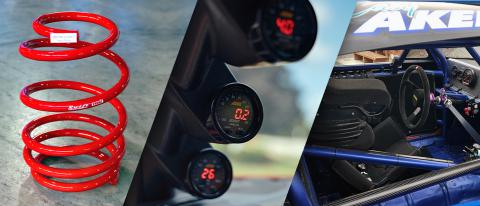
The fast-moving parts and services at the Tapout Tuning shop are the installation and tuning of the company’s personally designed downpipes, carbon fiber trim pieces, and cold air intakes, in addition to Pure turbochargers, and Swift Sport lowering springs.
Its customers choose these parts because they are developed specifically for the Cadillac platform by the Tapout Tuning staff. The downpipes vastly improve the sound of these vehicles and also serve to produce significant horsepower gains. The Tapout Fuel cam, when used in combination with a few other fuel system modifications, allows customers to run ethanol in their vehicles. With the Purple Belt Performance Package, customers can make up to more than 100 whp over the power that can be produced on regular pump gas.
As far as marketing these products, according to founder/owner Scott Cook, “These products speak for themselves in the results they provide. They are high-quality, made in the USA products with zero failures and hundreds installed. We have the best inventory management in the business, and every item we sell is currently in stock for immediate shipment. We even ship the same day when you order by 3:00 p.m. EST.”
Jon Jon Motorsports
Elgin, Illinois
Jorge Vazquez-owned Jon Jon Motorsports is a multi-faceted automotive business whose primary functions are suspension work, diagnostics, and the swapping and building of engines. The majority of its customers modify their cars for the street, but roughly 20% of them are racers. These competitors road race at tracks such as GingerMan Raceway and the Autobahn Country Club, while the drag racers compete at Great Lakes Dragaway.
Master Technician Jamison Sanchez relates the customers of Jon Jon Motorsports, much like himself with his own personal vehicle, are “really big on trying to build something different,” which is a prime reason behind why customers choose its two fastest moving product lines, AEM gauges and Rotiform wheels. Sanchez stated that the customers appreciate the look of the gauges and wheels because they have their own style, setting them apart from other manufacturers. It’s also important that they’ve experienced superior reliability from these products with almost no problems at all in the years the company has been selling them. With all the engine work Jon Jon Motorsports performs, another fast mover is Liqui Moly engine oil, known for its superior lubrication properties.
Super Rupair
Rathdrum, Idaho
Super Rupair began in automotive repair/maintenance/aftermarket parts and has expanded into engine building and fabrication, with about 20% of its customers being racers. With two tracks within an hour of the shop, the racing customer base is primarily local racers competing in hobby stock, modifieds, limited late model, drag racing, and street/strip.
The fastest moving products off the Super Rupair shelves are from BG Products, motor oil, and fuel lines/fuel rails. According to Super Rupair owner Tysen Akers, “BG Products manufactures and distributes high-quality, professional-use additives, cleaners, specialty lubricants, and precision tools and equipment. We’ve seen amazing results with their products.”
As engine builders, Akers cited Motul and Schaeffer’s motor oils as fast movers due to increased oil performance in high-horsepower applications, turbocharged cleanliness and protection, and shear stability.
Super Rupair has many customers who come in for custom engine builds. The turbochargers and combinations they use from Forced Performance have always exceeded the customer’s expectations, he explained.
When working on engines, regardless if they’re for street machines or race cars, the shop replaces the fuel lines and fuel rails rather than reusing the old, worn-out ones. Super Rupair uses components from Bosch and Radium Engineering to improve performance and reliability for its customers’ engines.
While the staff at Super Rupair are knowledgeable and capable of explaining the advantages of these products to customers, they’ve found the products often sell themselves due to their quality and performance, so no extra marketing is needed.
“One of the most common mistakes we see racers make is the assumption that bigger is better,” said Goodyear’s Jay Chapman. Not only can a tire that’s too big create clearance issues, it can also negatively affect the tire’s footprint.
Maximizing the footprint may be attractive, but properly sizing your tires can improve their longevity, thermal efficiency, and overall grip.
When it comes to a race car’s performance potential, the buck stops where the rubber meets the road. All the horsepower in the world isn’t worth much if it can’t effectively be translated into forward motion, so it makes sense to do whatever it takes to increase mechanical grip. But while it may seem counterintuitive at first glance, that doesn’t always mean that a wider tire is the right answer.
“One of the most common mistakes we see racers make is the assumption that bigger is better,” explained Jay Chapman of Goodyear Race Tires, Akron, Ohio. “Folks often want to put the biggest possible rear tire on rear-wheel drive cars, but in many cases a square setup, where the same size tires are being used at both the front and the rear, will work better in those applications. You can definitely ‘over-tire’ a car.”
Over-sizing the tires for a given wheel and platform can not only lead to clearance issues that can cause the tire to rub on the inside of the fender or the outside of the fender well when the suspension compresses, it can also create other, less obvious problems that may negatively impact the car’s performance.
“If the wheel isn’t wide enough for the tire that you’re trying to use it with, it can cause the tire to ‘crown,’ where the center of the tire is higher than the rest of the surface, and that prevents it from creating a proper footprint,” Chapman said. “At that point you’re not utilizing the tire as it was designed.”
Meanwhile Drew Dayton of Yokohama Tire in Santa Ana, California, pointed out that over-sized tires can also create more work for the car. “You’re not only losing some responsiveness, there’s also a weight disadvantage because wider tires are going to be heavier, and that’s especially important when we’re talking about rotational mass. There’s also the potential for a wider tire to create more aerodynamic drag, which could also negatively affect lap times.”
Using an under-sized tire can create problems, too. Although it’s a less common occurrence, the supply chain challenges we’ve collectively seen over the past few years have recently made this situation more prevalent.
Some race series do allow a certain amount of latitude in tire size, said Jay Chapman of Goodyear, which can enable teams to dial in the car’s responsiveness by using tire height to adjust gear ratios for a particular track.
“In that situation, the tire can get overheated more easily because it can’t disperse the heat across the tire as effectively,” said Chapman. “Sometimes people try to help mask this by increasing air pressure, but that also affects tire performance across the board.”
Dayton also noted that switching up tire widths can have a significant effect on the overall dynamic balance with certain platforms. “The relationship between the front and rear is something we focus on a lot with the Porsche GT3 Cup car, for example, because they’re really sensitive to changes. You can end up fighting a lot more oversteer or understeer if you disrupt that balance.”
Chapman pointed out that while the rulebooks of most spec classes and upper-level series require all competitors to use a particular tire, there are areas of grassroots and sportsman-level racing where racers have room to dial in their setups a bit more, and tire sizing can make a significant difference in a team’s competitiveness.
“In SCCA Touring classes like T3 and T4, there’s a tire maximum width rule, but the overall diameter of the tire can be adjusted a little bit. That effectively allows a team to adjust their gear ratios to optimize the car for a particular track. If it’s a shorter track, for instance, you might want to switch to a smaller tire to come off of the turns quicker, or maybe you want a taller tire for a longer track in order to get down the straights without running out of gear.”
Dayton said that in situations where none of the available tire sizes are ideal for the wheels being used, determining which tire to use in competition occasionally comes down to the data collected during practice sessions. “For example, at Pikes Peak this year we had a team that had these really cool carbon fiber wheels that required a pretty unique rear tire size. That gave us two options: a soft compound 300/60R18, or a medium compound 320/60R18. We ended up testing both tires on the same set of wheels to figure out what the trade-offs were going to be, and ultimately which tires would produce better lap times. In that case we ended up going with the wider tire with the harder compound.”
Wheel and tire manufacturers can be a great source of information for racers who are looking to ensure that they’re getting tires that are sized appropriately for the wheels they’re being mounted on, but Chapman said that competitors should also do some fact-finding of their own to verify that everything is copasetic. “Tire temperatures and air pressure are the most basic way to get information, but I think they’re also the key to determining what’s going on with the tire. With that you can make sure you have the proper spread from the inside to the outside of the tire, and that your psi gain is where it’s supposed to be.”
A motorsports retailer may be better set up to handle returns than the product’s manufacturer, reported some of our sources. Mike Buca of Design Engineering, Inc. (DEI) clarified, “If the product is being returned for any reason outside of a warranty issue, the proper channel is to go through the place of purchase.”
When it comes to returning a performance part, honesty really is the best policy.
Every manufacturer and retailer has to deal with product returns. But in the racing and performance industry, things can get, well, complicated.
“We had a situation where a guy returned an oil pan that he said he bought two years ago, but it clearly had build data on it from five years ago,” recalled Frank Thibodeau of Moroso Performance Products, Guilford, Connecticut. “He had beat the hell out of it. He said it had never been raced, but it clearly had been bottomed out and scraped on the race track.”
“We had a guy who bought a Turbo 350, had it for a couple months, and burned it up,” said J.C. Beattie Jr. of ATI Performance Products, Baltimore, Maryland. “At first, he said it just burned up, but that sounded wrong with the data he was giving us. As we talked to him, we found out he has an autistic son who loves to do donuts.”
“Probably one of the most extreme situations happened to us many years ago,” recounted Reggie Wynn, sales and marketing manager for Precision Turbo & Engine and Turbonetics, Crown Point, Indiana. “A guy crashed his car, and he had our turbo kit on his car. He told us he crashed the car, but he said, ‘I’m getting another one. Is there anything you guys can do to help me out?’”
Two of those three customers did what manufacturers recommend when it comes to returning products. “We do our best to help anyone who asks for it, but we really appreciate it when people are honest, when they say, ‘Can you help me out?’ rather than, ‘That’s how I got it,’” Thibodeau said. “Manufacturers know their product. They’re going to know in most cases how it was used, if it was abused, and they’re not being told the truth.”
In all three cases—even the questionable oil pan claim—the companies helped the customer. “We’re all racers here,” Thibodeau said. “We could tell that thing hit something on the race track. But we’re still going to help the guy out, because that’s the kind of company we are. We want them to buy a Moroso product in the future. It’s going to cost us a couple of bucks, but we’re going to maintain a customer.”
In the case of that ATI transmission, “after getting the rest of the story and discussing it with him, we were able to make the repair, and everyone was happy at the end of the day,” Beattie said. “We’re a family-owned business, and we try to work with people. In today’s world, a lot of times the manufacturer might need that part back to sell it anyway. As long as you bought it from us, and it’s not really old, installed, or broken, we’ll usually take it back.”
Handling the Return
“If the product is being returned for any reason outside of a warranty issue, the proper channel is to go through the place of purchase,” said Mike Buca of Design Engineering, Inc. (DEI), Avon Lake, Ohio. “Fortunately, because our defective rate is well under 1%, our distributors are not seeing many DEI products being returned. Also, between our website and training of personnel at the distributor level, the chance of a consumer buying the wrong product is also minimal.”
“If you bought a product from Summit or JEGS, they’re set up to handle returns,” Thibodeau pointed out. “They’re probably going to have that part in stock, so they can get you something brand new, right out of the box, whereas a manufacturer may not be set up to do that. We can do it, but we don’t have an automated, streamlined process.”
Reggie Wynn of Precision Turbo & Engine and Turbonetics appreciates a customer who is honest when returning a product. “There have been times I’ve bent over backwards to help out guys who were completely honest with me.”
That’s one reason some manufacturers ask for a restocking fee. “Let’s say a damper comes back, and the packaging is no longer usable, the directions are gone, maybe a decal is missing, stuff like that. We do have to repackage stuff, and it’s not zero cost to us to get your part back. We cannot just toss it right in a shipping box and send it back out,” Beattie said.
For online retailers and other customers who buy in quantity, manufacturers offer stock adjustment programs to handle bulk returns. DEI, for example, has a stock adjustment program that’s “based on how much they bought through the year,” Buca said. “Say they bought some products that didn’t sell. They can do a once-a-year return on that against another order. It’s usually a two-for-one. So if they want to return $100 worth of product, they have to order $200 more of a different product. Then we take that inventory back, as long as it’s new and in saleable condition.”
ATI, too, handles bulk returns and stock adjustments from Summit, JEGS, and other retailers. “They might have 30–40 things to send back once a quarter,” Beattie said. But, he added, “that’s a different story” than direct returns from end users. “We really don’t get a ton of returns, maybe less than five a week. We don’t do RMA numbers—that tells you how small the amount of returns are.”
Return Merchandise Authorization
What Beattie is referring to is a return merchandise authorization number, which most companies ask their customers for when initiating a return. This helps identify and track the part as it goes through the return process.
At Moroso, “we call it an RA number, and we recommend you write it on the outside of the box,” said Thibodeau. “That way when it gets to our returns people, we know there’s already something written up about it. Otherwise, the product could sit for a few days while we try to get in touch with the customer. Contact the manufacturer first, tell them what you want, and it’ll speed up the process.”
Thibodeau said he’s surprised at the number of customers who return products “with no note inside, no return address or phone number. It’s amazing that a guy will buy a $2,000 dry sump pump and will send it back with no information.”
Thibodeau offered one more tip: “We like to see clean parts coming out of a box. You want to make it in as good a shape as you can for the manufacturer to go through, so they don’t have to spend a lot of time cleaning it. It goes a long way if you can do something a little helpful for the next person. Usually, you get a better result than you would normally. But there again, we’re going to help people either way because that’s just the type of company we are.”
Facebook Reels are a cost-effective opportunity to accelerate customer engagement and boost brand identity.
For the past few years, short-form vertical video has taken over social media. The trend started with TikTok, and then Instagram created Reels shortly after to directly compete. Reels quickly became Instagram’s fastest growing content format. This prompted Meta (which owns and operates Facebook and Instagram) to bring Reels to Facebook as well, which has created major growth opportunities for users who have adapted to this change and put more emphasis on Reels.
Early adopters of Reels on Facebook have reaped the rewards as the algorithm has heavily weighted the feature, allowing content to get shared and highlighted more, which in turn offers more exposure and engagement as well as an increase in followers.
Facebook Reels is very similar to Instagram Reels with its editing capabilities, including music, voiceovers, filters, effects, stickers, and other tools. In fact, users can even create a Reel on Instagram and post it to both Instagram and Facebook Reels at the same time if their accounts are synced.
One of the biggest benefits of Facebook Reels is increased discoverability to a new audience. With Facebook’s one billion monthly active social media users worldwide, businesses have a large number of viewers to attract to their content, which turns into increased brand awareness and potentially more customers. If done well, brands can reach a large segment of their target audience and grow their following in a short amount of time.
Reels are public and get pushed out to everyone, not just your current followers or friends, but more specifically to those users who engage in similar content and topics as your industry. The algorithm picks up on users’ viewing habits and continues to send them videos related to what they already enjoy watching. For example, there are millions of motorsports fans and gearheads globally, so if you’re a racing business highlighting automotive-related content, your videos will be showcased to the many like-minded viewers out there. A majority of the users viewing your videos aren’t yet followers, so posting to Reels gives you the chance to get your brand in front of them and convert them into followers, and then customers.
For the best results, here are some tips and best practices for Facebook Reels. Focus on quality content. Instant gratification is more prevalent than ever right now, so you must grab the audience’s attention immediately or else they will scroll right by. Use content that’s exciting, relatable, and/or inspiring. And keep it short. Attention spans have become shorter, so a 10- to 15-second clip is the optimal length for Reels. Get creative, try new things, and don’t get discouraged if an idea doesn’t work. Not every video will go viral.
It’s also important to keep in mind that you don’t necessarily need professional camera equipment or top-notch video editing skills. High-quality videos can be captured on cell phones, and Reels offers several easy-to-use editing features directly through the app. If you don’t have a team of professional videographers and editors, utilize those editing tools for best results and further reach.
Avoid low-resolution video, horizontal video, and videos with watermarks. This type of lower-quality content offers a less satisfying experience for viewers, which will result in the Reel being less discoverable on the app.
Facebook is one of the original social media platforms, which also makes it one of the largest from a user standpoint. Because of that, it’s almost necessary for a business to utilize Facebook Reels, since it’s currently the best way to reach the most people organically.
To sum it up, the most important reasons to start using Facebook Reels are to reach a wider audience, increase engagement, and increase brand awareness. Plus, it’s a cost-effective way to reach our target audience. It’s time to get creative!
Hundreds of new product announcements cross the desks of PRI editors each month. Following are our top picks for October.
Global B Custom Tuning Support
HP Tuners
hptuners.com
Performance enthusiasts driving popular GM vehicles like the C8 Corvette and Cadillac CT4-V Blackwing have long been at a disadvantage to improve tuning because of security restrictions built into the cars’ computers.
Engineers at HP Tuners in Buffalo Grove, Illinois, have now cracked the codes, and the company is offering comprehensive diagnostics and custom calibration solutions for GM vehicles running the Global B control modules.
“Performance shops and anyone wanting to get more out of the vehicles have been asking for this,” said Chris Holt.
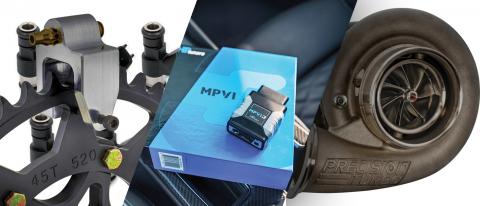
Currently available to approved resellers, these services enable access to HP Tuners’ VCM Suite software for diagnostics and tuning via the OBDII port using the latest generation of MPVI3 interface. Once their ECUs and TCMs are upgraded, professional tuners can access and edit hundreds of engine and transmission parameters.
“It will allow much more modifiable parameters in the ECU so you can get more complex parts to work, like superchargers, twin-turbo kits, and nitrous,” explained Holt. “Previously, you were able to add all those components, but you weren’t able to do as much tuning as is needed to optimize these parts.”
HP Tuners will soon offer custom tuning support for the full lineup of GM Global B controllers covering the most popular models. This includes new generations of the E90, E01, and E66 ECMs along with the remainder of the T93 TCM support.
Pro Bracket Race Torque Converter
Summit Racing
summitracing.com
Available in 8-, 9- and 10-inch diameters, these new Pro Bracket race torque converters from Summit Racing are designed for weekend warriors and professional bracket racers looking for performance right away.
“Most bracket race torque converters are custom builds that can take weeks to get. Our Pro Bracket converters offer racers in-stock options they can order and get in a few days,” said Mike Schmidt.
Targeted toward engines displacing 327 to 555 cubic inches, these converters deliver stall speeds ranging from 4,400 to 6,000 rpm. They fit GM TH350 and TH400 transmissions in addition to GM Powerglides that have been equipped with a Turbo input shaft.
“In back-to-back testing using a 9-second small block car, one of our converters was within 200 rpm and a tenth of a second of the custom-built unit originally in the car. We even created a stall-speed guide to help racers choose a Pro Bracket converter based on vehicle weight, horsepower, and cubic inches,” added Schmidt.
The converters feature a furnace-brazed pump and turbine, dual anti-balloon plates, TIG-welded blades, and Torrington bearings. There are models for use with .090-, .125- and .250-inch-thick motor plates. All converters are fully computer welded and balanced.
Billet Aluminum Porsche Pedal Assembly
Penta Motorsports
penta-motorsports.com
A new Penta Motorsports pedal assembly for 1963 through 1989 Porsche 911 vehicles offers position adjustability to achieve optimum heel-toe actuation for drivers on road courses. Other benefits include setting the front/rear brake balance more accurately, and ability to mount Tilton 78 Series master cylinders for brake and clutch action on the unit itself for maintenance and security.
“We initially developed the pedal assembly for use in the 1974 Porsche RSR that we compete with on several vintage racing circuits, and we’ve had other Porsche racers ask about getting an assembly for their cars. So, the decision was made to go into production,” explained Steve Sanett from the Moorpark, California-based company.
The Penta assembly is a bolt-in replacement for the factory steel units. The truss-style pedal arms and base have been designed using FEA (finite element analysis), and they are precision CNC-machined from 6061-T6 aluminum followed by gold and black anodizing.
Key attributes include the use of precision ball-bearing pivots instead of OEM brass bushings and “clockable” 32-spline shafts (plus multiple pedal pad positions) facilitating pedal placement to suit the driver.
“Optimum driver comfort is important in endurance racing, and the adjustability of this assembly facilitates tailoring pedal position to best suit each driver,” added Sanett. “This is critical for optimum heel/toe downshifting. The ability to set the ideal front/rear brake balance is also an important benefit.”
Laser Chain and Sprocket Alignment Tool
Speedway Motors
speedwaymotors.com
Getting the chain and sprocket aligned on a competition kart or mini-sprint car is just as important as setting the driveline angles on a race car. Speedway Motors in Lincoln, Nebraska, developed a laser tool to make sure there is no drag in the system.
“We had several racers that ran in classes that used chains and recognized a problem. By getting the sprockets correctly lined up, the chain will run freely. This will also help in wear and tear and possibly fewer DNFs,” said Greg Nicol.
The tool helps the racer align the edges of both front and rear sprockets and is compatible with 35, 40, 219, 520, and 530 chain sizes. A laser with LR41 button-cell batteries is included, so there’s no need for additional shopping to find a light that will work. The laser holder is CNC-machined from aluminum, and there is a brass laser sight to ensure accuracy in the alignment process.
“We worked with several different classes and teams to get the best product we could,” added Nicol. “The racers that have purchased them have all been impressed with them and think it is a high-quality tool.”
The tool’s versatile design makes it useful in the pits for mini-, micro and Lightning sprints as well as karts and quarter midgets. The clamp-on feature allows the user’s hands to remain free for adjusting the chain and sprockets.
Spintric Air/Oil Separator
ARE Dry Sump Systems
drysump.com
Spintric Technologies, a division of ARE Dry Sump Systems in Loomis, California, has a new axial flow version of the company’s line of air/oil separators for dry sump systems that can be mounted vertically.
“These passive units mount in-line, between the scavenge pump and the dry sump oil tank, and separate up to 80% of the air that is normally returned into the tank,” said Gary Armstrong. “The separated air is then returned to the very top air gap in the tank, resulting in more efficient lubrication, cooling, and pressure to your racing engine.”
Although simple looking, the separator is a sophisticated design with several complex channels that allow “centripetal air separation.” The oil traveling back to the tank is the only moving part in the Spintric separator. The internal centripetal force is generated by the design of internal components that forces the air out of the oil prior to entering the tank.
The separator can be mounted anywhere in the scavenge return line. One of the advantages of a stand-alone separator, as opposed to one integrated into the dry-sump pump, is that it is easier to mount the pump if packaging is a critical issue.
ARE has also expanded its dry-sump tank line with new models featuring CNC-machined aluminum castings that are heat-treated to T6.
Next Gen 8385 Turbocharger
Precision Turbo and Engine
precisionturbo.net
Honda K20Z3 Gasket Kit
Cometic Gasket
cometic.com
The new Street Pro top-end gasket kit from Cometic Gasket in Concord, Ohio, brings race-proven MLS technology to the budget-minded racer running a Honda K20Z3 engine. Street Pro gasket kits are constructed from multiple layers of stainless steel for strength, along with excellent rebound and corrosion-resistant characteristics.
“Racers will greatly benefit from this K20Z3 kit as it ensures continuous aftermarket support,” said Brendan Chess. “Cometic also can provide a wide range of head gasket variations of different bore sizes and thickness.”
The outer layers of the MLS head gaskets are coated with a proprietary high-temperature coating to create a heat-resistant seal to withstand extreme cylinder pressures. They are compatible with aluminum heads and iron or aluminum blocks.
“What sets our product apart from others in the field is we offer the flexibility to change the bore size and thickness of the head gasket according to your specific requirements,” explained Chess. “Our ultimate aim is to ensure a perfect fit and seal, giving you complete confidence in the performance and reliability of your engine.”
Class rulesets often require compromises in the combination, but advances in design and tuning strategies are making superchargers more efficient—and more durable—than ever before.
Although the concept of supercharging dates all the way back to the mid-1800s, engineers and competitors are still finding ways to improve this method of forced induction more than a century and a half later.
The demands of the application, the specifics of a given class or series’ ruleset, and the style of blower being used all come into play when determining where progress can be made, but there are a few elements that blower manufacturers generally keep at top-of-mind. Internal tolerances and aerodynamics have always played crucial roles in supercharger efficiency, and as more sophisticated technologies have been incorporated into development, manufacturers are now able to pinpoint areas for improvement with a level of precision that just was not available a decade ago.
A strict maintenance schedule can make a big difference in the longevity and performance of a blower. “Keep an eye on the run count and change the oil regularly,” said ProCharger’s Erik Radzins. “The teams that are winning championships are keeping track of everything, and that’s why they’re going round after round.”
“Over the years, people found ways to get tighter and tighter clearances for sealing and things like that,” explained Brad Littlefield of Littlefield Blowers, Rancho Cucamonga, California. “More recently, the focus has kind of shifted away from the tightness of the seal—you can only go so far with that. Now it’s about how you can do that with minimal drag and better heat properties. And, in a general sense, a lot of that is about locating where it’s necessary to have those tight clearances, and where you can open things up a bit. If you look at the blower on a Top Alcohol car from the early 1990s, at that time it was about making everything so tight that it takes a breaker bar to turn it even when it’s sitting on the bench. For two or three runs they’d make incredible boost, then the performance would basically fall off a cliff. That’s no longer the case with the way that they’re designed now.”
But there are also other factors, both in terms of a supercharger’s design and how it’s utilized out on the track, that play important roles in the performance it can deliver. More often than not, those same variables will also have a significant effect on the blower’s overall longevity.
Demands of the Task
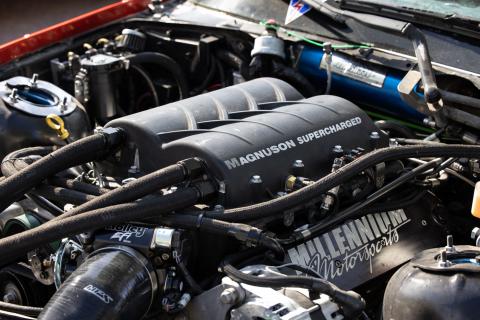
Kim Pendergast of Magnuson Superchargers in Ventura, California, said that one of the main areas of development focus in recent years has been proper application sizing in displacements and pressure ratios that are not traditionally found in the automotive realm. “For example, the new TVS V180 is 10 times smaller than a traditional TVS1900 and capable of much higher pressure ratios,” she said. “On the flip side, we also continue to develop large displacement units for bigger engines, whether that’s a traditional gas-powered application or something that utilizes an alternative fuel. And we continue to develop the rotor design with Eaton, because what works best for a smaller unit doesn’t necessarily scale linearly for the larger units.”
Properly sizing a supercharger to a given engine combination plays a fundamental role in its performance potential. But as Lance Keck of Vortech Superchargers in Channel Islands, California, pointed out, manufacturers and teams must often deviate from an ideal setup for a given application due to the limitations of class rulesets.
“We see it with all of the sanctioning bodies—they want to control the class with the power adder, and they typically go with a unit that’s much too small for the application,” Keck said. “When you do that, the supercharger runs into choke basically all of the time, and that elevates discharge temperatures dramatically. It’s something we’ve had to contend with for years.”
Littlefield said that while camshaft and cylinder head choice will also have a big impact on a blower’s efficiency and durability in a given application, rule mandates related to other engine components can force teams to build their combinations around the specifics of that stipulation.
“Nostalgia Funny Car and Nostalgia Top Fuel are good examples of that because they’re limited to 6-71 blowers, and they also use what’s essentially a ‘spec’ fuel pump in the class—they have to have a pump that’s 20 gallons-per-minute at 8,000 rpm in the Top Fuel class, or 21 gallons-per-minute in the Funny Car class,” Littlefield explained. “Because of that, you see teams playing more and more with the top openings. Some of those guys will reduce the top opening to three or four inches, even though it’s kind of a no-no to shrink blower opening to the point where it won’t perform well at a higher rpm. They do that because they’re so limited by the fuel pump that a really efficient blower will otherwise just burn itself up and run away from the motor toward the end of a run. By shrinking that top opening, they’re able to get to that boost early, and then have the blower kind of follow the engine curve a little bit better toward the top end.”
Properly sizing a supercharger to a given engine combination plays a fundamental role in its performance potential, though rule mandates related to other engine components can force teams to build their combinations around the specifics of that stipulation.
Properly sizing a supercharger to a given engine combination plays a fundamental role in its performance potential, though rule mandates related to other engine components can force teams to build their combinations around the specifics of that stipulation.
But Erik Radzins of ProCharger in Lenexa, Kansas, noted that there’s been some headway with sanctioning bodies on the subject. “One of the things I like about the PRI Show is that it’s one of the few places where a guy like me can talk directly to people who’re on rule committees. Rule makers basically used to tell us how they wanted things like the blower gearbox to be designed—we’d make something new, and they wouldn’t allow it. When I finally had the opportunity to have a conversation with one of them, I basically said, ‘This is like telling everyone they can run your class and make 2,000 horsepower, but they have to use a 4L60 transmission. That means that the only teams that are going to win the class are the ones that have a dozen 4L60 transmissions sitting in a trailer.’”
Dialed-In Design
Supercharger manufacturers may face constraints in motorsports, but efforts to improve their products remain ongoing. “The compressor side has always been an area of concentration for us,” said Keck of Vortech.
“With a really good compressor design, we can pick up efficiency as well as durability,” he continued. “If we do a compressor design and it doesn’t reach a 70% efficiency point, then we scratch that design and start over. We have an internal supercharger dyno that we use to develop compressor maps and do our testing with; we’re one of the few supercharger companies that does that. When you can improve the efficiency of the compressor stage, there’s less heat generated from creating boost, and that keeps the gearbox side of things cooler.”
Meanwhile, Magnuson has recently added a custom-built test stand to its roster of development equipment. Dubbed “Big Gulp,” it’s powered by a supercharged LT1 V8 engine from a seventh-generation Chevrolet Corvette. “Boy, does it make the blowers scream,” said Pendergast. “Its purpose is two-fold. Durability is obviously a big part of it, but it’s also about full-on performance. Having a gas engine power the blower lets us run and test in areas of the efficiency map that nobody has been capable of with an electrically driven test stand. We are truly pushing new limits of blower speed and boost pressure.”
By now, tools like CAD, computational fluid dynamics simulation, and 3D printing have become commonplace in supercharger development. But as is typically the case with technology, each new iteration of these tools provides a new level of sophistication. While that can enable designers to discover areas where there’s room for refinement in a design, Radzins said that it has also allowed ProCharger to take a more holistic development approach to the company’s products.
Internal tolerances and aerodynamics have always played crucial roles in supercharger efficiency. As more sophisticated technologies are incorporated into development, manufacturers can pinpoint areas for improvement with a level of precision that wasn’t available years ago.
“For us, it comes down to blank-sheet engineering,” he explained. “For instance, when the F4X was designed, it didn’t share a single part with the F3. We could have tried to retain some stuff to help out with cost, but we wanted something that was purpose-built for what it needed to do.” That approach has extended out to system components that are produced outside of the company as well. “In the past, we had to use bearings that weren’t designed specifically for what we do with them. But due to the amount of bearings we’re using these days, we’ve established great relationships with these bearing companies. It’s to the point where they’re sending out engineers to see exactly what we’re doing with these things with their own eyes.”
Littlefield told us that a hard-anodized coating treatment is incorporated into its manufacturing process because it’s especially beneficial in applications where methanol or nitromethane fuels are being used. “It’s something we’ve always done with our high-performance blowers as kind of a first line of defense,” he explained. “It both strengthens the surface and reduces friction. It also reduces the potential for corrosion, which is always a plus.”
Code Of Conduct
Although advances in supercharger design have fundamentally elevated their performance potential and durability, Radzins said a greater understanding of best practices by end users has also had a profound effect. “Honestly, getting racers to understand the limitations of a blower has been the biggest help of all. At one point, everybody wanted to be John Force. They were doing burnouts at 8,000 rpm and just banging off of the rev limiter. That alone is incredibly stressful on the blower, and it kind of took a few years to get the word out. You’re creating a condition where the engine is at or near max rpm and beyond maximum load because it’s not making boost—it’s just moving air because the bypass valves are open. So you’re just shoving the compressor clean off of the map in one direction.”
Bad tuning habits have also been something of a sticking point for ProCharger. “If you’re battling a bad tune-up and you keep backfiring the motor without an intercooler in the equation, there’s no buffer involved. You have an impeller that’s trying to make boost, and you’re shoving a flame back through it in the wrong direction. Stuff like that is really hard on gearsets.”
To help combat the issue from a mechanical standpoint, ProCharger redesigned the blower gearbox as well as the system’s bypass valves. “We needed the bypass valves to operate quicker than anything that had ever been used in a supercharger,” Radzins continued. “We couldn’t do that until data logging sample rates reached a certain point. The resolution just wasn’t good enough to catch those pressure spikes.”
Keck said that ignition timing is another aspect where tuners can inadvertently cause supercharger damage. “Folks will go overboard on the amount of timing that the motor will accept. While they may not see it on the spark plug, when they start to detonate it, the crankshaft is going through harmonics, and it sends those harmonics through the gear drive directly into the supercharger. Suddenly the blower is dealing with those harmonics along with the harmonics that are inherent to the supercharger’s operation, and that makes the impeller shaft move in kind of an oval pattern. If the harmonics are bad enough, it will move the impeller shaft—along with the impeller—far enough that it will make contact with the volute. At that point it’s game over.”
“A lot of folks think they can improve our units by taking them apart, porting, changing oil types and fill rates,” said Magnuson’s Kim Pendergast. “You wouldn’t believe how many used units we’ve improved by simply putting them back to our original specs.”
Pendergast said that racers’ quest for more performance can sometimes send them in the opposite direction, too. “A lot of folks think they can improve our units by taking them apart, porting, changing oil types and fill rates,” she explained. “You wouldn’t believe how many used units we’ve improved by simply putting them back to our original specs. You really can’t blame them; everyone wants to try new ideas and push the limits. But, at the end of the day, we’re all after the same goals.”
Outside of tuning and racer-initiated abuse, Radzins recommended sticking to a strict maintenance schedule, as that can make a world of difference in both longevity and performance of a blower. “Keep an eye on the run count and change the oil regularly,” he advised. “The teams that are winning championships are putting checkmarks on the slicks, the valve covers, and the blower. They’re keeping track of everything, and that’s why they’re going round after round.”
Need to rev up your knowledge of racing crankshafts? Check out these tips, tricks, and advice from experts at the leading manufacturers and service shops.
In a poetic sense, a race engine’s rhythmic pulse is generated by the crankshaft and its accompanying rotating components. Seemingly simple in form but rather complex in function, the crankshaft can be a fractious topic among bench-racing circles. There are constant debates over material, construction, weight, balance, and more. Durability is always a goal, but so is freeing up horsepower. So, who has the answers?
The technical reps at crankshaft manufacturers and those companies that service crankshafts have heard all the questions and are happy to share their answers. They have stripped away the myths, analyzed the choices, and consulted with engineers to answer even the most academic and complicated questions posed by engine builders as well as weekend warriors.
The following is a sampling of some of the most-asked questions in addition to some of the more interesting queries directed at aftermarket crankshaft suppliers. There should be a revelation or two for even the most experienced racer who wants to know more about the engine’s mechanical heartbeat.
There are many misconceptions about crankshaft balance, including one that a crankshaft is balanced “out of the box.” Crankshafts are balanced only using the representative weight of the rotating components. All crankshafts must be balanced to a specific rod and piston combination. Photo courtesy of Late Model Engines.
Q: The most-asked question we usually get is, “What is the horsepower rating?”
A: Really, there is no such thing as a horsepower rating. The only time horsepower comes into play is if the crank breaks in the rear area, which sees the most torque. Most other times it’s the lack of power that hurts a crankshaft; i.e. detonation is the number-one reason crankshafts get damaged. Next would be damage because of balancing issues, and lastly clearance mistakes.
—Kirk Peters, Howards Cams, Oshkosh, Wisconsin
Q: Why do some crankshafts have center counterweights?
A: Howards added center counterweights to strengthen our Billet Reaper line. By adding the center counterweights, we can reduce flex caused by torque and make the crankshaft easier to balance. When dealing with lightweight crankshafts, it’s very important to use lightweight components to maximize the advantage of gaining higher and quicker rpm.
—Kirk Peters, Howards Cams
Q: What are the advantages and disadvantages of lightweight cranks?
A: A lighter crankshaft spins up quicker and lets you get back into your powerband quicker, which is great for circle-track applications. However, this advantage is also a disadvantage in other applications. Since momentum is a function of mass, this means that while you can spin up quicker, you will also lose rpm much faster, as well. For street builds and drag-strip applications, going too light on the crankshaft can be detrimental.
—Thomas Sheets, Scat Crankshafts, Redondo Beach, California
Q: Should I always choose a longer stroke?
A: While the adage “There is no replacement for displacement” is true, sometimes too much stroke isn’t ideal for a build. A longer stroke certainly gives you more torque and more power, but if your heads don’t have enough air flowing into the engine, that extra power is going to waste. If you’re using power adders, you may not need a longer stroke, as the extra air generated by the power adders provides the boost in power. Finally, if you’re going to have a high-revving engine, a longer stroke inhibits how fast you can spin the crank.
—Thomas Sheets, Scat Crankshafts
Q: Is a forged crank always better than a cast crank?
A: It is true that a forged crank will always be stronger than a cast steel crank. However, due to the grain structure present in a forging, sometimes it is overkill for a particular build. While the ratings vary based off the engine platform, cast cranks tend to be a couple of pounds lighter than forged cranks due to the density of forged steel. Basically, there is more meat per square inch in a forging. So, for street builds that are naturally aspirated, sometimes a cast crank may be the better choice.
—Thomas Sheets, Scat Crankshafts
Q: I’ve got a journal with a crack in it. Can it be repaired?
A: Sight unseen, it’s hard to tell, but we have been able to repair a lot of journals with fractures in them. We basically grind out the crack, weld in fresh metal, refinish the journal, and heat-treat the crank. You should see some of the really ugly stuff we’ve been able to repair!
—Dave Olsen, Mile High Crankshafts, Denver, Colorado
A: In quite a few cases, a crack in a journal fillet or oil hole can be repaired. Diameter figures into how deep we will go, but we will carefully remove material where the crack resides and make a judgment call with the engine builder once it is taken care of.
—Nick Boes, Shaftech, Findlay, Ohio
Q: What are the challenges of repairing a crack in a journal?
A: If a fracture is long enough, chances are it’s running pretty deep into the journal. But while trying to eliminate it, I can get to a point where I just don’t feel like we’ve got enough base material left in the crank for strength. If a crack is more than .250- to .375-inch deep from the journal surface, I don’t really feel like that can be a good repair for racing applications.
—Dave Olsen, Mile High Crankshafts
Q: How can you tell if a crack in a crankshaft is really trouble?
A: I recently worked on some old Ford Cosworth Indy cranks. They were museum pieces, so we weren’t really concerned about the strength of the crank. I don’t know if you’re aware that a crank has a ring to it, kind of like a tuning fork when you tap it with a small hammer up and down. And if a crank has a bad enough crack, it will actually kill the ring. These particular Cosworth cranks sounded just like a brick. And I was really amazed when I finished repairing them that they rang beautifully again.
—Dave Olsen, Mile High Crankshafts
Q: Can you reshape a counterweight?
A: You can, but I don’t do that type of work just because once a manufacturer has made a crank and it’s gone through the heat-treating, it really gets hard to machine some of the surfaces without just destroying your lathe bits. We’ll reduce the diameter of a crank, or if they want a little bit of a taper cut on one face of the counterweights, we can do that.
—Dave Olsen, Mile High Crankshafts
A: This can be done, but we don’t get into that here. Between the abuse on tooling due to the counterweights already being nitrided and the further work then trying to re-balance the crankshaft, it’s not something we have tried. Shaping counterweights will help with windage, but unless the whole assembly is getting lighter, it will make balancing the crankshaft a pretty expensive endeavor.
—Nick Boes, Shaftech
Selecting the proper crankshaft and following established installation procedures will help ensure optimum performance.
Q: How much stroke can you add?
A: This question does cause some confusion from time to time. When offset grinding, it’s a 1:1 ratio. That is, for every .001 you remove from the diameter, you can move the stroke that same amount. Realistically we need to have a little bit of stock left over to make sure the journal rounds up at the end. But generally, we figure if we are grinding .100 off a crank, we can move the stroke .095 inch up or down. The one area that may cause problems is how much material they have between the bearing diameter and the inside of the lightening hole that is usually drilled through the crankpin. If reducing stroke, this area may get too thin. Oil hole placement will sometimes cause a problem as well, depending on the amount somebody wants to add. Occasionally on special projects we will weld on half of a journal diameter in order to make large changes and still maintain the factory journal size. These can range from .250 up to 1.000 inch.
—Nick Boes, Shaftech
Q: Can you do extra-deep nitriding?
A: You can, but it generally comes with drawbacks, such as an increased compound zone (white layer), journal distortion, and softening of the core material. Many of your higher-end cranks use a thin nitride layer to provide a nice bearing surface, while the core material provides the strength and stiffness needed. This is why we re-nitride just about everything we grind here. By the time you remove .010-inch of material, the surface hardness has gone from high 50s HRC down to the high 40s. In most performance applications this will make quite a difference in how the crank performs over the remainder of its life.
—Nick Boes, Shaftech
A: We don’t have such an option. There are different nitriding processes. Ion nitriding is only a few thousandths deep, but it’s not like it goes in a few thousandths and stops. It’s hard on the surface and sort of fades away. That’s true with just about any kind of nitriding. The other kinds of nitriding, like ammonia gas, can go deeper, but you run the risk of getting what’s called the dreaded white layer, and that’s where cracks can start. While it is more expensive, ion nitride is simply a better process.
A: Good question. You are mostly limited by the path the oil holes take and what bearings are available. It is common for us to grind .150- to .200-inch off main bearings to fit one type of crank into another block.
—Nick Boes, Shaftech
Q: How do you balance weight and strength?
A: It does come down to the lightest, strongest crank you can get. The best thing going for a crankshaft is smaller outside diameter. If you have a smaller outside diameter, there’s less leverage working on the bearings, so your mains look much better. The design is generated by the stroke and bob weight, but there are limiting factors. With a bigger stroke, obviously you can’t cut the counterweights down too far, unless you put in a bunch of heavy metal.
—Peter Harris, Crower Cams & Equipment, San Diego, California
Q: Is there a particular engine that is tougher to design crankshafts for?
A: Four-cylinders are probably harder on cranks because of the up-down-down-up configuration. They tend to vibrate if you get the crankshaft too light, so they’re one of the hardest to get both lightweight and strong for the turbo guys.
—Peter Harris, Crower Cams & Equipment
This photo from Scat Crankshafts compares a standard crankshaft (top) and one that has been lightened. Note how the counterweight has been scalloped. “A lighter crankshaft spins up quicker and lets you get back into your powerband quicker, which is great for circle-track applications,” said Thomas Sheets.
Q: Is there a difference between billet and a forging?
A: We only make crankshafts out of 4340 steel here at Crower, so the forgings and the billets are the same material. We heat-treat them the same way, so they should be the same strength. The beauty of a billet is you can make it any shape you want, and you can increase overlap areas and really make a billet stronger just because you start with a blank canvas. With a forging, we’ve got certain guidelines and X amount of material.
—Peter Harris, Crower Cams & Equipment
Q: How do eight counterweights reduce crankshaft bending?
A: First, you could put a crank in a lathe, position a dial indicator in the middle of it, push on the crank with your thumb, and you can bend it slightly. That’s true with all cranks. With any crank you have weight from the rods, piston, wrist pin, etc. pulling on each rod pin. The higher the rpm, the higher those forces are. These forces are in the thousands of pounds and turn the crank into a piece of spaghetti. You need a counterweight opposite of those forces to reduce the bending. The key is getting the counterweights placed correctly to reduce that bending. If they’re not placed correctly, you will see edge loading with the bearings and destroyed mains.
—Tom Molnar, Molnar Technologies
Q: Why is journal overlap so important?
A: An example of this: A number of years ago a customer asked me to make a LS crank with eight counterweights. He said he had a 4.500-inch stroke with 1.88-inch Honda rod journals, and he wanted eight counterweights because he kept taking out the mains and thought that would fix it. A crank with LS-size mains, 4.500-inch stroke, and Honda-size rod journals does not have any overlap keeping it together, and at high rpm, the forces bend the crank. There is simply nothing to keep it straight, and it destroys the main bearings. The larger the mains, larger the rod journals, the shorter the stroke, the stiffer the crank will be.
—Tom Molnar, Molnar Technologies
Q: Please help me understand crankshaft balancing.
A: By far, the most common question we get regarding crankshafts has to do with balancing. People often misunderstand “internally balanced” as meaning the crank is already balanced out of the box. A crankshaft is not balanced by itself. A crankshaft is balanced to match the pistons and rods that are used with it. Since different rods and different pistons are different weights, it is impossible to make a crankshaft that out of the box is balanced to work with every rod and piston combination. All crankshafts must be balanced to your specific rod and piston combination.
When an Eagle crankshaft is listed as “internal balance” or “external balance,” this is stating how this crank is intended to be balanced, not if the crank is balanced or not. A crank that is balanced internally uses a damper and flywheel that do not affect the balance of the crank. They have no weights on them and therefore do not contribute to the balancing of the crank. They are “neutral” or “internal.” A crank that is externally balanced uses either a damper and/or flywheel with weights on them that contribute to the balancing of the crank. These components must be installed on the crank when the balancing is done. Some cranks are designed for a combination balance, meaning it will be internal in the front and external in the rear. A common example of this are one-piece rear-seal GM small and big block engines.
Eight-counterweight crankshafts, such as this billet LS model from Molnar Technologies, can reduce crankshaft bending due to the forces pulling on each rod pin. The location and orientation of the center counterweights are crucial. “If they’re not placed correctly, you will see edge loading with the bearings and destroyed mains,” said Tom Molnar.
It is important to pay attention to how the crankshaft manufacturer intends its crank to be balanced. It may not be the same as OEM. A crank can be balanced otherwise, but it is much more difficult to do so. Eagle crankshafts are listed with a “target bobweight.” This is an approximation (+/-2%) of the bobweight the crankshaft is roughly “out of the box.” This is not intended to imply that the crank is balanced. It is simply provided so that the machine shop can more accurately predict what will be involved in balancing the crank so they can estimate balancing costs more accurately. Eagle crankshafts are designed to have a target bobweight higher than most typical rod and piston combinations. Therefore, in most cases, you will only need to remove material to balance the crankshaft instead of adding material, which can be expensive.
From new materials to advanced computer simulations, the science of brake systems continues to evolve and expand, as part of a never-ending cycle in which these components react to increased speeds and contribute to those speeds going even higher.
Brakes are speed. While the rest of the world thinks of these vital components only as a way to slow down and stop, racers in most forms of motorsports also see them as a means of steering, transferring weight, and driving harder into corners. But what constitutes the ideal race-car brake system inevitably changes over time. New technologies, experimental setups, advanced materials, and revolutionary data systems are being applied to brake system development, bringing racers a range of options that are more effective than ever.
To get a handle on the latest developments in brake systems and components, we talked to leading manufacturers and suppliers. They gave us a deeply nuanced view of brakes, the science behind them, and what that means for racers.
The Big Picture
One trend, more than perhaps any other, that has contributed to brake system development is that today’s street cars carry much more weight and far more power. This is particularly the case with production-based vehicles since many OEM performance-car platforms now tip the scale at well over two tons. At the same time, these behemoth machines are often making 500-plus horsepower right off the showroom floor, with modified cars routinely exceeding 1,000 hp. This combination of hefty mass and brutally strong power places extreme demands on brake systems.
“Many race cars are following the same trend that street cars are following—heavier and faster,” said Paul Rankin of PFC Brakes, Clover, South Carolina. “This increases braking demand, so we are always looking at how to mitigate the heat most effectively. It’s necessary to keep calipers and disc hats/disc bells cool, so we’re designing in thermal barriers when necessary to help keep the heat in the disc, which is the primary heat sink of a braking system. But then we need to effectively manage the heat in the disc to help get it out of the system to keep the pads and discs in their optimal thermal window, so we don’t see reduced performance or other thermal incidents. All of this must be accomplished without excess weight or too much system compliance, so it can be a delicate balance.”
While Alcon has traditionally been known for being in high-price, low-volume sectors, “we’re getting more involved with grassroots type series,” said Phil Stubbs. “We’re having a lot of success with that, be it road racing or oval track.”
Manufacturers have also responded to this trend by producing new pads, with compounds that are better suited to quickly bring fast, heavy cars down from high velocities. “For years, our DTC-70 was our highest torque, highest temperature pad,” said Edwin Mangune of Hawk Performance, Medina, Ohio. “But because race cars are making more power and are heavier, we realized we needed more brake torque than we currently had. So we produced our DTC-80, and now that’s very successful.”
In the quest to improve performance and respond to racers’ continual needs for more effective brakes, manufacturers constantly look for new materials that can do the job better. “There are always new materials to evaluate for any aspect of a brake system,” said Rankin. “For aluminum components such as calipers or disc hats and disc bells, there’s always a search for lighter and stiffer materials that can handle the thermal and mechanical stress. On brake discs, the iron can be tweaked with different alloys to tune the rotor properties for the environment which they will be subjected to.”
In many cases, brake-system development is a collaborative process between brake manufacturers and racers. Such efforts typically begin as a theory based on observations and measurements. That can start with racers asking manufacturers to develop parts based on new ideas, or by manufacturers going to racers and asking them to try a new setup.
“A good example is a few years ago in NASA Spec E30,” said Mangune. “Everyone was running our DTC-60 pad on the front axle and then our DTC-30 pads on the rear axle, so it was a staggered fitment, with the high-torque pad on the front. But after doing some testing with one of the regulars in that class and monitoring rotor temperatures, we felt he could use a higher torque pad on the rear. So we installed our DTC-70 pads on the rear, which is about a half a step more brake torque than what the DTC-60 offers up front. And it made a big difference. Now, I don’t think anybody uses the old combination anymore with DTC-30s on the rear axle.”
New Markets
Like any other business, brake component manufacturers are always on the lookout for new markets. With the constant ebb and flow of different types of motorsports in America, that tends to be a moving target.
Endurance racing has proven to be one of the healthiest markets for brake manufacturers in recent times, and all of the sources we spoke to point to it as an area of significant growth. The popularity of these series has opened up new possibilities for brake manufacturers, which are generally embracing the segment with open arms and bringing new technical developments to it. Foremost among the new brake products being made for endurance racing are advanced pads designed to withstand the rigors of long events, without requiring excessive brake-pad changeouts.
Traditionally, the US road race market focused on sprint racing, according to Mangune. “But in the last several years, endurance racing has become popular. So we developed our latest release, our ER-1 endurance race pad. We formulated it for grassroots endurance series, like ChampCar and Lucky Dog.”
While the need for longer-lasting pads is obvious in all types of endurance racing, this can come with tradeoffs. In particular, the traditional compromise with endurance pads is that they tend to gain longevity at the expense of initial bite. This typically requires pads to get several laps in them before they work effectively, requiring significant alteration in braking technique early in races.
Now, however, that’s proving to be less the case, as manufacturers are finding ways to create brake pads that last for 12 hours or more while still having good initial bite. “When I was working with drivers on our ER-1 endurance pads, I told them to take it easy for the first lap or two because I didn’t know how this pad comes on,” said Mangune. “I had the dyno data, but that can be different in a real-world scenario. But when the drivers came back, they told me, ‘These pads came on so strong that I just got on them right away.’”
The trend to heavier and faster cars increases braking demand, said Paul Rankin of PFC, “so we’re always looking at how to mitigate the heat most effectively. All this must be accomplished without excess weight or too much system compliance, so it can be a delicate balance.”
Along with the developments in pad compounds, one of the most profound changes in endurance racing series has been the introduction of antilock braking systems (ABS). This has significantly altered the landscape of brake-system development. On the one hand, ABS has increased performance by giving racers relatively easy access to a much greater percentage of their car’s ultimate braking capability. But it also has brought unique engineering challenges that manufacturers continue to grapple with.
“With ABS, drivers are using more of the brake system through the apex of turns,” said Jim Emerson of PAGID Racing, Troy, Michigan. “In the old days, if you got a little bit of lock-up on the inside tire, you just backed off the brakes a little bit. But now they just drive it. So what happens is some of the less experienced drivers will just keep their foot to the floor and drive through the corner. But that means that the brake pad never comes off the disk—it never has a chance to breathe. So you have to be ready for thermal events over a period of time.”
In terms of specific endurance-racing series, one of our sources noted that World Racing League (WRL) in particular is creating vast opportunities for brake manufacturers. As one of the most popular endurance racing series in the US, WRL’s large number of participants, aggressive tires, and use of proven car platforms combine to make it an appealing market for brake manufacturers.
While braking systems become increasingly more sophisticated, our sources also pointed out that many motorsports market segments remain highly price sensitive. Manufacturers must walk a fine line between creating the most effective, competitive parts, and keeping them at a price their intended market is willing to pay.
“What’s interesting about the WRL series is they’re on a 200-treadwear tire,” said Emerson. “They’re basically racing on slicks with treads. And because they run previous-generation cars, we have all the stuff. We have the tooling; we have the inventory already in the US. We know what works.”
One brake brand in particular is eyeing this and other similar grassroots series as a means of expanding market share beyond its established clientele in the upper echelons of motorsports. “Traditionally, Alcon is known for being in high-price, low-volume sectors,” said Phil Stubbs of Alcon/Pro-System, Mooresville, North Carolina. “Now we’re getting more and more involved with grassroots type series. We’re having a lot of success with that, be it road racing or oval track. We’ve developed some products specifically for those cars that are working really well.”
Along with more established forms of motorsports, all of the brake component suppliers we spoke to are keeping a close eye on the electric-vehicle market. That said, they differ in how they’re approaching this emerging sector. Some manufacturers are preparing to dive in, while others are holding back and waiting to see how the scene develops. Regardless, all EVs present unique technical challenges for brake system manufacturers.
“Depending on the power of regenerative braking and the budget of the race series, changes in EV brake systems can be minimal or substantial,” said Rankin. “If a vehicle has limited or no regenerative braking, the brake system will remain largely unchanged. Of course, the system must be appropriately sized for the speed, weight, and brake power demands of the specific vehicle. But as more regenerative braking is added to the race car, we can start downsizing discs on the axles that are doing the regeneration, since the thermal load will not be as significant.
“On the brake-apply side of the system, the pedal and master cylinder may no longer be directly connected, in what’s called a brake-by-wire system,” continued Rankin. “This allows for brake blending to occur, where the first part of the brake pedal stroke does not engage the friction brakes but instead activates the regenerative braking—up to a point. At a certain level, the friction brake will engage to assist the motor regeneration. This is all computer controlled and, if well-programmed, it’s imperceptible to the driver.”
Alcon has been extensively involved with EV racing and continues to support it. However, Stubbs noted significant drawbacks that could limit the motorsports potential of EVs. “I don’t think EVs really lend themselves particularly well to racing right now, with their limited battery life,” he said. “So we’re not seeing a huge demand yet. It will probably come in time. Still, I think it’s going to be a while before EV racing is widespread. But we’re definitely involved. We were involved early on with Formula E, and we’ve been involved with electric rallycross cars. And we’ve developed our own brake-by-wire system.”
Although road racing is perhaps the most obvious motorsports segment for brake-system manufacturers to target, appealing opportunities are also coming from the off-road market, according to our sources. In particular, the side-by-side market has come on strong recently, bringing with it new potential for brake system development and new products that complement it. “We’re getting heavily into the off-road market right now,” said Dave Brzozowski of Wilwood, Camarillo, California. “Side-by-sides have taken off like wildfire, so that’s really growing. Our biggest thing has been, of course, the calipers for them. And then we’ve added our lug drive rotor type system for those.”
Other brake companies are taking a collaborative approach in pursuing the off-road market, fostering unique synergies that benefit both companies. “Several years ago, when I was tasked with the off-road market, I piggybacked with chassis builders,” said Mangune. “I was looking for chassis builders to work with, and I found Jamar. At the time, they were one of the only ones that produced a full corner suspension that included the uprights and the brake system. For side-by-sides, they very recently did a full brake system that uses our pads.”
Increasing Sophistication
As all forms of motorsports become more sophisticated and complex, brake manufacturers are keeping pace. Today’s brake suppliers are increasingly taking a comprehensive view of their processes and their approach to problem solving. Among the many benefits of this are improved performance of products, greater cost competitiveness, and a wider range of components.
Alcon has shifted toward a systems approach instead of just focusing on individual components. This puts the company in charge of everything from pads to pedal box. OEM automakers favor this integrated-system approach, according to Stubbs. “We genuinely have control over the whole system,” he said, “so we can do a better job, and it’s a fully integrated package. Whether it’s for the Ford Mustang GT3 or Aston Martin GT3, manufacturers prefer to get as much as they can from one supplier. They know it all works together. Troubleshooting is a lot easier. And during testing and development, they only have one company to deal with—there’s no potential for finger pointing.”
Complementing this approach is the move to more extensive simulation and data collection in brake development. “In the GT market, a lot of it now is coming down to repeatable simulation,” said Emerson. “We’re doing a lot of that, verifying braking characteristics with our dyno simulations to reproduce certain key tracks globally—Spa, Sebring, Nürburgring. The great thing about our team is we’re so global that we have that ability to compare the results.”
There’s always a search for lighter and stiffer materials that can handle the thermal and mechanical stress” of competition, said Paul Rankin of PFC. The iron in brake discs “can be tweaked with different alloys to tune the rotor properties for the environment they will be subjected to.”
PFC is also doing extensive simulation and has developed a brake-rotor thermal simulation tool, which can predict rotor temperatures at any point on the track for any circuit used by IndyCar. At the same time, it can predict if changes to the car or brake system will affect brake rotor temperature. This has proven to be especially helpful with the carbon rotors and pads used in the series. “With carbon rotors and pads there’s a temperature window,” said Rankin. “If you aren’t in this window, performance can drop off, so our rotor thermal simulation tool is effective in keeping the rotors in the ideal range.”
For all this sophistication, our sources also pointed out that many motorsports market segments remain highly price sensitive. Manufacturers must walk a fine line between creating the most effective, competitive parts, and keeping them at a price their intended market is willing to pay. Because of this, the development process for brake components usually focuses on specific price points from the very start of the project.
One way manufacturers are keeping costs in check is by bringing as much of the manufacturing in-house as possible, thereby creating a more predictable flow of raw materials and limiting potential supply-chain challenges. “We do everything in-house,” said Brzozowski. “We’re in complete control. So we aren’t reliant on a lot of people, which is a game changer. We even went so far as bringing our anodizing in-house. We built our own type III anodizing facility, which isn’t an easy process.”
Another way brake manufacturers are controlling costs is by implementing design-for-manufacture processes, in which the design and development of components is driven from the start by how the part will be produced and what materials will go in it. This allows companies to maximize the inherent advantages of certain methods and materials, while minimizing the downsides.
“We’re very much moving toward design for manufacturing,” said Stubbs. “From the start, we’re designing to make the manufacturing process as efficient as possible. That might mean, for example, that we’re forging parts or casting them rather than machining them from solid billets. You can design the best, most exotic brake caliper, but if it’s difficult to make, then it’s not going to be very successful.”
Whether it’s in the form of new materials, new combinations of components, or the pursuit of new markets, manufacturers are forging promising developments in the science of braking. Regardless of where that journey takes them, the ultimate beneficiaries are racers, who get more choices of parts, improved components, and ultimately better results on track.
Photo courtesy of Sean Buur/Challenge of the Americas
What began as a hobbyist pastime has evolved into a nuanced and highly competitive motorsports discipline that’s been cited as a crucial step in many professional racers’ careers.
Back in the mid-1950s, fabricator Art Ingels was working at Kurtis-Kraft. At that point in time the Glendale, California-based shop was the nation’s top midget race car builder, so Ingels’ interests naturally gravitated toward diminutive platforms.
He wanted to take the quarter-midget idea a step further, so he began piecing together chromoly tubing in his garage to build a simpler, lighter, and smaller chassis, and he eventually paired it with a 2.5-horsepower two-stroke engine from a lawnmower. Ingels’ creation was an immediate hit when he debuted it in the pits at a Pomona Raceway event, and by 1957, a group of intrepid DIY racers had begun competing with their home-built karts on the Rose Bowl parking lot’s wide expanses of asphalt.
“At that point it was very much the realm of tinkerers,” observed Dan Roche of Briggs & Stratton Racing, Wauwatosa, Wisconsin, “people who could weld and had access to small engines who basically just said to themselves, ‘That looks like fun—let’s give it a try.’”
Over the next decade the concept of competitive karting started to take shape, but it wasn’t until the 1970s that it really began to develop into a motorsports discipline of its own. “That’s when manufacturers started to take notice of it as a potential market, and they started bringing purpose-built chassis, tires, and other components into the space,” Roche said. “The European side of kart racing really pushed the maturity further in the 1980s. That’s when you start to see Italian engines and chassis really becoming the gold standard for the sport.”
Today you’d be hard-pressed to find a driver on the Formula 1 grid whose early career in wheel-to-wheel racing didn’t include a stint in karting (see sidebar with driver Oscar Piastri on page 108). Although the sport has seen some significant changes over the past decade or so, it’s still considered an important steppingstone for young drivers who are looking to establish a long-term career in road racing—and for good reason.
Building A Solid Foundation
“There’s simply nothing that provides the same level of competitiveness that karting on a sprint track does,” said Brad Zoeller of TS Racing, Bushnell, Florida. “You will never race with more people that close together with that same level of intensity. That’s what makes it such a good training ground for young drivers—you learn a skill set that can be translated into big-car racing.” Beyond developing car control and general racing strategy, karting also allows competitors to familiarize themselves with other crucial aspects of motorsports very early on.
“Although it’s a rigid chassis without a suspension, you still have camber, toe, ride heights, and other setup variables to contend with, and small adjustments can make a big difference,” he explained. “Tire pressure adjustments, for example, are typically made to the tenth of a psi.”
But as Andy Seesemann of Full Throttle Karting in Orange, California, emphasized, sheer accessibility is perhaps karting’s biggest draw. “Today there are teams spending upwards of six figures, but you can still find a $3,000 used kart on Craigslist and go to a track to run laps for $50.”
The emergence of indoor karting tracks has made the discipline more accessible than ever. “That has brought the concept to the masses in a way that just wasn’t available in the 1990s,” explained Mike Smith of K1 Circuit, Winchester, California. “Back in the day, you kind of needed to be in the know. As a kid, I found out about karting because of a dirt race that was held at the local horse arena. But now you have all these indoor facilities popping up, and they remove even more barriers to entry. A parent can bring their kid to one of these tracks and kind of dip a toe in the sport to see if a larger investment makes sense.”
A recent trend in karting is the emergence of a race team support business model, where a team is supplying not only racing gear but also services like coaching and data. It’s akin to an arrive-and-drive program, said a source. Photo courtesy Briggs & Stratton.
From The Garage To The F1 Grid
Another factor that has helped karting gain traction in recent decades is a class structure that allows young drivers to move up the ranks progressively rather than being immediately dropped into the deep end of the pool.
“That structure makes the sport more approachable early on,” said Roche. “You have the Kid Kart class for ages 5 to 7, the Cadets for 7 to 9, Sportsman for 9 to 11, Junior for 12 to 15, and then anyone 15 or older runs in Senior. So by the time you’re 15 years old, you could have potentially participated in four or five different classes. That means you’re always going to be competing against other drivers that are at your development level.”
As we’ve seen in a number of other motorsports disciplines in recent years, spec-style racing has become incredibly popular in karting. “Today the sport is essentially divided between two-cycle engines and four-cycle engines,” Zoeller said. “Possibly the biggest change we’ve seen over the past 20 years is the introduction of a sealed four-cycle motor—the Briggs and Stratton Local Option 206. That’s now the biggest class you’ll find anywhere.”
Its popularity stems from the same rationale found in other forms of the sport where spec racing has found a foothold: It’s an effective way to create an environment that rewards talent and tuning rather than out-spending the competition to snag a podium position.
This sealed motor has moved the focus away from the mechanical elements of the kart to a tangible degree in the class it’s used in, but Smith noted that he has seen a similar shift across the board. “The biggest change I’ve noticed over the past decade or so is a transition from traditional brick-and-mortar shops to a ‘race team support’ business model,” he explained. “Instead of going to a few different shops to mingle and source parts, now you’re getting your stuff from a race team that’s also supplying all of the services that you would need—kind of an ‘arrive and drive’ type of situation. The teams are also providing coaching, data, and all the other elements required to make it a one-stop shop.”
Meanwhile, Seesemann told us that there are some fundamental differences between how series in the United States and Europe operate. “You won’t see the same type of ‘spec’ engines at the world championships in Italy. They have to be more or less built to the same ‘spec,’ but six different manufacturers make an engine for that, whereas here in the US each series has its own engine manufacturer that backs it.”
The skills young drivers learn in karting, from car set-up to finding the racing line and experiencing the intensity of driving wheel-to-wheel in traffic, all translate to racing in other forms of motorsports. Photo courtesy Briggs & Stratton.
It’s a dynamic that speaks to a larger fragmentation of the sport that has developed here in United States.
“There are a lot of different organizations running events right now, which is not necessarily a good thing,” said Zoeller. “As a number of different motorsport disciplines have discovered over the years, all you are really doing is taking the same pool of drivers and dividing them up into smaller groups. Having too many classes can be problematic on some levels, too. I think the reason that the European drivers tend to be so much better is because there’s a Junior class, a Senior class, a Shifter class, and that’s it. Instead of dividing the pool of drivers into five different classes, like we do in the US, a lot of the kids who would have been put into different classes are running against each other, and it’s collectively making them stronger competitors.”
While opinions differ on the correct path forward, Roche said that interest in the sport is on the upswing. “There is definitely some Drive To Survive energy surrounding kart racing right now.”
The popular Netflix reality show chronicles the race seasons of various Formula 1 teams, and the drivers’ roots in kart racing are often cited in both their development paths and their relationships with other F1 racers, many of whom originally met in karting series during their formative years.
One factor that has helped karting grow in the US is a graduated class structure that allows young drivers to move up through the ranks by age group. “That structure makes the sport more approachable early on,” said Dan Roche of Briggs & Stratton Racing.
“COVID-19 was also actually very good for karting,” Roche added. “For a while it was one of the few things you could do that was socially distanced by nature, and many people looked at the downtime as an opportunity to check a few things off their bucket lists. It brought a surge of demand to our business.”
The Road Ahead
Social media, YouTube, and shows like Drive to Survive have helped to bring more visibility to karting, and the sport still remains one of the best options available for young drivers who’re looking to get into wheel-to-wheel racing, but some are concerned that domestic fragmentation of the sport is hampering efforts to bring new competitors into karting.
“There really isn’t a cohesive strategy at this point,” Seesemann said. “Things like Facebook and race streaming help, but for the most part, people aren’t going to ‘stumble upon’ karting in that way, so there has to be more of a concerted effort. One thing that surprises me is that you don’t really see these companies with booths at major NASCAR and IndyCar races and events like that. Costs and logistics are likely to be factors there. I think that if some of those series recognized that their customers came from karting and did a better job of reaching out to the sport to look into ways to provide these businesses with a space to advertise to those motorsport fans, it could have a meaningful impact.” As it stands now, word-of-mouth remains the strongest driver of new interest in karting.
“Word-of-mouth has always been the most effective method for new people to find out about karting,” said Smith. “CalSpeed, for example, used social media extensively for promotions, but it was largely word-of-mouth that got the job done. That seems to be the case for most organizations—one hardcore racer knows two other ones, and those two know three more between them, and it just keeps spreading from there as long as you have a good product. With social media you’re casting a pretty wide net, and I think a more targeted approach—that is, going to places where you already have racing enthusiasts—is ultimately going to yield better results.”
Looking down the road, organizers are also focused on adapting to a changing motorsports landscape.
By participating in the age-related class structure, drivers who started karting at age five and stayed with it until their mid-teens “could have potentially participated in four or five different classes,” Briggs & Stratton’s Dan Roche said. “That means you’re always going to be competing against other drivers that are at your development level.”
“I definitely think that there’s an electric power plant that is right for karting racing,” said Roche. “The hurdle that we’re facing right now is basically the same one that every EV interest has: infrastructure. Most kart tracks just don’t have the facilities to support the power requirements, and bringing a portable generator to charge a battery to go racing just doesn’t seem productive. I think there’s an electric version of karting that’s going to emerge fairly quickly, but the infrastructure requirements must be addressed in order to make it viable.”
Seesemann also sees an opportunity for electric karting to make inroads in the future, after some of the early challenges are addressed. “Several companies are currently working on it, and they’re facing the same obstacles we’re seeing with EVs in other forms of motorsport in terms of trying to make it cheap enough, light enough, and charge fast enough.”
But K1 has used electric karts at its indoor tracks for some time now, and Smith said the company is in the midst of developing a package that could see use in higher tiers of competition sooner rather than later.
“This kart offers speed that’s comparable to the ROK VLR or IAME KA engines, which are the primary two 100cc packages that are available today,” Smith explained. “Concerns about noise and EPA regulations may be driving a lot of this development, but I recently had a chance to drive one, and it’s definitely a good time.”
Karting’s Ladder to Formula 1
In only his first year of Formula 1 and having already earned two top-five finishes (as of press time), F1 driver and HP Tuners athlete Oscar Piastri attributes the racing skills he uses at each event on the worldwide racing stage to the disciplines he learned early on in his motorsports career with karting.
“I started karting when I was 10, and a lot of the lessons that I learned back then have helped me on the ladder up to Formula 1,” Piastri told PRI. “There is no better way to learn the basics and fundamentals of racing.”
He began his karting career in his home country of Australia. “Karting is where you learn your race craft, hone your skills, and get used to going wheel-to-wheel,” he said. “It’s also where you first start dealing with competition, and the emotions of winning and losing. It’s obviously a lot rawer than Formula 1, but it’s pure racing, and you still have to be precise and accurate. It’s a fantastic discipline to refine your skills.”
Oscar Piastri, currently driving in Formula 1, started racing karts at age 10. He believes “there is no better way to learn the basics and fundamentals of racing.”
Those skills he learned include overtaking competitors, braking at the right moments, finding the racing line, and more. “But away from the track,” he added, “there is a great camaraderie amongst drivers, and that is a great community to be part of. It’s old-school racing, and it is built on respect.
“It also educates drivers about all the other little things that nobody thinks of, like sponsorship and how to present yourself and conduct yourself in a professional manner.
“But more than anything, it is just great fun,” he added.
In addition to his F1 driving duties, Piastri also serves as a global ambassdor for HP Tuners, which he described as “a fantastic company that specializes in tuning and diagnostics in the aftermarket performance sector.”
Honda Racing Corporation (HRC) in Sakura, Japan, and Honda Performance Development (HPD) in Santa Clarita, California, have jointly announced that HPD will formally become Honda Racing Corporation USA (HRC US) starting with the 2024 motorsports season.
With this change, HRC US will play an integral role in Honda's global motorsports activities, which includes contributing to the company's Formula 1 program.
Collaborating as one global HRC entity, the two independent racing arms of Honda will combine their unique expertise and resources to strengthen Honda's overall motorsports capabilities.
"Our goal is to increase the HRC brand and sustain the success of our racing activities, and we believe that uniting Honda motorsports globally as one racing organization will help achieve that," said Koji Watanabe, the president of HRC Japan. "Our race engineers in the U.S. and Japan will be stronger together, and I am so happy to welcome our U.S. associates to the HRC team."
The 2024 Rolex 24 at Daytona, scheduled for January 27-28, will mark the inaugural race for the new HRC US, with the defending champion Acura ARX-06 prototypes to sport HRC logos on their racing liveries.
 MEMBERSHIP LOGIN