Turn 14 Distribution has announced several promotions within its leadership team.
Mike Hall, a 14-year veteran of the company, has been named the Horsham, Pennsylvania-based parts distributor's vice president of operations. He most recently served as director of operations and helped create new efficiencies in warehouse operations, the company said. With his promotion to vice president of operations, Hall will expand his oversight to include distribution optimization and transportation.
Mike Malloy has been promoted to vice president of purchasing. Malloy is approaching his 10-year anniversary at Turn 14 Distribution and recently managed a distribution arrangement resulting from the dismantling of Transamerican Wholesale and oversaw the negotiation and onboarding of over 100 vendor relationships through the Tucker acquisition.
Sabrina Usonis was also named the vice president of finance. Usonis has made a swift impact during her first year at Turn 14 Distribution, the company said, playing a key role in the Tucker acquisition and rising financial reporting expectations.
George Poteet, the legendary land speed record-setter and hot-rodding icon, has passed away at the age of 75.
He was known for his record-breaking land speed piston-powered streamliner, "The Speed Demon 715," which secured a new land speed record of 470.015 MPH in August 2020. SEMA and PRI send their condolences to the Poteet family.
Tracking legal, legislative, and regulatory developments impacting the racing and performance industry.
PRI’s Washington, DC-based legal and advocacy teams work continuously to protect and support motorsports venues, sanctioning bodies, and businesses around the nation. We are tracking several initiatives this month, including Driving Force Action PAC’s efforts to broaden campaign messaging nationwide in preparation for the 2024 general election, and two successful rallies in California and Pennsylvania that featured motorsports businesses engaging with state lawmakers and advocating for our industry.
Driving Force Action Launches with Focus on November Elections, EV Mandates
Driving Force Action (DFA) is ramping up efforts to counter President Biden’s electric vehicle (EV) mandates by focusing on key battleground states in November’s upcoming high-stakes elections. A project of SEMA and PRI, DFA’s mission is to engage voters nationwide to elevate the issue of EV mandates and support candidates who believe in the freedom of choice for American car buyers rather than federal government imposition.
“While many Americans struggle to make ends meet, President Biden is forcing us into EVs we can’t afford. Once again, the wealthy will take advantage of the tax breaks and subsidies, while the rest of us will be stuck with the bill,” said Scot Crockett, spokesperson for DFA.
A significant victory for DFA came recently when Virginia Governor Glenn Youngkin announced that the state would no longer follow California’s EV mandate, which would have required all new cars sold in Virginia to be fully electric by 2035. This announcement came after a year-long campaign by DFA to roll back the EV mandate in Virginia.
Driving Force Action, established as a political action committee in 2023, is now broadening its campaign message nationwide in preparation for the 2024 general election. In 2023, DFA’s focus on Virginia elections resulted in a 75% success rate for its endorsed candidates.
To learn more about Driving Force Action, visit: drivingforceaction.org.
Racing Businesses Engage with Lawmakers, Advocate for Pro-Industry Policies at SEMA/PRI Pennsylvania Rally
In June, SEMA and PRI’s Washington, DC, office organized the SEMA/PRI Pennsylvania Rally at the state capitol in Harrisburg, bringing together automotive aftermarket and motorsports businesses to engage with lawmakers and advocate for industry-supportive policies.
Participants tackled several vital legislative issues during their discussions with state lawmakers, and Pennsylvania’s historical alignment with California’s motor-vehicle emissions laws was a significant focus. Attendees strongly advocated for the state to maintain its current stance of not adopting California’s 2035 ban on new internal combustion engine (ICE)-powered vehicles. Other critical topics included the corporate net income tax rate and net operating losses for small businesses.
Representative Ryan Mackenzie, the Republican nominee for Pennsylvania’s 7th District, delivered an impassioned speech highlighting the pivotal role of individual industry members in advocacy efforts at the 2024 SEMA/PRI Pennsylvania Rally luncheon.
The SEMA/PRI Pennsylvania Rally highlighted the specialty automotive aftermarket industry’s substantial contributions to Pennsylvania’s economy, with a $9.26 billion economic output and support for more than 40,000 jobs, an economic impact that underscores the industry’s vital role in the Keystone state’s economy.
At a luncheon, Rep. Ryan Mackenzie, the Republican nominee for Pennsylvania’s 7th District, delivered an impassioned speech highlighting the pivotal role of individual industry members in advocacy efforts. He underscored the significant impact of advocacy from within the industry on shaping legislative initiatives affecting Pennsylvania’s automotive aftermarket.
“Our collective voice gains strength through member engagement, directly impacting policy decisions that shape our industry,” said Christian Robinson, PRI’s senior director of state government affairs and grassroots, highlighting the critical importance of active member involvement during events like the SEMA/PRI Pennsylvania Rally. “These gatherings serve as essential platforms for fostering meaningful discussions, fostering collaboration, and propelling positive changes, all of which are crucial for ensuring a dynamic and prosperous future for the automotive aftermarket in Pennsylvania.”
Motorsports Industry Advocates for ITS Future at SEMA/PRI California Rally
The SEMA/PRI California Rally, hosted in Sacramento on June 5, brought together businesses within the automotive aftermarket and motorsports industry to amplify their voices and advocate for policies conducive to industry growth and innovation.
Participants engaged with influential California lawmakers, leveraging their collective voice to champion policies supporting industry growth. Key legislative topics included supporting cutting-edge vehicle technologies, Proposition 65, emissions compliance, and a PRI-opposed proposal mandating speed limiters in new vehicles.
The SEMA/PRI California Rally highlighted the specialty automotive aftermarket industry’s substantial contributions to California’s economy, creating more than $40 billion in economic output and nearly 150,000 jobs, an economic impact that underscores the industry’s vital role in the Golden State.
Lance Hastings, president and CEO of California Manufacturing and Technology Association (CMTA), speaks at the SEMA California Rally luncheon.
Christian Robinson, PRI’s senior director of state government affairs and grassroots, emphasized the importance of member engagement in events like the SEMA/PRI California Rally. “Member participation is crucial in amplifying our collective voice and shaping policies that directly impact our industry,” Robinson said. “Events like these provide a platform for meaningful dialogue and collaboration, driving positive change and ensuring a vibrant future for the automotive aftermarket in California.”
The science and innovations that are creating safer seats in motorsports.
In 1984, Randy LaJoie snapped loose coming out of Daytona’s fourth turn during a qualifying race for the Daytona 500. His No. 07 Chevy went into a long slide, and then a short flight, before finally smashing the inside wall—bottom-side of the car first—and rolling end-over-end.
Miraculously, LaJoie was left relatively unscathed beyond a concussion. When recounting the story, the two-time NASCAR Xfinity Series champion believes his seat kept him safe that day.
“I had a Mark Donohue-designed fiberglass seat that my dad purchased from him in 1971,” said LaJoie. “My dad was a racer and Hall of Famer in New England, so good enough for him, good enough for me. But I had to sign a waiver before I went out to qualify [at Daytona] because [NASCAR] had never seen a seat like that. It was a bucket seat, it had a frame around it, no padding in it, it was painted white. It looked like a damn bathtub.”
NASCAR allowed LaJoie to keep using the seat—until it banned fiberglass seats in 1992. Unwilling to abandon his rounded seat and disappointed with the absence of rounded aluminum seats on the market, LaJoie founded The Joie of Seating in Concord, North Carolina.
After 30 years in business, LaJoie continues to learn and innovate. “We’ve learned the less the occupant moves, the better they’re going to be.” As a self-described “test-dummy” for his first decade in business, LaJoie applied the lessons of his past hits to provide better safety for today’s racers.
“We’ve gone the strong seat route. I started that probably 25 years ago with putting tubing around the seat. When I hit stuff hard, the Monday and Tuesday were a lot nicer when I didn’t move so much.” According to LaJoie, the rounded seat design only further bolstered seat strength. “It’s a very strong seat because of the shape. You fit the body 50% better because of the round butt, whereas there’s lots of voids sitting in a square.”
Selling seats is LaJoie’s business, but educating local racers about safety is his passion. Every year, LaJoie takes his safety sermon on the road. In 2007, he launched the Safer Racer Tour and visited local tracks to spread knowledge to grassroots racers about safety innovations.
“I’ve been to 185 race tracks, but when I first started going on the road, it was 20% good seats and 80% bad ones, maybe even under 10% good ones. Now I go and it’s 80% good and 20% bad.”
Significant innovation in seat technology has elevated safety in all forms of motorsports, giving today’s drivers the best chance of surviving even the most horrific crashes. As LaJoie pointed out, there’s still work to be done at the grassroots level, where unsafe seats still result in preventable injuries and death.
As an industry, our challenge is less about figuring out how to make seats safer, and more about convincing every racer that their lives are worth the investment.
Specs Save Lives
Not long ago, race seats were unregulated and up to the racers’ discretion. Racers are notorious for cutting costs in the safety department, but thankfully a rise in sanctioning bodies requiring certified seats has significantly increased safety outcomes.
Two main organizations set safety standards, while also testing and certifying that seats meet appropriate safety specifications: The SFI Foundation, Inc. (SFI) oversees safety standards for prominent North American sanctioning bodies including NASCAR, NHRA, and World of Outlaws, while the Federation Internationale de I’Automobile (FIA) oversees safety standards for international racing series including Formula 1, World Rally Championship, World Endurance Championship, and more.
“[SFI] came up with a 39.1 spec, which is a 100G hit,” said LaJoie. “The seat cannot flex more than half of an inch, and it must come back within 1/4 inch of where it started. NASCAR mandated that in 2011. SFI also made a 39.2 spec for all the short track series, which is half of the spec of the big guys. It’s half as strong, but that’s still a push load of 2,000 pounds for the head, 3,000 pounds for the shoulder, and 4,000 pounds for the hip. It’s a great spec.”
While the SFI 39.1 spec is required in NASCAR’s top divisions—Cup, Xfinity, Trucks, and ARCA—the adoption of the 39.2 spec seat has been slower, though progress is happening.
Foam materials of different densities and stiffness are used in the seat and head surround, said Matt Ray of Impact Foam Solutions. The company has developed a new rear head foam that is “lighter and softer” than the SFI 45.2-approved foam it produces.
“World of Outlaws picked it up, Lucas Oil Late Model Dirt Series picked it up, and next year all traveling dirt series teams will need to have a certified 39.2 seat,” said LaJoie. “That’s still 14 years after NASCAR mandated a certified seat, and a lot of guys got hurt in between those 14 years, just because they move too much.”
FIA seat safety standards have been around longer, with the FIA 8855-1999 spec ratified in 1999.
“FIA 8855-1999 involves sled testing of the seats with a Hybrid II dummy strapped into the seat,” said David Black of Racetech Manufacturing, Seaview, New Zealand. “20G rearward [first impact], 15G sideways, and 10G rearward [second impact]. The shell of the seat must show no signs of cracking or delamination. Rules around padding and brackets are quite loose. This standard still has its place in a number of forms of motorsport and is certainly a big improvement over no standard.”
The FIA made a significant improvement upon that standard with its 8862-2009 spec, one that Black described as a “huge leap forward in race car safety.”
“The FIA 8862-2009 was ratified in 2009 after many years of development and testing to prove the concept,” continued Black. “This is a quasi-static test, which is more repeatable and provides a rough equivalent load of 70G lateral and rearward. It also requires the energy foam to be in place, along with the fire-resistant cover. Plus, the seat must be mounted into the car with the brackets it was tested with. The loads applied equals about 3 tons at one time and must hold for 60 seconds, with specified deflections at each part of the seat—the head, shoulders, and pelvis. Most GT racing, V8 Supercars, British Touring cars, and WRC rally cars all use 8862-2009 seats.”
Ultimately, the right spec depends on the race vehicle and its usage. But even a basic spec will be a quality seat. Fred Bickford at ButlerBuilt in Concord, North Carolina, offered straightforward advice for racers in the market for a quality seat: “There are lots of ‘crash’ products out in the market today. But I would advise consumers to request test data or have a certified spec with the product.”
The Foam Frontier
Rapid developments in impact-absorbing foams are making a big difference for racers across a variety of disciplines.
“Padding has evolved greatly over the past quarter century,” said Matt Ray at Impact Foam Solutions, Cornelius, North Carolina. “Most seat foams were nothing more than furniture foam in the late 1990s. Through research and development, superior foam products were developed specifically for motorsports. The SFI 45.2 specification was introduced in 2002 to create a minimum standard for impact padding.”
The adoption of the SFI 45.2 spec helped standardize and propagate effective impact padding to drivers in all forms of racing, significantly reducing head and body injuries. Just as important is how teams and manufacturers layer padding to maximize impact absorption.
“The benefit of the foam materials depends on the seat structure it is installed into,” said Ray. “A rigid seat structure allows the foam to perform more of the energy management it was designed to do. Different density and stiffness foam materials are used in areas of the seat and head surround.” For example, Impact Foam Solutions created a new rear head foam that is “lighter and softer” than the SFI 45.2-approved foam it produces.
Several sources discussed the importance of layering multiple different foam densities, particularly in their headrest designs.
“In [Racetech’s] 119 range of seats, there’s two different foams in it—an FIA-approved energy foam and then a layer of EVA, which is just a little bit softer for taking the vibration out of rough roads,” said Black. “Obviously, it’s quite important to absorb energy at different rates. General driving, where [your helmet] is bumping against the headrest, is one thing, but when you have an impact, you need to have that much harder energy absorbing foam there to accept that impact.”
Different foam densities serve different purposes, but layering them together protects drivers from both small and large impacts. RECARO Automotive in Clinton Township, Michigan, has used this same approach to lessen impacts drivers feel.
“We developed technology where you take a foam that’s harder, and then we layer it up with softer foams,” said Nicole McElroy of RECARO. “The hard foam has a lot of cells to it, so the energy dissipates when it goes through that foam. By the time it gets to the top layer, all that energy is not getting put through the body.”
Sprint car racing—where crashes often involve wild barrel rolls—is a discipline where foam plays a critical role. However, it’s not the rolling that scares drivers so much as that final landing.
“The concern for the sprint car driver is that last four-wheel, bottom-out smackdown after a tumble,” said Bickford. “This is a literal back-breaker crash and, in extreme cases, paralysis.”
Tillett’s handmade racing seats, with roots in karting, were designed to provide drivers with maximum comfort yet still be strong and rigid enough to endure race after race.
This exact scenario happened to NASCAR Cup Series driver Alex Bowman in 2023, resulting in a fractured vertebrae that forced him to sit out multiple Cup Series races. While ButlerBuilt does not produce foam, it is constantly working on ways to develop both seat design and foam placement to improve outcomes for drivers.
“We used CNC-cut custom scanned inserts from the 45.2 foam with increased thickness to absorb more energy in high-impact wrecks,” said Bickford. “We also changed the head-and-neck device clearance points to take pressure off the back and shoulders at the point of contact, securing the driver back in the seat for a tighter fit. [World of Outlaws driver] David Gravel has been testing sprint prototype seats and foam over the last two years for real-time feedback.”
Necessitated by the stiffness of the Next Gen Cup car, NASCAR teams have also been experimenting with foam layups in headrests to improve safety outcomes.
“[NASCAR] used to mandate 3/4 of an inch [of padding] behind the head, because the older cars had so much crush in them, they had 6 feet of crush behind the driver,” said LaJoie. “With this [Next Gen] car, you only have 2 feet of crush, so now there’s 3 inches [of padding] behind your head.”
Fit is Function
During on-track battles, the last thing drivers should worry about is their seats. While the safety and strength of a seat are critical during a crash, the fit and comfort of a seat make a difference each lap.
One size does not fit all when it comes to race seats. “Make sure you get the right size seat to fit your body. That’s part of the reason we have four sizes of most seats,” said Black. “Every human is a different size, so it’s crucial that the body is supported at the right level, the right height in the car. The eye is about the center of gravity of the head, so that should be within the head restraint of the seat.”
Another consideration is ensuring the seat aligns body positioning and provides secure support, not distracting aches. At RECARO, McElroy said each seat design starts with a focus on comfort and body positioning.
“We start with the curvature and body positioning in a seat, and then use that as our basis for formation of the seat. That allows us to make sure we’re holding the body correctly at the right angle,” she said.
Not only does this improve comfort during the drive, but research has shown it also reduces fatigue. “We just did a study with Michigan State University (MSU) with female drivers, and it showed they’re using less energy burn in our seats, which is good,” said McElroy. “That means they’re probably having less fatigue.”
Improved comfort and reduced fatigue allow drivers to focus their full attention on driving the car—increasing both on-track performance and overall safety.
“We’re constantly working on the next way to increase safety and comfort together,” said McElroy. “If you’re not comfortable, you’re never going to be safe, because it’s a distraction.”
Based in Kent, United Kingdom, Tillett Racing Seats made its reputation by manufacturing hand-crafted kart seats. The brand gained popularity due to its carefully sculptured shapes, providing drivers with comfort and feedback from the kart, while at the same time having the rigidity for speed.
“Through many years of karting experience, we learned how to hold a driver comfortably without padding,” said Laura Tillett. “We develop the shapes millimeter by millimeter feeling every pressure point, then scraping it away until the body is loaded evenly. We do not use CAD to initially design the seats, everything is done by hand. That way we can provide the perfect feel from the vehicle and give superior support, without hindering the parts of the body that control the vehicle.
While its origins are in karting seats, Tillett has also expanded its “perfect feel” seats to road and track cars. The copyrighted shapes, some of which are FIA approved, allow the foam to be minimal, giving better feedback from the car and enhanced support during longer stints.
“The seats are incredibly compact, which means the driver can sit lower with superior leg room,” said Tillett. “Our seats are very popular in cars with space restrictive cockpits, such as Lotus and Corvettes. In the UK, the seats are a common aftermarket choice for the driver who wants high quality, safety, weight savings, and extra headroom. We are looking to offer these attributes to the US drivers, too.”
Life-Saving Investments
From setups to engine components, achieving success in racing requires access to trusted information. The same is true for safety in race seats.
“Really do your research and make sure you get somebody with the right expertise and experience to give you the right advice,” said Black.
A friend at the track may swear by his favorite old-school seat, but if put to the test, the laws of physics may not agree. Buying a seat with an official SFI or FIA safety certification is the safest way for protection in a hard crash, keeping in mind the type of racing where the driver competes.
“It’s just understanding the usage of your vehicle and what your intention is,” said McElroy. “You can spend as low as $300 for an FIA-certified seat, but is it the right seat for what you’re using it for, and is it going to meet the requirements that you’re expecting?”
Still, the final hurdle is to convince every racer and every race series to prioritize safety and require their competitors to use race seats that meet certified standards.
“I hope that [local] racers will push toward certifying their seats,” said LaJoie. “Because a guy’s life on Thursday, Friday, and Saturday is no different than a guy’s life on Sunday.”
Inside Dallara’s Mission to Build a Safer Cell
The Indianapolis 500 is the Greatest Spectacle in Racing: 33 IndyCars battling wheel-to-wheel, reaching speeds approaching 240 miles per hour. This annual spectacle is riveting but filled with danger. Spectacular crashes are a common occurrence.
To protect drivers at Indy and during every race on the schedule, IndyCar’s exclusive chassis supplier, Dallara in Speedway, Indiana, has created a “cocoon” within the car to protect drivers. Commonly known as a monocoque safety cell, it has been refined and strengthened over the years to better protect drivers.
“The chassis monocoque itself is carbon fiber with aluminum bulkheads,” said Dominic Coffey of Dallara. “Above that there is EPP [expanded polypropylene] foam below the driver, on the driver’s back, and on each side of the driver. Then on top of that is the custom-made, driver-specific seat. We don’t manufacture the [seat]; that’s up to the teams to either pour a seat or have one machined of similar EPP foam.”
Over the years, Dallara has continued to make safety updates. For example, the headrest is now constructed with multiple foams in a single bonded assembly, where in the past those headrests could be multiple separate pieces.
Development of IndyCar’s monocoque safety cell included time in Dallara’s driving simulator. Scott Dixon, seen here, tested the aeroscreen for proper sightlines.
The monocoque’s most significant recent safety development came five years ago with the addition of an aeroscreen. This innovative safety device provides complete driver cockpit protection, with a ballistic windscreen from PPG anchored by a titanium framework produced by Pankl. While other open wheel racing series commonly use a Halo to protect drivers from cockpit intrusions, high-speed oval track crashes and their expansive debris fields necessitated a full coverage option.
“We started in roughly March 2019 with IndyCar and Red Bull Advanced Technologies,” said Coffey. “There was a lot of CAD design work and a lot of analysis of crashes that had already happened. We developed something called the Helmet Exclusion Zone, which is an area behind the windscreen where there can’t be any ducting or any fairings, because that’s the accepted area where you could expect the helmet to be in a big crash. The aeroscreen and the upper titanium frame do not intrude on this Helmet Exclusion Zone.”
After a few months of development, the team was confident in the safety and integrity of the aeroscreen. But before taking it to the track, they tested the concept on Dallara’s world-class driving simulator.
“We got a rapid prototype dummy version of the titanium frame and the aeroscreen profile to put it in the simulator. Then we had a driver, Scott Dixon in that case, get in there and define if the sightlines were good and if he was happy with what he was seeing,” added Coffey.
By the start of the 2020 season, the aeroscreen was ready to use during all races. Dallara has continued to make tweaks in the last couple of years, including raising the sides of the headrest to provide enhanced lateral support. This season, Dallara introduced the second version of the aeroscreen, which is lighter and includes 3D-printed TPU rubber air vents.
“The benefit of these ducts is one, that it pushes as much air to the driver as we can, but also that the rubber acts as a good energy absorption area,” said Coffey. “If the driver’s hand gets thrown into this rubber duct, it’s going to absorb quite a bit of energy, rather than just being thrown right into titanium.”
For the Dallara team, safety developments are a constant pursuit. While the monocoque dates to 2012, continual upgrades have pushed the overall safety and strength of the car to new levels.
“The structure supporting the titanium frame added a lot of stiffness to the monocoque,” said Coffey. “With the new bodywork for the car in 2018, the structural sidepods have crash structure inside that’s immediately next to the driver, that also provided a big increase in the strength and stiffness of the car. So those two things together were quite a big jump in a very short amount of time for the safety of the car.” —Jack Haworth
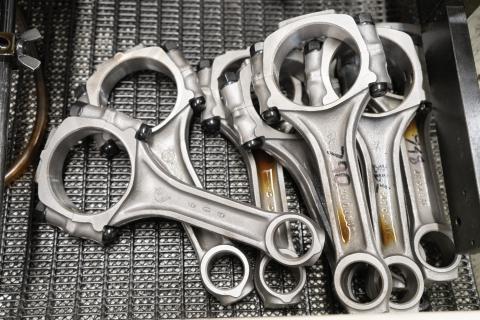
Development often comes at a glacial pace in the connecting rod industry, but there are a few current talking points of interest to racers.
If there’s a segment of the performance-engine market where the excitement level is tantamount to sleep inducement with a double shot of melatonin, it’s the connecting rod industry. There just hasn’t been many news flashes that boast about updated designs, materials, or manufacturing methods in the past decade.
“Essentially, there are only so many ways you can make a rod,” confessed Tom Molnar of Molnar Technologies, Kentwood, Michigan. “Our rods, of course, are a little different than the other guys, but a rod is a rod, for the most part. When it comes to cranks, it’s sort of the same way. There’s only so much real estate that you can put in metal without it affecting everything else, and it’s tough.”
“Yeah, we’re still using the same steel, and racers really aren’t asking for anything different these days,” agreed Richard Batchelor of CP-Carrillo, Irvine, California. “They just want a rod that’s strong and not excessively heavy. That’s the battle, isn’t it?”
A sampling of connecting rod manufacturers revealed a continued assessment of the market to address new applications, but not much else. With regards to new materials, steel suppliers have always dropped into the offices of the manufacturers to pitch a new alloy that is stronger and lighter. There’s only one snag.
“My particular customer base is not ready to pay for that kind of steel,” stated Roger Friedman of Dyers Top Rods, Forrest, Illinois. “Plus, there’s the hassle with adjusting your heat-treating. I mean, you’re probably going to add $500 to $1,000 a set. I’m also getting price increases from UPS, from our electrical company, and all my dry goods like sandpaper rolls. I mean, prices have gone out of sight.”
Richard Batchelor of CP-Carrillo cited the continued popularity of aluminum connecting rods in sport compact applications. Seen here is the company’s solid rod on the bottom for Honda K Series engines, while the pocketed rod on top is for the LS market.
There is one success story in the rod market that illustrates this Catch-22 storyline, and it involves technology trickling down from NASCAR. Callies of Fostoria, Ohio, built a special set of rods for the Spinal Tap 2.0 engine project created by EFI University in Lake Havasu City, Arizona, that is a viral sensation within social media.
“Nick [Norris of Callies] exposed me to the PremoMet materials that had previously been used successfully in NASCAR, so we decided it might be a good fit for this engine, given the extremely high-rpm requirements,” explained Ben Strader of EFI University. “The goal is to have power peak up near 11,000 rpm with nearly 1,000 more rpm for overhead protection.”
“The material is really expensive, and the processes are actually quite difficult,” added Norris. “The challenge is that in its final state, it has to be vacuum hardened, so the parts become very hard at that point. We can’t actually machine the pin-end bore with normal cutters. We have a special machine with small grinding wheels on an oscillating shaft, and even the threads have to be cut with special mills.”
Strader said the material strength is about 10 KSI (kilopounds per square inch) stronger than 300M steel.
“Given the extra headroom, we decided that we could either have more strength in the same rod dimensions, or the same strength in a smaller cross section to save weight,” explained Strader. “In the end, we were able to add some material to critical areas around the rod bolts and under the pin eye, while reducing cross sections in other areas to achieve a lightweight and very strong result.”
ItalianRP revealed some of its latest developments, including longer-than-stock connecting rods for BMW S58 engine architecture, seen here at the 2023 PRI Show, and the company “is doing considerable development for motors in the Can-Am side-by-side market,” said Nico Pouyoukas.
The team called in P1 Manufacturing in Rogersville, Missouri, to develop custom bolts from an exotic alloy called MP35N. The H-beam rod uses a 1.850-inch bearing and a short, 0.708-inch DLC pin that is some 45 grams lighter than a more typical 0.866x2.125 pin.
“We purchase the material from Carpenter Technology and then have Trenton Forging make the forgings,” said Norris. “We can forge only so many parts before the dies have to repaired. It’s a really robust material with good fatigue life.”
The estimated cost is $4,500 for a set of these connecting rods, so there is a limited market. On a more traditional note, Callies continues to develop its Ultra Dirt H-beam as a supporting component to the company’s Ultra Dirt crankshafts. “They are not made out of exotic material, but they are not necessarily lightweight. We know that in sprint cars and dirt late models, you can’t be light anymore. But we try to keep the mass down on the pin end, and then we do some really nice work around the big end to keep it round,” said Norris.
That “nice” work includes reversed radius instead of a chamfer. “Basically, there’s no downside to it, and it’s actually easier to machine,” added Norris.
Aluminum Gaining Momentum
While steel connecting rods make up the majority of performance applications, aluminum rods are drawing more attention with the increasing popularity of boosted applications.
“We’re seeing more demand for aluminum on the sport-compact side, too,” said Batchelor. “We recently released 1,600-horsepower rods for K24 Honda engines. One of the sales guys asked if we could start making them for his customers. We got all the parameters and had engineering design them.”
The rod actually measures 0.010-inch shorter than stock, which allows customers to use standard compression-height pistons. It’s also a solid-beam design that is “maxed out” as far as dimensions will allow. Two lengths are offered: 5.462-inch for the K20 and 5.974-inch for the K24.
Here’s an example of a Callies rod constructed from PremoMet steel. It was used in NASCAR applications and most recently found in the unique Spinal Tap 2.0 engine project at the EFI University.
“We had a rod before and just really beefed it up before we started running out of real estate,” said Batchelor. “These are from a forging and not machined from billet. We like the grain flow of a forging. And it comes with 7/16-inch H11 steel fasteners.”
CP-Carrillo also has aluminum rods for Top Fuel and blown alcohol applications, and there are two options for materials—but that’s a topic for more discreet conversations.
“We try not to talk about aluminum materials because of the competition on this side,” Batchelor said.
Over at ItalianRP, a rod manufacturer based in Italy with an office and distribution center in Phoenix, Arizona, longer-than-stock rods are being developed for BMW S58 engine architecture.
“We’re also doing considerable development for motors in the Can-Am side-by-side market,” said Nico Pouyoukas. “It’s such a growing market right now. Guys are making 900 horsepower with these three-cylinder engines.”
The company offers three different lines of connecting rods, and all products are designed and manufactured in Italy. The Silver and Gold lines are machined from 34CrNiM06 steel forgings. The Silver line weighs less than a comparable 4340 design, and the Gold is about 15% lighter in weight than the Silver line. The Gold is also designed to be stronger and harder than the Silver. The Platinum line is machined from 35NCD16 billet material and undergoes two “deep freeze” treatments. The weight of a Platinum rod is 20% less than a comparable Gold model, and the strength and hardness numbers are also significantly higher.
“Obviously the Platinum material is very expensive,” said Pouyoukas. “It’s a memory steel that’s used in Formula 1. We also do a lot of rods for LMP3 cars and WRC teams.”
The company offers a catalog of parts, and custom applications are designed, engineered, and manufactured in Italy, then shipped stateside. The design will depend on the application, with ItalianRP offering I- and H-beam styles along with a hybrid.
“The owner is an engineer, and he does a lot of research and design. We have in-house simulation programs that are very spot-on. Most important is to be lightest but strongest. Our pistons and rods can handle 2,000 horsepower, yet they’re not the same weight as OEM,” said Pouyoukas.
H-Beam vs. I-Beam Continues
Many companies will offer both an I- and H-beam style rod. The debate has many proponents on both sides, and for most customers it is simply a personal preference.
“Our normal game is making H-beam rods,” said Friedman. “But we can make I-beams. We picked up a customer at the PRI Show last year. He wanted I-beams, so we made them I-beams. Their customers are used to seeing I-beams in their engines. I don’t believe the rod is any stronger than an H-beam. It’s just more of a customer preference.”
Durability is a concern for racing customers, and Friedman is always in education mode when working with teams to set fatigue limits. “In dirt late model, there’s a big variation because some customers use Honda journal rods. Those rods weigh less than 600 grams, and they use 3/8-inch bolts. They’ll run them 2,500 to 3,000 laps and take them out,” explained Friedman. “The guys with 7/16-inch rod bolts have rods that weigh in the 620-gram range, and they think they should last forever.”
Advancements in camshaft and valvetrain components have led to engines running close to if not over 9,000 rpm, and that puts enormous strain on the rods.
“They’re racers, and they’re going to run as hard as they can,” continued Friedman. “When you get into calculating loads on bolts and the clamp loads needed to hold these rods together, you’re good up to about 8,500 to 9,000 rpm. When you go over that number, bad things start to happen. Your loads start increasing by huge amounts. Some racers don’t want to hear about it, but facts are facts.”
Molnar Technologies offers three types of rods for some engine applications. Shown is the PWR ADR and PWR ADR Plus rods for the LS. Note the beefier construction for the Plus version.
The connecting rod must work in harmony with the crankshaft and the piston assembly. The pressure to keep removing weight from the rotating assembly—including using a smaller wrist pin, which requires changes on the little end of the rod—can lead to conflict in balancing that harmony.
“I like heavier wrist pins because they deform less, and when they deform less you have less load on the pin into the rod,” said Molnar. “Getting pistons and pins too light can be a problem. The really, really light parts, I won’t make. I’m looking at some 3D models of parts and thinking, boy, we can buy a lot of bad advertising with this deal.”
Molnar has experience with customers returning broken rods and noting that the rod pulled the pin right out of the pin bosses on the piston. “If you break a rod, you can’t pull the pin out. There’s no force on it. That was a piston problem,” said Molnar. “But they thought the rods were breaking until someone tore a motor down and discovered there was cracking on the bottom of the pistons. That’s when the light went on for a lot of these racers.”
Molnar doesn’t like to rate rods by horsepower, but he does offer different series that are built to engine configurations. For example, there’s a standard LS rod, LS engines with a power adder, and LS engines with an even bigger power adder. Basically, the differences are more metal in strategic areas of the rod.
For example, a 6.125-inch LS standard rod will weigh 602 grams, while the PWR ADR version will weigh 654 grams. There’s also a slightly lighter version at 642 grams that’s clearanced for high-lift cam lobes. The PWR ADR PLUS will be much stronger at 737 grams. All are designed with Molnar’s experience, which started with the early H-beam rods in the 1960s.
“It has changed, but a lot of the stuff on the market today is a copy of a copy of a copy, and they don’t understand why they’re doing something—they’re just copying it,” he said.
The connecting rod lineup at Howards Cams in Oshkosh, Wisconsin, has been fine-tuned with some models discontinued. The Sport rods are forged 4340 I-beam design with ARP 2000 fasteners. They are stroker clearanced and forged in the USA.
This massive rod is the Extreme Duty X-beam from Howards Cams designed for the 6.6-liter Duramax diesel engine.
“It’s for the guy who wants to run a stock-appearing I-beam but can run cap screws instead of the old bolt and nut,” said Kirk Peters, noting they’re popular in many dirt-track classes. “We’re a grassroots company, and that’s where our bread-and-butter products are, whether it’s dirt track or bracket racing.”
Then there’s the Ultimate Duty “forged billet” rod made from high-nickel 4340 and put through a multi-phase heat-treat process. The rods are fully stress relieved and shot peened, and the design profile helps reduce weight while accompanying long-stroke applications.
“They’ll take upwards of 750 to 850 horsepower,” said Peters.
Howards also has the Ultimate X rod for Duramax engines. The latest offering is the Track Smart forged H-beam rod. It’s constructed from 4340 high-tensile steel and heat-treated. Other features include stress relieving, shot peening, and double-ribbed caps for extra bearing support. They are available for small block Chevy, LS1, Chevy big block, and Ford small block. All rods come with 7/16-inch ARP 2000 bolts.
“These are computer designed with the professional engine builder in mind,” added Peters.
In conclusion, while connecting rods don’t seem to be generating exciting new designs or shifting to new materials, there is considerable development to keep pace with the increasing boost and horsepower levels in today’s competitive engines. Subtle design changes can make a big difference in improving strength while keeping weight to a minimum.
Some racers, however, need to help themselves when considering a parts strategy for high-stress engines. Oftentimes, the connecting rod isn’t changed after its lifecycle is exceeded.
“Everyone is trying to get as much life out of a set of rods and think they can last forever,” said Friedman. “Does your crankshaft last forever? What does a set of titanium valves cost for an engine today? New lifters? New pistons, rings, and pins? When you start adding these parts up, you’re comparing apples to oranges. Why don’t you change the rods every time? There’s a perception from the engine builder that all this should last, but it doesn’t!”
How to guard against the corrosive nature of racing on water.
All forms of motorsports are tough on parts, but racing in a marine environment takes that wear-and-tear up to another level. The corrosive effects of water and saltwater, the forces generated from bouncing across a liquid surface, can all conspire to send marine racing engines toward an early exit.
Although the parts used in, say, drag boat engines are not much different from those used in the typical land-based drag car, factors such as clearances, materials, and safety features specific to boats can affect engine builds.
“It’s a brutal environment,” noted Frank Beck of Beck Racing Engines, Phoenix, Arizona. “You’re constantly under heavy load. Depending on who and what the application is, you’re running between 4,000 and 7,000 rpm. You’re jumping out of the water, coming back down and biting hard, and if the guy’s not working the throttle right, it’s a pretty good shock to the system.”
John Groth of Groth Manufacturing in Carpentersville, Illinois, is a long-time boat racer who still competes regularly in drag boat racing at Blarney Island on Grass Lake, Antioch, Illinois. “The difference between cars and boats is the cars get to speed the last half of the track. The boats get it right now,” Groth said “The G-forces on the boats are a lot worse than on a car because you get the speed right now.”
Dreadnought Engineering
The unique factors at work in a marine motorsports environment tend to push parts manufacturers and engine builders toward over-engineering their products.
CP-Carrillo in Irvine, California, manufactures pistons, connecting rods, and hardware for high-performance applications, including many off-the-shelf and custom marine products. “We design custom pistons and rods for the boat racing industry every week,” said Bryan Moreland. “It comes in cycles as the sanctioning bodies and seasons come to a close and open and people hurt parts through the weekend and such. In general, we’re always designing parts for boats.
“There’s drag racing, there’s circle boat racing, there’s pleasure boats, there’s offshore, and everything in between. Basically, a lot of these things are over-engineered, and with just the safety margin alone, there’s no real advantage to designing a super lightweight connecting rod for any kind of boat racing, unless it’s a naturally aspirated drag race application,” Moreland said.
“Start with a great product, a proven package that’s been dyno tested and tuned,” advised Frank Beck. The engine shown on Beck’s dyno is a BRE 540 Blown Marine series with the EFI upgrade. “We sell this package as 1,000-plus hp on straight 91-octane pump gas. It actually made almost 1,100 hp.”
Dynamic loading—when the prop is free spinning when out of the water and then grabbing again when it’s back in the water—is one of those marine racing factors that parts makers have to consider. “You just have to beef up the parts knowing that it’s going to hit some dynamic loading, where it’s going to try to pull the motor down when the prop comes out of the water,” said Richard Batchelor of CP-Carrillo. “It’s similar to off-road stuff, where they’re going through the woods and they’re not letting off. Because those guys don’t let off when they come out of the water. They just stick into it.”
The type of cooling system in use also plays a role in boat engine parts design. “On the piston side, it’s not such a problem for designing lighter weight,” Moreland explained. “You can increase the strap thickness under the wrist pin, and if the thing’s coming in and out of the water and it’s yanking on it and it’s spinning a ton of rpm, you can feel safe and comfortable with that just by the thickness of the area under the wrist pin. The rest of the piston can be thin and light and can be designed according to whatever it’s being used for.
“The one thing that we look at for piston design is whether it’s an open or closed cooling system,” he continued. “If it’s a closed cooling system and it maintains a temperature, and it might have a thermostat, and it runs at 150 or 170 degrees or whatever it is, that makes a bigger difference to us. Or whether or not the block is aluminum or the block is iron, those set up diametrical clearances for us, and we make accommodations and allowances for that. If it’s cold water coming in and you’re running the thing in a river, like a jet drive and it’s going to be 115 to 120 degrees, cold water, you can’t do much about it. You have to increase the clearance that you give it because the block isn’t going to grow quite as much as it would otherwise.”
Given the heavy load on the engine under racing conditions, a well-thought-out lubrication system is another essential. “The biggest thing we do on all our endurance applications—whether it be the NASCAR Tour engines we did back in the day, or our Bonneville engines, or marine engines, off-road Trophy Truck Class 1 stuff—we flood ’em, basically,” Beck said. “Spring oilers lubricate the entire upper valvetrain, valve springs, rocker assemblies. We have our billet valve covers made with an oiler running down the outside channel, and it squirts it all, every single valve spring, and it’s strategically positioned with a nice spray pattern. We also run piston oilers to help lubricate the wrist pins, but mostly to cool the piston. We’re shooting 200-plus degree oil temp up there, but it’s 1,400 degrees on the other side of that piston, so it’s thinking it’s getting icicles, so it’s a happy camper. Less chance of detonation that way, so lubrication is the key. Just flood it everywhere.”
Dynamic loading— when the prop spins free when out of the water and then grabs again when it’s back in the water—is a factor manufacturers have to consider when making parts for marine use. “Those guys don’t let off when they come out of the water,” said Richard Batchelor of CP-Carrillo. Photo courtesy of Teague Custom Marine.
Engine building for marine competition is not just about speed, but safety as well. And it all ties in with how the boat is rigged. “There is a thing called a whirlaway. What the whirlaway does, let’s say your motor just stops and you’re doing 180 mph,” Groth said. “The whirlaway has a spring on it inside the gearbox you’re using that allows the prop to free-wheel instead of just lock up. If it locks up, it’s flipping the boat.
“You see the crashes in the pro races with the flat-bottom boats, the blown alcohol flat-bottom boats. You get two bounces for free. That third one, you’re going over.”
Should things go awry during a race, a proper engine package ensures the driver won’t be dragged down to Davey Jones’ Locker. “We use breakaways because we’ve seen the motors come through the capsule in a wreck and kill the driver,” Groth said. “They’re V-shaped breakaways. The bottom of it is drilled so it pull-tests at a certain amount of pressure. After a while you have to replace them because they will break. But what happens is, the cable that goes to the throttle, the cable that goes to the parachute, any cables you’ve got going to anything toward the motor, it all breaks away when the capsule breaks away in a crash. That way the motor isn’t coming with the capsule.”
Details Matter
For racers just easing into the marine motorsports environment, attention to detail is crucial in keeping an engine operating for the long haul.
“Any time that we take information from a customer, we’re asking them to give us as much detail as humanly possible,” Moreland said. “If they have enough insight to be able to manipulate our design approach, then that’s always welcome. If they don’t, and they want to rely on us as suppliers to do the legwork for them and know what they should need, a lot of times that’s the case, too. They rely on us for our experiences, and they just need to answer the questions that we mentioned before.
“Is it an offshore thing? How long of a duration is the race? Are you going to tear the thing down after every race, or are you going to run it for two years and never look at it? Is it cold water? How much rpm does it turn? What’s the piston assembly weight? Oil—dry sump, wet sump—that makes a big difference for ring package and some of the other oiling characteristics,” Moreland added.
CP-Carrillo “designs custom pistons and rods for the boat racing industry every week,” said Bryan Moreland. The manufacturer contributed forged pistons and H-beam connecting rods to this Teague Custom Marine project—twin TCM 1400s (named for the power the supercharged engines produce) in a 41-foot Apache powerboat. Photo courtesy of Teague Custom Marine.
For John Groth’s racing activities, keeping the engine from running at the ragged edge has paid big dividends. “Buy a motor that’s faster than the class you want to race. That way it will last you a long time, because you’re not going to have it on Kill all the time.” Groth runs a 632 Dart tall deck, with a 0.938 lift on the cam, 16:1 compression, and 1150 Dominator carbs. It produces about 1,485 horsepower, he said.
“That motor that I’ve got, that 632, that’s 17 years old. But I’m only running 70% of the power. Let’s say you’re racing an 8.4 second dial-in class, which is Super Comp. Buy a 7-second motor, or a 6.5-second motor. The thing will last you forever.”
Not surprisingly, Groth also emphasized the importance of proper maintenance. “Send your fuel pump in every year, whether it works or not, to put new bearings in it,” he said.
Experience has taught Beck that there’s no skimping on quality parts in a marine racing environment. Only top-quality, heavy-duty parts will do. “Start with a great product, a proven package that’s been dyno tested and tuned. We spend a lot of time on the dyno really sorting it out, not just the wide-open stuff that most people generally do,” he said.
Teams may be competing on water, but racers want no part of H2O seeping into the fuel system. Such infiltration can dramatically shorten the life of the engine. “In diesel applications, we expect to see a three times increase in the life of injection components by simply improving fuel filtration,” said Jake Hopkins of FASS Diesel Fuel Systems, Marthasville, Missouri. “Per CAT, diesel fuel—what our filtration systems are designed for—contains at least 10% air when stationary. In racing applications, marine or otherwise, that 10% figure will go much, much higher over the course of a race. In fuel, entrained air and vapor can alter injection timing, rob horsepower, slow throttle response, damage injectors, reduce efficiency, and more.
Marine racing is a “brutal environment,” said Frank Beck of Beck Racing Engines, made worse by saltwater’s corrosive effects. These intercoolers demonstrate just how much damage seawater can do to aluminum.
“Beyond air and vapor, water-in-fuel is a particularly notorious problem. Even a single tank of heavily contaminated fuel can wreak havoc on an engine,” Hopkins said. “To safeguard against this, we engineered our Extreme Water Separator (XWS) to eliminate more than 99%, third party verified, of the water from diesel fuel. In cases of extreme water contamination, our XWS acts as a fail-safe, shutting your engine down and preventing catastrophic damage.
“While other water separators can allow water to pass through once, they reach their saturation point. Ours will not, potentially saving owners thousands of dollars in unnecessary repairs,” Hopkins added.
Keeping moisture out of the oiling system is similarly important. “We want the water temp to run as cold as possible. We do run a thermostatically controlled bypass for the oil cooler because we want the oil temp to be above 212 degrees,” Beck said. “Because water boils at 212, we want to steam it out of the oil and get it out of there, get it evaporated out of the breathers. It’s less chance of rust and corrosion and wear and tear on your valvetrain.”
When fighting against the elements in a marine racing series, it pays not to underestimate the care and work required. “The saltwater environment is obviously the worst-case scenario. We can hard anodize cylinder heads, but they still tend to rot out over time,” Beck said. “The guys need to be in a regimen to flush it and use a Salt-Away product to help break down the salt. Even with some of the teams that are pretty good about that, it just still seems to pocket in certain areas. I can’t over-emphasize enough to maybe just run it on the garden hose for a while to flush it out as much as possible.”
Racing on water is a whole ’nother environment, but plenty of pioneers have risen to the challenge and worked through the problems. “There’s no one magic thing, just a bunch of little details that all add up,” Beck said.
Firepunk has found better ways to harness massive torque, for either street or strip.
The smoke and throaty rumble that emerge from a diesel truck attest to the brutal struggle of physics that’s taking place beneath its hood, as pressure and heat turn an otherwise docile fuel into something explosive. Managing the power and torque, and harnessing it, are crucial for a diesel truck, whether it spends its working life hauling a trailer up long, steep grades or arrowing down the quarter mile, aiming for an elapsed time that might shock those unfamiliar with diesel drag racing.
From very obscure beginnings that usually involved modified Class 8 highway trucks, the universe of diesel drag racing is now a dream world where actual working trucks—many of them still street legal—routinely blast out four-digit horsepower totals with great gobs of torque that could seemingly twist the Earth on its axis. Like all forms of straight-line competition, diesel dragging involves connecting copious power to the ground efficiently, a consideration that’s also germane to heavy towing.
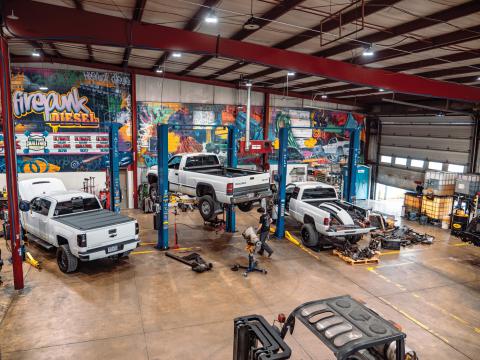
Firepunk’s core mission is hardened automatic transmissions, but the firm’s selection of products is far broader than that. It offers thousands of pieces for Cummins-, Duramax-, and Power Stroke-powered trucks, from traction bars to turbochargers.
Optimizing that make-or-break connection between power and pavement is the mission of Firepunk, which specializes in prepping the drivelines of big-output diesels by its building of super-hardened automatic transmissions, along with offering engine parts for big compression-ignition monsters from Ram, General Motors, and Ford.
Firepunk’s heritage goes all the way back to when its founder, Lavon Miller, was tinkering with oil-burning work trucks inside his family’s dairy barn in Plain City, Ohio, where Firepunk Diesel began and has been based since its founding. It was a gradual process that began when Miller pieced together his first pure drag truck in 2008. Since then, the firm’s reputation has grown to where it’s one of the industry’s leading builders and suppliers of ultra-duty automatic transmissions and specialty swaps where really hot trucks are created. Firepunk built its name by scoring victories at top diesel performance drag races during its formative years, which put it on the map for customers in this highly specialized segment of motorsports.
As Miller explained, the founding principles at Firepunk Diesel go all the way back to employing trial and error to add horsepower to his own truck. “Diesels for me started because I had a concrete business, and I needed a truck that was going to help me do a workingman’s job,” he recalled. “So I bought a diesel truck in my teenage years when I was about 19. Boys being boys, they’ll pick up forums and find out that there are ways where you can increase horsepower, and that made a pretty significant impact in my young brain, how you can just put a tuner on a truck, and you pick up 120 horsepower and 250 foot-pounds of torque just by plugging in a module. Now you’ve gone from a work truck to a hot rod.”
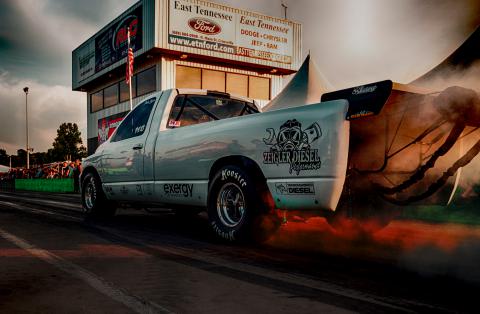
The Firepunk Diesel Race Team set Pro Mod records for speed (194.41 mph) and elapsed time (4.101 seconds) in its Cummins-powered 1970 Duster. The records were set at the first and third events in this year’s Outlaw Diesel Super Series.
Firepunk, today, has the capability to muscle up a lot of trucks. The firm’s core mission is hardened automatic transmissions, but the firm’s selection of products is far broader than that. For example, Firepunk divides its available components for Ram pickups by the generation of the truck, with the catalog further specifying the parts according to the displacement of the truck’s Cummins diesel engine. The total comes to thousands of pieces, ranging from transmission valve bodies to traction bars, performance filtering systems, and a variety of high-capacity turbochargers, one of them being a Tater Built bolt-on unit for Ram 5.7 diesel applications. Add in the add-ons for Duramax- and Power Stroke-powered pickups from GM and Ford, respectively, and Firepunk’s parts inventory grows exponentially.
From Concrete to Trucks
The firm grew, literally, from a single modified pickup that set Miller on his journey to build a business, in large part thanks to word of mouth, and social media, that proclaimed to the diesel performance world what the company could accomplish.
“Things got carried away really quickly for me,” he explained. “In rural central Ohio, my father was a farmer, my grandfather was a farmer, and we were country boys with welders and a shop and tools, so I started tinkering. I bought my first truck in 2004, a 2001 Dodge Ram 2500, and had the transmission in it torn up by June. So then I bought a new, built transmission, a tuner, bigger injectors, and working with my friends, I fabricated a whole twin-turbo system. That meant I blew a head gasket, because there was more boost, so I pulled the head, O-ringed it, and went from there. From about 2004 to 2009, this was a 100% hobby for me.”
At the time, Miller had a contracting business doing decorative concrete work on residential properties in central Ohio, an endeavor that took a major hit following the 2008 banking crisis. “When the housing market collapsed, I did a big home-and-garden show in Columbus in the spring and got no leads. But during the winter and on rainy days, I had still been helping friends on trucks, doing turbos, so I really switched from doing concrete to trucks without a business plan. I was doing just trucks by 2010, full time. I knew how to fix transmissions, and people were sending me trucks after hearing about us from the diesel forums and on social media.”
With hot-rodded diesel pickups routinely producing power at four-digit levels, transferring all that force to the ground requires a similarly beefed-up transmission. Among the most popular transmission upgrades Firepunk performs are swapping the Ram 68RFE for the earlier 48RE and modifying Allison A900 and A750 transmissions for Duramax applications.
The big jump to national prominence came when a Firepunk customer, Damon Wisley, took a Firepunk-modified Ram pickup to a major challenge hosted outside of Denver in 2013 by Diesel Power magazine, which involved not only drag racing but also a dyno challenge, a 1/8th-mile drag race while towing a 10,000-pound trailer, a 100-mile ride across the Rockies to determine average fuel economy, a sled pull, and an obstacle course negotiated while pulling a trailer loaded with a Bobcat excavator.
Miller recalled, “Damon brought me a truck, a 2004 Ram, and we did a pretty big build, about 1,200 to 1,300 horsepower, and took it to Denver, running against the best of the best, which kind of put our name on the map. We went back in 2014 and dominated that competition, and then defended it again in 2015, and that was really the start of our nationwide publicity. Since then, we learned that you can only win that event twice, and that we were the first ones to win it back-to-back.”
The next leap forward came when another periodical, Diesel magazine, organized an invitation-only contest called the Ultimate Callout Challenge, involving 30 modified trucks. “The basic rule was that it had to be a truck, minimum 4,500 pounds,” Miller said. “We took a 2006 regular-cab truck and added structural supports so it could run at up to 8,500 pounds, like a Swiss army knife. We went and won 2016, 2017, and 2018. Here we were, country bumpkins, trying to put our heads together, going against $50 million companies. For five years, in pretty much every such challenge, we were able to go out and dominate the industry.”
Core Business
Though its inventory includes scores of parts aimed at upgrading diesel engines from various manufacturers, Firepunk is not in the engine-building business. The firm’s core business is modifying and selling severe-service automatic transmissions from all manufacturers. As an example, one popular swap allows buyers to acquire a fully Firepunk-hardened Chrysler swap kit that allows racers to exchange the often-indecisive shifting of the 68RFE transmission to a more predictable 48RE, with complete hardware, mounting accessories, fluid lines, and bellhousing adapters. Firepunk also produces a line of heavily modified Allison transmissions for mating to Duramax diesels, especially the A900 and A750 transmissions.
“In the early years, in the Diesel Power days, I built my own engines,” Miller said. “I quickly realized that I had to go to a machine shop, machine the block, hone it, and then I’d come back and start assembling it. Well, if my bearing clearances aren’t perfect, or the piston walls aren’t perfect, I’ve got to pack it all back up, take it back to the machine shop, and machine it again. So I’ve built a relationship with D&J Precision Machine, about an hour and a half from us in Cambridge, Ohio, and they’ve got all the CNC machines, the hones, plus I have them do all my engine builds, top to bottom. We’re a dealer for them, and they do the same core manufacturing process we do with our transmissions, only with the engines.”
Since owner Lavon Miller put together his first pure diesel drag race truck in 2008, Firepunk’s reputation has grown to where it’s one of the industry’s leading builders and suppliers of ultra-duty automatic transmissions and specialty swaps where really hot trucks are created.
Firepunk now has 25 employees who serve a genuinely national customer base. Most were recruited locally. Miller has a winning strategy of identifying potential Firepunk staffers by hosting field trips for students from regional vocational schools. Occasionally, the selection process is more informal than that: “The attraction of racing and performance adds a level of desire to work at Firepunk. People want to be a part of it,” Miller said. “One of my lead transmission guys I recruited from a local pizza shop where we would go to lunch. We’d see the guy there and we could see that he was busting his tail, he took the initiative, he would do everything in his power to make sure we got our food fast so we could be back in time from our lunch break. I saw his work ethic, and I realized if he had that core work ethic, then I could teach him the job skills. We did that, and 10 years later, he’s one of the lead guys in our transmission department.”
Racers, too, are key to spreading the Firepunk mantra. One of them is Robby Garcia of Fort Worth, Texas, who holds Firepunk’s long-distance record by transiting his fourth-generation Ram all the way to Ohio for work, led by the aforementioned 48RE transmission swap. “It’s a stronger transmission that will hold up to the power these trucks can make,” Garcia said. “I made 2,147 horsepower on Firepunk’s dyno last year, and expect to make 2,400 to 2,500 this year, and it’s still actually street legal. Man, they are hands down an amazing shop to work with. Even at the races, anytime you need help with something, they’ll always hop right over. They’ve done work for me from transmission to engine swaps to nitrous, and they helped me take it to the next level.”
James Weaver is another Firepunk customer, who hails from closer to home in Troy, Ohio. He also did the popular transmission changeout with his fourth-generation Ram, noting that “it’s easy to get horsepower, just add more fuel. The thing that Lavon did that made the truck so reliable was the transmission. I went from the standard six-speed to the 48 swap, an older four-speed transmission, so being able to reliably drive around in a truck with 800 horsepower while you’re pulling a trailer is pretty cool. They’re the best in the industry at what they do.”
Miller explained that since the business world is subject to unforeseen change, he’s transitioning to a new LLC that will see the company rebranded as simply Firepunk, no “Diesel.” As he laid out the plan, Miller said, “That’s mostly so we can keep our heads on a swivel, so if the EPA and state regulation keeps cracking down on diesel performance, where we can’t defeat any emissions systems or remove systems, they hold our feet to the fire over that, I can shift my business into other avenues, like if I had to shift into more service- or fleet-oriented use in the shop as opposed to performance.
“The fabrications and race departments can stay race,” he said. “That’s for non-highway use, and I want to do the big custom-build marketing and exposure, but I want to grow the manufacturing side, with race-type parts we now manufacture like a valve cover lifter, which helps you get hold of the cover and lift it off the engine. We made them for convenience for our techs, and now we’re probably selling 25 to 30 of them a month. There are probably 50 products that we manufacture and powder coat here. I want to keep growing the manufacturing side of our race department.”
What does it take to build a transmission that’ll stand up to the punishment of diesel drag racing? Five experts weigh in.
Any transmission built for racing must handle high torque loads and change gears faster than in an OEM application. A transmission built for diesel drag racing is subjected to forces altogether higher than anything else on the drag strip.
“In any race application the transmission is going through a lot of abuse,” said Tom Hauser of RevMax, Charlotte, North Carolina (which is under the Race Winning Brands umbrella). “With diesel trucks, you have two added features. Number one is the weight of these trucks. You’re talking 6,500 to 8,000 pounds. Heck, the AS69 truck that we brought to the Ultimate Callout Challenge a few years ago was 8,240 pounds.
“Number two is the torque these diesels produce,” Hauser added. “The amount of torque on one of our UCC trucks was over 2,300 lb.-ft. And that’s small potatoes compared to some of the guys out there nowadays who are putting down 3,000 horsepower, and the torque is pushing toward that 4,000 number.”
“It’s the way a diesel makes power versus a gas car,” explained Will Terry of Power Driven Diesel, Cedar City, Utah. “When you’re making about 500 hp in a diesel, you’re usually making double that in torque. You’re making 1,000 lb.-ft., and that’s at the tire. The torque at the input shaft might be 1,200 lb.-ft.”
“At some point, some of the diesel guys went to the more common transmissions that the gas guys always run with good success, and the diesel guys would just destroy them,” observed Nathannial DeLong of Rudy’s Performance Parts, Burlington, North Carolina. “Break shafts, burn up the clutches. The diesels make so much torque that it just blows right through the converter.”
“When diesels create so much horsepower and torque, something has to become a fuse,” said Eric Sempson of Pacific Performance Engineering (PPE), Montclair, California. “Usually, the input shaft is the first thing to break, and that happens right around 1,000 hp. We always design around those intentional weaknesses.”
“The torque is what eats things up,” said Carl Rossler of Rossler Transmissions, Girard, Ohio. To withstand those high twisting forces, “everything” in Rossler’s diesel racing transmissions “is bigger, stronger, and designed to take that punishment. It’s like putting them on steroids.”
Each of these five specialists occupies a different niche in the diesel transmission market. Read on for an inside look at what they do to make their racing transmissions as bulletproof as possible.
Shift Faster and Take More Torque
PPE specializes in modifying the Allison 1000 transmissions that were OE in the Chevrolet and GMC 3/4- and 1-ton HD pickups, specifically the five-speed version used from 2001–2005 and the 2006–2019 six-speed. The company produces upgrade kits in Stage4, Stage5, and Stage6 configurations, as well as complete transmissions.
“We upgrade them to help them shift faster and take more torque and more horsepower,” Sempson explained. In stock form the Allison is “good for up to 300–400 hp, but when you start going above that there is not enough clutch surface area in the clutch packs. We upgrade the frictions and steels for the C1, C2, C3, and C4 clutch packs. We also upgrade the number of components. In some cases, there are only three or four plates. We will upgrade those to five or six plates to get more surface area, which gives the clutch surface area more holding power.” Each of PPE’s different kit stages “gets a different friction material.”
Valve body upgrades and some pump modifications provide “additional holding power for the clutch packs,” he said. They “raise the main line pressure, which gives the transmission the ability to grab the clutch stacks tighter.”
Allisons made from 2011–2019 have an electronic pressure control (EPC) valve on the valve body designed to open “to reduce drag on the transmission’s oil pump to lower the mainline pressure and improve fuel economy,” Sempson said. “But at the same time the EPC valve lowers the clutch holding capacity.” PPE offers an EPC blocker that installs between the EPC valve and the valve body that “basically eliminates the pressure drop. The computer will still open the valve and try to drop the pressure, but this little blocker part doesn’t let the pressure leak out.”
When diesel engines are “transitioning from, say, 700 to 1,000 hp, that’s when they start needing parts like a billet input, intermediate, and output shaft,” Sempson continued. The input shaft is particularly vulnerable—the “fuse” mentioned earlier—because it’s the part “that connects the torque converter to the C1/C2 drum,” he explained. “It actually has a little relief machined into it, where the diameter gets thinner and narrower. That’s where it’s intended to break.” The aftermarket shafts PPE uses “are the same size all the way through and made of a better material.”
PPE offers an upgraded torque converter with a billet, rather than cast, stator “that’s so much stronger it can handle anything thrown at it torque- and horsepower-wise.” A triple-surface clutch in the converter provides more surface area to prevent slippage when the converter locks up.
PPE also designed its own transmission pans that are made from cast aluminum with built-in cooling fins. Pans are available in a standard depth, or a deeper pan adds an extra gallon of fluid capacity.
Learn to Build
“Most racing diesel transmissions are based on a Dodge 48RE platform, which is essentially an overdrive 727,” said Terry, and Power Driven Diesel offers several transmissions based on the 48RE to accommodate a range of power levels.
Regarding the shaft upgrades mentioned in the introduction, Power Driven Diesel has several different types to choose from, depending on the engine’s output. Upgraded 23-spline input shafts are available in a variety of materials, including 300M and 300 Maraging, “which is a better heat-treated 300M,” Terry said, though at power levels from 1,500–2,000 lb.-ft., “all of them will break and twist off splines.” The next size up is a 27-spline Magnum shaft “which seems to be good up to around 2,000 hp.” The newest entry is a 35-spline input shaft from Sonnax. “To get this big shaft in there, the pump stator is bored out. They’re right on the limits of what they can actually fit in the torque converter.”
“Shafts have to be upgraded much sooner in diesel racing than gas racing because of the way diesel makes power,” said Power Driven Diesel’s Will Terry. A 500-hp diesel is likely making double that in torque, “and that’s at the tire.”
Intermediate and output shafts are also upgraded depending on power level. The threshold for the intermediate shaft is 1,000 hp “or around 2,000 lb.-ft.,” Terry reported, while the output shaft is usually upgraded at 600 hp or 1,200 lb.-ft.
There’s one more modification Power Driven Diesel makes to the intermediate shaft, Terry said. “That shaft runs through the main case and goes through this little support that has oil there. We found when we get around 1,000 hp, that case twists so much it loads that intermediate shaft, and it’ll friction weld if there’s not enough lubrication there. So we’re adding lube there, as well as in places that I’ve never seen in a gas performance transmission. We’re drilling holes and feeding oil in places that no one in our industry is doing.”
Next on Power Driven Diesel’s priority list are the clutch packs. Compared to a stock, 200-hp transmission with four clutches or a factory 48RE with five, Power Driven Diesel uses “six or seven clutches in third gear,” Terry said. As for clutch material, “if I’m holding big power, we like the GPZ clutch. We will also sand the discs with 36-grit to make the steels more aggressive.”
Power Driven Diesel matches the upgraded clutch packs with increased line pressure. “A stock 48RE makes about 140 psi,” Terry pointed out. “When we’re up there at around 2,500 lb.-ft. of torque, we need about 230 psi of line pressure to keep the trans from slipping.” Getting there requires “upgrading the valve body and the control strategy. The valve body is a huge part of it because it is a brain that controls the shift timing, the pressure, and how efficiently it makes the pressure.” To design the company’s valve body modifications, Terry invested $20,000 in a valve body test stand and another $5,000 in modifications “so our test stand will read up to 300 psi.”
In addition to its built transmissions, Power Driven Diesel offers DIY rebuild kits for those who want to tackle the job themselves.
“I strongly encourage people, if they’re racing regularly, to buy a kit and learn how to build the transmission,” Terry said. “If you want to be successful racing, you need to be able to service and build your own transmission. Sometimes crap happens, and a lot of people don’t have an extra $15,000 for a spare transmission. This is their hobby, not their job. So I highly encourage kits so people can learn.”
More Holding Power and Less Slippage
Unlike companies that specialize in one transmission brand, RevMax offers upgrades for transmissions used in Dodge/Ram, Ford, and GM diesel pickups. In many cases, those upgrades are similar regardless of the make, but all are different and tailored to that specific transmission.
“All the torque these diesel trucks produce, combined with all that weight, it equals so much ripping force where the truck is trying to rip the clutches apart,” Hauser said. “We add clutch material as much as possible. In one of our transmissions, the 12XR that goes into our 68RFE platform—which is for 2007.5–2024 Dodges and Rams—we house 20 overdrive clutches in it. The amount of material, compared to the factory, is almost double. So we have added clutch material, and more aggressive clutch material.
One of the first patents RevMax filed was for an unbreakable sprag retainer in its torque converters. “Everybody would break their sprag retainer; it was very common,” said Tom Hauser. “Once we developed that product, we never had that problem again.”
“That’s part of the equation. Then you have tuning and added line pressure,” he continued. “With some of the ‘old school’ transmissions—like a [Ford] 4R100 or [Dodge] 47RH—they’re a mechanical style where rpm goes up, load goes up, line pressure goes up, and with more clutches, that gives you more holding power. The newer trucks are all computer controlled, so that’s all done by tuning. Good tuning will increase the line pressure, and with higher line pressure and more clutches, you’ll have more holding power and less slippage.”
At that point, though, “you start to find other weak links, like input shafts or drums.” RevMax offers billet input, intermediate, and output shafts, Hauser said, as well as billet drums, like the billet overdrive/underdrive drum for the 68RFE. “We also make them out of steel, because with all that holding power on those clutches, the clutch teeth can dig into an aluminum drum, but they won’t dig into a steel drum and damage it.”
RevMax also “modifies a lot of components on the valve bodies,” Hauser said. “When we build our valve bodies, we machine the valve bores, so they are like new, and sometimes we put a billet aluminum sleeve in it so it’s not as porous as the OE cast aluminum bore. We’ll also put in a better valve or a steel valve, so it doesn’t wear like the factory one.” RevMax also installs “billet accumulators, and then we put in heavier duty springs. We put billet channel plates on them, which don’t flex and allow cross leaks. We also do a bonded separator plate with a very thin gasket on it that allows for even fewer leaks inside that valve body.” Hauser pointed out that “all valve bodies have controlled leaks in them, but crossed leaks over the worm tracks will cause shift flares, shift binds, and it could cause a catastrophic failure in that transmission.”
Hauser said RevMax is working to develop upgrades for newer truck transmissions, but it’s difficult. “When you open up these new 10-speeds, there’s very little you can do to them because they’re so compact, so tight. We can add clutches to the 10-speeds, but it’s only 28–35% more, not like some of the older units where you can double the clutch capacity.” That, and the electronic controls on these transmissions, are causing some racers to swap the new gearboxes for older transmissions that are hydraulically controlled. “They don’t have to worry about the computer program or programming it correctly.” Plus, “a lot of racers like to go to the older style because people have been building those transmissions for 30-plus years. They know what works and what doesn’t work.
“But mark my words, five years from now, everybody’s gonna come around and say, ‘This [10-speed] isn’t so bad, because they figured out how to make it hold the power, how to make it last a while.’ And they’ll still have all their creature comforts.”
Everything Inhouse
“Every year the diesel guys are getting better and better,” Rossler said. “They keep coming up with new ways to hold more power with the blocks and heads, and the bolts to keep the motor together.” That challenges Rossler and his 10-man team to improve their transmissions “to overcome what the diesel guys keep throwing at us.”
All of Rossler’s transmissions are based on the venerable Turbo 400 and can be mated to any diesel with the appropriate aftermarket bellhousing. What sets a Rossler transmission apart from others on the market is the fact that, other than the pans and the Reid transmission cases, “we manufacture everything inhouse so we can develop it and change it,” Rossler said. “We can have new gear ratios, new parts. We can change how we do things to take the weak links out. If we see a problem, we can re-engineer it and get it right back out.”
The Reid cases “have a little bit more room in them, which lets us build components that are a little bigger,” Rossler explained. “You can’t increase the size of one thing without increasing the dimensions of the other pieces to fit it all.”
Nearly every component in the transmission is billet, according to Rossler. “We manufacture the whole inside,” he said. “The gear sets don’t look anything like the original gear sets. The drums are much larger, and they’re lighter. We do everything in aircraft aluminum, and then it’s supported with steel inserts. They’re very lightweight, very strong, and very safe because the aircraft aluminum doesn’t explode like it would if it was a cast drum.”
Rossler noted that he’s seen “a lot of shops use steel drums, which is nice, because they are strong, but they’re sort of heavy. There’s no need to have that. You can save horsepower through the drivetrain. We can’t make horsepower, but we can save horsepower, that’s for sure.”
The torque converters Rossler supplies for diesel racers come from Neal Chance Racing Converters of Cheney, Kansas. Drag racing diesel trucks need lockup torque converters, Rossler explained, “because diesels work off torque. They have to have load to make torque.” The Neal Chance converters have a “multiple-stage lockup so the clutch comes on a little softer. It doesn’t run all the power at one time because that can break components and upset the vehicle. It comes on a little bit gradual, and the efficiency is 100% once it locks so it takes all the motor power and puts it through the drivetrain to get it to the tires. That’s way more efficient on a diesel. If you ran an open converter, it would pretty much slip going down the track.”
Other than the pans, Reid transmission cases, and Browell bellhousings, Rossler Transmissions manufactures “everything inhouse so we can develop it and change it,” said Carl Rossler. “If we see a problem, we can re-engineer it and get it right back out.”
Those converters are “so large they won’t fit in a conventional bellhousing,” Rossler said. His primary bellhousing supplier, Browell Bellhousing of Lafayette, Indiana, makes “clutch-can-style bellhousings with way more room.”
Another component unique to the Rossler transmissions are the valve bodies, for which he has a patent pending. “We call it a direct-port valve body because we feed the servos and everything without the case. We do everything through the valve body. Most valve bodies direct the oil through the case, through the valve body, back to the case, around everywhere, and back to where it’s going. We take it directly to where it’s going.” Like his other components, the valve bodies are made inhouse, down to winding the coils for the solenoid. “Nobody makes what we need, so we make it ourselves,” he added.
Reliability vs. Holding Power
At Rudy’s Performance Parts, “we’ve always been Ford guys,” said DeLong. “We offer stuff for the Cummins and the Duramax, but we specialize in the Power Stroke.” The upgrades Rudy’s offers for the 2003–2007 5R110 and 2011–2019 6R140 transmissions are available in stages.
“With the stages, you fix one problem, and then there’s the next thing that will become the failure point,” he explained. “That’s how the stages progress.”
For the 5R transmissions, Rudy’s starts the upgrades with a billet input shaft. “When you have more power and a good converter, like an aftermarket triple-disc converter, it’ll break the factory input,” DeLong explained. “Then if you get a good input, you might break a low/reverse hub, or the intermediate shaft, or one of the planetaries.” The “end-all” Stage 5 upgrade for the 5R includes all billet internals—input, intermediate, and output shaft; overdrive planetary; and low/reverse hub—plus more clutch material than the lower stages.
DeLong described the 6R as “pretty stout” and said input shaft failures are rare. The top upgrade level for the 6R replaces the intermediate shaft with a billet shaft and billet apply pistons, plus aggressive clutch material.
This photo from Rudy’s Performance Parts shows some of a Ford transmission’s stock hard parts next to Rudy’s upgraded billet components, along with some of the prepped components ready for assembly, said Nathannial DeLong.
Regarding the clutches, DeLong said “additional frictions over stock counts are added in all stages. The main difference in a 6R build is which intermediate shaft is selected. It’s that balance of reliability versus holding power. If you stack too many in there, put a bunch of thin frictions and steels just to get the clutch counts way high, they might not last as long because they’re so thin they’re going to warp.” Even the racer who goes for the Stage 5 upgrade, whose “one concern is holding power, he knows going into it the clutches may not last several seasons, but they’re going to hold pretty consistently over time.”
Regardless of upgrade level, “every transmission I do is washed after disassembly, and each part is also run through our ultrasonic cleaner to ensure everything is as clean as possible before assembly,” DeLong said. “To add additional frictions, the apply pistons and pressure plates must be machined, which is all done inhouse. All the bushings throughout the transmissions are pressed out and replaced with bushings coated with Calico’s CT-1 dry film lubricant, the same coating used on engine bearings. The pump gets several internal modifications, including updated valves, one of which is the Sonnax oversized pressure regulator valve. I ream the valve bore and install this valve because the factory valve commonly sticks over time. This ensures the bore is perfectly aligned and smooth, and sticking is no longer a concern.”
DeLong said Rudy’s has offered upgrades for the 5R “forever, and I started messing with the 6Rs because it seems like we have a lot of demand for those.” Next is work on Ford’s new 10-speed transmission, “then I might start doing a little bit of Allison stuff, too. Our goal is to keep expanding, to be able to offer a little bit of everything if needed.”
Whether a racer is seeking to win races in diesel competition or looking to tow more efficiently, a robust aftermarket exists to meet those needs.
The war of physics that accompanies diesel combustion can give pause to the most jaded, mechanically inclined onlooker. The forces that accompany compression of more than 20 points are what give compression-ignition diesel engines their deep-grunt output, whether the engine is used for long-haul trucking, pulling a big trailer to a racing event, or even doing battle in the competition itself.
Diesels are a growing presence in motorsports, on all levels, and technology is advancing to enhance their reliability and power, ranging all the way from complete engine builds to basic additives that help tame a diesel’s tortuous internal forces. A racer’s solution to diesel power issues may come from a new engine, a bolt-on part, or a bottle that provides protection against the relentless hammering of a diesel’s compression. Whether a racer is looking to tow more efficiently or win races in diesel competition, a robust aftermarket exists to meet those needs.
Power Packages
“We have customers all over,” said Drew Pumphrey of D&J Precision, Cambridge, Ohio, a leader in building diesel engine performance packages. “Our drag applications are becoming bigger and bigger. There’s drag racing, sled pulling, mud bogs, some with guys with monster trucks. We’ve also done lots of custom vehicles like custom hot rods with engine transplants using our engines, and hopefully, complete packages of fuel system, turbos, and everything from a 1,000-horsepower setup. We have one in process now that’s going into a Unimog. If you can dream it up, we can help with an application that meets your needs.”
D&J specializes in building and modifying the familiar Cummins turbodiesel, of all displacements, which are familiar to owners of Dodge and Ram pickups. If a customer is looking for power, a build might start with D&J’s X-beam connecting rods, machined blocks, or custom Cummins cylinder heads. Another solution is a complete engine, using a new or remanufactured block, with custom applications for either stock output or all-out performance. For drag use, one well-known D&J Precision engine is the Enforcer, built from a 6.7-liter Cummins block with an inch-thick deck plate, X-beam rods, and billet pistons. D&J refers to it as “Your Ultimate Powerhouse.”
A lighter viscosity oil will free up horsepower, but having a thick enough oil to maintain engine protection is vitally important, too, especially in diesel racing applications. Hot Shot’s Secret formulates oil in a wide range of viscosity levels for diesels, from 30- to 70-weight.
“The biggest thing is, we’re always fighting cylinder pressure, which with the torque is significant,” Pumphrey explained. “We’ve had to improve our blocks along the way, because they would crack in the cylinder walls, so we went to a sleeve setup with a 1-inch deck on top. That’s our Enforcer long block. It also has a girdle down below to keep the mains from moving around. Head flow is another consideration, so we do CNC five-axis machining on original castings to improve flow for that application. We make our own intake manifolds, we make billet connecting rods that are better than factory, build our own girdles, deck plates, all machine and head work, and all CNC work. The most we’ve ever made with the Enforcer is 3,336 horsepower at the wheels, but most customers are at 1,200 to 2,500. If you want more, we have an aluminum billet block for that purpose.”
Drag-delineated diesel engines are also pieced together and tested at Kill Devil Diesel (KDD) in Poplar Branch, North Carolina, where owner Jared Alderson got his start in the remanufacturing business before getting the opportunity to build engines for the famed Grave Digger monster truck. That, in turn, led to Alderson’s involvement in the Monster Jam entertainment series, which pulled him deeper into the world of performance diesels. Today, Kill Devil Diesel builds and ships around 250 engines a year, with high-output versions of the Ford-marketed Power Stroke V8 diesel.
“Diesel isn’t necessarily very different from a gas engine. A rod bolt is a rod bolt. Ring gap is ring gap,” Alderson said. “A lot of shops aren’t really familiar with the engine. Like, the small block Chevy is not in my wheelhouse. But I had a few diesels, such as the 6.0-liter Power Stroke, fail the same way they all fail, which forced me down the rabbit hole of what needs to be done to fix them, to address weak links. The Power Stroke keeps us busy, with occasional Duramax and Cummins builds.”
Alderson estimates that 80% of his customers are looking for enhanced towing or street performance, with the rest intending to do all-out racing. Kill Devil Diesel offers a full range of components for all three major US diesel designs and produces crate engines based on both the Power Stroke and the General Motors Duramax V8 diesel. Kill Devil Diesel also handles all four displacements of Power Stroke engines, with available components including KC turbochargers, MAHLE premium insert bearings, and billet camshaft kits. KDD’s 7.3-liter Power Stroke long-block kit machines the block using an RMC V40 CNC machine, plus CNC cylinder honing and precision balancing. A ready-to-run 6.4-liter Power Stroke crate engine from KDD incorporates a new proprietary valvetrain, new KC or MPD turbos, upgraded rods and pistons, aluminum heads, and starts out at 500 horsepower, with packages good for 1,000 horsepower available.
Elsewhere in coastal North Carolina, specifically in Moyock, JeliBuilt Performance also sells power packages for flaming-hot performance diesels, also with an emphasis on the Ford Power Stroke, particularly the 7.3-liter variety. Founder and owner Brian Jelich noted a mix of customers, with street-oriented truck owners leavened by a smaller base of hardcore diesel drag racers.
“My business is all diesel pickups,” Jelich said. “Whether the engine is diesel or gas, the basics are the same: You add fuel, add air. Everything is now about electronic control for diesels. The engine I mainly focus on is the 7.3 Power Stroke, made from 1994 to 2003. That’s what my business is wrapped around. Here, we’re increasing the fuel flow through bigger injectors, bigger turbos, and bigger oil pumps because you need to inject high-pressure oil into injectors, so you have to do dual oil pumps. The Power Strokes love nitrous, pick up a lot of power, the nitrous cleans up the smoke and also, if you spray enough of it, exhaust gas temperature also decreases by quite an amount.”
For the 7.3 Power Stroke, for example, JeliBuilt offers and installs kits ranging from an exhaust-and-tune basic setup to Stage 3 street applications with a larger turbo and 475 horsepower, up to tow packages that can also improve output to 475 horsepower. Jelich races a 7.3 engine with about 1,500 horsepower on nitrous and estimates that most JeliBuilt race engines max out at around 900. One such racer is David Beach of Palmetto, Florida, whose JeliBuilt-tuned 1996 Ford F-250’s 7.3 Power Stroke has a best time of 6.40 seconds at 108 mph in the eighth-mile.
“I built my engine myself but honestly, Brian does a lot of hands-on work and has the knowledge, especially from tuning the nitrous,” Beach explained. “He has really helped me because his truck is very similar to mine in terms of its powerplant, and what his truck was before it was modified. We are still working on the powertrain control system because it also controls the transmission in the truck. Brian helped me a lot getting the truck dialed in so we can run on the index. There is always room for improvement, but right now, we are hitting it pretty good.”
Manufactured Solutions
Not every solution involves a new engine. Addressing diesel problems can be as simple as uncapping a bottle. That’s the formula created and practiced by Hot Shot’s Secret of Mount Gilead, Ohio, which produces specialty lubricants for severe-service applications and has developed them by partnering with not only D&J Precision, but also Firepunk (see accompanying profile beginning on page 66 in this issue). Hot Shot’s Todd Fischer is well-versed in tribology, the science of lubricating properties and engineering. In the world of hot diesels, Hot Shot’s Secret’s popular product is its FR3 friction reducer, which contains three proprietary synthetic lubricants, plus an exclusive carbon nano lubricant that fills in microscopic imperfections in machined surfaces.
“The nano lubricant greatly increases oil film strength, which is where we really find the power,” Fischer explained. “Film strength means you really want it to stick, and with the pressures we’re seeing at this level of power, blowby is your killer. That’s where you’re getting power loss. Our goal—and we worked with D&J on this—is to get those rings sealed to the cylinder wall as tight as possible. Every bit of blowby is power left on the table.
The unique properties of a diesel racing engine have driven MAHLE’s component development, particularly in metals and coatings, said Eric Grilliot. “Steel is now very common at the top ring, and you can substitute it for ductile or cast second and oil rings. You almost need it across the board.”
“We always see a 3–5% horsepower increase from using our lubricant,” or the lubricant is effective on engines making 300 to 2,000 horsepower, he noted. “We’re not inventing horsepower, but we’re freeing up the engine by reducing the wear, and also sealing up that ring package, so that engine will make every bit of horsepower it was designed to make. We also look at viscosity, because a thinner oil can make more power, while a thicker oil protects better. People always want to go with the lightest weight oil they can get away with,” he said. “Most importantly, you want to have proper viscosity for bearing clearances, while also having it thick enough to provide that protection. It 100% depends on the engine. We have 30, 40, 50, 60, and we’re about to introduce a really high-vis 70-weight oil for these 9,000-horsepower pulling tractor applications.”
Fischer further stated that FR3 is a synthetic lubricant that can be used with virtually any kind of motor oil. “It’s what we use in every one of our oils, from simple over-the-road trucks to the highest-adrenaline racing oil. The ‘3’ stands for the three patents on it. We’re the only people in the world who produce this product. It’s packing super-duper microscopic nano tubes as our anti-wear agent, rather than molybdenum, which is used in pretty much every single oil product. Molybdenum does a good job initially, but it breaks down. Moly is a bunch of plates that slide on each other to protect two metal surfaces, but its corners start to catch and chip up. By the time you change oil, you’ve lost a lot of protection.
“We’re not inventing horsepower,” said Hot Shot’s Secret’s Todd Fischer, “but we’re freeing up the engine by reducing the wear, and also sealing up that ring package, so that engine will make every bit of horsepower it was designed to make.”
“Ours does not break down,” Fischer continued. “The nanocarbons are polarized, so they’re attracted to metal and attracted to heat. When they’re present in the engine oil, they find the hot spots in the engine with the most wear and heat. The FR3 bonds to metal and fills in any microscopic voids in the metal. That could be wear, damage, or even machining marks from a brand-new build. The flatter you can make the surface, the better. Nano will find the tolerances, find the hot spot, and won’t break down on either your first pass or on your 20th pass.”
In addition to effective lubrication under brutal conditions, hardened components that can withstand the diesel’s pounding are absolutely essential. As Fischer makes clear, blowby from leakage past the piston rings means copious lost power for a performance diesel. MAHLE Motorsports in Fletcher, North Carolina, has been conducting research on better ways to toughen up the company’s lines of piston rings for applications where nothing less than maximum resistance to blowby is acceptable.
“In terms of ring development, there are definitely some unique properties of diesel that go hand in hand with it,” Eric Grilliot said. “If you look at a piston ring, heat and pressure are the two forces that are the hardest on the rings as they’re trying to seal combustion. What are the two things a diesel does better than any other kind of engine? Heat and pressure.
“When talking about performance, normal operation means higher temperature and pressures,” Grilliot continued. “What guys are doing with 50, 60, 100 pounds of boost, at the pressures they’re trying to run, pushes those numbers up into the stratosphere. What’s important in a diesel becomes magnified in the performance world.
“I would add that the key to making it work is the advances in materials and coatings, that’s what’s leading ring development,” he explained. “Without going into specifics on types of materials, you can look at the transition to steel for making rings. It’s happening across the board, and diesels are no exception. Steel is now very common at the top ring, and you can substitute it for ductile or cast second and oil rings, but in the diesel performance world, you almost need it across the board. It’s very important for top rings to handle that pressure and not lose tension.”
Results Driven
The proof of all this technology can easily be found at the drag strip today. Hollyrock Customs in Hollywood, Maryland, is a one-stop shop for all diesel needs, whether for enhanced street performance or all-out racing. Mike Graves cut his teeth on building Duramax engines, even though Hollyrock also does engine work and rebuilds on Ford and Cummins power. Given the Duramax connection, it’s therefore fitting that the shop’s in-house dragster is powered by a very serious Duramax racing engine.
Mattie Graves, racing Hollyrock Customs’ Duramax-powered dragster, has run a best of 3.94/191 mph. The twin-turbo V8 “hasn’t been on the dyno, but my tuner suspects it averages 2,200 to 2,500 horsepower on a real good pass,” she said.
Mike’s daughter Mattie Graves, the shop’s racer, runs a twin-turbo Duramax-powered dragster with a best of 3.94 at 191 mph at Maryland International Raceway in Mechanicsville, Maryland. “Hollyrock works on everything, as a normal diesel shop, but my dad has always been a Duramax guy at heart, so we went with our hearts and put a Duramax in the dragster,” Mattie Graves said. “That’s kind of unusual, so we went with the one we know makes high horsepower, which is Wagler Competition in Indiana, and we’ve been running his engines ever since. He handles our maintenance; we send it out each winter and he freshens it. We put in pushrods, valve springs, little stuff like that that we can manage at home. All the big internal stuff, we let him handle it because he’s the expert. It hasn’t been on the dyno, but my tuner suspects it averages 2,200 to 2,500 horsepower on a real good pass.
“The biggest difference is that diesel has turbos, so you need to be able to spool them up, so the starting procedure is a lot different than for a gas vehicle,” she explained. “Most gassers light the second bulb, get on the trans brake and just mat it to the floor on the two-step. With a diesel, you can’t do that, because you have to let the turbos spool, which takes three to seven seconds. We leave at about 5,200 rpm. We run a three-speed Coan transmission, same as the TH400 but with different internals and externals. We’re all very close in the diesel community, and if somebody needs help, you help them, even though we all run such unique and different combinations. If we can help, we’ll do it in a heartbeat. With us being a Duramax family, we’re a little bit out there.”
Machinery Row at December’s PRI Show is the best opportunity to network, order great deals, and see the latest innovations in shop equipment in addition to learning advanced skills and performance tricks.
With more emphasis on precise machining and measurements in today’s racing operations, engine builders are not only on the hunt for machine-shop equipment capable of such accuracy, but also information on how those critical efforts will translate into horsepower.
At this year’s PRI Show, December 12–14, a few manufacturers of engine-building equipment that are displaying on Machinery Row will also present seminars for customers and other interested parties. It’s just one of the many opportunities on Machinery Row for PRI Show attendees to discover products and services that can help gain a winning advantage in their operations.
“At the Show, we’re going to have live honing seminars,” said David Bianchi of Rottler Manufacturing, Kent, Washington. Rottler will be showcasing three honing machines: H85A, H85AX, and H85AXY in one of two separate areas on Machinery Row.
“Last year, we did three seminars each day, and it was basically standing room only,” continued Bianchi. “We’ve teamed up with Total Seal and Digital Metrology. We’ll have chairs set up in the booth, and we’ll be doing big seminars on cylinder honing.”
“We’ll probably be doing two different seminars,” echoed Randy Neal of CWT Industries, Norcross, Georgia. CWT will have its flagship Multi-Bal 5500 crankshaft balancer along with a turbo balancer and a driveline balancer.
“The seminars are going to be governed by different subjects. But mostly it’s going to be related to crank design and bearings,” continued Neal. “We’ll focus on the evolution of making power against the structural integrity of the product. And we’ll have a panel of experts for the Q&A. We’re actually busting at the seams with standing room only, so we hope to get more room.”
Consisting of more than 100 exhibitors, Machinery Row, located inside the Indiana Convention Center, showcases a multitude of products that will appeal to fabricators, welders, engine builders, machine shop owners, aftermarket manufacturers, and other racing professionals. Attendees will enjoy one-on-one attention with company experts and learn all the latest tricks of the trade.
High-end manufacturing equipment worth millions of dollars will be the big attention getters, but there will also be plenty of time-saving tools, replacement products, cleaners, and abrasives. Attendees will not only get an up-close inspection of the latest machinery, but they will also have access to updated software, support equipment, and training opportunities.
Centroid will display its A560 and A560XL CNC port-block machining centers at the PRI Show. Both machines feature major upgrades, including a new roller-cam-driven “B” axis swing head with a hydraulic brake that can be locked at a commanded angle, and 90 degrees of motion, which gives the user the ability to engrave on the end of a cylinder head or block.
“Centroid provides a comprehensive training program to guarantee our customers’ success right out of the box,” said John Cowher of Centroid, Howard, Pennsylvania. Centroid will display its popular A560 and A560XL CNC port-block machining centers, both sporting significant upgrades this year.
“We provide six days of comprehensive port training and two days of block machining when customers purchase the Port/Block combo. At training end, the customer is guaranteed a complete cylinder head CNC program of their head of choice, ready to machine, and a program for their engine block choice,” added Cowher.
Automation versus manual is always a debate for the ages on Machinery Row, and it’s been especially spirited since the pandemic tightened the labor market for skilled employees. Shop owners are looking to automate as much as possible to keep the machines running at a profitable rate. Yet, there remain veteran craftsmen who prefer the manual approach.
“Basically, 99% of valve-seat cutting is done by an operator driving a hand wheel,” explained Anthony Usher of MEC CNC, San Clemente, California, which distributes products from Robins Machines. The company will have its SG6.1 seat-and-guide machine on display.
“Engine builders have found the quality of the valve seat is directly related to the operator and how he drives that hand wheel. Two years ago, Jasper Engines asked us to develop a new technology where the finished cut of the valve seat is programmable and handled by CNC,” said Usher. “We’re calling our seat cutting on this machine ‘cut by wire.’ A lot of people don’t understand what it means. A computer is actually cutting the seat, but an operator is still running the machine. So, it’s a simple machine, low cost, easy to run. There’s no real programming, but the actual critical part of the valve seat cutting and machining process is done by the CNC.”
Getting the best deal is another motive for visiting Machinery Row. Exhibitors sometimes offer show specials, and the sales reps are always eager to negotiate or offer suggestions on a purchase strategy. Hernan Ramirez of Serdi in Mooresville, North Carolina, said customer service is paramount for the company.
“Serdi has recently implemented a trade-in program for Serdi machines only that will allow valued customers to upgrade to the newest versions of our machines,” said Ramirez, noting that Serdi will show its latest single-point CNC machine, the Profile valve-seat machine, along with the all-purpose Serdi 4.5 and the Serdi 3.5 valve-seat and valve-guide machines. “Customers purchasing new Serdi machines will be provided training and materials before operation, ensuring maximum productivity.”
Not every product on Machinery Row set out to target racing-specific operations. Many racers own construction companies or other manufacturing operations that require fabrication tools, welders, and other relevant equipment. Over at Sunnen Products in St. Louis, Missouri, the SV-35 vertical honing machine was developed with Jasper Engines to improve production in a large-scale remanufacturing facility.
The Robins SG6.1 seat-and-guide machine features “cut-by-wire” technology and operates in either manual or automatic modes. The final finish is CNC controlled for consistent results that are not dependent on the operator’s skill level.
“The SV-35 machine is really the go-to machine for production engine rebuilders. We have it in some race shops as well, but it’s geared toward the performance and rebuilding markets,” said Phil Hanna. “There are also industrial customers for this machine. But we’re going to have some new features on it for PRI.”
Machinery Row is the quintessential opportunity to view products and services that can benefit every racing operation. The networking possibilities alone are worth a visit to those aisles in the Show, and watching the different types of machines in action will keep you interested as the sales reps offer one-on-one attention. There’s no doubt that more racing and performance organizations are bringing work in-house, as opposed to sourcing out their needs. The advantages include better quality control and improved turnaround time—but more important, the work actually gets done. Far too often, businesses just can’t find shops to do the work these days.
With those talking points in mind, following is a sampling of some new or updated products that will be shown on Machinery Row at the PRI Show in Indianapolis this December.
Centroid
Both the A560XL and the standard A560 will get a new roller-cam-driven “B” axis swing head that incorporates a hydraulic brake that can be locked at a commanded angle.
“This design is extremely rigid. It’s like having a fixed-head machine that swings and locks. This facilitates much better machining capability to do billet work, be it a billet head or block, or anything else you desire to machine from billet,” said Cowher.
Also, previous machines had plus/minus 60 degrees of motion. “Now we have 90 degrees. That gives the user the ability to engrave on the end of a cylinder head or block,” added Cowher.
The XL will have an option for a 42-horsepower, 16,000-rpm motor. In years past, both machines had a tool count of 24. Now the A560XL will have a 40-tool ATC as standard, and the A560 will upgrade to 30.
“There’s a huge benefit to that. A billet cylinder head or a billet engine block will max out a 40 tool ATC, and in some cases, it’s not enough. So going from 24 to a 40-tool ATC is a huge tool-count upgrade,” said Cowher.
CWT Industries
In addition to the aforementioned products, CWT may bring a new polishing stand for crankshafts. There hasn’t been any change in the traditional style of polisher in decades.
“The problem is, we’ve gotten to a point of evolution. Tolerances, surface finish, roundness, blending into the radius areas—it needs a different approach,” said Neal, noting that when a user sees sparks, then it’s grinding, not polishing.
Neal said the crank may be shiny, “but I guarantee you it’s not round any longer. It’s probably got all sorts of deformations, meaning that it’s very inconsistent around the oil holes and into the blend area. I’m not trying to beat up people. I’m simply saying they can do more damage than good with the old way of polishing.”
CWT’s solution is currently under testing and review, and so not much has been revealed. The big concern is ensuring operator safety, meeting any government regulations, and staying within a budget before it will be introduced at the Show.
“Bottom line, I’ve got to find a way to minimize the exposure for the operator. Every time I start coming up with a cure, the price point skyrockets,” Neal said.
The Serdi Profile is the company’s latest single-point CNC machine and boasts more than 10 years of experience in single-point technology. Digital control of a single-point insert on two axis helps reduce the cutting forces and increases precision.
Mustang Dynamometer
Many performance shops already have a chassis dyno to validate modifications and tuning adjustments. Another tool now available is the MD-VMAS from Mustang Dynamometer in Twinsburg, Ohio, which measures mass emissions in real-time for pre-cert CARB EO testing.
“Now Mustang dyno owners can add emissions testing that measures and records grams-per-mile for tailpipe emissions, integrating core Mustang technologies into the basic system, which has been a standard for idle-state, loaded-mode, and transient emissions-based testing,” said Michael Caldwell.
The MD-VMAS 2.0 simultaneously measures raw concentrations, diluted exhaust flow, and dilution ratio. It also performs the required calculations to generate mass emissions rates and cumulative mass of CO, CO2, NO, NO2, and HC (as hexane), saving the data on a second-by-second basis for instant inspection and analysis.
“The MD-VMAS can also be useful for tuning race cars, as it reports Lambda in addition to the above-mentioned compounds,” added Caldwell.
The new Sunnen SV-35 vertical honing machine is designed to provide a constant crosshatch finish and features the Sunnen2 controls with a 15.6-inch color touchscreen.
Robins Machines
While “cut by wire” will be mentioned quite often in the Robins exhibit area as the SG6.1 seat-and-guide machine is displayed, the real buzzword will be “concentricity.”
“In layman’s terms, it’s also valve-seat runout,” said Usher. “The SG6.1 has a secondary mechanical centering system built into the machine, and we’re finding this is reducing valve-seat runout literally to tenths of a thou.”
The SG6.1 also has digital display that helps the operator cut all valve seats to equal depth. “That gives you balanced compression and equal performance,” added Usher.
Robins will also show off its GH8 valve-guide machine, which is designed to hone guides to the exact diameter with the desired crosshatch pattern using a single push-button auto cycle. “You need a lot of technology in the design of the spindle and tooling to achieve these kinds of results,” said Usher. “We have companies analyzing man hours to find out what it costs to hand-hone guides. A skilled guy has to do it—literally honing, measuring, honing, measuring. It’s not a pleasant job. We turn guide finishing into a pleasurable, precision job.”
Rottler Manufacturing
Engine builders are definitely paying more attention to honing as ring seal becomes a priority in performance engines. Rottler will have a full lineup of its H85A, H85AX, and H85AXY machines, all of which sport different levels of automation.
“The H85AX has the capability of machining the entire bank of cylinders on an engine block, while the H85AXY will rotate the block and is capable of honing a V8 block completely unattended,” said Bianchi.
Rottler will also introduce new technology involving hone diameters, lifter bores, and different types of stones. Also, users will have more control over the crosshatch angle. “There are features that make the machine very unique to control the surface finish,” added Bianchi.
Rottler will also show off the EM69HP five-axis porting and machining center. It features CNC digitizing and automatic tool changer. It can be used for cylinder boring, lifter boring, and cylinder head resurfacing in addition to porting cylinder heads. “And this machine is great for dimpling pistons,” said Bianchi.
Serdi
The Profile from Serdi is a single-point CNC valve-seat machine designed with triple air-cushion centering and features a built-in motor spindle that provides maximum torque from 0 to 3,000 rpm.
“Following the technological innovation of engines, Serdi has noticed a growing demand for machines capable of machining valve seats made of increasingly hard materials,” said Ramirez. “The carbide insert sometimes generates too much vibration for satisfactory machining. The solution lies in the digital control of a single-point insert on two axis, drastically reducing the cutting forces and increasing the machining precision.”
Optional fixtures for the Profile include a dual-axis rollover to position canted-valve heads more quickly and a direct reading digital micrometer.
Also showing on Machinery Row will be the venerable Serdi 4.5 manual machine that can ream guides and cut valve seats, and the Serdi 3.5 that was designed for multi-valve cylinder heads. “The 3.5 is the perfect machine for the most demanding motorcycle and automotive multi-valve cylinder heads,” added Ramirez. “It achieves excellent levels of concentricity, even in guide sizes as small as 3 mm/0.12-inch.”
Owners of dynos from Mustang Dynamometer can expand their sales with the MD-VMAS vehicle emissions analysis system. It measures emissions while running EPA drive cycles and helps tune vehicles more accurately under steady state conditions. Also, it helps ensure aftermarket products don’t increase emissions.
Sunnen Products
While the SV-35 honing machine is certainly going to draw plenty of eyeballs at the Show, Sunnen will also introduce the PGE6000 precision electronic bore-gauging system. For years, Sunnen has offered mechanical bore gauges in the PG line that were quite accurate, but the downside was having to write down all the measurements.
“Now we have a new electronic version,” said Hanna. “You click, you measure, and then it takes in the data, which you can export out of the gauge into a spreadsheet or a quality control program.”
The SV-35 will now offer a camera system that can measure the crosshatch angle and show it on the touchscreen display.
“Also, we have a system where we can provide immediate feedback to the machine from our wireless dial-bore gauge,” said Hanna. “The machine can make bore compensation automatically based on this feedback. The goal is ease of use, more productivity, and letting the operator perform other tasks while the machines are busily running.”
 MEMBERSHIP LOGIN