Qualcomm Signs Multi-Year Agreement With Formula E

Submitted by Anonymous (not verified) on Mon, 09/09/2013 - 08:12
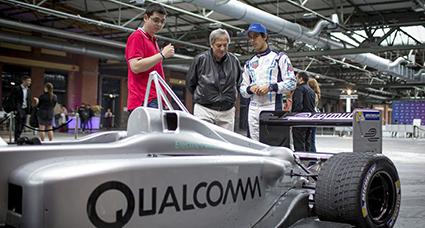
Qualcomm has announced a multi-year agreement with Formula E Holdings to become an Official Founding Technology Partner of the FIA Formula E Championship, the new international championship featuring racing cars powered exclusively by electric energy.

The agreement will allow Qualcomm and FEH to showcase mobile and Electronic Vehicle technologies globally and demonstrate how current and future generations can benefit from wireless, sustainable technology on and off the track.

Qualcomm will advise FEH in their quest to incorporate new and more sustainable technologies into the racing series. As a start, Qualcomm Halo Wireless Electric Vehicle Charging (WEVC) technology will be adapted to be fitted into the 2014/2015 FIA Formula E Championship safety cars so they can be wirelessly charged. The wireless charging system will be made available to the race cars from season two.

Qualcomm Halo WEVC technology uses resonant magnetic induction to transfer energy between a ground-based pad and a charging pad on the electric vehicle. Drivers simply park over the base pad and charging commences automatically.

As part of its advisory role, Qualcomm will evaluate the connectivity and mobile technology of each of the ten venue cities around the world, providing solutions to help enhance the spectator experience around the circuit such as live streaming to fans, video gaming and social media.

For more information, visit www.fiaformulae.com.
September 2013

Green Cove Dragway Joins IHRA Family

Submitted by Anonymous (not verified) on Fri, 09/06/2013 - 08:18
The International Hot Rod Association is pleased to welcome Green Cove Dragway, located just outside of Jacksonville, Florida, to the IHRA member track family.

Owned and operated by Pete Scalzo of the Motorsports Management Group, Green Cove Dragway is slated to open sometime later this year and will begin full operation in 2014. Green Cove Dragway, which is located 40 miles south of Jacksonville, will be an eighth-mile facility located on the grounds of a business park and will give IHRA a much needed presence in northern Florida. Green Cove Dragway is the sixth track from the state of Florida to join the IHRA.

“Green Cove will give IHRA a presence in northern Florida which we haven’t had in a couple of years,” said Phil Gingerich, IHRA Director of Track Development. “The facility has plenty of parking and plenty of room to host a major event sometime in the future. And with Jacksonville so close by, the track has a huge area to draw racers and fans from.

“They are really excited about the track down there. From the town to the mayor, they are all thrilled to death to have something come in and generate business.”
September 2013

TOTAL Lubricants USA To Support Action Express Racing

Submitted by Anonymous (not verified) on Fri, 09/06/2013 - 08:09
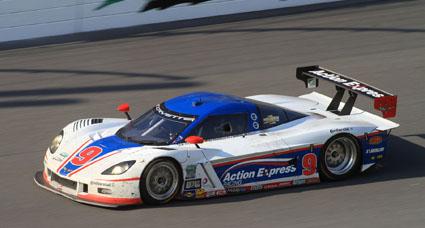
Action Express Racing has announced a new partnership with TOTAL Lubricants USA that will see the No. 9 Action Express Racing Corvette DP carry branding from TOTAL in the final two races of the 2013 Grand-Am Rolex Sports Car Series championship, starting with this weekend’s Continental Tire Sports Car Festival at Mazda Raceway Laguna Seca.

Action Express Racing broke onto the racing scene with a huge victory at Daytona in 2010, and enters the final stages of the 2013 Grand-Am season firmly in the mix for the Rolex Series championship title. With five podium finishes so far this season, including wins at Mid-Ohio and Watkins Glen, the two-car team has developed into a full fledged championship contender.

The No. 9 TOTAL Lubricants Corvette DP is shared by Burt and Brian Frisselle, who finished a season-best third two rounds ago at Road America.

The new marketing partnership with Action Express marks an expansion of the partnership effort that TOTAL first established with Grand-Am ahead of the 2012 season, when TOTAL was named the “Official Engine Oil of Grand-Am.”

“As hard as our team has been working to generate positive results on the track, we’ve also been working to develop a platform that supports the marketing efforts of our corporate partners, so we are very excited to welcome TOTAL to the Action Express Racing family, and we look forward to having a strong finish to the season as everyone looks ahead to a very exciting future next year,” said Bob Johnson, Action Express Racing team owner.
September 2013

Infinity ECU-Tuned White Goose Bar VW Rabbit Pickup Sets Land Speed Record at Bonneville

Submitted by Anonymous (not verified) on Fri, 09/06/2013 - 08:02
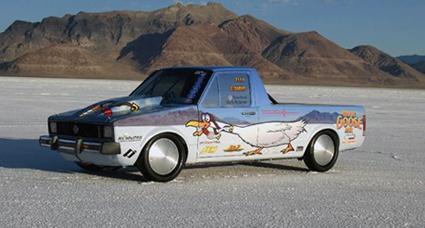
The Infinity ECU-tuned #2111 White Goose Bar VW Rabbit Pickup set a land speed record in the F/BMMP (under 3.0L, Blown Mid-Mini Pickup) class to 189.646 MPH at Bonneville Salt Flats. The existing record was 175.567 MPH and was set earlier in the week. The Keith Pedersen-piloted mini-pickup is powered by a 2.8L Volkswagen VR6 engine with an Exile Turbo GT4202.


In addition to the Infinity-10 EMS, the record-setting pickup used AEM wideband air/fuel ratio sensors, IGBT “Smart” ignition coils, and various stainless steel pressure and temperature sensors. The electronics ran flawlessly throughout Speed Week.


The event was not trouble free, however, as the truck suffered a serious clutch failure earlier in the week, which required pulling the engine, sourcing an uprated multi-disc clutch assembly and reinstalling everything—all in the extreme heat of the middle of the Utah desert.

September 2013

X-DRL Cancels Races Amid Financial Troubles

Submitted by Anonymous (not verified) on Thu, 09/05/2013 - 10:45
The X-Treme Drag Racing League (X-DRL) announced that its upcoming Thunder at the Heartland event scheduled for September 20–21 at the Lucas Oil Raceway at Indianapolis and the Southern Slam slated for October 4–5 at Alabama’s Montgomery Motorsports Park have been cancelled due to financial difficulties that have strained the upstart doorslammer series in its debut season.

The series made the announcement on their Facebook page, issuing the following statement regarding their current status:

We would like to thank all of the racers, fans, sponsors and track partners who have continued to support us as we work through these un-forseen financial difficulties. We continue to work on completing our financial restructuring through our financial partners and sponsorship partners that will allow us to pay all past obligations, inclusive of all racer payouts and vendor payments, and move forward in a positive manner. In the meantime, regrettably, we are canceling Thunder at the Heartland scheduled for September 20-21 at Lucas Oil Raceway at Indianapolis and Southern Slam scheduled for October 4-5 at Montgomery Motorsports Park. We are hopeful that we will work through these issues and be able to finish the season with the World Finals in October at Charlotte.

In a previous statement, the X-DRL said that the organization is still in operation, and officials are working with marketing partners to secure funding to both move forward and settle payout debts from previous events. The series, which was formed last winter and was said to have funding in place from the outset to cover the expenses of the inaugural season, has consistently struggled to attract fans and racers and has come under fire and intense scrutiny from the racing community for falling behind on payments for much of the season, even after issuing a new post-race payment policy at the most recent event in Maryland, intended to rectify the issue.

While the series is hopeful that it can continue, it’s most difficult challenge may not be in securing capital funding in a down economy, but in restoring its image with the racing community.
September 2013

Mexico On 21-Race Draft 2014 Formula One Calendar

Submitted by Anonymous (not verified) on Thu, 09/05/2013 - 05:55
Formula 1 is set for a 21-race calendar next year, including the return of Mexico but no New Jersey race. A first draft of the 2014 provisional calendar has been distributed to teams ahead of this weekend's Italian Grand Prix.

Although the 2014 schedule needs to be approved at a meeting of the FIA's World Motor Sport Council that takes place in Croatia on September 26–28, teams are bracing themselves for F1's longest ever season.

An early version of the schedule, which has been seen by AUTOSPORT, does not include the proposed event in New Jersey that F1 supremo Bernie Ecclestone had hoped to include. However, it will feature events in Russia and Mexico, providing the circuits are ready in time.

As has been widely expected, the season will start in Australia on March 16 for the traditional double-header with Malaysia.

The Korean Grand Prix has been moved from the end of season run of flyaway events to become the fourth race of the campaign, taking place in the week after the Chinese GP. However, the event is likely to only be made official subject to the completion of a contract with Formula One Management.

The returning Austrian GP is pencilled in for June 22, earlier than the July 6 date that it was originally scheduled for.

The new Russian GP at Sochi will become a back-to-back with Abu Dhabi, while the Mexican GP is being twinned with the USA GP at Austin.

The Spanish GP is set to take place at Barcelona, with Valencia not making it back on to the schedule, while the German GP will return to Hockenheim.

DRAFT 2014 CALENDAR

March 16 - Australia (Melbourne)
March 23 - Malaysia (Sepang)
April 6 - China (Shanghai)
April 13 – Korea* (Korea International Circuit)
April 27 – Bahrain (Sakhir)
May 11 – Spain (Barcelona)
May 25 – Monaco (Monaco)
June 8 – Canada (Montreal)
June 22 – Austria (Red Bull Ring)
July 6 – Britain (Silverstone)
July 20 – Germany (Hockenheim)
July 27 – Hungary (Budapest)
August 24 – Belgium (Spa)
September 7 – Italy (Monza)
September 21 – Singapore (Marina Bay)
October 5 - Japan (Suzuka)
October 19 – Russia* (Sochi)
October 26 – Abu Dhabi (Yas Marina)
November 9 – Mexico* (Mexico City)
November 16 – USA (Circuit of the Americas)
November 30 – Brazil (Interlagos)

* (subject to confirmation of track/contract)
September 2013

CASE STUDY: ROSS Racing Pistons

Submitted by Anonymous (not verified) on Thu, 09/05/2013 - 05:29
ROSS Racing Pistons designs and manufactures high-end aluminum pistons. The company handles 40 to 50 orders each week, and nearly every job is custom. The company also fabricates approximately 1000 pistons in a week, using a process that involves four to five different machining operations performed on high-end computer numerical control (CNC) equipment.

With CNC programming being a critical step in the production process, ROSS’ programmers must work quickly and their programs must be right the first time to avoid delays caused by rework and reprogramming. In the past, using a traditional programming process, the task required about 200 hours per week.

Using macros created with DP Technology’s ESPRIT CAM software, that time has been reduced to only 30 hours per week. And when a programmer wants to make a minor change to an existing macro, which is common, it takes only minutes using ESPRIT instead of the cumbersome C++ programming process required previously. In addition, ESPRIT’s simulation functionality helps avoid errors that lead to rework.

“We can't afford a lot of programming time,” explained Nicholas Plantus, chief engineer at ROSS Racing Pistons. “With ESPRIT, it takes about 20 minutes total to program the five operations needed to get a part ready to run.”

Power and Precision

ROSS Racing Pistons began production of high-end forged aluminum racing pistons in 1979 and the company is still run by one of its founders, Ken Roble. The company offers pistons for so many cars that its catalog runs to 45 pages. While most of the company’s pistons go into drag racers, some are made for other uses, such as in antique and vintage cars for which pistons are no longer made.

The breadth of the company’s product line means that the design team must deal with 900 possible combinations of applications, cylinder heads and compression ratios—the three factors that determine the shape of a piston. “There are so many different possibilities out there that almost every job that we do is different,” said Plantus. To design a new piston, designers work from samples that customers send, as well as drawings or actual cylinder heads. Some customers even send plastic models of their engines’ combustion chambers.

The company’s production equipment includes vertical machining centers, horizontal machining centers, lathes, a turning center, and a 5-axis machining center from vendors such as Okuma, Mori Seiki, Takisawa, and Fadal.

The first step of the production process involves the selection of the appropriate aluminum forging from one of the 95 different forgings the company uses. Forgings range in size from 1.5 to 6.8 inches in diameter.

Actual production begins on a pin-boring machine where pin holes are made. The part then goes to the lathe for OD turning, facing, and creating ring grooves. The next stop is the horizontal machining center, where dome shapes or dish shapes on top of the piston are made, along with the pockets for the valve. This machine also trims the sides of the forging for weight removal, and to make it easier to install the lock rings. When there are valves with compound angles, the part goes next to the 5-axis machine. After that, the vertical machining center is used to remove additional material to further lighten the piston. The last step is the turning center, which is used to make the piston elliptical to compensate for thermal expansion.

Addressing Programming Challenges

Even though nearly every job is unique, many of the new pistons vary only slightly from those that ROSS has already made. Using a traditional approach, however, CNC programming still required 20 hours per order. With that approach, the programmer imported a CAD model into the programming software. He added a model of the workpiece and positioned the part inside. He then selected and organized the features in the part.

The next step was to define the machining operations. For each toolpath, he selected a tool and defined its diameter, length, tool holder, and speeds and feeds.

Macros greatly simplified the creation of the CNC programs by prompting the programmer to enter dimensions and other basic information for each type of part. However, the company’s previous CAM system generated macros using C++. “The guy who was writing the macros for us was pretty good, but when he left, we had nobody who knew C++,” said Plantus.

This meant the company could no longer maintain its existing macros or develop new ones for new piston geometries. Another drawback of the previous CAM system was that it did not let end users generate post processors. The only way to get them was to buy them from the software developer, and that was expensive.

One of the main reasons ROSS chose ESPRIT was because its macro programming language is based on the industry-standard programming language Microsoft Visual Basic for Applications, which many programmers know and is much easier to use than C++. ESPRIT enables programmers to use VBA to access virtually all of its capabilities.

For example, a programmer can create a new dialog box that asks for parameters to define a hole (diameter, depth, XYZ location, hole type). Then the VBA macro automatically creates circles representing the holes, selects the cutting tools, automatically creates the drilling operations, and produces the G-code program all in one step. All of ESPRIT’s menus and tool bars are also accessible from within a macro or add-in program via the ESPRIT API. This allows the macros and programs to adapt the ESPRIT interface to suit the individual needs of a particular application or business. “So far we have created 60,000 lines of code and we are adding to it,” Plantus noted. DP Technology also allows users to develop their own post-processors.

Streamlined Process

Using macros created in ESPRIT, ROSS has created a fast 5-step process for CNC programming in which programmers simply fill in parameters and make some menu picks. The first step involves importing an IGES file for the dome and a Pro/ENGINEER CAD file for the piston. Using that geometry, he defines the features on the part.

There are normally between 10 and 12 features, and this step takes between one and five minutes. Next, he identifies which machining operations will be required and assigns them to the various machines, which are selected from a menu.  Finally, he selects the tool for each operation. At that point, ESPRIT generates the code for each machining operation. This step takes less than one minute—for a total of 20 minutes or less for the entire process.

The programmer then uses the ESPRIT simulation functionality to visualize the cutting process. ESPRIT makes it possible to view each individual cut in the entire machining process as dynamic 3D solids. The programmer can also view a presentation of the part that will be produced by the program and compare the as-machined workpiece to the original design. By zooming in on the simulated mold, the programmer can determine whether or not it matches the customer’s requirements.

The simulation process provides the ideal opportunity to take a close look at the program that has been created up to that point. At times, the simulation will show a problem with a program, which can then be corrected before any time or aluminum is wasted.

ESPRIT’s simulation functionality is more user-friendly, according to Plantus, than what was available in the company’s previous CAM system. For example, ESPRIT allows the user to place the cursor over a geometric feature and read its dimensions. “Simulation using ESPRIT is very accurate, and it’s easier, compared to our old software, to check the geometry and catch mistakes,” he explained.

The ease of creating macros with ESPRIT means that the company’s two CNC programmers have time to do other things, such as setting up jobs on the machines. It is also allowing ROSS to keep up with demand, even as its product line has expanded. “In the past, it could take half a day to program one operation,” Plantus said. “Now that it goes so quickly, we are better able to handle the complexity of our product line.”

For more information, contact:

In North America: DP Technology Corp., 1150 Avenida Acaso, Camarillo, California 93012, US. Telephone: 805/388-6000; Fax: 805/388-3085; Email: esprit@dptechnology.com; Website: www.dptechnology.com

In Europe: Hélène Horent, DP Technology Europe, MIBI, 672 rue du Mas de Verchant, 34000 Montpellier, France. Tel: +33 (0)4 67 64 99 40; Cell: +33 (0)6 50 76 78 77; Fax: +33 (0)4 67 64 99 41; Email: helene.horent@dptechnology.com or esprit.europe@dptechnology.com; Website: www.dptechnology.com


September 2013

Derek Scott Forms Mid-South Performance

Submitted by Anonymous (not verified) on Thu, 09/05/2013 - 05:11
Derek Scott has formed a racing parts supply house in Atoka, 30 miles northeast of Memphis, Tennessee. This facility will cater chiefly to performance engine builders.

Scott is highly regarded in the industry, having served the past dozen years or more at Comp Cams. He developed an early passion for the advancement of race engine components, and at various stages of his career has been crucially involved in most disciplines from NASCAR to the short–track ovals and from drag racing to truck and tractor pulling.

Scott has already established his business with Comp Cams, Trend Performance, Diamond Pistons, Total Seal, Ram Clutches, KRC Power Steering, Wilson Manifolds and others already on board.

Company contact information:
 
Mid-South Performance
245 Commercial Dr. Suite C
Atoka, TN 38004
(901) 647-1377
dscott@midsouthperformance.com
September 2013