Business Profile: Nelson Racing Engines
Submitted by jeffreyc on Sun, 10/17/2021 - 21:09


In a constantly changing landscape, this southern california shop continues to innovate, adapt, and thrive.

It’s the mid-1980s in Southern California’s San Fernando Valley. A 12-year-old boy straps into the passenger seat of his dad’s De Tomaso Pantera, ready for an exhilarating drive as usual. But this ride would prove to be particularly thrilling. The boy’s father had just bolted a pair of turbochargers to the Ford V8 perched right behind their seats. After a couple of full-boost runs in the now-even-faster mid-engine coupe, the boy was hooked for life. That boy was Tom Nelson, founder of Nelson Racing Engines (NRE).

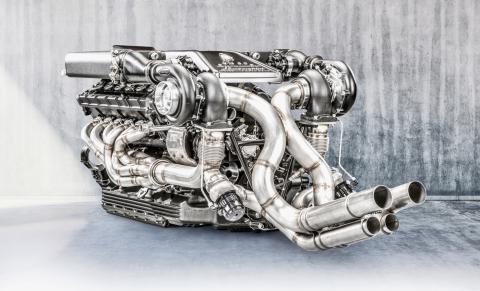
Since 1995, NRE in Chatsworth, California, has put together engines that are both immensely powerful and wondrous to behold. Anyone who has attended a major car show or flipped through the pages of a performance magazine in the last 25 years is most likely familiar with its work. The shop has produced some jaw-dropping custom builds over the years, and from the very beginning, Nelson has strived to balance function and form. 

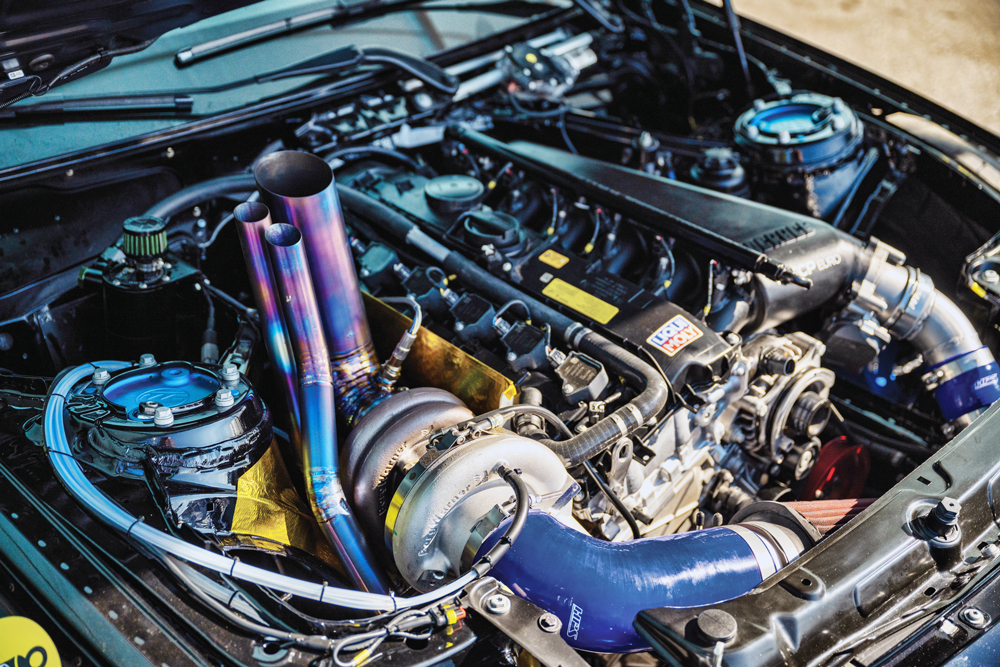
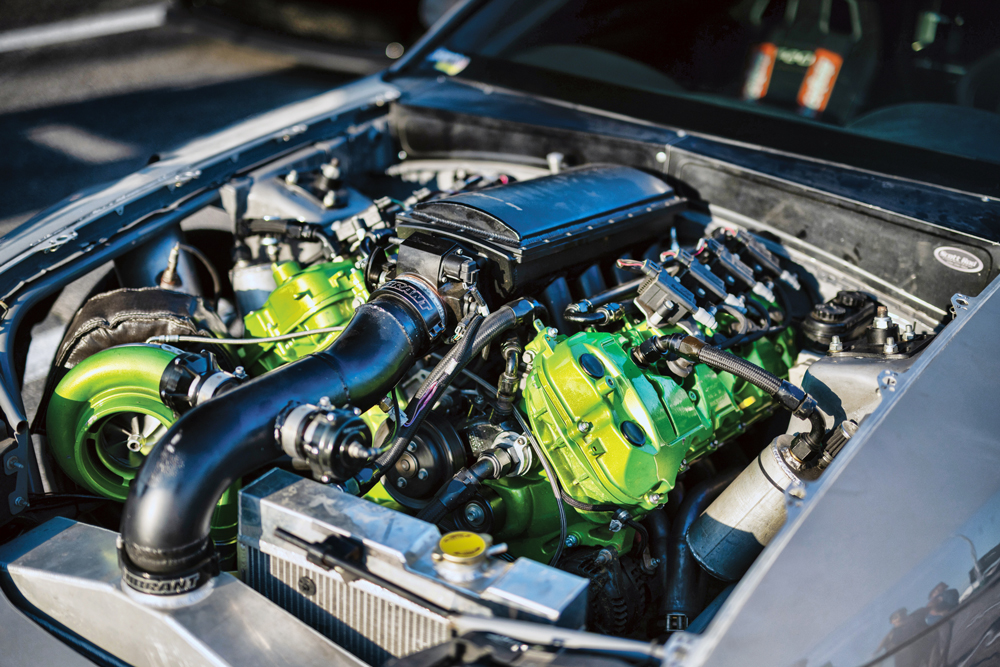
“We came up with these near mirror-image turbos back in the day,” he said. “Other people have them out now because we sold the patent to Precision Turbo & Engine, but we manufacture our own. We sell a whole bunch of those. 

“Up until we made that, there wasn’t a counter-rotating turbo. In a V8 there wasn’t a clockwise and a counterclockwise turbo. They were only clockwise. So they always kind of looked funny. We made a counterclockwise one, for a left and a right turbocharger, and that way the headers can look the same, the intercooler pipes can look the same, and it really adds to the whole look of the engine.” 

In addition to being highly aesthetically pleasing, a symmetrical twin-turbo setup has some unexpected performance benefits.

“Thinking in terms of reliability,” Nelson said, “having the left side the same as the right side adds reliability. If the left side has different conduit lengths that are going to affect the way it’s tuned comparative to the right side, then it’s going to change the way it’s tuned.”

business2
Nelson Racing Engines’ crate engine offerings benefit from ongoing refinement from owner Tom Nelson and team members, including Justin Kim, seen here working on a twin turbo 572 crate engine. “In this shop we’re never staying stagnant,” Nelson said. “We’re always trying to one-up what we did before.”

To this day, NRE’s twin-turbo kits are still its bestseller. But coming in a close second are its crate motors, which Nelson said are also built with both function and form in mind. “I think we have a specific aesthetic,” he explained. “Like our engines, usually when we build it, you know that we built it. It’s done a specific way. I like to think that we’re not just making horsepower, we’re making functional art.”

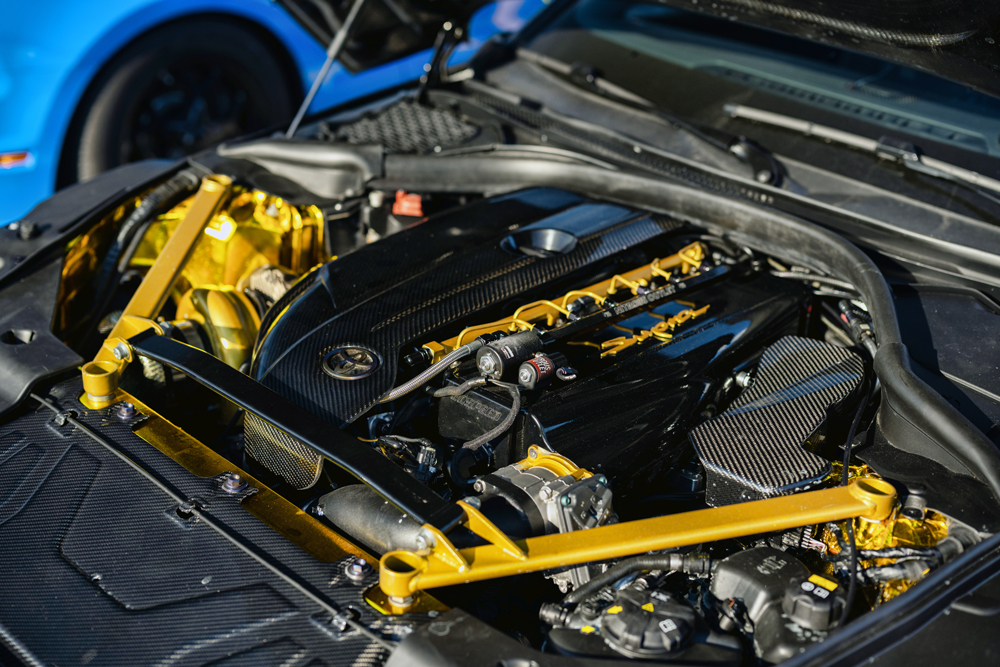
Nelson expanded on why big power isn’t enough for him: “Years ago, we kind of capped out where we need to be power-wise for a street car. It wasn’t really about finding every ounce of horsepower when we already had more than we’d ever need for a street car. I like the idea of the engine being a piece of art, like the engine bay is a picture frame and the motor is the jewelry. We try to hide a lot of stuff, where it looks like it doesn’t even run. We hide throttle linkage, we have injectors put on the inside of the intake, wiring that’s out of sight. So then it becomes beautiful.”

Keeping Pace With Technology

As Nelson alluded to, turnkey crate engines more or less hit their performance ceiling years ago. With that said, it would be easy to become complacent and keep offering the same crate motors year after year. That’s just not how NRE does things. 

“We’re always changing,” he said. “In this industry everything’s moving fast. Everything. There’s 3D scanning, 3D printing, all the advancements in fuel management, lightweight components and a lot more innovations each year. So we spend a lot of time in research and development trying ‘what if’ ideas. I think that keeps us fresh. If you’re doing the same thing over and over, you’re going to get left behind.”

Nelson pointed to his shop’s crate motors as a prime example. “Those crate motors are probably getting improved quarterly. If we find we like a certain valve better, we’re changing all those valves. If we find that we like a certain cam that’s making a little bit more power, we change it. In this shop we’re never staying stagnant, we’re always trying to one-up what we did before.

“It’s really about the process,” he continued. “We just keep refining our process. We can always do better. At the shop we’re always wondering, what used to be really good yesterday is probably not going to be really good three to six months from now because we keep refining it.” 

When asked what has changed the most since he started in the business, without missing a beat, Nelson said, “The electronics.”

He explained, “When I started, 500 hp was big. Now 1,000 hp is normal, and probably the biggest change that’s made that possible are the electronics that manage it all.” 

Just as the parts have evolved, so have the tools. “We’ve got a DTS engine dynamometer that we do a lot of engine testing on, and then we have a cylinder head flow bench. We also do a lot of remote tuning, so we end up getting a lot of feedback from data logs.”

Another Satisfied Customer

Tim Cagle at TCD Motorsports, an NRE customer who purchased a 1,500-hp LS 427 twin-turbo crate motor and transmission for his 1986 Chevy square body pickup truck project, can attest to the level of tuning and service that comes with an NRE engine. 

“Everything’s just so over the top,” Cagle said. “Tom does the dyno. He provides the service after we get it started up and installed in the truck. There’s a port where an iPhone plugs in, and he will tune it from the shop on his laptop, whether you’re in another state or just driving it down the street.” 

Cagle said NRE was “the obvious choice” to provide a motor for his C10. When pressed on why he went with NRE, he said, “The build was getting excessive, and I didn’t want to shortchange it in the motor department by putting just an LS or LS3 or crate motor of any sort. I had to get the engine to match the build.”

The tremendous effort Nelson puts into his engines to make them stand out did not go unnoticed for Cagle.

“To me, an NRE engine is just a machined piece of art,” Cagle said. “The fabrication, the machining, it just looks like art. It’s not something you see everywhere. I only see that level of detail in high-end magazine builds. Everything about them was so over the top: the service, the tech end of things. And Tom was always right there. If I needed anything mocked up or modified or changed, he was willing to handle it. It was full hands-on service. Plus, there are not many people who offer a 1,500-hp crate motor with a warranty. When it’s picked up, they’re not setting it on a tire in the back of the truck. It comes with a powder-coated engine stand that’s bolted to the motor. Just an over-the-top outfit.”

Taking Care of Business

Though NRE has grown substantially since its humble beginnings, Nelson still considers his company a homegrown operation. “We’re still a small shop,” he said. “We have a 16,000-square-foot garage and a little more than a dozen employees.” 

His tech staff is made up of six engine builders, two fabricators, a machinist, a sheet-metal guy and a wiring guy. Though the majority of his employees work hands-on with engines and cars, like any company, NRE has folks (salespeople and bookkeepers) who help the business run behind the scene.

business3
While extensive testing is performed on the shop’s engine dyno, as seen here with Mike Fagan and a blown 427 LS engine, NRE’s engines are also outfitted with a smartphone connection that allows a tech to tune the engine remotely after it’s installed in a customer’s vehicle.

When asked how he recruits his employees, Nelson said he’s had existing work relationships with many of them.

“The guys who are working here I’ve kind of sought after,” he said. “We’ve got some really good tube conduit guys who do headers, intakes, intercoolers, etc., and these are guys who I’ve worked with for many, many years. Over the years we’ve developed a relationship, and I finally got them to work with me. Same with the engine builders. Currently, we have previous IndyCar-winning engine builders. Another guy ran an engine shop for 10 years. So the guys who are in this shop are really the best in the country.”

When it comes to training, there are a few skills specific to what NRE does that will be learned on the job, but generally speaking, applicants should already be masters of their craft. 

“There are certain positions that need training. Right now we’re looking for a block prepper, which we would train for,” Nelson explained. “But the guys who are doing the heavy lifting are guys who have done it for 30 years. There are some young guys in here, too, who are like 29 or 30, but they’ve been doing it since they were kids so they’re all really talented guys. That’s the one nice thing that I can definitely say about my engine shop—I have a lot of trust in what they do.” 

business4
NRE’s tech staff is comprised of six engine builders, two fabricators, a machinist, a sheet-metal specialist, and a wiring specialist. Owner Tom Nelson said he had existing work relationships with many of them long before they joined the shop.

One position NRE doesn’t have is a social media specialist, because Nelson runs all of the shop’s social media accounts himself. Currently, Nelson Racing Engines has 262,000 followers on Instagram, 162,000 followers on Facebook, and 143,000 subscribers on YouTube. “For an engine shop we’ve got a pretty good-sized social media presence,” he said modestly. 

Social media is how NRE engages with its customers outside of the shop. “We don’t do a lot of shows, so that is the best way for us to interact with our audience.” 

It’s through those same social media channels, Nelson said, that NRE gets most of its new customers. 

Getting Through the Pandemic and Beyond

Like every other business, NRE was thrown a major curveball in 2020 when the COVID-19 pandemic hit.

“Originally, one of my guys had a stroke from COVID,” Nelson said, speaking of the early days of the pandemic. “We really didn’t know much at that point. It was scary. So we really didn’t work for a month or two. Then we came back and started working.”

But instead of coming back to a slow trickle of orders, they had a long waiting list of people wanting to buy engines and parts.

“People were going stir-crazy, so everybody went into their garage,” he said. “They’re not spending money, they’re not vacationing, they’re just stuck in their garage, and they want to build stuff. If I had the parts, I could’ve sold like a zillion engines, but COVID made parts almost impossible to get.” 

The supply shortages and increased demand have forced NRE to limit the number of orders it can accept, but it’s still busier than ever. “For us, we had to be careful how much business we would take in because we had to be able to get it done and we had to be able to get the parts,” he said. “We’ve pretty much extended our timelines—it’s almost double now—because of COVID. I mean, I’ve had blocks on order for over a year. Certain things we just can’t get. We can’t get a computer—five months I’ve been waiting for a computer. Engine bearings we can’t get. Intake gaskets we can’t get.”

Despite parts being in short supply, NRE is producing about four engines a week, and its bread-and-butter twin-turbo kits continue to be hot sellers. 

business5
While making big power is the name of the game at NRE, aesthetics play an important role in their engine builds as well. "We hide throttle linkage, we have injectors put on the inside of the intake, wiring that's out of sight," Nelson noted. "So then it becomes beautiful."

Nelson plans to offer more affordable crate motor packages while continuing to perfect NRE’s craftsmanship. “We’re really kind of known for these really expensive engines,” Nelson admitted. “So we’ve been figuring out through buying power and making deals with a lot of the big brands to be able to buy at a lower rate and pass those savings to the customer. We’re going to have a bunch more affordable crate packages that are essentially custom badass motors but at a crate-engine price.”

Affordable is a relative term, and Nelson clarified by saying these packages will be a bargain for what they are. “We have a supercharged engine that we sell for like $26,000,” he said. “It used to sell for $36,000. We were able to figure out how to make it for $10,000 less. We have a twin-turbo 427 LS that we sell for $29,000 that used to be $42,000. We’ve come up with ways to make the package actually nicer than it was but also more affordable.”

When asked if some of those savings could come from outsourcing production, Nelson was adamant that everything will still be built in-house. “Everything has to be built here,” he said. “If we’re going to have our name on it, we’re going to build it.”
November 2021
By
Alex Nishimoto

International Report: The New Virtual Workplace

Submitted by jeffreyc on Sun, 10/17/2021 - 20:43

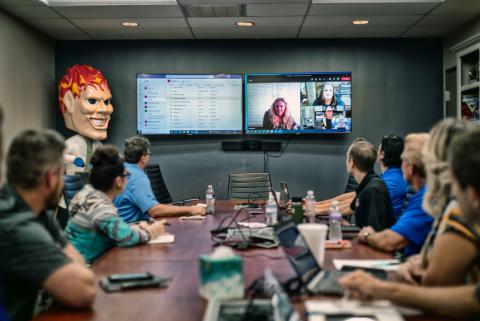
With ongoing travel restrictions and many businesses’ staff still working from home, online platforms have taken on an increasingly pivotal role in how companies stay in contact internally and with their customers. After a year of trial and error, we’ve gained some insight into what seems to work best—and also what doesn’t.

Not so long ago, video conferences and virtual meetings were looked at as a necessary evil—a rather inelegant solution to the temporary issue of not being able to put a certain group of people in the same room at a given time. In the new reality brought on by the pandemic, though, face-to-face meetings are still rare occurrences for many companies. As a result, these technologies have now become indispensable tools to conduct business.

As an industry with strong international ties that often champions a hands-on approach, racing has been particularly affected by these circumstances. But ingenuity has also long been a hallmark of motorsports, and it’s a mindset that tends to carry over into the office. 

Here we take a closer look at how companies are continuing to do business and effectively communicate while in-person contact remains elusive. We also get some insight into where things may be headed as the available solutions continue to evolve and we collectively establish the new normal. 

ASAP Trading USA

San Diego, California

“We normally travel throughout Latin America to see our customers—the importers,” said Juan-Jose Rebaza. “And we also travel throughout the United States to see companies and the factories that we represent. So after lockdowns took effect in March of 2020, we had no choice but to face this new reality. We had a number of scheduled trips to Peru, Chile, Argentina, Ecuador, and elsewhere that we had to cancel, or, in some cases, the airlines were canceling those flights. So we quickly needed to regroup and think about how we were going to do this now, because the best marketing for us over the past few years has been these in-person meetings and attending some of the biggest events in Latin America (Mexico, Central and South America).”

Rebaza told us that early on, the issue of attending events essentially solved itself—there no longer were any. The real challenge they faced was finding a suitable and effective replacement for their in-person meetings with clients and customers. “Very quickly we realized we were going to have to get comfortable being in front of a camera,” he explained. “So we made sure that we had nice company shirts, confirmed that our haircuts and eyeglasses were on-point, and then we got some nice equipment to use.”

Beyond meetings, Rebaza and his partner Ricardo organized what he refers to as virtual trips, virtually traveling to Colombia, Mexico, Costa Rica, Panama, and other countries, not only to maintain their relationships with their customers, but to reassure those folks that they understood the situation they were going through because they were dealing with similar challenges as well. 

“Initially it wasn’t an easy adjustment for some of the customers and factories,” he explained. “Some just weren’t ready for it. Employees didn’t have cameras or didn’t have microphones. Others just weren’t comfortable being on camera and being seen at home. But by the beginning of June things started coming together, and people started getting used to those meeting requests. And little by little, people also started to figure out how to go racing again.” 

int2
Juan-Jose Rebaza of ASAP Trading USA recommends sending out an initial calendar invite that establishes the meeting time, then following up with another email that includes a link to the conference just before the meeting as a last-minute reminder.

Rebaza said that they initially used Zoom for video conferencing, but they quickly ran into limitations with the free-to-use version of the platform. “It seemed to be the easiest option, but you’re limited to 45 minutes with the free version and then it abruptly cuts out. So there were times where we had organized a seminar with one of the factories that we represent, and in the middle of it the meeting would get cut off. I’d have to tell them that we had a technical issue and send another link to a new meeting.” 

That led the team to seek out other options, which in turn brought them to Google Meet. Formerly known as Google Hangouts, the video meeting software functions similarly to Zoom, but boasts several distinct advantages. “We found out that it offered unlimited time for free, and the quality and reliability was similar to Zoom. The audio and video settings are easier to adjust, too. And the process of creating a new meeting is very streamlined.”

However, Google Meet comes with a caveat of its own. “You have to have a Gmail account in order to use it, and that can sometimes be a hassle if one or more of the potential attendees don’t have one. But these days most people have a Gmail account, and they’re also free, so that hasn’t been a huge issue for us.”

He also began to establish some best practices in order to keep everything running smoothly. “I would send an initial calendar invite for meeting sometime in the future—let’s say a Friday at 9:00 in the morning—and then on the invite, I would explain that five minutes before the meeting, I would send out a link to the meeting. So five minutes before the scheduled meeting I’d create the meeting and send out a link, and it worked like a charm. Engine builders and garage owners normally aren’t sitting in front of the computer all of the time, and these days we’re processing so much information on a daily basis that it’s really easy for these types of things to get forgotten. So that kind of works as an excuse to remind people about the meeting.”

While Google Meet has become the go-to platform for ASAP Trading USA, Rebaza noted that companies should really have all the popular options installed and ready to go at a moment’s notice. “The bigger companies might take issue with certain platforms because of security concerns or things like that,” he said. “Some prefer Microsoft Teams or GoToMeeting. Each company has its preferred tools, so you need to be able to move fast and be comfortable using different platforms.” 

He added that messaging apps like WhatsApp have become more popular alternatives to traditional email because of their simplicity and ease of use. “WhatsApp is great because it’s very user-friendly and full of features. For instance, it’s really easy to snap a picture and share it with a person—you don’t even have to ‘attach’ it. And you can synchronize your conversations across multiple devices, so if you move from your mobile phone to your laptop, you can pick up right where you left off.”

Meanwhile, Telegram is a newer messaging app that is gaining traction internationally as well. “I see more and more people using it every day. It’s a business platform, but it functions like Snapchat. The messages eventually go away on their own. I send you a text, you read it, and it goes away. People seem to appreciate the privacy and security that design provides.” 

Even though these platforms offer viable solutions for their company, Rebaza admitted that nothing can ever totally replace the effectiveness of in-person meetings. “Since we’re not able to travel, we’ve also started to use agents in each country that we normally frequent, so we can at least visit customers indirectly. Folks still want that personal touch, so we’re trying to be creative and do what we can do.”

VP Racing Fuels

San Antonio, Texas

Although VP Racing Fuels’ business was significantly impacted early on during lockdown, the company quickly saw its sales for small engine fuels skyrocket as folks across the nation looked for projects to take on while stuck at home. “With everyone stuck at home, people decided to start working in their yards. Thankfully we have diversified our product portfolio and we are no longer just a race fuel company. Having a full line of ethanol-free small-engine fuels truly saved our business,” said James McVey. “And since we commonly use ethanol in several of our race fuels, we developed our own hand sanitizer and brought that into the market through our distribution channels. Those sanitizers generated an additional revenue stream that allowed us to remain profitable even with the reduction in our race fuel sales.”

As a result, 2020 ended up being a record year for VP Racing Fuels, and it’s on track to raise the bar even higher this year. But with a significant international presence, the company has also faced logistical challenges as a result of the pandemic that required changes to its strategies.

“Domestically it changed quite a bit,” explained McVey. “We have facilities on the West Coast, East Coast, Northeast, and so on, and salespeople who are normally constantly out there knocking on doors and meeting with customers. So when COVID hit, all those face-to-face meetings stopped, and everything went online. The international side wasn’t really as impacted, but that’s because we were already using online software solutions for meetings in many cases.”

int3
VP Racing Fuels uses Microsoft Teams not only because of its performance and security, but because it incorporates additional features that typically aren’t included in meeting software.

VP Racing Fuels’ virtual meeting platform of choice is Microsoft Teams. McVey said Teams was chosen largely for its performance and security, but there are other advantages as well. “It’s not just meeting software. There are a lot of features that a company can use internally, too. You can create chat rooms and groups, share files and so on. We utilize it to communicate with each other on a day-to-day basis internally, often as an alternative to email. The days of sending out emails with 20 people cc’d on it, and then receiving 50 replies, are mostly over thanks to this platform.” 

But he noted that even with a proven solution like Teams, it’s important to prepare for the unexpected. “You can’t assume that the technology is always going to work,” McVey advised. “You can have the best software, but if your customer doesn’t have the greatest data connection, you’re going to have some challenges. I think we’ve all become a little more forgiving of those issues now, though. People have learned to deal with it.” 

That’s important because these technologies are likely to only become more integral in the coming years. “We’ve seen that it’s the direction things are going, and it has definitely helped us get answers quicker and keep in regular contact with our customers,” McVey said. “Like the transition from fax machines to email, it has sped up the way we do business.”

Motor State Distributing

Watervliet, Michigan

Like many in the industry, Motor State Distributing saw its business come roaring back in the summer of 2020. But with most events canceled or postponed, it sought to find a way to keep in contact with its customers, and ultimately its traditional methods proved the most effective. 

“Today we’re still primarily email-based,” said Darren Lane. “We didn’t really try to push anything on anybody in terms of technology. It’s more about staying in regular contact with people. The sales team has never really done much in the way of video conferencing—I don’t think they’re particularly fond of it, to be honest. Occasionally a customer might call using FaceTime or something like that, but other than that, we stayed with the platforms that people feel the most comfortable with.” 

That focus on ease-of-use has helped bring WhatsApp into the fold as well. “I think we’ve kind of gravitated toward that platform because it tends to be what the customer is comfortable using.” 

Lane said it’s important to avoid creating potential technical barriers that could hinder regular communication, both internally and with customers. “Our team uses instant messaging a lot, and it seems to help. We use Cisco WebEx Messenger, but other platforms like Slack and WhatsApp will also do the job, so it really comes down to preferences and priorities.” 

Looking into the future, Lane doesn’t expect Motor State Distributing to change too dramatically over the next few years. “There’s always room for improvement, but I think we’ve got things pretty well dialed-in at this point. What we’re doing seems to be working.” 

AEM Electronics

Hawthorne, California

AEM’s Kirk Miller noted that international travel has never been a major element of the company’s business operations, and that’s by design. “We have a pretty robust network of distribution partners who are basically our boots on the ground. When you have a good distributor with a wide-open channel of communication, you’re talking with those folks every week, if not more.”

So while AEM’s use of video conferencing did increase after travel restrictions were put into place, it was already familiar territory for the team. “Whether it be text, email or video calls, we had already been using these systems frequently for years,” said Miller. “We have engineers in the field who regularly call in through video, so we were set up for this.” 

He told us the platform of choice for day-to-day communication within the company is Slack. “Instant messaging programs tend to be quicker than email, and the messages don’t get stacked up in your inbox. You see it right away, so you’ll often respond right away. An email might get buried under dozens and dozens of other emails that come in throughout the day, but when someone receives a direct message like that, it gets their attention.”

int4
Kirk Miller, at right, points out that while AEM’s staff has go-to options for instant messaging and video conferencing, it’s important to become familiar with a range of different platforms in order to accommodate the preferences of outside parties.

Miller pointed out that the company generally prefers using Google Meet because of its user-friendly design, but it often needs to jump to other platforms to work with engineering companies and suppliers who have their own preferred software. “In some cases that might even be a solution they’ve developed in-house, and they just send us the login information. But we’ll use whatever makes everyone happy.” 

Even though the company was well-versed in video conferencing etiquette before COVID, Miller said that they have learned a few things over the past year or so. “The biggest problem I’ve noticed is high head counts. When you get 12 to 15 people on a call, distractions and noise can become frustrating. Smaller head counts usually lead to more effective meetings in that regard.”

Yet despite any potential annoyances, Miller said it’s worth the effort. “The cool thing is that, much in the way a call allows you to hear the inflection in someone’s voice that you can’t get through email or text, video conferencing adds another layer to it,” he explained. “You can actually see someone’s face and read their body language. I think that makes a difference.”

SOURCES

–

AEM Electronics
aempower.com

ASAP Trading USA
asap-trading.net

Motor State Distributing
motorstate.com

VP Racing Fuels
vpracingfuels.com

November 2021
By
Bradley Iger

Track Attraction

Submitted by jeffreyc on Sun, 10/17/2021 - 17:37


The job of getting fans into the stands is as challenging as ever, so race tracks and sanctioning organizations rely on a diverse array of tools to MARKET their EVENTS AND PUSH OUT COMMUNICATIONS.

Reality can be harsh. In a perfect world, fans would flock to races without prompting, and drivers would pack the track just by seeing the sign out front. Yet the plain fact of the matter is, race tracks must compete against an ever-growing universe of entertainment options, ranging from TikTok smartphone videos to championship sports teams at massive arenas.

To keep grandstands full and starting grids healthy, race tracks and sanctioning bodies rely on a wide array of marketing and promotional methods. We reached out to a number of these organizations to find out what works and what doesn’t. Their insight proved valuable and at times quite surprising. 

The Digital Revolution

Contrary to what many experts imply, there really isn’t a right or wrong way to promote an event. What works for one organization might not work for another.

For this reason, large national sanctioning bodies prefer to partner with local tracks that know what works in their particular region. This cuts down on guesswork. “Every market is a little bit different in the way you approach it,” explained Chris Dolack of World Racing Group, Concord, North Carolina. “So we try to work with the local promoters in each region who know their market. If we go into a particular market and those fans are used to seeing a track’s messages on television, then it makes sense for us to do television.”

track2
In-house media productions like the NMCA’s Fastest Street Car Magazine offer advantages in event cross-promotion, brand building, and content generation for use on multiple platforms. Photo courtesy of NMCA.

That said, digital media has become the undisputed king of the hill in all regions. “If I was going to go to another venue for a different event, what’s the first thing I’m going to do?” said Chuck Deery of LaCrosse Fairgrounds Speedway, West Salem, Wisconsin. “I’d whip out my smartphone and look it up that way. So we’ve been trying to direct our attention toward that.”

Among the many forms of digital marketing, the strongest returns are coming from social media, according to our sources. Facebook in particular has emerged as the most powerful platform for reaching car enthusiasts and race fans. “We use Instagram and Twitter, too,” said Mary Lendzion of Summit Motorsports Park, Norwalk, Ohio. “But we can see by the response that Facebook is where we have the most impact. We have more than 66,000 followers there.”

Because of social media’s voracious demand for fresh content, many organizations that used to have separate marketing and editorial departments are merging those entities into a unified content team. The content these centralized groups develop is then used in social media, websites, ads and more. “We’re all after the same thing—to promote our races, which promotes our brands, which creates hype behind the series,” said Mike Galimi of NMCA, Santa Ana, California. “At the end of the day, it’s all content.”

Tracks can draw on the star power that comes with the major-league events they host. “I reached out to John Force to ask if he would make a one-minute-long video clip that we could post to our social media,” said Lendzion. “It was wonderful, and people really responded to it.”

Some large sanctioning bodies add a unique regional twist to this celebrity power play, choosing the racers they feature by region, to better appeal to the pride and familiarity of fans in that area. “We have drivers from all over the country that compete with us,” said Dolack. “If we’re going to the Dakota area, Donny Schatz has a huge fan base up there. Our messaging for that race will have his car and his name in those promotional efforts. In Pennsylvania, we’ll feature Logan Schuchart and Jacob Allen.”

For smaller organizations, sometimes just a well-thought-out, simple promotion can have potent returns on social media. David Carroll of the Southern Drag Boat Association in Burnet, Texas, has seen positive results by simply posting a digital version of the event flyer on Facebook. To entice people to tell others about it, he adds their name to a drawing for VIP tickets to the race if they share the flyer. “A lot of people don’t want to share things,” said Carroll. “But when they have a chance to win a couple-hundred-dollars’ worth of VIP tickets, they will.”

track3
Capitalizing on that star power that comes with hosting major-league events is an effective way for tracks to improve engagement with their audience. Seen here is Bill Bader Jr., at left, of Summit Motorsports Park and NHRA Funny Car legend John Force.

Regardless of what approach is used, ultimately social media is all about conversations. The best marketers see it as an opportunity to connect directly with their fans. “It’s very important to me to have a rapport with every single one of our guests who comments on our page,” said Lendzion. “I want to read what they’re saying, and I want to respond.”

Although most discussion of social media revolves around essentially free methods of promotion, paid advertising also has a place in the marketing mix. Several sources we spoke to use Facebook ads, while others see dividends from pay-per-click ad programs. “We do paid Google search ads,” said Chase Brashears of South Boston Speedway, South Boston, Virginia. “So we pop up as the number-one option on searches. We also have SEO paid functions that make it easier to find us, which actually is very, very successful.”

Last but definitely not least in our discussion of digital marketing is email. This venerable platform generally isn’t as hip or trendy as social media is right now. But few other marketing methods of any type allow the kind of personalization, targeting and cost efficiency that email provides. 

The one big hurdle with email, however, has always been the question of how to build an effective mailing list. It’s not something you can just go buy—anti-spam regulations banned that decades ago. Many race promoters have now discovered that a powerful method for getting a good list is built right into their normal race operations. “We’ve recently gone to online ticketing, so we’re able to capture all those email addresses,” said Deery. “We can sell that event or others to them again.”

Also worth noting are some downsides to digital marketing. For one thing, it can devour massive amounts of time. On top of that, it’s constantly changing and difficult to keep up with. To overcome those hurdles, some organizations are handing off the digital part of their promotion efforts to outside agencies. 

“It’s kind of like me working on my car,” said Brashears. “I have the tools to maybe change oil and stuff. But when it comes to taking out an engine, I’d have to go buy an engine hoist and all that stuff. Our ad agency already has all the tools they need in-house. We’re just a simple little task to them.”

Traditional Media

With all this talk of digital media’s power and popularity, you might think traditional media is being discarded like a worn-out race tire. But that’s not entirely true. 

Yes, some motorsports organizations are indeed stepping away from pre-Internet marketing methods such as brochures, radio ads and billboards. And almost all of our sources noted that print newspapers are a dead medium as far as they’re concerned. 

But others continue to see solid results from various forms of traditional media. Summit Motorsports Park, for instance, continues to produce a large, full-color printed annual brochure highlighting its events. The brochure is sent via postal mail to everyone on the track’s mailing list, handed to all spectators as they enter the track and passed out at major automotive events, such as the Detroit Autorama. 

track4
Providing a steady flow of fresh content is a crucial component of any social media strategy. Because of this, many organizations have combined their marketing and editorial departments into one unified content team. Photo courtesy of NMRA.

“We go to great lengths to make sure those brochures are as attractive and colorful and eye-catching as they can be,” said Lendzion. “We have them printed on high-quality glossy paper because we want fans to hang them on their walls.”

Car fans are often looking for something to liven up their garage décor, so a poster-worthy color brochure works well in that setting. But when it comes to commercial locations, the proliferation of large retail chain stores has effectively killed the value of posters, noted one source. “We used to do more printed posters and cards,” said Dolack, “but they’re harder and harder to get up in stores, because stores now have very well-defined plans for how that sort of stuff should appear in their windows.”

Along with print marketing materials, radio and television are seeing a similar mixed evolution. Much of radio’s audience has moved online to streaming platforms such as iHeartRadio, or to satellite systems like SiriusXM. Yet despite their boundaryless reach, these platforms lack the local emphasis that radio has traditionally provided. “People are listening to SiriusXM,” said Carroll, “but it’s hard to really target areas.”

At the same time, it can take a relatively large budget to buy enough radio and TV time to make much of an impression on viewers or listeners. This is hastening many promoters’ move to less expensive digital technologies. “We’ve spent a good chunk of money on TV and radio,” said Michelle Lackey Maynor of Alaska Raceway Park, Palmer, Alaska. “But we don’t have enough of a budget to make that an effective campaign. So for us, it didn’t work really well.”

Perhaps the ultimate way to utilize the power of television is to own a network, which is exactly what World Racing Group has done with its DIRTVision streaming platform. Beyond the exposure and brand building that naturally come from live racing broadcasts, World Racing Group also uses the platform to cross-promote its other events. “All of our races are broadcast live,” noted Dolack. “You can go home, flip on your TV, turn the app on and you’re watching our races on your television. It’s as strong of a tool as we have anywhere to promote our events, our series and our drivers.”

Complementing the DIRTVision platform, World Racing Group also creates unique video content for spectators at races. The work is done by a separate in-house team that tailors the race-day content to the needs and expectations of an in-person audience. That content is then displayed throughout the event on an array of screens at the track. Naturally, this on-site video content also promotes concessions, upcoming races and other products to spectators, making it a potent marketing vehicle. 

NMCA also has its own dedicated in-house media platform, Fastest Street Car Magazine. Like DIRTVision, the magazine is a luxury that only a relatively large organization like NMCA can sustain effectively. But if the resources are available, an in-house magazine is an undeniable advantage for cross promoting races, building the brand and generating content to use on other platforms. “It’s an incredible way to tell the story of our racers,” said Galimi.

Filling Starting Grids

While attracting spectators is an obvious necessity for any motorsports organization, there’s a hidden flipside that can be equally important: getting participants for races. Many race tracks must actively reach out to competitors and draw them to events or risk low car counts. 

Although the need to market to racers varies considerably from track to track, the pandemic appears to have made it more difficult, at least temporarily. “It was kind of crazy to go down a path of having to market to competitors, to be honest with you,” said Brashears. “But the track was shut down all last year, so our car counts at the beginning of the year struggled a little bit to get started.”

To help bring more racers to the South Boston Speedway, Brashears came up with a team information page on the track’s website, showing why racers should race there and displaying all pertinent information in one centralized location. This is complemented by email blasts and social media posts aimed at competitors, particularly those who have previously competed at the track. Brashears said that through these efforts, car counts at his track are quite healthy now. 

track5
To help bolster their car counts, South Boston Speedway developed an information hub for the track’s website that is devoted specifically to drivers and teams. The page outlines the benefits of racing with the track and puts other important details front-and-center. Photo courtesy of Joe Chandler/South Boston Speedway.

Even national organizations like NMCA feel the need to actively market to racers. NMCA’s outreach efforts tend to target less visible classes, based on the expectation that competitors in more prominent classes are already familiar with the organization and its events. “We target racers and fans with two different campaigns,” said Galimi. “If you’re a class racer, most likely you’ve come across our brands. So for racers, we’ll target some of the more street-oriented classes, where competitors may not have heard of us before.”

To help attract racers to these beginner-oriented classes, NMCA has teamed with Dodge to develop a program designed to assist new drag racers. The program takes prospective racers through all the necessary steps in racing, from when drivers enter the facility to when they make a run down the track. “We try to communicate the process as best we can to help eliminate some of the intimidation factor,” Galimi said.

Getting Creative

The long-term health of any racing organization depends on bringing a steady flow of new people through the gate. Hardcore racing fans may need just a slight nudge to get them to an event. On the other hand, the vast potential audience of casual spectators typically requires something unique to draw them to an unfamiliar location, to see a form of entertainment they know little or nothing about.

Doing so can take a lot of creativity and out-of-the box thinking. “It’s all about bringing people to the race track,” explained Royal Jones of Vado Speedway Park, Vado, New Mexico. “They see the place, utilize it, and get a warm, fuzzy feeling about us doing something for the community.” 

To do that, Jones isn’t afraid to try new things. For instance, when the pandemic shut down schools last year, he opened his facility to three high schools in the region so they could have graduation ceremonies. “It was an exciting, memorable experience for kids to graduate from high school and do it at the track,” recounted Jones. “And it showed this race track to about 3,000 families.”

track6
Moving to an online ticketing model can allow tracks to build mailing lists that are comprised of fans who have a proven interest in attending events at the facility, including Alaska Raceway Park, seen here.

Also on the track’s schedule is a Christmas decoration display that’s already seeing plenty of action on social media. “It’s getting thousands of hits now,” said Jones. 

Carroll of the Southern Drag Boat Association wanted to attract young spectators, who could potentially become fans for decades to come. To do so, he set his sights on college students for a race in College Station, Texas, home of Texas A&M University. Carroll offered half-price admission to anyone who presented a college ID at the gate. “I honestly believe if I can get a guy that’s interested in motorsports to one boat race, I’ll have him for life. It’s that exciting.”

Maynor of Alaska Raceway Park has seen good results emphasizing the track’s potential as family entertainment, to better compete for the limited number of fans in the market. “It’s affordable entertainment for families,” she explained. “There are only so many of us in Alaska. So being able to reach all of those who are interested in motorsports is what we focus on.”

Whatever method tracks and sanctioning bodies use for marketing and promotion, the job is really only limited by one’s imagination. While some organizations may have more money, a bigger brand name or more resources than others, marketing and promotion ultimately come down to how passionate an organization is about bringing its message to its audience. “We’re always exploring how to do something even bigger, or even better, or even bolder than before, said Lendzion. “It’s sort of ingrained in us.”

SOURCES

–

Alaska Raceway Park
raceak.com

LaCrosse Fairgrounds Speedway
lacrossespeedway.com

National Muscle Car Association
nmcadigital.com

National Mustang Racers Association
nmradigital.com

South Boston Speedway
southbostonspeedway.com

Southern Drag Boat Association
sdbaracing.com

Summit Motorsports Park
summitmotorsportspark.com

Vado Speedway Park
vadospeedwaypark.com

World Racing Group
worldracinggroup.com

November 2021
By
David Bellm

Plot The Path To Motorsports Success

Submitted by jeffreyc on Sun, 10/17/2021 - 17:12

Stu Kelly, Stu Kelly Motorsports and Force Indy

Studying the fundamentals early on not only helps kids develop racing skills and good discipline habits, it also can lead to meaningful long-term careers that aren’t necessarily behind the wheel.

Over the years, PRI Magazine has covered a variety of different programs that encourage young people to get involved in motorsports. Beyond developing driving talent and a better understanding of the engineering behind the scenes, these programs can also provide hands-on experience to kids who otherwise might not have a readily accessible path into the racing world. 

“When you’re a kid, there’s an inherent desire to figure out what you’re good at and what’s going to make you happy in the long term,” said Force Indy crew member and NXG Youth Motorsports program graduate Stu Kelly. “A lot of kids just aren’t aware that you don’t have to be a race car driver to have a career in motorsports. So these types of programs are really important in both of those aspects.” 

To examine the potential impact of these programs, we sat down with former youth racing program students who went on to establish careers in motorsports. Here’s how these schools helped put them on the path to success. 

Jason Simmons

Urban Youth Racing School Graduate

Jason Simmons’ day-to-day at NASCAR consists of assisting with the operational logistics and strategic initiatives for the organization’s international series. “That includes things like figuring out different ways to encourage sponsorships and finding unique programs to drive series development,” Simmons explained. “For instance, one of the things we’re working on right now is the development of an international iRacing series, where we pit top drivers from each of our three international series against one another, almost like an esports Olympics.” 

He scored an internship with NASCAR in 2013 and has taken on various roles within the organization in the years since, but the path that led him there dates much further back. 

“When I was a kid, one Sunday my brother and I got in trouble and our parents sent us to our room,” Simmons said. “We turned on the television and there was a NASCAR race on—this was the 1996 season, and they were racing at Sonoma. We started watching the race, and I was really just trying to make sense of everything that was happening. The biggest thing that stuck out to me were the paint schemes of the cars, the designs were just really cool and eye-catching. But there was one car that really caught my attention, and the kid behind the wheel was pretty good. It was Jeff Gordon in the Rainbow Warriors car. Now I had a guy to root for, and I was hooked. He finished runner-up that season, and then he won in both ’97 and ’98.”

youth2
Now part of NASCAR’s international operations team, Jason Simmons, seated, originally became interested in motorsports when a televised stock car race caught his attention while he was grounded in his room as a kid.

To a kid growing up in inner city Philadelphia, Simmons said that motorsports was a fairly alien concept, and that was actually part of the appeal. “It was just different, and I thought it was the coolest sport in the world. In school I wasn’t talking about Donovan McNabb stats, I was talking about how many points out of first place Jeff Gordon was. Those were the things that were going through my head when I was growing up. It just consumed me at a very young age, and before long I wanted to know what made these cars go fast, and why one team might be doing better than another.” 

His fascination did not go unnoticed by his parents. “They were the type who made it clear I was not going to be running around in the streets every summer. I was going to be involved in some kind of camp,” Simmons said. “One summer it was tennis camp, another was street hockey. It just so happened that one year, my mom found an ad in the newspaper for the Urban Youth Racing School, which had just started operating in 1998. She put my brother and me on the waiting list for that year, and we joined the program in 1999.”

He said that the curriculum covered the technical fundamentals of motorsports—how aerodynamics factors in, what different flags mean and the basics of driving technique. “They would bring in drivers from karting all the way up to Late Models to teach us about car control and general race craft. Then they took us to the race track to apply what we had learned in school.” 

He discovered he had a knack for it. Soon after, his father purchased a Mini Cup car so he could race at various tracks in Pennsylvania and the surrounding area. He eventually worked his way up the ranks into a Legends car. 

youth3
Looking for summer camp options, Jason Simmons’ mother came across an ad for the Urban Youth Racing School. The program not only set Simmons on a path that included stints competing in Mini Cup and Legends race cars, it also provided him with the industry connections that he would need in order to pursue career options in other aspects of motorsports.

“Aside from the technical aspects of racing, the other thing the program taught me a lot about was managing relationships in the industry, and how the industry works. That was one of the things that really helped me get to where I am today. I made a lot of connections through that school.”

Just before he graduated from college in the spring of 2012, Simmons decided to call one of those connections. “I was wondering what my next move was going to be—was I going to chase this dream? I reached out to this guy I had met years prior in Philadelphia who ran the government affairs team for NASCAR. I explained who I was, and he remembered me. I told him I was coming up on graduation and that I wanted to start looking into opportunities at NASCAR, and he said, ‘OK, let’s get the ball rolling.’ I’ll never forget that conversation. The following week he sent me some information about the NASCAR diversity internship program.” 

Simmons still makes a point of dropping by the school in Philadelphia and hopping in on virtual classes to talk with the kids. “I think it’s important to let these kids know that if this is something they want to get into, there are opportunities out there. I’m a prime example of what can happen if you’re dedicated to it.” 

Alex Vande Voort

Compass Racing Development Driver

As a former student of Youth Racers of America clinics and a Compass Racing Development driver, Alex Vande Voort said his career trajectory has been very much by-design. “We have a saying in my family, I didn’t really have a chance,” he joked. “It was racing or nothing.” 

Aside from his sprint car efforts with Alex Vande Voort Racing, Vande Voort works on the pit crew for several teams running in the Knoxville Raceway weekly 360 winged sprint car series, and he hopes to find work with a team based in Indianapolis later this year. He said his interest in motorsports can be traced back to his grandfather, who raced at Knoxville in the 1980s and later became a tech official for the track. 

“I grew up watching the races in those stands every weekend, and I fell in love with it,” Vande Voort explained. “I didn’t have the outside influence of an older sibling who was into basketball, baseball or something like that. For me it was all racing. I still remember sitting in my grandparents’ living room playing with toy sprint cars as we were getting ready to go watch sprint car races.” 

youth4
Although Alex Vande Voort had strong ties to racing from a very young age thanks to his family’s involvement, he told us that his work with Compass Racing Development and Youth Racers of America provided him with opportunities that he wouldn’t have had otherwise.

Vande Voort got his start in karting when he was 11 years old. As he moved up the ranks, he got to know other kids who were involved in the Compass Racing Development program. “Things were going really well, but then one night I had a crash, and I thought I was done. I was going to sell my car and move on to mini sprints. But that’s when McKenna Haase from the Compass Racing Development program called me.”

Haase asked Vande Voort if he would be interested in driving a 500 Outlaw car at an upcoming English Creek Speedway race in Knoxville. “There was no way I was going to turn that down,” he said. “I hadn’t driven a 500 yet, and this event was at one of the most prestigious karting tracks in the country. We ended up winning the first feature we ever raced in, and I continued to stay with the program.”

That also led to the Youth Racers of America program, of which Haase is also the executive director, and those clinics taught him how a race team operates. “When it started with Compass Racing Development, they gave me a car to race and develop. They wanted to see if I could get some results out of it. But with the Youth Racers of America organization, we learned about how the motorsports world really functions, what you have to do in order to accomplish certain things, and how to build various relationships.”

He said that along the way, he was concerned that a career in racing might not be feasible, but after seeking the advice from those with close racing ties, he felt much better about his prospects. “That’s when I discovered that a lot of teams and companies need help right now. As I’ve been working on the race cars more and more, I’ve realized that I would be happy to be working with a team as a driver or a crew guy. The opportunities are out there if you’re willing to look for them.”

Stu Kelly

NXG Youth Motorsports Graduate

As a race mechanic for the Force Indy team in the USF2000 open wheel series, Stu Kelly is responsible for the well-being of all the mechanical systems of the single seater from the cockpit on back. “The engine, gearbox, rear suspension—all of that is my territory,” he explained. 

When he’s not wrenching on Formula cars, Kelly also campaigns his own car in competitive drifting events and designs and sells drift car parts for Mazda RX-7s through Stu Kelly Motorsports. 

“My parents knew Charles Wilson and Rodney Reid, who together started the NXG Youth Motorsports program,” he said. “The program was designed to introduce kids to motorsports through kart racing, and I got to be part of their first program back in 2006. They taught me the fundamentals in terms of the racing line, braking points, turn-in, what the apex of a turn is and so on. I was 11 or 12 at the time, and I just really soaked it up. Charles was also kind of a mentor to me. He’d take me to his garage on the weekends, where he had a Late Model stock car and a souped-up third generation Camaro, and teach me the basics of being a mechanic.”

After going through the NXG program, Kelly returned to the organization a few years later as a teenager to work for it, assisting with course set-up and track operations. 

youth5
Years after graduating from NXG Youth Motorsports, Stu Kelly returned to the program to help out. He went on to become the general operations manager and crew chief for the organization, a role that would later help him secure a position at Force Indy.

“Then around 2009, Charles and Rodney decided to put one of the NXG graduates in their Late Model stock car,” he said. “I didn’t drive it, but I got to work on the car and experience the racing environment from the crew’s side. I remember going home the night after a practice session at Lucas Oil Raceway (back when it was O’Reilly Raceway), and the sound of stock car engines were just playing over and over in my head. I loved it. That’s really what got me hooked.” 

By 2011, Kelly was serving as NXG’s crew chief and general operations manager, a position he held until 2020, when he transitioned to his current role with the Force Indy team. “Rodney and Charles had always wanted to take students from NXG to the next levels of racing, whether that’s NASCAR, IndyCar or some other discipline,” he noted. “Because of our relationship with the Indianapolis Motor Speedway—where the majority of the NXG events take place—an opportunity arose for Rodney to create this Force Indy team with Roger Penske and continue the mission of getting more minorities into motorsports at a higher level.”

Kelly said that right now one of the biggest barriers that motorsports faces with kids is simply awareness of programs like NXG. “A lot of kids in the urban areas of Indianapolis only know and hear about sports like football and basketball. They just aren’t aware of what opportunities are available in racing. I think a lot of that stems from the notion that those sports can be a way into college or something like that. The opportunities are obviously different in motorsports, but if the message that you don’t have to be a race car driver to have a career in racing could reach more families, it would definitely drive up interest.”

Gavin Kercher

Hot Rodders of Tomorrow Graduate

Currently playing two roles for Team Penske’s IndyCar effort—one as a rearend mechanic for Scott McLaughlin’s #3 car at the shop, and the other as the “tire guy” at the track, adjusting pressures, checking tread depths, and keep everything copasetic on that front—Gavin Kercher was originally introduced to the world of racing through soap box derby competition not long after he learned to walk. By the age of seven he was already into drag racing snowmobiles, a passion that stuck with him throughout his formative years.

“It was around the time I was a junior in high school,” he recalled. “I remember thinking, ‘Well, I really like this snowmobiling stuff. I should probably start learning how to fix them.’” That in turn led him to the Motorcycle/Outdoor Power Technology class at the Elkhart Area Career Center. Within that class, the Hot Rodders of Tomorrow program was offered to students as an extracurricular activity.

youth6
The competitive aspect of Hot Rodders of Tomorrow provided Gavin Kercher with experience working in a team environment against the clock. The program also allowed him to secure a scholarship to the NASCAR Technical Institute, which in turn led to an internship at Penske Racing.

“We got a classroom demonstration of what they are doing in the program—tearing down and rebuilding a small block engine—and they mentioned that we could earn scholarships through the program. That part really interested me—I’ve always liked free money! So I decided to sign up and give it a shot.” 

Part of the Hot Rodders of Tomorrow program includes a five-person competition that scores teams based on how quickly they can tear down and rebuild a spec engine, along with how well the engine runs after the rebuild based on the rotational torque it makes. “You’re racing against other teams across the country, and whoever does it the fastest and most accurately wins,” Kercher said. “So it really helped me learn how to operate within a team, and to work in a fast-paced environment where every second counts.” 

The Hot Rodders of Tomorrow program eventually led to a scholarship to the NASCAR Technical Institute, where he learned about race car setup, suspension tuning and fabrication, among other motorsports-specific topics. 

“While I was in school my resume made it over to the folks at Penske Racing, and I got a paid internship in the carbon fiber composite shop,” Kercher said. “I’d work in the mornings before my afternoon classes, and I got to know guys who were working on the race team there. When I was about to graduate, I decided to speak to the chief of our Acura IMSA program about what opportunities might be available. I got hired there full-time as a tire technician about a month out of school.” 

youth7
Gavin Kercher joined the Hot Rodders of Tomorrow not long after he graduated from high school. Now a mechanic for an IndyCar team, he says his only regret is that he didn’t discover the program sooner.

He cited COVID as the main factor in his jump from the IMSA team to IndyCar. “I got really lucky with that, actually,” he said. “They needed some extra personnel, so I got pulled to go to some IndyCar races last year as well. Initially, I was the guy who held the sign board when drivers would come in for pit stops, and I started learning the IndyCar tires—they’re a little different from the stuff we use in IMSA. But I was also vocal about wanting to be a mechanic. I made sure people knew that was my goal. So right now is kind of a transitional year. I’m learning, but things are heading in the right direction.” 

Looking back, Kercher said that he feels it’s important for STEM outreach programs to connect with younger kids in order to have a greater impact on their career trajectory. “Personally, I didn’t really know anything about this stuff until my junior year of high school. I feel like I could have benefited even more if I had been involved at a younger age. I definitely would have been interested in it. I think kids should be aware that college isn’t the only option when it comes to furthering their education.”

SOURCES

–

Compass Racing Development
compassracingdevelopment.com

Hot Rodders of Tomorrow
hotroddersoftomorrow.com

NXG Youth Motorsports
nxgyouth.org

Urban Youth Racing School
uyrs.com

Youth Racers of America
youthracersofamerica.com

November 2021
By
Bradley Iger

Burning Questions

Submitted by jeffreyc on Sun, 10/17/2021 - 16:38


How will the future of performance engine development be influenced by the latest factory offerings from Detroit?

Consumer demand obviously drives performance engine R&D in the aftermarket. Yet today there are companies initiating much more aggressive strategies in building horsepower in new production engines than what was done 20 or 30 years ago with what was then the latest factory powertrain platforms.

The growing popularity of Ford’s Coyote and 7.3-liter Godzilla engines, along with increased attention given to GM’s Gen V LT series and Mopar’s Gen III Hemi, has many engine builders and speed merchants setting up dedicated development programs to improve performance in those engine families.

“We just spent 10 months on our dyno and Spintron developing intakes, camshafts and valvetrain parts for the Gen V engines,” reported Brian Tooley of Brian Tooley Racing (BTR), Bardstown, Kentucky. “We’re just about to start on the Hemi. We actually have a Spintron Hemi built, and we have additional Hemi test engines on standby.”

“We’re doing two versions of Godzilla,” said Jason Youd of Mast Motorsports, Nacogdoches, Texas. “There’s a street car version for Ford swaps and an all-out supercharged engine.”

These efforts and others throughout the industry represent a significant shift in philosophy compared to when the Gen III LS engine first appeared in the Corvette in the mid-1990s. There was no thunderbolt-like reaction from the aftermarket and racing community. Everyone was quite happy building conventional Chevy big and small block engines for both the street and track because there were so many inexpensive but quality parts and options available. 

engine2
Although the direct injection system can be an extra hurdle when it comes to tuning, increasing numbers of GM’s fifth-generation small block V8s are finding their way into racing.

A few GM specialists, like Lingenfelter Performance Engineering, now based in Brighton, Michigan, were able to crack the codes in the factory engine-management computer early on and develop cam profiles to take advantage of the tuning options. Then came a few new intake manifolds and eventually CNC-ported cylinder heads. But the LS really didn’t catch on with the aftermarket until truck engines started showing up in salvage yards. 

GM sold more than a million fullsize trucks and SUVs a year that were equipped with variants of the LS architecture. When hot rodders discovered how easy they were to swap into older vehicles, more companies started helping with conversion kits and power upgrades. The rest, as they say, is history. Now the LS engine is available in a variety of crate engines, and there’s a seemingly unlimited supply of aftermarket parts available. Spec versions of the LS are even mandated in some racing classes, including those for which the vehicle bodies are of a different marque than GM.

“Honestly, the same thing is going on with the LT motor as well,” said Lingenfelter’s Mark Rapson. “The LT motor is a better platform than the LS motor, but people have not embraced it like they do LS right now because the direct injection adds another layer of complexity.”

The Gen V LT is a more sophisticated evolution of the LS with direct injection (DI), piston squirters, improved oiling and upgraded VVT. There’s even a supercharged version that’s earned a loyal following in the dirt.

“We specialize in a lot of off-road race cars,” said Chris Bland of CBM Motorsports, Colton, California. “There are still limitations to fuel pumps, fuel injectors and so on, but we’ve done quite a bit with the LT5. We have those going into sand cars. With a typical LT, we’ve had some guys put them into rock crawlers and Jeeps. We even had an overseas customer put an LT1 with an eight-speed transmission into a Land Rover Defender, and it turned out real nice.”

The LT engine was first introduced in 2014 model year trucks, SUVs and Corvettes, and GM has not made it easy to upgrade the most recent performance versions of the LT engine family.

engine3
The Performance Design pTR carbon fiber intake manifold is one of many new performance products that Lingenfelter will be debuting for the C8 Corvette.

“The biggest challenge on the new vehicles, like the C8 Corvette with the LT2, is the electronics,” said Rapson. “Every year, the ECMs and electronics on the cars have evolved to make it more difficult. Now General Motors has moved to its Global B architecture, which completely blocks any direct access to the engine management system for calibration.”

Lingenfelter’s LT upgrade strategy is to develop advanced hardware that will complement the flexible calibrations programmed into the factory management system. The exhaust system flows a little easier but still provides necessary backpressure to keep the sensors happy. Lingenfelter then worked with Performance Design to develop the Carbon pTR intake manifold. When mated with a Lingenfelter 95-mm throttle body, the C8 Corvette LT2 engine will pick up 25 horsepower at the rear wheels.

“These new systems are wide-band driven,” explained Rapson. “It does give you an opportunity to look at managing the intake and exhaust air in such a way that if the engine sensors are correctly accepting the changes that you make, the engine will, for all practical purposes, recalibrate the air-fuel ratios itself and allow you to add additional horsepower.

“We spent a lot of time trying to really understand what the computer likes and doesn’t like,” added Rapson. “You can get readings out of the computer. You just can’t put information into it like in the old days.”

Aside from being constructed of carbon fiber to reduce weight, the intake manifold features individual runners inside a larger plenum that holds more air.

“We elected to use a taller runner because it allowed the engine to manage the air in the rpm band that the cam was designed for,” said Rapson. “We can’t make more power at a higher engine rpm because you can’t change the rev limiter. But if you change the volume dynamics, then you can make more power within the rpm range that it is operating.”

With the LT platform being one of the most popular of any of the new production engines released in the past decade, there’s more pressure on aftermarket companies to develop upgrades with CARB EO numbers to make them 50-state legal. That takes the pressure off speed shops that deal with the end customer and have had to turn away work that involves installing non-compliant equipment on vehicles still tagged for street use.

“Everything we do is custom-built to the customers’ specifications,” said Bland. “Obviously, dealing with the fact we’re in Southern California and the emissions here are crazy, modifying factory cars is a hard play for us. A lot of what we do is based on what the aftermarket manufacturers come up with that have EOs.”

“Everything that we’ve done and everything that we are doing going forward is designed around CARB EPA approval,” promised Rapson. “The exhaust system already has a 50-state EO, so that’s a no-brainer. The intake manifold is pending. The other things that we’re working on are all targeted around CARB approval as well.”

As more interest grows in the LT and the demand for even more power increases, the challenge will be developing advanced fuel pumps and larger fuel injectors that fit in with the factory electronics and work with boost.

“So far we haven’t exceeded the bandwidth of the car’s capability to add fuel where needed to keep the correct air-fuel ratio,” added Rapson. “When we get into doing other things to the car, whether it’s turbocharging or supercharging, some of the dynamics then change.”

Gen III Hemi

The Gen III Hemi has been used in Dodge and Ram vehicles since 2003, but it didn’t really start drawing serious attention from the aftermarket and hot rodders until the engine was freshened up for the 2009 model year. Chrysler strengthened the block, improved the cylinder heads, increased the oil capacity and added variable cam timing. The automaker also came out with larger displacement versions and supercharged models with wicked monikers like Demon, Hellcat and Redeye. In developing those trendy names and big power numbers, Mopar basically challenged the performance industry to a street fight.

One of the key ingredients in taking the late-model Hemi to 2,000 horsepower and beyond is a stout yet lightweight cylinder block. Keith Black Racing Engines in Buena Park, California, was one of the original innovators in aftermarket cylinder block development when it pioneered the aluminum replacement for the 426 Hemi (also known as the Gen II Hemi) in Top Fuel racing. CNC and billet technology have taken nitro engines to another level, but Keith Black is still casting the venerable 426 Hemi block for nostalgia and marine racing. Now under new ownership since Keith Black passed away, the company is setting its sights on developing a Gen III Hemi block.

engine4
Aftermarket development for the Gen III Hemi has lagged behind its Ford and GM counterparts for years, but it’s not for lack of a capable foundation.

“The Gen III is in development, and it will be capable of 3,500 horsepower,” boasted Darren Beale. 

The goal is not to compete with billet block manufacturers, but rather design and manufacture a cylinder block capable of operating in cold and hot weather conditions and will endure thousands of heat cycles.

“We are going to carry over the core principles of engine block design from our Gen II program,” explained Beale. “That is, a very strong and rigid bottom end with a high main-cap-to-block contact area and large clamping lines to ensure there is no cap walk. Because it’s a small block, the only way to make huge amounts of power is by adding lots of boost. Therefore, sleeve design is critical. Also, thick deck and extra head studs with deep thread engagement.”

The block will be constructed from A356 aluminum, and lubrication will be more conventional with full pressure to the lifters and journals along with plumbing options for exotic strategies.

engine5
The Dodge Challenger SRT Demon’s supercharged 6.2-liter Gen III Hemi offers 840 horsepower straight from the factory, but aftermarket blocks like the one currently in development at Keith Black Racing Engines should be capable of reliably supporting far more.

“There will also be a lot of attention on drain back, and we’ll build in features for dry-sump oiling,” added Beale. 

Tooley expects his Gen III Hemi development program will follow a game plan like the one that worked for his LT engine program, “because we learned so much with the Gen V program,” he said. “Some of the cams we tested, we were shocked at how much power we made. For example, we sell Stage 1, 2, 3 and 4 cams for Gen IV truck engines. Now we have a new Stage 2 cam, and it makes more power everywhere than our Stage 1, 2 or 3, top to bottom.

“We feel like there’s more opportunity to do well in the Hemi market than what we’re currently experiencing in the Gen V market,” continued Tooley. “Companies that specialize in a specific genre are really elevating the performance.”

Godzilla & Coyote

Perhaps no engine is generating more intense emotional reaction and product interest from the industry than the Ford 7.3-liter Godzilla V8. First released as the base gas engine for the 2020 Super Duty trucks, the 445-cubic-inch pushrod engine is also available as a crate engine rated at 430 horsepower and 475 lb-ft of torque. Since the physical dimensions are not much larger than a LS, the Godzilla is seen as a legitimate challenger to GM’s dominance in the hot-rod engine-swap market.

With that in mind, the aftermarket is serious about developing product for this crate engine. It didn’t take long before Mast Motorsports got one on the dyno for baseline runs. Then the team designed a CNC program for the cylinder heads and came up with different camshaft profiles for testing.
 

engine6
Introduced as the base gas engine in Super Duty trucks back in 2020, Ford’s new pushrod V8 has generated a lot of interest in performance circles thanks to its simplicity, tight packaging, and 7.3-liter displacement.

The crate motor baselined at just under 500 horsepower with peak torque at 549 lb-ft. Even with just a Stage 1 camshaft, the engine picked up 125 horsepower. With CNC-ported heads and a Stage 3 camshaft, the engine made 676 horsepower and 610 lb-ft of peak torque.

“To do a sub-700-horsepower engine that people can drop into a Mustang—you know, Ford really hasn’t had a good offering besides the Coyote,” said Youd. ”It’s a pretty big gamechanger, from a horsepower standpoint. The next step is working with Wiseco on a forged piston, and then an aftermarket connecting rod. Now we can put on a Harrop supercharger to test.”

Harrop already has tested its supercharger on a stock Godzilla and made 1,000 horsepower with E85, so there’s certainly potential with internal mods and a dedicated camshaft. 

In order to accommodate the engine swappers, different oil pan options will have to be offered. Plus, different intake manifolds will be developed to suit those with carburetor or EFI preferences.  

For now, the Coyote is still Ford’s go-to product for hot rodders. The 5.0-liter DOHC V8 has been around for a little more than a decade and first drew attention with the 411-horsepower 2011 Mustang GT. It’s also been available in the F-150 trucks.

Ford did produce a 5.2-liter VooDoo version for the 2016 GT350 Mustang rated at 526 horsepower, and the 5.2-liter Predator version in the Shelby GT500 is supercharged to make 760 horsepower. Ford also released the 5.2-liter Aluminator as a crate engine, but the aftermarket continues to focus on the more plentiful Coyote when developing new product.

Michael Rauscher at L&M Engines in Hatboro, Pennsylvania, has been consulting Coyote owners and dealing with tuning issues since the engine came out. He’ll build engines from scratch or short blocks on an exchange program. Much of his time is also devoted to camshaft development—a direction he took after measuring aftermarket cams and discovering they varied greatly from bank to bank. He purchased graduate-level automotive textbooks from MIT, studied all he could about overhead cam design and found software programs to design cams and understand the manufacturing process.

engine7
The DOHC, 5.0-liter Coyote engine has been in production for over a decade and remains the favorite among those seeking modern Ford V8 power.

“Because you can design a lobe nobody can grind or you can design a lobe that shoots the rocker arm through the valve cover, right?” he said. “Next thing you know I’m making power. Poor guy needs 25 pounds of boost to make his power. I’m doing it at 18 or 15 pounds.”

Specializing in overhead cam design has brought Rauscher closer to his customer base than other cam designers might enjoy.

“I take a little bit more of a chance,” he said, noting that due to the small size of the Coyote platform, he must address boost dynamics in many of his designs. “Now all the math is thrown out the window because of the feedback dynamics between the turbo, the turbo piping and the camshaft. That determines whether this is going to make it or not, power-wise. 

“The thing I’ve got to stress is feedback,” Rauscher continued. “The blowers are easy to design, cam-wise. Turbos? If somebody calls about a turbo, it puts the fear of God in me. I can design a cam that works great for the same turbo and all these combinations this guy has. And then the next guy doesn’t make any power because of all the losses in the piping system, the heat losses he introduced on the hot side, and it’s ugly.”

Rauscher admitted that the Coyote’s fate is really uncertain as the automaker moves to boosted V6 and I4 engines. “I don’t know what the future is going to be on Coyote, but it’s huge for me right now.”

What’s Next Gen?

Which begs the question: Are there going to be any new engine platforms from Detroit automakers in the next decade or two? Global government mandates are forcing the leap into EVs. Diesel pickups might last longer, but the surprising demand for the Mustang Mach-E may be a glimpse into the future of where production performance vehicles are headed.

One option is designing your own engine. The aftermarket has been busy doing that since Sonny Leonard and others developed cylinder blocks and heads with wider bore spacing to build mountain motor Pro Stock engines. Dart, Brodix, CFE and others have adapted that strategy to small block architecture. 

engine8
Michael Rauscher of L&M Engines said that specializing in overhead cam design has helped the company establish itself as an authority on the Coyote platform. Here, a Pro Mod profile is being checked on a Cam Doctor.

Advancements in CAD software and CNC machining allow innovators to design their own engines these days. Steve Morris developed the SMX platform that’s capable of 4,500 horsepower on the drag strip, yet it can be built for endurance applications if desired. Dan Jesel made headlines at the PRI Trade Show a couple years ago with his Equal 8 engine. Goodwin Competition also designed and built its own engine for truck pullers. There’s even a project underway at Neutron Engines to design a new V8 using Honda K48 cylinder heads.

So, the next great racing engine platform just might come from a little shop in the Midwest!

SOURCES

–

Brian Tooley Racing
briantooleyracing.com

CBM Motorsports
custombuiltmotors.com

Keith Black Racing Engines
keithblack.com

L&M Engines
lmengines.com

Lingenfelter Performance Engineering
lingenfelter.com

Mast Motorsports
mastmotorsports.com

November 2021
By
Mike Magda

Industry Insights: Bill Posey

Submitted by jeffreyc on Sun, 10/17/2021 - 15:47


As a co-sponsor of the RPM Act, Florida Representative Bill Posey is an active and vocal advocate in Congress for motorsports in the United States.

Of the 535 current members of the United States House of Representatives and US Senate, none boasts the motorsports and performance background of Representative Bill Posey (R-FL). A lifelong enthusiast, he has built hot rods, owned and driven more than 30 race cars, promoted and operated a short track, and been involved in the sale of more than 100 race tracks in the US.

Posey represents Florida’s 8th Congressional District, which includes all of Brevard and Indian River counties. He was first elected to the House of Representatives in 2008 and is currently serving his fifth term. Prior to being elected to Congress, Posey served for 16 years in the Florida State Senate and Florida House of Representatives, successfully leading efforts related to insurance reform and reforming and modernizing Florida’s election process.

Born in California in 1947, Posey’s formative years were spent amid the emerging car culture of Southern California. At age nine his family moved to the Space Coast of Florida, where his father worked on the Delta rocket project. Following his graduation from Brevard Community College in 1969, Posey served as an inspector with the McDonnell Douglas Saturn V Apollo project. At the conclusion of the project he left the aerospace industry to focus on real estate and later formed the National Racetrack Clearinghouse, listing and selling race tracks throughout the US. An active stock car racer throughout most of his life, Posey raced extensively at New Smyrna Speedway and Orlando Speed World and throughout the Southeast.

Currently serving as the House co-chair of the Congressional Automotive Performance and Motorsports Caucus, Posey is a longtime advocate for transparency and accountability in government and is also a consistent supporter of SEMA and PRI. He is an outspoken advocate (and a co-sponsor) of the RPM Act, federal legislation that would protect the right for Americans to convert street vehicles into dedicated race cars, and for manufacturers to sell products that allow racers to compete. Posey’s passion for his work and for the nation is evident, and he recently sat down to talk with PRI.

PRI: Let’s talk specifically about the RPM Act. A number of US House members have co-sponsored the bill. To help our readers understand the process, what does that mean? Is it important to have more co-sponsors? Is that a good thing?

Posey: It’s a great thing. One of the first bills I ever filed when I got elected to the state legislature was a bill to make it illegal for bureaucrats—unelected, unaccountable—to make laws they aren’t authorized to make. The governor at that time, Lawton Chiles, was so aggrieved by this bill that he instructed the committee members, “Do not let this bill get out of committee.” So a couple of my good friends who were Democrats, they came to me and said they would have to vote against the bill. I pointed out that it would look pretty stupid for them to vote against a bill they had co-sponsored. Bingo! They couldn’t do it, because that would be very embarrassing. That’s the significance of co-sponsoring a bill: There is no backing out on where you stand on that issue, and on that particular bill. So having many co-sponsors is a great thing for any bill.

industry2
An outspoken advocate of the RPM Act, Bill Posey currently represents Florida’s 8th Congressional District and serves as the House co-chair of the Congressional Automotive Performance and Motorsports Caucus.

PRI: You’ve been outspoken about the need for motorsports and the performance industry to get more involved in protecting their interests at the legislative level. Why is that so important now?

Posey: Well, if you don’t get interested in politics, you’re probably going to be out of business. That’s the bottom line. We know that our government tends to overregulate, including in the automotive field. It also tends to be dishonest about it, as evidenced by the threat the RPM Act was initiated to defeat. The EPA tried to sneak in rules saying you can never remove any pollution control devices even if it’s not for the street. I keep up to date on the bills introduced, but I don’t have a chance to read all the rules and regulations. Most people don’t know that rules are enforceable as laws, and rules are made by unelected bureaucrats.

PRI: You’ve also talked very openly of your concerns over government agencies using administrative rules to essentially bypass state and federal legislators. Is the RPM Act a response to that situation?

Posey: You bet it is. That’s one of my unfulfilled goals in Congress thus far: to limit the ability of federal agencies to abuse their administrative authority. One of the greatest examples of that abuse is for the EPA to hide a major restriction on motorsports—not related to automobiles, not related to racing, not related to anything—and bury it in a rules package. Had it not been for SEMA studying the package and discovering what the EPA was trying to do, it would have been implemented, without legislators voting on it. Laws made by un-elected people are a problem, and we need to address this.

PRI: What’s the next step in terms of progress? What has to happen in order to move forward?

Posey: If you get 218 co-sponsors, the bill can be forced to the floor. That’s pretty hard to do, but the more co-sponsors you have, the better chance the bill has to get to a vote.

PRI: Is there a threshold we need to reach for the RPM Act?

Posey: I’d say you need a minimum of 218 co-sponsors, to show that there is a majority in the chamber that will support the bill.

PRI: So we have a ways to go? 

Posey: Yes. (Editor’s Note: At the time of this interview, the RPM Act had received 101 co-sponsors in the House.)

PRI: We’ve seen a significant amount of public backing for the RPM Act—more than one million letters sent to lawmakers encouraging the passage of the bill. In racing parlance, do we need to stay on the gas now? Is now the time to keep pushing?

Posey: Until this threat is eliminated, you need to push every day.

PRI: Is there a form of constituent feedback that is more effective than others? Is writing a letter to our representatives enough?

Posey: The very best thing they can do is this: When their member of Congress is home from Washington, make an appointment to meet with them. Get to know your member of Congress or senator and let them know why the RPM Act is so important to your industry. Be armed with statistics that let them know how large the sport is, and how many people participate. 

industry3
Bill Posey is an accomplished stock car racer. In the mid-2000s he received the Daytona, Florida-based Victory Lane Racing Association’s award for short track driver achievement in memory of Davey and Clifford Allison, presented by Bobby and Judy Allison, at right.

PRI: A lot of track promoters and operators today are working long hours just keeping their gates open. That said, it seems that facilities need to be more proactive with their local authorities in terms of letting them know the economic boost they provide to the community. Do you agree?

Posey: Every race track needs to have their state representative, their state senator, their member of the House, and their US senator, serve as a grand marshal at one of their racing events. It’s very important. Way back in 2001, my first task as a state senator—going from the House to the Senate—was to reform election laws. I did that, and we did things other states adopted and use yet today. The governor, Jeb Bush, was happy with our success on that legislation and asked what he could do for me to show his gratitude. I invited him to be grand marshal at the Florida state super late model championship race at New Smyrna Speedway, the Governor’s Cup. He agreed. This was a very big race. Prior to that, the local newspapers were never supportive of area racing. The race that year was standing room only, a complete sellout. It was a wonderful day. After that, the (Daytona Beach) News-Journal started sponsoring the race! It probably was the single best thing to ever happen to New Smyrna Speedway. It raised the visibility—if it’s good enough for the governor to show up, it must be okay! All of our racing facilities and all of our racers need to be more proactive with their legislators. Everybody who cares about this sport needs to get more involved if they want the sport to survive.

PRI: Let’s shift gears a little and talk about serving in Congress today. What’s the biggest challenge in doing your job now? What’s the most difficult element of serving in Congress?

Posey: It isn’t easy. There is a lot of negative energy today. I’m on the right of the political spectrum, there’s no doubt about that, and I don’t apologize for that. I have some fundamental principles that I believe. It’s a very difficult environment now. But experience matters, and I have experience here that I believe is valuable, and there are many things we need to get done. There are many Democrat members that I can work with, and there are also people who aren’t going to work with me no matter what. You try and find common areas, ways you can work together.

There are a lot of good things about this job, and you’re able to help a lot of people. Every day I hear from someone thanking me for something we helped them with, but it’s tough sometimes.

Before the age of electronic communications, nobody ever sat down to write me a letter and began the letter, “Dear Asshole…” But I get emails like that every day. There is no respect. So that makes it tough.

PRI: Your background was in racing, track promotion and real estate. How did you end up in politics?

Posey: I never saw myself involved in politics. I was in real estate and sold a friend a building lot, but the owner couldn’t get a permit to build his house because the city never dedicated the street. The city manager told me it’s the city’s fault, the developer did nothing wrong. It’s just a box they didn’t check, and he needed to check it before he could issue more permits. One guy on the city council gave me a rash of baloney three times. I kept my mouth shut until after the thing was approved, and I shot back a wise comment to him. When I left city hall, a bunch of people followed me downstairs and said, “It’s about time somebody stood up to that bully. You need to run for office.”

A friend of mine worked for Boeing and was on the council. He got a job promotion and moved to Seattle, so there was a vacancy, and people encouraged me to run for it. I had just started my real estate company, so my attention wasn’t on running for office. The day before the qualifying deadline, when I came home from work, my wife Katie told me, “Three more people called today encouraging you to run.” So, we prayed about it. At the time I was thinking along the lines of, “If You want me to do that, You’re going to have to show me a way to do this that’s not going to be too expensive or too time-consuming.” Then I walked into the den and started opening the mail, and there’s a letter with no return address. Inside was a wanted poster for William J. Posey, like they put on the post office wall.

So I decided to run. I drew up a poster with “WANTED” at the top. Under that it said, “For Better Ideas” followed by my photograph and “REWARD.” The reward was my ideas about how to make government more efficient. I went down the next day to Village Printing and paid $100 to print up about 300 posters and filed for office on the last day. I came in middle of the pack, but I only had about 10 days to campaign before the special election.

A college political science teacher won, and I told him that he would always have my support if he did what he promised. After getting sworn in down at city hall, he gave some remarks and said, “It’s a good thing people didn’t elect Bill Posey, blah, blah, blah.” He kept egging me on to run. So, a year later, at age 26, I spent $400 and unseated the political science professor. I served three terms. I promised my wife I would never run again. I was off for seven years, and they were the best seven years of making money, selling real estate, selling race tracks, racing cars, having a good life. I’ve been working as an elected official ever since.

industry4
Bill Posey raced extensively at New Smyrna Speedway, Orlando Speed World, and throughout the Southeast. He finally hung up his racing gloves in 2008.

PRI: So now we can talk about racing a little bit.

Posey: Good! Let’s talk about racing.

PRI: Take us back to the beginning. How did you first connect with cars and racing?

Posey: It started when I was just a child. We lived in Encino, California, and my dad took me to what were then known as jalopy races at tracks in Culver City, Saugus and other places around Los Angeles. I loved it, and we had a great time together. I also used to ride my bicycle to watch the kids race midgets at a public park that was about a mile or two away. It was exciting stuff. My one lifetime achievement that went unfulfilled is that I never had a quarter midget. Our family just couldn’t afford it. They were luxury items back in those days.

PRI: You’ve been involved with the sale of many racing facilities, and you’ve also actively promoted a track. What’s the most important thing a rookie track operator needs to know?

Posey: Read my little book, “The Racetrack Promoter’s Handbook.” It’s online at race-tracks.net. One of my favorite clichés—and I got this from racing—is, “Everyone in the room seems to know how to make the baby stop crying, except the person holding it.” You can go into the grandstand at any race track in America on any Friday or Saturday night, and every person can tell you what the promoter should be doing better. I was only 21 when I opened my first race track, but I did my research on what needed to be done. It was just a matter of mathematics. Most people who buy race tracks don’t buy them based on a good investment model. 

industry5
More than 1.5 million letters have been sent to lawmakers encouraging the passage of the RPM Act. If the bill receives 218 co-sponsors or more, it can be forced to the House floor for a vote. Here, Bill Posey shows his support of motorsports while racing in 1991.

PRI: Do you miss actually driving in competition? Do you miss being behind the wheel of a race car?

Posey: Of course I do! Racing is the most fun you can have with your clothes on, that’s the best description I’ve ever heard. I haven’t raced since 2008. I just didn’t have time to continue. I still had a couple of classic cars and a couple of Late Models in the shop, but when you go six months without even having a chance to go and start the things, it was time to not have them anymore. I hated that. But I’m 73 now, not a spring chicken. In 2004, I double-broke my back in a race car at Orlando Speed World. And it was getting harder and harder for me to run a Late Model, just because of the cost. Plus, everybody else could cheat, except me! Can you imagine if I was one ounce over left-side weight, or anything else? Other guys were modifying their cars, steering geometry, stuff like that, but I couldn’t do that. Not a good look. 

PRI: Are there forms of motorsports you still follow? What racing would you be likely to follow on television?

Posey: I like all forms of motorsports, and I’d probably watch all levels of NASCAR first, then IndyCar, then IMSA. And anything related to short track racing, I still love that. I’ll even watch motorcycles or some of the European racing as well.

PRI: You’ve been very generous with your time, Rep. Posey. I hope we can get more of our readers active in the political process and make some positive things happen.

Posey: I really appreciate you taking the time to talk to me. Make sure you make me look good, so that all the other lawmakers wish they were me! (Laughing.) We want them to see that there are great benefits to being involved in motorsports.

November 2021
By
Dave Argabright

2021 PRI Road Tour

Submitted by jeffreyc on Sun, 10/17/2021 - 15:12


Spanning everything from legendary hill climb events to weekend-long ragers celebrating all things fast, the PRI Road Tour showcases the wide range of cultural and competitive reference points that motorsports has become home to. 

In our third installment of this four-part, behind-the-scenes look at iconic racing events across the country, we’re checking out the high-flying action at one of the biggest off-road events anywhere in the world; hitting a festival that’s equal parts music, drifting, and record-setting lap times; bearing witness to the performance crucible of Hot Rod Drag Week; and getting back to our roots with some street racing-style competition. 

For all the latest news, photos, footage, and other sundry delights from the Tour, head on over to
performanceracing.com/roadtour. 

Crandon World Championships & Crandon World Cup

For most folks, the phrase “wild off-road racing” conjures up mental images of Baja, Dakar, or vast expanses of Nevada desert. But over Labor Day weekend, Crandon International Off-Road Raceway in Crandon, Wisconsin, was the epicenter of short-course off-road action, playing host to the 52nd Polaris Crandon World Championship as well as the sixth annual Red Bull Crandon World Cup.

Encompassing everything from stock-style UTVs to untethered Pro 2-class trucks, the event brought competitors from the Ultra4 and AMSOIL Championship Off-Road series together in one place and attracted more than 50,000 spectators from around the world—along with sponsors like Polaris, Lucas Oil, Yokohama, and MAVTV.

Although the facility boasts hundreds of miles of ATV/UTV trails, endless acres of forest and grasslands, and more than 2,300 designated camping sites, the focal point of Crandon International Off-Road Raceway is its 1.75-mile dirt track circuit. Known as the longest and fastest off-road racing short-course around, top-tier classes saw speeds of over 100 mph when they weren’t negotiating technical corners or catching air off of massive jumps.

tour1

tour2

tour3

tour4

tour5

GRIDLIFE

There’s no shortage of motorsports events that seek to combine racing and popular culture, but few do so with the scale and contemporary authenticity of GRIDLIFE. Born out of the drifting scene in 2013, GRIDLIFE hosts automotive festivals with on-site camping and an array of underground hip-hop, EDM, and alternative artists and DJs to encourage attendees to make it a multi-day, Coachella-style affair. 

Often held at facilities like Road America and Pikes Peak, this particular shindig went down at West Michigan’s GingerMan Raceway, and the racing action was largely focused around three disciplines: Time Attack, drifting, and wheel-to-wheel racing in the GRIDLIFE Touring Cup. 

Although many participants are SCCA and NASA regional competitors, and GRIDLIFE’s demographics skew toward young enthusiasts, the class structures invite participation at every experience level. The Touring Cup attracted a 50-plus-car grid for four sprint races and an additional qualifying shootout, while sponsor support from the likes of Falken Tire, Valvoline, and Hawk Performance illustrate how quickly these events have grown in size and visibility in just a few short years. 

tour6

tour7

tour8

tour9

Hot Rod Drag Week

First held in 2004, Hot Rod Magazine’s competition to crown “America’s Fastest Street Car” has become an annual pilgrimage for drag racers from around the world. The math behind the event format is simple: Competitors race at five tracks, and their quickest of five runs at each track is recorded, then averaged. The lowest average quarter-mile ET across the five tracks wins. 

But simply finishing Drag Week is an accomplishment in and of itself. This year’s competition, for instance, included five days of back-to-back racing at five different tracks—US 131 Motorsports Park in Martin, Michigan; Summit Motorsports Park in Norwalk, Ohio; Lucas Oil Raceway in Indianapolis, Indiana; Byron Dragway in Byron, Illinois; and then back to US 131—as well as 1,125 miles of driving on public roads through the Midwest between them. The sold-out event saw 341 cars in the pits as racing initially got underway, but just 292 were still in the running at the start of Day 5. 

Despite their declining ranks, no fewer than eight competitors were posting ETs of 7.99 or quicker on the final day of competition. The title would ultimately go to Dave Schroeder and his Pro Mod-based 2019 Corvette with an average ET of 6.793 at 198.8 mph over five days, while runner up Mikeal Borggren and his 1987 Volvo 240 station wagon finished with a 7.259 at 192.44 mph average. Borggren capped off the event with an amazing 6.93 run at 203.34 mph, which we can only assume is the highest velocity that a Volvo 240 has ever achieved…which wasn’t shot out of a cannon. 

tour10

tour11

tour12

tour13

tour14

Street Car Takeover

Established in 2013 and held at race tracks across the country throughout the year, Street Car Takeover offers affordable, family-friendly events that combine show n’ shines, drifting, burnout competitions, traditional drag racing, and roll races—the latter of which takes inspiration from impromptu competitions out on the street. 

While the racing aspects generally cater to the small-tire doorslammer crowd, ETs in the 7-second range and trap speeds exceeding 200 mph aren’t uncommon in top classes. This is serious racing presented with a street racing community vibe.

“Racing kept me out of trouble as a kid,” said cofounder Justin Keith. “We wanted a platform for that kid that’s 17 to 18 years old, maybe just getting into racing, and he may only run 12s. We have a class for him, and the payouts are good. That kid could leave with two grand in his pocket. That will last in his mind forever, and every time Street Car Takeover comes around, he’ll be there.” 

It’s a formula that appears to be working: With over $15,000 up for grabs in St. Louis, there was a sizable crowd on hand for the proceedings, and Keith noted that participation and attendance is actually up in comparison to pre-pandemic levels. 

“Racing is essential,” he explained. We couldn’t agree more.

tour15

tour16

tour16

tour17

tour18

November 2021
By
Bradley Iger

Special Report: 2021 PRI Trade Show

Submitted by jeffreyc on Sun, 10/17/2021 - 14:32


After a year’s hiatus, members of the racing industry are more excited than ever to gather in Indianapolis next month to catch up on new product trends, attend informative seminars, network with contacts old and new, and renew the one-on-one relationships that are so important to this community.

For more than 30 years, the PRI Trade Show has played a critical role in the racing industry, kicking off the next year’s racing season with a high-intensity display of new products and information downloads for racers, engine builders, dealers, wholesalers, manufacturers, and others involved in high performance. That role came into sharper focus when the 2020 Show had to be canceled due to pandemic restrictions. Racing business didn’t stop, however; if anything, 2020 proved to be a record-setting year for many of the companies that made and sold parts. They had an eager market in racers who, with abbreviated or canceled seasons, spent their downtime improving their vehicles and teams for the inevitable day when racing started back up again. 

Yet something was missing, a hard-to-quantify yet invaluable aspect of attending the Show that no teleconference or web video can duplicate: face-to-face contact with others in your tribe. 

“The PRI Show is the greatest opportunity for us to market our product,” said Peter “Snake” Calvert of CP-Carrillo, Irvine, California. “There are a lot of different ways that we do that—through printed ads, visiting customers, and by attending races. But the PRI Show is absolutely, bar none, the best form of getting face-to-face with the customer, doing business, and making those personal connections.”

“People miss the face-to-face, and that’s why I think the PRI Show will be well attended,” said Jeff Ladd of Sports Insurance Specialists, Fort Wayne, Indiana. “We want to expand our race team business, and there are a lot of teams walking around the PRI Show. The drivers and crewmen are there doing their business, too, meeting with sponsors. We have a nice target audience there.”

“It’s a big deal to meet face-to-face with our sponsors,” said Erik Schwartz of Schwartz Offroad Motorsportz, Oshkosh, Wisconsin. “These are companies I email and phone 360 days a year, and I’ve had the ability to meet some of my sponsors face-to-face for the first time at the PRI Show. That one-on-one time takes that relationship to another level.” 

Calvert, Ladd, Schwartz, and tens of thousands of other exhibitors and attendees will have the opportunity to do just that when the 2021 PRI Trade Show opens its doors for three days beginning December 9. The Indiana Convention Center (ICC) and adjacent Lucas Oil Stadium will be filled with thousands of booths from nearly 1,000 exhibitors displaying their latest products, services, and other innovations—some they’ve been waiting to debut for more than a year.

special2
Tens of thousands of attendees and exhibitors will have the opportunity to connect or reconnect in person when the 2021 PRI Trade Show opens its doors for three days beginning December 9.

“We introduced a new lightweight crank last year called the Ultra Dirt/Oval,” said Brook Piper of Callies Performance Products, Fostoria, Ohio. Its planned unveiling at the Show couldn’t happen last year, “so we’re bringing it to this year’s Show to get it out there a little more.” It will be in the Callies booth alongside the company’s latest offering, a crankshaft for the International DT466 diesel engine used by tractor pullers. “We just have to figure out how to display a 300-plus-pound crankshaft,” Piper said, laughing. 

New products are a huge part of what makes the Show so important to the industry, but they’re just one facet of the total Show experience. Read on to learn about all the activities and events this year’s PRI Show has to offer. 

What’s New

Membership Has Its Benefits: For the first time, enrolling in a PRI Membership will be required to attend the PRI Show. Show attendees can sign up for a 2021 PRI Membership at no charge, and they won’t have to pay annual Membership dues until 2022. 

The reason for the change goes to the very future of racing itself. There’s no question that the Environmental Protection Agency (EPA) has racing in its sights, which makes it critical for members of the community to unify and fight against this and any other anti-racing government activity. An important step toward protecting racing will be the passage of the Recognizing the Protection of Motorsports (RPM) Act, a key part of which maintains the legality of converting street vehicles into dedicated race cars. 

PRI Membership empowers those in the racing industry to take an active role in support of the RPM Act and racing in general. Membership is available to businesses and individuals, with individual Membership offered at several different levels starting at $40 annually. Membership dues help support PRI’s legislative efforts, but Members also receive other exclusive benefits, including subscriptions to the digital edition of PRI Magazine and the PRI eNewsletter, discounts on PRI merchandise, and posting access on the PRI Jobs Board.

“PRI Membership creates a unified voice for the racing industry,” said PRI President Dr. Jamie Meyer. “Now more than ever, given the challenges the motorsports community currently faces, it is important that we unite to advocate on behalf of the industry.” 

For more information and to become a Member prior to the Show, visit performanceracing.com/membership. 

special3
This year’s edition of the PRI Road Tour, which has chronicled events from Pikes Peak and the NHRA Nationals in Las Vegas to the National Tractor Pulling Championships in Bowling Green, Ohio, concludes at the 2021 PRI Show in Indianapolis.

PRI Road Tour: If there was a silver lining to the cancelation of last year’s PRI Show, it was the creation of the PRI Road Tour, which sent several leading content creators across the country in search of compelling stories to tell about our racing community. The Tour was such a success that a second Road Tour hit the highways this summer, chronicling events from Pikes Peak and the NHRA Nationals in Las Vegas to the National Tractor Pulling Championships and the Indy Autonomous Challenge. The 2021 PRI Road Tour will end at the PRI Trade Show, where its team will be eager to show off the images and stories they gathered over the past six months. 

Content Creation Center: For those inspired by the Road Tour to generate their own multi-media stories, a new Content Creation Center at the PRI Show will display the latest in audio/video gear and software. Content experts and social media influencers will be on hand to help teach attendees the most effective strategies for reaching an audience in today’s always-on media world. 

special4
PRI’s Featured Products Showcase is a destination zone to explore new race parts and equipment. Located just inside Lucas Oil Stadium, “[it’s] my favorite attraction at the PRI Show,” said one veteran exhibitor, “and I imagine it is for a lot of other people, too.”

Electric Vehicle Performance Area: Electric racing is here, and there’s little doubt that electrification will do nothing but grow as sanctioning bodies and race teams push the boundaries of what’s possible with battery power. An area of the PRI Show will be devoted to displaying a selection of electric vehicles that are already racing, as well as concepts for future electric race series. 

Favorites Return

Featured Products Showcase: Located in Lucas Oil Stadium, the Featured Products Showcase is a special display of the latest, hottest products from PRI Trade Show exhibitors. For many attendees—and media covering the Show—it’s a great introduction to can’t-miss highlights available for further examination on the Show floor. 

“We like doing the Featured Products Showcase because that’s yet another chance to drive someone to our booth,” said Roger Mealey of RaceQuip, Riverview, Florida. “The Show is so big that most attendees don’t get to visit every booth they would like to. When they see something they like in the Showcase, that can prompt a direct visit to your booth.”

“It’s cool how PRI has it laid out, with products in their own separate room and nicely displayed in show cases,” added Brian LeBarron of Fluidampr, Springville, New York. “It’s a huge draw for attendees and media, so having a presence in there adds to your booth. It definitely drives traffic. The Featured Products Showcase is my favorite attraction at the PRI Show, and I imagine it is for a lot of other people, too.” 

special5
The vast Lucas Oil Stadium is home to PRI’s Trailer Exhibit, where manufacturers from all over the country converge to display their latest tags, fifth-wheels, stackers, accessories, and more.

Trailer Exhibits: The cavernous Lucas Oil Stadium is also home to the PRI Show’s Trailer Exhibit, where trailer manufacturers from all over the country converge to display their latest tags, fifth-wheels, stackers and more. Gathering all these trailers in one place—indoors, no less—makes it ultra-convenient for racers to compare trailer features and benefits, and talk directly with manufacturer’s reps and dealers about customizing a trailer for their specific needs. 

Machinery Row: Taking up a large portion of the ICC’s Yellow Hall, Machinery Row is one-stop shopping for those in the business of shaping metal into racing components. 

“Having a concentrated machinery area is extremely important,” said David Bianchi of Rottler Manufacturing, Kent, Washington. “It’s an environment where machinists, engine builders, and other people who are really interested in machined parts and pieces can go to compare machines and have a good conversation with the manufacturers. It’s a great chance to network and a great chance to be front-and-center with our current offerings. Customers can get some good knowledge as to what’s really going on in the industry.”

PRI Education Seminars: The popular PRI Education Seminars offer unprecedented opportunities to learn about the business of racing as well as cutting-edge technology from some of the sharpest, most experienced people in the business. This year the slate of seminars is larger than ever and is organized into two tracks. On the business side, topics will include how to build a brand, successful ways to hire and retain employees, mastering social media outreach, managing cash flow, and how to write successful sponsorship proposals. Technical discussions will cover tools to maximize intake and exhaust port flow, performance engine bearings, managing airflow for more power, racing valve springs, EFI tuning, and more. There will also be discussions about the RPM Act, opportunities for women in motorsports, influencers, and how to engage more young people in racing. 

“The PRI Show seminars are very important for people to attend,” said Mike Leary of Leary Racing Products, Denver, Colorado. Leary has both attended seminars and participated in them to share his racing shock absorber expertise. “There is a lot of good, important information, not just for those in the business but also for the actual end users, the racers. You’re really hurting yourself by not going. There’s way more to gain than most people can imagine.” 

special6
PRI’s world-famous Machinery Row is one-stop shopping for those in the business of shaping metal—and other materials—into hardcore racing components.

Grand Opening Breakfast: The traditional kickoff for the PRI Show takes place Thursday, December 9, in the Sagamore Ballroom from 7–9 a.m. Mingling with other Show attendees and hearing from what is always an impressive roster of guest speakers is a great way to prepare to hit the ground running at the Show. Having just worked out the details at press time, PRI Trade Show Director Karin Davidson revealed that among this year’s guest speakers will be none other than motorsports icon Roger Penske! 

One-on-One: For those looking to renew and build on those face-to-face connections they’ve missed since the last Show, just being at the ICC and Lucas Oil Stadium during Show hours can open doors for business and racing opportunities.  

“I’m always looking for an opportunity to make a new connection,” said Matthew Hurlbut of SpeedFactory Racing, Tacoma Washington, which specializes in drag racing Hondas and Acuras. “Not just continuing our relationships that we’ve had with people and businesses over the years, but looking for a new relationship. Maybe there’s an opportunity for us to connect with Company X and do some business.”

To that end, Hurlbut recommends “talking to everybody you possibly can. You never know where those conversations can go. You need to talk to as many people as possible, soaking in all the knowledge you can while you’re there.” 

There are venues to gather off the Show floor and network, starting with the PRI Exhibitor Reception on Wednesday, December 8, from 5–7 p.m. in the Lucas Oil Stadium Concourse. All show attendees are invited to attend the PRI Happy Hour on Thursday, December 9, from, 5–7 p.m., also in the Lucas Oil Stadium Concourse.

As in years’ past, register to attend the PRI Trade Show by November 18 to receive your badges in the mail before December 9. Visit performanceracing.com/trade-show/attend to register. And just a reminder, the Show is only open to PRI Members starting this year. For more information, visit performanceracing.com/membership.

Staying Healthy

As of this writing (in early October), the situation with the COVID Delta variant was in a state of flux, so PRI is following all recommendations and requirements from Dr. Virginia Caine, director of the Marion County Public Health Department. PRI has published a Know Before You Go page on the Show’s website (performanceracing.com/tradeshow) with recommended health and safety measures. In addition, the Official Tourism Site of Indianapolis (visitindy.com) has up-to-date COVID information and health protocols, as does Indiana’s COVID webpage (coronavirus.in.gov).

Tips for an Effective Show

We polled seasoned PRI Show exhibitors and attendees and asked them for tips and strategies to maximize effectiveness at what many think is an all-too-brief Show. 

“Plan, plan, plan” was the most-given piece of advice for attendees. “You’ll never see anything if you just wander through there,” noted David Schardt of Forgeline Motorsports, Dayton, Ohio. “Figure out ahead of time what it is you’re trying to accomplish, make a list of the vendors you want to see beforehand, and then track them down and figure out where they’re at.”

special7
The Trade Show’s education program offers some two-dozen seminars and workshops encompassing both business and technical training across a wide range of subjects.

Many exhibitors recommended using the online PRI Show Planner (available at PRI2021.com) to conveniently map out each day’s activities. 

“The Show Planner works fantastic,” said Donald Yonkers of CH Hanson/Palmgren, Naperville, Illinois. “If you’re going for specific parts from specific people, that’s the way to do it. Otherwise it could take you all day to find them.”

Another universal recommendation when planning: See who and what you need to see early. “Two years ago, I talked to one of our sponsor reps on Friday, and he was getting ready to leave,” Schwartz recalled. “There’s no guarantee the people you want to talk to are there every day. So get there early, talk to people, and if you’ve talked to everyone that you wanted to talk to, that’s when you can walk the floor.” 

“Get in there and ask questions,” recommended Rottler’s Bianchi. “Exhibitors are there for a reason, and that is to take the time with customers and peers in the industry to communicate what we’re doing. As an exhibitor, we love the questions. We want to talk to customers, doing everything we can to keep things upbeat and show where things are going. There’s a lot of exciting things in the high-performance racing market right now. A lot of new technology coming out, too.” 

Lynnie Doughton of DRP Performance Products in Rocky Mount, Virginia, had a tip to help with negotiating the ICC’s crowded halls, “kind of like what you would do at Disney World: Whatever most people do, do the opposite. There’s a flow of traffic at the Show, and often the flow starts in the first room. That’s where most people come through first, and it gets crowded first. Smart people will go the opposite direction,” such as starting in Lucas Oil Stadium and then working through the Yellow and Green halls.

To Dan Chervenak of DLC Racing Equipment in Fairport Harbor, Ohio, the PRI Show “is like Christmas for an auto nut and racing enthusiast like me.” He collects so many catalogs, brochures, and other pieces of information that he’s found the exhibitor bags handed out at the Show and even a backpack can’t hold it all. “Get a small travel suitcase on wheels and bring it with you. Then you can get all the catalogs you can grab while you’re there, of all the different companies you might be interested in to get a better, more informative look at their business.”

Much of the advice directed at exhibitors had to do with booth staffing. 

special8
Suppliers are more than ready to meet with buyers, answer questions, and showcase their parts and services for a captive audience. “We’re going there to support the folks at PRI, support the industry, and put on a good show,” said one longtime exhibitor.

“With the influx of racers coming to the Show, we bring additional staff to cover the waves of booth traffic,” said RaceQuip’s Mealey. “When those rushes occur, and people are waiting in line to see you, that visit may be your only chance to talk with them. If they have to leave, they may not be able to make it back. So try to have your bases covered.”

“Bring enough people to where people don’t have to wait to talk to you,” added CP-Carrillo’s Calvert. “It’s another plane ticket and another mouth to feed, but if you end up picking up more customers from having more people available, it’s a win-win situation.”

Bianchi said, “We’re going there to support the folks at PRI, support the industry, and put on a good show. We hope to take a lot of machine orders. What I’d like to accomplish is a record show, more machines sold than we ever have. And I hope the same for the other exhibitors.” 

“I wish more race teams would put the PRI Show on their to-do list,” added Doughton. “The amount of information they can learn and pull from a day or two at that Show, they can’t replace that. They’re going to see stuff they’d never see without coming to the Show. The ones that do come, always come. They know how important it is. They’re absolutely getting an advantage over those that don’t come.”

PRI Trade Show Quick Facts

Show Dates: Dec. 9–11, 2021

Show Location: Indiana Convention Center and Lucas Oil Stadium, Indianapolis, Indiana 

Show Times:

ICC: Thursday, Dec. 9 and 

Friday, Dec. 10: 9 a.m.–5 p.m. 

Saturday, Dec. 11: 9 a.m.–4 p.m.

Lucas Oil Stadium: Thursday, Dec. 9 and Friday, Dec. 10: 8 a.m.–5 p.m.; Saturday, Dec. 11: 8 a.m.–4 p.m.

Show website: PRI2021.com

Show registration/hotel reservations: PRI2021.com/attend

For information on PRI Membership (required for Show entry), visit performanceracing.com/membership

All-New TOPS Space at PRI 2021 Dedicated to Tracks, Sanctions

PRI has created a brand-new space at the 2021 Trade Show dedicated to owners, promoters, officials, and staff of motorsports facilities and sanctioning bodies. 

Located in the Indiana Convention Center’s 500 Ballroom, the Track Operators, Promoters & Sanctions (TOPS) Workroom and Lounge will serve as a headquarters, meeting spot, and break room exclusively for race track and sanctioning body personnel throughout all three days of the Show, December 9–11. 

Guests of the TOPS center will have the opportunity to meet in person, talk to others with a common interest, or take a break from the busy Show floor. A portion of the ballroom will be sectioned off to house meeting rooms for groups, state coalitions, councils, and others. The rest of the space will be a less formal social setting with couches, chairs and small meeting tables.

Prior to the Show, track and sanctioning body officials also may be interested in attending the 2021 Race Track Business Conference. Scheduled for Wednesday, December 8, from 9 a.m. to 5 p.m., this year’s program once again takes place at the Indiana Convention Center, site of PRI 2021. 

For additional information on agenda, speakers, etc., or to register, visit racetrackbusinessconference.com or call 847-853-0294.

New Product Sneak Peek

Here’s a brief description of the new products that exhibitors who contributed to our guide plan to bring to the 2021
PRI Show:

Callies Performance Products of Fostoria, Ohio, is entering the tractor pulling segment with a new crankshaft for the International DT466 diesel. “We’re in farm country, and we know how to make crankshafts, so here we come,” said Brook Piper. “They’re monsters at 44 inches tall and 300-plus pounds. We invested in a couple of mill turns, and the mill turn that we’re making these big ones on can make a crank 40 inches in diameter and 20 feet long.” 

DRP Performance Products of Rocky Mount, Virginia, will launch an education program called DRP University, said Lynnie Doughton. It’s a four-year course, available online and in-person, that will “teach race teams how the race car works.” The focus will be on “chassis setup, suspension dynamics and handling, information that’s typically not available unless you go out, spend money, and learn through trial and error.” The course is primarily directed at asphalt and dirt circle track racing, but other forms of racing can benefit, too, Doughton said. “Our goal is to speed up the process and let race teams learn decades of knowledge in a much shorter period of time.” 

Fluidampr of Springville, New York, is introducing two new dampers this year, said Brian LeBarron. “One that’s getting a lot of attention right now is for the Duramax L5P, the latest Duramax engine. We’ll have two damper variations, one for the 2017–2019 engines and one for 2020–current. The second damper is for the Nissan RB25DET NEO engines. Restrictions have eased, and so people are bringing old Skylines into the States. They’re affordable and an easy engine to get into drifting with, so we’ve had a lot of requests for that.”

Forgeline Motorsports “just got into drag racing,” said David Schardt of the Dayton, Ohio-based wheel manufacturer. “We’ve been in road racing for 25 years, and we released our first beadlock wheels for drag racing in 2019. We’re hoping to expand that with a lot more sizes, more styles, and more options we didn’t have in 2019.”

Palmgren will have an affordable new welding machine “that can do MIG, TIG and stick, 110- or 200-volt, so people in a garage can use it,” said David Yonkers. Also coming to the Show from the Naperville, Illinois, company, is “a new line of drill presses that are really big. The smallest drill press in our line will be 20-inch. This is for big fabricating stuff. It probably won’t be used in a garage, but we want to get the word out that we have them.”

David Bianchi said Rottler Manufacturing of Kent, Washington, is coming to the PRI Show “with a big black box. We’re going to unveil something at the Show that will be very exciting. It’s something we’ve never offered before, and we think it will appeal to the masses. Our plan is to unveil it Friday during the Show. The people at PRI don’t know about it. None of our sales reps know about it. It’s literally going to hit them between the eyes.”

Sports Insurance Specialists in Fort Wayne, Indiana, will be at the Show to market its new Competitive Advantage Program, said Jeff Ladd. “It’s a high limit medical program specific to drivers and crewmen. They can buy it on their own, and it would go above what any sanctioning body provides through their memberships or what a regular Friday or Saturday night track does through a release form.” —Drew Hardin

November 2021
By
Drew Hardin

F1 Releases Massive 23-Race Calendar For 2022

Submitted by laurap on Fri, 10/15/2021 - 14:51
Formula 1 logo


Formula 1 has announced a record-breaking 23 Grand Prix schedule for 2022, which opens in Bahrain on March 20, and closes in Abu Dhabi on November 20. 

The new Miami Grand Prix, set for May 8, joins the United States Grand Prix—set for October 23 at the Circuit of The Americas—on the calendar. Like 2021, F1 will not visit China, but will return “as soon as [pandemic] conditions allow.” 

Next season will also usher in the new 2022 F1 car, which is designed “specifically to promote better racing” with the potential for more overtakes. The vehicle was originally slated to be released during the 2021 season but was delayed due to the pandemic. 

For the complete schedule, visit here or formula1.com.

October 2021

Tony Stewart Racing Joins NHRA With Pruett, Hagan 

Submitted by laurap on Fri, 10/15/2021 - 13:07
TSR NHRA team


Tony Stewart, the championship-winning race car driver, is joining the NHRA as a team owner in 2022. Tony Stewart Racing (TSR) will field two full-time entries—one in Funny Car for 39-time event winner Matt Hagan and one in Top Fuel for nine-time event winner Leah Pruett, who is engaged to Stewart. 

“When I retired from full-time driving, I said it wasn’t the end, but the beginning of a new chapter. This is proof of that,” said Stewart, who also co-owns Stewart-Haas Racing in the NASCAR Cup Series with machine tool magnate Gene Haas.

“I appreciate all forms of racing, and I’ve always been intrigued about drag racing and NHRA, in particular. Back in 2009, when Tony Schumacher and I were both representing the U.S. Army, I got to hang out with him and Don Schumacher at the U.S. Nationals. Tony ended up winning, and after taking it all in, I was hooked. But it wasn’t until I met Leah and started going to races regularly, where I saw the strategy and the preparation firsthand, that I truly understood it.”
TSR will make its NHRA debut during the 2022 season opener on February 17–20, at Auto Club Raceway at Pomona. 

For more information, visit tonystewart.com.

October 2021