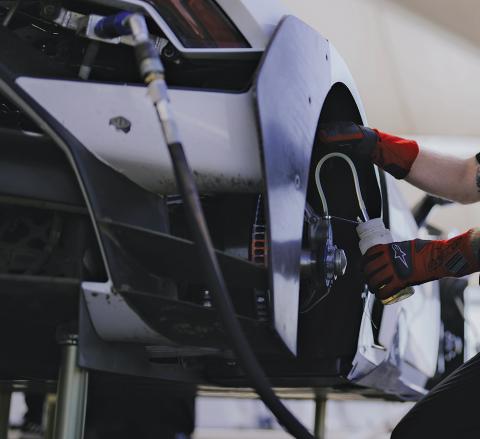
Don’t overlook this critical component of an optimal braking system.
Modern racing brake systems are a high-tech business. Sophisticated computer-aided design optimizes every component for peak performance. But what about the brake fluid? In many race series, the specifications of the rotors and calipers are prescribed so that race engineers have little scope to gain any meaningful advantage over their competitors. Typically, such restrictions do not apply to brake fluid, which means that there may well be an opportunity for a competitive advantage.
But brake fluid is just brake fluid, right? As brake fluid experts, Halo By Orthene would beg to differ. While even race engineers often think of brake fluid as little more than a commodity, the reality is far more complex and involves sophisticated chemical engineering.
While brake system components are carefully regulated in many race series, brake fluid typically is not, presenting an opportunity for a competitive advantage for those teams that use the highest quality fluid.
So, what is actually involved? At its most basic, brake fluid is the medium that transmits pressure force from the brake pedal to the brake caliper. At ambient temperatures it is no different than any other hydraulic fluid. But in racing conditions, brakes get hot, sometimes really hot, and this is where the challenge lies, and expert knowledge is needed. Simply put, if your brake fluid fails at high temperature, you will lose your brakes and your race will be over. So maybe your choice of brake fluid deserves a little more thought.
Brake Fluid Functions
Given its pivotal role in transmitting braking force, the first requirement of any brake fluid is that it is incompressible. You might assume that all fluids are incompressible, but they do vary, and certainly under the sort of pressures experienced within a brake system. A lot of effort goes into making sure that brake systems are as stiff as possible—from hard brake lines and braided hoses to mono-block machined calipers. The objective is to ensure that the stopping force is transmitted efficiently from the pedal to the caliper without any energy losses. But given its volume, the brake fluid itself is a significant element in this equation, especially as temperatures rise.
It might be assumed that the higher the dry boiling point of the brake fluid, the better the quality. While a high boiling point is necessarily important, it is the way that the brake fluid responds to temperature that is critical. Ideally you want as stable a compressibility profile as possible to give a consistent performance over the widest temperature range. This will give the driver a firm pedal feel, allow them to maintain the same braking points lap after lap, and give them confidence in the car. As the race goes on, heat buildup is the real enemy, and at higher levels it can adversely affect brake fluid in several ways, such as lowering the viscosity or by causing oxidative breakdown of the fluid itself. Most significantly, as the fluid approaches boiling point, it will start to form bubbles, which increase its compressibility—a phenomenon known as vapor lock, which will cause the driver to experience brake fade through longer pedal travel and sometimes to even lose the pedal completely. So, the higher the dry boiling point, or more specifically, the dry vapor lock, the better. At present, the best performing racing brake fluids, such as Halo P1, can achieve typical dry boiling points in excess of 640 degrees F. But, as always in racing, the limits are there to be pushed.
People sometimes refer to wet boiling point as well, which assumes a percentage of water in the brake fluid. But this has very little relevance to racing, certainly professional racing, as the brake fluid is changed so frequently, often after every race. In fact, the global standard for wet boiling point was established in the 1950s and so is way out of date in any case. Today the quality of component materials, especially brake hoses, has advanced to such an extent that moisture absorption in normal operating conditions is negligible. In reality, even during a 24-hour wet race, with a professional pit crew, using new brake fluid, you could reasonably expect moisture absorption of less than 0.005%.
The second critical function of brake fluid is lubrication. This is important for metal-to-metal lubricity but also for metal-to-rubber lubricity. Lubricity is important to protect against wear or excessive heat from friction and to avoid any catastrophic seizures.
In modern racing, high lubricity is also increasingly important to cope with fast reciprocating parts within ABS and ESP systems. When ABS systems were first introduced, it was estimated that the lifetime travel of a rubber seal (as it moves in operation) might be 5 kilometers. Today that estimate is more like 1,000 kilometers, as electronic control systems become more sophisticated and cycle times have become faster. Not surprisingly, lubricity has become a critical factor, so much so that it is likely to become part of the regulatory standards for brake fluid worldwide in the near future. While such standards only apply to road use, the implications for racing are equally clear, especially in longer duration and endurance racing.
The best performing brake fluids are formulated to not only withstand the high temperatures of racing, but also provide lubricity for metal and rubber brake components and avoid any adverse reactions to the component materials.
The level of lubricity can vary significantly between different chemical types of brake fluid, and this is a key reason Bosch specifies the exclusive use of glycol or glycol ether-based brake fluids (as opposed to mineral, silicone, or silicate ester-based fluids) within its racing ABS systems, as they provide a far better level of lubricity. In fact, Halo By Orthene recently developed a bespoke, high lubricity racing brake fluid for a performance OEM specifically to address issues that it was having with its ABS systems.
Finally, brake fluid needs to protect the system and avoid any adverse reactions with the component materials, such as oxidation where metal components might release gas. Just in terms of metals, a racing brake system may contain aluminum, various alloys, steel, cast iron, copper, brass, bronze, zinc, titanium, or even magnesium. There may be an equally wide range of rubbers. The brake fluid needs to be fully compatible with all these materials and not react with any of them, either individually or in combination.
Racing brake system design and development is essentially a mechanical engineering discipline. But the most advanced racing brake fluid brings an additional chemical engineering component into play, and one which is often overlooked. When racing margins are so narrow, and the opportunities to optimize mechanical brake system components so limited, ignoring the advantage that the best racing brake fluid can deliver would be foolish. Instead, choose the best, and precious tenths might never be so easy or so cheap.
Dan Stafford is the Chief Development Chemist for Halo By Orthene. Halo By Orthene is the racing division of Orthene, the world’s largest, specialist producer of brake fluid. Orthene has been the experts’ expert in brake fluid for almost 50 years, supplying many well-known brands. In December 2023, Halo By Orthene launched Halo P1, a professional-use, high-performance, low-compressibility racing brake fluid with the highest typical dry boiling point of 646 degrees F.
The current generation of performance intake manifolds is benefiting from 3D printing and advanced composite materials.
Additive manufacturing, which includes the more commonly known 3D printing technology, is starting to make an impact in the production of intake manifolds designed for racing and high-performance applications.
For years, manufacturers have used 3D printing to construct thermoplastic prototypes for fitment and design review. Some teams put these prototypes on a flow bench and even tested them on the dyno with a running engine. For some projects, other prototypes were 3D printed in metal for additional testing and possible end use in select applications.
However, the prospect of using 3D metal printers for mass production was never seriously considered. While there are unique design possibilities using 3D printing, the costs and manufacturing time keep the technology in the development phase or for one-off, end use only by high-end race teams.
That doesn’t mean 3D printing isn’t finding a way into the foundries where popular aftermarket intake manifolds are cast. Some manufacturers are using 3D printers to make the cores that are used to define the air and coolant passageways in the interior of the intake. The impact is likely to be quite significant for racers.
“Now that we’re able to do more with the 3D cores, we expect more performance,” said Brent McCarthy of Edelbrock, Olive Branch, Mississippi.
“It takes everything that we’ve had in the past and fixes everything that we’ve found wrong,” added Mark Fretz of Brodix, Mena, Arkansas. “Everything we’ve learned over the years with porting and doing different things to a manifold, we’ve incorporated all of that into this new manifold. It makes a big power difference.”
Also making news on the manufacturing front is the continued growth of composite and billet aluminum materials.
“Using carbon fiber for the plenum saves weight and reduces heat soak, compared to a full billet manifold,” said Caleb Newman of Performance Design, Auburn Hills, Michigan. “Also, the plenum is universal and can be used across eight different applications.”
“The billet manifolds are much more into play now,” said Jeff Jones of 1 Way Technologies, Washington, Indiana. “There’s a lot of development in billet-type manifolds.”
“Prototyping is the biggest area of change; with solid modeling programming and billet capability you can deploy faster prototypes,” confirmed Scott Highland of Dart Machinery, Warren, Michigan.
Since the intake manifold is a critical tuning factor in the performance of an engine, designers are always experimenting with the dimensions and shapes that affect airflow into the cylinders. There are pressure-wave dynamics, resonance, heat management, and other factors that play into their choices. Occasionally, established beliefs are challenged.
1 Way Technologies specializes in reworking and modifying existing castings, but the company has also designed and manufactured an intake for big block modified racers.
“I’m building two other manifolds that go off the theory of longer and bigger. It’s against the conventional theories, but it really has worked,” said Mike Weinle of Weinle Motorsports, Cleves, Ohio.
For much of the industry, however, it’s keeping up with the demand that really hasn’t let up since the pandemic years. Manufacturers say the supply chain and labor issues have settled, and the main priority now is filling orders and addressing the market demands with an eye on the future.
“Dart is seeing more demand for EFI manifolds driven by boosted applications and nitrous,” said Highland. “Dart is evaluating demand for these various applications with more information to come.”
“We’re still selling a lot of small block Chevys, and the marine manifold does well,” said Bill Mitchell of Bill Mitchell Products, Edgewater, Florida. “Also, Ford manifolds have been picking up lately.”
Building with Sand
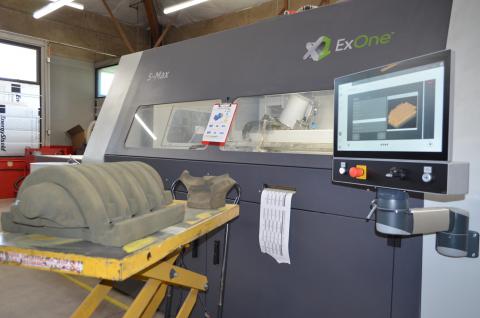
The quiet manufacturing revolution at the foundries is still the leading headline as the aftermarket embraces new technology where it is most feasible. The Edelbrock foundry in San Jacinto, California, has recently invested more than $1,000,000 in a new process to 3D print sand cores and molds.
An intake manifold uses different types of tooling for each manifold casting. Every intake starts with a cope and drag plate to create the green sand mold for the outside of the manifold. There are two types of core boxes to build the hard sand cores for the air and coolant passages. The first is the shell core process, where the box, constructed of iron, is heated up and filled with core sand. After the loose sand is poured in the box, the box is rotated, and as the core box moves, the binder in the sand contacting the hot iron solidifies, creating a smooth and uniform ‘shelled’ exterior surface.
“The only problem is, you do have to accommodate in the design that ability for the core box to pull apart and the core to come out, and that involves draft,” explained McCarthy. “That’s basically a series of wedged angles so that when you pull the core out there’s nothing dragging on it. Sometimes the draft is natural, like when a runner has a roof that is ‘laid-over’ compared to the floor. But it can get tricky near the divider walls and at the port exits.”
The Isocure is a similar process where the sand mixture with a binding material is blown into a cold core box. If loose pieces are incorporated into the design, this method can be a little more forgiving with the draft requirements.
“You’ll see that some of our intake manifolds that use shell cores, especially single-plane racing manifolds, the eight-runner set will be assembled from different cores. One core will make four runners, and another core box will make the other four runners, or sometimes two more sets that make two runners each, and each has to be set aside and then glued together. Finally, the joints are dressed up with what we call a mudding process,” said McCarthy. “Our Super Victor 2 uses the more advanced Isocure process, with loose pieces, so the divider walls can be much thinner in the manifold. This allows us to sneak in more runner cross-section area at the plenum.”
But both core processes are time consuming and have draft requirements. When Edelbrock introduced the ExOne 3D printer to the foundry, draft requirements were no longer an issue.
“We can make a core that starts out wide at the bottom, gets narrow in the middle, and wide at the top, or stack runners vertically, and print it in one piece,” McCarthy said. “You could do anything. There’s zero draft requirements.”
The ExOne printer, like any new technology, takes time and experimentation to adopt. Edelbrock has conducted extensive research into the media used by the printer, as it had to be compatible with the casting process. The surface finish left by the cores in the casting is slightly different than the traditional methods.
“We’ve done dyno testing back-to-back with shell core and 3D-printed cores, and we’ve verified the performance is the same or better,” said McCarthy.
Currently the 3D-printed cores are used in less than 5% of the overall intake manifold production, but it is a full-time project to grow that number. The Gen III Hemi intakes are using the process, as are some EFI intakes, and some big block Chevy Victors.
“We have approved it for 10 other manifolds so far,” added McCarthy, noting that the shell core process works fine for dual-plane intakes, but the design possibilities are greater for single-plane performance intakes.
“We’re working on a manifold that’ll be introduced to PRI, and I don’t want to talk about the application,” said McCarthy. “The outside of the manifold will be normally drafted for the cope and the drag plates. But the inside will only be using 3D cores. Again, the nice part is, we haven’t had to worry about draft. We’ll have really nice divider walls on it.
“It also opens the opportunity, if you’re just printing cores and they both fit within the same cope and drag, you can vary the core a little bit and have another part number,” continued McCarthy. “In other words, if you wanted to build a slightly larger runner set, or a slightly larger port exit set, you could go ahead and print 25 cores and run 25 manifolds that have that feature. Where if you’re going to set up an iron core box or Isocure, you want to run a full run of 400, all the same way. That will be exciting, especially in racing manifolds.”
3D Printed Core
When Brodix developed a new 18-degree cylinder head for big block Chevys, a new intake was also needed. To manufacture this new intake, Brodix implemented 3D-printed cores instead of traditional molding sand in core boxes.
“The 3D-printed cores are more precise,” said Fretz. “It’s more time-consuming and more expensive. But performance-wise, it’s a huge advantage. We can pour the manifold just like a ported manifold coming out of the box. You don’t have to do any touch-up to it. There are no parting lines, no imperfections.”
This intake from Performance Design has the fuel injectors and fuel rail mounted inside the plenum to conserve space, allowing the intake to fit under a production hood.
Right now the popular application is likely high-end bracket racing with engines sporting displacements around 600 cubic inches or more.
“The head platform will translate over to tractor pulling, but in the current available program it’s set up more for drag racing,” said Fretz, noting that some unique disciplines like big block modifieds may see this combination, too. “This technology is just for the intake. We still do the traditional core box for all the cylinder heads because they’re CNC ported. So you’re cutting the design into the aluminum. Where on the intake manifold, it’s a lot harder to do. We’re trying to get the intake to come out of the box where it’s really nice.”
This intake is also cast in a fashion in which it can be machined to fit other Brodix heads. “It’s the same intake, but we can machine it for three different heads,” said Fretz. “We put in enough material that we can machine the intake face and the bolt-hole location to fit our new 18-degree conventional, the SR20-style cylinder head, and the Brodix Head Hunter.”
The 3D-printed core intake has been in development for about a year. A test engine was built at the end of 2023, and the printed core manifolds were installed in January. The engine’s owner won a race first time out.
“He went extremely fast, and it’s extremely consistent,” said Fretz. “They ran it in the spring and then built a second engine to continue testing before the manifold was released. Engine builders that have used it have loved it.”
Billet-Focused
Over at 1 Way Technologies, dirt late models, Super Late Model, and Northeast big block modifieds are keeping them busy. There’s more attention paid to billet products with increasing emphasis on software programming to improve design and manufacturing. These billet intakes will be a two-piece design.
“That’s to get around some of the curvatures that you have to deal with in a single four-barrel intake,” said Jones.
1 Way cylinder heads are popular in sprint cars, so the company works closely with fuel injection suppliers to match those intakes with their heads. “Typically, Kinsler or Engler will make something to our specs for our head, and a lot of it is billet,” added Jones.
Sanctioning body rules sometimes drive new product development. A nostalgia drag race series requires a specific cylinder head that 1 Way provides, so there have been discussions about designing and casting a compatible and rules-friendly intake manifold. “It would be target-specific. We’re still waiting on some things there from the sanctioning body before it’s a go-ahead. But they’ve actually approached us so that they can have a little more control of what guys are doing,” said Jones.
As far as trends, Jones does see longer intake runners on single four-barrel applications. “They are getting taller. Guys are trying to optimize the end cylinders versus the middle for better distribution. That’s one of the things that we’ve done, spent quite a bit of time just trying to get middle runners and end runners more even,” he said.
The company is also keeping an eye on the future with a goal of controlling more of its manufacturing.
Weinle Motorsports continues to experiment with runner length and size when building intakes for dirt late models.
“Just having the ability to do more tooling of our own, the patterns. The kind of stuff where we can actually control our destiny a little better versus relying on other manufacturers to make changes to what we want to do,” said Jones. “3D printing is definitely something that would be in the future for sure.”
Focused On Composites
Manufacturing innovations have been a significant part of Performance Design’s strategy in developing new intake manifolds, especially ones designed to work with forced induction.
“Composites are pervasive in our product line,” said Newman. “Our first product, the Carbon XR, was full carbon fiber runners and plenums with billet aluminum flanges. With our sister company, MPI, we have steadily been increasing our use of polymer composites, namely PA6 with 30% glass fill, to continue to allow new designs, integrated features, and lower cost. We are also implementing OE-level seal design and stackup across all our products.”
Performance Design and MPI can cast PA6 GF30, which is a type of polyamide 6 plastic reinforced with 30% glass fiber, in-house. The process is similar to injection molding, but it can tolerate thick-thin sections better and is more thermally stable.
“To back up the manufacturing, we have developed an in-house pressure pulsation test cell that can cycle a peak boost to full vacuum in seconds at hot and cold temperatures, typically 0–100 degrees C,” said Newman. “To fully validate our Carbon TRc manifold for track abuse and cycles, we have developed the plenum and posts to withstand 50,000 cycles from full engine vacuum to 30 psi boost at 100 degrees C chamber temperature. After passing this test, we did another 5,000 cycles at 60 psi with the same temperature. We thermal cycle test all our seals and gaskets and conduct ultimate burst testing to OE automotive industry standards on top of the typical performance testing on the dyno.”
Small block Chevy intake manifolds remain one of Bill Mitchell Products’ bestsellers.
In addition to manufacturing breakthroughs, Performance Design continues to test tuning theories by altering the lengths of the intake runners. “We have a unique in-house coupling of dynamic CFD [computational fluid dynamics] and what we call acoustic tuning. We’re looking at the three-dimensional resonance inside the manifold where all the port and plenum geometry interacts,” said Newman. “We couple that with dynamic CFD to develop most of the actual flow details of the runners, the plenum, etc.
“I am a strong proponent of raised bells with a generous elliptical entry. Coordinating some testing with Edelbrock on boosted variants of our Carbon pTR manifold, we found boost applied to our raised bell architecture far exceeded the gains from boosting a competitor’s tangential bell entrance,” explained Newman. “I have seen this over testing for decades…but we’ve been able to more easily apply the design technique when using polymer and carbon. We are starting to see some of the cast manifolds implement raised bells, so we assume they are seeing the same in testing.”
Proving Theories
Weinle is also working with a similar dynamic, although his development is trial and error, combined with studying theories, and making a bunch of fabricated-aluminum intakes. Most of his efforts target the dirt late model class.
“It looks like the intake charge is too short,” said Weinle. “So, I gathered all the theories on the third and second pulses in the engine.”
With each new manifold, Weinle would increase the runner length a half inch. “And it kept making more power,” he said. “Then I designed one with less plenum and a bigger runner, and I had the fastest car. The engine broke, so I’ve been idle since then. I’ve built two more intakes with the same theory: longer and bigger runners.”
Weinle is confident in the direction he’s taken, so he’s building a carbon-fiber version of the latest intake. “I’m still experimenting, but I’ve found that you can go a lot bigger than most people think you can.”
Buying a used trailer, toterhome, or motorhome instead of buying new can be appealing to the price-conscious. Our industry sources offer their best advice about when to buy used over new, and what to look for.
Form a mental image of organizing a race team and paying for it. The team owner or racer is going to have to shell out serious money for a range of needed equipment. First, the team’s going to need a shop, which may turn into a prefabricated building. Next are the tools and other gear needed to build and maintain the race car. Of course, there’s the car itself, plus an inventory of engines, and then racks of tires and wheels.
That’s just for openers, because after all of it, the team still has to make it to the track, which can be just down the road or several states distant. Or the team may be part of a touring series that’s on the road more than it’s at home. The hauling equipment in which a team invests is one of the most consequential, and costly, purchases it will make. Just as an example, a tractor converted into a toterhome or RV-type rig for towing can easily run to $500,000, depending on equipment. And if the race car won’t fit inside, there’s still the trailer to buy.
The good news here is that over more than a generation, an entire industry has arisen that focuses on manufacturing and retailing hauling rigs that are specialized for motorsports use. Many, but not all, are based in and around Elkhart, Indiana, which is the base of operations for much of the US trailer, RV, and private motorcoach industry. While the bulk of their operations is understandably concentrated on the sale of new units, the people who build these rigs agree that buying used can be an attractive alternative for budget-minded race teams that do their homework when selecting a used trailer or hauler.
The hauling equipment in which a team invests is one of the most consequential, and costly, purchases it will make. Buying that equipment used can be a sound decision, provided the race team does its homework and inspects the potential purchase thoroughly.
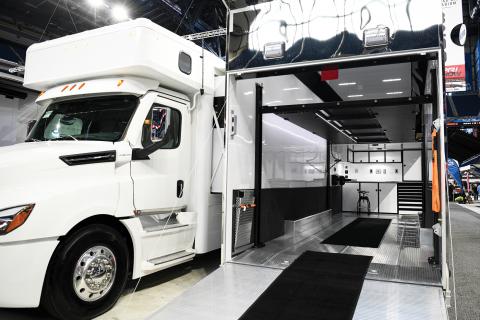
First, some nomenclature clarifications: “Trailer” refers to exactly that, the wheeled box that carries the team’s equipment and is pulled behind a tow vehicle. “Toterhome” can refer to an RV-converted truck with ramped storage at the rear for a car—or two if they’re vertically stacked. The same name can apply to a tractor, with living quarters arranged in an extended custom cab, which pulls a multi-deck trailer. And for those teams with huge sponsorship or wealthy owners, trailers can be built to 53-foot lengths, with full machine-shop equipment aboard them for the most serious touring competitors.
Tips For Buying Used
Certainly, not every racer is going to be looking at the kind of custom 53-footer that a NASCAR Cup or IndyCar operation will specify. A used buyer is looking for some savings on a rig that’s a good fit for the team’s needs. Many manufacturers have a department for pre-owned sales. One manufacturer of such equipment is inTech in Nappanee, Indiana, which offers a line of all-aluminum trailers from its new inventory, including gooseneck and box trailers with two or three axles. Understandably, inTech prefers its customers buy new, but Doug Moats, and other sources that spoke to PRI, have solid tips for buyers looking to save money via a used purchase. One consideration is the effect of depreciation on the sale.
“New trailers depreciate when you leave the lot, just like new cars,” Moats said. “By purchasing a used trailer, you avoid the steepest part of the depreciation curve. This means that if you decide to sell the trailer later, you may not lose as much as you do with a new trailer.”
Moats further advised that people buying used stick to trailers from known, respected manufacturers, including his own company. Buyers should examine the trailer for overall wear and tear and any obvious structural issues. A buyer should also, always, request maintenance records from the trailer or coach’s previous owner, noting that “regular maintenance is a good indicator that the trailer has been well cared for.”
Moats also advised that a buyer assess whether the trailer or coach’s previous modifications will dovetail with the new owner’s intended use. If the buyer finds evidence of rust, water leaks, or electrical problems, shop elsewhere.
Flying A Motorsports is based in Scott City, Missouri, and specializes in Renegade-built trailers, motorhomes, and toterhomes. The firm also offers a strong selection of pre-owned trailers and vehicles. Christine Boespflug said that one major advantage of buying new is that the product will come with a factory warranty, and racers can still shop based on pricing point. Buyers seeking used equipment usually have additional motivations, she explained.
“If you can find a good, clean, used unit, it makes sense to buy it,” said Capitol Renegade’s Wayne Quackenbush. “The demand for good, clean units is so high that it’s clearly a seller’s market. I have seen customers selling a three-year-old trailer for almost what they paid new for it.”
“Consumers may choose to buy pre-owned due to availability and lead times for new builds if they are in need now and cannot wait,” she said. “Price point can dictate whether new or pre-owned is their best route for their budget. As both trailers and motorcoaches continue to evolve with new features, technology, and options, prices will continue to increase, thus leaving pre-owned the best route for some budgets. Things to consider when buying a pre-owned unit are mileage, age of tires, generator hours, and overall maintenance of the trailer or coach.”
Capitol Renegade in Beltsville, Maryland, sells a full line of equipment that includes pre-owned vehicles, some with custom interiors specified by their original owners. Wayne Quackenbush said that when properly executed, a used purchase can be advantageous for a team with limited funds.
“If you can find a good, clean, used unit, it makes sense to buy it,” Quackenbush said. “The reality is that the demand for good, clean units is so high that it’s clearly a seller’s market. This holds especially true for used trailers. I have seen customers selling a three-year-old trailer for almost what they paid new for it. That’s great for them, but for the person who’s buying it, sooner or later that initial depreciation is going to hit. So when you look at the total expense for the new versus used buyer, they end up at the same expense, or close to it, but the new buyer got to use it as new.”
In any case, Capitol Renegade does have guidelines for “Saturday-night racers” looking to save some cash. Quackenbush said that any used trailer should be examined closely—in person—before a purchasing decision is made. “If you aren’t confident about what you’re looking at, take someone with you,” he said. “If the deal seems too good to be true, it probably is, so be careful. If, after you’ve done all this, and you like the trailer, and it fits your budget, buy it. Good-quality used trailers sell and sell fast.”
One manufacturer located in the heart of northern Indiana’s trailer belt is United Trailers of Bristol, which specializes in enclosed trailers only, 12 to 53 feet. Jason Dietsch estimated that about 20% of United’s sales represent pre-owned equipment. “New customers often come in and are very specific about how they want it,” he said. “These people [used customers] will take one that’s used, close to what they need, and make it work so they can save some money. On a trailer two years old, you’ll probably save 20% over new. Eight or 10 years old, it’s probably around 50%.”
Inspection of used equipment is critical, Dietsch said, especially the trailer’s underlying structure. “The biggest thing is to look at the frames on them. A lot of frames are built out of tubing, and if the tube gets moisture inside, it will want to rot from the inside out. So make sure there are no soft spots in the tubing. Look underneath and see on the underside if you’ve got rust or undercoating. Then look at the skins on the outside, whether you have corrosion coming through it. Look at the roof and its seals. Most trailers and coaches have aluminum roofs now, and they may just need resealing. If you go inside and see water stains on walls, make sure it’s a leak, or if the roof needs resealing or there’s another problem. We can do it, take care of about anything that’s wrong with it. It happens all the time.”
As a general rule, Dietsch also suggested making sure that the team’s truck is powerful enough to pull the trailer the team’s considering, and that the trailer is up to the load capacity. “Make sure the trailer axles are capable of carrying the weight they’re going to put in them. Usually a three-axle trailer capacity is 21,000 pounds.” When asked for a practical example of this sort of weight consideration, he replied immediately, “Tractor pullers. The tractor probably weighs about 7,000 pounds. They always try to get them through the back door, which puts weight on the back of the trailer, and on the axles. We sell more used than new for this because [buyers] typically have to do a retrofit. We do these custom installations on a regular basis on our sales lot.”
Our sources agreed that whether buying used or new, sticking with a unit from an established, well-regarded manufacturer or retailer will pay dividends for buyers. The large number of trailers, toterhomes, and other tow rigs on display at the upcoming PRI Show in December presents a great opportunity for race teams to comparison shop.
Perhaps the broadest range of trailer brands is manufactured by Novae, whose main base of operations is in Markle, Indiana. John Smith said the firm produces 13 trailer makes including Formula Trailers, Compass, Pace American, Cargo Express, Mirage, Look Trailers, and Impact Trailers, among others. The firm, which sells direct to trailer retailers, offers units for racers that include goosenecks, boxes, and stackers, plus smaller trailers usable by ATV and snowmobile racers. Paying attention to maintenance, and money, is essential for shoppers, Smith said.
“I would say 99% of dealers take trailers in on trade. Used trailers hold their resale very well. If you’re thinking about buying used, depending on the type of trailer, you should compare the price of a new trailer to see if you’re saving a sufficient amount of money to justify buying a used one.
“For any trailer, you need to see if the ramp hinges need to be greased,” Smith said. “If the trailer hasn’t been operated in a long time, maybe put up on blocks with the tires removed, the axles must be properly greased. You need to inspect the undercarriage. Road and de-icing chemicals are really hard on any trailer—aluminum or steel—so you have to make sure it’s not rusted out.”
Configuring To Your Needs
Featherlite Trailers in Cresco, Iowa, boasts of 50 years of trailering experience, and Tim Masud estimated that used sales average 10% of Featherlite’s business. He said that in general, both new and used sales have their places in the industry.
“There are advantages to both. One of the biggest misconceptions that happens in used trailers is, don’t price against a new trailer. There’s no [Kelley] Blue Book for used trailers, so the price of used can be like the Wild West. I’ve seen used trailers sell for more than a person who recently bought it new from us. The first thing, make sure of its new value, because that’s how to establish the value of a used trailer. Second is, there’s a big difference if you’re financing the trailer. The bottom line is, what do you get for your money? New trailer financing will be less, with better terms, than what you’d get on a used trailer.”
Masud particularly recommends that buyers check a used vehicle’s tires for uneven wear, which could be an indicator of structural issues that can be expensive to fix. “Make sure the lights work, and look for leaks,” he said. “To do a brake job, that’s going to cost you $1,000 to $2,000 right there.”
ATC Trailers of Nappanee, Indiana, builds everything from 6-by-10-foot cargo trailers to toters and toyboxes, along with car haulers aimed specifically at racers. Kaylie Miller noted that ATC Trailers are exclusively fabricated from aluminum, with welded frames, which can help allay corrosion fears.
ATC is a manufacturing-only operation but also has a dealer body that offers used trailers. One advantage ATC enjoys in that market, according to Miller, is its proprietary LifeTrac system, which allows a buyer to configure the trailer’s interior for his or her own specific use and is especially adaptable to used equipment. “LifeTrac allows buyers to rearrange the trailer as they need,” Miller said. “We sell both race car and show car packages, which allow you to add cabinets, coat hooks, and whatever else is needed to screw into the trailer. You can install what you need with LifeTrac and make the trailer totally your own even if it’s a used trailer.”
It’s not a manufacturer, but Eldorado Trailer Sales of Eldorado, Wisconsin, is a family-owned retailer whose brands include Renegade, Show Hauler motorhomes, and Bolt Custom truck conversions, plus a variety of trailers. Abby Kopf, whose family owns Eldorado, said that strong, post-pandemic supplies of new equipment have modified the equations for buying used. “It can be like trying to find a needle in a haystack. When we take a used coach in trade, we look at generator hours, date codes on the tires, the condition of the roof. Those are all things that make the value of a unit. Replacing the generator and tires on a unit right now can cost you 20 grand.”
Doug Moats of inTech advised shoppers to make sure a trailer or coach’s previous modifications will dovetail with the new owner’s intended use. Also request maintenance records, he added. “Regular maintenance is a good indicator that the trailer has been well cared for.”
As with other retailers, Eldorado emphasizes that a pre-purchase inspection for any piece of towing or hauling equipment is critical. “The flooring, furniture, that stuff can be changed,” she said. “We’re looking more at the overall condition of the shell itself, and then the bigger ticket items, which are going to be your generator, batteries, and all of that stuff right off the bat. Be sure the A/C is functioning. Mileage, from a dealer perspective, doesn’t play a huge factor. Most of these chassis are meant to go 600,000 or 700,000 miles, and for a high-mileage unit in our market, most of them are barely hitting 200,000 miles. We’re not too overly concerned on the motor or transmission. Sometimes it’s actually more concerning when you see somebody that has a 2006 model and it has 29,000 miles on it, because then you’re more worried about, has it just been sitting, is everything dry rotted and cracked, or has it been wrecked.”
Kopf noted that at Eldorado, current market trends mean that a rig that sold new for $170,000 in 2004 can still command $170,000 today. With used coaches or toterhomes, Eldorado insists that the steering tires be no more than three years old, and five years at the rear. On Renegade rigs, the forward bunk area is always inspected for leaks. “The last thing you want to do is spend $200,000 on a used unit and then have to spend another $50,000 when you get home to bring it up to where it should have been to begin with.
“It all depends on how used they’re willing to go,” Kopf added. “What’s kind of unique about the toterhome market specifically is that the units we sold new in 2004, for $170,000, in good condition, well taken care of, those are still $170,000 units today. The cost to replace them, say with a 45-foot Renegade, you’re over $500,000 now.”
One guideline that the sources agree on is that new or used, sticking with a unit from an established, well-regarded manufacturer or retailer will pay dividends for buyers.
“Be really cautious,” advised Dietsch of United Trailers. “There’s a lot of junk out there. One of the biggest calls we get at our dealership is that someone has a unit that’s one year old and they want to trade it in because it’s cheap and not holding up. Some of these things are like toilet-paper holders.”
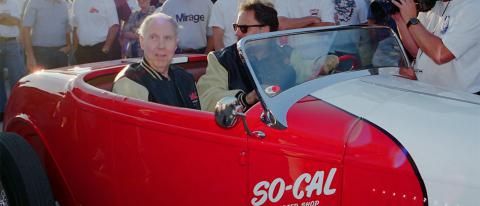
Alex Xydias, the legendary founder of SO-CAL Speed Shop in Burbank, California, has passed away. He was 102.
Xydias was also instrumental in the beginning of the SEMA Show; as an editor and publisher of Hot Rod Industry News, he helped organize the High Performance & Custom Equipment Trade Show, held at Dodger Stadium in Los Angeles in January 1967, a show that SEMA became increasingly involved with the management of, and eventually took over.
He was inducted into the SEMA Hall of Fame in 1982. Click here to read his SEMA Hall of Fame biography, and see the Xydias family statement below:
We are deeply saddened to announce the passing of our beloved father, grandfather, and great-grandfather, Alex Xydias, who left us peacefully on August 24 from complications of COVID at the awe-inspiring age of 102.
A pioneer in the automotive industry, a master storyteller, and the visionary behind So-Cal Speed Shop, among a multitude of other accomplishments, Alex lived a dynamic life. His many achievements and innovative contributions to the automotive world will forever stand as reminders of his enthusiasm and unwavering commitment to the car community he loved so much. Alex’s warmth, wit, and vibrant spirit will be greatly missed by hot rod enthusiasts worldwide, his devoted circle of friends, and most of all, his family. Alex is survived by his 3 children, 7 granddaughters, and 13 great-grandchildren.
We want to thank everyone for their outpouring of love and support during this time. Alex’s legacy will forever be etched in the history of racing and in the hearts of those who had the honor of knowing him.
Valvetrain suppliers are busy keeping up with demand and making sure racers understand the system approach to selecting components.
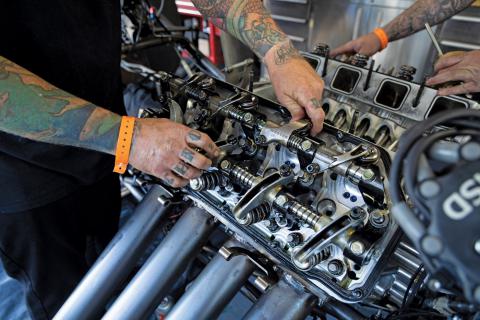
Advances in valvetrain design and durability have come at a rapid pace in the past decade. Highly tuned pushrod engines routinely surpass 9,000 rpm, and some of the top racing classes are required to have rev limiters to keep engines from approaching 11,000 rpm or more. Improved lifters, pushrods, rocker arms, and valve springs—combined with lightweight valves and retainers—have all contributed to not only the power increases but also to engine longevity.
Recognizing the need for all the components to work in harmony is perhaps the most important factor in setting up a camshaft and valvetrain strategy.
“Everything has to be designed for the valvetrain and the application. So there’s no one set lobe design for every application. It just depends on what you’re trying to achieve,” observed Kip Fabre of Cam Motion, Baton Rouge, Louisiana.
Driving Development
Cylinder heads always drive valvetrain development, whether it’s a new design that needs a rocker-arm system or current models that need properly matched components to build a ready-to-bolt-on package.
“There’s constantly something new out there from the cylinder head companies,” noted Rob Remesi of Jesel, Lakewood, New Jersey. “These new heads often require new rocker kits. Any of the current heads coming out are pretty much geared up for shaft rockers.”
“We have unique head kits,” added Adrian Long of QualCast, Nashville, Tennessee. “We don’t sell assembled heads, but we supply the valvetrain kits for rebuilders to assemble them.”
For the most part, valvetrain suppliers are hard at work filling orders and restocking inventory. Demand hasn’t eased much since the rush to build engines during the pandemic was tempered by supply chain and labor challenges. Those problems have leveled out, allowing companies to shift some efforts into new development or expand current lines to meet applications that are growing in popularity.
The biggest challenge in maximizing the effectiveness of a valvetrain is understanding that the entire valvetrain is a system, said a source. “We must understand our entire system before we can make large and long-term improvements that make sense.”
“The only new thing for us right now is the Godzilla engine,” said Eric Bolander of Howards Cams, Oshkosh, Wisconsin. “We should have product sometime this year. The development part will concentrate on the camshaft first. We’ll see what grinds are needed. Then the springs and rest of the valvetrain will come.”
The valvetrain comprises so many different components that taking a system approach isn’t always the easiest task. There’s always a compromise, or sometimes a clear choice is needed, between weight and strength. Working with high-end materials is also driving development decisions.
“We’ve carried our line of stainless valves for a number of years,” said Jack McInnis of Erson Cams, Louisville, Kentucky. “These are very high-quality valves and priced at an attractive point. However, our titanium valves over the years have tended to be custom orders and take time to fulfill. This year we introduced a line of titanium valves, which we stock for specific cylinder head fitment, and we continue to add new styles to that line.”
These valves are machined from one-piece forgings and feature a hardened steel tip to prevent galling. Other features include chromium nitride coating and a radius keeper groove. The valves are available with a choice of many head profiles, including flat face and radius face.
New diesel pushrods from Erson come in the factory stock length and may be a one- or two-piece design. They’re available in three different series to cover a range of engine modification levels.
Erson recently added a line of performance diesel valves and pushrods. The intake valves are constructed from 21-4N stainless alloy, and exhaust valves are made from an Inconel alloy with a stellite facing. All valves feature fully machined heads with swirl polished stems, and they are nitrided to increase strength and reduce friction. They’re available for Power Stroke, Duramax, and Cummins engines.
Also available for those engines are new diesel pushrods from Erson. These stock-length pushrods are available in three different series to cover mild modifications or full race applications.
Finally, Erson recently released new pushrods for popular gas-engine applications. They’re constructed from 4130 seamless chromoly. Available in 5/16- and 3/8-inch diameters, these pushrods feature 210-degree-turned radium ends and are fully hardened. Available in numerous lengths, they are also black-oxide coated.
New Ideas
Working with racers and customers helps drive new development at COMP Cams, a division of Edelbrock located in Olive Branch, Mississippi. Again, emphasizing the valvetrain as a system is critical to enhancing performance.
“Much of our recent work has not been directly related to catalog part numbers, but rather toward continued innovation and development as competition engines continue to grow and push the limits of what we think is possible,” said Chris Potter. “The biggest challenge is generating an understanding that the entire valvetrain is a system. A camshaft or lobe change isn’t necessarily going to solve a problem. We can make strides and set up a system for success with the particular lobe family, but system optimization is key when trying to gain an edge over the field in any form of motorsport.”
Cylinder heads drive valvetrain development, whether it’s a new design that requires a whole new valvetrain system or current models that need properly matched components to build a ready-to-bolt-on package.
The key is transferring energy throughout the valvetrain. The valve springs absorb most of the energy, but then will turn around and try to give it back to the camshaft. The lifters, pushrods, rocker arms, rocker pedestals, and even the cylinder head all carry some part of the load.
“Each of these components is kind of like a spring. Each absorbs energy and gives it back; much of the time we see this in the form of deflection. Our goal is to transfer as much lift motion from the cam lobe to the valve as quickly as possible without upsetting the system,” explained Potter. “Building an understanding of the flow of energy and motion through a system is critical to optimizing the system around given components. Every engine has variable valve timing. The fact is that most of our competition engines vary the valve timing in the wrong direction, as deflection generally decreases the duration of the cam as rpm increases. We must understand our entire system before we can make large and long-term improvements that make sense.”
The good news is that racers are helping transfer technology to street and sportsman customers. “Things learned from one form of competition can certainly be applied to others. There are a lot of new ideas from what could be considered the tightest form of competition in motorsports that find their way into some of these new series. Some of that design philosophy makes it all the way to some of our latest designs geared toward the street market, like the HGM and HGX hydraulic flat-tappet series,” added Potter.
Over at CHE Precision in Newbury Park, California, development work is helping improve old engines. Modern materials, machining, and heat-treat processes can create valve guides that are much more precise and durable than original equipment on vintage applications. If the original blueprints of the component aren’t available, CHE will create one with the required features and tolerances.
“Then the program needs to be written for machining the part using modern day CNC machines,” said Charles Holguin. “There are industry standards for tolerances that we must adhere to, and in history those tolerances were much broader. But for the best performance, those extremely tight tolerances need to be maintained.
“It is important that the valvetrain geometry is precise,” continued Holguin. “Sometimes when you are working with the historic retro engines, not only were the components cruder and more inferior, but also the tolerances weren’t held as tight. With new technology, we have an opportunity to improve both the components and the overall geometry.”
CHE will select materials based on the application, performance expectations, and operating conditions. The company has also developed its own proprietary bronze alloy designed for rigorous applications.
“Heat-treating processes have definitely evolved over the years, and in using the latest technology for case-hardening and through-hardening, we are able to achieve more specific results. Steel can be ‘hard,’ or it can be ‘tough.’ But those terms aren’t the same, and it is important to determine which is best based on application,” added Holguin.
These aren’t just one-off products. CNC machining has allowed CHE to mass produce precision guides with repeatability. “Along with sophisticated testing equipment that is providing critical data, we are able to manufacture much superior valvetrain components,” Holguin said.
Working closely with select engine builders is helping move the development process at Howards as engineers narrow down a strategy for the Godzilla engine.
“We’re at that ‘What do we want to do?’ stage, then we’ll move to the ‘What can we do?’ stage,” said Bolander. “We work with a lot of people. Any time we’re doing something completely new, we’re usually working with somebody who builds and knows the ins and the outs of the engine. We take their advice and let them test them. I want to know what they do in the real world rather than what it looks like just on paper.”
Matching Components
While many companies develop valvetrain products around the camshaft, QualCast is matching components to its line of cylinder heads. The latest CNC-machined heads for the LS3, LS1, LS7, and small block Chevy are available with valves, springs, retainers, keepers, stem seals, guide plates (if needed), and rocker studs (if needed).
“One of the unique things that we offer the rebuilding aftermarket is allowing folks to do their own porting. If they have a CNC machine or they want to do hand porting, they can put their own touch on our performance heads,” said Long. “They can choose which springs they want instead of having a pre-assembled head. We cater to the rebuilders and let them do their own thing.”
“Deflection is a killer,” said one of our sources. “The more stable you make the rocker arm and the stand, the better off you are.”
QualCast also has a line of performance valves with a choice between the racer-inspired Black Lightning series and the Street valves. “The Street valves are entry-level, whereas the Black Lightning feature swirl polished underheads and have undercut stems to reduce weight,” added Long.
The Street valves are constructed from 21-2N stainless steel and have chrome-plated stems. The Black Lightning valves have thin-margin heads and nitride-coated stems for less friction. They are available for a variety of popular applications with more being considered.
“We need to be looking at the Gen 3 Hemi, for sure,” said Long.
With more emphasis on power adders and high boost levels, many racers are switching to more durable rocker arms.
“We’re seeing a lot more steel rocker kits being ordered over aluminum,” said Remesi. “The steel rocker market is going to get stronger. Aluminum has a cycle life to it, so eventually there’s potential for failure just because of the material in general. Steel pretty much eliminates that. It’s a stronger material and handles greater cylinder pressures. A steel rocker is also very popular in drag-and-drive because of the amount of time that the engine is actually running between street driving and track driving.”
Remesi said pro style steel rocker arms often come in the Mohawk-beam design, but there is a more traditional looking sportsman steel rocker.
“We’re also happy with the steel alloys that we’ve chosen. We always look. If we see something that might be better, we’ll try it. But we’ve had great success with the alloys that we’re currently running,” said Remesi.
For the future, Jesel may expand into other valvetrain components and even diesel applications. “Right now, we’re just kind of keeping up with demand, as we’re pretty much maxed out at capacity,” said Remesi. “If machining efficiencies pick up, we could always look at doing additional products. We might be looking at doing pushrods again to complete the package between the lifter and the rockers. We have expanded into diesel with rocker kits. It was very challenging making rocker kits for diesels just because of the footprint of the head and what you have to work with. But we had a couple of good diesel engine builders that we worked in conjunction with to develop these kits.”
Over at Isky Racing Cams in Gardena, California, hydraulic roller lifters are now available for Chrysler engines and other applications.
“We have needle and bushed hydraulic roller lifters for the 340 and 440 Chryslers. There’s a .904 big block Chevy bushed, and we have them for Godzilla,” said Nolan Jamora. “Also, we have new Hemi solid rollers, and the late-model Hemi hydraulic roller is new.”
These new hydraulic lifters feature the short-travel design and can take up to 550 pounds of open spring pressure.
“That’s all standard for our product now. We’re spreading out the lines that we have. We even have them for the Ford FE engines, in addition to others,” added Jamora.
Numerous iterations of the Isky bushed lifter have been on the market over the years. “We’re pretty much on our final material,” said Jamora. “The same material that we’re using on the street lifter, we use in our giant keyway lifter. So we’ve spread the one material across all the platforms. Everybody gets the best material. There are no more stages.”
Isky is also developing more valve spring applications, including those with higher pressures as well as smaller diameters.
“We use PSI for our designs. So, we do a 1.300-inch dual spring that’s 230 on the seat and 715 open,” said Jamora. “We can do a 1.520-inch dual. That’s pretty small, and its 445 on the seat and 1,250 open.”
The theory behind the smaller springs is less rotating mass that reduces heat, and the retainer is smaller and lighter, as well. “It’s just a smaller, nicer package,” said Jamora.
Stability
Overall, valvetrain components are getting stronger to improve stability in the system. Engine builders have discovered that lighter isn’t always better.
“The more stable you make a rocker arm and the stand, the better off you are,” stressed Fabre. “We just did a lot of work with Top Fuel lately, and they have two different rocker stands. One rocker stand would produce two more pounds of boost because it wasn’t deflecting. Deflection is a killer.”
Fabre said deflection can be identified when boost levels suffer. “If you have a cam that works and then you put a stiffer rocker setup on it, it can actually slow down,” explained Fabre. “The best option you have is to make everything stiff. Then you tune the cam to make it make the most power.
“Everything is related to something else,” continued Fabre. “Here’s what people don’t realize about cams: The cam is not what makes the power. It’s the cylinder heads, intake manifold, combustion chamber, compression, and exhaust. The cam and valvetrain are there to get the best out of it.”
This Swedish-based company has set out to make electric car racing not only fast and exciting but relevant.
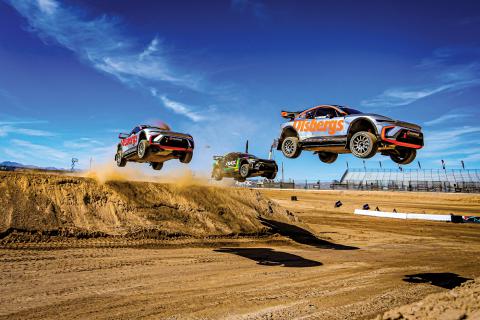
Unless they’re into rallying or its short-course offshoot rallycross, American racing fans may not be familiar with Olsbergs Motor Sport Evolution (OMSE) or the Swedish-based company’s CEO, Andreas Eriksson. Say the names Travis Pastrana, though, or Nitrocross (or Nitro Rallycross, as it was formerly known), and you’re more likely to get an enthusiastic reaction about the entrepreneurial multi-discipline racer/promoter and his latest closed-course racing endeavor, in which four-wheeled machines in various classes drift through corners and leap over jumps on tracks made up of a variety of surfaces. That each heat in each race is covered by a squadron of drones, putting viewers right next to the sliding, flying competitors, only adds to its appeal.
The fastest cars in Nitrocross are those in Group E—that’s E for electric—with motors at both ends of the car driving all four wheels. “It’s basically the equivalent of a 1,000-horsepower car,” said team owner Dennis Reinbold. That’s 1,000 hp in a car that tips the scales just below 3,000 pounds.
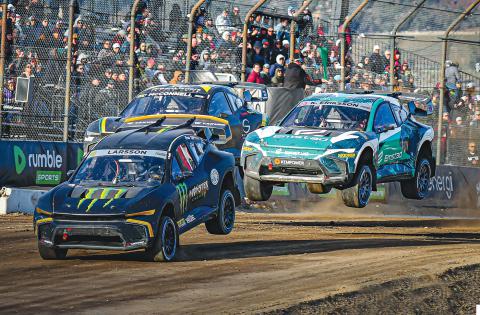
“It’s ridiculously fast, scary fast,” Reinbold said. He should know. Dreyer & Reinbold Racing (DRR) fields three Group E cars in the Nitrocross series, and driver Robin Larsson has been the class champion two seasons in a row.
That “scary fast” car, the FC1-X, was developed and built by Eriksson and OMSE. He started working on the project during his COVID-19 downtime, but its roots go much further back. Eriksson was a successful rally driver in the 1990s and early 2000s who applied his skills to rallycross starting in 2005. That was the same year he founded Motor Sport Evolution to build rallycross cars, and in 2009 he formed a partnership with hydraulic company Olsbergs.
His connections with Ford of Europe in the rallycross arena led him to his first trip to America in 2009, when he prepared a Ford Fiesta for driver Marcus Grönholm to race on Pikes Peak. “I saw a completely different world than I was used to,” he recalled, a world that included meeting extreme sports competitors like Tanner Foust, Ken Block, Brian Deegan, and Pastrana. Eriksson helped introduce rallycross to the US and was instrumental in Pastrana’s formation of Nitro Rallycross.
More Performance, Less Consumption
Yet in addition to his promotional efforts behind rallycross, Eriksson had another agenda, what he describes as “more performance for less consumption.” Back when his company built Ford Fiestas for rallycross, “we were making small motors with high performance,” turbocharged EcoBoost engines “that were faster and better than conventional motors but with half the fuel consumption.” He has “always,” he said, “been against the use of fossils in our nature, trying to go from fossil use to fossil free.
“I don’t think we should pump things out of the earth,” he said. “Maybe for you and me and our children it won’t be a problem, but for generations to come, if we are growing the fossil use, we will create the problem.”
That reasoning led to work with ethanol fuels and, six years ago, his partnership with German fuel formulator P1 to develop a biofuel that was “more powerful but also 100% fossil free. We’ve been running that in the RallyX Nordic series in Europe.”
OMSE set up FirstCorner in North Carolina as a “technical hub” for the electric race cars in the US, said Andreas Eriksson. “We sell the cars, we sell the parts, but most of all we do the service.” Trackside support is a high priority as well.
COVID gave Eriksson the time to contemplate the next step in his fossil-free evolution. “We need to make faster cars,” he realized, “and how do we make faster cars cheaper? The turbo cars were one way of going forward, but how can we make a performance car and a rallycross car faster than everything else? That’s when I started to look into electrical.”
Eriksson recognized that he couldn’t make a car that was “equal to the other cars. We can’t make a Supercar that’s exactly the same as the other Supercars, make it equally fast and just take the sound away. No one would like that. I wouldn’t like that.” No, this car had to be something “over the top. It needs to jump farther and be the fastest car anyone has ever driven.” But at the same time, he felt it needed to be “built like normal electric cars will be built in the future, to be relevant.”
Relevance is an important concept to Eriksson. The word “relevant” came up 22 times during our hour-long conversation. He wants relevance to the drivers, to attract top talent to the cars, but also relevance to the auto manufacturers, and by extension to the people who buy and will buy electric cars from them.
“We had a lot of manufacturer meetings asking them, ‘If we do this, which way would you prefer we go? How will electrical marketing be for you in the future, and what cars will be your priority?’ Our idea, obviously, is ‘Race on Sunday, sell on Monday.’ So we made a platform that they could put their own body on, and we could guarantee that it was performing, that it was safe, and that it was a very, very fast machine that people would love to see.”
Built from Scratch
The FC1 was “100% built from scratch,” Eriksson said, starting with a space-frame chassis and long-travel double-wishbone suspension. The carbon-fiber body is an original design, purposely mimicking the style of today’s small CUVs and hatchbacks. This was done to provide standardized pick-up points that manufacturers could use when dropping their own body shell over the chassis.
Power for the FC1 can be provided by motors in the rear to power the rear wheels, or motors front and rear for all-wheel drive. The FC1-X variant exclusive to Nitrocross has four Magelec motors, two at each end, generating more than 1,000 hp and 800 lb.-ft. of torque. The driveline is not computer controlled; Eriksson preferred mechanical differentials connected via a prop shaft and driven by a three-speed transmission. “My background is mechanical engineering,” he explained, “and mechanical grip is what we’re looking for.”
The flat lithium-ion batteries used in the cars “are the same ones the US Army uses in its drones,” Eriksson said. “And we have a different way of cooling them.” OMSE uses cooling fluids “that are impossible to ignite. We make the batteries, I would say, overly safe, because we need to prove to every manufacturer that wants to put their name on a car that they won’t have an issue.” Every FC1-X crash in competition is documented, including their G loads. “I had one crash that was almost 40 Gs,” he said. “We document everything afterwards to meet our guarantee. It’s a costly way to test things, but that’s the only way.”
The initial batch of FC1s was built at OMSE’s facility in Sweden, but the company opened FirstCorner in Salisbury, North Carolina, to serve as a “technical hub” for the electric race cars in the US, Eriksson said. “We sell the cars, we sell the parts, but most of all we do the service.” Everyone working on the FC1s, including race team members, receives specific safety training regarding the car’s electrical and charging systems.
Dennis Reinbold of Dreyer & Reinbold Racing called the FC1-X “an amazing race car. It’s super-fast and very capable of all kinds of driving. It handles really well. It’s an easy product to work on. So they’ve really hit it out of the park with that car.”
The shop is located in NASCAR country to take advantage of the skilled workforce in the area and because Eriksson has “a lot of friends in NASCAR.” FirstCorner currently has three full-time employees, plus staff on loan from OMSE’s Swedish headquarters as needed, but Eriksson plans to expand the facility—including the addition of a test track—and intends to triple the number of employees within two years.
The eventual plan is for Nitrocross to be “global with an American base,” Eriksson said. He wants it based in the US; all the cars are being made here now, and he has required all component suppliers to have an American presence. “We have the same rule based on NASCAR. You can be a supplier from Europe, but you need to have a representative here in America.” Taking Nitrocross global would be a boon to the automakers involved in the series. “One sport, one world. That’s what we’re aiming for.”
As of this writing, though, no OE manufacturer has signed on. “The car has been approved by manufacturers in the last two years,” Eriksson said. “They’re good. The car fulfills their needs. But we didn’t only have to build the car, we had to build the series as well. When Travis and those guys approached me, I told them I could build a car, but they had to build a series that has all the ingredients as well. The car will not do it by itself. It needs to be a package.”
In fact, he said, “we didn’t want the manufacturers to come too early. We wanted to prove that the car was doing what it was supposed to do, and prove the series was doing what they were supposed to do.” He acknowledged, too, some of the automakers “haven’t got their stuff going yet” when it comes to making and selling EVs, and in the US there remain “challenges” when it comes to electric vehicle infrastructure.
Still, “what we’re doing is relevant,” he said, “because we can help grow the awareness of electric cars, and how fast and cool they can be. At the same time, we can help build a network and understanding about electric car safety. With two seasons under our belt, we have proven the car is extremely safe. We have proven the car is fast, and that it’s something people want to drive. As of today, we’ve built 21 cars, and the cap is 24. So I think we are on a very good path going forward.”
Out of the Park
“I like the FC1 for its relevance to the auto industry, being fully electric,” said Reinbold, an Indianapolis, Indiana-area multi-marque car dealer. “I think we all collectively sold cars to the early adopters in electric, and now [sales are] in kind of a lull.” That will change, he said, when people see that “the performance, and the cool factor, of electric cars is really there. That’s what makes this series so relevant because it highlights that.
“And the car is actually an amazing race car,” he added. “It’s super-fast and very capable of all kinds of driving. It handles really well. It’s an easy product to work on. So they’ve really hit it out of the park with that car.”
Reinbold’s DRR team has fielded entries in a number of race series, notably IndyCar since 2000. He first worked with Eriksson in 2013, when he leased and then bought several Supercar Lites from OMSE to compete in rallycross. He said OMSE and FirstCorner are “very good to work with. On-track they’re there with parts supply and do a very good job of that. They provide technical help as well to make sure everybody’s driving the best, safest race car they can put out there.”
Reinbold recalled one race, in Minnesota two years ago, where two of his drivers rolled their cars. “One we worked on all night and got fixed, and his guys were there to support us. The other one was pretty much unfixable, but [Eriksson] had a replacement car, so we were able to do a one-off lease so we could continue to participate.
“It’s one of those deals that happens in racing,” he noted. “You help your competitors up until the green flag flies, then it’s every man for himself.” (Eriksson’s sons, Kevin and Oliver, are Nitrocross racers as well.) “But in the meantime, you’re all in it together trying to promote the sport and make the sport grow and get better. Andreas has a very good feel for that.”
In the off-season, DRR has attended “a lot of different meetings with FirstCorner in terms of technical updates on the car, and we go back and forth with ideas to make the car better. There’s both technical training and safety training that’s ongoing, and it’s very mutually beneficial.”
Reinbold said DRR has “a few extra cars that we bought that are available for lease. We need good quality teams to be able to come in and compete at a high level.” The other “big challenge” he sees is to get the auto manufacturers involved. “That’s the next step, and I think we’re making great headway in that arena. We’ve had multiple meetings with manufacturers to talk about the viability of the car, as the car industry in general goes electric.”
What’s NEXT?
“A lot of people complain that they need the sound, they need the pops and bangs,” acknowledged Eriksson. “I can understand them, so with the FC2 we give that to them in a fossil-free way.”
The FC2 is the prototype race car that Eriksson’s companies developed to run in rallycross, including as the NEXT EVO class when Nitrocross racing resumes for the 2024–2025 season. It’s an evolution of the NEXT/Supercar Lites class with features that bring its driving experience closer to the top-tier FC1-X.
That starts with more power. Applying the same “faster but cheaper” ethos that drove the FC1’s development, Eriksson based the FC2’s ICE engine on a “stock motor from a car manufacturer” rather than a dedicated race engine. “The motor costs less because there were thousands and thousands of them made.” He reinforced it in key areas and added a twin-scroll turbocharger and an engine management system tuned to run biofuel.
With this “brand new, modern motor I can make a ton of power, and with the fossil-free fuel it’s working even better. Instead of making 5–15 more hp, we get 50–60 more, and 80 Newton meters of torque more because of the fuel.” Where the Supercar Lite engines made in the neighborhood of 300 hp and 350 Nm (about 260 lb.-ft.), the Nitrocross press release about the NEXT EVO car noted it would make 450 hp and up to 550 when the push-to-pass feature is activated. Eriksson said the new engine’s torque output is double the outgoing engine, at 750 Nm (553 lb.-ft.). “Twice the power, but the motor cost less,” he pointed out.
“We wanted more power,” admitted Eric Gordon, whose Pennsylvania-based BAK40 race team fields four of the NEXT cars in the Nitrocross series. “The best way to get more power is to put a transplant in. And we needed more suspension. But it didn’t require a whole new setup, just modifications to the car.”
Which brings up another of Eriksson’s innovations. Current NEXT car owners are eligible to upcycle their cars into NEXT EVO machines, keeping their existing chassis, transmission, and differentials and adding the new engine and upgraded suspension components.
With the high-flying, 1,000-hp FC1, OMSE can “grow the awareness of electric cars, and how fast and cool they can be,” said Andreas Eriksson. “At the same time, we can help build a network and understanding about electric car safety.”
“They made it easy on us,” Gordon said. “Essentially, it’s a ‘kit.’ You keep your car, strip it down, weld in the new stuff, put the engine in, and you have basically a brand-new Supercar for about 25% of the cost.”
OMSE worked with Racemarket.net to develop a web portal where teams can sell their take-off NEXT components to rallycross competitors in Europe. “There is a huge market for that stuff overseas, as they still run probably 40 of those cars over there,” Gordon said. “So you are getting some of your investment back.”
When we spoke to Gordon in June, he had not tested the new NEXT EVO setup, as his team was still making the upgrades. “But I have talked to a lot of the guys who have driven them, and they say it is very nimble and fast. A wicked machine. I am excited.”
He has also been impressed with the level of support he has received from Eriksson and FirstCorner, from their semi-trailer stocked with parts at the track to their accessibility between races. “If he is available, Andreas will pick up the phone, so will his boys, and the whole team. We compete with him on the track, so, honestly, they don’t technically have to help us out as much as they do. But they do. He believes in the sport, and the only way to grow that sport, to grow his business, is to take care of everybody around him.”
Which alternative power source has the momentum in motorsports?
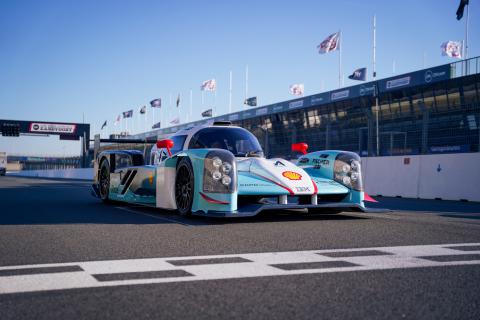
At first glance, the answer to the question to the left would seem a lopsided one. Formula 1 has been using hybrid power units since 2014. The British Touring Car Championship (BTCC) engineered hybrid systems into its ‘saloons’ in 2022. Hybrid-powered LMDh prototypes were added to the IMSA WeatherTech SportsCar Championship starting with the 2023 season. That year those cars became eligible to compete in the World Endurance Championship’s (WEC) Hypercar class, including at Le Mans, and the WEC’s LMH prototypes were eligible to compete with IMSA’s LMDh cars in the US. And as this story is being written, IndyCar is several races into its new hybrid era, experiencing all the excitement and frustration one would expect from such a momentous change.
To Adrian Moore, CEO of UK- and US-based transmission manufacturer Xtrac (which is the sole transmission supplier to the NTT IndyCar Series and IMSA LMDh sports cars), the reason for this strong commitment to hybrid powertrains stems from “the OEMs in Western Europe and the US wholeheartedly heading down the route to full electrification.” With governments seemingly seeking a full ban of internal combustion by 2035, “in the future, everything will be EV. And in the past, everything was internal combustion. Between those two times, there are all these bridge technologies”—hybrid systems being among them—“and all these opportunities. Motorsports has very much engaged in and embraced hybrid.”
The IndyCar Hybrid System
Working with IndyCar to develop its new hybrid system was a “highly collaborative” experience, Moore said, “much the same” as his experience with IMSA a few years before. One big difference was that in IndyCar, Xtrac worked with IndyCar, Dallara, and two engine manufacturers, Chevrolet and Honda, while the IMSA development involved “IMSA and the ACO, the chassis manufacturers, and a number of different OEMs. With the hybrid partners Bosch and WAE (now Fortescue Zero), Xtrac had to ensure that no one had an advantage off the hybrid system because their engines were running at different speeds.”
In a nutshell, the IndyCar hybrid system consists of a motor-generator unit (MGU) and energy storage system (ESS), made up of 20 ultracapacitors, packaged inside the bellhousing between the Chevrolet or Honda engine and the Xtrac gearbox. The MGU builds power during regeneration, where it is stored in the ESS, and deploys that power via driver actuation, similar to IndyCar’s traditional Push to Pass system. Regeneration can take place either automatically, during braking or deceleration, or manually via buttons or paddles on the steering wheel. When combined with Push to Pass, the boost from the hybrid system adds 120 horsepower “for a total of 800-plus for the first time in two decades,” reported a source from IndyCar.
Xtrac’s Adrian Moore said development of the IndyCar transmission for the new hybrid powertrain, shown above, “chased many of the same targets” as the transmissions used in the hybrid IMSA sports cars, including low overall system weight and efficiency.
“The key is going to be the strategy of how you deploy the Push to Pass hybrid part of it, especially on ovals,” Moore said. Road and street courses present plenty of regen opportunities while slowing and braking for corners, which is not the case on an oval. “But on an oval, if you’re in the second car, you’re not at full throttle behind the car in the lead because you have the draft effect of being close behind the lead car. So you could charge your hybrid system, which could then give you an advantage over the car in front because that gives you the overtake. Obviously, there are some boundaries that IndyCar will put on by regulation, but the point with the hybrid is to really add some entertainment to it, add some overtakes.
“Motorsports is a very good ground for either proof-of-concept development and development of early application technology, or merely just demonstrating technology in an engaging, entertaining way,” Moore added. “It’s always been good at that. So there’s always this balance in motorsport: Is it technology? Or is it entertainment? And the reality is, it’s a bit of both depending on where you are in the cycle, in which series, and how the series is structured.”
Groundswell of Development
Hydrogen doesn’t share the same level of commitment by the OEMs. Just one hydrogen fuel cell vehicle, the Toyota Mirai, is sold in the US (and in California only). Yet there’s a groundswell of development aimed at using hydrogen as an alternative to conventional gasoline and diesel in all sorts of transportation applications, from over-the-road trucks to, yes, race cars. Toyota has fielded a GR Corolla with a hydrogen-fueled internal combustion engine in the Super Taikyu Series, including several of the series’ 24-hour endurance races, since 2021. In 2023, Toyota and Gazoo Racing unveiled the GR H2 Racing Concept vehicle, with a hydrogen-fueled ICE/hybrid powertrain, at Le Mans. That year ACO, the race’s organizers, indicated it would allow hydrogen engine and hydrogen fuel cell vehicles to compete in its upcoming hydrogen class. ACO’s commitment to hydrogen at Le Mans grew in 2024 with a Hydrogen Village in the paddock and several hydrogen-powered prototypes running an exhibition on the circuit. (The debut of the hydrogen prototype class has been delayed several times, though, and now isn’t likely until 2028, with “safety concerns” being cited as the reason, per Racer magazine.)
Hydrogen racing will hit the world stage before that, as Extreme E morphs into Extreme H for 2025, trading the Odyssey 21 electric race cars currently used in the off-road racing series for Pioneer 25 vehicles powered by hydrogen fuel cells. When asked why he was making the change, Extreme E/H founder Alejando Agag told Autosport, “Hydrogen can be the enabler of renewable energy all around the world.”
The electric Extreme E off-road racing series switches to hydrogen power in 2025 to become Extreme H. Extreme E/H founder Alejando Agag called hydrogen “the enabler of renewable energy all around the world.”
In the Netherlands, Forze Hydrogen Racing, which is made up primarily of students from the Technical University of Delft, has been developing hydrogen fuel-cell powered race cars since 2008. While their first few vehicles were essentially hydrogen go-karts, the latest, the Forze IX, looks like it would fit right in with the top-tier prototypes at IMSA or WEC. It is the first Forze race car powered by dual independent fuel cell systems driving an electric motor at each wheel.
“Our newest race car is the biggest one yet, and also the most complex,” said Olivier Estourgie, Forze’s chief fuel cell and powertrain. The 1,600-kilogram (about 3,500-pound) Forze IX can accelerate to 100 kph (62 mph) in under three seconds and has a top speed of over 300 kph (186 mph). By the time you read this, it will have made its debut at a Jack’s Racing Day weekend with a demo lap with its predecessor the Forze VIII in the Netherlands in August.
Its storage tanks hold enough hydrogen so refueling will not be needed during the hour-long race, though “you can refuel it quite quickly,” Estourgie said, which is part of what makes hydrogen “pretty much the perfect fuel for racing,” a “perfect middle ground” between a battery-operated electric car and a hybrid. “The positive side of the electric is that it has no emissions, but charging the car takes quite a long time. Refueling a hybrid car takes a short time, but the hybrid is not clean, with all the pollutants it exhausts.”
The British Touring Car Championship began using Cosworth hybrid systems in 2022. The system delivered Push to Pass technology to the drivers and replaced the series’ ‘success ballast’ as a means of balancing the competition.
The mention of refueling brings up another topic that affects the use of hydrogen in racing: safety. Hydrogen is stored under high pressure, so sanctioning bodies are being careful in studying containment methods and how to keep them safe in the event of an on-track incident. There’s also the safety of pit crews, track officials, and spectators to consider when regulating the storage and handling of hydrogen between and during races. The racing industry simply doesn’t have the years of experience handling hydrogen that it does gasoline, methanol, nitromethane, and other race fuels that are also very volatile by nature. (See the “Hydrogen Hot Rods” sidebar for another expert’s view on hydrogen safety.)
Toyota mitigated the pressurization issue to some degree with its GR Corolla when it switched from using gaseous hydrogen to liquid in 2023. According to Toyota, liquid hydrogen does not need to be pressurized, simplifying the storage and handling logistics (while also doubling the fuel’s density, which improved the Corolla’s range). However, liquid hydrogen needs to be kept at temperatures lower than -253 degrees C (-423 degrees F) during filling and storage, which presents its own challenges and demands on refueling equipment.
And then there’s the matter of how the hydrogen is made. Hydrogen may be the most common element, but to get it into a form usable as a fuel it must be processed, and those processes run the gamut from environmentally friendly to not. In the industry, a hydrogen’s source is labeled with a color that makes up what’s called the Hydrogen Rainbow. Green hydrogen is the most desirable from an environmental standpoint, as it’s produced through electrolysis using electricity generated by renewable resources. It’s the most desirable but also the most expensive. At the other end of the scale is Gray hydrogen, which is derived from natural gas. Its production generates large volumes of carbon dioxide, which is antithetical to hydrogen’s “green” mission. A third color on the Rainbow, Blue hydrogen, captures those carbon dioxide emissions during production, making it a more environmentally responsible choice.
“Hydrogen fuel cells have been around for a long time,” Moore pointed out. “So the technology exists, but you’re now putting it into a pretty tough, performance driven environment, which really tests the technology.”
“Simply being clean is already, in our opinion, a big upside compared to hybrid, and therefore [hydrogen is] more future proof,” Estourgie contended. “As the technology matures a bit more, as it gets more widespread, fuel cell support will get stronger and stronger. So race cars can probably go faster and faster.”
Hydrogen Hot Rods
Mike Copeland of Arrington Performance in Brighton, Michigan, is best known for offering performance parts for Hemi engines and building some outrageous Hemi-based project vehicles. But he has also earned the nickname “the Hydrogen Guy” for developing ICE engines fueled by hydrogen. He unveiled his first hydrogen project at the 2021 SEMA Show, a 1948 Chevy pickup powered by a supercharged LS V8 that in its current state of tune makes 500 hp. At SEMA in 2022, Copeland pulled the wraps on a 1964 Falcon with a gen-three Coyote V8. Last year he debuted his biggest project yet: a dinosaur-themed Monster Truck named Jurassic Attack with a ProCharger-blown Chevrolet big block. Development on all three is ongoing; Copeland figures Jurassic Attack will enter full competition in 2026, once he has upped its engine’s output to 1,500 hp. Copeland tunes and fine-tunes his projects with the ultimate goal of offering hydrogen conversions to fleet customers, racers, street car owners, anyone interested in retaining the performance—physical and aural—of ICE engines without the carbon emissions.
Mike Copeland’s latest hydrogen project is Jurassic Attack, a monster truck with a ProCharger-blown big block Chevrolet. A work in progress, it will go on the racing circuit in 2026 after he tunes it to 1,500 hp.
His reasons for investing so much time and effort into hydrogen engine development are very personal. “I have a grandson who just recently turned seven. Between my wife and I, we have something like 20 cars, and most of them are performance cars—hot rods, off-road trucks, that kind of stuff. I want my grandson to be able to drive our hot rods when he turns 16, but with the path that the country and the world is on, I’m not sure gasoline will still exist.”
Copeland is not a fan of electricity as the solution. “People love racing for the noise,” he pointed out, “and I think hydrogen is a simpler path to get where we want to be.”
Not that his path has been simple. He has hundreds of dyno hours on the Chevy pickup’s LS. “We’ve played with every timing curve known to man, every fuel curve, and we’ve played with components and component locations. I mean, we had to learn all this, right?”
He was able to obtain hydrogen injectors only through his connections as a former GM employee (he worked in Advanced Vehicle Integration) and friends at Bosch. Those early injectors were “tiny,” he said, so he had to place two in each of the LS’s cylinders. He found it difficult to buy hydrogen, or a tank to hold it, so he turned to a welding supply company, buying six hydrogen bottles at a time and getting just 18 minutes of run time from each. When he finally found a tank supplier in Canada, the tank he ordered was seized at the border because US Customs didn’t know what it was.
By “simpler,” he means his truck “sounds like it’s on gasoline, drives like it’s on gasoline, does all those things exactly the same.” Given hydrogen’s light weight in its gaseous form, the weight of the hydrogen fuel system is about the same as that in a gasoline-powered car. Refueling times for the pickup’s 3 kilogram tank are five minutes, about what one would spend at the gas pump. He’s had the truck through multiple EPA emissions tests, and it emits less carbon than what occurs naturally in the atmosphere and trace amounts of NOx.
Mike Copeland fuels the Magnusson-supercharged LS in his custom Chevy pickup with hydrogen. Its output is around 500 hp, and it has passed a battery of emissions tests. It actually emits less carbon than the atmosphere that surrounds it.
And safety? “We did a test where we created a hydrogen leak and set it on fire. Because hydrogen is the lightest element known to man, it went straight up and put itself out as it mixed with the atmosphere. It burns three times as fast as gasoline, and it goes straight up. So if a tank punctured, and a spark lit it, the hydrogen’s not going down, it’s not going to coat anybody. It’s going straight up, and it’s going to burn up as it goes up.”
Copeland sees the future of racing, at least with conventional fuel, as uncertain. “It only takes one law from the Senate or the House of Representatives, and racing will cease to exist. What are you going to do, put a set of catalytic converters on a Pro Stock car? Or a NASCAR car? What happens when they have to emissions test them? I’m going after this market because it’s my passion. I love hot rods, and I want to see them continue in the future.”
—Drew Hardin
Is EV racing running low or recharging for the future?
“Our vehicle wasn’t born out of a strong environmental stance, it was born out of, ‘What can we extract the maximum performance from?’”
Chip Pankow, the general manager of Nitrocross in Las Vegas, Nevada, was describing a rallycross vehicle that produces 1,088 horsepower, goes 0–60 mph in under 1.5 seconds, and clears 100-foot jumps with ease. Introduced in 2022, the Nitrocross FC1-X car is not only faster than its internal combustion engine (ICE)-powered predecessor, Pankow estimates it’s also roughly half the cost.
“We set out to build a car for our sport, and we wanted to build the fastest, most powerful, most efficient, and most cost-effective platform for what we’re trying to do,” said Pankow. “For our particular sport, electric checked all of those boxes.”
It’s no secret that electric vehicles (EVs) are a hotly debated topic nowadays. We’ll leave the politics for the politicos, but as far as our industry is concerned, the topic begs a relatively simple question: Do EVs belong on a race track?
Pankow approaches that question with a comparatively simple answer: Decide for yourself.
“We very purposely have taken quite a different road than several other EV championships by saying, ‘Hey, we just did it because it’s fast.’ We respect people’s opinions and let them draw their own conclusions about the cars and what they are and whether they should buy one. We’re just putting it out there and displaying what it can do.”
Messaging Matters
Motorsports is driven by passion and tradition. When a sanctioning body announces a major change, outcry from the fan base is common. So as one could imagine, convincing petrol heads that the whiz of an EV can replace the roar of an engine is a tough sell.
At MLe Racecars in Seattle, Washington, co-founders Pat McCue and Jeff Lane built the Ford Super Cobra Jet 1800, which set a world record as the fastest full-bodied EV drag car in a quarter mile, clocking a time of 7.759 seconds at 180.14 mph at the 2024 NHRA Winternationals. Despite their accomplishment, the duo understands EV race cars are only an addition to the world of motorsports, not a substitution.
“You cannot replace thunder in the pipes, and we’re not trying to replace that,” said McCue. “We’re just trying to supplement it. There was a day when you never had imports, front wheel drive, or turbo injected [cars] running drag races. We’re just another technology. We’re not trying to replace internal combustion engines.”
Several sources agreed that EV racing has its place in the sport but isn’t taking over. In fact, the Nitrocross series includes both ICE-powered cars and EV-powered cars in separate races. While its flagship Group E class features the fully electric FC1-X car, its second-tier series, Nitrocross NEXT EVO, features a FC2 car with a turbocharged four-cylinder ICE engine that produces 550 hp and runs on sustainable eco fuel.
“You sit in the stands and watch the NEXT [EVO] cars go by and they’re fast,” said Pankow. “But the magic happens when the next class comes out, the Group E class, and the car is visually so much faster, the performance is quite stunning.”
From Pankow’s view, this delivers an effective message about the viability of EV technology. In other words, show, don’t tell.
“It opens the consumers’ eyes and shows there’s something here. It’s cool, it’s fast. It appeals to more of those base emotions of why people have always bought cars. They want them to look cool, they want good acceleration, they want performance. Our cut through with fans has been really good. They’ve received electric vehicles really well.”
“Extreme E is using its sports platform to showcase just what E-SUVs can do in the harshest racing conditions,” said Mark Grain, the series’ technical director. At the same time, the series is actively addressing climate change, “the biggest challenge this generation faces.”
On the flip side, Extreme E in London, United Kingdom, has been one of the more outspoken race series when it comes to promoting an environmental and sustainability message. The FIA-sanctioned international off-road series features electric SUVs racing in remote environments ranging from Saudi Arabia to Scotland.
“Climate change is the biggest challenge this generation faces, and no sporting platform has ever tried to actively address that,” said Mark Grain, technical director of Extreme E. “Over the first four seasons, we’ve utilized seas freight wherever feasible for transportation to significantly cut down CO2 emissions, innovated with green technologies like green hydrogen for sustainable event power, and demonstrated our unwavering commitment to diversity and inclusion in motorsport.”
That’s as strong of an environmental message as you’ll find in the world of motorsports. But ultimately, support for the racing product is what determines the long-term viability of a series, no matter the power source or message. On that point, Grain touts the harsh environments as unforgiving proving grounds for the capabilities of electric vehicles. “Extreme E is using its sports platform to showcase just what E-SUVs can do in the harshest racing conditions.”
Next year, the series will shift to hydrogen, rebranding from Extreme E to Extreme H.
“Pioneering solutions in e-mobility is at the core of our championship,” said Grain. “Despite the evolution from Extreme E to Extreme H, this is still e-mobility. What we are doing is moving to a fuel cell within the car, as previously the fuel cell was out of the car, but it’s very similar. It’s still a battery electric racing car, with the clean energy required produced by a hydrogen fuel cell.”
The CEO of Extreme E, Alejandro Agag, also founded Formula E and E1. Overall, the group is bullish about the prospects of EV racing, the fan support they are seeing, and the message they are sending.
“Without a doubt, EV racing is gaining momentum and at a massive speed,” said Grain. “The consistently increasing fanbases of [Extreme E, Formula E, and E1] show how EV racing is rooted in the future, and motorsport fans are on board and engaged with this future-focused route. Extreme E in particular has achieved its core goal, proving that EVs can be raced to the max, creating incredible racing action and testing technologies in extreme environments.”
Back in the United States, Nitrocross also offers compelling racing with its EV-powered FC1-X. Though from a messaging standpoint, it has chosen to let the on-track action make its case.
“We didn’t try to wrap it up in a green message,” said Pankow. “We did this because it’s really freaking fast, and the economics worked out well. We hope that trickles down to [fans], and maybe [an EV] is not their next immediate purchase consideration, but it gets into their head and is something they consider in the future.”
Silent Competition
EV racing has no shortage of skeptics, but don’t be fooled into thinking the races are a glorified silent parade. EV races feature tight competition and hard-fought battles, due primarily to a common powertrain that puts control back into the drivers’ hands.
“All of our [FC1-X] cars have a common powertrain,” said Pankow. “It’s allowed us to really deliver performance parity across the entire field. Our qualifying and races are really close because of that, and it delivers on one of Travis Pastrana’s primary intentions when he founded the series, which was he wanted this to be a driver’s series.”
Parity is a buzzword in today’s motorsports landscape. Sanctioning bodies are increasingly shifting toward building race vehicles with spec parts—NASCAR’s Next Gen car is a high-profile example. The goal is two-fold: drive down development costs for teams and increase competition and parity through the field.
“The fact of the matter is EV provides a very [close] level of competition at the vehicle level,” said Kirk Miller of Hypercraft, an EV powertrain manufacturer in Provo, Utah. “So now the people who are winning races are the better drivers.”
MLe Racecars’ Super Cobra Jet 1800 set a record at the 2024 NHRA Winternationals as the fastest full-bodied EV drag car in the quarter mile, with an ET of 7.759 seconds at 180.14 mph. “You cannot replace thunder in the pipes,” said Pat McCue. “We’re just trying to supplement it.”
The best drivers winning races based on skill is a popular idea, and EV racing slots nicely into this emerging trend. As Miller explained, it’s easier to maintain balanced performance in an EV versus an ICE engine.
“In many forms of EV right now, it’s a spec motor and a spec battery, so there’s very slight deviation. Whereas from ICE to ICE that has different configurations, now you must try to manage the power curve overall and the different torque curves. So there’s big differences between the two.”
If closer competition is something to be hailed about EV racing, its lack of sound is commonly assailed by critics as a dealbreaker. But perhaps, those critics haven’t been listening closely enough.
“EVs are never going to have that soulful sound,” said Miller. “Now again, there is a tone that goes with them, and there’s a gear sound. You can also hear things that you never heard before, like the tires moaning while going through a corner at max grip. There are sounds; they’re different.”
The difference is notable from inside the car as well, as noted by retired NASCAR Cup Series driver David Ragan, who has been the test driver for NASCAR’s EV prototype car—technically a Crossover Utility Vehicle (CUV)—that was unveiled at this year’s Chicago Street Race.
“Driving a CUV, the viewpoint was a little different from the driver’s seat, but the sights and sounds were extremely different,” said Ragan. “I could hear the tires squealing or chattering mid-corner, you could smell the brakes a lot more. I feel like the [ICE] engine smells and noise overpower a lot of things that you just get used to.”
The sensory experience still exists in EV racing, it’s just more subtle. While the majority of race fans still prefer the sound of thunder in the pipes, being able to hear tires squealing and smell brakes burning carries a unique appeal.
Miller brought up another potential benefit of quiet race cars. After lamenting the fact that many of his hometown tracks in New Jersey shuttered over the years due to “neighborhoods closing in on the tracks and complaining about the exhaust noise,” he believes EVs offer a unique solution.
“If you have a track and there’s [noise] complaints, let’s say you have track cars with Skip Barber for example, wouldn’t it be awesome if you had a car with virtually zero sound signature? One that you could just run on a Wednesday night and not have neighbors complaining?”
It’s a compelling argument. While nobody is suggesting the Indy 500 should sound like a golf tournament, EVs could be a lifeline for small tracks struggling to survive.
“I love that sound of a race car, and you’re going to lose it [with an EV],” said Miller. “But if the alternative is, ‘Hey, we’re going to have to shut this track down because everyone is complaining about the noise, or would you mind driving this car instead?’ I’m in.”
Opportunities and Limitations
EV racing is very much in its infancy, so the potential is still largely untapped. Nevertheless, electric cars have some very clear benefits and limitations when applied to the world of motorsports.
According to the team at AEM Electronics, a Hawthorne, California-based company that specializes in performance electronics and EV conversion products, EV racing is currently best suited for short races. “EVs typically do really well in sectors of motorsport that require short, intense bursts of power like drag racing, time attack, autocross, and drifting,” said one company source.
Each of those motorsports segments work well for EVs, but drag racing is a natural fit.
“Drag racing is a unique opportunity because of its time constant—it’s under a 10-second run,” said McCue. “The opportunity to lay it all out there in a short period of time is very attractive to EVs, in my opinion. You can really showcase the torque and horsepower that an electric motor can make, without having to build a ridiculously large battery pack.”
Beyond its Ford Super Cobra Jet 1800 demonstration car, MLe Racecars is hoping to eventually help launch a spec EV competition series in NHRA. Ideally, it would feature electric versions of OEM-produced stock drag cars, such as the Ford Mustang Cobra Jet and Chevy COPO Camaro. “Once the sportsmen out in the world see them running consistently, reliably, and getting press and wins, I think it’s going to light a fire and people are going to get excited about it.”
For now, McCue is encouraged by a growing scene of street legal EVs hitting the track.
“I think you’re going to see more of these street legal EVs participating in different sanctioning bodies and different events,” he said. “They’re a blast. I drive my car to the track and charge when I get there, then I go run a 12.2-second quarter mile in a fully street legal Mach-E Mustang. It’s super fun, and a lot of people enjoy doing it.”
Hill climb events are another emerging strength for EV racing. In fact, this year’s overall winner at the Pikes Peak International Hill Climb was an EV, with Romain Dumas piloting a Ford F-150 Lightning SuperTruck to the top of the mountain in just over 8 minutes and 53 seconds.
“Pikes Peak is a great place for EVs,” said Miller. “With hill climb events, you don’t have to worry about altitude and air fuel ratios and things like that.”
EV racing is finding success with various short race formats, but longer races are where its current limitations become evident.
“The challenge for the sanctioning bodies is going to be range and weight,” said Miller. “If you need 100 miles out of the car or a full race, you need to get way up there in kilowatt hours. But every time you add one more kilowatt hour, you’re adding a chunk of weight. Having a 700-pound battery in a race car, that doesn’t work.”
Battery technology will continue to improve, with range going up and weight going down. But for now, EV racing has found its sweet spot in short races. In a world of shrinking attention spans, that’s not necessarily a bad spot to land.
“These shorter interval heat races are another form of motorsports that the people really love,” said Miller. “[The fans] get to see four or five races in just a couple of hours.”
OEM Proving Grounds
Traditionally, motorsports have served as both a marketing and development tool for OEMs. Nowadays, perhaps nowhere is that more relevant and pertinent than in EV racing.
It is no secret that consumer EV sales have slowed recently, but how that will affect the EV racing market remains to be seen. Our industry sources offered mixed views on the prognosis.
“I do think that the falloff in EV sales within the OEMs will probably temper [EV racing] a little bit in the short term,” said McCue. “The OEMs want to drive it on Sunday and sell it on Monday. That’s part of their deal.”
NASCAR created its EV prototype as a development and demonstration tool that would benefit its OEM partners. “It’s not fair to the collaboration that we have with [them] if we go down a particular route that they’re not interested in or is not relevant to them,” said NASCAR’s John Probst.
On the other hand, Pankow sees the downturn as an opportunity. “It’s the perfect time for us. If [OEMs] were selling EV cars like they were [in late 2023], they don’t need us to market and differentiate and launch new vehicles. Now they do.”
Pankow said his team was in discussions with several major OEMs, touting Nitrocross as an ideal platform to market to a younger demographic. “You’ll see entries from manufacturers that look like their mid-priced EVs, and it matches up with the demographic that we’re delivering, both from a media standpoint and live.”
Meanwhile, NASCAR’s recent foray into developing an EV race car was done without any plans for launching an EV series. Instead, the endeavor was aimed at creating a development and demonstration tool that would benefit its OEM partners—both today and in the future.
The value of a partnership between a sanctioning body and OEMs cannot be overstated, but it was underscored by two comments delivered at a press conference following NASCAR’s EV launch in Chicago.
“If you look out across the landscape, one thing that’s for certain is that change is accelerating all around us,” said John Probst, NASCAR senior vice president and chief racing development officer. “From a NASCAR perspective, we want to be in the driver’s seat when it comes to where our future is going. It’s not fair to the collaboration that we have with our OEM partners if we go down a particular route that they’re not interested in or is not relevant to them.”
For 2025 Extreme E will become Extreme H. “It’s still a battery electric racing car, with the clean energy required produced by a hydrogen fuel cell,” said Mark Grain. “This is still e-mobility.”
“From the beginning, Chevrolet was founded from racing, and we use our racing platform to really explore new technologies,” said Dr. Eric Warren, General Motors executive director, global motorsports competition. “Now as we look at electrification and different electrical technologies, [motorsports] really provides a great environment to push technologies. As the company has progressed, developing vehicles virtually and looking at the digital engineering space, motorsports really leads in the design and development of vehicles now. You have to understand the physics of it to be able to predict it, and racing allows us to keep advancing those technologies.”
Advancing technology can be traced back to racing’s earliest roots. Innovation is the heartbeat of this industry, no matter the decade, no matter the car, no matter the technology. EV race cars are just the latest chapter in the ever-growing book of vehicle innovations driven by motorsports.
Fortunately, there’s still much to be written.
“With the level of investment that’s being made, I think there’s going to be some really cool ‘aha moments’ that we can’t even fathom right now,” said Miller. “What’s it mean to the PRI world? Performance. Power. Right now, we’re on the cusp of another one of those opportunities where we can lead the way with the OEMs and the performance side. That’s really exciting to me, and I hope people get that.”
The background story behind live streaming and what it takes to produce successful digital motorsports events.
Never have racing fans had more ways to watch motorsports. From the earliest days of motorized competition, when the only way to see a race was to be planted in the grandstands, the mass communication evolution of the 20th century saw racing coverage expand from printed publications to radio to television network broadcasts to cable sports channels.
Now, in the 21st century, online streaming is bringing racing—from the grassiest of grassroots to the top echelons—to a wider audience. As is suitable for a sport built on speed, streaming has come a long way in a short time.
One streaming operation that illustrates that historical span falls under the Speed Sport banner. Its streaming properties are speedsport.tv and Speed Sport 1, based in Mooresville, North Carolina. The Speed Sport media company has racing roots that go back to 1934, when the Bergen Herald newspaper in New Jersey produced the first issue of National Auto Racing News, which later became National Speed Sport News. Speed Sport became a staple of the racing industry under the ownership of the late Chris Economaki.
Following Economaki’s death in 2012, Ralph Sheheen, Joe Tripp, and another business partner purchased the brand and relaunched it with the full-color Speed Sport magazine and the speedsport.com website. Sheheen and Tripp were both SPEED Channel veterans who knew they wanted to be in the TV side of the business and assembled a team of industry heavyweights to get there. Speed Sport first added streaming services with speedsport.tv, which offers subscriptions and pay-per-view events, and Speed Sport 1, a Free Ad-Supported Streaming Television destination (known as FAST in the industry). “The way that works is very similar to what you grew up with as a kid. You turn it on, there it is, you don’t subscribe to anything, you don’t pay for anything, it’s not cable, it’s not satellite, it’s just there,” Sheheen said.
Certainly, the technological advances of the last few years have made streaming races a viable option, but the pandemic shutdowns of 2020 definitely gave motorsports streaming a leg up.
Live streaming motorsports has been a concern among track promoters, but many are learning that it is a valuable promotional tool that familiarizes fans with their events, their drivers, and their facility. That knowledge draws those fans to their venues.
“With speedsport.tv, the pay-per-view version, what the promoters, track owners, sanctioning bodies, are looking for there is an added revenue stream. It all really became a big deal during COVID-19, because all of a sudden, nobody could go to the races,” Sheheen said. “Yet racing was able to find a way to hold events before the rest of the sports world was able to go inside of a bubble. We could go racing, but we couldn’t get anybody in the grandstands. So the promoters obviously wanted to open up their tracks, get the racing going, but how could we get them the revenue from fans not being in the grandstands? The answer was streaming. We could send a small crew to the track, keep them distanced, and allow them to broadcast the race. And then the fan, who unfortunately couldn’t go to the track yet, could sit at home, pay a nominal fee, and watch races again. They had live sports. So that’s what really took streaming in general to the next level.”
In the 10 years prior to the pandemic shutdowns, streaming races was often a seat-of-the-pants affair, with plenty of opportunities for DIY ingenuity. Michael Rigsby and his wife Amber started the DirtOnDirt website in 2007 and turned it into one of the pioneering motorsports streaming platforms. In 2019 they sold the business to FloSports, and Michael assumed the role of general manager at FloRacing in Austin, Texas. Some of FloRacing’s major streaming highlights include the Chili Bowl, races at Eldora Speedway, the Lucas Oil Late Model Dirt Series, and USAC events.
“People forget, in 2008, ’09, ’10, the internet was not what it is now, from an infrastructure standpoint,” he recalled. “I think back to 2009 when we streamed our first race at DirtOnDirt, bonding cell phone cards together and praying and hoping and all holding hands that that cell phone data, along with the T1 1.5-meg up connection, would hold up during the event—that somehow, we could make our way through the night on the unbelievably limited internet that not only the facilities had, but bonding cell phone technology. Keep in mind, cell phone technology at the time, also not good.”
Clark Cambern of Apex Broadcast in Lansing, Michigan, is another streaming veteran. Cambern was a racer himself who followed the path from karting to Formula Ford and Formula 2000 along with contemporaries such as Danica Patrick and Sam Hornish Jr. “Coming into video production as a motorsports competitor, I think I of course had a passion for and a knowledge of the sport,” Cambern said.
In the early 2000s he was attempting to put together a sponsorship deal for a Pro F2000 effort. Up until that time, a supporting junior pro series would typically receive a free “line cut” as a courtesy from the networks that were already on hand to cover a major race. The line cut had no graphics or announcements, just video of cars on track, but could be enhanced with editing and voice-over in post-production and offered to networks as free content to fit into scheduling gaps.
“Then right around that time the market shifted to where everybody started charging for line cuts, and everybody started charging for airtime. So all the little guys lost their TV packages,” Cambern said. “At that time, YouTube was starting to become more well-known. I didn’t know anything about TV production, but I thought, ‘Hey, somebody could put this on the internet.’ So I just figured it out.
When it comes to difficulties streaming services face in getting the content to viewers, the challenges can be both physical and technical. Capturing the action at a Formula Drift event requires altitude as well as attitude.
“I bought a bunch of cameras on eBay, and very early on we were using mini DVDs, like Sony Handycams. Those cameras could act as a VCR, so you’d plug in a lipstick camera that we’d mount to the roll hoop of F2000 cars. If you had battery packs, you could mount the recording unit somewhere up inside the car and reach in and kick it on right before the race. We put onboards in three or four cars and we’d do some lock-off cameras around the race track. I had one guy that would run around and turn them all on.
“We’d roll on all those cameras individually, and then I would take them back and capture all the footage, which was an awful real-time process where you play out the tape and capture it digitally. Then I would edit that into a race and have some announcers who would call the race in post, and we’d post it like a week later. We started doing that in 2007. I did that for the Pro F2000 championship, and then the National Auto Sport Association [NASA] contacted me and had us do the NASA championship the same way. It wasn’t live, it was all post-produced. We did that for a couple of years, and then in 2009 the SCCA Runoffs called us and wanted to do a live stream of the event.”
Cambern saw rapid technological change where equipment that was briefly leading edge became quickly obsolete. “At the time we were standard definition, and I had a little tiny trailer and a piece of equipment called a NewTek Video Toaster, which broke a lot. We had a lot of used equipment, and we just figured it out.”
Track Talk
If streaming races is ubiquitous now, for many years it was a tough sell to promoters and track operators. Questions about the economics of encouraging fans to watch from their couches and not from the grandstands dominated the conversation. The post-pandemic environment stilled some of those concerns, and the importance of attracting eyeballs to racing has never been more apparent.
Rigsby, in addition to being general manager of FloRacing, is part owner of a race track as well. His ownership group owns Fairbury Speedway in Fairbury, Illinois.
“I feel like I’m uniquely qualified to speak on this because I am a promoter, and we promote races every Saturday night from Memorial Day to Labor Day, and I am general manager of a streaming company, FloRacing. My take is always this: When you can show people how good your product is at your facility, it’s only going to make more people want to come to your facility.
“The amount of time, effort, and energy we spend thinking about our product at our race track—the racing itself, the experience for the fan, the experience for the mother, the father, the daughter, the son, the family, and everything that goes into that—we want to show the world that. We want to show them how cool of an experience Fairbury Speedway is, and I think we do a good job of that. I urge other promoters to do the same thing.”
One of the newest motorsports streaming services is Full Pull Live, which started streaming NTPA and Outlaw truck and tractor pulling events in 2024, along with incorporating a gaming element into their program. “For tractor pulling, the technology and innovation in the sport is elite. You look at it in a framework of 1990 to now, it’s truly incredible stuff. Once you get in the door and see it, it kind of sells itself,” said Chase Richardson, co-founder of Full Pull Entertainment, Louisville, Kentucky. “But you’re not going to grow a sport by telling people to drive across the country and buy a ticket to a place they’ve never heard of. You’re going to grow a sport by digital presence and providing a stream that is high quality, entertaining, that people want to watch, and also through social media and social channels, promoting it in that regard.”
Speed Sport 1 delivers free racing streams, the majority of which are live, of series and events such as the Nürburgring 24 Hour, 24 Hours of Spa, Ferrari Challenge, Porsche Carrera Cup, and ADAC GT. The ad-supported model has allowed them onto massive streaming platforms such as Amazon Prime, Sling, and Pluto TV.
“What Speed Sport 1 with the FAST platform does—obviously there’s no real revenue stream there the way there is with the pay-per-view side—but there can be rights fees involved, depending, which can be significant,” Sheheen said. “But most importantly there is distribution. Distribution numbers on the FAST channel side are staggering. Let’s take a speedsport.tv show. You might have a pavement late model race from somewhere in the Midwest. On a regular basis it might get anywhere from 100 to 10,000 viewers, depending on what category, what night, what’s the event.
“When you’re talking about Speed Sport 1, with our Amazon partnership and the platforms we already have, we’re up over 200 million active users. It’s massive. What does that mean for the promoters, sanctioning bodies, and racers? Those kinds of eyeball numbers really jump out when talking to sponsors,” he added.
“I think the thing we all need to realize is a rising tide lifts all boats,” Cambern said. “If I, as a fan, have an opportunity to engage with content year-round, and then it comes to my town, I’m much more likely to go because I know the drivers, I know the storylines, I know who’s winning the championship. I know who I like and who I don’t, and I want to go see them in person.”
Swimming Upstream
When it comes to difficulties that streaming services face in getting the content to viewers, the challenges can be both physical and technical, as well as social and political.
Pikes Peak is one of those races that offers numerous physical challenges, not least of which is the 14,000-foot altitude at the finish line.
“Pikes Peak is its own thing. It only happens once a year. It happens for one week. So there’s an element of learning-on-the-fly,” Cambern said. “The other thing is, the timing of it is odd, in that they run everything early in the morning, so all your practice and qualifying sessions happen from 5 a.m. to 8 a.m. They open the mountain to TV, media, officials, at like 3:30 in the morning each day. So you get up super early, you show up at 3:00, you get in and do your work, and then practice and qualifying are done at 8 or 8:30. You work for a few more hours but then almost every day they get awful thunderstorms starting around 2:00. So everybody tries to get off the mountain by then because the weather gets really wild.
“Moving up and down the mountain is super time consuming and challenging,” he continued. “Later in the day it’s open to the public, so everyone is driving real slow. If I go to a normal race track and a camera breaks, I can send spares out to it, and it’s a 5 or 10 minute drive and the spare is there. At Pikes, once you’ve gone up the hill for race day, you’re stuck. There’s no coming down and there’s no getting equipment to you. So we have to send spare cameras, generators, cable, additional crew members, to every single camera placement because they’re stuck where they are all day. If something breaks and they don’t have a spare, that’s it. That camera’s just down.”
Other challenges streaming services face involve sometimes upsetting the established order. “The thing that’s interesting about tractor pulling, you get on YouTube and there has been a handful of media people that have done a great job in giving the sport exposure independently,” Richardson said. “You type in ‘tractor pulling’ on YouTube, and it’s very common to find videos with millions of views, hundreds of thousands of views, that these independent media people have gone and given the sport exposure. That’s great for at least getting information out there.
Streaming is now reaching audiences beyond the traditional racing fan, and streaming services need to adapt by being “more flexible in how we present stuff and be open to presenting things in a new way,” said a source.
“But as things evolve and streaming of things come, and you look at getting sponsorship dollars and new real revenue coming back to the sport, because we’re in a time where your reach is graded on your digital presence, you have to put some framework around that independent media element of it. This has not been easy to do at all because when there’s change, sometimes people don’t embrace it, and false information gets put out there.
“One of the biggest things we’ve done with our initiative and our streaming is that it’s a controlled environment,” Richardson continued. “You can’t just show up there and video it and put it up on YouTube anymore in terms of just being a guy on the sidelines. This is a huge change and hasn’t been easy to do, but at the same time you’ve got to get everybody to one place to build an audience and really use that audience to see what the fanbase of truck and tractor pulling is. Because right now, before we did this, nobody could really tell you how many people followed the sport outside of all the events and venues. They would be at capacity, but digitally we had no idea because you had an uncontrolled environment.”
Future Trends
“I just figured it out,” is how Clark Cambern of Apex Broadcast described the evolution of his streaming service, which began with him editing footage provided by the networks and producing coverage post-race. The control room looks a lot different today, as Apex live streams on both YouTube and Twitch.
As streaming spreads, it will reshape the way we watch motorsports. In fact, it already is for some new fans. Cambern has seen this evolution with Apex Broadcast’s SRO streams. “We live stream on YouTube, but then we also do a simulcast on Twitch,” he said. “A wonderful person named Ash Vandelay runs that Twitch stream and comments on top of the live show that’s already happening. She parses it for her fans. It’s this really interesting genre that’s super effective. She’s reaching a specific audience that’s Twitch oriented, that maybe is a bit newer to motorsports, or they’ve come in from the eSports side and now they want to watch the real thing.
“I think everyone is starting to realize we don’t necessarily need to be exclusive in our delivery style or format,” Cambern continued. “Nor do we need to be super exclusive in the way we story tell—different fan bases, different people consume and understand stories in different ways, and we in the industry need to be more flexible in how we present stuff and be open to presenting things in a new way.”
“In the world we live in now, society has changed, particularly since 2020. Things are measured on your digital presence, and nothing’s more digital than a stream,” Richardson said. “People learn and hear about things through digital information these days, via social media, proper marketing. And what we’re doing with gaming, we’re hoping that can be a driver to bring new eyeballs to our sport specifically. But I think it can continue growth for everyone. If there was no streaming, none of these digital initiatives, I think motorsports would be in huge trouble as a whole.”
Chris Harris has built a motorsports career that almost anyone could envy. He has been the president and general manager of Palm Beach International Raceway and the founder of the International Roll Racing Association, a form of drag racing that uses a rolling start.
From there he went into sports marketing, drawing on his Temple University college football experience, and all of that led him to found the African American Automotive Association, with a goal of “promoting diversity and inclusion within the automotive industry through STEAM-based education and community engagement.”
In the current political climate, DEI can be a hot topic, so we sat down with Harris to talk about the challenges he faces and his plans for success.
Chris Harris’s goal with the African American Automotive Association is to “create pipelines from underserved and underexposed communities in our industry.” His relationships have allowed him to “help make introductions and get people in driver’s seats or with teams.” Here Harris, right, takes a selfie with Myles Rowe, Indy NXT Series driver.
PRI: Tell us who you are and how you got where you are today. Harris: I’m a New York City kid from the Bronx, and then my parents moved to the suburbs in my high school years. I was getting into the typical city kid trouble, but I was always into cars growing up. There were always races in the street. I spent Saturday mornings looking out the window and seeing the guys washing their cars with the fire hydrant. And my dad was always into cars. I mean Chevy Bel Air and Monte Carlos and those sorts. But being in New York City, I just wasn’t exposed to anything outside of the street racing car show kind of life.
Then my dad got me into NASCAR as I got older, and Dale [Earnhardt] Sr. is kind of like my GOAT [Greatest Of All Time], as he is for so many people. I’ve kind of always been good at a lot of things. Music was one, but football was always my number one love. I went to Temple University and played college football, and a little bit professionally. I got in trouble in college because my coach found out that I was racing in the streets of Philadelphia in my 1993 Honda Civic. It was the slowest thing in the history in the world!
After football, I had a job in corrections at Rikers Island, but I didn’t want to do that, so I found a grassroots organization down in South Florida that was doing car events, and I reached out to them and said, ‘Hey, I think I can turn this into a real business.’ So I packed up the family in 2015 and we moved down to South Florida. Then from there, I eventually moved on and wound up having an opportunity to manage Palm Beach International Raceway. PRI: What did you learn working at Palm Beach International Raceway? Harris: I brought in alternative events, any revenue I could find for the facility. Donk racing was one event that I brought into the fold. Sage Thomas, the Donkmaster, came to a couple of events at the facility, and I was able to connect him with my mentor Royce Miller, who owns Maryland International Raceway, and then connect him with the general manager over at Memphis at the time. They didn’t really understand Donk racing. They never really entertained it. I had to explain to them that the culture’s different, but this could be profitable if you just give it a shot. PRI: How did the African American Automotive Association come about? Harris: I was helping guys like Sage, and I realized that I wanted to do this on a larger scale. I didn’t want to do it just within the people who were within arm’s reach. So one day during the pandemic in 2020, I was watching the Willie T. Ribbs documentary, and at the very end, there was a blurb that mentioned the Black American Racers Association. I don’t know if you’re familiar, but they started in 1972 and ended in 1978. It was started by four gentlemen including Leonard Miller, who is a mentor of mine, and they wanted to increase diversity and opportunities for African Americans specifically in motorsports. During their height, they had 5,000 paid members of the organization. And to do that in the early 1970s is amazing.
They disbanded because of a lack of funding and support. So I asked, how come something like this doesn’t exist anymore? Then I created the African American Racers Association. It was the Racers Association from 2020 until May of 2023 when I rebranded it into the African American Automotive Association. The reason I did that is first, I had a business partner that I separated from, and then second, I was getting a lot of requests from organizations of people that weren’t specific to racing, but they were in the automotive industry. I decided to change the name to have a bigger blanket and a broader scale.
I brought in the education curriculum and a whole new element. The goal is now not only to highlight the individuals of the past, but to create pipelines from underserved and underexposed communities in our industry. It’s good to be in the driver’s seat, but more importantly for me is being on the board, being a C-suite executive of some of these organizations and companies so they can be decision makers to create true diversity. The first thing that has to happen is awareness of the opportunities and then building the bridges to create a pipeline. That’s our main focus now as an organization.
The goal of the African American Automotive Association (AAAA), according to Chris Harris, seen here at the 2023 SEMA Show, is to not only “highlight the individuals of the past, but to create pipelines from underserved and underexposed communities in our industry.”
PRI: How is that going? Are you getting help from the automakers? Harris: I’ve established some great relationships between racing organizations and OEM companies and been able to build the bridges. So I’ve been able to help people get employment through those companies. Then on the racing circuit, I’ve been able to help make introductions and get people in driver’s seats or with teams. That’s kind of been the way the relationship is growing. I must say that God’s been great in his ability to help connect with organizations that need my help, because one thing I realized is that a lot of the organizations want to do something, but they just don’t necessarily know how or have the ability to touch the people they’re looking for. I’ve kind of been that conduit or that bridge between the two, and it’s been good. We’re growing every day. We’ve given out scholarships over the years, and every day we’re seeing improvement, building new relationships, and getting things done. I’m excited about it all. PRI: One of the things I wanted to talk about was the scholarships, specifically the Reyana Lobban Memorial Scholarship Fund. Tell us about that. Harris: That’s brand new. The previous scholarships I paid for through various schools and programs where it wasn’t a dedicated scholarship, which is to say, there wasn’t a dedicated fund for it. I was just helping people along and paying for various programs or assistance to help further their education. Reyana was actually a racer in my grassroots organization. She was 15 when she started. And unfortunately, she passed away. Her passion for racing and for cars was undeniable. I told her dad, I don’t know how, but one day I’m going to honor her and make sure her name lives on. I want to do this because this young Caribbean girl who was so passionate about cars, she would’ve loved to become a mechanic or a professional racer, and who knows where she would’ve ascended to in our industry? So this scholarship fund is our way to keep her name alive by providing for the next generation.
Chris Harris, left, with Willy T. Ribbs. While watching a documentary about Ribbs, Harris saw a mention of the Black American Racers Association of the 1970s, which inspired him to create the African American Automotive Association.
PRI: Is that a scholarship fund to send somebody for continuing education or to get involved in racing? Harris: All of the above. The application process, when it opens this fall, is essentially that they’re going to have to write down why they want the scholarship. The only caveat is that they have to be going for secondary education, which could be a trade school or a college. It has to be geared to the automotive industry. It is not limited to somebody who wants to be a mechanic or a racer. You might talk about CAD design and automotive design. You might talk about photography and social media and marketing. There’s even journalism. There are so many layers of our industry that I think don’t get their just due in their ability to push our industry forward. So, as long as the pathway is headed into some discipline that’s going to move our industry forward, that money is available to them, and they just have to convey that in the application process. PRI: I also noticed that your organization prepares internship opportunities. What sort of internships are you able to place? Harris: I’ve been able to get people into internships at various race tracks around the country. They can work events, they can work underneath the general managers or the staff, the track managers. There was an internship feeder program for OEMs that we were able to get some kids into. Also, a lot of individuals reach out all the time about opportunities in racing. So we are able to steer them and connect them with people. These are the kind of opportunities that are available. PRI: Let’s talk about simulators and online racing. Do you think that iRacing and other online simulations have the potential to reach a wider group of young people and get them involved in motorsports? Harris: One hundred percent yes. I’m currently active in that right now with my education curriculum. What we’re doing is tweaking our curriculum to add a racing simulating portion to it. We’re working with the YMCA as well as a company called RaceCraft1 in Indianapolis to broaden that scope. This is important because not only are there barriers of gender and color in motorsports, but economics plays a huge role. Not everybody can get the opportunity to race and show their skills because they can’t afford to get in a car. So iRacing has the lowest barrier of entry. It’s a great opportunity for kids to hone their skills and grow within the sport and show that they have the potential to have that translate into a real car. PRI: How can the motorsports industry do a better job to be more inclusive and provide more opportunities for people who haven’t grown up around motorsports? Harris: I think the first thing that needs to happen is the executives and the decision makers need to educate themselves on what DEI really is. There are some natural biases because of the climate of our country, and so naturally, we tend to be so divided on everything because it’s easy to be polarized and have a false sense of what DEI truly is.
So you ask, what is it? Well, DEI is about giving qualified people the opportunity to get in these spaces. We’re not asking about bringing somebody who’s unqualified and giving them the opportunity, but there are clear examples within our society where marginalized communities have not been given opportunities in various spaces. Executives have to take the time to learn, whether it’s through courses or through organizations like mine, to be educated on what DEI is and what DEI means. Then they have that responsibility to pass that knowledge on throughout their company. So not only do they have a better understanding of what DEI is, but their employees do as well.
A lot of times people get triggered about DEI as just a Black-only issue, but it’s not. Women’s rights is a DEI issue. So when we talk about this, while my organization is focused on Black and brown people, it’s not the blanket of DEI. I think once we have the executives educated and we have the employees educated, now these companies can start creating pipelines to these marginalized individuals and communities and let them know that they will be valued and accepted. Then we can provide these opportunities that everybody else is already getting without bias to be a part of the ecosystem and infrastructure.
The companies don’t have to go all the way down to these communities, but what they have to do is meet them at least halfway, and then organizations like mine can be the ones to build the bridges. Because it’s hard to tell somebody anything by screaming from the mountaintop. You have to meet people where they are and be a part of what they’re doing.
In South Florida Harris worked a series of event promotion jobs that ultimately led him to managing Palm Beach International Raceway. There, he brought in what he called “alternative events,” including Donk racing.
PRI: How can people in motorsports reach out into those communities that have not been part of our scene and make them feel like they belong? Harris: It’s leveraging organizations. It’s the same process of networking in any other part of business. If you’re a racing organization and you want to get better graphics for your race car, you’re going to go seek out designers, you’re going to find out where designers are and find out who’s qualified, and then give them opportunities, right? Because they may not even know there’s an opportunity available at a race team to design the livery of the car. Whatever you decide that you need to change within your organization, you have to go to those areas and make yourself visible and learn about them and let people know that there are opportunities.
The motorsports industry is so much bigger than just sitting in the car. So what happens is a kid may have a dream of being a race car driver and think that’ll never happen. And then we lose them. As an industry, you never know. This kid could be an awesome graphic designer, or he could be a lawyer. We need allies who truly understand our industry. But you can’t do that from the mountaintop. Again, you have to go down there, make yourself accessible, let these communities know that you are welcoming them and go from there. PRI: Why is representation so important to bring the next generation into motorsports? Harris: Because if you can’t see yourself in that role that you dream of you may never believe that it’s for you. I’m a true believer that having somebody that you can look up to that looks like you, that’s relatable to you, helps you be able to get to that space if that’s where you want to be. This is why when companies have mentorships and programs like that, they find the right mentor to connect to this person because they’re representative of the company as well as a representative of what this person could be as well. It’s another bridge. It’s just human nature to want to be around people who are like you because there’s an understanding, there’s a level of comfort that you belong.
So this notion that DEI doesn’t work is not true. If it’s not working for you, you’re not doing it right. That’s what I really want to convey. This isn’t a ‘passing the buck’ thing for anybody. Leaders have an absolute responsibility to their company and to society as a whole to make sure their company is inclusive and representative of everybody in this world, whether they’re gay, whether they’re transgender, whether they’re Black, whether they’re white. Your company should represent society as a whole and have a place for everybody.
 MEMBERSHIP LOGIN