From asphalt bullrings to sweeping dirt tracks, which surfaces are better suited for using monotube or twin tube shocks in oval track competition?
Many people in the circle track world—whether you’re racing an asphalt bullring or sweeping dirt track—see shocks as the key to speed. And for good reason. While shocks are merely one part of your overall setup, they play a big role in the way your car handles and finds grip.
So what’s the difference between a monotube shock and a twin tube shock? When or why do you need one versus the other? Before we answer those questions, let’s cover a couple quick things.
First, shocks are ultimately a tuning device, not the end-all, be-all components that will win races. While they modify the way your car behaves, they won’t solve every problem. Many other important factors, from bar angles to ride heights to spring choices, play major roles in performance. Check with your chassis builder—or other trusted expert on your class or track—to make sure you have a solid overall setup.
The choice between a monotube or twin tube shock can often come down to driver preference. An aggressive driver who loves a free car will choose a different setup than one who prefers a snug, predictable car.
Secondly, shock choices often come down to driver preference. If you’re an aggressive driver who loves a really free car, your shock setup will differ from someone who prefers a very snug, predictable car.
Now let’s get into the nitty gritty.
WHAT IS A MONOTUBE SHOCK?
Commonly called gas shocks, monotube shocks use a nitrogen charge. This gas is added via a port in the shock body. Some use a hyper screw, while others use a Schrader valve, depending on your class and rules package. This charge means there is always pressure in the shock, and the shaft floats on a cushion of gas.
The construction of the shock is right in the name. It is a single tube, and a floating piston rides directly against the body of the shock. This piston separates the nitrogen from the shock oil to keep it from foaming and becoming less effective.
WHAT IS A TWIN TUBE SHOCK?
A twin tube shock, which some call an oil shock or hydraulic shock, differs in construction and operation from a monotube shock. Instead of the piston riding directly against the outer body of the shock, there is a compression tube inside the shock body.
While a monotube shock uses nitrogen, a twin tube contains a sealed gas bag in the main body of the shock. As oil is displaced by the piston rod, it enters the shock body. The gas bag acts as displacement to ensure the oil is pressurized. This means the piston rod is not “floating” on a pocket of gas. Instead, the oil is forced through the piston and base valve.
A monotube shock can help add spring rate without over-springing a car, so they’re often used when racers want to lift a corner or promote weight transfer.
IS ONE BETTER THAN THE OTHER?
Short answer? No. Monotube and twin tube shocks each have advantages and disadvantages. The choice often comes down to driver preference and driving style, as well as the racing surface and the car’s overall setup.
Monotubes are good on rough or bumpy tracks. This is because they react more quickly to changes in the surface. The nitrogen charge adds spring rate to the shock, meaning it extends faster than a twin tube. That same gas charge makes them more suitable for high-compression applications.
Monotube shocks can also be used to help add spring rate without over-springing a car. They’re often used when you want to “lift” a corner of the car or promote weight transfer. Many drivers will run a monotube on the left rear of their dirt cars. They can also be used on the front end of asphalt cars to keep them from bottoming out. All of those traits can be helpful. But that same gas pressure gives the driver less feel for the track. And the more that shock compresses, the more spring rate it has.
Last but not least, monotubes are much more likely to be taken out of commission by a small dent or ding in the body. Remember, the piston rides directly against the shock body and uses tight tolerances. It can easily get stuck against a dent, and possibly even seize up.
Twin tube shocks offer more consistent valving through the whole range of travel than a monotube shock because they don’t build spring rate or gas charge.
WHERE DO TWIN TUBES EXCEL?
Twin tube shocks are great in very smooth or dry, slick conditions, as they provide more feel for the track. This is especially important when you’re fighting for traction. Twin tubes also offer more consistent valving through the whole range of travel because they don’t build spring rate or gas charge.
Twin tubes also perform well in high-rebound applications. This can help “tie down” the car. Many dirt racers will tie down the right front to help free the car up on entry. Asphalt racers may use them on both front corners to keep the front end from lifting off the track.
Because of their design, twin tubes can handle small dents and dings better than monotubes. So long as the compression tube is not deformed, the piston will still be able to move freely and keep the shock from seizing.
While that’s all great, twin tubes will not react to rough and rutty surfaces as quickly as monotube shocks. The lack of gas charge means they aren’t driven into the track in the same way.
The QA1 team helps craft guides, articles, and other resources that effectively explain products and solutions designed to enhance your car’s performance. QA1 specializes in designing and manufacturing shocks, suspension, driveshafts, rod ends, and more for various high-performance vehicles and applications.
A one-size-fits-all pitch won’t cut it anymore in the hunt for sponsorship. When reaching out to potential sponsor partners, a tailored sponsorship deck is now required to further that conversation.
Why a personalized sponsorship deck is necessary to obtain sponsor support and how to effectively put one together.
In motorsports sponsorship, where the competition for attention and investment is fierce, the ability to stand out and make a lasting impression is paramount. Picture this: two race teams with their sponsorship deck, each meticulously crafted to showcase the benefits of partnering with a brand. One is a generic template, filled with generalized information and lacking personalization. The other is tailored specifically to the needs, interests, and values of the prospect it aims to captivate.
As a sponsorship consultant, I’ve seen firsthand the stark contrast in outcomes between these approaches. Customization isn’t just a nicety; it’s necessary in today’s market, where authenticity and relevance reign supreme. A one-size-fits-all pitch won’t cut it. Let’s delve into why tailoring your sponsorship deck to each prospect is essential for success.
Why the Deck is So Important
A sponsorship deck outlines a potential sponsorship opportunity for a sponsor. Its purpose is to garner enough attention from a sponsor to warrant a call or meeting with the sponsorship seller. The deck creates the first impression of the driver, team, or race track in the sponsorship hunt.
Sponsorship managers receive numerous sponsorship decks every month. The decks that grab their attention are the ones that are relevant to their needs. If you receive many emails, you probably only open and read the ones important to you. Similarly, sponsorship managers will only pay attention to the decks that are relevant to their business. To create relevance, you need to customize your sponsorship deck to meet the sponsor’s specific needs. Since every sponsor is unique, your deck should be tailored to fit their requirements.
When researching potential sponsors, pay close attention to who they are trying to reach and how that connects with your audience. Audience includes the fans of a racer, team, or track, or race attendees, television viewers, website visitors, or email subscribers. For example, a sponsor may want to connect with families, which should be addressed in the Audience section of a sponsorship deck.
Understanding Sponsor Prospects
To customize a sponsorship deck, one must first understand the potential sponsor. Sponsors each have distinct business objectives, whether it’s enhancing brand visibility, launching a new product, or driving sales. The initial step involves research to understand these goals. There’s never been so much information about so many companies freely available on the internet. Researching a prospect often provides all the “breadcrumbs” necessary to create a relevant and targeted sponsorship deck
The Customization Process
Curating a sponsorship deck entails compiling data and insights directly addressing the sponsor’s needs. The structure of the deck itself should unfold to address these needs clearly and compellingly. It’s essential to distinguish between customization and personalization; the former involves tailoring the proposition to the sponsor’s objectives, while the latter might include using the sponsor’s name or brand colors.
Elements of the Customized Deck
Describing yourself in a relatable way. Often, a deck opens with an “About Us” section, introducing the racer, team, or track. This section must accomplish two objectives for the seller. First, it must present a unique description of the seller’s brand. A sprint car driver’s deck must differentiate this driver from the many other sprint car drivers in the US who are also looking for sponsorship. However, even a unique description may be tweaked as this section is customized.
For instance, the sponsor must see its brand values in the driver’s description. If a sponsor prospect works at a family company with a long history, they likely want to connect with a driver from a racing family with a long history in motorsports. Similarly, a tech company would like to affiliate with a tech-savvy driver who can symbolize change and innovation, as most tech companies do. Consequently, the About Us section would be customized to the brand values of each prospect.
Your audience matches the sponsor’s customers. An audience is generally the fans of a racer, team, or track. However, the audience can include race attendees, television viewers, website visitors, or email subscribers. The sponsorship seller describes its audience in terms of demographics (like age, gender, residence, and household income), psychographics (like values and hobbies), and buying preferences (like preferred products or brands).
As the motorsport industry continues to evolve, according to Ken Ungar of CHARGE, the future of sponsorship decks lies in the ability to innovate and customize in alignment with ever-changing sponsor objectives.
The Audience section of a deck must highlight the audience segment most relevant to each sponsor prospect. Sponsor A may seek young male customers, while Sponsor B seeks to connect with families. Sending the same deck to both Sponsor A and B could turn off both. Therefore, you’d want to customize each deck to tell the story of the young males (for Sponsor A) and families (for Sponsor B) who attend your race events.
Your sponsorship offer provides just the right tools. Your pre-sales research should guide what marketing tools you offer to a sponsor. A sponsor selling a business-to-business product cares little for logo placements on a car. They’re looking for opportunities to meet other businesses at a race event that can buy their products. This sponsor may also value unique VIP events or hospitality to entertain potential customers.
Conversely, a sponsor introducing a new product in your race market would love logo placements, signs, and social media. This sponsor needs a racer to create awareness for new products when the sponsor needs awareness the most. Again, you would customize the deck to the sponsor receiving it.
Mastering The Future
Customization is the keystone of a successful motorsport sponsorship deck. A tailored proposal demonstrates an understanding of the sponsor’s needs and showcases a commitment to a strategic partnership. As the motorsport industry continues to evolve, the future of sponsorship decks lies in the ability to innovate and customize in alignment with ever-changing sponsor objectives. The era of generic proposals is over; the future belongs to those who master the art of customization in their sponsorship decks.
Ken Ungar is president of CHARGE, LLC. Ken will share more details about how to customize sponsorship decks in his PRI Education seminar, “Customizing Sponsorship Decks: Dialing In The Perfect Pitch to Find Sponsors,” on Thursday, December 12, in rooms 234–235 of the Indiana Convention Center during the 2024 PRI Show. For more information about CHARGE, visit chargesponsorship.com.
Teams and manufacturers wage a constant battle against brake heat. Here’s expert advice about how to control that heat and complete the race to the checkered flag.
Excess brake heat in a racing environment is something that’s hard to ignore. Fans can’t help but notice the glowing brake rotors of the cars on track, shining like molten donuts and throwing off heat you can practically feel in the grandstands. Drivers know that sinking feeling in the pit of their stomach when, late in a race when brakes have been pushed to the limits, a brake pedal no longer responds to commands.
Parts manufacturers are well aware of the detrimental effects of out-of-control brake heat and offer an impressive selection of rotors, calipers, pads, and fluid to keep racers on track. The demands of different forms of racing offer constant challenges, but manufacturers often work directly with teams to solve problems and develop new products.
“No matter what brake system you’re running, heat is the killer,” said Dave Brzozowski of Wilwood, Camarillo, California. “Fluid is very important because heat will immediately attack fluid and its ability to take it. Then you have things that are all caliper related, so you have the heat dissipation, seals, pads. Pads, when they get extended heat periods or high heat, certain ones can become more compliant. They might look good, but they get a mushy feeling or soft, and lose some of their density.”
High levels of heat will become noticeable to a racer in a variety of ways. “There’s pretty much two kinds of fade. There’s either pad fade or fluid fade,” said Mitch Bloom of Hawk Performance, Medina, Ohio. “If the fluid starts to oxidize and get bubbles in it, that will result in a spongy pedal. That’s what most associate fade with. Pad fade is more of, the brake pedal feels fine, but the car is not slowing down. Or the characteristics of the pad are deteriorating and maybe its bite isn’t strong, or maybe the friction isn’t as linear with the pressure you’re applying.”
High heat can then create a cascading effect throughout the braking system. “When the friction material starts to overheat and go over its maximum temperature range, pad wear will accelerate really quick,” said Edwin Mangune, also with Hawk Performance. “You’ll also get glazing on the pad surface and on the rotors, which will affect stopping power. You’ll get excessive pad transfer onto the rotor. You’ll see a heavy build-up of the pad material on the rotor, which will cause an uneven surface, so you’ll get feedback from the pads to the brake pedal. Which can definitely annoy the driver and break his concentration.”
Teamwork
When it comes to addressing brake heat, there’s no better strategy than getting in the trenches with race teams and working through the problems. Our sources were hands-on when it came to interacting directly with racers.
“New Smyrna Speedway is a pretty hard-braking place. This year in particular, brakes are glowing around there for 100 laps. It’s not uncommon to see front brake rotors glowing,” Brzozowski said. “I ran three different pad compounds at New Smyrna with teams back in February clear up until May and June. We used all that to come to a conclusion that ‘This pad is something we want to move forward with,’ and we instigate it. That’s how we go about it.”
“No matter what brake system you’re running, heat is the killer,” said Dave Brzozowski of Wilwood. Parts manufacturers, well aware of the detrimental effects of out-of-control brake heat, offer an impressive selection of rotors, calipers, pads, and fluid to keep racers on track.
Halo by Orthene in Harrow, Middlesex, United Kingdom, specializes in brake fluid. The company’s flagship racing product is Halo P1. “Halo P1 was formulated after over 18 months of research and discussion with a number of top-tier race teams and performance OEMs,” said Daniel Stafford. “It has taken Orthene’s near 50 years’ experience specializing in brake fluid to create the best racing brake fluid we’ve ever produced. It’s formulated for track-only usage, which means that we’ve been able to focus on achieving the best performance, rather than needing to adhere to some of the requirements for road usage that limit what’s possible from a performance perspective.”
When developing P1, specific challenges from different racing series had to be considered. “Closed-wheel teams were using unsuitable fluids for ABS-equipped systems, which was causing poor performance and costly damage to ABS systems. P1 is fully compatible with ABS, as are most glycol or glycol ether-based brake fluids, as opposed to mineral, silicone or silicate ester-based fluids,” Stafford said.
“In rallying, an issue was teams using fluids with high viscosity. Certain brake fluids are highly viscous at low temperatures, which make them unsuitable for cold weather environments,” he continued. Another focus of P1’s development was heat soak during pit stops, which causes the pedal to be almost completely lost for the lap coming out of the stop, he said.
Sometimes working directly with race teams takes manufacturers in unexpected directions. “I was approached by a Trophy Truck team for the Baja 1000,” Mangune recalled. “The Trophy Truck guys several years ago would have to do one brake pad and rotor change to finish the race. Cooling was not an issue, and they couldn’t run any brake ducts because all they were going to get was foreign object debris being forced into the brake system. I went out to Barstow [California] with the teams and did some testing, and I brought a few pad materials I thought would work. One in particular was DTC-70. Back then, it was our highest torque pad with the highest temperature range,” he said.
“It solved the problem at Barstow in testing, so when it came to the real scenario at the Baja 1000, there were four or five cars that were on that pad. We weren’t really known in off-road back then, but after those trucks finished the race on one set of pads and rotors and said they had the best brakes ever, we became instantly popular.”
In a different corner of the racing universe, Mangune worked with a team in vintage racing to tackle overheating brakes. “It was a 1969 Camaro in SVRA Group 6. No matter how big the cooling vents were that the team put on the car front and rear, it couldn’t keep the brakes cool enough,” he said. “Because it was a vintage racer, they had to use the brakes spec’d for that class, which were the stock brakes basically. What the team did, and I was working with them very closely on this, was utilize a bigger rotor, a bigger heat sink.
“It was the same diameter because that was the call-out. But they didn’t say anything about the width, so he added more mass by going with a wider rotor, which gave us wider cooling vanes between the rotor plates. To do that, he made a spacer on the caliper to accept the wider rotor. While we did that, we made thicker brake pads for him. The thicker brake pads allowed the heat to dissipate before it transferred to the rotor and the calipers and the rest of the brake system.
“Everything we did was working better, but still not good enough, especially at tracks like Road America. So what he did was, on the intake ducts—which were huge, 3 or 4 inches, trying to maximize the airflow through there—he added bilge pumps from boats, used to evacuate water from the bow, which moved a lot more air than the vents did aerodynamically. That really helped manage the heat to keep the brake temperatures down. The stopping power was maximized as opposed to running hot and degrading,” Mangune said.
Changing Demands
Nothing stays static in racing for very long, and brake development is no exception. Manufacturers are constantly developing new products and solutions that will keep heat at bay. “There’s a lot of work that goes into the pad side of things. It’s a never-ending battle. You never can just sit there on your laurels and think you have the cat by the tail, and not think of the future,” Brzozowski said.
“Advancements in brake fluid technology have largely followed the new requirements of innovation within motorsport, be that the cars, parts, design, or regulations e.g., increasing grip-to-power ratio. These advancements on track require new formulations with new properties and are generally achieved through innovation in the production process, base materials, and additive packs,” Stafford said.
“Advancements in brake fluid technology have largely followed the new requirements of innovation within motorsport,” said Daniel Stafford of Halo by Orthene. “These advancements require new formulations with new properties achieved through innovation in the production process, base materials, and additive packs.”
“There’s still a lot that we can do with brake fluid, and new avenues to explore,” he added. “In theory, we could produce tailored fluids for short track and long track, wet race versus dry race, and different atmospheric conditions. One property that has caught the eyes of the Formula 1 engineers is specific density, and we could potentially take 20–30% of the weight out.”
Larger trends in the automotive industry also guide brake development. “OEM cars, compared to 10 or 20 years ago, are much heavier and make way more horsepower than they did,” Mangune said. “It’s the same in race car classes. Trophy Trucks now are way more than the 7,000 pounds they weighed a few years ago, and making over 1,000 horsepower, whereas back then they were making only 700 horsepower. So we’ve stepped it up with our DTC-80, which we’d already had, but the same teams approached me because their trucks were heavier now and making 1,000 horsepower.”
Halo by Orthene has also followed the increased weight of modern race cars and adjusted its brake fluids accordingly. “A high boiling point is often used as a selling point. But the high boiling of Halo P1 enables the low compressibility of the fluid to be maintained even at extremes of temperature,” Stafford said. “That’s an essential attribute not only for closed wheel hypercar race series, but also saloon car racing series such as BTCC where vehicle weights have increased dramatically due to increased safety requirements and also the hybridization of powertrains. To the driver, the combined effect of high heat resistance and low compressibility across a wide temperature range results in a pedal that feels and operates consistently for the duration of the race, allowing precise modulation of the brakes.
Ducting cool air to a brake rotor may accomplish cooling one side of the face or pad, reported one source, but the center of the brake is where racers should concentrate their work to cool the rotor. People will make ducts to actually cool the caliper. “They’ll do two things: caliper and then the rotor,” he added.
“While a high boiling point is necessarily important, it is the way that the brake fluid responds to temperature that is critical. Ideally you want as stable a compressibility profile as possible to give a consistent performance over the widest temperature range. This will give the driver a firm pedal feel, allow them to maintain the same braking points lap after lap, and give them confidence in the car.”
Hands-On
While parts manufacturers tackle brake heat from a product perspective, there are many things racers can do to help themselves when planning car builds or working through the racing season.
“The other thing about cooling—and this is where people miss the boat a little bit—is the fact that when you have a rotor that is a vented rotor, a curved vane rotor, the whole purpose of a curved vane is to act like a fan internally,” Brzozowski explained. “So you want to force the air to the center of the rotor to have those vanes moving to draw the air between the inner and outer face to help cool the rotor. Some people will just take a hose and a duct, and they’ll flow it to the face of the rotor. That may accomplish cooling one side of the face or pad, it may serve some purpose. But to truly cool a brake rotor and make it work, the ducting is everything. That’s why the center is really where you concentrate your work to cool the rotor. People will make ducts then to actually cool the caliper. They’ll do two things: caliper and then the rotor.”
Halo by Orthene’s flagship P1 brake fluid “is formulated for track-only usage,” said Daniel Stafford. “We’ve been able to focus on achieving the best performance, rather than needing to adhere to some of the requirements for road usage that limit what’s possible from a performance perspective.”
As with other aspects of motorsports, a bigger number is not always the optimum solution. “When we developed our brake fluids, of course we developed them to match our different friction profiles. For example, a race team could be out there with our highest torque, highest temp pad compound, which is DTC-80,” Hawk’s Mangune said. “But a mistake that often occurs with race teams is they’ll use the very best high-temp fluid that doesn’t break down, but the problem is that fluid will never boil, never get hot enough to break down to where the pedal will start getting soft. So the driver will not have any indication that he’s overheating the brakes. And he’ll just burn them down to nothing. With our fluid, even our 660, which matches our pad compound profiles, it will give the driver an indication that the brakes are overheating because the pedal will get soft. So the driver will know, ‘I’ll need to save my brakes.’”
Regular brake system maintenance plays a big role in minimizing brake heat in applications—like open wheel race cars—where ducts aren’t a factor. “You do all that stuff, and nine times out of 10 you’re not going to have any issues,” Wilwood’s Dave Brzozowski said.
Shiny new parts play their role in minimizing brake heat, but regular maintenance plays just as big a role. “On a normal weekend racer, whether it’s a big block modified, a sprint car, even a tour-type modified, there are no real brake ducts on an open wheel car,” Brzozowski said. “But on those applications, a lot of it is maintenance—ensuring that you’ve got really good fluid that can take whatever you’re dishing out to it and ensuring that you’re doing your lead process and staying on top of your preventive maintenance. You do all that stuff, and nine times out of 10 you’re not going to have any issues.”
Raw horsepower draws fans and manufacturers to straight-line dirt competition that has expanded beyond America’s Heartland.
At its most basic, the sport of pulling reflects the conflicts of physics at their most elemental and earsplitting level. It’s almost a colosseum-type experience, the action unfolding on a few hundred feet of groomed dirt in front of grandstands whose spectators can nearly reach out and touch the vehicles. The competition is pure grunt work, getting tonnage to budge from a dead stop as the effort to move all that weight gets progressively more difficult.
It’s a ritual of performance that can trace its origins back to when tractors first replaced horses, as the nation’s farmers labored to till their acreage around the turn of the 20th century. Pulling, to use its shorthand name, is now a vibrant genre of American motorsports, practiced in venues that vary from county fairgrounds to indoor sports arenas. It has parallels to drag racing, except that pulling is contested on a compact dirt surface in front of even more closely gathered spectators. And it’s indeed a spectacle. With the possible exception of nitro-fueled drag racing, no other brand of North American motorsports provides the sort of thunderous, torque-crazed competition that pulling—it’s not just “tractor pulling” anymore—delivers to its fans all over the United States.
It’s also a buzzy phenomenon in the world of modern automotive competition. Combine enthusiastic participants with equally amped spectators and enough raw power to seemingly bump the Earth off its axis, and it becomes clear that pulling represents unique opportunities for both technological advancement and grabbing the public’s attention. Pulling’s gone big today. It’s still a rural pastime at its most elemental, but this struggle between machine and ground now enjoys markedly broadened appeal in locales that aren’t necessarily out in the countryside. And again, a lot like drag racing, even street-legal vehicles can credibly participate.
Pulling Basics
To help explain its booming appeal, PRI reached out to a key presence in the pulling world, because he’s been organizing events for years. Richard Love is the proprietor of Pennsylvania-based Full Pull Productions, which now sanctions some 100 pulling events annually. They take place largely in the eastern United States, including in New York, which is a surprisingly strong hotbed for the sport today.
“Pulling in its early history started with tractors. It was a farmer-based motorsport, and over the years, trucks got involved,” Love said. “People who are into pulling basically fall into three classes: The farmer type who’s familiar with tractors is the first. Then there’s the 18- to 30-year-olds, the young kids in the diesel world just starting to get involved, and now the big rigs, appealing to truckers who are into grassroots motorsports. It’s still largely a rural sport, but it’s not necessarily about farming anymore.”
Love is well qualified to give an overview of pulling and its processes. Full Pull Productions presents pulling from an even dozen classes, running from moderately modified, street-legal diesel pickups to modified tractors powered by performance automotive V8s to Limited Pro Tractors, the kind that might have originally plowed a field, only now fitted with turbocharged diesel engines and running at a weight of up to 9,000 pounds. All of them take part in the action of moving the weighted sled from one end of the track to the other, an achievement that’s celebrated as a “full pull.” There’s also a highly popular Full Pull class for big rigs, matching beefed-up Class 8 highway trucks in competition.
What is pulling? It’s a motorized contest that takes place over a manicured dirt surface that’s at least 30 feet wide and 320 feet long, but often larger.
Love is also versed in what happens next, because Full Pull also designs and builds the pulling sleds that are integral to the sport. A sled essentially attaches to the drawbar of a pulling vehicle. When the start flag is waved, the pulling vehicle moves out on the groomed dirt pulling course, and the weight box atop the sled—the weight varies by class—begins moving forward, driven by gears that pull the weight box up and forward along the sled’s frame rails. An electronic trip mechanism then lets the sled’s hydraulically controlled weight pan drop toward the ground, where bars at the bottom of the pan will dig into the track surface. The amount of resistance increases with distance. The physical weight on the sled is 25,000 pounds, and as Love explained, the sled transfers 500% of that weight forward during the pull. The competitor whose rig pulls the sled the farthest is declared the winner of the pull.
Parts In Demand
This kind of action occurs hundreds of times per year across multiple classes and sanctioning bodies. Pulling’s popularity has led to a universe of specialty products aimed at maximizing this exercise in pure torque and horsepower. This new audience provides extensive marketing opportunities to not only promote products, but to engage the attention of the sport’s growing spectator base. One of the most prominent suppliers in the pulling world is Pacific Performance Engineering (PPE) of North Las Vegas, Nevada, which has a strong working relationship with another pull organizer, the National Association of Diesel Motorsports (NADM) in Kansas City, Missouri.
PPE’s business, and NADM’s contests, revolve primarily around modified diesel pickups. As PPE’s Eric Sempson explained, “Pulling is probably 30 to 40% of our business. Our equipment is going to be for a Chevrolet or GMC Duramax 6.6-liter turbocharged diesel.” A key component in PPE’s inventory is its Dual Fueler pumping system, for Duramax and other diesels, which Sempson said “provides redundancy for the factory fuel pump, allows improved fuel flow, and also allows the fuel pressure to be consistent.” It’s a bolt-on component, available for 15 years now, that does not require dyno tuning. Available horsepower for a Duramax can range from 500 to 2,000 hp, depending on equipment. PPE also produces transmission coolers, transmission pumps, transmission pans, and differential covers, with these components aimed at all three major diesel engines for light trucks: Duramax, Navistar, and Cummins.
With the possible exception of nitro-fueled drag racing, no other brand of North American motorsports provides the sort of thunderous, torque-crazed competition that pulling delivers to its fans.
PPE markets extensively, starting with its sponsorship of NADM, where its Dual Fueler is the group’s official fueling system for pulling-class pickups. “In terms of marketing, we do Instagram, Tik Tok, we advertise in Diesel Power magazine, we have banners at the track, and we do YouTube videos. Different media come to us, and we do hands-on videos, like installations, and cover all the bases we can. We’re also a National Hot Rod Diesel Association participant, primarily with diesel trucks.”
Larger and heavier pulling vehicles can find a performance partner at Hart’s Diesel and Machine in Fayette, Missouri. Roger Conley said much of Hart’s work involves turbochargers and fuel systems for larger diesel pullers, such as Pro Stock tractors. “That class is the big one now,” Conley said. “We supply premium turbo and fuel systems for all tractors in the diesel environment. We supply complete injectors, pumps, lines, all dyno’d for the application. It’s a very dynamic range. Our smallest turbo on the dyno might make 1,500 hp, whereas the Pro Stock turbo might make 5,000. What makes Hart’s unique is that in this R&D process, we machine every single component of each turbo right in our building, including the manufacturing of compressor wheels. The same applies to our fuel systems, which are custom high end with billet pumps. We had to build a giant pump dyno with electric power to test them, the only one in the world. You can’t have a good turbo without a good fuel system because you’ll just burn the engine up.”
What about marketing? In Conley’s view, “We do it the old-fashioned way. We just go out there and run.” He noted that a recent major indoor pull at Shipshewana, Michigan, drew 420 pulling tractors, and 372 of them were Hart’s-equipped. “We do some social media, and go to the PRI Show, but the pulling world is one of the tightest communities I’ve ever encountered in my 40 years in the aftermarket industry. Pulling is continuing to advance, in terms of using software, firmware, scanners, and 3D printers in product development. We’re using that technology to move pulling forward.”
In terms of direct sales, the market for pulling engines and components is a small element of overall business for Fleece Performance Engineering in Pittsboro, Indiana, which produces custom engines, engine kits, and hardened components, largely for wholesalers and diesel repair shops. Pulling, however, is an integral part of Fleece’s test lab for creating new products that aren’t necessarily pulling-related.
“At these pulls, people will see our products as the best of the best,” said John Benshoof of Fleece Performance Engineering. “We sold more engines this year for the pulling market than we ever have in the past.”
“We sell a stock Cummins cylinder head, but a lot of the technology in that stock head is derived from trying to make the head live in a pulling truck,” said John Benshoof. “Although it’s got a different valve size or spring rate, we’re able to take those concepts and apply them backward to our everyday products, and in turn put the best product we can on the market.”
Fleece’s “bread and butter,” as Benshoof described it, is components for pulling trucks running in classes that mandate maximum turbocharger inlets of 2.6 and 3.0 inches. Fleece specializes in both parts and complete engines for both of those pulling categories.
“Our customers are looking for high-quality products that solve problems, and we try to do that as elegantly as we can,” Benshoof continued. “Pulling is just a sliver of our overall business, but we look at all motorsports as a way to market our brand, and at these pulls, people will see our products as the best of the best. We sold more engines this year for the pulling market than we ever have in the past. In my opinion, it is interesting to see how much more refined the sport has gotten just in the past 10 years.”
The insane output of an all-out pulling engine means that proper lubrication is absolutely critical to avoiding a part-spewing disaster. Hot Shot’s Secret in Mount Gilead, Ohio, is in the business of providing specially formulated additives for extreme-service powerplants. Josh Steinmetz came to the firm with a strong working knowledge of pulling requirements, having spent a dozen years with the National Tractor Pulling Association (NTPA). Hot Shot’s takes on the world of pulling with its Adrenaline line of severe-service oil and fuel additives. As Steinmetz explained, Hot Shot’s additives are exclusively formulated using Group 4 poly-alpha-olefin, which are full-synthetic oils using a non-polar polymer as their basis.
PPE’s Dual Fueler pumping system, for Duramax and other diesels, “provides redundancy for the factory fuel pump, allows improved fuel flow, and also allows the fuel pressure to be consistent,” said Eric Sempson.
“A Pro Stock tractor has a maximum of 3,800 to 4,000 hp from an engine that originally made 130 hp,” Steinmetz explained. “You usually see a lot of valvetrain failure, or else a blower belt or turbo comes apart from heat and pressure. There’s a lot of shock loading, as well, so you also have a lot of driveline issues. So the Adrenaline line also includes gear additives, as well. We do see sometimes where it’s really tough because you’re applying such a shock load all at once.
“As you increase the engine’s power, the lubricity’s effect is usually the exact opposite,” he said. “If you’re running a lot of fuel at extreme pressure, the fuel is acting as a lubricant for the pump and injectors. Having [Adrenaline additives] is a really nice option, because it’s cost efficient, and you get the power and protection you need to keep things running a long time.”
Building the Sport
Today, pulling presents similar opportunities to those of drag racing when it comes to audience participation, or simply finding new competitor interest. The NADM now does eight major regional events a year, but Ron Knoch said the sport’s appeal is far more extensive than that.
Hot Shot’s Secret addresses the unique lubrication needs of the pulling world with its Adrenaline line of severe-service oil and fuel additives. “It’s cost efficient, and you get the power and protection you need to keep things running a long time,” said Josh Steinmetz.
“It’s big. Starting the first week of June to the end of August, you can find sled pulling at local, state, and county fairs practically six days out of the week, every night, in each state, from Kansas all the way to New York. That’s how big it is,” he explained. “We concentrate on the farm belt for our events because that’s where the trucks are. We are mainly 3/4-ton and 1-ton pickups, so that means we’re looking for street trucks, with a few tractor classes.”
Knoch said he and the association are fully committed to attracting new participants to pulling, and the NADM has been successful at sponsor relations for its entire existence. “The reason is that the competitors use our sponsors’ products. If you want to build the sport, you have to attract the local people with street trucks who are interested in pulling. Once you do, they want to increase the truck’s output and go to one of the bigger classes. But first, you have to get them started, and the only way to get them started is in street truck.
“You know what? A stock truck can be a puller,” Knoch said. “You can set the sled where’s it’s a 5,000-pound pull, which is the normal pulling tongue weight of the trailer. So if you can pull a 5,000-pound trailer, you can go sled pulling. Our categories today go from factory stock to highly modified. All of our sponsors are major manufacturers: ARP, MAHLE Motorsport, Callies, Total Seal, AutoMeter, PPE, Amsoil, Thermo-Tec. All the sponsors produce performance replacement parts that are all CARB approved for 50 states and have EPA numbers, so they’re legal for use on street vehicles. At the events, we have a sponsor tent full of equipment and literature, so the fans and competitors can learn what’s new and how they can benefit from purchasing the products.”
As the loads on engine rotating assemblies increase with boost and higher-rpm capabilities, crankshaft manufacturers are responding with stronger products.
Crankshafts, especially custom units, are more robust these days, and there’s a simple explanation.
“One-thousand horsepower used to be a lot. Now, we are hearing 2,000 horsepower more and more,” said Alan Davis of Eagle Specialty Products, Southaven, Mississippi. “Customers need crankshafts that can be the backbone of that kind of powerhouse. Center counterweights play a big role in crankshaft stability and strength at extreme power levels. We are developing more crankshafts with center counterweight designs.”
“Mostly we’re reacting to the needs of the market, and specifically our customers,” added Trip Manley of Manley Performance Products, Lakewood, New Jersey.
Demand for performance parts has yet to soften following the surge in engine building during the pandemic. Manufacturers are now looking at making changes in their manufacturing operations to keep up with customer orders.
“It’s been a lengthy project of making the manufacturing side more efficient,” said Nick Norris of Callies Performance Products, Fostoria, Ohio. “As part of that move, we’ve backed away from some new introductions at the moment.”
Other companies are developing new product. They just can’t talk about it.
“We’re looking at doing some exotic material Duramax cranks,” said Kirk Peters of Howards Cams, Oshkosh, Wisconsin. “What does that mean at this point? It’s hard to say. I can say it will be billet, not forged.”
Part of the final crankshaft inspection at Manley Performance Products includes an air gauge to double-check journal sizing.
“We’re expanding our billet line,” concurred Tom Molnar of Molnar Technologies, Kentwood, Michigan, adding that the demand for center-counterweight cranks is driving the development. “There are a lot of people who think you need an eight-counterweight crank. In some cases you do. In some cases you don’t.”
Over at Crower, which is based in San Diego, California, there have been some supply problems with acquiring US-made raw forgings. Officials also say heat-treating is taking longer due to labor issues where the process is sourced, and utility prices are challenging. But the dirt late model market is keeping the company busy.
“The small block, 4.500-inch bore center applications—we can’t seem to make enough of those,” said Peter Harris, noting that there were no engineering challenges to designing a crank for the wider bore centers. “Just understanding what the customer wants. They always want the ultimate strength and also light weight. We don’t make them in different weights. We make only one crank for the application. It’s a lightweight billet, center counterweight. But they have to be very strong because of the number of laps on them.”
The number of racers ordering custom crankshafts continues to grow. The debate over which is stronger—billet or forged—will always be spirited. The main reasons that billet is often preferred is flexibility in design. Counterweights can be shaped and located as desired, whereas a forging has limitations in the machining and finishing stages.
“The ratio of billet versus forged has gone higher,” said Norris. “Part of it, I would say, is there are certain forgings that haven’t been updated to eight counterweights. Behind that is the unreasonable cost of changing a forging die to that level. We’re talking six figures to update. At this point, it’s easier to make the billet cranks.”
Computer Simulations
Crankshafts are a specialty at Pankl, which is based in Austria. The company offers clean-sheet design and simulation capabilities for high-end projects and can include connecting rod and piston development in the same program. The customer first sets down the basic requirements including target weight, loads, and packaging considerations.
“We probably start with $10,000 worth of design work just based on experience,” said Christoph Wachmann. “First, you do a fatigue simulation to look into the safety factors in critical positions of the crankshaft, and you do this with a dynamic calculation.”
Wachmann said that anticipated cylinder-block flex must also be included in the analysis. “For NASCAR, it would be a cast-iron block. In other race cars, it would usually be aluminum. So you take into account the deformation of the whole engine and then do an EHD [elastohydrodynamic bearing calculation], where you look into the main and rod bearings. This is assuming that you know the boundaries for the oil viscosities, speeds, and pressures.”
The popularity of cylinder blocks with 4.500-inch bore centers has led to the development of custom crankshafts for this particular application. Here’s a 4340 billet steel model from Crower Cams & Equipment Co.
With all the relevant parameters in play, the computer simulation programs can calculate main bearing and rod bearing wear, oil-film thickness, and shear forces. “That’s a quite complex dynamics calculation that is also costly. You easily end up with $150,000 to $200,000 of just crankshaft simulation on the design side,” said Wachmann.
Friction calculations are becoming more important in crankshaft design. For example, a NASCAR superspeedway engine has a very low gradient of rpm change. The driver basically keeps the engine at WOT in high gear around a 2.5-mile track.
“So weight is not the most important factor, but friction is. How can you reduce the friction losses in this engine? In most cases, that has to do with stiffness,” said Wachmann. “You already have a stiff cast-iron block. We learned about 15 years ago in NASCAR that you can’t squeeze all the weight out of a crankshaft because it will start wobbling more, and you’ll have more frictional losses in the bearings.”
Extreme lightweight crankshafts are starting to lose favor with engine builders. There are some race classes where total engine weight may be more important than losing a couple horsepower to friction. Lightweight designs cannot compromise on durability, and many more race classes are demanding that engines live longer to reduce overall program costs.
Noting that “the big block Chevy guys are going in a lot of different directions,” Howards Cams offers a variety of crankshafts to meet their needs. Here’s its Reaper billet crankshaft with a 4.750-inch stroke for a big block Chevy.
“It comes down to choosing the material and nitriding depths,” said Wachmann. “In Formula 1, where you have a 10-million cycle requirement, or Le Mans endurance racing, people have started to go with very high nitriding depths. I’ve seen crankshafts going close to 1 mm of nitriding depth. That means, depending on the material, that the crankshaft would stay in the nitriding oven for 200 hours.”
Creative Approaches
As noted earlier, the manufacturing side is seeing changes. Callies is revamping the early stages of the production line that includes bringing in new equipment.
“We’ve taken a whole different approach to how we’re making parts from start to finish,” said Norris. “We’ve been making crankshafts for a long time, and we’ve made them the same way. We have some younger, different-thinking people in the production department. They’re changing some things, and some of them are showing improvement. Some aren’t, and that’s okay. If we don’t try, we don’t figure it out.”
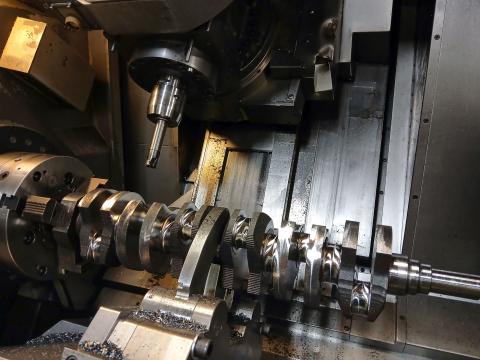
With the increasing popularity of eight-counterweight crankshafts, sometimes the manufacturing department has to get a little creative when producing a forged crankshaft. There are two ways to manufacture a forged crankshaft. First is the twist method, where the rod journals and counterweights are forged flat in the dies, then the forging is reheated and twisted to position the rod journals and counterweights.
This 4-inch-stroke LS billet crankshaft from Eagle Specialty Products is machined from 4340 steel and features eight counterweights.
The other method uses the two forging dies that are designed to shape the part in a single operation. These presses required a great deal of power to produce a forging.
“With eight-counterweight forgings, we need what we call a pre-roughing situation where we have to clear out some material similar to what we would have to do on a billet just to get them to the point where they can start running them through our normal production line,” explained Norris.
With some raw forgings, the counterweights can’t be located exactly where the engineers prefer. That’s because the dies are designed with a draft angle so the part can be released.
“When the dies come apart, instead of the part easily coming out of the die, it can get stuck in them,” said Norris. “Probably the best example is our Top Fuel forging. We have the counterweights pretty much where we want them. However, in order to do that we have to put in extra material just so that the dies will accomplish what’s needed.”
Engine Driven
Recent engine platforms are driving new crankshafts. Molnar Technologies is developing both billet and forged crankshafts for the LT series, but one application the company is shying away from is very large displacements.
“One of the things that helps reduce the bending of the crank, besides the placement of the counterweights, is the overlap of the rod and main journals on the crank,” said Molnar. “When you go longer with a stroke, you are reducing the overlap, and the cranks are bending. There’s not that much you can do to help that.
“I’ve seen guys build these big motors, and they’re running eight-plus-thousandths of main bearing clearance,” continued Molnar. “They almost have to, because it’s going to bend, and they’re just trying to help protect the bearings by running thicker oil and lots of clearance.”
Pankl offers clean-sheet design and simulation capabilities for high-end projects, including this custom lightweight crankshaft developed for a Porsche 911R engine.
Big block Chevys are drawing attention at Manley right now. Some crankshafts under development include forged BBC 4.500-inch-stroke with center counterweights, profiled for a 6.385-inch rod and 2,250-gram bobweight; forged BBC 4.875-inch-stroke with center counterweights, profiled for a 6.700-inch rod length and 2,300-gram bobweight; and billet Chevy LT1/LT4 4.000-inch-stroke with center counterweights.
“The two new big block cranks will round out an already outstanding lineup of center-counterweighted cranks we offer for these applications,” noted Manley. “The billet Chevy LT crank should enjoy similar success as our billet Chevy LS crank, which has become a staple for many of the top LS engine builders producing 2,000 hp and thus requiring superior internals that can survive in this environment.”
Manley is also working on a new billet 88-mm-stroke crankshaft for the Mitsubishi 4G63/4G64 engine. “The new billet Mitsu is something we are working on to fix a common problem with all Mitsu 4G63/4G64 crankshafts: eventual cracking in the number-four rod journal,” said Manley. “We’ve made some really nice improvements and added necessary cross-sectional thickness in critical areas. This should allow the Mitsu fraternity to gain more confidence when making big power and deliver an engine package that will have longevity. More details coming.”
Rat motors are also a hit with Howards Cams customers. “The big block Chevy guys are going in a lot of different directions. We’ve got ones building Outlaw 632-type motors with either a lot of boost or nitrous,” said Peters. “And then on the LS side, you’ve got a lot of turbocharged applications where guys are pushing the limits. That’s kind of where the marketplace is now with so many people gravitating toward the billet line for the big drag racing horsepower, and it’s getting crazy.”
For circle track racers, Howards has the Track Smart line made from 4340 steel forgings. They feature a larger, 0.125-inch radius on all journals, and the nitriding is a little deeper than normal.
“Since the pandemic, our camshaft business in circle track is really good. In turn, the Track Smart cranks have been increasing in sales,” added Peters.
Over at Eagle, new applications coming include the Ford 7.3L Godzilla engine, the Chevy LT, and Nissan VQ.
Molnar Technologies manufactures this eight-counterweight LS crankshaft that’s machined from billet steel.
“Along with strength, builders want consistency and predictability. We are well into the changeover to fully automated CNC-controlled journal grinding for unparalleled sizing consistency and accuracy,” said Davis. “In an inflation-riddled economy, Eagle has been working hard to keep costs, and prices, down. Eagle has not had a price increase in over two years.”
Finally, any discussion of crankshafts cannot be complete without mentioning flat-plane crankshafts. Recent factory performance engines from Ford and Chevy with flat-plane cranks have energized engine builders into considering such a move for a future project.
“We get asked about flat-plane cranks quite often. We always ask if they are aware of everything else in the engine that has to change as well,” cautioned Davis. “Usually, people don’t understand that it’s not just the crank that’s different. A flat-plane crank also affects ignition phasing and cam phasing, among other things. As much as people think they want to see it, it will not happen until builders have a firm grasp on everything else that goes along with it.”
Offering brand-name and custom-crafted components for rock crawling, rock bouncing, desert racing, and more, Branik Motorsports has built a reputation for customer service and rock-solid reliability.
The father-and-son team of Stan and Brandon Haynes didn’t set out to build an off-road racing business—but maybe it was inevitable that they did.
“We opened our doors in 2003 as a mold and die shop,” said Brandon Haynes, “making and repairing permanent molds, primarily for steering and suspension components for the Big Three automakers.” Stan Haynes named the company Branik, for Brandon and his sister Nicole.
Stan had previously operated an off-road shop, building roll cages and custom lift kits. “He was also into drag racing and circle track racing,” said Brandon. “I spent a lot of time as a child watching him race on weekends.” For a racer, owning a mold and die business presented new opportunities. “Having CNC and fabrication equipment, we started making parts for our own vehicles.” By 2007, Branik was offering racing and off-road components for sale.
Then came the crash of 2008–2009, and a precipitous drop in demand for new cars and light trucks. “We started making more off-road products, and off-road products were what kept us in business,” said Haynes. Branik, Inc. became Branik Motorsports. “Today our sales are 95% or more motorsports and off-road, and only 5% or less mold-making for industrial foundries.”
Branik customers drive rock crawlers, rock bouncers, rock racers, Class 1 buggies, Baja buggies, Trophy Trucks, monster trucks, and even pulling trucks; in WE Rock, XRock, Best in the Desert, and Ultra4, including the climactic King of the Hammers (KOH) race week. Branik maintains sponsorships with most of these sanctions and is involved, in some way, with “almost all of the dirt-type, off-road motorsports.”
The versatile manufacturing capabilities of the company’s 10,000-square-foot facility in Fort Wayne, Indiana, range from volume production to one-off customs. “The largest part of our off-road business is driveline: axle shafts, drive flanges, U-joints, and similar parts,” Haynes explained. Products also include Branik’s own Legacy brand brakes, steel and aluminum sway bar components, and steering components. Additionally, Branik sells parts from Wilwood, Reid Racing, and Yukon Gear & Axle.
SPECIALTY SUSPENSION
Leading and trailing suspension arms, custom-machined from 7075 aluminum billet, are another specialty. “All of our suspension arms have been one-off parts,” said Haynes. “We start with a sample of an existing arm, or a customer sketch or drawing with mounting locations, and then I design the arm on Solidworks. Once that’s done, we send the proof to the customer for approval—mostly on how it looks, but also to make sure it has all the features the customer wants. Then we order the material, write the programs for our CNC machines, and schedule production.” Start to finish, the entire process “usually takes three or four days, depending on the design, how complex it is, and the size.”
Demand for custom suspension arms and other custom parts is driven by the innovation that’s still allowed in off-road competition. “In Ultra4,” for example, “most of the vehicles are somewhat unique, especially in the 4400 class, which is unlimited. You run what you brung, and while some vehicles are similar, there are many different designs, from a lot of different shops that are all trying to build the better mousetrap.
The versatile manufacturing capabilities of Branik Motorsports’ 10,000-square-foot facility range from volume production to one-off customs. “The largest part of our off-road business is driveline: axle shafts, drive flanges, U-joints, and similar parts,” said Brandon Haynes.
“A lot of these racers will start by fabricating a steel arm—cutting pieces out of plate and welding them together—and after they bend or break it several times, they start looking for a stronger solution,” continued Haynes. “A lot of them don’t believe that an aluminum part can be stronger than steel,” but with the right design it can be. Further, “aluminum will flex some. It is forgiving. The 7075 alloy we use is like a memory material; it will flex and then straighten out and not break.”
“I started racing off-road back in 2010, at the Badlands Off-Road Park, and I kept breaking axle shafts,” recalled Chad Hundt, a racer based in Plymouth, Indiana. “So I Googled ‘shops that make racing and off-road stuff,’ drove to Fort Wayne and said, ‘Can you guys help?’ I found an amazing group of people to work with. Brandon and his father Stan go above and beyond.”
Today Hundt runs Ultra4 4400 with axle shafts, Heim joints, knuckles, and sway bars supplied by Branik. “It’s good to put in a product that will last through the race and not leave you high and dry. If I do have a problem, they get a replacement out to me right away—and we race all over the US, as far away as the King of the Hammers in California.”
“I won’t buy axle shafts from anyone else,” added Cam Beasley of Locust Grove, Virginia. “My team competes in WE Rock, XRock, Trail Breaker, Trail Hero—all the big, hardcore rock-crawling events. I had heard of Branik through a couple of my buddies who run their products but didn’t think I needed them. Then four years ago, I bought a new Unlimited car, and it had off-the-shelf chromoly axle shafts—and I quickly broke a few stub shafts.
Rock crawlers and bouncers are among Branik Motorsports’ customers, as are Trophy Trucks, Class 1 buggies, monster trucks, and pulling trucks. Branik maintains sponsorships and is involved with “almost all of the dirt-type, off-road motorsports,” said Brandon Haynes. Photo courtesy of Low Range Off-Road.
“I sell machinery for a living, and Branik is in my territory, so I stopped by and saw them. When I saw what they were all about, I ordered a set of their axle shafts. Now I am sponsored by Branik, and I run everything they make—brake hats and rotors, U-joints, and axle shafts—but the reason I go back to them is I just can’t break their stuff. And I am pretty hard on things: I have 40-inch tires, a crawl box, air lockers, the whole deal. I just won the last Put Up or Shut Up, and we were just hammering on the cars. If Branik makes it, I get it from them.”
MADE IN THE USA
We asked Haynes how Branik chooses suppliers, not only for materials like 7075, but also for machine tools and other manufacturing equipment. In either case, he answered, “a lot of it is driven by customer service, by having a relationship with the vendors. It’s important that they care about what they are selling.” That kind of relationship isn’t easy to find, however, as too many large suppliers show little interest in smaller-scale customers. “A lot of these vendors are commission-based,” he explained, “and they’ve got these huge companies as clients, and they are riding on Easy Street, making big bucks off of them. So it’s warming to have a sales rep who cares.”
Important as relationships are, however, Branik considers other factors as well. “We are still shopping price, quality, and where stuff is made,” said Haynes. “We do our best to source most of our materials domestically. We care about being made in the USA.” Partly—maybe primarily—that’s based on Branik’s “foundation of patriotism,” but there are practical advantages also. “The quality of materials, for sure, is more consistent with domestic products. The US mills hold quality control to a higher standard.”
Price, absolutely, has become an issue. Material costs “got real bad right after COVID-19,” and although some prices have “somewhat stabilized” over the last six months to a year, Haynes reminded us that “materials are commodities. It’s like buying gasoline—the prices are constantly going up and down, and our suppliers have gotten to a point where their quotes are good for only 48 hours. That makes it difficult for us to quote jobs.” He also reported “shortages and difficulties getting materials from some companies. So we’ve had to dig a little deeper and do our best to find new suppliers.”
The situation depends on the material and is worse for “higher-end” alloys such as 300M, the aerospace-grade, high-silicon nickel-steel alloy that Branik uses primarily in axle shafts. “There are a limited number of mills that produce 300M. We get it from one or two suppliers. It has actually gone up a lot in the last year,” even while costs for more common materials have stabilized. For Branik, the high price of 300M, as well as other materials, presents a quandary. “We can’t absorb all of it—obviously—so we have to adjust our prices, while we have to remain competitive and not price ourselves out of business. We keep an eye on what other companies are doing. We watch their websites. Our margins are floating, but we do our best to stay competitive.”
Brandon Haynes and his father Stan are racers as well as fabricators. “Having CNC and fabrication equipment, we started making parts for our own vehicles,” Brandon explained. That led to Branik selling racing and off-road components starting in 2007.
Haynes feels less “tied” to domestic products when buying machinery, but he still favors a few proven manufacturers. “We have Haas machines, and Hardinge machines, but we have also been buying a lot from Okuma. They really strive for quality and tight tolerances. Their controllers are phenomenal, and their capabilities are awesome.”
BEING THERE
Like so many other motorsports businesses, Branik has found that performance and participation are the most effective promotion. “We have been involved in off-road racing since 2007,” said Haynes. “We’ve been present in the off-road community, in several genres of the sport; we’ve supported the racers, and we’ve driven and participated ourselves. Participants and spectators see that we are supporting the community, and that has driven customers toward us.” Additionally, “We pride ourselves on having the best customer service we can possibly deliver.
“We do advertise in several sanctioning bodies,” continued Haynes. “We sponsor and support Ultra4, and we’ve sponsored several rock crawling and rock bouncing sanctions,” including WE Rock, XRock, and SRRS. “We have been the title sponsor for the 4800 Legends in King of the Hammers for the past five years. That goes a long way. Honestly, most of our sales and our growth have been through word-of-mouth, through being present and being involved. We haven’t had to do a lot of knocking on doors to promote sales.”
With that success in mind, Haynes plans to develop Branik’s event support even further. “Last year at KOH we had a vendor booth, and racers came to ask questions, or because they needed parts. We saw that as positive, and so we are going to expand by doing that at some other events next year, having people there who can answer questions.” Up until now, he added, “we haven’t done a lot of parts sales at events, but that is another potential area for growth, for producing more sales.”
Finding good employees has frankly been harder than finding customers. Especially since the Pandemic, “seeking employees has been a struggle,” making it difficult to “keep things rolling smooth and keep producing.” Branik has found some success with online recruiting services and even social media; the company has posted job openings on its Facebook page. One recent hire who was not on social media heard about the job opening from a friend who was, “and the friend suggested to him, ‘Hey, these guys are looking for people.’” As this is written, Branik employs seven people.
“We have Haas machines, and Hardinge machines, but we’ve also been buying a lot from Okuma,” Brandon Haynes said. “They really strive for quality and tight tolerances. Their controllers are phenomenal, and their capabilities are awesome.”
Training is mostly the on-the-job variety. “We have our own way of doing things,” said Haynes, “and our machinery is not the same as everyone else’s.” Branik has also taken advantage of CAD/CAM training offered by supplier Mastercam.
Retaining employees, said Haynes, “takes caring about them, paying them well, and doing our best to keep shop morale up and make work an enjoyable, fun place to be. We want employees who want to come to work.” He believes that Branik’s nominal four-day workweek, with 10 hours in a workday, contributes to that goal. “We get our main 40 hours in Monday through Thursday,” he explained. “We typically work five hours overtime on Friday as well, but we haven’t worked a Saturday or Sunday—as far as shop production—in seven or eight years.”
Haynes also understands that work culture is “driven by the owners. We’ve worked hard to build a good name. My dad and I are there every day, putting in our blood, sweat, and tears.”
Not surprisingly, most of the people who have come to work for Branik were already off-road enthusiasts, “or they’ve been converted in some form or fashion. A couple of guys who weren’t really into it ended up buying side-by-sides and coming out wheeling with us. I have an off-road vehicle, my dad has an off-road vehicle, probably 75% of the guys at the shop have something they can go out and recreate with.”
When asked about plans for the future, Haynes stressed manufacturing efficiency. “We are streamlining all of our processes. We are looking at better machinery and in the near future, robotics.” While Haynes didn’t share details, he mentioned new products also. “We’ve been continuing to expand the number of products we offer in the driveline segment, and we have immediate plans for growth in that market. We are always looking at different products, at making our existing products better, and growing with the market.
“The technology is constantly advancing, and so are the vehicles and the drivers. It’s crazy how in no-prep racing people are making 2,500 horsepower out of an LS motor. It’s constantly changing—and challenging us to make better products.”
Competing in rocks, whether crawling or bouncing, puts huge demands on components. Here’s how these rigs are built for maximum performance and durability.
Unlike any other segment in motorsports, racing in the rocks can mean very different things and require radically different approaches to winning. Rock crawling is literally that: precisely driving through a set course, with the help of a spotter, to score as few points as possible for things like missing gates or having to back up. Rock bouncers, on the other hand, use all the momentum they can muster to tackle impossibly steep terrain that’s sometimes so slippery it has earned the nickname ‘owl snot.’
“In rock crawling, everything is done really slow and meticulously, because you have traction,” explained Jake Burkey of Busted Knuckle Off Road, Cullman, Alabama. “But when you’re on the slick stuff, you can’t choose your line. You have to bounce up through and over the obstacle.”
“A lot of people would consider [rock bouncing] a car wreck from start to finish,” added Clyde Bynum of the National Rock Racing Association (NRRA), Horn Lake, Mississippi. “It’s hard to fathom the abuse these rigs are taking and the courses they are climbing.”
These polar opposite disciplines have traveled very different vehicle development paths. Yet they do have some needs in common.
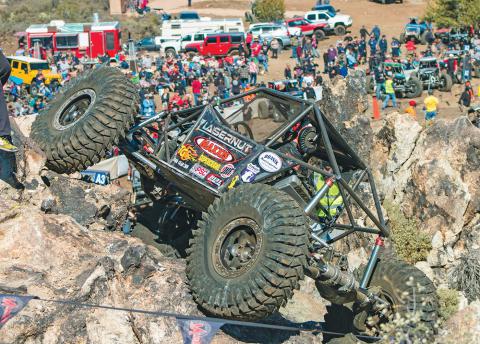
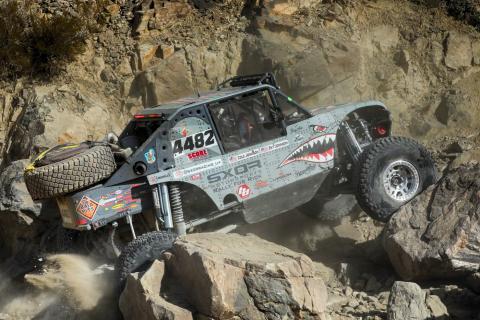
The King of the Hammers race in Southern California combines elements of rock crawling and bouncing with high-speed desert running. To survive that kind of punishment, the cars competing in the event use driveline, suspension, and tire technology from both disciplines.
The Might of Light
One trait the rock crawlers and bouncers share is recent movement away from overbuilding their rigs. Or, as Brandon Haynes of Branik Motorsports in Fort Wayne, Indiana, put it, “With light, there’s might.”
In rock crawling, “everybody’s trying to build strong but light,” said Big Rich Klein of the World Extreme Rock Crawling Championship Series (WE Rock), based in Kansas City, Kansas. “The whole idea is to push or pull as little weight as possible over the rock formation.”
The adoption of portal axles (see sidebar on page 80) has enabled builders to “go to a super lightweight, small axle assembly,” Klein said. Many put Toyota center sections in custom Ford 9-inch housings; others have gone even smaller, to Suzuki Samurai axles and diffs.
A lighter rock crawler means “very few people run big motors,” Klein added. “The Ecotec is one of the favorite motors because they can supercharge or turbocharge them. They’re real lightweight, and they’re an easy package to work around because they’re small.”
Likewise, rock bouncers have learned that “a lighter weight vehicle with good suspension actually prevails much better than a lot of horsepower in a heavier vehicle,” Burkey said. “Now we’re seeing people going from what was 1,600 or 1,500 hp down to 900 hp and at the same time reducing vehicle mass by 1,000 pounds. That seems to be a better ticket.”
Busted Knuckle Off Road developed a rock racing chassis that is both light and strong. “All of these chassis have a triangulated rollcage in them,” said Jake Burkey, and “that triangulation made it to where we can lighten up the vehicles a lot.”
How does one shave half a ton off a rock buggy? Switching from the Dana 80 or Rockwell axles that were commonly used to Ford 9-inch differentials with chromoly housings and 10-inch ring-and-pinions “reduces the weight by almost 300 pounds per axle, so there’s 600 pounds,” Burkey said. Grooving material out of the tires can take “almost 20 pounds off per tire,” and switching from an iron to aluminum engine block cuts another 100 pounds. “Then take out the passenger seat, get a smaller fuel cell, do a few things here and there, and you got 1,000 pounds off the vehicle.”
For those who are building a brand-new rock rig, Busted Knuckle put much effort into designing its tube chassis to be light and strong. “All of these chassis have a triangulated roll cage in them,” Burkey said. “Because of that, we were able to put bars in locations that were in compression or tensile, and we weren’t having to rely solely on the flexural strength of the material, but the compressive nature of it. That triangulation made it to where we can lighten up the vehicles a lot.”
Finding the Balance
Haynes acknowledged that “there’s a balance, for sure,” when building components for lightness but also strength and durability. It’s a balance that applies across the board. “We use the same materials, whether it’s for high speed or rock crawling, because there’s still a lot of strength required for the slow stuff.”
“Stuffing a front tire into a crevice or an undercut and expecting it to climb something that’s taller than the tire puts extreme forces and loads on the axles, U-joints, and stub axles,” said Klein. To stand up to those forces, crawlers are using “more exotic materials than just standard alloy steel axles, from chromoly to 300M. We’ve also increased spline count. We’re running 40-spline axles in a Dana 60 that might have only come with 28 splines from the factory. Plus, the size of the axle goes up from 1 inch to almost 2 inches in diameter. That means the axle tubes are bigger. The U-joints go bigger. A 1310 U-joint is typical in a pickup truck on the street. We’re using 1450s or even 1550s on some of the axle assemblies.”
“Some of these guys just don’t quit,” said Clyde Bynum of the competitors in the NRRA. “They want to race all the time. I get it. They’re spending a quarter-million dollars on some of these race cars these days. It’s a big sport.”
Branik Motorsports has developed its own 1550 U-joints. It manufactures components using 300M alloy “because the way those materials are manufactured and milled, they’re set to a higher standard, and we’re able to manufacture parts that are made not to break,” Haynes said.
Because of what Haynes described as the “point-and-shoot” nature of rock bouncing, where “they use their throttle like a light switch, and it’s all or nothing,” driveline components have to be extremely durable. Not just made of high-strength steel alloy, but big, too. Branik Motorsports turns out axle shafts with spline counts ranging from 40 to 47.
Some of the rock bouncers at the NRRA are using axle shafts from RCV Performance that are 47-spline “and are 2 inches around,” Bynum said. “That’s the same diameter as a Coke can.”
“In rock crawling, everything is done really slow and meticulously, because you have traction,” said Jake Burkey of Busted Knuckle Off Road. Yet that traction puts extreme forces on driveline components, requiring them to be built with many of the same high-strength materials as those used for rock bouncers.
Busted Knuckle uses 300M for its top-tier axle shafts not just for strength but because of “the material’s elasticity,” Burkey said. “It is extremely good for allowing a whole bunch of torsional cycles where you’re getting loaded and unloaded, loaded and unloaded, before any type of cracks start to form.”
Additionally, “we use a lot of high-end aluminum in our designs,” Burkey continued. “The 7075 alloy is one of our favorites. It is extremely strong, flexible, and light weight. We use it on a lot of components that were previously made from steel, allowing us to cut weight in multiple locations on the buggy.”
In terms of axle size, Busted Knuckle makes axle shafts with 40-plus spline counts, though Burkey pointed out that “spline count is not relative to size. It’s relative to the aggressiveness of the spline itself. For instance, our inner axle shafts are 40-spline, 1.75 inches, while our outer axle shafts are 32-spline, but they’re 2 3/8ths inches in diameter. So it doesn’t necessarily correlate. You have to talk diameter, not necessarily spline count.”
What’s the Diff
Variations on Ford’s 9-inch rearend are common on rock racers of all kinds. Among crawlers, the 9-inch is “really popular because if you blow a ring-and-pinion, you can pull the axle shafts out a little ways and drop in a new center section,” said Klein.
The versatility of the 9-inch’s drop-in center section is a “huge factor in how it became so popular,” said Haynes. “You can also build really strong axle housings or aftermarket formed axle housings for the 9-inch, and they’re easy to fabricate off of. You can weld right to the axle housing wherever you need.” Plus, he said, new technology, such as 10-inch gear sets and better race materials, “has put the 9-inch up there as equally strong as the 14-bolt.”
Next to the 9-inch, GM’s 14-bolt and the Dana 60, which were used by the OEs in one-ton trucks, are the most common housings Branik Motorsports deals with, Haynes said.
At the NRRA, “outside of your custom, one-off housings, the most popular are the 14-bolt and the Dana 80,” Bynum said. “A lot of people went to the Dana 80 because of its bigger pinion, but just as many people are running the 14-bolts front and rear because the pinion support in the 14-bolt helps it hold up to what we do a lot more.” The 14-bolt, in OE form, was a rear axle only, but “we’re building them into steer axles front and rear,” Bynum said, as most NRRA racers “are front and rear steer these days to be competitive.”
Rear steer has been popular among crawlers almost since the beginning of the sport, Klein said. “They would take a front steer axle, flip it over, and run it as a rear steer axle so they could get a sharper turning radius. Chassis got narrower so you could turn 40- or 42-inch tires in the rear to an extreme angle. Most pickup trucks or Jeeps you can buy off the showroom floor have a steering angle radius of probably 30 degrees in the front, where our crawlers are getting anywhere from 56 to 60 degrees of angle and making them survive in most situations.”
Where the Rubber Meets the Rocks
Klein credited BFGoodrich with developing the first tire specific for rock crawling. The BFG Krawler T/A is “what we call a sticky tire, which means it has a durometer rating lower than a standard DOT tire.” Other companies have followed, including Maxxis, Interco, and Mickey Thompson.
“We don’t care how many miles they get, and we’re not driving that fast,” Klein said. “If you see a wheel spinning, and it looks like they’re burning rubber, the guys are heating up the tires to get more stickiness out of the compound.”
Tires are one area where the rock crawler push for lightness doesn’t apply. “The lower the center of gravity you have on the vehicle the better when you’re off-camber or climbing because you get more traction the closer your weight is to the rocks,” Klein explained. “So unsprung weight is okay. Axles, wheels, tires, those items can be heavier because they’re below that center of gravity line, or most of it.” Some crawlers add water, or steel shot, or both to their tires to “create more weight in the wheel assembly to hold the vehicle onto the ground.”
“We manufacture heavy-duty drivelines for the industry, and all the components to put those heavy-duty drivelines together,” Busted Knuckle Off Road’s Jake Burkey said. Axle shafts and driveshafts are not only larger in diameter, but they are made of premium materials “to keep them from breaking.”
Falken Tires in Rancho Cucamonga, California, is currently testing a race compound, 40-inch version of its Wildpeak M/T01 with select rock crawling teams. “We’re two years out from releasing it in a DOT version. Right now, this is exclusive to motorsports,” said Doug Fletcher. “It has tremendous grip, and they’re doing really well with it.” In addition to the new tread compound, the 40-inch M/T01 is made with Falken’s Duraspec construction technology, in which the tire’s “turn-up plies come up way further than most of the rest of the industry’s products, which gives us additional strength in our sidewall,” Fletcher said. “That means the tire is going to be a little heavier than one that doesn’t have as high a turn-up ply.
“Plus, our tire comes with one of the thickest tread depths in the industry. Depending on size, we go up to 21/32s of rubber,” Fletcher continued. “Again, when we’re talking durability and strength of the tire versus weight, if I have more traction with more tread depth, I’ll sacrifice a little bit of weight to do that.”
On the rock bouncing side, “Mickey Thompson was one of those companies that developed a tire for our market, the Baja Pro X,” Bynum said. Like the BFG Krawler, it’s a non-DOT, sticky-compound tire. Most NRRA racers use the 43-inch-tall version with a 17-inch wheel.
“These guys are hitting, say, a 2-foot rock ledge that’s at a 90-degree angle at 40, 50, 60 miles an hour,” said Bynum. “So the tire has to be very tough for what we do.”
“The invention of the sticky tire allowed us to have the same amount of traction at a higher psi level in the tire,” Burkey pointed out. Conventional off-roading tires are run on the rocks at super low pressures—2–3 psi—for the tires to essentially wrap around the rocks for traction. “But we can run 8 or 9 psi with the sticky tires, which provides the same traction and is enough to keep the tire from compressing when we hit an obstacle at speed and bending the wheel.” Most competitors use beadlocks on their wheels, which bolt the tires to the wheels to secure them at low air pressures.
Burkey said most wheels are 17 or 20 inches in diameter to fit large brake packages and beefed-up steering knuckles and axle shafts. “We’re running huge steering knuckles. It’s kind of hard to fathom just how much bigger these are from even five years ago.”
Desert Race Suspensions
Tuned suspension systems “have become a number-one thing” among rock bouncers over the past three to five years, Burkey said. “We’ve realized that you can make it over an obstacle with less horsepower if your suspension absorbs the impact properly than if your suspension doesn’t. If you combine that with a sticky tire, you have a recipe to conquer all the terrains.”
Rock bouncers have been looking west and borrowing ideas from desert racers, he added, such as trailing arm systems and coilovers with bypass shocks. Desert race shock specialists like King and Fox are in the mix, but many bouncers use Radflo bypass shocks, a company Burkey calls “the industry leader.” Busted Knuckle “tunes the shocks based on the terrain and the vehicle characteristics that we have. Once that’s done, we order the shocks pre-valved from Radflo ready to bolt on the vehicle.”
Bynum agreed that Radflo “is one of the big companies that supports the sport,” and most of the NRRA competitors are using triple- or quadruple-bypass shocks. Trailing arm systems are popular with his bouncers, too, as “that way they get a lot more travel, as much as 24 to 30 inches of travel.”
Branik Motorsports has developed sway bars for bouncers that “keep your vehicle stable and improve the handling going around corners,” Haynes said. “The seat-of-the-pants feel is a whole lot more stable with sway bars front and rear.”
Rock crawlers also turned to desert racers for ideas about shock packages, coilovers, and link suspensions, but Klein said they soon found “all of those items react differently when you’re trying to go slow and gain traction, as opposed to carrying the vehicle as fast as you can over rough terrain.” Crawlers were able to use some of the components, “but the suspension design changed, and the shock valving and setups changed, even though they look identical to what a Trophy Truck or Class 1 car has.”
One innovation that has come to American crawlers from Australia is a shock absorber with the ability to push a tire down into a hole for more traction, Klein said. “It’s a shock with a hydraulic system over the top of the regular shock system. It acts like a regular shock, then at the push of a button it hydraulically pushes the ram to put the wheel where you want it to go. When you release it, it returns to normal ride height.”
Other than components like those hydraulic ram shock absorbers, or tires aired down to single-digit pressures, the vehicles built for rock crawling and rock bouncing “are really no different than any other race car,” Bynum said. “It’s just our sport. I would say it’s probably hardest on parts, but there have been a lot of companies that have stepped up and built custom parts for our industry.” Rock bouncing, he said, “is a sprint of the hardest courses you’ll ever find.”
Hammer Time
Hammerking Productions’ Ultra4 race series and its marquee event, the King of the Hammers in Johnson Valley, California, combine elements of rock crawling and bouncing with high-speed desert running. As such, the cars competing in the unlimited Ultra4 class look like a cross between crawlers and desert racers, and they share some tech with the rock racers.
“Nowadays we’re using portal boxes,” said Dave Cole, “which give you higher ground clearance, the ability to fit bigger tires, better gear reduction, and you can run bigger tires without adding load to your drivetrain. We also get a lot of flexibility out of our differentials, whether they’re selectable or automatic [locking].”
The high speeds put demands on the engines that are unmatched in crawling or bouncing, making “temperature control and oiling a really big deal,” Cole said. “Engine management systems have really exploded. We’re capturing telemetry and managing it at a much higher technological level than you would expect to find in off-road. Ten years ago, you might have found 10 people running a MoTeC system. Now there’s 300. Some people run the old stock ECUs, but you cannot be competitive unless you’re massively changing your entire data management system on your car.” —Drew Hardin
Portal Axles
Whenever portal axles came up in interviews for this story, everyone credited Jesse Haines of Jesse Haines Fabrication (JHF), in Dayton, Nevada, for his pioneering work adapting the system used on military Hummers to the requirements of off-road racing. “It’s old technology, proven in the military for 40 years or so, but a lot of guys are using them. They’re very strong and robust,” said Brandon Haynes of Branik Motorsports, Fort Wayne, Indiana, which worked closely with Haines to develop a Dana 60-sized axle shaft that fits in the JHF portal box.
Portal axles are geared axle hubs mounted on each wheel. Adding gear reduction at the wheels carries some of the driveline torque, “which makes your axle shafts and ring-and-pinion twice as strong,” said Haynes. The portals also increase ground clearance by lowering the wheel’s mount surface relative to the axle and differential.
“A lot of the guys in rock crawling are using smaller, lighter-weight center sections, like Toyota center sections,” Haynes noted. Even when they’re sending 250 to 350 hp to 40-or 42-inch tires, “the differentials hold up well with a portal setup.” —Drew Hardin
These versatile and affordable off-roaders put the thrill of racing within reach of just about anybody.
While UTVs were developed originally as working machines—the “U” stands for “utility” after all—these days UTVs have found a huge following in off-road recreation. Industry trackers estimate 2023 UTV sales at some $6 billion and expect the category to grow by 5% annually between now and 2032, driven largely by demand in the recreational segment.
“Powersports continues to expand simply because it’s a tremendous form of outdoor entertainment,” said Michael Mathis of Atturo Tire Corporation, Waukegan, Illinois. “UTVs allow you to go off-roading without having to expose your regular daily-driver street vehicle to damage. There are more places that are accessible to UTV use than there are to street vehicles going off-roading. And that translates over into motorsports.”
We spoke to several off-road race sanctioning organizations for this story, and all of them talked about the growth they see in UTV racing. Matt Martelli of UNLTD Off-Road Racing of Vista, California, said UTVs “make up our biggest class, and it continues to grow.”
Bryan Folks of the Best in the Desert (BITD) racing series, based in Las Vegas, Nevada, agreed that UTV racing “continues to grow” within the off-road race industry as a whole.
The UTVs racing at King of the Hammers are “game changing in their essence,” said Dave Cole, approaching the performance of the unlimited Class 4400 cars.
Dave Cole of Hammerking Productions in Temecula, California, said UTVs are his “biggest area of growth.”
And Jim Ryan of SCORE International in Reno, Nevada, said SCORE’s UTV entries “have accelerated dramatically in the last three to four years.” They have also become the “go-to vehicle for pre-running,” he said. “Even the Trophy Truck teams are using them.”
There are several reasons for the growing number of UTVs in off-road racing, and a lot of them have to do with how remarkably low the barrier of entry is to race a UTV, making it a form of motorsports that nearly anyone can do. In fact, “the barrier to entry has been reduced to almost nothing,” said Cole. “For someone sitting at home and thinking, ‘I want to try that,’ it’s easier to get into a UTV and race than getting in a roundy-round car or a Miata. UTVs have really changed that.”
Off the Showroom Floor
One of the biggest drivers of UTV popularity is the wide selection of models available from the OEMs, and how well equipped they are from the factory.
“You can get into racing one of these, almost off the showroom floor, without having to spend a lot more money on it,” said Mathis. For some sanctioning bodies, the only additions required, depending on class, are seats, harnesses, and other safety equipment. “The opportunities to get into a stock class with relatively little modification to that factory machine are far superior to anything you could do with a street vehicle to go off-road racing. Then with a race UTV, unlike a race truck, you could drive it on off-road trails or at an off-road park. There’s some dual use to it as well.”
UTV racing “can’t get more accessible,” said Folks. “Any Tom, Dick, or Harry can go to a Polaris dealer, a Can-Am dealer, a Honda dealer, or a Kawasaki dealer and have a pretty state-of-the-art vehicle they can race the next day.”
At SCORE, “our factory wars now are the UTVs,” said Ryan. “It’s not Ford, Chevy, Dodge, Toyota anymore. It’s Polaris, Can-Am, Honda, Kawasaki, Robby Gordon’s Speed, and Arctic Cat. We now have five UTV classes as the vehicle manufacturers have evolved their products. We’ve had to move their classes up on the starting line order in terms of when we stage their starts because they’re getting faster and more reliable. They’re quite capable vehicles and keep moving up through other classes on their overall finishes in our races.”
Some sanctioning bodies allow kids as young as five to race in UTVs. Eleven-year-old Brian Fulcher won the UTV Youth 1000 class at Best in the Desert’s 2024 Vegas to Reno race.
The upper tier of the market, which includes the Polaris RZR Pro R and Can-Am’s new Maverick R, “are almost race-ready in the Pro class,” Ryan said. “All they need is safety equipment, then go race.” The OEMs have “embraced new technology, and they use our races as a testing ground for what they call ‘Baja-proven technology.’”
“Twenty years ago, when UTVs started racing in Best in the Desert, they were little more than a golf cart with some suspension,” said Folks. “Now, it’s not an understatement to say that the technology has gone bonkers with UTVs. The OEMs looked at racing and said, ‘This is where we need to be.’ A UTV has won the Silver State 300 two years in a row. Think about it: Going from what was almost a golf cart to winning a big race two years in a row, that’s a pretty major step.”
The morning we spoke with Cole, he had spent a few hours in a new Maverick R. “It has a sequential gearbox. It has better steering than any Porsche or Mercedes you’ve ever driven. I was out in the desert doing 100 mph through 2-foot whoops in a $35,000 car out of the box.” Can-Am, he said, is gunning to win the top 4400 class in Hammerking’s prestigious King of the Hammers event, “and if they do that, they’ve proven they’ve built the best car.”
Economic Feasibility
Some people are probably reading this and thinking $35,000 is a lot of money compared to the cost of Spec Miatas, shifter karts, and other affordable forms of grassroots racing. “If you put the cost of a new UTV into a Volkswagen or a Miata, you’d have a really competitive autocross car,” Mathis pointed out.
Keep in mind that the $35,000–$45,000 R models from Polaris and Can-Am represent the high end of the new UTV market. There are less expensive models on the dealer’s floor, and those tend to make up the bulk of the entry lists in the desert.
SCORE moved its UTV classes up in the starting order “because they’re getting faster and more reliable,” said Jim Ryan. Here, Phil Blurton celebrates his class win at the 2024 Baja 500.
And while your local Mazda dealer can’t sell you a Spec Miata, your local UTV dealer will be happy to put you in the side-by-side of your dreams and finance the purchase as well. Martelli said Polaris “has moved into self-financing, and Can-Am will finance you for 1%. So with financing, people are willing to spend $30,000 or $40,000.
“Never before have we had a race car that you can finance,” he added. “Financing just completely changed the demographic of who is racing with us. And you only need to put about five grand worth of safety equipment into a UTV to race it. If you have halfway decent credit and a credit card, you can literally come racing with no out-of-pocket costs.”
As Folks pointed out, even if a racer spent $100,000 to build “a top-of-the-line UTV to race against the very best in the country,” in the off-road racing world that pales in comparison to “the half-million dollars to build a good Class 6100 truck or well over a million for a Trick [or Trophy] Truck.” Add in the fact that if you called any of the major builders, “it could be a year or two years before you get your truck built. You can’t argue the economic feasibility of the machine.”
Youth and Longevity
For some of the off-road racing sanctioning bodies, the growth in UTV racing is driven by their youth classes. BITD allows kids as young as five to race. “If you want to start your kid out young, start them in a UTV,” Folks said.
Hammerking’s “biggest area of growth is youth now,” Cole said, noting that those numbers may be skewed because “it’s a new market segment for us, so of course it’s growth. But there certainly tends to be younger people in UTVs.” These vehicles represent “30–40% of our business, and it’s edging up now because the youth is all UTV-based racing.”
“Once people realize how good the vehicles are, it’s a no-brainer,” said Matt Martelli of UNLTD Off Road Racing. “They’re just dominating off-road.”
At SCORE, UTVs have “enabled a younger generation of racers,” Ryan said. “We’ve also had veteran racers from other classes move down into that. We’ve seen a huge influx of women entering those classes. The competition levels are extremely good and very competitive.”
“UTV racing is very appealing to youth,” Mathis said. “We see a lot of under-16-year-old drivers out there on the race courses.” Those younger drivers will tend to “stick with it, whether it’s from a competitive or hobby standpoint, for another 30–40 years. Unlike motorcycles, it doesn’t beat up your body as bad. So you can have a much longer career racing. You see all these motorcycle guys—Brian Deegan, Travis Pastrana, and all those guys—who went from two wheels to four in a cage in order to prolong their careers. So it’s got longevity to it.”
This brings up an interesting point: For the most part, UTVs are not a feeder into higher echelons in off-road racing. According to Folks, at BITD “80% of the racers who start in UTV stay there, and 20% eventually feel like they’ve outgrown it, or they have the financial support to move from a UTV to a car or truck.”
“They don’t jump up,” Cole agreed. “Most of the stud UTV guys are staying in UTV.”
“There’s not a huge movement out of the UTV classes to go up into other classes, because the category itself keeps evolving,” Ryan said. “A lot of the teams in a pro class now used to run stock. They’ve moved through the system over the years.”
“They’re staying because they like it,” Folks said, “and because it’s economically viable. That means you have bigger turnouts and more competition, and the competition is stiff, especially up in the two top classes, Pro Open and Pro Turbo. You have OEM support there.”
That support goes beyond producing new nearly-race-ready models. “Kawasaki, Can-Am, and Polaris have huge contingency payouts for Best in the Desert events,” Folks explained. “They’re substantial enough to make the average racer say, ‘Hey, we need to go race here and give it all we can. If we think we have a shot at winning, we need to come here, because the payout is pretty darn good.’”
At SCORE, factory support also includes driver contracts, Ryan said, “which don’t exist in other classes. So there’s a lot of really talented guys there.”
Excited About the Future
Big as the UTV segment is, it’s only going to get bigger.
“I’ve heard through the grapevine that Yamaha is getting real serious and doing a lot of R&D right now to build a new unit,” Folks said. “Yamaha is competitive in short course, but they’re not very competitive in desert off-road, and they know that. Some pretty good sources there have told me they’re doing some heavy work to change that. We could see something here in the next year or so. Any time you have OEMs supporting your sport it’s a big, big deal.”
“The OEMs and aftermarket are always working on something,” Ryan said. “There’s a whole category devoted to suspension, there are specialized wheels, drivetrain, and there are exclusive manufacturers for UTV tires in that category. Everything else is being built for these vehicles: seats, safety equipment, communications gear, all these products specially built for UTVs.”
UTVs race in five classes at King of the Hammers. Here, Steven Carter’s Pro Stock Turbo Can-Am chases Tony Palarie’s Pro Mod Can-Am in the Can-Am UTV Hammers Championship.
Among those products in development is a new version of Atturo Tire’s Trail Blade X/T. The current X/T “is a hybrid tire that is a good choice for open desert, hard pack, and short course,” Mathis said. “It is also studdable for winter events.” The new X/T will be an “aramid reinforced version that will further enhance the durability for competition use.” It joins the Trail Blade BOSS, which is “better suited for rocks and mud with a deeper tread, a higher void ratio, and better sidewall protection.” Both the X/T and BOSS “utilize a moderately soft compound for good overall performance.”
Martelli said he’s “excited about the future. It’s all upside. Kawasaki has new units coming. Honda has new units coming. They are all seeing the potential. Then we have new players entering the space, like Segway and other brands.”
Segway? “Yes, they have a hybrid car,” Martelli replied. Called the Super Villain SX20, the gas/electric version reportedly puts out 330 horsepower and has a 150-mph top speed.
“Once people realize how good the vehicles are, it’s a no-brainer,” said Martelli. “They’re just dominating off-road.”
To him, it doesn’t need to stop there. “When you look at the versatility of these UTVs, this platform can race on dirt, on pavement, off-road, really everywhere. I’m a little surprised that other race disciplines haven’t adapted it yet. I think the pavement guys and the dirt track guys need to get aggressive with fostering more creativity for their racers and tap into this. Just to get more people in. It would be a great entry point.”
The Iowa Hall of Fame and Racing Museum has announced its Class of 2024, as well as its upcoming move to a new building at the Kossuth County Ag & Motorsports Museum in Algona, Iowa.
The Class of 2024 includes Harald "Andy" Anderson of Duncombe; Jeff Broeg and Lynn Richard of Mt. Pleasant; Rick Brown of Kellogg; Dave Chase of Bellevue, Nebraska; Doug Haack of Clinton; Ron Hutcherson and Steve Jackson of Des Moines; Bill Kirk and Karla Lampe of Fair Grove, Missouri; Hilbert Schram of Amarillo, Texas; Jerry Smith and Randy Smith of Mt. Ayr; and Dale Suhr of Waterloo.
The individuals will be recognized for their on-track accomplishments and contributions to the sport in the state of Iowa during the Hall of Fame Induction Ceremony on November 2 at the Briggs Woods Conference Center in Webster City, Iowa. The event is open to the public and tickets are available through the Hall of Fame's website.
At a to-be-determined date, the Iowa Hall of Fame and Racing Museum will move to its new location in Algona. Interior work is being completed at the new facility, and the current location in Otho is closed as staff prepares for the move. The new location will allow the museum to give race fans access to the collection of Iowa racing memorabilia and archives.
The National Auto Sport Association (NASA) will host its 2025 NASA Championships at Ozarks International Raceway.
Located in Gravois Mills, Missouri, the 19-turn track with 150 ft. of elevation change will host the Las Vegas-based sanctioning body's annual championship weekend on September 4–7, 2025.
"Ozarks International Raceway is a track everyone has been raving about since it opened in 2022," said NASA CEO Jeremy Croiset. "Its location in middle of the country should make it accessible to a vast majority of our members. It's one of the most unique tracks in the country, and an ideal spot for NASA Championships competition. We look forward to a great turnout and, of course, fantastic racing."
 MEMBERSHIP LOGIN