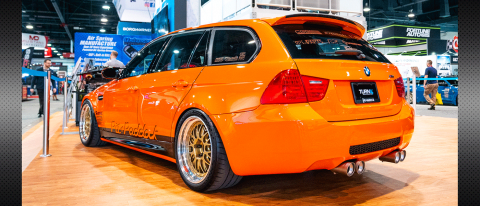
Turn 14 Distribution will announce the grand prize winner of the "Pit+Paddock x Bilstein BMW E91 GTS Tribute" giveaway during the 2024 SEMA Show, November 5-8 in Las Vegas. (Still need a SEMA Show badge? Register at semashow.com).
The giveaway marks the culmination of a six-month sales promotion where Turn 14 Distribution customers earned points by purchasing featured products from key vendor partner brands, including Bilstein, Akrapovič, Motul, StopTech, BBS, CSF, SPL Parts and Driveshaft Shop.
Seven customers were chosen as finalists and will represent their company at the SEMA Show in the Las Vegas Convention Center, where one grand prize winner will be announced and get to take home the heavily modified 3-Series wagon.
The BMW giveaway vehicle started as a gutted 328i Touring and underwent a complete transformation inspired by the E92 M3 GTS coupe--a track-focused, special production M3 limited to 150 units and only sold in Europe.
Highlights of the build include M3 body panels, Fire Orange paint, top-of-the-line aftermarket performance parts, and a powerful 516 HP, 4.6-liter V8 stroker engine.
Following its debut at last year's SEMA Show, the E91 traveled around the world to make impactful appearances at marquee events, including the PRI Show, the Goodwood Festival of Speed (UK), Ultrace (Poland), Bimmer Invasion (Florida), and Pit+Paddock Grid Icons (California).
The Pit+Paddock x Bilstein BMW E91 GTS Tribute giveaway ceremony will take place on Tuesday, November 5, at 4:30 p.m. PST inside the Turn 14 Distribution Booth #21303 in Central Hall. Attendees will also receive a sneak preview of the following two vehicles offered through Turn 14 Distribution's new sales promotion giveaway program.
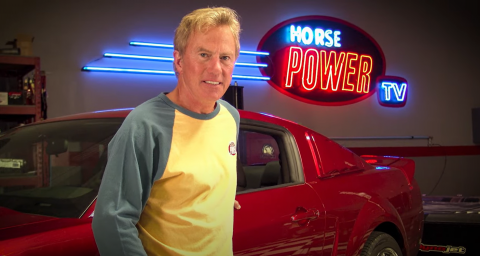
Joe Elmore, host of automotive television shows "Horsepower TV" and "Muscle Cars," has passed away, POWERNATION announced. He was 80 years old.
An Arkansas native, Elmore moved to Nashville, Tennessee, in 1985, where he began working for the Nashville Network before his rise to prominence in the automotive world began with "Horsepower TV."
Additionally, he served as host of "Tennessee Crossroads," a magazine-style travel show that airs on stations across Tennessee and the Southeast.
For more on Elmore, including a statement from POWERNATION, click here.
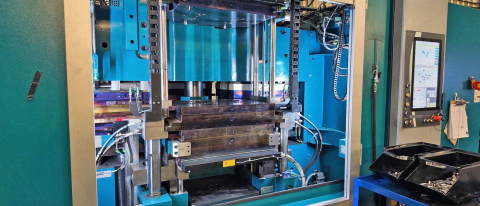
Timbren Industries, the Whitby, Ontario, Canada-based provider of high-performance suspension solutions, has invested more than CAD 1.3 million (approximately $940,000) in advanced equipment and machinery, including state-of-the-art milling machines, new rubber molding equipment and significant upgrades to their paint line. These advancements will enhance the production process and help meet the growing demand for Timbren's high-quality suspension products, including the Timbren SES and Axle-Less trailer suspension systems.
"We are dedicated to staying ahead of the curve by investing in the best technology to manufacture durable, high-performance suspension solutions," said Neil Hodgson, CEO of Timbren Industries. "These upgrades ensure that our products continue to meet the highest standards of quality, providing the exceptional performance our customers expect."
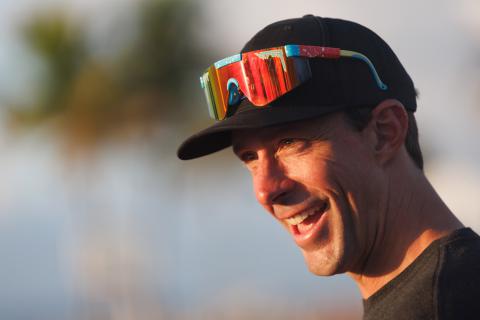
What hasn’t Travis Pastrana accomplished in motorsports? This year’s PRI Show Grand Opening Breakfast speaker reveals which race vehicles challenge him most, his favorite race car he’s driven, and why he believes the world’s best driver is yet to be discovered.
From two wheels to four wheels, Travis Pastrana is renowned for pushing the boundaries of performance in all forms of motorsports. A native of Annapolis, Maryland, Pastrana’s combination of exceptional talent, versatility, and personality is unmatched in the world of motorsports.
We’re thrilled to announce that Pastrana will be the special guest for our Grand Opening Breakfast, which officially opens the 2024 PRI Show on Thursday, December 12, in Indianapolis, Indiana. In addition to a hearty complimentary breakfast, the event will feature a talk-show style interview between Ralph Sheheen and Pastrana, providing attendees an opportunity to hear about his varied experiences in racing, entrepreneurship, and motorsports marketing.
Pastrana has claimed victory at the highest levels of competition, racking up 11 X Games gold medals and several championships across supercross, motocross, and rally racing. Frankly, it would probably be easier to list the racing series he hasn’t competed in, rather than those he has.
Notable races he’s competed in include the Daytona 500, Prelude to the Dream, Pikes Peak International Hill Climb, and the Rolex 24 at Daytona. If that’s not diverse enough, he’s also participated in Monster Jam, Extreme E, World Rally Championship, Race of Champions, NASCAR Xfinity and Truck Series, AMA Motocross Championships, World Freestyle Motocross Championships, and more.
Monster trucks were just one of the many obstacles facing Travis Pastrana in his “Gymkhana 2022” video. His ride for this installment of the Gymkhana series was the 862-horsepower, 165-mph Gymkhana Subaru Huckster.
If it involves an engine, there’s a good chance Pastrana has raced it, though he’s much more than a prolific competitor. Pastrana is a consummate showman and successful entrepreneur, having co-founded both Nitro Circus and Nitrocross.
Nitro Circus, which he co-founded in 2003, was Pastrana’s first successful foray into the world of motorsports business. Nitro Circus is a global entertainment brand that has revolutionized the world of action sports. What began as a small group of friends performing jaw-dropping stunts has evolved into a worldwide phenomenon, with live tours, a popular television series, and blockbuster films.
Launched in 2018, Nitrocross is a US-based rallycross race series that features tight tracks, huge jumps, and no-holds-barred racing that showcases the full power of high-performance electric vehicles. The series continues to grow in popularity and is currently one of the premier showcases for the possibilities of EV racing, with cars boasting more than 1,000 horsepower and going 0–60 mph in 1.5 seconds.
Both Nitro Circus and Nitrocross showcase Pastrana’s relentless pursuit of conquering the next big challenge, pushing the limits of what’s possible in motorsports, and captivating audiences around the globe. The success exemplifies his ability to turn passion and creativity into thriving business ventures.
In anticipation of welcoming Pastrana to the PRI Show in December, we connected with the motorsports legend to get his thoughts on the challenges of competing in various disciplines, his favorite race car, advice to young racers, and why success requires more than just winning races.
Travis Pastrana co-founded Nitrocross, originally called Nitro Rallycross, in 2018 and is also a competitor in the series. He calls it his “favorite type of racing. I took all the elements I love and put them together.”
PRI: Participating in multiple disciplines of motorsports has been a hallmark of your career. What are the benefits and challenges associated with competing in various forms of motorsports? Pastrana: Seat time in any vehicle is helpful. You learn something from every race, and a lot of it is transferable to other forms of racing.
Many of the launch procedures are different, and even the fastest line you want to take on the same track can vary from car to car. So, when you race multiple vehicles on the same day, you need to consciously think about which car you’re in and visualize the procedures and lines before starting the next race. PRI: What type of race vehicle challenges you the most and why? Pastrana: Rear-wheel-drive vehicles are the most challenging for me because I grew up on dirt bikes, where the motto is, “When in doubt, throttle out.” Then I moved to rally (all-wheel-drive cars on mostly dirt and gravel), where the motto is the same. On pavement, though, you have to be more precise to find time, and with rear-wheel-drive vehicles, you have to be more precise in how you put the power to the ground. Combining those factors makes it very difficult for me to be competitive. PRI: Do you have a favorite type of racing or race car? If so, what is it? Pastrana: Nitrocross racing is my favorite. I took all the elements I love and put them together. My favorite vehicle of all time is the Gymkhana Subaru Huckster. PRI: What is your most memorable moment in your career so far and why? Pastrana: Winning the Motocross of Nations for Team USA in France when I was 16. One hundred thousand screaming French fans booed me around the track as I passed the French rider on the last lap for the win. PRI: What do you consider your biggest contribution to motorsports? Pastrana: The ramp and airbag design for freestyle motocross helped elevate the sport in a safer direction. Also, building Nitro Circus around the globe.
Time will tell, but hopefully, Nitrocross will grow into my top contribution over the next decade or so. PRI: Your Nitrocross series has provided a great platform for the possibilities of EV racing. Can you discuss what you have learned about EV capabilities and what place it has in the motorsports landscape going forward? Pastrana: Electric vehicles are practically limitless in terms of power, which allows us to have more suspension and bigger vehicles. PRI: When we spoke with Chip Pankow at Nitrocross, he told us it was your firm belief that the world’s best driver is still yet to be discovered. How can the motorsports industry do a better job of discovering new talent, even if they lack resources to compete in top-level racing series? Do you think sim racing is a viable path for discovering talented young drivers? Pastrana: Sim racing has been a platform for many up-and-coming racers to showcase their skills and eventually take their love of racing from the screen to reality. The more drivers who are interested in racing, the more competition there will be, and the better drivers will have to be to rise to the top.
To call Travis Pastrana a multi-discipline racer would be an understatement. He has raced on two wheels and four, in the dirt and on pavement, in vehicles powered by gasoline and electricity. He won his UMP Modifieds feature race during the 2023 DIRTcar Nationals at Volusia Speedway Park.
PRI: As the owner of Nitrocross, what have you learned by being on the other side of the series, as opposed to being a competitor? Pastrana: When you’re a competitor, it’s hard to see past your own race. You get hyper-focused on the nuances and rarely take the time to look at the big picture. Being able to watch the show from a fan’s perspective allows me to dive deeper into the show and entertainment aspects.
We have the fastest cars and some of the best drivers on the planet, but with each round, we aim to improve the tracks and up the entertainment value for the fans. PRI: Being a successful racer requires much more than results. For up-and-coming racers out there, can you speak to the importance of building a personal brand and how to effectively use that brand to connect with sponsors and partners?
While Nitrocross serves as a platform to demonstrate the potential of electric vehicle racing, it also has classes for ICE vehicles as well. Here, Pastrana takes part in a Nitro Rallycross event in Southern California.
Pastrana: While winning races is the ultimate goal of every driver, you must remember that you’re not being paid just to win—you’re being paid to represent the brands that sponsor you.
The better you perform, the more likely you’ll be covered by cameras, and the more visible your sponsors will be to the world. But now, with social media, it’s possible to build a following that exponentially increases your value to sponsors before you even step foot on a race track. PRI: A 16-year-old Travis Pastrana asks you for advice on building a career in motorsports. Based on what you’ve learned over the past two decades, what would you say? Pastrana: Follow your passion. It takes working seven days a week, 365 days a year, to make a living from your hobby. But as long as you love what you do, you’ll never work a day in your life. PRI: Since you will be the Grand Opening Breakfast speaker at this year’s PRI Show, how can PRI—through the trade show and magazine—be beneficial to inspiring racers and teams? Pastrana: So many enthusiasts, up-and-coming talent, as well as driving legends, all come together at this amazing event. Keep inspiring the next generation to drive.
“While winning races is the ultimate goal of every driver, you must remember that you’re not being paid just to win,” Pastrana noted. “You’re being paid to represent the brands that sponsor you.”
PRI: What’s next for Travis Pastrana? Pastrana: I’m always trying to find the balance between family time, being on the road, and being on the road with the family.
I’m building Nitrocross and Nitro Circus while also working on a YouTube channel with my friends (Channel199). I’m promoting racing, building pathways for people to get into racing more affordably, and finding time to continue racing myself.
Trans Am’s new TA2 technical director brings more than three decades of racing and racing-industry experience to the role. When he’s away from his day job, he can often still be found at race events.
The cliché about “gasoline in his blood” applies perfectly to Doug Nagy, the new technical director for the CUBE 3 Architecture TA2 Series. Just ask his wife. She loves the sport, too, and the couple spent part of their honeymoon competing in the famed Baja 1000.
Nagy comes to Trans Am with a “get it done” spirit proven across a gamut of racing industry roles, plus experience as an FIA-licensed technical inspector, technical director for the American Rally Association, and the chief of tech for King of the Hammers. In his long career, Nagy previously held positions at Saleen, Bell Motorsports, and Mosler Automotive. He replaced Ricky Brooks as TA2 tech director.
“I was fortunate to grow up in the Phoenix area, where there were motorsports events happening almost six days and nights a week,” Nagy recalled about his racing background. “We had two or three drag strips, three oval tracks, three road courses, mud bogs, motorcycles, off-road racing, autocross, and probably some others I can’t remember.”
Nagy was either in the cockpit, wrenching, or watching—or all three. “My friends and I would go buy a cheap car, fix it up, and use it wherever we could to race,” he said. “We weren’t always competitive, but we learned a lot about setup and preparation stumbling through our different adventures.”
The TA2, one of five classes offered by The Trans Am Company LLC, revived the spirit of the original Trans Am series from the 1960s and 1970s, when America’s popular pony cars fought super-tight battles on premier road courses. Today’s version uses a purpose-built racing platform with the appropriate manufacturer engines and the instantly recognizable silhouettes of the modern Ford Mustang, Chevrolet Camaro, and Dodge Challenger. Races see car counts in the 40s to 50s. Notably, the TA2 cars are engineered to last an entire season and keep costs under control.
PRI: Was motorsports a career choice from long ago? Nagy: I had my first paid job in racing when I was 19 as a part-time crew member on a drag racing team. Since then, I have always had work in the racing industry, even if I had a “day job.” I was using all my available vacation time to attend races. Racing has been my full-time job for close to 30 years. The challenges of competition have always been fascinating to me, and I still enjoy watching teams work to find new ways to improve their performance. PRI: How long have you been an FIA-licensed technical inspector? Nagy: Just a couple of years. I added that after I took a position with the American Rally Association. PRI: You’ve worked on the builder/supplier side with Saleen, Bell Motorsports, and Mosler Automotive. How would you say that experience helps you in your new role with Trans Am? Nagy: As tech director, I deal with teams, suppliers, and manufacturers. Having worked on the builder/manufacturer side has given me a different perspective on what manufacturers and suppliers need from a series to be viable. If the series is going to be sustainable, the suppliers and manufacturers need to see a return on their investment, whether it is promotional or monetary or a bit of both. PRI: Do you foresee making any changes in how this role operates? Nagy: I started with Trans Am after the first couple of events had already taken place. I wanted to spend the first season getting to know the teams and series partners. I didn’t need to come in and make wholesale changes right away, as the series had a strong entry and full fields. I’ve had lots of good conversations with the teams on how to bring us up to the next level together and make TA2 a successful series for everyone involved. PRI: Are there any goals or plans for the 2025 season that you could share? Nagy: For 2025, my main goals are to continue building on what I have started in 2024, and to start looking to the future, three to five years down the road, such as what changes we might need to remain a cost-effective and competitive option for teams. With a longer-term vision, teams can make plans and invest in Trans Am for the extended future. We need to manage cost and supply issues for the long term so we aren’t caught by surprise. PRI: Is there someone you would call out as being a major influence on you in your career? Nagy: I have learned something from almost every team I have been involved with. Some teams were excellent examples of how to be a success, and some were opportunities to learn from mistakes. I still learn new things almost every time I go to the track. PRI: Did this new role require a relocation? Nagy: I didn’t have to relocate, but I had to add more travel to my calendar. As more of the races are in the Midwest and East, it makes for longer commutes some days!
DOUG NAGY
TITLE: Technical Director ORGANIZATION: CUBE 3 Architecture TA2 Series HOMETOWN: Orange County, California FAST FACT: “I spend more of my off-time than I should at races, whether it’s running off-road races in Mexico or spectating at the local short track. My wife is involved in racing, as well, so we can often spend time at events together. We spent a part of our honeymoon running the Baja 1000 over 20 years ago.”
Three experts weigh in on how to establish and cultivate relationships with potential sponsors instead of viewing them solely as money sources.
Competition vehicles don’t run on methanol, racing gasoline, or nitromethane. They run on dollars. Since most racers aren’t independently wealthy or born of rich parents, a racer has to become conversant in the techniques of finding money from sponsors. Pitching a sponsor for cash is one of the most consequential processes any racer can enter, and according to experts in this world, the racers frequently get it wrong. An effective proposal requires racers to know their target companies and understand how to express that backing a race team is in those companies’ best interests. That is the trick, although there is really no trick involved.
“The most important thing is to understand that sponsors have a need to sell and market their services,” said Ken Ungar, CEO of CHARGE, an Indianapolis, Indiana-based sponsorship-consultancy firm. “The racer has to understand that racing is a platform, where millions of race fans come to enjoy their sport. The racer is the one who connects the sponsor to the race fan. The sponsors want to make sure their potential customers are in that race fan audience. For this reason, the racer needs to understand the demographics and psychographics of the race fan.
The most important thing about forming a relationship with a sponsor “is to understand that sponsors have a need to sell and market their services,” said Ken Ungar. “The sponsors want to make sure their potential customers are in that race fan audience.” Photo courtesy of LAT USA.
“A drag racing fan is different from a NASCAR fan, who is different from a Formula 1 fan,” Ungar continued. “You have to understand the age of that audience, the gender, the household income, and their education. Businesses know who their customers are, and you have to demonstrate to the sponsor that the fans are their potential customers.”
Through its Sponsorship Success Method, CHARGE coaches racers about how to have meaningful conversations where both the sponsor and racer can benefit. “We don’t sell sponsorships, but we show people how to do it,” Ungar explained. “I recommend you start very simple, know your sponsor’s needs, and then deliver. If you think exposure is putting a decal on your car and their name on your suit, there’s also exposure that comes from social media, websites, and press releases. When you start small and can resolve problems and deliver, those grow into bigger relationships.”
Social Media’s Value
Knowing when to ask for sponsorship, and what to offer the business in return, is crucial. Erica Sietsma is founder and CEO of Autofluencer in Scottsdale, Arizona, which is a technology platform that brings sponsors and racers together to build and manage smarter sponsorships. Free for racers, Autofluencer allows potential sponsors to post their open sponsor programs. Racers can apply to the programs, enabling a more streamlined process while also providing partnership performance data. The engine that pulls today’s express train of sponsorship, she made clear, is the effective management of social media.
“Depending on your goals, doing social media is today’s currency,” Sietsma explained. “A driver’s social media will typically outperform a brand’s by six to one. Brand engagement is usually quite low, whereas the drivers already have a highly engaged target audience. When the racers promote their sponsor’s products to that highly engaged audience, it’s the strongest form of endorsement, and data proves the brands that maximize the social endorsements from their racers see higher organic website traffic and increased direct-to-consumer sales.”
For any sponsorships, she said, the racer must do the homework on the potential sponsor, probing its website and social media links to ensure there is alignment while also looking for ways the racer can bring value to the sponsor. One of the most common, but often overlooked, ways a racer can bring value is by highlighting new products the sponsor is looking to bring to market. For example: A racer may be using a firm’s supercharger on the race car but use a different supercharger from the same manufacturer on the tow rig. That’s an opportunity to expand the sponsor’s input. Autofluencer enables every step of the sponsorship process, making it simpler, more transparent, and easier to build and scale sponsorships.
Sietsma acknowledged that the sponsorship process today can be extremely manual and frustrating for both parties, but it’s not for lack of desire to build more successful sponsorships. Both sides of the sponsorships run flat out and have very little free time, but when done well, social partnerships work and are the future of our industry. As she noted, there is a reason 93% of brands in mainstream industries have incorporated influencer partnerships as part of their strategy, and more than 70% of them have boosted their partnership budgets for 2024—they are effective. Her hope is by bringing more technology, data, and education to the process, sponsors and racers will be able to spend more time doing what they love: building performance products and racing on those products, and less time sweating the small stuff.
“You need to start small and start local,” advised Alex Striler about finding sponsors. “Lots of times, local sponsorships go regional and then go national. So the first person you meet is a lead to many other people.”
More Than Money
Sietsma specifically cited the work of Alex Striler in San Diego, California, who founded SponsorshipSummits.com, as a valuable source of research materials on businesses that may be offering sponsorship dollars. Striler is a sponsorship coach who offers a monthly membership program that allows racers to access a 60-hour library of instructional videos on finding funding. He noted that the old method of managing sponsors, through race results published in traditional media, is largely obsolete for many.
“Business has changed now, where racers don’t have to race anymore to create value for sponsors,” Striler said. “The business of racing has changed. You need to take a business mindset when you meet people. You’re not just trying to sell someone and get sponsorship for one season. You don’t propose to marry someone on the first date, because you need to get to know them first. The very first thing racers need to do is stop selling when they meet someone new and just start forming a relationship, asking questions and understanding the business of that potential partner. A beverage company is going to have very different business objectives than an apparel company or a tire company. A lot of racers see a ‘Marketing’ title on a business card and jump right into a pitch. Then they never hear from that person again. Build the relationship first, and don’t approach people with the sole intention of seeking sponsorship. It could be a company that has outstanding media but no money. You’re not going to get money, but they can sure come to your events and record you, and edit the recording, and create content for you. There’s much more a sponsor can do besides just give you money.”
As an example, he pointed to his own experience with his teenage son, who had started a sock brand. Striler’s son gave socks to motorsports stars Tanner Foust and Ricky Johnson, who happened to be at the Lake Elsinore short-course off-road races. Another racer saw Foust and Johnson wearing the socks, then searched the sock company and approached Striler’s son. “He says, ‘Give me $100,000, and I will put your logo on the front of my car.’ It is a 16-year-old sitting in a garage with a little business. The example being, this racer was pitching a company he didn’t understand and didn’t know and kind of made a fool out of himself. The very first thing is to know who you are speaking to, and learn about them, instead of trying to sell them on your race program. By far, that is the single biggest problem racers have—not pitching to the right person.”
Ungar identified other challenges for racers seeking sponsorships. One of the most important issues is for racers to distinguish themselves from other racers. “You do it by describing who you are and what you stand for, including your interests and passions. Thousands of people race Late Models, so part of it could even be the size of your social media audience. Maybe you’re a veteran who races, and your program is attractive to other veterans. That might be a way to distinguish yourself from other racers who aren’t veterans.”
A racer has to be armed with relevant data to effectively win a sponsorship, Sietsma added. “If as a driver you aren’t treating your partnerships like a business transaction and getting serious about how you are being measured, what value you can provide, and can show the brand partner your value, it will be tough to compete when other drivers are starting to do this more consistently. In today’s day and age, a driver can crush the sponsorship game even if they’re not posting up Ws on the track: Provide content to brands that can connect them with audiences as well as help their own merchandising strategy. It’s a whole world of opportunity.”
Striler strongly advised racers to avoid approaching marketing directors at trade shows, who are more interested in selling their own products to show attendees. They start pressing decks and proposals into the marketing director’s hands and look for a deal. It’s more realistic, he said, to start with attainable goals.
“You need to start small and start local,” Striler said. “Some racers go straight to Ford corporate and try to meet Jim Farley, Ford’s CEO. But if you go to a local Ford dealer, they might actually have an F-150 they can loan you for an event and put a logo on. Lots of times, local sponsorships go regional and then go national. So the first person you meet is a lead to many other people. Once you know somebody, you can make a call, get a recommendation that doesn’t just go through cold calling. If a salesman goes to a marketer and says, ‘Hey, I think this is going to work,’ the marketers often listen.”
What do you need to complete your race program for 2025? A new service provider? What about an additional vendor? Whatever you are looking for, odds are pretty high that you will find it at the PRI Show next month in Indianapolis.
That is the purpose of this November edition of PRI Magazine: to serve as the official guide to the PRI Show. Let’s start with new products. PRI Magazine contributor Mike Magda surveyed a handful of exhibitors and asked them about the new products they plan to debut in Indianapolis. You can expect to see new throttle bodies, alternators, safety gear, expanded applications for fastener kits, clutches, and much more, all in a preview beginning on page 68.
When you arrive to the Indiana Convention Center, begin your visit with a stop at the Featured Products Showcase (FPS). Several hundred products will be displayed in glass showcases that include product descriptions next to them as well as the supplier and their booth number for reference to then learn more about those products or services offered. For a sneak peek of some of these products, turn to page 24 for a special FPS edition of Race Shop.
Adjacent to FPS at the Capitol Connector at the Capitol Avenue entrance to the Indiana Convention Center, just look up. It’s a sight worth checking out with the hanging race car display featuring the new IMSA WeatherTech SportsCar GTP champion No. 7 Porsche Penske Motorsport Porsche 963.
But the PRI Show is more than new products. It highlights what’s hot in the industry, such as sim racing; educational seminars focusing on improving business skills or incorporating the latest technology; encouraging the next generation to get involved in motorsports with the Women in Motorsports panel, Student Breakfast, and Gear Up Girl Lunch all on Friday, December 13, or the numerous conferences and seminars held before and during the Show.
Use this book as your reference of what to see and who to visit. Then, access the PRI App or My Show Planner via the PRI website to schedule the events or seminars you want to attend and receive reminders during the Show so you don’t forget. You can highlight any exhibitors you want to visit, use the interactive map while on the Show floor, or just take notes throughout your visit at the Trade Show.
This November edition was designed with the same thought as our Show: We want your PRI Show experience to be highly valuable and gain incredible ROI. Our focus is to help you prosper. If any of our PRI team members can help you to better achieve your business goals, don’t hesitate to approach us at the Show or stop us if we are walking by. We are there to help, and we want 2025 to be your best year yet!
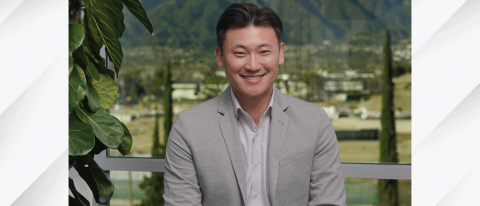
Sumitomo Rubber North America (SRNA), a subsidiary of Sumitomo Rubber Industries, Ltd., has announced the hiring of Ken Hsu as vice president of marketing for Falken Tires.
Hsu brings over 20 years of experience through various leadership roles from all facets of the automotive industry. Before joining SRNA, Hsu served as vice president of marketing and strategy at U.S. AutoForce. His previous experiences in the automotive sector include Yokohama Tire, Tire's Warehouse and Volvo Cars. Hsu will oversee the product planning, sales strategies, marketing and more.
"Ken's time at Yokohama Tire, Tire's Warehouse and recently U.S. AutoForce will bring a new perspective to the EC and our overall market approach," said Darren Thomas, SRNA's CEO and president. "I believe Ken is best qualified to make an impact and elevate the Falken Tires brand to greater heights."
Toyota Motor North America (TMNA) has announced that its racing division, Toyota Racing, will formally become Toyota Gazoo Racing North America prior to the start of the 2025 motorsports season.
All Toyota motorsports efforts in 2025 will compete under the global Toyota Gazoo Racing (TGR) banner. TRD, U.S.A., a subsidiary of TMNA, will continue its technical and engineering support across Toyota motorsports efforts throughout the U.S.
"The transition to Toyota Gazoo Racing is an opportunity for our world-class racing program to better align with Toyota's global motorsports efforts while simultaneously continuing the championship-level results we've earned under the previous banner here in the U.S.," said Paul Doleshal, group manager, motorsports, TMNA.
Toyota's NASCAR Cup Series entries will continue to carry the Camry nameplate, while its Xfinity Series entries race in GR Supras. NHRA teams in both Top Fuel and Funny Car already race under the TGR banner as well as Toyota's Formula DRIFT drivers competing in the GR Corolla Hatchback, GR Supra and the GR86, while GT4 drivers in IMSA and SRO field the GR Supra GT4 EVO. The Toyota GR Cup will begin its third season of the signature spec series in 2025, racing the Toyota GR86. The GR badge on these vehicles represents Toyota's dedication to producing exciting, race-inspired vehicles.
NASCAR CRAFTSMAN Truck Series Toyota Tundras will continue to carry the TRD Pro badge, and Toyota Off-Road Racing vehicles will continue to compete with the TRD nameplate.
The 2025 racing season officially kicks off at Daytona International Speedway, first with GR Supras taking the track in a four-hour GT4 race on Friday, January 24, 2025.
The National Engine Parts Manufacturers Association (NEPMA) today announced a $50,000 donation to Driving Force Action, an independent expenditure campaign organization established by SEMA and PRI to educate voters about the impact on America's small manufacturing businesses of electric vehicle (EV) mandates and internal combustion engine bans.
NEPMA's member companies--P1 Manufacturing, Driven Racing Oil, Race Winning Brands, SA Gear, Engine Power Components, Melling Engine Parts, Hastings Manufacturing, Elgin Industries and Durabond--are committed to educating the electorate on electric EV mandates and their impact on the motorsports and automotive aftermarket, an industry that drives more than $337 billion in annual economic impact.
"Our industry relies on leaders who take on the responsibility of advocating for our companies, our employees and our customers. The member companies of the National Engine Parts Manufacturers Association have put action behind words. They stepped up to the plate when national politics and policies made it impossible for the automotive aftermarket and motorsports industries to stay silent," said Driving Force Action Chair Kim Pendergast. "I applaud them for their resolve, generosity and leadership in the face of great challenges to our industry."
"Federal and state EV mandates pose a real danger to our nation, both economically and culturally. Our industry is not immune to such threats, and we must take action to secure our future," said Mark Melling, president of NEPMA. "I want to thank Scooter Brothers, a tireless advocate for our industry, for reiterating to our group for more than a year the important work being performed by Driving Force Action. Driving Force Action's fight is our fight, and we are proud to be in a position to bolster their efforts."
"Driving Force Action holds a vitally important presence in our industry educating and engaging American voters on how government policies will impact the industry," said PRI President Michael Good. "PRI and SEMA started this voter engagement effort to address the lack of education and awareness as it relates to the cars and trucks they drive, and the manufacturing job creators here in America. We've taken our message directly to the voters, and they will ultimately decide if they want their rights infringed upon by ineffective and overreaching policies coming from the White House."
Driving Force Action is engaged in voter education campaigns in several key battleground states, including Michigan, Ohio, Pennsylvania, and Wisconsin, where they share the stories of business owners whose livelihoods are at risk from the radical Biden-Harris EV mandates. Across a series of ads, Driving Force Action underscores how federal EV mandates and the ban of our traditional gas- and diesel-powered vehicles promoted by Kamala Harris are a grave threat to thousands of small businesses nationwide.
Driving Force Action is a nationwide alliance of gearheads, car enthusiasts, and small automotive businesses ready to fight to defend our freedom to drive. To learn more, visit www.drivingforceaction.org.
 MEMBERSHIP LOGIN