In the ever-changing world of motorsports and the endless pursuit of setting new records, sometimes we need to slow down, consider the impact of those who came before, and acknowledge their contributions to an industry that is driven by passion and a pursuit of betterment.
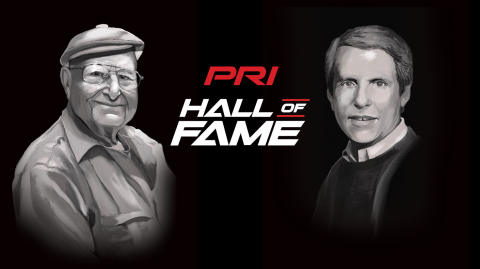
That is why PRI created its Hall of Fame. The inaugural class was announced at the Grand Opening Breakfast to kick off the 2024 PRI Show. It is only fitting that PRI founder Steve Lewis and the Camfather himself, Ed Iskenderian, be inducted as the first two members.
PRI's Hall of Fame honors the outstanding achievements and contributions of individuals and entities in the motorsports industry, preserving their legacies and inspiring future generations. Lewis and Iskenderian were honored for their career accomplishments, impact on the sport, contributions to innovation, sportsmanship, leadership qualities, and overall influence within the racing community.
"Steve and Ed left an incredible mark on the racing industry through their courage to take risks and relentless drive to push the industry forward," said PRI President Michael Good. "Their accomplishments, integrity, and passion for helping others have inspired countless people. We are proud to present them with this accolade that celebrates their boldness and innovation."
Read on to learn more about their contributions to motorsports, with anecdotes and insights from other industry leaders who know these legends best.
Ed Iskenderian
When discussions for the inaugural PRI Hall of Fame class began, Ed Iskenderian's name quickly went to the top of the list. His plentiful contributions to motorsports go beyond his well-known camshaft manufacturing company, which led to his Hall of Fame induction at the Grand Opening Breakfast during the 2024 PRI Show. Find out how this legendary Centenarian speed merchant conquered the competition one lobe at a time.
Nearly every person reading this article would not have been born before Ed "Isky" Iskenderian began his lifelong mechanical engineering adventure. Many thousands of engines have been made faster and more reliable simply by using one of his racing camshafts.

Ed Iskenderian is credited with many firsts, including being the initial president of SEMA to now, 70 years later, part of the PRI Hall of Fame inaugural class. Beyond launching his camshaft grinding business shortly after World War II, Isky worked with nationally known wry cartoonist Pete Millar to craft humorous, good-natured attacks of sneaky competitors who were stealing his sponsored racers with ISKYtoons. In addition, Isky was the first speed merchant to pay contingency money to racers using his products.
However, if you believe there is nothing new to read about the 103-year-old man who still goes to work daily, you'd be wrong. Most know the legend, but here we reveal much more of the man.
Simply put, Isky is a charmingly casual, unfussy fellow who only needs to look at a camshaft and can tell you the lobe specs and probably which engine it fits.
His journey first found traction after spending nickels and dimes to build his Model T roadster. It was chosen as the cover car for the June 1948 Hot Rod magazine and hailed "Hot Rod of the Month." This helped to ignite his foundational speed merchant business in the early 1950s.
From being the first president of SEMA to now, 70 years later, as part of the PRI Hall of Fame inaugural class, those who can best park the spotlight on Isky's pervasive and enduring influence on performance and racing are the ones who grew with him.
Ensuring the Future
Iskenderian Racing Cams President and CEO Richard Iskenderian is the company's oldest employee. He started at age 10, earning a respectable 25 cents per hour in 1960, learning how to grind camshafts.
"I grew up in the company and did many jobs through the years that taught me how the business works," described the man who built his first hot rod at age 13. "Dad taught me a lot, but I never wanted to live in his shadow. Being 'in the trenches' working nearly every job gave me a solid understanding of the operation and showed me that common sense was the best way to manage."
Iskenderian the son finds it tough to explain to his legendary father how the marketplace has moved beyond his understanding of the very industry that he helped build from scratch.
"Keeping up with the trends, and twists, especially the shift to electronic media, is a constant challenge," he admitted. He credited his wife, Norma, with "updating his workflow" by teaching him the value of texting instead of just using email.
"The departure from print ads to online marketing was a difficult transition for me, and without our Operations Manager, Nolan Jamora, who also keeps plant operations updated, I'd be lost."
"When Richard started learning to grind cams, it gradually gave him the confidence to take authority, and I really didn't have to give him any authority," Isky confessed. "The business is in good hands, and I have full confidence in him taking the company forward."
Industry Firsts
Isky has long nurtured the performance industry, as did sons Richard and Ron. Yet both would remind people that their father gets credit for many firsts, not just for having ideas and concepts, but more importantly putting most of them into working operation.
This includes hiring nationally known wry cartoonist Pete Millar to craft humorous, good-natured attacks of sneaky competitors who were stealing his sponsored racers with ISKYtoons, a clever pivot from Millar's wildly popular CARtoons. A marketing first.

In 1938, Ed Iskenderian bought the frame and running gear for his now-famous Model T roadster from his friend John Athan for $25 and spent another $7 for a body. He has owned it ever since. Isky raced the T on Southern California’s dry lakes and tested various pieces of speed equipment with it, including its distinctive Maxi cylinder heads. In the vintage photo Isky poses in his T in front of his Inglewood, California, shop. Fifty-some years later he recreated the pose at El Mirage dry lake.
"Pete knew exactly what was going on around town, and we both had the same idea about who needed to be made fun of every time we got together," Isky recalled about the competitors, smiling brightly. "It was Pete who nicknamed me 'The Camfather' right after 'The Godfather' movie came out. He had so many good ideas and knew how to illustrate with good humor."
Isky was the first speed merchant to pay contingency money to racers using his products, use decals to promote his expanding racing market acceptance, and activate the marketing stratagem of T-shirts to be wearable advertising. These marketing ideas have since permeated throughout motorsports worldwide.
Influencer
The Camfather loves an audience. He is a very social creature and has, for decades, proven himself a hard-working contributor to his business as well as the speed equipment industry.
"Dad attended races, car events, and trade shows until very recently," Richard acknowledged. "He really enjoyed seminars and would often get invited up on stage to speak, which usually led to him taking over the show. The speakers and moderators took delight watching as Isky revved the audience back up."
Even now, his desire to learn something new competes daily with his unwavering, unselfish desire to educate others. Through the years this congenial teaching outreach gained him not just friends, but loyal Isky Racing Cams customers.

Ed Iskenderian was an early adopter in the use of an engine dynamometer to test his camshafts. He bought his first one from Vic Edelbrock.
"Isky: one-of-a-kind mentor, innovator, a smart self-taught man who worked with his hands and built great things," said Christie Edelbrock, describing the man who, after World War II, was a lynchpin in Los Angeles when hot rodding gave birth to the speed equipment industry.
"There were guys just like Isky all on one block, and my grandfather was one of them," she said, insisting the families remain good friends. "They bench raced, brainstormed, and told lots of stories. Vic [Edelbrock] senior had a dyno in his shop and often asked Isky for special cam grinds. Soon after they got it right, the grind would often show up for sale at Iskenderian Cams! I'm sure there were some discussions about that at those bench racing sessions."
Isky also joined the Edelbrock family philanthropically and once helped raise more than $600,000 for their Rev'ved up for Kids charity event.
"That was truly life-changing for many complex challenged children in our local community," she said with gratitude. "Isky will always have a place in our family's heart. We applaud him, his life's work, and this well-deserved honor."
"Vic and Bobby Meeks were my great friends," said Isky, talking about the early days when he spent hours sorting cam profiles with Meeks on the dyno. "I loved going to their shop on Jefferson, especially during the pinochle games. I would sit back and learn something every time. Did you know that Keith Black got lots of engine advice from Bobby?"
Another of Isky's bighearted acts was adopting a destitute village in Baja California, Mexico, then making multiple trips to donate heaps of clothing, bedding, food, and toys just because he could.
When he was an unknown neophyte, Don Garlits first purchased an Iskenderian camshaft in 1956 and then bought another 5 Cycle cam for his 1957 front-motor Chrysler Hemi digger to compete at the 1957 ATAA World Series of Drag Racing in Cordova, Illinois. The event attracted numerous fuel dragsters because NHRA had banned nitromethane.
Garlits' homebuilt dragster was paired with the mighty Cook and Bedwell dragster that had recently set the world record at 166 mph. "I won the race, but the organizers demanded we run again, and I won again!" Garlits chuckled heartily.
He completely rebuilt the dragster, and on November 10, 1957, made several runs using 85% nitro at the Brooksville airport during a monthly Jaycees event. He raised the percentage to 98 on his last run. Because the charts stopped at 165 mph, they didn't know his speed, but he would get a call on Monday.
"Imagine my surprise when I got a personal call from Ed Iskenderian, stating that I was the new 176.4-mph world record holder," Garlits recalled vividly.
"That conversation began a long relationship with Iskenderian Cams. The monthly full-page ads, usually on the back cover of Hot Rod magazine, and the publicity was priceless! Those ads accounted for my 'rocket ship' rise to fame."
Garlits later changed cam grinders to get more sponsorship money. However, in 1988, he put an Isky camshaft in his Saltliner that earned him life membership into the Bonneville 200 MPH Club with the lengthiest runs he ever made.
"Ed Iskenderian is certainly a very unusual man, still sharp as ever, and a pleasure to be around," Garlits revealed.
"Don was a very fast learner, very fast," said Isky. "I thought I had the better deal when I sponsored him but didn't realize that my ads were helping him get lots of appearance money."
Nick Arias III has a rather unique perspective of the speed business evolution as it interwove with his father's 50-plus-year relationship with the Camfather.
"Ed was eight years Nick's senior, so Isky and other cam grinders from the Los Angeles Pico Heights neighborhood—Howard Johansen, Ed Winfield, Jack Engle—were mentors to Dad more than buddies," he said.
"Dad fell in with the Howards Cams gang, but over the years Ed and Dad's friendship grew, which led to a business relationship. Eventually, most Arias Racing Engines had Ed's components exclusively from the 1980s forward."
By the early 1990s, these two mechanical masterminds grabbed lunch at the Fabulous Burger Grill, two blocks south of Iskenderian's headquarters in Gardena, California, where they consistently commandeered the same booth nearly every workday. They attracted many local and out-of-towner gearheads, as well as the occasional industry celebrity and professional video crews.
Their tightknit bond was illuminated while attending Louie Senter's 2015 funeral. Elder Arias was recovering from a bad bout with pneumonia and using an oxygen tank on a cart.
"Dad, Ed, and I had ridden to the cemetery in my pickup truck. When loading up to head home, Dad had trouble stepping up into the cab," he recalled with halting emotion. "I watched in awe as a 95-year-old Isky took charge, loaded the oxygen into the back seat, and helped his 86-year-old pal into the front seat."
"Sometimes we called Nick' the spy' because on every visit to our shop he saw and learned things that he would mix into his business," laughed Isky when asked why they remained so tight personally and professionally. "Nick's curiosity helped us both grow, mostly because we discussed engines in great detail. We both taught each other things. I admired his engines."
Matt Stone, who wrote the book "Isky," published by CarTech, shared his personal experience meeting the legend. "The first time we met, talking to him is like pressing 'play' on a 50-year-old tape recorder—you sit back and listen. I spent a year of weekly interviews with Ed and found he has a better memory than most computers."

Ed Iskenderian (center) with racing and high-performance legends at the 2013 SEMA Hall of Fame lunch at the SEMA Show. From left: Herb Fishel, former executive director of GM Racing; Don Prudhomme; Isky; Don Garlits; and Joe Schubeck. Iskenderian’s accomplishments now include induction in PRI’s new Hall of Fame.
Speedway Motors in Lincoln, Nebraska, which is now a powerhouse speed shop with an international reach, remains a family business that began in 1952. It has sold Ed Iskenderian's camshafts for more than 70 years.
"Isky was one of our first vendors in the early 1950s and remains a trusted supplier of innovative and quality cams to our customers and our own winning race teams," explained Clay Smith, company president.
"I always looked forward to spending time with Isky and my dad ['Speedy' Bill Smith] at the SEMA Show and the Grand National Roadster Show. Both were industry founders who shared a passion for hot rodding and racing. Even today, Isky is the most inquisitive visitor to our Museum of American Speed. He recently spent more than 30 minutes inspecting a unique early engine designed in 1914."
Smith recognized Isky's enduring philanthropy to inspire the next generation when he loaned the museum his 1930s hot rod and Ed Winfield's original cam grinder from which Isky learned his craft.
"We are honored to be so connected to Isky, the company he founded, and the legacy he created," Smith added. "Isky lives the American dream and is a hero."
"Bill became a customer as I was just beginning to apply the things I learned from Ed Winfield," explained Isky. "We called our homebuilt rides' hot irons,' or 'gow [get up and go] jobs,' before the term 'hot rods.' We met up at plenty of auctions. I admire him for saving so many pieces of the speed industry's progress that would otherwise be lost. Visitors can see so many early pieces, parts, and names that influenced so many to discover more reliable speed."
Before Jerry Kugel, the rodder and racer, became the family business leader of Kugel Komponents in La Habra, California, he got to know Ed Iskenderian when Isky frequently visited Ak Miller's Garage in nearby Whittier, where Kugel was employed. "One day Isky came over to my work area and asked about the 427 engine on the floor with a hole in the pan," Kugel explained. "I told him it was a gift from Ak out of his race car. I intended to fix it up and put it in my roadster. Ed said he had a new cam grind for the salt flats that needed testing. So, with a patched-up engine, all used parts, a homemade fuel injector, and brand-new flat-tappet cam we were off to Bonneville."
Kugel set the 1967 Class B/FUEL record of 205.560 mph that earned him life membership in the Bonneville 200 MPH Club and the coveted red hat.
"No doubt about it Ed, the unmatched quality of your products helped us set more than 20 land speed records," enthused Kugel a half century later.
"Jerry became Ak's employee just before he and Jack Lufkin got so busy racing that they relied on the new guy," said Isky. "Kugel didn't let them down, or the customers. It told me Jerry was worth supporting when he needed a cam for his Bonneville car. And those wonderful stainless steel front ends he made later? Wow!"
A recent skull and speed session found Bonneville's revered plus-400-mile-per-hour couple Jane and Al Teague swapping speed stories and tech tales in the lunchtime burger booth. Al is a record-setting land speed racer who clocked the first piston-powered, plus-400-mph, single-engine World FIA record relying on an Isky camshaft.
"At one time he had the largest cam grinding business in the world, yet he's never been boastful, always humble, and a frugal man," Teague explained. "Ed is always interested in other people and how things work. He drills down into the details and does not live to impress others."
As a true innovator, Isky offered this advice: "Don't be afraid to try something unusual. It might not work, but it might also lead you to something great. Keep your eyes open, listen, and ask questions."
Steve Lewis
It is only fitting that PRI's founder be the first member inducted into the inaugural class of the PRI Hall of Fame. But this savvy businessman and risk-taker relies on his humble roots and attributes much of his success to the influence of others.
When Performance Racing Industry (PRI) founder Steve Lewis was notified last year that he was the first inductee in the inaugural PRI Hall of Fame class, he actually cringed. Not one to relish the spotlight, Lewis instead deflected the honor and cited the dedication and years of service from PRI team members. And, of course, he pointed to the thriving motorsports industry that led to the success of the PRI Show and PRI Magazine.

PRI founder Steve Lewis shares a story at the Grand Opening Breakfast to start the 2010 PRI Trade Show. From left, Bobby Rahal, Randy Bernard, Dave Despain, Lewis, and Robin Miller.
Lewis and business partner Jeff Wetmore kicked off the first PRI Trade Show in 1988 in Louisville, Kentucky. The premiere issue of PRI Magazine debuted in 1986 to build up momentum for the racing-only trade show.
That wasn't Lewis's first foray into trade show land. He first experienced success with the Action Sports Retailer and Outdoor Retailer shows. Lewis then combined his trade show experience with his love of auto racing. Almost 40 years later, the PRI Show is the largest motorsports trade show in the world, with over 1,000 exhibitors in more than 3,700 booths across 750,000 gross square feet of space. The PRI Show takes up the entire Indiana Convention Center and Lucas Oil Stadium in downtown Indianapolis.
While the PRI Show serves as the premier racing show experience today, the concept encountered a rocky start, which caused Lewis to pivot and change the direction for his racing show idea.
From the Beginning
In addition to PRI fame, Lewis is known for owning the championship-winning USAC National Midget team Nine Racing with the iconic red number nine on the car's tail. Surprisingly, when he formed his team in the late 1970s, he kept his racing involvement hidden from those he worked with at Pacifica Publishing. That soon changed with a telephone call.
"One day in late 1984 the phone rang, and it was Fred Marik, who was the former president of Bell," explained Lewis. Marik told Lewis that he had secured PPG's sponsorship to produce an event coordinated with the Indy 500. That transformed into a racing show in Indianapolis that Lewis convinced his business partner to produce.

Sunnen’s involvement in the PRI Show goes back to the early days of the event, starting with a 10- by 10-foot booth and eventually accounting for one of the Show’s largest footprints on the floorplan.
The first Indy Motorsports Expo was born in 1985, taking place at the RCA Dome and drawing on the racing crowd in town for the Indianapolis 500. Lewis gave his team's effort an A-, but the results were a C-, he admitted. After the second show the following year, they realized the consumer show just wasn't going to be highly profitable.
The change in the show's direction came from an unusual source. Stan Fox, Lewis's team driver and close friend, saw the potential of switching the focus from a racing consumer show to a racing trade show. Lewis then consulted with several motorsports parts manufacturers who gave their blessing, and the idea for the PRI Trade Show was born.
Since about two-thirds of all US race tracks are located east of the Mississippi River, Lewis knew the event had to be located in the Midwest, allowing easy driving access to numerous racing business operators. Housing the new trade show was a challenge on such short notice, but the Commonwealth Convention Center in Louisville, Kentucky, was available. The first Performance Racing Industry Trade Show came to life on December 2, 1988.
Some manufacturers that were early participants saw the potential in the racing-only trade show concept. Sunnen, a St. Louis, Missouri-based honing equipment manufacturer, has participated in every PRI Show.
Sunnen had already committed to a machinery show in Chicago on the same weekend of the inaugural PRI Show. But its Southeastern regional manager, Ray Morrow, was intrigued by the concept. He set up a 10- by 10-foot booth in Louisville and filled it with several machines that fit in the 100-square-foot space. After a few hours on the first day, Lewis stopped by to visit Morrow, who had already sold several machines.
"I'll guarantee we'll be back here big again next year," Morrow exclaimed. That led to a long-time relationship between Sunnen and PRI.
Sweet Spot
"We recognized right away that the PRI Show was the sweet spot of our business—the honing business—for engines and racing," explained Bob Davis, who joined Sunnen in 1988 and retired in 2024 after serving as the global communications manager. "You can't build a racing engine without a honing machine. So it was just a perfect market for us. We recognized it early on.

The first PRI Trade Show at the Commonwealth Convention Center in Louisville, Kentucky, featuring 150 exhibiting companies in 246 booths.
"Our booth grew right along with the Show," he continued. "We started off with just one booth," and within a few years, Sunnen worked up to having one of the largest footprints at the PRI Show.
Coast Fabrication was another early believer in the concept of the PRI Trade Show. While its initial product focus was aerospace fasteners, owners Jeff Heywood and Mike Lang saw the crossover opportunities into motorsports with customers in Formula 1 and IndyCar. Heywood appreciated the opportunity to display the company's fasteners to the racing industry and expand into new segments.
"It was a good fit for us, and we grew along with the PRI Show," reported Heywood. "We would bring new products to the Show so people were able to touch and feel the products. That makes a big impression, and it helped us grow our business."

Steve Lewis recognized the impact the Chevrolet small block engine had on motorsports, so he and the PRI team put together the 40th Anniversary Celebration of the Chevrolet Small Block Engine in 1995 to recognize those who designed the iconic engine.
Richard Iskenderian, president of Isky Racing Cams in Gardena, California, also saw the need for a motorsports-only show. Isky was committed to the automotive aftermarket and exhibited regularly at the SEMA Show. In fact, Isky Racing Cams' founder, Ed Iskenderian, served as SEMA's first president. Richard saw the need for an expanded footprint focused solely on auto racing.
"A lot of us felt that there was a need for a racing-only show," he explained. "Steve had really good foresight to understand that."
Already entrenched in drag racing, Iskenderian wanted to expand into circle track racing. The company waited a couple years to enter the PRI Show, but after seeing a strong contingent of oval track businesses participating in the event, he decided to jump onboard, as did many others soon after.
"The Most Amazing Call Ever"
Racing's siren call lured Lewis at an early age when his parents took him and his brother Jim to a local United Racing Association (URA) midget race at Orange Show Speedway in San Bernardino, California. Billy Cantrell won the race and quickly became Lewis's favorite driver. However, Lewis's parents didn't have the same affection for the sport, so he fed his racing addiction by going to the weekly shows with some neighbors who happened to be track season ticket holders.
Lewis immersed himself in the racing culture. As he grew, he crewed on several teams while going to college and after entering the workforce. He met the Horvath brothers—Don and Joe—who ran the high-performance Volkswagen engine building operation Revmaster. The Horvaths ended up working with car builder Don Edmunds. They invited Lewis to help them at midget races with Don Horvath driving the Revmaster Offy midget. Sadly, Don Horvath was killed in a racing incident in 1965, which shook Lewis, and he walked away from racing.
In the 1970s, Lewis focused on his career and was working for Larry Hester at Motorcycle Dealer News when he received a call from his old friend Don Edmunds, which Lewis referred to as "the most amazing call ever."
The gruff red head told him, "Lewis, you've always wanted to be in midget racing. Meet me for lunch today at my shop."

Legendary race engine builder Smokey Yunick led the Industry Roundtable, which took place the day prior to the start of the PRI Trade Show in the late 1990s.
Lewis obliged and met Edmunds at his Autoresearch shop in Anaheim. Edmunds explained that his biggest customer at the time had left for another car builder. Edmunds had an opportunity for Lewis to be the owner of a new four-bar VW-powered midget he had ready, but "I'm going to be the brains," Edmunds told him.
Edmunds wanted either Billy Vukovich Jr. or Gary Bettenhausen to drive the Edmunds-built midget race car. Even though the two drivers raced Indy cars, they also filled their schedules with midget races. But Lewis, who was supposed to be the silent owner who funded the project, went on a business trip to Wisconsin and was invited by Fred Fox of Parts Unlimited to see his brother Stan race at Angell Park Speedway in Sun Prairie. The younger Fox set quick time, won the heat, and completed the trifecta on the 1/3-mile clay oval by earning the main event trophy all while driving an older Edmunds car.
Despite witnessing Fox's driving ability in person, Lewis still had to convince the doubtful Edmunds that the unpolished Fox was their driver over the Indy car veterans. His persistence proved favorable. At the end of the 1979 season, the No. 97 Linne Lewis midget with Fox at the helm won several main events, including a USAC National Midget feature at Anderson Speedway, resulting in a ninth-place points finish that season in USAC. Hence, the team chose nine as its car number the following season and beyond. The number was originally created on the tail by famed race car painter Paul Knierim.
Mendota, Illinois-based Howard Linne, who was Don Edmunds largest dealer, was brought onboard to operate the No. 97 Edmunds midget. "That is why we chose the famous Howard Linne livery and number for my first midget," added Lewis.
Fox would go on to compete in Indy cars, and Lewis sought to achieve greatness on the race track as he had achieved in the business world.
Nine Racing was on its way to earning legendary status in the USAC National Midget ranks, ultimately scoring 133 USAC National Midget Series feature wins and 10 series championships. In addition to Fox, other drivers who earned seat time in the 9, or the other team cars—19, 91, and 9x—include Stevie Reeves, Mike Bliss, Tony Stewart, Kenny Irwin Jr., Jason Leffler, Kasey Kahne, Dave Darland, Dave Steele, JJ Yeley, Bobby East, and Kody Swanson.
Lewis is quick to note that he didn't achieve such a feat without the help of others, including car builder Bob East and engine builder Ed Pink. Coast Fabrication's Heywood introduced Lewis to Pink, combined with East who was already a major contributor to the Nine Racing program, which led to the USAC dominance in the 1990s and 2000s.
Recognizing Talent
So what is the secret sauce behind Lewis's achievements? It's simple really: Surround yourself with fun, energetic people who are willing to put in the hard work required to achieve a goal they believe in.
Lewis set a bar for himself to achieve what seemed unobtainable to many others, and he instilled a belief in those closest to him that they could determine, achieve, and often surpass such high expectations. That instilled a rare loyalty that is cited today by many who accomplished those goals right alongside him.
"Steve has a unique ability to recognize talent and fosters the working conditions to let people grow and thrive in their jobs," observed Davis, who personally witnessed the growth of a number of PRI team members and became personal friends with them over those 36 years he was with Sunnen.
"It might be the number one most important thing that he was able to do was to pick the right people to keep everything going and make a team that likes to work hard, but still gets along and plays well together," Davis added.

Numerous ancillary events enhanced the fun and afterhours business opportunities at the PRI Trade Show, including the Red Bull Kart Fight in Orlando, Florida.
"Give people objectives and then support them so they can meet their objectives," described Lewis about his team member philosophy. "And then have fun. Make it not like work. I never use the word 'work' for myself. I would go down to that building in Laguna Beach. I never thought I was working. I was having fun. I was pushed to be smart by working with really bright people.
"I looked at that PRI group and I saw the vitality. I saw the dedication. We didn't have this preamble or something where you have to be dedicated. We never said that. We wanted to create an environment where people could succeed," he concluded.
"He always expects the very best, and he gives the best," said Ed Pink, who built the race engines for nine of Nine Racing's 10 USAC championships.
Davis referred to Lewis as the PT Barnum of trade shows because "he was always thinking of ways to make the shows more fun." Several of the events Lewis incorporated into the PRI Show during his time leading the company include the Grand Opening Breakfast, Red Bull Kart Fight, and the Twin 25s races at Orlando Speed World when the Show was located in Orlando.
"He's down to earth," Iskenderian said about Lewis. "One of the things that makes him a unique guy is he's not afraid to show his true feelings or thoughts about things. It kind of reminds me of my dad. And like our family, we're just humble people. And that's what Steve is. He's just a humble guy involved in midget racing, and he wanted to see a show for the racing community."
While Lewis deservedly received the induction into PRI's inaugural Hall of Fame class as founder of PRI, it's his profound influence into the entire motorsports community that secured his nomination and recognition as a Hall of Fame member.
Sign up for a digital subscription to PRI Magazine on Zinio here.
Once you download the "PRI Magazine" mobile app or are logged into PRI Magazine/Zinio on a desktop browser, you will gain immediate access to more than a year's worth of content and more PRI Show coverage in the March/April 2025 issue here.
 MEMBERSHIP LOGIN