 MEMBERSHIP LOGIN
Proven Commodity: Racing Crankshafts
This article is presented in its entirety as a gift to PRI readers. Enjoy more exclusive industry coverage like this by subscribing to PRI Magazine for free.
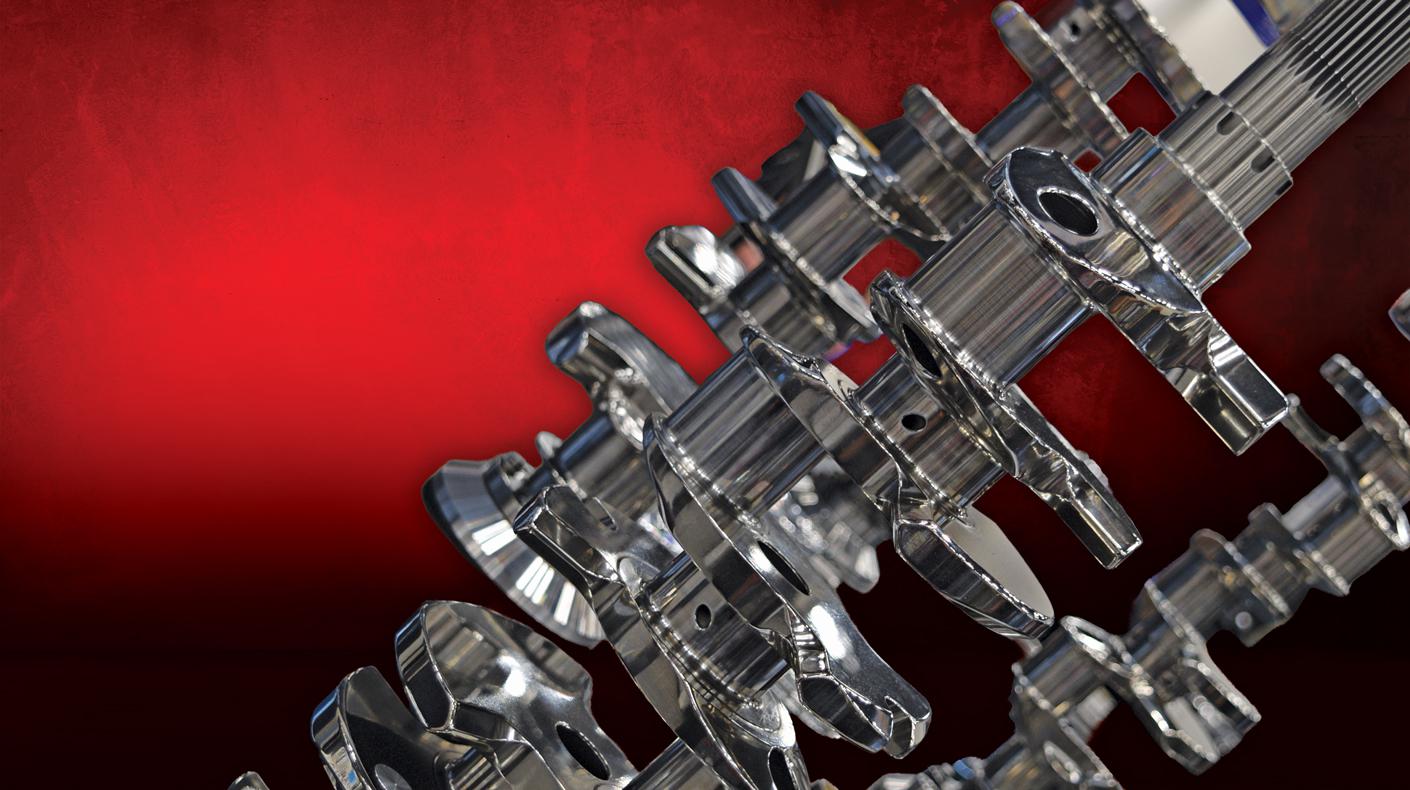
Looking at the crankshaft in a conventional automotive internal combustion engine, consider that there isn’t a viable replacement design to convert linear piston motion into rotation more efficiently. There have been valiant attempts, such as the Scotch Yoke and Swing Beam. Also, numerous cam-based designs have been drawn up in CAD and even moved to the prototype stage. There have been opposed-piston engines and free-piston engines. Knowledgeable observers may suggest forgetting reciprocating and just go Wankel, but most rulebooks won’t allow that strategy.
Since the role of the crankshaft in racing engines hasn’t changed over time, then it’s no shock that that there haven’t been significant design leaps by the OEMs or leading aftermarket manufacturers. Progress, instead, comes in incremental upgrades, mostly to improve durability or reduce friction. You can also try an old trick in a new application. When the challenge is to build a crankshaft for 12,000-horsepower Top Fuel engines, many small details can share the spotlight with such a significant change.
Callies Performance Products in Fostoria, Ohio, teamed up with Kalitta Motorsports a few years ago to develop a new Top Fuel crankshaft that would have a much longer lifespan than the usual four to eight passes. Callies tried new heat treatments with the traditional billet cranks machined from 4330V steel and saw little improvement. The company then took a bold approach by dropping the billet cranks and investing in new tooling to forge the 4.500-in.-stroke crankshafts out of a strong but stubborn EN30B steel alloy. The work paid off, as teams are now enjoying 12 to 16 passes before the crankshaft is retired.
In addition to the new forgings, Callies implemented small changes like designing larger fillets to improve strength in a critical area. This move required working with bearing suppliers to provide slightly narrower bearings. Also, the heavy metal slugs used to balance the cranks are inserted before the final grinding, instead of after all the machining is finished.
“Heavy metal slugs can deform the crankshaft,” explained Nick Norris. “The part gets most of the way through the machining, but prior to grinding the mains and rod journals we press in the heavy metal. And then we get the crank into a rough, balanced state.”
The theory is that the Top Fuel cranks can take upwards of 24 heavy-metal slugs filling up the front and rear two counterweights, and sometimes even a fifth counterweight is affected. The crank’s structure is heavily taxed when so many holes have to be drilled and reamed, and then the slugs press-fit into place.
“Everything changes when you press in so much heavy metal, so there’s a final stress-induced shape,” said Norris. “Now we can grind and polish the bearing surfaces, machine the splines, and go to the final balancing stage.”
Norris said the issue was discovered when bearing roundness was checked before and after the heavy metal was inserted, “Being that it was perfectly round when they ground the bearings. Then they put in the heavy metal and suddenly the perfect grind isn’t perfect anymore. Then it was taking more effort in the polishing stage to bring everything back to spec. At that point, we changed the sequence of operations.”
Serving nitro teams isn’t the most lucrative racing segment for the aftermarket, but it does help a company make an industry statement. At peak cylinder pressure, the crankshaft could likely be on the receiving end of more than 80,000 pounds of instantaneous force. At 8,000 rpm, that equates to more than 500 combustion-loading events every second. A crankshaft that survives that environment can be a standard bearer for strength and longevity and help promote a company’s entire line.
Recently, CP-Carrillo in Irvine, California, teamed with Brian Crower of Brian Crower Inc. in Santee, California, to launch a line of crankshafts for domestic applications. The new partnership is targeting dirt late models, 360 and 410 sprint cars, big block Chevy, LS, and Coyote.
“We’re also doing Pro Mod cranks for the 426 Hemi, and I’ve got Top Fuel cranks in the making,” said Crower. “I’m making them to see if I can compete in that market. It’s a spec project with one or two teams. CP pistons are really big in that market, and that’s how the partnership came about.”
Crower said he will work with both billet and forgings to serve these initial target markets. Applications above 2,000 horsepower will lean toward 4340 billet. The Top Fuel is EN30. High-horsepower Ford Coyote, Nissan VR38 and VR30, and Pro Mod applications will be EN40.
“Honestly, on Top Fuel, it won’t be a cheaper crank. It’s doesn’t work like that. Some teams did not run last year because they couldn’t get cranks. I’m filling a need, and it’s more to validate what we’re doing,” said Crower. “If I have a crank in a 12,000-hpTop Fuel engine, then your little 1,600-hp small block will be fine.”
One of Crower’s priority markets will be 4330V forging for the 4.500-in.-bore-center small block Chevys.
“The price isn’t so much the issue with teams; it’s the lead times. If I can offer a better forging and I can get the lead times down to eight to 10 weeks, then we can capture more of the market just by being able to deliver,” explained Crower, adding that the partnership will also work toward having complete and balanced rotating assemblies for popular applications in inventory. “CP is a big believer in carrying lots of inventory.”
Crower doesn’t ignore the small details in crank manufacturing. CNC machines with high-pressure capability are used to drill the oil holes and provide a smooth inner surface to improve oil flow. Heat-treats are specific to the metal alloy, and some may require a vacuum or cryogenic process.
Over at Howards Cams in Oshkosh, Wisconsin, a different fillet radius is machined on forged vs. billet crankshafts. Forged cranks get a .125-inch radius while billet cranks receive a .135-inch radius fillet.
“The more radius you can put in, the more resistant it is to cracking at that point. When you get into stroker cranks, it’s even more important because you lose the cross-section overlap between the rod journal and the mains,” said Kirk Peters, adding that even though bigger is better, there is a limit. “It has to do with the balance between bearing size to hold the oil and strength.”
One trick sometimes used by seasoned engine builders on select crankshafts is to machine down the counterweights on a lathe, then put in heavy metal to make up for the lost weight. “The idea is to get the mass closer to the centerline of the crank to improve the rpm,” added Peters.
One of the most popular Howards cranks is the Reaper series for big block Chevys. “Those guys run 632s with nitrous or some other power adder. We’ve had great longevity—same thing with the LS. Some of those guys run extremely high boost,” said Peters. “So, if it’s not broke, we don’t try to fix it.”
Fact is, there are very few crankshaft failures in and within the product itself. Most failures can be traced to the wrong crank for the application.
“Yeah, I always have to ask the customer, ‘Do you want a racecar that you will drive on the street, or a street car that you want to take to the track? Everybody wants to go faster,” stated Peters.
That’s the reason many crankshaft companies have extended product lines so that the crankshaft can be properly matched to the intended use of the engine.
“Our Magnum line is the general-purpose crankshaft, and for the most part, they work fine just about anywhere,” explained Norris. “We do make the Ultra Boost where we add some additional material in the pin arms to give more support to the rod journal. And we have the Ultra Dirt in both forged and billet that’s primarily geared toward sprint cars.”
Otherwise, detonation and failed lubrication tend to be cause of crankshaft failures.
“Am I going to say that we’ve never seen any? No. But, we see very few broken cranks, mostly because we pay a lot of attention to the details,” said Tom Molnar of Molnar Technologies, Kentwood, Michigan, noting that one crank returned to him had obvious metal transfer between the snout and the damper. “It’s keyed and should be press fit. To have metal transfer you must have two things: heavy contact and movement. Why was the damper moving on the snout? And the crank broke near the snout. Something was going on with that engine that wasn’t right, like detonation. The tune and detonation are the major factors behind broken parts.”
Oiling Strategy
Manufacturers are paying more attention to oiling strategy these days.
“By shrinking the oil hole size and making it as small as possible in the mains, we’re seeing improved oil pressure and better bearings,” said Peter Harris of Crower Cams, San Diego, California. “Back in the day, everyone would drill quarter-inch holes. Now it’s three-sixteenths.”
Harris also cautioned against some engine builders who try to modify the oil holes on a crank, usually with a die grinder. “Then, on a microscopic level, you end up with tiny grains of steel sticking up and that’s where a crack can start,” he warned.
Regarding lead times, Harris said the industry hasn’t fully recovered since the pandemic, as more than half of the positions in his crank shop can’t be filled due to an inexperienced labor force. And the same problems are affecting outside sources that handle heat-treatments and nitriding. He added that the company’s best seller is a 4.500-inch-bore-center small block Chevy. “I have a customer in the Southeast who said he can take as many as I can send.”
Manley in Lakewood, New Jersey, recently expanded its line to include a fully counterweighted billet crank for the LT engine family. “When we designed the counterweights on the billet, we did a lot more testing,” said Jesse Vazquez. “On a high-horsepower engine, you get a lot of torsional vibration, so we tested different counterweights and cross-section thicknesses to resist that twisting motion.”
Vazquez echoed the attention being paid to fillet radius, adding that the “standard radius” has to be enlarged to a more “optimal radius, as much as the bearing will allow.” Engineers also conduct FEA analysis to study the effects of changing the fillet radius. “As technology advances, racers are pushing the limits with higher and higher horsepower numbers. Fifteen-hundred horsepower street cars are now common. So, we’re always redesigning to make a better part for the end user,” added Vazquez.
In the event of a failure, the postmortem analysis includes hardness of the materials, reviewing external factors that could contribute and investigating any issues with heat-treat.
“Most of the time we can always tell by checking the bearing surfaces and seeing oil starvation or the wrong bearing clearance or the wrong thrust clearance,” continued Vazquez. “Also, cranks do have a limit, and the engine was likely pushing way beyond that.”
Unified Agreement
One design element that most everyone seems to agree on is not to cross-drill the crankshaft. A couple decades ago, there was viewpoint that cross-drilling an additional hole straight from the mains to the rod journals would better lubricate the bearings. Cross-drilling used to be a huge selling point in some circles, until results simply didn’t back up the hype.
“People thought that with two entrance holes they’d get more oil to the rod journals,” explained Molnar. “At low rpm it could help, but at higher rpm it didn’t.”
Molnar said racers incorrectly determined they had sufficient oil pressure; when, in fact, there were unknown internal leaks due to the centrifugal forces at play. Oil can actually be thrown outward inside the drilling and interfere with consistent oil delivery. In other words, at high rpm the oil doesn’t behave like a calm, pressurized stream. Instead, aeration becomes a problem when the oil is biased toward the outside of the passage.
Today’s straight-line drilled crankshaft uses a more direct passage from the main oil feed to the rod journal. This strategy provides a shorter path with fewer direction changes and less centrifugal separation. Basically, oil delivery is more stable at high rpm.
“It’s actually pulling oil in and delivering it to the rod journal with a straight oil hole,” said Molnar. “You know, I’ve seen all kinds of crazy oiling deals, not just the cross drilling. I’ve seen holes where they drill straight parallel with the rod pins and then drill two holes in a rod pin to intersect with that. And there’s another intersecting hole that goes from the arm down to the main journal somewhere, just all kinds of crazy things. Some of that may be okay, but ultimately, they come back to the straight-shot oiling.”
Sources
Brian Crower Inc.
briancrower.com
Callies Performance Products
callies.com
CP-Carrillo
cp-carrillo.com
Crower Cams & Equipment
crower.com
Howards Cams & Racing Components
howardscams.com
Manley Performance Products
manleyperformance.com
Molnar Technologies
molnartechnologies.com
To read hundreds of other articles like this for free, sign up for a digital subscription to PRI Magazine on Zinio here.
Once you download the Zinio mobile app or are logged into Zinio on a desktop browser, you will gain immediate access to more than a year's worth of content, including "Proven Commodity " here and additional coverage in the August 2026 issue here.